
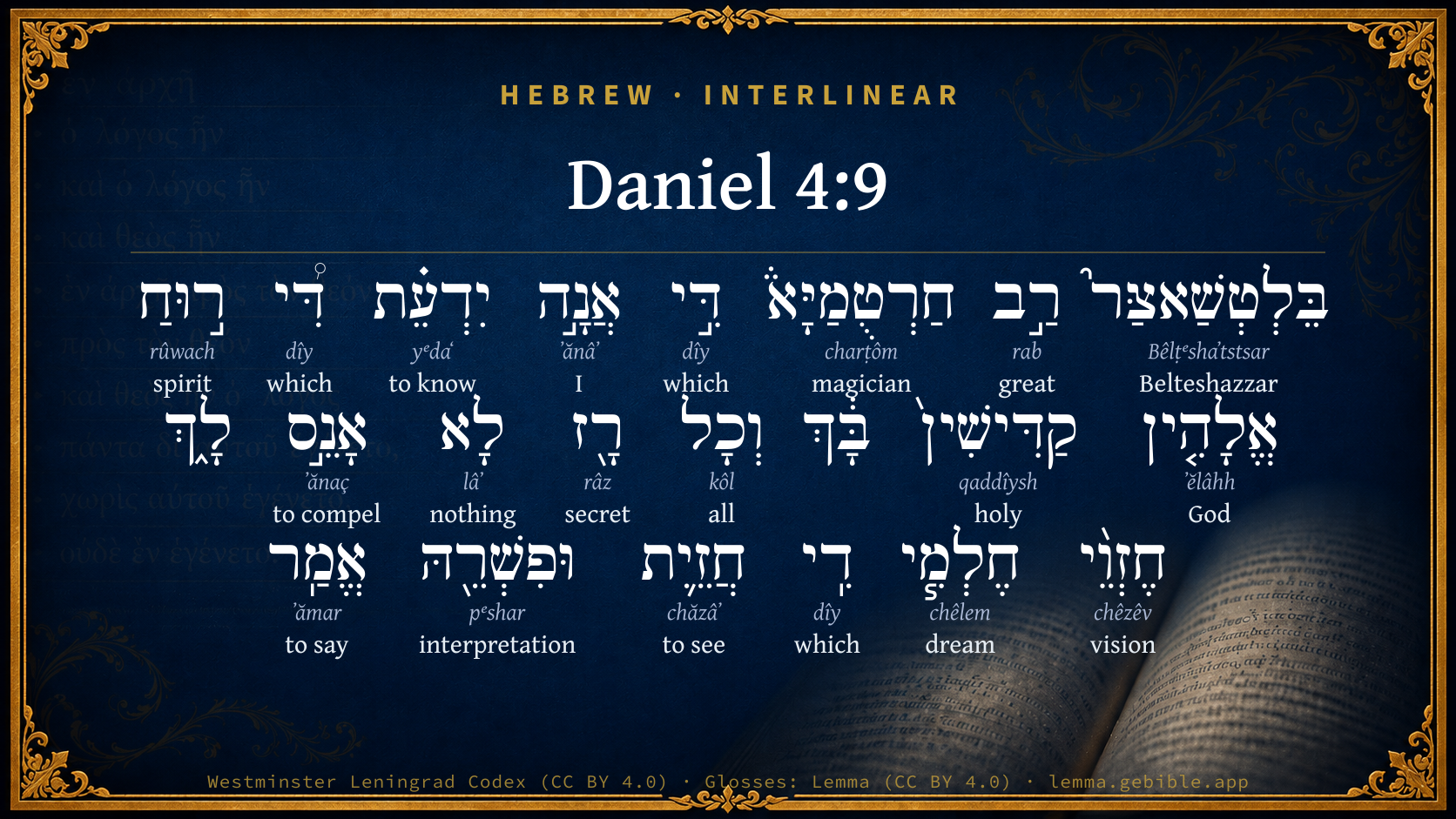
Daniel 4:9

Hebrew (Westminster Leningrad Codex) Daniel 4:9 appears in the Hebrew Old Testament. The text above is from the Westminster Leningrad Codex. Each word links to its Strong’s number, a concise gloss, and parsing drawn from the Open Scriptures Hebrew Bible morphology. Click any word for its full Brown-Driver-Briggs (BDB) entry.
Download image
Cite this verse

Daniel 4:9 (World English Bible). Public Domain. Lemma interlinear Bible study tool, https://lemma.gebible.app/v/daniel/4/9.

Show BibTeX & RIS
BibTeX
RIS
English Translation
Belteshazzar, master of the magicians, because I know that the spirit of the holy gods is in you, and no secret troubles you, tell me the visions of my dream that I have seen, and the interpretation of it.
World English Bible · Public Domain
Highlights
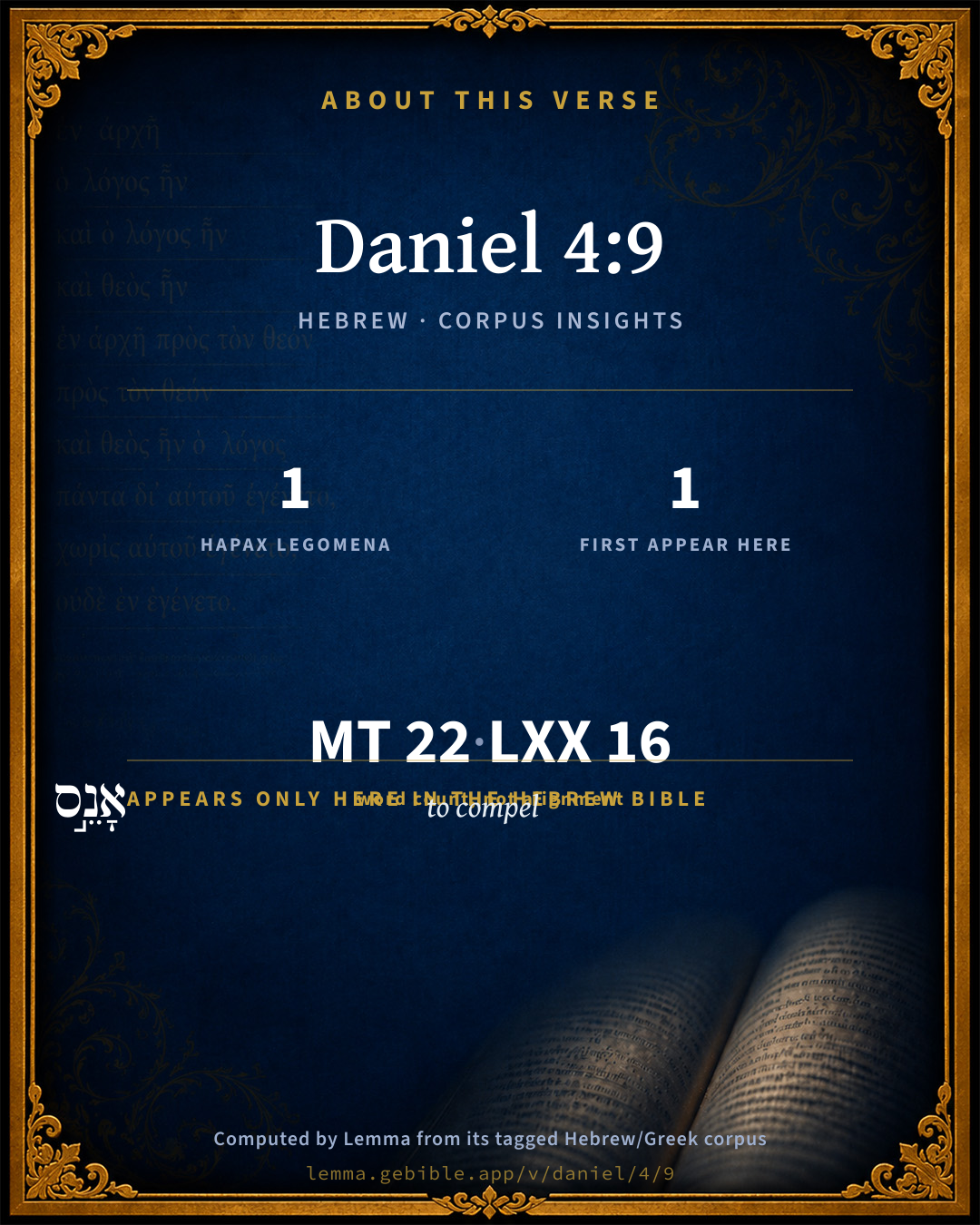
  • 1 hapax legomenon — only here in the Hebrew Bible
  • 1 first appearance in the Hebrew Bible
Full analysis ↓
Download a study sheet

One document with this verse’s original text, its word-by-word gloss line, the meaning frame, cross-references with their text, attributed commentary, and full source and license credits — printable, and it pastes into notes with its structure intact.

This verse Autodidact and up

Study sheet (.html) Plain text (.txt)

A passage Seminary Student

Up to 50 verses in one chapter. A passage sheet keeps up to 6 commentary sources and 12 cross-references per verse, in the order this page ranks them, and says so on the sheet whenever that leaves anything out. Ask for a single verse and you get the Autodidact verse sheet above.

Everything on this page stays free to read, with no account — the sheet is a download of what is already on screen, not access to it.

Want to remove ads? Support Godless Engineer
Compare translations 3

The same verse in 3 English versions, stacked beneath the original-language interlinear above. Click any original word for its lexicon entry.

Each is an independent rendering of the whole verse — the interlinear is not word-aligned to these translations.

Highlighted words mark where these versions differ — a whole-verse word diff, not a word-by-word alignment.

  • World English Bible Public Domain
    Belteshazzar, master of the magicians, because I know that the spirit of the holy gods is in you, and no secret troubles you, tell me the visions of my dream that I have seen, and the interpretation of it.
  • King James Version Public Domain
    O Belteshazzar, master of the magicians, because I know that the spirit of the holy gods is in thee, and no secret troubleth thee, tell me the visions of my dream that I have seen, and the interpretation thereof.
  • unfoldingWord Literal Text CC BY-SA 4.0
    “O Belteshazzar, chief of the magicians, since I know that the spirit of the holy gods is in you and that no mystery is too difficult for you, tell me the visions of my dream that I saw and their interpretation.

unfoldingWord Literal Text — © unfoldingWord, licensed CC BY-SA 4.0. Word-aligned USFM3 via Door43 (git.door43.org/unfoldingWord/en_ult).

Versions to compare (up to 4)

3 of 4 selected

Show all 18 translations

Every available English version of this verse, each an independent rendering of the whole verse.

  • World English Bible Public Domain
    Belteshazzar, master of the magicians, because I know that the spirit of the holy gods is in you, and no secret troubles you, tell me the visions of my dream that I have seen, and the interpretation of it.
  • Berean Standard Bible Public Domain
    “O Belteshazzar, chief of the magicians, I know that the spirit of the holy gods is in you and that no mystery baffles you. So explain to me the visions I saw in my dream, and their interpretation.
  • Majority Standard Bible Public Domain
    “O Belteshazzar, chief of the magicians, I know that the spirit of the holy gods is in you and that no mystery baffles you. So explain to me the visions I saw in my dream, and their interpretation.
  • King James Version Public Domain
    O Belteshazzar, master of the magicians, because I know that the spirit of the holy gods is in thee, and no secret troubleth thee, tell me the visions of my dream that I have seen, and the interpretation thereof.
  • American Standard Version (1901) Public Domain
    O Belteshazzar, master of the magicians, because I know that the spirit of the holy gods is in thee, and no secret troubleth thee, tell me the visions of my dream that I have seen, and the interpretation thereof.
  • Revised Version (1885) Public Domain
    O Belteshazzar, master of the magicians, because I know that the spirit of the holy gods is in thee, and no secret troubleth thee, tell me the visions of my dream that I have seen, and the interpretation thereof.
  • Geneva Bible (1599) Public Domain
    The boughes thereof were faire and the fruite thereof much, and in it was meate for all: it made a shadow vnder it for the beastes of the fielde, and the foules of the heauen dwelt in the boughes thereof, and all flesh fedde of it.
  • Douay-Rheims (1899) Public Domain
    Baltassar, prince of the diviners, because I know that thou hast in thee the spirit of the holy gods, and that no secret is impossible to thee: tell me the visions of my dreams that I have seen, and the interpretation of them.
  • Young's Literal Translation Public Domain
    `O Belteshazzar, master of the scribes, as I have known that the spirit of the holy gods `is' in thee, and no secret doth press thee, the visions of my dream that I have seen, and its interpretation, tell.
  • Literal Standard Version CC BY-SA 4.0
    O Belteshazzar, master of the scribes, as I have known that the spirit of the holy gods [is] in you, and no secret presses you, the visions of my dream that I have seen, and its interpretation, tell.
  • Unlocked Literal Bible CC BY-SA 4.0
    “Belteshazzar, chief of the magicians, I know that the spirit of the holy gods is in you and that no mystery is too difficult for you. Tell me what I saw in my dream and what it means.
  • unfoldingWord Literal Text CC BY-SA 4.0
    “O Belteshazzar, chief of the magicians, since I know that the spirit of the holy gods is in you and that no mystery is too difficult for you, tell me the visions of my dream that I saw and their interpretation.
  • Darby Bible Public Domain
    O Belteshazzar, master of the scribes, because I know that the spirit of the holy gods is in thee, and no secret is too hard for thee, tell me the visions of my dream which I have seen, and the interpretation of it.
  • World Messianic Bible Public Domain
    “Belteshazzar, master of the magicians, because I know that the spirit of the holy gods is in you and no secret troubles you, tell me the visions of my dream that I have seen, and its interpretation.
  • Webster's Bible Public Domain
    O Belteshazzar, master of the magicians, because I know that the spirit of the holy gods is in thee, and no secret troubleth thee, tell me the visions of my dream that I have seen, and the interpretation of it.
  • Free Bible Version CC BY-SA 4.0
    “Belteshazzar, chief of magicians,” I said, “I certainly know that the spirit of the holy gods is in you and that no mystery is difficult for you to explain. So tell me about what I saw in my dream and explain what it means.
  • Bible in Basic English Public Domain
    O Belteshazzar, master of the wonder-workers, because I am certain that the spirit of the holy gods is in you, and you are troubled by no secret; this is the dream which I saw: make clear to me its sense.
  • JPS Tanakh (1917) Public Domain
    (4-6) O Belteshazzar, master of the magicians, because I know that the spirit of the holy gods is in thee, and no secret causeth thee trouble, tell me the visions of my dream that I have seen, and the interpretation thereof.

Literal Standard Version (2020), Covenant Press — licensed CC BY-SA 4.0. Text via the HelloAO Bible API (eBible.org). Unlocked Literal Bible (unfoldingWord) — licensed CC BY-SA 4.0. Text via the HelloAO Bible API (eBible.org). unfoldingWord Literal Text — © unfoldingWord, licensed CC BY-SA 4.0. Word-aligned USFM3 via Door43 (git.door43.org/unfoldingWord/en_ult). Free Bible Version, Dr. Jonathan Gallagher — licensed CC BY-SA 4.0. Text via the HelloAO Bible API (eBible.org).

Word by word

More ways to search: Search by grammar → Find every occurrence → Compare this word →

Practice this passage: Drill this verse → Learn its vocabulary →

אָנֵ֣ס
ʼănaç
H598
“compelling”
Adjective, V
Part of Speech
Adjective
Full BDB Definition

Origin: corresponding to H597

TWOT: 2589

(Peal) to oppress, compel, constrain
  1. בֵּלְטְשַׁאצַּר֮ Bêlṭᵉshaʼtstsar H1096 “Belteshazzar” Adjective, N
  2. רַ֣ב rab H7229 “great of” Adjective, A
  3. חַרְטֻמַיָּא֒ charṭôm H2749 “magicians · the” Adjective, N, Common + Particle, Definite Article
  4. דִּ֣י dîy H1768 “which” Adjective, T
  5. אֲנָ֣ה ʼănâʼ H576 “I” Adjective, P, Construct
  6. יִדְעֵ֗ת yᵉdaʻ H3046 “to know” Adjective, V, Plural
  7. דִּ֠י dîy H1768 “which” Adjective, T
  8. ר֣וּחַ rûwach H7308 “spirit of” Adjective, N, Common
  9. אֱלָהִ֤ין ʼĕlâhh H426 “gods” Adjective, N, Common
  10. קַדִּישִׁין֙ qaddîysh H6922 “holy” Adjective, A
  11. וְכָל kôl H3606 “and · all of” Adjective, C + Noun, Common, Masculine, Singular, Construct
  12. רָ֖ז râz H7328 “secret” Adjective, N, Common
  13. לָא lâʼ H3809 “nothing” Adjective, T
  14. חֶזְוֵ֨י chêzêv H2376 “visions of” Adjective, N, Common
  15. חֶלְמִ֧י chêlem H2493 “dream · my” Adjective, N, Common + Suffix, Personal, 1st Person, Common, Singular
  16. דִֽי dîy H1768 “which” Adjective, T
  17. חֲזֵ֛ית chăzâʼ H2370 “to see” Adjective, V, Plural
  18. וּפִשְׁרֵ֖הּ pᵉshar H6591 “and · interpretation · his” Adjective, C + Noun, Common, Masculine, Singular, Construct + Suffix, Personal, 3rd Person, Masculine, Singular
  19. אֱמַֽר ʼămar H560 “say” Adjective, V

About this verse

These counts appear in no published source. They are computed here, from the morphology-tagged text and Lemma’s own curated glosses. What Lemma adds →

22
words
18
distinct lemmas
Prophets
section

Notable vocabulary

1 hapax legomenon — a word that appears only here in the entire Hebrew Bible:

  • אָנֵ֣ס to compel H598

First appearance in Scripture

This word makes its first canonical appearance in the Hebrew Bible here:

  • אָנֵ֣ס to compel H598

Shared distinctive vocabulary

חַרְטֻמַיָּא֒ magician H2749 occurs in 5 verses of the Hebrew Bible. Also found in:

Grammatical profile

  • 2 nouns
  • 19 adjectives
  • 1 particle

Repetition

A word recurs within this verse — often emphatic in Hebrew:

  • דִּ֣י which H1768 ×3

Hebrew & Septuagint length

In English translation the verse runs 39 words from the Hebrew and 45 from the Septuagint (LXX English) — closely comparable.

A rough comparison of the two English renderings, which tokenize alike — not a word-level alignment.

Word counts can differ between the Hebrew and the Greek without any difference in meaning — e.g. the Hebrew direct-object marker אֵת has no separate Greek word, and Greek often adds the article ὁ.

In the original languages it is 22 Hebrew tokens and 16 Greek tokens — but the two are counted differently (Hebrew bundles its prefixes and suffixes into one token; the Greek is in lemma form), so that isn’t a like-for-like length.

Cross-references

16

Topical passages linked to Daniel 4:9 in the Treasury of Scripture Knowledge — connected by theme and wording, ordered by reader-vote popularity; previews shown in the World English Bible.

  • Daniel 2:48 Then the king made Daniel great, and gave him many great gifts, and made him to rule over the whole province of Babylon, and to be chief governor over all the wise men of Babylon.
  • Daniel 5:11 There is a man in your kingdom, in whom is the spirit of the holy gods; and in the days of your father light and understanding and wisdom, like the wisdom of the gods, were found in him; and the king Nebuchadnezzar your father, the king, [I say], your father, made him master of the magicians, enchanters, Chaldeans, and soothsayers;
  • Daniel 4:8 But at the last Daniel came in before me, whose name was Belteshazzar, according to the name of my god, and in whom is the spirit of the holy gods: and I told the dream before him, [saying],
  • Genesis 41:38 Pharaoh said to his servants, "Can we find such a one as this, a man in whom is the Spirit of God?"
  • Judges 7:13–15 When Gideon had come, behold, there was a man telling a dream to his fellow; and he said, Behold, I dreamed a dream; and, behold, a cake of barley bread tumbled into the camp of Midian, and came to the tent, and struck it so that it fell, and turned it upside down, so that the tent lay flat.
  • Ezekiel 28:3 behold, you are wiser than Daniel; there is no secret that is hidden from you;
  • Daniel 1:20 In every matter of wisdom and understanding, concerning which the king inquired of them, he found them ten times better than all the magicians and enchanters who were in all his realm.
  • Daniel 4:5 I saw a dream which made me afraid; and the thoughts on my bed and the visions of my head troubled me.
  • Genesis 11:6–8 Yahweh said, "Behold, they are one people, and they have all one language; and this is what they begin to do. Now nothing will be withheld from them, which they intend to do.
  • Genesis 40:9–19 The chief cupbearer told his dream to Joseph, and said to him, "In my dream, behold, a vine was in front of me,
  • Genesis 41:15–36 Pharaoh said to Joseph, "I have dreamed a dream, and there is no one who can interpret it. I have heard it said of you, that when you hear a dream you can interpret it."
  • 1 Samuel 4:8 Woe to us! who shall deliver us out of the hand of these mighty gods? these are the gods that struck the Egyptians with all manner of plagues in the wilderness.
  • Isaiah 33:18 Your heart shall muse on the terror: Where is he who counted, where is he who weighed [the tribute]? where is he who counted the towers?
  • Isaiah 54:14 In righteousness shall you be established: you shall be far from oppression, for you shall not be afraid; and from terror, for it shall not come near you.
  • Daniel 2:3–5 The king said to them, I have dreamed a dream, and my spirit is troubled to know the dream.
  • Daniel 4:18 This dream I, king Nebuchadnezzar, have seen; and you, Belteshazzar, declare the interpretation, because all the wise men of my kingdom are not able to make known to me the interpretation; but you are able; for the spirit of the holy gods is in you.

Cross-references courtesy of OpenBible.info (CC BY 4.0).

Hebrew and Greek witnesses Masoretic Hebrew ↔ Greek Septuagint

The same verse in the two great witnesses to the Old Testament, shown verse-for-verse.

These are two independent witnesses, not word-aligned to each other, and the Septuagint is shown in lemma (dictionary) form.

Hebrew Daniel 4:9 Masoretic · Westminster Leningrad Codex

בֵּלְטְשַׁאצַּר֮ רַ֣ב חַרְטֻמַיָּא֒ דִּ֣י אֲנָ֣ה יִדְעֵ֗ת דִּ֠י ר֣וּחַ אֱלָהִ֤ין קַדִּישִׁין֙ בָּ֔ךְ וְכָל רָ֖ז לָא אָנֵ֣ס לָ֑ךְ חֶזְוֵ֨י חֶלְמִ֧י דִֽי חֲזֵ֛ית וּפִשְׁרֵ֖הּ אֱמַֽר

Belteshazzar, master of the magicians, because I know that the spirit of the holy gods is in you, and no secret troubles you, tell me the visions of my dream that I have seen, and the interpretation of it.

World English Bible · Public Domain

Greek LXX Daniel 4:9 Septuagint · lemma form

καί ἀπό ὁ δρόσος ὁ οὐρανός ὁ σῶμα αὐτός ἀλλοιόω καί ἑπτά ἔτος βόσκω σύν αὐτός

its leaves were fair, and its fruit abundant, and in it was meat for all; and under it the wild beasts of the field took shelter, and the birds of the sky lodged in the branches of it, and all flesh was fed of it.

LXX2012 (modern English Septuagint) · Public Domain

On this verse, Whedon's Commentary on the Bible discusses the Septuagint’s reading. Read the note in Commentary ↓

Hebrew: Westminster Leningrad Codex (CC BY 4.0). Greek: Septuagint (public domain); English from LXX2012 (modern English Septuagint) (Public Domain). How the Septuagint differs from the Hebrew →

Commentary

Notes on Daniel 4:9 from classic Christian and Jewish commentators (each source and its license shown beneath its notes). The classic Christian expositions comment on the surrounding passage and are grouped to its opening verse, so a note may address several verses; the Jewish commentaries on the Tanakh (Rashi and others) are per-verse, so they appear only where the commentator wrote on this verse.

Lemma curates 59 commentaries, every one of them public domain or Creative Commons licensed, each selected and text-cleaned for this edition rather than reprinted as found. About our sources →

Trapp's Complete Commentary

John Trapp

Dan 4:9 O Belteshazzar, master of the magicians, because I know that the spirit of the holy gods [is] in thee, and no secret troubleth thee, tell me the visions of my dream that I have seen, and the interpretation thereof.

Ver. 9. Because I know that the spirit of the holy gods is in thee.] The spirit of divination and prophecy.

And no secret troubleth thee.] Chald., Puts thee to business. Now he who had slighted Daniel before, to get what he desired, abaseth himself below the dignity of a king to him.

John Trapp, A Commentary or Exposition upon All the Books of the Old and New Testament (1647–1656) — public domain. Text from a community e-Sword module.

Ibn Ezra

Rabbi Abraham ibn Ezra

[Daniel 4:9] Its foliage (עׇפְיֵ֤הּ): Yefet [ben Ali] says [this means] its branches (עֲנָפָיו - anafayv). And similar to it [using a related word for foliage/branches] is: “from among the foliage (עֳפָאיִם) they give voice” [Psalms 104:12]. He [Yefet] also interpreted “and its visibility” (vachazoteh, from the previous verse [Daniel 4:8]) as its thickness/density (עֳבִיּוֹ - ovyo), and similarly [interpreted] “a conspicuous horn” (keren chazut, from Daniel 8:5) [in terms of its thickness or prominence rather than branching structure as Ibn Ezra preferred]. And some [other commentators] say that “its foliage” (ofyeh) means its leaves (עָלָיו - alav).

And its fruit (וְאִנְבֵּ֣הּ): [Means] and its fruit (וּפִרְיוֹ - u’piryo).

Found shade (תַּטְלֵ֣ל): [Meaning] like shade/shadow (כִּדְמוּת צֵל - kidmut tzel). [From the root צ.ל.ל - shade].

And on its branches (וּבְעַנְפ֙וֹהִי֙): [Means] its branches (עֲנָפָיו - anafayv).

Birds (צִפְּרֵ֣י): [Means] fowl/birds (עוֹף - oph).

Fed (יִתְּזִ֥ין): [This word] is derived from [the word/root for] food (מִגִּזְרַת מָזוֹן - mi-gizrat mazon).

Ibn Ezra on the Tanakh — English translations: “Sefaria Community Translation” (CC0 1.0 (public-domain dedication)); “Yalkut, Sifsei Chachomim Chumash, Metsudah Publications, 2009” (CC BY 4.0); and “Commentary of Ibn Ezra on Isaiah - trans. by M. Friedlander, 1873” (public domain). Text via Sefaria.

Jamieson, Fausset & Brown

Robert Jamieson, A. R. Fausset & David Brown

spirit of the holy gods--Nebuchadnezzar speaks as a heathen, who yet has imbibed some notions of the true God. Hence he speaks of "gods" in the plural but gives the epithet "holy," which applies to Jehovah alone, the heathen gods making no pretension to purity, even in the opinion of their votaries (Deu 32:31; compare Isa 63:11). "I know" refers to his knowledge of Daniel's skill many years before (Dan 2:8); hence he calls him "master of the magicians."

troubleth--gives thee difficulty in explaining it.

Jamieson, Fausset & Brown — Commentary Critical and Explanatory on the Whole Bible (1871) — public domain (CC PDM 1.0). Text via the HelloAO Bible API.

John Calvin's Commentaries

9. O Belteshazzar, master of the Magi, since I know that the spirit of the holy gods is in thee, and no secret can escape thee — or overcome thee, as I shall soon explain the word — relate the visions of my sleep which I saw, and their interpretation We yesterday shewed King Nebuchadnezzar to be a suppliant to Daniel, when reduced to extremity. He did not seek him at first, but consulted his Magicians, and he is now compelled to venerate the person whom he had despised. He calls him Belteshazzar, and doubtless the name severely wounded the Prophet’s mind; for another name had been imposed upon him by his parents from his earliest infancy; whence he could recognize himself as a Jew, and could draw his origin from a holy and elect nation. For his change of name was doubtless made by the tyrant’s cunning, as we have previously said, as to cause him to forget his own family. King Nebuchadnezzar wished, by changing his name, to render this holy servant of God degenerate. Hence, as often as he was called by this name, he was clearly offended in no slight degree. But this evil could not be remedied, since he was a captive, and knew he had to deal with a people victorious, proud, and cruel. Thus, in the last verse, Nebuchadnezzar had used this name according to the name of his god. Since then Daniel had a name of his own, which his parents had given him by God’s appointment, Nebuchadnezzar wished to blot out that sacred name, and so called him as a mark of respect Belteshazzar, which we may believe to have been deduced from the name of an idol. Hence this doubled the Prophet’s grief, when he was stained with that base spot in bearing an idol’s mark on his name; but it was his duty to endure this scourge of God among his other trials. Thus God exercised his servant in every way by enduring a cross.

He now calls him Prince of the Magi, and this doubtless wounded the holy Prophet’s feelings. He wished nothing better than separation from the Magi, who deceived the world by their impostures and soothsaying. For although they were skilled in the science of astrology, and knew some principles worthy of praise, yet we are sure they corrupted all the sciences. Hence Daniel did not willingly hear himself included among them; but he could not free himself from this infamy. Thus we see his patience to have been divinely proved in various ways. Now, Nebuchadnezzar adds, because I know the spirit of the holy gods to be in thee. Many understand this of angels; and this interpretation is not objectionable, as I have hinted elsewhere. For the existence of a supreme God was known to all the nations, but they fancied angels to be inferior deities. Whatever be the true meaning, Nebuchadnezzar here betrays his own ignorance, since he had made no real progress in the knowledge of the true God; because he was entangled in his former errors, and retained many gods, as from the beginning he had been imbued with that superstition. This passage might have been translated in the singular number, as some do, but it would be too forced, and the reason for such a translation is too weak; for they think Nebuchadnezzar to have been truly converted; but the vanity of this is proved by the whole context; and being occupied by this opinion, they wish to relieve him from all fault. But since it is clear that in this edict of Nebuchadnezzar many proofs of his old ignorance are comprehended, there is no reason why we should depart from the simple sense of the words. Hence he attributes a divine spirit to Daniel, but meanwhile imagines many gods. Since, therefore, the spirit of the holy gods is in thee, he says, and no secret overcomes thee Some translate אנס, anes, to be troublesome; it properly signifies to compel, or to force; for those who translate “there is no secret which can surpass thee,” depart from the correct sense. Others translate it, “to be troublesome.” This would be a more tolerable translation, but they would do better by translating, “no secret renders thee anxious or perplexed.” If the rules of grammar would allow the א aleph, to be a servile letter, the sense would be more suitable. For נסה, neseh, signifies to try, or prove, and also to elevate. We may translate it, “No secret is loftier than thy understanding;” or, “No secret proves thee;” if he had said, — Daniel was endued with a divine spirit; — he does not examine any proposition, and has no need to make an experiment in any science, since his answer is easy and at hand. But. it is necessary to remember what I said,—No secret renders thee anxious, or confounds thee. Nebuchadnezzar knew this. Then why did he not directly call him to himself in his perplexity? As Daniel could free him from all perplexity, the king’s ingratitude is proved, because he admitted the Magi to his counsels, and neglected Daniel. We see then how he always endeavored to avoid God, till he was drawn along by a violent hand, and thereby displayed the absence of conversion. For repentance is voluntary, and those only are said to repent, who willingly return by a change of mind to the God from whom they had revolted; and this cannot be done without faith and the love of God. He then asks him to relate his dream and its interpretation But the dream was not unknown, and he relates it to Daniel. There is, therefore, something superfluous in these words, but no doubt about the sense — as Nebuchadnezzar only asks for the explanation of his dream. It follows: —

John Calvin's Commentaries (1540-1563) — public domain. Text from the Calvin Translation Society English edition (1840s-50s) via the Christian Classics Ethereal Library (ccel.org). Calvin's coverage is partial (roughly two-thirds of the Bible); uncommented books and verses are honest gaps, never fabricated. The 19th-century editor's footnotes and remarks are omitted so the notes are faithfully Calvin's own voice.

Ellicott's Commentary for English Readers

(9) Troubleth thee.—Literally, goadeth thee, or, causeth thee this difficulty.

A Bible Commentary for English Readers, edited by Charles John Ellicott (1878–1897) — public domain. Text from a community e-Sword module.

The Cambridge Bible for Schools and Colleges

gen. ed. J. J. S. Perowne

9. master of the magicians] see Dan_2:48.

troubleth thee] forceth, constraineth thee, i.e. reduces thee to straits.

The Cambridge Bible for Schools and Colleges (gen. ed. J. J. S. Perowne; Cambridge University Press, 1878–1918) — public domain. Text from a community e-Sword module.

John Gill's Exposition

O Belteshazzar, master of the magicians,.... So he called him, either because he excelled them in knowledge, and was greater than they, as Jacchiades; though not of their rank and order, which Daniel would have scorned to have been among, and reckoned of; so that this would have been no compliment, but a grief unto him; or because he was appointed by the king chief over them, and even over their governors; See Gill on Dan 2:48,

because I know that the spirit of the holy gods is in thee; See Gill on Dan 4:8;

and no secret troubleth thee; any ways perplexes thy mind to find it out; it is easy to thee to come at; it gives thee no manner of trouble to get knowledge of it; there is no secret hidden from thee; all is plain before thee, and with the utmost facility canst thou reveal it:

tell me the visions of my dream that I have seen; that is, the meaning of them; for the king remembered this his dream, and afterwards tells it very particularly:

and the interpretation of it; it may be rendered, "that is, the interpretation of it" (h); for that only was what the king wanted.

(h) "id est, interpretationem ejus", Junius & Tremellius, Broughtonus, Michaelis.

John Gill's Exposition of the Whole Bible (1746–1763) — public domain (CC PDM 1.0). Text via the HelloAO Bible API.

Albert Barnes' Notes on the Bible

O Belteshazzar, master of the magicians - “Master,” in the sense that he was first among them, or was superior to them all. Or, perhaps, he still retained office at the head of this class of men - the office to which he had been appointed when he interpreted the former dream, Dan 2:48. The word rendered “master” (רב rab) is that which was applied to a teacher, a chief, or a great man among the Jews - from where came the title “rabbi.” Compare Dan 2:48; Dan 5:11.

Because I know that the spirit of the holy gods is in thee - This he had learned by the skill which he had shown in interpreting his dream on former occasion, Dan. 2.

And no secret troubleth thee - That is, so troubles you that you cannot explain it; it is not beyond your power to disclose its signification. The word rendered “secret” (רז r̂az) occurs in Dan 2:18-19, Dan 2:27-30, Dan 2:47. It is not elsewhere found. It means what is hidden, and has reference here to the concealed truth or intimation of the Divine will couched under a dream. The word rendered “troubleth thee” (אנס 'ânas) means, to urge, to press, to compel; and the idea here is, than it did not so “press” upon him as to give him anxiety. It was an easy matter for him to disclose its meaning. Greek, “No mystery is beyond your power” - ὀυκ ἀδυνατεῖ σε ouk adunatei se.

Tell me the visions of my dream - The nature of the vision, or the purport of what I have seen. He seems to have desired to know what sort of a vision he should regard this to be, as well as its interpretation - whether as an intimation of the Divine will, or as an ordimary dream. The Greek and Arabic render this, “Hear the vision of my dream, and tell me the interpretation thereof.” This accords better with the probable meaning of the passage, though the word “hear” is not in the Chaldee.

Albert Barnes' Notes on the Bible (1834–1885) — public domain. Text from a community e-Sword/MySword module.

Matthew Poole's English Annotations

This argued he was convinced of Daniel’s great abilities, and that he truly deserved the title and dignity the king had honoured him with; and by this persuasion and confidence he had of him, Daniel would show he answered both the opinion and expectation the king had of him.

Matthew Poole's English Annotations on the Holy Bible (1683–1685) — public domain. Text from a community e-Sword/MySword module.

Whedon's Commentary on the Bible

Daniel D. Whedon

9. Daniel is here recognized as master of the magicians. (See note Dan_2:48.) The otherwise unaccountable failure of the king to call on him first of all, instead of sending out a decree (Dan_4:6) to bring before him all the other magicians, may perhaps be explained as a mere matter of literary form on the part of the narrator, the effect of Daniel’s success being heightened by the previous unsuccessful attempts of all the other wise men. However, if the king, through an attempt to centralize the worship (Sayce) or for any other reason, was at this time an enemy of the priests (Dan_2:5; Dan_2:24-26), this might possibly have been a scheme of his. It should also be remembered that one version, which was probably the original LXX., omits Dan_4:6-7, which were evidently, therefore, not in the original text which it translated. This version says that immediately upon having his dream the king called Daniel and told it to him. It also gives an entirely different address to Daniel, although the phrase “the spirit of the holy gods is in thee” is not unnatural in a heathen ruler. (Compare Gen_41:38, Hebrews)

Daniel D. Whedon (gen. ed.), Commentary on the Old and New Testaments (1874–1909) — public domain. Text from a community e-Sword module.

The Pulpit Commentary

O Belteshazzar, master of the magicians, because I know that the spirit of the holy gods is in thee, and no secret troubleth thee, tell me the visions of my dream that I have seen, and the interpretation thereof. This verso is also omitted in the Septuagint. Theodotion and the Peshitta both have this passage, but with slight variations from the Massoretic text. Instead of "No secret troubleth snea; anays, "compel," (Est_1:8) thee," Thedotion renders, "No secret (musthrion) baffles (ajdunatei) thee." The Peshitta renders. "And no secret is hid (ethcasee) from thee," reading, instead of snea; probably ysikthi. Behrmann, who translates the word by verborgen, thinks the choice of the word occasioned by: Eze_28:3, No secret is hid from thee" ( this last word, he thinks, occasioning the use of sna; but is used in Aramaic. (see Lev_13:6, "dark" of the spot of leprosy) It seems more probable that there is some mistake in the reading.

The Massoretic reading of the last clause seems modelled on the situation in the second chapter, where Nebuchadnezzar demands of the magicians that they not only give the interpretation of the dream, but tell the dream itself. The versions here do not agree with the Massoretic. Theodotion renders, "Hear the vision (orasin) of the dream which I saw, and tell me its interpretation." The Peshitta has, "In the vision of my dream I was seeing visions of my head, and tell me the interpretation." The Massoretic reading contradicts the situation, and the variety of reading in the two versions confirms the suspicion of this verse induced by its absence from the Septuagint. "Master of the magicians" (rob-hartum-maya ). There is nothing in Dan_2:48 about the promotion of Daniel over the "magi-clans," but only over the "governors (signeen) of the wise men (hakaymeen) of Babylon" This is not to be in itself regarded as a proof of antagonism between these verses and the earlier portion of the, book, as Daniel might have been promoted in the interval. The Peshitta calls Daniel rab-hahmeen, "chief of the wise men;" Theodotion, arcwn twn ejpaoidwn. It is also to be observed that the writer of these verses does not make Daniel rab-mag, which so generally was anciently understood to mean "master of the magicians." Avoiding an alluring blunder is often as clear a proof of knowledge as a directly correct statement. "Spirit of the holy gods;" not the Spirit," but a spirit." The Authorized Version is here correct in translating "gods," not "God," as the adjective is plural; not as Theodotion, who renders, "a holy spirit of God," reading, hv; wOdq hla jWr.

The Pulpit Commentary (1880–1919), ed. H.D.M. Spence-Jones & Joseph S. Exell — public domain. Text from a community e-Sword module.

Rashi

Rabbi Shlomo Yitzchaki (Rashi)

its branches were beautiful [as translated,] its branches were beautiful.

and its fruit was plentiful [as translated,] and its fruit was plentiful.

and on it was sustenance for all On it was enough sustenance for all

took shade Aram. תַּטְלֵל, an expression of shade.

dwelt Aram. יְדֻרָן, an expression of dwelling and lodging.

was nourished Aram. יִתְּזִין, an expression of food.

Rashi on the Tanakh — English translations: “The Judaica Press complete Tanach with Rashi, translated by A. J. Rosenberg” (CC BY 4.0); “Pentateuch with Rashi's commentary by M. Rosenbaum and A.M. Silbermann, 1929-1934” (public domain); “The Metsudah Tanach series, Lakewood, N.J” (CC BY 4.0); and “The Book of Joshua, Metsudah Publications, 1997” (CC BY 4.0). Text via Sefaria.

Lesson kit

Teaching starters — assembled from the data on this page, not authored interpretation. Every prompt links to the verse data it draws on. Edit before teaching.

Daniel, in the Prophets, opens this verse with 22 words (18 distinct Hebrew lemmas). Its most distinctive word is ʼănaç (“to compel”). A historical commentator’s framing appears above. Read the whole chapter for the surrounding context.

Discussion questions

  1. The word ʼănaç carries the sense “to compel.” How does it shape the verse?
  2. This verse holds 1 word here found nowhere else in the Hebrew Bible. What might the rare word draw attention to?
  3. The word “to compel” first appears here in Scripture. What is being introduced at this debut?
  4. Daniel 2:10 shares the word «magician» with this verse. How do the two illuminate each other?
  5. “which” occurs 3× in this one verse. What is the effect of the repetition?
  6. These translations render this verse differently; the difference is in the English rendering, not the original. What questions does that raise?
  7. Reading how Trapp's Complete Commentary and Ibn Ezra read this verse, where do the two commentators agree and where do they part?

Things to notice

  • 1 word in this verse appears nowhere else in the Hebrew Bible.
  • 1 word makes its first canonical appearance in Scripture here.
  • This verse counts 22 Hebrew ↔ 16 Greek words.
  • These translations choose different wording for 16 words in this verse.
  • “which” occurs 3× in this single verse.

Reading settings

Reading text

Shown beneath each verse's original-language words.

Old Testament
Old Testament edition

Read the OT as the Masoretic Hebrew (MT) or the Greek Septuagint (LXX).

English shown for the Greek Septuagint (in the Hebrew ↔ Greek comparison).

Comparing translations? Open the Compare panel on any verse page to stack up to four side by side.