
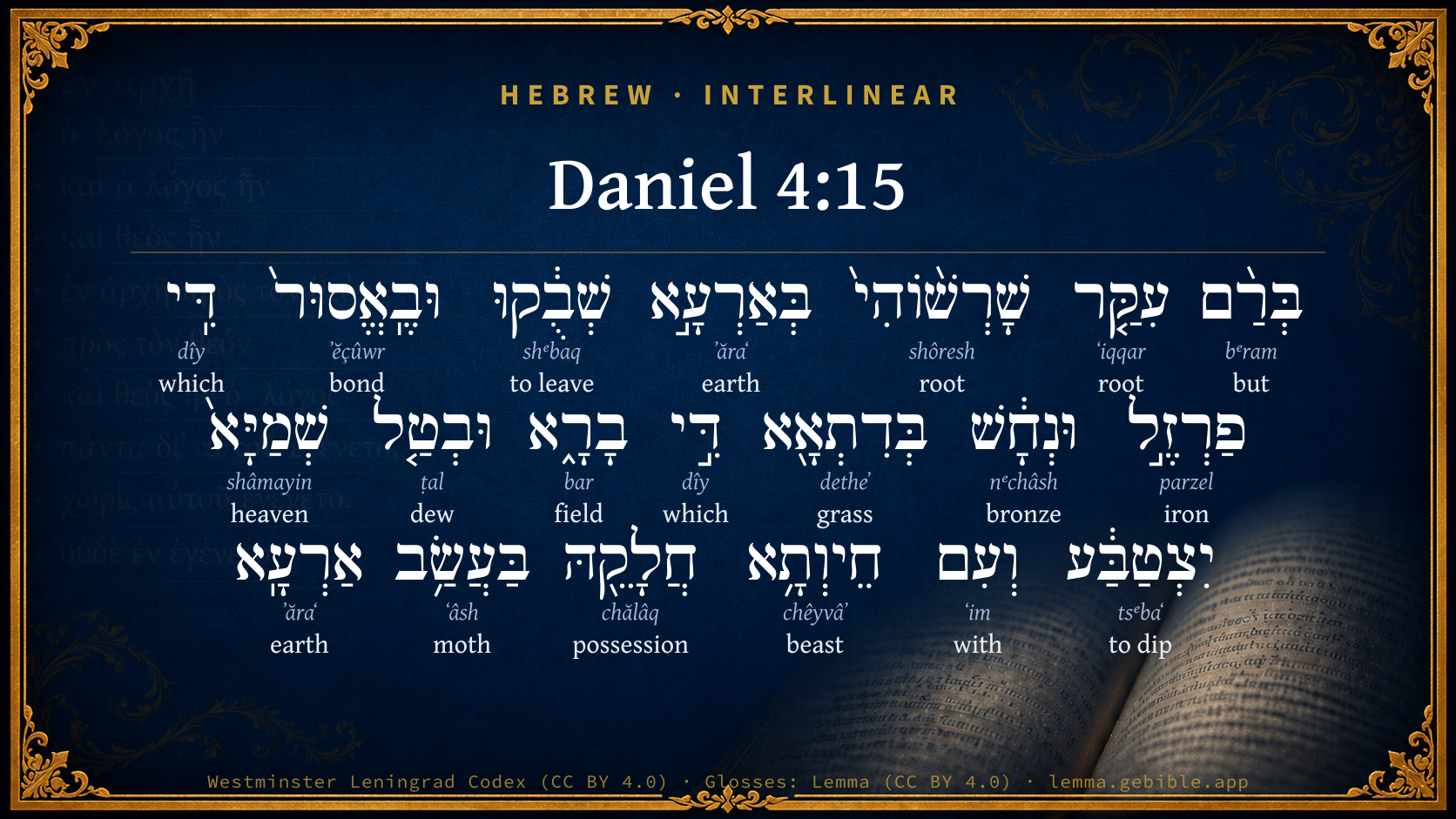
Daniel 4:15

Hebrew (Westminster Leningrad Codex) Daniel 4:15 appears in the Hebrew Old Testament. The text above is from the Westminster Leningrad Codex. Each word links to its Strong’s number, a concise gloss, and parsing drawn from the Open Scriptures Hebrew Bible morphology. Click any word for its full Brown-Driver-Briggs (BDB) entry.
Download image
Cite this verse

Daniel 4:15 (World English Bible). Public Domain. Lemma interlinear Bible study tool, https://lemma.gebible.app/v/daniel/4/15.

Show BibTeX & RIS
BibTeX
RIS
English Translation
Nevertheless leave the stump of its roots in the earth, even with a band of iron and brass, in the tender grass of the field; and let it be wet with the dew of the sky: and let his portion be with the animals in the grass of the earth:
World English Bible · Public Domain
Highlights
  • 5 first appearances in the Hebrew Bible
Full analysis ↓
Download a study sheet

One document with this verse’s original text, its word-by-word gloss line, the meaning frame, cross-references with their text, attributed commentary, and full source and license credits — printable, and it pastes into notes with its structure intact.

This verse Autodidact and up

Study sheet (.html) Plain text (.txt)

A passage Seminary Student

Up to 50 verses in one chapter. A passage sheet keeps up to 6 commentary sources and 12 cross-references per verse, in the order this page ranks them, and says so on the sheet whenever that leaves anything out. Ask for a single verse and you get the Autodidact verse sheet above.

Everything on this page stays free to read, with no account — the sheet is a download of what is already on screen, not access to it.

Want to remove ads? Support Godless Engineer
Compare translations 3

The same verse in 3 English versions, stacked beneath the original-language interlinear above. Click any original word for its lexicon entry.

Each is an independent rendering of the whole verse — the interlinear is not word-aligned to these translations.

Highlighted words mark where these versions differ — a whole-verse word diff, not a word-by-word alignment.

  • World English Bible Public Domain
    Nevertheless leave the stump of its roots in the earth, even with a band of iron and brass, in the tender grass of the field; and let it be wet with the dew of the sky: and let his portion be with the animals in the grass of the earth:
  • King James Version Public Domain
    Nevertheless leave the stump of his roots in the earth, even with a band of iron and brass, in the tender grass of the field; and let it be wet with the dew of heaven, and let his portion be with the beasts in the grass of the earth:
  • unfoldingWord Literal Text CC BY-SA 4.0
    But leave the stump of its roots in the earth, bound with a band of iron and bronze, in the tender grass of the field. Let him be wet with the dew of heaven. Let his portion be with the animals in the grass of the earth.

unfoldingWord Literal Text — © unfoldingWord, licensed CC BY-SA 4.0. Word-aligned USFM3 via Door43 (git.door43.org/unfoldingWord/en_ult).

Versions to compare (up to 4)

3 of 4 selected

Show all 18 translations

Every available English version of this verse, each an independent rendering of the whole verse.

  • World English Bible Public Domain
    Nevertheless leave the stump of its roots in the earth, even with a band of iron and brass, in the tender grass of the field; and let it be wet with the dew of the sky: and let his portion be with the animals in the grass of the earth:
  • Berean Standard Bible Public Domain
    But leave the stump with its roots in the ground, and a band of iron and bronze around it, in the tender grass of the field. Let him be drenched with the dew of heaven and graze with the beasts on the grass of the earth.
  • Majority Standard Bible Public Domain
    But leave the stump with its roots in the ground, with a band of iron and bronze around it, in the tender grass of the field. Let him be drenched with the dew of heaven and graze with the beasts on the grass of the earth.
  • King James Version Public Domain
    Nevertheless leave the stump of his roots in the earth, even with a band of iron and brass, in the tender grass of the field; and let it be wet with the dew of heaven, and let his portion be with the beasts in the grass of the earth:
  • American Standard Version (1901) Public Domain
    Nevertheless leave the stump of its roots in the earth, even with a band of iron and brass, in the tender grass of the field; and let it be wet with the dew of heaven: and let his portion be with the beasts in the grass of the earth:
  • Revised Version (1885) Public Domain
    Nevertheless leave the stump of his roots in the earth, even with a band of iron and brass, in the tender grass of the field; and let it be wet with the dew of heaven, and let his portion be with the beasts in the grass of the earth:
  • Geneva Bible (1599) Public Domain
    This is the dreame, that I King Nebuchad-nezzar haue seene: therefore thou, O Belteshazzar, declare the interpretation thereof: for all the wisemen of my kingdome are not able to shewe mee the interpretation: but thou art able, for the spirit of the holy gods is in thee.
  • Douay-Rheims (1899) Public Domain
    Nevertheless leave the stump of its roots in the earth, and let it be tied with a band of iron, and of brass, among the grass, that is without, and let it be wet with the dew of heaven, and let its portion be with the wild beasts in the grass of the earth.
  • Young's Literal Translation Public Domain
    but the stump of its roots leave in the earth, even with a band of iron and brass, in the tender grass of the field, and with the dew of the heavens is it wet, and with the beasts `is' his portion in the herb of the earth;
  • Literal Standard Version CC BY-SA 4.0
    but the stump of its roots leave in the earth, even with a band of iron and bronze, in the tender grass of the field, and with the dew of the heavens is it wet, and with the beasts [is] his portion in the herb of the earth;
  • Unlocked Literal Bible CC BY-SA 4.0
    Leave the stump of its roots in the earth, bound with a band of iron and bronze, in the middle of the tender grass of the field. Let it be wet with the dew from the heavens. Let it live with the animals among the plants on the ground.
  • unfoldingWord Literal Text CC BY-SA 4.0
    But leave the stump of its roots in the earth, bound with a band of iron and bronze, in the tender grass of the field. Let him be wet with the dew of heaven. Let his portion be with the animals in the grass of the earth.
  • Darby Bible Public Domain
    Nevertheless leave the stump of its roots in the earth, even with a band of iron and brass, in the tender grass of the field; and let it be bathed with the dew of heaven, and let his portion be with the beasts in the grass of the earth.
  • World Messianic Bible Public Domain
    Nevertheless leave the stump of its roots in the earth, even with a band of iron and bronze, in the tender grass of the field; and let it be wet with the dew of the sky. Let his portion be with the animals in the grass of the earth.
  • Webster's Bible Public Domain
    Nevertheless leave the stump of its roots in the earth, even with a band of iron and brass, in the tender grass of the field; and let it be wet with the dew of heaven, and let its portion be with the beasts in the grass of the earth.
  • Free Bible Version CC BY-SA 4.0
    But leave the stump and its roots in the ground, and bind it with iron and bronze, surrounded by the new grass of the field. Let him become soaked with the dew of heaven, and let him live with the animals outside in the undergrowth.
  • Bible in Basic English Public Domain
    But keep its broken end and its roots still in the earth, even with a band of iron and brass; let him have the young grass of the field for food, and let him be wet with the dew of heaven, and let his part be with the beasts.
  • JPS Tanakh (1917) Public Domain
    (4-12) Nevertheless leave the stump of its roots in the earth, even in a band of iron and brass, in the tender grass of the field; and let it be wet with the dew of heaven, and let his portion be with the beasts in the grass of the earth;

Literal Standard Version (2020), Covenant Press — licensed CC BY-SA 4.0. Text via the HelloAO Bible API (eBible.org). Unlocked Literal Bible (unfoldingWord) — licensed CC BY-SA 4.0. Text via the HelloAO Bible API (eBible.org). unfoldingWord Literal Text — © unfoldingWord, licensed CC BY-SA 4.0. Word-aligned USFM3 via Door43 (git.door43.org/unfoldingWord/en_ult). Free Bible Version, Dr. Jonathan Gallagher — licensed CC BY-SA 4.0. Text via the HelloAO Bible API (eBible.org).

Word by word

More ways to search: Search by grammar → Find every occurrence → Compare this word →

Practice this passage: Drill this verse → Learn its vocabulary →

בְּדִתְאָ֖א
detheʼ
H1883
“in/at · grass · the”
Adjective, R + Noun, Common, Masculine, Singular, Determined + Particle, Definite Article
Part of Speech
Adjective + Noun + Particle
Type
Definite Article
Full BDB Definition

Origin: corresponding to H1877

TWOT: 2684

grass
  1. בְּרַ֨ם bᵉram H1297 “but” Adjective, C
  2. עִקַּ֤ר ʻiqqar H6136 “root of” Adjective, N, Common
  3. שָׁרְשׁ֨וֹהִי֙ shôresh H8330 “roots · his” Adjective, N, Common + Suffix, Personal, 3rd Person, Masculine, Singular
  4. בְּאַרְעָ֣א ʼăraʻ H772 “in/at · earth · the” Adjective, R + Noun, Common, Feminine, Singular, Determined + Particle, Definite Article
  5. שְׁבֻ֔קוּ shᵉbaq H7662 “leave” Adjective, V
  6. וּבֶֽאֱסוּר֙ ʼĕçûwr H613 “and · in/at · bond” Adjective, C + Preposition + Noun, Common, Masculine, Singular, Absolute
  7. דִּֽי dîy H1768 “which” Adjective, T
  8. פַרְזֶ֣ל parzel H6523 “iron” Adjective, N, Common
  9. וּנְחָ֔שׁ nᵉchâsh H5174 “and · bronze” Adjective, C + Noun, Common, Masculine, Singular, Absolute
  10. דִּ֣י dîy H1768 “which” Adjective, T
  11. בָרָ֑א bar H1251 “field · the” Adjective, N, Common + Particle, Definite Article
  12. וּבְטַ֤ל ṭal H2920 “and · in/at · dew of” Adjective, C + Preposition + Noun, Common, Masculine, Singular, Construct
  13. שְׁמַיָּא֙ shâmayin H8065 “heaven(s) · the” Adjective, N, Common + Particle, Definite Article
  14. יִצְטַבַּ֔ע tsᵉbaʻ H6647 “to dip” Adjective, V
  15. וְעִם ʻim H5974 “and · with” Adjective, C + Preposition
  16. חֵיוְתָ֥א chêyvâʼ H2423 “beast · the” Adjective, N, Common + Particle, Definite Article
  17. חֲלָקֵ֖הּ chălâq H2508 “possession · his” Adjective, N, Common + Suffix, Personal, 3rd Person, Masculine, Singular
  18. בַּעֲשַׂ֥ב ʻâsh H6211 “in/at · moth of” Adjective, R + Noun, Common, Masculine, Singular, Construct
  19. אַרְעָֽא ʼăraʻ H772 “earth · the” Adjective, N, Common + Particle, Definite Article

About this verse

These counts appear in no published source. They are computed here, from the morphology-tagged text and Lemma’s own curated glosses. What Lemma adds →

20
words
18
distinct lemmas
Prophets
section

Notable vocabulary

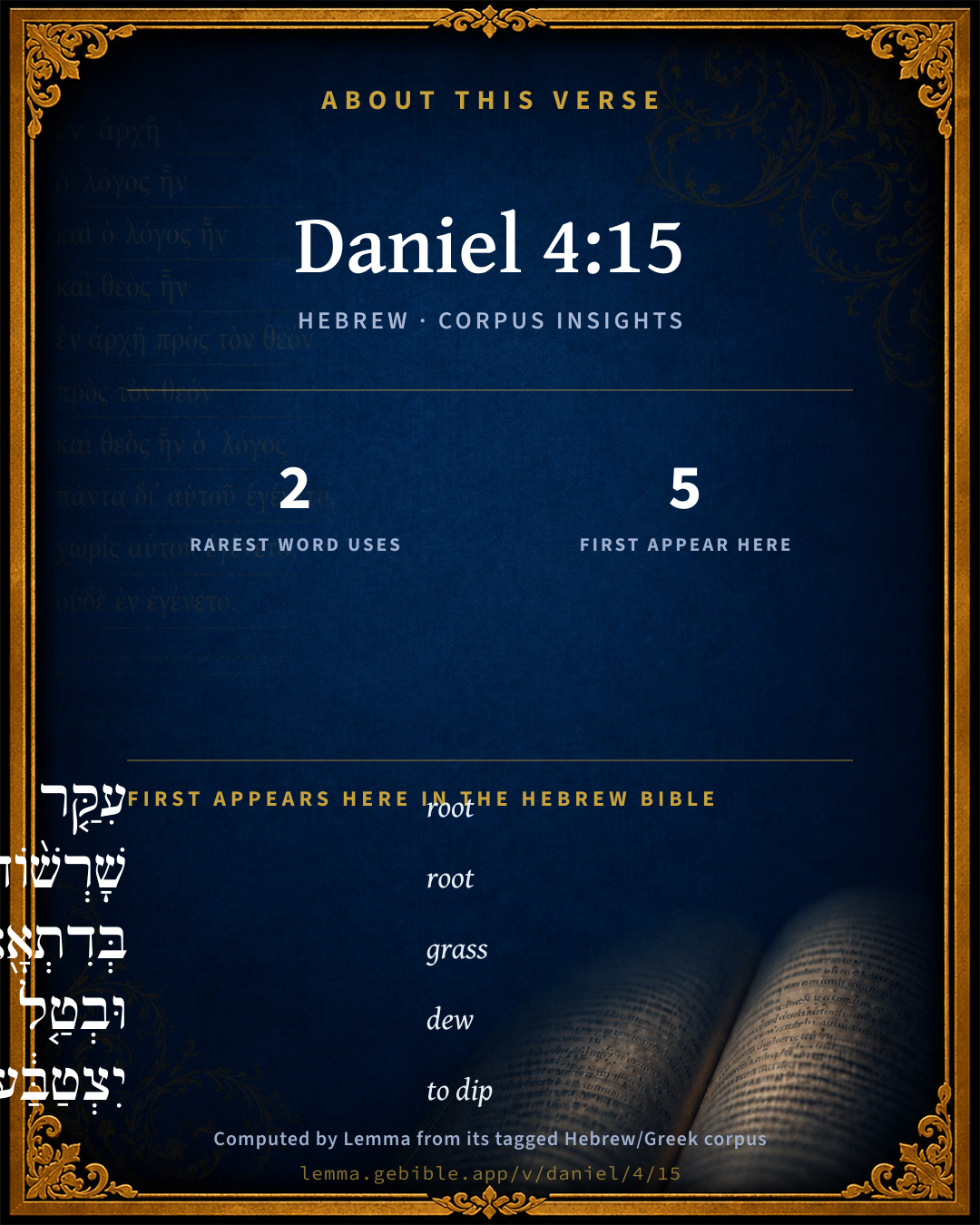
The rarest word here is בְּדִתְאָ֖א grass H1883 — appearing just 2 times in the whole Hebrew Bible.

First appearance in Scripture

These words make their first canonical appearance in the Hebrew Bible here:

  • עִקַּ֤ר root H6136
  • שָׁרְשׁ֨וֹהִי֙ root H8330
  • בְּדִתְאָ֖א grass H1883
  • וּבְטַ֤ל dew H2920
  • יִצְטַבַּ֔ע to dip H6647

Shared distinctive vocabulary

בְּדִתְאָ֖א grass H1883 occurs in 2 verses of the Hebrew Bible. Also found in:

Grammatical profile

  • 4 nouns
  • 9 adjectives
  • 1 preposition
  • 6 particles

Repetition

Words recur within this verse — often emphatic in Hebrew:

  • בְּאַרְעָ֣א earth H772 ×2
  • דִּֽי which H1768 ×2

Hebrew & Septuagint length

In English translation the verse runs 50 words from the Hebrew and 48 from the Septuagint (LXX English) — closely comparable.

A rough comparison of the two English renderings, which tokenize alike — not a word-level alignment.

Word counts can differ between the Hebrew and the Greek without any difference in meaning — e.g. the Hebrew direct-object marker אֵת has no separate Greek word, and Greek often adds the article ὁ.

Cross-references

3

Topical passages linked to Daniel 4:15 in the Treasury of Scripture Knowledge — connected by theme and wording, ordered by reader-vote popularity; previews shown in the World English Bible.

  • Job 14:7–9 "For there is hope for a tree, If it is cut down, that it will sprout again, That the tender branch of it will not cease.
  • Ezekiel 29:14–15 and I will bring back the captivity of Egypt, and will cause them to return into the land of Pathros, into the land of their birth; and they shall be there a base kingdom.
  • Daniel 4:25–27 that you shall be driven from men, and your dwelling shall be with the animals of the field, and you shall be made to eat grass as oxen, and shall be wet with the dew of the sky, and seven times shall pass over you; until you know that the Most High rules in the kingdom of men, and gives it to whoever he will.

Cross-references courtesy of OpenBible.info (CC BY 4.0).

Hebrew and Greek witnesses Masoretic Hebrew ↔ Greek Septuagint

The same verse in the two great witnesses to the Old Testament, shown verse-for-verse.

These are two independent witnesses, not word-aligned to each other, and the Septuagint is shown in lemma (dictionary) form.

Hebrew Daniel 4:15 Masoretic · Westminster Leningrad Codex

בְּרַ֨ם עִקַּ֤ר שָׁרְשׁ֨וֹהִי֙ בְּאַרְעָ֣א שְׁבֻ֔קוּ וּבֶֽאֱסוּר֙ דִּֽי פַרְזֶ֣ל וּנְחָ֔שׁ בְּדִתְאָ֖א דִּ֣י בָרָ֑א וּבְטַ֤ל שְׁמַיָּא֙ יִצְטַבַּ֔ע וְעִם חֵיוְתָ֥א חֲלָקֵ֖הּ בַּעֲשַׂ֥ב אַרְעָֽא

Nevertheless leave the stump of its roots in the earth, even with a band of iron and brass, in the tender grass of the field; and let it be wet with the dew of the sky: and let his portion be with the animals in the grass of the earth:

World English Bible · Public Domain

Greek LXX Daniel 4:15 Septuagint · lemma form

ὁ δέ ἀναὑψόω ὁ δένδρον ἐκεῖνος καί ἐγγίζω ὁ οὐρανός καί ὁ κύτος αὐτός ἅπτομαι ὁ νεφέλη σύ βασιλεύς ὑψόω ὑπέρ πᾶς ὁ ἄνθρωπος ὁ εἰμί ἐπί πρόσωπον πᾶς ὁ γῆ ὑψόω σύ ὁ καρδία ὑπερηφανία καί ἰσχύς ὁ πρός ὁ ἅγιος καί ὁ ἄγγελος αὐτός ὁ ἔργον σύ ὁράω καθότι ἐκἐρημόω ὁ οἶκος ὁ θεός ὁ ζάω ἐπί ὁ ἁμαρτία ὁ λαός ὁ ἁγιάζω

This is the vision which I king Nabuchodonosor saw: and do you, Baltasar, declare the interpretation, for none of the wise men of my kingdom are able to show me the interpretation of it: but you, Daniel, are able; for the Holy Spirit of God is in you.

LXX2012 (modern English Septuagint) · Public Domain

On this verse, The Pulpit Commentary discusses the Septuagint’s reading. Read the note in Commentary ↓

Hebrew: Westminster Leningrad Codex (CC BY 4.0). Greek: Septuagint (public domain); English from LXX2012 (modern English Septuagint) (Public Domain). How the Septuagint differs from the Hebrew →

Commentary

Notes on Daniel 4:15 from classic Christian and Jewish commentators (each source and its license shown beneath its notes). The classic Christian expositions comment on the surrounding passage and are grouped to its opening verse, so a note may address several verses; the Jewish commentaries on the Tanakh (Rashi and others) are per-verse, so they appear only where the commentator wrote on this verse.

Lemma curates 59 commentaries, every one of them public domain or Creative Commons licensed, each selected and text-cleaned for this edition rather than reprinted as found. About our sources →

Trapp's Complete Commentary

John Trapp

Dan 4:15 Nevertheless leave the stump of his roots in the earth, even with a band of iron and brass, in the tender grass of the field; and let it be wet with the dew of heaven, and [let] his portion [be] with the beasts in the grass of the earth:

Ver. 15. Nevertheless, leave the stump of his roots.] Which, having life still in it, may shoot out again. {a}

Even with a band of iron and brass.] Hic ab arbore desilit angelus ad personam. This band intimateth Nebuchadnezzar’s madness; for mad folk use to be bound.

Let his portion be with the beasts.] Turn him agrazing among beasts, for his beastly conditions.

{a} Pintus in loc.

John Trapp, A Commentary or Exposition upon All the Books of the Old and New Testament (1647–1656) — public domain. Text from a community e-Sword module.

Albert Barnes' Notes on the Bible

Nevertheless, leave the stump of his roots in the earth - As of a tree that is not wholly dead, but which may send up suckers and shoots again. See the note at Isa 11:1. In Theodotion this is, τὴν φυήν τῶν ῥιξῶν tēn phuēn tōn rizōn - the nature, germ. Schleusner renders the Greek, “the trunk of its roots.” The Vulgate is, germen radicum ejus, “the germ of his roots.” The Codex Chisianus has: ῥίξαν μίαν ἄφετε ἀυτοῦ ἐν τῇ γῇ rizan mian aphete autou en tē gē - “leave one of his roots in the earth.” The original Chaldee word (עקר ‛ı̂qqar) means a “stump, trunk” (Gesenius); the Hebrew - עקר ‛ēqer - the same word with different pointing, means a shrub, or shoot. It occurs only once in Hebrew Lev 25:47, where it is applied to the stock of a family, or to a person sprung from a foreign family resident in the Hebrew territory: “the stock of the stranger’s family.” The Chaldee form of the word occurs only in Dan 4:15, Dan 4:23, Dan 4:26, rendered in each place “stump,” yet not meaning “stump” in the sense in which that word is now commonly employed. The word “stump” now means the stub of a tree; the part of the tree remaining in the earth, or projecting above it after the tree is cut down, without any reference to the question whether it be alive or dead. The word here used implies that it was still alive, or that there was a germ which would send up a new shoot, so that the tree would live again. The idea is, that though the mighty tree would fall, yet there would remain vitality in the root, or the portion that would remain in the earth after the tree was cut down, and that this would spring up again - a most striking image of what would occur to Nebuchadnezzar after he should be cast down from his lofty throne, and be again restored to his reason and to power.

Even with a band of iron and brass - This expression may be regarded as applicable either to the cut-down tree, or to the humbled monarch. If applied to the former, it would seem that the idea is, that the stump or root of a tree, deemed so valuable, would be carefully secured by an enclosure of iron or brass, either in the form of a hoop placed round the top of the stump, to preserve it from being opened or cracked by the heat of the sun, so as to admit moisture, which would rot it; or around the roots, to bind it together, with the hope that it would grow again; or it may refer to a railing or enclosure of iron or brass, to keep it from being plowed or dug up as worthless. In either case, it would be guarded with the hope that a tree so valuable might spring up again. If applied to the monarch - an explanation not inconsistent with the proper interpretation of the passage - it would seem to refer to some method of securing the royal maniac in bonds of iron and brass, as with the hope that his reason might still be restored, or with a view to keep him from inflicting fatal injury on himself. That the thing here referred to might be practiced in regard to a valuable tree cut down, or broken down, is by no means improbable; that it might be practiced in reference to the monarch is in accordance with the manner in which the insane have been treated in all ages and countries.

In the tender grass of the field - Out of doors; under no shelter; exposed to dews and rains. The stump would remain in the open field where the grass grew, until it should shoot up again; and in a condition strongly resembling that, the monarch would be excluded from his palace and from the abodes of men. For the meaning of this, as applied to Nebuchadnezzar, see the note at Dan 4:25. The word which is rendered “tender grass,” means simply young grass or herbage. No emphasis should be put on the word tender. It simply means that he would be abroad where the grass springs up and grows.

And let it be wet with the dew of heaven - As applied to the tree, meaning that the dew would fall on it and continually moisten it. The falling of the dew upon it would contribute to preserve it alive and secure its growth again. In a dry soil, or if there were no rain or dew, the germ would die. It cannot be supposed that, in regard to the monarch, it could be meant that his remaining under the dew of heaven would in any way contribute to restore his reason, but all that is implied in regard to him is the fact that he would thus be an outcast. The word rendered “let it be wet” - יצטבע yı̂tseṭaba‛ from צבע tseba‛ - means, to dip in, to immerse; to tinge; to dye; though the word is not found in the latter senses in the Chaldee. In the Targums it is often used for “to dye, to color.” The word occurs only in this chapter of Daniel Dan 4:15, Dan 4:23, Dan 4:33 and is in each place rendered in the same way. It is not used in the Hebrew scripture in the sense of to dye or tinge, except in the form of a noun - צבע tseba‛ - in Jdg 5:30 : “To Sisera a prey of divers colors, a prey of divers colors of needlework, of divers colors of needlework.” In the passage before us, of course, there is no allusion of this kind, but the word means merely that the stump of the tree would be kept moist with the dew; as applicable to the tree that it might be more likely to sprout up again.

And let his portion be with the beasts in the grass of the earth - Here is a change evidently from the tree to something represented by the tree. We could not say of a tree that its “portion was with the beasts in the grass,” though in the confused and incongruous images of a dream, nothing would be more natural than such a change from a tree to some object represented by it, or having some resemblance to it. It is probable that it was this circumstance that particularly attracted the attention of the monarch, for though the dream began with a “tree,” it ended with reference to “a person,” and evidently some one whose station would be well represented by such a magnificent and solitary tree. The sense here is, “let him share the lot of beasts; let him live as they do:” that is, let him live on grass. Compare Dan 4:25.

Albert Barnes' Notes on the Bible (1834–1885) — public domain. Text from a community e-Sword/MySword module.

Ibn Ezra

Rabbi Abraham ibn Ezra

[Daniel 4:15] This (דְּנָה֙): [Meaning, Nebuchadnezzar is saying:] Thus I spoke to Daniel (כָּךְ אָמַרְתִּי לְדָנִיֵּאל - kach amarti l'Daniel).

Ibn Ezra on the Tanakh — English translations: “Sefaria Community Translation” (CC0 1.0 (public-domain dedication)); “Yalkut, Sifsei Chachomim Chumash, Metsudah Publications, 2009” (CC BY 4.0); and “Commentary of Ibn Ezra on Isaiah - trans. by M. Friedlander, 1873” (public domain). Text via Sefaria.

Jamieson, Fausset & Brown

Robert Jamieson, A. R. Fausset & David Brown

stump--The kingdom is still reserved secure for him at last, as a tree stump secured by a hoop of brass and iron from being split by the sun's heat, in the hope of its growing again (Isa 11:1; compare Job 14:7-9). BARNES refers it to the chaining of the royal maniac.

Jamieson, Fausset & Brown — Commentary Critical and Explanatory on the Whole Bible (1871) — public domain (CC PDM 1.0). Text via the HelloAO Bible API.

Adam Clarke's Commentary

Verse 15. Leave the stump] Let him not be destroyed, nor his kingdom alienated.

Adam Clarke's Commentary on the Bible (1810–1826) — public domain. Text from a community e-Sword/MySword module.

Ellicott's Commentary for English Readers

(15) The stump.—The whole tree was not to be destroyed, but just so much was to remain as could produce a new sapling. (Comp. Isa_11:1.) As long as the stump remained, it might be hoped that the green branches might shoot forth again. (Comp. Dan_4:36.)

A band.—As the vision continues, the typical language is gradually laid aside, and it begins to appear that by the tree a man is intended. We must not understand by “the band” the chains by which the unfortunate king would be confined, but metaphorically trouble and affliction, as Psa_107:10; Psa_149:8. It has been assumed that during his malady the king wandered about at large. This is highly improbable. That his courtiers did not avail themselves of his sickness to substitute some other king in his place is sufficient proof of their regard for him. It is natural to suppose that he was confined in some court of his palace. The inscriptions of Nebuchadnezzar, and accounts of his reign written by historians, being all composed with the view of glorifying the monarch, naturally suppress all mention of his madness.

A Bible Commentary for English Readers, edited by Charles John Ellicott (1878–1897) — public domain. Text from a community e-Sword module.

The Cambridge Bible for Schools and Colleges

gen. ed. J. J. S. Perowne

15. The destruction of the tree, however, is not to be total: a stump is to be left, which may ultimately grow again.

even in a band of iron and brass] Unless it might be supposed that it was customary, for any purpose, to place a metal band round the stump of a tree which had been cut down, the figure, it seems, must be here abandoned. Whether, however, that be the case or not, the reference, as the interpretation shews, is to something which Nebuchadnezzar would experience during his madness,—probably, either (Keil) the loss of mental freedom, or (Prince) the physical restraint and confinement to which he would naturally have then to submit.

in the tender grass of the field] There would be nothing remarkable in a tree being surrounded by grass; the tree, it is evident, must symbolize something for which such a position would be unnatural. What that is appears more distinctly in the sequel.

let his portion be, &c.] Let him share with them in the herbage of the earth.

herbage] the word used is a wider one than either ‘grass’ or ‘tender (i.e. young) grass,’ and includes vegetables and small shrubs (Gen_1:11-12).

The Cambridge Bible for Schools and Colleges (gen. ed. J. J. S. Perowne; Cambridge University Press, 1878–1918) — public domain. Text from a community e-Sword module.

John Gill's Exposition

Nevertheless, leave the stump of his roots in the earth,.... Let him not be utterly destroyed, or his life taken away; but let him continue in being; though in a forlorn condition, yet with hope of restoration; for a tree may be cut down to the stump, and yet revive again, Job 14:7 and let his kingdom remain:

even with a band of iron and brass; which some think was done to preserve it and to show that his kingdom remained firm and immovable; but that is meant by the former clause, Dan 4:26, rather the allusion is to his distracted condition afterwards related; it being usual to bind madmen with chains of iron or brass, to keep them from hurting themselves and others, as in Mar 5:4,

in the tender grass of the field; where his dwelling should be, not in Babylon, and in his fine palace, living sumptuously as he now did; but in the field, grazing there like a beast, and like one that is feddered and confined to a certain place:

and let it be wet with the dew of heaven; suggesting that this would not only be his case in the daytime; but that he should lie all night in the field, and his body be wet all over with the dew that falls in the night, as if he had been dipped in a dyer's vat, as the word (m) signifies; and Jarchi says it has the signification of dipping; and not be in a stately chamber, and on a bed of down, but on a plot of grass, exposed to all the inclemencies of the air:

and let his portion be with the beasts in the grass of the earth; instead of feeding on royal dainties, as he had all his days, let him eat grass like the beasts of the field, as it seems he did.

(m) "tingatur", Pagninus, Montanus, Munster; "intingatur", Junius & Tremellius; "tingetur", Piscator, Michaelis.

John Gill's Exposition of the Whole Bible (1746–1763) — public domain (CC PDM 1.0). Text via the HelloAO Bible API.

Matthew Poole's English Annotations

Here he mitigates and corrects the former rigour of his sentence, that the kingdom should remain, with hope of return and readmission: God cuts off many flourishing kingdoms to the stumps, by spoiling their riches, beauty, and majesty.

In the tender grass of the field: let the body of Nebuchadnezzar be preserved, and the king doth remain firm, though he be turned out to grass for a while among the beasts.

Matthew Poole's English Annotations on the Holy Bible (1683–1685) — public domain. Text from a community e-Sword/MySword module.

Whedon's Commentary on the Bible

Daniel D. Whedon

15, 16. The destruction of the tree is nearly absolute, since only a “stump” remains, not rooted solidly in its former place of life, but under a most strange and unnatural form of restraint. This stump represents Nebuchadnezzar (compare Isa_11:1), and the dreamer now sees the king rather than the tree, constrained and restrained by some unnatural compulsion, unprotected from the night dews, eating grass like the beasts of the field, and having the inner consciousness of an animal rather than of a man, until “seven times pass over him.” These times (literally, periods) may be “years” (Greek) or “months” (Lenormant), or, more in accordance with the literal meaning of the word, “seasons.” Thomson refers to J. Rendel Harris for the statement that “summer and winter are the only seasons counted in Babylonia,” which would make this expression parallel to the “times and time and half a time” of Dan_7:25. “Seven” was, however, a round number with all the orientals. Gunkel sees in this figure a reference to the Babylonian world-tree, whose height reached to heaven, but whose roots were bound to the earth.

Daniel D. Whedon (gen. ed.), Commentary on the Old and New Testaments (1874–1909) — public domain. Text from a community e-Sword module.

The Pulpit Commentary

Nevertheless leave the stump of his roots in the earth, even with a band of iron and brass, in the tender grass of the field; and let it be wet with the dew of heaven, and let his portion be with the beasts in the grass of the earth . Again the Septuagint differs considerably from the received text, "And thus he said, Leave one root of it in the earth, in order that it may with the beasts of the earth browse in the mountains on grass like an ox." As the reading is the briefer, it is on the whole to be preferred, the more so that the belt of iron and brass is got rid of. The Septuagint assumes that the work of demolishing the tree had gone on to some extent, and then the watcher intervenes to bring forward this limitation to the completeness of the destruction at first enjoined. Theodotion is in agreement with the Massoretic text, as also the Peshitta. Moses Stuart thinks the belt of iron and brass is represented as being put round the stump of the tree in order to prevent it cracking, and so rotting, in this following yon Langerke. Keil, with more justice, thinks that this is a transition from the symbol to the person symbolized; in this view he agrees with Hengstenberg, Kliefoth, Zockler, Behrmann, Hitzig, Ewald, Kranichfeld, and others. There is a further division of opinion as to whether it symbolizes the mental darkness Nebuchadnezzar will be under, or the limitation of his kingdom, or the fact that, as a maniac, he will be bound with fetters. The fact that, while commentators have devoted so much time to this, there is no reference to it in the interpretation, confirms us in our suspicion of the whole clause. The transition to the person, if barely doubtful in regard to the belt of iron and brass, is obvious in the remaining clauses in this verse. Every tree is wet with the dew of heaven that would indicate neither degradation nor hardship; and the browsingwith the boasts is impossible to a tree. The transition from thing to person is in perfect accordance with what every one has experienced in dreams.

The Pulpit Commentary (1880–1919), ed. H.D.M. Spence-Jones & Joseph S. Exell — public domain. Text from a community e-Sword module.

unfoldingWord translationNotes

Door43 World Missions Community

General Information:

In verses 1-18, Nebuchadnezzar describes in the first person his vision from God. (See: First, Second, or Third Person)

General Information:

The holy messenger in the vision continues shouting to some people.

stump of its roots

This is the part of the tree that is left above the ground after a tree is cut down.

dew

the moisture on the ground that is found in the mornings

Let his mind be changed ... seven years pass by

Since the tree represents Nebuchadnezzar, the masculine pronouns "his" and "him" in verse 16 refer to the same tree as the neuter pronoun "it" in verse 15. AT: "The man's mind will change from a man's mind to an animal's mind for a period of seven years" (See: Pronouns)

translationWords

earth

bronze

heaven

mind

unfoldingWord translationNotes — © Distant Shores Media and the Door43 World Missions Community, licensed CC BY-SA 4.0. Source: git.door43.org/Door43/en_tn.

Rashi

Rabbi Shlomo Yitzchaki (Rashi)

its interpretation [as translated,] its interpretation.

but you can [as translated,] but you can.

Rashi on the Tanakh — English translations: “The Judaica Press complete Tanach with Rashi, translated by A. J. Rosenberg” (CC BY 4.0); “Pentateuch with Rashi's commentary by M. Rosenbaum and A.M. Silbermann, 1929-1934” (public domain); “The Metsudah Tanach series, Lakewood, N.J” (CC BY 4.0); and “The Book of Joshua, Metsudah Publications, 1997” (CC BY 4.0). Text via Sefaria.

Lesson kit

Teaching starters — assembled from the data on this page, not authored interpretation. Every prompt links to the verse data it draws on. Edit before teaching.

Daniel, in the Prophets, opens this verse with 20 words (18 distinct Hebrew lemmas). Its most distinctive word is detheʼ (“grass”). A historical commentator’s framing appears above. Read the whole chapter for the surrounding context.

Discussion questions

  1. The word detheʼ carries the sense “grass.” How does it shape the verse?
  2. 5 words make their first appearance in Scripture here. What does this debut establish?
  3. How does Daniel 4:23, which shares the word «grass», read alongside this verse?
  4. What does the repetition of “earth” (2× in this one verse) do in this verse?
  5. These translations render this verse differently. What is at stake in choosing one wording over another?
  6. Compare how Trapp's Complete Commentary and Albert Barnes' Notes on the Bible read this verse. Where do they agree or differ?

Things to notice

  • 5 words make their first canonical appearance in Scripture here.
  • These translations choose different wording for 10 words in this verse.
  • “earth” occurs 2× in this single verse.
  • 18 distinct Hebrew lemmas span 20 words in this verse.

Reading settings

Reading text

Shown beneath each verse's original-language words.

Old Testament
Old Testament edition

Read the OT as the Masoretic Hebrew (MT) or the Greek Septuagint (LXX).

English shown for the Greek Septuagint (in the Hebrew ↔ Greek comparison).

Comparing translations? Open the Compare panel on any verse page to stack up to four side by side.