
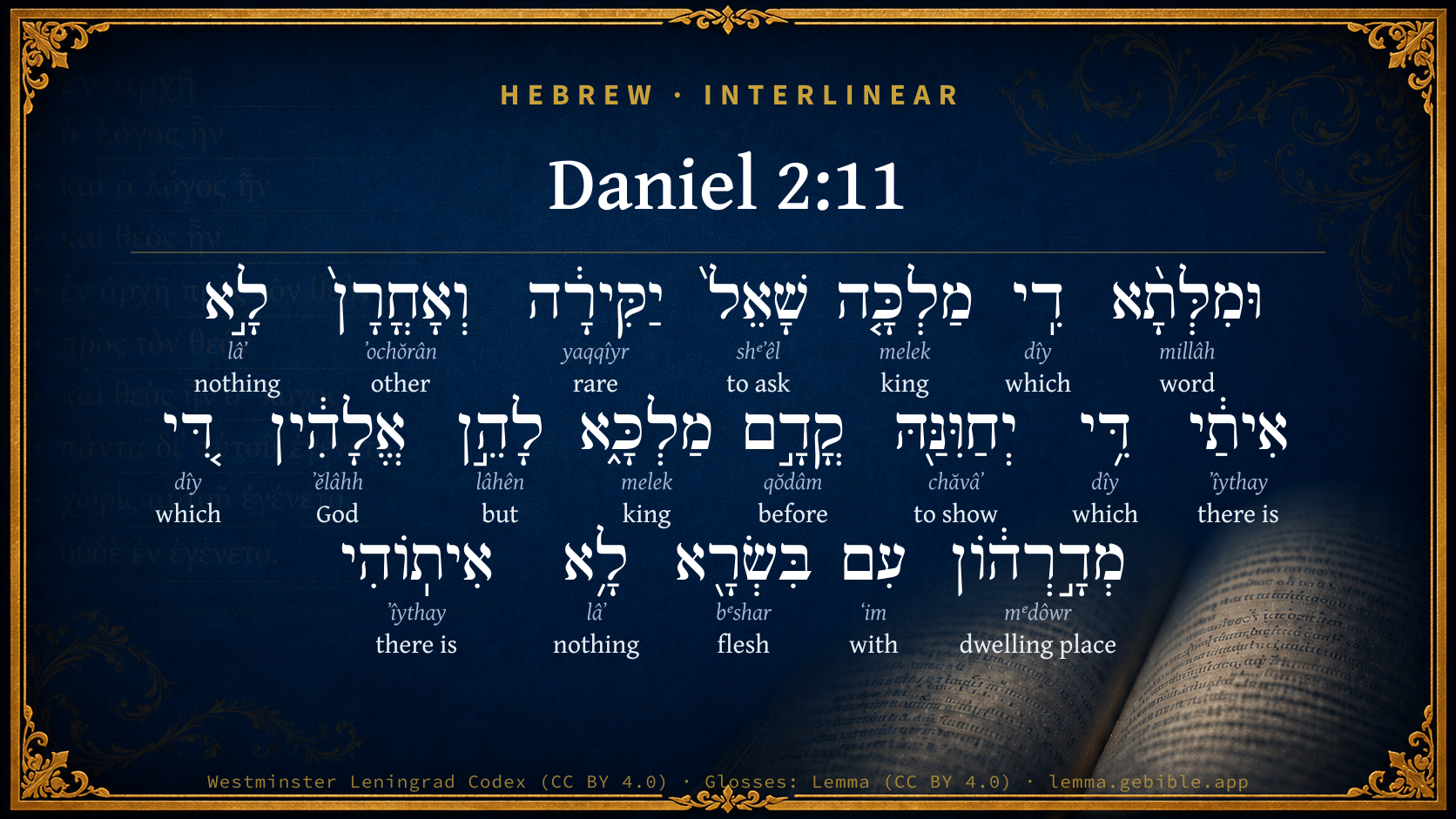
Daniel 2:11

Hebrew (Westminster Leningrad Codex) Daniel 2:11 appears in the Hebrew Old Testament. The text above is from the Westminster Leningrad Codex. Each word links to its Strong’s number, a concise gloss, and parsing drawn from the Open Scriptures Hebrew Bible morphology. Click any word for its full Brown-Driver-Briggs (BDB) entry.
Download image
Cite this verse

Daniel 2:11 (World English Bible). Public Domain. Lemma interlinear Bible study tool, https://lemma.gebible.app/v/daniel/2/11.

Show BibTeX & RIS
BibTeX
RIS
English Translation
It is a rare thing that the king requires, and there is no other who can show it before the king, except the gods, whose dwelling is not with flesh.
World English Bible · Public Domain
Highlights
  • 3 first appearances in the Hebrew Bible
Full analysis ↓
Download a study sheet

One document with this verse’s original text, its word-by-word gloss line, the meaning frame, cross-references with their text, attributed commentary, and full source and license credits — printable, and it pastes into notes with its structure intact.

This verse Autodidact and up

Study sheet (.html) Plain text (.txt)

A passage Seminary Student

Up to 50 verses in one chapter. A passage sheet keeps up to 6 commentary sources and 12 cross-references per verse, in the order this page ranks them, and says so on the sheet whenever that leaves anything out. Ask for a single verse and you get the Autodidact verse sheet above.

Everything on this page stays free to read, with no account — the sheet is a download of what is already on screen, not access to it.

Want to remove ads? Support Godless Engineer
Compare translations 3

The same verse in 3 English versions, stacked beneath the original-language interlinear above. Click any original word for its lexicon entry.

Each is an independent rendering of the whole verse — the interlinear is not word-aligned to these translations.

Highlighted words mark where these versions differ — a whole-verse word diff, not a word-by-word alignment.

  • World English Bible Public Domain
    It is a rare thing that the king requires, and there is no other who can show it before the king, except the gods, whose dwelling is not with flesh.
  • King James Version Public Domain
    And it is a rare thing that the king requireth, and there is none other that can shew it before the king, except the gods, whose dwelling is not with flesh.
  • unfoldingWord Literal Text CC BY-SA 4.0
    The thing that the king demands is difficult, and there is no one else who can show it to the king except the gods, whose dwelling is not with flesh.”

unfoldingWord Literal Text — © unfoldingWord, licensed CC BY-SA 4.0. Word-aligned USFM3 via Door43 (git.door43.org/unfoldingWord/en_ult).

Versions to compare (up to 4)

3 of 4 selected

Show all 18 translations

Every available English version of this verse, each an independent rendering of the whole verse.

  • World English Bible Public Domain
    It is a rare thing that the king requires, and there is no other who can show it before the king, except the gods, whose dwelling is not with flesh.
  • Berean Standard Bible Public Domain
    What the king requests is so difficult that no one can tell it to him except the gods, whose dwelling is not with mortals.”
  • Majority Standard Bible Public Domain
    What the king requests is so difficult that no one can tell it to him except the gods, whose dwelling is not with mortals.”
  • King James Version Public Domain
    And it is a rare thing that the king requireth, and there is none other that can shew it before the king, except the gods, whose dwelling is not with flesh.
  • American Standard Version (1901) Public Domain
    And it is a rare thing that the king requireth, and there is no other that can show it before the king, except the gods, whose dwelling is not with flesh.
  • Revised Version (1885) Public Domain
    And it is a rare thing that the king requireth, and there is none other that can shew it before the king, except the gods, whose dwelling is not with flesh.
  • Geneva Bible (1599) Public Domain
    For it is a rare thing that the King requireth, and there is none other that can declare it before the King, except the gods whose dwelling is not with flesh.
  • Douay-Rheims (1899) Public Domain
    For the thing that thou askest, O king, is difficult; nor can any one be found that can shew it before the king, except the gods, whose conversation is not with men.
  • Young's Literal Translation Public Domain
    and the thing that the king is asking `is' precious, and others are there not that do shew it before the king, save the gods, whose dwelling is not with flesh.'
  • Literal Standard Version CC BY-SA 4.0
    and the thing that the king is asking [is] precious, and there are no others that show it before the king, except the gods, whose dwelling is not with flesh.”
  • Unlocked Literal Bible CC BY-SA 4.0
    What the king demands is difficult, and there is no one who can tell it to the king except the gods, and they do not live among humans.”
  • unfoldingWord Literal Text CC BY-SA 4.0
    The thing that the king demands is difficult, and there is no one else who can show it to the king except the gods, whose dwelling is not with flesh.”
  • Darby Bible Public Domain
    For the thing that the king demandeth is extraordinary, and there is none other that can shew it before the king, except the gods, whose dwelling is not with flesh.
  • World Messianic Bible Public Domain
    It is a rare thing that the king requires, and there is no other who can show it before the king except the gods, whose dwelling is not with flesh.”
  • Webster's Bible Public Domain
    And it is a rare thing that the king requireth, and there is no other that can show it before the king, except the gods, whose dwelling is not with flesh.
  • Free Bible Version CC BY-SA 4.0
    What Your Majesty is asking is impossible! No one can tell Your Majesty what you dreamed, except the gods, and they do not live among us mortals.”
  • Bible in Basic English Public Domain
    The king's request is a very hard one, and there is no other who is able to make it clear to the king, but the gods, whose living-place is not with flesh.
  • JPS Tanakh (1917) Public Domain
    And it is a hard thing that the king asketh, and there is none other that can declare it before the king, except the gods, whose dwelling is not with flesh.'

Literal Standard Version (2020), Covenant Press — licensed CC BY-SA 4.0. Text via the HelloAO Bible API (eBible.org). Unlocked Literal Bible (unfoldingWord) — licensed CC BY-SA 4.0. Text via the HelloAO Bible API (eBible.org). unfoldingWord Literal Text — © unfoldingWord, licensed CC BY-SA 4.0. Word-aligned USFM3 via Door43 (git.door43.org/unfoldingWord/en_ult). Free Bible Version, Dr. Jonathan Gallagher — licensed CC BY-SA 4.0. Text via the HelloAO Bible API (eBible.org).

Word by word

More ways to search: Search by grammar → Find every occurrence → Compare this word →

Practice this passage: Drill this verse → Learn its vocabulary →

יַקִּירָ֔ה
yaqqîyr
H3358
“rare”
Adjective, A
Part of Speech
Adjective
Full BDB Definition

Origin: corresponding to H3357

TWOT: 2775a

rare, noble, famous, difficult - honourable - difficult (metonymy)
  1. וּמִלְּתָ֨א millâh H4406 “and · word · the” Adjective, C + Noun, Common, Feminine, Singular, Determined + Particle, Definite Article
  2. דִֽי dîy H1768 “which” Adjective, T
  3. מַלְכָּ֤ה melek H4430 “king · the” Adjective, N, Common + Particle, Definite Article
  4. שָׁאֵל֙ shᵉʼêl H7593 “asking” Adjective, V
  5. וְאָחֳרָן֙ ʼochŏrân H321 “and · other” Adjective, C + Adjective, Adjective, Masculine, Singular, Absolute
  6. לָ֣א lâʼ H3809 “nothing” Adjective, T
  7. אִיתַ֔י ʼîythay H383 “there is” Adjective, T
  8. דִּ֥י dîy H1768 “which” Adjective, T
  9. יְחַוִּנַּ֖הּ chăvâʼ H2324 “to show · her” Adjective, V + Suffix, Personal, 3rd Person, Feminine, Singular
  10. קֳדָ֣ם qŏdâm H6925 “before” Adjective, R
  11. מַלְכָּ֑א melek H4430 “king · the” Adjective, N, Common + Particle, Definite Article
  12. לָהֵ֣ן lâhên H3861 “but” Adjective, C
  13. אֱלָהִ֔ין ʼĕlâhh H426 “gods” Adjective, N, Common
  14. דִּ֚י dîy H1768 “which” Adjective, T
  15. מְדָ֣רְה֔וֹן mᵉdôwr H4070 “dwelling place · their” Adjective, N, Common + Suffix, Personal, 3rd Person, Masculine, Plural
  16. עִם ʻim H5974 “with” Adjective, R
  17. בִּשְׂרָ֖א bᵉshar H1321 “flesh · the” Adjective, N, Common + Particle, Definite Article
  18. לָ֥א lâʼ H3809 “nothing” Adjective, T
  19. אִיתֽוֹהִי ʼîythay H383 “there is · him” Adjective, T + Suffix, Personal, 3rd Person, Masculine, Singular

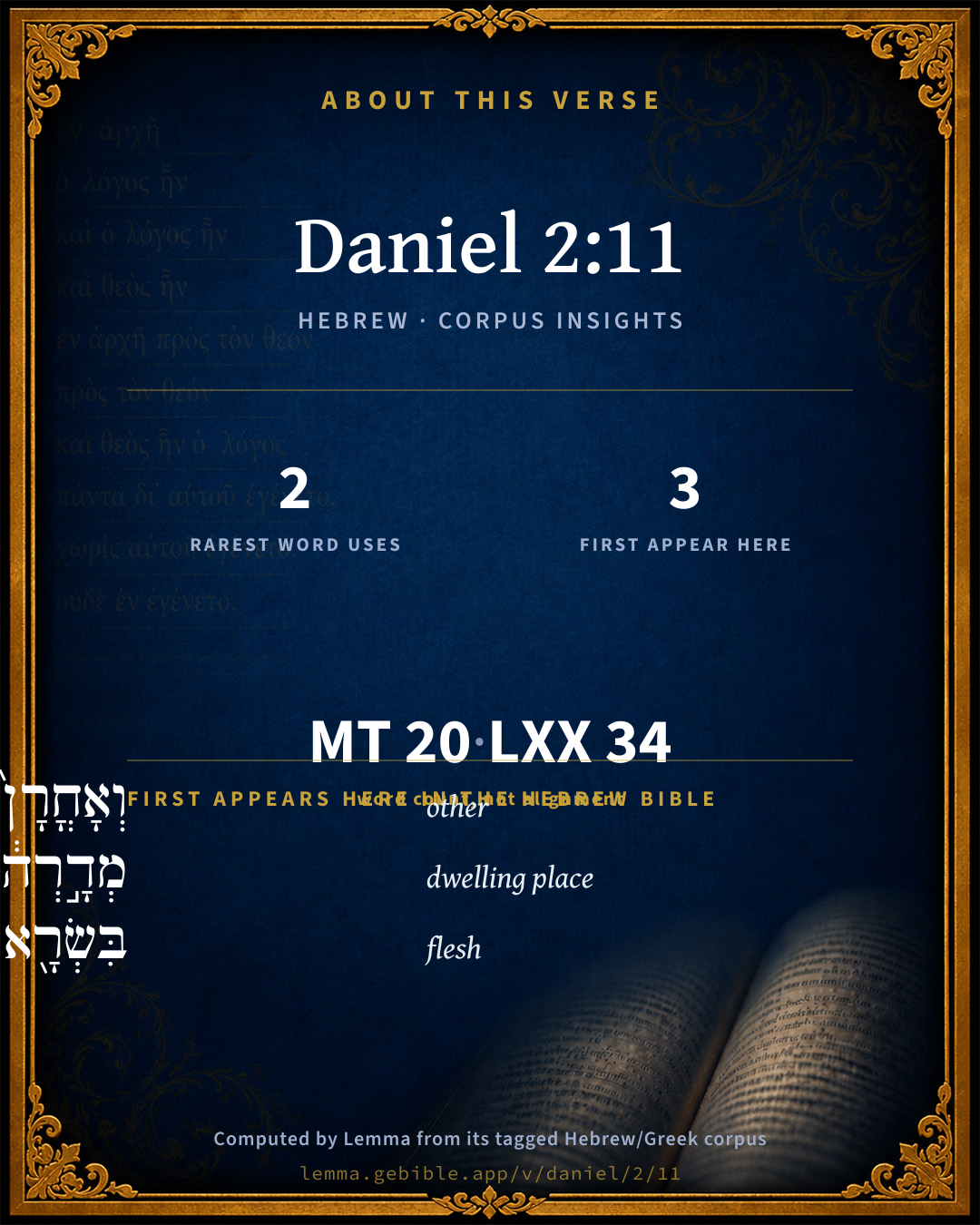
About this verse

These counts appear in no published source. They are computed here, from the morphology-tagged text and Lemma’s own curated glosses. What Lemma adds →

20
words
15
distinct lemmas
Prophets
section

Notable vocabulary

The rarest word here is יַקִּירָ֔ה rare H3358 — appearing just 2 times in the whole Hebrew Bible.

First appearance in Scripture

These words make their first canonical appearance in the Hebrew Bible here:

  • וְאָחֳרָן֙ other H321
  • מְדָ֣רְה֔וֹן dwelling place H4070
  • בִּשְׂרָ֖א flesh H1321

Shared distinctive vocabulary

יַקִּירָ֔ה rare H3358 occurs in 2 verses of the Hebrew Bible. Also found in:

Grammatical profile

  • 16 adjectives
  • 4 particles

Repetition

Words recur within this verse — often emphatic in Hebrew:

  • מַלְכָּ֤ה king H4430 ×2
  • לָ֣א nothing H3809 ×2
  • אִיתַ֔י there is H383 ×2
  • דִֽי which H1768 ×3

Hebrew & Septuagint length

In English translation the verse runs 30 words from the Hebrew and 32 from the Septuagint (LXX English) — closely comparable.

A rough comparison of the two English renderings, which tokenize alike — not a word-level alignment.

Word counts can differ between the Hebrew and the Greek without any difference in meaning — e.g. the Hebrew direct-object marker אֵת has no separate Greek word, and Greek often adds the article ὁ.

In the original languages it is 20 Hebrew tokens and 34 Greek tokens — but the two are counted differently (Hebrew bundles its prefixes and suffixes into one token; the Greek is in lemma form), so that isn’t a like-for-like length.

Cross-references

22

Topical passages linked to Daniel 2:11 in the Treasury of Scripture Knowledge — connected by theme and wording, ordered by reader-vote popularity; previews shown in the World English Bible.

  • Daniel 5:11 There is a man in your kingdom, in whom is the spirit of the holy gods; and in the days of your father light and understanding and wisdom, like the wisdom of the gods, were found in him; and the king Nebuchadnezzar your father, the king, [I say], your father, made him master of the magicians, enchanters, Chaldeans, and soothsayers;
  • Genesis 41:39 Pharaoh said to Joseph, "Because God has shown you all of this, there is none so discreet and wise as you.
  • Exodus 29:45 I will dwell among the children of Israel, and will be their God.
  • Isaiah 57:15 For thus says the high and lofty One who inhabits eternity, whose name is Holy: I dwell in the high and holy place, with him also who is of a contrite and humble spirit, to revive the spirit of the humble, and to revive the heart of the contrite.
  • Matthew 19:26 Looking at them, Jesus said, "With men this is impossible, but with God all things are possible."
  • John 1:14 The Word became flesh, and lived among us. We saw his glory, such glory as of the one and only Son of the Father, full of grace and truth.
  • John 14:17 the Spirit of truth, whom the world can't receive; for it doesn't see him, neither knows him. You know him, for he lives with you, and will be in you.
  • John 14:23 Jesus answered him, "If a man loves me, he will keep my word. My Father will love him, and we will come to him, and make our home with him.
  • 2 Corinthians 6:16 What agreement has a temple of God with idols? For you are a temple of the living God. Even as God said, "I will dwell in them, and walk in them; and I will be their God, and they will be my people."
  • Exodus 8:19 Then the magicians said to Pharaoh, "This is the finger of God:" and Pharaoh's heart was hardened, and he didn't listen to them; as Yahweh had spoken.
  • Numbers 35:34 You shall not defile the land which you inhabit, in the midst of which I dwell: for I, Yahweh, dwell in the midst of the children of Israel.
  • 1 Kings 8:27 But will God in very deed dwell on the earth? behold, heaven and the heaven of heavens can't contain you; how much less this house that I have built!
  • 2 Chronicles 6:18 But will God in very deed dwell with men on the earth? behold, heaven and the heaven of heavens can't contain you; how much less this house which I have built!
  • Psalms 68:18 You have ascended on high. You have led away captives. You have received gifts among men, Yes, among the rebellious also, that Yah God might dwell there.
  • Psalms 113:5–6 Who is like Yahweh, our God, Who has his seat on high,
  • Psalms 132:14 "This is my resting place forever. Here I will live, for I have desired it.
  • Isaiah 8:18 Behold, I and the children whom Yahweh has given me are for signs and for wonders in Israel from Yahweh of Hosts, who dwells in Mount Zion.
  • Isaiah 66:1–2 Thus says Yahweh, heaven is my throne, and the earth is my footstool: what manner of house will you build to me? and what place shall be my rest?
  • Daniel 2:27–28 Daniel answered before the king, and said, The secret which the king has demanded can neither wise men, enchanters, magicians, nor soothsayers, show to the king;
  • Joel 3:21 I will cleanse their blood, That I have not cleansed: For Yahweh dwells in Zion."
  • John 1:1–3 In the beginning was the Word, and the Word was with God, and the Word was God.
  • Revelation 21:3 I heard a loud voice out of heaven saying, "Behold, God's dwelling is with people, and he will dwell with them, and they will be his people, and God himself will be with them as their God.

Cross-references courtesy of OpenBible.info (CC BY 4.0).

Hebrew and Greek witnesses Masoretic Hebrew ↔ Greek Septuagint

The same verse in the two great witnesses to the Old Testament, shown verse-for-verse.

These are two independent witnesses, not word-aligned to each other, and the Septuagint is shown in lemma (dictionary) form.

Hebrew Daniel 2:11 Masoretic · Westminster Leningrad Codex

וּמִלְּתָ֨א דִֽי מַלְכָּ֤ה שָׁאֵל֙ יַקִּירָ֔ה וְאָחֳרָן֙ לָ֣א אִיתַ֔י דִּ֥י יְחַוִּנַּ֖הּ קֳדָ֣ם מַלְכָּ֑א לָהֵ֣ן אֱלָהִ֔ין דִּ֚י מְדָ֣רְה֔וֹן עִם בִּשְׂרָ֖א לָ֥א אִיתֽוֹהִי

It is a rare thing that the king requires, and there is no other who can show it before the king, except the gods, whose dwelling is not with flesh.

World English Bible · Public Domain

Greek LXX Daniel 2:11 Septuagint · lemma form

καί ὁ λόγος ὅς ζητέω βασιλεύς βαρύς εἰμί καί ἐπίδοξος καί οὐδείς εἰμί ὅς δηλόω οὗτος ὁ βασιλεύς εἰ μήτι ἄγγελος ὅς οὐ εἰμί κατοικητήριον μετά πᾶς σάρξ ὅθεν οὐ ἐνδέχομαι γίγνομαι καθάπερ οἴομαι

For the question which the king asks is difficult, and there is no one else who shall answer it before the king, but the gods, whose dwelling is not with any flesh.

LXX2012 (modern English Septuagint) · Public Domain

On this verse, The Pulpit Commentary discusses the Septuagint’s reading. Read the note in Commentary ↓

Hebrew: Westminster Leningrad Codex (CC BY 4.0). Greek: Septuagint (public domain); English from LXX2012 (modern English Septuagint) (Public Domain). How the Septuagint differs from the Hebrew →

Commentary

Notes on Daniel 2:11 from classic Christian and Jewish commentators (each source and its license shown beneath its notes). The classic Christian expositions comment on the surrounding passage and are grouped to its opening verse, so a note may address several verses; the Jewish commentaries on the Tanakh (Rashi and others) are per-verse, so they appear only where the commentator wrote on this verse.

Lemma curates 59 commentaries, every one of them public domain or Creative Commons licensed, each selected and text-cleaned for this edition rather than reprinted as found. About our sources →

Trapp's Complete Commentary

John Trapp

Dan 2:11 And [it is] a rare thing that the king requireth, and there is none other that can shew it before the king, except the gods, whose dwelling is not with flesh.

Ver. 11. And it is a rare thing.] Exceeding man’s wit.

Except the gods, whose dwelling is not with flesh.] They cohabit not with men, that we might converse and confer with them. Here these wizards (1.) Superstitiously affirm a multitude of gods, which the wiser heathens denied, Thales, Pythagoras, Socrates, Plato, Chrysippus, &c. (2.) They deny God’s providence, as did also the Epicures, who held that the gods did nothing out of themselves. The Peripatetics also held that they had nothing to do with things below the moon; yea, the Platonists and Stoics placed the gods in heaven only, and other spirits good and bad in the air, which conversed with men, and were as messengers between them and the gods. Thus these famous philosophers became altogether "vain in their imaginations, and their foolish heart was darkened." {Rom 1:21} (3.) They seem to affirm that man can know nothing of God, unless he cohabited in the flesh with him. "But we have the mind of Christ," {1Co 2:16} and "the secret of the Lord is with them that fear him"; {Psa 25:14} this is a paradox to the natural man. {1Co 2:14} Lastly, they deny the incarnation of Christ, that great "mystery of godliness, God manifested in the flesh." {1Ti 3:16 Joh 1:14}

John Trapp, A Commentary or Exposition upon All the Books of the Old and New Testament (1647–1656) — public domain. Text from a community e-Sword module.

Ibn Ezra

Rabbi Abraham ibn Ezra

[Daniel 2:11] U-mill'ta... yakkirah (וּמִלְּתָא... יַקִּירָה - And the matter... is difficult): [The word yakkirah means difficult/weighty,] like [the usage in] “And costly/precious (v'yakar - וְיָקַר) is the redemption of their soul” [Psalms 49:9], for which no [sufficient] value/reason can be found (shelo matz'ah taʿam - שֶׁלֹּא מָצְאָה טַעַם). [The parallel illustrates the weightiness or difficulty implied by the root י-ק-ר].

[Daniel 2:11] Elahin (אֱלָהִין - Gods): [The Chaldeans refer to beings who] are the upper angels, who are the form of truth (tzurat emet - צוּרַת אֱמֶת) and are not like bodies [i.e., they are incorporeal]. And the [human] souls are derived (nigzarot - נִגְזָרוֹת, lit. 'cut') from them, like light that goes out from the sun. But the souls are [like] bodies [in that they are embodied or less pure/more limited than the angels]. Therefore, they [human souls] do not know the hidden things except a little, and [primarily] in visions of the night when the souls are not occupied with the needs of the body. And one who knows the secret of the soul will testify to my words.

Ibn Ezra on the Tanakh — English translations: “Sefaria Community Translation” (CC0 1.0 (public-domain dedication)); “Yalkut, Sifsei Chachomim Chumash, Metsudah Publications, 2009” (CC BY 4.0); and “Commentary of Ibn Ezra on Isaiah - trans. by M. Friedlander, 1873” (public domain). Text via Sefaria.

Jamieson, Fausset & Brown

Robert Jamieson, A. R. Fausset & David Brown

gods, whose dwelling is not with flesh--answering to "no man upon the earth"; for there were, in their belief, "men in heaven," namely, men deified; for example, Nimrod. The supreme gods are referred to here, who alone, in the Chaldean view, could solve the difficulty, but who do not communicate with men. The inferior gods, intermediate between men and the supreme gods, are unable to solve it. Contrast with this heathen idea of the utter severance of God from man, Joh 1:14, "The Word was made flesh, and dwelt among us"; Daniel was in this case made His representative.

Jamieson, Fausset & Brown — Commentary Critical and Explanatory on the Whole Bible (1871) — public domain (CC PDM 1.0). Text via the HelloAO Bible API.

John Calvin's Commentaries

They add, that the object of the king’s inquiry surpassed the power of human ingenuity. There is no doubt that they were slow to confess this, because, as we said before, they had acquired the fame of such great wisdom, that the common people thought nothing unknown to them or concealed from them. And most willingly would they have escaped the dire necessity of confessing their ignorance in this respect, but in their extremity they were compelled to resort to this subterfuge. There may be a question why they thought the matter about which the king inquired was precious; for as they were ignorant of the king’s dream, how could they ascertain its value? But it is not surprising that men, under the influence of extreme anxiety and fear, should utter anything without judgment. They say, therefore, — this matter is precious; thus they mingle flattery with their excuses to mitigate the king’s anger, hoping to escape the unjust death which was at hand. The matter of which the king inquires is precious; and yet it would probably be said, since the, matter was uncommon, that the dream was divinely sent to the king, and was afterwards suddenly buried in oblivion. There certainly was some mystery here, and hence the Chaldeans very reasonably considered the whole subject to surpass in magnitude the common measure of human ability; therefore they add, — there cannot be any other interpreters than gods or angels Some refer this to angels, but we know the Magi to have worshipped a multitude of gods. Hence it is more simple to explain this of the crowd of deities which they imagined. They had, indeed, lesser gods; for among all nations a persuasion has existed concerning a supreme God who reigns alone. Afterwards they imagined inferior deities, and each fabricated a god for himself according to his taste; hence they are called “gods,” according to common opinion and usage, although they ought rather to be denoted genie or demons of the air. For we know that all unbelievers were imbued with this opinion concerning the existence of intermediate deities. The Apostles contended strongly against this ancient error, and we know the books of Plato to be full of the doctrine that demons or genii act as mediators between man and the Heavenly Deity.

We may, then, suitably understand these words that the Chaldeans thought angels the only interpreters; not because they imagined angels as the Scriptures speak of them clearly and sincerely, but the Platonic doctrine flourished among them, and also the superstition about the genii who dwell in heaven, and hold familiar intercourse with the supreme God. Since men are clothed in flesh, they cannot so raise themselves towards heaven as to perceive all secrets. Whence it follows, that the king acted unjustly in requiring them to discharge a duty either angelic or divine. This excuse was indeed probable, but the king’s ears were deaf because he was carried away by his passions, and God also spurred him on by furies, which allowed him no rest. Hence this savage conduct which Daniel records.

John Calvin's Commentaries (1540-1563) — public domain. Text from the Calvin Translation Society English edition (1840s-50s) via the Christian Classics Ethereal Library (ccel.org). Calvin's coverage is partial (roughly two-thirds of the Bible); uncommented books and verses are honest gaps, never fabricated. The 19th-century editor's footnotes and remarks are omitted so the notes are faithfully Calvin's own voice.

Ellicott's Commentary for English Readers

(11) A rare thing—i.e., a difficult matter. The difficulty is so great, that the gods whose dwelling is not with flesh are alone able to solve it. Here the reference is to a doctrine of Babylonian theology, according to which every man from his birth onward had a special deity attached to him as his protector. It lived in him, or “dwelt with flesh,” as the wise men here remark. The deity, being united to the man, became a partaker of human infirmities. For instance, it was subject to the action of evil spirits, and to the influence of the spirits of sickness to such an extent that it might injure the person whom it was bound to protect. Even these deities, the wise men urge, cannot do what the king requires. Such wisdom belongs only to the gods whose dwelling is apart from man. (See Lenormant, La Magie, pp. 181-183.)

A Bible Commentary for English Readers, edited by Charles John Ellicott (1878–1897) — public domain. Text from a community e-Sword module.

The Cambridge Bible for Schools and Colleges

gen. ed. J. J. S. Perowne

11. rare] difficult: properly heavy. The word has the same sense sometimes in Syriac, as Exo_18:18, in the Peshiṭtâ.

requireth] asketh (as Dan_2:10), which indeed is all that the translators of 1611 meant by their rendering: for require formerly did not express the idea now attaching to the word of demanding as a right. So elsewhere in A.V., as 2Sa_12:20; Pro_30:7 (R.V. asked); Ezr_8:22 (R.V. ask); and in P.B.V. of the Psalms, as Psa_27:4; Psa_38:16; Psa_40:9; Psa_51:6; Psa_137:3.

shew] declare.

whose dwelling is not with flesh] i.e. who are superhuman, supra-mundane beings.

The Cambridge Bible for Schools and Colleges (gen. ed. J. J. S. Perowne; Cambridge University Press, 1878–1918) — public domain. Text from a community e-Sword module.

John Gill's Exposition

And it is a rare thing the king requireth, Meaning not scarce, or seldom heard of; for they had before asserted it never had been required; but that it was hard and difficult, yea, with them, and as they supposed with any other, impossible to be done:

and there is none other that can show it before the king, except the gods, whose dwelling is not with flesh; these men own there was a God, though, they held, more than one; and the omniscience of God, though they seem to have no notion of his omnipresence; and to suggest as if he had no concern with mortals; had no regard to men on earth, nor communicated the knowledge of things unto them. Jarchi, Aben Ezra, and Saadiah, interpret this of angels, who are incorporeal; but the superior deities of the Gentiles are rather designed; who were supposed to dwell in heaven, and to have no conversation with men on earth; these, it is owned, could declare to the king what he desired, and no other; and therefore should not persist in his demand on them.

John Gill's Exposition of the Whole Bible (1746–1763) — public domain (CC PDM 1.0). Text via the HelloAO Bible API.

Albert Barnes' Notes on the Bible

And it is a rare thing that the king requireth - Chaldee, יקירה yaqqı̂yrâh - meaning, “choice, valuable, costly;” then, “heavy, hard, difficult.” Greek, βαρύς barus. Vulgate, “gravis - heavy, weighty.” The idea is not so much that the thing demanded by the king was “uncommon” or “rarely made” - though that was true, as that it was so difficult as to be beyond the human powers. They would not have been likely on such an occasion to say that the requirement was absolutely unjust or unreasonable. The term which they used was respectful, and yet it implied that no man could have any hope of solving the question as it was proposed by him.

And there is none other that can show it before the king except the gods, whose dwelling is not with flesh - This was clearly true, that a matter of that kind could not be disclosed except by Divine assistance. It would seem from this that these persons did not claim to be inspired, or to have communication with the gods; or, at least, that they did not claim to be inspired by the Supreme God, but that they relied on their own natural sagacity, and their careful and long study of the meaning of those occurrences which prefigured future events, and perhaps on the mystic arts derived from their acquaintance with science as then understood. The word “gods” here - אלהין 'ĕlâhı̂yn, the same as the Hebrew אלהים 'ĕlohı̂ym - is in the plural number, but might be applied to the true God, as the Hebrew אלהים 'ĕlohı̂ym often is. It is by no means certain that they meant to use this in the plural, or to say that it was an admitted truth that the gods worshipped in Babylon did not dwell with people.

It was, undoubtedly, the common opinion that they did; that the temples were their abode; and that they frequently appeared among men, and took part in human affairs. But it was a very early opinion that the Supreme God was withdrawn from human affairs, and had committed the government of the world to intermediate beings - internuncii - demons, or aeons: beings of power far superior to that of men, who constantly mingled in human affairs. Their power, however, though great, was limited; and may not the Chaldeans here by the word אלהין 'ĕlâhı̂yn - have meant to refer to the Supreme God, and to say that this was a case which pertained to him alone; that no inferior divinity could be competent to do such a thing as he demanded; and that as the Supreme God did not dwell among men it was hopeless to attempt to explain the matter? Thus understood, the result will convey a higher truth, and will show more impressively the honor put on Daniel. The phrase, “whose dwelling is not with flesh,” means “with men - in human bodies.”

On the supposition that this refers to the Supreme God, this undoubtedty accords with the prevailing sentiment of those times, that however often the inferior divinities might appear to men, and assume human forms, yet the Supreme God was far removed, and never thus took up his abode on the earth. They could hope, therefore, for no communication from Him who alone would be competent to the solution, of such a secret as this. This may be regarded, therefore, as a frank confession of their entire failure in the matter under consideration. They acknowledged that “they” themselves were not competent to the solution of the question, and they expressed the opinion that the ability to do it could not be obtained from the help which the inferior gods rendered to men, and that it was hopeless to expect the Supreme God - far withdrawn from human affairs - to interpose. It was a public acknowledgment that their art failed on a most important trial, and thus the way was prepared to show that Daniel, under the teaching of the true God, was able to accomplish what was wholly beyond all human power.

The trial had been fairly made. The wisest men of the Chaldean realm had been applied to. They on whom reliance had been placed in such emergencies; they who professed to be able to explain the prognostics of future events; they who had been assembled at the most important and magnificent court of the world - the very center of Pagan power; they who had devoted their lives to investigations of this nature, and who might be supposed to be competent to such a work, if any on earth could, now openly acknowledged that their art failed them, and expressed the conviction that there was no resource in the case.

Albert Barnes' Notes on the Bible (1834–1885) — public domain. Text from a community e-Sword/MySword module.

Haydock's Catholic Bible Commentary

Men. They acknowledged greater and less gods. (Stanley, p. 13. Chap. i.) --- They pretend not to have any communication with the superior ones, (Calmet) and by their answer unguardedly bear testimony to the excellence of the God whom Daniel served. (St. Jerome)

George Leo Haydock (1774–1849), Haydock's Catholic Family Bible and Commentary, 1859 edition — public domain. Excludes Psalms (Douay-Rheims chapter numbering differs from Protestant) and Deuterocanonical books (Catholic canon only).

Matthew Poole's English Annotations

The Chaldeans bring three arguments to convince the king.

1. There is not a man upon earth can show the king’s matter.

2. There is no king requires such a thing of any magician.

3. None but the gods can do this. The Chaldeans with other Gentiles did believe more gods than one and the supreme deity or deities did not meddle with the affairs of men, but had the cognizance by inferior or intermediate demons. So Plato and many of them held. The meaning then is this, Seeing there are some things that God, who knoweth all things, will not communicate the knowledge of to men, and hath not done it to us, it is therefore a singular and unreasonable thing the king should require it of us, and that so suddenly, and upon such penalties.

Matthew Poole's English Annotations on the Holy Bible (1683–1685) — public domain. Text from a community e-Sword/MySword module.

The Pulpit Commentary

And it is a rare thing that the king requireth. The Septuagint Version of this passage is, "The thing which thou requirest, O king, is hard and strange." The last two winds are most likely a case of doublet two different renderings of the same Aramaic wind, yakkirah. The primary meaning of this word is "heavy," and by transference it becomes "difficult," and then, "strange" or "rare." There may have been a slight difference of reading to account for the sentence taking the vocative term it does. It may be due to reading rdh instead of rja in the following clause. Theodotion agrees with the Massoretic text. and translates yakkirah, baruv. The Peshitta does not differ here from the Massoretic text. The soothsayers still pursue their line of defence, which they had adopted in the preceding verse. The king cannot get the answer he demands his demand is so difficult and strange. And there is none ether that can show it before the king except the gods, whose dwelling is not with flesh. The Septuagint rendering (lifters somewhat, though slightly, from the Massoretic text: "And there is no one who will show these things to the king, unless some (tiv) angel, whose dwelling is not at all with flesh." The omission of ahoran, "other," gives some slight confirmation of the suggestion that ejpidoxov, "strange" or "peculiar," represents it. It is very characteristic of the time when the Septuagint translation was made, and of the opinions then current, that the, word yjla (elohin), "gods," should be rendered aggelov, "angels" By this time there was an avoidance of the use of the Divine name, and anything that suggested it; further, there was an avoidance of the names of heathen deities. The same feeling that makes the historian of the Book of Samuel represent (1Sa_29:6) Achish swearing by Jehovah rather than by his own gods, as would certainly be the case, makes the translator here represent the soothsayers referring to "angels." The idea of angels of the nations, which we find later in this book, was generally adopted by the Jews in Egypt. (as e.g. Deu_32:8) A question has been raised here as to whether the statement, "whose dwelling is not with flesh," is to be regarded as distinguishing all gods from human beings, or as distinguishing certain of the higher gods from the others. The first view is that of Hitzig, Kranichfeld, Bevan, and others; Professor Fuller and Von Lengerke and others maintain the latter opinion. There is one thing certain that the soothsayers and interpreters of dreams and auguries believed, or, at all events, pretended they believed, themselves each under the guidance of a special genius or subordinate god. Such a god had his dwelling with flesh that is to say, with humanity; but there were in their pantheon highergods, whose dwelling was not with flesh. In some of the incantations and magical formulas which Lenormant has collected in his "La Magie," we find (p. 21) Selek-Moulou-ki coming to Ea his father for information as to the causes of disease, etc. Marduk is the Babylonian name for Selek-Moulou-ki, and Marduk was the great revealer; but by this his dwelling was with flesh. As we see, however, there were gods whose dwelling was not with flesh, who knew secrets hid even from Marduk. This excuse of the wise men is a preparation for Daniel"s claim to raveal the secret of the king by the power of a higher God than any that communicated with the Babylonian soothsayers. Hitzig regards this as an artistic device of the author. We regard it as the providential intervention of God himself, that raise heathen soothsayers should shelter themselves under an excuse that forced into clearer light the supremacy of Jehovah. It indicates a special knowledge of Babylonian worship thus to lay stress on this distinction between higher and lower gods.

The Pulpit Commentary (1880–1919), ed. H.D.M. Spence-Jones & Joseph S. Exell — public domain. Text from a community e-Sword module.

Rashi

Rabbi Shlomo Yitzchaki (Rashi)

difficult Aram. יַקִירָה, heavy, and its burden is heavy.

and there is no other who can tell it and there is no other who will tell it.

but the angels but the angels whose dwelling is not with flesh and blood.

whose dwelling Aram. מְדָרְהוֹן, their dwelling. The Midrash of Rabbi Tanhuma (ad loc.) [says]: וְאַחֲרָן לָא אִיתַי, and Aaron is not here. A priest who wears the Urim and Tummim is not here to tell you. He said to them, “That Temple was so powerful, and you advised me to destroy it?” Immediately, he became angry and commanded to slay them.

Rashi on the Tanakh — English translations: “The Judaica Press complete Tanach with Rashi, translated by A. J. Rosenberg” (CC BY 4.0); “Pentateuch with Rashi's commentary by M. Rosenbaum and A.M. Silbermann, 1929-1934” (public domain); “The Metsudah Tanach series, Lakewood, N.J” (CC BY 4.0); and “The Book of Joshua, Metsudah Publications, 1997” (CC BY 4.0). Text via Sefaria.

Lesson kit

Teaching starters — assembled from the data on this page, not authored interpretation. Every prompt links to the verse data it draws on. Edit before teaching.

Daniel, in the Prophets, opens this verse with 20 words (15 distinct Hebrew lemmas). Its most distinctive word is yaqqîyr (“rare”). A historical commentator’s framing appears above. Read the whole chapter for the surrounding context.

Discussion questions

  1. How does “rare” (yaqqîyr) shape what this verse is saying?
  2. 3 words make their first appearance in Scripture here. What does this debut establish?
  3. How does Ezra 4:10, which shares the word «rare», read alongside this verse?
  4. What does the repetition of “king” (2× in this one verse) do in this verse?
  5. These translations render this verse differently; the difference is in the English rendering, not the original. What questions does that raise?
  6. Compare how Trapp's Complete Commentary and Ibn Ezra read this verse. Where do they agree or differ?

Things to notice

Reading settings

Reading text

Shown beneath each verse's original-language words.

Old Testament
Old Testament edition

Read the OT as the Masoretic Hebrew (MT) or the Greek Septuagint (LXX).

English shown for the Greek Septuagint (in the Hebrew ↔ Greek comparison).

Comparing translations? Open the Compare panel on any verse page to stack up to four side by side.