
Daniel 6:17

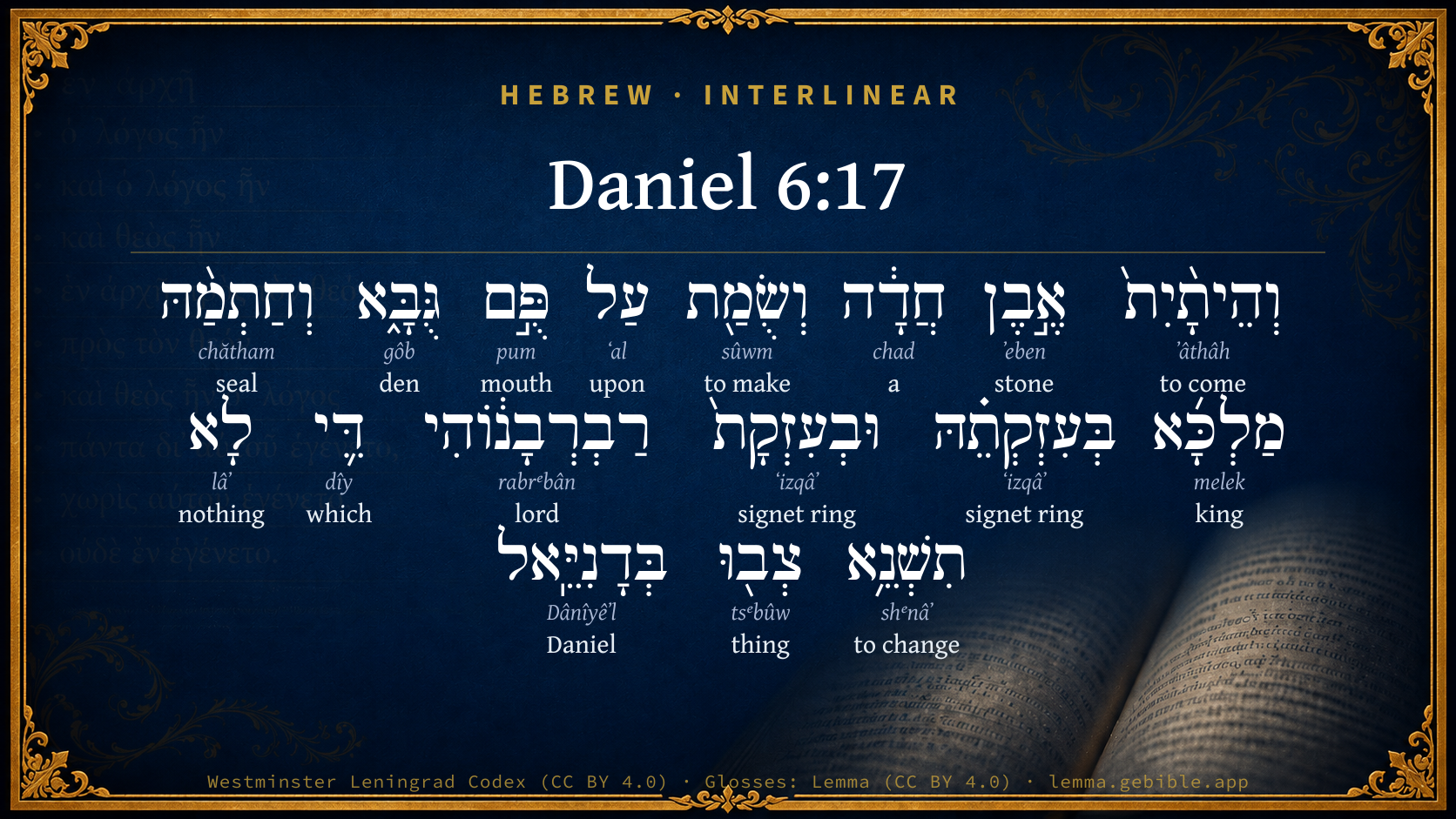
Hebrew (Westminster Leningrad Codex) Daniel 6:17 appears in the Hebrew Old Testament. The text above is from the Westminster Leningrad Codex. Each word links to its Strong’s number, a concise gloss, and parsing drawn from the Open Scriptures Hebrew Bible morphology. Click any word for its full Brown-Driver-Briggs (BDB) entry.
Download image
Cite this verse

Daniel 6:17 (World English Bible). Public Domain. Lemma interlinear Bible study tool, https://lemma.gebible.app/v/daniel/6/17.

Show BibTeX & RIS
BibTeX
RIS
English Translation
A stone was brought, and laid on the mouth of the den; and the king sealed it with his own signet, and with the signet of his lords; that nothing might be changed concerning Daniel.
World English Bible · Public Domain
Highlights
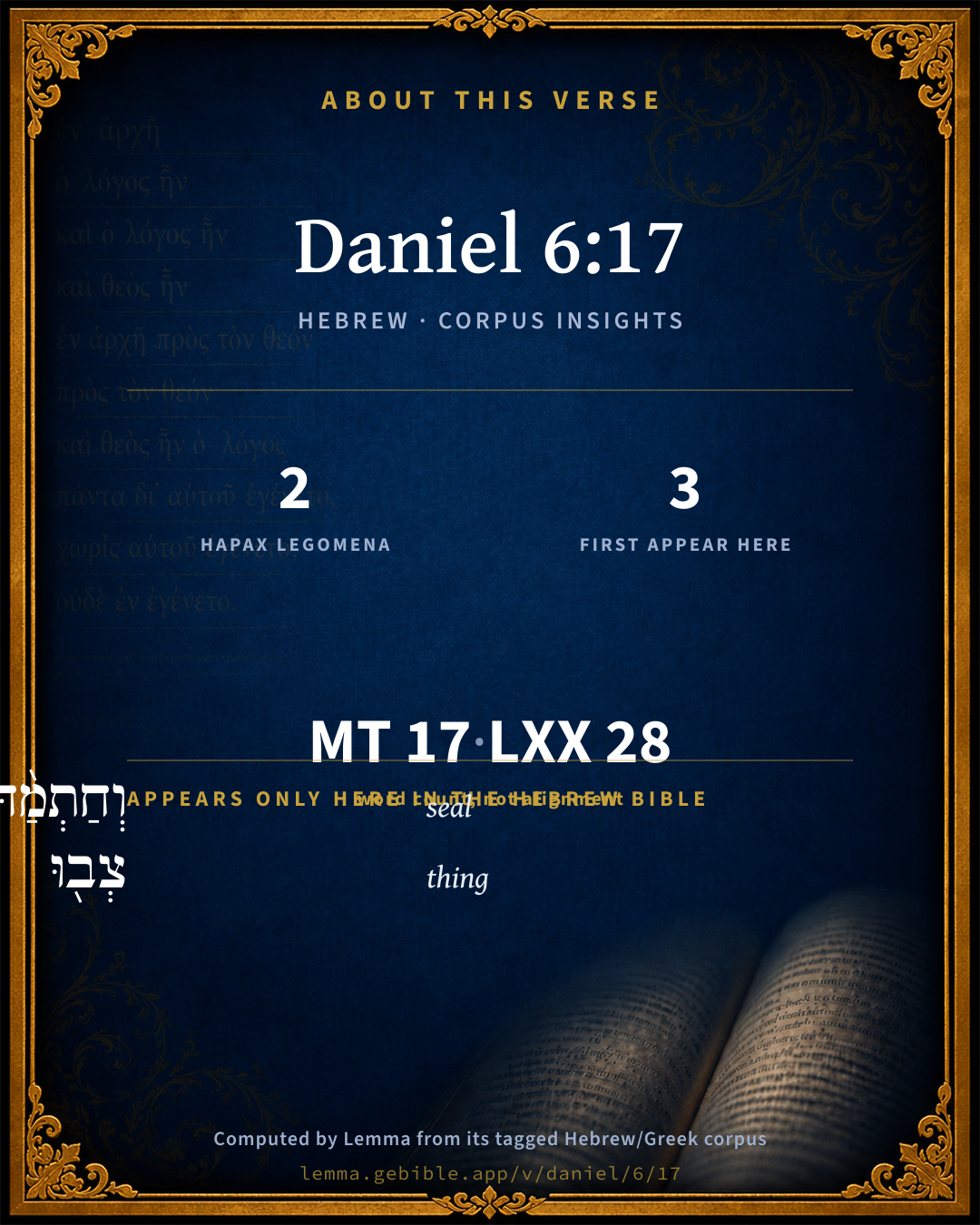
  • 2 hapax legomena — only here in the Hebrew Bible
  • 3 first appearances in the Hebrew Bible
Full analysis ↓
Download a study sheet

One document with this verse’s original text, its word-by-word gloss line, the meaning frame, cross-references with their text, attributed commentary, and full source and license credits — printable, and it pastes into notes with its structure intact.

This verse Autodidact and up

Study sheet (.html) Plain text (.txt)

A passage Seminary Student

Up to 50 verses in one chapter. A passage sheet keeps up to 6 commentary sources and 12 cross-references per verse, in the order this page ranks them, and says so on the sheet whenever that leaves anything out. Ask for a single verse and you get the Autodidact verse sheet above.

Everything on this page stays free to read, with no account — the sheet is a download of what is already on screen, not access to it.

Want to remove ads? Support Godless Engineer
Compare translations 3

The same verse in 3 English versions, stacked beneath the original-language interlinear above. Click any original word for its lexicon entry.

Each is an independent rendering of the whole verse — the interlinear is not word-aligned to these translations.

Highlighted words mark where these versions differ — a whole-verse word diff, not a word-by-word alignment.

  • World English Bible Public Domain
    A stone was brought, and laid on the mouth of the den; and the king sealed it with his own signet, and with the signet of his lords; that nothing might be changed concerning Daniel.
  • King James Version Public Domain
    And a stone was brought, and laid upon the mouth of the den; and the king sealed it with his own signet, and with the signet of his lords; that the purpose might not be changed concerning Daniel.
  • unfoldingWord Literal Text CC BY-SA 4.0
    A stone was brought and laid over the mouth of the den, and the king sealed it with his own signet ring and with the signet rings of his nobles so that nothing might be changed concerning Daniel.

unfoldingWord Literal Text — © unfoldingWord, licensed CC BY-SA 4.0. Word-aligned USFM3 via Door43 (git.door43.org/unfoldingWord/en_ult).

Versions to compare (up to 4)

3 of 4 selected

Show all 18 translations

Every available English version of this verse, each an independent rendering of the whole verse.

  • World English Bible Public Domain
    A stone was brought, and laid on the mouth of the den; and the king sealed it with his own signet, and with the signet of his lords; that nothing might be changed concerning Daniel.
  • Berean Standard Bible Public Domain
    A stone was brought and placed over the mouth of the den, and the king sealed it with his own signet ring and with the rings of his nobles, so that nothing concerning Daniel could be changed.
  • Majority Standard Bible Public Domain
    A stone was brought and placed over the mouth of the den, and the king sealed it with his own signet ring and with the rings of his nobles, so that nothing concerning Daniel could be changed.
  • King James Version Public Domain
    And a stone was brought, and laid upon the mouth of the den; and the king sealed it with his own signet, and with the signet of his lords; that the purpose might not be changed concerning Daniel.
  • American Standard Version (1901) Public Domain
    And a stone was brought, and laid upon the mouth of the den; and the king sealed it with his own signet, and with the signet of his lords; that nothing might be changed concerning Daniel.
  • Revised Version (1885) Public Domain
    And a stone was brought, and laid upon the mouth of the den; and the king sealed it with his own signet, and with the signet of his lords; that nothing might be changed concerning Daniel.
  • Geneva Bible (1599) Public Domain
    And a stone was brought, and layed vpon the mouth of the denne, and the King sealed it with his owne signet, and with the signet of his princes, that the purpose might not be changed, concerning Daniel.
  • Douay-Rheims (1899) Public Domain
    And a stone was brought, and laid upon the mouth of the den: which the king sealed with his own ring, and with the ring of his nobles, that nothing should be done against Daniel.
  • Young's Literal Translation Public Domain
    And a stone hath been brought and placed at the mouth of the den, and the king hath sealed it with his signet, and with the signet of his great men, that the purpose be not changed concerning Daniel.
  • Literal Standard Version CC BY-SA 4.0
    And a stone has been brought and placed at the mouth of the den, and the king has sealed it with his signet, and with the signet of his great men, that the purpose is not changed concerning Daniel.
  • Unlocked Literal Bible CC BY-SA 4.0
    A stone was brought over the entrance to the den, and the king sealed it with his own signet ring and with the signet rings of his nobles so that nothing might be changed concerning Daniel.
  • unfoldingWord Literal Text CC BY-SA 4.0
    A stone was brought and laid over the mouth of the den, and the king sealed it with his own signet ring and with the signet rings of his nobles so that nothing might be changed concerning Daniel.
  • Darby Bible Public Domain
    And a stone was brought, and laid upon the mouth of the den; and the king sealed it with his own signet, and with the signet of his nobles, that the purpose might not be changed concerning Daniel.
  • World Messianic Bible Public Domain
    A stone was brought, and laid on the mouth of the den; and the king sealed it with his own signet, and with the signet of his lords; that nothing might be changed concerning Daniel.
  • Webster's Bible Public Domain
    \\6:16\\Then the king commanded, and they brought Daniel, and cast him into the den of lions. Now the king spoke and said to Daniel, Thy God whom thou servest continually, he will deliver thee.
  • Free Bible Version CC BY-SA 4.0
    A stone was brought and placed over the entrance to the den and the king sealed it with his own personal seal and those of his nobles so that no one could interfere with what was happening to Daniel.
  • Bible in Basic English Public Domain
    Then the king gave the order, and they took Daniel and put him into the lions' hole. The king made answer and said to Daniel, Your God, whose servant you are at all times, will keep you safe.
  • JPS Tanakh (1917) Public Domain
    (6-18) And a stone was brought, and laid upon the mouth of the den; and the king sealed it with his own signet, and with the signet of his lords; that nothing might be changed concerning Daniel.

Literal Standard Version (2020), Covenant Press — licensed CC BY-SA 4.0. Text via the HelloAO Bible API (eBible.org). Unlocked Literal Bible (unfoldingWord) — licensed CC BY-SA 4.0. Text via the HelloAO Bible API (eBible.org). unfoldingWord Literal Text — © unfoldingWord, licensed CC BY-SA 4.0. Word-aligned USFM3 via Door43 (git.door43.org/unfoldingWord/en_ult). Free Bible Version, Dr. Jonathan Gallagher — licensed CC BY-SA 4.0. Text via the HelloAO Bible API (eBible.org).

Word by word

More ways to search: Search by grammar → Find every occurrence → Compare this word →

Practice this passage: Drill this verse → Learn its vocabulary →

וְחַתְמַ֨הּ
chătham
H2857
“and · seal · her”
Adjective, C + Verb, Qal, Perfect, 3rd Person, Masculine, Singular + Suffix, Personal, 3rd Person, Feminine, Singular
Part of Speech
Adjective + Verb
Stem
Qal
Form
Perfect
Person
3rd Person
Gender
Masculine
Number
Singular
Full BDB Definition

Origin: a root corresponding to H2856

TWOT: 2749

(Peal) seal.
  1. וְהֵיתָ֨יִת֙ ʼâthâh H858 “and · to come” Adjective, C + Verb, Hophal, Perfect, 3rd Person, Feminine, Singular
  2. אֶ֣בֶן ʼeben H69 “stone” Adjective, N, Common
  3. חֲדָ֔ה chad H2298 “a” Adjective, N, Common
  4. וְשֻׂמַ֖ת sûwm H7761 “and · to make” Adjective, C + Verb, Qal Passive, Perfect, 3rd Person, Feminine, Singular
  5. עַל ʻal H5922 “upon” Adjective, R
  6. פֻּ֣ם pum H6433 “mouth of” Adjective, N, Common
  7. גֻּבָּ֑א gôb H1358 “den · the” Adjective, N, Common + Particle, Definite Article
  8. מַלְכָּ֜א melek H4430 “king · the” Adjective, N, Common + Particle, Definite Article
  9. בְּעִזְקְתֵ֗הּ ʻizqâʼ H5824 “in/at · signet ring · his” Adjective, R + Noun, Common, Feminine, Singular, Construct + Suffix, Personal, 3rd Person, Masculine, Singular
  10. וּבְעִזְקָת֙ ʻizqâʼ H5824 “and · in/at · signet ring of” Adjective, C + Preposition + Noun, Common, Feminine, Singular, Construct
  11. רַבְרְבָנ֔וֹהִי rabrᵉbân H7261 “lords · his” Adjective, N, Common + Suffix, Personal, 3rd Person, Masculine, Singular
  12. דִּ֛י dîy H1768 “which” Adjective, C
  13. לָא lâʼ H3809 “nothing” Adjective, T
  14. תִשְׁנֵ֥א shᵉnâʼ H8133 “to change” Adjective, V
  15. צְב֖וּ tsᵉbûw H6640 “thing” Adjective, N, Common
  16. בְּדָנִיֵּֽאל Dânîyêʼl H1841 “in/at · Daniel” Adjective, R + Noun, Proper

About this verse

These counts appear in no published source. They are computed here, from the morphology-tagged text and Lemma’s own curated glosses. What Lemma adds →

17
words
16
distinct lemmas
Prophets
section

Notable vocabulary

2 hapax legomena — words that appear only here in the entire Hebrew Bible:

  • וְחַתְמַ֨הּ seal H2857
  • צְב֖וּ thing H6640

First appearance in Scripture

These words make their first canonical appearance in the Hebrew Bible here:

  • וְחַתְמַ֨הּ seal H2857
  • בְּעִזְקְתֵ֗הּ signet ring H5824
  • צְב֖וּ thing H6640

Grammatical profile

  • 3 verbs
  • 3 nouns
  • 9 adjectives
  • 2 particles

Verb forms

  • וְהֵיתָ֨יִת֙ Hophal · Perfect
  • וְשֻׂמַ֖ת Qal Passive · Perfect
  • וְחַתְמַ֨הּ Qal · Perfect

Repetition

A word recurs within this verse — often emphatic in Hebrew:

  • בְּעִזְקְתֵ֗הּ signet ring H5824 ×2

Hebrew & Septuagint length

In English translation the verse runs 35 words from the Hebrew and 40 from the Septuagint (LXX English) — closely comparable.

A rough comparison of the two English renderings, which tokenize alike — not a word-level alignment.

Word counts can differ between the Hebrew and the Greek without any difference in meaning — e.g. the Hebrew direct-object marker אֵת has no separate Greek word, and Greek often adds the article ὁ.

In the original languages it is 17 Hebrew tokens and 28 Greek tokens — but the two are counted differently (Hebrew bundles its prefixes and suffixes into one token; the Greek is in lemma form), so that isn’t a like-for-like length.

Cross-references

4

Topical passages linked to Daniel 6:17 in the Treasury of Scripture Knowledge — connected by theme and wording, ordered by reader-vote popularity; previews shown in the World English Bible.

  • Lamentations 3:53 They have cut off my life in the dungeon, and have cast a stone on me.
  • Acts 12:4 When he had arrested him, he put him in prison, and delivered him to four squads of four soldiers each to guard him, intending to bring him out to the people after the Passover.
  • Matthew 27:60–66 and laid it in his own new tomb, which he had hewn out in the rock, and he rolled a great stone to the door of the tomb, and departed.
  • Acts 16:23–24 When they had laid many stripes on them, they threw them into prison, charging the jailer to keep them safely,

Cross-references courtesy of OpenBible.info (CC BY 4.0).

Hebrew and Greek witnesses Masoretic Hebrew ↔ Greek Septuagint

The same verse in the two great witnesses to the Old Testament, shown verse-for-verse.

These are two independent witnesses, not word-aligned to each other, and the Septuagint is shown in lemma (dictionary) form.

Hebrew Daniel 6:17 Masoretic · Westminster Leningrad Codex

וְהֵיתָ֨יִת֙ אֶ֣בֶן חֲדָ֔ה וְשֻׂמַ֖ת עַל פֻּ֣ם גֻּבָּ֑א וְחַתְמַ֨הּ מַלְכָּ֜א בְּעִזְקְתֵ֗הּ וּבְעִזְקָת֙ רַבְרְבָנ֔וֹהִי דִּ֛י לָא תִשְׁנֵ֥א צְב֖וּ בְּדָנִיֵּֽאל

A stone was brought, and laid on the mouth of the den; and the king sealed it with his own signet, and with the signet of his lords; that nothing might be changed concerning Daniel.

World English Bible · Public Domain

Greek LXX Daniel 6:17 Septuagint · lemma form

ἀναβοάω δέ δαρεῖος ὁ βασιλεύς εἶπον ὁ δανιηλ ὁ θεός σύ ὅς σύ λατρεύω ἐνδελεχῶς τρίς ὁ ἡμέρα αὐτός ἐκαἱρέω σύ ἐκ χείρ ὁ λέων ἕως πρωΐ θαρρέω

And they brought a stone, and put it on the mouth of the den; and the king sealed it with his ring, and with the ring of his nobles; that the case might not be altered with regard to Daniel.

LXX2012 (modern English Septuagint) · Public Domain

On this verse, The Pulpit Commentary discusses the Septuagint’s reading. Read the note in Commentary ↓

Hebrew: Westminster Leningrad Codex (CC BY 4.0). Greek: Septuagint (public domain); English from LXX2012 (modern English Septuagint) (Public Domain). How the Septuagint differs from the Hebrew →

Commentary

Notes on Daniel 6:17 from classic Christian and Jewish commentators (each source and its license shown beneath its notes). The classic Christian expositions comment on the surrounding passage and are grouped to its opening verse, so a note may address several verses; the Jewish commentaries on the Tanakh (Rashi and others) are per-verse, so they appear only where the commentator wrote on this verse.

Lemma curates 59 commentaries, every one of them public domain or Creative Commons licensed, each selected and text-cleaned for this edition rather than reprinted as found. About our sources →

Trapp's Complete Commentary

John Trapp

Dan 6:17 And a stone was brought, and laid upon the mouth of the den; and the king sealed it with his own signet, and with the signet of his lords; that the purpose might not be changed concerning Daniel.

Ver. 17. And a stone was brought, and laid upon the mouth of the den.] To make all sure, as they thought, and that there might be no privite dealings with the keepers for Daniel’s deliverance. But God had a holy hand in it, for the greater manifestation of the miracle.

And the king sealed it.] Ne, videlicet, alia perimeretur morte ab insidiatoribus, saith one, lest the conspirators, understanding that the lions did not meddle with him, should some way else despatch him, as the persecutors dealt by some of the martyrs,

That the purpose might not be changed concerning Daniel.] The Latin interpreter hath it, Lest anything should be done against Daniel. He feared not the lions so much as the men, saith the ordinary gloss there.

John Trapp, A Commentary or Exposition upon All the Books of the Old and New Testament (1647–1656) — public domain. Text from a community e-Sword module.

Joseph Benson's Commentary

Dan 6:17. And a stone was brought, and laid upon the mouth of the den — Because, perhaps, it was seen that the lions did not seize on him immediately; and therefore, that they might have full opportunity to satisfy their rage and hunger, Daniel’s enemies were determined he should be confined all night among them. And the king sealed it with his own signet, and with the signet of his lords — That neither the one nor the other of the parties might separately do any thing for or against Daniel. We may observe here, with Mr. Wintle, that the design of the king and of the nobles was probably different; the latter feared the king, lest he should release Daniel; the former was apprehensive that some other injury might be done to him, beyond the power of the wild beasts. Hence the Vulgate renders the conclusion of the verse, Ne quid fieret contra Danielem, That nothing might be done against Daniel; indicating the king’s desire, that the lions’ den might be closed with a sealed stone, lest the lords should put Daniel to death when they found him not slain by the lions. The king’s sealing the stone, “must naturally remind us of the like circumstances which happened at the interment of our Saviour, of whom Daniel, in this case at least, has by many been considered as a type:” see Mat 27:60; Mat 27:66.

Joseph Benson's Commentary on the Old and New Testaments (1811–1818) — public domain. Text from a community e-Sword module.

Tyndale Open Study Notes

Tyndale Open Resources

6:17 his own royal seal and the seals of his nobles: The multiple sealing of the lions’ den made a covert rescue impossible. Neither the king nor the officials could open the den without breaking the other seals and thus informing the other parties.

Tyndale Open Study Notes — © Tyndale Open Resources, licensed CC BY-SA 4.0. Text via the HelloAO Bible API.

Jamieson, Fausset & Brown

Robert Jamieson, A. R. Fausset & David Brown

stone . . . sealed--typical of Christ's entombment under a seal (Mat 27:66). Divinely ordered, that the deliverance might be the more striking.

his own signet, and . . . of his lords--The concurrence of the lords was required for making laws. In this kingly power had fallen since it was in Nebuchadnezzar's hands. The Median king is a puppet in his lords' hands; they take the security of their own seal as well as his, that he should not release Daniel. The king's seal guaranteed Daniel from being killed by them, should he escape the lions.

Jamieson, Fausset & Brown — Commentary Critical and Explanatory on the Whole Bible (1871) — public domain (CC PDM 1.0). Text via the HelloAO Bible API.

Adam Clarke's Commentary

Verse 17. A stone was brought] All this precaution served the purposes of the Divine Providence. There could be no trick nor collusion here; if Daniel be preserved, it must be by the power of the Supreme God. The same precaution was taken by the Jews, in the case of the burial of our blessed Lord; and this very thing has served as one of the strongest proofs of the certainty of his resurrection and their unmixed wickedness.

Adam Clarke's Commentary on the Bible (1810–1826) — public domain. Text from a community e-Sword/MySword module.

John Calvin's Commentaries

There is no doubt that God’s counsel provided that the nobles should seal the stone with their own rings, and thus close the mouth of the cave, and render the miracle more illustrious. For when the king approached on the morrow, the rings were all entire, and the seals all unbroken. Thus the preservation of this servant of God was manifestly by the aid of heaven and not by the art of men. Hence we see how boldly the king’s nobles had compelled him to perform their pleasure. For he might seem deprived of all royal power when he delivered up to them a subject dear and faithful to himself, and ordered him to be thrown into the lions’ den. They are not content with this compliance of the king; they extort another point from him — the closing up of the mouth of the cave; and then they all seal the stone, lest any one should release Daniel. We see, then, when once liberty has been snatched away, all is over, especially when any one has become a slave by his own faults, and has attached himself to the counsels of the ungodly. For, at first, such slavery will not prevail as to induce a man to do everything which he is ordered, since he seems to be free; but when he has given himself up to such slavery as I have described, he is compelled to transgress not once or twice, but constantly and without ceasing. For example, if any one swerves from his duty through either the fear of man or flattery, or any other depraved affection, he will grant various things, not only when asked, but when urgently compelled. But when he has once submitted to the loss of freedom, he will be compelled, as I have already said, to consent to the most shameful deeds at the nod of any one. If any teacher or pastor of the Church should turn from the right path through the influence of ambition, the author of his declension will come to him again and say, What! do you dare to refuse me? Did I not obtain from you, yesterday or the day before, whatever I wished? Thus he will be compelled to transgress a second time in favor of the person to whom he has joined himself, and will also be forced to repeat the transgression continually. Thus princes also, who are not free agents through being under the tyranny of others, if they permit themselves to be overcome contrary to their conscience, lay aside all their authority, and are drawn aside in all directions by the will of their subjects. This example, then, is proposed to us in the case of King Darius, who after inflicting unjust punishment upon Daniel, adds this, He must be enclosed in the cave, and then, the stone must be sealed, — and for what object? — lest the doom should be changed; meaning, he did not dare to attempt anything in Daniel’s favor. We see, then, how the king submitted to the greatest disgrace, because his nobles had no confidence in him; they refused to trust him when he ordered Daniel to be thrown into the lions’ den, but they exacted a guarantee against his liberation, and would not suffer him to attempt anything. We thus see how disgracefully they withdrew their confidence from their king; next they use their authority against him, lest he should dare to remove the stone which had been sealed, unless he would incur the charge of falsehood by corrupting the public signatures, and of deception by falsifying the public documents. Hence this passage admonishes us against prostituting ourselves in slavery to the lust of men. Let every one serve his nearest neighbors as far as charity will allow and as custom demands. Meanwhile, no one ought to permit himself to be turned aside in different directions contrary to his conscience, because when he loses his free agency, he will be compelled to endure many affronts and to obey the foulest commands. This we see exemplified in the case of the panders to the avarice, or ambition, or cruelty of princes; for when once they are under the power of such men, they are most miserable victims; they cannot avoid the most extreme necessities, they become wretched slaves, and call down against themselves, a hundred times over, the anger of both God and man. It now follows, —

John Calvin's Commentaries (1540-1563) — public domain. Text from the Calvin Translation Society English edition (1840s-50s) via the Christian Classics Ethereal Library (ccel.org). Calvin's coverage is partial (roughly two-thirds of the Bible); uncommented books and verses are honest gaps, never fabricated. The 19th-century editor's footnotes and remarks are omitted so the notes are faithfully Calvin's own voice.

Ellicott's Commentary for English Readers

(17) Sealed it.—This sealing both by the king and his nobles appears to have been due to the fear that the nobles had (Dan_6:16) of the king’s attempting to rescue Daniel. The nobles also would be unable to put Daniel to death in the event of his escaping the fury of the lions.

A Bible Commentary for English Readers, edited by Charles John Ellicott (1878–1897) — public domain. Text from a community e-Sword module.

The Cambridge Bible for Schools and Colleges

gen. ed. J. J. S. Perowne

17. sealed it with his own signet] seals were in common use alike among the Assyrians, Babylonians (cf. Hdt. i. 195, ‘every one has a seal’), and Persians; and numbers, especially from Babylonia and Assyria, have been brought to European museums during the past half century. The signet cylinder of Darius Hystaspis represented the king as engaged in a lion hunt (Rawlinson, Anc. Mon. iii. 226, 227). Cf. (in Israel) 1Ki_21:8; and (in Persia) Est_3:12; Est_8:8; Est_8:10.

that nothing might be changed concerning Daniel (R.V.)] i.e. that nothing might be done, either by the king, or by anyone else, to rescue Daniel. The word, meaning properly will, purpose, is here used in the weakened sense of thing, which it has in the Aramaic of Palmyra (Lidzbarski, Handbuch der Nordsemitischen Epigraphik (1898), p. 464, l. 6, ‘about these things’), as well as constantly in Syriac, as Sir_32:19 (Pesh.) ‘Do not anything without counsel.’

The Cambridge Bible for Schools and Colleges (gen. ed. J. J. S. Perowne; Cambridge University Press, 1878–1918) — public domain. Text from a community e-Sword module.

John Gill's Exposition

Then the king went to his palace,.... After he had accompanied Daniel to the den, and he was cast into it, the stone was laid to the mouth of it, and that sealed; this was after sunset, for he had laboured till then to serve him, Dan 6:14, perhaps it was late at night:

and passed the night fasting; vexed for what he had done, in signing the decree; fretting because he could not save Daniel, and his heart full of grief for him, and so had no stomach to eat; went to bed without his supper, lay all night fasting, and would not eat a bit nor drink a drop of anything:

neither were instruments of music brought before him; as used to be after supper, and played upon; his heart was too full, and his mind and thoughts so intent on Daniel's case, that he could not listen to music, or bear the sound of it. Jarchi interprets it a "table", to sit down at, and eat, being furnished and well served, as was usual; but this is implied in the preceding clause. Aben Ezra, Saadiah, and Jacchiades, explain by songs and musical instruments, harps and psalter and Saadiah adds, girls to sing and dance. De Dieu, from the use of the word in the Arabic language, thinks that incense is meant, which was used at feasts, and in the palaces of princes.

And his sleep went from him; while he was up he could take no pleasure in eating and drinking, and hearing music; and when he was in bed, he could not sleep for thinking what he had done, and what was the case of Daniel.

John Gill's Exposition of the Whole Bible (1746–1763) — public domain (CC PDM 1.0). Text via the HelloAO Bible API.

Albert Barnes' Notes on the Bible

And a stone was brought, and laid upon the mouth of the den - Probably a large flat stone sufficient to cover the mouth of the cave, and so heavy that Daniel could not remove it from within and escape. It was usual then, as it is now, to close up the entrance to sepulchres with a large stone. See Joh 11:38; Mat 27:60. It would be natural to endeavor to secure this vault or den in the same way - on the one hand so that Daniel could not escape from within, and on the other so that none of his friends could come and rescue him from without.

And the king sealed it with his own signet - With his own seal. That is, he affixed to the stone, probably by means of clay or wax, his seal in such a way that it could not be removed by anyone without breaking it, and consequently without the perpetration of a crime of the highest kind - for no greater offence could be committed against his authority than thus to break his seal, and there could be no greater security that the stone would not be removed. On the manner of sealing a stone in such circumstances, compare the note at Mat 27:66.

And with the signet of his lords - That it might have all the security which there could be. Perhaps this was at the suggestion of his lords, and the design, on their part, may have been so to guard the den that the king should not release Daniel.

That the purpose might not be changed concerning Daniel - By the king. Probably they feared that if there was not this security, the king might release him; but they presumed that he would not violate the seal of the great officers of the realm. It would seem that some sort of concurrence between the king and his nobles was required in making and executing the laws.

Albert Barnes' Notes on the Bible (1834–1885) — public domain. Text from a community e-Sword/MySword module.

Haydock's Catholic Bible Commentary

Own ring, that none of his enemies might injure Daniel. The nobles also affixed their seal, (Haydock) that the king might not liberate him. (Menochius) --- All this shews that aristocracy was mixed with the monarchical form of government. Nothing of importance is done without the nobles.

George Leo Haydock (1774–1849), Haydock's Catholic Family Bible and Commentary, 1859 edition — public domain. Excludes Psalms (Douay-Rheims chapter numbering differs from Protestant) and Deuterocanonical books (Catholic canon only).

Matthew Poole's English Annotations

They are resolved to make all fast and sure. So did the enemies of the three young men, by the hellish heat of the fiery furnace. So did the enemies of Christ, Mat 27:66. So did Herod serve Peter, Act 12:4, &c. Thus Paul and Silas were made sure, Act 16:23,24. Thus the heathen persecutors, that thought by variety, cruelty, and universality of persecutions and torments to drive the Christian religion out of the world. And thus antichrist by crusades, massacres, and burnings. In this sealing of the den they took away all power from the king of delivering Daniel, because they knew he favoured him; by which the power and providence of God for his preservation and deliverance was the more signalized, Act 4:26-28. Thus the Lord gratifies the enemies of his people oftentimes, as if they had a commission from him to do their worst; and they go a great way in it, as far as they have rope, Isa 10:6,7; Lu 22:53.

Matthew Poole's English Annotations on the Holy Bible (1683–1685) — public domain. Text from a community e-Sword/MySword module.

Whedon's Commentary on the Bible

Daniel D. Whedon

17. Literally this den of lions is called a pit, and many critics have depended upon this as one of the best proofs of the absolute unhistoricity of the whole story. So Graf (Biblical Lexicon) asks how the lions could live in this “hole of a cistern,” and Reuss (La Bible) ridicules the idea that there was room for the lions and satraps and all the other officials in this “pit” which could be closed with a single paving stone! It is astonishing that these suggestions should have been considered weighty by Farrar and Prince and so many recent writers. While this word “pit” did often mean a dark hole or cistern, yet like our word pit (for example, the pit of a theater) it had a larger meaning, “sometimes even standing for Sheol” (Meinhold). Certainly, as Kuenen acknowledges (Onderzoek, ii, note 487), this modern notion of what the “den” must have been is quite inconsistent with the writer’s own idea, for he saw no need of a miracle to keep the lions from stifling in this dark vault which, according to these modern critics, was rendered air-tight when a stone was laid on its one small opening at the top! It seems far more reasonable that this “den” was somewhat like those now used in oriental countries. Host (quoted by Urquhart) describes one of these which he saw in Morocco, belonging to the emperor and sometimes used by him as a place of execution for criminals. It was a large square cavern below the level of the ground, open at the top but surrounded with a wall. A door in this wall constituted the mouth of the den from which steps led down to the vault below. A partition and trapdoors very similar to those used in modern and ancient lion cages enabled the keeper to clean the cages or separate the animals at will. That the Assyrian and Babylonian kings did make a specialty of captured lions, and did at times throw criminals to these beasts, is proved over and over again from the inscriptions. Several portable cages of lions, the doors of which are raised by attendants who stand on top protected by an iron screen, are pictured on the monuments. The custom of sealing the king’s treasure chambers and wine cellars with the royal signet was universal in ancient Babylonia. Even many of the clay letters and official documents of the days of Nebuchadnezzar and earlier were placed in clay envelopes and sealed. The seal was worn by every Babylonian except those of the lowest classes. It is stated that the door was sealed not only with the signet of the king but also with that of his nobles, “that nothing might be changed concerning Daniel” (R.V.), that is, in order that no one, not even the king himself, could illegally deliver him without being discovered. Gregorius Bar-Hebraeus (thirteenth century) said it was sealed with the king’s seal that the nobles might not kill him, and with the nobles’ seals that they could not say that the lions had been well fed and therefore no miracle was necessary for Daniel’s deliverance. This does not ill accord with the lesson emphasized all through this chapter (as in chapter iii), which is evidently the antagonism of the world-monarchies to righteousness, and Jehovah’s ability to preserve miraculously all of his true worshipers and bring the heathen to shame.

Daniel D. Whedon (gen. ed.), Commentary on the Old and New Testaments (1874–1909) — public domain. Text from a community e-Sword module.

The Pulpit Commentary

And a stone was brought, and laid upon the mouth of the den; and the king sealed it with his own signet, and with the signet of his lords; that the purpose might not be changed concerning Daniel. The Septuagint text begins, according to Tischendorf, with a passage elsewhere considered, "And the king was grieved, and commanded to cast Daniel into the den of lions, according to the decree which he had made concerning him." This is repeated from the fourteenth verse, where it appears alike in the Chisian Manuscript and in the version of Paul of Tella, "Then Daniel was cast into the den of lions, and a stone was brought and placed at the mouth of the den, and the king sealed it with his own signet and with the signets of his lords, in order that Daniel might not be raised by them or delivered by the king out of the den." The reason assigned for the double sealing of the stone, while a very probable one, is from its very probability to be suspected; it is most likely an explanatory marginal remark, that has slipped into the text. It will be observed that the clause with which the Septuagint Version of this verse begins is the equivalent of the opening clause of the preceding verse. Theodotion"s rendering does not differ from the Massoretic reading. From the similarity of the dialects, the resemblance of the Peshitta to the Massoretic is even closer. There are few criticisms of Daniel more unfair than that founded on the assumption that the writer had a bottle-shaped dungeon in his mind, that might be covered over as a well by one large stone. Nothing in the words used implies this. While gob certainly means a "pit" or a "cistern," it was by no means necessarily of small size or covered over with one stone, so that within it would be darkness. There were probably walls rising from the sides of the pit which formed the den; in that wall there would be naturally an aperture through which food could be passed to the lions. Through this door was Daniel cast, and when he had been so cast in, a stone was rolled up to the aperture and sealed. There is no necessity for arguing, as Hitzig and von Lengerke do, against this incident. The passage the former refers to in Xenophon"s "Anabasis" (v. 5.25) applies to dwellings of human beings, and even if we could transfer its description to the present case, it would not damage our argument. In these dwellings Xenophon tells us "were goats, sheep, oxen, birds, and their young; all the cattle are fed within with green fodder." These critics forget that lions" dens were in use not only among the Assyrians and Babylonians, but also among the Greek monarchs, and so, even if the writer was of the late date attributed to him by critics, still he would not speak nonsense about what he could not fail to know something. Hitzig sees in Daniel being let down into the den of lions an imitation of what befell Joseph at the hands of his brethren. Certainly the same word is used in the Targum of Onkelos, Gen_37:22, but identity of name does not prove identity of thing. No one could argue that the pit of a theatre was necessarily dark, dirty, and damp, because a coal-pit is. That Reuben persuaded his brethren to put Joseph in the pit in order to save him alive, and the rulers had Daniel put in the lions" den in order to destroy him, is nothing to the purpose, it would seem; that there were lions in the pit or den in which Daniel was placed, and no venomous beast in that into which Joseph was let down, is also of no moment. The further fact that this letting down into the pit occurs in the beginning of Joseph"s career, and in Daniel"s case it is near the end of a long and prosperous life, is not noticed. The life of Daniel must be proved to be written in imitation of the life of Joseph, so any means are good enough to secure this predetermined conclusion. While this resemblance is only superficial, there is another resemblance that is, at all events, full of interest. In later history there was another sealing of the stone that was rolled to the mouth of a grave it may be noted that gob is used for a "grave" also and fear here also was lest the innocently condemned might be taken away.

The Pulpit Commentary (1880–1919), ed. H.D.M. Spence-Jones & Joseph S. Exell — public domain. Text from a community e-Sword module.

unfoldingWord translationNotes

Door43 World Missions Community

den

This may refer to a room or pit where lions were kept. See how you translated this in Daniel 6:7.

the king sealed it with his own signet ring and with the signet rings of his nobles ... concerning Daniel

The function of the signet ring can be stated clearly. The king and the noblemen pressed their rings into a seal made of wax. AT: "the king pressed his signet ring into a wax seal, the nobles did this too. No one was allowed to break the seal and help Daniel" (See: Assumed Knowledge and Implicit Information)

nothing might be changed concerning Daniel

"no one could help Daniel"

he went through the night fasting

This symbolic act showed that the king was worried about Daniel. (See: Symbolic Action)

No entertainment was brought before him

This can be stated in active form. AT: "He did not have anyone entertain him" (See: Active or Passive)

sleep fled from him

Sleep is spoken of as if it could run away from the king. AT: "he did not sleep at all that night" (See: Personification)

translationWords

king

Daniel

palace

fast

unfoldingWord translationNotes — © Distant Shores Media and the Door43 World Missions Community, licensed CC BY-SA 4.0. Source: git.door43.org/Door43/en_tn.

Lesson kit

Teaching starters — assembled from the data on this page, not authored interpretation. Every prompt links to the verse data it draws on. Edit before teaching.

Daniel, in the Prophets, opens this verse with 17 words (16 distinct Hebrew lemmas). Its most distinctive word is chătham (“seal”). A historical commentator’s framing appears above. Read the whole chapter for the surrounding context.

Discussion questions

  1. The word chătham carries the sense “seal.” How does it shape the verse?
  2. 2 words here appear nowhere else in the Hebrew Bible. Why might the author reach for such rare wording?
  3. 3 words make their first appearance in Scripture here. What does this debut establish?
  4. How does Lamentations 3:53, which shares this passage’s theme, read alongside this verse?
  5. What does the repetition of “signet ring” (2× in this one verse) do in this verse?
  6. The translations on this page render this verse differently — a whole-verse word diff, not a word-by-word alignment. What might account for the different wordings?
  7. «וְהֵיתָ֨יִת֙» is a Hophal Perfect verb. How does that grammatical form shape the action described?
  8. Compare how Trapp's Complete Commentary and Joseph Benson's Commentary read this verse. Where do they agree or differ?

Things to notice

  • 2 words in this verse appear nowhere else in the Hebrew Bible.
  • 3 words make their first canonical appearance in Scripture here.
  • This verse counts 17 Hebrew ↔ 28 Greek words.
  • These translations choose different wording for 8 words in this verse.
  • “signet ring” occurs 2× in this single verse.

Reading settings

Reading text

Shown beneath each verse's original-language words.

Old Testament
Old Testament edition

Read the OT as the Masoretic Hebrew (MT) or the Greek Septuagint (LXX).

English shown for the Greek Septuagint (in the Hebrew ↔ Greek comparison).

Comparing translations? Open the Compare panel on any verse page to stack up to four side by side.