
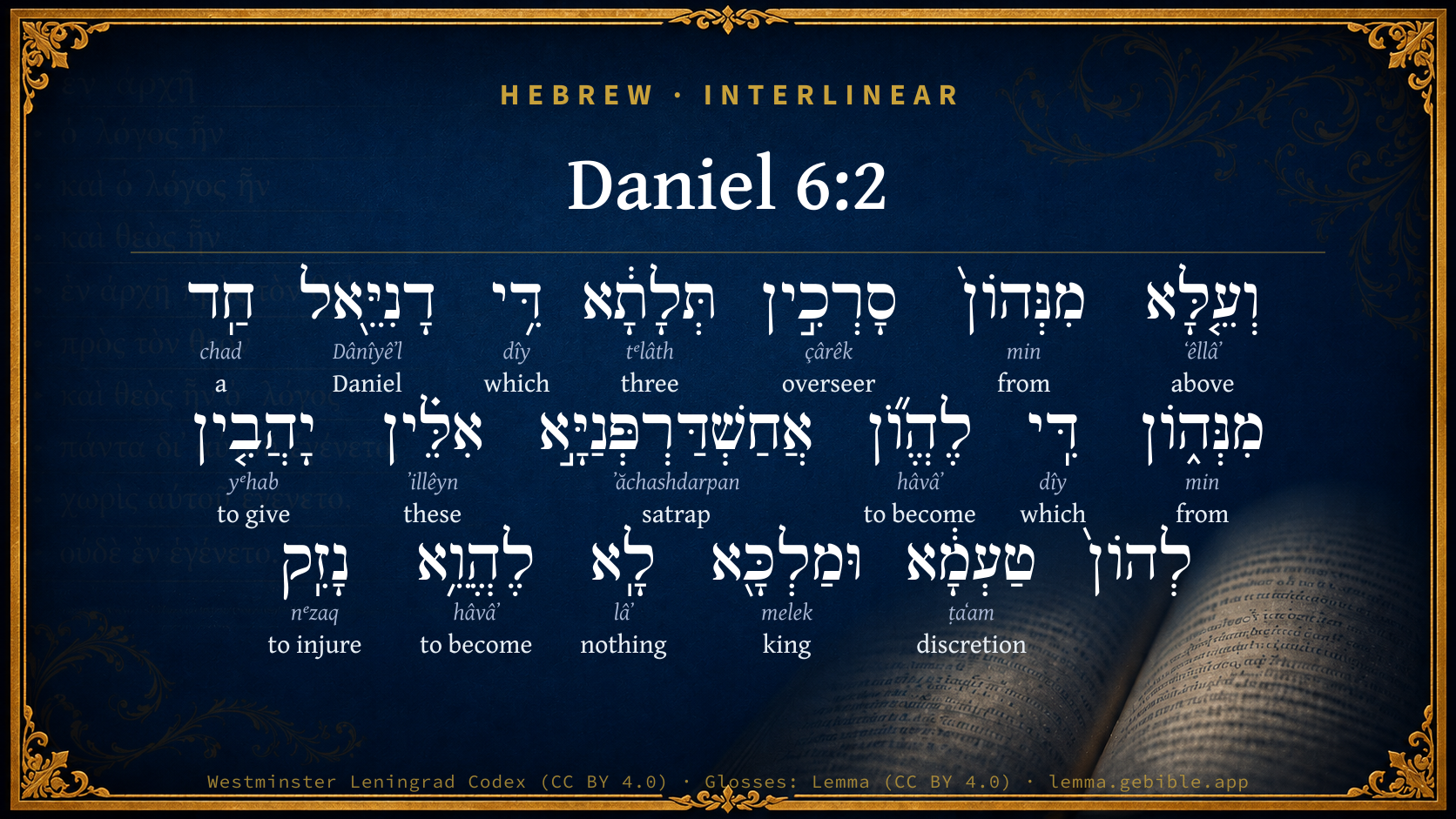
Daniel 6:2

Hebrew (Westminster Leningrad Codex) Daniel 6:2 appears in the Hebrew Old Testament. The text above is from the Westminster Leningrad Codex. Each word links to its Strong’s number, a concise gloss, and parsing drawn from the Open Scriptures Hebrew Bible morphology. Click any word for its full Brown-Driver-Briggs (BDB) entry.
Download image
Cite this verse

Daniel 6:2 (World English Bible). Public Domain. Lemma interlinear Bible study tool, https://lemma.gebible.app/v/daniel/6/2.

Show BibTeX & RIS
BibTeX
RIS
English Translation
and over them three presidents, of whom Daniel was one; that these satraps might give account to them, and that the king should have no damage.
World English Bible · Public Domain
Highlights
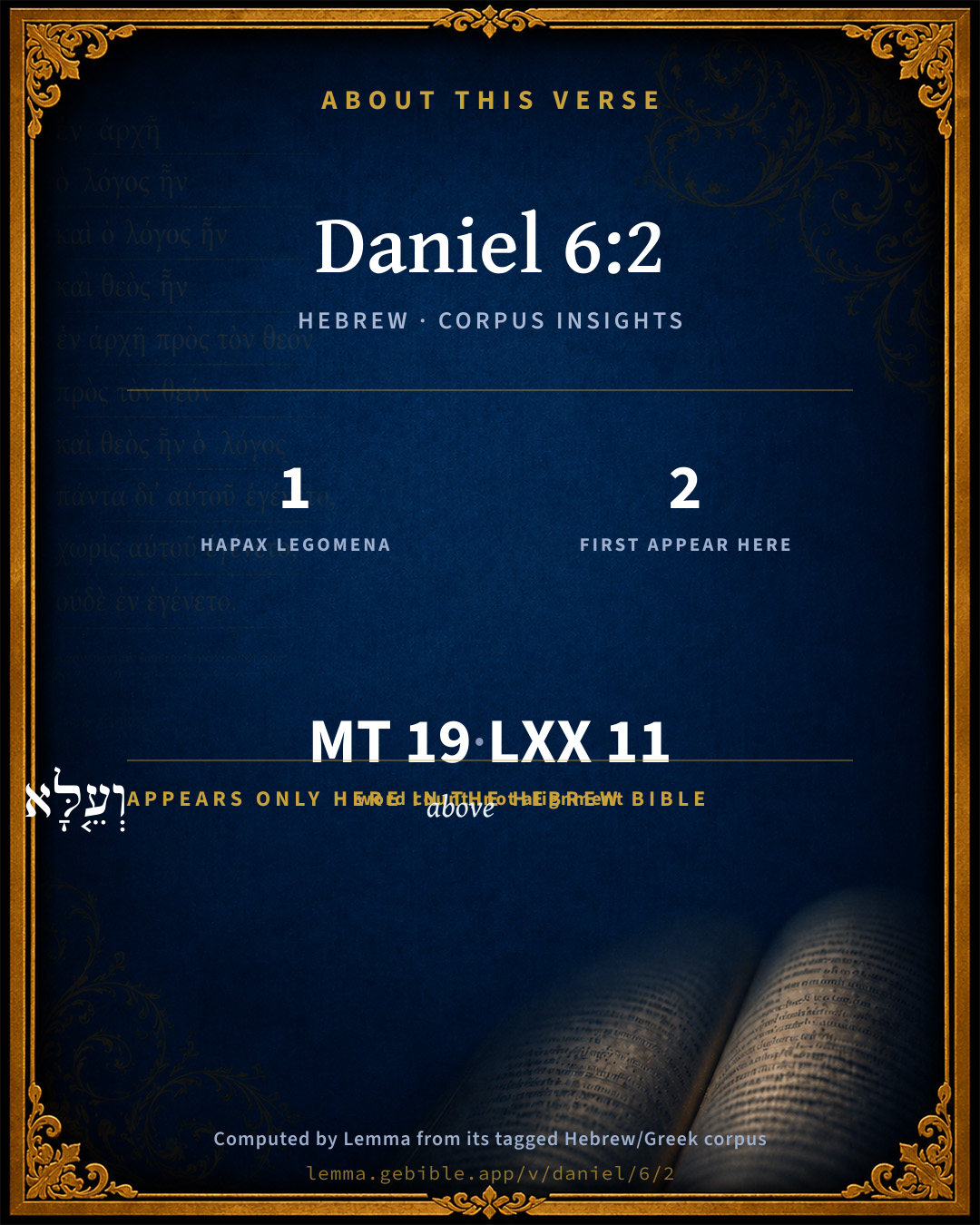
  • 1 hapax legomenon — only here in the Hebrew Bible
  • 2 first appearances in the Hebrew Bible
Full analysis ↓
Download a study sheet

One document with this verse’s original text, its word-by-word gloss line, the meaning frame, cross-references with their text, attributed commentary, and full source and license credits — printable, and it pastes into notes with its structure intact.

This verse Autodidact and up

Study sheet (.html) Plain text (.txt)

A passage Seminary Student

Up to 50 verses in one chapter. A passage sheet keeps up to 6 commentary sources and 12 cross-references per verse, in the order this page ranks them, and says so on the sheet whenever that leaves anything out. Ask for a single verse and you get the Autodidact verse sheet above.

Everything on this page stays free to read, with no account — the sheet is a download of what is already on screen, not access to it.

Want to remove ads? Support Godless Engineer
Compare translations 3

The same verse in 3 English versions, stacked beneath the original-language interlinear above. Click any original word for its lexicon entry.

Each is an independent rendering of the whole verse — the interlinear is not word-aligned to these translations.

Highlighted words mark where these versions differ — a whole-verse word diff, not a word-by-word alignment.

  • World English Bible Public Domain
    and over them three presidents, of whom Daniel was one; that these satraps might give account to them, and that the king should have no damage.
  • King James Version Public Domain
    And over these three presidents; of whom Daniel was first: that the princes might give accounts unto them, and the king should have no damage.
  • unfoldingWord Literal Text CC BY-SA 4.0
    Over them were three high officials, of whom Daniel was one, to whom these satraps should give account, so that the king might suffer no loss.

unfoldingWord Literal Text — © unfoldingWord, licensed CC BY-SA 4.0. Word-aligned USFM3 via Door43 (git.door43.org/unfoldingWord/en_ult).

Versions to compare (up to 4)

3 of 4 selected

Show all 18 translations

Every available English version of this verse, each an independent rendering of the whole verse.

  • World English Bible Public Domain
    and over them three presidents, of whom Daniel was one; that these satraps might give account to them, and that the king should have no damage.
  • Berean Standard Bible Public Domain
    and over them three administrators, including Daniel, to whom these satraps were accountable so that the king would not suffer loss.
  • Majority Standard Bible Public Domain
    and over them three administrators, including Daniel, to whom these satraps were accountable so that the king would not suffer loss.
  • King James Version Public Domain
    And over these three presidents; of whom Daniel was first: that the princes might give accounts unto them, and the king should have no damage.
  • American Standard Version (1901) Public Domain
    and over them three presidents, of whom Daniel was one; that these satraps might give account unto them, and that the king should have no damage.
  • Revised Version (1885) Public Domain
    and over them three presidents, of whom Daniel was one; that these satraps might give account unto them, and that the king should have no damage.
  • Geneva Bible (1599) Public Domain
    And ouer these, three rulers (of whome Daniel was one) that the gouernours might giue accompts vnto them, and the King should haue no domage.
  • Douay-Rheims (1899) Public Domain
    And three princes over them, of whom Daniel was one: that the governors might give an account to them, and the king might have no trouble.
  • Young's Literal Translation Public Domain
    and higher than they three presidents, of whom Daniel `is' first, that these satraps may give to them an account, and the king have no loss.
  • Literal Standard Version CC BY-SA 4.0
    and three presidents higher than they, of whom Daniel [is] first, that these satraps may give to them an account, and the king have no loss.
  • Unlocked Literal Bible CC BY-SA 4.0
    Over them there were three chief administrators, and Daniel was one of them. These chief administrators were appointed so that they might supervise the provincial governors, so that the king should suffer no loss.
  • unfoldingWord Literal Text CC BY-SA 4.0
    Over them were three high officials, of whom Daniel was one, to whom these satraps should give account, so that the king might suffer no loss.
  • Darby Bible Public Domain
    and over these, three presidents -- of whom Daniel was one -- to whom these satraps should render account, and that the king should suffer no loss.
  • World Messianic Bible Public Domain
    and over them three presidents, of whom Daniel was one, that these local governors might give account to them, and that the king should suffer no loss.
  • Webster's Bible Public Domain
    \\6:1\\It pleased Darius to set over the kingdom a hundred and twenty princes, who should be over the whole kingdom;
  • Free Bible Version CC BY-SA 4.0
    Three chief ministers were placed over them to look after the king's interests. Daniel was one of the three.
  • Bible in Basic English Public Domain
    Darius was pleased to put over the kingdom a hundred and twenty captains, who were to be all through the kingdom;
  • JPS Tanakh (1917) Public Domain
    (6-3) and over them three presidents, of whom Daniel was one; that these satraps might give account unto them, and that the king should have no damage.

Literal Standard Version (2020), Covenant Press — licensed CC BY-SA 4.0. Text via the HelloAO Bible API (eBible.org). Unlocked Literal Bible (unfoldingWord) — licensed CC BY-SA 4.0. Text via the HelloAO Bible API (eBible.org). unfoldingWord Literal Text — © unfoldingWord, licensed CC BY-SA 4.0. Word-aligned USFM3 via Door43 (git.door43.org/unfoldingWord/en_ult). Free Bible Version, Dr. Jonathan Gallagher — licensed CC BY-SA 4.0. Text via the HelloAO Bible API (eBible.org).

Word by word

More ways to search: Search by grammar → Find every occurrence → Compare this word →

Practice this passage: Drill this verse → Learn its vocabulary →

וְעֵ֤לָּא
ʻêllâʼ
H5924
“and · above”
Adjective, C + Adverb
Part of Speech
Adjective + Adverb
Full BDB Definition

Origin: from H5922

TWOT: 2909a

above
  1. מִנְּהוֹן֙ min H4481 “from · them” Adjective, R + Suffix, Personal, 3rd Person, Masculine, Plural
  2. סָרְכִ֣ין çârêk H5632 “overseers” Adjective, N, Common
  3. תְּלָתָ֔א tᵉlâth H8532 “three” Adjective, A, Common
  4. דִּ֥י dîy H1768 “which” Adjective, T
  5. דָנִיֵּ֖אל Dânîyêʼl H1841 “Daniel” Adjective, N
  6. חַֽד chad H2298 “a” Adjective, A, Common
  7. מִנְּה֑וֹן min H4481 “from · them” Adjective, R + Suffix, Personal, 3rd Person, Masculine, Plural
  8. דִּֽי dîy H1768 “which” Adjective, T
  9. לֶהֱוֺ֞ן hâvâʼ H1934 “to become” Adjective, V
  10. אֲחַשְׁדַּרְפְּנַיָּ֣א ʼăchashdarpan H324 “satraps · the” Adjective, N, Common + Particle, Definite Article
  11. אִלֵּ֗ין ʼillêyn H459 “these” Adjective, P
  12. יָהֲבִ֤ין yᵉhab H3052 “giving” Adjective, V
  13. טַעְמָ֔א ṭaʻam H2941 “discretion · the” Adjective, N, Common + Particle, Definite Article
  14. וּמַלְכָּ֖א melek H4430 “and · king · the” Adjective, C + Noun, Common, Masculine, Singular, Determined + Particle, Definite Article
  15. לָֽא lâʼ H3809 “nothing” Adjective, T
  16. לֶהֱוֵ֥א hâvâʼ H1934 “to become” Adjective, V
  17. נָזִֽק nᵉzaq H5142 “injuring” Adjective, V

About this verse

These counts appear in no published source. They are computed here, from the morphology-tagged text and Lemma’s own curated glosses. What Lemma adds →

19
words
15
distinct lemmas
Prophets
section

Notable vocabulary

1 hapax legomenon — a word that appears only here in the entire Hebrew Bible:

  • וְעֵ֤לָּא above H5924

First appearance in Scripture

These words make their first canonical appearance in the Hebrew Bible here:

  • וְעֵ֤לָּא above H5924
  • סָרְכִ֣ין overseer H5632

Shared distinctive vocabulary

נָזִֽק to injure H5142 occurs in 4 verses of the Hebrew Bible. Also found in:

Grammatical profile

  • 15 adjectives
  • 1 adverb
  • 3 particles

Repetition

Words recur within this verse — often emphatic in Hebrew:

  • לֶהֱוֺ֞ן to become H1934 ×2
  • מִנְּהוֹן֙ from H4481 ×2
  • דִּ֥י which H1768 ×2

Hebrew & Septuagint length

In English translation the verse runs 26 words from the Hebrew and 25 from the Septuagint (LXX English) — closely comparable.

A rough comparison of the two English renderings, which tokenize alike — not a word-level alignment.

Word counts can differ between the Hebrew and the Greek without any difference in meaning — e.g. the Hebrew direct-object marker אֵת has no separate Greek word, and Greek often adds the article ὁ.

In the original languages it is 19 Hebrew tokens and 11 Greek tokens — but the two are counted differently (Hebrew bundles its prefixes and suffixes into one token; the Greek is in lemma form), so that isn’t a like-for-like length.

Cross-references

12

Topical passages linked to Daniel 6:2 in the Treasury of Scripture Knowledge — connected by theme and wording, ordered by reader-vote popularity; previews shown in the World English Bible.

  • Ezra 4:22 Take heed that you not be slack herein: why should damage grow to the hurt of the kings?
  • Esther 7:4 for we are sold, I and my people, to be destroyed, to be slain, and to perish. But if we had been sold for bondservants and bondmaids, I had held my peace, although the adversary could not have compensated for the king's damage.
  • Daniel 2:48–49 Then the king made Daniel great, and gave him many great gifts, and made him to rule over the whole province of Babylon, and to be chief governor over all the wise men of Babylon.
  • Daniel 5:16 But I have heard of you, that you can give interpretations, and dissolve doubts; now if you can read the writing, and make known to me the interpretation of it, you shall be clothed with purple, and have a chain of gold about your neck, and shall be the third ruler in the kingdom.
  • Daniel 5:29 Then commanded Belshazzar, and they clothed Daniel with purple, and put a chain of gold about his neck, and made proclamation concerning him, that he should be the third ruler in the kingdom.
  • 1 Samuel 2:30 Therefore Yahweh, the God of Israel, says, I said indeed that your house, and the house of your father, should walk before me forever: but now Yahweh says, Be it far from me; for those who honor me I will honor, and those who despise me shall be lightly esteemed.
  • Proverbs 3:16 Length of days is in her right hand. In her left hand are riches and honor.
  • Proverbs 26:6 One who sends a message by the hand of a fool Is cutting off feet and drinking violence.
  • Matthew 18:23 Therefore the Kingdom of Heaven is like a certain king, who wanted to reconcile accounts with his servants.
  • Luke 16:2 He called him, and said to him, 'What is this that I hear about you? Give an accounting of your management, for you can no longer be manager.'
  • Luke 19:13–27 He called ten servants of his, and gave them ten mina coins, and told them, 'Conduct business until I come.'
  • 1 Corinthians 4:2 Here, moreover, it is required of stewards, that they be found faithful.

Cross-references courtesy of OpenBible.info (CC BY 4.0).

Hebrew and Greek witnesses Masoretic Hebrew ↔ Greek Septuagint

The same verse in the two great witnesses to the Old Testament, shown verse-for-verse.

These are two independent witnesses, not word-aligned to each other, and the Septuagint is shown in lemma (dictionary) form.

Hebrew Daniel 6:2 Masoretic · Westminster Leningrad Codex

וְעֵ֤לָּא מִנְּהוֹן֙ סָרְכִ֣ין תְּלָתָ֔א דִּ֥י דָנִיֵּ֖אל חַֽד מִנְּה֑וֹן דִּֽי לֶהֱוֺ֞ן אֲחַשְׁדַּרְפְּנַיָּ֣א אִלֵּ֗ין יָהֲבִ֤ין לְהוֹן֙ טַעְמָ֔א וּמַלְכָּ֖א לָֽא לֶהֱוֵ֥א נָזִֽק

and over them three presidents, of whom Daniel was one; that these satraps might give account to them, and that the king should have no damage.

World English Bible · Public Domain

Greek LXX Daniel 6:2 Septuagint · lemma form

καί καταἵστημι σατράπης ἑκατόν εἴκοσι ἑπτά ἐπί πᾶς ὁ βασιλεία αὐτός

and over them three governors, of whom one was, Daniel; for the satraps to give account to them, that the king should not be troubled.

LXX2012 (modern English Septuagint) · Public Domain

Hebrew: Westminster Leningrad Codex (CC BY 4.0). Greek: Septuagint (public domain); English from LXX2012 (modern English Septuagint) (Public Domain). How the Septuagint differs from the Hebrew →

Commentary

Notes on Daniel 6:2 from classic Christian and Jewish commentators (each source and its license shown beneath its notes). The classic Christian expositions comment on the surrounding passage and are grouped to its opening verse, so a note may address several verses; the Jewish commentaries on the Tanakh (Rashi and others) are per-verse, so they appear only where the commentator wrote on this verse.

Lemma curates 59 commentaries, every one of them public domain or Creative Commons licensed, each selected and text-cleaned for this edition rather than reprinted as found. About our sources →

The Cambridge Bible for Schools and Colleges

gen. ed. J. J. S. Perowne

2. three presidents] Aram. sârak, prob. a form derived from the Pers. sâr, ‘head,’ ‘chief,’ ‘prince.’ In the O.T. it is found only in this chap. (Dan_6:2-4; Dan_6:6-7): in the Targums it stands often for the Heb. shôṭçr, ‘officer,’ as Exo_5:6; Exo_5:10; Deu_1:15; Deu_20:5; Jos_1:10; Pro_6:7 (‘overseer’).

was first] was one: so R.V. rightly.

that these satraps might give account unto them] strictly, might be giving account, i.e. might be permanently answerable to them, that the interests and revenues of the king were properly guarded. No such officials are mentioned elsewhere,—except in so far as they may be regarded as the successors of the three Babylonian ministers, presupposed in Dan_5:7; Dan_5:16; Dan_5:29. Darius Hystaspis, as a check upon his satraps, appointed in each satrapy an independent military commandant, and a royal ‘scribe,’ or secretary, whose business it was to report to the king the doings of the satrap (Hdt. iii. 128; Rawl., Anc. Mon.4 iii. 424).

The Cambridge Bible for Schools and Colleges (gen. ed. J. J. S. Perowne; Cambridge University Press, 1878–1918) — public domain. Text from a community e-Sword module.

Trapp's Complete Commentary

John Trapp

Dan 6:2 And over these three presidents; of whom Daniel [was] first: that the princes might give accounts unto them, and the king should have no damage.

Ver. 2. And over these three presidents.] Triumviros sive tres rationales. Three to whom the rest should audit and be accountable.

And the king should have no damage.] In his rights and in his revenues, which were, saith Herodotus, yearly fourteen thousand five hundred and threescore Euboian talents, raised out of the several satrapies.

John Trapp, A Commentary or Exposition upon All the Books of the Old and New Testament (1647–1656) — public domain. Text from a community e-Sword module.

Joseph Benson's Commentary

Dan 6:2-3. And over these three presidents; of whom Daniel was first —

He had been appointed one of the principal officers of state by Belshazzar, Dan 5:29. The office to which he was now advanced seems to have been of the same sort with that conferred on Joseph by Pharaoh, Gen 41:41. Grotius thinks these eparchs were like the præfecti prætorio in the latter part of the Roman empire. That the princes might give accounts unto them — Might lay before them the state of the public accounts. They doubtless also received appeals from the princes, or complaints against them, in case of mal-administration. And the king should have no damage — That he might not sustain any loss in his revenue, and that the power he delegated to the princes might not be abused to the oppression of the subjects; for by that a king, whether he thinks so or not, receives real damage; both as it alienates the affections of his people from him, and provokes the displeasure of God against him. Daniel was preferred, because an excellent spirit was in him — Besides that spirit of uncommon wisdom and sagacity which was in Daniel, he had great experience in public affairs, it being now sixty-five years since he was first advanced by Nebuchadnezzar, Dan 2:48. It is no wonder, therefore, that Darius should have thoughts of putting the chief management of the whole empire into his hands.

Joseph Benson's Commentary on the Old and New Testaments (1811–1818) — public domain. Text from a community e-Sword module.

Tyndale Open Study Notes

Tyndale Open Resources

6:2 The three administrators placed over the whole territory reported directly to the king. • and protect the king’s interests: Rebels could bring down the empire, so these administrators had to be absolutely trustworthy.

Tyndale Open Study Notes — © Tyndale Open Resources, licensed CC BY-SA 4.0. Text via the HelloAO Bible API.

Geneva Bible (1599)

Geneva Bible translators

Or, not be troubled.

Geneva Bible (1599) marginal notes — public domain. Text via Bolls.life.

Adam Clarke's Commentary

Verse 2. Three presidents] Each having forty of these presidents accountable to him for their administration.

Daniel was first] As being established over that part where was the seat of government. He was confirmed in his offices by Darius.

Adam Clarke's Commentary on the Bible (1810–1826) — public domain. Text from a community e-Sword/MySword module.

Ellicott's Commentary for English Readers

(2) Three presidents.—See Note on Dan_5:7. If there had been a triumvirate in Babylon, Darius continued the form of government which he found already existing, and retained Daniel in the official post to which he had been promoted by Belshazzar.

A Bible Commentary for English Readers, edited by Charles John Ellicott (1878–1897) — public domain. Text from a community e-Sword module.

John Gill's Exposition

And over these three presidents,.... To whom the hundred and twenty princes were accountable for their conduct, and to whom the people might apply for redress of grievances, if oppressed; perhaps the whole empire was divided into three greater parts, and each part had forty provinces in it, and over it a president or deputy of the king; to whom the princes of each province gave in the account of what they received for the king, and what use they made of it:

(of whom Daniel was the first:) or "one" (u), who was now an old man, having been about seventy years in Babylon, and had had a large experience of the affairs of civil government, being advanced in the times of Nebuchadnezzar to high posts; and very probably Darius had heard of the wisdom of Daniel before he came to the kingdom, as well as the king of Tyre, Eze 28:3 and might be informed of his prediction of Belshazzar's death, and the change of the empire: and of Belshazzar's promise to make him the third ruler in the kingdom; and he might also himself observe in him an uncommon sagacity and fitness for business of this sort. Josephus (w) says, that Darius took Daniel with him into Media, and made him one of the three presidents; and indeed no mention is made in this history of the nobles of Babylon, but only of the Medes and Persians:

that the princes might give account unto them, and the king should have no damage: or loss in his revenues, through the fraud and bad management of the princes of the provinces; since they might be discovered and checked by the presidents, who were to audit their accounts: or, "have no trouble" (x); in looking over and passing the accounts of the princes.

(u) Sept.; "unus", V. L. Syr. Ar. Pagninus, Montanus, Piscator, Cocceius, Michaelis. (w) Antiqu. l. 10. c. 11. sect. 4. (x) , Sept.; "ne rex molestia afficeretur", Pagninus; "ut rex illo levaretur gravamine", Munster.

John Gill's Exposition of the Whole Bible (1746–1763) — public domain (CC PDM 1.0). Text via the HelloAO Bible API.

Albert Barnes' Notes on the Bible

And over these, three presidents - סרכין sârekı̂yn. This word is found only in the plural. The etymology is uncertain, but its meaning is not doubtful. The word president expresses it with sufficient accuracy, denoting a high officer that presided over others. It is not improbable that these presided over distinct departments, corresponding somewhat to what are now called “secretaries” - as Secretaries of State, of the Treasury, of Foreign Affairs, etc., though this is not particularly specified.

Of whom Daniel was first - First in rank. This office he probably held from the rank which he was known to have occupied under the kings of Babylon, and on account of his reputation for ability and integrity.

That the princes might give accounts unto them - Be immediately responsible to them; the accounts of their own administration, and of the state of the empire.

And the king should have no damage - Either in the loss of revenue, or in any maladministration of the affairs. Compare Ezr 4:13. “They pay not toll, tribute, and custom, and so thou shalt endamage the revenue of the kings.” The king was regarded as the source of all power, and as in fact the supreme proprietor of the realm, and any malfeasance or malversation in office was regarded as an injury to him.

Albert Barnes' Notes on the Bible (1834–1885) — public domain. Text from a community e-Sword/MySword module.

Matthew Poole's English Annotations

Of whom Daniel was first: this was Belshazzar’s promise to Daniel, he should be the third ruler in the kingdom, Dan 5:7,16,29; the first was general of the army, the second president of the palace, the third of the land and provinces.

Matthew Poole's English Annotations on the Holy Bible (1683–1685) — public domain. Text from a community e-Sword/MySword module.

Whedon's Commentary on the Bible

Daniel D. Whedon

2, 3. Over these subordinate governors presidents were appointed, “of whom Daniel was one,” to see that the collection of the royal revenues, etc., was properly attended to; and presently “the king” (Gubaru?) even considered placing him over the whole realm — the province of Babylon.

Daniel D. Whedon (gen. ed.), Commentary on the Old and New Testaments (1874–1909) — public domain. Text from a community e-Sword module.

John Wesley's Explanatory Notes

Daniel was first - Belshazzar's promise to Daniel was, that he should be the third ruler in the kingdom, chap. v, 7, 16, 29. The first was general of the army, the second president of the palace, the third of the land and provinces.

John Wesley, Explanatory Notes Upon the Whole Bible (1754–1765) — public domain. Text via the GEBible commentary corpus.

Lesson kit

Teaching starters — assembled from the data on this page, not authored interpretation. Every prompt links to the verse data it draws on. Edit before teaching.

Daniel, in the Prophets, opens this verse with 19 words (15 distinct Hebrew lemmas). Its most distinctive word is ʻêllâʼ (“above”). A historical commentator’s framing appears above. Read the whole chapter for the surrounding context.

Discussion questions

  1. The word ʻêllâʼ carries the sense “above.” How does it shape the verse?
  2. 1 word here appears nowhere else in the Hebrew Bible. Why might the author reach for such rare wording?
  3. 2 words make their first appearance in Scripture here. What does this debut establish?
  4. How does Ezra 4:13, which shares the word «to injure», read alongside this verse?
  5. What does the repetition of “to become” (2× in this one verse) do in this verse?
  6. The translations on this page render this verse differently — a whole-verse word diff, not a word-by-word alignment. What might account for the different wordings?
  7. Compare how The Cambridge Bible for Schools and Colleges and Trapp's Complete Commentary read this verse. Where do they agree or differ?

Things to notice

  • 1 word in this verse appears nowhere else in the Hebrew Bible.
  • 2 words make their first canonical appearance in Scripture here.
  • This verse counts 19 Hebrew ↔ 11 Greek words.
  • These translations choose different wording for 13 words in this verse.
  • “to become” occurs 2× in this single verse.

Reading settings

Reading text

Shown beneath each verse's original-language words.

Old Testament
Old Testament edition

Read the OT as the Masoretic Hebrew (MT) or the Greek Septuagint (LXX).

English shown for the Greek Septuagint (in the Hebrew ↔ Greek comparison).

Comparing translations? Open the Compare panel on any verse page to stack up to four side by side.