
Daniel 5:21

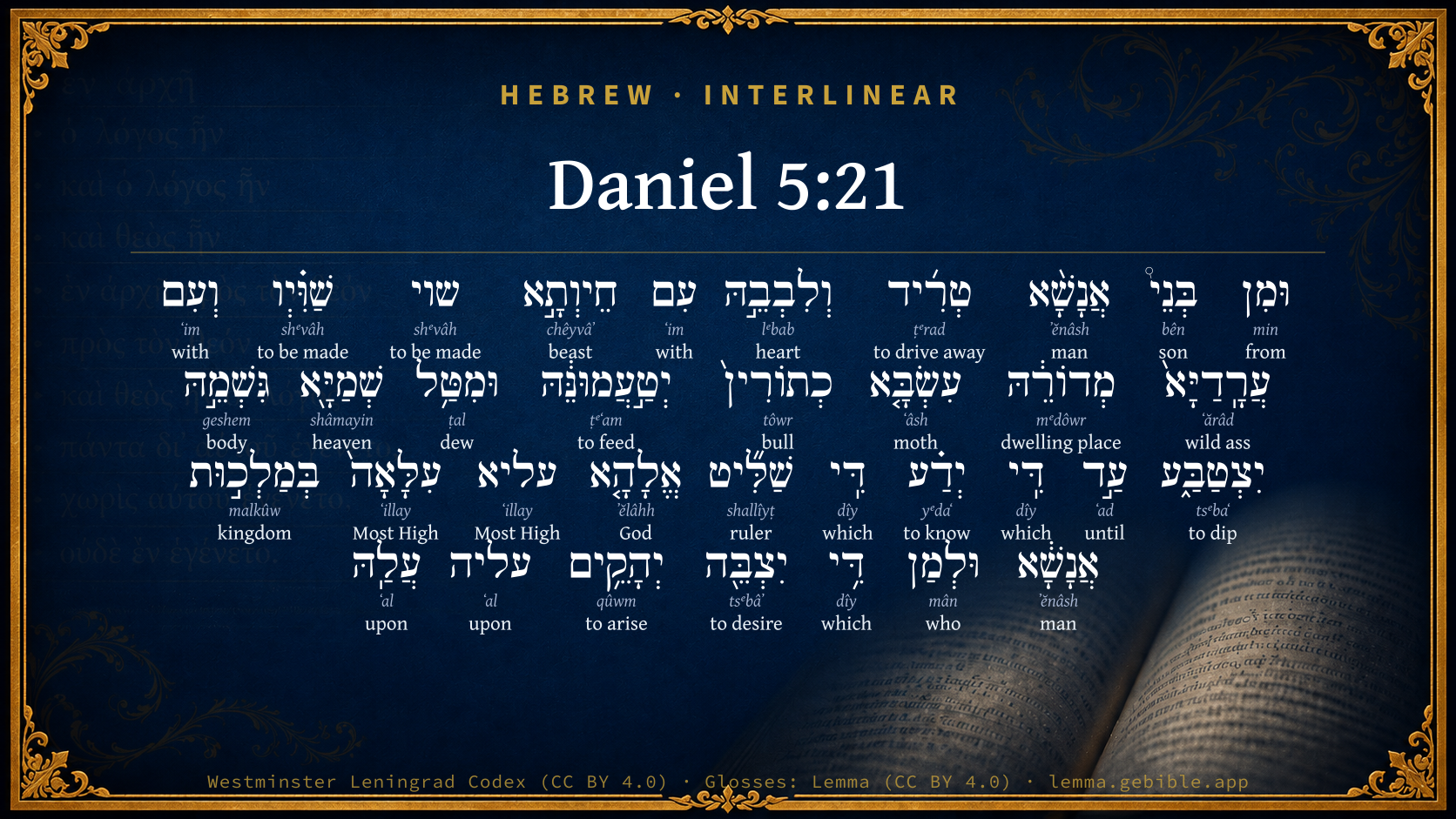
Hebrew (Westminster Leningrad Codex) Daniel 5:21 appears in the Hebrew Old Testament. The text above is from the Westminster Leningrad Codex. Each word links to its Strong’s number, a concise gloss, and parsing drawn from the Open Scriptures Hebrew Bible morphology. Click any word for its full Brown-Driver-Briggs (BDB) entry.
Download image
Cite this verse

Daniel 5:21 (World English Bible). Public Domain. Lemma interlinear Bible study tool, https://lemma.gebible.app/v/daniel/5/21.

Show BibTeX & RIS
BibTeX
RIS
English Translation
and he was driven from the sons of men, and his heart was made like the animals', and his dwelling was with the wild donkeys; he was fed with grass like oxen, and his body was wet with the dew of the sky; until he knew that the Most High God rules in the kingdom of men, and that he sets up over it whoever he will.
World English Bible · Public Domain
Highlights
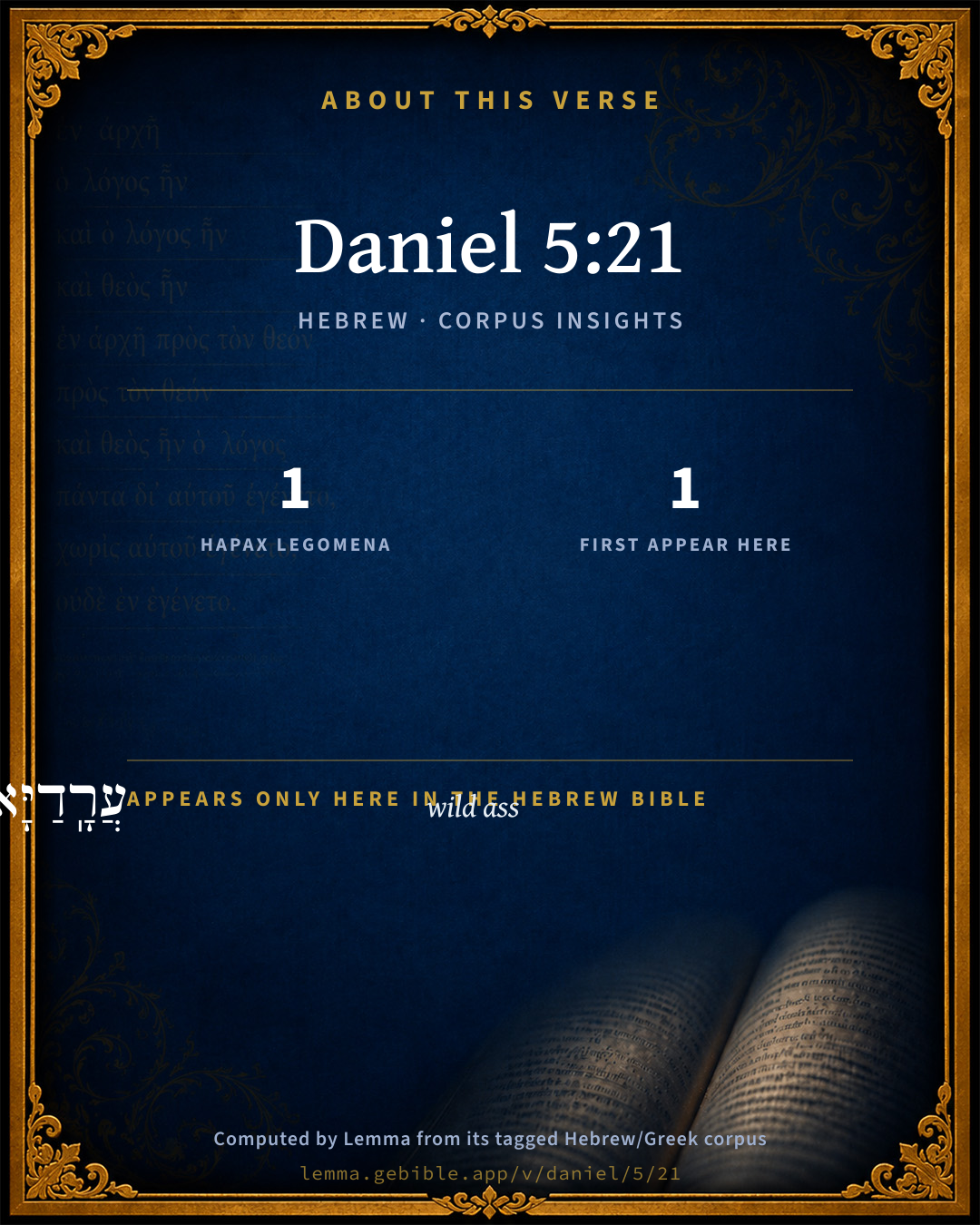
  • 1 hapax legomenon — only here in the Hebrew Bible
  • 1 first appearance in the Hebrew Bible
Full analysis ↓
Download a study sheet

One document with this verse’s original text, its word-by-word gloss line, the meaning frame, cross-references with their text, attributed commentary, and full source and license credits — printable, and it pastes into notes with its structure intact.

This verse Autodidact and up

Study sheet (.html) Plain text (.txt)

A passage Seminary Student

Up to 50 verses in one chapter. A passage sheet keeps up to 6 commentary sources and 12 cross-references per verse, in the order this page ranks them, and says so on the sheet whenever that leaves anything out. Ask for a single verse and you get the Autodidact verse sheet above.

Everything on this page stays free to read, with no account — the sheet is a download of what is already on screen, not access to it.

Want to remove ads? Support Godless Engineer
Compare translations 3

The same verse in 3 English versions, stacked beneath the original-language interlinear above. Click any original word for its lexicon entry.

Each is an independent rendering of the whole verse — the interlinear is not word-aligned to these translations.

Highlighted words mark where these versions differ — a whole-verse word diff, not a word-by-word alignment.

  • World English Bible Public Domain
    and he was driven from the sons of men, and his heart was made like the animals', and his dwelling was with the wild donkeys; he was fed with grass like oxen, and his body was wet with the dew of the sky; until he knew that the Most High God rules in the kingdom of men, and that he sets up over it whoever he will.
  • King James Version Public Domain
    And he was driven from the sons of men; and his heart was made like the beasts, and his dwelling was with the wild asses: they fed him with grass like oxen, and his body was wet with the dew of heaven; till he knew that the most high God ruled in the kingdom of men, and that he appointeth over it whomsoever he will.
  • unfoldingWord Literal Text CC BY-SA 4.0
    He was driven away from the sons of mankind, and his mind was made like that of an animal, and his dwelling was with the wild donkeys. He was given grass to eat like an ox. His body was wet with the dew of heaven until he recognized that the Most High God is ruler over the kingdom of mankind and that he sets over it whom he wishes.

unfoldingWord Literal Text — © unfoldingWord, licensed CC BY-SA 4.0. Word-aligned USFM3 via Door43 (git.door43.org/unfoldingWord/en_ult).

Versions to compare (up to 4)

3 of 4 selected

Show all 18 translations

Every available English version of this verse, each an independent rendering of the whole verse.

  • World English Bible Public Domain
    and he was driven from the sons of men, and his heart was made like the animals', and his dwelling was with the wild donkeys; he was fed with grass like oxen, and his body was wet with the dew of the sky; until he knew that the Most High God rules in the kingdom of men, and that he sets up over it whoever he will.
  • Berean Standard Bible Public Domain
    He was driven away from mankind, and his mind was like that of a beast. He lived with the wild donkeys and ate grass like an ox, and his body was drenched with the dew of heaven until he acknowledged that the Most High God rules over the kingdom of mankind, setting over it whom He wishes.
  • Majority Standard Bible Public Domain
    He was driven away from mankind, and his mind was like that of a beast. He lived with the wild donkeys and ate grass like an ox, and his body was drenched with the dew of heaven until he acknowledged that the Most High God rules over the kingdom of mankind, setting over it whom He wishes.
  • King James Version Public Domain
    And he was driven from the sons of men; and his heart was made like the beasts, and his dwelling was with the wild asses: they fed him with grass like oxen, and his body was wet with the dew of heaven; till he knew that the most high God ruled in the kingdom of men, and that he appointeth over it whomsoever he will.
  • American Standard Version (1901) Public Domain
    and he was driven from the sons of men, and his heart was made like the beasts', and his dwelling was with the wild asses; he was fed with grass like oxen, and his body was wet with the dew of heaven; until he knew that the Most High God ruleth in the kingdom of men, and that he setteth up over it whomsoever he will.
  • Revised Version (1885) Public Domain
    and he was driven from the sons of men; and his heart was made like the beasts, and his dwelling was with the wild asses; he was fed with grass like oxen, and his body was wet with the dew of heaven: until he knew that the Most High God ruleth in the kingdom of men, and that he setteth up over it whomsoever he will.
  • Geneva Bible (1599) Public Domain
    And hee was driuen from the sonnes of men, and his heart was made like the beastes, and his dwelling was with the wilde asses: they fed him with grasse like oxen, and his body was wet with the dewe of the heauen, till he knewe, that the most high God bare rule ouer the kingdome of men, and that he appointeth ouer it, whomsoeuer he pleaseth.
  • Douay-Rheims (1899) Public Domain
    And he was driven out from the sons of men, and his heart was made like the beasts, and his dwelling was with the wild asses, and he did eat grass like an ox, and his body was wet with the dew of heaven: till he knew that the most High ruled in the kingdom of men, and that he will set over it whomsoever it shall please him.
  • Young's Literal Translation Public Domain
    and from the sons of men he is driven, and his heart with the beasts hath been like, and with the wild asses `is' his dwelling; the herb like oxen they cause him to eat, and by the dew of the heavens is his body wet, till that he hath known that God Most High is ruler in the kingdom of men, and whom He willeth He raiseth up over it.
  • Literal Standard Version CC BY-SA 4.0
    and he is driven from the sons of men, and his heart has been like with the beasts, and with the wild donkeys [is] his dwelling; they cause him to eat the herb like oxen, and by the dew of the heavens is his body wet, until he has known that God Most High is ruler in the kingdom of men, and whom He wills He raises up over it.
  • Unlocked Literal Bible CC BY-SA 4.0
    He was driven away from humanity, he had the mind of an animal, and he lived with the wild donkeys. He ate grass like an ox. His body was wet with the dew from the heavens until he learned that the Most High God rules over the kingdoms of people and that he sets over them anyone he wishes.
  • unfoldingWord Literal Text CC BY-SA 4.0
    He was driven away from the sons of mankind, and his mind was made like that of an animal, and his dwelling was with the wild donkeys. He was given grass to eat like an ox. His body was wet with the dew of heaven until he recognized that the Most High God is ruler over the kingdom of mankind and that he sets over it whom he wishes.
  • Darby Bible Public Domain
    and he was driven from the sons of men, and his heart was made like the beasts, and his dwelling was with the wild asses; they fed him with grass like oxen, and his body was bathed with the dew of heaven; till he knew that the Most High God ruleth over the kingdom of men, and that he appointeth over it whomsoever he will.
  • World Messianic Bible Public Domain
    He was driven from the sons of men, and his heart was made like the animals’, and his dwelling was with the wild donkeys. He was fed with grass like oxen, and his body was wet with the dew of the sky, until he knew that the Most High God rules in the kingdom of men, and that he sets up over it whomever he will.
  • Webster's Bible Public Domain
    And he was driven from the sons of men; and his heart was made like the beasts, and his dwelling was with the wild asses: they fed him with grass like oxen, and his body was wet with the dew of heaven; till he knew that the most high God ruleth in the kingdom of men, and that he appointeth over it whomsoever he will.
  • Free Bible Version CC BY-SA 4.0
    He was driven away from human society and his mind became like that of an animal. He lived with the wild donkeys and ate grass like cattle, and he was soaked with the dew of heaven until he acknowledged that the Most High rules over human kingdoms, and that he gives them to anyone he chooses.
  • Bible in Basic English Public Domain
    And he was sent out from among the sons of men; and his heart was made like the beasts', and he was living with the asses of the fields; he had grass for his food like the oxen, and his body was wet with the dew of heaven, till he was certain that the Most High is ruler in the kingdom of men, and gives power over it to anyone at his pleasure.
  • JPS Tanakh (1917) Public Domain
    and he was driven from the sons of men, and his heart was made like the beasts, and his dwelling was with the wild asses; he was fed with grass like oxen, and his body was wet with the dew of heaven; until he knew that God Most High ruleth in the kingdom of men, and that He setteth up over it whomsoever He will.

Literal Standard Version (2020), Covenant Press — licensed CC BY-SA 4.0. Text via the HelloAO Bible API (eBible.org). Unlocked Literal Bible (unfoldingWord) — licensed CC BY-SA 4.0. Text via the HelloAO Bible API (eBible.org). unfoldingWord Literal Text — © unfoldingWord, licensed CC BY-SA 4.0. Word-aligned USFM3 via Door43 (git.door43.org/unfoldingWord/en_ult). Free Bible Version, Dr. Jonathan Gallagher — licensed CC BY-SA 4.0. Text via the HelloAO Bible API (eBible.org).

Word by word

More ways to search: Search by grammar → Find every occurrence → Compare this word →

Practice this passage: Drill this verse → Learn its vocabulary →

עֲרָֽדַיָּא֙
ʻărâd
H6167
“wild asses · the”
Adjective, N, Common + Particle, Definite Article
Part of Speech
Adjective + Particle
Type
Definite Article
Full BDB Definition

Origin: corresponding to H6171

TWOT: 2928

wild ass
  1. וּמִן min H4481 “and · from” Adjective, C + Preposition
  2. בְּנֵי֩ bên H1123 “sons of” Adjective, N, Common
  3. אֲנָשָׁ֨א ʼĕnâsh H606 “man · the” Adjective, N, Common + Particle, Definite Article
  4. טְרִ֜יד ṭᵉrad H2957 “to drive away” Adjective, V, Plural
  5. וְלִבְבֵ֣הּ lᵉbab H3825 “and · heart · his” Adjective, C + Noun, Common, Masculine, Singular, Construct + Suffix, Personal, 3rd Person, Masculine, Singular
  6. עִם ʻim H5974 “with” Adjective, R
  7. חֵיוְתָ֣א chêyvâʼ H2423 “beast · the” Adjective, N, Common + Particle, Definite Article
  8. שוי shᵉvâh H7739 “to be made” Adjective, V, Plural
  9. שַׁוִּ֗יְו shᵉvâh H7739 “to be made” Adjective, V, Plural
  10. וְעִם ʻim H5974 “and · with” Adjective, C + Preposition
  11. מְדוֹרֵ֔הּ mᵉdôwr H4070 “dwelling place · his” Adjective, N, Common + Suffix, Personal, 3rd Person, Masculine, Singular
  12. עִשְׂבָּ֤א ʻâsh H6211 “moth · the” Adjective, N, Common + Particle, Definite Article
  13. כְתוֹרִין֙ tôwr H8450 “like/as · bulls” Adjective, R + Noun, Common, Masculine, Plural, Absolute
  14. יְטַ֣עֲמוּנֵּ֔הּ ṭᵉʻam H2939 “to feed · him” Adjective, V + Suffix, Personal, 3rd Person, Masculine, Singular
  15. וּמִטַּ֥ל ṭal H2920 “and · from · dew of” Adjective, C + Preposition + Noun, Common, Masculine, Singular, Construct
  16. שְׁמַיָּ֖א shâmayin H8065 “heaven(s) · the” Adjective, N, Common + Particle, Definite Article
  17. גִּשְׁמֵ֣הּ geshem H1655 “body · his” Adjective, N, Common + Suffix, Personal, 3rd Person, Masculine, Singular
  18. יִצְטַבַּ֑ע tsᵉbaʻ H6647 “to dip” Adjective, V
  19. עַ֣ד ʻad H5705 “until” Adjective, R
  20. דִּֽי dîy H1768 “which” Adjective, T
  21. יְדַ֗ע yᵉdaʻ H3046 “to know” Adjective, V, Plural
  22. דִּֽי dîy H1768 “which” Adjective, T
  23. שַׁלִּ֞יט shallîyṭ H7990 “ruler” Adjective, A
  24. אֱלָהָ֤א ʼĕlâhh H426 “God · the” Adjective, N, Common + Particle, Definite Article
  25. עליא ʻillay H5943 “Most High · the” Adjective, A + Particle, Definite Article
  26. עִלָּאָה֙ ʻillay H5943 “Most High · the” Adjective, A + Particle, Definite Article
  27. בְּמַלְכ֣וּת malkûw H4437 “in/at · kingdom of” Adjective, R + Noun, Common, Feminine, Singular, Construct
  28. אֲנָשָׁ֔א ʼĕnâsh H606 “man · the” Adjective, N, Common + Particle, Definite Article
  29. וּלְמַן mân H4479 “and · to/for · who” Adjective, C + Preposition + Pronoun, Indefinite, 3rd Person, Common, Singular
  30. דִּ֥י dîy H1768 “which” Adjective, P, Feminine, Construct
  31. יִצְבֵּ֖ה tsᵉbâʼ H6634 “to desire” Adjective, V
  32. יְהָקֵ֥ים qûwm H6966 “to arise” Adjective, V
  33. עליה ʻal H5922 “upon · it” Adjective, R + Suffix, Personal, 3rd Person, Common, Singular
  34. עֲלַֽהּ ʻal H5922 “upon · it” Adjective, R + Suffix, Personal, 3rd Person, Common, Singular

About this verse

These counts appear in no published source. They are computed here, from the morphology-tagged text and Lemma’s own curated glosses. What Lemma adds →

35
words
28
distinct lemmas
Prophets
section

Notable vocabulary

1 hapax legomenon — a word that appears only here in the entire Hebrew Bible:

  • עֲרָֽדַיָּא֙ wild ass H6167

First appearance in Scripture

This word makes its first canonical appearance in the Hebrew Bible here:

  • עֲרָֽדַיָּא֙ wild ass H6167

Shared distinctive vocabulary

שוי to be made H7739 occurs in 2 verses of the Hebrew Bible. Also found in:

Grammatical profile

  • 4 nouns
  • 19 adjectives
  • 1 pronoun
  • 2 prepositions
  • 9 particles

Repetition

Words recur within this verse — often emphatic in Hebrew:

  • אֲנָשָׁ֨א man H606 ×2
  • שוי to be made H7739 ×2
  • עליא Most High H5943 ×2
  • עליה upon H5922 ×2
  • דִּֽי which H1768 ×3
  • עִם with H5974 ×2

Hebrew & Septuagint length

In English translation the verse runs 67 words from the Hebrew and 70 from the Septuagint (LXX English) — closely comparable.

A rough comparison of the two English renderings, which tokenize alike — not a word-level alignment.

Word counts can differ between the Hebrew and the Greek without any difference in meaning — e.g. the Hebrew direct-object marker אֵת has no separate Greek word, and Greek often adds the article ὁ.

Cross-references

9

Topical passages linked to Daniel 5:21 in the Treasury of Scripture Knowledge — connected by theme and wording, ordered by reader-vote popularity; previews shown in the World English Bible.

  • Daniel 4:25 that you shall be driven from men, and your dwelling shall be with the animals of the field, and you shall be made to eat grass as oxen, and shall be wet with the dew of the sky, and seven times shall pass over you; until you know that the Most High rules in the kingdom of men, and gives it to whoever he will.
  • Ezekiel 17:24 All the trees of the field shall know that I, Yahweh, have brought down the high tree, have exalted the low tree, have dried up the green tree, and have made the dry tree to flourish; I, Yahweh, have spoken and have done it.
  • Daniel 4:17 The sentence is by the decree of the watchers, and the demand by the word of the holy ones; to the intent that the living may know that the Most High rules in the kingdom of men, and gives it to whoever he will, and sets up over it the lowest of men.
  • Daniel 4:35 All the inhabitants of the earth are reputed as nothing; and he does according to his will in the army of heaven, and among the inhabitants of the earth; and none can stay his hand, or tell him, What do you?
  • Exodus 9:14–16 For this time I will send all my plagues against your heart, against your officials, and against your people; that you may know that there is none like me in all the earth.
  • Job 30:3–7 They are gaunt from lack and famine. They gnaw the dry ground, in the gloom of waste and desolation.
  • Psalms 83:17–18 Let them be disappointed and dismayed forever. Yes, let them be confounded and perish;
  • Daniel 4:32–33 and you shall be driven from men; and they dwelling shall be with the animals of the field; you shall be made to eat grass as oxen; and seven times shall pass over you; until you know that the Most High rules in the kingdom of men, and gives it to whoever he will.
  • Daniel 4:37 Now I, Nebuchadnezzar, praise and extol and honor the King of heaven; for all his works are truth, and his ways justice; and those who walk in pride he is able to abase.

Cross-references courtesy of OpenBible.info (CC BY 4.0).

Hebrew and Greek witnesses Masoretic Hebrew ↔ Greek Septuagint

The same verse in the two great witnesses to the Old Testament, shown verse-for-verse.

These are two independent witnesses, not word-aligned to each other, and the Septuagint is shown in lemma (dictionary) form.

Hebrew Daniel 5:21 Masoretic · Westminster Leningrad Codex

וּמִן בְּנֵי֩ אֲנָשָׁ֨א טְרִ֜יד וְלִבְבֵ֣הּ עִם חֵיוְתָ֣א שוי שַׁוִּ֗יְו וְעִם עֲרָֽדַיָּא֙ מְדוֹרֵ֔הּ עִשְׂבָּ֤א כְתוֹרִין֙ יְטַ֣עֲמוּנֵּ֔הּ וּמִטַּ֥ל שְׁמַיָּ֖א גִּשְׁמֵ֣הּ יִצְטַבַּ֑ע עַ֣ד דִּֽי יְדַ֗ע דִּֽי שַׁלִּ֞יט אֱלָהָ֤א עליא עִלָּאָה֙ בְּמַלְכ֣וּת אֲנָשָׁ֔א וּלְמַן דִּ֥י יִצְבֵּ֖ה יְהָקֵ֥ים עליה עֲלַֽהּ

and he was driven from the sons of men, and his heart was made like the animals', and his dwelling was with the wild donkeys; he was fed with grass like oxen, and his body was wet with the dew of the sky; until he knew that the Most High God rules in the kingdom of men, and that he sets up over it whoever he will.

World English Bible · Public Domain

Greek LXX Daniel 5:21 Septuagint · lemma form
And he was driven forth from men; and his heart was given him after the nature of wild beasts, and his dwelling was with the wild asses; and they fed him with grass as an ox, and his body was bathed with the dew of heaven; until he knew that the most high God is Lord of the kingdom of men, and will give it to whoever he shall please.

LXX2012 (modern English Septuagint) · Public Domain

Hebrew: Westminster Leningrad Codex (CC BY 4.0). Greek: Septuagint (public domain); English from LXX2012 (modern English Septuagint) (Public Domain). How the Septuagint differs from the Hebrew →

Commentary

Notes on Daniel 5:21 from classic Christian and Jewish commentators (each source and its license shown beneath its notes). The classic Christian expositions comment on the surrounding passage and are grouped to its opening verse, so a note may address several verses; the Jewish commentaries on the Tanakh (Rashi and others) are per-verse, so they appear only where the commentator wrote on this verse.

Lemma curates 59 commentaries, every one of them public domain or Creative Commons licensed, each selected and text-cleaned for this edition rather than reprinted as found. About our sources →

Trapp's Complete Commentary

John Trapp

Dan 5:21 And he was driven from the sons of men; and his heart was made like the beasts, and his dwelling [was] with the wild asses: they fed him with grass like oxen, and his body was wet with the dew of heaven; till he knew that the most high God ruled in the kingdom of men, and [that] he appointeth over it whomsoever he will.

Ver. 21. And he was driven.] See on Dan 4:22. Lege historiam, ne fias historia.

John Trapp, A Commentary or Exposition upon All the Books of the Old and New Testament (1647–1656) — public domain. Text from a community e-Sword module.

Tyndale Open Study Notes

Tyndale Open Resources

5:21 the Most High God rules . . . and appoints anyone he desires: God had taught Nebuchadnezzar this lesson, and it was the heart of God’s message to Belshazzar. God would appoint a new ruler that very night (5:30-31).

Tyndale Open Study Notes — © Tyndale Open Resources, licensed CC BY-SA 4.0. Text via the HelloAO Bible API.

Jamieson, Fausset & Brown

Robert Jamieson, A. R. Fausset & David Brown

heart was made like . . . beasts--literally, "he made his heart like the beasts," that is, he desired to dwell with them.

Jamieson, Fausset & Brown — Commentary Critical and Explanatory on the Whole Bible (1871) — public domain (CC PDM 1.0). Text via the HelloAO Bible API.

John Calvin's Commentaries

First, with respect to the text; verbally, it is “he put,” and thus some translate, “he placed his own heart among the brutes,” which makes a tolerable sense; but others rather refer this to God, who placed his heart among beasts, and we know how often the noun substantive is defective in Hebrew and Chaldee; hence we may translate it verbally, Nebuchadnezzar himself placed his own heart, that is, assimilated his own senses to the brutes, so as to differ in no respect from them. It may also mean, God placed his heart among the brutes, that is, infatuated him so, as to render him like them. Others take the word שוי, shevi, absolutely; but it ought rather to be explained actively. Again, some translate the next clause, “Made him taste the grass, like a brute;” and others, that the grass supported him. The number is changed, but there is no doubt about the sense; for if we read, “The herb of the field supported him,” the expression will be indefinite, similar to many others previously noticed; but if any one prefers using the plural number, the sense will be equally suitable; for “the herbs of the field gave him nourishment.”

This verse does not need any long explanation, since Daniel only repeats what he had formerly written: His grandfather, Nebuchadnezzar, although not changed into a wild beast, was driven from the common society of men, and his whole body was deformed, whilst he abhorred the habits of men and preferred to dwell with the brutes. This was a horrible prodigy, especially in so great a monarch; and it was an example worthy of being handed down by posterity even to a thousand generations, had the monarchy endured so long. But his grandson quickly forgot this event, and thus he is deservedly convicted of the basest slothfulness. This is the reason why Daniel repeats the history again, He was driven, says he, from the children of men; his heart was placed among the beasts, meaning he was deprived of reason and judgment. We know this to be the principal difference between men and brutes — men understand and reason, but brutes are carried away by their senses. God, therefore, set forth a memorable example in despoiling this king of his reason and intelligence, His dwelling, says he, was with the wild asses; formerly he had dwelt in a palace, conspicuous throughout the world at large, from whom all the people of the East sought their laws. Since he was habitually worshipped as a god, this was a horrible judgment, since he afterwards dwelt among wild beasts, and like a bull received his sustenance from the grass of the field, when he had previously reveled in every delicacy, and was accustomed to luxurious habits, and to the whole wealth of a kingdom; especially, when we know how luxuriously the Orientals indulged themselves. Babylon was the mother of all indulgences, and when the king’s condition was thus changed, no one could be ignorant of its cause — not mere chance or accident:, but the rare and singular judgment of God!

He afterwards adds what he had formerly said, His body was moistened by the dews of heaven, until he acknowledged God to reign supreme in the kingdom of men Here again the end of the punishment is expressed — that Nebuchadnezzar might feel himself to have been created king by divine power, and to shew how earthly kings could not stand unless God propped them up by his hand and influence. They think themselves placed beyond the changes of fortune, and although they verbally boast of reigning by the grace of God, yet they despise every deity and transfer the glory of the divinity to themselves! We gather from these words that this is the folly of all kings. For if Nebuchadnezzar had been persuaded of God’s appointment of kings, of their dependence upon his will, and of their fall or stability according to his decree, he had not needed this punishment, as these words clearly imply, tie excluded God, then, from the government of the world; but this is common with all earthly kings, as I have lately stated. All indeed will profess something, but the Holy Spirit does not regard those false protestations, as they are called. Hence in the character of King Nebuchadnezzar we have set before us, as in a glass, the drunken confidence of all kings, in supposing themselves to stand by their own power, and to free themselves from the authority of God, as if he were not seated as a judge in heaven, Nebuchadnezzar, therefore, ought to be humbled, until he acknowledged God’s reign upon earth, since the common opinion fixed him up in heaven, as if contented with his own ease, and careless of the affairs of the human race. At length it is added, and whom he wills, he exalts, or sets up. What has been said obscurely is better expressed, since Nebuchadnezzar acknowledged, by being severely punished and subdued, the reign of God on the earth. For when earthly kings see themselves surrounded by guards, powerful in riches, and able to collect mighty armies by their nod; when they see they inspire universal terror, they think God deprived of his rights, and are unable to conceive any change; as it is said in the Psalms of all the proud, (Psalm 10:4,) and as Isaiah says to the same purport, Even should a blast pass by, or a deluge overwhelm the whole earth, yet evil shall not touch us. (Isaiah 28:15.) As if they had said, although God should thunder from heaven, yet we shall be safe from all disaster and disturbance. Kings persuade themselves of this. Hence they begin to acknowledge God as king of the earth, when they feel themselves in his hand and at his disposal, to east down those whom he has raised up, and to exalt the lowly and abject, as we have already seen. This clause of the verse, then, is an explanation of the former sentence. It now follows:

John Calvin's Commentaries (1540-1563) — public domain. Text from the Calvin Translation Society English edition (1840s-50s) via the Christian Classics Ethereal Library (ccel.org). Calvin's coverage is partial (roughly two-thirds of the Bible); uncommented books and verses are honest gaps, never fabricated. The 19th-century editor's footnotes and remarks are omitted so the notes are faithfully Calvin's own voice.

Ellicott's Commentary for English Readers

(21) His dwelling . . .—This is a fact supplementary to what is stated in Daniel 4.

A Bible Commentary for English Readers, edited by Charles John Ellicott (1878–1897) — public domain. Text from a community e-Sword module.

The Cambridge Bible for Schools and Colleges

gen. ed. J. J. S. Perowne

21. See Dan_4:25; Dan_4:32-33.

the wild asses] An untamable animal, which roamed in the open plains (see Job_39:5-8; and cf. Gen_16:12): to dwell with the wild asses would thus be a special mark of wildness and savagery.

they fed him] or he was fed (R.V.): Dan_4:25; Dan_4:32 (‘make to eat’).

till he knew, &c.] Dan_4:25; Dan_4:32.

appointeth] setteth up (R.V.), as Dan_4:17 (A.V.) for the same word. ‘Appointeth’ is not strong enough.

The Cambridge Bible for Schools and Colleges (gen. ed. J. J. S. Perowne; Cambridge University Press, 1878–1918) — public domain. Text from a community e-Sword module.

John Gill's Exposition

And he was driven from the sons of men,.... From their company, and from conversation with them; his madness was of that kind, that he chose rather to be with beasts than men; it drove him from men, and made him more desirous of being with beasts; or it was so intolerable, that his family, friends, and courtiers, were obliged to remove him from them, from his palace and court, and from all conversation with men, which he was incapable of through his frenzy and madness:

and his heart was made like the beasts; to have the same affections and desires as they have; to crave the same things they did, and like what they liked, and live as they lived: or, "he put his heart with the beasts" (x); either Nebuchadnezzar himself chose to be with them, and delighted in a beastly life; or God did it; he put such a heart into him, or so disposed it, that it became brutish; though to read the words impersonally, as before, seems best:

and his dwelling was with the wild asses; in a wilderness or field; or rather in some enclosed place, in one of his parks, where such creatures were kept for hunting; among these he dwelt, as being like them, having lost the use of his reason, and so was become stupid and sottish as they:

and they fed him with grass like oxen; as they are fed, and which he chose above any other food:

and his body was wet with the dew of heaven; being without clothes, and lying naked in some open place all night:

till he knew that the most high God ruled in the kingdom of men, and that he appointeth over it whomsoever he will: till he came to his senses, and was brought to see and own the sovereign dominion of the one, true, and living God, over all the kingdoms of the earth, and that they are at his dispose; Dan 4:32.

(x) "cor ejus cum bestiis posuit", Vatablus, Calvin; "animum suum cum bestis posuit", Cocceius.

John Gill's Exposition of the Whole Bible (1746–1763) — public domain (CC PDM 1.0). Text via the HelloAO Bible API.

Albert Barnes' Notes on the Bible

And he was driven ... - See this fully explained in Dan 4:25-33.

Albert Barnes' Notes on the Bible (1834–1885) — public domain. Text from a community e-Sword/MySword module.

Haydock's Catholic Bible Commentary

Beasts. His disordered imagination made him dwell with them. (Worthington) --- It is strange that such an example should have been so soon forgotten, that Daniel is forced to repeat it so explicitly. (Chap. iv. 13.)

George Leo Haydock (1774–1849), Haydock's Catholic Family Bible and Commentary, 1859 edition — public domain. Excludes Psalms (Douay-Rheims chapter numbering differs from Protestant) and Deuterocanonical books (Catholic canon only).

Rashi

Rabbi Shlomo Yitzchaki (Rashi)

was banished Aram. טְרִיד was driven away.

Rashi on the Tanakh — English translations: “The Judaica Press complete Tanach with Rashi, translated by A. J. Rosenberg” (CC BY 4.0); “Pentateuch with Rashi's commentary by M. Rosenbaum and A.M. Silbermann, 1929-1934” (public domain); “The Metsudah Tanach series, Lakewood, N.J” (CC BY 4.0); and “The Book of Joshua, Metsudah Publications, 1997” (CC BY 4.0). Text via Sefaria.

Lesson kit

Teaching starters — assembled from the data on this page, not authored interpretation. Every prompt links to the verse data it draws on. Edit before teaching.

Daniel, in the Prophets, opens this verse with 35 words (28 distinct Hebrew lemmas). Its most distinctive word is ʻărâd (“wild ass”). A historical commentator’s framing appears above. Read the whole chapter for the surrounding context.

Discussion questions

  1. What does “wild ass” (ʻărâd) contribute to the verse as a whole?
  2. 1 word here appears nowhere else in the Hebrew Bible. Why might the author reach for such rare wording?
  3. This is the first place “wild ass” appears in Scripture (first appears here). What does its debut here establish?
  4. How does Daniel 3:29, which shares the word «to be made», read alongside this verse?
  5. What does the repetition of “man” (2× in this one verse) do in this verse?
  6. The translations on this page render this verse differently — a whole-verse word diff, not a word-by-word alignment. What might account for the different wordings?
  7. Compare how Trapp's Complete Commentary and Tyndale Open Study Notes read this verse. Where do they agree or differ?

Things to notice

  • 1 word in this verse appears nowhere else in the Hebrew Bible.
  • 1 word makes its first canonical appearance in Scripture here.
  • These translations choose different wording for 33 words in this verse.
  • “man” occurs 2× in this single verse.
  • 28 distinct Hebrew lemmas span 35 words in this verse.

Reading settings

Reading text

Shown beneath each verse's original-language words.

Old Testament
Old Testament edition

Read the OT as the Masoretic Hebrew (MT) or the Greek Septuagint (LXX).

English shown for the Greek Septuagint (in the Hebrew ↔ Greek comparison).

Comparing translations? Open the Compare panel on any verse page to stack up to four side by side.