
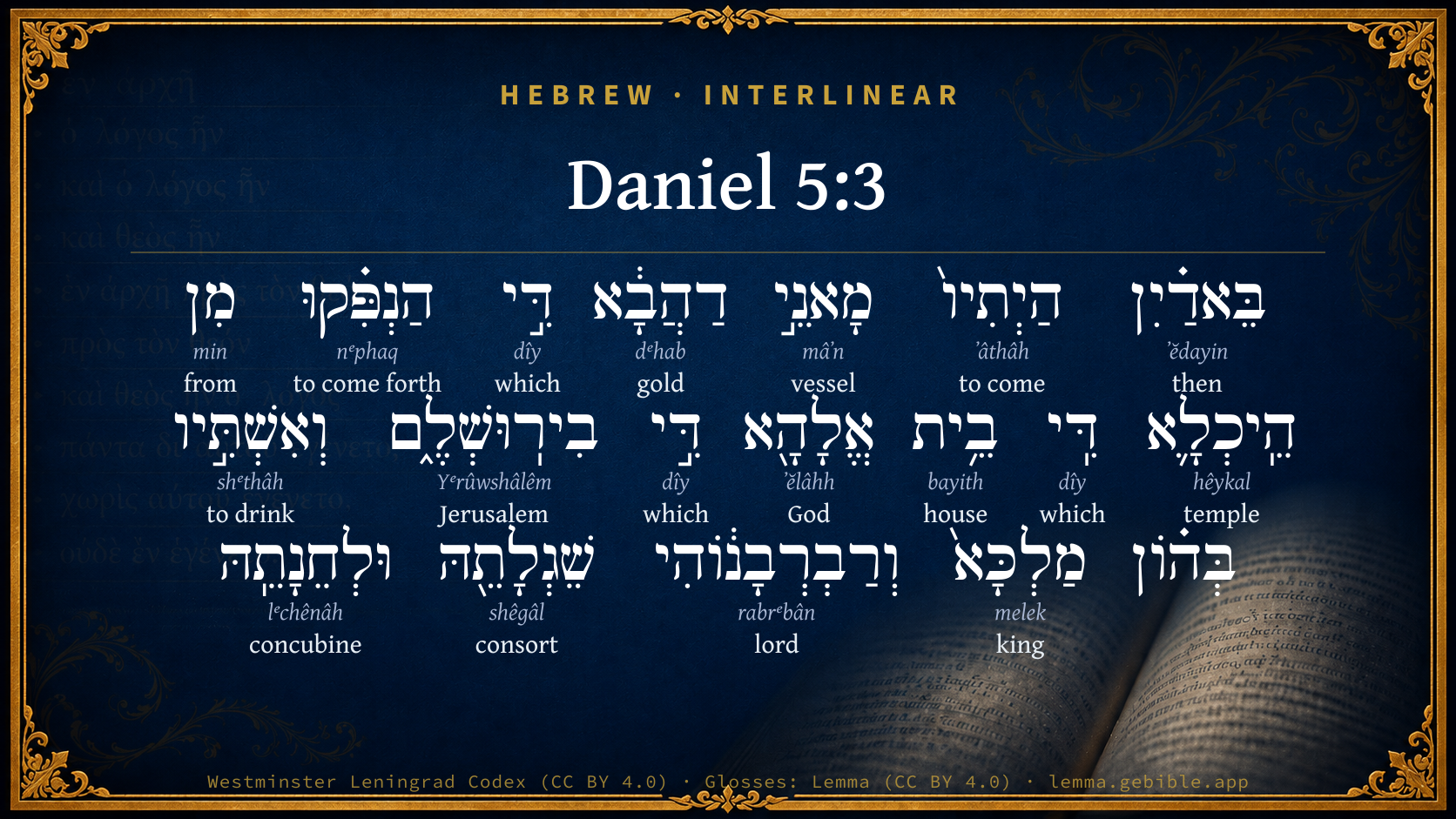
Daniel 5:3

Hebrew (Westminster Leningrad Codex) Daniel 5:3 appears in the Hebrew Old Testament. The text above is from the Westminster Leningrad Codex. Each word links to its Strong’s number, a concise gloss, and parsing drawn from the Open Scriptures Hebrew Bible morphology. Click any word for its full Brown-Driver-Briggs (BDB) entry.
Download image
Cite this verse

Daniel 5:3 (World English Bible). Public Domain. Lemma interlinear Bible study tool, https://lemma.gebible.app/v/daniel/5/3.

Show BibTeX & RIS
BibTeX
RIS
English Translation
Then they brought the golden vessels that were taken out of the temple of the house of God which was at Jerusalem; and the king and his lords, his wives and his concubines, drank from them.
World English Bible · Public Domain
Download a study sheet

One document with this verse’s original text, its word-by-word gloss line, the meaning frame, cross-references with their text, attributed commentary, and full source and license credits — printable, and it pastes into notes with its structure intact.

This verse Autodidact and up

Study sheet (.html) Plain text (.txt)

A passage Seminary Student

Up to 50 verses in one chapter. A passage sheet keeps up to 6 commentary sources and 12 cross-references per verse, in the order this page ranks them, and says so on the sheet whenever that leaves anything out. Ask for a single verse and you get the Autodidact verse sheet above.

Everything on this page stays free to read, with no account — the sheet is a download of what is already on screen, not access to it.

Want to remove ads? Support Godless Engineer
Compare translations 3

The same verse in 3 English versions, stacked beneath the original-language interlinear above. Click any original word for its lexicon entry.

Each is an independent rendering of the whole verse — the interlinear is not word-aligned to these translations.

Highlighted words mark where these versions differ — a whole-verse word diff, not a word-by-word alignment.

  • World English Bible Public Domain
    Then they brought the golden vessels that were taken out of the temple of the house of God which was at Jerusalem; and the king and his lords, his wives and his concubines, drank from them.
  • King James Version Public Domain
    Then they brought the golden vessels that were taken out of the temple of the house of God which was at Jerusalem; and the king, and his princes, his wives, and his concubines, drank in them.
  • unfoldingWord Literal Text CC BY-SA 4.0
    Then they brought the gold vessels that had been taken out of the temple, the house of God which was in Jerusalem, and the king and his noblemen, his wives and his concubines drank from them.

unfoldingWord Literal Text — © unfoldingWord, licensed CC BY-SA 4.0. Word-aligned USFM3 via Door43 (git.door43.org/unfoldingWord/en_ult).

Versions to compare (up to 4)

3 of 4 selected

Show all 18 translations

Every available English version of this verse, each an independent rendering of the whole verse.

  • World English Bible Public Domain
    Then they brought the golden vessels that were taken out of the temple of the house of God which was at Jerusalem; and the king and his lords, his wives and his concubines, drank from them.
  • Berean Standard Bible Public Domain
    Thus they brought in the gold vessels that had been taken from the temple, the house of God in Jerusalem, and the king drank from them, along with his nobles, his wives, and his concubines.
  • Majority Standard Bible Public Domain
    Thus they brought in the gold vessels that had been taken from the temple, the house of God in Jerusalem, and the king drank from them, along with his nobles, his wives, and his concubines.
  • King James Version Public Domain
    Then they brought the golden vessels that were taken out of the temple of the house of God which was at Jerusalem; and the king, and his princes, his wives, and his concubines, drank in them.
  • American Standard Version (1901) Public Domain
    Then they brought the golden vessels that were taken out of the temple of the house of God which was at Jerusalem; and the king and his lords, his wives and his concubines, drank from them.
  • Revised Version (1885) Public Domain
    Then they brought the golden vessels that were taken out of the temple of the house of God which was at Jerusalem; and the king and his lords, his wives and his concubines, drank in them.
  • Geneva Bible (1599) Public Domain
    Then were brought the golden vessels, that were taken out of the Temple of the Lords house at Ierusalem, and the King and his princes, his wiues and his concubines dranke in them.
  • Douay-Rheims (1899) Public Domain
    Then were the golden and silver vessels brought, which he had brought away out of the temple that was in Jerusalem: and the king and his nobles, his wives and his concubines, drank in them.
  • Young's Literal Translation Public Domain
    Then they have brought in the vessels of gold that had been taken out of the temple of the house of God that `is' in Jerusalem, and drunk with them have the king and his great men, his wives and his concubines;
  • Literal Standard Version CC BY-SA 4.0
    Then they have brought in the vessels of gold that had been taken out of the temple of the house of God that [is] in Jerusalem, and the king and his great men, his wives and his concubines, have drunk with them;
  • Unlocked Literal Bible CC BY-SA 4.0
    The servants brought the gold containers that had been taken out of the temple, the house of God, in Jerusalem. The king, his noblemen, and his wives and concubines drank from them.
  • unfoldingWord Literal Text CC BY-SA 4.0
    Then they brought the gold vessels that had been taken out of the temple, the house of God which was in Jerusalem, and the king and his noblemen, his wives and his concubines drank from them.
  • Darby Bible Public Domain
    Then they brought the golden vessels that were taken out of the temple of the house of God which was at Jerusalem; and the king and his nobles, his wives and his concubines, drank in them.
  • World Messianic Bible Public Domain
    Then they brought the golden vessels that were taken out of the temple of God’s house which was at Jerusalem; and the king and his lords, his wives and his concubines, drank from them.
  • Webster's Bible Public Domain
    Then they brought the golden vessels that were taken out of the temple of the house of God which was at Jerusalem; and the king, and his princes, his wives, and his concubines, drank in them.
  • Free Bible Version CC BY-SA 4.0
    So they brought in the gold cups and bowls that had been taken from the Temple of God in Jerusalem. The king and his nobles, his wives and concubines, drank from them.
  • Bible in Basic English Public Domain
    Then they took in the gold and silver vessels which had been in the Temple of the house of God at Jerusalem; and the king and his lords, his wives and his other women, took wine from them.
  • JPS Tanakh (1917) Public Domain
    Then they brought the golden vessels that were taken out of the temple of the house of God which was at Jerusalem; and the king, and his lords, his consorts and his concubines, drank in them.

Literal Standard Version (2020), Covenant Press — licensed CC BY-SA 4.0. Text via the HelloAO Bible API (eBible.org). Unlocked Literal Bible (unfoldingWord) — licensed CC BY-SA 4.0. Text via the HelloAO Bible API (eBible.org). unfoldingWord Literal Text — © unfoldingWord, licensed CC BY-SA 4.0. Word-aligned USFM3 via Door43 (git.door43.org/unfoldingWord/en_ult). Free Bible Version, Dr. Jonathan Gallagher — licensed CC BY-SA 4.0. Text via the HelloAO Bible API (eBible.org).

Word by word

More ways to search: Search by grammar → Find every occurrence → Compare this word →

Practice this passage: Drill this verse → Learn its vocabulary →

שֵׁגְלָתֵ֖הּ
shêgâl
H7695
“consorts · his”
Adjective, N, Common + Suffix, Personal, 3rd Person, Masculine, Singular
Part of Speech
Adjective
Gender
Common
Full BDB Definition

Origin: corresponding to H7694

TWOT: 3020

king's wife, king's concubine, (royal) consort
  1. בֵּאדַ֗יִן ʼĕdayin H116 “in/at · then” Adjective, R + Adverb
  2. הַיְתִיו֙ ʼâthâh H858 “to come” Adjective, V, Plural
  3. מָאנֵ֣י mâʼn H3984 “vessels of” Adjective, N, Common
  4. דַהֲבָ֔א dᵉhab H1722 “gold · the” Adjective, N, Common + Particle, Definite Article
  5. דִּ֣י dîy H1768 “which” Adjective, T
  6. הַנְפִּ֗קוּ nᵉphaq H5312 “to come forth” Adjective, V, Plural
  7. מִן min H4481 “from” Adjective, R
  8. הֵֽיכְלָ֛א hêykal H1965 “temple · the” Adjective, N, Common + Particle, Definite Article
  9. דִּֽי dîy H1768 “which” Adjective, T
  10. בֵ֥ית bayith H1005 “house of” Adjective, N, Common
  11. אֱלָהָ֖א ʼĕlâhh H426 “God · the” Adjective, N, Common + Particle, Definite Article
  12. דִּ֣י dîy H1768 “which” Adjective, T
  13. בִירֽוּשְׁלֶ֑ם Yᵉrûwshâlêm H3390 “in/at · Jerusalem” Adjective, R + Noun, Proper
  14. וְאִשְׁתִּ֣יו shᵉthâh H8355 “and · to drink” Adjective, C + Verb, Qal, Perfect, 3rd Person, Masculine, Plural
  15. מַלְכָּא֙ melek H4430 “king · the” Adjective, N, Common + Particle, Definite Article
  16. וְרַבְרְבָנ֔וֹהִי rabrᵉbân H7261 “and · lords · his” Adjective, C + Noun, Common, Masculine, Plural, Construct + Suffix, Personal, 3rd Person, Masculine, Singular
  17. וּלְחֵנָתֵֽהּ lᵉchênâh H3904 “and · concubines · his” Adjective, C + Noun, Common, Feminine, Plural, Construct + Suffix, Personal, 3rd Person, Masculine, Singular

About this verse

These counts appear in no published source. They are computed here, from the morphology-tagged text and Lemma’s own curated glosses. What Lemma adds →

19
words
16
distinct lemmas
Prophets
section

Notable vocabulary

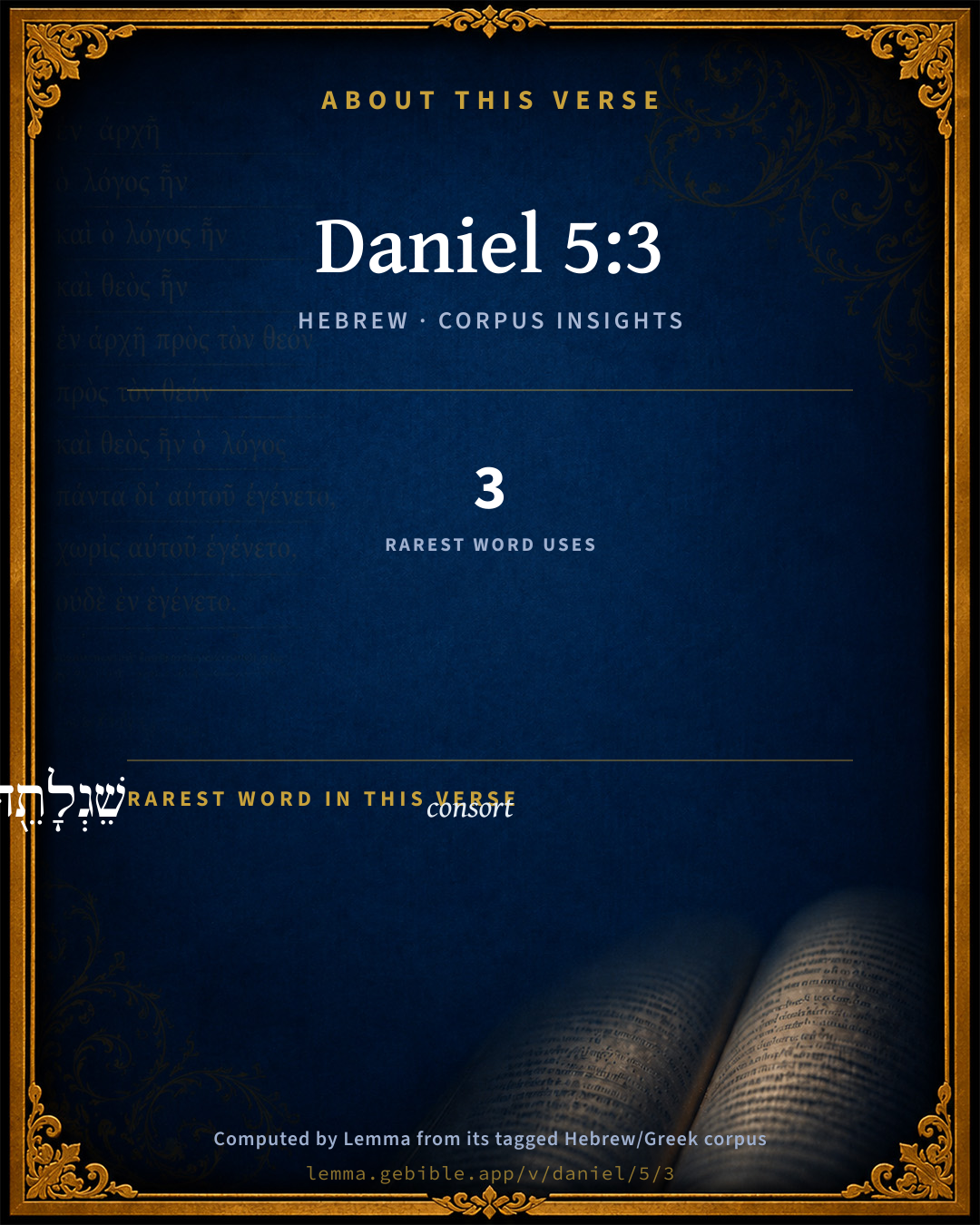
The rarest word here is שֵׁגְלָתֵ֖הּ consort H7695 — appearing just 3 times in the whole Hebrew Bible.

Shared distinctive vocabulary

שֵׁגְלָתֵ֖הּ consort H7695 occurs in 3 verses of the Hebrew Bible. Also found in:

Grammatical profile

  • 1 verb
  • 3 nouns
  • 10 adjectives
  • 1 adverb
  • 4 particles

Verb forms

  • וְאִשְׁתִּ֣יו Qal · Perfect

Repetition

A word recurs within this verse — often emphatic in Hebrew:

  • דִּ֣י which H1768 ×3

Hebrew & Septuagint length

In English translation the verse runs 36 words from the Hebrew and 36 from the Septuagint (LXX English) — the same length.

A rough comparison of the two English renderings, which tokenize alike — not a word-level alignment.

Word counts can differ between the Hebrew and the Greek without any difference in meaning — e.g. the Hebrew direct-object marker אֵת has no separate Greek word, and Greek often adds the article ὁ.

Hebrew and Greek witnesses Masoretic Hebrew ↔ Greek Septuagint

The same verse in the two great witnesses to the Old Testament, shown verse-for-verse.

These are two independent witnesses, not word-aligned to each other, and the Septuagint is shown in lemma (dictionary) form.

Hebrew Daniel 5:3 Masoretic · Westminster Leningrad Codex

בֵּאדַ֗יִן הַיְתִיו֙ מָאנֵ֣י דַהֲבָ֔א דִּ֣י הַנְפִּ֗קוּ מִן הֵֽיכְלָ֛א דִּֽי בֵ֥ית אֱלָהָ֖א דִּ֣י בִירֽוּשְׁלֶ֑ם וְאִשְׁתִּ֣יו בְּה֗וֹן מַלְכָּא֙ וְרַבְרְבָנ֔וֹהִי שֵׁגְלָתֵ֖הּ וּלְחֵנָתֵֽהּ

Then they brought the golden vessels that were taken out of the temple of the house of God which was at Jerusalem; and the king and his lords, his wives and his concubines, drank from them.

World English Bible · Public Domain

Greek LXX Daniel 5:3 Septuagint · lemma form

καί φέρω καί πίνω ἐν αὐτός

So the gold and silver vessels were brought which Nabuchodonosor had taken out of the temple of God in Jerusalem; and the king, and his nobles, and his mistresses, and his concubines, drank out of them.

LXX2012 (modern English Septuagint) · Public Domain

On this verse, The Pulpit Commentary discusses the Septuagint’s reading. Read the note in Commentary ↓

Hebrew: Westminster Leningrad Codex (CC BY 4.0). Greek: Septuagint (public domain); English from LXX2012 (modern English Septuagint) (Public Domain). How the Septuagint differs from the Hebrew →

Commentary

Notes on Daniel 5:3 from classic Christian and Jewish commentators (each source and its license shown beneath its notes). The classic Christian expositions comment on the surrounding passage and are grouped to its opening verse, so a note may address several verses; the Jewish commentaries on the Tanakh (Rashi and others) are per-verse, so they appear only where the commentator wrote on this verse.

Lemma curates 59 commentaries, every one of them public domain or Creative Commons licensed, each selected and text-cleaned for this edition rather than reprinted as found. About our sources →

Trapp's Complete Commentary

John Trapp

Dan 5:3 Then they brought the golden vessels that were taken out of the temple of the house of God which [was] at Jerusalem; and the king, and his princes, his wives, and his concubines, drank in them.

Ver. 3. Then they brought the golden vessels.] Made and appointed for a better use; as were likewise much of our Church lands, vessels, and utensils, concerning which a learned man complaineth, Possidebant Papistae, possident iam rapistae. Luther cried out earnestly against this abuse in Germany, Knox in Scotland, Calvin at Geneva: I see, said he to the senate there in a sermon, that we have taken the purse from Judas and given it to the devil; neither can I endure such sacrilege, which I know God in the end will punish most severely. Belshazzar paid dear for his boosing in the bowls of the sanctuary.

And the king and his princes … drank in them.] As if they had been swine troughs. This was to outsin his father and grandfather, who yet were none of the best.

John Trapp, A Commentary or Exposition upon All the Books of the Old and New Testament (1647–1656) — public domain. Text from a community e-Sword module.

Jamieson, Fausset & Brown

Robert Jamieson, A. R. Fausset & David Brown

This act was not one of necessity, or for honor's sake, but in reckless profanity.

Jamieson, Fausset & Brown — Commentary Critical and Explanatory on the Whole Bible (1871) — public domain (CC PDM 1.0). Text via the HelloAO Bible API.

John Calvin's Commentaries

The Prophet uses the word “golden,” probably, because the most precious vessels were brought; silver might also have been added, but the more splendid ones are noticed. He does not say that Nebuchadnezzar carried them off, but implies it to be the common act of all the Babylonians. They obtained the victory under the direction of this king, hence he used the spoils; and since they were all engaged in the victory, the Prophet speaks of them all. In using the phrase, “the temple,” he expresses more than before, by saying, not from Jerusalem only but from the temple of God’s house.

John Calvin's Commentaries (1540-1563) — public domain. Text from the Calvin Translation Society English edition (1840s-50s) via the Christian Classics Ethereal Library (ccel.org). Calvin's coverage is partial (roughly two-thirds of the Bible); uncommented books and verses are honest gaps, never fabricated. The 19th-century editor's footnotes and remarks are omitted so the notes are faithfully Calvin's own voice.

John Gill's Exposition

Then they brought the golden vessels that were taken out of the temple of the house of God which was at Jerusalem,.... That is, the servants to whom the orders were given fetched them from the temple of Bel, and brought them to the king's house; and though only mention is made of golden vessels, yet no doubt the silver ones were also brought, according to the king's command:

and the king, and his princes, his wives, and his concubines, drank in them; by which they were profaned, being dedicated to holy uses, but now put to common use, and that by such impious persons; and who did it, not on account of the value and antiquity of these vessels, and in admiration of them, and to the honour of their festival; but in contempt of them, and in a profane and scurrilous way, as follows:

John Gill's Exposition of the Whole Bible (1746–1763) — public domain (CC PDM 1.0). Text via the HelloAO Bible API.

Whedon's Commentary on the Bible

Daniel D. Whedon

3, 4. The favorite temple of the king adjoined the palace, so that these vessels could be obtained quickly and easily. A reason for this insult to Jehovah has already been suggested. (See note Dan_5:1-4; see also Introduction, III, 4, “Babylon and its Fall.”)

Daniel D. Whedon (gen. ed.), Commentary on the Old and New Testaments (1874–1909) — public domain. Text from a community e-Sword module.

The Pulpit Commentary

Vers. 3, 4. Then they brought the golden vessels that were taken out of the temple of the house of God which was at Jerusalem; and the king, and his princes, his wives, and his concubines, drank in them. They drank wine, and praised the gods of gold, and of silver, of brass, of iron, of wood, and of stone. The corresponding verses in the Septuagint differ in several points from those above; the Septuagint third verse contains, condensed, the Massoretic third and fourth verses, but adds new matter in its fourth verse: "(3) And they were brought, and they drank in them, and blessed their idols made with hands; (4) and the God the eternal, who hath dominion over their spirit ("breath," pneuma), they did not bless." In the introductory portion, which contains, as we think, marginal readings, we have the second and fourth verses brought into connection, "In that day Baltasar, being uplifted with wine, and boasting himself, praised in his drink all the gods of the nations, the molten and the carved, but to God the Highest he gave not praise." The reading of the latter portion of this seems better than the text, as it is briefer; the description of God as he that has power "over their breath," is a preparation for what we find in ver. 23, "and thy breath is in his hand." Theodotion is, as usual, much nearer the Massoretic text, but while the Massoretic only mentions the "golden" vessels being brought, Theodotion mentions the silver also, and the verb hanpiqoo is translated singular, as if it were hanpayq, and "Nebuchadnezzar" understood. A various reading adds, "and the God of eternity, who hath power of their breath, did they not bless," according to the Alexandrine and Vatican codices. In both these cases Jerome follows Theodotion. The Peshitta agrees only in the latter, putting the verb in the singular. Modern translators, as Luther and Ewald, the Authorized and Revised English Versions, retain the plural, but make the verb passive, as if it were written honpaqoo. Calvin alone preserves both number and voice. The French Version, which makes it impersonal, is probably as good as any. It is, however, not impossible that the true reading is huphal; that seems better than Calvin"s suggestion, that what Nebuchadnezzar had done is now transferred to all the Babylonians. The praises of the gods being sung was especially natural, if this were a dedication of a palace. In such a case the various elemental deities would be invoked to bless the residence of the king.

The fact that the vessels belonging to the temple of the God of the Jews were brought forward from the treasury of Bel would afford an occasion for praising Bel, the god who had given them the victory. While they praised these god, of the nations, they did not even mention Jehovah an addition in the text of Theodotion and the LXX, both text and margin, and therefore one that, we think, ought, in some form, to lie in the text. It is singular that in the Cyrus Cylinder, 17, the overthrow of Nabunahid is attributed to Marduk, "whom Nabunahid did not fear." The reason of Belshazzar thus ostentatiously praising the gods might be to get over the reputation of unfaithfulness to the gods, which was weakening them, father and son, in their struggle with Cyrus. Belshazzar most likely was, at this very time, carrying on war against Cyrus. The object of this festive gathering of his nobles might be to hearten them in their struggle against the King of Persia.

The Pulpit Commentary (1880–1919), ed. H.D.M. Spence-Jones & Joseph S. Exell — public domain. Text from a community e-Sword module.

unfoldingWord translationNotes

Door43 World Missions Community

the gold containers that had been taken out of the temple

This can be stated in active form. AT: "the gold containers that the army of Nebuchadnezzar had taken out of the temple" (See: Active or Passive)

out of the temple, the house of God

"out of God's temple." The phrase "the house of God" tells us something more about the temple.

translationWords

servant

gold

temple

house of God

Jerusalem

king

noble

concubine

wine

praise

false god

silver

bronze

unfoldingWord translationNotes — © Distant Shores Media and the Door43 World Missions Community, licensed CC BY-SA 4.0. Source: git.door43.org/Door43/en_tn.

Rashi

Rabbi Shlomo Yitzchaki (Rashi)

were brought [as translated,] were brought.

that they had taken out [as translated,] that they had taken out.

Rashi on the Tanakh — English translations: “The Judaica Press complete Tanach with Rashi, translated by A. J. Rosenberg” (CC BY 4.0); “Pentateuch with Rashi's commentary by M. Rosenbaum and A.M. Silbermann, 1929-1934” (public domain); “The Metsudah Tanach series, Lakewood, N.J” (CC BY 4.0); and “The Book of Joshua, Metsudah Publications, 1997” (CC BY 4.0). Text via Sefaria.

Lesson kit

Teaching starters — assembled from the data on this page, not authored interpretation. Every prompt links to the verse data it draws on. Edit before teaching.

Daniel, in the Prophets, opens this verse with 19 words (16 distinct Hebrew lemmas). Its most distinctive word is shêgâl (“consort”). A historical commentator’s framing appears above. Read the whole chapter for the surrounding context.

Discussion questions

  1. The word shêgâl carries the sense “consort.” How does it shape the verse?
  2. How does Daniel 5:2, which shares the word «consort», read alongside this verse?
  3. What does the repetition of “which” (3× in this one verse) do in this verse?
  4. The translations on this page render this verse differently — a whole-verse word diff, not a word-by-word alignment. What might account for the different wordings?
  5. «וְאִשְׁתִּ֣יו» is a Qal Perfect verb. How does that grammatical form shape the action described?
  6. Compare how Trapp's Complete Commentary and Jamieson, Fausset & Brown read this verse. Where do they agree or differ?

Things to notice

Reading settings

Reading text

Shown beneath each verse's original-language words.

Old Testament
Old Testament edition

Read the OT as the Masoretic Hebrew (MT) or the Greek Septuagint (LXX).

English shown for the Greek Septuagint (in the Hebrew ↔ Greek comparison).

Comparing translations? Open the Compare panel on any verse page to stack up to four side by side.