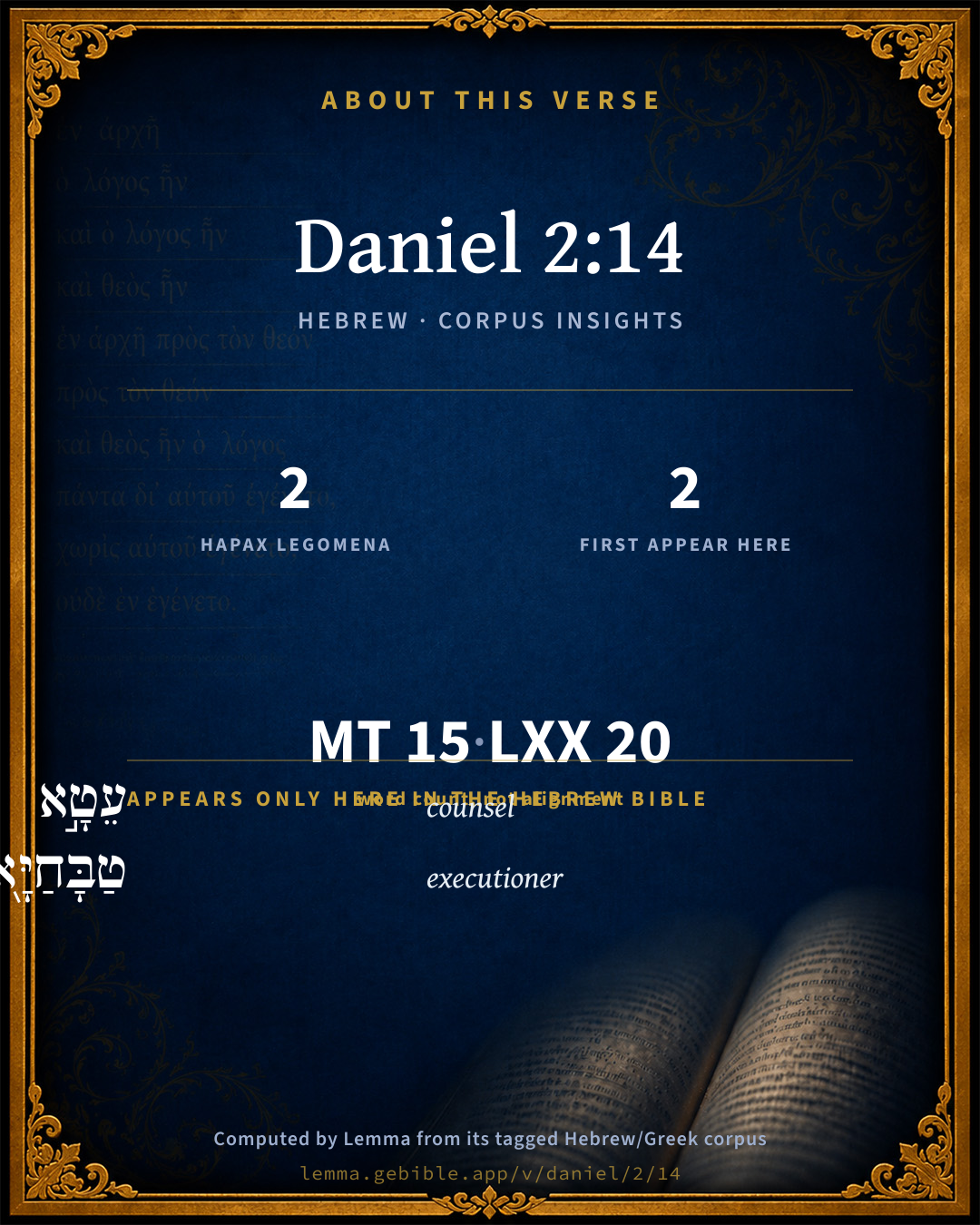
Daniel 2:14

Hebrew (Westminster Leningrad Codex) Daniel 2:14 appears in the Hebrew Old Testament. The text above is from the Westminster Leningrad Codex. Each word links to its Strong’s number, a concise gloss, and parsing drawn from the Open Scriptures Hebrew Bible morphology. Click any word for its full Brown-Driver-Briggs (BDB) entry.
Download image
Cite this verse

Daniel 2:14 (World English Bible). Public Domain. Lemma interlinear Bible study tool, https://lemma.gebible.app/v/daniel/2/14.

Show BibTeX & RIS
BibTeX
RIS
English Translation
Then Daniel returned answer with counsel and prudence to Arioch the captain of the king's guard, who was gone forth to kill the wise men of Babylon;
World English Bible · Public Domain
Highlights
  • 2 hapax legomena — only here in the Hebrew Bible
  • 2 first appearances in the Hebrew Bible
Full analysis ↓
Download a study sheet

One document with this verse’s original text, its word-by-word gloss line, the meaning frame, cross-references with their text, attributed commentary, and full source and license credits — printable, and it pastes into notes with its structure intact.

This verse Autodidact and up

Study sheet (.html) Plain text (.txt)

A passage Seminary Student

Up to 50 verses in one chapter. A passage sheet keeps up to 6 commentary sources and 12 cross-references per verse, in the order this page ranks them, and says so on the sheet whenever that leaves anything out. Ask for a single verse and you get the Autodidact verse sheet above.

Everything on this page stays free to read, with no account — the sheet is a download of what is already on screen, not access to it.

Want to remove ads? Support Godless Engineer
Compare translations 3

The same verse in 3 English versions, stacked beneath the original-language interlinear above. Click any original word for its lexicon entry.

Each is an independent rendering of the whole verse — the interlinear is not word-aligned to these translations.

Highlighted words mark where these versions differ — a whole-verse word diff, not a word-by-word alignment.

  • World English Bible Public Domain
    Then Daniel returned answer with counsel and prudence to Arioch the captain of the king's guard, who was gone forth to kill the wise men of Babylon;
  • King James Version Public Domain
    Then Daniel answered with counsel and wisdom to Arioch the captain of the king's guard, which was gone forth to slay the wise men of Babylon:
  • unfoldingWord Literal Text CC BY-SA 4.0
    Then Daniel replied with prudence and discretion to Arioch the captain of the guard of the king, who had gone out to kill the wise men of Babylon.

unfoldingWord Literal Text — © unfoldingWord, licensed CC BY-SA 4.0. Word-aligned USFM3 via Door43 (git.door43.org/unfoldingWord/en_ult).

Versions to compare (up to 4)

3 of 4 selected

Show all 18 translations

Every available English version of this verse, each an independent rendering of the whole verse.

  • World English Bible Public Domain
    Then Daniel returned answer with counsel and prudence to Arioch the captain of the king's guard, who was gone forth to kill the wise men of Babylon;
  • Berean Standard Bible Public Domain
    When Arioch, the commander of the king’s guard, had gone out to execute the wise men of Babylon, Daniel replied with discretion and tact.
  • Majority Standard Bible Public Domain
    When Arioch, the commander of the king’s guard, went out to execute the wise men of Babylon, Daniel responded with discretion and tact.
  • King James Version Public Domain
    Then Daniel answered with counsel and wisdom to Arioch the captain of the king's guard, which was gone forth to slay the wise men of Babylon:
  • American Standard Version (1901) Public Domain
    Then Daniel returned answer with counsel and prudence to Arioch the captain of the king's guard, who was gone forth to slay the wise men of Babylon;
  • Revised Version (1885) Public Domain
    Then Daniel returned answer with counsel and prudence to Arioch the captain of the king’s guard, which was gone forth to slay the wise men of Babylon;
  • Geneva Bible (1599) Public Domain
    Then Daniel answered with counsel and wisedome to Arioch the Kings chiefe stewarde, which was gone foorth to put to death the wise men of Babel.
  • Douay-Rheims (1899) Public Domain
    Then Daniel inquired concerning the law and the sentence, of Arioch the general of the king's army, who was gone forth to kill the wise men of Babylon.
  • Young's Literal Translation Public Domain
    Then Daniel hath replied `with' counsel and discretion to Arioch chief of the executioners of the king, who hath gone forth to slay the wise men of Babylon.
  • Literal Standard Version CC BY-SA 4.0
    Then Daniel has replied [with] counsel and discretion to Arioch chief of the executioners of the king, who has gone forth to slay the wise men of Babylon.
  • Unlocked Literal Bible CC BY-SA 4.0
    Then Daniel replied with prudence and discretion to Arioch the commander of the king's bodyguard, who had come to kill all those in Babylon who were known for their wisdom.
  • unfoldingWord Literal Text CC BY-SA 4.0
    Then Daniel replied with prudence and discretion to Arioch the captain of the guard of the king, who had gone out to kill the wise men of Babylon.
  • Darby Bible Public Domain
    Then Daniel answered with counsel and prudence to Arioch the chief of the king's bodyguard, who had gone forth to slay the wise men of Babylon:
  • World Messianic Bible Public Domain
    Then Daniel returned answer with counsel and prudence to Arioch the captain of the king’s guard, who had gone out to kill the wise men of Babylon.
  • Webster's Bible Public Domain
    Then Daniel answered with counsel and wisdom to Arioch the captain of the king's guard, who had gone forth to slay the wise men of Babylon:
  • Free Bible Version CC BY-SA 4.0
    Daniel approached Arioch, the commander of the imperial guard, whom the king had put in charge of the order to execute all the wise men of Babylon. Wisely and tactfully
  • Bible in Basic English Public Domain
    Then Daniel gave an answer with wisdom and good sense to Arioch, the captain of the king's armed men, who had gone out to put to death the wise men of Babylon;
  • JPS Tanakh (1917) Public Domain
    Then Daniel returned answer with counsel and discretion to Arioch the captain of the king's guard, who was gone forth to slay the wise men of Babylon;

Literal Standard Version (2020), Covenant Press — licensed CC BY-SA 4.0. Text via the HelloAO Bible API (eBible.org). Unlocked Literal Bible (unfoldingWord) — licensed CC BY-SA 4.0. Text via the HelloAO Bible API (eBible.org). unfoldingWord Literal Text — © unfoldingWord, licensed CC BY-SA 4.0. Word-aligned USFM3 via Door43 (git.door43.org/unfoldingWord/en_ult). Free Bible Version, Dr. Jonathan Gallagher — licensed CC BY-SA 4.0. Text via the HelloAO Bible API (eBible.org).

Word by word

More ways to search: Search by grammar → Find every occurrence → Compare this word →

Practice this passage: Drill this verse → Learn its vocabulary →

עֵטָ֣א
ʻêṭâʼ
H5843
“counsel”
Adjective, N, Common
Part of Speech
Adjective
Gender
Common
Full BDB Definition

Origin: from H3272

TWOT: 2772b

counsel
  1. בֵּאדַ֣יִן ʼĕdayin H116 “in/at · then” Adjective, R + Adverb
  2. דָּנִיֵּ֗אל Dânîyêʼl H1841 “Daniel” Adjective, N
  3. הֲתִיב֙ tûwb H8421 “to return” Adjective, V, Plural
  4. וּטְעֵ֔ם ṭᵉʻêm H2942 “and · decree” Adjective, C + Noun, Common, Masculine, Singular, Absolute
  5. לְאַרְי֕וֹךְ ʼĂryôwk H746 “to/for · Arioch” Adjective, R + Noun, Proper
  6. רַב rab H7229 “great of” Adjective, A
  7. טַבָּחַיָּ֖א ṭabbâch H2877 “executioners · the” Adjective, N, Common + Particle, Definite Article
  8. דִּ֣י dîy H1768 “which” Adjective, T
  9. מַלְכָּ֑א melek H4430 “king · the” Adjective, N, Common + Particle, Definite Article
  10. דִּ֚י dîy H1768 “which” Adjective, T
  11. נְפַ֣ק nᵉphaq H5312 “to come forth” Adjective, V, Plural
  12. לְקַטָּלָ֔ה qᵉṭal H6992 “to slay” Adjective, R + Verb, Piel, Infinitive Construct
  13. לְחַכִּימֵ֖י chakkîym H2445 “to/for · wise men of” Adjective, T + Noun, Common, Masculine, Plural, Construct
  14. בָּבֶֽל Babel H895 “Babylon” Adjective, N

About this verse

These counts appear in no published source. They are computed here, from the morphology-tagged text and Lemma’s own curated glosses. What Lemma adds →

15
words
14
distinct lemmas
Prophets
section

Notable vocabulary

2 hapax legomena — words that appear only here in the entire Hebrew Bible:

  • עֵטָ֣א counsel H5843
  • טַבָּחַיָּ֖א executioner H2877

First appearance in Scripture

These words make their first canonical appearance in the Hebrew Bible here:

  • עֵטָ֣א counsel H5843
  • טַבָּחַיָּ֖א executioner H2877

Shared distinctive vocabulary

לְאַרְי֕וֹךְ Arioch H746 occurs in 6 verses of the Hebrew Bible. Also found in:

Grammatical profile

  • 1 verb
  • 3 nouns
  • 8 adjectives
  • 1 adverb
  • 2 particles

Verb forms

  • לְקַטָּלָ֔ה Piel · Infinitive Construct

Repetition

A word recurs within this verse — often emphatic in Hebrew:

  • דִּ֣י which H1768 ×2

Hebrew & Septuagint length

In English translation the verse runs 27 words from the Hebrew and 27 from the Septuagint (LXX English) — the same length.

A rough comparison of the two English renderings, which tokenize alike — not a word-level alignment.

Word counts can differ between the Hebrew and the Greek without any difference in meaning — e.g. the Hebrew direct-object marker אֵת has no separate Greek word, and Greek often adds the article ὁ.

In the original languages it is 15 Hebrew tokens and 20 Greek tokens — but the two are counted differently (Hebrew bundles its prefixes and suffixes into one token; the Greek is in lemma form), so that isn’t a like-for-like length.

Cross-references

7

Topical passages linked to Daniel 2:14 in the Treasury of Scripture Knowledge — connected by theme and wording, ordered by reader-vote popularity; previews shown in the World English Bible.

  • Daniel 2:24 Therefore Daniel went in to Arioch, whom the king had appointed to destroy the wise men of Babylon; he went and said thus to him: Don't destroy the wise men of Babylon; bring me in before the king, and I will show to the king the interpretation.
  • Genesis 37:36 The Midianites sold him into Egypt to Potiphar, an officer of Pharaoh's, the captain of the guard.
  • 2 Samuel 20:16–22 Then cried a wise woman out of the city, "Hear, hear! Please say to Joab, 'Come near here, that I may speak with you.'"
  • Ecclesiastes 9:13–18 I have also seen wisdom under the sun in this way, and it seemed great to me.
  • Jeremiah 39:9 Then Nebuzaradan the captain of the guard carried away captive into Babylon the residue of the people who remained in the city, the deserters also who fell away to him, and the residue of the people who remained.
  • Jeremiah 52:12 Now in the fifth month, in the tenth day of the month, which was the nineteenth year of king Nebuchadrezzar, king of Babylon, came Nebuzaradan the captain of the guard, who stood before the king of Babylon, into Jerusalem:
  • Jeremiah 52:14 All the army of the Chaldeans, who were with the captain of the guard, broke down all the walls of Jerusalem round about.

Cross-references courtesy of OpenBible.info (CC BY 4.0).

Hebrew and Greek witnesses Masoretic Hebrew ↔ Greek Septuagint

The same verse in the two great witnesses to the Old Testament, shown verse-for-verse.

These are two independent witnesses, not word-aligned to each other, and the Septuagint is shown in lemma (dictionary) form.

Hebrew Daniel 2:14 Masoretic · Westminster Leningrad Codex

בֵּאדַ֣יִן דָּנִיֵּ֗אל הֲתִיב֙ עֵטָ֣א וּטְעֵ֔ם לְאַרְי֕וֹךְ רַב טַבָּחַיָּ֖א דִּ֣י מַלְכָּ֑א דִּ֚י נְפַ֣ק לְקַטָּלָ֔ה לְחַכִּימֵ֖י בָּבֶֽל

Then Daniel returned answer with counsel and prudence to Arioch the captain of the king's guard, who was gone forth to kill the wise men of Babylon;

World English Bible · Public Domain

Greek LXX Daniel 2:14 Septuagint · lemma form

τότε δανιηλ εἶπον βουλή καί γνώμη ὅς ἔχω αριώχης ὁ ἀρχιμάγειρος ὁ βασιλεύς ὅς προςτάσσω ἐκἄγω ὁ σοφιστής ὁ βαβυλωνία

Then Daniel answered with counsel and prudence to Arioch the captain of the royal guard, who was gone forth to kill the wise men of Babylon; saying,

LXX2012 (modern English Septuagint) · Public Domain

On this verse, Keil & Delitzsch discusses the Septuagint’s reading. Read the note in Commentary ↓

Hebrew: Westminster Leningrad Codex (CC BY 4.0). Greek: Septuagint (public domain); English from LXX2012 (modern English Septuagint) (Public Domain). How the Septuagint differs from the Hebrew →

Commentary

Notes on Daniel 2:14 from classic Christian and Jewish commentators (each source and its license shown beneath its notes). The classic Christian expositions comment on the surrounding passage and are grouped to its opening verse, so a note may address several verses; the Jewish commentaries on the Tanakh (Rashi and others) are per-verse, so they appear only where the commentator wrote on this verse.

Lemma curates 59 commentaries, every one of them public domain or Creative Commons licensed, each selected and text-cleaned for this edition rather than reprinted as found. About our sources →

Matthew Henry's Commentary

When the king sent for his wise men to tell them his dream, and the interpretation of it (Dan 2:2), Daniel, it seems, was not summoned to appear among them; the king, though he was highly pleased with him when he examined him, and thought him ten times wiser than the rest of his wise men, yet forgot him when he had most occasion for him; and no wonder, when all was done in a heat, and nothing with a cool and deliberate thought. But Providence so ordered it; that the magicians being nonplussed might be the more taken notice of, and so the more glory might redound to the God of Daniel. But, though Daniel had not the honour to be consulted with the rest of the wise men, contrary to all law and justice, by an undistinguishing sentence, he stands condemned with them, and till he has notice brought him to prepare for execution he knows nothing of the matter. How miserable is the case of those who live under arbitrary government, as this of Nebuchadnezzar's! How happy are we, whose lives are under the protection of the law and methods of justice, and lie not thus at the mercy of a peevish and capricious prince!

We have found already, in Ezekiel, that Daniel was famous both for prudence and prayer; as a prince he had power with God and by man; by prayer he had power with God, by prudence he had power with man, and in both he prevailed. Thus did he find favour and good understanding in the sight of both, and in these verses we have a remarkable instance of both.

I. Daniel by prudence knew how to deal with men, and he prevailed with them. When Arioch, the captain of the guard, that was appointed to slay all the wise men of Babylon, the whole college of them, seized Daniel (for the sword of tyranny, like the sword of war, devours one as well as another), he answered with counsel and wisdom (Dan 2:14); he did not fall into a passion, and reproach the king as unjust and barbarous, much less did he contrive how to make resistance, but mildly asked, Why is the decree so hasty? Dan 2:15. And whereas the rest of the wise men had insisted upon it that it was utterly impossible for him ever to have his demand gratified, which did but make him more outrageous, Daniel undertakes, if he may but have a little time allowed him, to give the king all the satisfaction he desired, Dan 2:16. The king, being now sensible of his error in not sending for Daniel sooner, whose character he began to recollect, was soon prevailed upon to respite the judgment, and make trial of Daniel. Note, The likeliest method to turn away wrath, even the wrath of a king, which is as the messenger of death, is by a soft answer, by that yielding which pacifies great offences; thus, though where the word of a king is there is power, yet even that word may be repelled, and that so as to be repealed; and so some read it here (Dan 2:14): Then Daniel returned, and stayed the counsel and edict, through Arioch, the king's provost-marshal.

II. Daniel knew how by prayer to converse with God, and he found favour with him, both in petition and in thanksgiving, which are the two principal parts of prayer. Observe,

1. His humble petition for this mercy, that God would discover to him what was the king's dream, and the interpretation of it. When he had gained time he did not go to consult with the rest of the wise men whether there was anything in their art, in their books, that might be of use in this matter, but went to his house, there to be alone with God, for from him alone, who is the Father of lights, he expected this great gift. Observe, (1.) He did not only pray for this discovery himself, but he engaged his companions to pray for it too. He made the thing known to those who had been all along his bosom-friends and associates, requesting that they would desire mercy of God concerning this secret, Dan 2:17, Dan 2:18. Though Daniel was probably their senior, and every way excelled them, yet he engaged them as partners with him in this matter, Vis unita fortior - The union of forces produces greater force. See Est 4:16. Note, Praying friends are valuable friends; it is good to have an intimacy with and an interest in those that have fellowship with God and an interest at the throne of grace; and it well becomes the greatest and best of men to desire the assistance of the prayers of others for them. St. Paul often entreats his friends to pray for him. Thus we must show that we put a value upon our friends, upon prayer, upon their prayers. (2.) He was particular in this prayer, but had an eye to, and a dependence upon, the general mercy of God: That they would desire the mercies of the God of heaven concerning this secret, Dan 2:18. We ought in prayer to look up to God as the God of heaven, a God above us, and who has dominion over us, to whom we owe adoration and allegiance, a God of power, who can do everything. Our savior has taught us to pray to God as our Father in heaven. And, whatever good we pray for, our dependence must be upon the mercies of God for it, and an interest in those mercies we must desire; we can expect nothing by way of recompence for our merits, but all as the gift of God's mercies. They desired mercy concerning this secret. Note, Whatever is the matter of our care must be the matter of our prayer; we must desire mercy of God concerning this thing and the other thing that occasions us trouble and fear. God gives us leave to be humbly free with him, and in prayer to enter into the detail of our wants and burdens. Secret things belong to the Lord our God, and therefore, if there be any mercy we stand in need of that concerns a secret, to him we must apply; and, though we cannot in faith pray for miracles, yet we may in faith pray to him who has all hearts in his hand, and who in his providence does wonders without miracles, for the discovery of that which is out of our view and the obtaining of that which is out of our reach, as far as is for his glory and our good, believing that to him nothing is hidden, nothing is hard. (3.) Their plea with God was the imminent peril they were in; they desired mercy of God in this matter, that so Daniel and his fellows might not perish with the rest of the wise men of Babylon, that the righteous might not be destroyed with the wicked. Note, When the lives of good and useful men are in danger it is time to be earnest with God for mercy for them, as for Peter in prison, Act 12:5. (4.) The mercy which Daniel and his fellows prayed for was bestowed. The secret was revealed unto Daniel in a night-vision, Dan 2:19. Some think he dreamed the same dream, when he was asleep, that Nebuchadnezzar had dreamed; it should rather seem that when he was awake, and continuing instant in prayer, and watching in the same, the dream itself, and the interpretation of it, were communicated to him by the ministry of an angel, abundantly to his satisfaction. Note, The effectual fervent prayer of righteous men avails much. There are mysteries and secrets which by prayer we are let into; with that key the cabinets of heaven are unlocked, for Christ has said, Thus knock, and it shall be opened unto you.

2. His grateful thanksgiving for this mercy when he had received it: Then Daniel blessed the God of heaven, Dan 2:19. He did not stay till he had told it to the king, and seen whether he would own it to be his dream or no, but was confident that it was so, and that he had gained his point, and therefore he immediately turned his prayers into praises. As he had prayed in a full assurance that God would do this for him, so he gave thanks in a full assurance that he had done it; and in both he had an eye to God as the God of heaven. His prayer was not recorded, but his thanksgiving is. Observe,

(1.) The honour he gives to God in this thanksgiving, which he studies to do in a great variety and copiousness of expression: Blessed be the name of God for ever and ever. There is that for ever in God which is to be blessed and praised; it is unchangeably and eternally in him. And it is to be blessed for ever and ever; as the matter of praise is God's eternal perfection, so the work of praise shall be everlastingly in the doing. [1.] He gives to God the glory of what he is in himself: Wisdom and might are his, wisdom and courage (so some); whatever is fit to be done he will do; whatever he will do he can do, he dares do, and he will be sure to do it in the best manner, for he has infinite wisdom to design and contrive and infinite power to execute and accomplish. With him are strength and wisdom, which in men are often parted. [2.] He gives him the glory of what he is to the world of mankind. He has a universal influence and agency upon all the children of men, and all their actions and affairs. Are the times changed? Is the posture of affairs altered? Does every thing lie open to mutability? It is God that changes the times and the seasons, and the face of them. No change comes to pass by chance, but according to the will and counsel of God. Are those that were kings removed and deposed? Do they abdicate? Are they laid aside? It is God that removes kings. Are the poor raised out of the dust, to be set among princes? It is God that sets up kings; and the making and unmaking of kings is a flower of his crown who is the fountain of all power, King of kings and Lord of lords. Are there men that excel others in wisdom, philosophers and statesmen, that think above the common rate, contemplative penetrating men? It is God that gives wisdom to the wise, whether they be so wise as to acknowledge it or no; they have it not of themselves, but it is he that gives knowledge to those that know understanding, which is a good reason why we should not be proud of our knowledge, and why we should serve and honour God with it and make it our business to know him. [3.] He gives him the glory of this particular discovery. He praises him, First, For that he could make such a discovery (Dan 2:22): He reveals the deep and secret things which are hidden from the eyes of all living. It was he that revealed to man what is true wisdom when none else could (Job 28:27, Job 28:28); it is he that reveals things to come to his servants and prophets. He does himself perfectly discern and distinguish that which is most closely and most industriously concealed, for he will bring into judgment every secret thing; the truth will be evident in the great day. He knows what is in the darkness, and what is done in the darkness, for that hides not from him, Psa 139:11, Psa 139:12. The light dwells with him, and he dwells in the light (Ti1 6:16), and yet, as to us, he makes darkness his pavilion. Some understand it of the light of prophecy and divine revelation, which dwells with God and is derived from him; for he is the Father of lights, of all lights; they are all at home in him. Secondly, For that he had made this discovery to him. Here he has an eye to God as the God of his fathers; for, though the Jews were now captives in Babylon, yet they were beloved for their father's sake. He praises God, who is the fountain of wisdom and might, for the wisdom and might he had given him, wisdom to know this great secret and might to bear the discovery. Note, What wisdom and might we have we must acknowledge to be God's gift. Thou hast made this known to me, Dan 2:23. What was hidden from the celebrated Chaldeans, who made the interpreting of dreams their profession, is revealed to Daniel, a captive-Jew, a babe, much their junior. God would hereby put honour upon the Spirit of prophecy just when he was putting contempt upon the spirit of divination. Was Daniel thus thankful to God for making known that to him which was the saving of the lives of him and his fellows? Much more reason have we to be thankful to him for making known to us the great salvation of the soul, to us and not to the world, to us and not to the wise and prudent.

(2.) The respect he puts upon his companions in this thanksgiving. Though it was by his prayers principally that this discovery was obtained, and to him that it was made, yet he owns their partnership with him, both in praying for it (it is what we desired of thee) and in enjoying it - Thou hast made known unto us the king's matter. Either they were present with Daniel when the discovery was made to him, or as soon as he knew it he told it them (heurēka, heurēka - I have found it, I have found it), that those who had assisted him with their prayers might assist him in their praises; his joining them with him is an instance of his humility and modesty, which well become those that are taken into communion with God. Thus St. Paul sometimes joins Sylvanus, Timotheus, or some other minister, with himself in the inscriptions to many of his epistles. Note, What honour God puts upon us we should be willing that our brethren may share with us in.

Matthew Henry's Commentary on the Whole Bible (1708–1710) — public domain (CC PDM 1.0). Text via the HelloAO Bible API.

Trapp's Complete Commentary

John Trapp

Dan 2:14 Then Daniel answered with counsel and wisdom to Arioch the captain of the king’s guard, which was gone forth to slay the wise [men] of Babylon:

Ver. 14. Then Daniel answered with counsel.] Retulit consilium et causum; { a} he conferred with Arioch the chief slaughterman, giving him good reasons wherefor to defer further execution. This good turn he did for the magicians and astrologers who were his utter enemies.

{a} Tremel.

John Trapp, A Commentary or Exposition upon All the Books of the Old and New Testament (1647–1656) — public domain. Text from a community e-Sword module.

Joseph Benson's Commentary

Dan 2:14. Then Daniel answered with counsel and wisdom — This seems to be better rendered in the Vulgate, namely, Tunc Daniel requisivit de lege atque sententia ab Arioch — Then Daniel inquired of Arioch concerning the law and decree, namely, which the king had made for destroying the wise men: that is, he inquired the reason of the decree and judgment issued against them; for as he had not been called in unto the king with the other wise men, he probably was ignorant of all that had passed with regard to the king’s dream. The word שׂעם, here rendered wisdom, usually signifies an edict, or public decree, set forth by authority. Captain of the king’s guard — “Literally, chief of the king’s executioners. Greek, αρχιμαγειρω, the chief butcher [or chief cook.] The term רב שׂבחיא, may probably mean, the leader of the guard appointed for capital punishments. Nor does this office seem to have been at all infamous; for Arioch had free access to the king, as we find, Dan 2:25: see also 1Sa 15:33. And perhaps his office might be to execute any of the king’s commands on his subjects, whether they related to honour or dishonour, to life or to death. The same title is given to Nebuzar-adan, 2Ki 25:8; and from the character of the commander, it seems to mean a person of the first authority over the soldiery. Mr. Bruce (Trav., p. 455) speaks of an officer, called the executioner of the camp, whose business it was to attend at capital punishments; and this belonged only to a detachment of the royal Abyssinian army.” — Wintle.

Joseph Benson's Commentary on the Old and New Testaments (1811–1818) — public domain. Text from a community e-Sword module.

Keil & Delitzsch

C. F. Keil & F. Delitzsch

Daniel's willingness to declare his dream to the king; his prayer for a revelation of the secret, and the answer to his prayer; his explanation before the king.

Dan 2:14

Through Daniel's judicious interview of Arioch, the further execution of the royal edict was interrupted. וּטעם עטא התיב, he answered, replied, counsel and understanding, i.e., the words of counsel and understanding; cf. Pro 26:16. The name Arioch appears in Gen 14:1 as the name of the king of Ellasar, along with the kings of Elam and Shinar. It is derived not from the Sanscr. ârjaka, venerabilis, but is probably formed from ארי, a lion, as נסרך from nisr = נשׁר. רב־טבּחיּא is the chief of the bodyguard, which was regarded as the highest office of the kingdom (cf. Jer 39:9, Jer 39:11; Jer 40:1.). It was his business to see to the execution of the king's commands; see Kg1 2:25; Kg2 25:8.

Dan 2:15

The partic. Aph. מהחצפה standing after the noun in the stat. absol. is not predicative: "on what account is the command so hostile on the part of the king?" (Kran.), but it stands in apposition to the noun; for with participles, particularly when further definitions follow, the article, even in union with substantives defined by the article, may be and often is omitted; cf. Sol 7:5, and Ew. 335a. חצף, to be hard, sharp, hence to be severe. Daniel showed understanding and counsel in the question he put as to the cause of so severe a command, inasmuch as he thereby gave Arioch to understand that there was a possibility of obtaining a fulfilment of the royal wish. When Arioch informed him of the state of the matter, Daniel went in to the king - i.e., as is expressly mentioned in Dan 2:24, was introduced or brought in by Arioch - and presented to the king the request that time should be granted, promising that he would show to the king the interpretation of the dream.

Dan 2:16-17

With להחויה וּפשׁרא the construction is changed. This passage does not depend on דּי, time, namely, to show the interpretation (Hitz.), but is co-ordinate with the foregoing relative clause, and like it is dependent on וּבעא. The change of the construction is caused by the circumstance that in the last passage another subject needed to be introduced: The king should give him time, and Daniel will show the interpretation. The copulative וbefore פשׁרא (interpretation) is used neither explicatively, namely, and indeed, nor is it to be taken as meaning also; the simple and is sufficient, although the second part of the request contains the explanation and reason of the first; i.e., Daniel asks for the granting of a space, not that he might live longer, but that he might be able to interpret the dream to the king. Besides, that he merely speaks of the meaning of the dream, and not also of the dream itself, is, as Dan 2:25. show, to be here explained (as in Dan 2:24) as arising from the brevity of the narrative. For the same reason it is not said that the king granted the quest, but Dan 2:17. immediately shows what Daniel did after the granting of his request. He went into his own house and showed the matter to his companions, that they might entreat God of His mercy for this secret, so that they might not perish along with the rest of the wise men of Babylon.

Dan 2:18

The final clause depends on הודע (Dan 2:17). The ו is to be interpreted as explicative: and indeed, or namely. Against this interpretation it cannot be objected, with Hitz., that Daniel also prayed. He and his friends thus prayed to God that He would grant a revelation of the secret, i.e., of the mysterious dream and its interpretation. The designation "God of heaven" occurs in Gen 24:7, where it is used of Jehovah; but it was first commonly used as the designation of the almighty and true God in the time of the exile (cf. Dan 2:19, Dan 2:44; Ezr 1:2; Ezr 6:10; Ezr 7:12, Ezr 7:21; Neh 1:5; Neh 2:4; Psa 136:26), who, as Daniel names Him (Dan 5:23), is the Lord of heaven; i.e., the whole heavens, with all the stars, which the heathen worshipped as gods, are under His dominion.

Dan 2:19

In answer to these supplications, the secret was revealed to Daniel in a night-vision. A vision of the night is not necessarily to be identified with a dream. In the case before us, Daniel does not speak of a dream; and the idea that he had dreamed precisely the same dream as Nebuchadnezzar is arbitrarily imported into the text by Hitz. in order to gain a "psychological impossibility," and to be able to cast suspicion on the historical character of the narrative. It is possible, indeed, that dreams may be, as the means of a divine revelation, dream-visions, and as such may be called visions of the night (cf. Dan 7:1, Dan 7:13); but in itself a vision of the night is a vision simply which any one receives during the night whilst he is awake.

(Note: "Dream and vision do not constitute two separate categories. The dream-image is a vision, the vision while awake is a dreaming - only that in the latter case the consciousness of the relation between the inner and the outer maintains itself more easily. Intermediate between the two stand the night-visions, which, as in Job 4:13, either having risen up before the spirit, fade away from the mind in after-thought, or, as in the case of Nebuchadnezzar (Dan 2:29), are an image before the imagination into which the thoughts of the night run out. Zechariah saw a number of visions in one night, Dan 1:7; Dan 6:15. Also these which, according to Dan 1:8, are called visions of the night are not, as Ew. and Hitz. suppose, dream-images, but are waking perceptions in the night. Just because the prophet did not sleep, he says, Daniel 4, 'The angel awaked me as one is awaked out of sleep.'" - Tholuck's Die Propheten, u.s.w., p. 52.)

Dan 2:20

On receiving the divine revelation, Daniel answered (ענה) with a prayer of thanksgiving. The word ענה retains its proper meaning. The revelation is of the character of an address from God, which Daniel answers with praise and thanks to God. The forms להוא, and in the plur. להון and להוין, which are peculiar to the biblical Chaldee, we regard, with Maur., Hitz., Kran., and others, as the imperfect or future forms, 3rd pers. sing. and plur., in which the ל instead of the י is to be explained perhaps from the Syriac praeform. נ, which is frequently found also in the Chaldee Targums (cf. Dietrich, de sermonis chald. proprietate, p. 43), while the Hebrew exiles in the word הוא used ל instead of נ as more easy of utterance. The doxology in this verse reminds us of Job 1:21. The expression "for ever and ever" occurs here in the O.T. for the first time, so that the solemn liturgical Beracha (Blessing) of the second temple, Neh 9:5; Ch1 16:36, with which also the first (Psa 45:14) and the fourth (Psa 106:48) books of the Psalter conclude, appears to have been composed after this form of praise used by Daniel. "The name of God" will be praised, i.e., the manifestation of the existence of God in the world; thus, God so far as He has anew given manifestation of His glorious existence, and continually bears witness that He it is who possesses wisdom and strength (cf. Job 12:13). The דּי before the להּ is the emphatic re-assumption of the preceding confirmatory דּי, for.

Dan 2:21-23

The evidence of the wisdom and power of God is here unfolded; and firs the manifestation of His power. He changes times and seasons. lxx, Theodot. καιροὺς καὶ χρόνους, would be more accurately χρόνους καὶ καιρούς, as in Act 1:7; Th1 5:1; for the Peschito in these N. T. passages renders χρόνοι by the Syriac word which is equivalent to זמניּא, according to which עדּן is the more general expression for time = circumstance of time, זמן for measured time, the definite point of time. The uniting together of the synonymous words gives expression to the thought: ex arbitrio Dei pendere revolutiones omnium omnino temporum, quaecunque et qualia-cunque illa fuerint. C. B. Mich. God's unlimited control over seasons and times is seen in this, that He sets up and casts down kings. Thus Daniel explains the revelation regarding the dream of Nebuchadnezzar made to him as announcing great changes in the kingdoms of the world, and revealing God as the Lord of time and of the world in their developments. All wisdom also comes from God. He gives to men disclosures regarding His hidden counsels. This Daniel had just experienced. Illumination dwells with God as it were a person, as Wisdom, Pro 8:30. The Kethiv נהירא is maintained against the Keri by נהירוּ, Dan 5:11, Dan 5:14. With the perf. שׁרא the participial construction passes over into the temp. fin.; the perfect stands in the sense of the completed act. Therefore (Dan 2:23) praise and thanksgiving belong to God. Through the revelation of the secret hidden to the wise men of this world He has proved Himself to Daniel as the God of the fathers, as the true God in opposition to the gods of the heathen. וּכען = ועתּה, and now.

Dan 2:24-25

Hereupon Daniel announced to the king that he was prepared to make known to him the dream with its interpretation. דּנה כּל־קבל, for that very reason, viz., because God had revealed to him the king's matter, Daniel was brought in by Arioch before the king; for no one had free access to the king except his immediate servants. אזל, he went, takes up inconsequenter the על (intravit), which is separated by a long sentence, so as to connect it with what follows. Arioch introduced (Dan 2:25) Daniel to the king as a man from among the captive Jews who could make known to him the interpretation of his dream. Arioch did not need to take any special notice of the fact that Daniel had already (Dan 2:16) spoken with the king concerning it, even if he had knowledge of it. In the form הנעל, Dan 2:25, also Dan 4:3 (6) and Dan 6:19 (18), the Dagesch lying in העל, Dan 2:24, is compensated by an epenthetic n: cf. Winer, Chald. Gram. 19, 1. בּהתבּהלה, in haste, for the matter concerned the further execution of the king's command, which Arioch had suspended on account of Daniel's interference, and his offer to make known the dream and its interpretation. השׁכּחת for אשׁכּחת, cf. Winer, 15, 3. The relative דּי, which many Codd. insert after גּבר, is the circumstantially fuller form of expression before prepositional passages. Cf. Dan 5:13; Dan 6:14; Winer, 41, 5.

Dan 2:26-28

To the question of the king, whether he was able to show the dream with its interpretation, Daniel replies by directing him from man, who is unable to accomplish such a thing, to the living God in heaven, who alone reveals secrets. The expression, whose name was Belteshazzar (Dan 2:26), intimates in this connection that he who was known among the Jews by the name Daniel was known to the Chaldean king only under the name given to him by the conqueror - that Nebuchadnezzar knew of no Daniel, but only of Belteshazzar. The question, "art thou able?" i.e., has thou ability? does not express the king's ignorance of the person of Daniel, but only his amazement at his ability to make known the dream, in the sense, "art thou really able?" This amazement Daniel acknowledges as justified, for he replies that no wise man was able to do this thing. In the enumeration of the several classes of magicians the word חכּימין is the general designation of them all. "But there is a God in heaven." Daniel "declares in the presence of the heathen the existence of God, before he speaks to him of His works." Klief. But when he testifies of a God in heaven as One who is able to reveal hidden things, he denies this ability eo ipso to all the so-called gods of the heathen. Thereby he not only assigns the reason of the inability of the heathen wise men, who knew not the living God in heaven, to show the divine mysteries, but he refers also all the revelations which the heathen at any time receive to the one true God. The וin והודע introduces the development of the general thought. That there is a God in heaven who reveals secrets, Daniel declares to the king by this, that he explains his dream as an inspiration of this God, and shows to him its particular circumstances. God made known to him in a dream "what would happen in the end of the days." אחרית יומיּא = הימים אחרית designates here not the future generally (Hv.), and still less "that which comes after the days, a time which follows after another time, comprehended under the הימים" (Klief.), but the concluding future or the Messianic period of the world's time; see Gen 49:1.

From דּנה אחרי in Dan 2:29 that general interpretation of the expression is not proved. The expression יומיּא בּאחרית of Dan 2:28 is not explained by the דּנה אחרי להוא דּי מה of Dan 2:29, but this אחרי relates to Nebuchadnezzar's thoughts of a future in the history of the world, to which God, the revealer of secrets, unites His Messianic revelations; moreover, every Messianic future event is also an דּנה אחרי (cf. Dan 2:45), without, however, every דּנה אחרי being also Messianic, though it may become so when at the same time it is a constituent part of the future experience and the history of Israel, the people of the Messianic promise (Kran.). "The visions of thy head" (cf. Dan 4:2 [5], Dan 4:7 [10], Dan 4:10 [13], Dan 7:1) are not dream-visions because they formed themselves in the head or brains (v. Leng., Maur., Hitz.), which would thus be only phantoms or fancies. The words are not a poetic expression for dreams hovering about the head (Hv.); nor yet can we say, with Klief., that "the visions of thy head upon thy bed, the vision which thou sawest as thy head lay on thy pillow," mean only dream-visions. Against the former interpretation this may be stated, that dreams from God do not hover about the head; and against the latter, that the mention of the head would in that case be superfluous. The expression, peculiar to Daniel, designates much rather the divinely ordered visions as such, "as were perfectly consistent with a thoughtfulness of the head actively engaged" (Kran.). The singular הוּא דּנה goes back to חלמך (thy dream) as a fundamental idea, and is governed by ראשׁך וחזוי in the sense: "thy dream with the visions of thy head;" cf. Winer, 49, 6. The plur. חזוי is used, because the revelation comprehends a series of visions of future events.

Dan 2:29-30

The pronoun אנתּה (as for thee), as Daniel everywhere writes it, while the Keri substitutes for it the later Targ. form אנתּ, is absolute, and forms the contrast to the ואנה (as for me) of Dan 2:30. The thoughts of the king are not his dream (Hitz.), but thoughts about the future of his kingdom which filled his mind as he lay upon his bed, and to which God gave him an answer in the dream (v. Leng., Maur., Kran., Klief.). Therefore they are to be distinguished from the thoughts of thy heart, Dan 2:30, for these are the thoughts that troubled the king, which arose from the revelations of the dream to him. The contrast in Dan 2:30 and Dan 2:30 is not this: "not for my wisdom before all that live to show," but "for the sake of the king to explain the dream;" for בis not the preposition of the object, but of the means, thus: "not by the wisdom which might be in me." The supernatural revelation (לי (<) גּלי) forms the contrast, and the object to which דּי על־דּברת points is comprehended implicite in מן־כּל־חיּיּא, for in the words, "the wisdom which may be in me before all living," lies the unexpressed thought: that I should be enlightened by such superhuman wisdom. יהודצוּן, "that they might make it known:" the plur. of undefined generality, cf. Winer, 49, 3. The impersonal form of expression is chosen in order that his own person might not be brought into view. The idea of Aben Ezra, Vatke, and others, that angels are the subject of the verb, is altogether untenable.

Dan 2:31-45

The Dream and Its Interpretation. - Nebuchadnezzar saw in his dream a great metallic image which was terrible to look upon. אלוּ (behold), which Daniel interchanges with ארו, corresponds with the Hebrew words ראה, ראוּ, or הנּה. צלם is not an idol-image (Hitz.), but a statue, and, as is manifest from the following description, a statue in human form. חד is not the indefinite article (Ges., Win., Maur.), but the numeral. "The world-power is in all its phases one, therefore all these phases are united in the vision in one image" (Klief.). The words from צלמא to יתּיר contain two parenthetical expressions, introduced for the purpose of explaining the conception of שׁגיא (great). קאם is to be united with ואלוּ. דּכּן here and at Dan 7:20. is used by Daniel as a peculiar form of the demonstrative pronoun, for which Ezra uses דּך. The appearance of the colossal image was terrible, not only on account of its greatness and its metallic splendour, but because it represented the world-power of fearful import to the people of God (Klief.).

Dan 2:32-36

The description of the image according to its several parts is introduced with the absolute צלמא הוּא, concerning this image, not: "this was the image." The pronoun הוּא is made prominent, as דּנה, Dan 4:15, and the Hebr. זה more frequently, e.g., Isa 23:13. חדוהי, plural חדין - its singular occurs only in the Targums - corresponding with the Hebr. חזה, the breast. מצין, the bowels, here the abdomen enclosing the bowels, the belly. ירכה, the thighs (hfte) and upper part of the loins. Dan 2:33. שׁק, the leg, including the upper part of the thigh. מנהון is partitive: part of it of iron. Instead of מנהון the Keri prefers the fem. מנהן here and at Dan 2:41 and Dan 2:42, with reference to this, that רגליו is usually the gen. fem., after the custom of nouns denoting members of the body that are double. The Kethiv unconditionally deserves the preference, although, as the apparently anomalous form, which appears with this suffix also in Dan 7:8, Dan 7:20, after substantives of seemingly feminine meaning, where the choice of the masculine form is to be explained from the undefined conception of the subjective idea apart from the sex; cf. Ewald's Lehr. d. hebr. Sp. 319.

The image appears divided as to its material into four or five parts - the head, the breast with the arms, the belly with the thighs, and the legs and feet. "Only the first part, the head, constitutes in itself a united whole; the second, with the arms, represents a division; the third runs into a division in the thighs; the fourth, bound into one at the top, divides itself in the two legs, but has also the power of moving in itself; the fifth is from the first divided in the legs, and finally in the ten toes runs out into a wider division. The material becomes inferior from the head downward - gold, silver, copper, iron, clay; so that, though on the whole metallic, it becomes inferior, and finally terminates in clay, losing itself in common earthly matter. Notwithstanding that the material becomes always the harder, till it is iron, yet then suddenly and at last it becomes weak and brittle clay." - Klief. The fourth and fifth parts, the legs and the feet, are, it is true, externally separate from each other, but inwardly, through the unity of the material, iron, are bound together; so that we are to reckon only four parts, as afterwards is done in the interpretation. This image Nebuchadnezzar was contemplating (Dan 2:34), i.e., reflected upon with a look directed toward it, until a stone moved without human hands broke loose from a mountain, struck against the lowest part of the image, broke the whole of it into pieces, and ground to powder all its material from the head even to the feet, so that it was scattered like chaff of the summer thrashing-floor. בידין לא דּי does not mean: "which was not in the hands of any one" (Klief.), but the words are a prepositional expression for without; ב לא, not with = without, and דּי expressing the dependence of the word on the foregoing noun. Without hands, without human help, is a litotes for: by a higher, a divine providence; cf. Dan 8:25; Job 34:20; Lam 4:6. כּחדה, as one = at once, with one stroke. דּקוּ for דּקּוּ is not intransitive or passive, but with an indefinite plur. subject: they crushed, referring to the supernatural power by which the crushing was effected. The destruction of the statue is so described, that the image passes over into the matter of it. It is not said of the parts of the image, the head, the breast, the belly, and the thighs, that they were broken to pieces by the stone, "for the forms of the world-power represented by these parts had long ago passed away, when the stone strikes against the last form of the world-power represented by the feet," but only of the materials of which these parts consist, the silver and the gold, is the destruction replicated; "for the material, the combinations of the peoples, of which these earlier forms of the world-power consist, pass into the later forms of it, and thus are all destroyed when the stone destroys the last form of the world-power" (Klief.). But the stone which brought this destruction itself became a great mountain which filled the whole earth. To this Daniel added the interpretation which he announces in Dan 2:36. נאמר, we will tell, is "a generalizing form of expression" (Kran.) in harmony with Dan 2:30. Daniel associates himself with his companions in the faith, who worshipped the same God of revelation; cf. Dan 2:23.

Dan 2:37-38

The interpretation begins with the golden head. מלכיּא מלך, the usual title of the monarchs of the Oriental world-kingdoms (vid., Eze 26:7), is not the predicate to אנתּה, but stands in apposition to מלכּא. The following relative passages, Dan 2:37 and Dan 2:38, are only further explications of the address King of Kings, in which אנתּה is again taken up to bring back the predicate. בּכל־דּי, wherever, everywhere. As to the form דּארין, see the remarks under קאמין at Dan 3:3. The description of Nebuchadnezzar's dominion over men, beasts, and birds, is formed after the words of Jer 27:6 and Jer 28:14; the mention of the breasts serves only for the strengthening of the thought that his dominion was that of a world-kingdom, and that God had subjected all things to him. Nebuchadnezzar' dominion did not, it is true, extend over the whole earth, but perhaps over the whole civilised world of Asia, over all the historical nations of his time; and in this sense it was a world-kingdom, and as such, "the prototype and pattern, the beginning and primary representative of all world-powers" (Klief.). ראשׁה, stat. emphat. for ראשׁא; the reading ראשׁהּ defended by Hitz. is senseless. If Daniel called him (Nebuchadnezzar) the golden head, the designation cannot refer to his person, but to the world-kingdom founded by him and represented in his person, having all things placed under his sway by God. Hitzig's idea, that Nebuchadnezzar is the golden head as distinguished from his successors in the Babylonian kingdom, is opposed by Dan 2:39, where it is said that after him (not another king, but) "another kingdom" would arise. That "Daniel, in the words, 'Thou art the golden head,' speaks of the Babylonian kingdom as of Nebuchadnezzar personally, while on the contrary he speaks of the other world-kingdoms impersonally only as of kingdoms, has its foundation in this, that the Babylonian kingdom personified in Nebuchadnezzar stood before him, and therefore could be addressed by the word thou, while the other kingdoms could not" (Klief.).

Dan 2:39

In this verse the second and third parts of the image are interpreted of the second and third world-kingdoms. Little is said of these kingdoms here, because they are more fully described in Daniel 7, 8 and 10. That the first clause of Dan 2:39 refers to the second, the silver part of the image, is apparent from the fact that Dan 2:38 refers to the golden head, and the second clause of Dan 2:39 to the belly of brass. According to this, the breast and arms of silver represent another kingdom which would arise after Nebuchadnezzar, i.e., after the Babylonian kingdom. This kingdom will be מנּך ארעא, inferior to thee, i.e., to the kingdom of which thou art the representative. Instead of the adjective ארעא, here used adverbially, the Masoretes have substituted the adverbial form ארץ, in common use in later times, which Hitz. incorrectly interprets by the phrase "downwards from thee." Since the other, i.e., the second kingdom, as we shall afterwards prove, is the Medo-Persian world-kingdom, the question arises, in how far was it inferior to the Babylonian? In outward extent it was not less, but even greater than it. With reference to the circumstance that the parts of the image representing it were silver, and not gold as the head was, Calv., Aub., Kran., and others, are inclined to the opinion that the word "inferior" points to the moral condition of the kingdom. But if the successive deterioration of the inner moral condition of the four world-kingdoms is denoted by the succession of the metals, this cannot be expressed by מנּך ארעא, because in regard to the following world-kingdoms, represented by copper and iron, such an intimation or declaration does not find a place, notwithstanding that copper and iron are far inferior to silver and gold. Klief., on the contrary, thinks that the Medo-Persian kingdom stands inferior to, or is smaller than, the Babylonian kingdom in respect of universality; for this element is exclusively referred to in the text, being not only attributed to the Babylonian kingdom, Dan 2:37, in the widest extent, but also to the third kingdom, Dan 2:39, and not less to the fourth, Dan 2:40. The universality belonging to a world-kingdom does not, however, require that it should rule over all the nations of the earth to its very end, nor that its territory should have a defined extent, but only that such a kingdom should unite in itself the οἰκουμένη, i.e., the civilised world, the whole of the historical nations of its time. And this was truly the case with the Babylonian, the Macedonia, and the Roman world-monarchies, but it was not so with the Medo-Persian, although perhaps it was more powerful and embraced a more extensive territory than the Babylonian, since Greece, which at the time of the Medo-Persia monarchy had already decidedly passed into the rank of the historical nations, as yet stood outside of the Medo-Persian rule. But if this view is correct, then would universality be wanting to the third, i.e., to the Graeco-Macedonian world-monarchy, which is predicated of it in the words "That shall bear rule over the whole earth," since at the time of this monarchy Rome had certainly passed into the rank of historical nations, and yet it was not incorporated with the Macedonian empire.

The Medo-Persian world-kingdom is spoken of as "inferior" to the Babylonian perhaps only in this respect, that from its commencement it wanted inner unity, since the Medians and Persians did not form a united people, but contended with each other for the supremacy, which is intimated in the expression, Dan 7:5, that the bear "raised itself up on one side:" see under that passage. In the want of inward unity lay the weakness or the inferiority in strength of this kingdom, its inferiority as compared with the Babylonian. This originally divided or separated character of this kingdom appears in the image in the circumstance that it is represented by the breast and the arms. "Medes and Persians," as Hofm. (Weiss. u. Ef. i. S. 279) well remarks, "are the two sides of the breast. The government of the Persian kingdom was not one and united as was that of the Chaldean nation and king, but it was twofold. The Magi belonged to a different race from Cyrus, and the Medes were regarded abroad as the people ruling with and beside the Persians." This two-sidedness is plainly denoted in the two horns of the ram, Daniel 8.

Dan 2:39

Dan 2:39 treats of the third world-kingdom, which by the expression אחרי, "another," is plainly distinguished from the preceding; as to its quality, it is characterized by the predicate "of copper, brazen." In this chapter it is said only of this kingdom that "it shall rule over the whole earth," and thus be superior in point of extent and power to the preceding kingdoms. Cf. Dan 7:6, where it is distinctly mentioned that "power was given unto it." Fuller particulars are communicated regarding the second and third world-kingdoms in Daniel 8 and Dan 10:1.

Dan 2:40-43

The interpretation of the fourth component part of the image, the legs and feet, which represent a fourth world-kingdom, is more extended. That kingdom, corresponding to the legs of iron, shall be hard, firm like iron. Because iron breaks all things in pieces, so shall this kingdom, which is like to iron, break in pieces and destroy all these kingdoms.

Dan 2:40-41

Instead of רביציא, which is formed after the analogy of the Syriac language, the Keri has the usual Chaldee form רביעאה, which shall correspond to the preceding תליתאה, Dan 2:39. See the same Keri Dan 3:25; Dan 7:7, Dan 7:23. דּי כּל־קבל does not mean just as (Ges., v. Leng., Maur., Hitz.), but because, and the passage introduced by this particle contains the ground on which this kingdom is designated as hard like iron. חשׁל, breaks in pieces, in Syriac to forge, i.e., to break by the hammer, cf. חוּשׁלא, bruised grain, and thus separated from the husks. כּל־אלּין is referred by Kran., in conformity with the accents, to the relative clause, "because by its union with the following verbal idea a blending of the image with the thing indicated must first be assumed; also nowhere else, neither here nor in Daniel 7, does the non-natural meaning appear, e.g., that by the fourth kingdom only the first and second kingdoms shall be destroyed; and finally, in the similar expression, Dan 7:7, Dan 7:19, the הדּק stands likewise without an object." But all the three reasons do not prove much. A mixing of the figure with the thing signified does not lie in the passage: "the fourth (kingdom) shall, like crushing iron, crush to pieces all these" (kingdoms). But the "non-natural meaning," that by the fourth kingdom not only the third, but also the second and the first, would be destroyed, is not set aside by our referring כּל־אלּין to the before-named metals, because the metals indeed characterize and represent kingdoms. Finally, the expressions in Dan 7:7, Dan 7:19 are not analogous to those before us. The words in question cannot indeed be so understood as if the fourth kingdom would find the three previous kingdoms existing together, and would dash them one against another; for, according to the text, the first kingdom is destroyed by the second, and the second by the third; but the materials of the first two kingdoms were comprehended in the third. "The elements out of which the Babylonian world-kingdom was constituted, the countries, people, and civilisation comprehended in it, as its external form, would be destroyed by the Medo-Persia kingdom, and carried forward with it, so as to be constituted into a new external form. Such, too, was the relation between the Medo-Persian and the Macedonian world-kingdom, that the latter assumed the elements and component parts not only of the Medo-Persian, but also therewith at the same time of the Babylonian kingdom" (Klief.). In such a way shall the fourth world-kingdom crush "all these" past kingdoms as iron, i.e., will not assume the nations and civilisations comprehended in the earlier world-kingdoms as organized formations, but will destroy and break them to atoms with iron strength. Yet will this world-kingdom not throughout possess and manifest the iron hardness. Only the legs of the image are of iron (Dan 2:41), but the feet and toes which grow out of the legs are partly of clay and partly of iron.

Regarding מנהון, see under Dan 2:33. חסף means clay, a piece of clay, then an earthly vessel, Sa2 5:20. פּחר in the Targums means potter, also potter's earth, potsherds. The פּחר דּי serves to strengthen the חסף, as in the following the addition of טינא, clay, in order the more to heighten the idea of brittleness. This twofold material denotes that it will be a divided or severed kingdom, not because it separates into several (two to ten) kingdoms, for this is denoted by the duality of the feet and by the number of the toes of the feet, but inwardly divided; for פּלג always in Hebr., and often in Chald., signifies the unnatural or violent division arising from inner disharmony or discord; cf. Gen 10:25; Psa 55:10; Job 38:25; and Levy, chald. Worterb. s. v. Notwithstanding this inner division, there will yet be in it the firmness of iron. נצבּא, firmness, related to יצב, Pa. to make fast, but in Chald. generally plantatio, properly a slip, a plant.

Dan 2:42-43

In Dan 2:42 the same is aid of the toes of the feet, and in Dan 2:43 the compar

Keil & Delitzsch — Biblical Commentary on the Old Testament (1861–1891) — public domain (CC PDM 1.0). Text via the HelloAO Bible API. (Old Testament only.)

Ibn Ezra

Rabbi Abraham ibn Ezra

[Daniel 2:14] Be'dayin (בֵּאדַיִן - Then): Then (az - אָז) Daniel answered (hetiv - הֵתִיב) with counsel (ʿeta - עֵטָא) and discretion/reason (teʿem - טְעֵם). And behold, [the concept of giving good counsel/reason is] like [in Proverbs 26:16 concerning] “seven men who can render a reason” (shivʿah meshivei taʿam - שִׁבְעָה מְשִׁיבֵי טָעַם). [Regarding] Arioch, the captain of the guards (rav tabbachayya - רַב־טַבָּחַיָּא): [Consider] Potiphar, Pharaoh's captain of the guard (sar ha-tabbachim - שַׂר הַטַּבָּחִים) [Genesis 39:1]. According to my opinion, [the meaning of the title is complex because] the word tabbach (טַבָּח) in the Holy Tongue [Hebrew] is interpreted in two senses/meanings (טעמים): The first: killing/slaughter (harigah - הֲרִיגָה), like [the title] chief of the executioners/slaughterers (rav tabbachim - רַב טַבָּחִים). And the proof [that Arioch's title relates to killing] is [the phrase in this verse] “who had set out to put [them] to death” (di nefaq l'qattala - דִּי נְפַק לְקַטָּלָא). And similar to it [the use of the root ט-ב-ח for killing] is [the phrase] “like a lamb (k'cheves) or a ram (alluf) led (yuval) to the slaughter (litvoach) like sheep (k'tzon)” [cf. Jeremiah 11:19]. And many [other examples] are like this. And the second meaning is like [the word] in the language of Ishmael [Arabic] for cook/butcher (mevashel - מְבַשֵּׁל). Like [in]: “and slaughter a slaughtering (v'tavoach tevach) and prepare (v'hachen)” [Genesis 43:16]. [This second meaning is supported by verses like I Samuel 8:13 referring to women as] “perfumers (l'raqqachot) and cooks/butchers (ul'tabbachot)” – because women do not [ritually] slaughter. And also [the verse] “And the cook (ha-tabbach) took up (vayarem) [the portion]” [I Samuel 9:24]. And because the chief baker baked the bread and the chief cupbearer was his counterpart, therefore I said [in Genesis commentary] that he [Pharaoh] put them [the baker and cupbearer] in the house of their colleague [Potiphar], who was the chief cook (שר המבשלים), and did not put them in the prison where all prisoners were confined, because of their high rank as officials. [This digression clarifies the dual meaning of tabbach relevant to understanding Potiphar and perhaps Arioch].

Ibn Ezra on the Tanakh — English translations: “Sefaria Community Translation” (CC0 1.0 (public-domain dedication)); “Yalkut, Sifsei Chachomim Chumash, Metsudah Publications, 2009” (CC BY 4.0); and “Commentary of Ibn Ezra on Isaiah - trans. by M. Friedlander, 1873” (public domain). Text via Sefaria.

Geneva Bible (1599)

Geneva Bible translators

Or, the captain of the guards.

Geneva Bible (1599) marginal notes — public domain. Text via Bolls.life.

Jamieson, Fausset & Brown

Robert Jamieson, A. R. Fausset & David Brown

captain of the king's guard--commanding the executioners (Margin; and Gen 37:36, Margin).

Jamieson, Fausset & Brown — Commentary Critical and Explanatory on the Whole Bible (1871) — public domain (CC PDM 1.0). Text via the HelloAO Bible API.

Adam Clarke's Commentary

Verse 14. Captain of the king's guard] Chief of the king's executioners or slaughter men. Margin, רב תבחיא rab tabachaiya, chief of the butchers, he that took off the heads of those whom the king ordered to be slain, because they had in any case displeased him. "Go and bring me the head of Giaffer." The honourable butcher went and brought the head in a bag on a dish. It was Herod's chief butcher that brought the head of John the Baptist in a dish to the delicate daughter of Herodias. This was the custom of the country. No law, no judge, no jury. The will or caprice of the king governed all things. Happy England! know and value thy excellent privileges!

Adam Clarke's Commentary on the Bible (1810–1826) — public domain. Text from a community e-Sword/MySword module.

John Calvin's Commentaries

Nebuchadnezzar had often heard of Daniel, and had been compelled to admire the dexterity of his genius, and the singular gift of his wisdom. How comes it, then, that he passed him by when he had need of his singular skill? Although the king anxiously inquires concerning the dream, yet we observe he does not act seriously; since it would doubtless have come into his mind, “Behold, thou hadst formerly beheld in the captives of Judah the incredible gift of celestial wisdom — -then, in the first place, send for them!” Here the king’s sloth is detected because he did not send for Daniel among the rest. We have stated this to be governed by the secret providence of God, who was unwilling that his servant should mix with those ministers of Satan, whose whole knowledge consisted in juggling and errors. We now see how the king had neglected the gift of God, and had stifled the light offered to him; but Daniel is next dragged to death. Therefore, I said, that tyrants are, for this reason, very unjust, and exercise a cruel violence because they will not undertake the labor and trouble of inquiry. Meanwhile we see that God wonderfully snatches his own people from the jaws of death, as it happened in Daniel’s case; for we may be surprised at Arioch sparing his life when he slew the others who were natives. How can we account for Daniel meeting with more humanity than the Chaldeans, though he was a foreigner and a captive? Because his life was in the hand and keeping of God, who restrained both the mind and the hand of the prefect from being immediately savage with him. But it is said — Daniel inquired concerning the counsel and the edict Some translate prudently and cunningly and עטא, gneta, signifies “prudence,” just as טעם, tegem, metaphorically is received for “intelligence” when it signifies taste. But we shall afterwards find this latter word used for an edict, and because this sense appears to suit better, I therefore adopt it, as Daniel had inquired of the prefect the meaning of the edict and the king’s design. Arioch also is called the Prince of Satellites. Some translate it of executioners, and others of cooks, for טבח, tebech, signifies “to slay,” but the noun deduced from this means a cook. Thus Potiphar is called, to whom Joseph was sold. (Genesis 39:1.) It seems to me a. kind of absurdity to call him the prince of gaolers; and if we say the prefect of cooks, it is equally unsuitable to his office of being sent to slay the Chaldeans. I therefore prefer interpreting it more mildly, supposing him to be the prefect of the guards; for, as I have said, Potiphar is called רב טבחים, reb tebechi, and here the pronunciation only is changed. It follows:

John Calvin's Commentaries (1540-1563) — public domain. Text from the Calvin Translation Society English edition (1840s-50s) via the Christian Classics Ethereal Library (ccel.org). Calvin's coverage is partial (roughly two-thirds of the Bible); uncommented books and verses are honest gaps, never fabricated. The 19th-century editor's footnotes and remarks are omitted so the notes are faithfully Calvin's own voice.

Ellicott's Commentary for English Readers

(14) Arioch.—See Note on Gen_14:1.

A Bible Commentary for English Readers, edited by Charles John Ellicott (1878–1897) — public domain. Text from a community e-Sword module.

The Cambridge Bible for Schools and Colleges

gen. ed. J. J. S. Perowne

14. answered with counsel and discretion] lit. returned counsel and discretion (or tact): lit. taste, and so figuratively of the faculty which discriminates and selects what is suitable for a given occasion. Cf. 1Sa_25:33, ‘And blessed be thy discretion’ (R.V. marg.), of the tact displayed by Abigail in averting David’s vengeance from Nabal; Job_12:20, ‘and taketh away the discretion of the elders;’ Pro_26:16 (the same phrase as here), ‘than seven men answering with discretion’ (lit. returning discretion).

Arioch] The name, in Gen_14:1, of an ancient king of Ellasar (Larsa, in S. Babylonia); and, no doubt, borrowed thence, both here and in Jdt_1:6 (where it is the name of a ‘king of the Elymaeans’). “The name was Sumerian and not used at that period [Nebuchadnezzar’s] of Babylonian history” (Sayce, in Hastings’ Dict. of the Bible, s.v.).

captain of the king’s guard] ‘Captain of the guard’ is the same expression which occurs in 2Ki_25:8 ff., Jer_39:9 ff., of an officer of Nebuchadnezzar, and (with sar for rab) in Gen. (Gen_37:36, Gen_39:1, al.) of an officer of Pharaoh. It is lit. ‘captain (or superintendent, chief) of the slaughterers’ (viz. of animals [not executioners]): the royal butchers came in some way to form the royal body-guard (cf. W. R. Smith, OTJC[206][207], p. 262 f.). The use of the same term in reference to two such different countries as Egypt and Babylon, shews that, though it happens only to be applied to foreigners, it was really a native Hebrew title.

[206] TJC. W. Robertson Smith, The Old Testament in the Jewish Church, ed. 2, 1892.

[207] W. Robertson Smith, The Old Testament in the Jewish Church, ed. 2, 1892.

The Cambridge Bible for Schools and Colleges (gen. ed. J. J. S. Perowne; Cambridge University Press, 1878–1918) — public domain. Text from a community e-Sword module.

John Gill's Exposition

Then Daniel answered with counsel and wisdom,.... In a discreet manner, using soft words and gentle language, humbly and modestly inquiring what should be the meaning of all this. The Vulgate Latin version is, "he inquired of the law and decree" (i); what was the reason of the king's orders, which this officer had in commission to execute; with which others agree: or, "he made to return the counsel and decree" (k), as some choose to render it; he stopped the execution of it for the present, by his inquiries and prudent behaviour but neither seem to agree with what follows; the first sense is best:

to Arioch the captain of the king's guards: there was a king of this name, Gen 14:1, this man, according to the Septuagint version, and others that follow it, was the chief of the king's cooks; and Aben Ezra says the word in the Arabic language so signifies: or, as it may be rendered, "the chief of the slaughterers" (l); the executioners of malefactors, so Jarchi; he was the king's chief executioner, with which agrees the business he was now charged with: the Vulgate Latin version calls him the prince of the militia; and others the king's provost marshal:

which was gone forth to slay the wise men of Babylon; who by the king's order went forth from the court into the city, to slay all in Babylon who went under the character of wise men; they were not among those that could not answer the king's demand, since they declared none could do it; and therefore he ordered them all to be slain, as a set of useless men in his kingdom.

(i) "interrogavit de lege et decreto", V. L.; "super consilio", Munster, Calvin; "de eo consilio", Castalio. (k) "Redire fecit consilium et statutum", Pagninus, Montanus; "reverti fecit", Michaelis. (l) "principem carnificum", Montanus, Grotius.

John Gill's Exposition of the Whole Bible (1746–1763) — public domain (CC PDM 1.0). Text via the HelloAO Bible API.

Albert Barnes' Notes on the Bible

Then Daniel answered - Margin, “returned.” The original literally is, “returned counsel and wisdom,” meaning, that he returned an answer which was replete with wisdom. It would seem probable that Arioch had communicated to Daniel the decree of the king, and had stated to him that he was involved in that decree, and must prepare to die.

Counsel and wisdom - That is, “wise counsel.” He evinced great prudence and discretion in what he said. He made such a suggestion to Arioch as, if acted on, would stay the execution of the sentence against all the wise men, and would secure the object which the king had in view. What was the exact nature of this answer is not mentioned. It is probable, however, that it was that he might be enabled to disclose the dream, and that he made this so plausible to Arioch, that he was disposed to allow him to make the trial. It is evident that Arioch would not have consented to arrest the execution of the sentence, unless it had appeared to him to be in the highest degree probable that he would be able to relieve the anxiety of the king. Knowing that the “main” object of the king was to obtain the interpretation of his dream, and seeing that this object was not any the more likely to be secured by the execution of this stern decree, and knowing the high favor with which Daniel had been received at court Dan 1:19-21, he seems to have been willing to assume some measure of responsibility, and to allow Daniel to make his own representation to the king.

To Arioch the captain of the king’s guard - Margin, “chief of the executioners, or slaughter-men, or chief marshal.” Greek, ἀρχιμαγείρῳ τοῦ βασιλέως archimageirō tou basileōs - chief cook of the king. The Vulgate renders this,” Then Daniel inquired respecting the law and the sentence of Arioch, the commander of the royal army.” The Chaldee word rendered “guard” is טבחיא ṭabâchayâ'. It is derived from טבח ṭâbach, to slaughter; to kill animals; and then to kill or slay men. The “noun,” then, means a slaughterer or slayer; a cook; an executioner, or one who kills men at the will of a sovereign, or by due sentence of law. There can be no doubt that the word here refers to Arioch, as sent out to execute this sentence; yet we are not to regard hint as a mere executioner, or as we would a hangman, for undoubtedly the king would entrust this sentence to one who was of respectable, if not of high rank. It is probable that one of the principal officers of his body-guard would be entrusted with the execution of such a sentence. In 1Sa 8:13, the word is rendered “cooks.” It does not elsewhere occur. That he was not a “mere” executioner is apparent from the title given him in the next verse, where he is called “the king’s captain.”

Which was gone forth to slay ... - He had gone to execute the decree, and its execution had already commenced.

Albert Barnes' Notes on the Bible (1834–1885) — public domain. Text from a community e-Sword/MySword module.

Haydock's Catholic Bible Commentary

General. He occupied the same office as Putiphar, in Egypt. (Genesis xxxix. 1.) It was no disgrace for such a one to execute himself the king’s order, as Banaias slew the brother of Solomon. (3 Kings ii.)

George Leo Haydock (1774–1849), Haydock's Catholic Family Bible and Commentary, 1859 edition — public domain. Excludes Psalms (Douay-Rheims chapter numbering differs from Protestant) and Deuterocanonical books (Catholic canon only).

Whedon's Commentary on the Bible

Daniel D. Whedon

14-16. Daniel, having been informed of the decree, addresses Arioch (Iri-Aku) the captain, or rather “chief executioner,” of the royal bodyguard — an officer well known from the inscriptions (tabihu) — so wisely: diplomatically asking, “Why is the decree so cruel [or, bitter] on the part of the king?” that, although opposing the decree (for to “answer” always means “to take the opposite side,” Behrmann), he learns from this officer the entire story, and immediately, either in person or by petition, addresses Nebuchadnezzar, asking for a definite time, which is not named, with the implied promise that if this is given him he will show to the king the meaning of his dream.

Daniel D. Whedon (gen. ed.), Commentary on the Old and New Testaments (1874–1909) — public domain. Text from a community e-Sword module.

The Pulpit Commentary

Then Daniel answered with counsel and wisdom to Arioch the captain of the king"s guard, which was gone forth to slay the wise men of Babylon. The text here does not seem to have differed much from the Egyptian recension, the translation of which we have in the Septuagint Version. "Then Daniel spake with the counsel and knowledge which were his to Arioch the chief executioner ajrcirw, "chief butcher," used by Plutarch for "chief cook" of the king, to whom it was appointed to lead out the wise men (sofistav) of Babylonia." The text before the Septuagint translators seems to have had hleyd (deeleh), "which to him," equivalent to "which he had." The LXX text had dqp instead of qpn.

Something may be said for this reading, as the l of the succeeding word may have occasioned the disappearance of the d, which might be regarded as a l defectively written. Theodotion agrees perfectly with the Massoretic text. The Peshitta is somewhat of a paraphrase in regard to the first clause, "Then Daniel pacified and consulted, and said to Arioch the chief of the king"s guard, who had gone out to slay the wise men of Babylon." It would seem as if there had been some confusion of the words here, though the meaning is not far from that of the other version. The Vulgate Version differs, "Then Daniel asked about the law and sentence (sentientia) at Arioch, who had gone forth to slay the wise men of Babylon." The slate of matters implied here reveals to us the fact that several links of the story are awanting. There seems to have been absolute secrecy as to what had taken place in the royal council-chamber, and how absolute had been the failure of the Chaldean wise men to satisfy the demands of the king. We could imagine the strange turmoil that this would have caused in the college of young cadets of the various guilds of soothsayers and augurs, had it been announced that these great heads of their various orders had failed. News may have come of the wrath of the king, and close behind the angry sentence of extirpation, passed not only on those who had been the immediate occasions of the king"s wrath, but on all the gull, is of wise men in Babylon. This must have filled those who belonged to the various guilds implicated, not only with terror, but with amazement. It was next brought to them that they, though only in the lower stages of these famous guilds, were doomed to a common destruction with the past masters of the craft. That this was allowed to reach these subalterns proves that popular opinion had not gone with the fiery edict of the king. Above all, Arioch, captain "of the guard the cut-throats," as the Spanish translators have rendered it; "chief butcher," as both Theodotion and the Septuagint render his title acts as if he is not in favour of it. lie is compelled to do the king"sbidding; but he is evidently bent on going about the realtor in such a leisurely fashion that the great body of the condemned may escape. We may stay to notice that the name Arioch is a genuine Babylonian name, Eri Aku, "Servant of the moon-god." Professor Bevan declares it is borrowed Gen_14:1, as his title is from Gen_37:36. It is singular that when the author"s acquaintance with the earlier Scriptures was so full and accurate, he should drop into the blunders he is accused of. In Genesis the executioner does not execute anybody; in Daniel he is represented as engaged in organizing the massacre. Daniel seems not to have waited till the terrible band of guardsmen-executioners arrived at the college where he and his friends were living, he goes direct to the chief of the band. The fact that he is not cut down immediately on his approach seems to argue that even the common guardsmen shrank from the duty imposed on them. Their horror and shrinking were perfectly natural. Let us suppose a company in a regiment of Irish Roman Catholics ordered to shoot down their own priests, and we may have some idea of the feelings of these soldiers. These augurs and soothsayers, these astrologers and magicians, had been their counsellors; they had been their intercessors with their deities. If they were all slaughtered, would not the sheer blank in their own lives be immense? There would be no one now to tell them, however falsely, of the future: no one to tell them what to do to propitiate the gods. But more, the gods might well be supposed to be enraged by the slaughter of so many of their special servants, and might be expected to pour down vengeance on the whole nation as well as on the king who had commanded it, but most of all on those who, under whatever compulsion, raised their sacrilegious hands against the priests of the holy gods. It is even not improbable that, once the immediate paroxysm of his fury had passed, Nebuchadnezzar would be appalled at what he had himself ordered, and would connive at delay, in the hope that, though late, these wise men might come to reason and tell him what he wished. Daniel seems to find no difficulty in gaining access to the presence of Arioch. There are men who have a magnetic power over their fellows, and bend every one to their way, and still gain their affection. And Daniel seems pre-eminently to have been a man of this type. Personal good looks and suave manners had their own share, but something more was needed to carry a condemned man through the ranks of guards right into the presence of their chief. This is made all the more striking when we bear in mind that preparations were being made for the great massacre.

Vers. 14-30.

The dream found.

was the secret revealed unto Daniel in a night vision." In this section Daniel is the principal actor; and as he moves through the successive scenes of this part of the sacred drama, his character shines like the light, and may illumine for us the path of life. We shall, therefore, keep him prominent throughout. Observe Daniel

I IN THE SHADE.

1. The position. Although Daniel had been trained for distinguished services, pronounced by the king to excel all the magi, (Dan_1:20) he was forgotten by the king, ignored by his fellows of the magian college through jealousy, only discovered to share a common ruin. This was a picture of the trials of his whole career. Daniel the eminent had to contend with the jealousy of the mean. This spirit begot the attempt to cast his companions into the burning fiery furnace. Years after it throws him to the lions. So now the captain of the king"s guard "sought Daniel and his fellows to be slain.

2. The moral attitude. Daniel was ever animated by a sense of duty, and more by a readiness to serve those who either neglected or opposed him.

3. The providential call. At the critical moment God, in wisdom and love, supervened and intervened; broke the meshes of the confining net; and called the saint out into that ministry for which he was intellectually and spiritually fit, and also morally ready.

II AT THE KING"S GATE.

1. The calm spirit of Daniel. There was much to exasperate in the whole situation. Cruel death was impending. But Daniel lived high above events in a serene heaven of the soul, and was, therefore, prepared to come down into the incidents of life, and act with the best effect.

2. His use of means. To act well in great emergencies requires the coolness of spiritual wisdom. Daniel:

(1) Had conference with Arioch.

(2) Sent a respectful message to the king. (We understand that Daniel did not go himself, till later, actually into the presence of the king, but sent in the request by the proper officer.)

3. His success. This may be attributed especially to three causes, note specially the last:

(1) The king"s remembrance of Daniel.

(2) The awakening of a great hope in the king"s breast.

(3) The hearts of men are in the keeping of God.

III WITH HIS OWN COMPANY.

1. The prayer. Here observe:

(1) Daniel did not delay. He lost no time. He did not go to consult with the magi, whether there was anything in their art, in their books, that might be of use in the matter. With some men prayer is the last resort instead of the first.

(2) Resolved to make the difficulty a matter of prayer.

(3) Fell back into the soul fellowship to which he belonged. (ver. 17).

(4) Seemed the power of united supplication.

In the prayer itself the following specialities are suggestive:

(1) It kept prominent the exalted supremacy of God.

(2) It appealed to his "mercies.

(3) It went upon the principle of committing all that troubles us to God.

(4) It concerned a great public interest. But

(5) one in which the private safety of the petitioners was involved.

1. The prevalence. The all-important fact is that the prayer was answered. The answer was revealed either in a dream, or more probably in a waking vision of the night; and the vision was no doubt accompanied by a clear attestation of the truth of it. Can any one doubt the possibility of such revelation, who has realized to himself the nearness of the Eternal to the human mind?

2. The praise. This was:

(1) Instantaneous. Daniel did not wait till he had verified the dream by audience with the king. As soon as ever he received the mercy, he was ready to praise.

(2) Full. Matthew Henry puts it well.

(a) Daniel gives to God the glory of what he is in himself.

(b) Of what he is to the world of mankind.

(c) Of this particular discovery.

(3) Sympathetic. Friends were associated in the praise, as in the prayer.

IV IN THE KING"S CLOSET. Here we have Daniel, the living representative of what a true prophet should be. He is not only a type of him whom technically we call a prophet, but of every one who is for God the mouthpiece of vital truth to man. Before the king:

1. He sinks himself. (Ver. 30.)

2. He forgives personal adversaries. (Ver. 24.)

3. He is forward to put down all that exalts itself against God. (Ver. 27.)

4. He has a sense of the moment of his message. (Vers. 2:8, 29.)

5. He glorifies God. (Ver. 28.) R.

Vers. 14-23.

A specific remedy for human distress.

The immoderate anger of the king had only aggravated his trouble without bringing a remedy. Uncontrollable temper is suicidal, it robbed Nebuchadnezzar of his kingly dignity, of the use of reason, of the power of memory. For the time being he had forgotten that, in all matters of practical wisdom, he had found Daniel to surpass all other state councillors. Now he was on the point of staining his conscience and his throne with wanton cruelty, with the waste of life, with the most precious blood that Babylon held.

I IT WAS A CASE OF REAL EMERGENCY. The terror of the king, caused by his midnight scare, had only an imaginary foundation. Natural cheerfulness was enough to drive that spectre of evil out of the royal chamber. He might have laughed it out of existence. But now a real distress impended over Daniel and all the wise men of Babylon. It was not merely a fear of future disaster; reputation, property, life, were in imminent peril. The royal edict had gone forth for their summary destruction. The executioner was already preparing the murderous weapons. Before another dawn the die might be cast the deed be beyond recall. Daniel"s anxiety was awakened as much for others as himself. With his devout trust in God, death was not to him draped in sable gloom. There were worse evils, in his regard, than violent death. To die in defence of truth; to die in vindication of God"s cause, was a noble deed. But others, not so prepared for the tremendous change, were included in the peril. Eternal shame would cover the king. The foundations of the throne might be sapped. The fortunes of God"s people might sink into a yet deeper night. Israel"s prospects might suffer a blacker eclipse. The mind of Daniel would be impressed with the folly of putting trust in man. The king had, not long before, shown him special favour had expressed both regard and friendship; yet now, Daniel is condemned to death unheard, unjudged. More fickle than the vernal sunshine is the ephemeral smile of royalty. "Put not your trust in princes.

II THE TRUE ORACLE SOUGHT. Whether the magicians and sorcerers adopted any measures to avert the approaching calamity, we are not told. Possibly they were paralyzed with fear, and could only hide their heads in cowardly shame. Now the worth and power of true piety emerge into the light. In the darkest hours of trouble, religion shines in brightest colours. There was:

1. An exercise of preventive prudence. However imperative be the duty of prayer, there are other duties which must not be neglected. The want of practical prudence often robs prayer of its efficacious lasses, The wise general will dispose his forces well on the battle-field before he makes an onset. Daniel"s first step was to stay the hasty execution of the edict. He calls into exercise his well-disciplined wisdom. He uses his acquired standing in the realm to secure delay. He overlooks no point of precaution. He employs his just influence with the king to gain a temporary respite. He does not attempt to reason with the monarch in his angry mood that would be a foolish enterprise. He moderates his demand so as to bring it within the compass of a possible success. Prudence is a step towards greater acquisitions.

2. There was united supplication. Daniel"s heart was not excited with selfish ambition to secure the honour of a triumph for himself. He solicited the aid of his companions in this holy task, and addresses them by their proper Jewish names, which names reminded them that theirs was an accessible Deity. "Union is strength" in prayer, as much as in toil. The lack of humility, or earnestness, or preseverance, in one may be supplied or may be promoted by another Combined fervour has special promises of success. "If two of you shall agree touching any matter in my kingdom, it shall be granted unto you.

3. There was strong confidence in God. In a spirit of calm and unquestioning confidence, Daniel assured the king "that he would show the king the interpretation." Already Daniel knew that in some way the response would come. Unbelief might have whispered into his car that Jehovah had never yet answered such a request as this. Where, in the range of Jewish history, had it been recorded that the God of heaven had disclosed to one a dream which had lapsed from the memory of another? But faith would reply, "That objection is not to the point. There must be a first occasion, on which God will reveal his will to men on any matter. Let this be the first instance of its kind. The request I make is not in itself wrong or improper. It is not hostile to the purity of God"s nature. It does not spring from a selfish or carnal motive. My success will bring honour and homage to the true God. My petition must succeed. Has not Jehovah said, by the mouth of David, our model king, "Call upon me in the day of trouble: I will deliver thee, and thou shalt glorify me"?

4. There was becoming humility in the posture of their souls. "They desired mercies of the God of heaven." Daniel and his fellow-suppliants presented no claim. They abandoned themselves to the abounding mercy of their God. In a word, they confessed personal unworthiness, and approached the heavenly throne as culprits suing for mercy. This is men"s only chance of success. For, wanting all personal merit, they have no opportunity of feigning a false merit in Jehovah"s presence. With a glance of his eye he strips the veil of pretence from every suppliant, that while he rewards the contrite, he may dismay the proud and the hypocrite. "He requireth truth in the inward parts." The poor in spirit, he enriches; the boastful rich, he empties.

III THE ORACULAR RESPONSE OBTAINED. "Then was the secret revealed unto Daniel in a night vision." In what particular way this desired knowledge was imparted is not said. This is not important. Possibly the dream or vision of the king was reproduced before the imagination of Daniel, with the further disclosure of its signification. But whatever was the modus operandi, it was done. Ascertained fact overrides all pre-assumed difficulties. The same God who permits us to have dreams at all can surely repeat the shadowy spectacle; and if he is the sovereign Lord of men, he can certainly make known to intelligent minds his purposes respecting the future. "With God nothing is impossible.

1. The mode of deliverance resembled, inform, the cause of distress. A dream was the occasion of Nebuchadnezzar"s alarm the occasion of the wise men"s peril; a night vision was also the method of relief. Jacob"s carnal struggle with Esau was his sin, and also his ground of anxiety; Jacob"s midnight struggle with the heavenly stranger was the source of his triumph. Serpents had bitten with death the Hebrews; by gazing on a brazen serpent, they are healed. The fruit of the forbidden tree was the occasion of sin; the fruit "of the tree of life is for the healing of the nations." "By man came death; by man came also the resurrection from the dead.

2. The outcome was gratitude and gladness. "Then," without any lapse of time while the sense of benefit was fresh, "Daniel blessed the God of heaven." His faith was furnished with an additional proof that Israel"s God was a real and living God; that he was accessible to the prayers of men; and that he was a Refuge in every hour of need. It is a blessed necessity that drives us to the throne of grace. As the hosts of winter prepare the soil for a more prolific harvest, so trouble, if rightly used is pregnant with blessing. Now it would be known all through Chaldea, that while the heathen oracles are dumb, the heavenly oracle is ever vocal. The false systems of human invention are covered with shame; the system of God"s truth receives new honour. In that hour of anguish, Daniel learnt new lessons in heavenly wisdom obtained fresh discoveries of the Divine goodness discovered new methods in the Divine procedure. Now he learns that "God giveth wisdom to the wise, and knowledge to them that know understanding." They that use their capacities shall enlarge them. The man who trades with his ten talents shall gain ten more. He who sows in prayer shall reap in praise. D.

The Pulpit Commentary (1880–1919), ed. H.D.M. Spence-Jones & Joseph S. Exell — public domain. Text from a community e-Sword module.

Scofield Reference Notes

C. I. Scofield

captain

Or, executioner, Dan 2:24.

The Scofield Reference Bible (1917 edition), notes by C. I. Scofield — public domain. Text from a community e-Sword module.

Kretzmann's Popular Commentary

Paul E. Kretzmann

Daniel Prepares to Interpret The King’s Dream

v. 14. Then Daniel answered with counsel and wisdom, with sound and prudent advice, to Arioch, the captain of the king’s guard, who was also in charge of the sentence of execution, which was gone forth to slay the wise men of Babylon;

v. 15. he answered and said to Arioch, the king’s captain, thereby displaying the wisdom for which he afterward became so famous, Why is the decree so hasty from the king? Why the furious and sharp command, which came upon the people concerned like a bolt out of the blue sky? Then Arioch made the thing known to Daniel, giving him the information which he sought.

v. 16. Then Daniel went in, naturally after being properly announced, and desired of the king that he would give him time, postponing the execution of the cruel decree for some days, and that he would show the king the interpretation, thereby giving the king a definite promise.

v. 17. Then Daniel went to his house and made the thing known to Hananiah, Mishael, and Azariah, his companions, who were of one mind with him in their observation of the religion of their fathers,

v. 18. that they would desire mercies of the God of heaven, the fulfillment of their united prayers being represented as a taking of gifts from before the throne of God, concerning this secret, that Daniel and his fellows, his Jewish companions, should not perish with the rest of the wise men of Babylon, whose death, according to the king’s decree, seemed inevitable.

v. 19. Then was the secret revealed unto Daniel in a night vision, the Lord Himself granting the knowledge needed in this urgent case. Then Daniel, properly giving all glory and honor to God alone, blessed the God of heaven, the one and only Lord.

v. 20. Daniel answered and said, responding, as it were, to the goodness of God with his hymn of praise, Blessed be the name of God forever and ever, this name including His entire essence and attributes; for wisdom and might are His, the two qualities coming into consideration here;

v. 21. and He changeth the times and the seasons, as would appear in the carrying out of the king’s prophetic vision; He removeth kings and setteth up kings, all the events in the history of nations being determined by Him; He giveth wisdom unto the wise and knowledge to them that know understanding, Daniel thus tracing his own accomplishments entirely to the gift of God;

v. 22. He revealeth the deep and secret things, which are hidden before the eyes of such as are mere human beings; He knoweth what is in the darkness, what is covered before human eyes, and the light dwelleth with Him, abiding with Him as His possession, so that He is the Source of all light, physical and spiritual.

v. 23. I thank Thee and praise Thee, O Thou God of my fathers, of the patriarchs of the Jewish nation, who hast given me wisdom and might and hast made known unto me now what we desired of Thee, that for which they had so eagerly implored Him; for Thou hast now made known unto us the king’s matter, the very thing which the Chaldeans had declared to be an impossibility.

v. 24. Therefore Daniel went in unto Arioch, whom the king had ordained to destroy the wise men of Babylon; he went and said thus unto him, Destroy not the wise men of Babylon, their execution thus being summarily stayed; bring me in before the king, and I will show unto the king the interpretation.

v. 25. Then Arioch brought in Daniel before the king in haste and said thus unto him, I have found a man of the captives of Judah that will make known unto the king the interpretation.

v. 26. The king, having duly received Daniel in audience, answered and said to Daniel, whose name was Belteshazzar, Art thou able to make known unto me the dream which I have seen and the interpretation thereof?

v. 27. Daniel answered in the presence of the king, whose amazement at his assertion concerning his ability to undertake what the wisest of the realm had found beyond their wisdom had just appeared in his question, and said, The secret which the king hath demanded cannot the wise men, the astrologers, the magicians, the soothsayers, show unto the king, it was clearly impossible for any mere man, no matter what degree of wisdom was his, to solve the king’s difficulty;

v. 28. but there is a God in heaven that revealeth secrets, possessing the attribute of omniscience of which the heathen gods and their servants knew nothing, and maketh known to the King Nebuchadnezzar what shall be in the latter days, at the period to which the believers of the Old Testament were looking forward with such intense eagerness. Thy dream and the visions of thy head, those which he saw in his mind, upon thy bed are these:

v. 29. As for thee, O king, thy thoughts came into thy mind upon thy bed, he was engaged with these problems, what should come to pass hereafter; and He that revealeth secrets, the one true God, whom the Jews worshiped, maketh known to thee what shall come to pass.

v. 30. But as for me, this secret is not revealed to me for any wisdom that I have more than any living, because he possessed such an extraordinary measure of wisdom by virtue of his own efforts or natural abilities, but for their sakes that shall make known the interpretation to the king, and that thou mightest know the thoughts of thy heart. The indefinite expression was used purposely, so that the person of Daniel might be as little conspicuous as possible. When God endows a person with unusual understanding and wisdom in the interest of His Word and work, it behooves such a person to be properly humble, giving the glory to God alone and working in His service with cheerful energy.

Paul E. Kretzmann, Popular Commentary of the Bible (1921–1924) — public domain. Text from a community e-Sword module.

unfoldingWord translationNotes

Door43 World Missions Community

prudence and discretion

These two words mean basically the same thing and emphasize the greatness of his prudence. AT: "caution and careful judgment" (See: Doublet)

Arioch

This is the name of the king's commander. (See: How to Translate Names)

bodyguard

This is a group of men whose job is to protect the king.

who had come to kill

"who the king had sent out to kill"

Daniel went in

Daniel probably went to the palace. AT: "Daniel went to the palace" or "Daniel went to talk with the king" (See: Assumed Knowledge and Implicit Information)

requested an appointment with the king

"asked for a set time to meet with the king"

translationWords

Daniel

commander

king

Babylon

wise

decree

interpret

unfoldingWord translationNotes — © Distant Shores Media and the Door43 World Missions Community, licensed CC BY-SA 4.0. Source: git.door43.org/Door43/en_tn.

Rashi

Rabbi Shlomo Yitzchaki (Rashi)

Then Aram. בֵּאדַיִן, the Targum for אָז.

answered with counsel and good sense He answered [with] counsel and good sense to Arioch, the name of the man.

the...chief executioner the officer over those who executed the ones condemned to death.

Rashi on the Tanakh — English translations: “The Judaica Press complete Tanach with Rashi, translated by A. J. Rosenberg” (CC BY 4.0); “Pentateuch with Rashi's commentary by M. Rosenbaum and A.M. Silbermann, 1929-1934” (public domain); “The Metsudah Tanach series, Lakewood, N.J” (CC BY 4.0); and “The Book of Joshua, Metsudah Publications, 1997” (CC BY 4.0). Text via Sefaria.

Lesson kit

Teaching starters — assembled from the data on this page, not authored interpretation. Every prompt links to the verse data it draws on. Edit before teaching.

Daniel, in the Prophets, opens this verse with 15 words (14 distinct Hebrew lemmas). Its most distinctive word is ʻêṭâʼ (“counsel”). A historical commentator’s framing appears above. Read the whole chapter for the surrounding context.

Discussion questions

  1. The word ʻêṭâʼ carries the sense “counsel.” How does it shape the verse?
  2. This verse holds 2 words here found nowhere else in the Hebrew Bible. What might the rare words draw attention to?
  3. 2 words here appear for the first time in Scripture. What is being introduced at this debut?
  4. Genesis 14:1 shares the word «Arioch» with this verse. How do the two illuminate each other?
  5. “which” occurs 2× in this one verse. What is the effect of the repetition?
  6. The translations on this page render this verse differently — a whole-verse word diff, not a word-by-word alignment. What might account for the different wordings?
  7. The verb «לְקַטָּלָ֔ה» is Piel Infinitive Construct. How does its form color the action?
  8. Reading how Matthew Henry's Commentary and Trapp's Complete Commentary read this verse, where do the two commentators agree and where do they part?

Things to notice

  • 2 words in this verse appear nowhere else in the Hebrew Bible.
  • 2 words make their first canonical appearance in Scripture here.
  • This verse counts 15 Hebrew ↔ 20 Greek words.
  • These translations choose different wording for 17 words in this verse.
  • “which” occurs 2× in this single verse.

Reading settings

Reading text

Shown beneath each verse's original-language words.

Old Testament
Old Testament edition

Read the OT as the Masoretic Hebrew (MT) or the Greek Septuagint (LXX).

English shown for the Greek Septuagint (in the Hebrew ↔ Greek comparison).

Comparing translations? Open the Compare panel on any verse page to stack up to four side by side.