
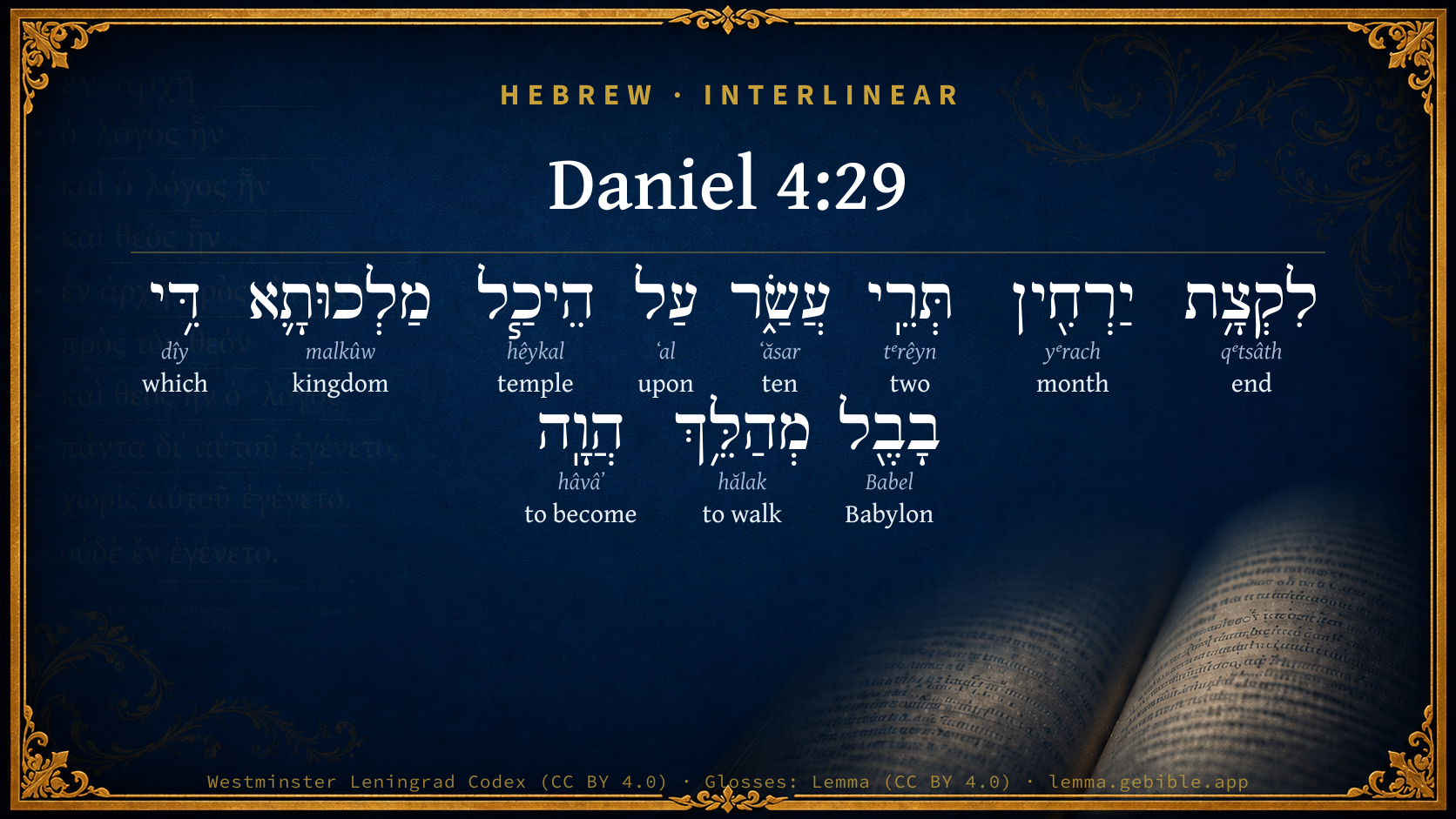
Daniel 4:29

Hebrew (Westminster Leningrad Codex) Daniel 4:29 appears in the Hebrew Old Testament. The text above is from the Westminster Leningrad Codex. Each word links to its Strong’s number, a concise gloss, and parsing drawn from the Open Scriptures Hebrew Bible morphology. Click any word for its full Brown-Driver-Briggs (BDB) entry.
Download image
Cite this verse

Daniel 4:29 (World English Bible). Public Domain. Lemma interlinear Bible study tool, https://lemma.gebible.app/v/daniel/4/29.

Show BibTeX & RIS
BibTeX
RIS
English Translation
At the end of twelve months he was walking in the royal palace of Babylon.
World English Bible · Public Domain
Download a study sheet

One document with this verse’s original text, its word-by-word gloss line, the meaning frame, cross-references with their text, attributed commentary, and full source and license credits — printable, and it pastes into notes with its structure intact.

This verse Autodidact and up

Study sheet (.html) Plain text (.txt)

A passage Seminary Student

Up to 50 verses in one chapter. A passage sheet keeps up to 6 commentary sources and 12 cross-references per verse, in the order this page ranks them, and says so on the sheet whenever that leaves anything out. Ask for a single verse and you get the Autodidact verse sheet above.

Everything on this page stays free to read, with no account — the sheet is a download of what is already on screen, not access to it.

Want to remove ads? Support Godless Engineer
Compare translations 3

The same verse in 3 English versions, stacked beneath the original-language interlinear above. Click any original word for its lexicon entry.

Each is an independent rendering of the whole verse — the interlinear is not word-aligned to these translations.

Highlighted words mark where these versions differ — a whole-verse word diff, not a word-by-word alignment.

  • World English Bible Public Domain
    At the end of twelve months he was walking in the royal palace of Babylon.
  • King James Version Public Domain
    At the end of twelve months he walked in the palace of the kingdom of Babylon.
  • unfoldingWord Literal Text CC BY-SA 4.0
    At the end of twelve months he was walking on the roof of the royal palace of Babylon.

unfoldingWord Literal Text — © unfoldingWord, licensed CC BY-SA 4.0. Word-aligned USFM3 via Door43 (git.door43.org/unfoldingWord/en_ult).

Versions to compare (up to 4)

3 of 4 selected

Show all 17 translations

Every available English version of this verse, each an independent rendering of the whole verse.

  • World English Bible Public Domain
    At the end of twelve months he was walking in the royal palace of Babylon.
  • Berean Standard Bible Public Domain
    Twelve months later, as he was walking on the roof of the royal palace of Babylon,
  • Majority Standard Bible Public Domain
    Twelve months later, as he was walking on the roof of the royal palace of Babylon,
  • King James Version Public Domain
    At the end of twelve months he walked in the palace of the kingdom of Babylon.
  • American Standard Version (1901) Public Domain
    At the end of twelve months he was walking in the royal palace of Babylon.
  • Revised Version (1885) Public Domain
    At the end of twelve months he was walking in the royal palace of Babylon.
  • Geneva Bible (1599) Public Domain
    And they shall driue thee from men, and thy dwelling shalbe with the beastes of the fielde: they shall make thee to eate grasse, as the oxen, and seuen times shall passe ouer thee, vntill thou knowest, that the most High beareth rule ouer the kingdome of men, and giueth it vnto whomsoeuer he will.
  • Douay-Rheims (1899) Public Domain
    At the end of twelve months he was walking in the palace of Babylon.
  • Young's Literal Translation Public Domain
    `At the end of twelve months, on the palace of the kingdom of Babylon he hath been walking;
  • Literal Standard Version CC BY-SA 4.0
    At the end of twelve months, on the palace of the kingdom of Babylon he has been walking;
  • unfoldingWord Literal Text CC BY-SA 4.0
    At the end of twelve months he was walking on the roof of the royal palace of Babylon.
  • Darby Bible Public Domain
    At the end of twelve months he was walking upon the royal palace of Babylon:
  • World Messianic Bible Public Domain
    At the end of twelve months he was walking in the royal palace of Babylon.
  • Webster's Bible Public Domain
    At the end of twelve months he walked in the palace of the kingdom of Babylon.
  • Free Bible Version CC BY-SA 4.0
    Twelve months later he was walking on the roof of the royal palace in Babylon.
  • Bible in Basic English Public Domain
    At the end of twelve months he was walking on the roof of his great house in Babylon.
  • JPS Tanakh (1917) Public Domain
    (4-26) At the end of twelve months he was walking upon the royal palace of Babylon.

Literal Standard Version (2020), Covenant Press — licensed CC BY-SA 4.0. Text via the HelloAO Bible API (eBible.org). unfoldingWord Literal Text — © unfoldingWord, licensed CC BY-SA 4.0. Word-aligned USFM3 via Door43 (git.door43.org/unfoldingWord/en_ult). Free Bible Version, Dr. Jonathan Gallagher — licensed CC BY-SA 4.0. Text via the HelloAO Bible API (eBible.org).

Word by word

More ways to search: Search by grammar → Find every occurrence → Compare this word →

Practice this passage: Drill this verse → Learn its vocabulary →

About this verse

These counts appear in no published source. They are computed here, from the morphology-tagged text and Lemma’s own curated glosses. What Lemma adds →

11
words
11
distinct lemmas
Prophets
section

Notable vocabulary

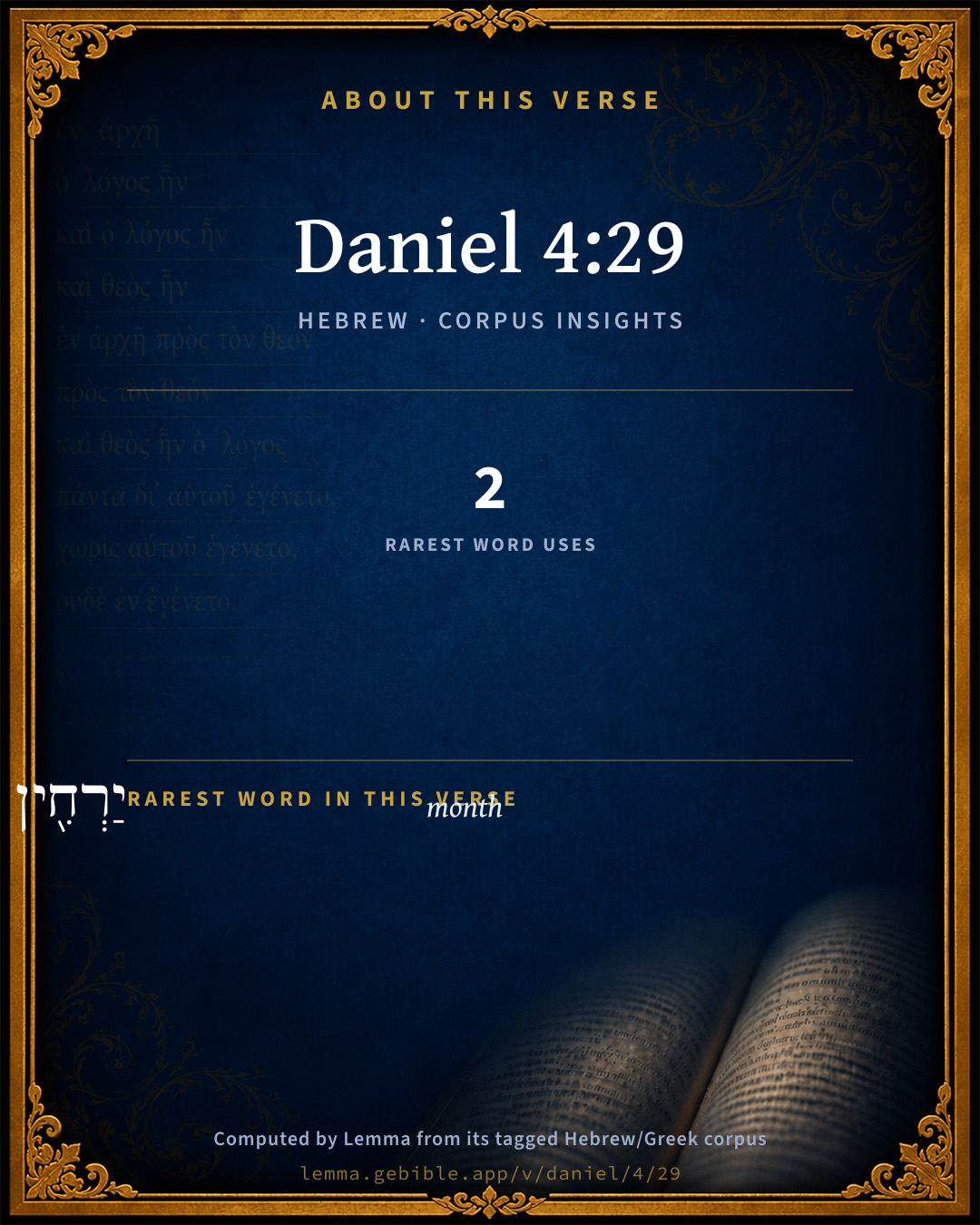
The rarest word here is יַרְחִ֖ין month H3393 — appearing just 2 times in the whole Hebrew Bible.

Shared distinctive vocabulary

יַרְחִ֖ין month H3393 occurs in 2 verses of the Hebrew Bible. Also found in:

Grammatical profile

  • 1 noun
  • 9 adjectives
  • 1 particle

Hebrew & Septuagint length

In English translation the verse runs 15 words from the Hebrew and 60 from the Septuagint (LXX English) — the Septuagint runs noticeably longer here. See the side-by-side →

A rough comparison of the two English renderings, which tokenize alike — not a word-level alignment.

Word counts can differ between the Hebrew and the Greek without any difference in meaning — e.g. the Hebrew direct-object marker אֵת has no separate Greek word, and Greek often adds the article ὁ.

Cross-references

6

Topical passages linked to Daniel 4:29 in the Treasury of Scripture Knowledge — connected by theme and wording, ordered by reader-vote popularity; previews shown in the World English Bible.

  • Revelation 2:21 I gave her time to repent, but she refuses to repent of her sexual immorality.
  • Genesis 6:3 Yahweh said, "My Spirit will not strive with man forever, because he also is flesh; yet will his days be one hundred twenty years."
  • Ecclesiastes 8:11 Because sentence against an evil work is not executed speedily, therefore the heart of the sons of men is fully set in them to do evil.
  • 1 Peter 3:20 who before were disobedient, when God waited patiently in the days of Noah, while the ark was being built. In it, few, that is, eight souls, were saved through water.
  • 2 Peter 3:9–10 The Lord is not slow concerning his promise, as some count slowness; but is patient with us, not wishing that any should perish, but that all should come to repentance.
  • 2 Peter 3:15 Regard the patience of our Lord as salvation; even as our beloved brother Paul also, according to the wisdom given to him, wrote to you;

Cross-references courtesy of OpenBible.info (CC BY 4.0).

Hebrew and Greek witnesses Masoretic Hebrew ↔ Greek Septuagint

The same verse in the two great witnesses to the Old Testament, shown verse-for-verse.

Here the Septuagint runs noticeably longer than the Hebrew — LXX2012 (modern English Septuagint) 60 words vs World English Bible 15. A rough length comparison of the two English translations, not a word-level alignment — read both below.

These are two independent witnesses, not word-aligned to each other, and the Septuagint is shown in lemma (dictionary) form.

Hebrew Daniel 4:29 Masoretic · Westminster Leningrad Codex

לִקְצָ֥ת יַרְחִ֖ין תְּרֵֽי עֲשַׂ֑ר עַל הֵיכַ֧ל מַלְכוּתָ֛א דִּ֥י בָבֶ֖ל מְהַלֵּ֥ךְ הֲוָֽה

At the end of twelve months he was walking in the royal palace of Babylon.

World English Bible · Public Domain

Greek LXX Daniel 4:29 Septuagint · lemma form

ὁ ὕψιστος ἀντιὁμολογέω καί αἰνέω ὁ κτίζω ὁ οὐρανός καί ὁ γῆ καί ὁ θάλασσα καί ὁ ποταμός καί πᾶς ὁ ἐν αὐτός ἐκὁμολογέω καί αἰνέω ὅτι αὐτός εἰμί θεός ὁ θεός καί κύριος ὁ κύριος καί βασιλεύς ὁ βασιλεύς ὅτι αὐτός ποιέω σημεῖον καί τέρας καί ἀλλοιόω καιρός καί χρόνος ἀποαἱρέω βασιλεία βασιλεύς καί καταἵστημι ἕτερος ἀντί αὐτός ἀπό ὁ νῦν αὐτός λατρεύω καί ἀπό ὁ φόβος αὐτός τρόμος λαμβάνω ἐγώ καί πᾶς ὁ ἅγιος αὐτός αἰνέω ὁ γάρ θεός ὁ ἔθνος οὐ ἔχω ἐν ἑαυτοῦ ἰσχύς ἀποστρέφω βασιλεία βασιλεύς εἰς ἕτερος βασιλεύς καί ἀποκτείνω καί ζάω ποιέω καί ποιέω σημεῖον καί θαυμάσιος μέγας καί φοβερός καί ἀλλοιόω ὑπερμεγέθης πρᾶγμα καθώς ποιέω ἐν ἐγώ ὁ θεός ὁ οὐρανός καί ἀλλοιόω ἐπί ἐγώ μέγας πρᾶγμα ἐγώ πᾶς ὁ ἡμέρα ὁ βασιλεία ἐγώ περί ὁ ψυχή ἐγώ ὁ ὕψιστος θυσία προςφέρω εἰς ὀσμή εὐωδία ὁ κύριος καί ὁ ἀρεστός ἐνώπιον αὐτός ποιέω ἐγώ καί ὁ λαός ἐγώ ὁ ἔθνος ἐγώ καί ὁ χώρα ἐγώ ὁ ἐν ὁ ἐξουσία ἐγώ καί ὅσος λαλέω εἰς ὁ θεός ὁ οὐρανός καί ὅσος ἄν καταλαμβάνω λαλέω τις οὗτος κατακρίνω θάνατος γράφω δέ ὁ βασιλεύς ναβουχοδονοσορ ἐπιστολή ἐγκύκλιος πᾶς ὁ κατά τόπος ἔθνος καί χώρα καί γλῶσσα πᾶς ὁ οἰκέω ἐν πᾶς ὁ χώρα ἐν γενεά καί γενεά κύριος ὁ θεός ὁ οὐρανός αἰνέω καί θυσία καί προσφορά προςφέρω αὐτός ἐνδόξως ἐγώ βασιλεύς βασιλεύς ἀντιὁμολογέω αὐτός ἐνδόξως ὅτι οὕτως ποιέω μετά ἐγώ ἐν αὐτός ὁ ἡμέρα καταἵζω ἐγώ ἐπί ὁ θρόνος ἐγώ καί ὁ ἐξουσία ἐγώ καί ὁ βασιλεία ἐγώ ἐν ὁ λαός ἐγώ κρατέω καί ὁ μεγαλωσύνη ἐγώ ἀπο καταἵστημι ἐγώ ναβουχοδονοσορ βασιλεύς πᾶς ὁ ἔθνος καί πᾶς ὁ χώρα καί πᾶς ὁ οἰκέω ἐν αὐτός εἰρήνη σύ πληθύνω ἐν πᾶς καιρός καί νῦν ὑποδεικνύω σύ ὁ πρᾶξις ὅς ποιέω μετά ἐγώ ὁ θεός ὁ μέγας δοκέω δέ ἐγώ ἀποδεικνύω σύ καί ὁ σοφιστής σύ ὅτι εἰμί θεός καί ὁ θαυμάσιος αὐτός μέγας ὁ βασίλειον αὐτός βασίλειον εἰς ὁ αἰών ὁ ἐξουσία αὐτός ἀπό γενεά εἰς γενεά καί ἀποστέλλω ἐπιστολή περί πᾶς ὁ γίγνομαι αὐτός ἐν ὁ βασιλεία αὐτός πᾶς ὁ ἔθνος ὁ εἰμί ὑπό ὁ βασιλεία αὐτός βαλτασαρ ὁ βασιλεύς ποιέω δοχή μέγας ἐν ἡμέρα ἐγκαινισμός ὁ βασίλειον αὐτός καί ἀπό ὁ μεγιστάν αὐτός καλέω ἀνήρ δισχίλιοι ἐν ὁ ἡμέρα ἐκεῖνος βαλτασαρ ἀναὑψόω ἀπό ὁ οἶνος καί καυχάομαι ἐπιαἰνέω πᾶς ὁ θεός ὁ ἔθνος ὁ χωνευτός καί γλυπτός ἐν ὁ τόπος αὐτός καί ὁ θεός ὁ ὕψιστος οὐ δίδωμι αἴνεσις ἐν αὐτός ὁ νύξ ἐκἔρχομαι δάκτυλος ὡσεί ἄνθρωπος καί ἐπιγράφω ἐπί ὁ τοῖχος οἶκος αὐτός ἐπί ὁ κονίαμα κατέναντι ὁ λύχνος μανη φαρες θεκελ εἰμί δέ ὁ ἑρμηνεία αὐτός μανη ἀριθμέω φαρες ἐκαἴρω θεκελ ἵστημι

And they shall drive you from men, and your dwelling shall be with the wild beasts of the field, and they shall feed you with grass as an ox: and seven times shall pass over you, until you know that the Most High is Lord of the kingdom of men, and he will give it to whoever he shall please.

LXX2012 (modern English Septuagint) · Public Domain

Hebrew: Westminster Leningrad Codex (CC BY 4.0). Greek: Septuagint (public domain); English from LXX2012 (modern English Septuagint) (Public Domain). How the Septuagint differs from the Hebrew →

Commentary

Notes on Daniel 4:29 from classic Christian and Jewish commentators (each source and its license shown beneath its notes). The classic Christian expositions comment on the surrounding passage and are grouped to its opening verse, so a note may address several verses; the Jewish commentaries on the Tanakh (Rashi and others) are per-verse, so they appear only where the commentator wrote on this verse.

Lemma curates 59 commentaries, every one of them public domain or Creative Commons licensed, each selected and text-cleaned for this edition rather than reprinted as found. About our sources →

Trapp's Complete Commentary

John Trapp

Dan 4:29 At the end of twelve months he walked in the palace of the kingdom of Babylon.

Ver. 29. At the end of twelve months he walked,] scil., A year after the dream, the interpretation thereof, and the good counsel given him thereupon. It is some wonder how he could so soon forget all; but the world, with the lusts thereof, had hardened his heart.

In the palace of the kingdom.] His idle walk, and his stately palace, were some occasion of his pride and fall. He walketh and stalketh, musing of nothing but his own greatness only.

John Trapp, A Commentary or Exposition upon All the Books of the Old and New Testament (1647–1656) — public domain. Text from a community e-Sword module.

Jamieson, Fausset & Brown

Robert Jamieson, A. R. Fausset & David Brown

twelve months--This respite was granted to him to leave him without excuse. So the hundred twenty years granted before the flood (Gen 6:3). At the first announcement of the coming judgment he was alarmed, as Ahab (Kg1 21:27), but did not thoroughly repent; so when judgment was not executed at once, he thought it would never come, and so returned to his former pride (Ecc 8:11).

in the palace--rather, upon the (flat) palace roof, whence he could contemplate the splendor of Babylon. So the heathen historian, ABYDENUS, records. The palace roof was the scene of the fall of another king (Sa2 11:2). The outer wall of Nebuchadnezzar's new palace embraced six miles; there were two other embattled walls within, and a great tower, and three brazen gates.

Jamieson, Fausset & Brown — Commentary Critical and Explanatory on the Whole Bible (1871) — public domain (CC PDM 1.0). Text via the HelloAO Bible API.

Ellicott's Commentary for English Readers

(29) Twelve months—i.e., counting from the time of the vision. Sufficient time for repentance was mercifully granted to the king.

Palace of the kingdom of Babylon.—He had palaces in other towns. Daniel lays a stress upon the fact that this occurred in the town of Babylon. Nebuchadnezzar, the golden head of the image, was in the very centre of his dominions, in his own proud capital, when this occurred. It is needless, therefore, to assume that this was written by a person who lived a long way off from Babylon.

A Bible Commentary for English Readers, edited by Charles John Ellicott (1878–1897) — public domain. Text from a community e-Sword module.

The Cambridge Bible for Schools and Colleges

gen. ed. J. J. S. Perowne

29. he was walking upon the royal palace of Babylon] ‘upon’ means on the roof of: cf. 2Sa_11:2.

The Cambridge Bible for Schools and Colleges (gen. ed. J. J. S. Perowne; Cambridge University Press, 1878–1918) — public domain. Text from a community e-Sword module.

John Gill's Exposition

While the word was in the king's mouth, there fell a voice from heaven,.... Before the king had done speaking in the above boasting manner, an articulate voice from heaven was heard by him, and all about him, formed by the angels, and much like what the Jews call Bath Kol; see Act 12:21, so Abydenus (g), in the account he gives of Nebuchadnezzar's oration to the people, relates, that when the king had spoke it, , immediately he disappeared:

saying, O King Nebuchadnezzar, to thee it is spoken, the kingdom is departed from thee; that is, the administration of it; for he was not deposed, or declared to be no longer king; his office was not taken away from him, and another king set upon the throne; only the administration was taken into other hands, either of his wife or son, or his nobles; he being unfit for it, till such time as his reason returned to him.

(g) Apud Euseb. ut supra. (Praepar. Evangel. l. 9. c. 41. p. 457.)

John Gill's Exposition of the Whole Bible (1746–1763) — public domain (CC PDM 1.0). Text via the HelloAO Bible API.

Albert Barnes' Notes on the Bible

At the end of twelve months - After the dream, and the interpretation - giving him ample opportunity to repent, and to reform his life, and to avoid the calamity.

He walked in the palace - Margin, “upon.” The margin is the more correct rendering. The roofs of houses in the East are made flat, and furnish a common place of promenade, especially in the cool of the evening. See the note at Mat 9:2. The Codex Chisianus has here, “The king walked upon the walls of the city with all his glory, and went around the towers, and answering, said.” The place, however, upon which he walked, appears to have been the roof of his own palace - doubtless reared so high that he could have a good view of the city from it.

Of the kingdom of Babylon - Appertaining to that kingdom; the royal residence. As it is to be supposed that this “palace of the kingdom,” on the roof of which the king walked, was what he had himself reared, and as this contributed much to the splendor of the capital of his empire, and doubtless was the occasion, in a considerable degree, of his vainglorious boasting when the judgment of heaven fell upon him Dan 4:30-31, a brief description of that palace seems to he not inappropriate. The description is copied from an article on Babylon in Kitto’s “Cyclopaedia of Biblical Literature,” vol. i. pp. 270, 271: “The new palace built by Nebuchadnezzar was prodigious in size and superb in embellishments. Its outer wall embraced six miles; within that circumference were two other embattled walls, besides a great tower. Three brazen gates led into the grand area, and every gate of consequence throughout the city was of brass. The palace was splendidly decorated with statues of men and animals, with vessels of gold and silver, and furnished with luxuries of all kinds brought thither from conquests in Egypt, Palestine, and Tyre. Its greatest boast were the hanging gardens, which acquired, even from Grecian writers, the appellation of one of the wonders of the world. They are attributed to the gallantry of Nebuchadnezzar, who constructed them in compliance with a wish of his queen Amytis to possess elevated groves, such as she had enjoyed on the hills around her native Ecbatana. Babylon was all flat, and to accomplish so extravagant a desire, an artificial mountain was reared, four hundred feet on each side, while terraces, one above another, rose to a height that overtopped the walls of the city, that is, above three hundred feet in elevation.

The ascent from terrace to terrace was made by corresponding flights of steps, while the terraces themselves were reared to their various stages on ranges of regular piers, which, forming a kind of vaulting, rose in succession one over the other to the required height of each terrace, the whole being bound together by a wall twenty-two feet in thickness. The level of each terrace or garden was then formed in the following manner: the tops of the piers were first laid over with flat stones, sixteen feet in length, and four in width; on these stones were spread beds of matting, then a thick layer of bitumen, after which came two courses of bricks, which were covered with sheets of solid lead. The earth was heaped on this platform, and in order to admit the roots of large trees, prodigious hollow piers were built and filled with mould. From the Euphrates, which flowed close to the foundation, water was drawn up by machinery. The whole, says Q. Curtius (Dan 4:5), had, to those who saw it from a distance, the appearance of woods overhanging mountains. The remains of this palace are found in the vast mound or hill called by the natives “Kasr.” It is of irregular form, eight hundred yards in length, and six hundred yards in breadth. Its appearance is constantly undergoing change from the continual digging which takes place in its inexhaustible quarries for brick of the strongest and finest material. Hence, the mass is furrowed into deep ravines, crossing and recrossing each other in every direction.”

Albert Barnes' Notes on the Bible (1834–1885) — public domain. Text from a community e-Sword/MySword module.

Matthew Poole's English Annotations

Here we see God did forbear the execution of his judgment decreed the space of one whole year, which may be upon Daniel’s words, and he did reform somewhat, as Ahab was spared a good while upon his humiliation, 1Ki 21:27; and God would try him by giving him space of repentance, as he did to them before the flood, Gen 6:3; and to Jezebel, Rev 2:21; but it is most probable, though he may be a little astonished at the first, when he heard God’s decree against him, yet having this respite, he grew hardened, and thought it was over, and therefore spreads his plumes and strutted in his pride as high as ever.

Matthew Poole's English Annotations on the Holy Bible (1683–1685) — public domain. Text from a community e-Sword/MySword module.

Whedon's Commentary on the Bible

Daniel D. Whedon

29, 30. This picture of the king walking on the roof garden of the royal palace in Babylon and praising himself for his magnificent building enterprises finds an echo in almost every one of his inscriptions which have been preserved. [See Introduction, III, 3, (1); 4.] He was the greatest builder of all the Babylonian kings, rebuilding the capital city almost from its foundations. Again and again he records how “silver, gold, precious stones, copper, precious woods, all kinds of valuable things, the produce of the mountains, the fullness of the seas, rich presents, splendid gifts, to my city of Babylon into his [Bel-Marduk’s] presence I brought.”

Daniel D. Whedon (gen. ed.), Commentary on the Old and New Testaments (1874–1909) — public domain. Text from a community e-Sword module.

The Pulpit Commentary

Vers. 29-33.

The sudden collapse of pride.

Careful and costly measures had been furnished by God to restrain Nebuchadnezzar from the brink of ruin, to which he was fast hastening. The dream, with its appalling omens; the human messenger; the king"s conscience; all these were voices from the supreme court of heaven. But conscience was silenced, the prophet was forgotten, the sense of danger diminished; Nebuchadnezzar persisted in his sin, until the patience of God was exhausted.

I WE SEE PRIDE VAUNTING ITSELF IN BOASTFUL VAINGLORY. A year had elapsed since the faithful voice of Daniel had wakened the conscience of the king. At first the monarch intended to reform, but procrastination destroyed the sensitiveness of feeling, blinded him to the imminence of danger, and gave momentum to his downward course. The city grew in magnitude and in magnificence. The royal plans proceeded towards completion. Outward prosperity shone upon him in still clearer glory, Notwithstanding, the hour of reckoning was about to strike. Walking upon his elevated palace-roof, and surveying the grandeur of the city, Nebuchadnezzar gave the reins to natural pride thought and spoke as if there were none greater than he. This is the end pride ever aims at, viz. to make man a god unto himself. Yet was there a solitary stone in that vast pile that had been created by Nebuchadnezzar? Was the mind that designed the whole self-originated? Were the ten thousand artisans who had daily wrought upon those buildings the workmanship of man or of God? Pride is idolatry. Pride becomes mad atheism. There is no sin that is so frequently and freely condemned in Scripture as pride. By it the angels lost their high estate. Into this pit Adam fell. "Ye shall be as gods," the tempter said. "God resisteth the proud." They are a smoke in his nostrils. "Pride goeth before destruction." One step only between haughtiness and hell. Insolent arrogance verges on madness.

II WE SEE HUMAN PRIDE MOVING TO ACTIVITY THE COUNSELS OF HEAVEN. If the statesmen or the artisans in Babylon overheard the utterance of the king, they might have regarded it as a harmless outburst of vanity. Yet God doth not so regard it. It disturbs the tranquillity of heaven. It is regarded there as the language of hostile defiance. The limit of God"s forbearance was leached. There is a time to be quiet and a time to act. The cup of Nebuchadnezzar"s sin was full. He had despised the messages of kindly expostulation from Jehovah, and now no delay was permitted. The king had barely ceased to speak when Jehovah responded. But the words of Nebuchadnezzar were not intended for the ears of God. Ah! still he heard them. He regarded them as an indirect menace to him, and he at once replies. The verdict has passed the Judge"s lips. The kingdom is alienated. In a moment empire is lost. Rank, honour, power, are lost. Manhood is lost. Intelligence, memory, reason, love, all lust. Bare existence only remains. Like the prodigal boy, he descends step by step into a deeper degradation, and at length herds with the beasts of the field. Yet this is but an outward and visible portraiture of the inward degradation.

III WE SEE HUMAN PRIDE MEETING WITH FITTING RETRIBUTION. We have here in concrete form in the history of a living person the abstract truth, "He that exalteth himself shall be abased." This is its natural and fitting outcome its proper fruit. We cannot doubt that every form and degree of sin has, in the Divine code, a suitable and adequate punishment. There is not simply one rigid penalty for every mode and measure of transgression. The justice that presides on the eternal throne has eyes of subtlest discrimination and balances of exquisite nicety. Every step in the judicial procedure of God is accordant with natural principles. Even the forces of material nature will possibly be employed in vindicating the Divine Majesty. The indolence and sensual indulgence of the Babylonian palace served to emasculate Nebuchadnezzar. The rousing energy which war had demanded in earlier years had braced the monarch"s mind. But now the years of public peace had been so misused that inertia bred softness and luxury produced effeminacy. Step by step character deteriorated, though, perhaps, not detected by mortal eye. At length, by the Divine fiat, Reason abdicated her seat; the animal got the better of the man. In his imbecile condition the king imagined himself an ox, and preferred to browse in the fields. He was held last by this hallucination. His relatives and attendants, very possibly, feared to resist him. They humoured his infatuation until, in the royal paddock, his hair grew ragged and coarse, his nails became long and bent like eagles" claws. This is the monarch who disdained to recognize God the monarch who plumed himself on his self-sufficiency! Draw near, all proud doffers of God, and see this portrait of yourselves! D.

The Pulpit Commentary (1880–1919), ed. H.D.M. Spence-Jones & Joseph S. Exell — public domain. Text from a community e-Sword module.

Rashi

Rabbi Shlomo Yitzchaki (Rashi)

they will banish Aram. טָרְדִין. an expression of driving away.

Rashi on the Tanakh — English translations: “The Judaica Press complete Tanach with Rashi, translated by A. J. Rosenberg” (CC BY 4.0); “Pentateuch with Rashi's commentary by M. Rosenbaum and A.M. Silbermann, 1929-1934” (public domain); “The Metsudah Tanach series, Lakewood, N.J” (CC BY 4.0); and “The Book of Joshua, Metsudah Publications, 1997” (CC BY 4.0). Text via Sefaria.

Lesson kit

Teaching starters — assembled from the data on this page, not authored interpretation. Every prompt links to the verse data it draws on. Edit before teaching.

Daniel, in the Prophets, opens this verse with 11 words (11 distinct Hebrew lemmas). Its most distinctive word is yᵉrach (“month”). The Greek Septuagint runs longer here. A historical commentator’s framing appears above. Read the whole chapter for the surrounding context.

Discussion questions

  1. The word yᵉrach carries the sense “month.” How does it shape the verse?
  2. Ezra 6:15 shares the word «month» with this verse. How do the two illuminate each other?
  3. Compared with the Hebrew, the Septuagint runs longer here. What questions does that raise?
  4. The translations on this page render this verse differently — a whole-verse word diff, not a word-by-word alignment. What might account for the different wordings?
  5. Reading how Trapp's Complete Commentary and Jamieson, Fausset & Brown read this verse, where do the two commentators agree and where do they part?

Things to notice

Reading settings

Reading text

Shown beneath each verse's original-language words.

Old Testament
Old Testament edition

Read the OT as the Masoretic Hebrew (MT) or the Greek Septuagint (LXX).

English shown for the Greek Septuagint (in the Hebrew ↔ Greek comparison).

Comparing translations? Open the Compare panel on any verse page to stack up to four side by side.