Daniel 7:22

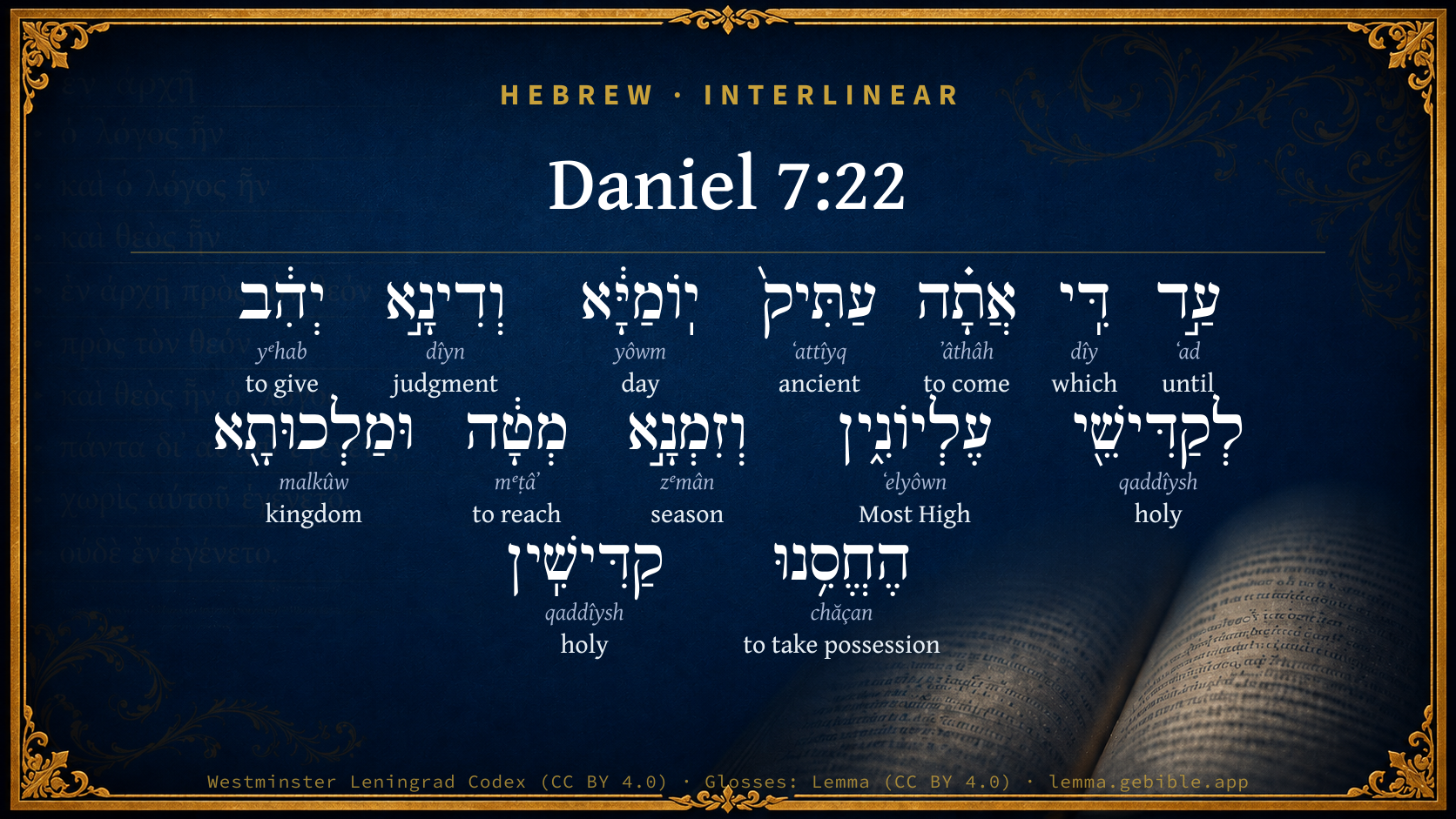
Hebrew (Westminster Leningrad Codex) Daniel 7:22 appears in the Hebrew Old Testament. The text above is from the Westminster Leningrad Codex. Each word links to its Strong’s number, a concise gloss, and parsing drawn from the Open Scriptures Hebrew Bible morphology. Click any word for its full Brown-Driver-Briggs (BDB) entry.
Download image
Cite this verse

Daniel 7:22 (World English Bible). Public Domain. Lemma interlinear Bible study tool, https://lemma.gebible.app/v/daniel/7/22.

Show BibTeX & RIS
BibTeX
RIS
English Translation
until the ancient of days came, and judgment was given to the saints of the Most High, and the time came that the saints possessed the kingdom.
World English Bible · Public Domain
Download a study sheet

One document with this verse’s original text, its word-by-word gloss line, the meaning frame, cross-references with their text, attributed commentary, and full source and license credits — printable, and it pastes into notes with its structure intact.

This verse Autodidact and up

Study sheet (.html) Plain text (.txt)

A passage Seminary Student

Up to 50 verses in one chapter. A passage sheet keeps up to 6 commentary sources and 12 cross-references per verse, in the order this page ranks them, and says so on the sheet whenever that leaves anything out. Ask for a single verse and you get the Autodidact verse sheet above.

Everything on this page stays free to read, with no account — the sheet is a download of what is already on screen, not access to it.

Want to remove ads? Support Godless Engineer
Compare translations 3

The same verse in 3 English versions, stacked beneath the original-language interlinear above. Click any original word for its lexicon entry.

Each is an independent rendering of the whole verse — the interlinear is not word-aligned to these translations.

Highlighted words mark where these versions differ — a whole-verse word diff, not a word-by-word alignment.

  • World English Bible Public Domain
    until the ancient of days came, and judgment was given to the saints of the Most High, and the time came that the saints possessed the kingdom.
  • King James Version Public Domain
    Until the Ancient of days came, and judgment was given to the saints of the most High; and the time came that the saints possessed the kingdom.
  • unfoldingWord Literal Text CC BY-SA 4.0
    until the Ancient of Days came, and judgment was given for the saints of the Most High. Then the time arrived when the saints took possession of the kingdom.

unfoldingWord Literal Text — © unfoldingWord, licensed CC BY-SA 4.0. Word-aligned USFM3 via Door43 (git.door43.org/unfoldingWord/en_ult).

Versions to compare (up to 4)

3 of 4 selected

Show all 18 translations

Every available English version of this verse, each an independent rendering of the whole verse.

  • World English Bible Public Domain
    until the ancient of days came, and judgment was given to the saints of the Most High, and the time came that the saints possessed the kingdom.
  • Berean Standard Bible Public Domain
    until the Ancient of Days arrived and pronounced judgment in favor of the saints of the Most High, and the time came for them to possess the kingdom.
  • Majority Standard Bible Public Domain
    until the Ancient of Days arrived and pronounced judgment in favor of the saints of the Most High, and the time came for them to possess the kingdom.
  • King James Version Public Domain
    Until the Ancient of days came, and judgment was given to the saints of the most High; and the time came that the saints possessed the kingdom.
  • American Standard Version (1901) Public Domain
    until the ancient of days came, and judgment was given to the saints of the Most High, and the time came that the saints possessed the kingdom.
  • Revised Version (1885) Public Domain
    until the ancient of days came, and judgment was given to the saints of the Most High; and the time came that the saints possessed the kingdom.
  • Geneva Bible (1599) Public Domain
    Vntill the Ancient of dayes came, and iudgement was giuen to the Saintes of the most High: and the time approched, that the Saintes possessed the kingdome.
  • Douay-Rheims (1899) Public Domain
    Till the Ancient of days came and gave judgment to the saints of the most High, and the time came, and the saints obtained the kingdom.
  • Young's Literal Translation Public Domain
    till that the Ancient of Days hath come, and judgment is given to the saints of the Most High, and the time hath come, and the saints have strengthened the kingdom.
  • Literal Standard Version CC BY-SA 4.0
    until the Ancient of Days has come, and judgment is given to the saints of the Most High, and the time has come, and the saints have strengthened the kingdom.
  • Unlocked Literal Bible CC BY-SA 4.0
    until the Ancient of Days came, and justice was given to the holy people of the Most High. Then the time came when the holy people received the kingdom.
  • unfoldingWord Literal Text CC BY-SA 4.0
    until the Ancient of Days came, and judgment was given for the saints of the Most High. Then the time arrived when the saints took possession of the kingdom.
  • Darby Bible Public Domain
    until the Ancient of days came, and judgment was given to the saints of the most high [places]; and the appointed time arrived, and the saints possessed the kingdom.
  • World Messianic Bible Public Domain
    until the Ancient of Days came, and judgment was given to the holy ones of the Most High, and the time came that the holy ones possessed the kingdom.
  • Webster's Bible Public Domain
    Until the Ancient of days came, and judgment was given to the saints of the most High; and the time came that the saints possessed the kingdom.
  • Free Bible Version CC BY-SA 4.0
    until the Ancient of Days came and gave judgment in favor of the dedicated people of the Most High, and at that time they took possession of the kingdom.
  • Bible in Basic English Public Domain
    Till he came, who was very old, and the decision was made and the authority was given to the saints of the Most High; and the time came when the saints took the kingdom.
  • JPS Tanakh (1917) Public Domain
    until the Ancient of days came, and judgment was given for the saints of the Most High; and the time came, and the saints possessed the kingdom.

Literal Standard Version (2020), Covenant Press — licensed CC BY-SA 4.0. Text via the HelloAO Bible API (eBible.org). Unlocked Literal Bible (unfoldingWord) — licensed CC BY-SA 4.0. Text via the HelloAO Bible API (eBible.org). unfoldingWord Literal Text — © unfoldingWord, licensed CC BY-SA 4.0. Word-aligned USFM3 via Door43 (git.door43.org/unfoldingWord/en_ult). Free Bible Version, Dr. Jonathan Gallagher — licensed CC BY-SA 4.0. Text via the HelloAO Bible API (eBible.org).

Word by word

More ways to search: Search by grammar → Find every occurrence → Compare this word →

Practice this passage: Drill this verse → Learn its vocabulary →

הֶחֱסִ֥נוּ
chăçan
H2631
“to take possession”
Adjective, V, Plural
Part of Speech
Adjective
Number
Plural
Full BDB Definition

Origin: corresponding to H2630

TWOT: 2738

(Aphel) to take possession of
  1. עַ֣ד ʻad H5705 “until” Adjective, R
  2. דִּֽי dîy H1768 “which” Adjective, T
  3. אֲתָ֗ה ʼâthâh H858 “to come” Adjective, V, Plural
  4. עַתִּיק֙ ʻattîyq H6268 “ancient” Adjective, N
  5. יֽוֹמַיָּ֔א yôwm H3118 “day · the” Adjective, N + Particle, Definite Article
  6. וְדִינָ֣א dîyn H1780 “and · judgment · the” Adjective, C + Noun, Common, Masculine, Singular, Determined + Particle, Definite Article
  7. יְהִ֔ב yᵉhab H3052 “to give” Adjective, V, Plural
  8. לְקַדִּישֵׁ֖י qaddîysh H6922 “to/for · holy of” Adjective, R + Adjective, Adjective, Masculine, Plural, Construct
  9. עֶלְיוֹנִ֑ין ʻelyôwn H5946 “Most High” Adjective, A
  10. וְזִמְנָ֣א zᵉmân H2166 “and · season · the” Adjective, C + Noun, Common, Masculine, Singular, Determined + Particle, Definite Article
  11. מְטָ֔ה mᵉṭâʼ H4291 “to reach” Adjective, V, Plural
  12. וּמַלְכוּתָ֖א malkûw H4437 “and · kingdom · the” Adjective, C + Noun, Common, Feminine, Singular, Determined + Particle, Definite Article
  13. קַדִּישִֽׁין qaddîysh H6922 “holy” Adjective, A

About this verse

These counts appear in no published source. They are computed here, from the morphology-tagged text and Lemma’s own curated glosses. What Lemma adds →

14
words
13
distinct lemmas
Prophets
section

Notable vocabulary

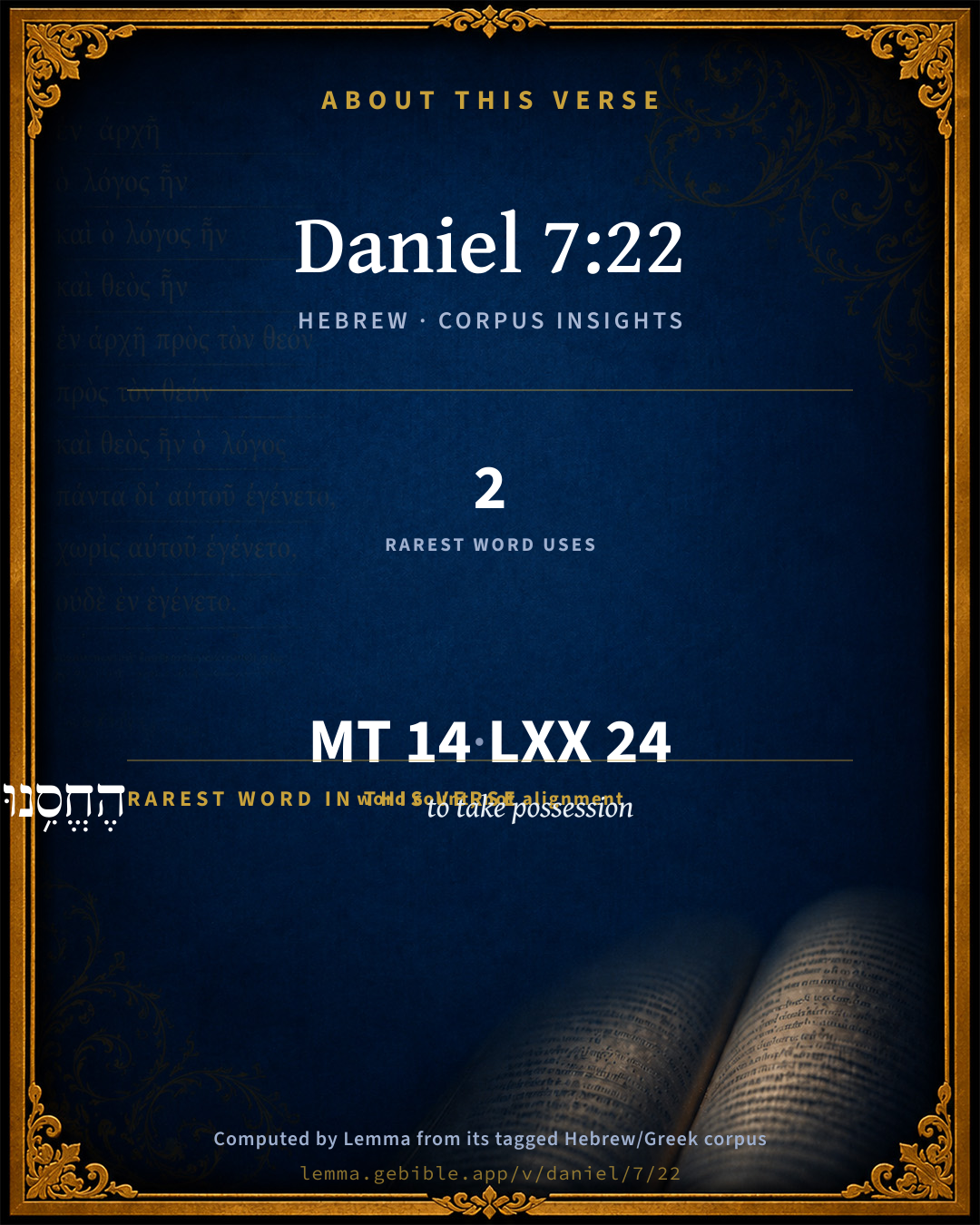
The rarest word here is הֶחֱסִ֥נוּ to take possession H2631 — appearing just 2 times in the whole Hebrew Bible.

Shared distinctive vocabulary

הֶחֱסִ֥נוּ to take possession H2631 occurs in 2 verses of the Hebrew Bible. Also found in:

Grammatical profile

  • 10 adjectives
  • 4 particles

Repetition

A word recurs within this verse — often emphatic in Hebrew:

  • לְקַדִּישֵׁ֖י holy H6922 ×2

Hebrew & Septuagint length

In English translation the verse runs 27 words from the Hebrew and 28 from the Septuagint (LXX English) — closely comparable.

A rough comparison of the two English renderings, which tokenize alike — not a word-level alignment.

Word counts can differ between the Hebrew and the Greek without any difference in meaning — e.g. the Hebrew direct-object marker אֵת has no separate Greek word, and Greek often adds the article ὁ.

In the original languages it is 14 Hebrew tokens and 24 Greek tokens — but the two are counted differently (Hebrew bundles its prefixes and suffixes into one token; the Greek is in lemma form), so that isn’t a like-for-like length.

Cross-references

15

Topical passages linked to Daniel 7:22 in the Treasury of Scripture Knowledge — connected by theme and wording, ordered by reader-vote popularity; previews shown in the World English Bible.

  • Daniel 7:18 But the saints of the Most High shall receive the kingdom, and possess the kingdom forever, even forever and ever.
  • Revelation 5:10 And made them kings and priests to our God, And they reign on earth."
  • Revelation 20:4 I saw thrones, and they sat on them, and judgment was given to them. I saw the souls of those who had been beheaded for the testimony of Jesus, and for the word of God, and such as didn't worship the beast nor his image, and didn't receive the mark on their forehead and on their hand. They lived, and reigned with Christ for the thousand years.
  • Daniel 7:9–11 I saw until thrones were placed, and one who was ancient of days sat: his clothing was white as snow, and the hair of his head like pure wool; his throne was fiery flames, [and] the wheels of it burning fire.
  • Matthew 19:28 Jesus said to them, "Most assuredly I tell you that you who have followed me, in the regeneration when the Son of Man will sit on the throne of his glory, you also will sit on twelve thrones, judging the twelve tribes of Israel.
  • Luke 22:29–30 I confer on you a kingdom, even as my Father conferred on me,
  • 1 Corinthians 6:2–3 Don't you know that the saints will judge the world? And if the world is judged by you, are you unworthy to judge the smallest matters?
  • 2 Thessalonians 2:8 Then the lawless one will be revealed, whom the Lord will kill with the breath of his mouth, and bring to nothing by the brightness of his coming;
  • Revelation 3:21 He who overcomes, I will give to him to sit down with me on my throne, as I also overcame, and sat down with my Father on his throne.
  • Revelation 11:11–18 After the three and a half days, the breath of life from God entered into them, and they stood on their feet. Great fear fell on those who saw them.
  • Revelation 14:8–20 Another, a second angel, followed, saying, "Babylon the great has fallen, which has made all the nations to drink of the wine of the wrath of her sexual immorality."
  • Revelation 19:11–21 I saw the heaven opened, and behold, a white horse, and he who sat on it is called Faithful and True. In righteousness he judges and makes war.
  • Revelation 20:9–15 They went up over the breadth of the earth, and surrounded the camp of the saints, and the beloved city. Fire came down out of heaven from God, and devoured them.
  • Isaiah 63:4 For the day of vengeance was in my heart, and the year of my redeemed is come.
  • Revelation 1:6 and he made us to be a Kingdom, priests to his God and Father; to him be the glory and the dominion forever and ever. Amen.

Cross-references courtesy of OpenBible.info (CC BY 4.0).

Hebrew and Greek witnesses Masoretic Hebrew ↔ Greek Septuagint

The same verse in the two great witnesses to the Old Testament, shown verse-for-verse.

These are two independent witnesses, not word-aligned to each other, and the Septuagint is shown in lemma (dictionary) form.

Hebrew Daniel 7:22 Masoretic · Westminster Leningrad Codex

עַ֣ד דִּֽי אֲתָ֗ה עַתִּיק֙ יֽוֹמַיָּ֔א וְדִינָ֣א יְהִ֔ב לְקַדִּישֵׁ֖י עֶלְיוֹנִ֑ין וְזִמְנָ֣א מְטָ֔ה וּמַלְכוּתָ֖א הֶחֱסִ֥נוּ קַדִּישִֽׁין

until the ancient of days came, and judgment was given to the saints of the Most High, and the time came that the saints possessed the kingdom.

World English Bible · Public Domain

Greek LXX Daniel 7:22 Septuagint · lemma form

ἕως ὁ ἔρχομαι ὁ παλαιός ἡμέρα καί ὁ κρίσις δίδωμι ὁ ἅγιος ὁ ὕψιστος καί ὁ καιρός δίδωμι καί ὁ βασίλειον καταἔχω ὁ ἅγιος

until the Ancient of days came, and he gave judgment to the saints of the Most High; and the time came on, and the saints possessed the kingdom.

LXX2012 (modern English Septuagint) · Public Domain

Hebrew: Westminster Leningrad Codex (CC BY 4.0). Greek: Septuagint (public domain); English from LXX2012 (modern English Septuagint) (Public Domain). How the Septuagint differs from the Hebrew →

Commentary

Notes on Daniel 7:22 from classic Christian and Jewish commentators (each source and its license shown beneath its notes). The classic Christian expositions comment on the surrounding passage and are grouped to its opening verse, so a note may address several verses; the Jewish commentaries on the Tanakh (Rashi and others) are per-verse, so they appear only where the commentator wrote on this verse.

Lemma curates 59 commentaries, every one of them public domain or Creative Commons licensed, each selected and text-cleaned for this edition rather than reprinted as found. About our sources →

Trapp's Complete Commentary

John Trapp

Dan 7:22 Until the Ancient of days came, and judgment was given to the saints of the most High; and the time came that the saints possessed the kingdom.

Ver. 22. Until the Ancient of days came.] Not by change of place, but change of providence. {Zec 14:3-4}

And judgment was given to the saints.] As upprovers of Christ’s righteous judgment.

That the saints possessed the kingdom,] sc., In Christ their head. {Dan 7:10}

John Trapp, A Commentary or Exposition upon All the Books of the Old and New Testament (1647–1656) — public domain. Text from a community e-Sword module.

The Preacher's Complete Homiletical Commentary

Joseph S. Exell (gen. ed.)

HOMILETICS

SECT. XXVII.—THE KINGDOM OF THE SAINTS OF THE MOST HIGH (Chap. Dan_7:18; Dan_7:22; Dan_7:27)

‘The saints shall take the kingdom.” A striking feature in the kingdom predicted in this vision of Daniel is that, while it is distinctly said to be given to the Son of Man, it is just as distinctly said, and that twice over, to be given to the saints, or to the people of the saints of the Most High, and that the saints take the kingdom. Although this circumstance has been slightly referred to under the preceding section, in connection with the administration of the kingdom of the Son of Man, yet from the prominence given to it and its threefold repetition in the vision it demands a separate consideration. We notice—the saints to whom the kingdom is given; the kingdom itself; the sense in which it is given to the saints; the suitableness of the appointment; and the beneficial results.

I. The saints [211]. Saints denote holy or sanctified persons. The term is applicable both to angels and men. Here it is the latter. “Holy” means separated from sin, and separated to God and His service. The former may be called the moral, the latter the official meaning of the term. Whatever is set apart to God and His service or use may be called holy in the official sense. Men thus set apart are or ought to be holy also in the moral sense, holy in heart and life, or separate from sin. This is the sense in the text; hence they are called “saints of the Most High,” such as are both separated to His service, belonging to Him as His own, made saints by Himself, and approved by Him as such. This far removed from the profane caricature of Papal canonisation. Men are made saints by the mighty power of divine grace, renewing them in the spirit of their mind, making them spiritually alive from being dead in trespasses and sins, and rendering them “new creatures,” or a new creation in Christ Jesus. This is especially the work assigned to the Holy Ghost, and such are said to be “born of the Spirit.” Baptism with water is the sign, but not the instrument of it. Cornelius, and thousands more, were born again of the Spirit before they were baptized; while Simon the sorcerer, like millions more, though baptized with water, was never born again at all. The instrument in the new birth, in the case of any beyond infancy, is the Word of truth. “Being born again,” says Peter, “not of corruptible seed but of incorruptible, by the Word of God, that liveth and abideth for ever.” “Of His own will,” says James, “begat He us by the Word of truth.” It is by the same instrument that the work of holiness or sanctification is carried on in the saints afterwards. “Sanctify them through Thy truth; Thy Word is truth.” “Now ye are clean through the Word that I have spoken unto you.” “That He might sanctify and cleanse it (the Church) with the washing of water by the Word” (Joh_17:17; Joh_15:3; Eph_5:26). This renewing and sanctifying of the soul by the Holy Ghost is effected in union with Christ, as members of His body and branches in Him as the true Vine,—“sanctified in Christ Jesus.” The work is carried on here in the body of flesh, but is only perfected when the body is either put off at death or changed at the Lord’s coming. Hence “the spirits of just men made perfect.” Men may be truly saints here, but only perfected saints hereafter. This saintship or sanctified condition is peculiar to no nation or class. There is, however, also a federal or covenant holiness which may belong to a nation or class, and which, like official holiness, may exist without holiness in heart and life. Thus the Jews were a holy, because a covenant people, chosen by the Lord as a people for Himself. Thus baptized Christians and the children of such are federally holy, as taken outwardly into the Christian covenant, and professedly given up to God in baptism, though, alas! too often, like the Jews, far away from moral and personal holiness. The saints of the Most High are not merely federally and officially, but morally and personally holy; holy as God is holy, and pure as God is pure, partakers of the divine character, and possessing the same holiness in kind though not in degree. In the Old Testament such were chiefly found among the Jews, to whom pertained the adoption and the giving of the law, as well as the covenants and the promises. In the New Testament they are found both among Jews and Gentiles of every nation, people, and tongue. It is of such that the kingdom of the Son of Man, identical with the kingdom given to the saints, consists. Hence the commission: “Go ye and teach (disciple) all nations, baptizing them in the name of the Father, and of the Son, and of the Holy Ghost.” While He is King of the Jews, He is also “Lord of all.” There appears, therefore, no reason for limiting the term in the text, especially as the vision has obviously its fulfilment, not in Old, but in New Testament times. A more difficult question perhaps might be, Are they the glorified saints, or saints still in the body, or both? [212] If the giving of the kingdom to the saints is to be understood in the sense of reward, as in that sense it is given to the Son of Man, then it would seem that the saints here indicated are those who, like Paul, have fought the good fight, have finished their course, and have kept the faith, and so have now received the crown of righteousness from the hand of the righteous Judge at His appearing. On this supposition they are those who have overcome, and so have received power from Christ “over the nations to rule them,” and have been made to sit down with Him on His throne. It would be the fulfilment of the promise, “Ye are they that have continued with me in my temptations, and I appoint unto you a kingdom, even as my Father hath appointed unto me” (Luk_22:28-29). Other parallel passages would be Rev_5:9-10; Rev_17:18; Rev_20:4. In this case, the saints would be those who should be raised from the dead at the Lord’s appearing, according to 1Co_15:23, and 1Th_4:16, together with those who should be alive at His coming (1Co_15:51-52; 1Th_4:17). However, even in respect to the saints then still in the body, and constituting the renewed subjects of the millennial kingdom in general, with converted Israel in particular, it would still be true that the saints take the kingdom, all civil government being then exercised by the holy persons in subordination to Christ and His glorified Bride.

[211] “Saints.” According to Keil, these are neither the Jews, who are accustomed to call themselves “saints,” in contrast with the heathen (as V. Lengerke, Maurer, Hitzig, &c., think), nor the converted Israel of the millennium (as Hofmann and others believe); but, as we argue from Exo_19:6; Deu_7:6, the true members of the covenant nation, the New Testament Israel of God, i.e., the congregation of the new covenant, consisting of Israel and the faithful of all nations. Auberlen, like Hofmann, understands the Jews still on earth to be the saints meant in this vision of Daniel. “By ‘the people of the saints of the Most High,’ to whom dominion is given, Daniel evidently could only understand the people of Israel, as distinguished from the heathen nations and kingdoms, which were to rule till then. In this point Roos, Preiswerk, Hofmann, agree with Hitzig, Bertholdt, and others. The prophet’s words refer to the re-establishment of the kingdom of Israel, concerning which the disciples asked immediately before the ascension.” Œcolampadius and others understood the faithful reigning with Christ in the celestial kingdom. Willet, however, justly observes that the kingdom is not said to be in heaven, but under heaven, and therefore on earth. Some, as Pellican and Bullinger, thought the Church of Christ is indicated, commencing while the other monarchies were still standing, and propagated over all the world in the time of the fourth beast or Roman Empire. Willet thinks the kingdom is the spiritual dominion of the Church, commencing when the other monarchies are extinguished; beginning in this world, but perfected at the Lord’s second Advent, the saints reigning in grace here and in glory hereafter.

[212] “Among the saints who are called to reign with Christ,” says Auberlen on Rev_20:4, “the martyrs of ancient and modern times are mentioned first; they become most like to the Lord Jesus in their suffering and death, and are therefore nearest Him in His life and reign.… And the Saviour teaches expressly that at His second coming as King of the kingdom, He shall place one servant over ten cities and another over five, according to the measure of faithfulness they showed during His absence (Luk_19:11). Next to the martyrs are mentioned all who had not worshipped the beast, be it in more remote times or in the last days, which are referred to by the image and the mark upon their forehead, as will appear from a comparison with Rev_13:14-17. Worshippers of the beast are all they that take the powers of this world as a reality and serve it, instead of looking to things invisible and future (2Co_4:17).… Hence our passage refers to the whole congregation of believers who are born of God, to God’s Church gathered out of Israel and the Gentiles (Rom_8:17).… Immediately connected with the resurrection of the dead is the transfiguration of those who will be then living on the earth; and the living thus changed, freed from the weight of the earthly and corruptible, and transported into the essential liberty of spirit, can now, even as the transfigured Saviour ascended up on high, be caught up into the clouds to meet the returning Lord in the air (1Th_4:17). The New Testament tells us that instead of the devil, the transfigured Church of Christ shall rule the world; while the Old Testament informs us that instead of the heathen beast, the holy people of Israel shall do so. Both agree in what is of central importance, that it is Christ, the Son of Man, who now rules humanity by His transfigured Church in heaven and by His people Israel on earth.” Calvin observes that in consequence of the intimate union between Christ and His Church, what belongs to the Head is transferred to the body; that the supreme power is constantly promised by the prophets to the Church, especially by Jesus Christ, who often predicts its complete supremacy; and that while the Church reigns by itself, Christ, its only supreme Head, obtains dominion therein.

II. The kingdom itself. This appears to be the same as that of which the interpreting angel had already spoken as the kingdom given by the Ancient of Days to the Son of Man—the kingdom of which Christ is the Head and King, and which was to take the place of the kingdoms of this world, or of the four monarchies, which shall have disappeared as the chaff of the summer threshing-floor (chap. 2) The same dominion, rule, and kingdom that is given to Christ is given to the saints as Christ’s members, who are to reign and be glorified with Him, and to sit with Him on His throne; to whom He Himself was to give authority over the nations, to rule them along with Him, and whom He was to appoint a kingdom as His Father had appointed to Himself. The kingdom is given by the Ancient of Days to Christ, and by Christ is given to His Church or Bride, to possess it along with Him, and be associated with Him in its government. The kingdom is heavenly in its origin and character, but has its place not in heaven but on earth, over and among the nations and peoples inhabiting it. While having its earthly visible and material side, like its predecessors, it will be spiritual and holy in its character, consisting not in meats and drinks, but in righteousness and peace, and joy in the Holy Ghost; the kingdom that has been so long prayed for, when God’s will shall be done on earth as it is in heaven. From heaven, wherever that may be, the saints will rule the earth with Christ, while the saints on earth shall rule subordinately with them. The “kingdom of the world” shall become “the kingdom of our Lord and of His Christ,” or His anointed members (Rev_11:15, R.V.)

III. The sense in which the saints shall take the kingdom. This appears to be the same as that in which Christ Himself takes it. The angel indicates no difference; only that Christ receives it directly from the Ancient of Days, which the saints are not said to do, they receiving it mediately from or virtually in Christ, whose members and whose Bride they are, forming with Him one body and one Christ (Rev_11:15; 1Co_12:12). Christ the Head receives the kingdom from the Father as His reward for the accomplishment of His mediatorial work given Him by the Father to do as His Righteous Servant (Php_2:6-10). His members receive it also as a reward from Christ, whose servants they were, and to whom they were enabled to be faithful even unto death. “If any man will serve me, let him follow me; and where I am there shall also my servant be. If any man serve me, him will my Father honour.” “Be thou faithful unto death, and I will give thee a crown of life.” “He that overcometh, and keepeth my words unto the end, to him will I give power over the nations.” “Ye are they which have continued with me in my temptations; and I appoint unto you a kingdom, even as my Father hath appointed me” (Joh_12:26; Rev_2:10; Rev_3:21; Luk_22:28-29). The saints take the kingdom as heirs of God and joint-heirs with Christ. One with Christ, they share with Him in His glory and reign, as they shared with Him before in His humiliation and suffering. They possess the kingdom, and exercise kingly rule and authority with and under Him, as the priest-kings whom He made such by His grace after redeeming them by His blood (Rev_1:5-6; Rev_5:9-10). With the members as with the Head, it is first humiliation and then glory: “Out of prison he cometh to reign” (Ecc_4:13). They take the kingdom, not as the kings of the world, as a matter of earthly ambition, or through carnal relationship, or by skilful management, intrigue, and violence, or as conquerors with garments rolled in blood. They take it as a gift of grace from their loving Husband and King, whom it was given them by the same grace lovingly to follow and obey even unto death. They take and possess the kingdom, not for the gratification of personal ambition, or selfish desires, or carnal pleasures, from which, as saints, they are for ever separated; but for the glory of Him who created all things for Himself, and of His Son who redeemed them by His blood, as well as for the happiness of a regenerated world and wide-extended universe. For the same high and holy ends will the saints then still in the flesh, and Israel more especially, exercise in a subordinate capacity the rule which the King Himself in His wisdom shall assign to them. [213]

[213] “Take the kingdom.” Calvin refers the taking of the kingdom by the saints to the time when, after the promulgation of the Gospel, the kingdom of God and of the saints obtained some fame and celebrity in the world. In another place, however, he remarks that the slaying of the fourth beast and the giving the kingdom and authority to the people of the saints does not seem to have taken place yet; whence all Christian interpreters agree in treating this prophecy as relating to the final day of Christ’s Advent He himself thinks the saints began to reign under the whole heaven when Christ ushered in His kingdom by the promulgation of it; and that though Daniel does not here predict occurrences connected with the Advent of Christ as Judge of the World, but with the first preaching of the Gospel, yet he notwithstanding draws a magnificent picture of Christ’s reign, embracing its final completion. The taking of the kingdom was in like manner interpreted by the early Fathers as referring to the general spread of Christianity after the first Advent of Christ. So Dr. Lee and Professor Bush.

IV. The suitableness of the appointment. There is something suitable in the thrice-repeated declaration that the saints of the Most High, or truly holy persons, shall take the kingdom. In the preceding empires, and ever since Nimrod, the “mighty hunter before the Lord,” began to be “a mighty one on the earth,” the “vilest of men” have often been “exalted” to kingly power, and, as a consequence, the “wicked have walked on every side” (Psa_12:8). For wise and holy reasons, God, in His mysterious providence, often sets over kingdoms the “basest of men,” when, as a natural result, the land is filled with misery and crime (Dan_4:17). Selfish and godless rulers have constituted a part of the present state of earthly things. Natural, so long as “the whole world lieth in the evil one” (1Jn_5:19, R.V.) Evil rulers a part of the evil entailed by the Fall, and often the chastisement of the sins of the people. What the world wants and longs for, but seldom obtains, is wise, upright, disinterested rulers, ruling in the fear of God and for the best interests of their subjects. Such is the state of things predicted in the text. Something suitable and becoming when holy men, separated from sin and selfishness, bearing the image and character of the God whose name and nature is love, and who is “righteous in all His ways and holy in all His works,” shall take, and, by divine gift, possess the kingdom. Such have learned to rule by being first taught how to obey, and have been trained to reign with Christ hereafter by suffering with Him here. Such fitted to rule by imbibing the spirit and walking in the steps of Him who was meek and lowly in heart, and who pleased not Himself, but went about doing good. “Blessed are the poor in spirit, for theirs is the kingdom of heaven.” “Blessed are the meek, for they shall inherit the earth” (Mat_5:3; Mat_5:5).

V. Its beneficial results. The happiness of subjects greatly bound up with the character and government of their rulers. “The king by judgment establisheth the land.” “When the righteous are in authority, the people rejoice; but when the wicked bear rule, the people mourn” (Pro_29:2; Pro_29:4). Seen in a measure in the rule of David, as compared with that of many who succeeded him. Limited examples also in our own Alfred, and in her who now sits upon his throne. The best of rulers, however, in the present state of things, able only to produce partial results, both from their own imperfect spiritual condition and that of their ministers and coadjutors in the government, their short continuance in power, the evil state of things already existing, and the hostile influences, visible and invisible, which oppose them. From these impediments the reign of the saints of the Most High in the millennial kingdom of the Son of Man will be greatly exempt, so that their rule will be naturally one of the highest beneficence, and attended with the happiest results to humanity [214]. The state of things in the world, under a government in which a King (Messiah) shall reign in righteousness, and princes (the saints associated with Him) shall rule in judgment, represented by the prophets under such imagery as the following: “The wolf also shall dwell with the lamb, and the leopard shall lie down with the kid, and the calf, and the young lion, and the fatling together, and a little child shall lead them.” “He shall come down like rain upon the mown grass; as showers that water the earth. There shall be a handful of corn in the earth upon the top of the mountains; the fruit thereof shall shake like Lebanon; and they of the city shall flourish like grass of the earth” (Isa_11:6-9; Isa_65:25; Psa_72:6; Psa_72:16). Without any figure, “Then shall the earth yield her increase, and God, even our own God, shall bless us. God shall bless us, and all the ends of the earth shall fear Him” (Psa_67:6-7). The subject suggests—

[214] “Not only,” says Auberlen, “does the evil spiritual influence which the prince of this world exerted on humanity in the preceding ages cease, but, in place of it, the transfigured Church of God obtain a most blessed dominion over the world. Christianity will pervade the world and all relations of life in spirit and in truth.… It is upon this present earth that it must be shown and proved that the devil, who pretended to be its rightful lord, was only a usurper; man, who was created to ‘have dominion over the earth,’ is to rejoice over his world with full, unmixed, holy joy. Every legitimate and true ideal will then become a reality.”

1. Cause of rejoicing in the prospect presented by the text. It was as a ground of comfort and a matter of rejoicing that it was three times announced to Daniel that the saints should take and possess the kingdom. It was intimated as good tidings not only for the saints themselves, who, instead of being given into the hands of oppressors and persecutors, despised and down-trodden, and often counted as sheep for the slaughter, should have the rule and government of the nations committed to them, but for the world who should reap the benefit of such a state of things. Whether it be the saints that have finished their course of suffering and service on earth, and now are glorified according to the promise, or whether it be the saints still living in the flesh, be it Jews or Gentiles, or both, it is for every lover of his kind to rejoice that a day is coming when truly holy persons, and only such, shall hold the reins of government, and administer a righteous and beneficent rule over the nations, in loyal and loving subordination and obedience to the Prince of Peace. That saints, renewed and sanctified in Christ, transformed into His image, and breathing His spirit of meekness, humility, and love, and at the same time guided by a wisdom that is from above, pure, peaceable, and gentle, full of mercy and of good fruits, instead of the wisdom that is earthly, sensual, and devilish—that such shall be the only rulers that the earth shall know, and that their rule shall be at the same time the rule of the Son of Man, with all power in heaven and earth, is surely a consummation devoutly to be wished, and a prospect greatly to be rejoiced in.

2. The blessed consequence of a faithful adherence to the Saviour. The saints shall take the kingdom. Believers are made kings and priests already. They are princes even now, but in disguise. They travel to their inheritance incognito. It doth not yet appear what we shall be, but we do know that a crown of glory awaits every faithful follower of Jesus, however poor his condition may be now. If we suffer with Christ, we shall also reign with Him. Suffering with Him now, we shall be also glorified with Him hereafter. When He who is our life shall be manifested, we shall also “with Him be manifested in glory” (Col_3:4, R.V.) The humblest follower of Jesus, faithful unto death, shall receive a crown of life, and shall sit down with Christ in His throne, sharing with Him in His kingly glory, and in the government of a renewed world. They shall reign with Christ. “The saints shall judge the world. Know ye not that we shall judge angels?” (1Co_6:2-3). It matters not how the saints shall reign or exercise the kingly authority that shall be committed to them. What we know not now we shall know hereafter. Enough that the thing is true. If we suffer with Him, we shall reign with Him. Let this be our comfort under the burden and heat of the day, and let it animate us to use unfaltering perseverance in a cause of faithful self-denying service, till the Master shall please to call us from the field.

3. The character of the future blessedness of the saints. They shall possess the kingdom. They shall thus have noble work to do, honourable and dignified service to employ them. His servants shall still serve Him, and they shall serve Him in the highest form of service. They shall find abundant scope for the sanctified faculties which they shall possess, and have ample field for the exercise of the Christ-like disposition which shall animate them. Renewed in the image of the universal Ruler, they shall have the employment restored to them which was originally bestowed upon man at his creation, but was lost through the Fall. Their blessedness will not be mere rest, but rest from trouble, sin, and bondage, with a holy and happy employment which shall become their position as sons of God and brethren of the King of kings, and in which they shall with Him still contribute to the glory of the Creator and the happiness of His creatures. They will thus not only be made to resemble their Lord and Husband, but be kept in closest sympathy and fellowship with Him, as sharing in the government that shall be upon His shoulders. What was their chief happiness on earth will thus be perfected in glory. Their kingly and princely office they will also be enabled to discharge without fatigue, and without the grief of being continually opposed and thwarted in their benevolent endeavours by the wily and watchful enmity of him who was the great adversary of God and man, but who shall then be under a divine restraint, so as no more to deceive the nations (Rev_20:4).

4. The privilege of believers to be employed now in a way that shall be both an anticipation of their future blessedness and their preparation for it. This is that of seeking, according to our gifts and opportunities, to promote the objects aimed at by Christ Himself and the saints that shall reign with Him over the earth—the glory of the Creator and the happiness of men, as experienced in His favour and service. To promote this twofold object is the work given to believers to do now, more especially by communicating the knowledge of the Saviour, and persuading men to be reconciled through Him to God. The Saviour’s parting commission to His Church, “Ye shall be witnesses unto me, both in Jerusalem, and in Judea, and in Samaria, and to the uttermost parts of the earth.” “Preach the Gospel to every creature.” “Shine as lights in the world, holding forth the Word of life.” “Others save with fear, pulling them out of the fire.” For this blessed though now often trying and self-denying service He has promised and bestowed abundant qualification in the gift of His Holy Spirit: “Ye shall receive power after that the Holy Ghost is come upon you” (Act_1:7-8). Such employment here, in whatever way and in whatever circumstances, a blessed anticipation of and preparation for our future employment when the saints shall take the kingdom. It was the faithful servant to whom it was said, “Have thou authority over ten cities.” Nor will the painful trials and deep sorrow which we may be called to experience in connection with a faithful endeavour to serve Christ and our fellow-men in the present state, be the least part of our preparation for the higher service that awaits us when all tears shall be wiped away.

5. Our interest to make sure our place now among the saints who shall possess the kingdom. Regard to one’s own interest makes this the first object we should be concerned to secure. The day is hastening when to have neglected this will appear the height of madness. To throw a fortune, a dukedom, a kingdom away, will one day soon appear to be reason and sense compared with the throwing away the opportunity of obtaining a place among those who shall in a few short years possess a kingdom that shall never pass away. That place is to be secured simply by a sincere and cordial acceptance of the Saviour whom God in His love has provided for a lost and guilty world, that Son of Man who came to seek and to save that which is lost. “To as many as received Him, to them gave He power to become the sons of God, even to them that believe on His name.” That Son of Man who shall come one day in His glory and all His saints with Him, comes now in His Gospel to each man and woman who hears it, and offers him freely Himself, and along with Himself a place among His saints who shall hereafter with Himself possess the kingdom. Reader, have you cordially accepted Him? Is He yours? Are you among His redeemed people? If not, accept Him now, and take no rest till by His grace you are enabled joyfully to say, “My Lord and my God!”

The Preacher's Complete Homiletical Commentary (gen. ed. Joseph S. Exell; Funk & Wagnalls, c. 1892) — public domain (pre-1929). A full-Bible homiletical/sermon-outline anthology covering 65 of 66 books (2 John is absent from the source module). Text from a community e-Sword module.

Tyndale Open Study Notes

Tyndale Open Resources

7:22 The Ancient One turned the tide of the battle when he judged in favor of his holy people. In God’s time, his people would take over the kingdom with their King (7:13-14).

Tyndale Open Study Notes — © Tyndale Open Resources, licensed CC BY-SA 4.0. Text via the HelloAO Bible API.

Geneva Bible (1599)

Geneva Bible translators

Till God showed his power in the person of Christ, and by the preaching of the Gospel gave unto his some rest, and so obtained a famous Name in the world, and were called the Church of God, or the kingdom of God.

Geneva Bible (1599) marginal notes — public domain. Text via Bolls.life.

Jamieson, Fausset & Brown

Robert Jamieson, A. R. Fausset & David Brown

Ancient of days came--The title applied to the Father in Dan 7:13 is here applied to the Son; who is called "the everlasting Father" (Isa 9:6). The Father is never said to "come"; it is the Son who comes.

judgment was given to . . . saints--Judgment includes rule; "kingdom" in the end of this verse (Co1 6:2; Rev 1:6; Rev 5:10; Rev 20:4). Christ first receives "judgment" and the "kingdom," then the saints with Him (Dan 7:13-14).

Jamieson, Fausset & Brown — Commentary Critical and Explanatory on the Whole Bible (1871) — public domain (CC PDM 1.0). Text via the HelloAO Bible API.

Adam Clarke's Commentary

Verse 22. Saints of the Most High] To the supereminent saints; See Clarke on Da 7:18.

Adam Clarke's Commentary on the Bible (1810–1826) — public domain. Text from a community e-Sword/MySword module.

John Calvin's Commentaries

It now follows, Until the Ancient of days came, judgment was given to the saints of the lofty ones No doubt the Prophet says God came in the same sense as before; namely, when he erected his tribunal and openly appeared as the judge of the world in the person of Christ. He does not here set before us the Son of man, as he did before, but yet a fuller explanation of this passage is to be sought in the former one. God then is said to have come, when he put forth his power in supplying the needs of the Church, as by common figure he is said to be at a distance from us, and to sleep or to be reposing, when he does not show himself openly as our deliverer. So, on the other hand, he is said to come to us, when he openly proves his constant care of us. Under this figure Daniel now says he beheld the appearance of God Himself. The Ancient of days then came. If we ask when, we have the reply at hand; it was immediately after the promulgation of the gospel. Then God stretched forth his hand for his Church, and lifted it out of the abyss. For since the Jewish name had been for a long’ time hated, and all people desired to exterminate the Jews from the world, Christ’s advent increased this hatred and cruelty; and the license to injure them was added, as they thought Christ’s disciples were plotting a change of government, and wished to overthrow the existing state of things; as in these days all the pious suffer grievously under this false imputation. God, therefore, is said to have come, where the doctrine of the gospel was more and more promulgated, and some rest granted to the Church. Thus, by this repose, the saints received the kingdom which had been taken from them; that is, the kingdom of God and of the saints obtained some fame and celebrity in the world, through the general diffusion of the doctrine of piety, in every direction. Now, therefore, we understand what Daniel wished to convey by the phrase, The Ancient of days came, and judgment was given to the saints of the lofty ones The remainder tomorrow.

John Calvin's Commentaries (1540-1563) — public domain. Text from the Calvin Translation Society English edition (1840s-50s) via the Christian Classics Ethereal Library (ccel.org). Calvin's coverage is partial (roughly two-thirds of the Bible); uncommented books and verses are honest gaps, never fabricated. The 19th-century editor's footnotes and remarks are omitted so the notes are faithfully Calvin's own voice.

The Cambridge Bible for Schools and Colleges

gen. ed. J. J. S. Perowne

22. the Ancient of days] Dan_7:9; Dan_7:13.

judgement was given for, &c. (R.V. marg.)] i.e. was pronounced in their favour. Bevan and Kamph. agree, however, that Ewald was perhaps right in conjecturing that the words יתב ושלטנא have dropped out by homœoteleuton before יהב: the verse would then run, ‘and the judgement [sat, and dominion] was given to the saints,’ &c. (cf. Dan_7:10 b, 14; 26, 27). The rendering to (with the existing text) means that judgement was committed into their hands (1Co_6:2), an idea alien to the present context: God Himself is here the judge, and by His judgement secures justice for His saints.

and the time came, and, &c.] The time appointed by God for the purpose. Cf. Dan_7:18.

The Cambridge Bible for Schools and Colleges (gen. ed. J. J. S. Perowne; Cambridge University Press, 1878–1918) — public domain. Text from a community e-Sword module.

John Gill's Exposition

Until the Ancient of days came,.... Not locally, by change of place, he being the omnipresent God; but in a providential way, to check and put a stop to the power and prevalency of the little horn over the saints; for this is the terminus or end of that; which puts a period to it; for when the Ancient of days comes in the exertion of his power and providence, he will come and sit as a Judge upon this little horn or antichrist, and judge, and condemn, and punish it; see Dan 7:9,

and judgment was given to the saints of the most High; their characters vindicated from all calumny and false aspersions; their adversaries condemned and punished; and power, dominion, and authority, given to them with Christ; see Dan 7:27,

and the time came that the saints possessed the kingdom; See Gill on Dan 7:18; till which time the little horn or antichrist will reign and rage, and prevail over the saints, but no longer.

John Gill's Exposition of the Whole Bible (1746–1763) — public domain (CC PDM 1.0). Text via the HelloAO Bible API.

Albert Barnes' Notes on the Bible

Until the Ancient of days came - Notes, Dan 7:9. That is, this was to occur after the horn grew to its full size, and after the war was made with the saints, and they had been overcome. It does not affirm that this would occur immediately, but that at some subsequent period the Ancient of days would come, and would set up a kingdom on the earth, or would make over the kingdom to the saints. There would be as real a transfer and as actual a setting up of a peculiar kingdom, as if God himself should appear on the earth, and should publicly make over the dominion to them.

And judgment was given to the saints of the Most High - That is, there was a solemn act of judgement in the case by which the kingdom was given to their hands. It was as real a transfer as if there had been a judgment pronounced on the beast, and he had been condemned and overthrown, and as if the dominion which he once had should be made over to the servants of the Most High.

And the time came that the saints possessed the kingdom - That they ruled on the earth; that good men made and administered the laws; that the principles of religion prevailed, influencing the hearts of all men, and causing righteousness and justice to be done. The universal prevalence of true religion, in controlling the hearts and lives of men, and disposing them to do what in all circumstances ought to be done, would be a complete fulfillment of all that is here said. Thus far the description of what Daniel saw, of which he was so desirous to obtain an explanation. The explanation follows, and embraces the remainder of the chapter.

Albert Barnes' Notes on the Bible (1834–1885) — public domain. Text from a community e-Sword/MySword module.

Matthew Poole's English Annotations

This shows plainly the horn is antichrist of Rome, or the whore that rides the beast, and this is more apparent in the interpretation of the

fourth beast and the ten kings.

Matthew Poole's English Annotations on the Holy Bible (1683–1685) — public domain. Text from a community e-Sword/MySword module.

Rashi

Rabbi Shlomo Yitzchaki (Rashi)

and gave revenge to the high holy ones and He gave them revenge from it.

Rashi on the Tanakh — English translations: “The Judaica Press complete Tanach with Rashi, translated by A. J. Rosenberg” (CC BY 4.0); “Pentateuch with Rashi's commentary by M. Rosenbaum and A.M. Silbermann, 1929-1934” (public domain); “The Metsudah Tanach series, Lakewood, N.J” (CC BY 4.0); and “The Book of Joshua, Metsudah Publications, 1997” (CC BY 4.0). Text via Sefaria.

Lesson kit

Teaching starters — assembled from the data on this page, not authored interpretation. Every prompt links to the verse data it draws on. Edit before teaching.

Daniel, in the Prophets, opens this verse with 14 words (13 distinct Hebrew lemmas). Its most distinctive word is chăçan (“to take possession”). A historical commentator’s framing appears above. Read the whole chapter for the surrounding context.

Discussion questions

  1. The word chăçan carries the sense “to take possession.” How does it shape the verse?
  2. Daniel 7:18 shares the word «to take possession» with this verse. How do the two illuminate each other?
  3. “holy” occurs 2× in this one verse. What is the effect of the repetition?
  4. The translations on this page render this verse differently — a whole-verse word diff, not a word-by-word alignment. What might account for the different wordings?
  5. Reading how Trapp's Complete Commentary and The Preacher's Complete Homiletical Commentary read this verse, where do the two commentators agree and where do they part?

Things to notice

Reading settings

Reading text

Shown beneath each verse's original-language words.

Old Testament
Old Testament edition

Read the OT as the Masoretic Hebrew (MT) or the Greek Septuagint (LXX).

English shown for the Greek Septuagint (in the Hebrew ↔ Greek comparison).

Comparing translations? Open the Compare panel on any verse page to stack up to four side by side.