
Daniel 5:11

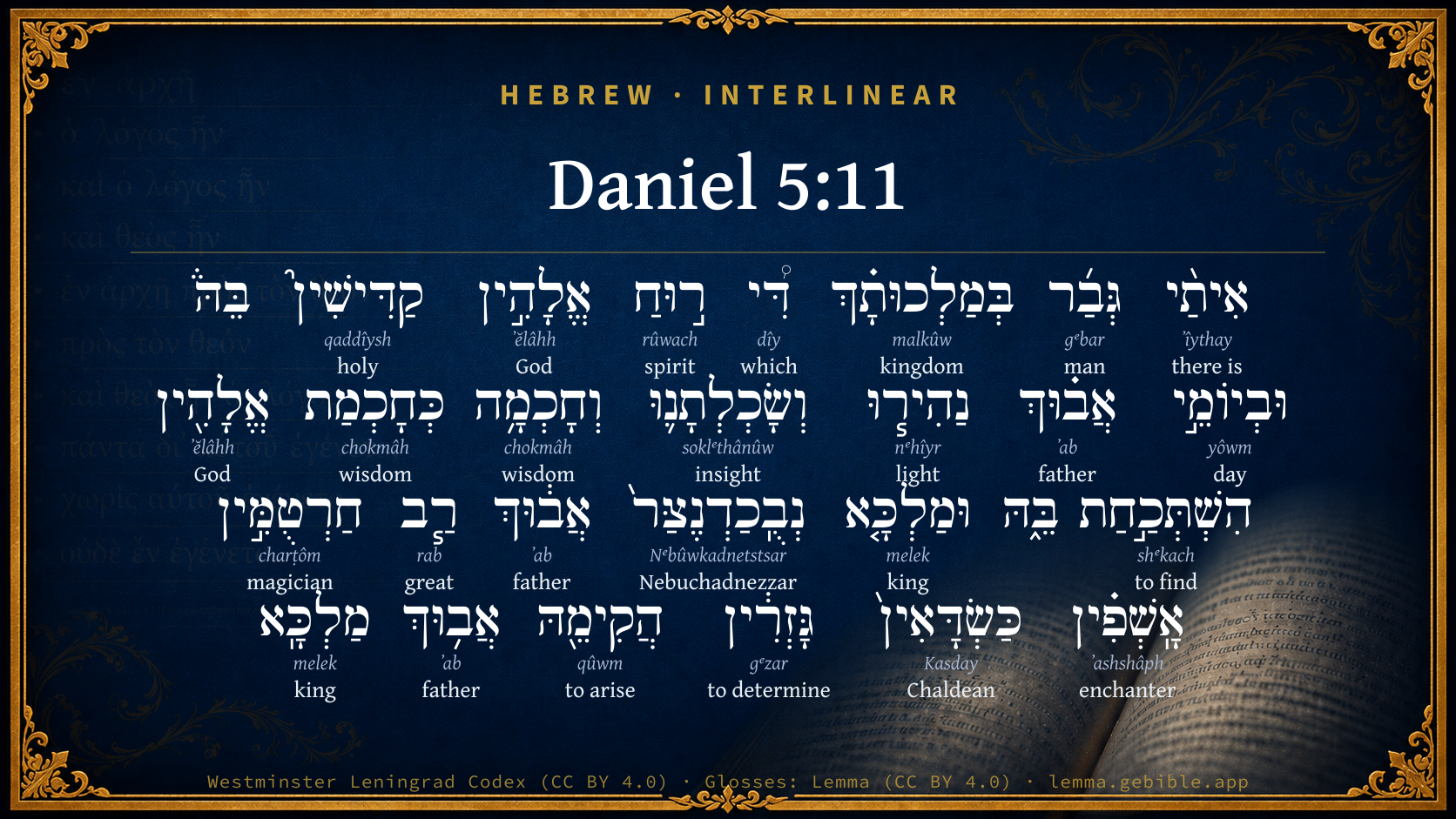
Hebrew (Westminster Leningrad Codex) Daniel 5:11 appears in the Hebrew Old Testament. The text above is from the Westminster Leningrad Codex. Each word links to its Strong’s number, a concise gloss, and parsing drawn from the Open Scriptures Hebrew Bible morphology. Click any word for its full Brown-Driver-Briggs (BDB) entry.
Download image
Cite this verse

Daniel 5:11 (World English Bible). Public Domain. Lemma interlinear Bible study tool, https://lemma.gebible.app/v/daniel/5/11.

Show BibTeX & RIS
BibTeX
RIS
English Translation
There is a man in your kingdom, in whom is the spirit of the holy gods; and in the days of your father light and understanding and wisdom, like the wisdom of the gods, were found in him; and the king Nebuchadnezzar your father, the king, [I say], your father, made him master of the magicians, enchanters, Chaldeans, and soothsayers;
World English Bible · Public Domain
Highlights
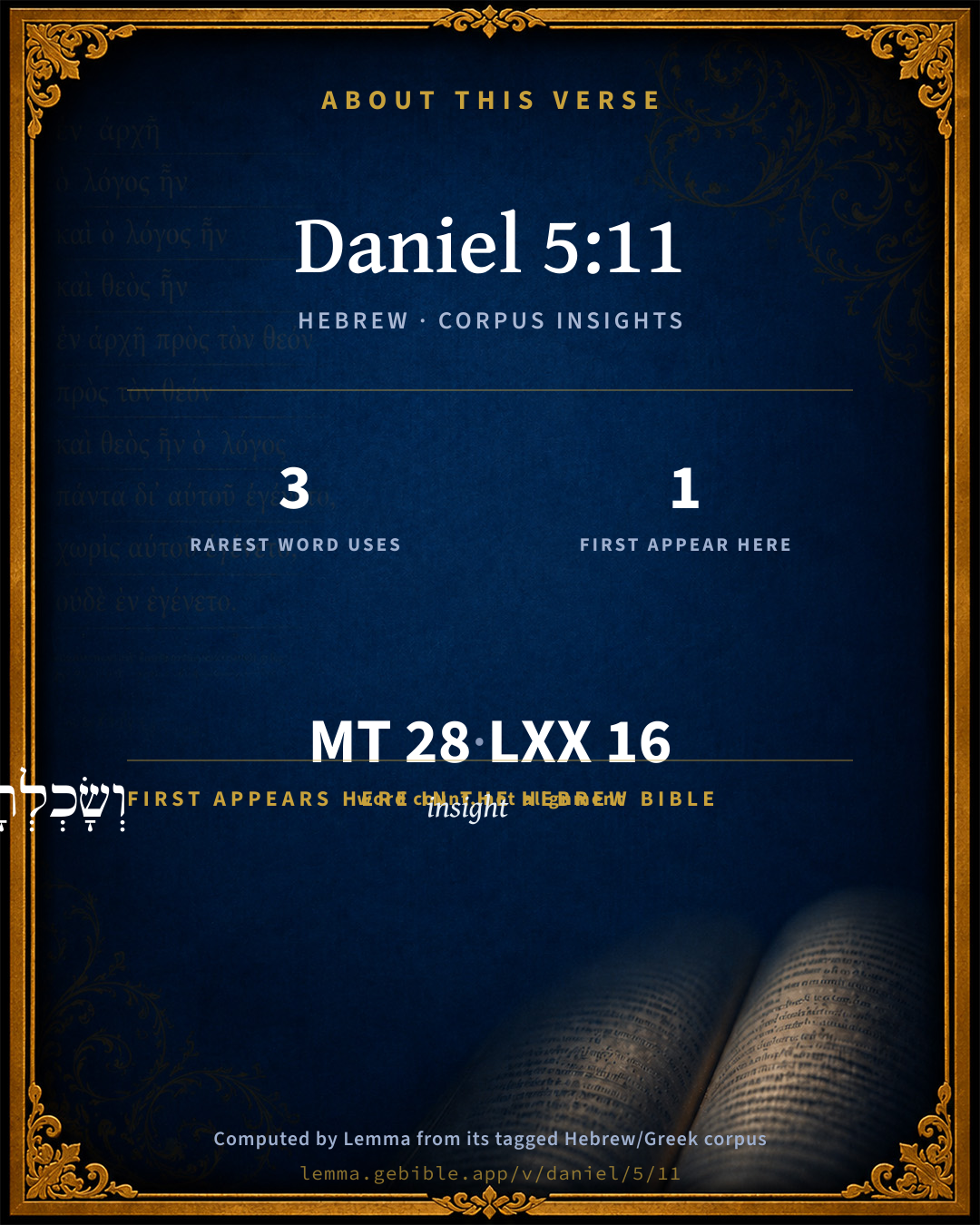
  • 1 first appearance in the Hebrew Bible
Full analysis ↓
Download a study sheet

One document with this verse’s original text, its word-by-word gloss line, the meaning frame, cross-references with their text, attributed commentary, and full source and license credits — printable, and it pastes into notes with its structure intact.

This verse Autodidact and up

Study sheet (.html) Plain text (.txt)

A passage Seminary Student

Up to 50 verses in one chapter. A passage sheet keeps up to 6 commentary sources and 12 cross-references per verse, in the order this page ranks them, and says so on the sheet whenever that leaves anything out. Ask for a single verse and you get the Autodidact verse sheet above.

Everything on this page stays free to read, with no account — the sheet is a download of what is already on screen, not access to it.

Want to remove ads? Support Godless Engineer
Compare translations 3

The same verse in 3 English versions, stacked beneath the original-language interlinear above. Click any original word for its lexicon entry.

Each is an independent rendering of the whole verse — the interlinear is not word-aligned to these translations.

Highlighted words mark where these versions differ — a whole-verse word diff, not a word-by-word alignment.

  • World English Bible Public Domain
    There is a man in your kingdom, in whom is the spirit of the holy gods; and in the days of your father light and understanding and wisdom, like the wisdom of the gods, were found in him; and the king Nebuchadnezzar your father, the king, [I say], your father, made him master of the magicians, enchanters, Chaldeans, and soothsayers;
  • King James Version Public Domain
    There is a man in thy kingdom, in whom is the spirit of the holy gods; and in the days of thy father light and understanding and wisdom, like the wisdom of the gods, was found in him; whom the king Nebuchadnezzar thy father, the king, I say, thy father, made master of the magicians, astrologers, Chaldeans, and soothsayers;
  • unfoldingWord Literal Text CC BY-SA 4.0
    There is a man in your kingdom in whom is the spirit of the holy gods. In the days of your father, illumination and insight and wisdom like the wisdom of the gods were found in him. King Nebuchadnezzar, your father, your father the king, appointed him chief of the magicians, enchanters, Chaldeans, and astrologers,

unfoldingWord Literal Text — © unfoldingWord, licensed CC BY-SA 4.0. Word-aligned USFM3 via Door43 (git.door43.org/unfoldingWord/en_ult).

Versions to compare (up to 4)

3 of 4 selected

Show all 18 translations

Every available English version of this verse, each an independent rendering of the whole verse.

  • World English Bible Public Domain
    There is a man in your kingdom, in whom is the spirit of the holy gods; and in the days of your father light and understanding and wisdom, like the wisdom of the gods, were found in him; and the king Nebuchadnezzar your father, the king, [I say], your father, made him master of the magicians, enchanters, Chaldeans, and soothsayers;
  • Berean Standard Bible Public Domain
    There is a man in your kingdom who has the spirit of the holy gods in him. In the days of your father he was found to have insight, intelligence, and wisdom like that of the gods. Your father, King Nebuchadnezzar, appointed him chief of the magicians, enchanters, astrologers, and diviners. Your own father, the king,
  • Majority Standard Bible Public Domain
    There is a man in your kingdom who has the spirit of the holy gods in him. In the days of your father he was found to have insight, intelligence, and wisdom like that of the gods. Your father, King Nebuchadnezzar, appointed him chief of the magicians, enchanters, astrologers, and diviners. Your own father, the king,
  • King James Version Public Domain
    There is a man in thy kingdom, in whom is the spirit of the holy gods; and in the days of thy father light and understanding and wisdom, like the wisdom of the gods, was found in him; whom the king Nebuchadnezzar thy father, the king, I say, thy father, made master of the magicians, astrologers, Chaldeans, and soothsayers;
  • American Standard Version (1901) Public Domain
    There is a man in thy kingdom, in whom is the spirit of the holy gods; and in the days of thy father light and understanding and wisdom, like the wisdom of the gods, were found in him; and the king Nebuchadnezzar thy father, the king, `I say', thy father, made him master of the magicians, enchanters, Chaldeans, and soothsayers;
  • Revised Version (1885) Public Domain
    There is a man in thy kingdom, in whom is the spirit of the holy gods; and in the days of thy father light and understanding and wisdom, like the wisdom of the gods, was found in him: and the king Nebuchadnezzar thy father, the king, I say, thy father, made him master of the magicians, enchanters, Chaldeans, and soothsayers;
  • Geneva Bible (1599) Public Domain
    There is a man in thy kingdome, in whom is the spirit of the holy gods, and in the dayes of thy father light and vnderstanding and wisdome like the wisdome of the gods, was found in him: whom the King Nebuchad-nezzar thy father, the King, I say, thy father, made chiefe of the enchanters, astrologians, Caldeans, and soothsayers,
  • Douay-Rheims (1899) Public Domain
    There is a man in thy kingdom that hath the spirit of the holy gods in him: and in the days of thy father knowledge and wisdom were found in him: for king Nabuchodonosor thy father appointed him prince of the wise men, enchanters, Chaldeans, and soothsayers, thy father, I say, O king:
  • Young's Literal Translation Public Domain
    there is a man in thy kingdom in whom `is' the spirit of the holy gods: and, in the days of thy father, light, and understanding, and wisdom -- as the wisdom of the gods -- was found in him; and king Nebuchadnezzar thy father, chief of the scribes, enchanters, Chaldeans, soothsayers, established him -- thy father, O king --
  • Literal Standard Version CC BY-SA 4.0
    there is a man in your kingdom in whom [is] the spirit of the holy gods: and in the days of your father, light, and understanding, and wisdom—as the wisdom of the gods—was found in him; and your father King Nebuchadnezzar, chief of the scribes, enchanters, Chaldeans, soothsayers, established him—your father, O king—
  • Unlocked Literal Bible CC BY-SA 4.0
    There is a man in your kingdom who has the spirit of the holy gods. In the days of your father, light and understanding and wisdom like the wisdom of the gods was found in him. King Nebuchadnezzar, your father the king, made him chief of the magicians, as well as chief of those who speak with the dead, of the wise men, and of the astrologers.
  • unfoldingWord Literal Text CC BY-SA 4.0
    There is a man in your kingdom in whom is the spirit of the holy gods. In the days of your father, illumination and insight and wisdom like the wisdom of the gods were found in him. King Nebuchadnezzar, your father, your father the king, appointed him chief of the magicians, enchanters, Chaldeans, and astrologers,
  • Darby Bible Public Domain
    There is a man in thy kingdom in whom is the spirit of the holy gods; and in the days of thy father, light and understanding and wisdom, like the wisdom of the gods was found in him; and the king Nebuchadnezzar thy father, [even] the king thy father, made him master of the scribes, magicians, Chaldeans, [and] astrologers;
  • World Messianic Bible Public Domain
    There is a man in your kingdom in whom is the spirit of the holy gods; and in the days of your father, light and understanding and wisdom, like the wisdom of the gods, were found in him. The king, Nebuchadnezzar, your father—yes, the king, your father—made him master of the magicians, enchanters, Kasdim, and soothsayers,
  • Webster's Bible Public Domain
    There is a man in thy kingdom, in whom is the spirit of the holy gods; and in the days of thy father light and understanding and wisdom, like the wisdom of the gods, was found in him; whom the king Nebuchadnezzar thy father, the king, I say, thy father, made master of the magicians, astrologers, Chaldeans, and sooth-sayers;
  • Free Bible Version CC BY-SA 4.0
    There's a man in your kingdom who has the spirit of the holy gods in him. In your father's time he was found to have understanding and insight, and wisdom like that of the gods. Your Majesty's father, King Nebuchadnezzar put him in charge of the magicians, enchanters, astrologers, and diviners. Your father did this
  • Bible in Basic English Public Domain
    There is a man in your kingdom in whom is the spirit of the holy gods; and in the days of your father, light and reason like the wisdom of the gods were seen in him: and King Nebuchadnezzar, your father, made him master of the wonder-workers, and the users of secret arts, and the Chaldaeans, and the readers of signs;
  • JPS Tanakh (1917) Public Domain
    there is a man in thy kingdom, in whom is the spirit of the holy gods; and in the days of thy father light and understanding and wisdom, like the wisdom of the gods, was found in him; and the king Nebuchadnezzar thy father, the king, I say, thy father, made him master of the magicians, enchanters, Chaldeans, and astrologers;

Literal Standard Version (2020), Covenant Press — licensed CC BY-SA 4.0. Text via the HelloAO Bible API (eBible.org). Unlocked Literal Bible (unfoldingWord) — licensed CC BY-SA 4.0. Text via the HelloAO Bible API (eBible.org). unfoldingWord Literal Text — © unfoldingWord, licensed CC BY-SA 4.0. Word-aligned USFM3 via Door43 (git.door43.org/unfoldingWord/en_ult). Free Bible Version, Dr. Jonathan Gallagher — licensed CC BY-SA 4.0. Text via the HelloAO Bible API (eBible.org).

Word by word

More ways to search: Search by grammar → Find every occurrence → Compare this word →

Practice this passage: Drill this verse → Learn its vocabulary →

וְשָׂכְלְתָנ֛וּ
soklᵉthânûw
H7924
“and · insight”
Adjective, C + Noun, Common, Feminine, Singular, Absolute
Part of Speech
Adjective + Noun
Type
Common
Gender
Feminine
Number
Singular
State
Absolute
Full BDB Definition

Origin: from H7920

TWOT: 3009a

insight
  1. אִיתַ֨י ʼîythay H383 “there is” Adjective, T
  2. גְּבַ֜ר gᵉbar H1400 “man” Adjective, N, Common
  3. בְּמַלְכוּתָ֗ךְ malkûw H4437 “in/at · kingdom · your” Adjective, R + Noun, Common, Feminine, Singular, Construct + Suffix, Personal, 2nd Person, Masculine, Singular
  4. דִּ֠י dîy H1768 “which” Adjective, T
  5. ר֣וּחַ rûwach H7308 “spirit of” Adjective, N, Common
  6. אֱלָהִ֣ין ʼĕlâhh H426 “gods” Adjective, N, Common
  7. קַדִּישִׁין֮ qaddîysh H6922 “holy” Adjective, A
  8. וּבְיוֹמֵ֣י yôwm H3118 “and · in/at · days of” Adjective, C + Preposition + Noun, Common, Masculine, Plural, Construct
  9. אֲב֗וּךְ ʼab H2 “father · your” Adjective, N, Common + Suffix, Personal, 2nd Person, Masculine, Singular
  10. נַהִיר֧וּ nᵉhîyr H5094 “light” Adjective, N, Common
  11. וְחָכְמָ֥ה chokmâh H2452 “and · wisdom” Adjective, C + Noun, Common, Feminine, Singular, Absolute
  12. כְּחָכְמַת chokmâh H2452 “like/as · wisdom of” Adjective, R + Noun, Common, Feminine, Singular, Construct
  13. אֱלָהִ֖ין ʼĕlâhh H426 “gods” Adjective, N, Common
  14. הִשְׁתְּכַ֣חַת shᵉkach H7912 “to find” Adjective, V, Plural
  15. וּמַלְכָּ֤א melek H4430 “and · king · the” Adjective, C + Noun, Common, Masculine, Singular, Determined + Particle, Definite Article
  16. נְבֻֽכַדְנֶצַּר֙ Nᵉbûwkadnetstsar H5020 “Nebuchadnezzar” Adjective, N
  17. אֲב֔וּךְ ʼab H2 “father · your” Adjective, N, Common + Suffix, Personal, 2nd Person, Masculine, Singular
  18. רַ֧ב rab H7229 “great of” Adjective, A
  19. חַרְטֻמִּ֣ין charṭôm H2749 “magicians” Adjective, N, Common
  20. אָֽשְׁפִ֗ין ʼashshâph H826 “enchanters” Adjective, N, Common
  21. כַּשְׂדָּאִין֙ Kasday H3779 “Chaldeans” Adjective, N
  22. גָּזְרִ֔ין gᵉzar H1505 “determining” Adjective, V
  23. הֲקִימֵ֖הּ qûwm H6966 “to arise · him” Adjective, V, Plural + Suffix, Personal, 3rd Person, Masculine, Singular
  24. אֲב֥וּךְ ʼab H2 “father · your” Adjective, N, Common + Suffix, Personal, 2nd Person, Masculine, Singular
  25. מַלְכָּֽא melek H4430 “king · the” Adjective, N, Common + Particle, Definite Article

About this verse

These counts appear in no published source. They are computed here, from the morphology-tagged text and Lemma’s own curated glosses. What Lemma adds →

28
words
21
distinct lemmas
Prophets
section

Notable vocabulary

The rarest word here is וְשָׂכְלְתָנ֛וּ insight H7924 — appearing just 3 times in the whole Hebrew Bible.

First appearance in Scripture

This word makes its first canonical appearance in the Hebrew Bible here:

  • וְשָׂכְלְתָנ֛וּ insight H7924

Shared distinctive vocabulary

וְשָׂכְלְתָנ֛וּ insight H7924 occurs in 3 verses of the Hebrew Bible. Also found in:

Grammatical profile

  • 5 nouns
  • 21 adjectives
  • 2 particles

Repetition

Words recur within this verse — often emphatic in Hebrew:

  • אֲב֗וּךְ father H2 ×3
  • אֱלָהִ֣ין God H426 ×2
  • וְחָכְמָ֥ה wisdom H2452 ×2
  • וּמַלְכָּ֤א king H4430 ×2

Hebrew & Septuagint length

In English translation the verse runs 60 words from the Hebrew and 43 from the Septuagint (LXX English) — closely comparable.

A rough comparison of the two English renderings, which tokenize alike — not a word-level alignment.

Word counts can differ between the Hebrew and the Greek without any difference in meaning — e.g. the Hebrew direct-object marker אֵת has no separate Greek word, and Greek often adds the article ὁ.

In the original languages it is 28 Hebrew tokens and 16 Greek tokens — but the two are counted differently (Hebrew bundles its prefixes and suffixes into one token; the Greek is in lemma form), so that isn’t a like-for-like length.

Cross-references

10

Topical passages linked to Daniel 5:11 in the Treasury of Scripture Knowledge — connected by theme and wording, ordered by reader-vote popularity; previews shown in the World English Bible.

  • Daniel 4:8–9 But at the last Daniel came in before me, whose name was Belteshazzar, according to the name of my god, and in whom is the spirit of the holy gods: and I told the dream before him, [saying],
  • Daniel 2:47–48 The king answered to Daniel, and said, Of a truth your God is the God of gods, and the Lord of kings, and a revealer of secrets, seeing you have been able to reveal this secret.
  • Daniel 4:18 This dream I, king Nebuchadnezzar, have seen; and you, Belteshazzar, declare the interpretation, because all the wise men of my kingdom are not able to make known to me the interpretation; but you are able; for the spirit of the holy gods is in you.
  • Daniel 5:14 I have heard of you, that the spirit of the gods is in you, and that light and understanding and excellent wisdom are found in you.
  • Genesis 41:11–15 We dreamed a dream in one night, I and he. We dreamed each man according to the interpretation of his dream.
  • 2 Samuel 14:17 Then your handmaid said, Please let the word of my lord the king be comfortable; for as an angel of God, so is my lord the king to discern good and bad: and Yahweh your God be with you.
  • Daniel 2:11 It is a rare thing that the king requires, and there is no other who can show it before the king, except the gods, whose dwelling is not with flesh.
  • Acts 12:22 The people shouted, "The voice of a god, and not of a man!"
  • Acts 14:11 When the multitude saw what Paul had done, they lifted up their voice, saying in the language of Lycaonia, "The gods have come down to us in the likeness of men!"
  • Revelation 3:9 Behold, I give of the synagogue of Satan, of those who say they are Jews, and they are not, but lie. Behold, I will make them to come and worship before your feet, and to know that I have loved you.

Cross-references courtesy of OpenBible.info (CC BY 4.0).

Hebrew and Greek witnesses Masoretic Hebrew ↔ Greek Septuagint

The same verse in the two great witnesses to the Old Testament, shown verse-for-verse.

These are two independent witnesses, not word-aligned to each other, and the Septuagint is shown in lemma (dictionary) form.

Hebrew Daniel 5:11 Masoretic · Westminster Leningrad Codex

אִיתַ֨י גְּבַ֜ר בְּמַלְכוּתָ֗ךְ דִּ֠י ר֣וּחַ אֱלָהִ֣ין קַדִּישִׁין֮ בֵּהּ֒ וּבְיוֹמֵ֣י אֲב֗וּךְ נַהִיר֧וּ וְשָׂכְלְתָנ֛וּ וְחָכְמָ֥ה כְּחָכְמַת אֱלָהִ֖ין הִשְׁתְּכַ֣חַת בֵּ֑הּ וּמַלְכָּ֤א נְבֻֽכַדְנֶצַּר֙ אֲב֔וּךְ רַ֧ב חַרְטֻמִּ֣ין אָֽשְׁפִ֗ין כַּשְׂדָּאִין֙ גָּזְרִ֔ין הֲקִימֵ֖הּ אֲב֥וּךְ מַלְכָּֽא

There is a man in your kingdom, in whom is the spirit of the holy gods; and in the days of your father light and understanding and wisdom, like the wisdom of the gods, were found in him; and the king Nebuchadnezzar your father, the king, [I say], your father, made him master of the magicians, enchanters, Chaldeans, and soothsayers;

World English Bible · Public Domain

Greek LXX Daniel 5:11 Septuagint · lemma form

καί εἶπον ὁ βασιλεύς ὁ ἄνθρωπος ἐπιστήμων εἰμί καί σοφός καί ὑπερἔχω πᾶς ὁ σοφός βαβυλών

There is a man in your kingdom, in whom is the Spirit of God; and in the days of your father watchfulness and understanding were found in him; and king Nabuchodonosor your father made him chief of the enchanters, magicians, Chaldeans, and soothsayers.

LXX2012 (modern English Septuagint) · Public Domain

On this verse, Whedon's Commentary on the Bible discusses the Septuagint’s reading. Read the note in Commentary ↓

Hebrew: Westminster Leningrad Codex (CC BY 4.0). Greek: Septuagint (public domain); English from LXX2012 (modern English Septuagint) (Public Domain). How the Septuagint differs from the Hebrew →

Commentary

Notes on Daniel 5:11 from classic Christian and Jewish commentators (each source and its license shown beneath its notes). The classic Christian expositions comment on the surrounding passage and are grouped to its opening verse, so a note may address several verses; the Jewish commentaries on the Tanakh (Rashi and others) are per-verse, so they appear only where the commentator wrote on this verse.

Lemma curates 59 commentaries, every one of them public domain or Creative Commons licensed, each selected and text-cleaned for this edition rather than reprinted as found. About our sources →

Trapp's Complete Commentary

John Trapp

Dan 5:11 There is a man in thy kingdom, in whom [is] the spirit of the holy gods; and in the days of thy father light and understanding and wisdom, like the wisdom of the gods, was found in him; whom the king Nebuchadnezzar thy father, the king, [I say], thy father, made master of the magicians, astrologers, Chaldeans, [and] soothsayers;

Ver. 11. There is a man in thy kingdom.] Once famous for his oracles, and highly promoted by thy grandfather Nebuchadnezzar. Thus this old queen speaketh of ancient things. She was not therefore Belshazzar’s wife, as Porphyry scoffingly objected, but his mother at least, if not his grandmother.

In whom is the spirits.] See on Dan 5:10.

The king, I say, thy father.] This was a check to Belshazzar for neglecting so worthy a person as Daniel, whom his grandfather had so highly honoured.

John Trapp, A Commentary or Exposition upon All the Books of the Old and New Testament (1647–1656) — public domain. Text from a community e-Sword module.

Tyndale Open Study Notes

Tyndale Open Resources

5:11-12 The queen mother reasoned that someone who had the spirit of the holy gods and could interpret dreams (see 1:17) should also be able to interpret the writing.

Tyndale Open Study Notes — © Tyndale Open Resources, licensed CC BY-SA 4.0. Text via the HelloAO Bible API.

Ibn Ezra

Rabbi Abraham ibn Ezra

[Daniel 5:11] Illumination (נַהִיר֧וּ - nahiru): [This word is] like [the Aramaic word for light/illumination found, for example, in Daniel 2:22]: “and light (וּנְהוֹרָא - u’nehora)”.

Ibn Ezra on the Tanakh — English translations: “Sefaria Community Translation” (CC0 1.0 (public-domain dedication)); “Yalkut, Sifsei Chachomim Chumash, Metsudah Publications, 2009” (CC BY 4.0); and “Commentary of Ibn Ezra on Isaiah - trans. by M. Friedlander, 1873” (public domain). Text via Sefaria.

Geneva Bible (1599)

Geneva Bible translators

Read Dan. 4:6, and this declareth that both this name was odious unto him, and also he did not use these vile practices, because he was not among them when all were called.

Geneva Bible (1599) marginal notes — public domain. Text via Bolls.life.

Jamieson, Fausset & Brown

Robert Jamieson, A. R. Fausset & David Brown

spirit of the holy gods--She remembers and repeats Nebuchadnezzar's language (Dan 4:8-9, Dan 4:18). As Daniel was probably, according to Oriental custom, deprived of the office to which Nebuchadnezzar had promoted him, as "master of the magicians" (Dan 4:9), at the king's death, Belshazzar might easily be ignorant of his services.

the king . . . thy father the king . . . thy father--The repetition marks with emphatic gravity both the excellencies of Daniel, and the fact that Nebuchadnezzar, whom Belshazzar is bound to reverence as his father, had sought counsel from him in similar circumstances.

Jamieson, Fausset & Brown — Commentary Critical and Explanatory on the Whole Bible (1871) — public domain (CC PDM 1.0). Text via the HelloAO Bible API.

Adam Clarke's Commentary

Verse 11. Nebuchadnezzar thy father] See Clarke on Da 5:1.

Adam Clarke's Commentary on the Bible (1810–1826) — public domain. Text from a community e-Sword/MySword module.

Ellicott's Commentary for English Readers

(11) The spirit.—Comp. Dan_4:8-9.

Thy father.—No blood relationship is necessarily implied by this word. It means no more than “predecessor.” (See Introd., sec. VI.)

A Bible Commentary for English Readers, edited by Charles John Ellicott (1878–1897) — public domain. Text from a community e-Sword module.

The Cambridge Bible for Schools and Colleges

gen. ed. J. J. S. Perowne

11. in whom is the spirit, &c.] As Dan_4:8, where see the note.

thy father] see on Dan_5:2.

like the wisdom of (the) gods] Cf. 2Sa_14:20. The queen, however, speaks as a polytheist.

made master of the magicians, &c.] See Dan_2:48 and Dan_4:9.

enchanters, Chaldeans, and determiners (of fates)] As Dan_5:7.

The Cambridge Bible for Schools and Colleges (gen. ed. J. J. S. Perowne; Cambridge University Press, 1878–1918) — public domain. Text from a community e-Sword module.

John Gill's Exposition

There is a man in thy kingdom,.... She does not say in his court; very probably, after the death of Nebuchadnezzar, perhaps in one of the former reigns, he was removed from his offices; for, had he been in one, very likely the queen would have described him by it; and this seems to receive confirmation by the question Belshazzar put to him upon his coming into his presence,

art thou that Daniel, &c.; and only says that he had heard of him, Dan 5:13,

in whom is the spirit of the holy gods; something divine, something more than human; she uses the very words of Nebuchadnezzar; which seems to confirm that opinion, that she was his widow, Dan 4:8,

and in the days of thy father light and understanding and wisdom, like the wisdom of the gods, was found in him; "light" in the knowledge of things obscure; understanding in the interpretation of dreams; and "wisdom" in things both human and divine, like that of an angel of God, as Jacchiades interprets "Elohim": of this instances were given in the days of his grandfather, for so Nebuchadnezzar was; nor is it unusual for a grandfather to be called a father, and even a more remote ancestor; which instances were, telling him his dream when he had forgot it, as well as the interpretation of it; and explaining his dream or vision of the tree cut down to its stump; of which see Daniel chapters two and four:

whom the king Nebuchadnezzar thy father, the king, I say, thy father, made master of the magicians, astrologers, Chaldeans, and soothsayers, Dan 2:48 she seems tacitly to upbraid him with his neglect of such a man, or with turning him out of his office, when so great a prince as his grandfather was took so much notice of him, and so highly advanced him.

John Gill's Exposition of the Whole Bible (1746–1763) — public domain (CC PDM 1.0). Text via the HelloAO Bible API.

Albert Barnes' Notes on the Bible

There is a man in thy kingdom - To wit, Daniel. As the queen-mother had lived in the time of Nebuchadnezzar, and recollected the important service which he had rendered in interpreting the dream of the king, it was natural that her mind should at once recur to him. It would seem, also, that though Daniel was no longer employed at court, yet that she still had an acquaintance with him, so far at least as to know that he was accessible, and might be called in on this occasion. It may be asked, perhaps, how it was Belshazzar was so ignorant of all this as to need this information? For it is clear from the question which the king asks in Dan 5:13, “Art thou that Daniel?” that he was ignorant of him personally, and probably even of his services as an officer in the court of Nebuchadnezzar. An ingenious and not improbable solution of this difficulty has been proposed as founded on a remark of Sir John Chardin: “As mentioned by the queen, Daniel had been made by Nebuchadnezzar ‘master of the magicians, astrologers, Chaldeans, and soothsayers.’ Of this employment Chardin conjectures that he had been deprived on the death of that king, and obtains this conclusion from the fact that when a Persian king dies, both his astrologers and physicians are driven from court - the former for not having predicted, and the latter for not having prevented, his death. If such was the etiquette of the ancient Babylonian, as it is of the modern Persian court, we have certainly a most satisfactory solution of the present difficulty, as Daniel must then be supposed to have relinquished his public employments, and to have lived retired in private life during the eight years occupied by the reigns of Evil-Merodach and Belshazzar.” - Harmer, as quoted by Rosenmuller (“Morgenland,” on Dan 5:13).

In whom is the spirit of the holy gods - This is language such as a pagan would be likely to use when speaking of one who had showed extraordinary knowledge of Divine things. See the note at Dan 4:9.

And, in the days of thy father - Margin, “grandfather.” See the note at Dan 5:1-2.

Light, and understanding, and wisdom - Light is the emblem of knowledge, as it makes all things clear. The meaning here is, that he had showed extraordinary wisdom in interpreting the dream of Nebuchadnezzar.

Like the wisdom of the gods - Such as the gods only could possess.

Whom the king Nebuchadnezzar thy father, the king, I say, thy father, made master of the magicians ... - See Dan 2:48. This is repeated here, and dwelt on, in order to call the attention of the king to the fact that Daniel was worthy to be consulted. Though now living in obscurity, there was a propriety that one who had been placed at the very head of the wise men of Babylon by a prince so distinguished as Nebuchadnezzar, should be consulted on the present occasion.

Albert Barnes' Notes on the Bible (1834–1885) — public domain. Text from a community e-Sword/MySword module.

Haydock's Catholic Bible Commentary

Father. So a grandfather might be styled. (Jeremias xxvii. 7.) (Worthington) ---Daniel was not perhaps at the head of the wise men. (Calmet) --- They were too jealous to mention him; and the intoxicated king and courtiers remembered not his merit, till an aged matron suggested that he should be consulted. He was probably (Haydock) in some office, at Susa, yet happened to be then in Babylon, (Calmet) which was besieged; and thither he might have retired at the approached of Cyrus.

George Leo Haydock (1774–1849), Haydock's Catholic Family Bible and Commentary, 1859 edition — public domain. Excludes Psalms (Douay-Rheims chapter numbering differs from Protestant) and Deuterocanonical books (Catholic canon only).

Matthew Poole's English Annotations

A man in whom is the spirit of the holy gods: this man was Daniel; but how came the king not to think of him? Daniel possibly was out of his place, by his own resignation, or his enemies’ malicious contrivance, and was willing to withdraw himself from the court, and from the company of the soothsayers, and would not be reckoned one of them.

Matthew Poole's English Annotations on the Holy Bible (1683–1685) — public domain. Text from a community e-Sword/MySword module.

Whedon's Commentary on the Bible

Daniel D. Whedon

11. Compare Dan_2:2; Dan_2:47; Dan_4:7-8. It is now known that Belshazzar was the son of Nabonidus and that Nabonidus was not the son of Nebuchadnezzar. Nevertheless the queen mother might have used these very words; for “son,” as all Assyriologists know, is very often used in the sense of “descendant” or even “successor” in the royal letters. It is not at all impossible Nabonidus may have claimed to be a descendant of Nebuchadnezzar. If so, it would have been death for anyone at the court to deny this, and to appeal to his descent from this greatest king would have been to make the strongest possible appeal to his pride and (especially when coming from the queen mother, see note Dan_5:10) would have offered also the strongest possible pledge of allegiance. It meant a good deal, at a time when everyone was suspected of being a traitor (see note Dan_5:1-4), to have this highest representative of the old dynasty acknowledge Belshazzar as the legitimate successor of Nebuchadnezzar. This accounts perfectly for the unusual emphasis given by the queen to the relationship of Belshazzar and Nebuchadnezzar. The criticisms of Meinhold and others, who have seen in these words another colossal “blunder” by the writer of this book, are thus disposed of. [See also Introduction, III, 3, (3), (4), (5); 4.] 12. Dissolving of doubts — Literally, loosing of knots. This probably refers to his skill in unraveling difficulties; although the figure used is drawn from Babylonian magic, where we now know “knots” (which could only be untied, according to the common notion, by the exercise of greatest care and skill) were commonly used to entangle and bewitch one’s enemies. The version which seems to represent the original LXX. is much briefer and more reserved than our Aramaic text.

Daniel D. Whedon (gen. ed.), Commentary on the Old and New Testaments (1874–1909) — public domain. Text from a community e-Sword module.

The Pulpit Commentary

Vers. 11, 12.

The representative of God.

is a man in thy kingdom, in whom is the spirit of the holy gods" (ver. 11).

I SOME OF HIS CHARACTERISTICS.

1. Intelligence. "Light, understanding, wisdom" (ver. 11).

2. Excellence of spirit. (Ver. 12.)

3. Faculty. (Ver. 12.)

4. Experience. Some achievement (ver. 12).

5. The indwelling of the Divine Spirit. (Ver. 11.)

II A POSSIBLE POSITION.

1. Comparative obscurity.

2. Even after years of distinguished service.

III THE CERTAIN CALL. When God wants a man, he is sure to call (by providence, by his Spirit); and when he calls, man must answer. R.

The Pulpit Commentary (1880–1919), ed. H.D.M. Spence-Jones & Joseph S. Exell — public domain. Text from a community e-Sword module.

Keil & Delitzsch

C. F. Keil & F. Delitzsch

Her judgment concerning Daniel is that of Nebuchadnezzar, Daniel 4:5-6 (Dan 4:8, Dan 4:9); and that she states it in the same words leads to the conclusion that Nebuchadnezzar was her husband. The מלכּא אבוּך at the end of this verse may be an emphatic repetition of the foregoing אבוּך נב מלכּא (Maur., Hitz.), but in that case מלכּא would perhaps stand first. מלכּא is better interpreted by Ros., v. Leng., Klief., and others as the vocative: thy father, O king, by which the words make a greater impression.

Keil & Delitzsch — Biblical Commentary on the Old Testament (1861–1891) — public domain (CC PDM 1.0). Text via the HelloAO Bible API. (Old Testament only.)

Scofield Reference Notes

C. I. Scofield

thy father

Or, grandfather. See note 2, (See Scofield "Dan 5:2").

The Scofield Reference Bible (1917 edition), notes by C. I. Scofield — public domain. Text from a community e-Sword module.

unfoldingWord translationNotes

Door43 World Missions Community

the spirit of the holy gods

The queen believed that Daniel's power came from the false gods that Nebuchadnezzar worshiped. See how you translated this phrase in Daniel 4:8.

In the days of your father

"When your father was ruling"

light and understanding and wisdom like the wisdom of the gods was found in him

This can be stated in active form. AT: "he had light and understanding and wisdom like the wisdom of the gods" (See: Active or Passive)

King Nebuchadnezzar, your father the king

"Your father, King Nebuchadnezzar"

these qualities were found in this man Daniel, whom the king named Belteshazzar

This can be stated in active form. AT: "this same Daniel, whom the king named Belteshazzar, had all of these qualities" (See: Active or Passive)

what has been written

"what has been written on the wall." This can be stated in active form. AT: "what the hand wrote on the wall" (See: Active or Passive)

translationWords

kingdom

spirit

holy

light

wise

false god

king

Nebuchadnezzar

chief

die

magic

learned men

know

interpret

dream

unfoldingWord translationNotes — © Distant Shores Media and the Door43 World Missions Community, licensed CC BY-SA 4.0. Source: git.door43.org/Door43/en_tn.

Rashi

Rabbi Shlomo Yitzchaki (Rashi)

There is a man There is a man in your kingdom in whom is the spirit of the holy ones.

like the wisdom of the angels [as translated,] angels.

appointed him He appointed him prince over them all.

Rashi on the Tanakh — English translations: “The Judaica Press complete Tanach with Rashi, translated by A. J. Rosenberg” (CC BY 4.0); “Pentateuch with Rashi's commentary by M. Rosenbaum and A.M. Silbermann, 1929-1934” (public domain); “The Metsudah Tanach series, Lakewood, N.J” (CC BY 4.0); and “The Book of Joshua, Metsudah Publications, 1997” (CC BY 4.0). Text via Sefaria.

Lesson kit

Teaching starters — assembled from the data on this page, not authored interpretation. Every prompt links to the verse data it draws on. Edit before teaching.

Daniel, in the Prophets, opens this verse with 28 words (21 distinct Hebrew lemmas). Its most distinctive word is soklᵉthânûw (“insight”). A historical commentator’s framing appears above. Read the whole chapter for the surrounding context.

Discussion questions

  1. What does “insight” (soklᵉthânûw) contribute to the verse as a whole?
  2. The word “insight” first appears here in Scripture. What is being introduced at this debut?
  3. Daniel 5:12 shares the word «insight» with this verse. How do the two illuminate each other?
  4. “father” occurs 3× in this one verse. What is the effect of the repetition?
  5. The translations on this page render this verse differently — a whole-verse word diff, not a word-by-word alignment. What might account for the different wordings?
  6. Reading how Trapp's Complete Commentary and Tyndale Open Study Notes read this verse, where do the two commentators agree and where do they part?

Things to notice

Reading settings

Reading text

Shown beneath each verse's original-language words.

Old Testament
Old Testament edition

Read the OT as the Masoretic Hebrew (MT) or the Greek Septuagint (LXX).

English shown for the Greek Septuagint (in the Hebrew ↔ Greek comparison).

Comparing translations? Open the Compare panel on any verse page to stack up to four side by side.