
Ezra 6:5

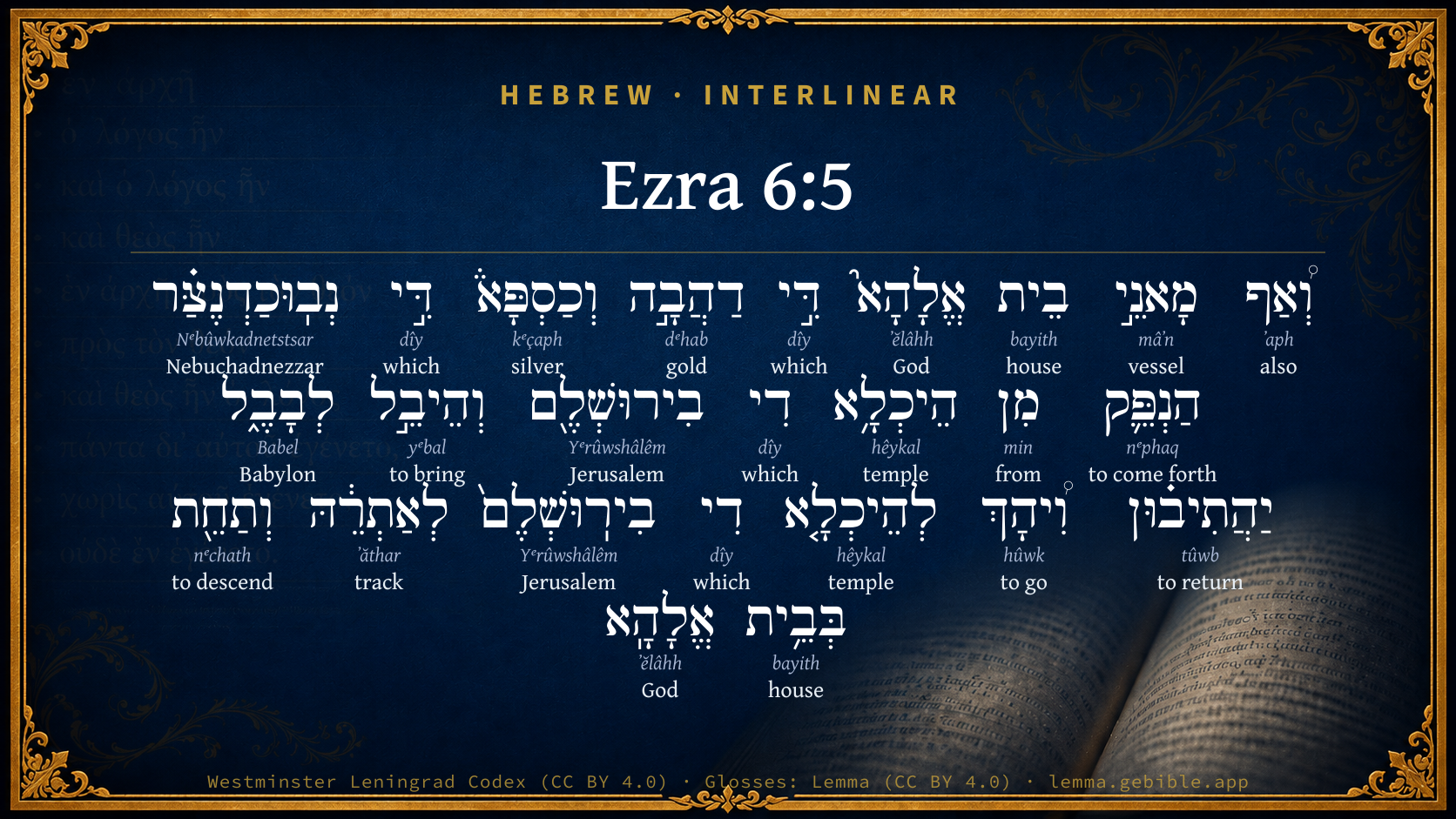
Hebrew (Westminster Leningrad Codex) Ezra 6:5 appears in the Hebrew Old Testament. The text above is from the Westminster Leningrad Codex. Each word links to its Strong’s number, a concise gloss, and parsing drawn from the Open Scriptures Hebrew Bible morphology. Click any word for its full Brown-Driver-Briggs (BDB) entry.
Download image
Cite this verse

Ezra 6:5 (World English Bible). Public Domain. Lemma interlinear Bible study tool, https://lemma.gebible.app/v/ezra/6/5.

Show BibTeX & RIS
BibTeX
RIS
English Translation
Also let the gold and silver vessels of the house of God, which Nebuchadnezzar took forth out of the temple which is at Jerusalem, and brought to Babylon, be restored, and brought again to the temple which is at Jerusalem, everyone to its place; and you shall put them in the house of God.
World English Bible · Public Domain
Download a study sheet

One document with this verse’s original text, its word-by-word gloss line, the meaning frame, cross-references with their text, attributed commentary, and full source and license credits — printable, and it pastes into notes with its structure intact.

This verse Autodidact and up

Study sheet (.html) Plain text (.txt)

A passage Seminary Student

Up to 50 verses in one chapter. A passage sheet keeps up to 6 commentary sources and 12 cross-references per verse, in the order this page ranks them, and says so on the sheet whenever that leaves anything out. Ask for a single verse and you get the Autodidact verse sheet above.

Everything on this page stays free to read, with no account — the sheet is a download of what is already on screen, not access to it.

Want to remove ads? Support Godless Engineer
Compare translations 3

The same verse in 3 English versions, stacked beneath the original-language interlinear above. Click any original word for its lexicon entry.

Each is an independent rendering of the whole verse — the interlinear is not word-aligned to these translations.

Highlighted words mark where these versions differ — a whole-verse word diff, not a word-by-word alignment.

  • World English Bible Public Domain
    Also let the gold and silver vessels of the house of God, which Nebuchadnezzar took forth out of the temple which is at Jerusalem, and brought to Babylon, be restored, and brought again to the temple which is at Jerusalem, everyone to its place; and you shall put them in the house of God.
  • King James Version Public Domain
    And also let the golden and silver vessels of the house of God, which Nebuchadnezzar took forth out of the temple which is at Jerusalem, and brought unto Babylon, be restored, and brought again unto the temple which is at Jerusalem, every one to his place, and place them in the house of God.
  • unfoldingWord Literal Text CC BY-SA 4.0
    And also, the vessels of the house of God, of gold and silver, that Nebuchadnezzar had taken out from the temple that was in Jerusalem and had brought to Babylon, must be returned. And let each go to the temple that is in Jerusalem, to its place. So you must put them in the house of God.’”

unfoldingWord Literal Text — © unfoldingWord, licensed CC BY-SA 4.0. Word-aligned USFM3 via Door43 (git.door43.org/unfoldingWord/en_ult).

Versions to compare (up to 4)

3 of 4 selected

Show all 18 translations

Every available English version of this verse, each an independent rendering of the whole verse.

  • World English Bible Public Domain
    Also let the gold and silver vessels of the house of God, which Nebuchadnezzar took forth out of the temple which is at Jerusalem, and brought to Babylon, be restored, and brought again to the temple which is at Jerusalem, everyone to its place; and you shall put them in the house of God.
  • Berean Standard Bible Public Domain
    Furthermore, the gold and silver articles of the house of God, which Nebuchadnezzar took from the temple in Jerusalem and carried to Babylon, must also be returned to the temple in Jerusalem and deposited in the house of God.
  • Majority Standard Bible Public Domain
    Furthermore, the gold and silver articles of the house of God, which Nebuchadnezzar took from the temple in Jerusalem and carried to Babylon, must also be returned to the temple in Jerusalem and deposited in the house of God.
  • King James Version Public Domain
    And also let the golden and silver vessels of the house of God, which Nebuchadnezzar took forth out of the temple which is at Jerusalem, and brought unto Babylon, be restored, and brought again unto the temple which is at Jerusalem, every one to his place, and place them in the house of God.
  • American Standard Version (1901) Public Domain
    And also let the gold and silver vessels of the house of God, which Nebuchadnezzar took forth out of the temple which is at Jerusalem, and brought unto Babylon, be restored, and brought again unto the temple which is at Jerusalem, every one to its place; and thou shalt put them in the house of God.
  • Revised Version (1885) Public Domain
    And also let the gold and silver vessels of the house of God, which Nebuchadnezzar took forth out of the temple which is at Jerusalem, and brought unto Babylon, be restored, and brought again unto the temple which is at Jerusalem, every one to its place, and thou shalt put them in the house of God.
  • Geneva Bible (1599) Public Domain
    And also let them render the vessels of the house of God (of golde and siluer, which Nebuchadnezzar tooke out of the Temple, which was in Ierusalem, and brought vnto Babel) and let him goe vnto the Temple that is in Ierusalem to his place, and put them in the house of God.
  • Douay-Rheims (1899) Public Domain
    And also let the golden and silver vessels of the temple of Cod, which Nabuchodonosor took out of the temple of Jerusalem, and brought to Babylon, be restored, and carried back to the temple of Jerusalem to their place, which also were placed in the temple of God.
  • Young's Literal Translation Public Domain
    `And also, the vessels of the house of God, of gold and silver, that Nebuchadnezzar took forth out of the temple that `is' in Jerusalem, and brought to Babylon, let be given back, and go to the temple that `is' in Jerusalem, `each' to its place, and put `them' down in the house of God.
  • Literal Standard Version CC BY-SA 4.0
    And also, the vessels of the house of God, of gold and silver, that Nebuchadnezzar took forth out of the temple that [is] in Jerusalem, and brought to Babylon, let be given back, and go to the temple that [is] in Jerusalem, [each] to its place, and put [them] down in the house of God.
  • Unlocked Literal Bible CC BY-SA 4.0
    Now bring back the gold and silver objects belonging to the house of God, which Nebuchadnezzar brought to Babylon from the temple in Jerusalem and send them back to the temple in Jerusalem. You are to put them in the house of God.'
  • unfoldingWord Literal Text CC BY-SA 4.0
    And also, the vessels of the house of God, of gold and silver, that Nebuchadnezzar had taken out from the temple that was in Jerusalem and had brought to Babylon, must be returned. And let each go to the temple that is in Jerusalem, to its place. So you must put them in the house of God.’”
  • Darby Bible Public Domain
    and also let the golden and silver vessels of the house of God, which Nebuchadnezzar took out of the temple that is at Jerusalem and brought to Babylon, be restored and brought again to the temple that is at Jerusalem, in their place; and thou shalt put [them] in the house of God.
  • World Messianic Bible Public Domain
    Also let the gold and silver vessels of God’s house, which Nebuchadnezzar took out of the temple which is at Jerusalem and brought to Babylon, be restored and brought again to the temple which is at Jerusalem, everything to its place. You shall put them in God’s house.
  • Webster's Bible Public Domain
    And also let the golden and silver vessels of the house of God, which Nebuchadnezzar took out of the temple which is at Jerusalem, and brought to Babylon, be restored, and brought again to the temple which is at Jerusalem, every one to its place, and place them in the house of God.
  • Free Bible Version CC BY-SA 4.0
    In addition, the gold and silver items of God's Temple, which Nebuchadnezzar took from the Temple in Jerusalem and brought to Babylon, must also be returned to the Temple in Jerusalem and placed there.
  • Bible in Basic English Public Domain
    And let the gold and silver vessels from the house of God, which Nebuchadnezzar took from the Temple at Jerusalem to Babylon, be given back and taken again to the Temple at Jerusalem, every one in its place, and put them in the house of God.
  • JPS Tanakh (1917) Public Domain
    and also let the gold and silver vessels of the house of God, which Nebuchadnezzar took forth out of the temple which is at Jerusalem, and brought unto Babylon, be restored, and brought back unto the temple which is at Jerusalem, every one to its place, and thou shalt put them in the house of God.'

Literal Standard Version (2020), Covenant Press — licensed CC BY-SA 4.0. Text via the HelloAO Bible API (eBible.org). Unlocked Literal Bible (unfoldingWord) — licensed CC BY-SA 4.0. Text via the HelloAO Bible API (eBible.org). unfoldingWord Literal Text — © unfoldingWord, licensed CC BY-SA 4.0. Word-aligned USFM3 via Door43 (git.door43.org/unfoldingWord/en_ult). Free Bible Version, Dr. Jonathan Gallagher — licensed CC BY-SA 4.0. Text via the HelloAO Bible API (eBible.org).

Word by word

More ways to search: Search by grammar → Find every occurrence → Compare this word →

Practice this passage: Drill this verse → Learn its vocabulary →

וְהֵיבֵ֣ל
yᵉbal
H2987
“and · to bring”
Adjective, C + Verb, Hiphil, Perfect, 3rd Person, Masculine, Singular
Part of Speech
Adjective + Verb
Stem
Hiphil
Form
Perfect
Person
3rd Person
Gender
Masculine
Number
Singular
Full BDB Definition

Origin: corresponding to H2986

TWOT: 2760

(Aphel) to bring, carry, bear along
  1. וְ֠אַף ʼaph H638 “and · also” Adjective, C + Particle, Accusative
  2. מָאנֵ֣י mâʼn H3984 “vessels of” Adjective, N, Common
  3. בֵית bayith H1005 “house of” Adjective, N, Common
  4. אֱלָהָא֮ ʼĕlâhh H426 “God · the” Adjective, N, Common + Particle, Definite Article
  5. דִּ֣י dîy H1768 “which” Adjective, T
  6. דַהֲבָ֣ה dᵉhab H1722 “gold · the” Adjective, N, Common + Particle, Definite Article
  7. וְכַסְפָּא֒ kᵉçaph H3702 “and · silver · the” Adjective, C + Noun, Common, Masculine, Singular, Determined + Particle, Definite Article
  8. דִּ֣י dîy H1768 “which” Adjective, T
  9. נְבֽוּכַדְנֶצַּ֗ר Nᵉbûwkadnetstsar H5020 “Nebuchadnezzar” Adjective, N
  10. הַנְפֵּ֛ק nᵉphaq H5312 “to come forth” Adjective, V, Plural
  11. מִן min H4481 “from” Adjective, R
  12. הֵיכְלָ֥א hêykal H1965 “temple · the” Adjective, N, Common + Particle, Definite Article
  13. דִי dîy H1768 “which” Adjective, T
  14. בִירוּשְׁלֶ֖ם Yᵉrûwshâlêm H3390 “in/at · Jerusalem” Adjective, R + Noun, Proper
  15. לְבָבֶ֑ל Babel H895 “to/for · Babylon” Adjective, R + Noun, Proper
  16. יַהֲתִיב֗וּן tûwb H8421 “to return” Adjective, V
  17. וִ֠יהָךְ hûwk H1946 “and · to go” Adjective, C + Verb, Qal, Imperfect, 3rd Person, Masculine, Singular
  18. לְהֵיכְלָ֤א hêykal H1965 “to/for · temple · the” Adjective, R + Noun, Common, Masculine, Singular, Determined + Particle, Definite Article
  19. דִי dîy H1768 “which” Adjective, T
  20. בִירֽוּשְׁלֶם֙ Yᵉrûwshâlêm H3390 “in/at · Jerusalem” Adjective, R + Noun, Proper
  21. לְאַתְרֵ֔הּ ʼăthar H870 “to/for · track · his” Adjective, R + Noun, Common, Masculine, Singular, Construct + Suffix, Personal, 3rd Person, Masculine, Singular
  22. וְתַחֵ֖ת nᵉchath H5182 “and · to descend” Adjective, C + Verb, a, Imperfect, 2nd Person, Masculine, Singular
  23. בְּבֵ֥ית bayith H1005 “in/at · house of” Adjective, R + Noun, Common, Masculine, Singular, Construct
  24. אֱלָהָֽא ʼĕlâhh H426 “God · the” Adjective, N, Common + Particle, Definite Article

About this verse

These counts appear in no published source. They are computed here, from the morphology-tagged text and Lemma’s own curated glosses. What Lemma adds →

25
words
18
distinct lemmas
Historical
section

Notable vocabulary

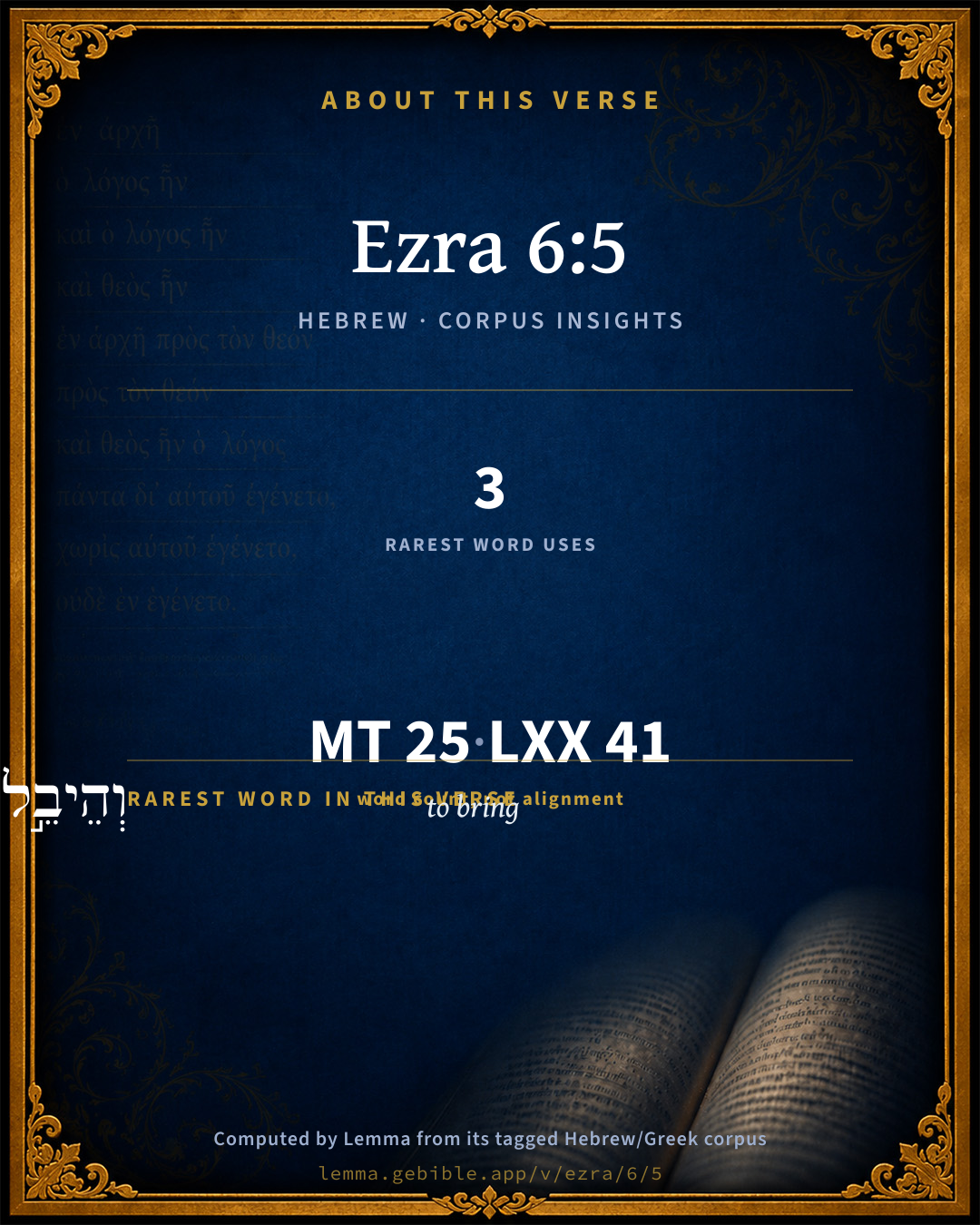
The rarest word here is וְהֵיבֵ֣ל to bring H2987 — appearing just 3 times in the whole Hebrew Bible.

Shared distinctive vocabulary

וְהֵיבֵ֣ל to bring H2987 occurs in 3 verses of the Hebrew Bible. Also found in:

Grammatical profile

  • 3 verbs
  • 5 nouns
  • 10 adjectives
  • 7 particles

Verb forms

  • וְהֵיבֵ֣ל Hiphil · Perfect
  • וִ֠יהָךְ Qal · Imperfect
  • וְתַחֵ֖ת Imperfect

Repetition

Words recur within this verse — often emphatic in Hebrew:

  • בֵית house H1005 ×2
  • אֱלָהָא֮ God H426 ×2
  • הֵיכְלָ֥א temple H1965 ×2
  • בִירוּשְׁלֶ֖ם Jerusalem H3390 ×2
  • דִּ֣י which H1768 ×4

Hebrew & Septuagint length

In English translation the verse runs 54 words from the Hebrew and 56 from the Septuagint (LXX English) — closely comparable.

A rough comparison of the two English renderings, which tokenize alike — not a word-level alignment.

Word counts can differ between the Hebrew and the Greek without any difference in meaning — e.g. the Hebrew direct-object marker אֵת has no separate Greek word, and Greek often adds the article ὁ.

In the original languages it is 25 Hebrew tokens and 41 Greek tokens — but the two are counted differently (Hebrew bundles its prefixes and suffixes into one token; the Greek is in lemma form), so that isn’t a like-for-like length.

Cross-references

12

Topical passages linked to Ezra 6:5 in the Treasury of Scripture Knowledge — connected by theme and wording, ordered by reader-vote popularity; previews shown in the World English Bible.

  • Ezra 5:14 The gold and silver vessels also of the house of God, which Nebuchadnezzar took out of the temple that was in Jerusalem, and brought into the temple of Babylon, those did Cyrus the king take out of the temple of Babylon, and they were delivered to one whose name was Sheshbazzar, whom he had made governor;
  • Daniel 5:2 Belshazzar, while he tasted the wine, commanded to bring the golden and silver vessels which Nebuchadnezzar his father had taken out of the temple which was in Jerusalem; that the king and his lords, his wives and his concubines, might drink from it.
  • 2 Kings 25:14–15 The pots, and the shovels, and the snuffers, and the spoons, and all the vessels of brass with which they ministered, took they away.
  • 2 Chronicles 36:6–7 Against him came up Nebuchadnezzar king of Babylon, and bound him in fetters, to carry him to Babylon.
  • Jeremiah 27:16 Also I spoke to the priests and to all this people, saying, Thus says Yahweh: Don't listen to the words of your prophets who prophesy to you, saying, Behold, the vessels of Yahweh's house shall now shortly be brought again from Babylon; for they prophesy a lie to you.
  • 2 Kings 24:13 He carried out there all the treasures of the house of Yahweh, and the treasures of the king's house, and cut in pieces all the vessels of gold, which Solomon king of Israel had made in the temple of Yahweh, as Yahweh had said.
  • 2 Chronicles 36:10 At the return of the year king Nebuchadnezzar sent, and brought him to Babylon, with the goodly vessels of the house of Yahweh, and made Zedekiah his brother king over Judah and Jerusalem.
  • Jeremiah 27:18–22 But if they be prophets, and if the word of Yahweh be with them, let them now make intercession to Yahweh of Hosts, that the vessels which are left in the house of Yahweh, and in the house of the king of Judah, and at Jerusalem, don't go to Babylon.
  • Jeremiah 52:19 The cups, and the fire pans, and the basins, and the pots, and the lampstands, and the spoons, and the bowls-that which was of gold, in gold, and that which was of silver, in silver,-the captain of the guard took away.
  • Ezra 1:7–8 Also Cyrus the king brought forth the vessels of the house of Yahweh, which Nebuchadnezzar had brought forth out of Jerusalem, and had put in the house of his gods;
  • Daniel 1:2 The Lord gave Jehoiakim king of Judah into his hand, with part of the vessels of the house of God; and he carried them into the land of Shinar to the house of his god: and he brought the vessels into the treasure-house of his god.
  • 2 Chronicles 36:18 All the vessels of the house of God, great and small, and the treasures of the house of Yahweh, and the treasures of the king, and of his princes, all these he brought to Babylon.

Cross-references courtesy of OpenBible.info (CC BY 4.0).

Hebrew and Greek witnesses Masoretic Hebrew ↔ Greek Septuagint

The same verse in the two great witnesses to the Old Testament, shown verse-for-verse.

These are two independent witnesses, not word-aligned to each other, and the Septuagint is shown in lemma (dictionary) form.

Hebrew Ezra 6:5 Masoretic · Westminster Leningrad Codex

וְ֠אַף מָאנֵ֣י בֵית אֱלָהָא֮ דִּ֣י דַהֲבָ֣ה וְכַסְפָּא֒ דִּ֣י נְבֽוּכַדְנֶצַּ֗ר הַנְפֵּ֛ק מִן הֵיכְלָ֥א דִי בִירוּשְׁלֶ֖ם וְהֵיבֵ֣ל לְבָבֶ֑ל יַהֲתִיב֗וּן וִ֠יהָךְ לְהֵיכְלָ֤א דִי בִירֽוּשְׁלֶם֙ לְאַתְרֵ֔הּ וְתַחֵ֖ת בְּבֵ֥ית אֱלָהָֽא

Also let the gold and silver vessels of the house of God, which Nebuchadnezzar took forth out of the temple which is at Jerusalem, and brought to Babylon, be restored, and brought again to the temple which is at Jerusalem, everyone to its place; and you shall put them in the house of God.

World English Bible · Public Domain

Greek LXX Ezra 6:5 Septuagint · lemma form

καί ὁ σκεῦος οἶκος ὁ θεός ὁ ἀργυροῦς καί ὁ χρυσοῦς ὅς ναβουχοδονοσορ ἐκφέρω ἀπό οἶκος ὁ ἐν ἰερουσαλήμ καί κομίζω εἰς βαβυλῶνα καί δίδωμι καί ἀποἔρχομαι εἰς ὁ ναός ὁ ἐν ἰερουσαλήμ ἐπί τόπος οὗ τίθημι ἐν οἶκος ὁ θεός

And the silver and the gold vessels of the house of God, which Nabuchodonosor carried off from the house that was in Jerusalem, and carried to Babylon, let them even be given, and be carried to the temple that is in Jerusalem, and put in the place where they were set in the house of God.

LXX2012 (modern English Septuagint) · Public Domain

In the Septuagint this is one book — Esdras B (2 Esdras): Ezra is chapters 1–10, Nehemiah 11–23.

Hebrew: Westminster Leningrad Codex (CC BY 4.0). Greek: Septuagint (public domain); English from LXX2012 (modern English Septuagint) (Public Domain). How the Septuagint differs from the Hebrew →

Commentary

Notes on Ezra 6:5 from classic Christian and Jewish commentators (each source and its license shown beneath its notes). The classic Christian expositions comment on the surrounding passage and are grouped to its opening verse, so a note may address several verses; the Jewish commentaries on the Tanakh (Rashi and others) are per-verse, so they appear only where the commentator wrote on this verse.

Lemma curates 59 commentaries, every one of them public domain or Creative Commons licensed, each selected and text-cleaned for this edition rather than reprinted as found. About our sources →

Trapp's Complete Commentary

John Trapp

Ezr 6:5 And also let the golden and silver vessels of the house of God, which Nebuchadnezzar took forth out of the temple which [is] at Jerusalem, and brought unto Babylon, be restored, and brought again unto the temple which [is] at Jerusalem, [every one] to his place, and place [them] in the house of God.

Ver. 5. And also let the golden and silver vessels] This was decreed, and this was done accordingly, Ezr 1:7-8. Let good resolutions be put in execution; purpose without performance is like a cloud without rain; and not unlike Hercules’s club in the tragedy, of a great bulk, but stuffed with moss and rubbish.

John Trapp, A Commentary or Exposition upon All the Books of the Old and New Testament (1647–1656) — public domain. Text from a community e-Sword module.

Joseph Benson's Commentary

Ezr 6:5. And place them in the house of God — Thus far the decree of Cyrus is recited, which justified all the allegations of the Jews in the foregoing chapter. In the next verse the decree of Darius thereupon appears to begin.

Joseph Benson's Commentary on the Old and New Testaments (1811–1818) — public domain. Text from a community e-Sword module.

Geneva Bible (1599)

Geneva Bible translators

Meaning, Zerubbabel to whom he giveth charge.

Geneva Bible (1599) marginal notes — public domain. Text via Bolls.life.

Ellicott's Commentary for English Readers

(5) And also let the golden and silver vessels . . . be restored.—The desecration of these vessels by Belshazzar (Dan_5:2-3) was thus to be expiated. Every word, including the twice repeated “house of God,” is most emphatic.

A Bible Commentary for English Readers, edited by Charles John Ellicott (1878–1897) — public domain. Text from a community e-Sword module.

The Cambridge Bible for Schools and Colleges

gen. ed. J. J. S. Perowne

5. and place them in the house of God] R.V. And thou Shalt put them in the house of God. The A.V. does not mark the abrupt transition to the 2nd pers. sing. The use of the 2nd pers. sing. and the occurrence of the same word ‘put’ as in the parallel context of Ezr_5:15 show that Sheshbazzar is here addressed. This name has not occurred before in this copy of Cyrus’s decree. We must suppose that the copyist gives a free paraphrase of its contents.

the house of God] The Divine name is here used absolutely for the God of Israel.

The Cambridge Bible for Schools and Colleges (gen. ed. J. J. S. Perowne; Cambridge University Press, 1878–1918) — public domain. Text from a community e-Sword module.

John Gill's Exposition

And also let the golden and silver vessels,.... See Ezr 1:7 and which confirms what the Jews said to Tatnai, Ezr 5:14.

.

Ezra 6:6

ezr 6:6

ezr 6:6

ezr 6:6Now therefore Tatnai, governor beyond the river,.... The river Euphrates, that side of it towards the land of Israel; Josephus (z) calls this man master of the horse:

Shetharboznai, and your companions the Apharsachites, which are beyond the river, be ye far from thence; keep at a distance from the Jews, and give them no disturbance, nor interrupt them in their work of building of the temple, but mind your own business and government.

(z) Ibid. (Antiqu.) l. 11. c. 4. sect. 7.

John Gill's Exposition of the Whole Bible (1746–1763) — public domain (CC PDM 1.0). Text via the HelloAO Bible API.

Haydock's Catholic Bible Commentary

Placed formerly, before the destruction of the temple. Protestants, "and place them in the house of God."

George Leo Haydock (1774–1849), Haydock's Catholic Family Bible and Commentary, 1859 edition — public domain. Excludes Psalms (Douay-Rheims chapter numbering differs from Protestant) and Deuterocanonical books (Catholic canon only).

Matthew Poole's English Annotations

Be restored to Sheshbazzar; for this is part of Cyrus’s decree, (which is here recited,) and not Darius’s, which does not begin till the next verse.

Matthew Poole's English Annotations on the Holy Bible (1683–1685) — public domain. Text from a community e-Sword/MySword module.

Whedon's Commentary on the Bible

Daniel D. Whedon

5. Vessels — Compare Ezr_1:7-11.

Daniel D. Whedon (gen. ed.), Commentary on the Old and New Testaments (1874–1909) — public domain. Text from a community e-Sword module.

The Pulpit Commentary

Also let the gold and silver vessels... be restored. The decree terminated with instructions for the restoration of the vessels. Undoubtedly it was impressed upon Cyrus, when he took Babylon, that the wanton desecration of the vessels by Belshazzar at his feast (Dan_5:2, Dan_5:3) brought in a great measure the terrible judgment of God upon him, causing his own death and the destruction of his kingdom. He was therefore most anxious to clear himself of any participation in so great a crime, and not only instructed his treasurer, Mithredath, to deliver the vessels over to Zerubbabel, (Ezr_1:8) but devoted to the subject almost half of his decree.

The Pulpit Commentary (1880–1919), ed. H.D.M. Spence-Jones & Joseph S. Exell — public domain. Text from a community e-Sword module.

Rashi

Rabbi Shlomo Yitzchaki (Rashi)

And also the vessels of and also the sacred vessels of the House of God, of gold and silver, which Nebuchadnezzar took out of the Temple in Jerusalem and brought to Babylon.

let them be given over [as translated,] let them be given over.

and brought which he brought.

and brought Let all this work be brought to the Temple that is in Jerusalem, to its place.

and it shall be deposited And it shall be deposited in the House of the Holy One, blessed be He.

Rashi on the Tanakh — English translations: “The Judaica Press complete Tanach with Rashi, translated by A. J. Rosenberg” (CC BY 4.0); “Pentateuch with Rashi's commentary by M. Rosenbaum and A.M. Silbermann, 1929-1934” (public domain); “The Metsudah Tanach series, Lakewood, N.J” (CC BY 4.0); and “The Book of Joshua, Metsudah Publications, 1997” (CC BY 4.0). Text via Sefaria.

Lesson kit

Teaching starters — assembled from the data on this page, not authored interpretation. Every prompt links to the verse data it draws on. Edit before teaching.

Ezra, in the Historical, opens this verse with 25 words (18 distinct Hebrew lemmas). Its most distinctive word is yᵉbal (“to bring”). A historical commentator’s framing appears above. Read the whole chapter for the surrounding context.

Discussion questions

  1. What does “to bring” (yᵉbal) contribute to the verse as a whole?
  2. How does Ezra 5:14, which shares the word «to bring», read alongside this verse?
  3. What does the repetition of “house” (2× in this one verse) do in this verse?
  4. These translations render this verse differently; the difference is in the English rendering, not the original. What questions does that raise?
  5. «וְהֵיבֵ֣ל» is a Hiphil Perfect verb. How does that grammatical form shape the action described?
  6. Compare how Trapp's Complete Commentary and Joseph Benson's Commentary read this verse. Where do they agree or differ?

Things to notice

Reading settings

Reading text

Shown beneath each verse's original-language words.

Old Testament
Old Testament edition

Read the OT as the Masoretic Hebrew (MT) or the Greek Septuagint (LXX).

English shown for the Greek Septuagint (in the Hebrew ↔ Greek comparison).

Comparing translations? Open the Compare panel on any verse page to stack up to four side by side.