
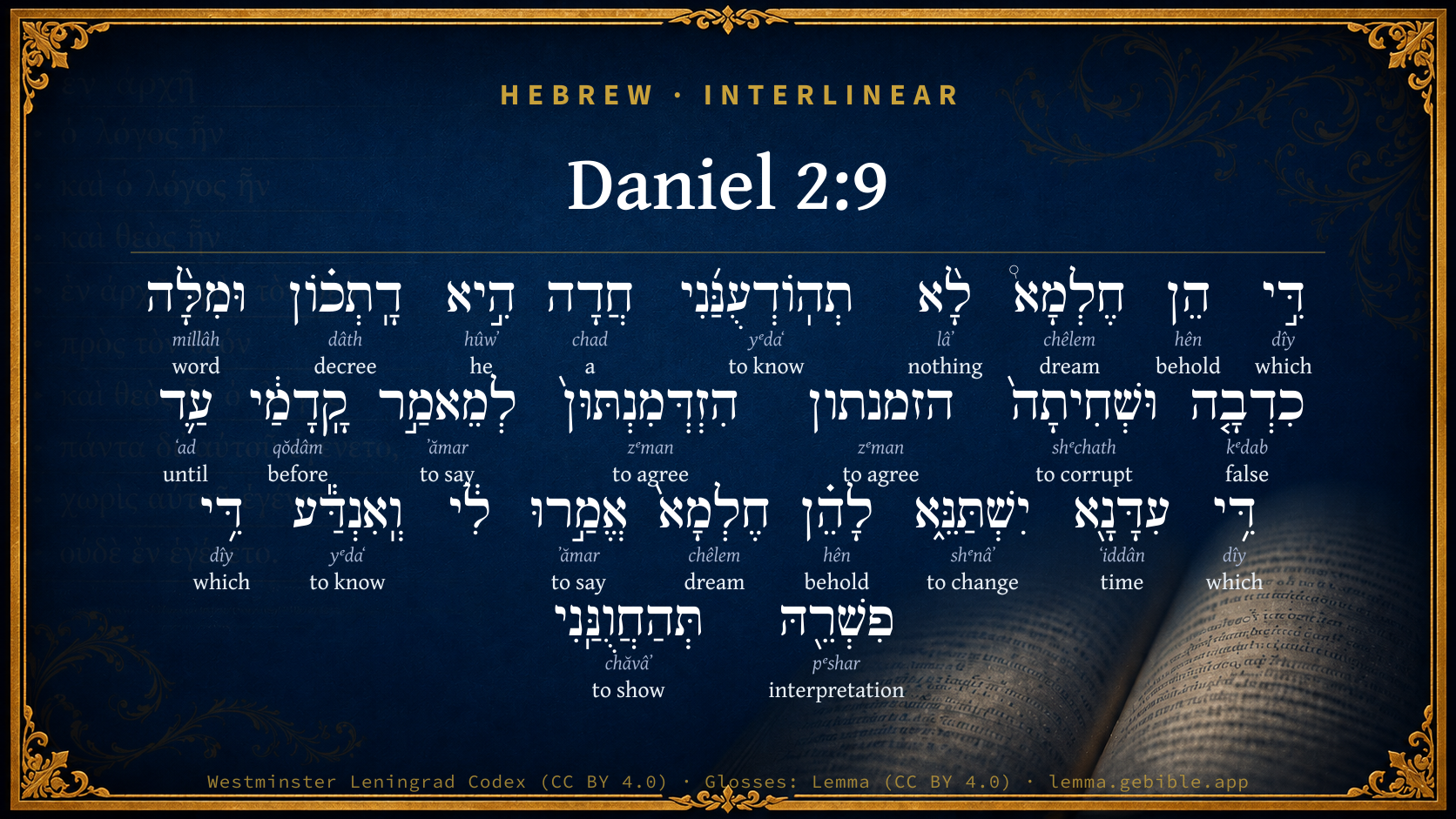
Daniel 2:9

Hebrew (Westminster Leningrad Codex) Daniel 2:9 appears in the Hebrew Old Testament. The text above is from the Westminster Leningrad Codex. Each word links to its Strong’s number, a concise gloss, and parsing drawn from the Open Scriptures Hebrew Bible morphology. Click any word for its full Brown-Driver-Briggs (BDB) entry.
Download image
Cite this verse

Daniel 2:9 (World English Bible). Public Domain. Lemma interlinear Bible study tool, https://lemma.gebible.app/v/daniel/2/9.

Show BibTeX & RIS
BibTeX
RIS
English Translation
But if you don't make known to me the dream, there is but one law for you; for you have prepared lying and corrupt words to speak before me, until the time be changed: therefore tell me the dream, and I shall know that you can show me the interpretation of it.
World English Bible · Public Domain
Highlights
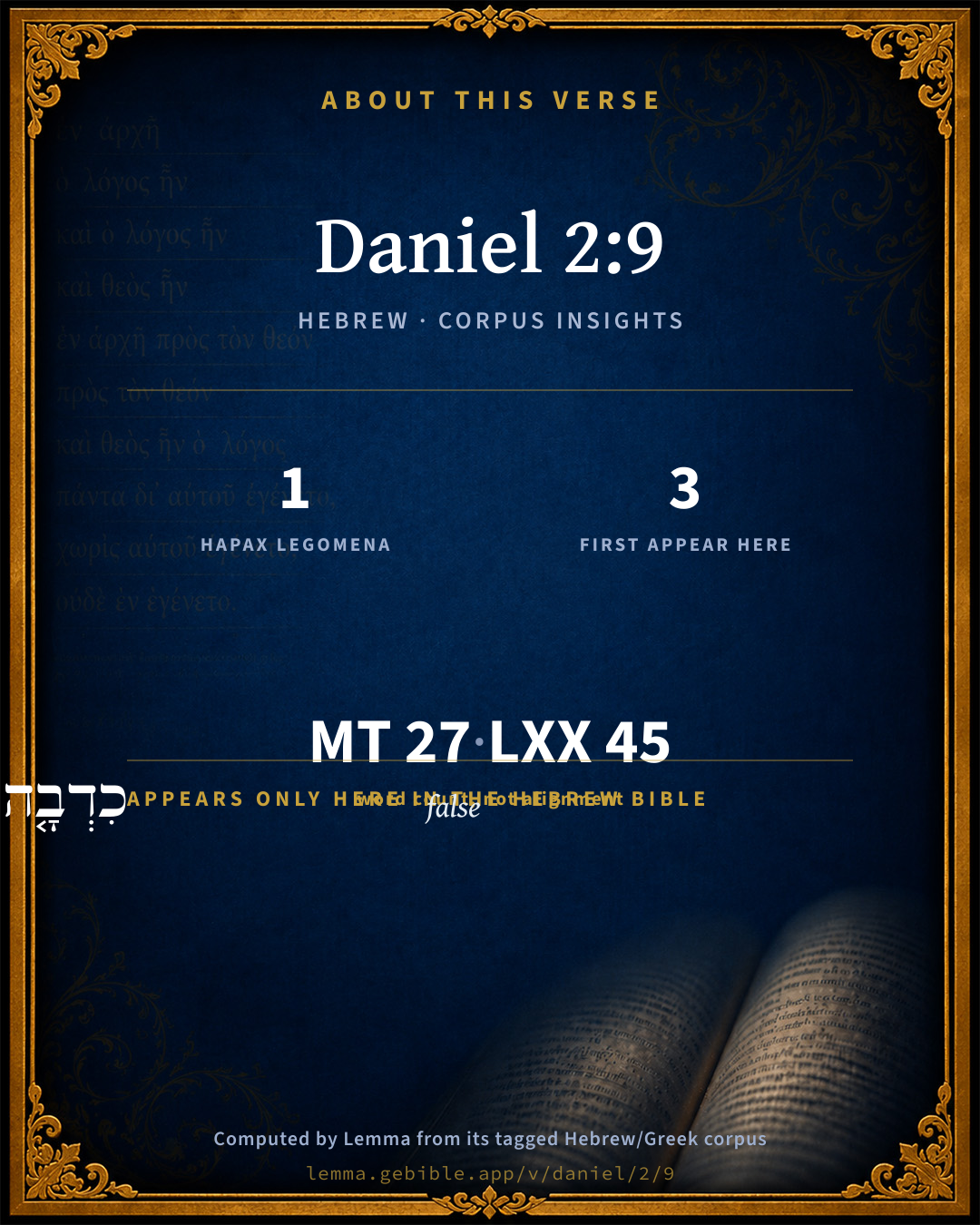
  • 1 hapax legomenon — only here in the Hebrew Bible
  • 3 first appearances in the Hebrew Bible
Full analysis ↓
Download a study sheet

One document with this verse’s original text, its word-by-word gloss line, the meaning frame, cross-references with their text, attributed commentary, and full source and license credits — printable, and it pastes into notes with its structure intact.

This verse Autodidact and up

Study sheet (.html) Plain text (.txt)

A passage Seminary Student

Up to 50 verses in one chapter. A passage sheet keeps up to 6 commentary sources and 12 cross-references per verse, in the order this page ranks them, and says so on the sheet whenever that leaves anything out. Ask for a single verse and you get the Autodidact verse sheet above.

Everything on this page stays free to read, with no account — the sheet is a download of what is already on screen, not access to it.

Want to remove ads? Support Godless Engineer
Compare translations 3

The same verse in 3 English versions, stacked beneath the original-language interlinear above. Click any original word for its lexicon entry.

Each is an independent rendering of the whole verse — the interlinear is not word-aligned to these translations.

Highlighted words mark where these versions differ — a whole-verse word diff, not a word-by-word alignment.

  • World English Bible Public Domain
    But if you don't make known to me the dream, there is but one law for you; for you have prepared lying and corrupt words to speak before me, until the time be changed: therefore tell me the dream, and I shall know that you can show me the interpretation of it.
  • King James Version Public Domain
    But if ye will not make known unto me the dream, there is but one decree for you: for ye have prepared lying and corrupt words to speak before me, till the time be changed: therefore tell me the dream, and I shall know that ye can shew me the interpretation thereof.
  • unfoldingWord Literal Text CC BY-SA 4.0
    That if you do not make the dream known to me, there is only one sentence for you. For you have agreed together to speak lying and corrupt words before me until the times change. So then, tell me the dream, and I will know that you can show me its interpretation.”

unfoldingWord Literal Text — © unfoldingWord, licensed CC BY-SA 4.0. Word-aligned USFM3 via Door43 (git.door43.org/unfoldingWord/en_ult).

Versions to compare (up to 4)

3 of 4 selected

Show all 18 translations

Every available English version of this verse, each an independent rendering of the whole verse.

  • World English Bible Public Domain
    But if you don't make known to me the dream, there is but one law for you; for you have prepared lying and corrupt words to speak before me, until the time be changed: therefore tell me the dream, and I shall know that you can show me the interpretation of it.
  • Berean Standard Bible Public Domain
    If you do not tell me the dream, there is only one decree for you. You have conspired to speak before me false and fraudulent words, hoping the situation will change. Therefore tell me the dream, and I will know that you can give me its interpretation.”
  • Majority Standard Bible Public Domain
    If you do not tell me the dream, there is only one decree for you. You have conspired to speak before me false and fraudulent words, hoping the situation will change. Therefore tell me the dream, and I will know that you can give me its interpretation.”
  • King James Version Public Domain
    But if ye will not make known unto me the dream, there is but one decree for you: for ye have prepared lying and corrupt words to speak before me, till the time be changed: therefore tell me the dream, and I shall know that ye can shew me the interpretation thereof.
  • American Standard Version (1901) Public Domain
    But if ye make not known unto me the dream, there is but one law for you; for ye have prepared lying and corrupt words to speak before me, till the time be changed: therefore tell me the dream, and I shall know that ye can show me the interpretation thereof.
  • Revised Version (1885) Public Domain
    But if ye make not known unto me the dream, there is but one law for you: for ye have prepared lying and corrupt words to speak before me, till the time be changed: therefore tell me the dream, and I shall know that ye can shew me the interpretation thereof.
  • Geneva Bible (1599) Public Domain
    But if ye will not declare mee the dreame, there is but one iudgement for you: for ye haue prepared lying and corrupt wordes, to speake before me till the time bee changed: therefore tell me the dreame, that I may knowe, if yee can declare me the interpretation thereof.
  • Douay-Rheims (1899) Public Domain
    If therefore you tell me not the dream, there is one sentence concerning you, that you have also framed a lying interpretation, and full of deceit, to speak before me till the time pass away. Tell me therefore the dream, that I may know that you also give a true interpretation thereof.
  • Young's Literal Translation Public Domain
    `so' that, if the dream ye do not cause me to know -- one is your sentence, seeing a word lying and corrupt ye have prepared to speak before me, till that the time is changed, therefore the dream tell ye to me, then do I know that its interpretation ye do shew me.'
  • Literal Standard Version CC BY-SA 4.0
    [so] that, if you do not cause me to know the dream—one is your sentence, seeing a lying and corrupt word you have prepared to speak before me, until the time is changed, therefore tell the dream to me, then I know that you show me its interpretation.”
  • Unlocked Literal Bible CC BY-SA 4.0
    But if you do not tell me the dream, there is only one sentence for you. You have decided to prepare false and deceptive words that you agreed together to say to me until I change my mind. So then, tell me the dream, and then I will know you can interpret it for me.”
  • unfoldingWord Literal Text CC BY-SA 4.0
    That if you do not make the dream known to me, there is only one sentence for you. For you have agreed together to speak lying and corrupt words before me until the times change. So then, tell me the dream, and I will know that you can show me its interpretation.”
  • Darby Bible Public Domain
    but if ye do not make known unto me the dream, there is but one decree for you; for ye have prepared lying and corrupt words to speak before me, till the time be changed: therefore tell me the dream, and I shall know that ye can shew me its interpretation.
  • World Messianic Bible Public Domain
    But if you don’t make known to me the dream, there is but one law for you; for you have prepared lying and corrupt words to speak before me, until the situation changes. Therefore tell me the dream, and I will know that you can show me its interpretation.”
  • Webster's Bible Public Domain
    But if ye will not make known to me the dream, there is but one decree for you: for ye have prepared lying and corrupt words to speak before me, till the time be changed: therefore tell me the dream, and I shall know that ye can show me the interpretation of it.
  • Free Bible Version CC BY-SA 4.0
    If you can't reveal the dream to me, you will all receive the same punishment! You have conspired against me, telling me lies, hoping things will change. So tell me what my dream was and then I'll know that you can explain what it means.”
  • Bible in Basic English Public Domain
    That if you do not make my dream clear to me there is only one fate for you: for you have made ready false and evil words to say before me till the times are changed: so give me an account of the dream, and I will be certain that you are able to make the sense of it clear.
  • JPS Tanakh (1917) Public Domain
    that, if ye make not known unto me the dream, there is but one law for you; and ye have agreed together to speak before me lying and corrupt words, till the time be changed; only tell me the dream, and I shall know that ye can declare unto me the interpretation thereof.'

Literal Standard Version (2020), Covenant Press — licensed CC BY-SA 4.0. Text via the HelloAO Bible API (eBible.org). Unlocked Literal Bible (unfoldingWord) — licensed CC BY-SA 4.0. Text via the HelloAO Bible API (eBible.org). unfoldingWord Literal Text — © unfoldingWord, licensed CC BY-SA 4.0. Word-aligned USFM3 via Door43 (git.door43.org/unfoldingWord/en_ult). Free Bible Version, Dr. Jonathan Gallagher — licensed CC BY-SA 4.0. Text via the HelloAO Bible API (eBible.org).

Word by word

More ways to search: Search by grammar → Find every occurrence → Compare this word →

Practice this passage: Drill this verse → Learn its vocabulary →

כִדְבָ֤ה
kᵉdab
H3538
“false”
Adjective, A
Part of Speech
Adjective
Full BDB Definition

Origin: from a root corresponding to H3576

TWOT: 2783

false, lying
  1. דִּ֣י dîy H1768 “which” Adjective, T
  2. הֵן hên H2006 “behold” Adjective, C
  3. חֶלְמָא֩ chêlem H2493 “dream · the” Adjective, N, Common + Particle, Definite Article
  4. לָ֨א lâʼ H3809 “nothing” Adjective, T
  5. תְהֽוֹדְעֻנַּ֜נִי yᵉdaʻ H3046 “to know · me” Adjective, V + Suffix, Personal, 1st Person, Common, Singular
  6. חֲדָה chad H2298 “a” Adjective, A, Common
  7. הִ֣יא hûwʼ H1932 “he” Adjective, P
  8. דָֽתְכ֗וֹן dâth H1882 “decree · your” Adjective, N, Common + Suffix, Personal, 2nd Person, Masculine, Plural
  9. וּמִלָּ֨ה millâh H4406 “and · word” Adjective, C + Noun, Common, Feminine, Singular, Absolute
  10. וּשְׁחִיתָה֙ shᵉchath H7844 “and · corrupted” Adjective, C + Verb, Qal Passive, Participle Passive, Feminine, Singular, Absolute
  11. הזמנתון zᵉman H2164 “to agree” Adjective, V, Plural
  12. הִזְדְּמִנְתּוּן֙ zᵉman H2164 “to agree” Adjective, V, Plural
  13. לְמֵאמַ֣ר ʼămar H560 “to say” Adjective, R + Verb, Qal, Infinitive Construct
  14. קָֽדָמַ֔י qŏdâm H6925 “before · me” Adjective, R + Suffix, Personal, 1st Person, Common, Singular
  15. עַ֛ד ʻad H5705 “until” Adjective, R
  16. דִּ֥י dîy H1768 “which” Adjective, T
  17. עִדָּנָ֖א ʻiddân H5732 “time · the” Adjective, N, Common + Particle, Definite Article
  18. יִשְׁתַּנֵּ֑א shᵉnâʼ H8133 “to change” Adjective, V
  19. לָהֵ֗ן hên H2006 “behold” Adjective, C
  20. חֶלְמָא֙ chêlem H2493 “dream · the” Adjective, N, Common + Particle, Definite Article
  21. אֱמַ֣רוּ ʼămar H560 “say” Adjective, V
  22. וְֽאִנְדַּ֕ע yᵉdaʻ H3046 “and · to know” Adjective, C + Verb, Qal, Imperfect, 1st Person, Common, Singular
  23. דִּ֥י dîy H1768 “which” Adjective, T
  24. פִשְׁרֵ֖הּ pᵉshar H6591 “interpretation · his” Adjective, N, Common + Suffix, Personal, 3rd Person, Masculine, Singular
  25. תְּהַחֲוֻנַּֽנִי chăvâʼ H2324 “to show · me” Adjective, V + Suffix, Personal, 1st Person, Common, Singular

About this verse

These counts appear in no published source. They are computed here, from the morphology-tagged text and Lemma’s own curated glosses. What Lemma adds →

27
words
19
distinct lemmas
Prophets
section

Notable vocabulary

1 hapax legomenon — a word that appears only here in the entire Hebrew Bible:

  • כִדְבָ֤ה false H3538

First appearance in Scripture

These words make their first canonical appearance in the Hebrew Bible here:

  • כִדְבָ֤ה false H3538
  • וּשְׁחִיתָה֙ to corrupt H7844
  • הזמנתון to agree H2164

Grammatical profile

  • 3 verbs
  • 1 noun
  • 20 adjectives
  • 3 particles

Verb forms

  • וּשְׁחִיתָה֙ Qal Passive · Participle Passive
  • לְמֵאמַ֣ר Qal · Infinitive Construct
  • וְֽאִנְדַּ֕ע Qal · Imperfect

Repetition

Words recur within this verse — often emphatic in Hebrew:

  • הֵן behold H2006 ×2
  • חֶלְמָא֩ dream H2493 ×2
  • תְהֽוֹדְעֻנַּ֜נִי to know H3046 ×2
  • הזמנתון to agree H2164 ×2
  • לְמֵאמַ֣ר to say H560 ×2
  • דִּ֣י which H1768 ×3

Hebrew & Septuagint length

In English translation the verse runs 52 words from the Hebrew and 48 from the Septuagint (LXX English) — closely comparable.

A rough comparison of the two English renderings, which tokenize alike — not a word-level alignment.

Word counts can differ between the Hebrew and the Greek without any difference in meaning — e.g. the Hebrew direct-object marker אֵת has no separate Greek word, and Greek often adds the article ὁ.

In the original languages it is 27 Hebrew tokens and 45 Greek tokens — but the two are counted differently (Hebrew bundles its prefixes and suffixes into one token; the Greek is in lemma form), so that isn’t a like-for-like length.

Cross-references

15

Topical passages linked to Daniel 2:9 in the Treasury of Scripture Knowledge — connected by theme and wording, ordered by reader-vote popularity; previews shown in the World English Bible.

  • Esther 4:11 All the king's servants, and the people of the king's provinces, do know, that whoever, whether man or woman, shall come to the king into the inner court, who is not called, there is one law for him, that he be put to death, except those to whom the king shall hold out the golden scepter, that he may live: but I have not been called to come in to the king these thirty days.
  • Isaiah 41:23 Declare the things that are to come hereafter, that we may know that you are gods: yes, do good, or do evil, that we may be dismayed, and see it together.
  • Daniel 2:21 He changes the times and the seasons; he removes kings, and sets up kings; he gives wisdom to the wise, and knowledge to those who have understanding;
  • Daniel 7:25 He shall speak words against the Most High, and shall wear out the saints of the Most High; and he shall think to change the times and the law; and they shall be given into his hand until a time and times and half a time.
  • Isaiah 44:25 who frustrates the signs of the liars, and makes diviners mad; who turns wise men backward, and makes their knowledge foolish;
  • Ezekiel 13:6 They have seen falsehood and lying divination, who say, Yahweh says; but Yahweh has not sent them: and they have made men to hope that the word would be confirmed.
  • Daniel 3:15 Now if you are ready whenever you hear the sound of the horn, flute, zither, lyre, harp, pipe, and all kinds of music to you fall down and worship the image which I have made, [well]: but if you don't worship, you shall be cast the same hour into the midst of a burning fiery furnace; and who is that god that shall deliver you out of my hands?
  • Daniel 5:28 PERES; your kingdom is divided, and given to the Medes and Persians.
  • 1 Kings 22:6 Then the king of Israel gathered the prophets together, about four hundred men, and said to them, Shall I go against Ramoth-gilead to battle, or shall I forbear? They said, Go up; for the Lord will deliver it into the hand of the king.
  • 1 Kings 22:22 Yahweh said to him, 'How?' He said, 'I will go forth, and will be a lying spirit in the mouth of all his prophets.' He said, 'You shall entice him, and shall prevail also: go forth, and do so.'
  • Proverbs 12:19 Truth's lips will be established forever, But a lying tongue is only momentary.
  • Ezekiel 13:17 You, son of man, set your face against the daughters of your people, who prophesy out of their own heart; and prophesy you against them,
  • Ezekiel 13:19 You have profaned me among my people for handfuls of barley and for pieces of bread, to kill the souls who should not die, and to save the souls alive who should not live, by your lying to my people who listen to lies.
  • Daniel 5:31 Darius the Mede received the kingdom, being about sixty-two years old.
  • 2 Corinthians 2:17 For we are not as so many, peddling the word of God. But as of sincerity, but as of God, in the sight of God, we speak in Christ.

Cross-references courtesy of OpenBible.info (CC BY 4.0).

Hebrew and Greek witnesses Masoretic Hebrew ↔ Greek Septuagint

The same verse in the two great witnesses to the Old Testament, shown verse-for-verse.

These are two independent witnesses, not word-aligned to each other, and the Septuagint is shown in lemma (dictionary) form.

Hebrew Daniel 2:9 Masoretic · Westminster Leningrad Codex

דִּ֣י הֵן חֶלְמָא֩ לָ֨א תְהֽוֹדְעֻנַּ֜נִי חֲדָה הִ֣יא דָֽתְכ֗וֹן וּמִלָּ֨ה כִדְבָ֤ה וּשְׁחִיתָה֙ הזמנתון הִזְדְּמִנְתּוּן֙ לְמֵאמַ֣ר קָֽדָמַ֔י עַ֛ד דִּ֥י עִדָּנָ֖א יִשְׁתַּנֵּ֑א לָהֵ֗ן חֶלְמָא֙ אֱמַ֣רוּ לִ֔י וְֽאִנְדַּ֕ע דִּ֥י פִשְׁרֵ֖הּ תְּהַחֲוֻנַּֽנִי

But if you don't make known to me the dream, there is but one law for you; for you have prepared lying and corrupt words to speak before me, until the time be changed: therefore tell me the dream, and I shall know that you can show me the interpretation of it.

World English Bible · Public Domain

Greek LXX Daniel 2:9 Septuagint · lemma form

ἐάν μή ὁ ἐνύπνιον ἀποἀγγέλλω ἐγώ ἐπί ἀλήθεια καί ὁ οὗτος σύγκρισις δηλόω θάνατος περιπίπτω συνεἶπον γάρ λόγος ψευδής ποιέω ἐπί ἐγώ ἕως ἄν ὁ καιρός ἀλλοιόω νῦν οὖν ἐάν ὁ ῥῆμα εἶπον ἐγώ ὅς ὁ νύξ ὁράω γιγνώσκω ὅτι καί ὁ οὗτος κρίσις δηλόω

If then you⌃ do not tell me the dream, I know that you⌃ have concerted to utter before me a false and corrupt tale, until the time shall have past: tell me my dream, and I shall know that you⌃ will also declare to me the interpretation thereof.

LXX2012 (modern English Septuagint) · Public Domain

On this verse, The Pulpit Commentary discusses the Septuagint’s reading. Read the note in Commentary ↓

Hebrew: Westminster Leningrad Codex (CC BY 4.0). Greek: Septuagint (public domain); English from LXX2012 (modern English Septuagint) (Public Domain). How the Septuagint differs from the Hebrew →

Commentary

Notes on Daniel 2:9 from classic Christian and Jewish commentators (each source and its license shown beneath its notes). The classic Christian expositions comment on the surrounding passage and are grouped to its opening verse, so a note may address several verses; the Jewish commentaries on the Tanakh (Rashi and others) are per-verse, so they appear only where the commentator wrote on this verse.

Lemma curates 59 commentaries, every one of them public domain or Creative Commons licensed, each selected and text-cleaned for this edition rather than reprinted as found. About our sources →

Trapp's Complete Commentary

John Trapp

Dan 2:9 But if ye will not make known unto me the dream, [there is but] one decree for you: for ye have prepared lying and corrupt words to speak before me, till the time be changed: therefore tell me the dream, and I shall know that ye can shew me the interpretation thereof.

Ver. 9. There is but one decree for you.] But that was a very tyrannical and bloody one. It is dangerous to affront great men, {a} though in a just cause. {Ecc 10:4}

“ Saevum praelustri fulmen ab arce venit. ” - Ovid.

Till the time be changed.] The Latin hath it, Till there be another state of things. See on Dan 2:8.

Tell me the dream, and I shall know that ye can show me the interpretation thereof.] If you cannot tell it, surely you cannot interpret it; since they are both of a divine instinct, and nothing is hidden from God.

{a} Procul a culmine, et procul a fulmine.

John Trapp, A Commentary or Exposition upon All the Books of the Old and New Testament (1647–1656) — public domain. Text from a community e-Sword module.

Joseph Benson's Commentary

Dan 2:9. If ye will not make known the dream, &c., there is but one decree for you — No alteration will be made as to my declaration; and you have nothing to expect but the execution of the sentence which I have passed upon you. For ye have prepared lying and corrupt words — The king’s meaning seems to be, that he found by their behaviour, they were ready, in case he told his dream, to invent and give some kind of plausible interpretation of it; or such a one as might, in some way or other, be applicable to whatever events should follow it: in short, that he found their pretended knowledge to be all imposture, since, if they were able to foretel things not yet come to pass, they might certainly tell things already past, and so inform him what was the subject of his dream. Till the time be changed — Till there be such an alteration of things, that neither my dream, nor your interpretation, may be thought of any more. Or, as some think, this may be spoken of the wise men framing excuses, in order to delay their punishment, in hopes there might be some change in things, or in the king’s mind, whereby they might escape it. From what he says, however, in the conclusion of the verse, it seems to be rather an insinuation, that they intended to forge or invent an interpretation of his dream, not being able to show the true interpretation of it.

Joseph Benson's Commentary on the Old and New Testaments (1811–1818) — public domain. Text from a community e-Sword module.

Tyndale Open Study Notes

Tyndale Open Resources

2:9 Only someone with supernatural insight could tell Nebuchadnezzar the contents of his dream (cp. Mark 2:9-12).

Tyndale Open Study Notes — © Tyndale Open Resources, licensed CC BY-SA 4.0. Text via the HelloAO Bible API.

Ibn Ezra

Rabbi Abraham ibn Ezra

[Daniel 2:9] ʿad di ʿiddana yishtanne (עַד דִּי עִדָּנָא יִשְׁתַּנֵּא -...until the time/circumstances change): [The king means, you hope to stall until] "And I [the king] become occupied with another matter" [and forget about this].

Ibn Ezra on the Tanakh — English translations: “Sefaria Community Translation” (CC0 1.0 (public-domain dedication)); “Yalkut, Sifsei Chachomim Chumash, Metsudah Publications, 2009” (CC BY 4.0); and “Commentary of Ibn Ezra on Isaiah - trans. by M. Friedlander, 1873” (public domain). Text via Sefaria.

Jamieson, Fausset & Brown

Robert Jamieson, A. R. Fausset & David Brown

one decree--There can be no second one reversing the first (Est 4:11).

corrupt--deceitful.

till the time be changed--till a new state of things arrive, either by my ceasing to trouble myself about the dream, or by a change of government (which perhaps the agitation caused by the dream made Nebuchadnezzar to forebode, and so to suspect the Chaldeans of plotting).

tell . . . dream, and I shall know . . . ye can show . . . interpretation--If ye cannot tell the past, a dream actually presented to me, how can ye know, and show, the future events prefigured in it?

Jamieson, Fausset & Brown — Commentary Critical and Explanatory on the Whole Bible (1871) — public domain (CC PDM 1.0). Text via the HelloAO Bible API.

John Calvin's Commentaries

He adds again, Ye have prepared a fallacious and corrupt speech to relate here before me, as your excuse. Again, the king charges them with fraud and malice, of which they were not guilty; as if he had said, they purposely sought specious pretenses for practicing deceit. But he says, a lying speech, or fallacious and corrupt; that is, yours is a stale excuse, as we commonly say, and I loathe it. If there were any colorable pretext I might admit what. ye say, but I see in your words nothing but fallacies, and those too which savor of corruption. Now, therefore, we observe the king not only angry because the Magi cannot relate his dream, but charging it against them, as a greater crime, that they brought a stale excuse and wished purposely to deceive him. He next adds, tell me the dream and then I shall know it; or then I shall know that ye can faithfully interpret, its meaning. Here the king takes up another argument to convict the Magi of cunning. Ye boast, indeed, that you have no difficulty in interpreting the dream. How can ye be confident of this, for the dream itself is still unknown to you? If I had told it you, ye might then say whether ye could explain it or not; but when I now ask you about the dream of which both you and I are ignorant, ye say, when have related the dream, the rest is in your power; I therefore shall prove you to be good and true interpreters of dreams if ye can tell me mine, since the one thing depends on the other, and ye are too rash in presuming upon what is not yet discovered. Since, therefore, ye burst forth so hastily, and wish to persuade me that ye are sure of the interpretation, you are evidently quite deceived in this respect; and your rashness and fraud are herein detected, because ye are clearly deceiving me. This is the substance — the rest to-morrow.

John Calvin's Commentaries (1540-1563) — public domain. Text from the Calvin Translation Society English edition (1840s-50s) via the Christian Classics Ethereal Library (ccel.org). Calvin's coverage is partial (roughly two-thirds of the Bible); uncommented books and verses are honest gaps, never fabricated. The 19th-century editor's footnotes and remarks are omitted so the notes are faithfully Calvin's own voice.

Ellicott's Commentary for English Readers

(9) There is but one decree.—He refers to the decree mentioned Dan_2:5, that both the dream and the interpretation must be told. These two things must go together, for they form the subject of one decree.

Ye have prepared . . . be changed—i.e., “you have made au agreement among yourselves to postpone the matter till a more lucky time for explaining the dream shall come.” On Eastern notions about fortunate days, comp. Est_3:7 and the standard inscription or Nebuchadnezzar towards the end.

A Bible Commentary for English Readers, edited by Charles John Ellicott (1878–1897) — public domain. Text from a community e-Sword module.

The Cambridge Bible for Schools and Colleges

gen. ed. J. J. S. Perowne

9. That, if ye make not known unto me the dream, there is but one law for you] you can expect nothing else but punishment. Lit. your law (i.e. the law or sentence against you) is one, implying that it is unalterable and inevitable; cf. Est_4:11. The word for ‘law’ (dâth) is Persian, Zend dâta, Mod. Pers. dâd (see the Introduction, p. lvi).

and (also) lying and corrupt words ye have agreed to speak before me] pretending falsely that you will be able to explain the dream, if it is only told you.

prepared] So the Kt.; but the Qrê, ‘ye have prepared yourselves, or agreed together’ (cf. Amo_3:3 Targ.), is more in accordance with usage (see Levy, Chald. W. B., s.v.).

before me] to speak ‘before,’ rather than ‘to,’ a king, is the language of respect: so Dan_2:10-11; Dan_2:27; Dan_2:36; Dan_5:17; Dan_6:12; Est_1:16; Est_7:9; Est_8:3. Cp. on Dan_6:10.

till the time be changed] till circumstances take a favourable turn, and the king, for instance, has his attention diverted to something else.

therefore tell me, &c.] if they are able to tell him the dream, it will be a guarantee to him that their explanation will be trustworthy.

The Cambridge Bible for Schools and Colleges (gen. ed. J. J. S. Perowne; Cambridge University Press, 1878–1918) — public domain. Text from a community e-Sword module.

John Gill's Exposition

But if ye will not make known unto me the dream,.... For the present he does not insist upon the interpretation, only the dream itself, at least this is now only mentioned; concluding that if they could do the one, they could do the other, as is after observed:

there is but one decree for you; for them all; and that was the decree of death; which should never be revoked or mitigated, or the sentence be changed for another; but should certainly be executed, and in which they were all involved, not one should escape:

for ye have prepared lying and corrupt words to speak before me; framed a deceitful answer to impose upon and screen yourselves:

till the time be changed; either that he could remember his dream, and tell them it himself; or all the images and impressions of it were wore off his mind, so that they could tell him anything, and he not be able to disprove them; or he would grow indifferent to it, and his passionate desire after it cool, and he be careless whether he knew it or not; or he or they should die; or he might be engaged in other affairs, and be called abroad to war, as he had been; or some thing or other turn up, whereby they might escape the ruin threatened. Saadiah fixes the time to noon, when the conversation of kings ceased, and they were otherwise engaged:

therefore tell me the dream, and I shall know that ye can show me the interpretation thereof; for by being able to tell a dream that was past, it might be concluded they were able to tell what was to come, signified by that dream; and if they could not declare what was past, how should it be thought that they could foretell things to come?

John Gill's Exposition of the Whole Bible (1746–1763) — public domain (CC PDM 1.0). Text via the HelloAO Bible API.

Albert Barnes' Notes on the Bible

But if ye will not make known unto me the dream, there is but one decree for you - That is, you shall share the same fate. You shall all be cut to pieces, and your houses reduced to ruin, Dan 2:5. There shall be no favor shown to any class of you, or to any individual among you. It seems to have been supposed that the responsibility rested on them individually as well as collectively, and that it would be right to hold each and every one of them bound to explain the matter. As no difference of obligation was recognized, there would be no difference of criminality. It should be said, however, that there is a difference of interpretation here. Gesenius, and some others, render the word translated “decree” - דת dâth - “counsel, plan, purpose,” and suppose that it means, “this only is your counsel, or plan;” that is, to prepare lying words, and to gain time. So Prof. Stuart renders the verse, “If ye will not make known to me the dream, one thing is your purpose, both a false and deceitful word have ye agreed to utter before me, until the time shall have changed; therefore tell me the dream, and then I shall know that you can show me the interpretation thereof.” The original word, however, is most commonly used in the sense of law or decree. See Deu 33:2; Est 1:8, Est 1:13, Est 1:15, Est 1:19; Est 2:8; Est 3:8, Est 3:14-15; Est 4:3, Est 4:8, Est 4:11, Est 4:16; Est 8:13-14, Est 8:17; Est 9:1, Est 9:13-14; and there seems to be no necessity for departing from the common translation. It contains a sense according to the truth in the case, and is in accordance with the Greek, Latin, and Syriac versions.

For ye have prepared lying and corrupt words to speak before me - That is, “You have done this in asking me to state the dream Dan 2:4, Dan 2:7, and in the demand that the dream should be made known to you, in order that you may interpret it. I shall know by your inability to recal the dream that you have been acting a false and deceitful part, and that your pretensions were all false. Your wish, therefore, to have me state the dream will be shown to be a mere pretence, an artifice for delay, that you might put off the execution of the sentence with the hope of escaping altogether.”

Till the time be changed - That is, until a new state of things shall occur; either until his purpose might change, and his anger should subside or until there should be a change of government: It was natural for such thoughts to pass through the mind of the king, since, as matters could be no “worse” for them if the subject was delayed, there was a possibility that they might be “better” - for any change would be likely to be an advantage. There does not appear to have been any great confidence or affection on either side. The king suspected that they were influenced by bad motives, and they certainly had no strong reasons for attachment to him. Compare the notes at Dan 2:21, and Dan 7:25.

Albert Barnes' Notes on the Bible (1834–1885) — public domain. Text from a community e-Sword/MySword module.

Haydock's Catholic Bible Commentary

Thereof. It is indeed more easy to discover what dream a person has had, than to explain it; since the devil might disclose the former, but he can only guess at what will happen, and herein his agents are often deceived. (See Genesis xl.) (Worthington) --- It is not even certain that the devil can know the dreams which we have not divulged, as it is the privilege of God to discern the secrets of the heart. (Haydock)

George Leo Haydock (1774–1849), Haydock's Catholic Family Bible and Commentary, 1859 edition — public domain. Excludes Psalms (Douay-Rheims chapter numbering differs from Protestant) and Deuterocanonical books (Catholic canon only).

Matthew Poole's English Annotations

There is but one decree for you; that is, I will not retract my sentence, ye shall surely die: you are upon tricks, ye have prepared corrupt and lying words, for he that can interpret a dream can tell the dream, both come from a Divine inspiration, which ye pretend to; but I say ye have it not.

Matthew Poole's English Annotations on the Holy Bible (1683–1685) — public domain. Text from a community e-Sword/MySword module.

The Pulpit Commentary

But if ye will not make known unto me the dream, there is but one decree for you. The words translated (di hen) "but it liar, caused some difference, most translating as if the first word were not present. This is the rendering of the Septuagint. Theodotion and Jerome render the first word, which is really the relative, as "therefore," e rgo, "then," ou+n. The Peshitta has den, the corresponding Syriac phrase, which has a similar sense to that assumed here. The rendering of the next clause, both in the Septuagint and in the version of Theodotion, differs considerably from the Massoretic text. The rendering of the Septuagint is as follows: "If ye do not truly tell me the dream, an, l show me the interpretation, ye shall die." The version of Theodotion is shorter, "It, then, ye will not tell me the dream." Theodotion thus omits the clause translated, "there is but one decree for you;" the only word that may be the remains of it is oida, tdy, or simply the participle, The Syriac is, "If ye will not declare the dream to me, one is your plan and your word." The text of the Septuagint in this case indicates that we have here additions from previous verses. The phrase, "and declare to me the interpretation," is evidently supplied from ver. 5, whereas "ye shall die." literally, "ye shall chance to (fall into) death," has a different origin. This phrase has all the appearance of a translation. It would seem applicable on the idea that in the text before the Septuagint translator, instead of wktd (datheon), "your decree," there stood wktm (motheon), "your death," the w (vav) being omitted, and possibly the preposition b (be), and milch being read into some part of nephal, "to fall," probably WlPTi (tippelun). The omission of this clause, as above mentioned, from Theodotion renders it a little doubtful, as it indicates that in the text used by the Jews of Asia Minor this phrase was awanting. Most commentators take dath in the sense more common in Eastern than in Western Aramaic, of "pica" rather than "decree" Ewald and Professor Bevan oppose this view, as also Keil, the last with great positiveness. The facts that so many commentators give this meaning, and that certain Rabbinic authorities reterred to but not named by Jephet-ibn-Ali prove it to be no impossible translation. Hitzig, Von Lengerke, Maurer, Michaelis, and Moses Stuart are not quite despicable. The main reason against this view is that in Western Aramaic dath means "decree," in Eastern Aramaic it means, according to Castell, scopus, meta, finis, voluntas. The only difficulty is that he gives no reference, and Brockelmann gives only lex, which in this case it cannot be, though this is the only reference beside Hoffmann"s "Glossary." It might be an individual "decree," but a "law" it cannot be. On the received renderings the succession is somewhat violent. "If ye will not tell me the dream, one is your decree," can only be made consecutive by a violent jerk away back to the fifth verse. It seems more natural to take it as meaning, "Ye have agreed together to say one thing to me." The accusation of conspiracy naturally followed from the king"s firm conviction that the soothsayers could tell, if they only would, what he required of them. If there began to dawn upon him any idea that their silence was due to inability to answer, it might well move him to redoubled anger that they had been guilty of imposture in claiming such lofty powers and being so highly paid and honoured for their exercise. The king"s mind had not yet abandoned the faith of his fathers in magic and divination. For ye have prepared lying and corrupt words to speak before me. It" the Septuagint is to be taken as our guide, the word shheethah is a doubtful addition to the Massoretic text It is, however, in the other later versions. According to the rendering of both the Greek versions, the meaning here is stronger than that which is expressed in the Authorized Version; hizdaminton really means "to conspire." He will not admit the plea of inability to satisfy his demands the vague suspicion may be floating before his mind as, if he were to admit their inability to satisfy what he wished to learn, then, according to his logic, all their claims were false. Hence the accusation of "lying and corrupt words" would still stand, and have all the greater emphasis. Waiving the question of the authenticity of corrupt," the distinction between the two words lying" and "corrupt" seems to be in this: the first refers to the person addressed to Nebuchadnezzar, the words are untrue, they are lies as coming from the soothsayers they are corrupt," because they are symptomatic of a corrupt disposition, probably traitor, us. Till the time be changed. Theodotion renders here. "till the time be passed." The Septuagint follows a similar reading to that in the Massoretic text. The Peshitta rendering is akin to that of Theodotion. While in all forms of magic and soothsaying, time was an element not to be neglected, it was doubly important in regard to astrology, and an hour or two changed the position of the moon in relation to the constellations. If something required to be clone in consequence of this dream, then most likely it would require to be done in a certain relation of the heavenly bodies to each other. Therefore tell me the dream, and I shall know that ye can show me the interpretation thereof. The Septuagint rendering is paraphrastic, "Now then, if ye tell me the thing which I saw in the night, I shall know that ye can also show the interpretation." While we have called it a paraphrase as regards the Massoretic text, the rendering in the Septuagint may represent the Egyptian recension of the text of Daniel. The use of rJhma or "thing" suggests translation, and assumes millah or mill"tha, which has the same double suggestion of "word spoken" anti "thing spoken about." If the Septuagint text were assumed here, we should have confirmation of our view that Nebuchadnezzar remembered his vision, but was determined to experiment on the soothsayers of his court. This view is certainly implied in the following clause. The first word of this clause is peculiar grammatically: Dnai ( in"d"a) instead of dya (iyda) or Dai ("idda).

This form of compensating for a dropped consonant by inserting n (nun) instead of doubling occurs elsewhere in Biblical Aramaic (see ver. 30). This is rare in Syriac, and in the Targums found only in those later, especially those of the Megilloth, which have affinities with the form of Aramaic seen in the Babylonian Talmud. This peculiarity is common in the Maudaitic dialect. It is thus a distinctively Eastern form of Aramaic that is indicated here. When we pass beyond the grammatical elements, we find that Nebuchadnezzar would take correct information as to what he had dreamed a guarantee of the correctness of the interpretation of the dream which the soothsayers might afterwards give him. His attitude was purely and truly scientific, as it is stated. In his own mind he was warped and confused by his overmastering belief in omens and auguries, in gods and demons, in magicians and astrologers. With this faith in his heart, his only explanation of the silence of these soothsayers was treason.

The Pulpit Commentary (1880–1919), ed. H.D.M. Spence-Jones & Joseph S. Exell — public domain. Text from a community e-Sword module.

John Wesley's Explanatory Notes

But one decree - I will not retract my sentence.

John Wesley, Explanatory Notes Upon the Whole Bible (1754–1765) — public domain. Text via the GEBible commentary corpus.

Rashi

Rabbi Shlomo Yitzchaki (Rashi)

or if you have prepared yourselves...a false and corrupt word Or if you have prepared yourselves to say before me a false and corrupt word.

until the time changes until the time changes, i.e., before the shadows of evening slant, when the time of morning changes.

“Until the time changes” is an expression of rebuke and an exaggeration: so will he be punished, and the punishment was already delineated above. A similar instance is (Gen. 4:15): “Therefore, whoever kills Cain.”

but the dream; tell me what I dreamed, and I shall know that you will surely tell me the interpretation.

Rashi on the Tanakh — English translations: “The Judaica Press complete Tanach with Rashi, translated by A. J. Rosenberg” (CC BY 4.0); “Pentateuch with Rashi's commentary by M. Rosenbaum and A.M. Silbermann, 1929-1934” (public domain); “The Metsudah Tanach series, Lakewood, N.J” (CC BY 4.0); and “The Book of Joshua, Metsudah Publications, 1997” (CC BY 4.0). Text via Sefaria.

Lesson kit

Teaching starters — assembled from the data on this page, not authored interpretation. Every prompt links to the verse data it draws on. Edit before teaching.

Daniel, in the Prophets, opens this verse with 27 words (19 distinct Hebrew lemmas). Its most distinctive word is kᵉdab (“false”). A historical commentator’s framing appears above. Read the whole chapter for the surrounding context.

Discussion questions

  1. The word kᵉdab carries the sense “false.” How does it shape the verse?
  2. This verse holds 1 word here found nowhere else in the Hebrew Bible. What might the rare word draw attention to?
  3. 3 words here appear for the first time in Scripture. What is being introduced at this debut?
  4. Esther 4:11 shares this passage’s theme. How do the two illuminate each other?
  5. “behold” occurs 2× in this one verse. What is the effect of the repetition?
  6. These translations render this verse differently. What is at stake in choosing one wording over another?
  7. The verb «וּשְׁחִיתָה֙» is Qal Passive Participle Passive. How does its form color the action?
  8. Reading how Trapp's Complete Commentary and Joseph Benson's Commentary read this verse, where do the two commentators agree and where do they part?

Things to notice

  • 1 word in this verse appears nowhere else in the Hebrew Bible.
  • 3 words make their first canonical appearance in Scripture here.
  • This verse counts 27 Hebrew ↔ 45 Greek words.
  • These translations choose different wording for 21 words in this verse.
  • “behold” occurs 2× in this single verse.

Reading settings

Reading text

Shown beneath each verse's original-language words.

Old Testament
Old Testament edition

Read the OT as the Masoretic Hebrew (MT) or the Greek Septuagint (LXX).

English shown for the Greek Septuagint (in the Hebrew ↔ Greek comparison).

Comparing translations? Open the Compare panel on any verse page to stack up to four side by side.