
Daniel 3:5

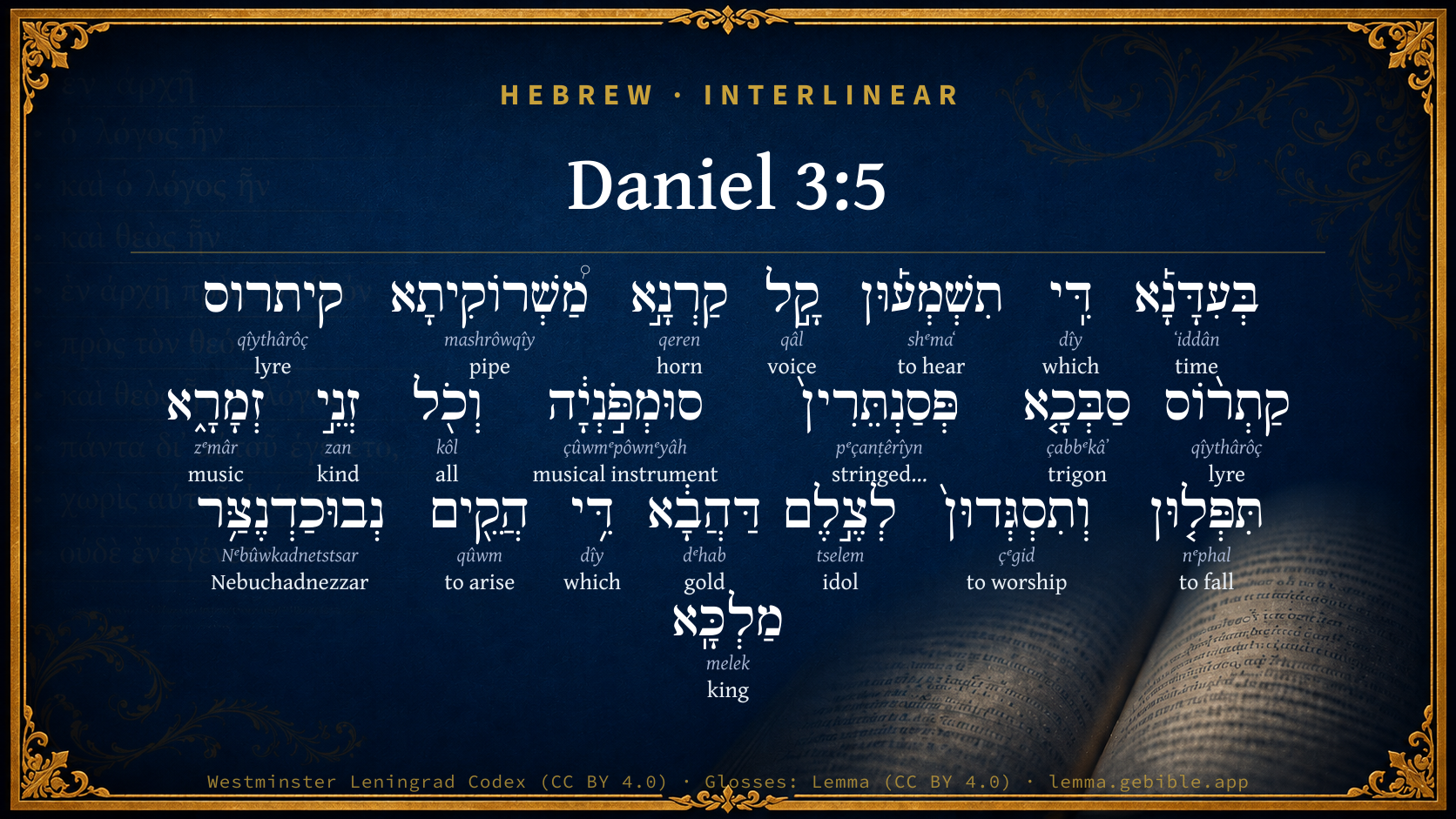
Hebrew (Westminster Leningrad Codex) Daniel 3:5 appears in the Hebrew Old Testament. The text above is from the Westminster Leningrad Codex. Each word links to its Strong’s number, a concise gloss, and parsing drawn from the Open Scriptures Hebrew Bible morphology. Click any word for its full Brown-Driver-Briggs (BDB) entry.
Download image
Cite this verse

Daniel 3:5 (World English Bible). Public Domain. Lemma interlinear Bible study tool, https://lemma.gebible.app/v/daniel/3/5.

Show BibTeX & RIS
BibTeX
RIS
English Translation
that whenever you hear the sound of the horn, flute, zither, lyre, harp, pipe, and all kinds of music, you fall down and worship the golden image that Nebuchadnezzar the king has set up;
World English Bible · Public Domain
Highlights
  • 10 first appearances in the Hebrew Bible
Full analysis ↓
Download a study sheet

One document with this verse’s original text, its word-by-word gloss line, the meaning frame, cross-references with their text, attributed commentary, and full source and license credits — printable, and it pastes into notes with its structure intact.

This verse Autodidact and up

Study sheet (.html) Plain text (.txt)

A passage Seminary Student

Up to 50 verses in one chapter. A passage sheet keeps up to 6 commentary sources and 12 cross-references per verse, in the order this page ranks them, and says so on the sheet whenever that leaves anything out. Ask for a single verse and you get the Autodidact verse sheet above.

Everything on this page stays free to read, with no account — the sheet is a download of what is already on screen, not access to it.

Want to remove ads? Support Godless Engineer
Compare translations 3

The same verse in 3 English versions, stacked beneath the original-language interlinear above. Click any original word for its lexicon entry.

Each is an independent rendering of the whole verse — the interlinear is not word-aligned to these translations.

Highlighted words mark where these versions differ — a whole-verse word diff, not a word-by-word alignment.

  • World English Bible Public Domain
    that whenever you hear the sound of the horn, flute, zither, lyre, harp, pipe, and all kinds of music, you fall down and worship the golden image that Nebuchadnezzar the king has set up;
  • King James Version Public Domain
    That at what time ye hear the sound of the cornet, flute, harp, sackbut, psaltery, dulcimer, and all kinds of musick, ye fall down and worship the golden image that Nebuchadnezzar the king hath set up:
  • unfoldingWord Literal Text CC BY-SA 4.0
    that at the time you hear the sound of the horn, flute, lyre, trigon, harp, bagpipe, and all kinds of music, you must fall down and worship the image of gold that King Nebuchadnezzar has set up.

unfoldingWord Literal Text — © unfoldingWord, licensed CC BY-SA 4.0. Word-aligned USFM3 via Door43 (git.door43.org/unfoldingWord/en_ult).

Versions to compare (up to 4)

3 of 4 selected

Show all 18 translations

Every available English version of this verse, each an independent rendering of the whole verse.

  • World English Bible Public Domain
    that whenever you hear the sound of the horn, flute, zither, lyre, harp, pipe, and all kinds of music, you fall down and worship the golden image that Nebuchadnezzar the king has set up;
  • Berean Standard Bible Public Domain
    As soon as you hear the sound of the horn, flute, zither, lyre, harp, pipes, and all kinds of music, you must fall down and worship the golden statue that King Nebuchadnezzar has set up.
  • Majority Standard Bible Public Domain
    As soon as you hear the sound of the horn, flute, zither, lyre, harp, pipes, and all kinds of music, you must fall down and worship the golden statue that King Nebuchadnezzar has set up.
  • King James Version Public Domain
    That at what time ye hear the sound of the cornet, flute, harp, sackbut, psaltery, dulcimer, and all kinds of musick, ye fall down and worship the golden image that Nebuchadnezzar the king hath set up:
  • American Standard Version (1901) Public Domain
    that at what time ye hear the sound of the cornet, flute, harp, sackbut, psaltery, dulcimer, and all kinds of music, ye fall down and worship the golden image that Nebuchadnezzar the king hath set up;
  • Revised Version (1885) Public Domain
    that at what time ye hear the sound of the cornet, flute, harp, sackbut, psaltery, dulcimer, and all kinds of music, ye fall down and worship the golden image that Nebuchadnezzar the king hath set up:
  • Geneva Bible (1599) Public Domain
    That when ye heare the sound of the cornet, trumpet, harpe, sackebut, psalterie, dulcimer, and all instruments of musike, ye fall downe and worship the golden image, that Nebuchad-nezzar the King hath set vp,
  • Douay-Rheims (1899) Public Domain
    That in the hour that you shall hear the sound of the trumpet, and of the flute, and of the harp, of the sackbut, and of the psaltery, and of the symphony, and of all kind of music; ye fall down and adore the golden statue which king Nabuchodonosor hath set up.
  • Young's Literal Translation Public Domain
    at the time that ye hear the voice of the cornet, the flute, the harp, the sackbut, the psaltery, the symphony, and all kinds of music, ye fall down and do obeisance to the golden image that Nebuchadnezzar the king hath raised up:
  • Literal Standard Version CC BY-SA 4.0
    At the time that you hear the voice of the horn, the flute, the harp, the lyre, the stringed instrument, the symphony, and all kinds of music, you fall down and pay respect to the golden image that Nebuchadnezzar the king has raised up:
  • Unlocked Literal Bible CC BY-SA 4.0
    that at the time you hear the sound of the horns, flutes, zithers, lyres, harps, and pipes, and all kinds of music, you must fall down and prostrate yourselves to the golden statue that King Nebuchadnezzar has set up.
  • unfoldingWord Literal Text CC BY-SA 4.0
    that at the time you hear the sound of the horn, flute, lyre, trigon, harp, bagpipe, and all kinds of music, you must fall down and worship the image of gold that King Nebuchadnezzar has set up.
  • Darby Bible Public Domain
    that at what time ye hear the sound of the cornet, pipe, lute, sambuca, psaltery, bagpipe, and all kinds of music, ye fall down and worship the golden image that Nebuchadnezzar the king hath set up;
  • World Messianic Bible Public Domain
    that whenever you hear the sound of the horn, flute, zither, lyre, harp, pipe, and all kinds of music, you fall down and worship the golden image that Nebuchadnezzar the king has set up.
  • Webster's Bible Public Domain
    That at what time ye hear the sound of the cornet, flute, harp, sackbut, psaltery, dulcimer, and all kinds of music, ye fall down and worship the golden image that Nebuchadnezzar the king hath set up.
  • Free Bible Version CC BY-SA 4.0
    As soon as you hear the sound of the horn, flute, zither, trigon, harp, pipes, and all kinds of musical instruments, you must fall to the ground and worship the gold statue that King Nebuchadnezzar has set up.
  • Bible in Basic English Public Domain
    That when the sound of the horn, pipe, harp, trigon, psaltery, bagpipe, and all sorts of instruments, comes to your ears, you are to go down on your faces in worship before the image of gold which Nebuchadnezzar the king has put up:
  • JPS Tanakh (1917) Public Domain
    that at what time ye hear the sound of the horn, pipe, harp, trigon, psaltery, bagpipe, and all kinds of music, ye fall down and worship the golden image that Nebuchadnezzar the king hath set up;

Literal Standard Version (2020), Covenant Press — licensed CC BY-SA 4.0. Text via the HelloAO Bible API (eBible.org). Unlocked Literal Bible (unfoldingWord) — licensed CC BY-SA 4.0. Text via the HelloAO Bible API (eBible.org). unfoldingWord Literal Text — © unfoldingWord, licensed CC BY-SA 4.0. Word-aligned USFM3 via Door43 (git.door43.org/unfoldingWord/en_ult). Free Bible Version, Dr. Jonathan Gallagher — licensed CC BY-SA 4.0. Text via the HelloAO Bible API (eBible.org).

Word by word

More ways to search: Search by grammar → Find every occurrence → Compare this word →

Practice this passage: Drill this verse → Learn its vocabulary →

מַ֠שְׁרוֹקִיתָא
mashrôwqîy
H4953
“pipe · the”
Adjective, N, Common + Particle, Definite Article
Part of Speech
Adjective + Particle
Type
Definite Article
Full BDB Definition

Origin: from a root corresponding to H8319

TWOT: 3049a

pipe
  1. בְּעִדָּנָ֡א ʻiddân H5732 “in/at · time · the” Adjective, R + Noun, Common, Masculine, Singular, Determined + Particle, Definite Article
  2. דִּֽי dîy H1768 “which” Adjective, T
  3. תִשְׁמְע֡וּן shᵉmaʻ H8086 “to hear” Adjective, V
  4. קָ֣ל qâl H7032 “voice of” Adjective, N, Common
  5. קַרְנָ֣א qeren H7162 “horn · the” Adjective, N, Common + Particle, Definite Article
  6. קיתרוס qîythârôç H7030 “lyre” Adjective, N, Common
  7. קַתְר֨וֹס qîythârôç H7030 “lyre” Adjective, N, Common
  8. סַבְּכָ֤א çabbᵉkâʼ H5443 “trigon” Adjective, N, Common
  9. פְּסַנְתֵּרִין֙ pᵉçanṭêrîyn H6460 “stringed instrument” Adjective, N, Common
  10. סוּמְפֹּ֣נְיָ֔ה çûwmᵉpôwnᵉyâh H5481 “musical instrument” Adjective, N, Common
  11. וְכֹ֖ל kôl H3606 “and · all of” Adjective, C + Noun, Common, Masculine, Singular, Construct
  12. זְנֵ֣י zan H2178 “kinds of” Adjective, N, Common
  13. זְמָרָ֑א zᵉmâr H2170 “music · the” Adjective, N, Common + Particle, Definite Article
  14. תִּפְּל֤וּן nᵉphal H5308 “to fall” Adjective, V
  15. וְתִסְגְּדוּן֙ çᵉgid H5457 “and · to worship” Adjective, C + Verb, Qal, Imperfect, 2nd Person, Masculine, Plural
  16. לְצֶ֣לֶם tselem H6755 “to/for · idol of” Adjective, R + Noun, Common, Masculine, Singular, Construct
  17. דַּהֲבָ֔א dᵉhab H1722 “gold · the” Adjective, N, Common + Particle, Definite Article
  18. דִּ֥י dîy H1768 “which” Adjective, T
  19. הֲקֵ֖ים qûwm H6966 “to arise” Adjective, V, Plural
  20. נְבוּכַדְנֶצַּ֥ר Nᵉbûwkadnetstsar H5020 “Nebuchadnezzar” Adjective, N
  21. מַלְכָּֽא melek H4430 “king · the” Adjective, N, Common + Particle, Definite Article

About this verse

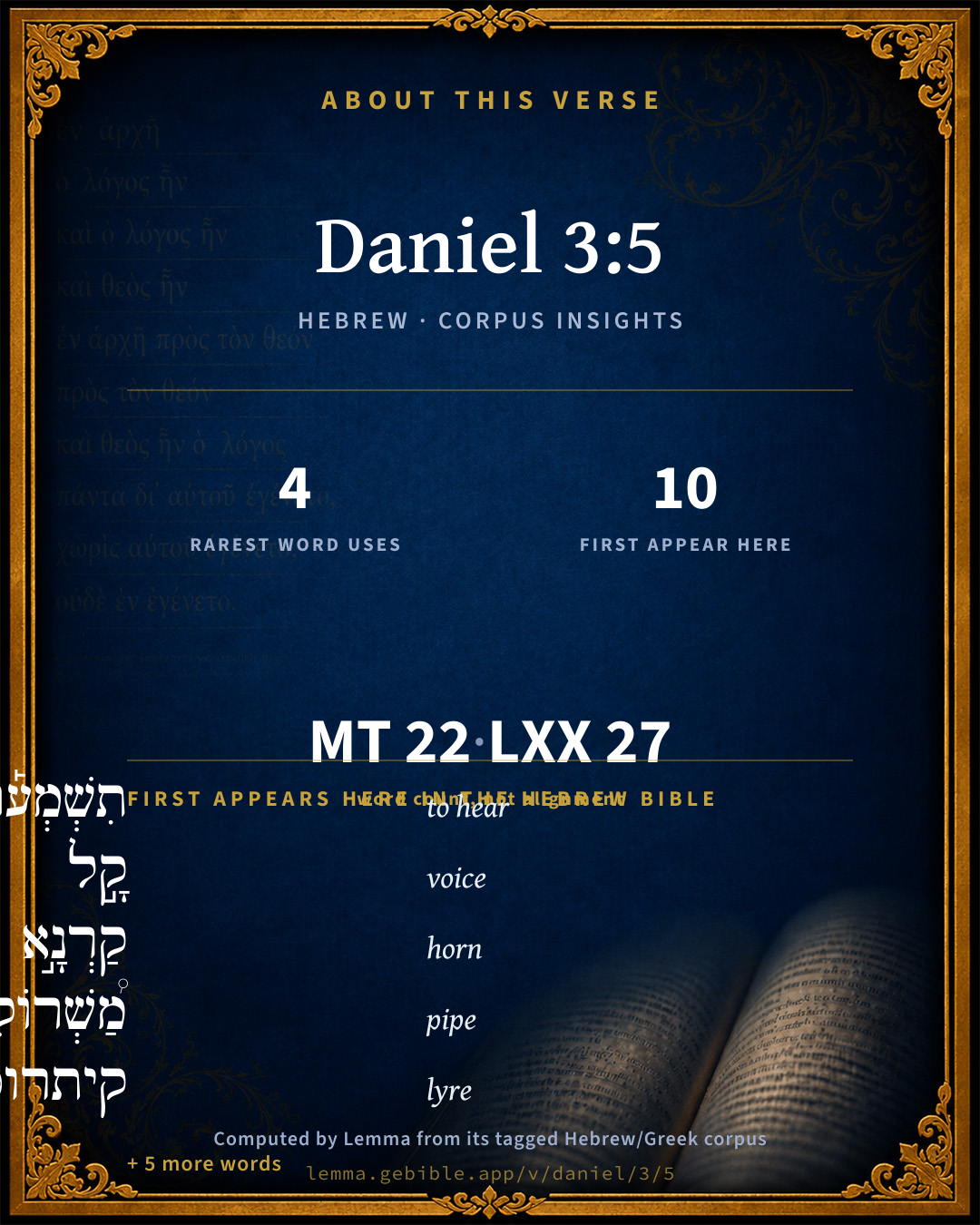
These counts appear in no published source. They are computed here, from the morphology-tagged text and Lemma’s own curated glosses. What Lemma adds →

22
words
20
distinct lemmas
Prophets
section

Notable vocabulary

The rarest word here is מַ֠שְׁרוֹקִיתָא pipe H4953 — appearing just 4 times in the whole Hebrew Bible.

First appearance in Scripture

These words make their first canonical appearance in the Hebrew Bible here (10 in total — showing 8):

  • תִשְׁמְע֡וּן to hear H8086
  • קָ֣ל voice H7032
  • קַרְנָ֣א horn H7162
  • מַ֠שְׁרוֹקִיתָא pipe H4953
  • קיתרוס lyre H7030
  • סַבְּכָ֤א trigon H5443
  • פְּסַנְתֵּרִין֙ stringed instrument H6460
  • סוּמְפֹּ֣נְיָ֔ה musical instrument H5481

Shared distinctive vocabulary

מַ֠שְׁרוֹקִיתָא pipe H4953 occurs in 4 verses of the Hebrew Bible. Also found in:

Grammatical profile

  • 1 verb
  • 2 nouns
  • 13 adjectives
  • 6 particles

Verb forms

  • וְתִסְגְּדוּן֙ Qal · Imperfect

Repetition

Words recur within this verse — often emphatic in Hebrew:

  • קיתרוס lyre H7030 ×2
  • דִּֽי which H1768 ×2

Hebrew & Septuagint length

In English translation the verse runs 34 words from the Hebrew and 39 from the Septuagint (LXX English) — closely comparable.

A rough comparison of the two English renderings, which tokenize alike — not a word-level alignment.

Word counts can differ between the Hebrew and the Greek without any difference in meaning — e.g. the Hebrew direct-object marker אֵת has no separate Greek word, and Greek often adds the article ὁ.

In the original languages it is 22 Hebrew tokens and 27 Greek tokens — but the two are counted differently (Hebrew bundles its prefixes and suffixes into one token; the Greek is in lemma form), so that isn’t a like-for-like length.

Cross-references

3

Topical passages linked to Daniel 3:5 in the Treasury of Scripture Knowledge — connected by theme and wording, ordered by reader-vote popularity; previews shown in the World English Bible.

  • Daniel 3:15 Now if you are ready whenever you hear the sound of the horn, flute, zither, lyre, harp, pipe, and all kinds of music to you fall down and worship the image which I have made, [well]: but if you don't worship, you shall be cast the same hour into the midst of a burning fiery furnace; and who is that god that shall deliver you out of my hands?
  • Daniel 3:10 You, O king, have made a decree, that every man that shall hear the sound of the horn, flute, zither, lyre, harp, pipe, and all kinds of music, shall fall down and worship the golden image;
  • Daniel 3:7 Therefore at that time, when all the peoples heard the sound of the horn, flute, zither, lyre, harp, pipe, and all kinds of music, all the peoples, the nations, and the languages, fell down and worshiped the golden image that Nebuchadnezzar the king had set up.

Cross-references courtesy of OpenBible.info (CC BY 4.0).

Hebrew and Greek witnesses Masoretic Hebrew ↔ Greek Septuagint

The same verse in the two great witnesses to the Old Testament, shown verse-for-verse.

These are two independent witnesses, not word-aligned to each other, and the Septuagint is shown in lemma (dictionary) form.

Hebrew Daniel 3:5 Masoretic · Westminster Leningrad Codex

בְּעִדָּנָ֡א דִּֽי תִשְׁמְע֡וּן קָ֣ל קַרְנָ֣א מַ֠שְׁרוֹקִיתָא קיתרוס קַתְר֨וֹס סַבְּכָ֤א פְּסַנְתֵּרִין֙ סוּמְפֹּ֣נְיָ֔ה וְכֹ֖ל זְנֵ֣י זְמָרָ֑א תִּפְּל֤וּן וְתִסְגְּדוּן֙ לְצֶ֣לֶם דַּהֲבָ֔א דִּ֥י הֲקֵ֖ים נְבוּכַדְנֶצַּ֥ר מַלְכָּֽא

that whenever you hear the sound of the horn, flute, zither, lyre, harp, pipe, and all kinds of music, you fall down and worship the golden image that Nebuchadnezzar the king has set up;

World English Bible · Public Domain

Greek LXX Daniel 3:5 Septuagint · lemma form

ὅταν ἀκούω ὁ φωνή ὁ σάλπιγξ σύριγξ καί κιθάρα σαμβύκη καί ψαλτήριον συμφωνία καί πᾶς γένος μουσικός πίπτω προςκυνέω ὁ εἰκών ὁ χρυσοῦς ὅς ἵστημι ναβουχοδονοσορ βασιλεύς

at what hour you⌃ shall hear the sound of the trumpet, and pipe, and harp, and sackbut, and lute, and every kind of music, you⌃ shall fall down and worship the golden image which king Nabuchodonosor has set up.

LXX2012 (modern English Septuagint) · Public Domain

On this verse, The Cambridge Bible for Schools and Colleges discusses the Septuagint’s reading. Read the note in Commentary ↓

Hebrew: Westminster Leningrad Codex (CC BY 4.0). Greek: Septuagint (public domain); English from LXX2012 (modern English Septuagint) (Public Domain). How the Septuagint differs from the Hebrew →

Commentary

Notes on Daniel 3:5 from classic Christian and Jewish commentators (each source and its license shown beneath its notes). The classic Christian expositions comment on the surrounding passage and are grouped to its opening verse, so a note may address several verses; the Jewish commentaries on the Tanakh (Rashi and others) are per-verse, so they appear only where the commentator wrote on this verse.

Lemma curates 59 commentaries, every one of them public domain or Creative Commons licensed, each selected and text-cleaned for this edition rather than reprinted as found. About our sources →

Trapp's Complete Commentary

John Trapp

Dan 3:5 [That] at what time ye hear the sound of the cornet, flute, harp, sackbut, psaltery, dulcimer, and all kinds of musick, ye fall down and worship the golden image that Nebuchadnezzar the king hath set up:

Ver. 5. That at what time ye hear.] See on Dan 3:1. The allurements of pleasure are shrewd enticements to idolatry. {2Pe 2:18} Sir Walter Raleigh said, Were I to choose a religion to gratify the flesh, I would choose Popery. The Catholics, in their supplication to King James for a toleration, plead that their religion is, inter caetera, among others, so conformable to natural sense and reason, that it ought to be embraced! A proper argument. I have read of a lady in Paris who, when she saw the bravery of a procession to a saint, she cried out, Oh how fine is our religion beyond that of the Huguenots!

That at what time ye hear the sound.] So in the Papacy, when the Ave Mary bell rings, which is at sunrising, at noon, and at sunsetting, all men, in what place soever, house, field, street, or market, do presently kneel down and send up their united devotions by an Ave Maria. {a}

Ye fall down and worship.] This is all that is required; de certa confessionis forma imperata, ne gry. [Sic.]

{a} Spec. Europ.

John Trapp, A Commentary or Exposition upon All the Books of the Old and New Testament (1647–1656) — public domain. Text from a community e-Sword module.

Albert Barnes' Notes on the Bible

That at what time ye hear the sound of the cornet - It would not be practicable to determine with precision what kind of instruments of music are denoted by the words used in this verse. They were, doubtless, in many respects different from those which are in use now, though they may have belonged to the same general class, and may have been constructed on substantially the same principles. A full inquiry into the kinds of musical instruments in use among the Hebrews may be found in the various treatises on the subject in Ugolin’s “Thesau Ant. Sacra.” tom. xxxii. Compare also the notes at Isa 5:12. The Chaldee word rendered “cornet” - קרנא qarenâ' - the same as the Hebrew word קרן qeren - means a “horn,” as e. g., of an ox, stag, ram. Then it means a wind instrument of music resembling a horn, or perhaps horns were at first literally used. Similar instruments are now used, as the “French horn,” etc.

Flute - משׁרוקיתא masherôqı̂ythâ'. Greek, σύριγγός suringos. Vulgate, fistula, pipe. The Chaldee words occurs nowhere else but in this chapter, Dan 3:5, Dan 3:7, Dan 3:10, Dan 3:15, and is in each instance rendered “flute.” It probably denoted all the instruments of the pipe or flute class in use among the Babylonians. The corresponding Hebrew word is חליל châlı̂yl. See this explained in the notes at Isa 5:12. The following remarks of the Editor of the “Pictorial Bible” will explain the usual construction of the ancient pipes or flutes: “The ancient flutes were cylindrical tubes, sometimes of equal diameter throughout, but often wider at the off than the near end, and sometimes widened at that end into a funnel shape, resembling a clarionet. They were always blown, like pipes, at one end, never transversely; they had mouthpieces, and sometimes plugs or stopples, but no keys to open or close the holes beyond the reach of the hands. The holes varied in number in the different varieties of the flute. In their origin they were doubtless made of simple reeds or canes, but in the progress of improvement they came to be made of wood, ivory, bone, and even metal. They were sometimes made in joints, but connected by an interior nozzle which was generally of wood. The flutes were sometimes double, that is, a person played on two instruments at once, either connected or detached; and among the Classical ancients the player on the double-flute often had a leather bandage over his mouth to prevent the escape of his breath at the corners. The ancient Egyptians used the double-flute.” Illustrations of the flute or pipe may be seen in the notes at Isa 5:12. Very full and interesting descriptions of the musical instruments which were used among the Egyptians may be found in Wilkinson’s “Manners and Customs of the Ancient Egyptians,” vol. ii. pp. 222-327.

Harp - On the form of the “harp,” see the notes at Isa 5:12. Compare Wilkinson, as above quoted. The harp was one of the earliest instruments of music that was invented, Gen 4:21. The Chaldee word here used is not the common Hebrew word to denote the harp (כנור kinnôr), but is a word which does not occur in Hebrew - קיתרוס qaytherôs. This occurs nowhere else in the Chaldee, and it is manifestly the same as the Greek κιθάρα kithara, and the Latin cithara, denoting a harp. Whether the Chaldees derived it from the Greeks, or the Greeks from the Chaldees, however, cannot be determined with certainty. It has been made an objection to the genuineness of the book of Daniel, that the instruments here referred to were instruments bearing Greek names. See Intro. to ch. Section II. IV. (c) (5).

Sackbut - Vulgate, Sambuca. Greek, like the Vulgate, σαμβύκη sambukē. These words are merely different forms of writing the Chaldee word סבכא sabbekâ'. The word occurs nowhere else except in this chapter. It seems to have denoted a stringed instrument similar to the lyre or harp. Strabo affirms that the Greek word σαμβύκη sambukē, “sambyke,” is of barbarian, that is, of Oriental origin. The Hebrew word from which this word is not improperly derived - סבך sâbak - means, “to interweave, to entwine, to plait,” as e. g., branches; and it is possible that this instrument may have derived its name from the “intertwining” of the strings. Compare Gesenius on the word. Passow defines the Greek word σαμβύκη sambukē, sambuca (Latin), to mean a triangular-stringed instrument that made the highest notes; or had the highest key; but as an instrument which, on account of the shortness of the strings, was not esteemed as very valuable, and had little power. Porphyry and Suidas describe it as a triangular instrument, furnished with cords of unequal length and thickness. The Classical writers mention it as very ancient, and ascribe its invention to the Syrians. Musonius describes it as having a sharp sound; and we are also told that it was often used to accompany the voice in singing Iambic verses - Pictorial Bible. It seems to have been a species of triangular lyre or harp.

Psaltery - The Chaldee is פסנתרין pesantērı̂yn. Greek, ψαλτήριον psaltērion; Vulgate, psalterium. All these words manifestly have the same origin, and it hat been on the ground that this word, among others, is of Greek origin, that the genuineness of this book has been called in question. The word occurs nowhere else but in this chapter, Dan 3:5, Dan 3:7, Dan 3:10, Dan 3:15. The Greek translators often use the word ψαλτήριον psaltērion, psaltery, for נבל nebel, and כנור kinnôr; and the instrument here referred to was doubtless of the harp kind. For the kind of instrument denoted by the נבל nebel, see the notes at Isa 5:12. Compare the illustrations in the Pict. Bible on Psa 92:3. It has been alleged that this word is of Greek origin, and hence, an objection has been urged against the genuineness of the book of Daniel on the presumption that, at the early period when this book is supposed to have been written, Greek musical instruments had not been introduced into Chaldea. For a general reply to this, see the introduction, section I, II, (d). It may be remarked further, in regard to this objection,

(1) that it is not absolutely certain that the word is derived from the Greek. See Pareau, 1. c. p. 424, as quoted in Hengstenberg, “Authentic des Daniel,” p. 16.

(2) It cannot be demonstrated that there were no Greeks in the regions of Chaldea as early as this. Indeed, it is more than probable that there were. See Hengstenberg, p. 16, following.

Nebuchadnezzar summoned to this celebration the principal personages throughout the realm, and it is probable that there would be collected on such an occasion all the forms of music that were known, whether of domestic or foreign origin.

Dulcimer - סומפניה sûmpôneyâh. This word occurs only here, and in Dan 3:10, Dan 3:15. In the margin it is rendered “symphony” or “singing.” It is the same as the Greek word συμφωνία sumphōnia, “symphony,” and in Italy the same instrument of music is now called by a name of the same origin, zampogna, and in Asia Minor zambonja. It answered probably to the Hebrew עוגב ‛ûgâb, rendered “organ,” in Gen 4:21; Job 21:12; Job 30:31; Psa 150:4. See the notes at Job 21:12. Compare the tracts on Hebrew musical instruments inscribed schilte haggibborim in Ugolin, thesau. vol. xxxii. The word seems to have had a Greek origin, and is one of those on which an objection has been founded against the genuineness of the book. Compare the Intro. Section I. II. (c). The word “dulcimer” means “sweet,” and would denote some instrument of music that was characterized by the sweetness of its tones.

Johnson (Dict.) describes the instrument as one that is “played by striking brass wires with little sticks.” The Greek word would denote properly a concert or harmony of many instruments; but the word here is evidently used to denote a single instrument. Gesenius describes it as a double pipe with a sack; a bagpipe. Servius (on Virg. AEn. xi. 27) describes the “symphonia” as a bagpipe: and the Hebrew writers speak of it as a bagpipe consisting of two pipes thrust through a leather bag, and affording a mournful sound. It may be added, that this is the same name which the bagpipe bore among the Moors in Spain; and all these circumstances concur to show that this was probably the instrument intended here. “The modern Oriental bagpipe is composed of a goatskin, usually with the hair on, and in the natural form, but deprived of the head, the tail, and the feet; being thus of the same shape as that used by the water-carriers. The pipes are usually of reeds, terminating in the tips of cows’ horns slightly curved; the whole instrument being most primitively simple in its materials and construction.” - “Pict. Bible.”

And all kinds of music - All other kinds. It is not probable that all the instruments employed on that occasionwere actually enumerated. Only the principal instruments are mention ed, and among them those which showed that such as were of foreign origin were employed on the occasion. From the following extract from Chardin, it will be seen that the account here is not an improbable one, and that such things were not uncommon in the East: “At the coronation of Soliman, king of Persia, the general of the musqueteers having whispered some moments in the king’s ear, among several other things of lesser importance gave out, that both the loud and soft music should play in the two balconies upon the top of the great building which stands at one end of the palace royal, called “kaisarie,” or palace imperial. No nation was dispensed with, whether Persians, Indians, Turks, Muscovites, Europeans, or others; which was immediately done. And this same “tintamarre,” or confusion of instruments, which sounded more like the noise of war than music, lasted twenty days together, without intermission, or the interruption of night; which number of twenty days was observed to answer to the number of the young monarch’s years, who was then twenty years of age,” p. 51; quoted in Taylor’s “fragments to Calmet’s Dict.” No. 485. It may be observed, also, that in such an assemblage of instruments, nothing would be more probable than that there would be some having names of foreign origin, perhaps names whose origin was to be found in nations not represented there. But if this should occur, it would not be proper to set the fact down as an argument against the authenticity of the history of Sir John Chardin, and as little should the similar fact revealed here be regarded as an argument against the genuineness of the book of Daniel.

Ye shall fall down and worship - That is, you shall render “religious homage.” See these words explained in the notes at Dan 2:46. This shows, that whether this image was erected in honor of Belus, or of Nabopolassar, it was designed that he in whose honor it was erected should be worshipped as a god.

Albert Barnes' Notes on the Bible (1834–1885) — public domain. Text from a community e-Sword/MySword module.

The Biblical Illustrator

Joseph S. Exell

Dan_3:5

The sound of the cornet, flute, harp.

Eastern Musical Instruments

The instruments enumerated here are mostly still in use in the present time, but some of them have become obsolete. The cornet is a brass trumpet manufactured in the country, and used in martial music. There are several kinds of flute, both single and double. The harp is no longer in use, nor the psaltery, which is a similar instrument of the same kind; they have been replaced by the ood, which gives a richer sound, and is more portable. The sackbut is a tamboora, a sort of guitar, of various shapes and sizes; in its most complete and perfect form it is three feet nine inches long, has ten strings of fine wire, and forty-seven steps. It is played with a plectrum, and is often inlaid with mother-of-pearl and valuable woods. It is often, however, of smaller size and less costly materials. The dulcimer is a kanoon, or sander. The kanoon is the original of our piano, both being probably derived from the lyre and the harp, whence the piano was first called a harpsichord. This instrument consists of a box two inches in depth, and of an irregular form, its greatest length being thirty-nine inches, and its width sixteen. There are only twenty-four notes, and, like the piano, each note has three strings, which are tuned with a key. The sounding-board lies under the strings, and is perforated, and covered with fish-skin where the bridge rests. The performer lays the instrument on his knees, and strikes the chords with the forefinger of each hand, to which is fastened a plectrum of horn. Another form of this instrument, called santur, is a double kanoon, and comes still nearer to our piano; the strings are of wire, and only double; they are struck with wooden hammers held in the hand. When used in a procession, this instrument is suspended from the neck by means of a cord. (H. J. Van Lennep, D.D.)

The Religion of Ceremonial

Are all the coloured garments so many visions of beauty? Is there some strain religious in the blare of brazen trumpets and the throb of military drums? Most of the people that we see gathered together around great sights would gladly be at home, listening to the voice of child, or friend, or bird. Do external images fill the soul? is it enough to have a painted God? What wonder if we begin by worshipping things that are seen? That course would seem to be natural, and would seem to be able to justify itself by sound reasoning of a preliminary kind. Who could not in ignorance of other deity worship the sun? Sometimes he seems to be almost God! How multitudinous are his phases, how manifold the apocalypse within which he shows his uncounted riches; now so pale, as if he were weary, an eye half closed in sleep long needed, long delayed; and then in full pomp, every beam, so to say, alive, and the whole heaven amazed and delighted at this vision of glory, as if hidden within that fount of flame and heat there lay ten thousand times ten thousand summers, and ten thousand times ten thousand purple autumns, with all their largesses of fruit and flowers and benison, for the sustenance and the nutrition of men; then lost among the clouds, where, indeed, he seems to be disporting himself in painting a thousand academies by one look of his eyes; see how he fills the clouds and seems to shape them, or fall into their shape, making them burn and sparkle and glitter, and invests them with unimagined and untransferable colours; a marvellous, glorious sight! Who could not uncover his head in presence of such glory, and say, Surely this is the gate at least that opens upon the palaces of God. To worship nature would seem in certain stages of development to be right. God made it; God made the green grass and the blushing flower; the great hills, stairways to heights which man never scaled; God made the valleys and the mountains; and what are these fountains saying to the hearing ear? Only the true listener can tell; the vulgar man hears nothing in that splash of water, but the refined soul hears in it melody and song, music religious, and hint of other music that might please the ear of God. As we grow in wisdom, in capacity, in understanding, in sympathy, we close our eyes upon the universe, and say it is no more to us an image that should be sought unto for purposes of worship; but we see within, by a Divinely directed introspection, the true altar, the true sanctuary, the true centre of acceptable worship. Thus we grow from the natural to the spiritual, and when we have obtained the measure of our growth we say, God is a Spirit; if we still preserve the image, it is as we should preserve a symbol, that was helpful to us before we saw the thing signified. If our religion is in colour, form, aesthetic attitude and motion, our religion will surely come to nought; but if our piety live in eternity, if it feed itself upon the almightiness and the grace of God, as shown in the Cross of Christ, then it will abide for ever. (Joseph Parker, D.D.)

The Biblical Illustrator, edited by Joseph S. Exell (c. 1880s–1900s) — public domain. Text from a community e-Sword module.

Tyndale Open Study Notes

Tyndale Open Resources

3:5 Pipes could be rendered “drums,” or possibly this was a word of musical direction that indicated being “in harmony” with the other instruments.

Tyndale Open Study Notes — © Tyndale Open Resources, licensed CC BY-SA 4.0. Text via the HelloAO Bible API.

Ibn Ezra

Rabbi Abraham ibn Ezra

[Daniel 3:5] At the time (בְּעִדָּנָא - Beʿiddana): [Means] At the time (Beʿet).

The sound of the horn (קָל קַרְנָא - kal karna): The sound of the shofar (kol ha-shofar).

Pipe (מַשְׁרוֹקִיתָא - mashrokita): An instrument to whistle (lishrok) with. However, the zither (קַתְרֹס - katros) and its companions [i.e., the lyre (sabbekha), psaltery (psanterin), bagpipe (sumponyah listed in the verse)], all of them are musical instruments (k'lei niggunim). Also in the Holy Tongue [Hebrew, there are instruments like] the kinnor [lyre/harp] and ugav [pipe/flute] [mentioned together first in Genesis 4:21: “he was the ancestor of all who play the kinnor and ugav”], and machol [dance/pipe?] [cf. Psalms 149:3], and minim [strings?] [cf. Psalms 150:4], and their [exact] identities (shmotam - lit. 'names', but referring to the precise nature/identification of the instrument) we do not know. Although ugav is [perhaps] derived from [the root related to pleasure/love, as in the verb] “rejoice” (vətaʿagvah) [Job 21:12], and minim [perhaps means] two instruments, and machol [perhaps means] a flute (chalil), and the kinnor [is shaped] like a menorah [candelabrum]. And these are speculations (sevarot) without proof (re'ayah).

Ibn Ezra on the Tanakh — English translations: “Sefaria Community Translation” (CC0 1.0 (public-domain dedication)); “Yalkut, Sifsei Chachomim Chumash, Metsudah Publications, 2009” (CC BY 4.0); and “Commentary of Ibn Ezra on Isaiah - trans. by M. Friedlander, 1873” (public domain). Text via Sefaria.

Jamieson, Fausset & Brown

Robert Jamieson, A. R. Fausset & David Brown

cornet--A wind instrument, like the French horn, is meant.

flute--a pipe or pipes, not blown transversely as our "flute," but by mouthpieces at the end.

sackbut--a triangular stringed instrument, having short strings, the sound being on a high sharp key.

psaltery--a kind of harp.

dulcimer--a bagpipe consisting of two pipes, thrust through a leathern bag, emitting a sweet plaintive sound. Chaldee sumponya, the modern Italian zampogna, Asiatic zambonja.

fall down--that the recusants might be the more readily detected.

Jamieson, Fausset & Brown — Commentary Critical and Explanatory on the Whole Bible (1871) — public domain (CC PDM 1.0). Text via the HelloAO Bible API.

Adam Clarke's Commentary

Verse 5. The sound of the CORNET] There is not less difficulty in ascertaining the precise meaning of these musical instruments than there is in the offices in Da 3:2. קרנא karna, here translated cornet, is the common blowing horn, which makes a deep and hollow sound, as well as one shrill and piercing.

FLUTE] משרוקיתא mashrokitha, from שרק sharak, to whistle, shriek. A wind instrument which made a strong and shrill noise, such as the hautbois or clarionet.

HARP] קיתרס kithros, cytharus; κιθαρα. Some kind of stringed instrument. It seems to be formed from the Greek word.

SACKBUT] סבכא sabbecha. The Greek has it σαμβυκη, from which our word sackbut, from סבך sabach, to interweave; probably on account of the number of chords, for it seems to have been a species of harp.

PSALTERY] פסנתרין pesanterin; Greek, ψαλτηριον. A stringed instrument, struck with a plectrum; that called santeer in Egypt is probably the same. Dr. Russel says: "It is a large triangle, and has two bottoms two inches from each other, with about twenty catguts of different sizes." It was the ancient psalterium, and most probably the same as David's harp.

DULCIMER] סומפניה sumponeyah; Greek, συμφωνεια. Probably a kind of tamboor, tambourine, or tomtom drum. It does not mean the same as the Greek symphonia, which signifies a concert or harmony of many instruments, for here one kind of instrument only is intended.

All kinds of music] כל זני זמרא col zeney zemara, the whole stock, or band, of music; the preceding being the chief, the most common, and the most sonorous. My old MS. Bible has, Trumpe, and Pipe, and Harpe: Sambuke, Santrie, and Synfonye, and al kynde of musykes.

Adam Clarke's Commentary on the Bible (1810–1826) — public domain. Text from a community e-Sword/MySword module.

Ellicott's Commentary for English Readers

(5) The cornet.—On the musical instruments, see Exc. B.

A Bible Commentary for English Readers, edited by Charles John Ellicott (1878–1897) — public domain. Text from a community e-Sword module.

The Cambridge Bible for Schools and Colleges

gen. ed. J. J. S. Perowne

5. cornet] lit. horn: so Dan_3:7; Dan_3:10; Dan_3:15; elsewhere in this sense only in the ‘ram’s horn,’ Jos_6:5. The usual Hebrew name for this (or some similar) instrument is shôphâr. The word used here (karnâ) is, however, common in the same sense in Syriac.

flute] pipe, Aram. mashroḳîtha (from the root sheraḳ, to hiss, Heb. שׁרק, Isa_5:26), not the word usually rendered ‘flute,’ and found besides (in the O. T.) only in Dan_3:7; Dan_3:10; Dan_3:15. It occurs, though very rarely (P.S[219] Col. 4339), in Syriac in the same sense.

[219] .S. R. Payne Smith, Thesaurus Syriacus.

harp] or lyre, Aram. kitharos, i.e. the Greek κίθαρις: so Dan_3:7; Dan_3:10; Dan_3:15.

sackbut] trigon (Dan_3:7; Dan_3:10; Dan_3:15), Aram. sabbeka, whence no doubt the Gk. σαμβύκη was derived, which was a small triangular instrument, of the nature of a harp, but possessing only four strings (see Athen. iv. P. 175, d, e, where it is said to be a Syrian invention; xiv. p. 633 f.; and the other passages cited by Gesenius in his Thesaurus, p. 935). Sambucistriae and psaltriae (see the next word) are mentioned by Livy (xxxix. 6) as a luxurious accompaniment at banquets, introduced into Rome from the East in 187 b.c. (The mediaeval ‘sackbut,’—Span. sacabuche, a sackbut, and also a tube used as a pump: from sacar, to draw out, and bucha, a box,—meaning properly a tube that can be drawn out at will, was something quite different, viz. “a bass trumpet with a slide like the modern trombone,” Chappell, Music of the most Ancient Nations, i. 35, as quoted in Wright’s Bible Word-Book, s.v.)

psaltery] Aram. psanṭçrîn, i.e. ψαλτήριον: so Dan_3:7; Dan_3:10; Dan_3:15. The Greek ψαλτήριον. and the Latin psalterium, was a stringed instrument, of triangular shape, like an inverted Δ: it differed from the cithara (as Augustine repeatedly states) in having the sounding-board above the strings, which were played with a plectrum and struck downwards[220]. The number of strings in the ancient psaltery appears to have varied. The ‘psaltery’ is often mentioned in old English writers: in Chaucer it appears in the form ‘sawtrie,’ or ‘sauterie,’ as Manciple’s Tale, 17,200, “Bothe harp and lute, gitern and sauterie”; and Shakespeare, for instance, speaks of “the trumpets, sackbuts, psalteries, and fifes” (Coriol. v. 4. 53). The name, in the form sanṭîr, passed also into Arabic; and the instrument, under this name, is mentioned in the Arabian Nights, and is in use also in modern Egypt[221].

[220] Isid. Etym. iii. 22. 7; Cassiod. Praef. in Psalm, c. iv; Augustine on Psalms 56 (iv. 539a–b, ed. Bened.), and elsewhere (see the Index); also Vergil, Ciris 177 ‘Non arguta sonant tenui psalteria chorda.’

[221] Dozy, Supplément aux Dict. Arabes, i. 694; Lane, Modern Egyptians, ii. 70. The LXX used ψαλτήριον (sometimes) for the Heb. nçbel and kinnôr. Elsewhere in A.V. or R.V. where ‘psaltery’ occurs (as Psa_33:2), it always represents nçbel.

dulcimer] bagpipe: Aram. sûmpônyâh, i.e. the Greek συμφωνία. Συμφωνία, which in Plato and Aristotle has the sense of harmony or concord, came in later Greek to denote a bagpipe, an instrument consisting essentially of a combination of pipes, supplied with wind from a bladder blown by the mouth, and called ‘symphonia,’ on account of the combination of sounds produced by it, one pipe (called the ‘chaunter’) producing the melody, and three others the fixed accompaniments, or ‘drones.’ It is remarkable that Polybius employs the same word of the music used, on festive occasions, by Antiochus Epiphanes[222]. Sûmpônyâh is found, in the same sense, in the Mishna[223]; and it passed likewise into Latin[224], and hence into several of the Romance languages, as Ital. zampogna; Old Fr. Chyfonie, Chiffonie (v. Ducange). In Syriac, it appears in the form צפוניא, which also denotes a kind of flute (Payne Smit[225] col. 3430). (The dulcimer was an entirely different kind of instrument, consisting of a trapèze-shaped frame, with a number of strings stretched across it, which was laid horizontally on a table, and played by a small hammer, held in the hand,—a rudimentary form of the modern pianoforte.)

[222] Polyb. xxvi. 10, as cited by Athen. Dan_3:21, p. 193d–e (and similarly x. 52, P. 439 a) Antiochus Epiphanes associated with very common boon companions—ὅτε δὲ τῶν νεωτέρων αἴσθοιτό τινας συνευωχουμένους, οὐδεμίαν ἔμφασιν ποιήσας παρῆν ἐπικωμάζων μετὰ κεραμίου (or κερατίου) καὶ συμφωνίας, ὥστε τοὺς πολλοὺς διὰ τὸ παράδοξον ἀνισταμένους φεύγειν; and xxxi. 4 (Athen. x. 53, p. 439 d) καὶ τῆζ συμφωνίας προκαλουμένης ὁ βασιλεὺς ἀναπηδήσας ὠρχεῖτο καὶ προσέπαιζε τοῖς μίμοις ὦστε πάντας αἰσχύνεσθαι. (Κεράμιον is a jar [of wine?]; Diod. Sic. xxix. 32 has κερατίου, lit. a little horn [κέρας denoted the Phrygian flute]. Συμφωνία means very probably not a band, but—as in Dan., and in the passages cited in the next note but one—a musical instrument.)

[223] Levy, NHWB. iii. 492a (Kelim xi. 6, xvi. 8); cf. 513a.

[224] As Pliny, H. N. viii. 64 (= the αὐλὸς of Athen. xii. 19, p. 520 c), ix. 24; Prudentius, Symm. ii. 527 ‘signum symphonia belli Aegyptis dederat, clangebat buccina contra’; Fortunatus, Vit. Martin. iv. 48, ‘Donec plena suo cecinit symphonia flatu.’

[225] yne Smith R. Payne Smith, Thesaurus Syriacus.

worship] lit. bow down to (Dan_2:46). So regularly.

The Cambridge Bible for Schools and Colleges (gen. ed. J. J. S. Perowne; Cambridge University Press, 1878–1918) — public domain. Text from a community e-Sword module.

John Gill's Exposition

That at what time ye hear the sound of the cornet,.... So called of the horn of which it was made; a sort of trumpet; so the Jews had trumpets of rams' horns:

flute; or pipe, or whistle, so called for its hissing noise; it is used of the shepherd's pipe or whistle; see Zac 10:8,

harp; an instrument of music used by David, and much in use among the Jews, and other nations;

sackbut; or "sambuca"; which, according to Athenaeus (g), was a four stringed instrument, an invention of the Syrians; and Strabo (h), a Greek writer, speaks of it as a barbarous name, as the eastern ones were reckoned by the Grecians:

psaltery; this seems to be a Greek word, as does the next that follows, rendered "dulcimer"; but in the original text is "symphonia"; which does not signify symphony, or a concert or consort of music, but a particular instrument of music. Maimonides (i) makes mention of it as a musical instrument, among others; Servius (k) calls it an oblique pipe; and Isidore (l) describes it a hollow piece of wood, with leather stretched upon it, and beat upon with rods or sticks, something like our drum: the king of Babylon might have Grecian musicians, or, however, Grecian instruments of music, in his court, as the Grecians had from the eastern nations:

and all kinds of music; that could be had or thought of; and this was done in honour to this idol, and to allure carnal sensual persons to the worship of it, according to the order given:

ye fall down and worship the golden image that Nebuchadnezzar the king hath set up; when they heard the music sound, immediately they were to repair to the plain where the image stood, and pay their adoration to it; or to fall down prostrate in their own houses in honour of it; and perhaps persons were appointed in all cities and towns throughout the empire to play this music; at hearing which, all people, nations, and tongues, were to bow down, in token of their religious regard unto it.

(g) Deipnosoph. I. 4. (h) Geograph. l. 10. p. 324. (i) Hilchot Celim, c. 10. sect. 14. (k) In Virgil. Aeneid. I. 11. (l) Originum, l. 3. c. 21.

John Gill's Exposition of the Whole Bible (1746–1763) — public domain (CC PDM 1.0). Text via the HelloAO Bible API.

Haydock's Catholic Bible Commentary

Symphony. This and several other terms seem taken from the Greek, though the scythara and sambuca came originally from Chaldea. (Calmet) --- Down. This and offering incense were sometimes considered as marks of idolatry; so being present at the sermons and churches of Protestants was a sign of joining in their communion, being required for that purpose. (Worthington)

George Leo Haydock (1774–1849), Haydock's Catholic Family Bible and Commentary, 1859 edition — public domain. Excludes Psalms (Douay-Rheims chapter numbering differs from Protestant) and Deuterocanonical books (Catholic canon only).

Matthew Poole's English Annotations

All kinds of music, i.e. wind and stringed instruments of various sorts and fashions, for we have here Syrian and Greek ones, as appears by the words, though in Chaldee letters, for this mighty monarch was lord over them all.

Ye fall down and worship: mark, all that is required of them is only a gesture of worship, without oral profession. The pomp and equipage, the solemn sound of the music, and the strict command, was enough to induce them to stoop and fall down to it. This is one of Satan’s great engines to draw the world from God’s pure worship, and the simplicity that is in Christ, dazzling men’s eyes, and bewitching them with a gaudy, whorish dress of idolatrous service, as ye see in this example, and Rev 17:4,5; all which ariseth merely from hence, because men do not or will not see that God’s worship is wholly spiritual, and most beautiful and glorious as such, 2Co 3:7 to the end; by this it excels all pagan, Jewish, and antichristian worship, all which is human, bodily, uncommanded of God, therefore displeasing and provoking, unprofitable, insnaring, and destructive. Now idolatrous gestures are sinful, because forbidden of God, Exo 20:5, because this satisfies and hardens idolater’s in their way, also because by this snare and critical mark their proselytes are known and distinguished, as here, they that stood up, when others fell down; thus antichrist and new Babylon hath her mark in the forehead and hands of her followers, Rev 13:15-17. Primitive Christians would not offer a grain of frankincense to a pagan idol for fear or favour, nor true protestants kneel to the host, which the popish priest holds up to insnare them.

Matthew Poole's English Annotations on the Holy Bible (1683–1685) — public domain. Text from a community e-Sword/MySword module.

Whedon's Commentary on the Bible

Daniel D. Whedon

5. Prince gives the names of these musical instruments as “the horn, syrinx, lyre, triangular harp, upright harp, bagpipe (?).” (See also Hebraica, Dan_4:7.) There can be little doubt that he is correct as to the first three instruments, but as to the “triangular harp” there may be a difference of opinion. The only thing certainly known is that it was not a sackbut (trombone). The “upright harp” (A.V., psaltery) must also remain only a probability, as the term used was a general name for several kinds of instruments, especially for such stringed instruments as were played upon by the fingers of both hands. (See Hastings’s Dictionary of the Bible, under “Music,” vol. 3:1900.) The last instrument is mentioned nowhere else in the Bible and has provoked much discussion. It, like the “psaltery” (psanterim), is certainly a Greek loan word. “The Greek συμφωνια, from which the word is derived, did not originally denote an instrument but a concordant interval. Tradition applies it to the bagpipe. Originally the form of this instrument may have been developed from the double flute, one of the pipes being shorter and being used for the melody while the longer furnished a droning bass accompaniment. We are told by Athenaeus (Lib. X, p. 439) that Antiochus Epiphanes used to dance to the sound of the symphonia. To this day the Italians have a bagpipe called zampugna or sampogna, and a chifonie or symphonie was an instrument of the same class used in the Middle Ages. In Rome this instrument was introduced in the time of the empire under the name of tibia utricularis or chorus, and soon became highly popular” (ibid.). Too much stress has been laid by most modern scholars upon the modern form of these Greek names, together with the fact that they never appear on the Babylonian monuments and never in Greek literature until a very late period. It is natural for an editor or translator to modernize obsolete terms. As Francis Brown has said in another connection, “It is one thing to argue that a document is late because it contains words not found in old documents, and quite another thing to argue that words are new because they occur only in a late document.” That the Babylonians and the Greeks were in close touch toward the end of the sixth century B.C. cannot be rationally denied. (See Introduction, III, 2, and compare Margoliouth, Expository Times, February, 1901.) While Driver makes the Greek words the chief proof of late date, Meinhold considers this proof rather weak and thinks the presence of Persian words is most significant; while the word which Kautzsch declares to be of all others the one which dates Daniel linguistically as a late production Behrmann shows is not a Greek word at all, but pure Aramaic. It has even been argued with some force that these particular terms are interpolations and were not a part of the original Daniel text (Thomson). But all such discussion is now obsolete. The argument as to the date of this book no longer centers upon the decision of such questions (Introduction, II, 4-7).

Daniel D. Whedon (gen. ed.), Commentary on the Old and New Testaments (1874–1909) — public domain. Text from a community e-Sword module.

Rashi

Rabbi Shlomo Yitzchaki (Rashi)

At the time you hear the sound of the whistling horn Aram. קָל קַרְנָא מַשְּׁרוֹקֵיתָא, the sound of the whistling horn, like (Zech. 10:8) “I will whistle (אֶשְּׁרְקָא) to them, and I will gather them.”

the clavichord, the harp, etc. They are all musical instruments.

kinds of music Aram. זְנֵי זְמָרָא kinds of music. (Gen. 1:11) “After its kind,” Onkelos renders: לִזְנוֹהִי.

Rashi on the Tanakh — English translations: “The Judaica Press complete Tanach with Rashi, translated by A. J. Rosenberg” (CC BY 4.0); “Pentateuch with Rashi's commentary by M. Rosenbaum and A.M. Silbermann, 1929-1934” (public domain); “The Metsudah Tanach series, Lakewood, N.J” (CC BY 4.0); and “The Book of Joshua, Metsudah Publications, 1997” (CC BY 4.0). Text via Sefaria.

Lesson kit

Teaching starters — assembled from the data on this page, not authored interpretation. Every prompt links to the verse data it draws on. Edit before teaching.

Daniel, in the Prophets, opens this verse with 22 words (20 distinct Hebrew lemmas). Its most distinctive word is mashrôwqîy (“pipe”). A historical commentator’s framing appears above. Read the whole chapter for the surrounding context.

Discussion questions

  1. The word mashrôwqîy carries the sense “pipe.” How does it shape the verse?
  2. 10 words make their first appearance in Scripture here. What does this debut establish?
  3. How does Daniel 3:7, which shares the word «pipe», read alongside this verse?
  4. What does the repetition of “lyre” (2× in this one verse) do in this verse?
  5. These translations render this verse differently; the difference is in the English rendering, not the original. What questions does that raise?
  6. «וְתִסְגְּדוּן֙» is a Qal Imperfect verb. How does that grammatical form shape the action described?
  7. Compare how Trapp's Complete Commentary and Albert Barnes' Notes on the Bible read this verse. Where do they agree or differ?

Things to notice

Reading settings

Reading text

Shown beneath each verse's original-language words.

Old Testament
Old Testament edition

Read the OT as the Masoretic Hebrew (MT) or the Greek Septuagint (LXX).

English shown for the Greek Septuagint (in the Hebrew ↔ Greek comparison).

Comparing translations? Open the Compare panel on any verse page to stack up to four side by side.