Daniel 4:20

Hebrew (Westminster Leningrad Codex) Daniel 4:20 appears in the Hebrew Old Testament. The text above is from the Westminster Leningrad Codex. Each word links to its Strong’s number, a concise gloss, and parsing drawn from the Open Scriptures Hebrew Bible morphology. Click any word for its full Brown-Driver-Briggs (BDB) entry.
Download image
Cite this verse

Daniel 4:20 (World English Bible). Public Domain. Lemma interlinear Bible study tool, https://lemma.gebible.app/v/daniel/4/20.

Show BibTeX & RIS
BibTeX
RIS
English Translation
The tree that you saw, which grew, and was strong, whose height reached to the sky, and the sight of it to all the earth;
World English Bible · Public Domain
Download a study sheet

One document with this verse’s original text, its word-by-word gloss line, the meaning frame, cross-references with their text, attributed commentary, and full source and license credits — printable, and it pastes into notes with its structure intact.

This verse Autodidact and up

Study sheet (.html) Plain text (.txt)

A passage Seminary Student

Up to 50 verses in one chapter. A passage sheet keeps up to 6 commentary sources and 12 cross-references per verse, in the order this page ranks them, and says so on the sheet whenever that leaves anything out. Ask for a single verse and you get the Autodidact verse sheet above.

Everything on this page stays free to read, with no account — the sheet is a download of what is already on screen, not access to it.

Want to remove ads? Support Godless Engineer
Compare translations 3

The same verse in 3 English versions, stacked beneath the original-language interlinear above. Click any original word for its lexicon entry.

Each is an independent rendering of the whole verse — the interlinear is not word-aligned to these translations.

Highlighted words mark where these versions differ — a whole-verse word diff, not a word-by-word alignment.

  • World English Bible Public Domain
    The tree that you saw, which grew, and was strong, whose height reached to the sky, and the sight of it to all the earth;
  • King James Version Public Domain
    The tree that thou sawest, which grew, and was strong, whose height reached unto the heaven, and the sight thereof to all the earth;
  • unfoldingWord Literal Text CC BY-SA 4.0
    The tree that you saw, which grew and became strong, and whose top reached to heaven and was visible to all the earth

unfoldingWord Literal Text — © unfoldingWord, licensed CC BY-SA 4.0. Word-aligned USFM3 via Door43 (git.door43.org/unfoldingWord/en_ult).

Versions to compare (up to 4)

3 of 4 selected

Show all 18 translations

Every available English version of this verse, each an independent rendering of the whole verse.

  • World English Bible Public Domain
    The tree that you saw, which grew, and was strong, whose height reached to the sky, and the sight of it to all the earth;
  • Berean Standard Bible Public Domain
    The tree you saw that grew large and strong, whose top reached the sky and was visible to all the earth,
  • Majority Standard Bible Public Domain
    The tree you saw that grew large and strong, whose top reached the sky and was visible to all the earth,
  • King James Version Public Domain
    The tree that thou sawest, which grew, and was strong, whose height reached unto the heaven, and the sight thereof to all the earth;
  • American Standard Version (1901) Public Domain
    The tree that thou sawest, which grew, and was strong, whose height reached unto heaven, and the sight thereof to all the earth;
  • Revised Version (1885) Public Domain
    The tree that thou sawest, which grew, and was strong, whose height reached unto the heaven, and the sight thereof to all the earth;
  • Geneva Bible (1599) Public Domain
    Where as the King sawe a watchman, and an holy one, that came downe from heauen, and said, Hew downe the tree and destroy it, yet leaue the stumpe of the rootes thereof in the earth, and with a bande of yron and brasse binde it among the grasse of the fielde, and let it be wette with the dewe of heauen, and let his portion be with the beastes of the fielde, till seuen times passe ouer him,
  • Douay-Rheims (1899) Public Domain
    The tree which thou sawest which was high and strong, whose height reached to the skies, and the sight thereof into all tire earth:
  • Young's Literal Translation Public Domain
    The tree that thou hast seen, that hath become great and strong, and its height doth reach to the heavens, and its vision to all the land,
  • Literal Standard Version CC BY-SA 4.0
    The tree that you have seen, that has become great and strong, and its height reaches to the heavens, and its vision to all the land,
  • Unlocked Literal Bible CC BY-SA 4.0
    The tree that you saw—which grew and became strong, and whose top reached up to the heavens, and which could be seen to the ends of the whole earth—
  • unfoldingWord Literal Text CC BY-SA 4.0
    The tree that you saw, which grew and became strong, and whose top reached to heaven and was visible to all the earth
  • Darby Bible Public Domain
    The tree that thou sawest, which grew and was strong, whose height reached unto the heavens, and the sight of it to all the earth;
  • World Messianic Bible Public Domain
    The tree that you saw, which grew and was strong, whose height reached to the sky and its sight to all the earth;
  • Webster's Bible Public Domain
    The tree that thou sawest, which grew, and was strong, whose hight reached to the heaven, and the sight of it to all the earth;
  • Free Bible Version CC BY-SA 4.0
    “The tree you saw was growing strong and tall, reaching high into the sky so it could be seen by everyone in the whole world.
  • Bible in Basic English Public Domain
    The tree which you saw, which became tall and strong, stretching up to heaven and seen from the ends of the earth;
  • JPS Tanakh (1917) Public Domain
    (4-17) The tree that thou sawest, which grew, and was strong, whose height reached unto the heaven, and the sight thereof to all the earth;

Literal Standard Version (2020), Covenant Press — licensed CC BY-SA 4.0. Text via the HelloAO Bible API (eBible.org). Unlocked Literal Bible (unfoldingWord) — licensed CC BY-SA 4.0. Text via the HelloAO Bible API (eBible.org). unfoldingWord Literal Text — © unfoldingWord, licensed CC BY-SA 4.0. Word-aligned USFM3 via Door43 (git.door43.org/unfoldingWord/en_ult). Free Bible Version, Dr. Jonathan Gallagher — licensed CC BY-SA 4.0. Text via the HelloAO Bible API (eBible.org).

Word by word

More ways to search: Search by grammar → Find every occurrence → Compare this word →

Practice this passage: Drill this verse → Learn its vocabulary →

וַחֲזוֹתֵ֖הּ
chăzôwth
H2379
“and · visibility · his”
Adjective, C + Noun, Common, Feminine, Singular, Construct + Suffix, Personal, 3rd Person, Masculine, Singular
Part of Speech
Adjective + Noun
Type
Common
Gender
Feminine
Number
Singular
State
Construct
Full BDB Definition

Origin: from H2370

TWOT: 2725b

view, sight, visibility
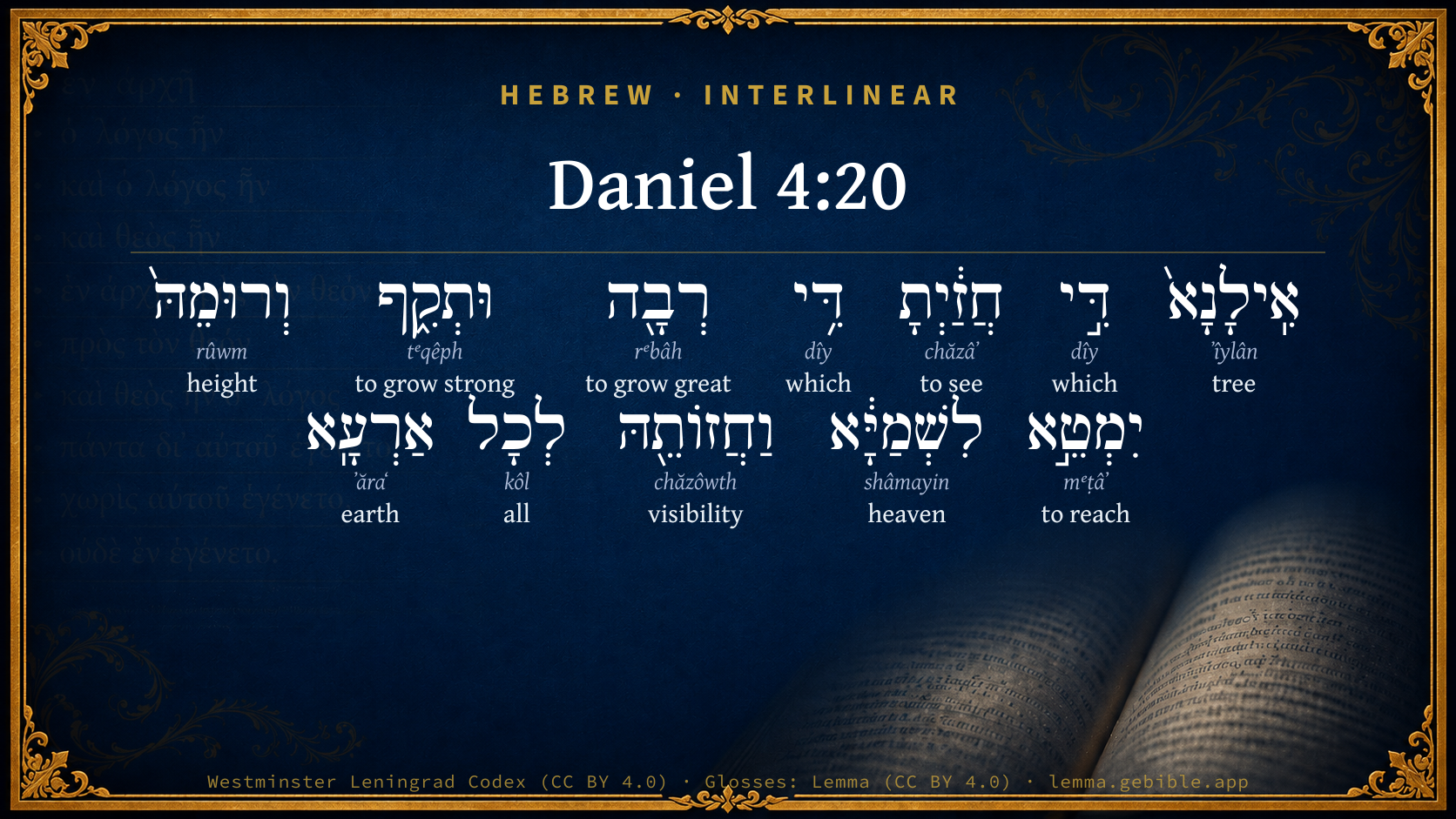
  1. אִֽילָנָא֙ ʼîylân H363 “tree · the” Adjective, N, Common + Particle, Definite Article
  2. דִּ֣י dîy H1768 “which” Adjective, T
  3. חֲזַ֔יְתָ chăzâʼ H2370 “to see” Adjective, V, Plural
  4. דִּ֥י dîy H1768 “which” Adjective, T
  5. רְבָ֖ה rᵉbâh H7236 “to grow great” Adjective, V, Plural
  6. וּתְקִ֑ף tᵉqêph H8631 “and · to grow strong” Adjective, C + Verb, Qal, Perfect, 3rd Person, Masculine, Singular
  7. וְרוּמֵהּ֙ rûwm H7314 “and · height · his” Adjective, C + Noun, Common, Masculine, Singular, Construct + Suffix, Personal, 3rd Person, Masculine, Singular
  8. יִמְטֵ֣א mᵉṭâʼ H4291 “to reach” Adjective, V
  9. לִשְׁמַיָּ֔א shâmayin H8065 “to/for · heaven(s) · the” Adjective, R + Noun, Common, Masculine, Plural, Determined + Particle, Definite Article
  10. לְכָל kôl H3606 “to/for · all of” Adjective, R + Noun, Common, Masculine, Singular, Construct
  11. אַרְעָֽא ʼăraʻ H772 “earth · the” Adjective, N, Common + Particle, Definite Article

About this verse

These counts appear in no published source. They are computed here, from the morphology-tagged text and Lemma’s own curated glosses. What Lemma adds →

12
words
11
distinct lemmas
Prophets
section

Notable vocabulary

The rarest word here is וַחֲזוֹתֵ֖הּ visibility H2379 — appearing just 2 times in the whole Hebrew Bible.

Shared distinctive vocabulary

וַחֲזוֹתֵ֖הּ visibility H2379 occurs in 2 verses of the Hebrew Bible. Also found in:

Grammatical profile

  • 1 verb
  • 3 nouns
  • 5 adjectives
  • 3 particles

Verb forms

  • וּתְקִ֑ף Qal · Perfect

Repetition

A word recurs within this verse — often emphatic in Hebrew:

  • דִּ֣י which H1768 ×2

Hebrew & Septuagint length

In English translation the verse runs 25 words from the Hebrew and 75 from the Septuagint (LXX English) — the Septuagint runs noticeably longer here. See the side-by-side →

A rough comparison of the two English renderings, which tokenize alike — not a word-level alignment.

Word counts can differ between the Hebrew and the Greek without any difference in meaning — e.g. the Hebrew direct-object marker אֵת has no separate Greek word, and Greek often adds the article ὁ.

Cross-references

3

Topical passages linked to Daniel 4:20 in the Treasury of Scripture Knowledge — connected by theme and wording, ordered by reader-vote popularity; previews shown in the World English Bible.

  • Ezekiel 31:3 Behold, the Assyrian was a cedar in Lebanon with beautiful branches, and with a forest-like shade, and of high stature; and its top was among the thick boughs.
  • Daniel 4:10–12 Thus were the visions of my head on my bed: I saw, and, behold, a tree in the midst of the earth; and the height of it was great.
  • Ezekiel 31:16 I made the nations to shake at the sound of his fall, when I cast him down to Sheol with those who descend into the pit; and all the trees of Eden, the choice and best of Lebanon, all that drink water, were comforted in the lower parts of the earth.

Cross-references courtesy of OpenBible.info (CC BY 4.0).

Hebrew and Greek witnesses Masoretic Hebrew ↔ Greek Septuagint

The same verse in the two great witnesses to the Old Testament, shown verse-for-verse.

Here the Septuagint runs noticeably longer than the Hebrew — LXX2012 (modern English Septuagint) 75 words vs World English Bible 25. A rough length comparison of the two English translations, not a word-level alignment — read both below.

These are two independent witnesses, not word-aligned to each other, and the Septuagint is shown in lemma (dictionary) form.

Hebrew Daniel 4:20 Masoretic · Westminster Leningrad Codex

אִֽילָנָא֙ דִּ֣י חֲזַ֔יְתָ דִּ֥י רְבָ֖ה וּתְקִ֑ף וְרוּמֵהּ֙ יִמְטֵ֣א לִשְׁמַיָּ֔א וַחֲזוֹתֵ֖הּ לְכָל אַרְעָֽא

The tree that you saw, which grew, and was strong, whose height reached to the sky, and the sight of it to all the earth;

World English Bible · Public Domain

Greek LXX Daniel 4:20 Septuagint · lemma form

κύριος ζάω ἐν οὐρανός καί ὁ ἐξουσία αὐτός ἐπί πᾶς ὁ γῆ αὐτός δέομαι περί ὁ ἁμαρτία σύ καί πᾶς ὁ ἀδικία σύ ἐν ἐλεημοσύνη λυτρόω ἵνα ἐπιείκεια δίδωμι σύ καί πολυήμερος γίγνομαι ἐπί ὁ θρόνος ὁ βασιλεία σύ καί μή καταφθείρω σύ οὗτος ὁ λόγος ἀγαπάω ἀκριβής γάρ ἐγώ ὁ λόγος καί πλήρης ὁ χρόνος σύ

And whereas the king saw a watcher and a holy one coming down from heaven, and he said, Strip the tree, and destroy it; only leave the stump of its roots in the ground, and bind it with a band of iron and brass; and it shall lie in the grass that is without, and in the dew of heaven, and its portion shall be with wild beasts, until seven times have passed over it;

LXX2012 (modern English Septuagint) · Public Domain

On this verse, The Pulpit Commentary discusses the Septuagint’s reading. Read the note in Commentary ↓

Hebrew: Westminster Leningrad Codex (CC BY 4.0). Greek: Septuagint (public domain); English from LXX2012 (modern English Septuagint) (Public Domain). How the Septuagint differs from the Hebrew →

Commentary

Notes on Daniel 4:20 from classic Christian and Jewish commentators (each source and its license shown beneath its notes). The classic Christian expositions comment on the surrounding passage and are grouped to its opening verse, so a note may address several verses; the Jewish commentaries on the Tanakh (Rashi and others) are per-verse, so they appear only where the commentator wrote on this verse.

Lemma curates 59 commentaries, every one of them public domain or Creative Commons licensed, each selected and text-cleaned for this edition rather than reprinted as found. About our sources →

Trapp's Complete Commentary

John Trapp

Dan 4:20 The tree that thou sawest, which grew, and was strong, whose height reached unto the heaven, and the sight thereof to all the earth;

Ver. 20. The tree that thou sawest.] See on Dan 4:11.

John Trapp, A Commentary or Exposition upon All the Books of the Old and New Testament (1647–1656) — public domain. Text from a community e-Sword module.

Joseph Benson's Commentary

Dan 4:20-22. The tree that thou sawest is thou, O king, that art grown and become strong — Princes and great men are frequently represented in Scripture by fair and flourishing trees. So the king of Assyria is described, Eze 31:3-8 : compare Isa 10:34; Zec 11:2. Thy greatness is grown and reacheth unto heaven — As near as human greatness can do. He shows the king his present prosperous state in the glass of his own dream: see Dan 4:11. And thy dominion to the end of the earth — To the Caspian sea, to the Euxine sea, and to the Atlantic ocean. — Grotius. See note on chap. Dan 2:38.

Joseph Benson's Commentary on the Old and New Testaments (1811–1818) — public domain. Text from a community e-Sword module.

Geneva Bible (1599)

Geneva Bible translators

Whereby he meaneth a long space, as seven years. Some interpret seven months, and others seven weeks, but it seemeth he means of years.

Geneva Bible (1599) marginal notes — public domain. Text via Bolls.life.

Jamieson, Fausset & Brown

Robert Jamieson, A. R. Fausset & David Brown

The tree is the king. The branches, the princes. The leaves, the soldiers. The fruits, the revenues. The shadow, the protection afforded to dependent states.

Jamieson, Fausset & Brown — Commentary Critical and Explanatory on the Whole Bible (1871) — public domain (CC PDM 1.0). Text via the HelloAO Bible API.

Adam Clarke's Commentary

Verse 20. The tree that thou sawest] The dream is so fully interpreted in the following verses that it needs no comment.

Adam Clarke's Commentary on the Bible (1810–1826) — public domain. Text from a community e-Sword/MySword module.

John Calvin's Commentaries

Here we see what I have touched upon, namely, how Daniel acted respectfully to the king, and thus was mindful of his prophetic duty, while he punctually discharged the commands of God. We must notice this distinction, for nothing is more difficult for ministers of the Word than to maintain this middle course. Some are always fulminating through a pretense of zeal, and forget themselves to be but men: they shew no sign of benevolence, but indulge in mere bitterness. Hence they have no authority, and all their admonitions are hateful. Next, they explain God’s Word with pride and boasting, when they frighten sinners without either humanity, or pain, or sympathy. Others, again, who are wicked and perfidious flatterers, gloss over the grossest iniquities; they object to both Prophets and Apostles, esteeming the fervor of their zeal to have driven away all human affections! Thus they delude miserable men, and destroy them by their flattery. But our Prophet, as all the rest, here shews how God’s servants ought to take a middle course. Thus Jeremiah, when prophesying adversity, feels sorrow and bitterness of spirit, and yet does not turn aside from unsparing reproof of the severest threats, as both sprang from God. (Jeremiah 9:1.) The rest of the prophets also act in the same manner. Here Daniel, on the one hand, pities the king, and on the other, through knowing himself to be the herald of God’s anger, he is not frightened by any danger while setting before the king the punishment which he had despised. Hence we gather why he was not astonished. He felt no fear of the tyrant, although many do not dare to discharge their duty when an odious message is entrusted to them, which stimulates the impious and the unbelievers to madness. Daniel, however, was not astonished with any fear of this kind; he only wished God to act mercifully towards his king. For he says here, Thou art king thyself. He does not speak with any doubt or hesitation, neither does he use obscurity nor a number of excuses, but plainly announces king Nebuchadnezzar to be intended by the tree which he saw. Hence the tree which thou sawest is large and strong, under the shade of which the beasts of the field were dwelling, and in the boughs of which the birds of the air were making their nests: thou, says he, art the king. Why so? Thou hast become great and strong; thy magnitude has extended to the heavens, and thy power to the ends of the earth Now, what follows?

John Calvin's Commentaries (1540-1563) — public domain. Text from the Calvin Translation Society English edition (1840s-50s) via the Christian Classics Ethereal Library (ccel.org). Calvin's coverage is partial (roughly two-thirds of the Bible); uncommented books and verses are honest gaps, never fabricated. The 19th-century editor's footnotes and remarks are omitted so the notes are faithfully Calvin's own voice.

Ellicott's Commentary for English Readers

(20) It should be noticed that both in this and in the following verse the description of the tree given in Dan_4:11-12 is curtailed. It was observed that, on the contrary, there was an expansion of details in the interpretation of the former dream. (See Note on Dan_4:23.)

A Bible Commentary for English Readers, edited by Charles John Ellicott (1878–1897) — public domain. Text from a community e-Sword module.

The Cambridge Bible for Schools and Colleges

gen. ed. J. J. S. Perowne

20–21. The description repeated from Dan_4:11-12.

The Cambridge Bible for Schools and Colleges (gen. ed. J. J. S. Perowne; Cambridge University Press, 1878–1918) — public domain. Text from a community e-Sword module.

John Gill's Exposition

The tree which thou sawest, In these two verses is related part of the dream, which respects the flourishing estate of Nebuchadnezzar and his kingdom; See Gill on Dan 4:10, Dan 4:11, Dan 4:12.

.

Daniel 4:22

dan 4:22

dan 4:22

dan 4:22It is thou, O king, that art grown, and become strong,.... Here begins the interpretation of the dream: the tree was an emblem of King Nebuchadnezzar, of his greatness, and growing power and strength:

for thy greatness is grown, and reacheth unto heaven; he overtopped all the kings of the earth, exceeding them in honour and power, and aspired to deity itself; See Gill on Dan 4:11.

and thy dominion to the end of the earth; as far as Hercules's pillars, as Strabo (q) says he came. Grotius interprets it, as far as the Caspian and Euxine sea, and the Atlantic ocean.

(q) Geograph. l. 15. p. 472.

John Gill's Exposition of the Whole Bible (1746–1763) — public domain (CC PDM 1.0). Text via the HelloAO Bible API.

Albert Barnes' Notes on the Bible

The tree that thou sawest ... - In these two verses Daniel refers to the leading circumstances respecting the tree as it appeared in the dream, without any allusion as yet to the order to cut it down. He probably designed to show that he had clearly understood what had been said, or that he had attended to the most minute circumstances as narrated. It was important to do this in order to show clearly that it referred to the king; a fact which probably Nebuchadnezzar himself apprehended, but still it was important that this should be so firmly fixed in his mind that he would not revolt from it when Daniel came to disclose the fearful import of the remainder of the dream.

Albert Barnes' Notes on the Bible (1834–1885) — public domain. Text from a community e-Sword/MySword module.

Whedon's Commentary on the Bible

Daniel D. Whedon

20-22. See Dan_4:10-12, and for the greatness of Nebuchadnezzar’s empire, Introduction, III, 3, 4. One ancient Greek version gives as a reason for Nebuchadnezzar’s fall, “because thou hast laid waste the house of the living God.” This seems like a stroke at Antiochus Epiphanes.

Daniel D. Whedon (gen. ed.), Commentary on the Old and New Testaments (1874–1909) — public domain. Text from a community e-Sword module.

The Pulpit Commentary

Vers. 20-22. The tree that thou sawest, which grew, and was strong, whose height reached unto the heaven, and the sight thereof to all the earth; whose leaves were fair, and the fruit thereof much, and in it was meat for all; under which the beasts of the field dwelt, and upon whose branches the fowls of the heaven had their habitation: it is thou, O king, that art grown and become strong: for thy greatness is grown, and reacheth unto heaven, and thy dominion to the end of the earth. The Septuagint Version here differs very considerably in wording from the above, but not in sense, "Thou, O king, art this tree planted in the earth, the appearance of which was great, and all the birds of the heaven made their nests in it: the strength of the earth and of the nations, and of all tongues to the ends of the earth, and all the provinces (cwrai) serve thee. And that tree was exalted and neared the heaven, and its breadth (kutov) touched the clouds. Thou, O king, wast exalted above all men that are upon the face of the whole earth, and thine heart has been literally, "was" lifted up with pride and strength over those things which pertain to the Holy One and his angels, and thy works are manifest, because thou hast laid waste the house of the living God on account of the sins of the consecrated people." The latter portion of this contains plain evidence of interpolation. Had there been anything of that sort in the original Daniel, it would not have disappeared from the Massoretic text. This addition reveals the mental attitude of the Jews of the Maccabean period to foreign oppressors. The fact that the whole atmosphere of the primitive Daniel differs so much from this is an indirect evidence of its genuineness. If one looks at the Septuagint rendering of these three verses, there seem evidences of an early origin. The first verse is clearly an instance in which the text behind the Septuagint is superior to that of the Massoretic; the latter is obviously filled out from ver. 11. The statement of Nebuchadnezzar"s greatness in ver. 22 (14 Septuagint, 18 Massoretic) may be somewhat the result of paraphrase. The fifteenth verse, according to the LXX, which is paralleled by Tischeudorf with ver. 19 of the Massoretic, is really another version of the preceding verses, probably slightly modified to give the resulting text the appearance of being continuous. Theodotion bears a very close resemblance to the Massoretic text, only he has kutov, "breadth," instead of orasiv. The Peshitta differs but little, though still a little, from the Massoretic text. Instead of rendering, "meat for all," it has, "for all flesh." According to both recensions of the text, Daniel repeats, either in substance or with verbal exactness, the description Nebuchadnezzar had himself given of the tree of his vision, but applies it to the monarch. To us the terms of the description of Nebuchadnezzar"s power are exaggerated; but we must bear in mind that the manners of an Oriental court are different from those of Western nations. It is not unlike the boastful language of Nebuchadnezzar in the Standard Inscription. The monarch"s dominion was vast, but it had been given him, and that he did not recognize, and hence the judgment that came upon him.

The Pulpit Commentary (1880–1919), ed. H.D.M. Spence-Jones & Joseph S. Exell — public domain. Text from a community e-Sword module.

unfoldingWord translationNotes

Door43 World Missions Community

General Information:

Verses 19-33 use the third person to describe the punishment of Nebuchadnezzar. (See: First, Second, or Third Person)

General Information:

Many terms in these verses are almost the same as Daniel 4:10-12. See how you translated those verses.

whose fruit was abundant

"which bore a great amount of fruit"

this tree is you, king

"this tree represents you, king"

Your greatness has grown ... your authority reaches

These two phrases mean similar things. (See: Parallelism)

Your greatness has grown

This phrase is using the word "grown" as a way of saying the king's greatness has increased. AT: "Your greatness has increased" (See: Personification)

to the heavens ... to the ends of the earth

These phrases are exaggerations to emphasize that everyone everywhere knew how great Nebuchadnezzar was. (See: Hyperbole and Generalization)

translationWords

heaven

earth

king

authority

unfoldingWord translationNotes — © Distant Shores Media and the Door43 World Missions Community, licensed CC BY-SA 4.0. Source: git.door43.org/Door43/en_tn.

Lesson kit

Teaching starters — assembled from the data on this page, not authored interpretation. Every prompt links to the verse data it draws on. Edit before teaching.

Daniel, in the Prophets, opens this verse with 12 words (11 distinct Hebrew lemmas). Its most distinctive word is chăzôwth (“visibility”). The Greek Septuagint runs longer here. A historical commentator’s framing appears above. Read the whole chapter for the surrounding context.

Discussion questions

  1. The word chăzôwth carries the sense “visibility.” How does it shape the verse?
  2. How does Daniel 4:11, which shares the word «visibility», read alongside this verse?
  3. What does the repetition of “which” (2× in this one verse) do in this verse?
  4. The Septuagint runs longer here than the Hebrew. What might account for the difference?
  5. These translations render this verse differently. What is at stake in choosing one wording over another?
  6. «וּתְקִ֑ף» is a Qal Perfect verb. How does that grammatical form shape the action described?
  7. Compare how Trapp's Complete Commentary and Joseph Benson's Commentary read this verse. Where do they agree or differ?

Things to notice

Reading settings

Reading text

Shown beneath each verse's original-language words.

Old Testament
Old Testament edition

Read the OT as the Masoretic Hebrew (MT) or the Greek Septuagint (LXX).

English shown for the Greek Septuagint (in the Hebrew ↔ Greek comparison).

Comparing translations? Open the Compare panel on any verse page to stack up to four side by side.