
Daniel 2:30

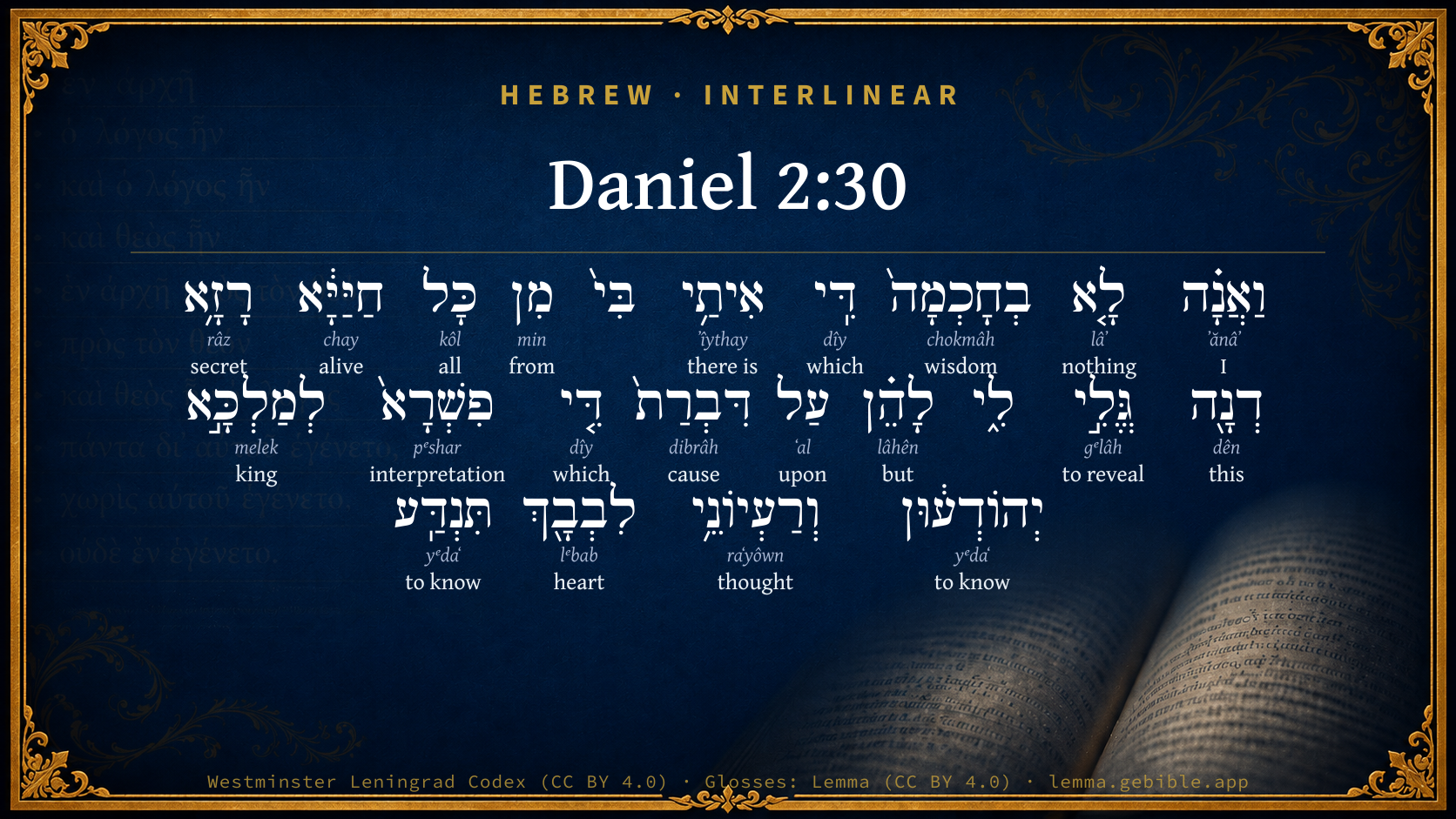
Hebrew (Westminster Leningrad Codex) Daniel 2:30 appears in the Hebrew Old Testament. The text above is from the Westminster Leningrad Codex. Each word links to its Strong’s number, a concise gloss, and parsing drawn from the Open Scriptures Hebrew Bible morphology. Click any word for its full Brown-Driver-Briggs (BDB) entry.
Download image
Cite this verse

Daniel 2:30 (World English Bible). Public Domain. Lemma interlinear Bible study tool, https://lemma.gebible.app/v/daniel/2/30.

Show BibTeX & RIS
BibTeX
RIS
English Translation
But as for me, this secret is not revealed to me for any wisdom that I have more than any living, but to the intent that the interpretation may be made known to the king, and that you may know the thoughts of your heart.
World English Bible · Public Domain
Highlights
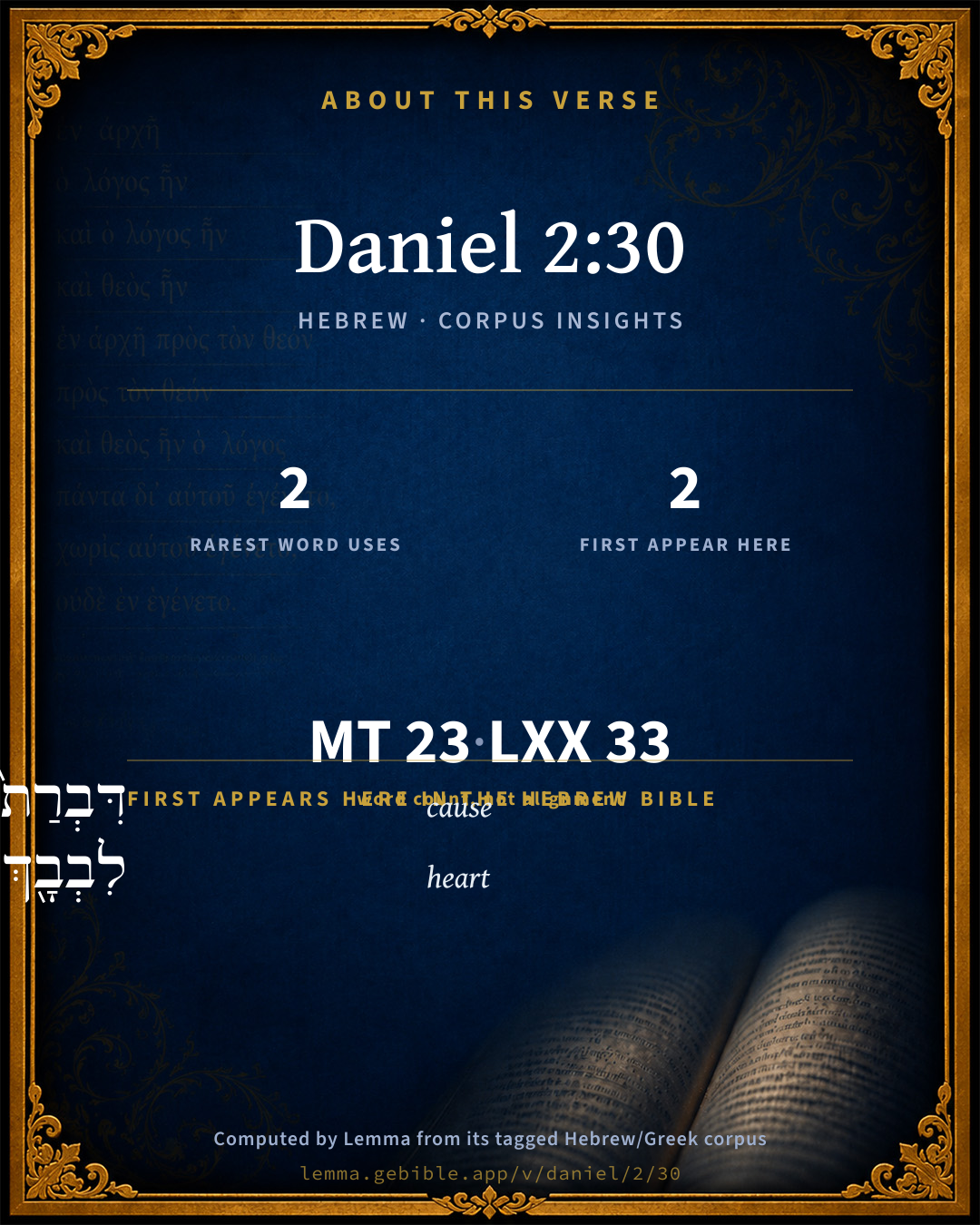
  • 2 first appearances in the Hebrew Bible
Full analysis ↓
Download a study sheet

One document with this verse’s original text, its word-by-word gloss line, the meaning frame, cross-references with their text, attributed commentary, and full source and license credits — printable, and it pastes into notes with its structure intact.

This verse Autodidact and up

Study sheet (.html) Plain text (.txt)

A passage Seminary Student

Up to 50 verses in one chapter. A passage sheet keeps up to 6 commentary sources and 12 cross-references per verse, in the order this page ranks them, and says so on the sheet whenever that leaves anything out. Ask for a single verse and you get the Autodidact verse sheet above.

Everything on this page stays free to read, with no account — the sheet is a download of what is already on screen, not access to it.

Want to remove ads? Support Godless Engineer
Compare translations 3

The same verse in 3 English versions, stacked beneath the original-language interlinear above. Click any original word for its lexicon entry.

Each is an independent rendering of the whole verse — the interlinear is not word-aligned to these translations.

Highlighted words mark where these versions differ — a whole-verse word diff, not a word-by-word alignment.

  • World English Bible Public Domain
    But as for me, this secret is not revealed to me for any wisdom that I have more than any living, but to the intent that the interpretation may be made known to the king, and that you may know the thoughts of your heart.
  • King James Version Public Domain
    But as for me, this secret is not revealed to me for any wisdom that I have more than any living, but for their sakes that shall make known the interpretation to the king, and that thou mightest know the thoughts of thy heart.
  • unfoldingWord Literal Text CC BY-SA 4.0
    As for me, this mystery was revealed to me, not because of any wisdom that I have more than all the living, but in order that the interpretation may be made known to the king, and so that you may know the thoughts of your mind.

unfoldingWord Literal Text — © unfoldingWord, licensed CC BY-SA 4.0. Word-aligned USFM3 via Door43 (git.door43.org/unfoldingWord/en_ult).

Versions to compare (up to 4)

3 of 4 selected

Show all 18 translations

Every available English version of this verse, each an independent rendering of the whole verse.

  • World English Bible Public Domain
    But as for me, this secret is not revealed to me for any wisdom that I have more than any living, but to the intent that the interpretation may be made known to the king, and that you may know the thoughts of your heart.
  • Berean Standard Bible Public Domain
    And to me this mystery has been revealed, not because I have more wisdom than any man alive, but in order that the interpretation might be made known to the king, and that you may understand the thoughts of your mind.
  • Majority Standard Bible Public Domain
    And to me this mystery has been revealed, not because I have more wisdom than any man alive, but in order that the interpretation might be made known to the king, and that you may understand the thoughts of your mind.
  • King James Version Public Domain
    But as for me, this secret is not revealed to me for any wisdom that I have more than any living, but for their sakes that shall make known the interpretation to the king, and that thou mightest know the thoughts of thy heart.
  • American Standard Version (1901) Public Domain
    But as for me, this secret is not revealed to me for any wisdom that I have more than any living, but to the intent that the interpretation may be made known to the king, and that thou mayest know the thoughts of thy heart.
  • Revised Version (1885) Public Domain
    But as for me, this secret is not revealed to me for any wisdom that I have more than any living, but to the intent that the interpretation may be made known to the king, and that thou mayest know the thoughts of thy heart.
  • Geneva Bible (1599) Public Domain
    As for me, this secret is not shewed mee for any wisedome that I haue, more then any other liuing, but onely to shewe the King the interpretation, and that thou mightest knowe the thoughts of thine heart.
  • Douay-Rheims (1899) Public Domain
    To me also this secret is revealed, not by any wisdom that I have more than all men alive: but that the interpretation might be made manifest to the king, and thou mightest know the thoughts of thy mind.
  • Young's Literal Translation Public Domain
    As to me -- not for `any' wisdom that is in me above any living hath this secret been revealed to me; but for the intent that the interpretation to the king they make known, and the thoughts of thy heart thou dost know.
  • Literal Standard Version CC BY-SA 4.0
    As for me—not for [any] wisdom that is in me above any living has this secret been revealed to me; but for the intent that the interpretation to the king they make known, and the thoughts of your heart you know.
  • Unlocked Literal Bible CC BY-SA 4.0
    As for me, this mystery was not revealed to me because of any wisdom that I have more than any other living person. This mystery was revealed to me so that you, king, may understand the meaning, and so that you may know the thoughts deep within you.
  • unfoldingWord Literal Text CC BY-SA 4.0
    As for me, this mystery was revealed to me, not because of any wisdom that I have more than all the living, but in order that the interpretation may be made known to the king, and so that you may know the thoughts of your mind.
  • Darby Bible Public Domain
    And as for me, this secret is revealed to me, not by [any] wisdom that I have more than any living, but to the intent that the interpretation should be made known to the king, and that thou mightest know the thoughts of thy heart.
  • World Messianic Bible Public Domain
    But as for me, this secret is not revealed to me for any wisdom that I have more than any living, but to the intent that the interpretation may be made known to the king, and that you may know the thoughts of your heart.
  • Webster's Bible Public Domain
    But as for me, this secret is not revealed to me for any wisdom that I have more than any living, but for their sakes that shall make known the interpretation to the king, and that thou mayest know the thoughts of thy heart.
  • Free Bible Version CC BY-SA 4.0
    It's not because I have any more wisdom than anyone else that this mystery has been revealed to me, but to explain to Your Majesty what you were thinking about so you could understand.
  • Bible in Basic English Public Domain
    As for me, this secret is not made clear to me because of any wisdom which I have more than any living man, but in order that the sense of the dream may be made clear to the king, and that you may have knowledge of the thoughts of your heart.
  • JPS Tanakh (1917) Public Domain
    But as for me, this secret is not revealed to me for any wisdom that I have more than any living, but to the intent that the interpretation may be made known to the king, and that thou mayest know the thoughts of thy heart.

Literal Standard Version (2020), Covenant Press — licensed CC BY-SA 4.0. Text via the HelloAO Bible API (eBible.org). Unlocked Literal Bible (unfoldingWord) — licensed CC BY-SA 4.0. Text via the HelloAO Bible API (eBible.org). unfoldingWord Literal Text — © unfoldingWord, licensed CC BY-SA 4.0. Word-aligned USFM3 via Door43 (git.door43.org/unfoldingWord/en_ult). Free Bible Version, Dr. Jonathan Gallagher — licensed CC BY-SA 4.0. Text via the HelloAO Bible API (eBible.org).

Word by word

More ways to search: Search by grammar → Find every occurrence → Compare this word →

Practice this passage: Drill this verse → Learn its vocabulary →

דִּבְרַת֙
dibrâh
H1701
“cause of”
Adjective, N, Common
Part of Speech
Adjective
Gender
Common
Full BDB Definition

Origin: corresponding to H1700

TWOT: 2667

cause, reason
  1. וַאֲנָ֗ה ʼănâʼ H576 “and · I” Adjective, C + Pronoun, Personal, 1st Person, Common, Singular
  2. לָ֤א lâʼ H3809 “nothing” Adjective, T
  3. בְחָכְמָה֙ chokmâh H2452 “in/at · wisdom” Adjective, R + Noun, Common, Feminine, Singular, Absolute
  4. דִּֽי dîy H1768 “which” Adjective, T
  5. אִיתַ֥י ʼîythay H383 “there is” Adjective, T
  6. מִן min H4481 “from” Adjective, R
  7. כָּל kôl H3606 “all of” Adjective, N, Common
  8. חַיַּיָּ֔א chay H2417 “alive · the” Adjective, A + Particle, Definite Article
  9. רָזָ֥א râz H7328 “secret · the” Adjective, N, Common + Particle, Definite Article
  10. דְנָ֖ה dên H1836 “this” Adjective, P
  11. גֱּלִ֣י gᵉlâh H1541 “to reveal” Adjective, V, Plural
  12. לָהֵ֗ן lâhên H3861 “but” Adjective, C
  13. עַל ʻal H5922 “upon” Adjective, R
  14. דִּ֤י dîy H1768 “which” Adjective, T
  15. פִשְׁרָא֙ pᵉshar H6591 “interpretation · the” Adjective, N, Common + Particle, Definite Article
  16. לְמַלְכָּ֣א melek H4430 “to/for · king · the” Adjective, R + Noun, Common, Masculine, Singular, Determined + Particle, Definite Article
  17. יְהוֹדְע֔וּן yᵉdaʻ H3046 “to know” Adjective, V
  18. וְרַעְיוֹנֵ֥י raʻyôwn H7476 “and · thoughts of” Adjective, C + Noun, Common, Masculine, Plural, Construct
  19. לִבְבָ֖ךְ lᵉbab H3825 “heart · your” Adjective, N, Common + Suffix, Personal, 2nd Person, Masculine, Singular
  20. תִּנְדַּֽע yᵉdaʻ H3046 “to know” Adjective, V

About this verse

These counts appear in no published source. They are computed here, from the morphology-tagged text and Lemma’s own curated glosses. What Lemma adds →

23
words
19
distinct lemmas
Prophets
section

Notable vocabulary

The rarest word here is דִּבְרַת֙ cause H1701 — appearing just 2 times in the whole Hebrew Bible.

First appearance in Scripture

These words make their first canonical appearance in the Hebrew Bible here:

  • דִּבְרַת֙ cause H1701
  • לִבְבָ֖ךְ heart H3825

Shared distinctive vocabulary

דִּבְרַת֙ cause H1701 occurs in 2 verses of the Hebrew Bible. Also found in:

Grammatical profile

  • 2 nouns
  • 16 adjectives
  • 1 pronoun
  • 4 particles

Repetition

Words recur within this verse — often emphatic in Hebrew:

  • יְהוֹדְע֔וּן to know H3046 ×2
  • דִּֽי which H1768 ×2

Hebrew & Septuagint length

In English translation the verse runs 45 words from the Hebrew and 42 from the Septuagint (LXX English) — closely comparable.

A rough comparison of the two English renderings, which tokenize alike — not a word-level alignment.

Word counts can differ between the Hebrew and the Greek without any difference in meaning — e.g. the Hebrew direct-object marker אֵת has no separate Greek word, and Greek often adds the article ὁ.

In the original languages it is 23 Hebrew tokens and 33 Greek tokens — but the two are counted differently (Hebrew bundles its prefixes and suffixes into one token; the Greek is in lemma form), so that isn’t a like-for-like length.

Cross-references

14

Topical passages linked to Daniel 2:30 in the Treasury of Scripture Knowledge — connected by theme and wording, ordered by reader-vote popularity; previews shown in the World English Bible.

  • Genesis 41:16 Joseph answered Pharaoh, saying, "It isn't in me. God will give Pharaoh an answer of peace."
  • Acts 3:12 When Peter saw it, he responded to the people, "You men of Israel, why do you marvel at this man? Why do you fasten your eyes on us, as though by our own power or godliness we had made him walk?
  • Daniel 2:17–18 Then Daniel went to his house, and made the thing known to Hananiah, Mishael, and Azariah, his companions:
  • 2 Corinthians 4:15 For all things are for your sakes, that the grace, being multiplied through the many, may cause the thanksgiving to abound to the glory of God.
  • Isaiah 43:3–4 For I am Yahweh your God, the Holy One of Israel, your Savior; I have given Egypt as your ransom, Ethiopia and Seba in your place.
  • Isaiah 45:4 For Jacob my servant's sake, and Israel my chosen, I have called you by your name: I have surnamed you, though you have not known me.
  • Daniel 1:17 Now as for these four youths, God gave them knowledge and skill in all learning and wisdom: and Daniel had understanding in all visions and dreams.
  • Daniel 2:49 Daniel requested of the king, and he appointed Shadrach, Meshach, and Abednego, over the affairs of the province of Babylon: but Daniel was in the gate of the king.
  • Amos 4:13 For, behold, he who forms the mountains, And creates the wind, And declares to man what is his thought; Who makes the morning darkness, And treads on the high places of the Earth: Yahweh, the God of hosts, is his name."
  • Matthew 24:22 Unless those days had been shortened, no flesh would have been saved. But for the sake of the chosen ones, those days will be shortened.
  • Mark 13:20 Unless the Lord had shortened the days, no flesh would have been saved; but for the sake of the chosen ones, whom he picked out, he shortened the days.
  • Romans 8:28 We know that all things work together for good for those who love God, to those who are called according to his purpose.
  • 1 Corinthians 3:21–23 Therefore let no one boast in men. For all things are yours,
  • 1 Corinthians 15:8–12 and last of all, as to the child born at the wrong time, he appeared to me also.

Cross-references courtesy of OpenBible.info (CC BY 4.0).

Hebrew and Greek witnesses Masoretic Hebrew ↔ Greek Septuagint

The same verse in the two great witnesses to the Old Testament, shown verse-for-verse.

These are two independent witnesses, not word-aligned to each other, and the Septuagint is shown in lemma (dictionary) form.

Hebrew Daniel 2:30 Masoretic · Westminster Leningrad Codex

וַאֲנָ֗ה לָ֤א בְחָכְמָה֙ דִּֽי אִיתַ֥י בִּי֙ מִן כָּל חַיַּיָּ֔א רָזָ֥א דְנָ֖ה גֱּלִ֣י לִ֑י לָהֵ֗ן עַל דִּבְרַת֙ דִּ֤י פִשְׁרָא֙ לְמַלְכָּ֣א יְהוֹדְע֔וּן וְרַעְיוֹנֵ֥י לִבְבָ֖ךְ תִּנְדַּֽע

But as for me, this secret is not revealed to me for any wisdom that I have more than any living, but to the intent that the interpretation may be made known to the king, and that you may know the thoughts of your heart.

World English Bible · Public Domain

Greek LXX Daniel 2:30 Septuagint · lemma form

καΐἐμός δέ οὐ παρά ὁ σοφία ὁ εἰμί ἐν ἐγώ ὑπέρ πᾶς ὁ ἄνθρωπος ὁ μυστήριον οὗτος ἐκφαίνω ἀλλά ἕνεκεν ὁ δηλόω ὁ βασιλεύς σημαίνω ἐγώ ὅς ὑπολαμβάνω ὁ καρδία σύ ἐν γνῶσις

Moreover, this mystery has not been revealed to me by reason of wisdom which is in me beyond all others living, but for the sake of making known the interpretation to the king, that you might know the thoughts of your heart.

LXX2012 (modern English Septuagint) · Public Domain

On this verse, The Pulpit Commentary discusses the Septuagint’s reading. Read the note in Commentary ↓

Hebrew: Westminster Leningrad Codex (CC BY 4.0). Greek: Septuagint (public domain); English from LXX2012 (modern English Septuagint) (Public Domain). How the Septuagint differs from the Hebrew →

Commentary

Notes on Daniel 2:30 from classic Christian and Jewish commentators (each source and its license shown beneath its notes). The classic Christian expositions comment on the surrounding passage and are grouped to its opening verse, so a note may address several verses; the Jewish commentaries on the Tanakh (Rashi and others) are per-verse, so they appear only where the commentator wrote on this verse.

Lemma curates 59 commentaries, every one of them public domain or Creative Commons licensed, each selected and text-cleaned for this edition rather than reprinted as found. About our sources →

Trapp's Complete Commentary

John Trapp

Dan 2:30 But as for me, this secret is not revealed to me for [any] wisdom that I have more than any living, but for [their] sakes that shall make known the interpretation to the king, and that thou mightest know the thoughts of thy heart.

Ver. 30. But as for me, this secret is not revealed to me, &c.] So careful are God’s best saints to give unto him all the glory, which they look upon as God’s wife, in the enjoying whereof he is a "jealous God," admitting no co-rival in heaven or earth. "Thy talent hath gained ten talents," saith he in the Gospel; I have not done it. And, "Not I, but the grace of God that is in me," saith Paul. The glory of God and the good of his Church is the chief thing that saints aim at.

But for their sakes,] i.e., For the poor Jews’ sake, to whose prayer thou owest this revelation; toward whom, therefore, thou shouldst exercise more clemency, and alleviate their misery.

John Trapp, A Commentary or Exposition upon All the Books of the Old and New Testament (1647–1656) — public domain. Text from a community e-Sword module.

Joseph Benson's Commentary

Dan 2:30. This secret is not revealed to me for any wisdom that I have more than any living — Namely, to merit such a discovery, or qualify me for receiving it. No praise is due to me on this occasion. Observe, reader, it well becomes those whom God has highly favoured and honoured, to be humble and low in their own eyes; and to lay aside all opinion of their own wisdom and worthiness, that God alone may have all the praise of what they are, and have, and do. But for their sakes that shall make known the interpretation to the king — For the sake of Daniel’s brethren and companions in tribulation, who had by their prayers helped him to obtain this discovery, and so might be said to make known the interpretation; that their lives might be spared, that they might come into favour and be preferred, and that all the people of the Jews might fare the better in their captivity for their sakes. This is the sense of the words, according to the common translation; but the marginal reading is thought by many to be more agreeable to the context, which if we follow, the meaning of the clause is, “Not for any wisdom of mine, but that the king may know the interpretation,” &c. “The impious king,” says Jerome, “had a prophetic dream, that, the saint interpreting it, God might be glorified, and the captives, and those who served God in captivity, might receive great consolation. We read the same thing of Pharaoh; not that Pharaoh and Nebuchadnezzar deserved to see such things, but that Joseph and Daniel, interpreting them, might be preferred to all others.” And, as Jerome observes afterward, “That Nebuchadnezzar might admire the grace of divine inspiration, he (Daniel) not only told him the dream which he was favoured with, but even the secret thoughts of his heart previous to the dream.”

Joseph Benson's Commentary on the Old and New Testaments (1811–1818) — public domain. Text from a community e-Sword module.

Ibn Ezra

Rabbi Abraham ibn Ezra

[Daniel 2:30] Va'anah (וַאֲנָה - And I): [Daniel speaks] in the way of humility (derekh ʿanavah - דֶּרֶךְ עֲנָוָה). [Saying effectively:] For there is no wisdom in me that I should be able to know this secret [through my own abilities]. Rather, the secret was revealed to me for the sake of your [the king's] honor (baʿavur k'vodkha - בַּעֲבוּר כְּבוֹדְךָ), [so] that you should know the interpretation (pitron - פִּתְרוֹן) of your dream, and that you should know the thoughts of your heart (raʿyonei levavkha - רַעְיוֹנֵי לְבָבָךְ)—which you thought at the beginning of the night.

And the word “they should make known” (yehodoʿun - יְהוֹדְעוּן): [This plural verb] refers back to the servants of the Glorious Name (meshartei ha-Shem ha-nikhbad - מְשָׁרְתֵי הַשֵּׁם הַנִּכְבָּד) [i.e., the angels or heavenly agents, indicating the interpretation comes through divine means, not from Daniel alone].

Ibn Ezra on the Tanakh — English translations: “Sefaria Community Translation” (CC0 1.0 (public-domain dedication)); “Yalkut, Sifsei Chachomim Chumash, Metsudah Publications, 2009” (CC BY 4.0); and “Commentary of Ibn Ezra on Isaiah - trans. by M. Friedlander, 1873” (public domain). Text via Sefaria.

Geneva Bible (1599)

Geneva Bible translators

Because he had said that God only must reveal the signification of this dream, the King might have asked, why Daniel did enterprise to interpret it, and therefore he showeth that he was but God’s minister and had no gifts, but such as God had given him to set forth his glory.

Geneva Bible (1599) marginal notes — public domain. Text via Bolls.life.

Jamieson, Fausset & Brown

Robert Jamieson, A. R. Fausset & David Brown

not . . . for any wisdom that I have--not on account of any previous wisdom which I may have manifested (Dan 1:17, Dan 1:20). The specially-favored servants of God in all ages disclaim merit in themselves and ascribe all to the grace and power of God (Gen 41:16; Act 3:12). The "as for me," disclaiming extraordinary merit, contrasts elegantly with "as for thee," whereby Daniel courteously, but without flattery, implies, that God honored Nebuchadnezzar, as His vicegerent over the world kingdoms, with a revelation on the subject uppermost in his thoughts, the ultimate destinies of those kingdoms.

for their sakes that shall make known, &c.--a Chaldee idiom for, "to the intent that the interpretation may be made known to the king."

the thoughts of thy heart--thy subject of thought before falling asleep. Or, perhaps the probation of Nebuchadnezzar's character through this revelation may be the meaning intended (compare Ch2 32:31; Luk 2:35).

Jamieson, Fausset & Brown — Commentary Critical and Explanatory on the Whole Bible (1871) — public domain (CC PDM 1.0). Text via the HelloAO Bible API.

John Calvin's Commentaries

Here Daniel meets an objection which Nebuchadnezzar might make, — If God alone can reveal secrets, how, I pray thee, canst thou, a mere mortal, do it? Daniel anticipates this, and transfers the whole glory to God, and ingenuously confesses that he has no interpretation of his own to offer, but represents himself as led forward by God’s hand to be its interpreter; and as having nothing by his own natural talents, but acting as God pleased to appoint him his servant for this office, and-as using his assistance. This secret, then, says he, has been made known to me By these words he sufficiently declares, how his undertaking to interpret the dream was God’s peculiar gift. But he more clearly expresses this gift to be supernatural, as it is called, by saying, not in the wisdom which belongs to me For if Daniel had surpassed the whole world in intelligence, yet he could never divine what; the king of Babylon had dreamt! He excelled, indeed, in superior abilities and learning, and was endowed, as we have said, with remarkable gifts; yet; he could never have obtained this power which he acquired from God through prayer, (I repeat it; again,) through his own study or industry, or any human exertions.

We observe how Daniel here carefully excludes, not only what men foolishly claim as their own, but; also what God naturally confers; since we know the profane to be endowed with singular talents, and other eminent faculties; and these are called natural, since God desires his gracious gifts to shine forth in the human race by such examples as these. But while Daniel acknowledges himself endowed with no common powers, through the good pleasure and discipline of God, though he confesses this, I say, yet he places this revelation on a higher footing. We observe also how the gifts of the Spirit mutually differ, because Daniel acted in a kind of twofold capacity with regard to the endowments with which it pleased God to adorn him. First of all, he made rapid progress in all sciences, and flourished much in intellectual quickness, and we have already clearly shewn this to be, owing to the mere liberality of God. This liberality puts all things in their proper order, while it shews God’s singular favor in the explanation of the dream.

This secret, then, was not made known to me on account of any wisdom in me beyond the rest of mankind Daniel does not affirm himself to be superior to all men in wisdom, as some falsely twist these words, but he leaves this in doubt by saying, This ought not to be ascribed to wisdom, for if I were the acutest of all men, all my shrewdness would avail me nothing and, again, if I were the rudest idiot, still it is God who uses me as his servant, in interpreting the dream to you. You must not, therefore, expect anything human from me, but you must receive what I say to you, because I am the instrument of God’s Spirit, just as if I had come down from heaven. This is the simple sense of the words. Hence we may learn to ascribe the praise to God alone, to whom it is due; for it is his peculiar office to illuminate our minds, so that we may comprehend heavenly mysteries. For although we are naturally endued with the greatest acuteness, which is also his gift, yet we may call it a limited endowment, as it does not reach to the heavens. Let us learn, then, to leave his own to God, as we are admonished by this expression of Daniel.

He afterwards adds, But that I may make known to the king the interpretation, and thou mayest know the thoughts of thy heart Daniel uses the plural number, but indefinitely; as if he had said, God has left thee indeed hitherto in suspense; but yet he did not inspire thee with this dream in vain. These flyings, therefore, are mutually united, namely, — God has revealed to thee this secret, and has appointed me his interpreter. Thus we perceive Daniel’s meaning. For Nebuchadnezzar might object, Why does God torment me thus? What is the meaning of my perplexity; — first I dream, and then my dream escapes me, and its interpretation is unknown to me? Lest, therefore, Nebuchadnezzar should thus argue with God, Daniel here anticipates him, and shows how neither the dream nor the vision occurred in vain; but God now grants what was there wanting, namely, the return of the dream to Nebuchadnezzar’s memory, and at the same time his acknowledgment of its purport, and the reason of its being sent to him.

John Calvin's Commentaries (1540-1563) — public domain. Text from the Calvin Translation Society English edition (1840s-50s) via the Christian Classics Ethereal Library (ccel.org). Calvin's coverage is partial (roughly two-thirds of the Bible); uncommented books and verses are honest gaps, never fabricated. The 19th-century editor's footnotes and remarks are omitted so the notes are faithfully Calvin's own voice.

Ellicott's Commentary for English Readers

(30) For any wisdom—i.e., by reason of any wisdom of his own, but “for the sake of the king.”

A Bible Commentary for English Readers, edited by Charles John Ellicott (1878–1897) — public domain. Text from a community e-Sword module.

The Cambridge Bible for Schools and Colleges

gen. ed. J. J. S. Perowne

30. Like Joseph (Gen_40:8; Gen_41:16), Daniel disclaims the power of interpreting dreams by his own wisdom.

but for their sakes that shall make known, &c.] but to the intent that the interpretation may be made known to the king, and that thou mayest know, &c. (R.V.).

The Cambridge Bible for Schools and Colleges (gen. ed. J. J. S. Perowne; Cambridge University Press, 1878–1918) — public domain. Text from a community e-Sword module.

John Gill's Exposition

But as for me,.... As to the part I have in this affair, I can ascribe nothing to myself; it is all owing to the God of heaven, the recovery of the dream, and its interpretation:

this secret is not revealed to me for any wisdom that I have more than any living: not that he thought or affirmed that he had more wisdom than any man living, as the Vulgate Latin version and others suggest; but as the king might think he had, by revealing this secret to him, and that it was owing to that; but that he had not such wisdom, and, whatever he had, which was the gift of God, it was not through that, or any sagacity and penetration into things he was master of, superior to others, that it was revealed to him; and therefore would not have it placed to any such account; this he said in great modesty, and in order to set the king right, and that God might have all the glory:

but for their sakes that shall make known the interpretation to the king; meaning not only himself, and his companions concerned with him, that they might be promoted to honour and dignity, but the whole body of the Jews in captivity, with which they were in connection; that they might meet with more civil and kind treatment, for the sake of the God they worshipped, who revealed this secret to the king: or, "but that they might make known", &c. (x); the three Persons in the Godhead, as some; the angels, as others; the ministers of God, as Aben Ezra: or rather it may be rendered impersonally,

but that the interpretation might be made known to the king (y) as by the Vulgate Latin, as it follows:

and that thou mightest know the thoughts of thy heart; both what they were, which were forgotten, and the meaning of them.

(x) "sed ut notificarent", Pagninus, Montanus; "indicent", Vatablus. (y) "Sed ut interpretatio regi manifesta fieret", V. L. "eo fine ut indicetur", De Dieu.

John Gill's Exposition of the Whole Bible (1746–1763) — public domain (CC PDM 1.0). Text via the HelloAO Bible API.

Albert Barnes' Notes on the Bible

But as for me - So far as I am concerned in this matter, or whatever skill or wisdom I may evince in the interpretation, it is not to be traced to myself. The previous verse commences with the expression “as for thee;” and in this verse, by the phrase “as for me,” Daniel puts himself in strong contrast with the king. The way in which this was done was not such as to flatter the vanity of the king, and cannot be regarded as the art of the courtier, and yet it was such as would be universally adopted to conciliate his favor, and to give him an elevated idea of the modesty and piety of the youthful Daniel. In the previous verse he says, that, as to what pertained to the king, God had greatly honored him by giving him important intimations of what was yet to occur. Occupying the position which he did, it might be supposed that it would not be wholly unnatural that he should be thus favored, and Daniel does not say, as in his own case, that it was not on account of anything in the character and rank of the king that this had been communicated to him. But when he comes to speak of himself - a youth; a captive; a stranger in Babylon; a native of another land - nothing was more natural or proper than that he should state distinctly that it was not on account of anything in him that this was done.

This secret is not revealed to me for any wisdom that I have more than any living - That is, “it is not “by” any wisdom which I have above others, nor is it “on account of” any previous wisdom which I have possessed or manifested.” There is an absolute and total disclaimer of the idea that it was in any sense, or in any way, on account of his own superiority in wisdom. All the knowledge which he had in the case was to be traced entirely to God.

But for their sakes that shall make known the interpretation to the king - Margin, “or, the intent that the interpretation may be made known.” The margin is the more correct rendering, and should have been admitted into the text. The literal translation is, “but (להן lâhēn) on account of the thing that they might make known the interpretation to the king.” The word rendered “make known” is indeed in the plural, but it is evidently used in an impersonal sense, meaning that the interpretation would be made known. “It was to the intent that they might make it known;” that is, that somebody might do it, or that it might be done. Would not modesty and delicacy lead to the choice of such an expression here, inclining Daniel to avoid, as far as possible, all mention of himself? The main thought is, that the grand object to be secured was not to glorify Daniel, or any other human being, but to communicate to this pagan monarch important truths respecting coming events, and through him to the world.

And that thou mightest know the thoughts of thy heart - In reference to this matter; that is, that he might be able to recal the thoughts which passed through his mind in the dream. This Dan 2:27-30 is the introduction to the important disclosure which Daniel was about to make to the king. This entire disclaimer of the honor of having originated the interpretation by his own wisdom, and the ascribing of it to God, are worthy here of special attention. It is probable that the magicians were accustomed to ascribe to their own skill and sagacity the ability to interpret dreams and the other prognostics of the future, and to claim special honor on that account. In opposition to this, Daniel utterly disclaims any such wisdom himself, and attributes the skill which he has entirely to God. This is a beautiful illustration of the nature of modesty and piety. It places before us a young man, having now the prospect of being elevated to great honors; under every temptation to arrogate the possession of extraordinary wisdom to himself; suddenly exalted above all the sages of the most splendid court on earth, disclaiming all merit, and declaring in the most solemn manner that whatever profound wisdom there might be in the communication which he was about to make, it was not in the slightest degree to be traced to himself. See the remarks at the end of the chapter, (6.)

Albert Barnes' Notes on the Bible (1834–1885) — public domain. Text from a community e-Sword/MySword module.

Matthew Poole's English Annotations

For their sakes that shall make known the interpretation to the king: some will have this relate to the Jews and the church of God, by whose prayers this was obtained; but the more plain sense is this, But that the interpretation may be manifest to the king, and that thou mayst know the thoughts of thy heart, that thou mayst be better instructed and satisfied in thy mind in this great secret, when thou seest the mind of God in it, and what it points at, and what thy duty is, and how to steer thy counsel and actions in this vast monarchy, and towards the afflicted church of God in it.

Matthew Poole's English Annotations on the Holy Bible (1683–1685) — public domain. Text from a community e-Sword/MySword module.

The Pulpit Commentary

But as for me, this secret was not revealed to me for any wisdom that I have more than any living, but for their sakes that shall make known the interpretation to the king, and that thou mightest know the thoughts of thy heart. The Septuagint Version is simpler, "But as for me, not on account of any wisdom in me above all men is this mystery revealed, but in order that it should be shown to the king it is revealed to me what thou thoughtest in thy heart in knowledge." The translator has read the preformative t into b. There is no reference to "those who shall show the interpretation." The text before him may have omitted the plural termination; consequently, the huphal was supplied. Theodotion, the Peshitta, and Jerome all agree pretty closely with the Massoretic text, but all make the verb translated shows" singular, not plural, as does the Massoretic. Of course, it may be that this was due to rendering the sense, not the words, of the original; but Theodotion especially is more prone in any difficulty to slavish adherence to his original. His rendering is, "But as for me, not for wisdom which is in me beyond all living is the mystery revealed, but that the interpretation be made known to the king in order that thou mightest know the thoughts of thy heart." The Pe-shitta renders the latter clauses thus: "But that the interpretation may be made known to the king, and that thou mayest know what thou didst meditate on in thy heart." Jerome, after rendering azr (raza, "secret") sacra-mentum, proceeds," Sed ut interpretatio regi manifesta fieret et cogitationes mentis tuae seires." The fact that the last word takes the Mandaitic form DnTi ( tin"dae) instead of Dti (tidda") indicates on the whole an Oriental origin. The use of the plural form, WdwOhy (yehodun), is wrongly rendered, "for their sakes who shall make known the interpretation." The Revised Version is more accurate, "but to the intent that the interpretation may be made known;" and Luther translates, "Dass dem Konige die Deutung augezeiget warde." The use of the plural for the indefinite occurs elsewhere (Wirier, The position Daniel takes up is one which does not separate him from the other hakmeen of the court. He in effect says, "I am no wiser than the other sages who have been condemned to death, only the God of heaven can reveal what the king demands, and he has revealed it to me." The purpose of the revelation, "that thou mightest know the interpretation," is fitted to soothe his pride. The humility of Daniel has been remarked in reference to this verse. He puts himself behind the impersonal form, "in order that people may show the king the interpretation." The reason why the interpretation was shown to Nebuchadnezzar might be really to humble him, to show him that his empire, splendid as it was, was only one in a succession, and that the whole system of world-empires would be overthrown before a kingdom set up by the God of the Jews.

The Pulpit Commentary (1880–1919), ed. H.D.M. Spence-Jones & Joseph S. Exell — public domain. Text from a community e-Sword module.

John Wesley's Explanatory Notes

But - But that the interpretation may be manifest to the king, and that thou mayest be better instructed and satisfied in thy mind.

John Wesley, Explanatory Notes Upon the Whole Bible (1754–1765) — public domain. Text via the GEBible commentary corpus.

Rashi

Rabbi Shlomo Yitzchaki (Rashi)

And I, not with wisdom And I, not with superior wisdom that I have, more than other creatures, was this secret revealed to me.

but in order that they should let the king know the interpretation They should let you know from heaven.

and you should know the thoughts of your heart and the thoughts of your heart about which you are constantly thinking, [which are] to know who will rise after you.

you should know [as translated,] you should know.

Rashi on the Tanakh — English translations: “The Judaica Press complete Tanach with Rashi, translated by A. J. Rosenberg” (CC BY 4.0); “Pentateuch with Rashi's commentary by M. Rosenbaum and A.M. Silbermann, 1929-1934” (public domain); “The Metsudah Tanach series, Lakewood, N.J” (CC BY 4.0); and “The Book of Joshua, Metsudah Publications, 1997” (CC BY 4.0). Text via Sefaria.

Lesson kit

Teaching starters — assembled from the data on this page, not authored interpretation. Every prompt links to the verse data it draws on. Edit before teaching.

Daniel, in the Prophets, opens this verse with 23 words (19 distinct Hebrew lemmas). Its most distinctive word is dibrâh (“cause”). A historical commentator’s framing appears above. Read the whole chapter for the surrounding context.

Discussion questions

  1. How does “cause” (dibrâh) shape what this verse is saying?
  2. 2 words here appear for the first time in Scripture. What is being introduced at this debut?
  3. Daniel 4:17 shares the word «cause» with this verse. How do the two illuminate each other?
  4. “to know” occurs 2× in this one verse. What is the effect of the repetition?
  5. These translations render this verse differently. What is at stake in choosing one wording over another?
  6. Reading how Trapp's Complete Commentary and Joseph Benson's Commentary read this verse, where do the two commentators agree and where do they part?

Things to notice

Reading settings

Reading text

Shown beneath each verse's original-language words.

Old Testament
Old Testament edition

Read the OT as the Masoretic Hebrew (MT) or the Greek Septuagint (LXX).

English shown for the Greek Septuagint (in the Hebrew ↔ Greek comparison).

Comparing translations? Open the Compare panel on any verse page to stack up to four side by side.