
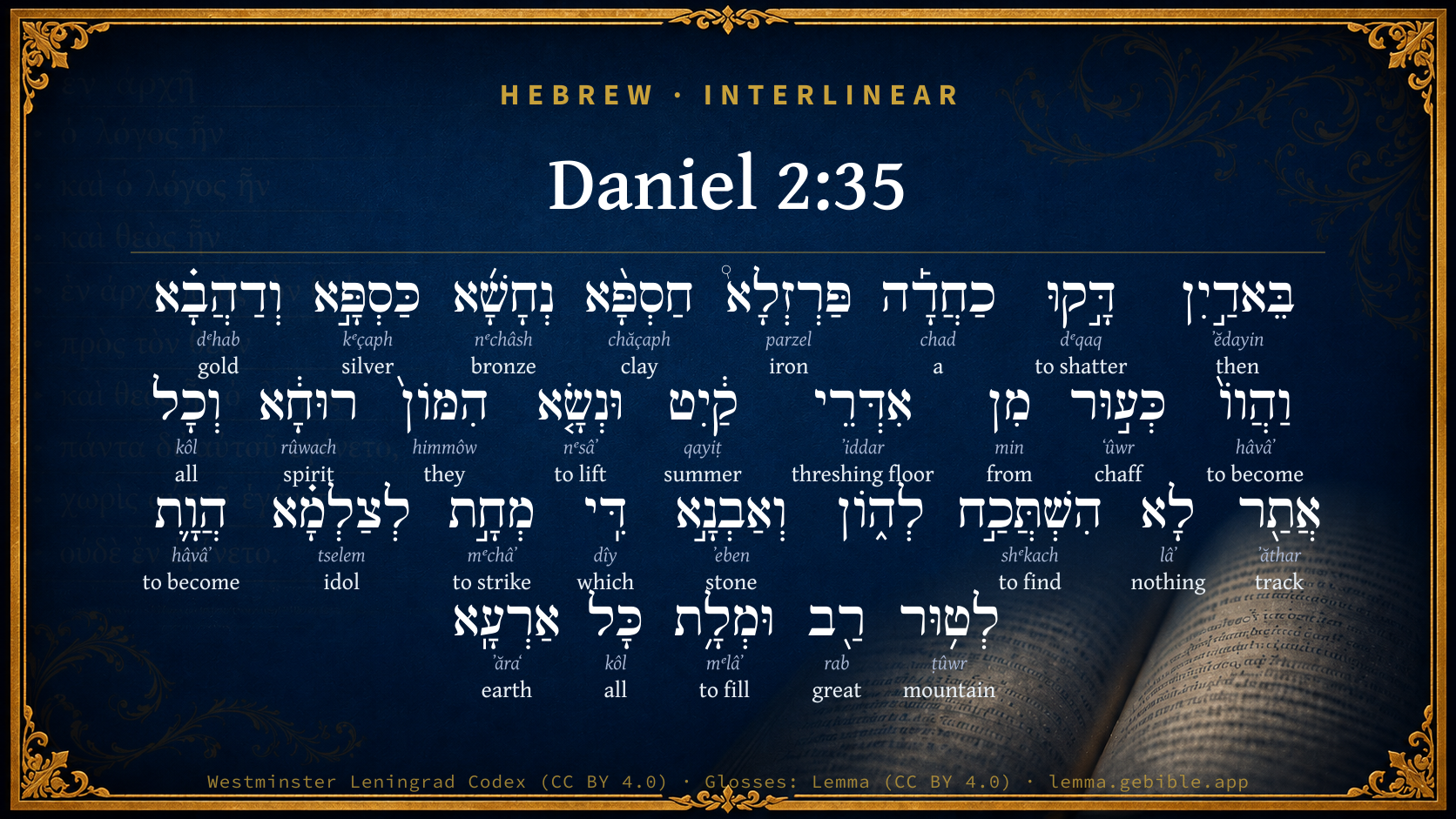
Daniel 2:35

Hebrew (Westminster Leningrad Codex) Daniel 2:35 appears in the Hebrew Old Testament. The text above is from the Westminster Leningrad Codex. Each word links to its Strong’s number, a concise gloss, and parsing drawn from the Open Scriptures Hebrew Bible morphology. Click any word for its full Brown-Driver-Briggs (BDB) entry.
Download image
Cite this verse

Daniel 2:35 (World English Bible). Public Domain. Lemma interlinear Bible study tool, https://lemma.gebible.app/v/daniel/2/35.

Show BibTeX & RIS
BibTeX
RIS
English Translation
Then was the iron, the clay, the brass, the silver, and the gold, broken in pieces together, and became like the chaff of the summer threshing floors; and the wind carried them away, so that no place was found for them: and the stone that struck the image became a great mountain, and filled the whole earth.
World English Bible · Public Domain
Highlights
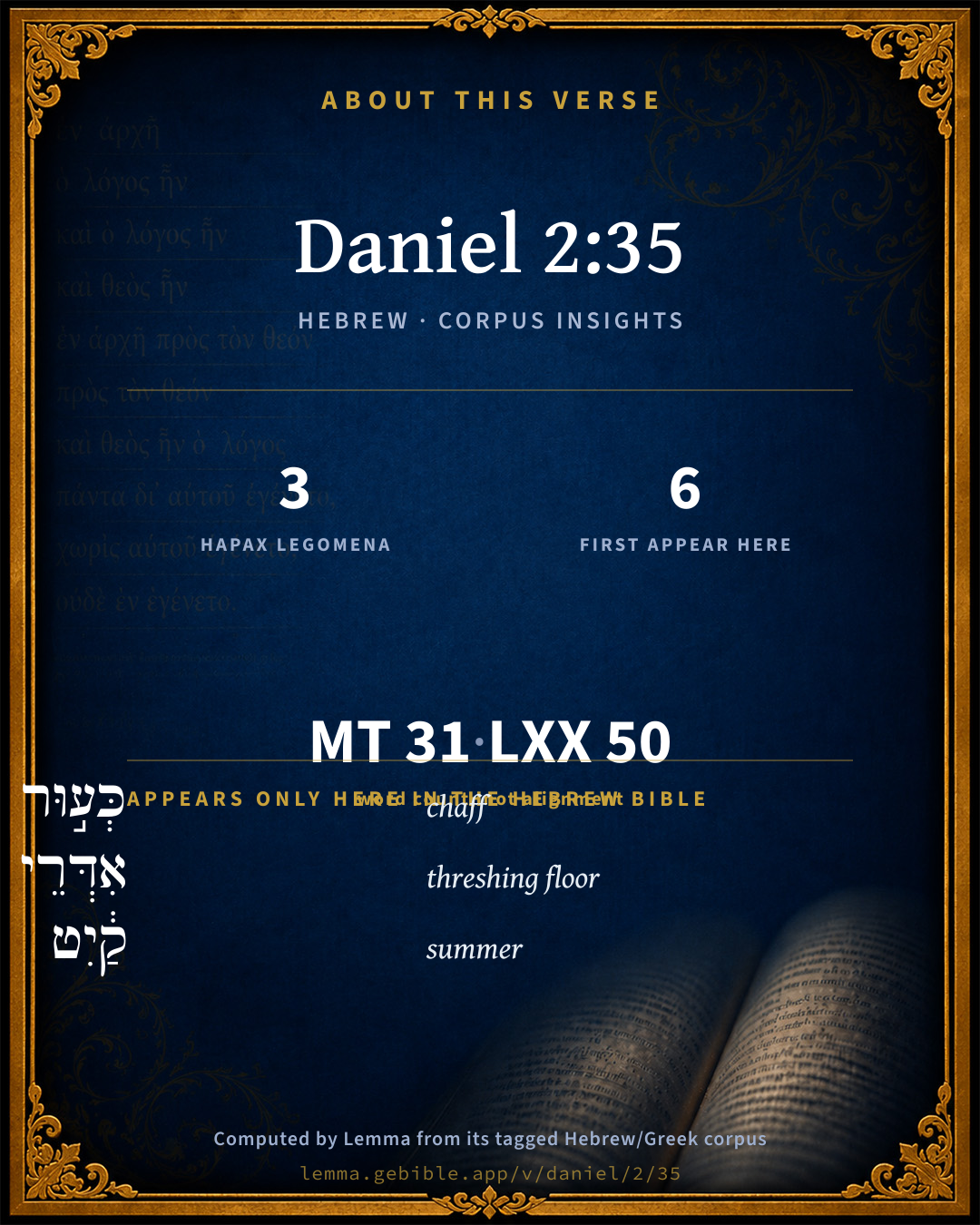
  • 3 hapax legomena — only here in the Hebrew Bible
  • 6 first appearances in the Hebrew Bible
Full analysis ↓
Download a study sheet

One document with this verse’s original text, its word-by-word gloss line, the meaning frame, cross-references with their text, attributed commentary, and full source and license credits — printable, and it pastes into notes with its structure intact.

This verse Autodidact and up

Study sheet (.html) Plain text (.txt)

A passage Seminary Student

Up to 50 verses in one chapter. A passage sheet keeps up to 6 commentary sources and 12 cross-references per verse, in the order this page ranks them, and says so on the sheet whenever that leaves anything out. Ask for a single verse and you get the Autodidact verse sheet above.

Everything on this page stays free to read, with no account — the sheet is a download of what is already on screen, not access to it.

Want to remove ads? Support Godless Engineer
Compare translations 3

The same verse in 3 English versions, stacked beneath the original-language interlinear above. Click any original word for its lexicon entry.

Each is an independent rendering of the whole verse — the interlinear is not word-aligned to these translations.

Highlighted words mark where these versions differ — a whole-verse word diff, not a word-by-word alignment.

  • World English Bible Public Domain
    Then was the iron, the clay, the brass, the silver, and the gold, broken in pieces together, and became like the chaff of the summer threshing floors; and the wind carried them away, so that no place was found for them: and the stone that struck the image became a great mountain, and filled the whole earth.
  • King James Version Public Domain
    Then was the iron, the clay, the brass, the silver, and the gold, broken to pieces together, and became like the chaff of the summer threshingfloors; and the wind carried them away, that no place was found for them: and the stone that smote the image became a great mountain, and filled the whole earth.
  • unfoldingWord Literal Text CC BY-SA 4.0
    Then the iron, the clay, the bronze, the silver, and the gold were crushed all at the same time and became like the chaff of the summer threshing floors. The wind carried them away so that no trace of them could be found. But the stone that struck the statue became a great mountain and filled the whole earth.

unfoldingWord Literal Text — © unfoldingWord, licensed CC BY-SA 4.0. Word-aligned USFM3 via Door43 (git.door43.org/unfoldingWord/en_ult).

Versions to compare (up to 4)

3 of 4 selected

Show all 18 translations

Every available English version of this verse, each an independent rendering of the whole verse.

  • World English Bible Public Domain
    Then was the iron, the clay, the brass, the silver, and the gold, broken in pieces together, and became like the chaff of the summer threshing floors; and the wind carried them away, so that no place was found for them: and the stone that struck the image became a great mountain, and filled the whole earth.
  • Berean Standard Bible Public Domain
    Then the iron, clay, bronze, silver, and gold were shattered and became like chaff on the threshing floor in summer. The wind carried them away, and not a trace of them could be found. But the stone that had struck the statue became a great mountain and filled the whole earth.
  • Majority Standard Bible Public Domain
    Then the iron, clay, bronze, silver, and gold were shattered and became like chaff on the threshing floor in summer. The wind carried them away, and not a trace of them could be found. But the stone that had struck the statue became a great mountain and filled the whole earth.
  • King James Version Public Domain
    Then was the iron, the clay, the brass, the silver, and the gold, broken to pieces together, and became like the chaff of the summer threshingfloors; and the wind carried them away, that no place was found for them: and the stone that smote the image became a great mountain, and filled the whole earth.
  • American Standard Version (1901) Public Domain
    Then was the iron, the clay, the brass, the silver, and the gold, broken in pieces together, and became like the chaff of the summer threshing-floors; and the wind carried them away, so that no place was found for them: and the stone that smote the image became a great mountain, and filled the whole earth.
  • Revised Version (1885) Public Domain
    Then was the iron, the clay, the brass, the silver, and the gold, broken in pieces together, and became like the chaff of the summer threshing-floors; and the wind carried them away, that no place was found for them: and the stone that smote the image became a great mountain, and filled the whole earth.
  • Geneva Bible (1599) Public Domain
    Then was the yron, the clay, the brasse, the siluer and the golde broken all together, and became like the chaffe of the sommer floures, and the winde caryed them away, that no place was founde for them: and the stone that smote the image, became a great mountaine, and filled the whole earth.
  • Douay-Rheims (1899) Public Domain
    Then was the iron, the clay, the brass, the silver, and the gold broken to pieces together, and became like the chaff of a summer's thrashingfloor, and they were carried away by the wind: and there was no place found for them: but the stone that struck the statue, became a great mountain, and filled the whole earth.
  • Young's Literal Translation Public Domain
    then broken small together have been the iron, the clay, the brass, the silver, and the gold, and they have been as chaff from the summer threshing-floor, and carried them away hath the wind, and no place hath been found for them: and the stone that smote the image hath become a great mountain, and hath filled all the land.
  • Literal Standard Version CC BY-SA 4.0
    then broken small together have been the iron, the clay, the bronze, the silver, and the gold, and they have been as chaff from the summer threshing-floor, and the wind has carried them away, and no place has been found for them: and the stone that struck the image has become a great mountain, and has filled all the land.
  • Unlocked Literal Bible CC BY-SA 4.0
    Then the iron, clay, bronze, silver, and gold at the same time were broken into pieces and became like the chaff of the threshing floors in the summer. The wind carried them away and there was no trace of them left. But the stone that struck the statue became a great mountain and filled the whole earth.
  • unfoldingWord Literal Text CC BY-SA 4.0
    Then the iron, the clay, the bronze, the silver, and the gold were crushed all at the same time and became like the chaff of the summer threshing floors. The wind carried them away so that no trace of them could be found. But the stone that struck the statue became a great mountain and filled the whole earth.
  • Darby Bible Public Domain
    Then was the iron, the clay, the brass, the silver, and the gold broken in pieces together, and they became like the chaff of the summer threshing-floors; and the wind carried them away, and no place was found for them. And the stone that smote the image became a great mountain, and filled the whole earth.
  • World Messianic Bible Public Domain
    Then the iron, the clay, the bronze, the silver, and the gold were broken in pieces together, and became like the chaff of the summer threshing floors. The wind carried them away, so that no place was found for them. The stone that struck the image became a great mountain and filled the whole earth.
  • Webster's Bible Public Domain
    Then was the iron, the clay, the brass, the silver, and the gold, broken to pieces together, and became like the chaff of the summer threshing-floors; and the wind carried them away, that no place was found for them: and the stone that smote the image became a great mountain, and filled the whole earth.
  • Free Bible Version CC BY-SA 4.0
    Then the rest of the statue—the bronze, the silver, and the gold—broke into pieces like the iron and clay. The wind blew them all away like chaff from the summer threshing floor, so that no trace of them could be found. But the stone that struck the statue became a great mountain and filled the whole earth.
  • Bible in Basic English Public Domain
    Then the iron and the earth, the brass and the silver and the gold, were smashed together, and became like the dust on the floors where grain is crushed in summer; and the wind took them away so that no sign of them was to be seen: and the stone which gave the image a blow became a great mountain, covering all the earth.
  • JPS Tanakh (1917) Public Domain
    Then was the iron, the clay, the brass, the silver, and the gold, broken in pieces together, and became like the chaff of the summer threshing-floors; and the wind carried them away, so that no place was found for them; and the stone that smote the image became a great mountain, and filled the whole earth.

Literal Standard Version (2020), Covenant Press — licensed CC BY-SA 4.0. Text via the HelloAO Bible API (eBible.org). Unlocked Literal Bible (unfoldingWord) — licensed CC BY-SA 4.0. Text via the HelloAO Bible API (eBible.org). unfoldingWord Literal Text — © unfoldingWord, licensed CC BY-SA 4.0. Word-aligned USFM3 via Door43 (git.door43.org/unfoldingWord/en_ult). Free Bible Version, Dr. Jonathan Gallagher — licensed CC BY-SA 4.0. Text via the HelloAO Bible API (eBible.org).

Word by word

More ways to search: Search by grammar → Find every occurrence → Compare this word →

Practice this passage: Drill this verse → Learn its vocabulary →

כְּע֣וּר
ʻûwr
H5784
“like/as · chaff”
Adjective, R + Noun, Common, Masculine, Singular, Absolute
Part of Speech
Adjective + Noun
Type
Common
Gender
Masculine
Number
Singular
State
Absolute
Full BDB Definition

Origin: chaff (as the naked husk)

TWOT: 2904

chaff
  1. בֵּאדַ֣יִן ʼĕdayin H116 “in/at · then” Adjective, R + Adverb
  2. דָּ֣קוּ dᵉqaq H1855 “to shatter” Adjective, V, Plural
  3. כַחֲדָ֡ה chad H2298 “like/as · a” Adjective, R + Adjective, Cardinal number, Feminine, Singular, Absolute
  4. פַּרְזְלָא֩ parzel H6523 “iron · the” Adjective, N, Common + Particle, Definite Article
  5. חַסְפָּ֨א chăçaph H2635 “clay · the” Adjective, N, Common + Particle, Definite Article
  6. נְחָשָׁ֜א nᵉchâsh H5174 “bronze · the” Adjective, N, Common + Particle, Definite Article
  7. כַּסְפָּ֣א kᵉçaph H3702 “silver · the” Adjective, N, Common + Particle, Definite Article
  8. וְדַהֲבָ֗א dᵉhab H1722 “and · gold · the” Adjective, C + Noun, Common, Masculine, Singular, Determined + Particle, Definite Article
  9. וַהֲווֹ֙ hâvâʼ H1934 “and · to become” Adjective, C + Verb, Qal, Perfect, 3rd Person, Masculine, Plural
  10. מִן min H4481 “from” Adjective, R
  11. אִדְּרֵי ʼiddar H147 “threshing floors of” Adjective, N, Common
  12. קַ֔יִט qayiṭ H7007 “summer” Adjective, N, Common
  13. וּנְשָׂ֤א nᵉsâʼ H5376 “and · to lift” Adjective, C + Verb, Qal, Perfect, 3rd Person, Masculine, Singular
  14. הִמּוֹן֙ himmôw H1994 “they” Adjective, S
  15. רוּחָ֔א rûwach H7308 “spirit · the” Adjective, N, Common + Particle, Definite Article
  16. וְכָל kôl H3606 “and · all of” Adjective, C + Noun, Common, Masculine, Singular, Construct
  17. אֲתַ֖ר ʼăthar H870 “track” Adjective, N, Common
  18. לָא lâʼ H3809 “nothing” Adjective, T
  19. הִשְׁתֲּכַ֣ח shᵉkach H7912 “to find” Adjective, V, Plural
  20. וְאַבְנָ֣א ʼeben H69 “and · stone · the” Adjective, C + Noun, Common, Feminine, Singular, Determined + Particle, Definite Article
  21. דִּֽי dîy H1768 “which” Adjective, T
  22. מְחָ֣ת mᵉchâʼ H4223 “to strike” Adjective, V, Plural
  23. לְצַלְמָ֗א tselem H6755 “to/for · idol · the” Adjective, R + Noun, Common, Masculine, Singular, Determined + Particle, Definite Article
  24. הֲוָ֛ת hâvâʼ H1934 “to become” Adjective, V, Plural
  25. לְט֥וּר ṭûwr H2906 “to/for · mountain” Adjective, R + Noun, Common, Masculine, Singular, Absolute
  26. רַ֖ב rab H7229 “great” Adjective, A
  27. וּמְלָ֥ת mᵉlâʼ H4391 “and · to fill” Adjective, C + Verb, Qal, Perfect, 3rd Person, Feminine, Singular
  28. כָּל kôl H3606 “all of” Adjective, N, Common
  29. אַרְעָֽא ʼăraʻ H772 “earth · the” Adjective, N, Common + Particle, Definite Article

About this verse

These counts appear in no published source. They are computed here, from the morphology-tagged text and Lemma’s own curated glosses. What Lemma adds →

31
words
28
distinct lemmas
Prophets
section

Notable vocabulary

3 hapax legomena — words that appear only here in the entire Hebrew Bible:

  • כְּע֣וּר chaff H5784
  • אִדְּרֵי threshing floor H147
  • קַ֔יִט summer H7007

First appearance in Scripture

These words make their first canonical appearance in the Hebrew Bible here:

  • כְּע֣וּר chaff H5784
  • אִדְּרֵי threshing floor H147
  • קַ֔יִט summer H7007
  • רוּחָ֔א spirit H7308
  • לְט֥וּר mountain H2906
  • וּמְלָ֥ת to fill H4391

Shared distinctive vocabulary

לְט֥וּר mountain H2906 occurs in 2 verses of the Hebrew Bible. Also found in:

Grammatical profile

  • 3 verbs
  • 3 nouns
  • 15 adjectives
  • 1 adverb
  • 9 particles

Verb forms

  • וַהֲווֹ֙ Qal · Perfect
  • וּנְשָׂ֤א Qal · Perfect
  • וּמְלָ֥ת Qal · Perfect

Repetition

Words recur within this verse — often emphatic in Hebrew:

  • וַהֲווֹ֙ to become H1934 ×2
  • וְכָל all H3606 ×2

Hebrew & Septuagint length

In English translation the verse runs 57 words from the Hebrew and 60 from the Septuagint (LXX English) — closely comparable.

A rough comparison of the two English renderings, which tokenize alike — not a word-level alignment.

Word counts can differ between the Hebrew and the Greek without any difference in meaning — e.g. the Hebrew direct-object marker אֵת has no separate Greek word, and Greek often adds the article ὁ.

In the original languages it is 31 Hebrew tokens and 50 Greek tokens — but the two are counted differently (Hebrew bundles its prefixes and suffixes into one token; the Greek is in lemma form), so that isn’t a like-for-like length.

Cross-references

25

Topical passages linked to Daniel 2:35 in the Treasury of Scripture Knowledge — connected by theme and wording, ordered by reader-vote popularity; previews shown in the World English Bible.

  • Isaiah 2:2–3 It shall happen in the latter days, that the mountain of Yahweh's house shall be established on the top of the mountains, And shall be raised above the hills; And all nations shall flow to it.
  • Psalms 37:10 For yet a little while, and the wicked will be no more. Yes, though you look for his place, he isn't there.
  • Hosea 13:3 Therefore they will be like the morning cloud, And like the dew that passes away early, Like the chaff that is driven with the whirlwind out of the threshing floor, And like the smoke out of the chimney.
  • Revelation 20:11 I saw a great white throne, and him who sat on it, from whose face the earth and the heaven fled away. There was found no place for them.
  • Job 6:17 In the dry season, they vanish. When it is hot, they are consumed out of their place.
  • Isaiah 11:9 They shall not hurt nor destroy in all my holy mountain; for the earth shall be full of the knowledge of Yahweh, as the waters cover the sea.
  • Isaiah 41:15–16 Behold, I have made you [to be] a new sharp threshing instrument having teeth; you shall thresh the mountains, and beat them small, and shall make the hills as chaff.
  • Psalms 1:4–5 The wicked are not so, But are like the chaff which the wind drives away.
  • Psalms 22:27 All the ends of the earth shall remember and turn to Yahweh. All the relatives of the nations shall worship before you.
  • Psalms 37:36 But he passed away, and, behold, he was not. Yes, I sought him, but he could not be found.
  • Psalms 46:9 He makes wars cease to the end of the earth. He breaks the bow, and shatters the spear. He burns the chariots in the fire.
  • Psalms 66:4 All the earth will worship you, And will sing to you; They will sing to your name." Selah.
  • Psalms 67:1–2 May God be merciful to us, bless us, And cause his face to shine on us. Selah.
  • Psalms 72:16–19 There shall be abundance of grain throughout the land. Its fruit sways like Lebanon. Let it flourish, thriving like the grass of the field.
  • Psalms 80:9–10 You cleared the ground for it. It took deep root, and filled the land.
  • Psalms 86:9 All nations you have made will come and worship before you, Lord. They shall glorify your name.
  • Psalms 103:16 For the wind passes over it, and it is gone. Its place remembers it no more.
  • Isaiah 17:13–14 The nations shall rush like the rushing of many waters: but he shall rebuke them, and they shall flee far off, and shall be chased as the chaff of the mountains before the wind, and like the whirling dust before the storm.
  • Micah 4:1–2 But in the latter days, It will happen that the mountain of Yahweh's temple will be established on the top of the mountains, And it will be exalted above the hills; And peoples will stream to it.
  • Micah 4:13 Arise and thresh, daughter of Zion; For I will make your horn iron, And I will make your hoofs brass; And you will beat in pieces many peoples: And I will devote their gain to Yahweh, And their substance to the Lord of the whole earth.
  • Zechariah 14:8–9 It will happen in that day, that living waters will go out from Jerusalem; half of them toward the eastern sea, and half of them toward the western sea; in summer and in winter will it be.
  • 1 Corinthians 15:25 For he must reign until he has put all his enemies under his feet.
  • Revelation 11:15 The seventh angel sounded, and great voices in heaven followed, saying, "The kingdom of the world has become the Kingdom of our Lord, and of his Christ. He will reign forever and ever!"
  • Revelation 12:8 They didn't prevail, neither was a place found for him any more in heaven.
  • Revelation 20:2–3 He seized the dragon, the old serpent, which is the devil and Satan, who deceives the whole inhabited earth, and bound him for a thousand years,

Cross-references courtesy of OpenBible.info (CC BY 4.0).

Hebrew and Greek witnesses Masoretic Hebrew ↔ Greek Septuagint

The same verse in the two great witnesses to the Old Testament, shown verse-for-verse.

These are two independent witnesses, not word-aligned to each other, and the Septuagint is shown in lemma (dictionary) form.

Hebrew Daniel 2:35 Masoretic · Westminster Leningrad Codex

בֵּאדַ֣יִן דָּ֣קוּ כַחֲדָ֡ה פַּרְזְלָא֩ חַסְפָּ֨א נְחָשָׁ֜א כַּסְפָּ֣א וְדַהֲבָ֗א וַהֲווֹ֙ כְּע֣וּר מִן אִדְּרֵי קַ֔יִט וּנְשָׂ֤א הִמּוֹן֙ רוּחָ֔א וְכָל אֲתַ֖ר לָא הִשְׁתֲּכַ֣ח לְה֑וֹן וְאַבְנָ֣א דִּֽי מְחָ֣ת לְצַלְמָ֗א הֲוָ֛ת לְט֥וּר רַ֖ב וּמְלָ֥ת כָּל אַרְעָֽא

Then was the iron, the clay, the brass, the silver, and the gold, broken in pieces together, and became like the chaff of the summer threshing floors; and the wind carried them away, so that no place was found for them: and the stone that struck the image became a great mountain, and filled the whole earth.

World English Bible · Public Domain

Greek LXX Daniel 2:35 Septuagint · lemma form

τότε λεπτός γίγνομαι ἅμα ὁ σίδηρος καί ὁ ὄστρακον καί ὁ χαλκός καί ὁ ἄργυρος καί ὁ χρυσίον καί γίγνομαι ὡσεί λεπτός ἄχυρον ἐν ἅλων καί ῥιπίζω αὐτός ὁ ἄνεμος ὥστε μηδείς καταλείπω ἐκ αὐτός καί ὁ λίθος ὁ πατάσσω ὁ εἰκών γίγνομαι ὄρος μέγας καί πατάσσω πᾶς ὁ γῆ

Then once for all the earthenware, the iron, the brass, the silver, the gold, were ground to powder, and became as chaff from the summer threshing floor; and the violence of the wind carried them away, and no place was found for them: and the stone which had struck the image became a great mountain, and filled all the earth.

LXX2012 (modern English Septuagint) · Public Domain

On this verse, The Pulpit Commentary discusses the Septuagint’s reading. Read the note in Commentary ↓

Hebrew: Westminster Leningrad Codex (CC BY 4.0). Greek: Septuagint (public domain); English from LXX2012 (modern English Septuagint) (Public Domain). How the Septuagint differs from the Hebrew →

Commentary

Notes on Daniel 2:35 from classic Christian and Jewish commentators (each source and its license shown beneath its notes). The classic Christian expositions comment on the surrounding passage and are grouped to its opening verse, so a note may address several verses; the Jewish commentaries on the Tanakh (Rashi and others) are per-verse, so they appear only where the commentator wrote on this verse.

Lemma curates 59 commentaries, every one of them public domain or Creative Commons licensed, each selected and text-cleaned for this edition rather than reprinted as found. About our sources →

Trapp's Complete Commentary

John Trapp

Dan 2:35 Then was the iron, the clay, the brass, the silver, and the gold, broken to pieces together, and became like the chaff of the summer threshingfloors; and the wind carried them away, that no place was found for them: and the stone that smote the image became a great mountain, and filled the whole earth.

Ver. 35. Then was the iron, the clay, the brass, &c.] Those four mighty monarchies had their times and their turns - their ruin as well as their rise.

And the stone that smote the image became a great mountain.] The kingdom of Christ, little at first, increaseth wonderfully. Nec minor ab exordio, nec maior incrementis ulla, said Eutropius, {a} concerning Rome; may we better say concerning the Church, which shall stand when all other powers shall quite vanish and disappear for ever, seem they for present never so splendid and solid. Sic transit gloria mundi. So transitory is the glory of the world.

{a} Hist., lib. i.

John Trapp, A Commentary or Exposition upon All the Books of the Old and New Testament (1647–1656) — public domain. Text from a community e-Sword module.

Tyndale Open Study Notes

Tyndale Open Resources

2:35 covered (literally filled) the whole earth: Cp. Gen 1:28; Exod 1:7; Matt 28:18-20. This new kingdom would replace all other kingdoms.

Tyndale Open Study Notes — © Tyndale Open Resources, licensed CC BY-SA 4.0. Text via the HelloAO Bible API.

Ibn Ezra

Rabbi Abraham ibn Ezra

[Daniel 2:35] Be'dayin daku kachdah (בֵּאדַיִן דָּקוּ כַחֲדָה - Then they were crushed together): Together (Kachdah - כַחֲדָה): [Means] together (yachdav - יַחְדָּיו).

[Daniel 2:35] k'ʿur min idrei qayit (כְּעוּר מִן־אִדְּרֵי־קַיִט - like chaff from the threshing floors of summer): [Means] like chaff (k'motz) that is driven (y'soʿer) from the threshing floor (min goren) in the days of summer (bimei ha-qayitz)....

[Daniel 2:35] v'chol atar la hishtakach lehon (וְכָל־אֲתַר לָא־הִשְׁתֲּכַח לְהוֹן - and any place/trace was not found for them): Place (atar - אֲתַר): [Means] place (maqom - מָקוֹם)....

[Daniel 2:35] havat l'tur rav (הֲוָת לְטוּר רַב - became a great mountain): To a great mountain (l'tur rav - לְטוּר רַב): [Means] to a great mountain (l'har gadol - לְהַר גָּדוֹל). And filled the whole earth.

Ibn Ezra on the Tanakh — English translations: “Sefaria Community Translation” (CC0 1.0 (public-domain dedication)); “Yalkut, Sifsei Chachomim Chumash, Metsudah Publications, 2009” (CC BY 4.0); and “Commentary of Ibn Ezra on Isaiah - trans. by M. Friedlander, 1873” (public domain). Text via Sefaria.

Jamieson, Fausset & Brown

Robert Jamieson, A. R. Fausset & David Brown

broken . . . together--excluding a contemporaneous existence of the kingdom of the world and the kingdom of God (in its manifested, as distinguished from its spiritual, phase). The latter is not gradually to wear away the former, but to destroy it at once, and utterly (Th2 1:7-10; Th2 2:8). However, the Hebrew may be translated, "in one discriminate mass."

chaff--image of the ungodly, as they shall be dealt with in the judgment (Psa 1:4-5; Mat 3:12).

summer threshing-floors--Grain was winnowed in the East on an elevated space in the open air, by throwing the grain into the air with a shovel, so that the wind might clear away the chaff.

no place . . . found for them-- (Rev 20:11; compare Psa 37:10, Psa 37:36; Psa 103:16).

became . . . mountain--cut out of the mountain (Dan 2:45) originally, it ends in becoming a mountain. So the kingdom of God, coming from heaven originally, ends in heaven being established on earth (Rev 21:1-3).

filled . . . earth-- (Isa 11:9; Hab 2:14). It is to do so in connection with Jerusalem as the mother Church (Psa 80:9; Isa 2:2-3).

Jamieson, Fausset & Brown — Commentary Critical and Explanatory on the Whole Bible (1871) — public domain (CC PDM 1.0). Text via the HelloAO Bible API.

Adam Clarke's Commentary

Verse 35. The stone - became a great mountain] There is the kingdom אבן eben, of the stone, and the kingdom of the mountain. See at the end at the chapter. See Clarke on Da 2:49.

Adam Clarke's Commentary on the Bible (1810–1826) — public domain. Text from a community e-Sword/MySword module.

Ellicott's Commentary for English Readers

(35) Like the chaff.—This language recalls Psa_1:4; Psa_2:9. It is emblematic of Divine judgments, as Isa_41:15-16; Jer_51:33, &c. Comp. with this the description of the Judgment, Dan_7:9-14. Observe, however, that the stone did not crush the head, breast, or loins of the body. These became fragments by falling when the feet were broken. (Comp. Dan_7:12.)

A Bible Commentary for English Readers, edited by Charles John Ellicott (1878–1897) — public domain. Text from a community e-Sword module.

The Cambridge Bible for Schools and Colleges

gen. ed. J. J. S. Perowne

35. The absolute dissipation of the image. The feet being broken, the entire image fell to pieces; and the fragments were dispersed by the wind. A fall would not naturally break masses of metal into fragments small enough to be scattered by the wind; but in a dream physical impossibilities or improbabilities occasion no difficulty.

threshingfloors] which were generally on exposed or elevated spots, where the chaff might readily be cleared away by the wind. Cf. Hos_13:3, Isa_41:16, Psa_1:4; and with no place, &c., Rev_20:11.

became a great mountain, and filled the whole earth] another figure, the incongruity of which would not be perceived in a dream, implying the irresistible expansive force, and also the ultimate universality, of the kingdom of God (Dan_2:44).

The Cambridge Bible for Schools and Colleges (gen. ed. J. J. S. Perowne; Cambridge University Press, 1878–1918) — public domain. Text from a community e-Sword module.

John Gill's Exposition

Then was the iron, the clay, the brass, the silver, and the gold, broken to pieces together,.... The feet, the basis of the image, being broken, the whole body of it fell, and with its own weight was broken to pieces; an emblem this of the utter dissolution of all the monarchies and kingdoms of the earth, signified by these several metals:

and became like the chaff of the summer threshing floors; which is exceeding small and light:

and the wind carried them away, that no place was found for them; for the several metals, and the monarchies signified by them, which were no more: the allusion is to the manner of winnowing corn in the eastern countries upon mountains, when the chaff was carried away by the wind, and seen no more:

and the stone that smote the image became a great mountain, and filled the earth; Christ's kingdom, from small beginnings, has increased, and will more and more, until the whole earth is subject to it: this began to have its accomplishment in the first times of the Gospel, especially when the Roman empire, as Pagan, was destroyed by Constantine, and the kingdom of Christ was set up in it; and it received a further accomplishment at the time of the Reformation, when Rome Papal had a deadly blow given it, and the Gospel of Christ was spread in several nations and kingdoms; but it will receive its full accomplishment when both the eastern and western antichrists shall be destroyed, and the kingdoms of this world shall become the Lord's and his Christ's, Rev 11:15.

John Gill's Exposition of the Whole Bible (1746–1763) — public domain (CC PDM 1.0). Text via the HelloAO Bible API.

Albert Barnes' Notes on the Bible

Then was the iron, the clay, the brass, the silver, and the gold broken to pieces together, and became like the chaff of the summer threshing-floor - The word rendered “together” (כצרה kachădâh) our translators would seem to have understood as referring to “time;” to its being done simultaneously. The more literal interpretation, however, is, “as one;” that is, “they were beaten small as one,” referring to identity of condition. They were all reduced to one indiscriminate mass; to such a mass that the original materials could no longer be distinguished, and would all be blown away together. The literal meaning of the word (חד chad used and חדה chădâh) is, “one,” or “first.” Ezr 4:8, “wrote a letter;” Ezr 5:13, “in the first year of Cyrus;” Ezr 6:2, “a roll;” Dan 2:9; “there is but one decree for you;” Dan 3:19, “heat the furnace one seven times hotter,” etc. United with the preposition (כ k) it means “as one,” like the Hebrew כאחד ke'echâd) - Ecc 11:6; 2Ch 5:13; Ezr 2:64; Ezr 3:9; Isa 65:25. The phrase “chaff of the summer threshing-floors” refers to the mode of winnowing grain in the East. This was done in the open air, usually on an elevated place, by throwing the grain, when thrashed, into the air with a shovel, and the wind thus drove away the chaff. Such chaff, therefore, naturally became an emblem of anything that was light, and that would be easily dissipated. See the notes at Isa 30:24; Mat 3:12.

And the wind carried them away, that no place was found for them - They were entirely dissipated like chaff. As that seems to have no longer any place, but is carried we know not where, so the figure here would denote an entire annihilation of the power to which it refers.

And the stone that smote the image became a great mountain, and filled the whole earth - The vision which was before the mind of the king as here represented was, that the stone which was cut out of the mountain was at first small, and that while he contemplated it, it swelled to larger dimensions, until it became an immense mountain - a mountain that filled the whole land. It was this which, perhaps more than anything else, excited his wonder, that a stone, at first of so small dimensions, should of itself so increase as to surpass the size of the mountain from which it was cut, until it occupied every place in view. Everything about it was so remarkable and unusual, that it was no wonder that he could not explain it. We have now gone over a description of the literal vision as it appeared to the mind of the monarch. Had it been left here, it is clear that it would have been of difficult interpretation, and possibly the true explanation might never have been suggested. We have, however, an exposition by Daniel, which leaves no doubt as to its design, and which was intended to carry the mind forward into some of the most important and remarkable events of history. A portion of his statement has been fulfilled; a part remains still unaccomplished, and a careful exposition of his account of the meaning of the vision will lead our thoughts to some of the most important historical events which have occurred in introducing the Christian dispensation, and to events still more important in the statement of what is yet to come.

Albert Barnes' Notes on the Bible (1834–1885) — public domain. Text from a community e-Sword/MySword module.

Whedon's Commentary on the Bible

Daniel D. Whedon

35. The little rock out of the mountain stirred by the invisible elemental forces hidden in the heart of nature is unseen, unnoticed, and absurdly unworthy of notice, as it begins to roll toward the vast and glorious image. But though coming silently and unobserved it is moved by a power strong and irresistible as that of gravitation itself, and striking the point of weakness inevitable in every human creation, the monster totters, the iron legs crush down upon the feet of clay, and the proud image lies a hideous ruin, crushed and pulverized into dust, which the wind blows away like chaff (compare Job_21:18; Psa_1:4; Psa_35:5), while the stone, as if having life in itself, grows, enlarges at the base and towers in height, till like a mighty mountain it fills the whole horizon of the sleeper’s sight. (Compare Expositor, 9:448.)

Daniel D. Whedon (gen. ed.), Commentary on the Old and New Testaments (1874–1909) — public domain. Text from a community e-Sword module.

The Pulpit Commentary

Then was the iron, the clay, the brass, the silver, and the gold, broken to pieces together, and became like the chaff of the summer threshing-floors. The versions arc closer to the Massoretic than our Authorized Version, as they all give more prominence to hdj (kahadah), "at once." It is rendered "together." The LXX renders ama; Theodotion, eijsapax the Peshitta repeats the word; and Jerome renders pariter. Theedotion changes the order somewhat, for the sake of making it more symmetrical. The rendering of the LXX is in some respects different from the natural sense of the Massoretic text, but not so much so as to require us to presume a radically different text: "Then the iron, and the clay, etc., became fragments, and they were smaller than the chaff of the threshing-floor." We have this verse also in the Itala, preserved to us in Tertullian, but it does not differ from Jerome seriously. It would follow naturally enough if the mighty image were so smitten on its weak and fragile feet, that it would come crashing to the earth; but more happened than this. As the monarch looked, in falling, the various parts of the image, as they fell in a heap, became broken, nay, triturated they became as the dust or chaff of the summer threshing-floor. Summer is the dead time in the East; harvest is over by the end of June, and the threshing of corn then commences. All this huge statue was reduced to particles as small and light as the chaff that is beaten off the grain by the threshing instruments of those days feet of oxen or wheel of cart. Chaff is a favourite symbol for lightness and worthlessness. In the first psalm the wicked are compared to chaff; so in Ps 28. In Hosea, where he speaks (Hos_13:3) of Israel"s sins, he says, "Ephraim shall be like the chaff of the threshing-floor." Isaiah (Isa_41:15, Isa_41:16) speaks of Jacob getting new threshing instruments to thresh the mountains, and make them small as chaff. It may be noted that the word here translated "chaff" only occurs here. The word does not appear in the Targums, instead of which is used xwOm (motz), the Hebrew word. In Syriac, again, in the Peshitta, it occurs frequently, as Psa_1:4 and as Isa_40:15 another sign, slight in itself, of theEastern origin of the Book of Daniel. The fact that the word occurred in Daniel would have a tendency to preserve it if in use when Daniel was published, or introduce it if it were not. Yet, as we have said, it does not appear in the Targums. It does appear in Syriac, the language of a people who, as not Jews, would presumably not be familiar with Daniel. The word for "threshing-floor," yreD (iddrei), is also one that does not appear in the Targums, but it does appear in the Peshitta. Jensen suggests an Assyrian etymology, but Brockelmann marks this doubtful; Lagarde suggests a Persian etymology, also marked doubtful. Whichever etymology holds bears out the Eastern origin of the book. The Targums represent the older Aramaic of Palestine. If Daniel were a book originating in Palestine, the Persian words appearing in it might also be expected to appear in the Targums. And the wind carried them away, that no place was found for them: and the stone that smote the image became a great mountain, and filled the whole earth. The LXX rendering is, "And the wind carried them away, so that there was nothing left of them, and the stone that smote the image became a great mountain, and smote the whole earth." The first portion of this is a fairly correct rendering of our present Massoretic text. On the other hand, the latter clause implies that the translator had before him, or imagined he had, not talm, but tjm; not impossibly talm might be written without the silent a; thus, tlm, as in the Peshitta. In that case the mistake might easily be made. Behrmann remarks on the vocalization of talm in this passage being the same as tjm, but does not remark that it is written defectively in Syriac. The sense in the Massoretic text is much better than that implied in this reading.

Theodotion"s rendering differs in the first clause of this portion of the present verse, "And the abundance (plhqov) of wind carried it away, and place was not found for them: and the stone, when it had smitten (pataxav) the image, became a great mountain, and filled the whole earth." The rendering "multitude" (plhqov) is due to reading wOmh; instead of wOmhi. This form of the plural of the demonstrative pronoun is the commoner in Biblical Aramaic, but does not appear in the Targums nor the Peshitta. It is akin to the Mandaitic wnyh. Neither the Peshitta nor the Vulgate presents any peculiarities of rendering. All this mass that had formed the image, though it had been gold, silver, brass, and iron, yet was so ground down had become reduced to particles so small, that the wind carried them away. So scattered were they that they collected in no special place, so that one could say, "This is the image." The figure is still that of the threshing-floor; the wind, blowing on the grain that is lifted up before it, carries away the chaff, but, search as one may, the chaff, once blown away, cannot be found. A more remarkable thing now takes place the stone that, bounding down the mountainside, had smitten the imageon the feet, so that it fell and became as dust, now grows apace, overtopping the utmost height the image had attained, overtopping the mountain from which it had been cut. Not only did it grow in height, but, as it increased in height, its base broadened till the whole earth was filled with it. There seems to be a reference here to Isa_2:2, The mountain of the Lord"s house shall be established on the top of the mountains, and shall be exalted above the hills; and all nations shall flow unto it." As the monarch gazes in his dream, the change is completed, the huge image, with its glittering head and gleaming breast, its polished thighs and legs of iron, its unseemly feet that inspired terror by its very appearance, had utterly disappeared, and its place was occupied by a mountain, huge but peaceful, on which the flocks might browse and trees might grow. It may be noted, though not as of importance, that the material of the mountain is most akin with that of the weak clay of which the feet of the image were largely composed. Such, then, is the dream which Nebuchadnezzar had seen, and which the prophet now presented once more before him. We must, however, glance at the picture presented by the reading of the LXX To the translator the picture evidently present was that of a stone descending from the mountain, and increasing in momentum as it descends; but this stone further increases in size, till before its tremendous strokes and rebounds the very solid earth quakes.

The Pulpit Commentary (1880–1919), ed. H.D.M. Spence-Jones & Joseph S. Exell — public domain. Text from a community e-Sword module.

Scofield Reference Notes

C. I. Scofield

mountain

A mountain is one of the bibical symbols of a kingdom. (See Scofield "Isa 2:2").

The Scofield Reference Bible (1917 edition), notes by C. I. Scofield — public domain. Text from a community e-Sword module.

Rashi

Rabbi Shlomo Yitzchaki (Rashi)

Then...crumbled together Then all the types of metals and the clay that were in it crumbled together.

and they were like chaff from the threshing floors of the summer [as translated,] and they were like chaff from the threshing floors of the summer.

and the wind carried them off [as translated,] and the wind carried them off.

and no place was found for them i.e., their original place was unknown, and it was unrecognizable that they were ever there.

became a huge mountain [as translated,] became a huge mountain.

Rashi on the Tanakh — English translations: “The Judaica Press complete Tanach with Rashi, translated by A. J. Rosenberg” (CC BY 4.0); “Pentateuch with Rashi's commentary by M. Rosenbaum and A.M. Silbermann, 1929-1934” (public domain); “The Metsudah Tanach series, Lakewood, N.J” (CC BY 4.0); and “The Book of Joshua, Metsudah Publications, 1997” (CC BY 4.0). Text via Sefaria.

Lesson kit

Teaching starters — assembled from the data on this page, not authored interpretation. Every prompt links to the verse data it draws on. Edit before teaching.

Daniel, in the Prophets, opens this verse with 31 words (28 distinct Hebrew lemmas). Its most distinctive word is ʻûwr (“chaff”). A historical commentator’s framing appears above. Read the whole chapter for the surrounding context.

Discussion questions

  1. How does “chaff” (ʻûwr) shape what this verse is saying?
  2. 3 words here appear nowhere else in the Hebrew Bible. Why might the author reach for such rare wording?
  3. 6 words make their first appearance in Scripture here. What does this debut establish?
  4. How does Daniel 2:45, which shares the word «mountain», read alongside this verse?
  5. What does the repetition of “to become” (2× in this one verse) do in this verse?
  6. The translations on this page render this verse differently — a whole-verse word diff, not a word-by-word alignment. What might account for the different wordings?
  7. «וַהֲווֹ֙» is a Qal Perfect verb. How does that grammatical form shape the action described?
  8. Compare how Trapp's Complete Commentary and Tyndale Open Study Notes read this verse. Where do they agree or differ?

Things to notice

  • 3 words in this verse appear nowhere else in the Hebrew Bible.
  • 6 words make their first canonical appearance in Scripture here.
  • This verse counts 31 Hebrew ↔ 50 Greek words.
  • These translations choose different wording for 19 words in this verse.
  • “to become” occurs 2× in this single verse.

Reading settings

Reading text

Shown beneath each verse's original-language words.

Old Testament
Old Testament edition

Read the OT as the Masoretic Hebrew (MT) or the Greek Septuagint (LXX).

English shown for the Greek Septuagint (in the Hebrew ↔ Greek comparison).

Comparing translations? Open the Compare panel on any verse page to stack up to four side by side.