
Daniel 7:6

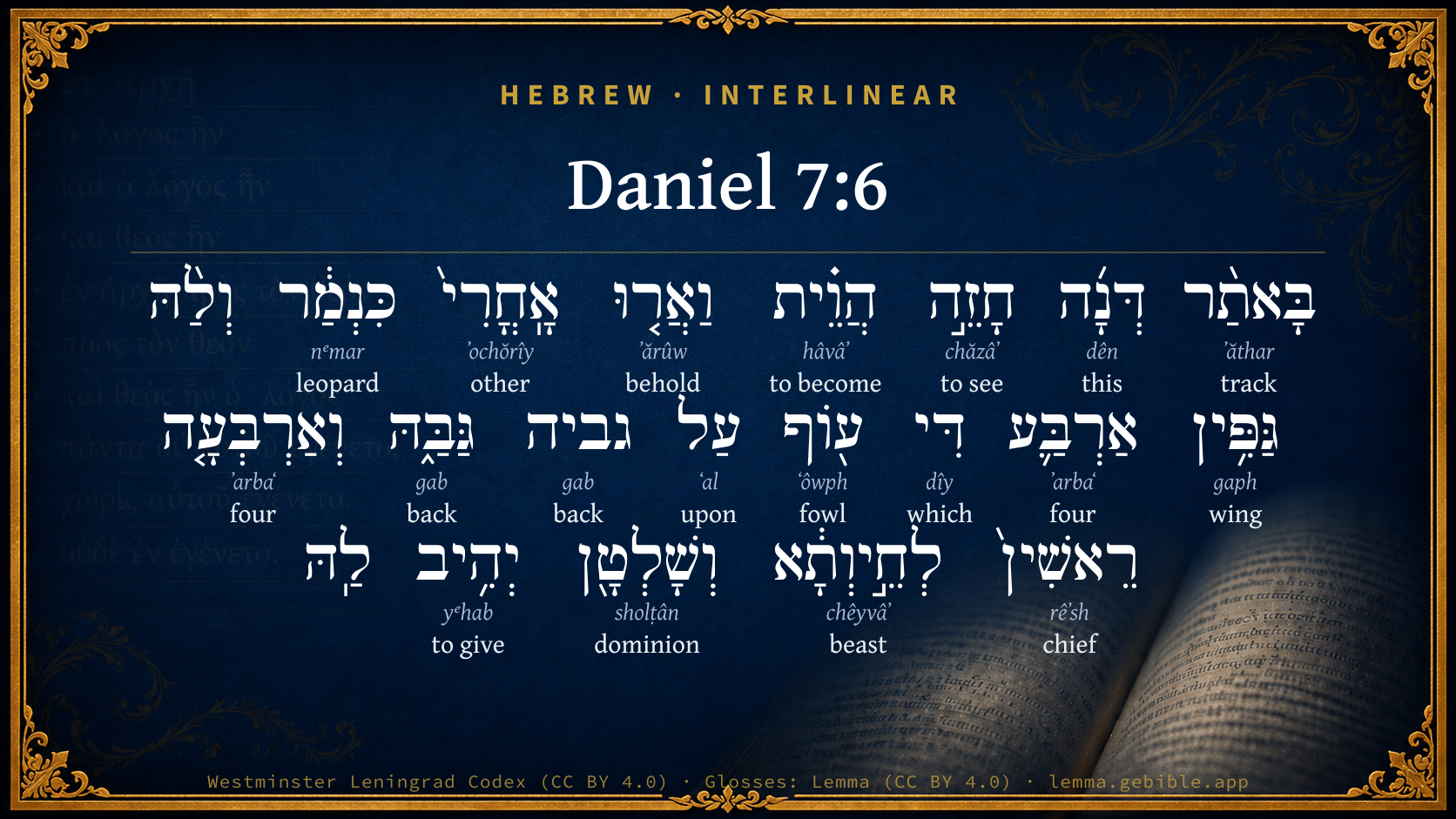
Hebrew (Westminster Leningrad Codex) Daniel 7:6 appears in the Hebrew Old Testament. The text above is from the Westminster Leningrad Codex. Each word links to its Strong’s number, a concise gloss, and parsing drawn from the Open Scriptures Hebrew Bible morphology. Click any word for its full Brown-Driver-Briggs (BDB) entry.
Download image
Cite this verse

Daniel 7:6 (World English Bible). Public Domain. Lemma interlinear Bible study tool, https://lemma.gebible.app/v/daniel/7/6.

Show BibTeX & RIS
BibTeX
RIS
English Translation
After this I saw, and, behold, another, like a leopard, which had on its back four wings of a bird; the animal had also four heads; and dominion was given to it.
World English Bible · Public Domain
Highlights
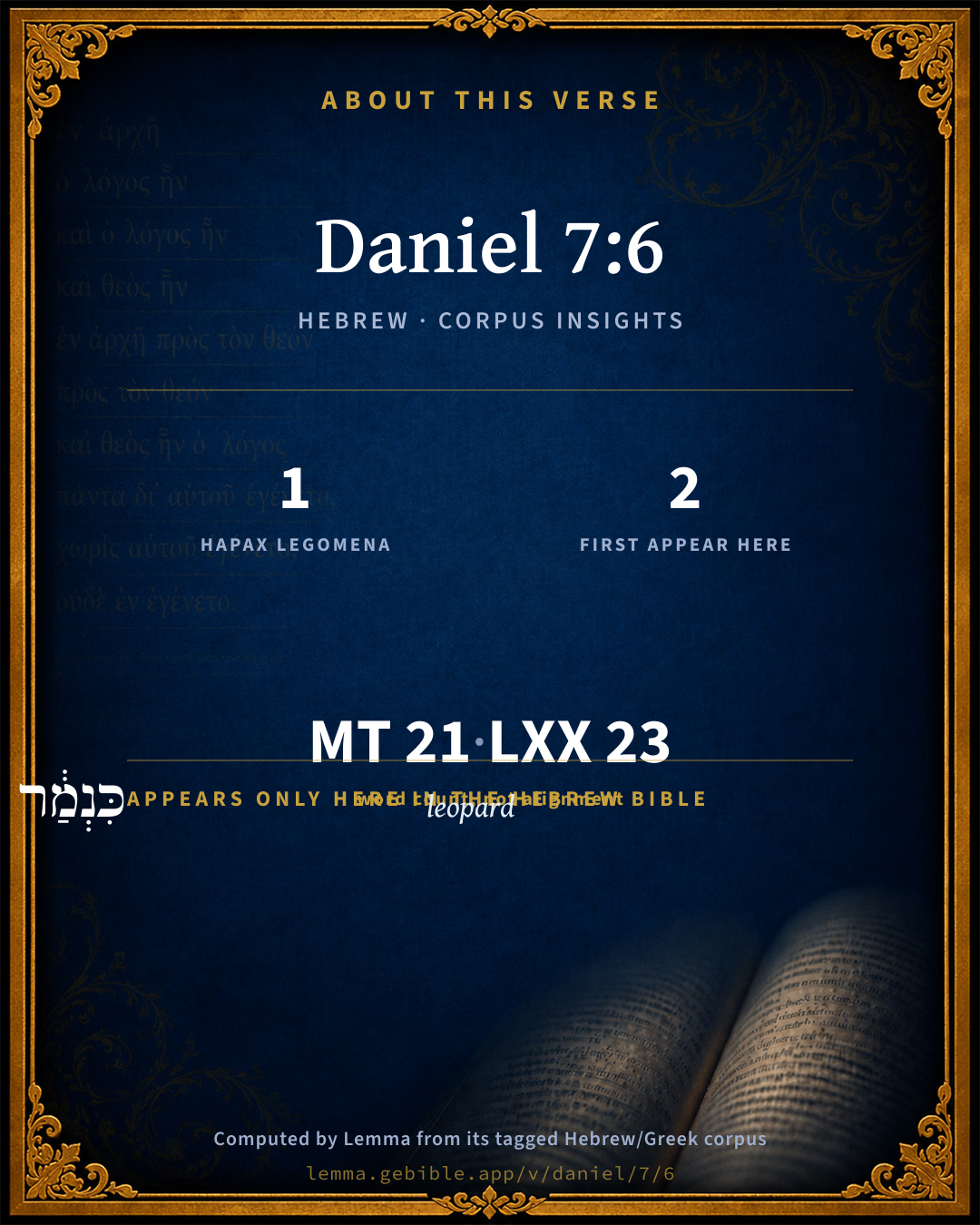
  • 1 hapax legomenon — only here in the Hebrew Bible
  • 2 first appearances in the Hebrew Bible
Full analysis ↓
Download a study sheet

One document with this verse’s original text, its word-by-word gloss line, the meaning frame, cross-references with their text, attributed commentary, and full source and license credits — printable, and it pastes into notes with its structure intact.

This verse Autodidact and up

Study sheet (.html) Plain text (.txt)

A passage Seminary Student

Up to 50 verses in one chapter. A passage sheet keeps up to 6 commentary sources and 12 cross-references per verse, in the order this page ranks them, and says so on the sheet whenever that leaves anything out. Ask for a single verse and you get the Autodidact verse sheet above.

Everything on this page stays free to read, with no account — the sheet is a download of what is already on screen, not access to it.

Want to remove ads? Support Godless Engineer
Compare translations 3

The same verse in 3 English versions, stacked beneath the original-language interlinear above. Click any original word for its lexicon entry.

Each is an independent rendering of the whole verse — the interlinear is not word-aligned to these translations.

Highlighted words mark where these versions differ — a whole-verse word diff, not a word-by-word alignment.

  • World English Bible Public Domain
    After this I saw, and, behold, another, like a leopard, which had on its back four wings of a bird; the animal had also four heads; and dominion was given to it.
  • King James Version Public Domain
    After this I beheld, and lo another, like a leopard, which had upon the back of it four wings of a fowl; the beast had also four heads; and dominion was given to it.
  • unfoldingWord Literal Text CC BY-SA 4.0
    After this I was looking, and behold, another, like a leopard, and on its back it had four wings of a bird. And the beast had four heads, and dominion was given to it.

unfoldingWord Literal Text — © unfoldingWord, licensed CC BY-SA 4.0. Word-aligned USFM3 via Door43 (git.door43.org/unfoldingWord/en_ult).

Versions to compare (up to 4)

3 of 4 selected

Show all 18 translations

Every available English version of this verse, each an independent rendering of the whole verse.

  • World English Bible Public Domain
    After this I saw, and, behold, another, like a leopard, which had on its back four wings of a bird; the animal had also four heads; and dominion was given to it.
  • Berean Standard Bible Public Domain
    Next, as I watched, another beast appeared. It was like a leopard, and on its back it had four wings like those of a bird. The beast also had four heads, and it was given authority to rule.
  • Majority Standard Bible Public Domain
    Next, as I watched, suddenly another beast appeared. It was like a leopard, and on its back it had four wings like those of a bird. The beast also had four heads, and it was given authority to rule.
  • King James Version Public Domain
    After this I beheld, and lo another, like a leopard, which had upon the back of it four wings of a fowl; the beast had also four heads; and dominion was given to it.
  • American Standard Version (1901) Public Domain
    After this I beheld, and, lo, another, like a leopard, which had upon its back four wings of a bird; the beast had also four heads; and dominion was given to it.
  • Revised Version (1885) Public Domain
    After this I beheld, and lo another, like a leopard, which had upon the back of it four wings of a fowl; the beast had also four heads; and dominion was given to it.
  • Geneva Bible (1599) Public Domain
    After this I behelde, and loe, there was an other like a leopard, which had vpon his backe foure wings of a foule: the beast had also foure heads, and dominion was giuen him.
  • Douay-Rheims (1899) Public Domain
    After this I beheld, and lo, another like a leopard, and it had upon it four wings as of a fowl, and the beast had four heads, and power was given to it.
  • Young's Literal Translation Public Domain
    `After this I was seeing, and lo, another like a leopard, and it hath four wings of a fowl on its back, and four heads hath the beast, and dominion is given to it.
  • Literal Standard Version CC BY-SA 4.0
    After this I was seeing, and behold, another like a leopard, and it has four wings of a bird on its back, and the beast has four heads, and dominion is given to it.
  • Unlocked Literal Bible CC BY-SA 4.0
    After this I looked again. There was another animal, one that looked like a leopard. On its back it had four wings like bird wings, and it had four heads. It was given authority to rule.
  • unfoldingWord Literal Text CC BY-SA 4.0
    After this I was looking, and behold, another, like a leopard, and on its back it had four wings of a bird. And the beast had four heads, and dominion was given to it.
  • Darby Bible Public Domain
    After this I saw, and behold, another, like a leopard, and it had four wings of a bird upon its back; and the beast had four heads; and dominion was given to it.
  • World Messianic Bible Public Domain
    “After this I saw, and behold, another, like a leopard, which had on its back four wings of a bird. The animal also had four heads; and dominion was given to it.
  • Webster's Bible Public Domain
    After this I beheld, and lo another, like a leopard, which had upon the back of it four wings of a fowl; the beast had also four heads; and dominion was given to it.
  • Free Bible Version CC BY-SA 4.0
    After this I saw a third beast. It looked like a leopard with four wings like those of a bird on its back, and it had four heads. It was given power to impose its rule.
  • Bible in Basic English Public Domain
    After this I saw another beast, like a leopard, which had on its back four wings like those of a bird; and the beast had four heads, and the power of a ruler was given to it.
  • JPS Tanakh (1917) Public Domain
    After this I beheld, and lo another, like a leopard, which had upon the sides of it four wings of a fowl; the beast had also four heads; and dominion was given to it.

Literal Standard Version (2020), Covenant Press — licensed CC BY-SA 4.0. Text via the HelloAO Bible API (eBible.org). Unlocked Literal Bible (unfoldingWord) — licensed CC BY-SA 4.0. Text via the HelloAO Bible API (eBible.org). unfoldingWord Literal Text — © unfoldingWord, licensed CC BY-SA 4.0. Word-aligned USFM3 via Door43 (git.door43.org/unfoldingWord/en_ult). Free Bible Version, Dr. Jonathan Gallagher — licensed CC BY-SA 4.0. Text via the HelloAO Bible API (eBible.org).

Word by word

More ways to search: Search by grammar → Find every occurrence → Compare this word →

Practice this passage: Drill this verse → Learn its vocabulary →

כִּנְמַ֔ר
nᵉmar
H5245
“like/as · leopard”
Adjective, R + Noun, Common, Masculine, Singular, Absolute
Part of Speech
Adjective + Noun
Type
Common
Gender
Masculine
Number
Singular
State
Absolute
Full BDB Definition

Origin: corresponding to H5246

TWOT: 2864

leopard
  1. בָּאתַ֨ר ʼăthar H870 “track” Adjective, R
  2. דְּנָ֜ה dên H1836 “this” Adjective, P
  3. חָזֵ֣ה chăzâʼ H2370 “seeing” Adjective, V
  4. הֲוֵ֗ית hâvâʼ H1934 “to become” Adjective, V, Plural
  5. וַאֲר֤וּ ʼărûw H718 “and · behold” Adjective, C + Particle, Demonstrative
  6. אָֽחֳרִי֙ ʼochŏrîy H317 “other” Adjective, A
  7. גַּפִּ֥ין gaph H1611 “wings” Adjective, N, Common
  8. אַרְבַּ֛ע ʼarbaʻ H703 “four” Adjective, A, Common
  9. דִּי dîy H1768 “which” Adjective, T
  10. ע֖וֹף ʻôwph H5776 “fowl” Adjective, N, Common
  11. עַל ʻal H5922 “upon” Adjective, R
  12. גביה gab H1355 “backs · the” Adjective, N, Common + Particle, Definite Article
  13. גַּבַּ֑הּ gab H1355 “back · her” Adjective, N, Common + Suffix, Personal, 3rd Person, Feminine, Singular
  14. וְאַרְבְּעָ֤ה ʼarbaʻ H703 “and · four” Adjective, C + Adjective, Cardinal number, Both, Singular, Absolute
  15. רֵאשִׁין֙ rêʼsh H7217 “chiefs” Adjective, N, Common
  16. לְחֵ֣יוְתָ֔א chêyvâʼ H2423 “to/for · beast · the” Adjective, R + Noun, Common, Feminine, Singular, Determined + Particle, Definite Article
  17. וְשָׁלְטָ֖ן sholṭân H7985 “and · dominion” Adjective, C + Noun, Common, Masculine, Singular, Absolute
  18. יְהִ֥יב yᵉhab H3052 “to give” Adjective, V, Plural

About this verse

These counts appear in no published source. They are computed here, from the morphology-tagged text and Lemma’s own curated glosses. What Lemma adds →

21
words
17
distinct lemmas
Prophets
section

Notable vocabulary

1 hapax legomenon — a word that appears only here in the entire Hebrew Bible:

  • כִּנְמַ֔ר leopard H5245

First appearance in Scripture

These words make their first canonical appearance in the Hebrew Bible here:

  • כִּנְמַ֔ר leopard H5245
  • גביה back H1355

Shared distinctive vocabulary

ע֖וֹף fowl H5776 occurs in 2 verses of the Hebrew Bible. Also found in:

Grammatical profile

  • 2 nouns
  • 15 adjectives
  • 1 preposition
  • 3 particles

Repetition

Words recur within this verse — often emphatic in Hebrew:

  • אַרְבַּ֛ע four H703 ×2
  • גביה back H1355 ×2

Hebrew & Septuagint length

In English translation the verse runs 32 words from the Hebrew and 36 from the Septuagint (LXX English) — closely comparable.

A rough comparison of the two English renderings, which tokenize alike — not a word-level alignment.

Word counts can differ between the Hebrew and the Greek without any difference in meaning — e.g. the Hebrew direct-object marker אֵת has no separate Greek word, and Greek often adds the article ὁ.

In the original languages it is 21 Hebrew tokens and 23 Greek tokens — but the two are counted differently (Hebrew bundles its prefixes and suffixes into one token; the Greek is in lemma form), so that isn’t a like-for-like length.

Cross-references

9

Topical passages linked to Daniel 7:6 in the Treasury of Scripture Knowledge — connected by theme and wording, ordered by reader-vote popularity; previews shown in the World English Bible.

  • Revelation 13:2 The beast which I saw was like a leopard, and his feet were like those of a bear, and his mouth like the mouth of a lion. The dragon gave him his power, his throne, and great authority.
  • Daniel 11:3–20 A mighty king shall stand up, who shall rule with great dominion, and do according to his will.
  • Ezekiel 17:3 and say, Thus says the Lord Yahweh: A great eagle with great wings and long feathers, full of feathers, which had various colors, came to Lebanon, and took the top of the cedar:
  • Daniel 2:39 After you shall arise another kingdom inferior to you; and another third kingdom of brass, which shall bear rule over all the earth.
  • Daniel 7:4 The first was like a lion, and had eagle's wings: I saw until the wings of it were plucked, and it was lifted up from the earth, and made to stand on two feet as a man; and a man's heart was given to it.
  • Daniel 8:5–8 As I was considering, behold, a male goat came from the west over the surface of the whole earth, and didn't touch the ground: and the goat had a notable horn between his eyes.
  • Daniel 8:20–22 The ram which you saw, that had the two horns, they are the kings of Media and Persia.
  • Daniel 10:20 Then he said, "Do you know why I have come to you? Now I will return to fight with the prince of Persia. When I go forth, behold, the prince of Greece shall come.
  • Hosea 13:7 Therefore am I to them like a lion; Like a leopard I will lurk by the path.

Cross-references courtesy of OpenBible.info (CC BY 4.0).

Hebrew and Greek witnesses Masoretic Hebrew ↔ Greek Septuagint

The same verse in the two great witnesses to the Old Testament, shown verse-for-verse.

These are two independent witnesses, not word-aligned to each other, and the Septuagint is shown in lemma (dictionary) form.

Hebrew Daniel 7:6 Masoretic · Westminster Leningrad Codex

בָּאתַ֨ר דְּנָ֜ה חָזֵ֣ה הֲוֵ֗ית וַאֲר֤וּ אָֽחֳרִי֙ כִּנְמַ֔ר וְלַ֨הּ גַּפִּ֥ין אַרְבַּ֛ע דִּי ע֖וֹף עַל גביה גַּבַּ֑הּ וְאַרְבְּעָ֤ה רֵאשִׁין֙ לְחֵ֣יוְתָ֔א וְשָׁלְטָ֖ן יְהִ֥יב לַֽהּ

After this I saw, and, behold, another, like a leopard, which had on its back four wings of a bird; the animal had also four heads; and dominion was given to it.

World English Bible · Public Domain

Greek LXX Daniel 7:6 Septuagint · lemma form

καί μετά οὗτος θεωρέω θηρίον ἄλλος ὡσεί πάρδαλις καί πτερόν τέσσαρες ἐπιτεινώ ἐπάνω αὐτός καί τέσσαρες κεφαλή ὁ θηρίον καί γλῶσσα δίδωμι αὐτός

After this one I looked, and behold another wild beast as a leopard, and it had four wings of a bird upon it: and the wild beast had four heads, and power was given to it.

LXX2012 (modern English Septuagint) · Public Domain

On this verse, The Pulpit Commentary discusses the Septuagint’s reading. Read the note in Commentary ↓

Hebrew: Westminster Leningrad Codex (CC BY 4.0). Greek: Septuagint (public domain); English from LXX2012 (modern English Septuagint) (Public Domain). How the Septuagint differs from the Hebrew →

Commentary

Notes on Daniel 7:6 from classic Christian and Jewish commentators (each source and its license shown beneath its notes). The classic Christian expositions comment on the surrounding passage and are grouped to its opening verse, so a note may address several verses; the Jewish commentaries on the Tanakh (Rashi and others) are per-verse, so they appear only where the commentator wrote on this verse.

Lemma curates 59 commentaries, every one of them public domain or Creative Commons licensed, each selected and text-cleaned for this edition rather than reprinted as found. About our sources →

Trapp's Complete Commentary

John Trapp

Dan 7:6 After this I beheld, and lo another, like a leopard, which had upon the back of it four wings of a fowl; the beast had also four heads; and dominion was given to it.

Ver. 6. After this I beheld, and lo another, like a leopard.] Which is a creature cruel, desirous of man’s blood, crafty, spotted, and very swift of foot. So were the Grecians; Alexander especially (the founder of that third monarchy), active, bold, and headlong, but directed much by those who had been counsellors to his father Philip, a subtle prince; leopard-like, he was spotted by a mixture of virtues and vices; he was very quick of despatch, Mηδεν αναβαλλομενος, never deferring any enterprise; he much delighted in wine, and so took his death; like as the leopard is no way else to be taken but by such a bait laid for him.

Which had upon the back of it four wings.] Denoting the rapidity and celerity of Alexander and some other of the Grecian monarchs, in overrunning countries, as if they had flown.

The beast had also four heads,] i.e., This monarchy was, after Alexander’s death, divided into four satrapies, or rather kingdoms. Cassander had Macedonia; Antigonus, Asia; Seleucus, Syria; and Ptolemy, Egypt.

John Trapp, A Commentary or Exposition upon All the Books of the Old and New Testament (1647–1656) — public domain. Text from a community e-Sword module.

The Biblical Illustrator

Joseph S. Exell

Dan_7:6

Like a leopard.

Alexander the Great

The empire which rose on the ruins of the second monarchy was the Grecian. Alexander the Great subverted the Persian empire. The leopard is remarkable for its swiftness, and for the eagerness with which it springs upon its prey; and we know, also, how rapid were the conquests of Alexander, how eager he was to subdue all nations. This rapidity is symbolized in the vision by the four wings which the leopard had on its back. The leopard with four wings reigned over the vanquished bear. The leopard also prefigured the downfall of the Grecian kingdom. The leopard was seen with four wings upon its back; but besides these wings, it is described as having four heads, and these four heads symbolized its downfall. When Alexander died, his kingdom was divided among his captains, four of them. (W. Wood, A.M.)

The Wings of Alexander the Leopard

During the time occupied in the reduction of the Sogdians, the most heroic opposition was displayed by a company of the people, who, under the command of their governor, Arimazes, had fortified themselves upon a rock, situated near the river Oxus, which was considered impregnable. The Macedonians were as determined to drive them from their stronghold as the besieged were resolved not to be overcome. Alexander summoned the barbarians to yield themselves his prisoners; whereupon Arimazes, conceiving it impossible that his position could be reached, and knowing that he possessed ammunition and provisions sufficient for two years, returned the following laconic and undaunted answer: Can Alexander, who is able to do all things, fly also? And hath nature, on a sudden, given him wings? Exasperated at this reply to his message, the emperor gave orders to three hundred mountaineers, chosen from his army, to scale the place of refuge by night. Notwithstanding the perils attending so arduous an enterprise, the men succeeded, after witnessing the sacrifice of thirty-two of their party, who were precipitated and destroyed, in attaining a point higher than that inhabited by the natives. In the morning, when the signal on the peak of the rock wan descried by the Macedonians waving triumphantly over the heads of the Sogdians beneath, Alexander despatched one of his retinue to the governor, with an imperative injuction to surrender. Arimazes, being still ignorant of the extraordinary feat that had been performed, sent back an answer equally insolent with the former; but the officer, instead of returning with the reply, pointed to the soldiers stationed on the height above, and, remembering the nature of the message recently transmitted to his master, exclaimed, You see that Alexanders soldiers have wings. At this, Arimazes surrendered the garrison and supplicated clemency. (Charles Popham Miles.)

The Biblical Illustrator, edited by Joseph S. Exell (c. 1880s–1900s) — public domain. Text from a community e-Sword module.

Joseph Benson's Commentary

Dan 7:6. After this I beheld, and lo, another like a leopard — “This third kingdom is that of the Macedonians, or Grecians, who, under the command of Alexander the Great, overcame the Persians, and reigned next after them: and it is fitly compared to a leopard upon several accounts. The leopard is remarkable for swiftness, and Alexander and the Macedonians were amazingly swift and rapid in their conquests. The leopard is a spotted animal, and so was a proper emblem, according to Bochart, of the different manners of the nations which Alexander commanded; or, according to Grotius, of the various manners of Alexander himself, who was sometimes merciful, and sometimes cruel; sometimes temperate, and sometimes drunken; sometimes abstemious, and sometimes incontinent. The leopard, as Bochart observes, is of small stature, but of great courage, so as not to be afraid to engage with the lion and the larger beasts; and so Alexander, a little king, in comparison, of small stature too, and with a small army, dared to attack the king of kings, that is, Darius, whose kingdom was extended from the Ægean sea to the Indies. Which had upon the back of it four wings of a fowl — The Babylonian empire was represented with two wings, but this is described with four. For, as Jerome says, nothing was swifter than the victories of Alexander, who ran through all the countries from Illyricum and the Adriatic sea to the Indian ocean and the river Ganges, not so much fighting as conquering; and in six years (he should have said in twelve) subjugated part of Europe and all Asia to himself. The beast had also four heads — To denote the four kingdoms into which this same third kingdom should be divided, as it was after the death of Alexander, among his four captains; Cassander reigning over Macedon and Greece, Lysimachus over Thrace and Bithynia, Ptolemy over Egypt, and Seleucus over Syria. And dominion was given to it — Which shows, as Jerome observes, that it was not owing to the fortitude of Alexander, but proceeded from the will of the Lord. And, indeed, unless he had been directed, preserved, and assisted by the mighty power of God, how could Alexander, with thirty thousand men, have overcome Darius with six hundred thousand, and in so short a time have brought all the countries, from Greece as far as to India, into subjection.” — Bishop Newton.

Joseph Benson's Commentary on the Old and New Testaments (1811–1818) — public domain. Text from a community e-Sword module.

Tyndale Open Study Notes

Tyndale Open Resources

7:6 The leopard was known for its speed and agility (Hab 1:8). Four bird’s wings and four heads indicate the scope and speed of this fierce nation’s military campaigns. Greece conformed to this symbolism well, especially under Alexander the Great, whose kingdom was divided into four parts following his death in 323 BC.

Tyndale Open Study Notes — © Tyndale Open Resources, licensed CC BY-SA 4.0. Text via the HelloAO Bible API.

Geneva Bible (1599)

Geneva Bible translators

That is, his four chief captains, which had the empire among them after his death. Seleucus had Asia the great, Antigonus the less, Cassander and after him Antipater was king of Macedonia, and Ptolemy had Egypt.

Meaning, Alexander the king of Macedonia.

It was not of himself nor of his own power that he got all these countries: for his army contained but thirty thousand men, and he overcame in one battle Darius, which had ten hundred thousand, when he was so heavy with sleep, that his eyes were scarce open, as the stories report: therefore this power was given him of God.

Geneva Bible (1599) marginal notes — public domain. Text via Bolls.life.

Jamieson, Fausset & Brown

Robert Jamieson, A. R. Fausset & David Brown

leopard--smaller than the lion; swift (Hab 1:8); cruel (Isa 11:6), the opposite of tame; springing suddenly from its hiding place on its prey (Hos 13:7); spotted. So Alexander, a small king, of a small kingdom, Macedon, attacked Darius at the head of the vast empire reaching from the Ægean Sea to the Indies. In twelve years he subjugated part of Europe, and all Asia from Illyricum and the Adriatic to the Ganges, not so much fighting as conquering [JEROME]. Hence, whereas Babylon is represented with two wings, Macedon has four, so rapid were its conquests. The various spots denote the various nations incorporated into his empire [BOCHART]; Or Alexander's own variation in character, at one time mild, at another cruel, now temperate, and now drunken and licentious.

four heads--explained in Dan 8:8, Dan 8:22; the four kingdoms of the Diadochi or "successors" into which the Macedonian empire was divided at the death of Alexander, namely, Macedon and Greece under Cassander, Thrace and Bithynia under Lysimachus, Egypt under PTOLEMY, and Syria under Seleucus.

dominion . . . given to it--by God; not by Alexander's own might. For how unlikely it was that thirty thousand men should overthrow several hundreds of thousands! JOSEPHUS [Antiquities, 11.6] says that Alexander adored the high priest of Jerusalem, saying that he at Dium in Macedonia had seen a vision of God so habited, inviting him to go to Asia, and promising him success.

Jamieson, Fausset & Brown — Commentary Critical and Explanatory on the Whole Bible (1871) — public domain (CC PDM 1.0). Text via the HelloAO Bible API.

Adam Clarke's Commentary

Verse 6. Another like a leopard - four wings - four heads] This was the Macedonian or Greek empire; and Alexander the Great its king. Alexander and his subjects are fitly compared to a leopard.

1. The leopard is remarkable for its swiftness. Alexander and the Macedonians were very rapid in their conquests.

2. The leopard is a spotted animal; a proper emblem of the various nations, with their various customs and languages, which constituted the Macedonian empire. It may refer to the character of Alexander himself, sometimes mild, at others cruel; sober and drunken; continent and lecherous; having a great power of self-government, and at other times being a slave to his passions.

3. The leopard, though small, is not afraid to attack the lion.

Four wings of a fowl] The Babylonian empire was represented with two wings; and they sufficiently marked the rapidity of Nebuchadnezzar's conquests; but the Macedonian has here four wings; for nothing, in the history of the world, was equal to the conquests of Alexander, who ran through all the countries from Illyricum and the Adriatic Sea to the Indian Ocean and the River Ganges; and in twelve years subdued part of Europe, and all Asia.

The beast had also four heads] Signifying the empire after the death of Alexander, divided between his four generals. Cassander reigning over Macedon and Greece; Lysimachus, over Thrace and Bithynia; Ptolemy, over Egypt; and Seleucus, over Syria.

Dominion was given to it.] It was not owing to the skill, courage, or valour of Alexander and his troops, that he made those wondrous conquests; the nations were given to him. For, as Bishop Newton says, had he not been assisted by the mighty power of God, how could he, with only thirty thousand men, have overcome Darius with six hundred thousand; and in so short a time have brought the countries from Greece as far as India into subjection?

Adam Clarke's Commentary on the Bible (1810–1826) — public domain. Text from a community e-Sword/MySword module.

John Calvin's Commentaries

Daniel has already spoken of two empires, namely, the Chaldean and Persian. Interpreters agree in the necessity for referring this vision to the Macedonian Empire. He compares this kingdom to a leopard, or, as some translate, a panther, since Alexander obtained his great power through swiftness alone; and although it is not by any means a striking animal, yet it managed by its remarkable speed to subdue the whole east Others bring forward many points of likeness, in which the Grecian character is in accordance with the nature of the leopard. But I fear these minutiae have but little weight: it is sufficient for me that the Spirit treats here of the Third empire. It was not of any importance at first, and could neither terrify distant regions, nor acquire subjects by its own worthiness. It then became like some swift animal, if I may say so, since the swiftness of Alexander is notorious; but he did not excel in either prudence, or gravity, or judgment, or in any other virtues. Mere rashness seized upon him; and even if he had never tasted wine, his ambition would have intoxicated him. Hence Alexander’s whole life was drunken; there was neither moderation nor composure in him. We see, then, how suitably this answers to the character of Alexander, although this is also extended to his successors, all of whom partook largely of the nature of their prince. Daniel says, therefore, A beast appeared to him like a leopard

He also says, It had four wings on its back, and four heads Some persons, as I think perversely, distinguish between the wings and the heads. They suppose the kingdom to be depicted as winged because Alexander seized upon manly kingdoms in a short period; but the more simple sense is, this beast had four wings and four heads, because Alexander had scarcely completed his victories when he died, contrary to all expectation; and after his death, every one seized a portion of the prey for himself. This, however, is certain: after the chief generals of his army had contended for many years, all histories agree in stating that the supreme power centered in four. For Seleucus obtained Asia Major, and Antigonus Asia Minor, Cassander was king of Macedon, and was succeeded by Antipater, while Ptolemy the son of Lagus became the ruler of Egypt They had agreed indeed otherwise among themselves; for Alexander had a son by Roxana, first daughter of Darius; he had a brother, Aridaeus, who grew up to manhood, but was epileptic and of weak intellect. Then, since the generals of Alexander were cunning, they acted on this pretext, that all should swear allegiance to their young ward, and then to Aridaeus, in case their ward should die before he was of age. Then Lysimachus was set over the treasury, and another commanded the forces, and others obtained various provinces. Fifteen or twenty leaders divided among themselves both offices and power, while no one dared to assume the name of king. For Alexander’s son was the lawful king, and his successor was that Aridaeus of whom I have spoken. But they soon afterwards united; and that was an admirable specimen of God’s Providence, which alone is sufficient to prove that passage of Scripture He who sheds man’s blood, by man shall his blood be shed. (Genesis 9:6.) For none of Alexander’s generals escaped in safety except those four whom we have mentioned. His mother, at the age of eighty, suffered a violent death; his wife, Roxana, was strangled; his son perished miserably; Aridaeus, his brother, a man of no intellect, and almost on a level with the brutes, was slain with the rest — in truth, the whole family of Alexander suffered violent deaths. With respect to the generals, they perished in battles, some of them being betrayed by their soldiers, and others the victims of their own negligence; and yet, although they expected a sanguinary end, they did not escape it. But four only survived, and so the whole empire of Alexander was divided into four parts. For Seleucus, whose successor was Antiochus, obtained Upper Asia, that is, four eastern empire; Antigonus, Asia Minor, with a part of Cilicia, and Phrygia, and other neighboring regions; Ptolemy seized upon Egypt and a part of Africa; Cassander and then Antipater were kings of Macedon. By four wings and four heads, Daniel means that partition which was made immediately after the death of Alexander. Now, therefore, we understand what God showed to his Prophet under this vision, when he set before him the image of a leopard with four wings and heads.

He says, Power was given to the beast, because the success of Alexander the Great was incredible. For who would have thought, ‘when he was crossing the sea, that he would have conquered all Asia and the East? he led with him 50,000 men, and did not undertake the war on his own responsibility alone, but by various arts, he procured the nomination to the leadership of Greece from the Free States. Alexander was therefore, a kind of mercenary of the Greeks, and was unable to lead with him more than 30,000 men, as we have said he engaged in battle with 150,000, then with 400,000, and then with almost a myriad. For Darius in his last battle had collected above 800,000 men besides camp-followers, so that there were almost a million with him. Alexander had already drawn to himself some auxiliaries from the foreign nations whom he had conquered; but he could not trust them: hence his whole strength lay in these 30,000, and on the day on which he conquered Darius, he was so overcome by sleep that he could scarcely be aroused. The historians who extol his prudence, excuse this by recording his sleeplessness during the preceding night; besides, all agree in stating him to have been apparently dead, and when all his generals approached they could scarcely wake him up, and then they purposely raised a shout around his tent, though no one dared to enter. Alexander had scarcely wiped his eyes, when Darius fled; hence the Prophet’s statement is true — a beast’s power was given to him, since this happened beyond every natural expectation and every human opinion, as by his aspect although he could frighten all Greece, and lay prostrate so large an army. He states this of the Third Empire. I will not repeat here all that can be said and can be gathered from history; for many things must be put off till the eleventh chapter. I will therefore briefly compress whatever points seem necessary for the interpretation of the passage. It now follows, —

John Calvin's Commentaries (1540-1563) — public domain. Text from the Calvin Translation Society English edition (1840s-50s) via the Christian Classics Ethereal Library (ccel.org). Calvin's coverage is partial (roughly two-thirds of the Bible); uncommented books and verses are honest gaps, never fabricated. The 19th-century editor's footnotes and remarks are omitted so the notes are faithfully Calvin's own voice.

Ellicott's Commentary for English Readers

(6) A leopard.—More correctly, a panther. On the great vigilance and swiftness of the panther, comp. Jer_5:6; Hos_13:7; Hab_1:8. The third beast corresponds to the copper belly and thighs of the image (Daniel 2). It should be noticed that as unity characterises the first beast, and duality the second, so quadruplicity marks the third. It has four wings—wings as of a bird, not of an eagle—by which a degree of swiftness is implied inferior to that of the first beast. It has four heads, indicating four kingdoms, into which the third kingdom should develop itself. (Comp. Dan_8:8, where the same predominance of the number “four” is to be observed.)

A Bible Commentary for English Readers, edited by Charles John Ellicott (1878–1897) — public domain. Text from a community e-Sword module.

The Cambridge Bible for Schools and Colleges

gen. ed. J. J. S. Perowne

6. The third beast. A leopard.

upon the back of it] The Aram. word means both back and side; and, as the Heb. text (K’tib) has the mark of the plural, perhaps we ought to render on its sides (so Bevan, Behrmann).

of a fowl] i.e., as we should now say, of a bird.

The leopard is a fierce, carnivorous animal, remarkable for the swiftness and agility of its attack (cf. Hab_1:8, where the horses of the Chaldæans are said to be ‘swifter than leopards’). It is particularly dangerous to cattle; and “specially noted for the patience with which it waits, extended on the branch of a tree, or a rock near a watering place, expecting its prey, on which it springs with a deadly precision. Hence Hos_13:7, ‘as a leopard by the way will I observe them’; Jer_5:6” (G. E. Post, in Hastings’ Dict. of the Bible, s. v.).

Here the four wings upon the leopard’s back indicate that it is invested with more than ordinary agility of movement; while the four heads, looking, it may be presumed, towards the four quarters of the earth, are meant apparently to indicate that the empire which it symbolised was to extend in every direction[270]. It was thus a fit emblem of the Persian empire, the founder of which, Cyrus, astonished the world by the extent and rapidity of his conquests.

[270] So at least Keil, Meinhold, Behrmann. Others, however, as von Lengerke, Ew., Hitz., Delitzsch, Kuenen, Bevan, Prince, think that the four heads denote the four kings of Persia referred to in Dan_11:2.

and dominion was given to it] emphasizing the vastness of its rule: cf. Dan_2:39, where the corresponding empire is described as ‘ruling over all the earth.’

The Cambridge Bible for Schools and Colleges (gen. ed. J. J. S. Perowne; Cambridge University Press, 1878–1918) — public domain. Text from a community e-Sword module.

John Gill's Exposition

After this I beheld, and, lo another, like a leopard,.... Another beast, another monarchy, a third monarchy succeeding the Persian monarchy, and which rose up on the ruins of that; Darius king of the Persians being beaten by Alexander king of Macedon, who was the instrument of setting up the Grecian monarchy here intended; compared to a leopard, a smaller creature than a lion; signifying that this monarchy arose from a small beginning; and a crafty one, Alexander having many wise counsellors of his father's about him, though he himself was rash and hasty; and a spotted one, denoting the various virtues and vices of Alexander, and his inconstancy in them; sometimes exercising the one, and sometimes the other; or rather the different nations, and the manners of them, he conquered, of which this empire consisted; not to say anything of the cruelty and swiftness of this creature, which are both to be observed in this conqueror:

which had upon the back of it four wings of a fowl; denoting the swiftness of Alexander in his conquests; who in a few years made himself master of the whole world, at least as he thought, whose empire was greater than that of Nebuchadnezzar and the Chaldeans, to whom only two wings of an eagle are given, Dan 7:4. Says Jerom,

"nothing was more swift than the conquest of Alexander, from Illyricum and the Adriatic sea, unto the Indian ocean, and the river Ganges; he rather ran through the world by victories than by battles, and in six years subdued part of Europe, all Asia even unto India,''

to which may be added all Egypt, Syria, and Palestine. Arimazes being master of a rock in Sogdiana, which was thought inaccessible and impregnable, Alexander sent a messenger to him to demand the delivery of it to him; but, among other things he proudly said, he asked the messenger, with a sneer, if Alexander could fly; which, when the messenger reported, nettled him much, that he should be insulted because he had not wings; and vowed that the next night he would make him believe that the Macedonians did fly; and accordingly they found ways and means to get to the top of it, which, when the governor saw, he declared that Alexander's soldiers had wings (f):

the beast also had four heads; which signify the four kingdoms into which the Grecian empire was divided after Alexander's death, under four of his generals, who were heads or governors of them: Macedonia under Antipater, or, as others, Cassander; Egypt under Ptolemy; Syria under Seleucus; and Asia under Antigonus, or, as others, Lysimachus:

and dominion was given to it; the dominion of the whole world, or, however, a very large dominion; and this was given of God, and according to his will, and the ordering of his providence; for to nothing else can it be ascribed, that with thirty thousand men Alexander should beat an army of six hundred thousand; and with such a handful of men subdue so many kingdoms and nations, and that in the space of a few years.

(f) Curt. Hist. l. 7. c. 11.

John Gill's Exposition of the Whole Bible (1746–1763) — public domain (CC PDM 1.0). Text via the HelloAO Bible API.

Albert Barnes' Notes on the Bible

After this I beheld, and, lo, another, like a leopard - That is, as before, after the bear had appeared - indicating that this was to be a succeeding kingdom or power. The beast which now appeared was a monster, and, as in the former cases, so in regard to this, there are several circumstances which demand explanation in order to understand the symbol. It may assist us, perhaps, in forming a correct idea of the symbol here introduced to have before us a representation of the animal as it appeared to Daniel.

(a) The animal itself: “a leopard.” The word used here - נמר nemar - or in Hebrew נמר nâmêr - denotes a panther or leopard, so called from his spots. This is a well-known beast of prey, distinguished for blood-thirstiness and cruelty, and these characteristics are especially applicable to the female panther. The animal is referred to in the Scriptures as emblematic of the following things, or as having the following characteristics:

(1) As next in dignity to the lion - of the same general nature. Compare Bochart, Hieroz. P. I. lib. iii. c. vii. Thus the lion and the panther, or leopard, are often united in the Scriptures. Compare Jer 5:6; Hos 13:7. See also in the Apocrypha, Ecclesiasticus 28:23. So also they are united in Homer, r

Ὄυτε οἶν παρδάλιος τόσσον μένος, ὄυτε λέοντος.

Oute oun pardalios tosson menos, oute leontos.

“Neither had the leopard nor the lion such strength.”

(2) As distinguished for cruelty, or a fierce nature, as contrasted with the gentle and tame animal. Isa 11:6, “and the leopard shall lie down with the kid.” In Jer 5:6, it is compared with the lion and the wolf: “A lion out of the forest shall slay them, and a wolf of the evenings shall spoil them, a leopard shall watch over their cities.” Compare Hos 13:7.

(3) As distinguished for swiftness or fleetness. Hab 1:8 : “their horses are swifter than the leopards.” Compare also the quotations from the classics in Bochart as above, p. 788. His fleetness is often referred to - the celerity of his spring or bound especially - by the Greek and Roman writers.

(4) As insidious, or as lying in wait, and springing unexpectedly upon the unwary traveler. Compare Hos 13:7 : “As a leopard by the way will I observe them;” that is, I will “watch” (אשׁור 'âshûr) them. So Pliny says of leopards: Insidunt pardi condensa arborurn, occultatique earurn ramis in prcetereuntia desiliunt.

(5) They are characterized by their spots. In the general nature of the animal there is a strong resemblance to the lion. Thus, an Arabic writer quoted by Bochart, deflates the leopard to be “an animal resembling the lion, except that it is smaller, and has a skin marked by black spots.” The proper idea in this representation, when used as a symbol, would be of a nation or kingdom that would have more nobleness than the one represented by the bear, but a less decisive headship over others than that represented by the lion; a nation that, was addicted to conquest, or that preyed upon others; a nation rapid in its movements, and springing upon others unawares, and perhaps in its spots denoting a nation or people made up, not of homogeneous elements, but of various different people. See below in the application of this.

(b) The four wings: which had upon the back of it four wings of a fowl. The first beast was seen with the wings of an eagle, but without any specified number; this appears with wings, but without specifying any particular kind of wings, though the number is mentioned. In both of them celerity of movement is undoubtedly intended - celerity beyond what would be properly denoted by the animal itself the lion or the leopard. If there is a difference in the design of the representation, as there would seem to be by mentioning the kind of wings in the one case, and the number in the other, it is probable that the former would denote a more bold and extended flight; the latter a flight more rapid, denoted by the four wings. We should look for the fulfillment of the former in a nation that extended its conquests over a broader space; in the latter, to a nation that moved with more celerity. But there is some danger of pressing these similitudes too far. Nothing is said in the passage about the arrangement of the wings, except that they were on the back of the animal. It is to be supposed that there were two on each side.

(c) The four heads: “the beast had also four heads.” This representation must have been designed to signify either that the one power or kingdom denoted by the leopard was composed of four separate powers or nations now united in one; or that there were four successive kings or dynasties that made up its history; or that the power or kingdom actually appeared, as seen in its prevailing characteristic, as a distinct dominion, as having four heads, or as being divided into so many separate sovereignties. It seems to me that either one of these would be a proper and natural fulfillment of the design of the image, though the second suggested would be less proper than either of the others, as the heads appeared on the animal not in succession - as the little horn sprung up in the midst of the other ten, as represented in the fourth beast - but existed simultaneously. The general idea would be, that in some way the one particular sovereignty had four sources of power blended into one, or actually exerted the same kind of dominion, and constituted, in fact, the one kingdom as distinguished from the others.

(d) The dominion given to it: “and dominion was given to it.” That is, it was appointed to rule where the former had ruled, and until it should be succeeded by another - the beast with the ten horns.

In regard to the application of this, though the angel did not explain it to Daniel, except in general that a kingdom was represented by it. Dan 7:17, it would seem that there could be little difficulty, though there has been some variety in the views entertained. Maurer, Lengerke, and some others, refer it to the Medo-Persian empire - supposing that the second symbol referred to the kingdom of Media. But the objections to this are so obvious, and so numerous, that it seems to me the opinion cannot be entertained, for

(1) the kingdom of Media did not, in any proper sense, succeed that of Babylon;

(2) the representation of the bear with three ribs has no proper application to Media;

(3) the whole description, as we have seen above, of the second beast, accords entirely with the history of the Medo-Persian empire.

If this be so, then we naturally look for the fulfillment of this symbol - the third head - in the kingdom or dynasty that followed directly that of Medo-Persia - the Macedonian dynasty or kingdom founded by Alexander the Great, extending over the same countries before occupied by Babylon and the Medo-Persian empire, and continuing until it was swallowed up in the conquests of Rome. We shall find that all the circumstances agree with this supposition:

(a) The animal - the leopard. The comparative nobleness of the animal; a beast of prey; the celerity of its movements; the spring or bound with which it leaps upon its prey - all agree well with the kingdom of which Alexander was the founder. Indeed there was no other kingdom among the ancients to which it could be better applied; and it will be admitted that, on the supposition that it was the design of Daniel to choose a symbol that would represent the Macedonian empire, he could not have selected one that was better adapted to it than the leopard. All the characteristics of the animal that have been noticed -

(1) as next in dignity to the lion:

(2) as distinguished for a fierce nature;

(3) as characterized by fleetness;

(4) as known for lying in wait, and springing suddenly upon its prey; and

(5) in the point to be noticed soon - their spots - all agree with the characteristics of Alexander, and his movements among the nations, and with the kingdom that was founded by him in the East.

(b) The four wings. These represent well the rapidity of the conquests of Alexander, for no more rapid conquests were ever made than were his in the East. It was noticed that the leopard had four wings, as contrasted with the first beast, in reference to which the number is not mentioned: the one denoting a broader flight, and the other a more rapid one; and the one agrees well with the conquests of Nebuchadnezzar, and the other with those of Alexander.

(c) The four heads united to one body. It is well known that when Alexander died, his empire was left to four of his generals, and that they came to be at the head of as many distinct dominions, yet all springing from the same source, and all, in fact, out of the Macedonian empire. This fact would not be so well represented by four distinct and separate animals, as by one animal with four heads; that is, as the head represents authority or dominion, one empire, in fact, now ruling by four distinct authorities. The one empire, considered as Macedonian, continued its sway until it was swallowed up by the Romans; that is, the Macedonian power or dominion as distinct from that of Babylon or Medo-Persia; as having characteristics unlike these; as introducing a new order of things, continued, though that power was broken up and exercised under distinct manifestations of sovereignty. The fact was, that, at the death of Alexander, to whom the founding of this empire was owing, “Philip Aridaeus, brother of Alexander, and his infant son by Roxana, were appointed by the generals of the army to succeed, and Perdiccas was made regent. The empire was divided into thirty-three governments, distributed among as many general officers. Hence arose a series of bloody, desolating wars, and a period of confusion, anarchy, and crime ensued, that is almost without a parallel in the history of the world. After the battle of Ipsus, 301 b.c., in which Antigonus was defeated, the empire was divided into four kingdoms - Thrace and Bithynia under Lysimachus; Syria and the East under Seleucus; Egypt, under Ptolemy Soter; and Macedonia under Cassander.” - Lyman Hist. Chart. It was these four powers, thus springing out of the one empire founded by Alexander, that was clearly represented by. the four heads.

(d) The dominion given to it. No one can doubt that a dominion was given to Alexander and the Macedonian dynasty, which would fully correspond with this. In fact the dominion of the world was practically conceded to that kingdom.

(e) There is only one other circumstance to be noticed, though perhaps we are not to seek an exact accomphshment for that in any specific events. It is the fact tbat the leopard is marked by spots - a circumstance which many have supposed had a fulfillment in the fact that numerous nations, not homogeneous, were found in the empire of Alexander. So Bochart, Hieroz. P. I. lib. iii. c. vii. p. 789, says: “The spots of the leopard refer to the different customs of the nations over which he ruled. Among these, besides the Macedonians, Greeks, Thracians, and Illyrians, in Europe, there were in Africa the Libyans, Egyptians, and Troglodites; in Asia, almost all the nations to the Ganges.” But, without insisting on this, no one can compare the other particulars which were clearly designed to be symbolic, without perceiving that they had a full accomplishment in the Macedonian empire.

Albert Barnes' Notes on the Bible (1834–1885) — public domain. Text from a community e-Sword/MySword module.

Haydock's Catholic Bible Commentary

Leopard, a small spotted beast, may denote the size and disposition of Alexander, as well as his rapid conquests. When he was asked how he had subdued so many, he answered, "by never putting off." (Calmet) --- Four. He led his forces on all sides; (Haydock) and after his death, his empire was divided into four, (Worthington) Egypt, Syria, Asia, and Macedon, (Theod.) as he had united in his person the empire of the Chaldees, Medes, Persians, and Greeks. (Calmet)

George Leo Haydock (1774–1849), Haydock's Catholic Family Bible and Commentary, 1859 edition — public domain. Excludes Psalms (Douay-Rheims chapter numbering differs from Protestant) and Deuterocanonical books (Catholic canon only).

Matthew Poole's English Annotations

This

leopard was the Grecian monarchy; a leopard is less than a lion, so was this monarchy at first, but yet durst fight with a lion; so did Alexander encounter Darius with a force very small to the other. A

leopard also for his swiftness; therefore described with

four wings on his back.

The beast had also four heads, because his commanders that succeeded him were four of his chief commanders, that divided that empire into four parts between them; and these were the four heads to whom dominion was given, Ptolemy, Seleucus, Philippus, Antigonus, or, as others, Perdiccas and Meleager, Dan 8:21,22. Dominion was given to it: Alexander did this by the mighty power of God; else how could he conquer Darius, that had six hundred thousand, with thirty thousand, and in so short a time go conqueror over Asia to the East Indies, I mean that part which now the Mogul possesseth, where he fought with Porus and beat him?

Matthew Poole's English Annotations on the Holy Bible (1683–1685) — public domain. Text from a community e-Sword/MySword module.

Whedon's Commentary on the Bible

Daniel D. Whedon

6. Since the second animal could not represent an independent Median empire, because, historically, there was no independent Median empire between Nebuchadnezzar and Alexander, and because Daniel himself joins together the Median and Persian law and kingdom as a unity (see note Dan_2:39) — therefore this four-winged, four-headed leopard does not represent the Persian empire, but that of Alexander the Great (Dan_8:21). Historically, no one doubts that the empire following that of Nebuchadnezzar was the Persian (or Medo-Persian,) whose first and greatest king was Cyrus, and that immediately following this came the empire of Alexander. There is nothing here to indicate that Daniel did not have a correct historic perspective; in which case this third empire must have been that of Alexander. The wings here, as heretofore, symbolize world-wide and rapid conquest under the protection of the gods. The four heads — corresponding to the four horns of the rough goat (Dan_8:22), which Daniel himself declares to be the king or kingdom of Greece — would naturally represent the four kingdoms into which the empire was divided at Alexander’s death. (See, further, Dan_8:21.) The leopard is a peculiarly swift animal, and nothing is more remarkable in the conquest of Alexander than this characteristic; since in the insignificant space of nine years he flew with his arms over the whole of Asia, and even made some parts of Europe subject to him. Some expositors have also seen in Alexander’s personal courage, variability of temper, and extreme smallness of size other peculiarities symbolized by the leopard. Cowles offers an ingenious conjecture that the four heads of the leopard are to intimate that the Grecian empire of Alexander was distinguished more by the power of thought than by brute force. Among the great kingdoms of the ancient world, this was the empire of brains. Though this interpretation seems too ingenious to be true, yet it offers another reason why Alexander’s empire could not be symbolized by the fourth beast (Dan_7:7).

Daniel D. Whedon (gen. ed.), Commentary on the Old and New Testaments (1874–1909) — public domain. Text from a community e-Sword module.

The Pulpit Commentary

After this I beheld, and lo another, like a leopard, which had upon the back of it four wings of a fowl; the beast had also four heads; and dominion was given to it. The LXX rendering is shorter, "And after these things I saw another beast, like a leopard, and four wings stretched over it (ejpeteinon), and there were four heads to the beast." The grammar of this is difficult to understand. As it stands, it must be translated as above; if, however, we might read ejpiteinon, we should avoid the solecism of uniting a neuter plural to a plural verb, rendering, "and it stretched," etc. Paulus Tellensis renders as above, and adds a clause, "and a tongue was given to it a reading to all appearance due to the transposal of l and v. It is difficult, on the present text, to explain how the LXX rendered "wings of a fowl," "stretched over it." If, however, the original word were that used in the Peshitta, (paehatha), it is explicable that this should have been read Wvrp. Theodotion and the Peshitta do not differ from the Massoretic text. The majority of critical commentators maintain this to be the Persian Empire. A leopard is a less animal than a bear, and therefore, according to the argument these critics used with regard to the second empire, it ought to mean that it symbolized a still smaller empire. That, however, is impossible. No Jew of the age of the Maccabees could have been under that impression. Moreover, we have the four wings declared to mean that the Persian power extended to all quarters of the world, and attention is directed to the fact that the statement is made concerning it, "dominion was given to it." This assumes, what would be admitted by everybody to be contrary to fact, had the critics not a further conclusion in view. The traditional interpretation is that the Hellenic Empire that of Alexander the Great and his successors is intended here. In defence of this we have the fact that four, as we have just said, is the numerical sign of the Greek power. In the following chapter we have the goat, with its one notable horn, which, on being broken off, is replaced by four. In the eleventh chapter we are told that Alexander"s empire is to be divided to the four winds of heaven. But "wings" are not prophetically so much the symbol of extensive dominion, as of rapidity of movement. If Nebuchadnezzar (Eze_17:3) is a great eagle with long wings, it is because of the rapidity of his conquests. Jeremiah says of his horses, they are "swifter than eagles." Again in Lamentations, "Our persecutors are swifter than eagles." Wings, then, symbolize swiftness of motion. If we turn to the next chapter, the swiftness of Alexander"s conquests is the point that most impresses the seer. Swiftness, compared either with the conquests of Nebuchadnezzar or of Alexander, was not the characteristic of the Persian conquests. Cyrus, in the course of thirty years, had subdued Asia Minor, probably Armenia; had relieved Media, Elam, and Persia from the alien yoke of the Manda; and had conquered Babylon. Nebuchadnezzar, after the battle of Carehemish, had advanced to the river of Egypt. We do not know the extent and direction of his many campaigns, but rapidity of movement characterized some of them we do know, and Alexander"s conquests were made with extreme rapidity. Altogether the figure seems much more suitable for the empire of Alexander than for that of the Persians.

The Pulpit Commentary (1880–1919), ed. H.D.M. Spence-Jones & Joseph S. Exell — public domain. Text from a community e-Sword module.

John Wesley's Explanatory Notes

Like a leopard - This leopard was the Grecian monarchy; a leopard is less than a lion, so was this monarchy at first, but yet durst fight with a lion; so did Alexander encounter Darius with an inferior force. A leopard also for his swiftness; therefore described with four wings on his back. Four heads - He was succeeded by four of his chief commanders, who divided that empire into four parts.

John Wesley, Explanatory Notes Upon the Whole Bible (1754–1765) — public domain. Text via the GEBible commentary corpus.

Scofield Reference Notes

C. I. Scofield

leopard

Swiftness of Alexander’s conquests.

The Scofield Reference Bible (1917 edition), notes by C. I. Scofield — public domain. Text from a community e-Sword module.

unfoldingWord translationNotes

Door43 World Missions Community

another animal, one that looked like a leopard

This was not an actual leopard, but a symbolic animal that was similar to a leopard. (See: Symbolic Language)

four wings ... four heads

The four wings and four heads are symbols, but their meaning is unclear. (See: Symbolic Language)

it had four heads

"the animal had four heads"

It was given authority to rule

This can be stated in active form. AT: "Someone gave it authority to rule" (See: Active or Passive)

a fourth animal ... it had ten horns

This is also not an actual animal. It is a symbolic creature. (See: Symbolic Language)

trampled underfoot

"walked on and crushed"

translationWords

leopard

authority

unfoldingWord translationNotes — © Distant Shores Media and the Door43 World Missions Community, licensed CC BY-SA 4.0. Source: git.door43.org/Door43/en_tn.

Rashi

Rabbi Shlomo Yitzchaki (Rashi)

four wings...four heads They are the four rulers to whom Alexander of Macedon allotted his kingdom at his death, as is written in the book of Joseph ben Gurion (Book 3, ch. 14), for this third beast is the kingdom of Antiochus, and it is called נָמֵר because it issued decrees upon Israel [which were] spotted (מְנֻמָּרוֹת) and varied one from the other.

and dominion was given it [as translated,] and dominion was given it.

Rashi on the Tanakh — English translations: “The Judaica Press complete Tanach with Rashi, translated by A. J. Rosenberg” (CC BY 4.0); “Pentateuch with Rashi's commentary by M. Rosenbaum and A.M. Silbermann, 1929-1934” (public domain); “The Metsudah Tanach series, Lakewood, N.J” (CC BY 4.0); and “The Book of Joshua, Metsudah Publications, 1997” (CC BY 4.0). Text via Sefaria.

Lesson kit

Teaching starters — assembled from the data on this page, not authored interpretation. Every prompt links to the verse data it draws on. Edit before teaching.

Daniel, in the Prophets, opens this verse with 21 words (17 distinct Hebrew lemmas). Its most distinctive word is nᵉmar (“leopard”). A historical commentator’s framing appears above. Read the whole chapter for the surrounding context.

Discussion questions

  1. What does “leopard” (nᵉmar) contribute to the verse as a whole?
  2. This verse holds 1 word here found nowhere else in the Hebrew Bible. What might the rare word draw attention to?
  3. 2 words here appear for the first time in Scripture. What is being introduced at this debut?
  4. Daniel 2:38 shares the word «fowl» with this verse. How do the two illuminate each other?
  5. “four” occurs 2× in this one verse. What is the effect of the repetition?
  6. The translations on this page render this verse differently — a whole-verse word diff, not a word-by-word alignment. What might account for the different wordings?
  7. Reading how Trapp's Complete Commentary and The Biblical Illustrator read this verse, where do the two commentators agree and where do they part?

Things to notice

  • 1 word in this verse appears nowhere else in the Hebrew Bible.
  • 2 words make their first canonical appearance in Scripture here.
  • This verse counts 21 Hebrew ↔ 23 Greek words.
  • These translations choose different wording for 12 words in this verse.
  • “four” occurs 2× in this single verse.

Reading settings

Reading text

Shown beneath each verse's original-language words.

Old Testament
Old Testament edition

Read the OT as the Masoretic Hebrew (MT) or the Greek Septuagint (LXX).

English shown for the Greek Septuagint (in the Hebrew ↔ Greek comparison).

Comparing translations? Open the Compare panel on any verse page to stack up to four side by side.