Daniel 6:25

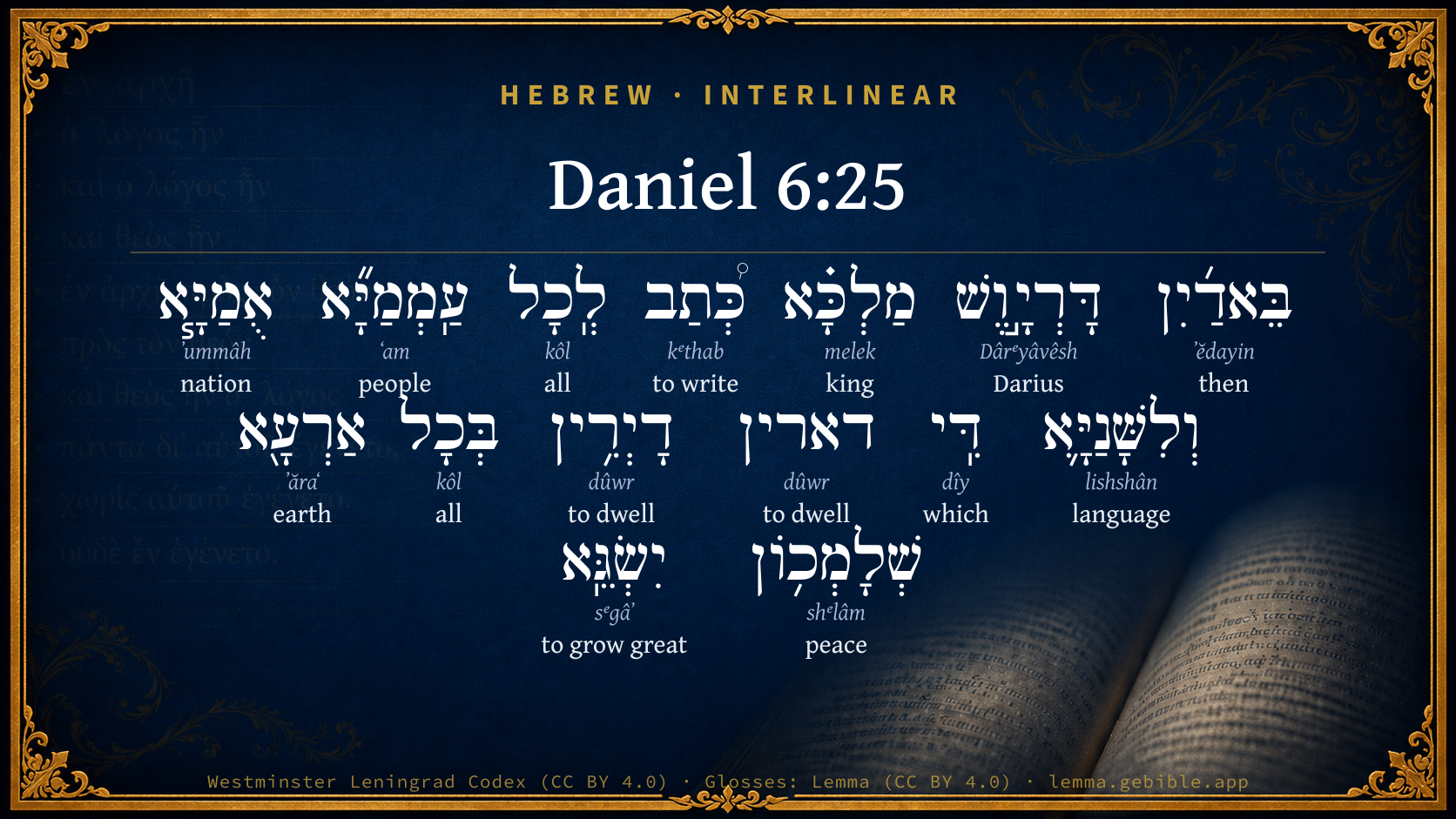
Hebrew (Westminster Leningrad Codex) Daniel 6:25 appears in the Hebrew Old Testament. The text above is from the Westminster Leningrad Codex. Each word links to its Strong’s number, a concise gloss, and parsing drawn from the Open Scriptures Hebrew Bible morphology. Click any word for its full Brown-Driver-Briggs (BDB) entry.
Download image
Cite this verse

Daniel 6:25 (World English Bible). Public Domain. Lemma interlinear Bible study tool, https://lemma.gebible.app/v/daniel/6/25.

Show BibTeX & RIS
BibTeX
RIS
English Translation
Then king Darius wrote to all the peoples, nations, and languages, who dwell in all the earth: Peace be multiplied to you.
World English Bible · Public Domain
Download a study sheet

One document with this verse’s original text, its word-by-word gloss line, the meaning frame, cross-references with their text, attributed commentary, and full source and license credits — printable, and it pastes into notes with its structure intact.

This verse Autodidact and up

Study sheet (.html) Plain text (.txt)

A passage Seminary Student

Up to 50 verses in one chapter. A passage sheet keeps up to 6 commentary sources and 12 cross-references per verse, in the order this page ranks them, and says so on the sheet whenever that leaves anything out. Ask for a single verse and you get the Autodidact verse sheet above.

Everything on this page stays free to read, with no account — the sheet is a download of what is already on screen, not access to it.

Want to remove ads? Support Godless Engineer
Compare translations 3

The same verse in 3 English versions, stacked beneath the original-language interlinear above. Click any original word for its lexicon entry.

Each is an independent rendering of the whole verse — the interlinear is not word-aligned to these translations.

Highlighted words mark where these versions differ — a whole-verse word diff, not a word-by-word alignment.

  • World English Bible Public Domain
    Then king Darius wrote to all the peoples, nations, and languages, who dwell in all the earth: Peace be multiplied to you.
  • King James Version Public Domain
    Then king Darius wrote unto all people, nations, and languages, that dwell in all the earth; Peace be multiplied unto you.
  • unfoldingWord Literal Text CC BY-SA 4.0
    Then King Darius wrote to all the peoples, nations, and languages that live in all the earth: “May your peace abound.

unfoldingWord Literal Text — © unfoldingWord, licensed CC BY-SA 4.0. Word-aligned USFM3 via Door43 (git.door43.org/unfoldingWord/en_ult).

Versions to compare (up to 4)

3 of 4 selected

Show all 18 translations

Every available English version of this verse, each an independent rendering of the whole verse.

  • World English Bible Public Domain
    Then king Darius wrote to all the peoples, nations, and languages, who dwell in all the earth: Peace be multiplied to you.
  • Berean Standard Bible Public Domain
    Then King Darius wrote to the people of every nation and language throughout the land: “May your prosperity abound.
  • Majority Standard Bible Public Domain
    Then King Darius wrote to the people of every nation and language throughout the land: “May your prosperity abound.
  • King James Version Public Domain
    Then king Darius wrote unto all people, nations, and languages, that dwell in all the earth; Peace be multiplied unto you.
  • American Standard Version (1901) Public Domain
    Then king Darius wrote unto all the peoples, nations, and languages, that dwell in all the earth: Peace be multiplied unto you.
  • Revised Version (1885) Public Domain
    Then king Darius wrote unto all the peoples, nations, and languages, that dwell in all the earth; Peace be multiplied unto you.
  • Geneva Bible (1599) Public Domain
    Afterwarde King Darius wrote, Vnto all people, nations and languages, that dwel in all the world: Peace be multiplied vnto you.
  • Douay-Rheims (1899) Public Domain
    Then king Darius wrote to all people, tribes, and languages, dwelling in the whole earth: PEACE be multiplied unto you.
  • Young's Literal Translation Public Domain
    Then Darius the king hath written to all the peoples, nations, and languages, who are dwelling in all the land: `Your peace be great!
  • Literal Standard Version CC BY-SA 4.0
    Then Darius the king has written to all the peoples, nations, and languages, who are dwelling in all the land: “Your peace be great!
  • Unlocked Literal Bible CC BY-SA 4.0
    Then King Darius wrote to all the peoples, nations, and languages that live in all the earth: “May peace increase for you.
  • unfoldingWord Literal Text CC BY-SA 4.0
    Then King Darius wrote to all the peoples, nations, and languages that live in all the earth: “May your peace abound.
  • Darby Bible Public Domain
    Then king Darius wrote unto all peoples, nations, and languages, that dwell in all the earth: Peace be multiplied unto you.
  • World Messianic Bible Public Domain
    Then King Darius wrote to all the peoples, nations, and languages who dwell in all the earth: “Peace be multiplied to you.
  • Webster's Bible Public Domain
    \\6:24\\And the king commanded, and they brought those men who had accused Daniel, and they cast them into the den of lions, them, their children, and their wives; and the lions had the mastery of them, and broke all their bones in pieces before they came to the bottom of the den.
  • Free Bible Version CC BY-SA 4.0
    Then Darius wrote to all the people of the world, the different nations and languages, saying, “I wish you well!
  • Bible in Basic English Public Domain
    And at the king's order, they took those men who had said evil against Daniel, and put them in the lions' hole, with their wives and their children; and they had not got to the floor of the hole before the lions overcame them and all their bones were broken.
  • JPS Tanakh (1917) Public Domain
    (6-26) Then king Darius wrote unto all the peoples, nations, and languages, that dwell in all the earth: 'Peace be multiplied unto you.

Literal Standard Version (2020), Covenant Press — licensed CC BY-SA 4.0. Text via the HelloAO Bible API (eBible.org). Unlocked Literal Bible (unfoldingWord) — licensed CC BY-SA 4.0. Text via the HelloAO Bible API (eBible.org). unfoldingWord Literal Text — © unfoldingWord, licensed CC BY-SA 4.0. Word-aligned USFM3 via Door43 (git.door43.org/unfoldingWord/en_ult). Free Bible Version, Dr. Jonathan Gallagher — licensed CC BY-SA 4.0. Text via the HelloAO Bible API (eBible.org).

Word by word

More ways to search: Search by grammar → Find every occurrence → Compare this word →

Practice this passage: Drill this verse → Learn its vocabulary →

יִשְׂגֵּֽא
sᵉgâʼ
H7680
“to grow great”
Adjective, V
Part of Speech
Adjective
Full BDB Definition

Origin: corresponding to H7679

TWOT: 3004

(Peal) to grow great
  1. בֵּאדַ֜יִן ʼĕdayin H116 “in/at · then” Adjective, R + Adverb
  2. דָּרְיָ֣וֶשׁ Dârᵉyâvêsh H1868 “Darius” Adjective, N
  3. מַלְכָּ֗א melek H4430 “king · the” Adjective, N, Common + Particle, Definite Article
  4. כְּ֠תַב kᵉthab H3790 “to write” Adjective, V, Plural
  5. לְֽכָל kôl H3606 “to/for · all of” Adjective, R + Noun, Common, Masculine, Singular, Construct
  6. עַֽמְמַיָּ֞א ʻam H5972 “peoples · the” Adjective, N, Common + Particle, Definite Article
  7. אֻמַיָּ֧א ʼummâh H524 “nations · the” Adjective, N, Common + Particle, Definite Article
  8. וְלִשָּׁנַיָּ֛א lishshân H3961 “and · languages · the” Adjective, C + Noun, Common, Masculine, Plural, Determined + Particle, Definite Article
  9. דִּֽי dîy H1768 “which” Adjective, T
  10. דארין dûwr H1753 “dwelling” Adjective, V
  11. דָיְרִ֥ין dûwr H1753 “dwelling” Adjective, V
  12. בְּכָל kôl H3606 “in/at · all of” Adjective, R + Noun, Common, Masculine, Singular, Construct
  13. אַרְעָ֖א ʼăraʻ H772 “earth · the” Adjective, N, Common + Particle, Definite Article
  14. שְׁלָמְכ֥וֹן shᵉlâm H8001 “peace · your” Adjective, N, Common + Suffix, Personal, 2nd Person, Masculine, Plural

About this verse

These counts appear in no published source. They are computed here, from the morphology-tagged text and Lemma’s own curated glosses. What Lemma adds →

15
words
13
distinct lemmas
Prophets
section

Notable vocabulary

The rarest word here is יִשְׂגֵּֽא to grow great H7680 — appearing just 3 times in the whole Hebrew Bible.

Shared distinctive vocabulary

יִשְׂגֵּֽא to grow great H7680 occurs in 3 verses of the Hebrew Bible. Also found in:

Grammatical profile

  • 2 nouns
  • 7 adjectives
  • 1 adverb
  • 5 particles

Repetition

Words recur within this verse — often emphatic in Hebrew:

  • לְֽכָל all H3606 ×2
  • דארין to dwell H1753 ×2

Hebrew & Septuagint length

In English translation the verse runs 22 words from the Hebrew and 22 from the Septuagint (LXX English) — the same length.

A rough comparison of the two English renderings, which tokenize alike — not a word-level alignment.

Word counts can differ between the Hebrew and the Greek without any difference in meaning — e.g. the Hebrew direct-object marker אֵת has no separate Greek word, and Greek often adds the article ὁ.

Cross-references

8

Topical passages linked to Daniel 6:25 in the Treasury of Scripture Knowledge — connected by theme and wording, ordered by reader-vote popularity; previews shown in the World English Bible.

  • Daniel 4:1 Nebuchadnezzar the king, to all the peoples, nations, and languages, who dwell in all the earth: Peace be multiplied to you.
  • Ezra 1:1–2 Now in the first year of Cyrus king of Persia, that the word of Yahweh by the mouth of Jeremiah might be accomplished, Yahweh stirred up the spirit of Cyrus king of Persia, so that he made a proclamation throughout all his kingdom, and [put it] also in writing, saying,
  • Ezra 4:17 [Then] sent the king an answer to Rehum the chancellor, and to Shimshai the scribe, and to the rest of their companions who dwell in Samaria, and in the rest [of the country] beyond the River: Peace, and so forth.
  • Esther 3:12 Then were the king's scribes called in the first month, on the thirteenth day of it; and there was written according to all that Haman commanded to the king's satraps, and to the governors who were over every province, and to the princes of every people, to every province according to the writing of it, and to every people after their language; in the name of king Ahasuerus was it written, and it was sealed with the king's ring.
  • Esther 8:9 Then were the king's scribes called at that time, in the third month Sivan, on the three and twentieth [day] of it; and it was written according to all that Mordecai commanded to the Jews, and to the satraps, and the governors and princes of the provinces which are from India to Ethiopia, one hundred twenty-seven provinces, to every province according to the writing of it, and to every people after their language, and to the Jews according to their writing, and according to their language.
  • 1 Peter 1:2 according to the foreknowledge of God the Father, in sanctification of the Spirit, that you may obey Jesus Christ and be sprinkled in his blood: Grace to you and peace be multiplied.
  • 2 Peter 1:2 Grace to you and peace be multiplied in the knowledge of God and of Jesus our Lord,
  • Jude 1:2 Mercy to you and peace and love be multiplied.

Cross-references courtesy of OpenBible.info (CC BY 4.0).

Hebrew and Greek witnesses Masoretic Hebrew ↔ Greek Septuagint

The same verse in the two great witnesses to the Old Testament, shown verse-for-verse.

These are two independent witnesses, not word-aligned to each other, and the Septuagint is shown in lemma (dictionary) form.

Hebrew Daniel 6:25 Masoretic · Westminster Leningrad Codex

בֵּאדַ֜יִן דָּרְיָ֣וֶשׁ מַלְכָּ֗א כְּ֠תַב לְֽכָל עַֽמְמַיָּ֞א אֻמַיָּ֧א וְלִשָּׁנַיָּ֛א דִּֽי דארין דָיְרִ֥ין בְּכָל אַרְעָ֖א שְׁלָמְכ֥וֹן יִשְׂגֵּֽא

Then king Darius wrote to all the peoples, nations, and languages, who dwell in all the earth: Peace be multiplied to you.

World English Bible · Public Domain

Greek LXX Daniel 6:25 Septuagint · lemma form

τότε ὁ δύο ἄνθρωπος ἐκεῖνος ὁ καταμαρτυρέω ὁ δανιηλ αὐτός καί ὁ γυνή αὐτός καί ὁ τέκνον αὐτός ῥίπτω ὁ λέων καί ὁ λέων ἀποκτείνω αὐτός καί θλάω ὁ ὀστέον αὐτός

Then king Darius wrote to all nations, tribes, and languages, who dwell in all the earth, saying, Peace be multiplied to you.

LXX2012 (modern English Septuagint) · Public Domain

On this verse, The Pulpit Commentary discusses the Septuagint’s reading. Read the note in Commentary ↓

Hebrew: Westminster Leningrad Codex (CC BY 4.0). Greek: Septuagint (public domain); English from LXX2012 (modern English Septuagint) (Public Domain). How the Septuagint differs from the Hebrew →

Commentary

Notes on Daniel 6:25 from classic Christian and Jewish commentators (each source and its license shown beneath its notes). The classic Christian expositions comment on the surrounding passage and are grouped to its opening verse, so a note may address several verses; the Jewish commentaries on the Tanakh (Rashi and others) are per-verse, so they appear only where the commentator wrote on this verse.

Lemma curates 59 commentaries, every one of them public domain or Creative Commons licensed, each selected and text-cleaned for this edition rather than reprinted as found. About our sources →

Matthew Henry's Commentary

Darius here studies to make some amends for the dishonour he had done both to God and Daniel, in casting Daniel into the lions' den, by doing honour to both.

I. He gives honour to God by a decree published to all nations, by which they are required to fear before him. And this is a decree which is indeed fit to be made unalterable, according to the laws of the Medes and Persians, for it is the everlasting gospel, preached to those that dwell on the earth, Rev 14:7. Fear God, and give glory to him. Observe, 1. To whom he sends this decree - to all people, nations and languages, that dwell in all the earth, Dan 6:25. These are great words, and it is true that all the inhabitants of the earth are obliged to that which is here decreed; but here they mean no more than every dominion of his kingdom, which, though it contained many nations, did not contain all nations; but so it is, those that have much are ready to think they have all. 2. What the matter of the decree is - that men tremble and fear before the God of Daniel. This goes further than Nebuchadnezzar's decree upon a similar occasion, for that only restrained people from speaking amiss of this God, but this requires them to fear before him, to keep up and express awful reverent thoughts of him. And well might this decree he prefaced, as it is, with Peace be multiplied unto you, for the only foundation of true and abundant peace is laid in the fear of God, for that is true wisdom. If we live in the fear of God, and walk according to that rule, peace shall be upon us, peace shall be multiplied to us. But, though this decree goes far, it does not go far enough; had he done right, and come up to his present convictions, he would have commanded all men not only to tremble and fear before this God, but to love him and trust in him, to forsake the service of their idols, and to worship him only, and call upon him as Daniel did. But idolatry had been so long and so deeply rooted that it was not to be extirpated by the edicts of princes, nor by any power less than that which went along with the glorious gospel of Christ. 3. What are the causes and considerations moving him to make this decree. They are sufficient to have justified a decree for the total suppression of idolatry, much more will they serve to support this. There is good reason why all men should fear before this God, for, (1.) His being is transcendent. "He is the living God, lives as a God, whereas the gods we worship are dead things, have not so much as an animal life." (2.) His government is incontestable. He has a kingdom, and a dominion; he not only lives, but reigns as an absolute sovereign. (3.) Both his being and his government are unchangeable. He is himself stedfast for ever, and with him is no shadow of turning. And his kingdom too is that which shall not be destroyed by any external force, nor has his dominion any thing in itself that threatens a decay or tends towards it, and therefore it shall be even to the end. (4.) He has an ability sufficient to support such an authority, Dan 6:27. He delivers his faithful servants from trouble and rescues them out of trouble; he works signs and wonders, quite above the utmost power of nature to effect, both in heaven and on earth, by which it appears that he is sovereign Lord of both. (5.) He has given a fresh proof of all this in delivering his servant Daniel from the power of the lions. This miracle, and that of the delivering of the three children, were wrought in the eyes of the world, were seen, published, and attested by two of the greatest monarchs that ever were, and were illustrious confirmations of the first principles of religion, abstracted from the narrow scheme of Judaism, effectual confutations of all the errors of heathenism, and very proper preparations for pure catholic Christianity.

II. He puts honour upon Daniel (Dan 6:28): So this Daniel prospered. See how God brought to him good out of evil. This bold stroke which his enemies made at his life was a happy occasion of taking them off, and their children too, who otherwise would still have stood in the way of his preferment, and have been upon all occasions vexatious to him; and now he prospered more than ever, was more in favour with his prince and in reputation with the people, which gave him a great opportunity of doing good to his brethren. Thus out of the eater (and that was a lion too) comes forth meat, and out of the strong sweetness.

Matthew Henry's Commentary on the Whole Bible (1708–1710) — public domain (CC PDM 1.0). Text via the HelloAO Bible API.

Trapp's Complete Commentary

John Trapp

Dan 6:25 Then king Darius wrote unto all people, nations, and languages, that dwell in all the earth; Peace be multiplied unto you.

Ver. 25. Then king Darius wrote.] See on Dan 4:1.

John Trapp, A Commentary or Exposition upon All the Books of the Old and New Testament (1647–1656) — public domain. Text from a community e-Sword module.

Joseph Benson's Commentary

Dan 6:25-27. Then King Darius wrote to all people — He wrote to all the several nations in his extensive empire. Darius here studies to make some amends for the dishonour he had done both to God and Daniel, by now doing honour to both. I make a decree, that men tremble and fear before the God of Daniel — This decree goes further than Nebuchadnezzar’s upon the like occasion, for that only restrained people from speaking amiss of this God; but this requires them to fear before him, to maintain and express awful and reverent thoughts of him. And well might this decree be prefaced, as it is, with Peace be multiplied unto you; for the only foundation of true peace and happiness is laid in the fear of God. But though this decree goes far, it does not go far enough: had he done right, and acted according to his present convictions, he would have commanded all men, not only to tremble and fear before this God, but to trust in, love, and obey him, to forsake the service of their idols, and to call upon and worship him only, as Daniel did. But idolatry had been so long and so deeply rooted, that it was not to be extirpated by the edicts of princes, nor by any power less than that which accompanied the glorious gospel of Christ. For he is the living God, &c. — Darius here mentions the considerations which moved him to make this decree; and, in doing this, he presents us with a very just and sublime character of the true God, — a character suited to his nature, and probably such as the king had learned of Daniel. Some think he was a convert to the true religion; if so, this, together with the favours shown to the prophet, may in some measure account for the notice taken of his reign. Certainly the reasons on which he here grounds his decree, were sufficient to have justified one for the total suppression of idolatry. He delivereth and rescueth, &c. — He has an ability sufficient to support his authority and dominion, delivering his faithful servants from trouble, and rescuing them out of the hands of their enemies. He worketh signs and wonders, quite above the power of nature to effect, both in heaven and earth — By which it appears that he is sovereign Lord of both: who hath delivered Daniel from the lions — This miracle, and that of delivering Shadrach and his companions, were wrought in the eye of the world; were seen, published, and attested, by two of the greatest monarchs that ever existed: and were illustrious confirmations of the first principles of religion, abstracted from the narrow scheme of Judaism, effectual confutations of all the errors of heathenism, and very proper preparations for pure catholic Christianity.

Joseph Benson's Commentary on the Old and New Testaments (1811–1818) — public domain. Text from a community e-Sword module.

Tyndale Open Study Notes

Tyndale Open Resources

6:25-27 King Darius sent this message: As Nebuchadnezzar had done previously (cp. 3:28-29; 4:34-37), the current ruler of the civilized world testified to all his subjects that the God of Daniel is the living God with real power and a kingdom that will never be destroyed.

Tyndale Open Study Notes — © Tyndale Open Resources, licensed CC BY-SA 4.0. Text via the HelloAO Bible API.

Adam Clarke's Commentary

Verse 25. Then king Darius wrote] And the substance of this decree, which was made by a heathen king, was to point out the perfections of the true God, and the fidelity of his devoted servant.

Adam Clarke's Commentary on the Bible (1810–1826) — public domain. Text from a community e-Sword/MySword module.

John Calvin's Commentaries

Here Daniel adds the king’s edict, which he wished to be promulgated. And by this edict he bore witness that he was so moved by the deliverance of Daniel, as to attribute the supreme glory to the God of Israel. Meanwhile, I do not think this a proof of the king’s real piety, as some interpreters here extol King Darius without moderation, as if he had really repented and embraced the pure worship prescribed by the law of Moses. Nothing of this kind can be collected from the words of the edict — and this circumstance shews it — for his empire was never purged from its superstitions. King Darius still allowed his subjects to worship idols; and he did not refrain from polluting himself with such defilement’s; but he wished to place the God of Israel on the highest elevation, thus attempting to mingle fire and water! We have previously discussed this point. For the profane think they discharge their duty to the true God, if they do not openly despise him, but assign him some place or other; and, especially, if they prefer him to all idols, they think they have satisfied God. But this is all futile; for unless they abolish all superstitions, God by no means obtains his right, since he allows of no equals. Hence this passage by no means proves any true and serious piety in King Darius; but it implies simply his being deeply moved by the miracle, and his celebrating through all the regions subject to him the name and glory of the God of Israel. Finally, as this was a special impulse on King Darius, so it did not proceed beyond a particular effect; he acknowledged God’s power and goodness on all sides; but he seized upon that specimen which was placed directly before his eyes. Hence he did not continue to acknowledge the God of Israel by devoting himself to true and sincere piety; but, as I have said, he wished him to be conspicuously superior to other gods, but not to be the only God. But God rejects this modified worship; and thus there is no reason for praising King Darius. Meanwhile his example will condemn all those who profess themselves to be catholic or Christian kings, or defenders of the faith, since they not only bury true piety, but, as far as they possibly can, weaken the whole worship of God, and would willingly extinguish his name from the world, and thus tyrannize over the pious, and establish impious superstitions by their own cruelty. Darius will be a fit judge for them, and the edict here recited by Daniel will be sufficient for the condemnation of them all.

He now says, The edict was written for all people, nations, and tongues, who dwell in the whole earth. We see how Darius wished to make known God’s power not only to the neighboring people, but studied to promulgate it far and wide. He wrote not only for Asia and Chaldea, but also for the Medes and Persians. He had never been the ruler of Persia, yet since his father-in-law had received him into alliance in the empire, his authority extended thither. This is the sense of the phrase, the whole earth This does not refer to the whole habitable world, but to that monarchy which extended through almost the entire East, since the Medes and Persians then held the sway from the sea as far as Egypt. When we consider the magnitude of this empire, Daniel may well say, the edict was promulgated through the whole earth. Peace be multiplied unto you! We know how kings in this way soothe their subjects, and use soft persuasions for more easily accomplishing their wishes, and thus obtain the implicit obedience of their subjects. And it is gratuitous on their part to implore peace on their subjects. Meanwhile, as I have already said, they court their favor by these enticements, and thus prepare their subjects to submit to the yoke. By the term “peace,” a state of prosperity is implied; meaning, may you be prosperous and happy. He afterwards adds, the decree is placed in their sight, that is, they display their command before all their subjects. This, then, is the force of the phrase, my edict has been placed; that is, if my authority and power prevail with you, you must thus far obey me; that all may fear, or, that all may be afraid and tremble before the God of Daniel! By fear and terror he means simply reverence, but he speaks as the profane are accustomed to do, who abhor God’s name. He seems desirous of expressing how conspicuous was the power of the God of Israel, which ought properly to impress every one, and induce all to worship with reverence, and fear, and trembling. And this method of speaking is derived from a correct principle; since lawful worship is never offered to God but when we are humbled before him. Hence God often calls himself terrible, not because he wishes his worshippers to approach him with fear, but, as we have said, because the souls of men will never be drawn forth to reverence unless they seriously comprehend his power, and thus become afraid of his judgment. But if fear alone flourishes in men’s minds, they cannot form themselves to piety, since we must consider that passage of the Psalm,

“With thee is propitiation that thou mayest be feared.” (Psalm 130:4.)

God, therefore, cannot be properly worshipped and feared, unless we are persuaded that he may be entreated; nay, are quite sure that he is propitious to us. Yet it is necessary for fear and dread to precede the humiliation of the pride of the flesh.

This, then, is the meaning of the phrase, that all should fear or be afraid of the God of Daniel The king calls him so, not because Daniel had fabricated a God for himself, but because he was his only worshipper. We very properly speak of Jupiter as the god of the Greeks, since he was deified by their folly, and hence obtained a name and a celebrity throughout the rest of the world. Meanwhile, Jupiter, and Minerva, and the crowd of false deities received their names from the same origin. There is another reason why King Darius calls the God whom Daniel worshipped Daniel’s God, as he is called the God of Abraham, not through deriving any precarious authority from Abraham, but through his manifesting himself to Abraham. To explain this more clearly — Why is he called the God of Daniel rather than of the Babylonians? because Daniel had learnt from the law of Moses the pure worship of God, and the covenant which he had made with Abraham and the holy fathers, and the adoption of Israel as his peculiar people. He complied with the worship prescribed in the Law, and that worship depended on the covenant. Hence this name is not given as if Daniel had been free to fashion or imagine any god for himself; but because he had worshipped that God who had revealed himself by his word. Lastly, this phrase ought to be so understood as to induce all to fear that God who had made a covenant with Abraham and his posterity, and had chosen for himself a peculiar people. He taught the method of true and lawful worship, and unfolded it in his law, so that Daniel worshipped him. We now understand the meaning of the clause. Thus we may learn to distinguish the true God from all the idols and fictions of men, if we desire to worship him acceptably. For many think they worship God when they wander through whatever errors they please, and never remain attached to one true God. But this is perverse, nay, it is nothing but a profanation of true piety to worship God so confusedly. Hence, we must contemplate the distinction which I have pointed out, that our minds may be always included within the bounds of the word, and not wander from the true God, if indeed we desire to retain him and to follow the religion which pleases him. We must continue, I say, within the limits of the word, and not turn away on either one side or the other; since numberless fallacies of the devil will meet us immediately, unless the word holds us in strict obedience. As far as concerns Darius, he acknowledged the one true God, but as we have already said, he did not reject that fictitious and perverse worship in which he was brought up; — such a mixture is intolerable before God!

He adds, Because he is alive, and remains for ever! This seems to reduce all false gods to nothing; but it has been previously said, and the circumstances prove it true, that when the profane turn their attention to the supreme God, they begin to wander directly. If they constantly acknowledged the true God, they would instantly exclude all fictitious ones; but they think it sufficient if God obtains the first rank; meanwhile they add minor deities, so that he lies hid in a crowd, although he enjoys a slight pre-eminence. Such, then, was the reasoning and the plan of Darius, because he held nothing clearly or sincerely concerning the essence of the one true God; but he thought the supreme power resident in the God of Israel, just as other nations worship their own deities! We see, then, that he did not depart from the superstitions which he had imbibed in his boyhood; and hence, we have no reason for praising his piety, unless in this particular case. But, meanwhile, God extorted a confession from him, in which he describes his nature to us. He calls him “the living God,” not only because he has life in himself, but out of himself, and is also the origin and fountain of life. This epithet ought to be taken actively, for God not only lives but has life in himself; and he is also the source of life, since there is no life independent of him. He afterwards adds, He remains for ever, and thus distinguishes him from all creatures, in which there is no firmness nor stability. We know also how everything in heaven, as well as heaven itself, is subject to various changes. In this, therefore, God differs from everything created, since he is unchangeable and invariable. He adds, His kingdom is not corrupted, and his dominion remains for ever. Here he clearly expresses what he had formerly stated respecting the firmness of God’s estate, since he not only remains essentially the same, but exercises his power throughout the whole world, and governs the world by his own virtue, and sustains all things. For if he had only said, “God remains for ever,” we are so perverse and narrow-minded as to interpret it merely as follows: — God, indeed, is not changeable in his own essence, but our minds could not comprehend his power as universally diffused. This explanation, then, is worthy of notice, since Darius clearly expresses that God’s kingdom is incorruptible and his dominion everlasting.

John Calvin's Commentaries (1540-1563) — public domain. Text from the Calvin Translation Society English edition (1840s-50s) via the Christian Classics Ethereal Library (ccel.org). Calvin's coverage is partial (roughly two-thirds of the Bible); uncommented books and verses are honest gaps, never fabricated. The 19th-century editor's footnotes and remarks are omitted so the notes are faithfully Calvin's own voice.

The Cambridge Bible for Schools and Colleges

gen. ed. J. J. S. Perowne

25. unto all the peoples, … unto you] verbally identical with Dan_4:1.

25–27. The edict of Darius, enjoining all his subjects to dread and fear the God of Daniel. Cf. the decree of Nebuchadnezzar in Dan_3:29, forbidding men anywhere to speak against Him; and his proclamation in Dan_4:1-3; Dan_4:37, declaring to mankind His doings. The thought and phraseology of the edict are strongly Jewish.

The Cambridge Bible for Schools and Colleges (gen. ed. J. J. S. Perowne; Cambridge University Press, 1878–1918) — public domain. Text from a community e-Sword module.

John Gill's Exposition

I make a decree, that in every dominion of my kingdom,.... In every province of his large empire; this explains who are meant by all people, nations, &c. before mentioned; namely, such as were within his dominions; for to no other could his decree reach: this decree is very different from that he had made a few days before, forbidding any man to ask anything of any god or man for the space of a month; but now his order is,

that men tremble and fear before the God of Daniel; that they would serve with fear and trembling, and reverence and adore the God that Daniel served and worshipped; and who manifestly appeared to be his God, and to be the true God, by his wonderful deliverance of him:

for he is the living God, and steadfast for ever; that has life in himself, and is the author and giver of life to others, and ever remains so, without any variation or shadow of turning; he is everlasting and unchangeable, permanent and immutable in his nature; steady and steadfast in his purposes and promises, in his conduct in the government of the world, and in the course of his providence:

and his kingdom that which shall not be destroyed, and his dominion shall be even unto the end; unto the end of time; other kingdoms will he destroyed, but his will not; all other rule, dominion and authority will be at an end but his will continue for ever; his kingdom is an everlasting one: this doctrine Darius had learned from Daniel, as Nebuchadnezzar before had done; see Dan 2:44.

John Gill's Exposition of the Whole Bible (1746–1763) — public domain (CC PDM 1.0). Text via the HelloAO Bible API.

Albert Barnes' Notes on the Bible

Then king Darius wrote unto all people ... - Compare the note at Dan 2:47; Dan 3:29; Dan 4:1. If there is a probability that Nebuchadnezzar would make such a proclamation as he did, there is no less probability that the same thing would be done by Darius. Indeed, it is manifest on the face of the whole narrative that one great design of all that occurred was to proclaim the knowledge of the true God, and to secure his recognition. That object was worthy of the Divine interposition, and the facts in the case show that God has power to induce princes and rulers to recognize his existence and perfections, and his government over the earth.

Albert Barnes' Notes on the Bible (1834–1885) — public domain. Text from a community e-Sword/MySword module.

Matthew Poole's English Annotations

In all the earth, i.e. of the known earth then, being chiefly that great empire; for what had he to do in all the world besides? It is usual with the Turk, Tartar, Chinese, to arrogate the same universality with the like pride.

Matthew Poole's English Annotations on the Holy Bible (1683–1685) — public domain. Text from a community e-Sword/MySword module.

Whedon's Commentary on the Bible

Daniel D. Whedon

25-27. This decree resembles very greatly, even in phrase, some of the speeches made previously to or by Nebuchadnezzar (chaps. ii, iii). The old Greek version follows a very different text and closes: “I, Darius, will worship and serve the God of Daniel all my life, for no idols made with hands can deliver as Daniel’s God delivered Daniel.”

Daniel D. Whedon (gen. ed.), Commentary on the Old and New Testaments (1874–1909) — public domain. Text from a community e-Sword module.

The Pulpit Commentary

Vers. 25-27. Then King Darius wrote unto all people, nations, and languages, that dwell in all the earth; Peace be multiplied unto you. I make a decree, That in every dominion of my kingdom men tremble and fear before the God of Daniel: for he is the living God, and stedfast for ever, and his kingdom that which shall not be destroyed, and his dominion shall be even unto the end. He delivereth and rescueth, and he worketh signs and wonders in heaven and in earth, who hath delivered Daniel from the power of the lions. This decree has a resemblance to the decrees of Nebuchadnezzar. In the Septuagint there is less magniloquence, though the divergence is too great to be the result merely of difference of reading, Then Darius wrote to all nations and tongues and countries dwelling in all his land, saying, Let all men who are in my kingdom stand and worship, and serve the God of Daniel, for he alone abideth, and liveth to generations of generations for ever. I Darius will worship and serve him all my days, for none of the idols that are made with hands are able to deliver as the God of Daniel did Daniel." It is to be observed that it is only to the inhabitants of his own land that Darius writes, and further, it is "all men in his kingdom" he commands, not "every dominion in his kingdom." There is no notice taken of the kingdom of God; it is God himself who liveth and abideth for ever. The last verse, again, in the Septuagint, in which Darius professes his faith in Jehovah, is evidently spurious. Theodotion and the Peshitta agree with the Massoretic text. Removing the exaggerations from it, the decree of Darius does not mean any more than we found in the decrees of Nebuchadnezzar; it is simply a warning against showing any disrespect to a Deity with such formidable powers as Jehovah. It may be regarded as connected with the dualistic view of the universe maintained by Zoroastrianism, that deliverance from lions is spoken of with such awe. The lion was one of the beasts specially representative of the evil principle, as we see in Persepolis. There was thus evidence given that the God of the Jews was supreme over the powers of evil; therefore, without forbidding any subject of Babylonia from worshipping his own ancestral divinity. Darius yet commanded him, in so doing, to watch his conduct, so that nothing disrespectful to the powerful God of the Hebrews should be done by him.

The Pulpit Commentary (1880–1919), ed. H.D.M. Spence-Jones & Joseph S. Exell — public domain. Text from a community e-Sword module.

John Wesley's Explanatory Notes

In all the earth - In all that great empire. It is usual with the Turk, Tartar, Chinese, to arrogate the same universality.

John Wesley, Explanatory Notes Upon the Whole Bible (1754–1765) — public domain. Text via the GEBible commentary corpus.

Scofield Reference Notes

C. I. Scofield

unto all people

(See Scofield "Dan 4:1").

The Scofield Reference Bible (1917 edition), notes by C. I. Scofield — public domain. Text from a community e-Sword module.

Rashi

Rabbi Shlomo Yitzchaki (Rashi)

who had informed on Daniel [as translated,] who had informed on Daniel.

and they did not reach the bottom of the pit They did not reach the bottom of the pit before the lions overwhelmed them and crushed their bones to powder.

Rashi on the Tanakh — English translations: “The Judaica Press complete Tanach with Rashi, translated by A. J. Rosenberg” (CC BY 4.0); “Pentateuch with Rashi's commentary by M. Rosenbaum and A.M. Silbermann, 1929-1934” (public domain); “The Metsudah Tanach series, Lakewood, N.J” (CC BY 4.0); and “The Book of Joshua, Metsudah Publications, 1997” (CC BY 4.0). Text via Sefaria.

Lesson kit

Teaching starters — assembled from the data on this page, not authored interpretation. Every prompt links to the verse data it draws on. Edit before teaching.

Daniel, in the Prophets, opens this verse with 15 words (13 distinct Hebrew lemmas). Its most distinctive word is sᵉgâʼ (“to grow great”). A historical commentator’s framing appears above. Read the whole chapter for the surrounding context.

Discussion questions

  1. What does “to grow great” (sᵉgâʼ) contribute to the verse as a whole?
  2. Ezra 4:22 shares the word «to grow great» with this verse. How do the two illuminate each other?
  3. “all” occurs 2× in this one verse. What is the effect of the repetition?
  4. These translations render this verse differently; the difference is in the English rendering, not the original. What questions does that raise?
  5. Reading how Matthew Henry's Commentary and Trapp's Complete Commentary read this verse, where do the two commentators agree and where do they part?

Things to notice

Reading settings

Reading text

Shown beneath each verse's original-language words.

Old Testament
Old Testament edition

Read the OT as the Masoretic Hebrew (MT) or the Greek Septuagint (LXX).

English shown for the Greek Septuagint (in the Hebrew ↔ Greek comparison).

Comparing translations? Open the Compare panel on any verse page to stack up to four side by side.