
Daniel 7:11

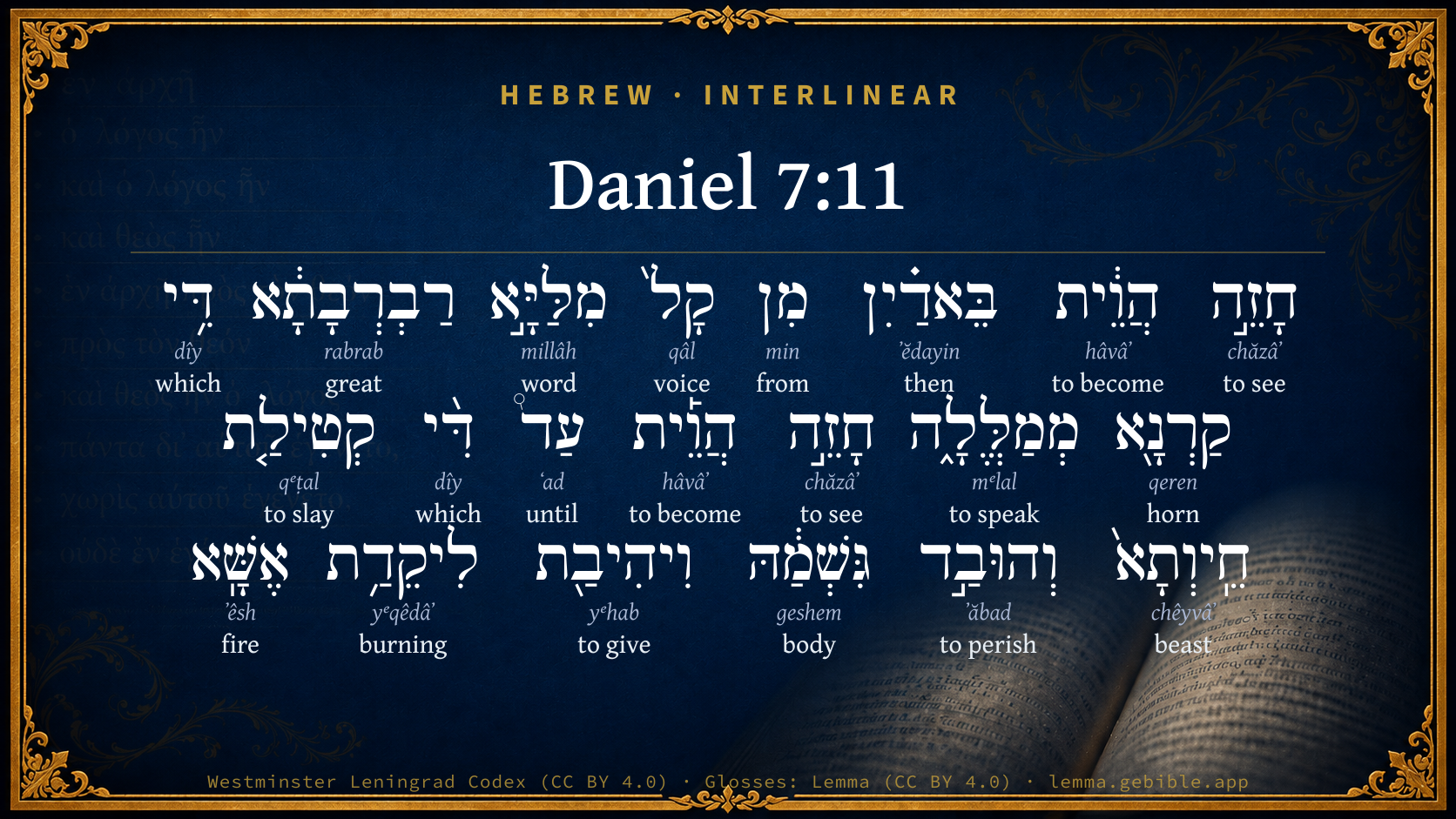
Hebrew (Westminster Leningrad Codex) Daniel 7:11 appears in the Hebrew Old Testament. The text above is from the Westminster Leningrad Codex. Each word links to its Strong’s number, a concise gloss, and parsing drawn from the Open Scriptures Hebrew Bible morphology. Click any word for its full Brown-Driver-Briggs (BDB) entry.
Download image
Cite this verse

Daniel 7:11 (World English Bible). Public Domain. Lemma interlinear Bible study tool, https://lemma.gebible.app/v/daniel/7/11.

Show BibTeX & RIS
BibTeX
RIS
English Translation
I saw at that time because of the voice of the great words which the horn spoke; I saw even until the animal was slain, and its body destroyed, and it was given to be burned with fire.
World English Bible · Public Domain
Highlights
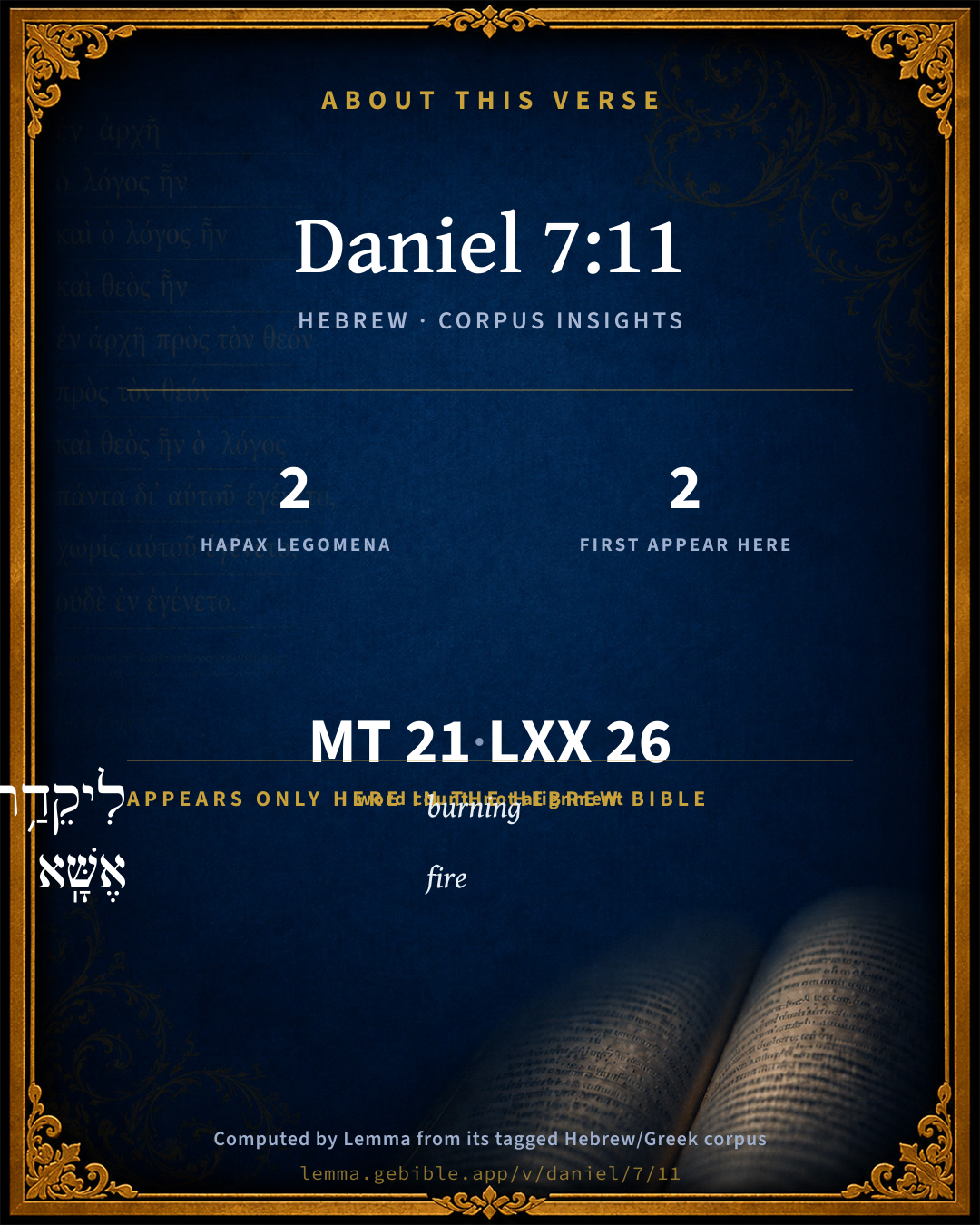
  • 2 hapax legomena — only here in the Hebrew Bible
  • 2 first appearances in the Hebrew Bible
Full analysis ↓
Download a study sheet

One document with this verse’s original text, its word-by-word gloss line, the meaning frame, cross-references with their text, attributed commentary, and full source and license credits — printable, and it pastes into notes with its structure intact.

This verse Autodidact and up

Study sheet (.html) Plain text (.txt)

A passage Seminary Student

Up to 50 verses in one chapter. A passage sheet keeps up to 6 commentary sources and 12 cross-references per verse, in the order this page ranks them, and says so on the sheet whenever that leaves anything out. Ask for a single verse and you get the Autodidact verse sheet above.

Everything on this page stays free to read, with no account — the sheet is a download of what is already on screen, not access to it.

Want to remove ads? Support Godless Engineer
Compare translations 3

The same verse in 3 English versions, stacked beneath the original-language interlinear above. Click any original word for its lexicon entry.

Each is an independent rendering of the whole verse — the interlinear is not word-aligned to these translations.

Highlighted words mark where these versions differ — a whole-verse word diff, not a word-by-word alignment.

  • World English Bible Public Domain
    I saw at that time because of the voice of the great words which the horn spoke; I saw even until the animal was slain, and its body destroyed, and it was given to be burned with fire.
  • King James Version Public Domain
    I beheld then because of the voice of the great words which the horn spake: I beheld even till the beast was slain, and his body destroyed, and given to the burning flame.
  • unfoldingWord Literal Text CC BY-SA 4.0
    Then I continued looking because of the sound of the great words which the horn was speaking. I kept looking until the beast was killed, and its body was destroyed, and it was given to the burning fire.

unfoldingWord Literal Text — © unfoldingWord, licensed CC BY-SA 4.0. Word-aligned USFM3 via Door43 (git.door43.org/unfoldingWord/en_ult).

Versions to compare (up to 4)

3 of 4 selected

Show all 18 translations

Every available English version of this verse, each an independent rendering of the whole verse.

  • World English Bible Public Domain
    I saw at that time because of the voice of the great words which the horn spoke; I saw even until the animal was slain, and its body destroyed, and it was given to be burned with fire.
  • Berean Standard Bible Public Domain
    Then I kept watching because of the arrogant words the horn was speaking. As I continued to watch, the beast was slain, and its body was destroyed and thrown into the blazing fire.
  • Majority Standard Bible Public Domain
    Then I kept watching because of the arrogant words the horn was speaking. As I continued to watch, the beast was slain, and its body was destroyed and thrown into the blazing fire.
  • King James Version Public Domain
    I beheld then because of the voice of the great words which the horn spake: I beheld even till the beast was slain, and his body destroyed, and given to the burning flame.
  • American Standard Version (1901) Public Domain
    I beheld at that time because of the voice of the great words which the horn spake; I beheld even till the beast was slain, and its body destroyed, and it was given to be burned with fire.
  • Revised Version (1885) Public Domain
    I beheld at that time because of the voice of the great words which the horn spake; I beheld even till the beast was slain, and his body destroyed, and he was given to be burned with fire.
  • Geneva Bible (1599) Public Domain
    Then I behelde, because of the voyce of the presumptuous wordes, which the horne spake: I behelde, euen till the beast was slaine, and his body destroyed, and giuen to the burning fire.
  • Douay-Rheims (1899) Public Domain
    I beheld because of the voice of the great words which that horn spoke: and I saw that the beast was slain, and the body thereof was destroyed, and given to the fire to be burnt:
  • Young's Literal Translation Public Domain
    `I was seeing, then, because of the voice of the great words that the horn is speaking, I was seeing till that the beast is slain, and his body hath been destroyed, and given to the burning fire;
  • Literal Standard Version CC BY-SA 4.0
    I was seeing, then, because of the voice of the great words that the horn is speaking, I was seeing until the beast is slain, and his body has been destroyed, and given to the burning fire;
  • Unlocked Literal Bible CC BY-SA 4.0
    I continued to look because of the boastful words spoken by the horn. I watched while the animal was killed, and its body was destroyed, and it was given over to be burned up.
  • unfoldingWord Literal Text CC BY-SA 4.0
    Then I continued looking because of the sound of the great words which the horn was speaking. I kept looking until the beast was killed, and its body was destroyed, and it was given to the burning fire.
  • Darby Bible Public Domain
    I beheld therefore, because of the voice of the great words that the horn spoke; I beheld till the beast was slain, and its body destroyed, and it was given up to be burned with fire.
  • World Messianic Bible Public Domain
    “I watched at that time because of the voice of the arrogant words which the horn spoke. I watched even until the animal was slain, and its body destroyed, and it was given to be burned with fire.
  • Webster's Bible Public Domain
    I beheld then because of the voice of the great words which the horn spoke: I beheld even till the beast was slain, and his body destroyed, and given to the burning flame.
  • Free Bible Version CC BY-SA 4.0
    I was watching because of the boasts the little horn was making. I went on watching until that beast was killed and its body destroyed by burning.
  • Bible in Basic English Public Domain
    Then I saw--because of the voice of the great words which the horn said--I saw till the beast was put to death, and its body was given to destruction, and the beast was given to the burning of fire.
  • JPS Tanakh (1917) Public Domain
    I beheld at that time because of the voice of the great words which the horn spoke, I beheld even till the beast was slain, and its body destroyed, and it was given to be burned with fire.

Literal Standard Version (2020), Covenant Press — licensed CC BY-SA 4.0. Text via the HelloAO Bible API (eBible.org). Unlocked Literal Bible (unfoldingWord) — licensed CC BY-SA 4.0. Text via the HelloAO Bible API (eBible.org). unfoldingWord Literal Text — © unfoldingWord, licensed CC BY-SA 4.0. Word-aligned USFM3 via Door43 (git.door43.org/unfoldingWord/en_ult). Free Bible Version, Dr. Jonathan Gallagher — licensed CC BY-SA 4.0. Text via the HelloAO Bible API (eBible.org).

Word by word

More ways to search: Search by grammar → Find every occurrence → Compare this word →

Practice this passage: Drill this verse → Learn its vocabulary →

לִיקֵדַ֥ת
yᵉqêdâʼ
H3346
“to/for · burning of”
Adjective, R + Noun, Common, Feminine, Singular, Construct
Part of Speech
Adjective + Noun
Type
Common
Gender
Feminine
Number
Singular
State
Construct
Full BDB Definition

Origin: from H3345

TWOT: 2774a

a burning
  1. חָזֵ֣ה chăzâʼ H2370 “seeing” Adjective, V
  2. הֲוֵ֔ית hâvâʼ H1934 “to become” Adjective, V, Plural
  3. בֵּאדַ֗יִן ʼĕdayin H116 “in/at · then” Adjective, R + Adverb
  4. מִן min H4481 “from” Adjective, R
  5. קָל֙ qâl H7032 “voice of” Adjective, N, Common
  6. מִלַּיָּ֣א millâh H4406 “words · the” Adjective, N, Common + Particle, Definite Article
  7. רַבְרְבָתָ֔א rabrab H7260 “great · the” Adjective, A + Particle, Definite Article
  8. דִּ֥י dîy H1768 “which” Adjective, T
  9. קַרְנָ֖א qeren H7162 “horn · the” Adjective, N, Common + Particle, Definite Article
  10. מְמַלֱּלָ֑ה mᵉlal H4449 “speaking” Adjective, V
  11. חָזֵ֣ה chăzâʼ H2370 “seeing” Adjective, V
  12. הֲוֵ֡ית hâvâʼ H1934 “to become” Adjective, V, Plural
  13. עַד֩ ʻad H5705 “until” Adjective, R
  14. דִּ֨י dîy H1768 “which” Adjective, T
  15. קְטִילַ֤ת qᵉṭal H6992 “to slay” Adjective, V, Plural
  16. חֵֽיוְתָא֙ chêyvâʼ H2423 “beast · the” Adjective, N, Common + Particle, Definite Article
  17. וְהוּבַ֣ד ʼăbad H7 “and · to perish” Adjective, C + Verb, Hophal, Perfect, 3rd Person, Masculine, Singular
  18. גִּשְׁמַ֔הּ geshem H1655 “body · her” Adjective, N, Common + Suffix, Personal, 3rd Person, Feminine, Singular
  19. וִיהִיבַ֖ת yᵉhab H3052 “and · to give” Adjective, C + Verb, Qal Passive, Perfect, 3rd Person, Feminine, Singular
  20. אֶשָּֽׁא ʼêsh H785 “fire” Adjective, N, Common

About this verse

These counts appear in no published source. They are computed here, from the morphology-tagged text and Lemma’s own curated glosses. What Lemma adds →

21
words
18
distinct lemmas
Prophets
section

Notable vocabulary

2 hapax legomena — words that appear only here in the entire Hebrew Bible:

  • לִיקֵדַ֥ת burning H3346
  • אֶשָּֽׁא fire H785

First appearance in Scripture

These words make their first canonical appearance in the Hebrew Bible here:

  • לִיקֵדַ֥ת burning H3346
  • אֶשָּֽׁא fire H785

Shared distinctive vocabulary

מְמַלֱּלָ֑ה to speak H4449 occurs in 5 verses of the Hebrew Bible. Also found in:

Grammatical profile

  • 2 verbs
  • 1 noun
  • 13 adjectives
  • 1 adverb
  • 4 particles

Verb forms

  • וְהוּבַ֣ד Hophal · Perfect
  • וִיהִיבַ֖ת Qal Passive · Perfect

Repetition

Words recur within this verse — often emphatic in Hebrew:

  • חָזֵ֣ה to see H2370 ×2
  • הֲוֵ֔ית to become H1934 ×2
  • דִּ֥י which H1768 ×2

Hebrew & Septuagint length

In English translation the verse runs 38 words from the Hebrew and 32 from the Septuagint (LXX English) — closely comparable.

A rough comparison of the two English renderings, which tokenize alike — not a word-level alignment.

Word counts can differ between the Hebrew and the Greek without any difference in meaning — e.g. the Hebrew direct-object marker אֵת has no separate Greek word, and Greek often adds the article ὁ.

In the original languages it is 21 Hebrew tokens and 26 Greek tokens — but the two are counted differently (Hebrew bundles its prefixes and suffixes into one token; the Greek is in lemma form), so that isn’t a like-for-like length.

Cross-references

13

Topical passages linked to Daniel 7:11 in the Treasury of Scripture Knowledge — connected by theme and wording, ordered by reader-vote popularity; previews shown in the World English Bible.

  • Revelation 19:20 The beast was taken, and with him the false prophet who worked the signs in his sight, with which he deceived those who had received the mark of the beast and those who worshiped his image. These two were thrown alive into the lake of fire that burns with sulfur.
  • Revelation 20:10 The devil who deceived them was thrown into the lake of fire and sulfur, where the beast and the false prophet are also. They will be tormented day and night forever and ever.
  • Daniel 7:8 I considered the horns, and, behold, there came up among them another horn, a little one, before which three of the first horns were plucked up by the roots: and, behold, in this horn were eyes like the eyes of a man, and a mouth speaking great things.
  • 2 Thessalonians 2:8 Then the lawless one will be revealed, whom the Lord will kill with the breath of his mouth, and bring to nothing by the brightness of his coming;
  • Daniel 8:25 Through his policy he shall cause craft to prosper in his hand; and he shall magnify himself in his heart, and in [their] security shall he destroy many: he shall also stand up against the prince of princes; but he shall be broken without hand.
  • Revelation 18:8 Therefore in one day her plagues will come: death, mourning, and famine; and she will be utterly burned with fire; for the Lord God who has judged her is strong.
  • Daniel 11:45 He shall plant the tents of his palace between the sea and the glorious holy mountain; yet he shall come to his end, and none shall help him.
  • 2 Peter 2:18 For, uttering great swelling words of emptiness, they entice in the lusts of the flesh, by licentiousness, those who are indeed escaping from those who live in error;
  • Jude 1:16 These are murmurers and complainers, walking after their lusts (and their mouth speaks proud things), showing respect of persons to gain advantage.
  • Revelation 13:5–6 A mouth speaking great things and blasphemy was given to him. Authority to make war for forty-two months was given to him.
  • Revelation 20:4 I saw thrones, and they sat on them, and judgment was given to them. I saw the souls of those who had been beheaded for the testimony of Jesus, and for the word of God, and such as didn't worship the beast nor his image, and didn't receive the mark on their forehead and on their hand. They lived, and reigned with Christ for the thousand years.
  • Revelation 20:12 I saw the dead, the great and the small, standing before the throne, and they opened books. Another book was opened, which is the book of life. The dead were judged out of the things which were written in the books, according to their works.
  • Daniel 7:25–26 He shall speak words against the Most High, and shall wear out the saints of the Most High; and he shall think to change the times and the law; and they shall be given into his hand until a time and times and half a time.

Cross-references courtesy of OpenBible.info (CC BY 4.0).

Hebrew and Greek witnesses Masoretic Hebrew ↔ Greek Septuagint

The same verse in the two great witnesses to the Old Testament, shown verse-for-verse.

These are two independent witnesses, not word-aligned to each other, and the Septuagint is shown in lemma (dictionary) form.

Hebrew Daniel 7:11 Masoretic · Westminster Leningrad Codex

חָזֵ֣ה הֲוֵ֔ית בֵּאדַ֗יִן מִן קָל֙ מִלַּיָּ֣א רַבְרְבָתָ֔א דִּ֥י קַרְנָ֖א מְמַלֱּלָ֑ה חָזֵ֣ה הֲוֵ֡ית עַד֩ דִּ֨י קְטִילַ֤ת חֵֽיוְתָא֙ וְהוּבַ֣ד גִּשְׁמַ֔הּ וִיהִיבַ֖ת לִיקֵדַ֥ת אֶשָּֽׁא

I saw at that time because of the voice of the great words which the horn spoke; I saw even until the animal was slain, and its body destroyed, and it was given to be burned with fire.

World English Bible · Public Domain

Greek LXX Daniel 7:11 Septuagint · lemma form

θεωρέω τότε ὁ φωνή ὁ λόγος ὁ μέγας ὅς ὁ κέρας λαλέω καί ἀποτυμπανίζω ὁ θηρίον καί ἀποὀλλύω ὁ σῶμα αὐτός καί δίδωμι εἰς καῦσις πῦρ

I watched then because of the voice of the great words which that horn spoke, until the wild beast was slain and destroyed, and his body given to be burnt with fire.

LXX2012 (modern English Septuagint) · Public Domain

On this verse, The Pulpit Commentary discusses the Septuagint’s reading. Read the note in Commentary ↓

Hebrew: Westminster Leningrad Codex (CC BY 4.0). Greek: Septuagint (public domain); English from LXX2012 (modern English Septuagint) (Public Domain). How the Septuagint differs from the Hebrew →

Commentary

Notes on Daniel 7:11 from classic Christian and Jewish commentators (each source and its license shown beneath its notes). The classic Christian expositions comment on the surrounding passage and are grouped to its opening verse, so a note may address several verses; the Jewish commentaries on the Tanakh (Rashi and others) are per-verse, so they appear only where the commentator wrote on this verse.

Lemma curates 59 commentaries, every one of them public domain or Creative Commons licensed, each selected and text-cleaned for this edition rather than reprinted as found. About our sources →

Trapp's Complete Commentary

John Trapp

Dan 7:11 I beheld then because of the voice of the great words which the horn spake: I beheld [even] till the beast was slain, and his body destroyed, and given to the burning flame.

Ver. 11. I beheld even till the beast was slain.] Till the whole body of the monster, and with it the Papal kingdom, came to ruin. This Bellarmine confesseth, and lamenteth that ever since we began to call the Pope Antichrist, the Church of Rome hath suffered loss. Cotton, the Jesuit, confesseth that the authority of the Pope is incomparably less than it was, and that now the Christian Church is but a diminutive.

And his body destroyed and given to the burning flame.] The Revelation, which is a heavenly commentary upon this prophecy, hath it thus, "The beast and the false prophet were cast alive," for more torment, "into a lake of fire burning with brimstone." {Rev 19:20}

John Trapp, A Commentary or Exposition upon All the Books of the Old and New Testament (1647–1656) — public domain. Text from a community e-Sword module.

Joseph Benson's Commentary

Dan 7:11-12. I beheld then — Chaldee, חזה הוית, I was attentive, spectabam attentus, I beheld attentively, as Grotius renders it; because of the voice of the great words which the horn spake — See on Dan 7:25. I was desirous of knowing, and looked carefully to see what would be the end of this matter, more particularly on account of the arrogant and boasting words which the horn spake. I beheld even till the beast was slain, and his body destroyed — This signified, that no other earthly kingdom should succeed to this, but that when an entire end should be put to it, and the ten kingdoms included in it, then the kingdom of Christ should succeed, as is more fully set forth toward the end of this chapter. We may observe, that it is not only said of this fourth beast, that he was slain, but that his body was destroyed and given to the burning flame; that is, made entirely extinct, as every thing is that is burned in the fire; whereas it is said, concerning the rest of the beasts, that though they had their dominion taken away, their lives were prolonged for a season and time. Their bodies were not destroyed, as that of the fourth beast, but they were suffered to continue still in being; that is, other kingdoms of the same nature, though different in some particulars, succeeded to them. The destruction of the beast, it must be observed, will be the destruction of the horn also, and consequently the horn is a part of the fourth beast, or of the Roman empire.

Joseph Benson's Commentary on the Old and New Testaments (1811–1818) — public domain. Text from a community e-Sword module.

The Preacher's Complete Homiletical Commentary

Joseph S. Exell (gen. ed.)

APPENDIX

IN relation to the prediction in Dan_7:11, regarding the destruction by fire of the body of the Beast or fourth universal empire, that immediately preceding the kingdom of the Son of Man, and of the saints—his body being “given to the burning flame”—science has recently indicated another way in which this judgment might be inflicted on apostate Christendom and the Antichristian kingdoms. The following extract from the Spectator, in relation to a recent conclusion of astronomy, only met the writer’s eye while the preceding work was in the press:—“We sometimes doubt whether the world’s belief in science is quite as genuine as it seems. Here is Mr. Proctor, whose astronomical authority and ability nobody doubts, has told the world for some time back, we believe, that there is really a very considerable chance of a catastrophe only fifteen years hence, which may put an end to us and our earthly hopes and fears altogether; and, so far as we can see, the world has blandly treated Mr. Proctor’s warning as it would have treated an interesting speculation on the future of electricity—that is, has regarded it with a certain mild, literary satisfaction, but has not made any change in its arrangements in consequence.… Yet, supposing Mr. Proctor’s facts to be correctly stated—on which we should like to have the judgment of other astronomers—there does seem a remarkably good chance that in 1897 the sun will suddenly break out into the same kind of intensity of heat and light which caused the conflagration in the star of the Northern Crown in 1866, when for a day or two the heat and light emitted by it became suddenly many hundreds of times greater than they were before, after which the star relapsed into its former relative insignificance. Those few days of violence, however, must have been enough to destroy completely all vegetable and animal life in the planets circulating round that sun, if such planets were in existence; and Mr. Proctor shows no little reason to believe that the same catastrophe may very probably happen to us, doubtless from a precisely similar cause, if the astronomers who believe that the comet of 1880 was identical with the comet of 1843 and the comet of 1668 should be right,—which would imply that the same comet, with a rapidly diminishing period, is likely to return and fall into the sun, with all its meteoric appendages, in or about the year 1897. Mr. Proctor tells us that Professor Winnecke believes that the identity of the comets of 1843 and 1880 hardly admits of a doubt; while Mr. Marth thinks that both may be identical with the comet of 1668, its velocity having been reduced by its passing through the corona of the sun; so that on its next return, in a considerably reduced time, it may be altogether unable to pass out of the sphere of the sun’s influence, and may precipitate itself, with all its meteoric train, into the mass of the sun. If this event occurs—as at some return or other Mr. Proctor believes to be nearly certain—(the next but one, we suppose, if not the next), there will certainly be an abrupt arrest of an enormous momentum as the long train of meteors enters the sun, which arrest would show itself in the shape of enormously increased heat,—the probable result whereof would be the burning up of all vegetable and animal life existing on the planets of the solar system. It is true that Mr. Proctor is not quite sure how the absorption of this comet and its train into the sun would really affect us. He is by no means certain that our sun would burst into flame, as the star in the Northern Crown did in 1866, but he evidently thinks it much more likely than not. And he does not seriously doubt that in the behaviour of the star in the Northern Crown, which so suddenly broke into flame in 1866, we have the example of a real sidereal catastrophe which from time to time either actually destroys, or would destroy, if they existed, such worlds as ours, if they happen to be the planets of a sun thus suddenly fed with a great accession of cosmic heat.”

In connection with the same subject the writer has recently met with the following passage in Mr. Garrat’s “Midnight Cry,” written about twenty years ago:—“The fiery flood. So it is described in Peter’s second epistle. The destruction of the ungodly will be by fire; and out of that fire will issue the new heavens and the new earth. The question is often asked, whether that event will happen at the commencement or the close of the millennium. Perhaps, in different degrees, at both. Isaiah says, speaking of a period prior to the thousand years, ‘By fire and by sword will the Lord plead with all flesh, and the slain of the Lord shall be many.’ And he seems also to place the creation of new heavens and a new earth at the same period; while it is after the millennium, John says in Revelation, ‘I saw a new heaven and a new earth.’ This and many other apparent difficulties of the same nature are easily explained. ‘One day is with the Lord as a thousand years, and a thousand years as one day.’ The whole millennium is, in God’s eye, but a day—the great day of the Lord God Almighty. It is the ‘regeneration,’—the period of earth’s new birth; and the events at its commencement and its close are sometimes looked upon as one. God will destroy His enemies with fire at the beginning of these thousand years. The conflagration at their close will be still more terrible. Both are looked upon as one event. And it is to both, regarded as one, that the words of Peter apply: ‘The day of the Lord will come as a thief in the night; in the which the heavens shall pass away with a great noise, and the elements shall melt with fervent heat, the earth also and the works that are therein shall be burned up.’ It will come as a thief in the night on the world. They will be alone, because the Church will have been translated. With what bitter remorse will men look on the fiery deluge as it comes sweeping along! They might have escaped, and they would not; and now escape is impossible.”

The Preacher's Complete Homiletical Commentary (gen. ed. Joseph S. Exell; Funk & Wagnalls, c. 1892) — public domain (pre-1929). A full-Bible homiletical/sermon-outline anthology covering 65 of 66 books (2 John is absent from the source module). Text from a community e-Sword module.

Keil & Delitzsch

C. F. Keil & F. Delitzsch

The construction of this verse is disputed. The second הוית חזה (I was seeing) repeats the first for the purpose of carrying on the line of thought broken by the interposed sentence. בּאדין (then) is separated by the accents from the first הוית חזה and joined to the clause following: "then on account of the voice of the great words." By this interposed sentence the occasion of the judgment which Daniel sees passed upon the beast is once more brought to view. קל מן, "on account of the voice of the words," i.e., on account of the loud words, not "from the time of the words, or from the time when the voice of the great words made itself heard" (Klief.). The following expression, דּי עד (till that), does not by any means require the temporal conception מן. To specify the terminus a quo of the vision was as little necessary here as in the דּי עד הוית חזה, Dan 7:9. The temporal conception of מן alters not only the parallelism of the passage Dan 7:9 and Dan 7:11, but also the course of thought in the representation, according to which Daniel remains overwhelmed during the vision till all the separate parts of it have passed before his view, i.e., till he has seen the close of the judgment. The first part of this scene consists of the constituting of the judgment (Dan 7:9, Dan 7:10), the second of the death and extinction of the horn speaking great things (Dan 7:11), with which is connected (Dan 7:12) the mention of the destruction of the dominion of the other beasts. If one considers that the words "I beheld till that" correspond with the like expression in Dan 7:9, he will not seek, with Kran., in the דּי עד a reference to a lasting process of judicial execution ending with destruction. The thought is simply this: Daniel remained contemplating the vision till the beast was slain, etc. חיותא (the beast) is, by virtue of the explanatory sentence interposed in the first hemistich, the horn speaking great things. The ungodly power of the fourth beast reaches its climax in the blaspheming horn; in this horn, therefore, the beast is slain and destroyed, while its body is given to the burning. אשּׁא ליקדת (to the burning fire) corresponds with the Hebr. אשׁ לשׂרפת, Isa 64:10. The burning in the fire is not the mere figure of destruction, specially justified by the thunder-storm which gathered as a veil around the scene of judgment (Kran.), for there is no mention of a storm either in Dan 7:9 or anywhere else in this entire vision. The supposition that the burning is only the figure of destruction, as e.g., in Isa 9:4, is decidedly opposed by the parallel passages, Isa 66:14, which Daniel had in view, and Rev 19:20 and Rev 20:10, where this prophecy is again taken up, and the judgment is expressed by a being cast into a like of fire with everlasting torment; so that v. Lengerke is right when he remarks that this passage speaks of the fiery torments of the wicked after death, and thus that a state of retribution after death is indicated.

Keil & Delitzsch — Biblical Commentary on the Old Testament (1861–1891) — public domain (CC PDM 1.0). Text via the HelloAO Bible API. (Old Testament only.)

Tyndale Open Study Notes

Tyndale Open Resources

7:11 God’s judgment brought about the destruction of the fourth beast . . . by fire.

Tyndale Open Study Notes — © Tyndale Open Resources, licensed CC BY-SA 4.0. Text via the HelloAO Bible API.

Geneva Bible (1599)

Geneva Bible translators

Meaning, that he was astonied when he saw these Emperors in such dignity and pride, and so suddenly destroyed at the coming of Christ, when this fourth Monarchy was subject to men of other nations.

Geneva Bible (1599) marginal notes — public domain. Text via Bolls.life.

Jamieson, Fausset & Brown

Robert Jamieson, A. R. Fausset & David Brown

Here is set forth the execution on earth of the judgment pronounced in the unseen heavenly court of judicature (Dan 7:9-10).

body . . . given to . . . flame-- (Rev 19:20).

Jamieson, Fausset & Brown — Commentary Critical and Explanatory on the Whole Bible (1871) — public domain (CC PDM 1.0). Text via the HelloAO Bible API.

Adam Clarke's Commentary

Verse 11. I beheld then because of the voice (or, the beast will be destroyed because) of the great words which the horn spake - his body destroyed] When the dominion was taken from the rest of the beasts, their bodies were not destroyed, but suffered to continue still in being; but when the dominion shall be taken away from this beast, his body shall be totally destroyed; because other kingdoms succeeded to those, but no other earthly kingdom shall succeed to this. - Bishop Newton.

Adam Clarke's Commentary on the Bible (1810–1826) — public domain. Text from a community e-Sword/MySword module.

John Calvin's Commentaries

Since the presumptuous speaking of the little horn terrified the Prophet, he now says he was attentive in considering this portion. He next says, The beast was slain, and his body was consumed by the burning of fire. This ought clearly to be referred to the end of the Roman empire. For, from the time when foreigners obtained the mastery, the fourth beast ceased to flourish. The name was always retained, yet with great mockery of that ancient monarchy. I now omit all mention of Caligula, Nero, Domitian, and similar monsters. But when Spaniards and Africans acquired the absolute sway, can we call Rome any longer the mistress of the world? Surely this would be foolish indeed! To this very day the Germans also say they possess the Roman empire; but while the title of empire has passed to the Germans, clearly enough Rome is at this very day in slavery. For as to the Pope having erected his own throne there, this empire is unworthy of the name of monarchy; but whatever be our view of this point, for about 1500 years the Romans have been in bondage as slaves to foreign princes. For, after the death of Nero:, Trajan was his successor, and from that time scarcely a single Roman obtained the empire; and God branded it with the, most disgraceful marks of ignominy, when a swine-herd was created emperor, and that too by the lust of the soldiery! The senate retained its name till then; But if it pleased the soldiers to create any one a Caesar, the senate was immediately compelled to submit to their dictation. Thus, the Prophet with great propriety says, The beast was slain shortly after the promulgation of the gospel. Then the presumptuous speaking of the little horn was at an end, and the fourth beast was extinct about the same time. For then no Roman became an Emperor who claimed for himself any share of power; but Rome itself fell into disgraceful slavery, and not only foreigners reigned there most shamefully, but even barbarians, swine-herds, and cow-herds! All this occurred in fulfillment of what God had shown to his Prophet, namely, after the coming of Christ and the opening of the books, that is — after the knowledge which shone upon the world through the preaching of the gospel — the destruction of that fourth beast and of the Roman empire was close at hand.

John Calvin's Commentaries (1540-1563) — public domain. Text from the Calvin Translation Society English edition (1840s-50s) via the Christian Classics Ethereal Library (ccel.org). Calvin's coverage is partial (roughly two-thirds of the Bible); uncommented books and verses are honest gaps, never fabricated. The 19th-century editor's footnotes and remarks are omitted so the notes are faithfully Calvin's own voice.

Ellicott's Commentary for English Readers

(11) Because of . . .—The blasphemy uttered by the little horn was the cause of the judgment, and being such, it attracted Daniel’s attention. We might have expected that the crowning scene of this vision would have been the uprooting of the little horn and the complete destruction of it, but it appears that the blaspheming spirit with which it was inspired issued from the fourth monster, which “was slain and burned.”

Burning flame.—Such is the doctrine of final retribution, as revealed to Daniel. (Comp. Isa_66:24; Rev_19:20; Rev_20:10.)

A Bible Commentary for English Readers, edited by Charles John Ellicott (1878–1897) — public domain. Text from a community e-Sword module.

The Cambridge Bible for Schools and Colleges

gen. ed. J. J. S. Perowne

11. The beast representing the fourth empire is slain, and utterly destroyed, on account of the blasphemies of Antiochus Epiphanes (Dan_7:8), the idea being that the guilt of the empire culminated in him. The writer thinks of empires only, not of individuals; and it is impossible to say what he pictured to himself as being the fate of the individuals of whom the fourth empire consisted.

I beheld, &c.] The second ‘I beheld’ is resumptive of the first, after the intervening clause introduced by because—a construction of which there are many examples in Hebrew (e.g. Lev_17:5; Jdg_11:31; Zec_8:23). I beheld till, as Dan_7:9. The clause because, &c., though apparently giving the reason for ‘I beheld,’ gives in reality the reason for ‘the beast was slain,’ &c.

and his body destroyed] The empire being represented by an animal, its ‘body’ will correspond to the fabric, or political organization, of the State. This is to be utterly brought to an end.

and he was given to be burned with fire (R.V.)] lit. to the burning of fire (cf. Isa_64:11, lit. ‘has become for the burning of fire), i.e. to complete destruction. It is hardly likely that there is any allusion here to the torments of the wicked after death, for though in parts of Enoch, written probably within 50 years of Daniel (10:13, 21:7–10, 90:24–27), mention is made of a fiery place of punishment for wicked angels and men, had that been intended here it is probable that it would have been indicated more distinctly,—to say nothing of the fact that, as remarked just above, it is the fate of empires, not of individuals, that the writer has in view. Rev_19:20; Rev_20:10 are not sufficient proof that the author of Daniel had the idea here in his mind.

The Cambridge Bible for Schools and Colleges (gen. ed. J. J. S. Perowne; Cambridge University Press, 1878–1918) — public domain. Text from a community e-Sword module.

John Gill's Exposition

I beheld then because of the voice of the great words which the horn spake,.... Or, "from the voice" (t); from the time it was heard, the prophet continued looking to see what would be the issue of all this; especially from the time he heard the little horn speak such blasphemous things against God, and Christ, and his people, which were so intolerable, that he concluded some notice would be taken of them in a way of correction and punishment; and the rather, when he saw the Judge appear with so much majesty and grandeur, and all things prepared for a judicial process:

I beheld even till the beast was slain; the fourth beast, the Roman monarchy, to which a period will be put, and be utterly abolished in every form and shape, and with it the little horn or Papacy; when the beast on which the whore of Rome sits and rules, and by whom she is supported, will go into perdition; and she herself shall be made desolate and naked, her flesh eaten, and she burned with fire by the ten horns, or kings, that shall rise up against her, being filled with hatred to her, Rev 17:3,

and his body destroyed, and given to the burning flame; when Rome with all its power and wealth shall cease, and be no more, the whole body of the antichristian states shall perish; the city of Rome shall be burnt with fire; the beast and false prophet shall be taken and cast into a lake of fire, burning with brimstone, Rev 18:8.

(t) "a voce", Montanus, Cocceius; "ex quo coepit vox", Vatablus, Junius & Tremellius; "ex quo audita fuit vox", Piscator.

John Gill's Exposition of the Whole Bible (1746–1763) — public domain (CC PDM 1.0). Text via the HelloAO Bible API.

Albert Barnes' Notes on the Bible

I beheld then, because of the voice of the great words which the horn spake - I was attracted by these words - by their arrogance, and haughtiness, and pride; and I saw that it was on account of these mainly that the solemn judgment proceeded against the beast. The attitude of the seer here is this - he heard arrogant and proud words uttered by the “horn,” and he waited in deep attention, and in earnest expectation, to learn what judgment would be pronounced. He had seen Dan 7:8 that horn spring up and grow to great power, and utter great things; he had then seen, immediately on this, a solemn and sublime preparation for judgment, and he now waited anxiously to learn what sentence would be pronounced. The result is stated in the subsequent part of the verse.

I beheld - I continued beholding. This would seem to imply that it was not done at once, but that some time intervened.

Even until the beast was slain - The fourth beast: what had the ten horns, and on which the little horn had sprung up. This was the result of the judgment. It is evidently implied here that the beast was slain on account of the words uttered by the horn that sprang up, or that the pride and arrogance denoted by that symbol were the cause of the fact that the beast was put to death. It is not said by whom the beast would be slain; but the fair meaning is, that the procuring cause of that death would be the Divine judgment, on account of the pride and arrogancy of the “horn” that sprang up in the midst of the others. If the “beast” represents a mighty monarchy that would exist on the earth and the “little horn” a new power that would spring out of that, then the fulfillment is to be found in such a fact as this - that this power, so mighty and terrible formerly, and that crushed down the nations, would, under the Divine judgment, be ultimately destroyed, on account of the nature of the authority claimed. We are to look for the accomplishment of this in some such state of things as that of a new power springing out of an existing dominion, that the existing dominion still remains, but was so much controlled by the new power, that it would be necessary to destroy the former on account of the arrogance and pride of what sprang from it. In other words, the destruction of the kingdom represented by the fourth beast would be, as a Divine judgment, on account of the arrogancy of that represented by the little horn.

And his body destroyed - That is, there would be a destruction of the kingdom here represented as much as there would be of the beast if his body was destroyed. The power of that kingdom, as such, is to come to an end.

And given to the burning flame - Consumed. This would represent, in strong terms, that the power here symbolized by the beast would be utterly destroyed. It is not, however, necessary to suppose that this is to be the mode in which it would be done, or that it would be by fire. It is to be remembered that all this is symbol, and no one part of the symbol should be taken literally more than another, nor is it congruous to suppose there would be a literal consuming fire in the case anymore than that there would be literally a beast, or ten horns, or a little horn, The fair meaning is, that there would be as real a destruction as if it were accomplished by fire; or a destruction of which fire would be the proper emblem. The allusion is here, probably, to the fact that the dead bodies of animals were often consumed by fire.

Albert Barnes' Notes on the Bible (1834–1885) — public domain. Text from a community e-Sword/MySword module.

Haydock's Catholic Bible Commentary

Spoke. I wished to see how the king would be punished. He felt the hand of God as he was going to destroy all the Jews, when he pretended to repent. (1 Machabees vi. and 2 Machabees ix. 4.) His successors could not much disturb the Jews. (ver. 13.) (Calmet)

George Leo Haydock (1774–1849), Haydock's Catholic Family Bible and Commentary, 1859 edition — public domain. Excludes Psalms (Douay-Rheims chapter numbering differs from Protestant) and Deuterocanonical books (Catholic canon only).

Matthew Poole's English Annotations

This cannot but be meant of the ruin and judgment of antichrist, till the beast was slain, and his body destroyed and given to the burning flame, 2Th 2:8; Rev 17:8; 19:20; 20:10.

Matthew Poole's English Annotations on the Holy Bible (1683–1685) — public domain. Text from a community e-Sword/MySword module.

Whedon's Commentary on the Bible

Daniel D. Whedon

11. The crimes of the beast (the Syrian empire, Dan_7:7) having been revealed from the open book, the divine judgment of death by fire is pronounced. The burning of the beast is because of the blasphemies of the little horn. “The punishment among the Babylonians was burning.” — Thomson. This symbolism is elaborated by a later and greater apocalyptist (Rev_19:20).

Daniel D. Whedon (gen. ed.), Commentary on the Old and New Testaments (1874–1909) — public domain. Text from a community e-Sword module.

The Pulpit Commentary

I beheld then because of the voice of the great words which the horn spake: I beheld even till the beast was slain, and his body destroyed, and given to the burning flame. The Septuagint Version has been translated from the same text; but the word translated "because" is rendered tote, "then," according to the usual meaning of the word. Theodotion has a doublet. The Peshitta is much briefer, "I saw that this beast was slain, and its body destroyed, and it was cast into the flame of fire." The voice of the great words; that is, blasphemies. The punishment of blasphemy among the Babylonians was burning. On account of the blasphemies of the little horn, the whole empire to which it belonged was destroyed. If we regard the fourth beast as Rome, and the little horn the imperial dignity, it was on account of its blasphemies that the empire really ceased. The blasphemous claim to divinity wrought madness in the minds of such youths as Caligula, Nero, Commodus, Caracalla, and Heliogabalus. The process might be a slow one. God had his purpose in the history of the race to work out by the Roman Empire; yet it was none the less the madness of the emperors that brought the empire down. The way the provinces were harried by barbarians East and West could well be described as burning the body of it with fire.

The Pulpit Commentary (1880–1919), ed. H.D.M. Spence-Jones & Joseph S. Exell — public domain. Text from a community e-Sword module.

John Wesley's Explanatory Notes

Destroyed - This cannot but be meant of the ruin and judgment of antichrist.

John Wesley, Explanatory Notes Upon the Whole Bible (1754–1765) — public domain. Text via the GEBible commentary corpus.

unfoldingWord translationNotes

Door43 World Missions Community

General Information:

Daniel continues to describe his vision of the court in heaven and the response to the fourth animal that he saw in Daniel 7:7.

the animal was killed ... to be burned up

This can be stated in active form. AT: "they killed the fourth animal, destroyed its body, and gave it to someone to burn it up" (See: Active or Passive)

the animal was killed

The animal was killed because the judge determined that it was guilty. AT: "they executed the animal" or "the judge commanded and they killed the animal" (See: Assumed Knowledge and Implicit Information)

the animal

This refers to the fourth animal that had the ten horns and the horn that spoke boastfully. AT: "the most frightening animal" or "the animal that had the boastful horn"

the rest of the four animals

It may be clearer to say, "the other three animals."

their authority to rule was taken away

This can be stated in active form. AT: "the judge took away their authority to rule" or "their authority to rule ended" (See: Active or Passive)

their lives were prolonged for a period of time

This can be stated in active form. AT: "they continued to live for a period of time" or "the judge let them live a little longer" (See: Active or Passive)

translationWords

boast

authority

unfoldingWord translationNotes — © Distant Shores Media and the Door43 World Missions Community, licensed CC BY-SA 4.0. Source: git.door43.org/Door43/en_tn.

Rashi

Rabbi Shlomo Yitzchaki (Rashi)

from the sound of the arrogant words From the sound of the haughty words that the horn was speaking, the wrath of the Ancient of Days was aroused.

until the beast was slain and its body was destroyed and given [as translated,] and its body was destroyed.

to a flame of fire to a flame of fire; this refers to Jacob’s fire etc.

Rashi on the Tanakh — English translations: “The Judaica Press complete Tanach with Rashi, translated by A. J. Rosenberg” (CC BY 4.0); “Pentateuch with Rashi's commentary by M. Rosenbaum and A.M. Silbermann, 1929-1934” (public domain); “The Metsudah Tanach series, Lakewood, N.J” (CC BY 4.0); and “The Book of Joshua, Metsudah Publications, 1997” (CC BY 4.0). Text via Sefaria.

Lesson kit

Teaching starters — assembled from the data on this page, not authored interpretation. Every prompt links to the verse data it draws on. Edit before teaching.

Daniel, in the Prophets, opens this verse with 21 words (18 distinct Hebrew lemmas). Its most distinctive word is yᵉqêdâʼ (“burning”). A historical commentator’s framing appears above. Read the whole chapter for the surrounding context.

Discussion questions

  1. How does “burning” (yᵉqêdâʼ) shape what this verse is saying?
  2. This verse holds 2 words here found nowhere else in the Hebrew Bible. What might the rare words draw attention to?
  3. 2 words here appear for the first time in Scripture. What is being introduced at this debut?
  4. Daniel 6:21 shares the word «to speak» with this verse. How do the two illuminate each other?
  5. “to see” occurs 2× in this one verse. What is the effect of the repetition?
  6. These translations render this verse differently; the difference is in the English rendering, not the original. What questions does that raise?
  7. The verb «וְהוּבַ֣ד» is Hophal Perfect. How does its form color the action?
  8. Reading how Trapp's Complete Commentary and Joseph Benson's Commentary read this verse, where do the two commentators agree and where do they part?

Things to notice

  • 2 words in this verse appear nowhere else in the Hebrew Bible.
  • 2 words make their first canonical appearance in Scripture here.
  • This verse counts 21 Hebrew ↔ 26 Greek words.
  • These translations choose different wording for 22 words in this verse.
  • “to see” occurs 2× in this single verse.

Reading settings

Reading text

Shown beneath each verse's original-language words.

Old Testament
Old Testament edition

Read the OT as the Masoretic Hebrew (MT) or the Greek Septuagint (LXX).

English shown for the Greek Septuagint (in the Hebrew ↔ Greek comparison).

Comparing translations? Open the Compare panel on any verse page to stack up to four side by side.