
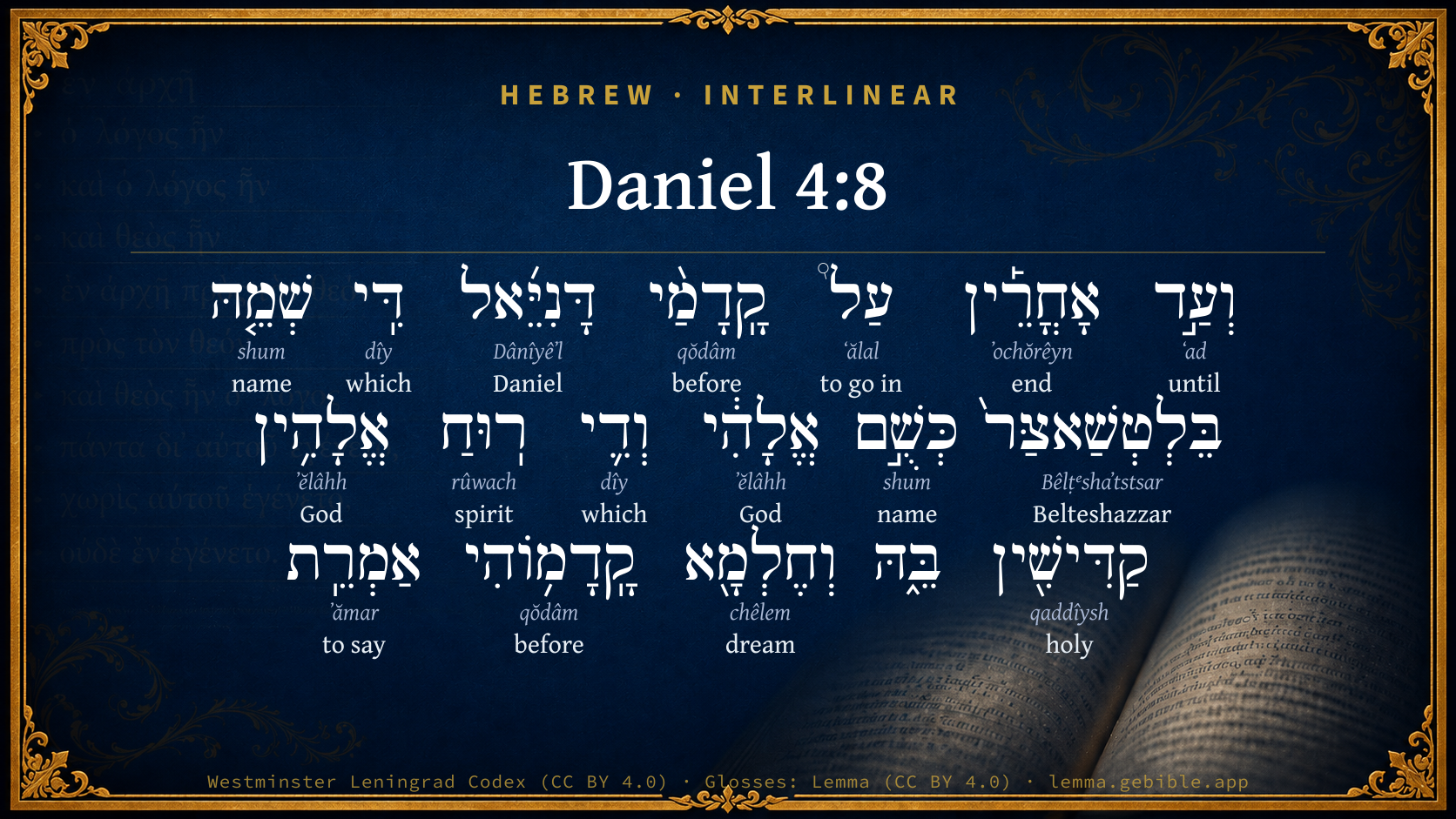
Daniel 4:8

Hebrew (Westminster Leningrad Codex) Daniel 4:8 appears in the Hebrew Old Testament. The text above is from the Westminster Leningrad Codex. Each word links to its Strong’s number, a concise gloss, and parsing drawn from the Open Scriptures Hebrew Bible morphology. Click any word for its full Brown-Driver-Briggs (BDB) entry.
Download image
Cite this verse

Daniel 4:8 (World English Bible). Public Domain. Lemma interlinear Bible study tool, https://lemma.gebible.app/v/daniel/4/8.

Show BibTeX & RIS
BibTeX
RIS
English Translation
But at the last Daniel came in before me, whose name was Belteshazzar, according to the name of my god, and in whom is the spirit of the holy gods: and I told the dream before him, [saying],
World English Bible · Public Domain
Highlights Full analysis ↓
Download a study sheet

One document with this verse’s original text, its word-by-word gloss line, the meaning frame, cross-references with their text, attributed commentary, and full source and license credits — printable, and it pastes into notes with its structure intact.

This verse Autodidact and up

Study sheet (.html) Plain text (.txt)

A passage Seminary Student

Up to 50 verses in one chapter. A passage sheet keeps up to 6 commentary sources and 12 cross-references per verse, in the order this page ranks them, and says so on the sheet whenever that leaves anything out. Ask for a single verse and you get the Autodidact verse sheet above.

Everything on this page stays free to read, with no account — the sheet is a download of what is already on screen, not access to it.

Want to remove ads? Support Godless Engineer
Compare translations 3

The same verse in 3 English versions, stacked beneath the original-language interlinear above. Click any original word for its lexicon entry.

Each is an independent rendering of the whole verse — the interlinear is not word-aligned to these translations.

Highlighted words mark where these versions differ — a whole-verse word diff, not a word-by-word alignment.

  • World English Bible Public Domain
    But at the last Daniel came in before me, whose name was Belteshazzar, according to the name of my god, and in whom is the spirit of the holy gods: and I told the dream before him, [saying],
  • King James Version Public Domain
    But at the last Daniel came in before me, whose name was Belteshazzar, according to the name of my God, and in whom is the spirit of the holy gods: and before him I told the dream, saying,
  • unfoldingWord Literal Text CC BY-SA 4.0
    But at last Daniel came in before me, whose name is Belteshazzar after the name of my god, and in whom is the spirit of the holy gods; and I told him the dream.

unfoldingWord Literal Text — © unfoldingWord, licensed CC BY-SA 4.0. Word-aligned USFM3 via Door43 (git.door43.org/unfoldingWord/en_ult).

Versions to compare (up to 4)

3 of 4 selected

Show all 18 translations

Every available English version of this verse, each an independent rendering of the whole verse.

  • World English Bible Public Domain
    But at the last Daniel came in before me, whose name was Belteshazzar, according to the name of my god, and in whom is the spirit of the holy gods: and I told the dream before him, [saying],
  • Berean Standard Bible Public Domain
    But at last, into my presence came Daniel (whose name is Belteshazzar after the name of my god, and in whom is the spirit of the holy gods). And I told him the dream:
  • Majority Standard Bible Public Domain
    But at last, into my presence came Daniel (whose name is Belteshazzar after the name of my god, and in whom is the spirit of the holy gods). And I told him the dream:
  • King James Version Public Domain
    But at the last Daniel came in before me, whose name was Belteshazzar, according to the name of my God, and in whom is the spirit of the holy gods: and before him I told the dream, saying,
  • American Standard Version (1901) Public Domain
    But at the last Daniel came in before me, whose name was Belteshazzar, according to the name of my god, and in whom is the spirit of the holy gods: and I told the dream before him, `saying',
  • Revised Version (1885) Public Domain
    But at the last Daniel came in before me, whose name was Belteshazzar, according to the name of my god, and in whom is the spirit of the holy gods: and I told the dream before him, saying,
  • Geneva Bible (1599) Public Domain
    A great tree and strong, and the height thereof reached vnto heauen, and the sight thereof to the endes of all the earth.
  • Douay-Rheims (1899) Public Domain
    Till their colleague Daniel came in before me, whose name is Baltassar, according to the name of my god, who hath in him the spirit of the holy gods: and I told the dream before him.
  • Young's Literal Translation Public Domain
    And at last come up before me hath Daniel, whose name `is' Belteshazzar -- according to the name of my god -- and in whom `is' the spirit of the holy gods, and the dream before him I have told:
  • Literal Standard Version CC BY-SA 4.0
    And at last Daniel has come up before me, whose name [is] Belteshazzar—according to the name of my god—and in whom [is] the spirit of the holy gods, and the dream before him I have told:
  • Unlocked Literal Bible CC BY-SA 4.0
    But at last Daniel came in—the one who is named Belteshazzar after the name of my god, and in whom is the spirit of the holy gods—and I told him the dream.
  • unfoldingWord Literal Text CC BY-SA 4.0
    But at last Daniel came in before me, whose name is Belteshazzar after the name of my god, and in whom is the spirit of the holy gods; and I told him the dream.
  • Darby Bible Public Domain
    But at the last Daniel came in before me, whose name is Belteshazzar, according to the name of my god, and in whom is the spirit of the holy gods; and before him I told the dream:
  • World Messianic Bible Public Domain
    But at last, Daniel came in before me, whose name was Belteshazzar according to the name of my god, and in whom is the spirit of the holy gods. I told the dream before him, saying,
  • Webster's Bible Public Domain
    But at the last Daniel came in before me, whose name is Belteshazzar, according to the name of my God, and in whom is the spirit of the holy gods: and before him I told the dream, saying,
  • Free Bible Version CC BY-SA 4.0
    In the end Daniel came before me and I told him the dream. (He is also called Belteshazzar after my god, and he has the spirit of the holy gods in him.)
  • Bible in Basic English Public Domain
    But at last Daniel came in before me, he whose name was Belteshazzar, after the name of my god, and in whom is the spirit of the holy gods: and I put the dream before him, saying,
  • JPS Tanakh (1917) Public Domain
    (4-5) But at the last Daniel came in before me, whose name was Belteshazzar, according to the name of my god, and in whom is the spirit of the holy gods; and I told the dream before him:

Literal Standard Version (2020), Covenant Press — licensed CC BY-SA 4.0. Text via the HelloAO Bible API (eBible.org). Unlocked Literal Bible (unfoldingWord) — licensed CC BY-SA 4.0. Text via the HelloAO Bible API (eBible.org). unfoldingWord Literal Text — © unfoldingWord, licensed CC BY-SA 4.0. Word-aligned USFM3 via Door43 (git.door43.org/unfoldingWord/en_ult). Free Bible Version, Dr. Jonathan Gallagher — licensed CC BY-SA 4.0. Text via the HelloAO Bible API (eBible.org).

Word by word

More ways to search: Search by grammar → Find every occurrence → Compare this word →

Practice this passage: Drill this verse → Learn its vocabulary →

אָחֳרֵ֡ין
ʼochŏrêyn
H318
“end”
Adjective, D
Part of Speech
Adjective
Full BDB Definition

Origin: from H317

TWOT: 2568c

end, outcome - hid part (of cows) - end (of time) - remnant, descendants
  1. וְעַ֣ד ʻad H5705 “and · until” Adjective, C + Preposition
  2. עַל֩ ʻălal H5954 “to go in” Adjective, V, Plural
  3. קָֽדָמַ֨י qŏdâm H6925 “before · me” Adjective, R + Suffix, Personal, 1st Person, Common, Singular
  4. דָּנִיֵּ֜אל Dânîyêʼl H1841 “Daniel” Adjective, N
  5. דִּֽי dîy H1768 “which” Adjective, T
  6. שְׁמֵ֤הּ shum H8036 “name · his” Adjective, N, Common + Suffix, Personal, 3rd Person, Masculine, Singular
  7. בֵּלְטְשַׁאצַּר֙ Bêlṭᵉshaʼtstsar H1096 “Belteshazzar” Adjective, N
  8. כְּשֻׁ֣ם shum H8036 “like/as · name of” Adjective, R + Noun, Common, Masculine, Singular, Construct
  9. אֱלָהִ֔י ʼĕlâhh H426 “God · my” Adjective, N, Common + Suffix, Personal, 1st Person, Common, Singular
  10. וְדִ֛י dîy H1768 “and · which” Adjective, C + Particle, Relative
  11. רֽוּחַ rûwach H7308 “spirit of” Adjective, N, Common
  12. אֱלָהִ֥ין ʼĕlâhh H426 “gods” Adjective, N, Common
  13. קַדִּישִׁ֖ין qaddîysh H6922 “holy” Adjective, A
  14. וְחֶלְמָ֖א chêlem H2493 “and · dream · the” Adjective, C + Noun, Common, Masculine, Singular, Determined + Particle, Definite Article
  15. קָֽדָמ֥וֹהִי qŏdâm H6925 “before · him” Adjective, R + Suffix, Personal, 3rd Person, Masculine, Singular
  16. אַמְרֵֽת ʼămar H560 “to say” Adjective, V, Plural

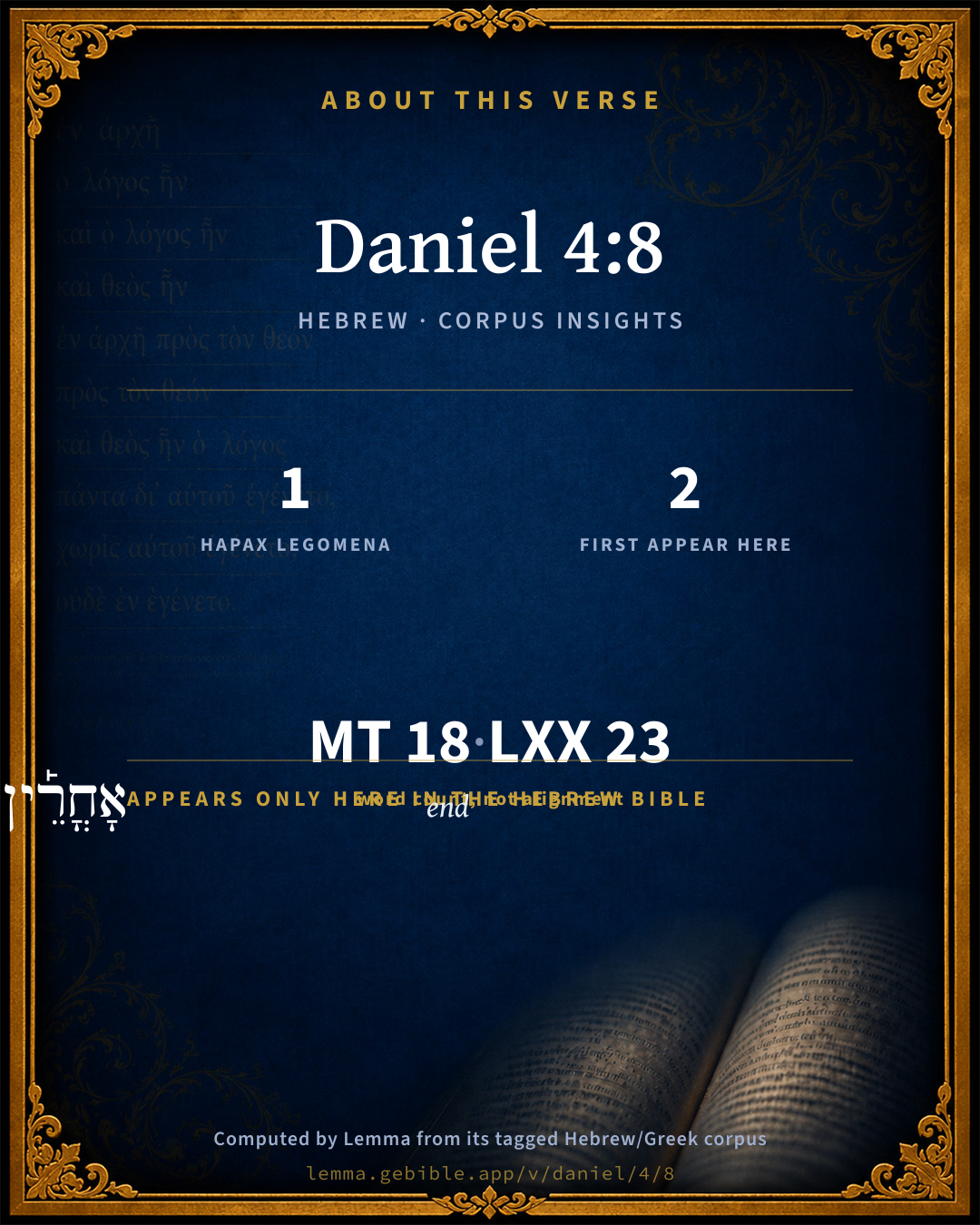
About this verse

These counts appear in no published source. They are computed here, from the morphology-tagged text and Lemma’s own curated glosses. What Lemma adds →

18
words
13
distinct lemmas
Prophets
section

Notable vocabulary

1 hapax legomenon — a word that appears only here in the entire Hebrew Bible:

  • אָחֳרֵ֡ין end H318

First appearance in Scripture

These words make their first canonical appearance in the Hebrew Bible here:

  • אָחֳרֵ֡ין end H318
  • קַדִּישִׁ֖ין holy H6922

Shared distinctive vocabulary

בֵּלְטְשַׁאצַּר֙ Belteshazzar H1096 occurs in 6 verses of the Hebrew Bible. Also found in:

Grammatical profile

  • 1 noun
  • 14 adjectives
  • 1 preposition
  • 2 particles

Repetition

Words recur within this verse — often emphatic in Hebrew:

  • קָֽדָמַ֨י before H6925 ×2
  • שְׁמֵ֤הּ name H8036 ×2
  • אֱלָהִ֔י God H426 ×2
  • דִּֽי which H1768 ×2

Hebrew & Septuagint length

In English translation the verse runs 38 words from the Hebrew and 23 from the Septuagint (LXX English) — the Septuagint runs noticeably shorter here. See the side-by-side →

A rough comparison of the two English renderings, which tokenize alike — not a word-level alignment.

Word counts can differ between the Hebrew and the Greek without any difference in meaning — e.g. the Hebrew direct-object marker אֵת has no separate Greek word, and Greek often adds the article ὁ.

In the original languages it is 18 Hebrew tokens and 23 Greek tokens — but the two are counted differently (Hebrew bundles its prefixes and suffixes into one token; the Greek is in lemma form), so that isn’t a like-for-like length.

Cross-references

10

Topical passages linked to Daniel 4:8 in the Treasury of Scripture Knowledge — connected by theme and wording, ordered by reader-vote popularity; previews shown in the World English Bible.

  • Daniel 1:7 The prince of the eunuchs gave names to them: to Daniel he gave [the name of] Belteshazzar; and to Hananiah, [of] Shadrach; and to Mishael, [of] Meshach; and to Azariah, [of] Abednego.
  • Daniel 4:18 This dream I, king Nebuchadnezzar, have seen; and you, Belteshazzar, declare the interpretation, because all the wise men of my kingdom are not able to make known to me the interpretation; but you are able; for the spirit of the holy gods is in you.
  • Daniel 5:14 I have heard of you, that the spirit of the gods is in you, and that light and understanding and excellent wisdom are found in you.
  • Daniel 2:11 It is a rare thing that the king requires, and there is no other who can show it before the king, except the gods, whose dwelling is not with flesh.
  • Daniel 4:9 Belteshazzar, master of the magicians, because I know that the spirit of the holy gods is in you, and no secret troubles you, tell me the visions of my dream that I have seen, and the interpretation of it.
  • Daniel 5:11–12 There is a man in your kingdom, in whom is the spirit of the holy gods; and in the days of your father light and understanding and wisdom, like the wisdom of the gods, were found in him; and the king Nebuchadnezzar your father, the king, [I say], your father, made him master of the magicians, enchanters, Chaldeans, and soothsayers;
  • Numbers 11:17–30 I will come down and talk with you there: and I will take of the Spirit which is on you, and will put it on them; and they shall bear the burden of the people with you, that you not bear it yourself alone.
  • Isaiah 46:1 Bel bows down, Nebo stoops; their idols are on the animals, and on the cattle: the things that you carried about are made a load, a burden to the weary [animal].
  • Isaiah 63:11 Then he remembered the days of old, Moses [and] his people, [saying], Where is he who brought them up out of the sea with the shepherds of his flock? where is he who put his holy Spirit in the midst of them?
  • Jeremiah 50:2 Declare you among the nations and publish, and set up a standard; publish, and don't conceal: say, Babylon is taken, Bel is disappointed, Merodach is dismayed; her images are disappointed, her idols are dismayed.

Cross-references courtesy of OpenBible.info (CC BY 4.0).

Hebrew and Greek witnesses Masoretic Hebrew ↔ Greek Septuagint

The same verse in the two great witnesses to the Old Testament, shown verse-for-verse.

Here the Septuagint runs noticeably shorter than the Hebrew — LXX2012 (modern English Septuagint) 23 words vs World English Bible 38. A rough length comparison of the two English translations, not a word-level alignment — read both below.

These are two independent witnesses, not word-aligned to each other, and the Septuagint is shown in lemma (dictionary) form.

Hebrew Daniel 4:8 Masoretic · Westminster Leningrad Codex

וְעַ֣ד אָחֳרֵ֡ין עַל֩ קָֽדָמַ֨י דָּנִיֵּ֜אל דִּֽי שְׁמֵ֤הּ בֵּלְטְשַׁאצַּר֙ כְּשֻׁ֣ם אֱלָהִ֔י וְדִ֛י רֽוּחַ אֱלָהִ֥ין קַדִּישִׁ֖ין בֵּ֑הּ וְחֶלְמָ֖א קָֽדָמ֥וֹהִי אַמְרֵֽת

But at the last Daniel came in before me, whose name was Belteshazzar, according to the name of my god, and in whom is the spirit of the holy gods: and I told the dream before him, [saying],

World English Bible · Public Domain

Greek LXX Daniel 4:8 Septuagint · lemma form

καί οὕτως εἶπον ῥίζα εἷς ἀποἵημι αὐτός ἐν ὁ γῆ ὅπως μετά ὁ θηρίον ὁ γῆ ἐν ὁ ὄρος χόρτος ὡς βοῦς νέμω

The tree grew large and strong, and its height reached to the sky, and its extent to the extremity of the whole earth:

LXX2012 (modern English Septuagint) · Public Domain

On this verse, Joseph Benson's Commentary discusses the Septuagint’s reading. Read the note in Commentary ↓

Hebrew: Westminster Leningrad Codex (CC BY 4.0). Greek: Septuagint (public domain); English from LXX2012 (modern English Septuagint) (Public Domain). How the Septuagint differs from the Hebrew →

Commentary

Notes on Daniel 4:8 from classic Christian and Jewish commentators (each source and its license shown beneath its notes). The classic Christian expositions comment on the surrounding passage and are grouped to its opening verse, so a note may address several verses; the Jewish commentaries on the Tanakh (Rashi and others) are per-verse, so they appear only where the commentator wrote on this verse.

Lemma curates 59 commentaries, every one of them public domain or Creative Commons licensed, each selected and text-cleaned for this edition rather than reprinted as found. About our sources →

Trapp's Complete Commentary

John Trapp

Dan 4:8 But at the last Daniel came in before me, whose name [was] Belteshazzar, according to the name of my god, and in whom [is] the spirit of the holy gods: and before him I told the dream, [saying],

Ver. 8. But at last Daniel came in before me.] And why "at last?" Why was he not sooner sent for? If the soothsayers and sorcerers could have served the turn, Daniel had never been sought to. This is the guise of graceless men; they run not to God till all other refuges fail them.

According to the name of my god, and in whom is the spirit of the holy gods.] Is this the language of a true convert? Should not former sinful practices be looked upon with a lively hatred, and mentioned with utter distaste?

John Trapp, A Commentary or Exposition upon All the Books of the Old and New Testament (1647–1656) — public domain. Text from a community e-Sword module.

Joseph Benson's Commentary

Dan 4:8-9. But at the last Daniel came in before me — Whether sent for by the king, or brought by another, appears not, but he was last, that it might appear that he only, or rather, his God, who revealed them to him, had the true understanding of these secrets: for if he had come first, or before the rest had tried all their skill in vain, they would have been ready to affirm they understood the interpretation of the dream as well as he, and so God would not have had the glory of it; but now it was evident that the interpretation was from the Spirit of God enlightening the prophet. In whom is the spirit of the holy gods — Who is enlightened by the gods, or heavenly powers, with a supernatural degree of knowledge, such as none of the wise men of Babylon can attain to. The original words, however, may be rendered, the holy God, as they are in the Greek and Arabic: and it is probable that this king had now the one true God in his mind. O Belteshazzar, master — Or, chief, of the magicians, as Wintle translates the words. That he was superior to, or placed as a governor over, all the magicians, or wise men, see on Dan 1:20; Dan 2:48. Because I know that the spirit of the holy gods — Or rather, of the holy God, is in thee, and that no secret troubleth thee — Or, is difficult to thee. The LXX. read, ουκ αδυνατει σε, is not impossible to thee. Thou art not at a loss to find out any secret thing whatsoever. Tell me the visions of my dream, and the interpretation thereof — Nebuchadnezzar tells the dream himself in the following words; so that the meaning of this sentence must be, Tell me the interpretation of the dream. The LXX. translate it thus: Hear the vision of my dream, which I saw, and tell me the interpretation thereof.

Joseph Benson's Commentary on the Old and New Testaments (1811–1818) — public domain. Text from a community e-Sword module.

Tyndale Open Study Notes

Tyndale Open Resources

4:8-9 At last: Nebuchadnezzar appealed first to his Babylonian advisers; in spite of his high position, Daniel, an exiled Jew, was a last resort. • spirit of the holy gods is in him: See 2:47; cp. 5:11. Despite his previous experience of the Most High God, Nebuchadnezzar still believed in many gods. In Egypt, Pharaoh had asserted the same thing of Joseph (Gen 41:37-38). It was the Most High God who assisted Daniel (Dan 4:24). Nevertheless, for the great king to say that Daniel had the spirit of the holy gods in him showed great respect and helps to explain Daniel’s immunity from harassment (see ch 3).

Tyndale Open Study Notes — © Tyndale Open Resources, licensed CC BY-SA 4.0. Text via the HelloAO Bible API.

Ibn Ezra

Rabbi Abraham ibn Ezra

[Daniel 4:8] Grew (רְבָ֥ה): [Meaning, it] grew great (גָּדַל - gadal).

Reached (יִמְטֵ֣א): [Meaning, it] reached (יַגִּיעַ - yagia).

And its visibility (וַחֲזוֹתֵ֖הּ): [Meaning] its branches/foliage (שֶׂעֲפָיו - se'apayiv). [Ibn Ezra interprets the tree's visibility as stemming from its extensive branches/foliage]. And similar to it [using the root ח.ז.ה related to vision/appearance] is: “a conspicuous horn” (קֶרֶן חָזוּת - keren chazut) [found in Daniel 8:5], because it [the horn] has the likeness of branches/foliage (שֶׁיֵּשׁ לוֹ כִּדְמוּת שְׂעִיפִים - sheyesh lo kidmut s'ifim). [Ibn Ezra interprets keren chazut not just as 'visible' but as prominent or conspicuous like spreading branches, linking the concept of visibility/appearance in both verses to the idea of branching structure].

Ibn Ezra on the Tanakh — English translations: “Sefaria Community Translation” (CC0 1.0 (public-domain dedication)); “Yalkut, Sifsei Chachomim Chumash, Metsudah Publications, 2009” (CC BY 4.0); and “Commentary of Ibn Ezra on Isaiah - trans. by M. Friedlander, 1873” (public domain). Text via Sefaria.

Jamieson, Fausset & Brown

Robert Jamieson, A. R. Fausset & David Brown

Belteshazzar--called so from the god Bel or Belus (see on Dan 1:7).

Jamieson, Fausset & Brown — Commentary Critical and Explanatory on the Whole Bible (1871) — public domain (CC PDM 1.0). Text via the HelloAO Bible API.

John Calvin's Commentaries

Here the king of Babylon addresses Daniel kindly, since he saw himself deserted by his own teachers. And hence we gather that no one comes to the true God, unless impelled by necessity. Daniel was not either unknown or far off; for we saw him to have been in the palace. Since then the king had Daniel with him from the first, why did he pass him over? Why did he call the other Magi from all quarters by his edict? Hence, as I have said, it clearly appears he would never have given glory to God, unless when compelled by extreme necessity. Hence he never willingly submitted to the God of Israel; and his affections were clearly but momentary, whenever they manifested any sign of piety. Because he besought Daniel so imploringly, we see his disposition to have been servile; just as all proud men swell out when they do not need any one’s help, and become overbearing in their insolence; but when they are reduced to extremity, they would rather lick the dust than not obtain the favor which they need. Such was the king’s disposition, since he willingly despised Daniel, and purposely preferred the Magi. But as soon as he saw himself left in difficulties, and unable to find any remedy except in Daniel, this was his last refuge; and he now seems to forget his own loftiness while speaking softly to God’s holy Prophet. But I shall proceed with the rest to-morrow.

John Calvin's Commentaries (1540-1563) — public domain. Text from the Calvin Translation Society English edition (1840s-50s) via the Christian Classics Ethereal Library (ccel.org). Calvin's coverage is partial (roughly two-thirds of the Bible); uncommented books and verses are honest gaps, never fabricated. The 19th-century editor's footnotes and remarks are omitted so the notes are faithfully Calvin's own voice.

Ellicott's Commentary for English Readers

(8) At the last.—On account of his position as the chief of the governors of the wise men, Daniel would not “come in” till last.

Belteshazzar.—See Note on Dan_1:7; Introduction, § 6.

The spirit . . .—He means his own gods, for though he recognised Jehovah to be a “high God,” yet he acknowledged Him only as one out of many.

A Bible Commentary for English Readers, edited by Charles John Ellicott (1878–1897) — public domain. Text from a community e-Sword module.

The Cambridge Bible for Schools and Colleges

gen. ed. J. J. S. Perowne

8. at the last] It is difficult to understand how the Aram. can bear this meaning; though no doubt something substantially similar is what is intended. Behrmann renders, ‘And (so it was) till another came in before me, (even) Daniel’; and Bevan (changing a point), ‘And yet another came in before me, (even) Daniel.’

according to the name of my god] viz. Bel. The ‘Bel’ in Belteshazzar is not really the name of the god, but (as explained on Dan_1:7) is part of the word balâṭsu, ‘his life’; but it may be only an assonance, not an etymology, which the king is represented as expressing,—just as Hebrew writers say, for instance, that Cain or Moses was so called because of the verbs ‘I have gotten,’ ‘I have drawn out,’ although philologically Cain cannot possibly mean ‘gotten,’ or Moses ‘drawn out.’

in whom is the spirit, &c.] imitated, it seems, from Gen_41:38 (of Joseph), ‘a man in whom the spirit of God is.’ On the sense of ‘spirit’ in the O.T., see on Joe_2:28 (in the Cambridge Bible).

the holy gods] Nebuchadnezzar expresses himself as a polytheist: though in Dan_4:3; Dan_4:34-35 he uses language indistinguishable from that of pure monotheism. The same expression occurs in the Phœnician inscription of Eshmunazar, king of Sidon (3–4 cent. b.c.), lines 9 and. 22[239]. On the sense attaching to the term ‘holy’ (which has here hardly any ethical connotation, and means rather what we should express by ‘divine’), see Hastings’ Dict. of the Bible, ii. 395–7; and cf. Sanday-Headlam, Comm. on the Epistle to the Romans, on Dan_1:7.

[239] Hogarth, Authority and Archæology (1899), p. 137 f.

The Cambridge Bible for Schools and Colleges (gen. ed. J. J. S. Perowne; Cambridge University Press, 1878–1918) — public domain. Text from a community e-Sword module.

John Gill's Exposition

But at the last Daniel came in before me,.... Whether sent for or no is not clear; the reason why he came not with the rest might be because he did not associate with them; nor did they care he should be among them, and present at this time; and it may be the king had forgot the knowledge he had of dreams; or, however, did not choose to send for him until he had tried all his wise men; and so it was ordered by the providence of God, and which is the chief reason of all, that he should come last, that the skill of the magicians might appear first to be baffled, and that Daniel, or rather Daniel's God, might be more known, and might be glorified:

whose name was Belteshazzar, according to the name of my god; so called by him and his courtiers, after the name of his god Bel, with which this name of Daniel begins; See Gill on Dan 1:7,

and in whom is the spirit of the holy gods: meaning either the holy angels, as Saadiah or speaking in his Heathenish manner, having imbibed the notion of many gods, some holy, and some impure; or it may be, speaking in the dialect of the Jews, he may mean the one true God who is holy, and from whom alone is the spirit of prophecy or of foretelling things to come; which he knew by former experience Daniel had:

and before him I told the dream, saying; as follows:

John Gill's Exposition of the Whole Bible (1746–1763) — public domain (CC PDM 1.0). Text via the HelloAO Bible API.

Albert Barnes' Notes on the Bible

But at the last - After the others had shown that they could not interpret the dream. Why Daniel was not called with the others does not appear; nor is it said in what manner he was at last summoned into the presence of the king. It is probable that his skill on a former occasion Dan. 2 was remembered, and that when all the others showed that they had no power to interpret the dream, he was called in by Nebuchadnezzar. The Latin Vulgate renders this, Donee collega ingressus est - “until a colleague entered.” The Greek, ἕως heōs, “until.” Aquila and Symmachus render it, “until another entered before me, Daniel.” The common version expresses the sense of the Chaldee with sufficient accuracy, though a more literal translation would be, “until afterward.”

Whose name was Belteshazzar - That is, this was the name which he bore at court, or which had been given him by the Chaldeans. See the note at Dan 1:7.

According to the name of my god - That is, the name of my god Bel, or Belus, is incorporated in the name given to him. This is referred to here, probably, to show the propriety of thus invoking his aid; because he bore the name of the god whom the monarch had adored. There would seem to be a special fitness in summoning him before him, to explain what was supposed to be an intimation of the will of the god whom he worshipped. There is a singular, though not unnatural, mixture of the sentiments of paganism and of the true religion in the expressions which this monarch uses in this chapter. He had been a pagan all his life; yet he had had some knowledge of the true God, and had been made to feel that he was worthy of universal adoration and praise, Dan. 2. That, in this state of mind, he should alternately express such sentiments as were originated by paganism, and those which spring from just views of God, is not unnatural or improbable.

And in whom is the spirit of the holy gods - It is not easy to determine whom he meant by the holy gods. It would seem probable that this was such language as was dictated by the fact that he had been an idolater. He had been brought to feel that the God whom Daniel worshipped, and by whose aid he had been enabled to interpret the dream, was a true God, and was worthy of universal homage; but perhaps his ideas were still much confused, and he only regarded him as superior to all others, though he did not intend to deny the real existence of others. It might be true, in his apprehension, that there were other gods, though the God of Daniel was supreme, and perhaps he meant to say that the spirit of all the gods was in Daniel; that in an eminent degree he was the favorite of heaven, and that he was able to interpret any communication which came from the invisible world. It is perhaps unnecessary to observe here that the word spirit has no intended reference to the Holy Spirit. It is probably used with reference to the belief that the gods were accustomed to impart wisdom and knowledge to certain men, and may mean that the very spirit of wisdom and knowledge which dwelt in the gods themselves seemed to dwell in the bosom of Daniel.

And before him I told the dream - Not requiring him, as he did before Dan. 2, to state both the dream and its meaning.

Albert Barnes' Notes on the Bible (1834–1885) — public domain. Text from a community e-Sword/MySword module.

Matthew Poole's English Annotations

Daniel came in before me; whether sent for by the king, or brought in by another, appears not, but he was last, that it might appear he had the true understanding of these secrets; for if he had come first, before the rest had done their best in trying all their skill in vain, they would have said they knew as well as he, and so God would not have had the glory; but now it is plain the Spirit of God in the prophet did all.

The holy gods; he speaks in the plural, like an idolater, and because he calls him

Belteshazzar, according to the name of his god, i.e. Bel or Baal. By the

spirit of the gods he means the spirit of divination, or prophecy of future contingent things, which God only knows, and reveals by his Spirit as he pleaseth, which none of the magicians were endued with.

Matthew Poole's English Annotations on the Holy Bible (1683–1685) — public domain. Text from a community e-Sword/MySword module.

Whedon's Commentary on the Bible

Daniel D. Whedon

8. How remarkably similar is this to the account in chapter ii! Brown, in his recent Hebrew Lexicon, objects to the connection of the name Belteshazzar with Bel, as “inexplicable;” but see note Dan_1:6-7. Vigouroux (Dictionnaire, 5:1893) gives a number of abbreviations precisely similar to this in which the first term — the divine name — is omitted. The express statement of this verse, that Daniel was named after Nebuchadnezzar’s favorite god, seems to exclude such derivations as those of Strassmaier, and others, who would make the first term Belit or Balat. Most of the inscriptions of Nebuchadnezzar were written in glorification of Bel, whom he calls “the joy of my heart.”

Daniel D. Whedon (gen. ed.), Commentary on the Old and New Testaments (1874–1909) — public domain. Text from a community e-Sword module.

The Pulpit Commentary

But at the last Daniel came in before me, whose name was Belteshazzar, according to the name of my god, and in whom is the spirit of the holy gods: and before him I told the dream, saying. This verse is also omitted in the Septuagint. Instead of this verse and those preceding, this verse occurs after the account of the dream, "And when I arose from my couch in the morning, I called Daniel, the ruler of the wise men, and the chief of the interpreters of dreams, and I related to him the dream, and he showed me all the interpretation of it." Theodotion and the Peshitta agree with the Massoretic text. The Septuagint arranges differently: instead of deferring the account of the dream till Nebuchadnezzar tells it to Daniel, the account of the dream follows immediately upon the statement of the fact that it had occurred and had troubled the king. In it, as we have seen, there is nothing of the summoning of all the wise men of Babylon in all their various classes. This summoning of the whole college of wise men, astrologers, soothsayers, and Chaldeans, is in obvious contradiction, not only to Dan_2:48, but also to the ninth verse of the chapter before us. There was no need of summoning the college of augurs until the king had consulted their head. The explanation of these verses and the occasion of their interpolation is not unlike the fact narrated in Dan_2:2, where Nebuchadnezzar, on account of his first dream, calls together the wise men that when he had a dream that troubled him it was natural that Nebuchadnezzar should do as the Septuagint declares he did, summon "Daniel, the ruler of the wise men, and the chief of the interpreters of dreams." One result of which follows, if we discard these verses, i.e. that we get rid, in this passage, of the class of "Chaldeans," and further, of the etymology of "Belteshazzar," both of which have been made objections to the authenticity of Daniel.

The Pulpit Commentary (1880–1919), ed. H.D.M. Spence-Jones & Joseph S. Exell — public domain. Text from a community e-Sword module.

Rashi

Rabbi Shlomo Yitzchaki (Rashi)

The tree grew and became strong The tree grew and became stronger and stronger.

reached the sky [as translated,] reached the sky.

Rashi on the Tanakh — English translations: “The Judaica Press complete Tanach with Rashi, translated by A. J. Rosenberg” (CC BY 4.0); “Pentateuch with Rashi's commentary by M. Rosenbaum and A.M. Silbermann, 1929-1934” (public domain); “The Metsudah Tanach series, Lakewood, N.J” (CC BY 4.0); and “The Book of Joshua, Metsudah Publications, 1997” (CC BY 4.0). Text via Sefaria.

Lesson kit

Teaching starters — assembled from the data on this page, not authored interpretation. Every prompt links to the verse data it draws on. Edit before teaching.

Daniel, in the Prophets, opens this verse with 18 words (13 distinct Hebrew lemmas). Its most distinctive word is ʼochŏrêyn (“end”). The Greek Septuagint runs shorter here. A historical commentator’s framing appears above. Read the whole chapter for the surrounding context.

Discussion questions

  1. How does “end” (ʼochŏrêyn) shape what this verse is saying?
  2. 1 word here appears nowhere else in the Hebrew Bible. Why might the author reach for such rare wording?
  3. 2 words make their first appearance in Scripture here. What does this debut establish?
  4. How does Daniel 2:26, which shares the word «Belteshazzar», read alongside this verse?
  5. What does the repetition of “before” (2× in this one verse) do in this verse?
  6. The Septuagint runs shorter here than the Hebrew. What might account for the difference?
  7. These translations render this verse differently. What is at stake in choosing one wording over another?
  8. Compare how Trapp's Complete Commentary and Joseph Benson's Commentary read this verse. Where do they agree or differ?

Things to notice

  • 1 word in this verse appears nowhere else in the Hebrew Bible.
  • 2 words make their first canonical appearance in Scripture here.
  • This verse counts 18 Hebrew ↔ 23 Greek words.
  • These translations choose different wording for 3 words in this verse.
  • “before” occurs 2× in this single verse.

Reading settings

Reading text

Shown beneath each verse's original-language words.

Old Testament
Old Testament edition

Read the OT as the Masoretic Hebrew (MT) or the Greek Septuagint (LXX).

English shown for the Greek Septuagint (in the Hebrew ↔ Greek comparison).

Comparing translations? Open the Compare panel on any verse page to stack up to four side by side.