
Daniel 6:4

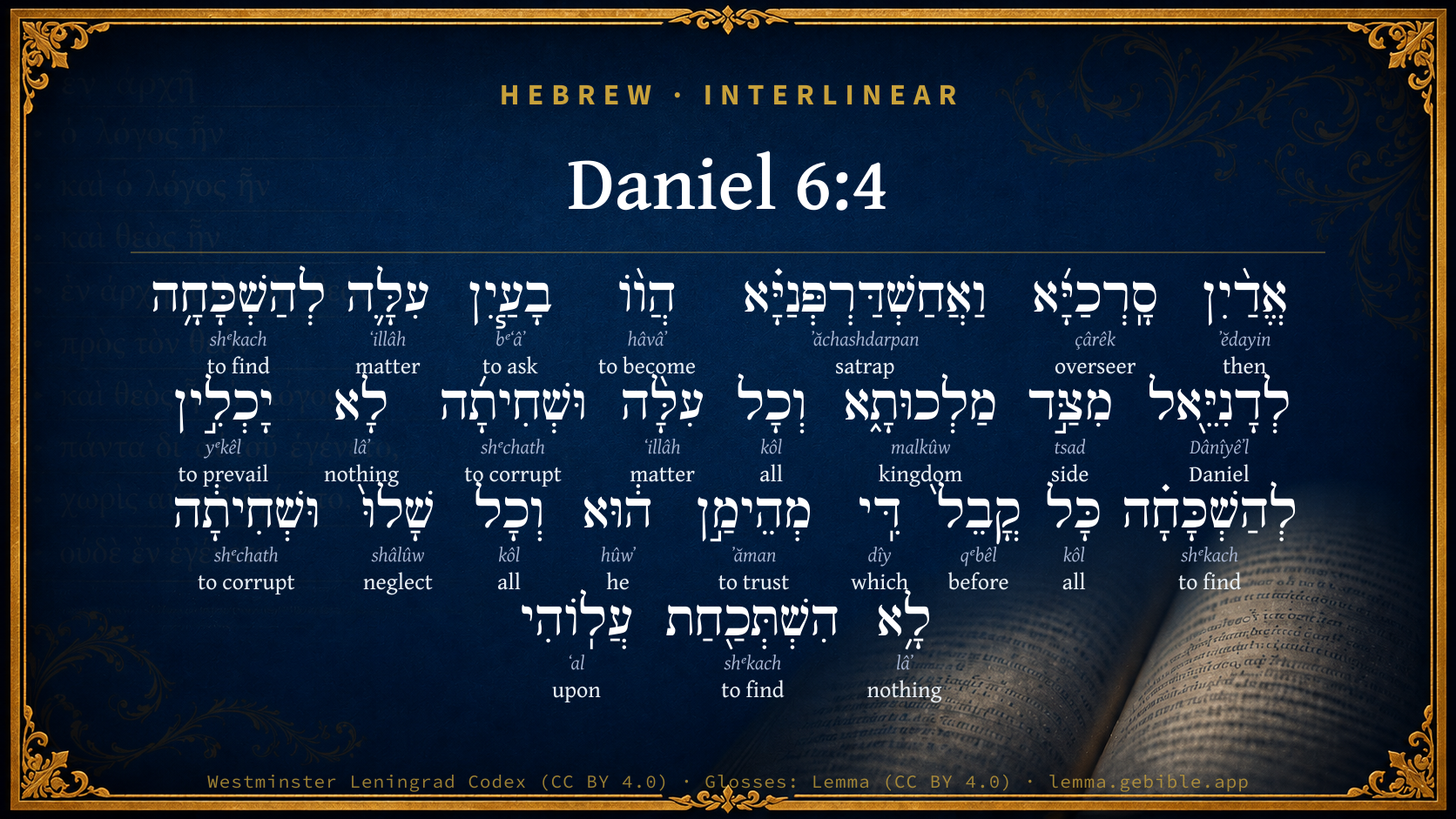
Hebrew (Westminster Leningrad Codex) Daniel 6:4 appears in the Hebrew Old Testament. The text above is from the Westminster Leningrad Codex. Each word links to its Strong’s number, a concise gloss, and parsing drawn from the Open Scriptures Hebrew Bible morphology. Click any word for its full Brown-Driver-Briggs (BDB) entry.
Download image
Cite this verse

Daniel 6:4 (World English Bible). Public Domain. Lemma interlinear Bible study tool, https://lemma.gebible.app/v/daniel/6/4.

Show BibTeX & RIS
BibTeX
RIS
English Translation
Then the presidents and the satraps sought to find occasion against Daniel as touching the kingdom; but they could find no occasion nor fault, because he was faithful, neither was there any error or fault found in him.
World English Bible · Public Domain
Highlights Full analysis ↓
Download a study sheet

One document with this verse’s original text, its word-by-word gloss line, the meaning frame, cross-references with their text, attributed commentary, and full source and license credits — printable, and it pastes into notes with its structure intact.

This verse Autodidact and up

Study sheet (.html) Plain text (.txt)

A passage Seminary Student

Up to 50 verses in one chapter. A passage sheet keeps up to 6 commentary sources and 12 cross-references per verse, in the order this page ranks them, and says so on the sheet whenever that leaves anything out. Ask for a single verse and you get the Autodidact verse sheet above.

Everything on this page stays free to read, with no account — the sheet is a download of what is already on screen, not access to it.

Want to remove ads? Support Godless Engineer
Compare translations 3

The same verse in 3 English versions, stacked beneath the original-language interlinear above. Click any original word for its lexicon entry.

Each is an independent rendering of the whole verse — the interlinear is not word-aligned to these translations.

Highlighted words mark where these versions differ — a whole-verse word diff, not a word-by-word alignment.

  • World English Bible Public Domain
    Then the presidents and the satraps sought to find occasion against Daniel as touching the kingdom; but they could find no occasion nor fault, because he was faithful, neither was there any error or fault found in him.
  • King James Version Public Domain
    Then the presidents and princes sought to find occasion against Daniel concerning the kingdom; but they could find none occasion nor fault; forasmuch as he was faithful, neither was there any error or fault found in him.
  • unfoldingWord Literal Text CC BY-SA 4.0
    Then the high officials and the satraps were seeking to find a ground for accusation against Daniel with regard to the kingdom, but they were not able to find any ground for accusation or corruption because he was faithful, and no negligence or corruption was found in him.

unfoldingWord Literal Text — © unfoldingWord, licensed CC BY-SA 4.0. Word-aligned USFM3 via Door43 (git.door43.org/unfoldingWord/en_ult).

Versions to compare (up to 4)

3 of 4 selected

Show all 18 translations

Every available English version of this verse, each an independent rendering of the whole verse.

  • World English Bible Public Domain
    Then the presidents and the satraps sought to find occasion against Daniel as touching the kingdom; but they could find no occasion nor fault, because he was faithful, neither was there any error or fault found in him.
  • Berean Standard Bible Public Domain
    Thus the administrators and satraps sought a charge against Daniel concerning the kingdom, but they could find no charge or corruption, because he was trustworthy, and no negligence or corruption was found in him.
  • Majority Standard Bible Public Domain
    Thus the administrators and satraps sought a charge against Daniel concerning the kingdom, but they could find no charge or corruption, because he was trustworthy, and no negligence or corruption was found in him.
  • King James Version Public Domain
    Then the presidents and princes sought to find occasion against Daniel concerning the kingdom; but they could find none occasion nor fault; forasmuch as he was faithful, neither was there any error or fault found in him.
  • American Standard Version (1901) Public Domain
    Then the presidents and the satraps sought to find occasion against Daniel as touching the kingdom; but they could find no occasion nor fault, forasmuch as he was faithful, neither was there any error or fault found in him.
  • Revised Version (1885) Public Domain
    Then the presidents and the satraps sought to find occasion against Daniel as touching the kingdom; but they could find none occasion nor fault; forasmuch as he was faithful, neither was there any error or fault found in him.
  • Geneva Bible (1599) Public Domain
    Wherefore the rulers and gouernours sought an occasion against Daniel concerning the kingdome: but they could finde none occasion nor fault: for he was so faithfull that there was no blame nor fault found in him.
  • Douay-Rheims (1899) Public Domain
    And the king thought to set him over all the kingdom: whereupon the princes, and the governors sought to find occasion against Daniel with regard to the king: and they could find no cause, nor suspicion, because he was faithful, and no fault, nor suspicion was found in him
  • Young's Literal Translation Public Domain
    Then the presidents and satraps have been seeking to find a cause of complaint against Daniel concerning the kingdom, and any cause of complaint and corruption they are not able to find, because that he `is' faithful, and any error and corruption have not been found in him.
  • Literal Standard Version CC BY-SA 4.0
    Then the presidents and satraps have been seeking to find a cause of complaint against Daniel concerning the kingdom, and any cause of complaint and corruption they are not able to find, because that he [is] faithful, and any error and corruption have not been found in him.
  • Unlocked Literal Bible CC BY-SA 4.0
    Then the other chief administrators and the provincial governors looked for mistakes in the work Daniel did for the kingdom, but they could find no corruption or failure in his duty because he was faithful. No mistakes or negligence was found in him.
  • unfoldingWord Literal Text CC BY-SA 4.0
    Then the high officials and the satraps were seeking to find a ground for accusation against Daniel with regard to the kingdom, but they were not able to find any ground for accusation or corruption because he was faithful, and no negligence or corruption was found in him.
  • Darby Bible Public Domain
    Then the presidents and the satraps sought to find a pretext against Daniel with respect to the kingdom; but they could not find any pretext or fault; inasmuch as he was faithful, neither was there any error or fault found in him.
  • World Messianic Bible Public Domain
    Then the presidents and the local governors sought to find occasion against Daniel as touching the kingdom; but they could find no occasion or fault, because he was faithful. There wasn’t any error or fault found in him.
  • Webster's Bible Public Domain
    \\6:3\\Then this Daniel was preferred above the presidents and princes, because an excellent spirit was in him; and the king thought to set him over the whole realm.
  • Free Bible Version CC BY-SA 4.0
    As a result the other chief ministers and provincial governors tried to find a pretext against Daniel as to the way he ran the kingdom. But they couldn't find any cause for complaint or any corruption, for he was trustworthy. They could not discover any evidence that Daniel was negligent or corrupt.
  • Bible in Basic English Public Domain
    Then this Daniel did his work better than the chief rulers and the captains, because there was a special spirit in him; and it was the king's purpose to put him over all the kingdom.
  • JPS Tanakh (1917) Public Domain
    (6-5) Then the presidents and the satraps sought to find occasion against Daniel as touching the kingdom; but they could find no occasion nor fault; forasmuch as he was faithful, neither was there any error or fault found in him.

Literal Standard Version (2020), Covenant Press — licensed CC BY-SA 4.0. Text via the HelloAO Bible API (eBible.org). Unlocked Literal Bible (unfoldingWord) — licensed CC BY-SA 4.0. Text via the HelloAO Bible API (eBible.org). unfoldingWord Literal Text — © unfoldingWord, licensed CC BY-SA 4.0. Word-aligned USFM3 via Door43 (git.door43.org/unfoldingWord/en_ult). Free Bible Version, Dr. Jonathan Gallagher — licensed CC BY-SA 4.0. Text via the HelloAO Bible API (eBible.org).

Word by word

More ways to search: Search by grammar → Find every occurrence → Compare this word →

Practice this passage: Drill this verse → Learn its vocabulary →

מִצַּ֣ד
tsad
H6655
“from · side of”
Adjective, R + Noun, Common, Masculine, Singular, Construct
Part of Speech
Adjective + Noun
Type
Common
Gender
Masculine
Number
Singular
State
Construct
Full BDB Definition

Origin: corresponding to H6654

TWOT: 2955

side - (CLBL) beside
  1. אֱדַ֨יִן ʼĕdayin H116 “then” Adjective, D
  2. סָֽרְכַיָּ֜א çârêk H5632 “overseers · the” Adjective, N, Common + Particle, Definite Article
  3. וַאֲחַשְׁדַּרְפְּנַיָּ֗א ʼăchashdarpan H324 “and · satraps · the” Adjective, C + Noun, Common, Masculine, Plural, Determined + Particle, Definite Article
  4. הֲו֨וֹ hâvâʼ H1934 “to become” Adjective, V, Plural
  5. בָעַ֧יִן bᵉʻâʼ H1156 “asking” Adjective, V
  6. עִלָּ֛ה ʻillâh H5931 “matter” Adjective, N, Common
  7. לְהַשְׁכָּחָ֥ה shᵉkach H7912 “to find” Adjective, R + Verb, Hiphil, Infinitive Construct
  8. לְדָנִיֵּ֖אל Dânîyêʼl H1841 “to/for · Daniel” Adjective, R + Noun, Proper
  9. מַלְכוּתָ֑א malkûw H4437 “kingdom · the” Adjective, N, Common + Particle, Definite Article
  10. וְכָל kôl H3606 “and · all of” Adjective, C + Noun, Common, Masculine, Singular, Construct
  11. עִלָּ֨ה ʻillâh H5931 “matter” Adjective, N, Common
  12. וּשְׁחִיתָ֜ה shᵉchath H7844 “and · corrupted” Adjective, C + Verb, Qal Passive, Participle Passive, Feminine, Singular, Absolute
  13. לָא lâʼ H3809 “nothing” Adjective, T
  14. יָכְלִ֣ין yᵉkêl H3202 “prevailing” Adjective, V
  15. לְהַשְׁכָּחָ֗ה shᵉkach H7912 “to find” Adjective, R + Verb, Hiphil, Infinitive Construct
  16. כָּל kôl H3606 “all” Adjective, C + Conjunction
  17. קֳבֵל֙ qᵉbêl H6903 “before” Adjective, C
  18. דִּֽי dîy H1768 “which” Adjective, C
  19. מְהֵימַ֣ן ʼăman H540 “trusted” Adjective, V, Singular
  20. ה֔וּא hûwʼ H1932 “he” Adjective, P
  21. וְכָל kôl H3606 “and · all of” Adjective, C + Noun, Common, Masculine, Singular, Construct
  22. שָׁלוּ֙ shâlûw H7960 “neglect” Adjective, N, Common
  23. וּשְׁחִיתָ֔ה shᵉchath H7844 “and · corrupted” Adjective, C + Verb, Qal Passive, Participle Passive, Feminine, Singular, Absolute
  24. לָ֥א lâʼ H3809 “nothing” Adjective, T
  25. הִשְׁתְּכַ֖חַת shᵉkach H7912 “to find” Adjective, V, Plural
  26. עֲלֽוֹהִי ʻal H5922 “upon · him” Adjective, R + Suffix, Personal, 3rd Person, Masculine, Singular

About this verse

These counts appear in no published source. They are computed here, from the morphology-tagged text and Lemma’s own curated glosses. What Lemma adds →

27
words
20
distinct lemmas
Prophets
section

Notable vocabulary

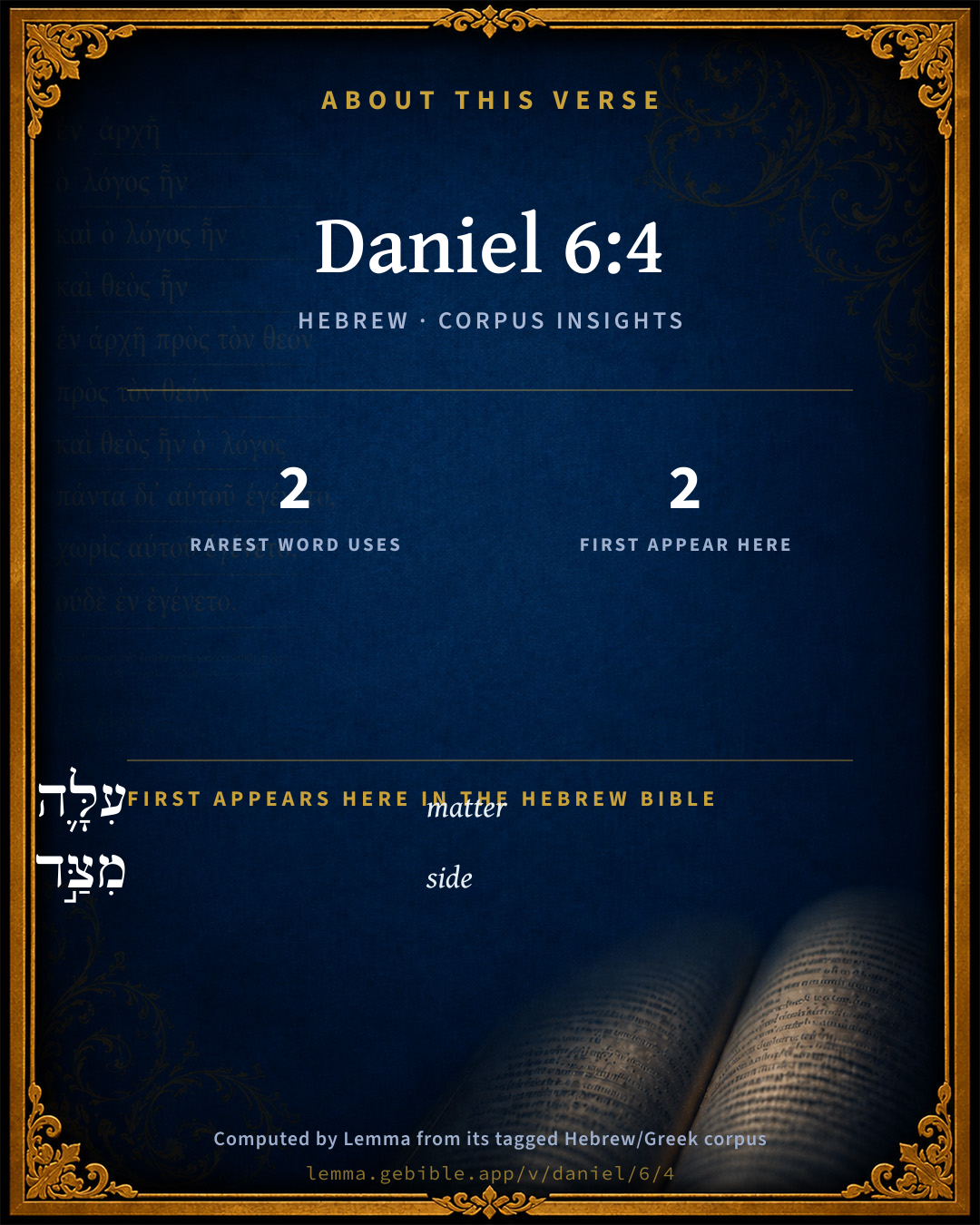
The rarest word here is מִצַּ֣ד side H6655 — appearing just 2 times in the whole Hebrew Bible.

First appearance in Scripture

These words make their first canonical appearance in the Hebrew Bible here:

  • עִלָּ֛ה matter H5931
  • מִצַּ֣ד side H6655

Shared distinctive vocabulary

מִצַּ֣ד side H6655 occurs in 2 verses of the Hebrew Bible. Also found in:

Grammatical profile

  • 4 verbs
  • 4 nouns
  • 15 adjectives
  • 1 conjunction
  • 3 particles

Verb forms

  • לְהַשְׁכָּחָ֥ה Hiphil · Infinitive Construct
  • וּשְׁחִיתָ֜ה Qal Passive · Participle Passive
  • לְהַשְׁכָּחָ֗ה Hiphil · Infinitive Construct
  • וּשְׁחִיתָ֔ה Qal Passive · Participle Passive

Repetition

Words recur within this verse — often emphatic in Hebrew:

  • לְהַשְׁכָּחָ֥ה to find H7912 ×3
  • וְכָל all H3606 ×3
  • עִלָּ֛ה matter H5931 ×2
  • וּשְׁחִיתָ֜ה to corrupt H7844 ×2
  • לָא nothing H3809 ×2

Hebrew & Septuagint length

In English translation the verse runs 38 words from the Hebrew and 26 from the Septuagint (LXX English) — the Septuagint runs noticeably shorter here. See the side-by-side →

A rough comparison of the two English renderings, which tokenize alike — not a word-level alignment.

Word counts can differ between the Hebrew and the Greek without any difference in meaning — e.g. the Hebrew direct-object marker אֵת has no separate Greek word, and Greek often adds the article ὁ.

Cross-references

26

Topical passages linked to Daniel 6:4 in the Treasury of Scripture Knowledge — connected by theme and wording, ordered by reader-vote popularity; previews shown in the World English Bible.

  • 1 Peter 3:16 having a good conscience; that, while you are spoken against as evildoers, they may be disappointed who curse your good manner of life in Christ.
  • Philippians 2:15 that you may become blameless and harmless, children of God without blemish in the midst of a crooked and perverse generation, among whom you are seen as lights in the world,
  • 1 Peter 2:12 having good behavior among the nations, so in that which they speak against you as evil-doers, they may by your good works, which they see, glorify God in the day of visitation.
  • Luke 20:20 They watched him, and sent out spies, who pretended to be righteous, that they might trap him in something he said, so as to deliver him up to the power and authority of the governor.
  • Luke 23:14–15 and said to them, "You brought this man to me as one that perverts the people, and see, I have examined him before you, and found no basis for a charge against this man concerning those things of which you accuse him.
  • Psalms 37:32–33 The wicked watches the righteous, And seeks to kill him.
  • Matthew 27:18 For he knew that because of envy they had delivered him up.
  • Titus 2:8 and soundness of speech that can't be condemned; that he who opposes you may be ashamed, having no evil thing to say about us.
  • Jeremiah 20:10 For I have heard the defaming of many, terror on every side. Denounce, and we will denounce him, [say] all my familiar friends, those who watch for my fall; peradventure he will be persuaded, and we shall prevail against him, and we shall take our revenge on him.
  • Genesis 43:18 The men were afraid, because they were brought to Joseph's house; and they said, "Because of the money that was returned in our sacks at the first time are we brought in; that he may seek occasion against us, and fall on us, and take us for bondservants, along with our donkeys."
  • Judges 14:4 But his father and his mother didn't know that it was of Yahweh; for he sought an occasion against the Philistines. Now at that time the Philistines had rule over Israel.
  • Proverbs 29:27 A dishonest man detests the righteous, And the upright in their ways detest the wicked.
  • Ecclesiastes 4:4 Then I saw all the labor and achievement that is the envy of a man's neighbor. This also is vanity and a striving after wind.
  • 1 Samuel 18:14 David behaved himself wisely in all his ways; and Yahweh was with him.
  • 1 Samuel 19:4–5 Jonathan spoke good of David to Saul his father, and said to him, Don't let the king sin against his servant, against David; because he has not sinned against you, and because his works have been very good toward you:
  • 1 Samuel 22:14 Then Ahimelech answered the king, and said, Who among all your servants is so faithful as David, who is the king's son-in-law, and is taken into your council, and is honorable in your house?
  • Psalms 37:12–13 The wicked plots against the just, And gnashes at him with his teeth.
  • Jeremiah 18:18 Then said they, Come, and let us devise devices against Jeremiah; for the law shall not perish from the priest, nor counsel from the wise, nor the word from the prophet. Come, and let us strike him with the tongue, and let us not give heed to any of his words.
  • Jeremiah 18:23 Yet, Yahweh, you know all their counsel against me to kill me; don't forgive their iniquity, neither blot out their sin from your sight; but let them be overthrown before you; deal you with them in the time of your anger.
  • Daniel 3:8 Therefore at that time certain Chaldeans came near, and brought accusation against the Jews.
  • Matthew 26:4 They took counsel together that they might take Jesus by deceit, and kill him.
  • Luke 22:2 The chief priests and the scribes sought how they might put him to death, for they feared the people.
  • John 19:4 Then Pilate went out again, and said to them, "Behold, I bring him out to you, that you may know that I find no basis for a charge against him."
  • 2 Corinthians 11:12 But what I do, that I will do, that I may cut off occasion from them that desire an occasion, that in which they boast, they may be found even as we.
  • 1 Timothy 5:14 I desire therefore that the younger widows marry, bear children, rule the household, and give no occasion to the adversary for reviling.
  • 1 Peter 4:14–16 If you are insulted for the name of Christ, blessed are you; because the Spirit of glory and of God rests on you. On their part he is blasphemed, but on your part he is glorified.

Cross-references courtesy of OpenBible.info (CC BY 4.0).

Hebrew and Greek witnesses Masoretic Hebrew ↔ Greek Septuagint

The same verse in the two great witnesses to the Old Testament, shown verse-for-verse.

Here the Septuagint runs noticeably shorter than the Hebrew — LXX2012 (modern English Septuagint) 26 words vs World English Bible 38. A rough length comparison of the two English translations, not a word-level alignment — read both below.

These are two independent witnesses, not word-aligned to each other, and the Septuagint is shown in lemma (dictionary) form.

Hebrew Daniel 6:4 Masoretic · Westminster Leningrad Codex

אֱדַ֨יִן סָֽרְכַיָּ֜א וַאֲחַשְׁדַּרְפְּנַיָּ֗א הֲו֨וֹ בָעַ֧יִן עִלָּ֛ה לְהַשְׁכָּחָ֥ה לְדָנִיֵּ֖אל מִצַּ֣ד מַלְכוּתָ֑א וְכָל עִלָּ֨ה וּשְׁחִיתָ֜ה לָא יָכְלִ֣ין לְהַשְׁכָּחָ֗ה כָּל קֳבֵל֙ דִּֽי מְהֵימַ֣ן ה֔וּא וְכָל שָׁלוּ֙ וּשְׁחִיתָ֔ה לָ֥א הִשְׁתְּכַ֖חַת עֲלֽוֹהִי

Then the presidents and the satraps sought to find occasion against Daniel as touching the kingdom; but they could find no occasion nor fault, because he was faithful, neither was there any error or fault found in him.

World English Bible · Public Domain

Greek LXX Daniel 6:4 Septuagint · lemma form

ὑπέρ πᾶς ἔχω ἐξουσία ἐν ὁ βασιλεία καί δανιηλ εἰμί ἐνδύω πορφύρα καί μέγας καί ἔνδοξος ἔναντι δαρεῖος ὁ βασιλεύς καθότι εἰμί ἔνδοξος καί ἐπιστήμων καί συνετός καί πνεῦμα ἅγιος ἐν αὐτός καί εὐοδόω ἐν ὁ πραγματεία ὁ βασιλεύς ὅς πράσσω τότε ὁ βασιλεύς βουλεύω καταἵστημι ὁ δανιηλ ἐπί πᾶς ὁ βασιλεία αὐτός καί ὁ δύο ἀνήρ ὅς καταἵστημι μετά αὐτός καί σατράπης ἑκατόν εἴκοσι ἑπτά

Then the governors and satraps sought to find occasion against Daniel; but they found against him no occasion, nor trespass, nor error, because he was faithful.

LXX2012 (modern English Septuagint) · Public Domain

On this verse, The Pulpit Commentary discusses the Septuagint’s reading. Read the note in Commentary ↓

Hebrew: Westminster Leningrad Codex (CC BY 4.0). Greek: Septuagint (public domain); English from LXX2012 (modern English Septuagint) (Public Domain). How the Septuagint differs from the Hebrew →

Commentary

Notes on Daniel 6:4 from classic Christian and Jewish commentators (each source and its license shown beneath its notes). The classic Christian expositions comment on the surrounding passage and are grouped to its opening verse, so a note may address several verses; the Jewish commentaries on the Tanakh (Rashi and others) are per-verse, so they appear only where the commentator wrote on this verse.

Lemma curates 59 commentaries, every one of them public domain or Creative Commons licensed, each selected and text-cleaned for this edition rather than reprinted as found. About our sources →

Trapp's Complete Commentary

John Trapp

Dan 6:4 Then the presidents and princes sought to find occasion against Daniel concerning the kingdom; but they could find none occasion nor fault; forasmuch as he [was] faithful, neither was there any error or fault found in him.

Ver. 4. Then the presidents and princes sought.] Chald., Were seeking; they made it their business so to do. Envious men are always in excubiis, set in their watch, to observe where they may fasten their fangs, and do most mischief. See Pro 27:4. {See Trapp on "Pro 27:4"}

But they could find none occasion.] His innocence thrattled their envy, and made them, since they could not come at his heart, to feed upon their own.

Nor fault.] Neque in facto, nec in signo; and yet they waited for his halting, {as Psa 38:16-17} and watched as eagerly for it as a dog doth for a bone. A blameless behaviour disappointeth malice, and maketh it drink up the most part of its own venom.

Forasmuch as he was faithful.] Homo quadratus; a square-dealing man, and such as against whom lay no just exception. Homo virtuti simillimus, as Paterculus saith of Cato Major, A man as like Virtue herself as could be possible.

John Trapp, A Commentary or Exposition upon All the Books of the Old and New Testament (1647–1656) — public domain. Text from a community e-Sword module.

The Biblical Illustrator

Joseph S. Exell

Dan_6:4

Then the Presidents and Princes sought to find occasion against Daniel.

The Hebrew Confessor

It is the nature of the carnal mind, even to hate God, and so it hates that which has God in it. His enemies hated Daniel on account of his faith: Amidst the rabble of deities, gods and goddesses, with all their splendour, and all their circumstantial authority, in Babylon, he was true to his worship of the one living God, true to Jehovah, and true to the covenant, true to the counsel of God, which was then working under all events, and flashing up from time to time, through all secrecies, giving hints of what was understood to be when Christ himself would come; and the mighty spirit of revelation rose in the soul of Daniel. There was nothing in Daniels life that ought to have excited hatred. All through life he had maintained his stedfastness of holy life; and they hated that holy life. They hated him also, because he was a man of rare gifts. Notice the effect of the conspiracy. It brought out Daniel s confession: In consequence of his confession, Daniel was thrown into the den of lions. Would you be ready, if the call were to come forth to the lions for Christs sake, could you be ready? (C. Stanford)

Daniel: His Trial and his Triumph

I. Let us look at the conduct of there Presidents and Princes as affording illustrations of THE LENGTHS OF WRONGDOING TO WHICH THE SPIRIT OF ENVY, WHEN IT IS ONCE YIELDED TO, WILL CARRY MEN.

II. Let us see, in their speech concerning Daniel, an instance of THE TRIBUTE WHICH, IN ONE FORM OR ANOTHER, VICE IS ALWAYS COMPELLED TO PAY TO VIRTUE.

III. Let us meditate upon the feeble and wicked compliance of the king with their blasphemous request, as revealing THE POWER OF FLATTERY TO LEAD MEN ASTRAY.

IV. Let us study the behaviour of the man of God in the hour of trial, that we may ADMIRE HIS COURAGE, IMITATE HIS SPLENDID EXAMPLE, AND, BY GODS HELP, MAKE HIS GLORIOUS VICTORY OURS. (Anon.)

Plotting Presidents

There are four things relating to the proposed statute which are worthy of being noted.

I. One is the influential character of the deputation. It consisted of presidents and satraps, two presidents and perhaps a considerable number of the satraps. It is not likely that all the one hundred and twenty satraps were present in Babylon at one and the same time. The deputation therefore consisted of the highest and most influential officers of state.

2. Another is the turbulence of their zeal. They are said to have assembled together, or rather, as in the margin, came tumultuously. They approached the king in his palace, not with calm deliberation, but in stormy haste. And the excited eagerness of such influential men, especially as the kingdom had been only recently subjugated and received, could not fail to impress the king.

3. Another is that the proposed statute was recommended by the whole body of his rulers. This was certainly false, as Daniel, the wisest ruler of them all, had never been consulted; and possibly there were others, especially in the remote provinces. It seems, however, likely that all the rulers who were consulted were of one mind as to the desirableness of getting such a statute, and of thereby effecting the favoured Jewish statesman. Such a representation on the part of this influential and resolute body of men would naturally have much weight with the king.

4. And another is the high honour which the statute would confer on Darius. He was to be regarded not only as a god, but as the god for the period of a month. This certainly was a most extraordinary proposal; but it would not seem so extraordinary to Darius as it does to us. His grandfather, Deioces, the king of the Medes, sought to inspire hie people with the idea that he was more than a man; and it was the belief of the Persians that their kings were an incarnation of the Deity. Their proposal was thus in the line both of the popular belief and of the kings natural desire for self-exaltation. (Thomas Kirk)

.

Religion behind righteousness

These presidents should have said, A religion that keeps Daniel so right in his action and policy must be a good religion, although we cannot understand its metaphysics, and although it is opposed in deadly hostility to all our Babylonian and Chaldean conceptions and imaginings. Why not reason so in modern civilization? Here the Christian has great opportunity, for doing good; he may not be able to explain the metaphysics of his Christianity, but what a chance he has for verifying its morality! And to morality the whole thing must come at some point or other. A man can never be so transcendently pious as to take out a licence to be wicked. If you are not correct in your accounts you cannot be correct in your prayers. Your piety is a mistake and a farce if it be not upheld and elucidated with dazzling illustration by your behaviour. Men then in some instances will be constrained to say that a piety which expresses itself in such conduct must be good. Through your morality men may come into God s own sanctuary; through your noble behaviour men may begin to inquire about the Cross which accounts for it: that is your chance. The penetration which belongs to metaphysical reasoning you may not possess; the power which inheres in expository and hortatory eloquence may not be your gift; but the humblest, youngest, simplest man may show what his Christianity has done for him by his industry, his punctuality, his faithfulness, his obedience, his reliableness in all circumstances, his ability to bear the test of every analysis and every pressure. So thus we may form ourselves, by the grace of God, into a great body of witnesses, each in his own way, explaining the divine kingdom, and accounting for the holiest conduct in human life. (Joseph Parker, D.D.)

The Envious Presidents

Lessons to be learnt.

1. That marked outward peculiarities of worship afford a ready subject of attack! Elaborate ceremonials oftentimes vex the minds of plain and practical men, and stir up all kinds of strife and controversy. Therefore it is well not to assign an undue importance, or an undue prominence, to outward ceremonials.

2. That we should not be ashamed frequently and openly to make confession of our faith. The days of religious persecution are past, it is hoped never to return. But the days when a religious profession excites ridicule and scorn are by no means vanished. Many a man who could not be tempted out of his faith has been laughed out of it.

3. That impiety ever is at war with piety, and injustice with justice. Good and evil can never agree together, they must ever be at war.

4. That all of us, like Daniel in the Scriptures, and like Christian, in the Pilgrims Progress, must pass through the lions to the palace beautiful. This world oftentimes in our hour of gloom seems to us but a den of darkness, a den filled with the wild beasts to which our sins and errors may be fully compared. If we walk along the narrow road of life, we see on both sides dangers and roaring lions, temptations and snares of all kinds, ready to overwhelm us. If we but advance, we shall find that the dangers which appeared to threaten us disappear, the mouths of the lions are stopped, the lions, it may be, are chained. (R. Young, M.A.)

The Biblical Illustrator, edited by Joseph S. Exell (c. 1880s–1900s) — public domain. Text from a community e-Sword module.

Joseph Benson's Commentary

Dan 6:4-6. Then the presidents and princes sought to find occasion against Daniel — We may judge, from what is here said, how blameless Daniel was in his conduct, and of how great advantage it is to act with virtue and integrity. All the spite and malice of his enemies could not so much as find out a pretence for accusing him, because he conducted himself in all affairs with uprightness, and established his credit by his virtuous behaviour. Then said these men, We shall not find, &c. — They concluded, at length, that they should not find any occasion against him, except concerning the law of his God — By this it appears that Daniel kept up the profession of his religion, and held it fast in that idolatrous country, without wavering or shrinking; and yet that was no bar to his preferment. There was no law requiring him to be of the king’s religion, or incapacitating him to bear office in the state unless he were. It was all one to the king what God he prayed to, so long as he did the business of the state faithfully and well. In this matter, therefore, his enemies hoped to insnare him. It is observable, that when they found no occasion against him concerning the kingdom, they had so much sense of justice left, that they did not suborn witnesses against him to accuse him of crimes he was innocent of, and to swear treason against him; wherein they shame many that were called Jews, and many now called Christians.

Joseph Benson's Commentary on the Old and New Testaments (1811–1818) — public domain. Text from a community e-Sword module.

Geneva Bible (1599)

Geneva Bible translators

Thus the wicked cannot abide the graces of God in others, but seek by all occasions to deface them, therefore against such assaults there is no better remedy than to walk upright in the fear of God, and to have a good conscience.

Geneva Bible (1599) marginal notes — public domain. Text via Bolls.life.

Jamieson, Fausset & Brown

Robert Jamieson, A. R. Fausset & David Brown

occasion . . . concerning the kingdom--pretext for accusation in his administration (Ecc 4:4).

Jamieson, Fausset & Brown — Commentary Critical and Explanatory on the Whole Bible (1871) — public domain (CC PDM 1.0). Text via the HelloAO Bible API.

Adam Clarke's Commentary

Verse 4. Sought to find occasion against Daniel] But they found no blemish in his administration, for he was faithful to his king: this was a virtue. But he was also faithful to his God: this they hoped to construe into a crime, and make it the cause of his ruin.

Adam Clarke's Commentary on the Bible (1810–1826) — public domain. Text from a community e-Sword/MySword module.

John Calvin's Commentaries

With respect to the envy felt by the nobles, we see this vice rampant in all ages, since the aspirants to any greatness can never bear the presence of virtue. For, being guilty of evil themselves, they are necessarily bitter against the virtue of others. Nor ought it to seem surprising that the Persians who sustained the greatest labors, and passed through numerous changes of fortune, should be unable to bear with an obscure and unknown person, not only associated with them, but appointed as their superior. Their envy, then, seems to have had some pretext, either real or imaginary. But it will always be deserving of condemnation, when we find men selfishly pursuing their own advantage without any regard for the public good. Whoever aspires to power and self-advancement, without regarding the welfare of others, must necessarily be avaricious and rapacious, cruel and perfidious, as well as forgetful of his duties. Since, then, the nobles of the realm envied Daniel, they betrayed their malice, for they had no regard for the public good, but desired to seize upon all things for their own interests. In this example we observe the natural consequence of envy. And we should diligently notice this, since nothing is more tempting than gliding down from one vice to a worse. The envious man loses all sense of justice while attempting every scheme for injuring his adversary. These nobles report Daniel to have been preferred to themselves unworthily. If they had been content with this abuse, it would have been, as I said, a vice and a sign of a perverse nature. But they go far beyond this, for they seek for an occasion of crime in Daniel. We see, then, how envy excites them to the commission of crime. Thus all the envious are perpetually on the watch, while they become spies of the fortunes of those whom they envy, to oppress them by every possible means. This is one point; but when they find no crime, they trample upon justice, without modesty and without humanity, and with cruelty and perfidy lay themselves out to crush an adversary. Daniel relates this of his rivals. He says, They immediately sought occasion against him, and did not find it Then he adds how unjustly and perfidiously they sought occasion against him. There is no doubt they knew Daniel to be a pious man and approved by God; hence, when they plot against his holy Prophet, they purposely wage war with God himself, while they are blinded with the perverse passion of envy. Whence, then, does it spring? Surely from ambition. Thus we see how pestilential a plague ambition is, from which envy springs up, and afterwards perfidy and cruelty!

John Calvin's Commentaries (1540-1563) — public domain. Text from the Calvin Translation Society English edition (1840s-50s) via the Christian Classics Ethereal Library (ccel.org). Calvin's coverage is partial (roughly two-thirds of the Bible); uncommented books and verses are honest gaps, never fabricated. The 19th-century editor's footnotes and remarks are omitted so the notes are faithfully Calvin's own voice.

Ellicott's Commentary for English Readers

(4) Concerning the kingdom—i.e., in his official capacity. The plan of the conspirators was to place Daniel in such a situation that his civil and religious duties might be forced to clash with each other.

A Bible Commentary for English Readers, edited by Charles John Ellicott (1878–1897) — public domain. Text from a community e-Sword module.

The Cambridge Bible for Schools and Colleges

gen. ed. J. J. S. Perowne

4. sought to find occasion, &c.] They were evidently jealous that a man of alien race and creed should be exalted above themselves.

concerning] as touching (R.V.): lit. from the side of. The meaning of course is, any charge of disloyalty, or any remissness or neglect in the discharge of his public office.

error] or negligence: Dan_3:29.

The Cambridge Bible for Schools and Colleges (gen. ed. J. J. S. Perowne; Cambridge University Press, 1878–1918) — public domain. Text from a community e-Sword module.

John Gill's Exposition

Then the presidents and princes sought to find occasion against Daniel concerning the kingdom,.... Concerning the management of the affairs of the kingdom, he being prime minister of state; the presidents and princes joined together in this inquiry; the princes, because Daniel was so strict and exact in looking into their accounts, that no fraudulent measures were taken to cheat the king of his revenue; and the presidents, because he was preferred above them:

but they could find none occasion nor fault; or "corruption" (a), that he had been guilty of any mis-administration, or any corrupt practices:

forasmuch as he was faithful, neither was there any error or fault found in him; no mistake in his accounts; no blunder in his management of things; nothing done amiss, neither wilfully, nor through ignorance, negligence, or inadvertence; so faithful and upright, so prudent and discreet, so exact and careful, that the most watchful observers of him, and these envious, and his most implacable enemies, could find no fault in him, or anything, or the colour of it, to ground an accusation upon.

(a) "corruptela", Pagninus, Montanus, Cocceius, Michaelis; "corruptionem", Gejerus.

John Gill's Exposition of the Whole Bible (1746–1763) — public domain (CC PDM 1.0). Text via the HelloAO Bible API.

Albert Barnes' Notes on the Bible

Then the presidents and princes sought to find occasion against Daniel - The word rendered “occasion” (עלה ‛illâh) means a pretext or pretence. “The Arabs use the word of any business or affair which serves as a cause or pretext for neglecting another business.” - Gesenius, Lexicon The meaning is, that they sought to find some plausible pretext or reason in respect to Daniel, by which the contemplated appointment might be prevented, and by which he might be effectually humbled. No one who is acquainted with the intrigues of cabinets and courts can have any doubts as to the probability of what is here stated. Nothing has been more common in the world than intrigues of this kind to humble a rival, and to bring down those who are meritorious to a state of degradation. The cause of the plot here laid seems to have been mere envy and jealousy - and perhaps the consideration that Daniel was a foreigner, and was one of a despised people held in captivity. “Concerning the kingdom.” In respect to the administration of the kingdom. They sought to find evidence of malversation in office, or abuse of power, or attempts at personal aggrandizement, or inattention to the duties of the office. This is literally “from the side of the kingdom;” and the meaning is, that the accusation was sought in that quarter, or in that respect. No other charge would be likely to be effectual, except one which pertained to maladministration in office.

But they could find none occasion nor fault - This is an honorable testimony to the fidelity of Daniel, and to the uprightness of his character. If there had been any malversation in office, it would have been detected by these men.

Albert Barnes' Notes on the Bible (1834–1885) — public domain. Text from a community e-Sword/MySword module.

Haydock's Catholic Bible Commentary

Kingdom, as prime minister, to whom the three princes should be accountable, as the inferior governors where to them. (Haydock) ---The king was now advanced in years, and wished to ease himself of part of the burden, (Calmet) as he could entirely confide in Daniel. (Haydock) --- He reigned only one year. (Chap. xiii. 65.) (Worthington) --- King. Chaldee: "kingdom," (Haydock) to accuse him of treason, (Grotius) or to get him removed. (Calmet) --- This is an old and malignant trick, to call religion treason, and to get laws made for that purpose. (Worthington) --- In him a great proof of integrity! (Menochius)

George Leo Haydock (1774–1849), Haydock's Catholic Family Bible and Commentary, 1859 edition — public domain. Excludes Psalms (Douay-Rheims chapter numbering differs from Protestant) and Deuterocanonical books (Catholic canon only).

Matthew Poole's English Annotations

Sought to find occasion against Daniel; made diligent inquiry, and set their wits to work about it: who can stand before envy? This disease always reigns in princes’ courts, every one would be uppermost and chief favourite, and quarrel with all them that stand in their light; their eye is evil because their prince’s eye is good.

Concerning the kingdom; and so to have made him guilty of treason, or other high misdemeanours, unfaithfulness, and falseness in the king’s business; but all their wit and malice could find none, forasmuch as he was conscientiously faithful.

Matthew Poole's English Annotations on the Holy Bible (1683–1685) — public domain. Text from a community e-Sword/MySword module.

Whedon's Commentary on the Bible

Daniel D. Whedon

4-6. The native Babylonians and Medes, jealous of the new honor contemplated for the Jew, Daniel (Dan_6:3), plotted together to bring him into disfavor because of his religion — which example has been followed by many politicians since in many lands. They therefore “rushed tumultuously” (as also in Dan_6:11; Dan_6:15) before the king, after the manner of all orientals when laboring under excitement.

Daniel D. Whedon (gen. ed.), Commentary on the Old and New Testaments (1874–1909) — public domain. Text from a community e-Sword module.

The Pulpit Commentary

Vers. 4, 5Then the presidents and princes sought to find occasion against Daniel concerning the kingdom; but they could find none occasion nor fault; forasmuch as he was faithful, neither was there any error or fault found in him. Then said these men, We shall not find any occasion against this Daniel, except we find it against him concerning the law of his God. The rendering of the Septuagint is here very paraphrastic, "Then the two young men (neaniskoi) took counsel, and planned among themselves with each other, saying, Since they found no error nor neglect (agnoian) against Daniel, about which they might accuse him to the king, and they said, Come, let us make a decree (oJrismon) among ourselves, that no man shall make any request, or offer any prayer, to any god for thirty days, but only from Darius the king, and if not he shall die; in order that they might lower (hJtthswsi) Daniel before the king, and that he be thrown into the den of lions; for they knew that Daniel prayed and made supplication to the Lord his God three times a day." There are elements here of interpolation and of the coalescence of different renderings. It is difficult to understand how "the presidents" could be called neaniskoi. There seems no Aramaic word with that meaning, into which sarekeen could be read; certainly it is as difficult to imagine any one thinking of introducing that as a logical equivalent. Young men would not be put in such a responsible place, nor would they have thought of Daniel a man of about eighty years as a colleague with youths. There are evident traces of two readings having coalesced; thus we have ajllhlouv legontev followed by ei+pan, after the course of the narrative has been interrupted by an inserted clause. As to the punishment to befall the transgressor of this decree, one statement is, "If not, he shall die" The next version of the punishment is brought into connection with the humiliation to be inflicted on Daniel, that "he may be cast into the den of lions." At the same time, the fact that we hear of the decree in connection with the consultation of these conspirators in the present text, is in harmony with what we find in the fourth chapter. In the original document not improbably the statement would be given as in Genesis 41. in regard to Pharaoh"s dreams alike when the conspirators devise the plan, and when they carry it out. In regard to some of the differences, an explanation may be hazarded, but we will not delay. Notwithstanding that the Massoretic here is shorter than the Greek text, we fancy it is not difficult through it to find a shorter text still. The text of Theodotion is much briefer than either of the other texts, "And the presidents (taktikoi) and the satraps sought to find occasion against Daniel, and they found neither occasion, nor fault, nor error against him, because he was faithful. And the presidents said, We shall not find occasion against Daniel except in regard to precepts (nomimouv) of his God." The Peshitta agrees in the main with the Massoretic. It makes Daniel faithful "towards God." That these co-presidents and the under-governors should be indignant that a Jew, who had actually been employed in the court of Nabunahid, should be put above those Babylonians who had admitted the shields of Guti into Esakkil, was natural. Of course, they could not seriously plead this before the governor Gobryas. They could not accuse Daniel directly of worshipping his national Deity, for the Persian rule In:babylon, while zealous for the gods of Babylon, did not imply any assault on the deities of other subject races. It is to be noted that in the Septuagint the plot is concoeted by the two "youths," Daniel"s co-presidents. They, most likely men of high rank, would feel most keenly that they were superseded by a Jew, and their feelings would naturally spread to those beneath them.

The Pulpit Commentary (1880–1919), ed. H.D.M. Spence-Jones & Joseph S. Exell — public domain. Text from a community e-Sword module.

John Wesley's Explanatory Notes

Concerning the kingdom - And so to have made him guilty of treason, or other high misdemeanors, in the king's business.

John Wesley, Explanatory Notes Upon the Whole Bible (1754–1765) — public domain. Text via the GEBible commentary corpus.

unfoldingWord translationNotes

Door43 World Missions Community

Then the other chief administrators and the provincial governors ... for the kingdom

The other administrators were jealous of Daniel. This can be made explicit. AT: "Then the other chief administrators and the provincial governors became jealous. So they looked for mistakes in the work Daniel did for the kingdom" (See: Assumed Knowledge and Implicit Information)

No mistakes or negligence was found in him

This can be stated in active form. AT: "They could find no mistakes or negligence in his work" (See: Active or Passive)

negligence

overly looking your responsibilities

to complain against this Daniel

"to complain about Daniel"

translationWords

chief

administration

province

govern

Daniel

kingdom

corrupt

faithful

God

unfoldingWord translationNotes — © Distant Shores Media and the Door43 World Missions Community, licensed CC BY-SA 4.0. Source: git.door43.org/Door43/en_tn.

Rashi

Rabbi Shlomo Yitzchaki (Rashi)

this Daniel [as translated,] this Daniel.

surpassed [as translated,] surpassed.

and the king contemplated The king was thinking in his heart to set him up over all of them.

Rashi on the Tanakh — English translations: “The Judaica Press complete Tanach with Rashi, translated by A. J. Rosenberg” (CC BY 4.0); “Pentateuch with Rashi's commentary by M. Rosenbaum and A.M. Silbermann, 1929-1934” (public domain); “The Metsudah Tanach series, Lakewood, N.J” (CC BY 4.0); and “The Book of Joshua, Metsudah Publications, 1997” (CC BY 4.0). Text via Sefaria.

Lesson kit

Teaching starters — assembled from the data on this page, not authored interpretation. Every prompt links to the verse data it draws on. Edit before teaching.

Daniel, in the Prophets, opens this verse with 27 words (20 distinct Hebrew lemmas). Its most distinctive word is tsad (“side”). The Greek Septuagint runs shorter here. A historical commentator’s framing appears above. Read the whole chapter for the surrounding context.

Discussion questions

  1. How does “side” (tsad) shape what this verse is saying?
  2. 2 words make their first appearance in Scripture here. What does this debut establish?
  3. How does Daniel 7:25, which shares the word «side», read alongside this verse?
  4. What does the repetition of “to find” (3× in this one verse) do in this verse?
  5. The Septuagint runs shorter here than the Hebrew. What might account for the difference?
  6. These translations render this verse differently. What is at stake in choosing one wording over another?
  7. «לְהַשְׁכָּחָ֥ה» is a Hiphil Infinitive Construct verb. How does that grammatical form shape the action described?
  8. Compare how Trapp's Complete Commentary and The Biblical Illustrator read this verse. Where do they agree or differ?

Things to notice

  • 2 words make their first canonical appearance in Scripture here.
  • These translations choose different wording for 24 words in this verse.
  • “to find” occurs 3× in this single verse.
  • 20 distinct Hebrew lemmas span 27 words in this verse.

Reading settings

Reading text

Shown beneath each verse's original-language words.

Old Testament
Old Testament edition

Read the OT as the Masoretic Hebrew (MT) or the Greek Septuagint (LXX).

English shown for the Greek Septuagint (in the Hebrew ↔ Greek comparison).

Comparing translations? Open the Compare panel on any verse page to stack up to four side by side.