
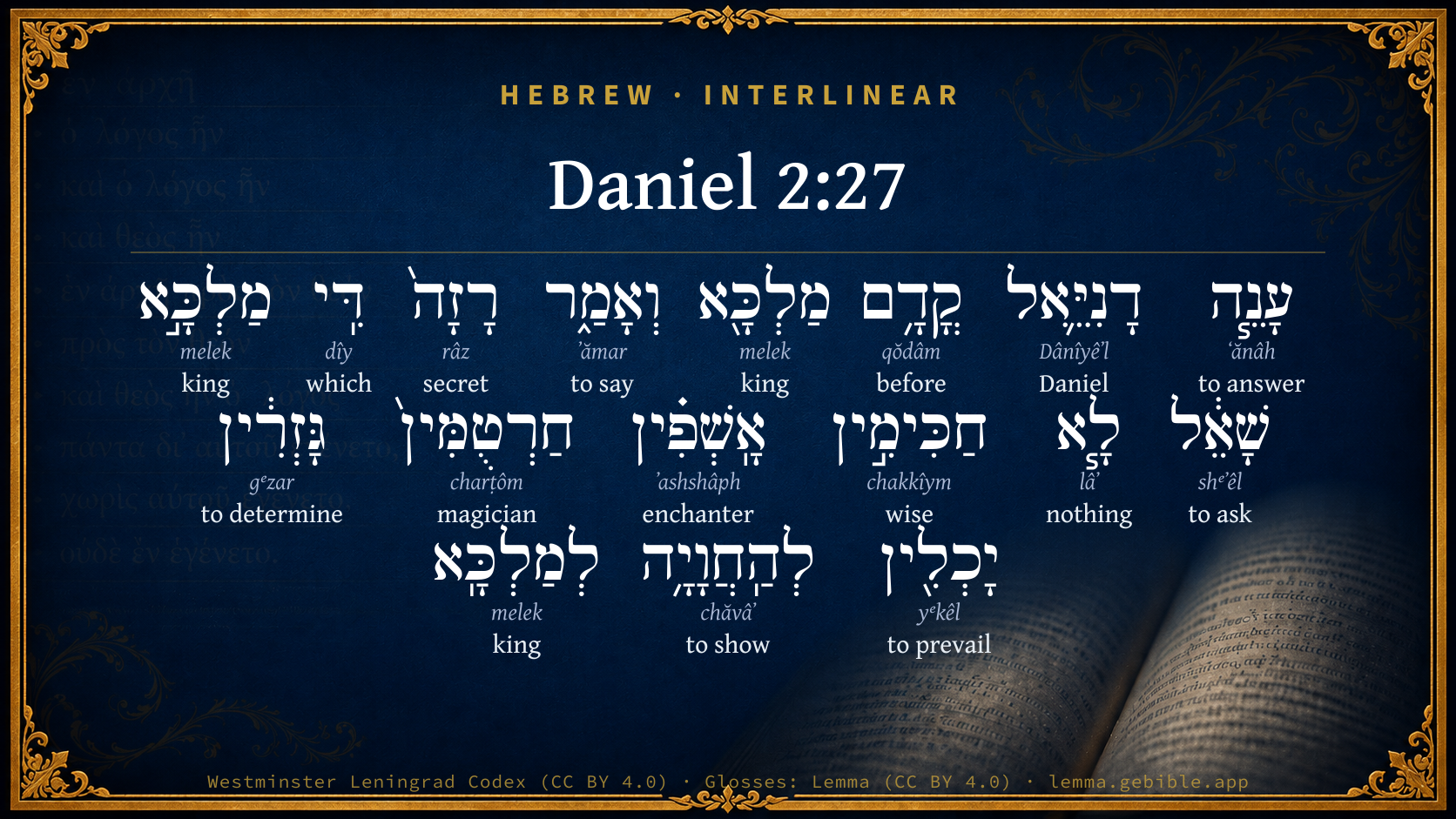
Daniel 2:27

Hebrew (Westminster Leningrad Codex) Daniel 2:27 appears in the Hebrew Old Testament. The text above is from the Westminster Leningrad Codex. Each word links to its Strong’s number, a concise gloss, and parsing drawn from the Open Scriptures Hebrew Bible morphology. Click any word for its full Brown-Driver-Briggs (BDB) entry.
Download image
Cite this verse

Daniel 2:27 (World English Bible). Public Domain. Lemma interlinear Bible study tool, https://lemma.gebible.app/v/daniel/2/27.

Show BibTeX & RIS
BibTeX
RIS
English Translation
Daniel answered before the king, and said, The secret which the king has demanded can neither wise men, enchanters, magicians, nor soothsayers, show to the king;
World English Bible · Public Domain
Highlights
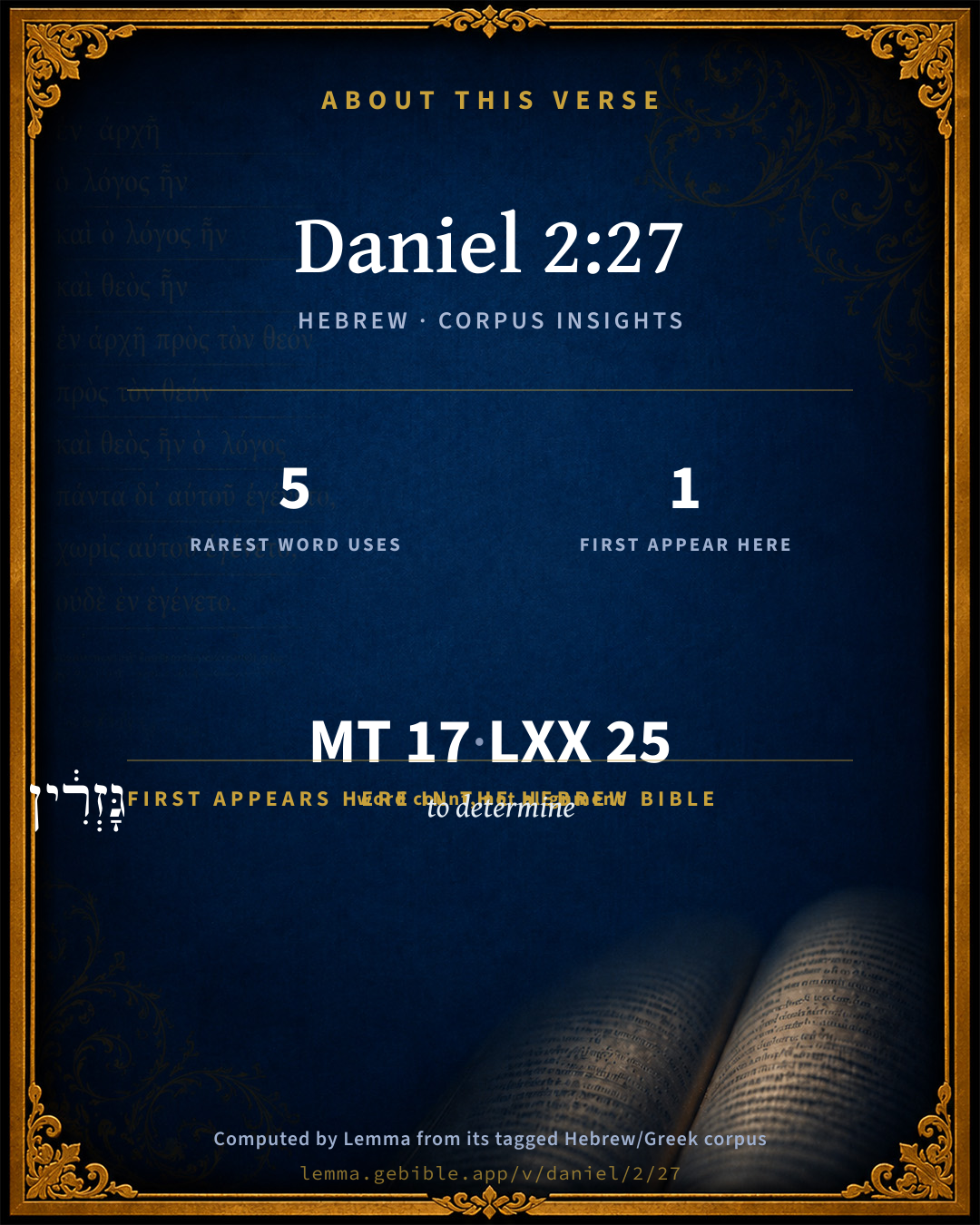
  • 1 first appearance in the Hebrew Bible
Full analysis ↓
Download a study sheet

One document with this verse’s original text, its word-by-word gloss line, the meaning frame, cross-references with their text, attributed commentary, and full source and license credits — printable, and it pastes into notes with its structure intact.

This verse Autodidact and up

Study sheet (.html) Plain text (.txt)

A passage Seminary Student

Up to 50 verses in one chapter. A passage sheet keeps up to 6 commentary sources and 12 cross-references per verse, in the order this page ranks them, and says so on the sheet whenever that leaves anything out. Ask for a single verse and you get the Autodidact verse sheet above.

Everything on this page stays free to read, with no account — the sheet is a download of what is already on screen, not access to it.

Want to remove ads? Support Godless Engineer
Compare translations 3

The same verse in 3 English versions, stacked beneath the original-language interlinear above. Click any original word for its lexicon entry.

Each is an independent rendering of the whole verse — the interlinear is not word-aligned to these translations.

Highlighted words mark where these versions differ — a whole-verse word diff, not a word-by-word alignment.

  • World English Bible Public Domain
    Daniel answered before the king, and said, The secret which the king has demanded can neither wise men, enchanters, magicians, nor soothsayers, show to the king;
  • King James Version Public Domain
    Daniel answered in the presence of the king, and said, The secret which the king hath demanded cannot the wise men, the astrologers, the magicians, the soothsayers, shew unto the king;
  • unfoldingWord Literal Text CC BY-SA 4.0
    Daniel answered before the king and said, “No wise men, enchanters, magicians, or astrologers are able to show to the king the mystery that the king has asked.

unfoldingWord Literal Text — © unfoldingWord, licensed CC BY-SA 4.0. Word-aligned USFM3 via Door43 (git.door43.org/unfoldingWord/en_ult).

Versions to compare (up to 4)

3 of 4 selected

Show all 18 translations

Every available English version of this verse, each an independent rendering of the whole verse.

  • World English Bible Public Domain
    Daniel answered before the king, and said, The secret which the king has demanded can neither wise men, enchanters, magicians, nor soothsayers, show to the king;
  • Berean Standard Bible Public Domain
    Daniel answered the king, “No wise man, enchanter, medium, or magician can explain to the king the mystery of which he inquires.
  • Majority Standard Bible Public Domain
    Daniel answered the king, “No wise man, enchanter, medium, or magician can explain to the king the mystery of which he inquires.
  • King James Version Public Domain
    Daniel answered in the presence of the king, and said, The secret which the king hath demanded cannot the wise men, the astrologers, the magicians, the soothsayers, shew unto the king;
  • American Standard Version (1901) Public Domain
    Daniel answered before the king, and said, The secret which the king hath demanded can neither wise men, enchanters, magicians, nor soothsayers, show unto the king;
  • Revised Version (1885) Public Domain
    Daniel answered before the king, and said, The secret which the king hath demanded can neither wise men, enchanters, magicians, nor soothsayers, shew unto the king;
  • Geneva Bible (1599) Public Domain
    Daniel answered in the presence of the King, and sayd, The secret which the King hath demanded, can neither the wise, the astrologians, the inchanters, nor the southsayers declare vnto the King.
  • Douay-Rheims (1899) Public Domain
    And Daniel made answer before the king, and said: The secret that the king desireth to know, none of the wise men, or the philosophers, or the diviners, or the soothsayers can declare to the king.
  • Young's Literal Translation Public Domain
    Daniel hath answered before the king and said, `The secret that the king is asking, the wise men, the enchanters, the scribes, the soothsayers, are not able to shew to the king;
  • Literal Standard Version CC BY-SA 4.0
    Daniel has answered before the king and said, “The secret that the king is asking, the wise men, the enchanters, the scribes, the soothsayers, are not able to show to the king;
  • Unlocked Literal Bible CC BY-SA 4.0
    Daniel answered the king and said, “The mystery that the king has asked about cannot be revealed by those who have wisdom, nor by those who claim to speak with the dead, nor by magicians, and not by astrologers.
  • unfoldingWord Literal Text CC BY-SA 4.0
    Daniel answered before the king and said, “No wise men, enchanters, magicians, or astrologers are able to show to the king the mystery that the king has asked.
  • Darby Bible Public Domain
    Daniel answered in the presence of the king and said, The secret that the king hath demanded cannot the wise men, the magicians, the scribes, the astrologers, shew unto the king;
  • World Messianic Bible Public Domain
    Daniel answered before the king, and said, “The secret which the king has demanded can’t be shown to the king by wise men, enchanters, magicians, or soothsayers;
  • Webster's Bible Public Domain
    Daniel answered in the presence of the king, and said, The secret which the king hath demanded, the wise men, the astrologers, the magicians, the sooth-sayers, cannot show to the king;
  • Free Bible Version CC BY-SA 4.0
    “No wise men or enchanters or magicians or diviners can explain the mystery Your Majesty wants to know,” Daniel replied.
  • Bible in Basic English Public Domain
    Then Daniel said in answer to the king, No wise men, or users of secret arts, or wonder-workers, or readers of signs, are able to make clear to the king the secret he is searching for;
  • JPS Tanakh (1917) Public Domain
    Daniel answered before the king, and said: 'The secret which the king hath asked can neither wise men, enchanters, magicians, nor astrologers, declare unto the king;

Literal Standard Version (2020), Covenant Press — licensed CC BY-SA 4.0. Text via the HelloAO Bible API (eBible.org). Unlocked Literal Bible (unfoldingWord) — licensed CC BY-SA 4.0. Text via the HelloAO Bible API (eBible.org). unfoldingWord Literal Text — © unfoldingWord, licensed CC BY-SA 4.0. Word-aligned USFM3 via Door43 (git.door43.org/unfoldingWord/en_ult). Free Bible Version, Dr. Jonathan Gallagher — licensed CC BY-SA 4.0. Text via the HelloAO Bible API (eBible.org).

Word by word

More ways to search: Search by grammar → Find every occurrence → Compare this word →

Practice this passage: Drill this verse → Learn its vocabulary →

חַרְטֻמִּין֙
charṭôm
H2749
“magicians”
Adjective, N, Common
Part of Speech
Adjective
Gender
Common
Full BDB Definition

Origin: the same as H2748

TWOT: 2742

magician, magician-astrologer
  1. עָנֵ֧ה ʻănâh H6032 “answering” Adjective, V
  2. דָנִיֵּ֛אל Dânîyêʼl H1841 “Daniel” Adjective, N
  3. קֳדָ֥ם qŏdâm H6925 “before” Adjective, R
  4. מַלְכָּ֖א melek H4430 “king · the” Adjective, N, Common + Particle, Definite Article
  5. וְאָמַ֑ר ʼămar H560 “and · saying” Adjective, C + Verb, Qal, Participle Active, Masculine, Singular, Absolute
  6. רָזָה֙ râz H7328 “secret · the” Adjective, N, Common + Particle, Definite Article
  7. דִּֽי dîy H1768 “which” Adjective, T
  8. מַלְכָּ֣א melek H4430 “king · the” Adjective, N, Common + Particle, Definite Article
  9. שָׁאֵ֔ל shᵉʼêl H7593 “asking” Adjective, V
  10. לָ֧א lâʼ H3809 “nothing” Adjective, T
  11. חַכִּימִ֣ין chakkîym H2445 “wise men” Adjective, N, Common
  12. אָֽשְׁפִ֗ין ʼashshâph H826 “enchanters” Adjective, N, Common
  13. גָּזְרִ֔ין gᵉzar H1505 “determining” Adjective, V
  14. יָכְלִ֖ין yᵉkêl H3202 “prevailing” Adjective, V
  15. לְהַֽחֲוָיָ֥ה chăvâʼ H2324 “to show” Adjective, R + Verb, Hiphil, Infinitive Construct
  16. לְמַלְכָּֽא melek H4430 “to/for · king · the” Adjective, R + Noun, Common, Masculine, Singular, Determined + Particle, Definite Article

About this verse

These counts appear in no published source. They are computed here, from the morphology-tagged text and Lemma’s own curated glosses. What Lemma adds →

17
words
15
distinct lemmas
Prophets
section

Notable vocabulary

The rarest word here is חַרְטֻמִּין֙ magician H2749 — appearing just 5 times in the whole Hebrew Bible.

First appearance in Scripture

This word makes its first canonical appearance in the Hebrew Bible here:

  • גָּזְרִ֔ין to determine H1505

Shared distinctive vocabulary

חַרְטֻמִּין֙ magician H2749 occurs in 5 verses of the Hebrew Bible. Also found in:

Grammatical profile

  • 2 verbs
  • 11 adjectives
  • 4 particles

Verb forms

  • וְאָמַ֑ר Qal · Participle Active
  • לְהַֽחֲוָיָ֥ה Hiphil · Infinitive Construct

Repetition

A word recurs within this verse — often emphatic in Hebrew:

  • מַלְכָּ֖א king H4430 ×3

Hebrew & Septuagint length

In English translation the verse runs 26 words from the Hebrew and 35 from the Septuagint (LXX English) — closely comparable.

A rough comparison of the two English renderings, which tokenize alike — not a word-level alignment.

Word counts can differ between the Hebrew and the Greek without any difference in meaning — e.g. the Hebrew direct-object marker אֵת has no separate Greek word, and Greek often adds the article ὁ.

In the original languages it is 17 Hebrew tokens and 25 Greek tokens — but the two are counted differently (Hebrew bundles its prefixes and suffixes into one token; the Greek is in lemma form), so that isn’t a like-for-like length.

Cross-references

7

Topical passages linked to Daniel 2:27 in the Treasury of Scripture Knowledge — connected by theme and wording, ordered by reader-vote popularity; previews shown in the World English Bible.

  • Isaiah 44:25 who frustrates the signs of the liars, and makes diviners mad; who turns wise men backward, and makes their knowledge foolish;
  • Isaiah 47:12–14 Stand now with your enchantments, and with the multitude of your sorceries, in which you have labored from your youth; if so be you shall be able to profit, if so be you may prevail.
  • Daniel 2:2 Then the king commanded to call the magicians, and the enchanters, and the sorcerers, and the Chaldeans, to tell the king his dreams. So they came in and stood before the king.
  • Daniel 2:10–11 The Chaldeans answered before the king, and said, There is not a man on the earth who can show the king's matter, because no king, lord, or ruler, has asked such a thing of any magician, or enchanter, or Chaldean.
  • Daniel 5:7–8 The king cried aloud to bring in the enchanters, the Chaldeans, and the soothsayers. The king spoke and said to the wise men of Babylon, Whoever shall read this writing, and show me the interpretation of it, shall be clothed with purple, and have a chain of gold about his neck, and shall be the third ruler in the kingdom.
  • Job 5:12–13 He frustrates the devices of the crafty, So that their hands can't perform their enterprise.
  • Isaiah 19:3 The spirit of Egypt shall fail in the midst of it; and I will destroy the counsel of it: and they shall seek to the idols, and to the charmers, and to those who have familiar spirits, and to the wizards.

Cross-references courtesy of OpenBible.info (CC BY 4.0).

Hebrew and Greek witnesses Masoretic Hebrew ↔ Greek Septuagint

The same verse in the two great witnesses to the Old Testament, shown verse-for-verse.

These are two independent witnesses, not word-aligned to each other, and the Septuagint is shown in lemma (dictionary) form.

Hebrew Daniel 2:27 Masoretic · Westminster Leningrad Codex

עָנֵ֧ה דָנִיֵּ֛אל קֳדָ֥ם מַלְכָּ֖א וְאָמַ֑ר רָזָה֙ דִּֽי מַלְכָּ֣א שָׁאֵ֔ל לָ֧א חַכִּימִ֣ין אָֽשְׁפִ֗ין חַרְטֻמִּין֙ גָּזְרִ֔ין יָכְלִ֖ין לְהַֽחֲוָיָ֥ה לְמַלְכָּֽא

Daniel answered before the king, and said, The secret which the king has demanded can neither wise men, enchanters, magicians, nor soothsayers, show to the king;

World English Bible · Public Domain

Greek LXX Daniel 2:27 Septuagint · lemma form

ἐκφωνέω δέ ὁ δανιηλ ἐπί ὁ βασιλεύς εἶπον ὁ μυστήριον ὅς ὁράω ὁ βασιλεύς οὐ εἰμί σοφός καί φαρμακός καί ἐπαοιδός καί γαζαρηνός ὁ δήλωσις

And Daniel answered before the king, and said, The mystery which the king asks the explanation of is not in the power of the wise men, magicians, enchanters, or soothsayers to declare to the king.

LXX2012 (modern English Septuagint) · Public Domain

On this verse, John Gill's Exposition discusses the Septuagint’s reading. Read the note in Commentary ↓

Hebrew: Westminster Leningrad Codex (CC BY 4.0). Greek: Septuagint (public domain); English from LXX2012 (modern English Septuagint) (Public Domain). How the Septuagint differs from the Hebrew →

Commentary

Notes on Daniel 2:27 from classic Christian and Jewish commentators (each source and its license shown beneath its notes). The classic Christian expositions comment on the surrounding passage and are grouped to its opening verse, so a note may address several verses; the Jewish commentaries on the Tanakh (Rashi and others) are per-verse, so they appear only where the commentator wrote on this verse.

Lemma curates 59 commentaries, every one of them public domain or Creative Commons licensed, each selected and text-cleaned for this edition rather than reprinted as found. About our sources →

Trapp's Complete Commentary

John Trapp

Dan 2:27 Daniel answered in the presence of the king, and said, The secret which the king hath demanded cannot the wise [men], the astrologers, the magicians, the soothsayers, shew unto the king;

Ver. 27. The secret which the king hath demanded cannot the wise men … show unto thee.] And therefore thou hast done amiss, first in seeking to them, next in slaying them, though God hath a holy hand in it for their just punishment.

John Trapp, A Commentary or Exposition upon All the Books of the Old and New Testament (1647–1656) — public domain. Text from a community e-Sword module.

Tyndale Open Study Notes

Tyndale Open Resources

2:27-28 Daniel made it clear that no human could do what was required (cp. 2:10-11; see also Gen 41:16).

Tyndale Open Study Notes — © Tyndale Open Resources, licensed CC BY-SA 4.0. Text via the HelloAO Bible API.

Ibn Ezra

Rabbi Abraham ibn Ezra

[Daniel 2:27] ʿAneh Daniel (עָנֵה דָנִיֵּאל - Answered Daniel): [Regarding the word] wise men (chakkimin - חַכִּימִין): [This is] an encompassing term (millah kolelet - מִלָּה כּוֹלֶלֶת) [which includes] the sorcerers (ha-mekhashshefim - הַמְּכַשְּׁפִים) and the Chaldeans (v'ha-Kasdim - וְהַכַּשְׂדִּים) [mentioned previously, e.g., in Daniel 2:2].

Ibn Ezra on the Tanakh — English translations: “Sefaria Community Translation” (CC0 1.0 (public-domain dedication)); “Yalkut, Sifsei Chachomim Chumash, Metsudah Publications, 2009” (CC BY 4.0); and “Commentary of Ibn Ezra on Isaiah - trans. by M. Friedlander, 1873” (public domain). Text via Sefaria.

Jamieson, Fausset & Brown

Robert Jamieson, A. R. Fausset & David Brown

cannot--Daniel, being learned in all the lore of the Chaldeans (Dan 1:4), could authoritatively declare the impossibility of mere man solving the king's difficulty.

soothsayers--from a root, "to cut off"; referring to their cutting the heavens into divisions, and so guessing at men's destinies from the place of the stars at one's birth.

Jamieson, Fausset & Brown — Commentary Critical and Explanatory on the Whole Bible (1871) — public domain (CC PDM 1.0). Text via the HelloAO Bible API.

Adam Clarke's Commentary

Verse 27. Cannot the wise men] Cannot your own able men, aided by your gods, tell you the secret? This question was necessary in order that the king might see the foolishness of depending on the one, or worshipping the other.

The soothsayers] One of our old words: "The tellers of truth:" but גזרין gazerin is the name of another class of those curious artists, unless we suppose it to mean the same as the CHALDEANS, Da 2:2. They are supposed to be persons who divined by numbers, amulets, &c. There are many conjectures about them, which, whatever learning they show, cast little light upon this place.

Adam Clarke's Commentary on the Bible (1810–1826) — public domain. Text from a community e-Sword/MySword module.

John Calvin's Commentaries

First, with respect to these names we need not trouble ourselves much, since even the Jews themselves are compelled to guess at them. They are very bold in their definitions and rash in their affirmations, and jet they cannot clearly distinguish how one kind of wise man differed from the others; hence it is sufficient for us to hold that the discourse now concerns those then esteemed “wise men,” under the various designations of Magi, Soothsayers, and Astrologers. Now, as to Daniel’s answer. He says it was not surprising that the king did not find what he hoped for among the Magi, since God had breathed into him this dream beyond the comprehension of human intellect. I know not whether those interpreters are right who think magical arts here simply condemned; for I rather think a comparison is instituted; between the king’s dream and the substance of the science of the Magi. I always exclude superstitions by which they vitiated true and genuine science. But as far as the principles are concerned, we cannot precisely condemn astronomy and whatever belongs to the consideration of the order of nature. This appears to me the whole intention, — the king’s dream was not subjected to human knowledge, for mortals have no such natural skill as to be able to comprehend the meaning of the dream, and God manifests those secrets which need the peculiar revelation of the Spirit. When Daniel says the Magi, Astrologers, and the rest cannot explain to the king his dream, and are not suitable interpreters of it, the true reason is, because the dream was not natural and had nothing in common with human conjectures, but was the peculiar revelation of the Spirit. As when Paul disputes concerning the Gospel, he collects into order every kind of intelligence among men, because those who are endued with any remarkable acuteness or ability think they can accomplish anything. But the doctrine of the Gospel is a heavenly mystery (1 Corinthians 2:4) which cannot be comprehended by the most learned and talented among men. The real sense of Daniel’s words is this, — the Magi, Astrologers, and Soothsayers had no power of expounding the king’s dream, since it was neither natural nor human.

This is clearly evident from the context, because he adds,

John Calvin's Commentaries (1540-1563) — public domain. Text from the Calvin Translation Society English edition (1840s-50s) via the Christian Classics Ethereal Library (ccel.org). Calvin's coverage is partial (roughly two-thirds of the Bible); uncommented books and verses are honest gaps, never fabricated. The 19th-century editor's footnotes and remarks are omitted so the notes are faithfully Calvin's own voice.

Ellicott's Commentary for English Readers

(27) The secret . . .—In this and the next verse Daniel justifies the astonishment of the king, and explains to him that what the wise men had stated was perfectly true. The “gods whose dwelling was with flesh” (see Note on Dan_2:11) could not reveal the secret, but there was a God in heaven who had made it known. Daniel here teaches us what Scripture lays down elsewhere (Gen_20:3; Gen_41:16; Gen_41:25; Gen_41:28; Num_22:35), that all power of prediction is to be excluded from heathen gods, and is possessed by wise men only so far as they acquire it through the God of heaven.

A Bible Commentary for English Readers, edited by Charles John Ellicott (1878–1897) — public domain. Text from a community e-Sword module.

The Cambridge Bible for Schools and Colleges

gen. ed. J. J. S. Perowne

27. in the presence of] before (R.V.), as Dan_2:9.

demanded] simply asked, which is all that ‘demand’ formerly expressed. ‘Like Fr. demander, to ask, simply; not as now in the stronger sense of “to ask with authority, or as a right,” ’ (W. A. Wright, Bible Word-book, s.v.). So Exo_5:14; 2Sa_11:7; Job_38:3. ‘Demand’ in the modern sense would suit these passages; but the Hebrew word used is the one that ordinarily means ‘ask.’

can neither wise men, enchanters (Dan_2:2), magicians, nor determiners (of fates) declare unto the king] The terms are all indefinite in the original. ‘Determiners’ (also Dan_4:4, Dan_5:7; Dan_5:11), viz. of future destinies, whether by observation of the heavens (Isa_47:13), or by other means. The Babylonians were famed for their astrology, and in classical times the idea of astrologer was that which was almost entirely associated with the term ‘Chaldaean’ (cf. above, p. 13). The verb (strictly, to cut), in the general sense of decide, decree, occurs in the Targums and in Syriac, and once also in the Aramaizing idiom of Job (Job_22:28); cf. the cognate subst., Dan_4:14; Dan_4:21. In this particular application, however, it is at present known only in the Biblical Aramaic.

The Cambridge Bible for Schools and Colleges (gen. ed. J. J. S. Perowne; Cambridge University Press, 1878–1918) — public domain. Text from a community e-Sword module.

John Gill's Exposition

Daniel answered in the presence of the king,.... Boldly, and without fear:

and said, the secret which the king hath demanded: so he calls it, to show that it was something divine, which came from God, and could only be revealed by him, and was not to be found out by any art of man:

cannot the wise men, the astrologers, the magicians, the soothsayers show unto the king; this he premises to the revelation of the secret, not only to observe the unreasonableness of the king's demand upon them, and the injustice of putting men to death for it; but that the discovery of the whole might appear to be truly divine, and God might have all the glory; it being what no class of men whatever could ever have made known unto him. The last word, rendered "soothsayers" (u), is not used before; the Septuagint version leaves it untranslated, and calls them Gazarenes; and so Saadiah says, it is the name of a nation or people so called; but Jarchi takes them to be a sort of men that had confederacy with devils: the word signifies such that "cut" into parts, as the soothsayers, who cut up creatures, and looked into their entrails, and by them made their judgment of events; or as the astrologers, who cut and divide the heavens into parts, and by them divide future things; or determine, as Jacchiades says, what shall befall men; for the word is used also in the sense of determining or decreeing; hence, Saadiah says, some interpret it of princes, who by their words determine the affairs of kingdoms: by some it is rendered "fatalists" (w), who declare to men what their fate will be; but neither of these could show this secret to the king.

(u) sectores, Cocceius, Gejerus. (w) "Fatidici", Munster, Tigurine version; "qui de homine determinant hoc, vel illo modo ipsi eventurum esse", Jacchiades.

John Gill's Exposition of the Whole Bible (1746–1763) — public domain (CC PDM 1.0). Text via the HelloAO Bible API.

Albert Barnes' Notes on the Bible

Daniel answered in the presence of the king, and said, The secret which the king hath demanded, cannot the wise men ... show unto the king - Daniel regarded it as a settled and indisputable point that the solution could not be hoped for from the Chaldean sages. The highest talent which the realm could furnish had been applied to, and had failed. It was clear, therefore, that there was no hope that the difficulty would be removed by human skill. Besides this, Daniel would seem also to intimate that the thing, from the necessity of the case, was beyond the compass of the human powers. Alike in reference to the question whether a forgotten dream could be recalled, and to the actual “signification” of a dream so remarkable as this, the whole matter was beyond the ability of man.

The wise men, the astrologers ... - On these words, see the notes at Dan 1:20. All these words occur in that verse, except גזרין gâzerı̂yn - rendered “soothsayers.” This is derived from גזר gezar - “to cut, to cut off;” and then “to decide, to determine;” and it is thus applied to those who decide or determine the fates or destiny of men; that is, those who “by casting nativities from the place of the stars at one’s birth, and by various arts of computing and divining, foretold the fortunes and destinies of individuals.” See Gesenius, “Com. z. Isa.” 2:349-356, Section 4, Von den Chaldern und deren Astrologie. On p. 555, he has given a figure, showing how the heavens were “cut up,” or “divided,” by astrologers in the practice of their art. Compare the phrase numeri Babylonii, in Hor. “Carm.” I. xi. 2. The Greek is γαζαρηνῶν gazarēnōn - the Chaldee word in Greek letters. This is one of the words - not very few in number - which the authors of the Greek version did not attempt to translate. Such words, however, are not useless, as they serve to throw light on the question how the Hebrew and Chaldee were pronounced before the vowel points were affixed to those languages.

Albert Barnes' Notes on the Bible (1834–1885) — public domain. Text from a community e-Sword/MySword module.

Haydock's Catholic Bible Commentary

Soothsayers. Chaldee: Gazerin, (Haydock) who inspect entrails, (Ezechiel xxi. 21. St. Jerome) or tell fortunes by sticks. (Chap. iii. 3.)

George Leo Haydock (1774–1849), Haydock's Catholic Family Bible and Commentary, 1859 edition — public domain. Excludes Psalms (Douay-Rheims chapter numbering differs from Protestant) and Deuterocanonical books (Catholic canon only).

Matthew Poole's English Annotations

He reckons up here all sorts of divination, to show that divine things, and the secrets of God, cannot be comprehended by man without special revelation; and that those who presume to do it arrogate too much to themselves, and that it is too tyrannical to require it of any, and that upon pain of death; for, saith Daniel, they cannot do it.

Matthew Poole's English Annotations on the Holy Bible (1683–1685) — public domain. Text from a community e-Sword/MySword module.

Whedon's Commentary on the Bible

Daniel D. Whedon

27-30. The one God of heaven, who has power in Babylonia as well as in Palestine, has chosen to reveal his will to Nebuchadnezzar, and the secret of its meaning, which the wise men were correct in saying could only be discovered miraculously, is now supernaturally made plain to Daniel in order that “the interpretation might be made known to the king” (R.V.), who might thus be led to honor the most high God. (Compare Dan_2:47 and Eze_28:26.)

Daniel D. Whedon (gen. ed.), Commentary on the Old and New Testaments (1874–1909) — public domain. Text from a community e-Sword module.

The Pulpit Commentary

Daniel answered in the presence of the king, and said, The secret which the king hath demanded cannot the wise men, the astrologers, the magicians, the soothsayers, show unto the king. The differences between this and the Septuagint are but slight and unimportant. To render it literally, the LXX is, "Daniel, having spoken out in the presence of the king, said, The mystery which the king saw is nut the showing of the wise men, the astrologers, the sorcerers, the magicians." There seems to have been a confusion between hn (anah), "to answer," and hnx (tzenah), "to cry out;" the latter word is unsuitable in the present connection. The change from lav to hzj is unlikely to have been the result of any mistake in the writing of the original. It may have been the Greek scribe who misread hjrwthsen into eJwraken. Theodotion and the Peshitta present no peculiarities worthy of notice. Jerome translates asbshaphim by magi, as usual, following the Peshitta. It is to be observed that here again we have a list of the different classes of soothsayers, and the class of Chaldeans is omitted, as also those marked as mecashphim in ver. 2; instead, occupying the same place in the catalogue, is gazrin. This may have been the original word, as evidently the real meaning was not known either in Egypt or Asia Minor, as both the LXX and Theodotion transfer the word. The Peshitta translates this word by asuphe, in reality the corresponding one to the second word in the Chaldee. This would seem to show that the word had disappeared from Eastern as well as Western Aramaic. It is derived from gezar, "to eat." Behrmann ("Das Buch Daniel") derives it thus, and says that it refers to the fact that those who studied nativities divided the heavens into sectiones or segmenta. This was precisely what the "Chaldeans" of classic times did; hence it is quite a possible thing that Chaldeans was inserted in some Greek translations, and got into the Aramaic from the Greek. The word does not seem to be used for, astrologers" in the Talmud. The occasion of Daniel"s narrating the impotence of the other wise men in presence of the task set them by the king is that probably he recognized the accent of surprise in the king"s tone. As if he said, "Yes, it is perfectly true, what none of these wise men could do, I, a mere youth, undertake to do." There is nothing of contempt for them in this, as is seen in the following verse. There may be a shade of rebuke implied to the king, who had demanded from men what they could not do. They had declared that only the gods could reveal this to the king. And what Daniel says is not in opposition to this, but confirmatory of it.

The Pulpit Commentary (1880–1919), ed. H.D.M. Spence-Jones & Joseph S. Exell — public domain. Text from a community e-Sword module.

unfoldingWord translationNotes

Door43 World Missions Community

The mystery that the king has asked about ... not by astrologers

This can be stated in active form. AT: "Those who have wisdom, those who claim to speak with the dead, magicians, and astrologers cannot reveal the mystery about which the king has asked" (See: Active or Passive)

The mystery that the king has asked about

This phrase refers to the king's dream.

translationWords

Daniel

king

mystery

reveal

wise

die

magic

learned men

God

heaven

Nebuchadnezzar

dream

vision

mind

unfoldingWord translationNotes — © Distant Shores Media and the Door43 World Missions Community, licensed CC BY-SA 4.0. Source: git.door43.org/Door43/en_tn.

Rashi

Rabbi Shlomo Yitzchaki (Rashi)

demonologists Aram. גָזְרִין, the name of a type of ruler over demons.

Rashi on the Tanakh — English translations: “The Judaica Press complete Tanach with Rashi, translated by A. J. Rosenberg” (CC BY 4.0); “Pentateuch with Rashi's commentary by M. Rosenbaum and A.M. Silbermann, 1929-1934” (public domain); “The Metsudah Tanach series, Lakewood, N.J” (CC BY 4.0); and “The Book of Joshua, Metsudah Publications, 1997” (CC BY 4.0). Text via Sefaria.

Lesson kit

Teaching starters — assembled from the data on this page, not authored interpretation. Every prompt links to the verse data it draws on. Edit before teaching.

Daniel, in the Prophets, opens this verse with 17 words (15 distinct Hebrew lemmas). Its most distinctive word is charṭôm (“magician”). A historical commentator’s framing appears above. Read the whole chapter for the surrounding context.

Discussion questions

  1. How does “magician” (charṭôm) shape what this verse is saying?
  2. The word “to determine” first appears here in Scripture. What is being introduced at this debut?
  3. Daniel 2:10 shares the word «magician» with this verse. How do the two illuminate each other?
  4. “king” occurs 3× in this one verse. What is the effect of the repetition?
  5. The translations on this page render this verse differently — a whole-verse word diff, not a word-by-word alignment. What might account for the different wordings?
  6. The verb «וְאָמַ֑ר» is Qal Participle Active. How does its form color the action?
  7. Reading how Trapp's Complete Commentary and Tyndale Open Study Notes read this verse, where do the two commentators agree and where do they part?

Things to notice

Reading settings

Reading text

Shown beneath each verse's original-language words.

Old Testament
Old Testament edition

Read the OT as the Masoretic Hebrew (MT) or the Greek Septuagint (LXX).

English shown for the Greek Septuagint (in the Hebrew ↔ Greek comparison).

Comparing translations? Open the Compare panel on any verse page to stack up to four side by side.