
Daniel 3:20

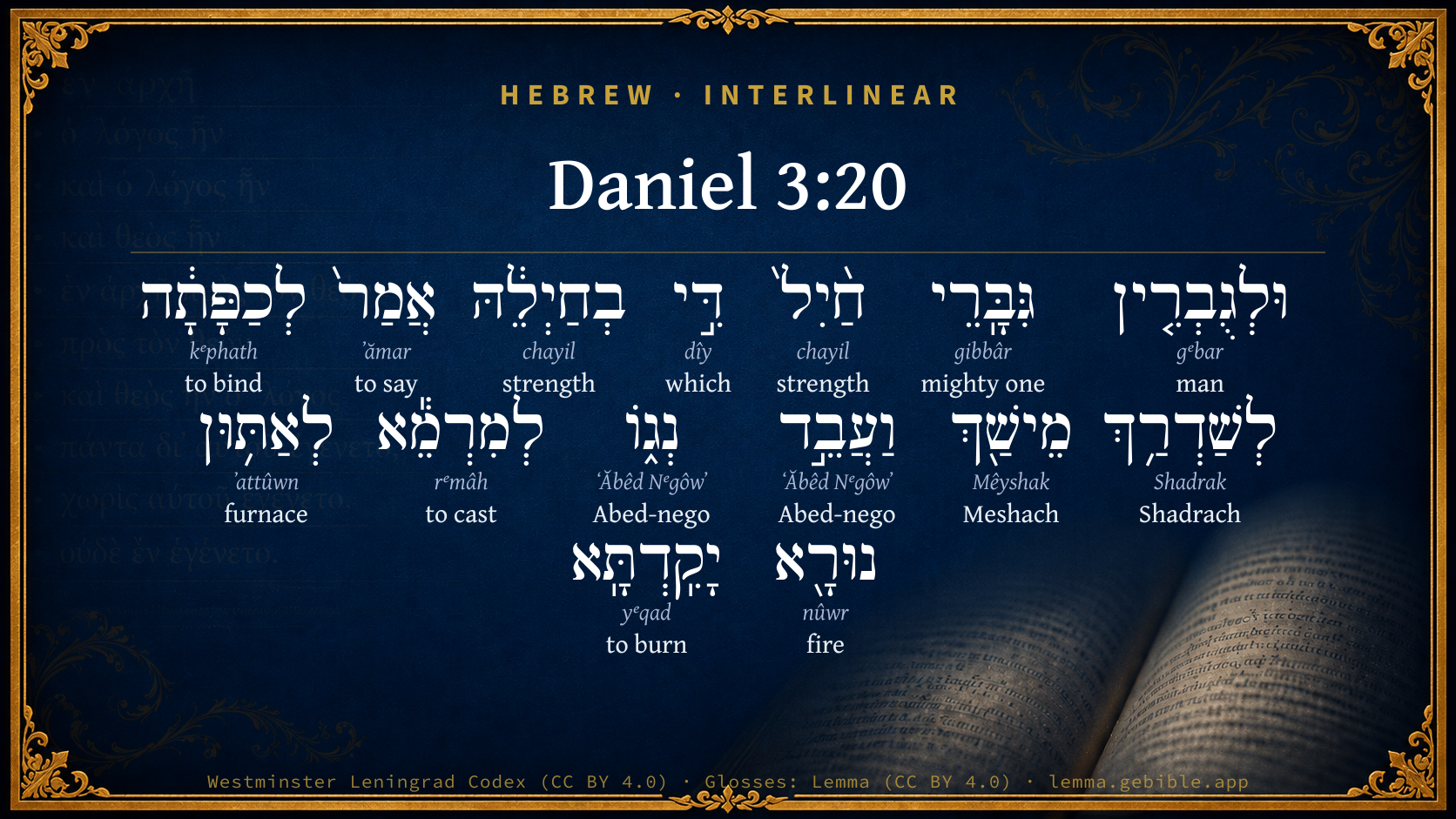
Hebrew (Westminster Leningrad Codex) Daniel 3:20 appears in the Hebrew Old Testament. The text above is from the Westminster Leningrad Codex. Each word links to its Strong’s number, a concise gloss, and parsing drawn from the Open Scriptures Hebrew Bible morphology. Click any word for its full Brown-Driver-Briggs (BDB) entry.
Download image
Cite this verse

Daniel 3:20 (World English Bible). Public Domain. Lemma interlinear Bible study tool, https://lemma.gebible.app/v/daniel/3/20.

Show BibTeX & RIS
BibTeX
RIS
English Translation
He commanded certain mighty men who were in his army to bind Shadrach, Meshach, and Abednego, [and] to cast them into the burning fiery furnace.
World English Bible · Public Domain
Highlights
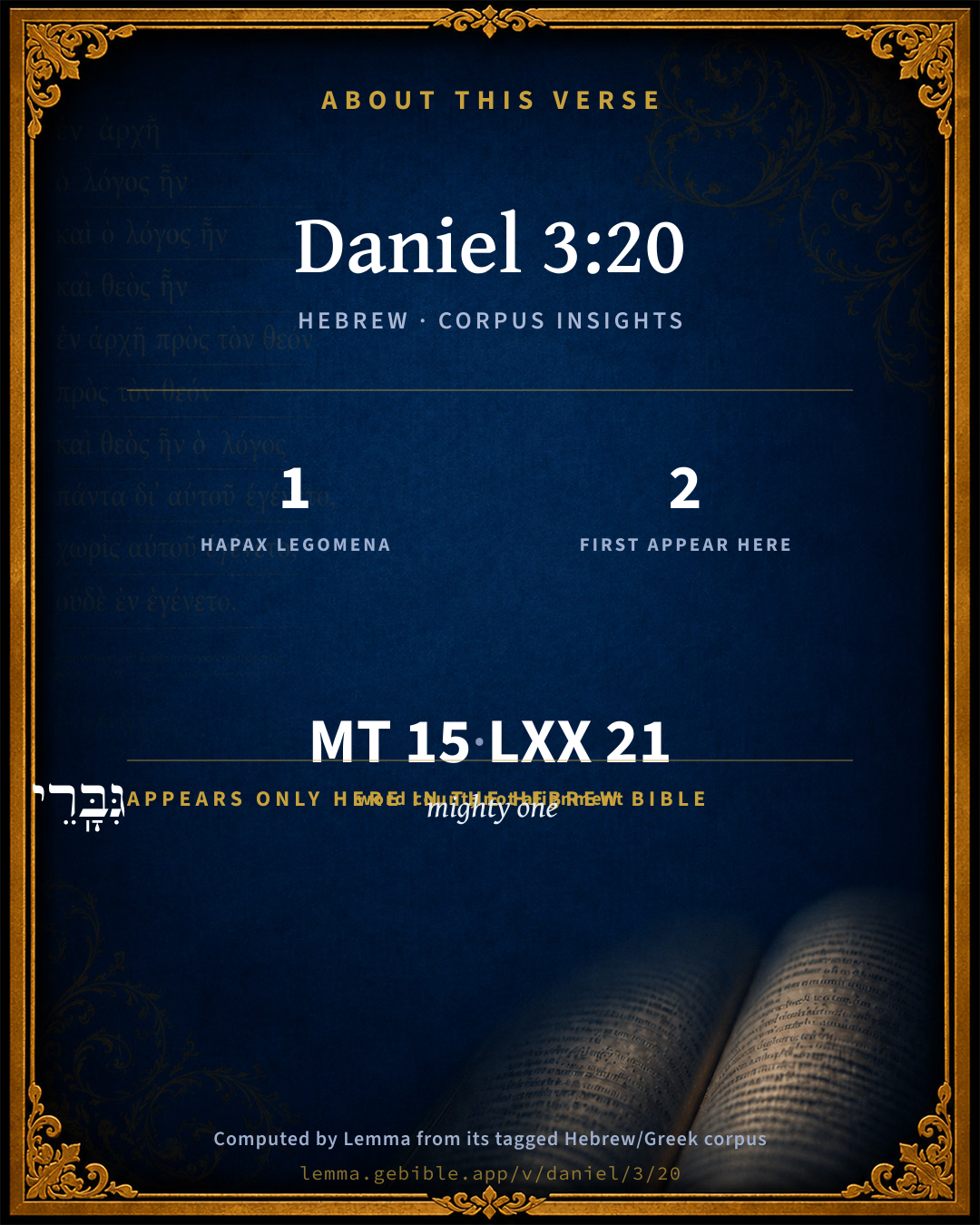
  • 1 hapax legomenon — only here in the Hebrew Bible
  • 2 first appearances in the Hebrew Bible
Full analysis ↓
Download a study sheet

One document with this verse’s original text, its word-by-word gloss line, the meaning frame, cross-references with their text, attributed commentary, and full source and license credits — printable, and it pastes into notes with its structure intact.

This verse Autodidact and up

Study sheet (.html) Plain text (.txt)

A passage Seminary Student

Up to 50 verses in one chapter. A passage sheet keeps up to 6 commentary sources and 12 cross-references per verse, in the order this page ranks them, and says so on the sheet whenever that leaves anything out. Ask for a single verse and you get the Autodidact verse sheet above.

Everything on this page stays free to read, with no account — the sheet is a download of what is already on screen, not access to it.

Want to remove ads? Support Godless Engineer
Compare translations 3

The same verse in 3 English versions, stacked beneath the original-language interlinear above. Click any original word for its lexicon entry.

Each is an independent rendering of the whole verse — the interlinear is not word-aligned to these translations.

Highlighted words mark where these versions differ — a whole-verse word diff, not a word-by-word alignment.

  • World English Bible Public Domain
    He commanded certain mighty men who were in his army to bind Shadrach, Meshach, and Abednego, [and] to cast them into the burning fiery furnace.
  • King James Version Public Domain
    And he commanded the most mighty men that were in his army to bind Shadrach, Meshach, and Abednego, and to cast them into the burning fiery furnace.
  • unfoldingWord Literal Text CC BY-SA 4.0
    He commanded certain mighty men who were in his army to tie up Shadrach, Meshach, and Abednego and to throw them into the furnace of blazing fire.

unfoldingWord Literal Text — © unfoldingWord, licensed CC BY-SA 4.0. Word-aligned USFM3 via Door43 (git.door43.org/unfoldingWord/en_ult).

Versions to compare (up to 4)

3 of 4 selected

Show all 18 translations

Every available English version of this verse, each an independent rendering of the whole verse.

  • World English Bible Public Domain
    He commanded certain mighty men who were in his army to bind Shadrach, Meshach, and Abednego, [and] to cast them into the burning fiery furnace.
  • Berean Standard Bible Public Domain
    and he commanded some mighty men of valor in his army to tie up Shadrach, Meshach, and Abednego and throw them into the blazing fiery furnace.
  • Majority Standard Bible Public Domain
    and he commanded some mighty men of valor in his army to tie up Shadrach, Meshach, and Abednego and throw them into the blazing fiery furnace.
  • King James Version Public Domain
    And he commanded the most mighty men that were in his army to bind Shadrach, Meshach, and Abednego, and to cast them into the burning fiery furnace.
  • American Standard Version (1901) Public Domain
    And he commanded certain mighty men that were in his army to bind Shadrach, Meshach, and Abed-nego, `and' to cast them into the burning fiery furnace.
  • Revised Version (1885) Public Domain
    And he commanded certain mighty men that were in is army to bind Shadrach, Meshach, and Abed-nego, and to cast them into the burning fiery furnace.
  • Geneva Bible (1599) Public Domain
    And hee charged the most valiant men of warre that were in his armie, to binde Shadrach, Meshach, and Abednego, and to cast them into the hote fierie fornace.
  • Douay-Rheims (1899) Public Domain
    And he commanded the strongest men that were in his army, to bind the feet of Sidrach, Misach, and Abdenago, and to cast them into the furnace of burning fire.
  • Young's Literal Translation Public Domain
    and to certain mighty men who `are' in his force he hath said to bind Shadrach, Meshach, and Abed-Nego, to cast into the burning fiery furnace.
  • Literal Standard Version CC BY-SA 4.0
    and to certain mighty men who [are] in his force he has said to bind Shadrach, Meshach, and Abed-Nego, to cast into the burning fiery furnace.
  • Unlocked Literal Bible CC BY-SA 4.0
    Then he commanded some very strong men in his army to tie up Shadrach, Meshach, and Abednego and to throw them into the blazing furnace.
  • unfoldingWord Literal Text CC BY-SA 4.0
    He commanded certain mighty men who were in his army to tie up Shadrach, Meshach, and Abednego and to throw them into the furnace of blazing fire.
  • Darby Bible Public Domain
    And he commanded the most mighty men that were in his army to bind Shadrach, Meshach, and Abed-nego, and cast them into the burning fiery furnace.
  • World Messianic Bible Public Domain
    He commanded certain mighty men who were in his army to bind Shadrach, Meshach, and Abednego, and to cast them into the burning fiery furnace.
  • Webster's Bible Public Domain
    And he commanded the most mighty men that were in his army to bind Shadrach, Meshach, and Abed-nego, and to cast them into the burning fiery furnace.
  • Free Bible Version CC BY-SA 4.0
    Then he commanded some of his strongest soldiers, “Tie up Shadrach, Meshach, and Abednego and throw them into the furnace of blazing fire!”
  • Bible in Basic English Public Domain
    And he gave orders to certain strong men in his army to put cords on Shadrach, Meshach and Abed-nego and put them into the burning and flaming fire.
  • JPS Tanakh (1917) Public Domain
    And he commanded certain mighty men that were in his army to bind Shadrach, Meshach, and Abed-nego, and to cast them into the burning fiery furnace.

Literal Standard Version (2020), Covenant Press — licensed CC BY-SA 4.0. Text via the HelloAO Bible API (eBible.org). Unlocked Literal Bible (unfoldingWord) — licensed CC BY-SA 4.0. Text via the HelloAO Bible API (eBible.org). unfoldingWord Literal Text — © unfoldingWord, licensed CC BY-SA 4.0. Word-aligned USFM3 via Door43 (git.door43.org/unfoldingWord/en_ult). Free Bible Version, Dr. Jonathan Gallagher — licensed CC BY-SA 4.0. Text via the HelloAO Bible API (eBible.org).

Word by word

More ways to search: Search by grammar → Find every occurrence → Compare this word →

Practice this passage: Drill this verse → Learn its vocabulary →

גִּבָּֽרֵי
gibbâr
H1401
“mighty ones of”
Adjective, N, Common
Part of Speech
Adjective
Gender
Common
Full BDB Definition

Origin: intensive of H1400

TWOT: 2647b

mighty one, might
  1. וּלְגֻבְרִ֤ין gᵉbar H1400 “and · to/for · men” Adjective, C + Preposition + Noun, Common, Masculine, Plural, Absolute
  2. חַ֨יִל֙ chayil H2429 “strength” Adjective, N, Common
  3. דִּ֣י dîy H1768 “which” Adjective, T
  4. בְחַיְלֵ֔הּ chayil H2429 “in/at · strength · his” Adjective, R + Noun, Common, Masculine, Singular, Construct + Suffix, Personal, 3rd Person, Masculine, Singular
  5. אֲמַר֙ ʼămar H560 “to say” Adjective, V, Plural
  6. לְכַפָּתָ֔ה kᵉphath H3729 “to bind” Adjective, R + Verb, Piel, Infinitive Construct
  7. לְשַׁדְרַ֥ךְ Shadrak H7715 “to/for · Shadrach” Adjective, T + Noun, Proper
  8. מֵישַׁ֖ךְ Mêyshak H4336 “Meshach” Adjective, N
  9. וַעֲבֵ֣ד ʻĂbêd Nᵉgôwʼ H5665 “and · Abed-nego” Adjective, C + Noun, Proper
  10. נְג֑וֹ ʻĂbêd Nᵉgôwʼ H5665 “Abed-nego” Adjective, N
  11. לְמִרְמֵ֕א rᵉmâh H7412 “to cast” Adjective, R + Verb, Qal, Infinitive Construct
  12. לְאַתּ֥וּן ʼattûwn H861 “to/for · furnace of” Adjective, R + Noun, Common, Masculine, Singular, Construct
  13. נוּרָ֖א nûwr H5135 “fire · the” Adjective, N, Common + Particle, Definite Article
  14. יָקִֽדְתָּֽא yᵉqad H3345 “burning · the” Adjective, V + Particle, Definite Article

About this verse

These counts appear in no published source. They are computed here, from the morphology-tagged text and Lemma’s own curated glosses. What Lemma adds →

15
words
13
distinct lemmas
Prophets
section

Notable vocabulary

1 hapax legomenon — a word that appears only here in the entire Hebrew Bible:

  • גִּבָּֽרֵי mighty one H1401

First appearance in Scripture

These words make their first canonical appearance in the Hebrew Bible here:

  • גִּבָּֽרֵי mighty one H1401
  • לְכַפָּתָ֔ה to bind H3729

Shared distinctive vocabulary

לְכַפָּתָ֔ה to bind H3729 occurs in 4 verses of the Hebrew Bible. Also found in:

Grammatical profile

  • 2 verbs
  • 5 nouns
  • 6 adjectives
  • 2 particles

Verb forms

  • לְכַפָּתָ֔ה Piel · Infinitive Construct
  • לְמִרְמֵ֕א Qal · Infinitive Construct

Repetition

Words recur within this verse — often emphatic in Hebrew:

  • חַ֨יִל֙ strength H2429 ×2
  • וַעֲבֵ֣ד Abed-nego H5665 ×2

Hebrew & Septuagint length

In English translation the verse runs 25 words from the Hebrew and 20 from the Septuagint (LXX English) — closely comparable.

A rough comparison of the two English renderings, which tokenize alike — not a word-level alignment.

Word counts can differ between the Hebrew and the Greek without any difference in meaning — e.g. the Hebrew direct-object marker אֵת has no separate Greek word, and Greek often adds the article ὁ.

In the original languages it is 15 Hebrew tokens and 21 Greek tokens — but the two are counted differently (Hebrew bundles its prefixes and suffixes into one token; the Greek is in lemma form), so that isn’t a like-for-like length.

Cross-references

4

Topical passages linked to Daniel 3:20 in the Treasury of Scripture Knowledge — connected by theme and wording, ordered by reader-vote popularity; previews shown in the World English Bible.

  • Daniel 3:15 Now if you are ready whenever you hear the sound of the horn, flute, zither, lyre, harp, pipe, and all kinds of music to you fall down and worship the image which I have made, [well]: but if you don't worship, you shall be cast the same hour into the midst of a burning fiery furnace; and who is that god that shall deliver you out of my hands?
  • Acts 16:23 When they had laid many stripes on them, they threw them into prison, charging the jailer to keep them safely,
  • Acts 16:25 But about midnight Paul and Silas were praying and singing hymns to God, and the prisoners were listening to them.
  • Acts 12:4–5 When he had arrested him, he put him in prison, and delivered him to four squads of four soldiers each to guard him, intending to bring him out to the people after the Passover.

Cross-references courtesy of OpenBible.info (CC BY 4.0).

Hebrew and Greek witnesses Masoretic Hebrew ↔ Greek Septuagint

The same verse in the two great witnesses to the Old Testament, shown verse-for-verse.

These are two independent witnesses, not word-aligned to each other, and the Septuagint is shown in lemma (dictionary) form.

Hebrew Daniel 3:20 Masoretic · Westminster Leningrad Codex

וּלְגֻבְרִ֤ין גִּבָּֽרֵי חַ֨יִל֙ דִּ֣י בְחַיְלֵ֔הּ אֲמַר֙ לְכַפָּתָ֔ה לְשַׁדְרַ֥ךְ מֵישַׁ֖ךְ וַעֲבֵ֣ד נְג֑וֹ לְמִרְמֵ֕א לְאַתּ֥וּן נוּרָ֖א יָקִֽדְתָּֽא

He commanded certain mighty men who were in his army to bind Shadrach, Meshach, and Abednego, [and] to cast them into the burning fiery furnace.

World English Bible · Public Domain

Greek LXX Daniel 3:20 Septuagint · lemma form

καί ἀνήρ ἰσχυρός ὁ ἐν ὁ δύναμις ἐπιτάσσω συνποδίζω ὁ σεδραχ μισαχ αβδεναγω ἐνβάλλω εἰς ὁ κάμινος ὁ πῦρ ὁ καίω

And he commanded mighty men to bind Sedrach, Misach, and Abdenago, and to cast them into the burning fiery furnace.

LXX2012 (modern English Septuagint) · Public Domain

On this verse, The Pulpit Commentary discusses the Septuagint’s reading. Read the note in Commentary ↓

Hebrew: Westminster Leningrad Codex (CC BY 4.0). Greek: Septuagint (public domain); English from LXX2012 (modern English Septuagint) (Public Domain). How the Septuagint differs from the Hebrew →

Commentary

Notes on Daniel 3:20 from classic Christian and Jewish commentators (each source and its license shown beneath its notes). The classic Christian expositions comment on the surrounding passage and are grouped to its opening verse, so a note may address several verses; the Jewish commentaries on the Tanakh (Rashi and others) are per-verse, so they appear only where the commentator wrote on this verse.

Lemma curates 59 commentaries, every one of them public domain or Creative Commons licensed, each selected and text-cleaned for this edition rather than reprinted as found. About our sources →

Trapp's Complete Commentary

John Trapp

Dan 3:20 And he commanded the most mighty men that [were] in his army to bind Shadrach, Meshach, and Abednego, [and] to cast [them] into the burning fiery furnace.

Ver. 20. And he commanded the most mighty men.] That they might be the more strongly bound, and no resistance made.

John Trapp, A Commentary or Exposition upon All the Books of the Old and New Testament (1647–1656) — public domain. Text from a community e-Sword module.

Ibn Ezra

Rabbi Abraham ibn Ezra

[Daniel 3:20] And to men, mighty warriors (וּלְגֻבְרִין גִּבָּֽרֵי־חַיִל - ul'guvrin gibbarei-chayil): [Meaning] those who are in his armies (she-hem b'tziv'otav).

To bind (לְכַפָּתָה - l'khappata): [Means] to tie (likshor).

Ibn Ezra on the Tanakh — English translations: “Sefaria Community Translation” (CC0 1.0 (public-domain dedication)); “Yalkut, Sifsei Chachomim Chumash, Metsudah Publications, 2009” (CC BY 4.0); and “Commentary of Ibn Ezra on Isaiah - trans. by M. Friedlander, 1873” (public domain). Text via Sefaria.

Adam Clarke's Commentary

Verse 20. The most mighty men] The generals, or chief officers of his army; not strong men, there was no need of such.

Adam Clarke's Commentary on the Bible (1810–1826) — public domain. Text from a community e-Sword/MySword module.

Ellicott's Commentary for English Readers

(20) The most mighty men.—He selected these as being the most likely to be able to bear the unusual heat of the fire. Whether he had any expectation that some attempt at a rescue would be made does not appear. We may gather, however, that the army was present at this horrible tragedy.

A Bible Commentary for English Readers, edited by Charles John Ellicott (1878–1897) — public domain. Text from a community e-Sword module.

The Cambridge Bible for Schools and Colleges

gen. ed. J. J. S. Perowne

20. the most] certain (lit. men: cf. in Heb. Deu_13:13 (14); Jdg_19:22; 1Ki_11:17).

The Cambridge Bible for Schools and Colleges (gen. ed. J. J. S. Perowne; Cambridge University Press, 1878–1918) — public domain. Text from a community e-Sword module.

John Gill's Exposition

And he commanded the most mighty men that were in his army,.... The most famous for courage of mind, and strength of body, that were in all his army:

to bind Shadrach, Meshach, and Abednego either their hands or their feet, or both; unless it can be thought that they were all three bound together in one bundle, and so cast into the furnace; which is not improbable, as Gejerus observes; seeing the king afterwards wondered to see them walk separately in the furnace: there was no need to bind them, for they would not have resisted; and if he ordered this to secure them from the power of their God, it was vain and foolish:

and to cast them into the burning fiery furnace: if they were all three bound together, it required some able bodied men to take them up and cast them in, especially if the furnace was above them; though it is more probable that it was a more depressed place, or below them, and so the cast was more easy.

John Gill's Exposition of the Whole Bible (1746–1763) — public domain (CC PDM 1.0). Text via the HelloAO Bible API.

Albert Barnes' Notes on the Bible

And he commanded the most mighty men that were in his army - Margin, “mighty of strength.” Chaldee, “And to mighty men, mighty men of strength who were in his army, he said.” He employed the strongest men that could be found for this purpose.

Albert Barnes' Notes on the Bible (1834–1885) — public domain. Text from a community e-Sword/MySword module.

Haydock's Catholic Bible Commentary

Strongest. Chaldee: "mighty in strength;" (Haydock) his own guards, the usual executioners.

George Leo Haydock (1774–1849), Haydock's Catholic Family Bible and Commentary, 1859 edition — public domain. Excludes Psalms (Douay-Rheims chapter numbering differs from Protestant) and Deuterocanonical books (Catholic canon only).

Matthew Poole's English Annotations

Did he think these three men would have resisted, or that their God would defend them from his power, or that, if he had, the king and his mighty men could have prevailed? None of all this was in the case, for God purposed to show his power when the king did his worst, and to quench the violence of the fire, both of the furnace and of the king’s fury, at once; and in the thing wherein he dealt proudly, to be above him.

Matthew Poole's English Annotations on the Holy Bible (1683–1685) — public domain. Text from a community e-Sword/MySword module.

Whedon's Commentary on the Bible

Daniel D. Whedon

20. This choice of executioners was made in order to add impressiveness to this public warning against disobedience to the king and disrespect to the national gods. How puny and weak these Hebrew youths appear beside these giants of the royal bodyguard.

Daniel D. Whedon (gen. ed.), Commentary on the Old and New Testaments (1874–1909) — public domain. Text from a community e-Sword module.

The Pulpit Commentary

And he commanded the most mighty men that were in his army to bind Shadrach, Meshach, and Abed-nego, and to cast them into the burning fiery furnace. The first clause might more correctly be rendered, "He commanded warriors, warriors of might, in his army." The Greek versions assume that the repetition of gubereen is equivalent to the superlative; hence the LXX renders it andrav ijscurotatouv; and Theodotion, andrav ijscurouv ijscui". The Peshitta omits the first gubreen. On the other hand, Theodotiun omits the clause, "that were in his army." The action of Nebuchadnezzar in this reveals one of the contradictions so often manifested by polytheism. He might be ready to admit that no accumulation of human power could equal Divine power, yet it is obvious that these men of might were chosen for this purpose, in order that, despite Divine power, the royal sentence might be carried out. Such self-contradiction is not peculiar to Nebuchadnezzar nor to Babylon. Many men, professing to be Christians and acknowledging that God sees and knows all things, and that the wrath of God is an infinitely more serious mattter than the contempt or "ill will" of men, yet commit sin secretly to hide it from God. Hitzig indicates that he thinks these not to have been the ordinary body-guard of the king, but really the best troops in the province where the festival was taking place. It is evident that the troops referred to are not those tabbaheen of whom Arioch was the commander, otherwise we might have expected them to be mentioned. We know that there were different classes of soldiers in the Assyrian army, with differing kinds of arms and armour. In all probability something similar prevailed in the Babylonian army. It is not impossible that one corps might be specialized as the men of greatest physical strength. These men are employed to bind these three Jews to cast them into the burning fiery furnace.

The Pulpit Commentary (1880–1919), ed. H.D.M. Spence-Jones & Joseph S. Exell — public domain. Text from a community e-Sword module.

John Wesley's Explanatory Notes

To bind - What did he think these three men would have refused? Or that their God would defend them from his power, or that if he had, his mighty men could have prevailed? None of all this was the case; for God purposed to shew his power when the king did his worst, and in the thing wherein he dealt proudly, to be above him.

John Wesley, Explanatory Notes Upon the Whole Bible (1754–1765) — public domain. Text via the GEBible commentary corpus.

Rashi

Rabbi Shlomo Yitzchaki (Rashi)

certain mighty men in his army [as translated,] certain mighty men in his army.

And he commanded...to bind He commanded to bind them because he saw that they were strengthening themselves to answer him harshly, and he said, “These are mighty”; so he commanded the mighty men in his army to bind them.

Rashi on the Tanakh — English translations: “The Judaica Press complete Tanach with Rashi, translated by A. J. Rosenberg” (CC BY 4.0); “Pentateuch with Rashi's commentary by M. Rosenbaum and A.M. Silbermann, 1929-1934” (public domain); “The Metsudah Tanach series, Lakewood, N.J” (CC BY 4.0); and “The Book of Joshua, Metsudah Publications, 1997” (CC BY 4.0). Text via Sefaria.

Lesson kit

Teaching starters — assembled from the data on this page, not authored interpretation. Every prompt links to the verse data it draws on. Edit before teaching.

Daniel, in the Prophets, opens this verse with 15 words (13 distinct Hebrew lemmas). Its most distinctive word is gibbâr (“mighty one”). A historical commentator’s framing appears above. Read the whole chapter for the surrounding context.

Discussion questions

  1. The word gibbâr carries the sense “mighty one.” How does it shape the verse?
  2. This verse holds 1 word here found nowhere else in the Hebrew Bible. What might the rare word draw attention to?
  3. 2 words here appear for the first time in Scripture. What is being introduced at this debut?
  4. Daniel 3:21 shares the word «to bind» with this verse. How do the two illuminate each other?
  5. “strength” occurs 2× in this one verse. What is the effect of the repetition?
  6. The translations on this page render this verse differently — a whole-verse word diff, not a word-by-word alignment. What might account for the different wordings?
  7. The verb «לְכַפָּתָ֔ה» is Piel Infinitive Construct. How does its form color the action?
  8. Reading how Trapp's Complete Commentary and Ibn Ezra read this verse, where do the two commentators agree and where do they part?

Things to notice

  • 1 word in this verse appears nowhere else in the Hebrew Bible.
  • 2 words make their first canonical appearance in Scripture here.
  • This verse counts 15 Hebrew ↔ 21 Greek words.
  • These translations choose different wording for 12 words in this verse.
  • “strength” occurs 2× in this single verse.

Reading settings

Reading text

Shown beneath each verse's original-language words.

Old Testament
Old Testament edition

Read the OT as the Masoretic Hebrew (MT) or the Greek Septuagint (LXX).

English shown for the Greek Septuagint (in the Hebrew ↔ Greek comparison).

Comparing translations? Open the Compare panel on any verse page to stack up to four side by side.