

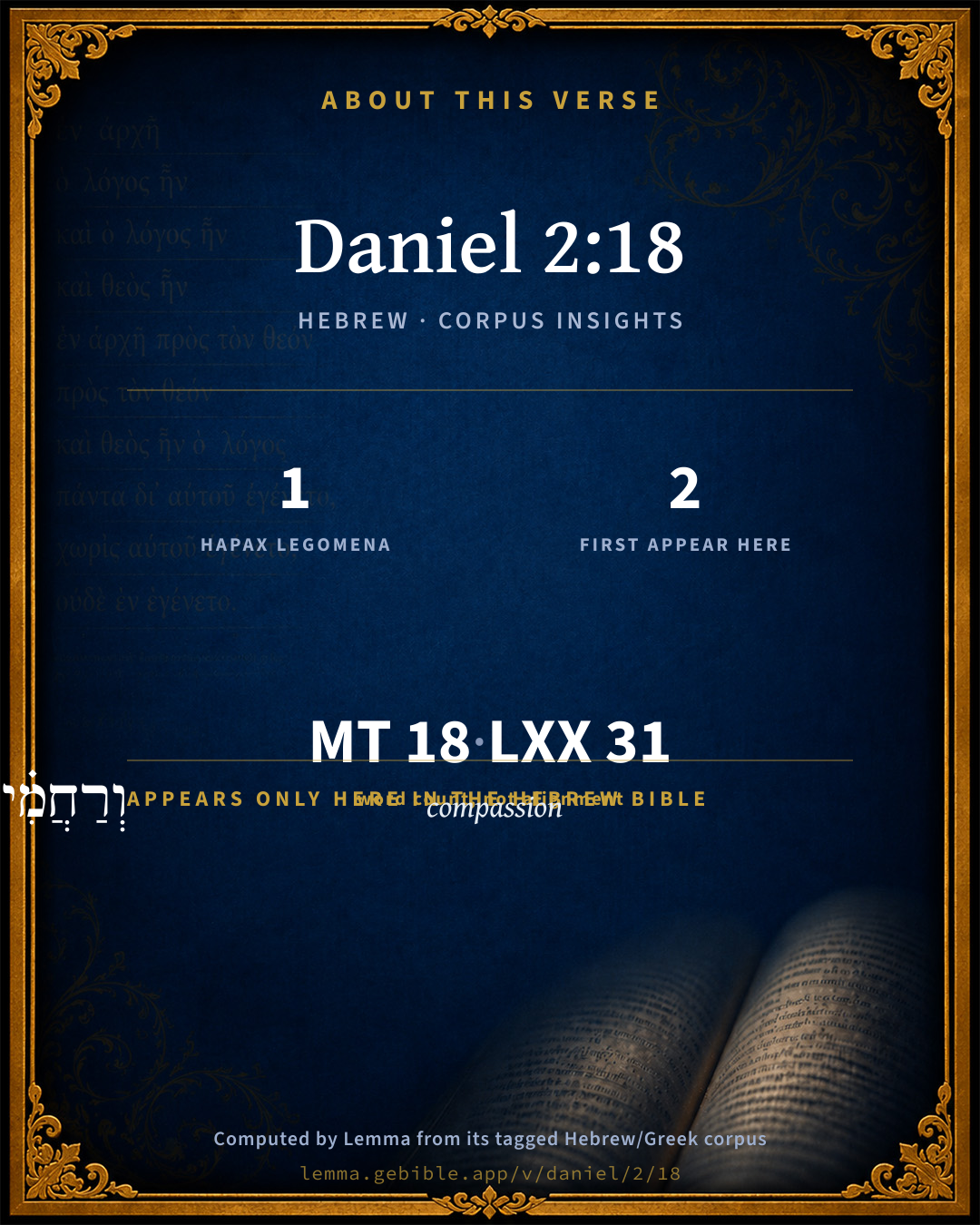
Daniel 2:18

Hebrew (Westminster Leningrad Codex) Daniel 2:18 appears in the Hebrew Old Testament. The text above is from the Westminster Leningrad Codex. Each word links to its Strong’s number, a concise gloss, and parsing drawn from the Open Scriptures Hebrew Bible morphology. Click any word for its full Brown-Driver-Briggs (BDB) entry.
Download image
Cite this verse

Daniel 2:18 (World English Bible). Public Domain. Lemma interlinear Bible study tool, https://lemma.gebible.app/v/daniel/2/18.

Show BibTeX & RIS
BibTeX
RIS
English Translation
that they would desire mercies of the God of heaven concerning this secret; that Daniel and his companions should nor perish with the rest of the wise men of Babylon.
World English Bible · Public Domain
Highlights
  • 1 hapax legomenon — only here in the Hebrew Bible
  • 2 first appearances in the Hebrew Bible
Full analysis ↓
Download a study sheet

One document with this verse’s original text, its word-by-word gloss line, the meaning frame, cross-references with their text, attributed commentary, and full source and license credits — printable, and it pastes into notes with its structure intact.

This verse Autodidact and up

Study sheet (.html) Plain text (.txt)

A passage Seminary Student

Up to 50 verses in one chapter. A passage sheet keeps up to 6 commentary sources and 12 cross-references per verse, in the order this page ranks them, and says so on the sheet whenever that leaves anything out. Ask for a single verse and you get the Autodidact verse sheet above.

Everything on this page stays free to read, with no account — the sheet is a download of what is already on screen, not access to it.

Want to remove ads? Support Godless Engineer
Compare translations 3

The same verse in 3 English versions, stacked beneath the original-language interlinear above. Click any original word for its lexicon entry.

Each is an independent rendering of the whole verse — the interlinear is not word-aligned to these translations.

Highlighted words mark where these versions differ — a whole-verse word diff, not a word-by-word alignment.

  • World English Bible Public Domain
    that they would desire mercies of the God of heaven concerning this secret; that Daniel and his companions should nor perish with the rest of the wise men of Babylon.
  • King James Version Public Domain
    That they would desire mercies of the God of heaven concerning this secret; that Daniel and his fellows should not perish with the rest of the wise men of Babylon.
  • unfoldingWord Literal Text CC BY-SA 4.0
    so that they might seek mercy from the God of heaven concerning this mystery so that Daniel and his companions might not be destroyed with the rest of the wise men of Babylon.

unfoldingWord Literal Text — © unfoldingWord, licensed CC BY-SA 4.0. Word-aligned USFM3 via Door43 (git.door43.org/unfoldingWord/en_ult).

Versions to compare (up to 4)

3 of 4 selected

Show all 18 translations

Every available English version of this verse, each an independent rendering of the whole verse.

  • World English Bible Public Domain
    that they would desire mercies of the God of heaven concerning this secret; that Daniel and his companions should nor perish with the rest of the wise men of Babylon.
  • Berean Standard Bible Public Domain
    urging them to plead for mercy from the God of heaven concerning this mystery, so that Daniel and his friends would not be killed with the rest of the wise men of Babylon.
  • Majority Standard Bible Public Domain
    urging them to plead for mercy from the God of heaven concerning this mystery, so that Daniel and his friends would not be killed with the rest of the wise men of Babylon.
  • King James Version Public Domain
    That they would desire mercies of the God of heaven concerning this secret; that Daniel and his fellows should not perish with the rest of the wise men of Babylon.
  • American Standard Version (1901) Public Domain
    that they would desire mercies of the God of heaven concerning this secret; that Daniel and his companions should nor perish with the rest of the wise men of Babylon.
  • Revised Version (1885) Public Domain
    that they would desire mercies of the God of heaven concerning this secret; that Daniel and his companions should not perish with the rest of the wise men of Babylon.
  • Geneva Bible (1599) Public Domain
    That they should beseech the God of heauen for grace in this secrete, that Daniel and his fellowes should not perish with the rest of ye wise men of Babel.
  • Douay-Rheims (1899) Public Domain
    To the end that they should ask mercy at the face of the God of heaven concerning this secret, and that Daniel and his companions might not perish with the rest of the wise men of Babylon.
  • Young's Literal Translation Public Domain
    and to seek mercies from before the God of the heavens concerning this secret, that they destroy not Daniel and his companions with the rest of the wise men of Babylon.
  • Literal Standard Version CC BY-SA 4.0
    and to seek mercies from before the God of the heavens concerning this secret, that they do not destroy Daniel and his companions with the rest of the wise men of Babylon.
  • Unlocked Literal Bible CC BY-SA 4.0
    He urged them to seek mercy from the God of heaven concerning this mystery so that he and they might not be killed with the rest of the men of Babylon who were known for their wisdom.
  • unfoldingWord Literal Text CC BY-SA 4.0
    so that they might seek mercy from the God of heaven concerning this mystery so that Daniel and his companions might not be destroyed with the rest of the wise men of Babylon.
  • Darby Bible Public Domain
    that they would desire mercies of the God of the heavens concerning this secret; that Daniel and his companions should not perish with the rest of the wise men of Babylon.
  • World Messianic Bible Public Domain
    that they would desire mercies of the God of heaven concerning this secret, that Daniel and his companions would not perish with the rest of the wise men of Babylon.
  • Webster's Bible Public Domain
    That they would desire mercies of the God of heaven concerning this secret; that Daniel and his companions should not perish with the rest of the wise men of Babylon.
  • Free Bible Version CC BY-SA 4.0
    He told them to pray to the God of heaven, asking for help regarding this mystery, so that he and his friends would not be killed along with the rest of the wise men of Babylon.
  • Bible in Basic English Public Domain
    So that they might make a request for the mercy of the God of heaven in the question of this secret; so that Daniel and his friends might not come to destruction with the rest of the wise men of Babylon.
  • JPS Tanakh (1917) Public Domain
    that they might ask mercy of the God of heaven concerning this secret; that Daniel and his companions should not perish with the rest of the wise men of Babylon.

Literal Standard Version (2020), Covenant Press — licensed CC BY-SA 4.0. Text via the HelloAO Bible API (eBible.org). Unlocked Literal Bible (unfoldingWord) — licensed CC BY-SA 4.0. Text via the HelloAO Bible API (eBible.org). unfoldingWord Literal Text — © unfoldingWord, licensed CC BY-SA 4.0. Word-aligned USFM3 via Door43 (git.door43.org/unfoldingWord/en_ult). Free Bible Version, Dr. Jonathan Gallagher — licensed CC BY-SA 4.0. Text via the HelloAO Bible API (eBible.org).

Word by word

More ways to search: Search by grammar → Find every occurrence → Compare this word →

Practice this passage: Drill this verse → Learn its vocabulary →

וְרַחֲמִ֗ין
rᵉchêm
H7359
“and · compassion”
Adjective, C + Noun, Common, Masculine, Plural, Absolute
Part of Speech
Adjective + Noun
Type
Common
Gender
Masculine
Number
Plural
State
Absolute
Full BDB Definition

Origin: corresponding to H7356

TWOT: 2995

compassion
  1. לְמִבְעֵא֙ bᵉʻâʼ H1156 “to ask” Adjective, R + Verb, Qal, Infinitive Construct
  2. מִן min H4481 “from” Adjective, R
  3. קֳדָם֙ qŏdâm H6925 “before” Adjective, R
  4. אֱלָ֣הּ ʼĕlâhh H426 “God of” Adjective, N, Common
  5. שְׁמַיָּ֔א shâmayin H8065 “heaven(s) · the” Adjective, N, Common + Particle, Definite Article
  6. עַל ʻal H5922 “upon” Adjective, R
  7. רָזָ֖ה râz H7328 “secret · the” Adjective, N, Common + Particle, Definite Article
  8. דְּנָ֑ה dên H1836 “this” Adjective, P
  9. דִּ֣י dîy H1768 “which” Adjective, C
  10. לָ֤א lâʼ H3809 “nothing” Adjective, T
  11. יְהֹֽבְדוּן֙ ʼăbad H7 “to perish” Adjective, V
  12. דָּנִיֵּ֣אל Dânîyêʼl H1841 “Daniel” Adjective, N
  13. וְחַבְר֔וֹהִי chăbar H2269 “and · companions · his” Adjective, C + Noun, Common, Masculine, Plural, Construct + Suffix, Personal, 3rd Person, Masculine, Singular
  14. עִם ʻim H5974 “with” Adjective, R
  15. שְׁאָ֖ר shᵉʼâr H7606 “remainder of” Adjective, N, Common
  16. חַכִּימֵ֥י chakkîym H2445 “wise men of” Adjective, N, Common
  17. בָבֶֽל Babel H895 “Babylon” Adjective, N

About this verse

These counts appear in no published source. They are computed here, from the morphology-tagged text and Lemma’s own curated glosses. What Lemma adds →

18
words
18
distinct lemmas
Prophets
section

Notable vocabulary

1 hapax legomenon — a word that appears only here in the entire Hebrew Bible:

  • וְרַחֲמִ֗ין compassion H7359

First appearance in Scripture

These words make their first canonical appearance in the Hebrew Bible here:

  • וְרַחֲמִ֗ין compassion H7359
  • רָזָ֖ה secret H7328

Shared distinctive vocabulary

וְחַבְר֔וֹהִי companion H2269 occurs in 3 verses of the Hebrew Bible. Also found in:

Grammatical profile

  • 1 verb
  • 2 nouns
  • 13 adjectives
  • 2 particles

Verb forms

  • לְמִבְעֵא֙ Qal · Infinitive Construct

Hebrew & Septuagint length

In English translation the verse runs 30 words from the Hebrew and 29 from the Septuagint (LXX English) — closely comparable.

A rough comparison of the two English renderings, which tokenize alike — not a word-level alignment.

Word counts can differ between the Hebrew and the Greek without any difference in meaning — e.g. the Hebrew direct-object marker אֵת has no separate Greek word, and Greek often adds the article ὁ.

In the original languages it is 18 Hebrew tokens and 31 Greek tokens — but the two are counted differently (Hebrew bundles its prefixes and suffixes into one token; the Greek is in lemma form), so that isn’t a like-for-like length.

Cross-references

17

Topical passages linked to Daniel 2:18 in the Treasury of Scripture Knowledge — connected by theme and wording, ordered by reader-vote popularity; previews shown in the World English Bible.

  • Jeremiah 33:3 Call to me, and I will answer you, and will show you great things, and difficult, which you don't know.
  • Matthew 18:19 Again, assuredly I tell you, that if two of you will agree on earth concerning anything that they will ask, it will be done for them by my Father who is in heaven.
  • Psalms 50:15 Call on me in the day of trouble. I will deliver you, and you will honor me."
  • Psalms 91:15 He will call on me, and I will answer him. I will be with him in trouble. I will deliver him, and honor him.
  • Matthew 18:12 "What do you think? If a man has one hundred sheep, and one of them goes astray, doesn't he leave the ninety-nine, go to the mountains, and seek that which has gone astray?
  • Genesis 18:28 What if there will lack five of the fifty righteous? Will you destroy all the city for lack of five?" He said, "I will not destroy it, if I find forty-five there."
  • 1 Samuel 17:37 David said, Yahweh who delivered me out of the paw of the lion, and out of the paw of the bear, he will deliver me out of the hand of this Philistine. Saul said to David, Go, and Yahweh shall be with you.
  • Esther 4:15–17 Then Esther bade them return answer to Mordecai,
  • Isaiah 37:4 It may be Yahweh your God will hear the words of Rabshakeh, whom the king of Assyria his master has sent to defy the living God, and will rebuke the words which Yahweh your God has heard. Therefore lift up your prayer for the remnant that is left.
  • Malachi 3:18 Then you shall return and discern between the righteous and the wicked, between him who serves God and him who doesn't serve him.
  • 2 Timothy 4:17–18 But the Lord stood by me, and strengthened me, that through me the message might be fully proclaimed, and that all the Gentiles might hear; and I was delivered out of the mouth of the lion.
  • Proverbs 3:5–6 Trust in Yahweh with all your heart, And don't lean on your own understanding.
  • Acts 4:24–31 When they heard it, they lifted up their voice to God with one accord, and said, "O Lord, you are God, who made the heaven, the earth, the sea, and all that is in them;
  • Acts 12:4 When he had arrested him, he put him in prison, and delivered him to four squads of four soldiers each to guard him, intending to bring him out to the people after the Passover.
  • Romans 15:30 Now I beg you, brothers, by our Lord Jesus Christ, and by the love of the Spirit, that you strive together with me in your prayers to God for me,
  • 2 Peter 2:9 the Lord knows how to deliver the godly out of temptation and to keep the unrighteous under punishment for the day of judgment;
  • Daniel 3:17 If it be [so], our God whom we serve is able to deliver us from the burning fiery furnace; and he will deliver us out of your hand, O king.

Cross-references courtesy of OpenBible.info (CC BY 4.0).

Hebrew and Greek witnesses Masoretic Hebrew ↔ Greek Septuagint

The same verse in the two great witnesses to the Old Testament, shown verse-for-verse.

These are two independent witnesses, not word-aligned to each other, and the Septuagint is shown in lemma (dictionary) form.

Hebrew Daniel 2:18 Masoretic · Westminster Leningrad Codex

וְרַחֲמִ֗ין לְמִבְעֵא֙ מִן קֳדָם֙ אֱלָ֣הּ שְׁמַיָּ֔א עַל רָזָ֖ה דְּנָ֑ה דִּ֣י לָ֤א יְהֹֽבְדוּן֙ דָּנִיֵּ֣אל וְחַבְר֔וֹהִי עִם שְׁאָ֖ר חַכִּימֵ֥י בָבֶֽל

that they would desire mercies of the God of heaven concerning this secret; that Daniel and his companions should nor perish with the rest of the wise men of Babylon.

World English Bible · Public Domain

Greek LXX Daniel 2:18 Septuagint · lemma form

καί παραἀγγέλλω νηστεία καί δέησις καί τιμωρία ζητέω παρά ὁ κύριος ὁ ὕψιστος περί ὁ μυστήριον οὗτος ὅπως μή ἐκδίδωμι δανιηλ καί ὁ μετά αὐτός εἰς ἀπώλεια ἅμα ὁ σοφιστής βαβυλών

And they sought mercies from the God of heaven concerning this mystery; that Daniel and his friends might not perish with the rest of the wise men of Babylon.

LXX2012 (modern English Septuagint) · Public Domain

On this verse, The Cambridge Bible for Schools and Colleges discusses the Septuagint’s reading. Read the note in Commentary ↓

Hebrew: Westminster Leningrad Codex (CC BY 4.0). Greek: Septuagint (public domain); English from LXX2012 (modern English Septuagint) (Public Domain). How the Septuagint differs from the Hebrew →

Commentary

Notes on Daniel 2:18 from classic Christian and Jewish commentators (each source and its license shown beneath its notes). The classic Christian expositions comment on the surrounding passage and are grouped to its opening verse, so a note may address several verses; the Jewish commentaries on the Tanakh (Rashi and others) are per-verse, so they appear only where the commentator wrote on this verse.

Lemma curates 59 commentaries, every one of them public domain or Creative Commons licensed, each selected and text-cleaned for this edition rather than reprinted as found. About our sources →

Trapp's Complete Commentary

John Trapp

Dan 2:18 That they would desire mercies of the God of heaven concerning this secret; that Daniel and his fellows should not perish with the rest of the wise [men] of Babylon.

Ver. 18. That they would desire mercies of the God of heaven.] All God’s children can pray. {Son 5:8} Those daughters of Jerusalem, though not so fully acquainted with Christ, yet are requested to pray for the Church. But these three were men of singular abilities, no doubt, and were themselves deeply concerned.

Concerning this secret.] In case of secrets and intricacies or riddles of providence, prayer is most seasonable; as being Tephillah, the usual Hebrew word for prayer, a repair to the Lord for inquiry, or for his sentence. {Gen 25:22-23}

John Trapp, A Commentary or Exposition upon All the Books of the Old and New Testament (1647–1656) — public domain. Text from a community e-Sword module.

The Biblical Illustrator

Joseph S. Exell

Dan_2:18

That they would desire mercies of the God of Heaven.

Companions in Prayer

Daniel and his companions were all equally concerned, every man of them for his life, and therefore ought everyone to pray; but, being companions in every other respect, it became them also to keep company in prayer. The necessity was urgent. In the land of Judah they might have gone up together to the house of God, and sought counsel of the Lord by Urim and Thummim. There they would have had the assistance of the priest, but here there was no priest and no oracle. Prayer, without ceremonial, was all that could be presented at the mercy seat, but it was quite enough. Time had come for the people of God to learn that the Mosaic ceremonial was not only interrupted for seventy years, but that, after frequent interruptions and woeful desecrations, even at Jerusalem, it was soon to pass away. A little party of faithful persons already proved that not in Jerusalem only, but even in a strange land, God could be worshipped in spirit and in truth; that prayer, more fragrant than the purest incense, would rise acceptable to God, without priest, or thurible, or altar; that, just as Jonah sent up his cry out of the depths of the sea, and gained an instant hearing, so at any time, and at any place, the poor man might cry, and God would hear him, and send present help for his necessity. Thus did Divine Providence prepare the way for a higher dispensation, when that meeting for prayer in the house of Daniel should be followed by many other such gatherings of the people of God in the lands of their dispersion. So was prayer made for imprisoned Peter by brethren assembled in the house of Mark. So did Roman Christians resort to the Catacombs, and Italian Christians to the Alpine valleys, and good men of every land to secret chambers. Daniel, be it noted, began his public life with prayer, and hence it came to pass that, as was said of the prophet Samuel, not a word of his ever fell to the ground. (W. H. Rule, D.D.)

Affliction Teaches Men to Pray

It was his yoke in his youth that first taught Daniel to pray. And Babylon taught Daniel and his three friends all to pray, and to pray together in their chamber, as we read. To be arrested in their fathers houses by Nebuchadnezzars soldiers; to have Babylonian chains put on their hands and their feet; to see the towers of Zion for the last time; to be asked to sing some of the songs of Zion to amuse their masters as they toiled over the Assyrian sands--you would have been experts yourselves in a school of prayer like that. You would have held little prayer meetings yourselves with your class-fellows and your companions, if you had come through half that Daniel and his three companions came through. It is because you are not being emptied from vessel to vessel all the week that we never see you on Tuesday night. Jeremiah, a great authority on why some men pray, and why other men never pray, has this about you in his book: Moab hath been at his ease from his youth up; he hath settled on his lees; he hath not been emptied from vessel to vessel; neither hath he gone into captivity; and, therefore, his taste remaineth in him, and his scent is not changed. The Cumulative

Power of Prayer

Manton says: Single prayers are like the single hairs of Samson; but the prayers of the congregation are like the whole of his bushy locks, wherein his strength lay. Therefore, you should, in Tertullians phrase, quasi manu facta, with a holy conspiracy, besiege Heaven, and force out a blessing for your pastors.

The Advantages of United Prayer

I often think of the negro woman who was once asked by the governor of Surinam why she and her fellows always prayed together. Could not they do it each one for himself? He happened to be standing at the time before a coal fire, and the woman answered: Dear sir, separate these coals from each other, and the fire will go out; but see how brisk the flame when they burn together. (Expository Times.)

Prayer Cultures Character

We may learn from this passage one principal means of Daniels excellence. Daniel was a great character: one of those illustrious men whom God raises up in His church, at distant intervals, when He has great works to accomplish. The excellencies of such men are the gift of God. Yet, while gifts, they are generally nourished to their perfection by appropriate culture; and it is of importance for all men to mark and consider the influence under which such characters were reared. Now there can be no doubt that Daniels prayerfulness, his habits of regular and frequent correspondence with God, had the greatest effect in fostering the excellencies of his character. Prayer did not give him his great intellect, for that was created with him; but prayer gave him wisdom, and self-denial, and fortitude, and true independence. We would, therefore, recommend prayer to all, and especially to the young, as a means of purifying, and elevating, and perfecting the character. It does this in a twofold way. It brings down the sanctifying influences of the Spirit into the mind. Frequent intercourse with God transforms the soul into His likeness. It fills the mind with a holy reverence that casteth out the fear of man. It begets confidence in all the Divine managements, which raises the soul above the fear of danger. It begets a sense of His favour, that sweetens the soul and keeps it in a healthful frame. All the great men of the church--prophets, reformers, martyrs--were brought up in the school of prayer. (William White.)

Nebuchadnezzars Dream

I. IN EVERY DIFFICULTY WE SHOULD APPEAL TO GOD. Very serious was the position in which Daniel and his friends were placed, as well as the native wise men of Babylon. The demand of the king was altogether unreasonable. Only a despot could have made such a demand, and issued such a sentence because of the non-accomplishment of his will. By any human power the thing wanted was impossible of attainment; but Daniel knew where to find help. Full often had he and his companions repaired to the throne of grace; and it was easy for them, with full confidence in the Almighty arm, to visit that throne in the day of their distress.

II. AND SINCE CHRIST JESUS IS TO REIGN OVER ALL, SHOULD WE NOT SEEK TO HAVE HIM AS OUR FRIEND? If we knew that some great earthly ruler was certain soon to be put in rightful possession of the kingdom in which we dwell, and if we had the means to acquire his favour, so that when his throne was erected amongst us, we should be his prime favourites, and during his life enjoy great riches and influence under him, I daresay we would earnestly employ these means to secure such a happy result. But Christs Kingdom is not for a lifetime merely, but for ever. Of His government there shall be no end. His friends are all to he raised to regal eminence and power, and their glory shall never fade away; but His foes shall be driven from His presence, and reap eternally the just recompense of their rebellion. Is it not, then, worth while to cast aside everything that would hinder us from securing the favour of this King, immortal and eternal--nay, to sacrifice even our earthly life, rather than not make certain of His friendship? (Original Secession Magazine.)

The Biblical Illustrator, edited by Joseph S. Exell (c. 1880s–1900s) — public domain. Text from a community e-Sword module.

Tyndale Open Study Notes

Tyndale Open Resources

2:18 Daniel appealed to God’s mercy (see Exod 34:6-7). God was not obligated to answer Daniel’s prayer, but doing so would accord with his character.

Tyndale Open Study Notes — © Tyndale Open Resources, licensed CC BY-SA 4.0. Text via the HelloAO Bible API.

Ibn Ezra

Rabbi Abraham ibn Ezra

[Daniel 2:18] V'rachamin... min kodam Elah shemayya (וְרַחֲמִין... מִן־קֳדָם אֱלָהּ שְׁמַיָּא - And [to request] mercy from before the God of Heaven): [They turned to God] because there is no sage on earth who could help (l'hoʿil - לְהוֹעִיל, be beneficial) in this matter.

Ibn Ezra on the Tanakh — English translations: “Sefaria Community Translation” (CC0 1.0 (public-domain dedication)); “Yalkut, Sifsei Chachomim Chumash, Metsudah Publications, 2009” (CC BY 4.0); and “Commentary of Ibn Ezra on Isaiah - trans. by M. Friedlander, 1873” (public domain). Text via Sefaria.

Jamieson, Fausset & Brown

Robert Jamieson, A. R. Fausset & David Brown

An illustration of the power of united prayer (Mat 18:19). The same instrumentality rescued Peter from his peril (Act 12:5-12).

Jamieson, Fausset & Brown — Commentary Critical and Explanatory on the Whole Bible (1871) — public domain (CC PDM 1.0). Text via the HelloAO Bible API.

Adam Clarke's Commentary

Verse 18. That they would desire mercies] For this Daniel had requested a little time; and doubtless both he and his three companions prayed incessantly till God gave the wished for revelation; but whether it was given that same sight, we do not know.

Adam Clarke's Commentary on the Bible (1810–1826) — public domain. Text from a community e-Sword/MySword module.

Ellicott's Commentary for English Readers

(18) The God of heaven.—We meet with this title of Almighty God for the first time in Gen_24:7. After the Captivity, it frequently designates the true God as contrasted with the heathen gods. (See Ezr_1:2, Neh_1:5, Psa_136:26.) It is used by Daniel in this sense in this verse.

A Bible Commentary for English Readers, edited by Charles John Ellicott (1878–1897) — public domain. Text from a community e-Sword module.

The Cambridge Bible for Schools and Colleges

gen. ed. J. J. S. Perowne

18. that they would] ‘that they might’ would be clearer, as it would include more easily a reference to Daniel (see Dan_2:23 ‘me’).

mercies] compassion, as the corresponding Heb. word is rendered in Lam_3:22, Zec_7:9 in A.V., and in Dan_1:9 in R.V.

the God of heaven] So Dan_2:19; Dan_2:37; Dan_2:44. A favourite expression among the post-exilic Jews[208]: see Ezr_1:2 (= 2Ch_36:23), Dan_5:11-12, Dan_6:9-10, Dan_7:12; Dan_7:21; Dan_7:23, Neh_1:4-5; Neh_2:4; Neh_2:20, Jon_1:9, Psa_136:26 (אל): also Enoch xiii. 6, Tob_10:11, Jdt_5:8; Jdt_6:19; Jdt_11:17, Rev_11:13; Rev_16:11.

[208] In Gen_24:7 it is probable that ‘and earth’ (so LXX) has accidentally fallen out: see Dan_2:3.

fellows] companions (R.V.), as Dan_2:17.

The Cambridge Bible for Schools and Colleges (gen. ed. J. J. S. Perowne; Cambridge University Press, 1878–1918) — public domain. Text from a community e-Sword module.

John Gill's Exposition

That they would desire mercies of the God of heaven concerning this secret,.... His view in sending for them, and informing them of this whole affair, was to engage them in prayer to God with him; even to that God that made the heaven, and dwells there, and is above all, and sees and knows what is done in earth, and rules both in heaven and in earth according to his will; to entreat his mercy, whose mercies are manifold, and not plead any merits of their own; and that he would, in compassion to them, and the lives of others that were in danger, make known this secret of the king's dream, and the interpretation of it; which could never be found out by the sagacity of men, or by any art they are masters of: this Daniel requested of them, as knowing that it was their duty and interest, as well as his, to unite in prayer unto God on this account, and that the joint and fervent prayer of righteous men avails much with him:

that Daniel and his fellows should not perish with the rest of the wise men of Babylon; which they were in danger of: this was the mercy they were to implore, being in distress, and this the interest they had in this affair; a strong argument to induce them to it.

John Gill's Exposition of the Whole Bible (1746–1763) — public domain (CC PDM 1.0). Text via the HelloAO Bible API.

Albert Barnes' Notes on the Bible

That they would desire mercies of the God of heaven concerning this secret - That they would implore of God that he would show his mercy to them in revealing this secret, that their lives might be spared. In the margin, as in the Chaldee, this is “from before the God of heaven.” All depended now on God. It was clear that human skill was exhausted, and that no reliance could be placed on any ability which man possessed. The art of the Chaldeans had failed, and Daniel, as well by this failure as by the promptings of his own feelings, must now have perceived that the only hope was in God, and that his favor in the case was to be obtained only by prayer. As his three friends were equally interested in the issue, and as it was an early principle of religion, and one found in all dispensations (compare Mat 18:19), that “united” prayer has special power with God, it was natural and proper to call on his friends to join with him in asking this favor from Him who alone could grant it. It was the natural and the last resource of piety, furnishing an example of what all may do, and should do, in times of perplexity and danger.

That Daniel and his fellows should not perish - Margin, “or, they should not destroy Daniel.” The leading in the margin is most in accordance with the Chaldee, though the sense is substantially the same. The word “fellows” is the same which is before rendered “companions.”

With the rest of the wise men of Babylon - It seems to have been certain that the decree would be executed on the Chaldeans, soothsayers, etc. And, indeed, there was no reason “why” the decree should not be executed. They had confessed their inability to comply with the king’s command, and whatever Daniel could now do could not be construed in their favor as furnishing any reason why the decree should not be executed on them. It was presumed, therefore, that the law, severe as it seemed to be, would be carried into effect on them, and we may suppose that this was probably done. The only hope of their escaping from the common lot was in the belief that the God whom they served would now interpose in their behalf.

Albert Barnes' Notes on the Bible (1834–1885) — public domain. Text from a community e-Sword/MySword module.

Haydock's Catholic Bible Commentary

Secret. Literally, "sacrament." Greek: "mystery," which seems to be derived from (Calmet) mosthor, "a secret." (Haydock)

George Leo Haydock (1774–1849), Haydock's Catholic Family Bible and Commentary, 1859 edition — public domain. Excludes Psalms (Douay-Rheims chapter numbering differs from Protestant) and Deuterocanonical books (Catholic canon only).

Matthew Poole's English Annotations

Observe here Daniel’s humility, he sought not to engross this business, and the honour of it, wholly to himself, but would have his fellows share in it with him. Again, they would desire mercy, Heb. the bowels of tender mercy: the choicest saints desire to be saved by mercy, Psa 51:1.

That Daniel and his fellows should not perish: the Lord hath a distinguishing care and love for his people, 2Th 1:6; 2Pe 2:9, especially in common calamities, Exo 14:19, &c.; Rev 18:4.

Matthew Poole's English Annotations on the Holy Bible (1683–1685) — public domain. Text from a community e-Sword/MySword module.

The Pulpit Commentary

That they would desire mercies of the God of heaven concerning this secret; that Daniel and his fellows should not perish with the rest of the wise men of Babylon. The Septuagint has as close a connection between the preceding verse and that before us as has the Massoretie, only it is slightly different in its rendering, "And he told them to fast and pray urged them to fasting and prayer, and to seek help from the Lord the Highest, concerning this mystery, in order that Daniel with his companions might not be given over to destruction with the wise men of Babylon." It is, certainly, possible that the Septuagint translator had a different reading here. The verb "to fast," in the infinitive, might have begun the verse. Still there would be the difficulty of finding anything to correspond to parhggeile. It, however, was probably added to bring the sentence into Greek regimen. The Septuagint translator read the words as nouns in the accusative, and of this case l was a frequent sign. Thus what they had was amwOxl WblW. The Hebrew word corresponding to the Aramaic word here translated "mercies," ymij (rahamin), "bowels," "mercies," is common enough in Biblical language; but the phrase, "to desire mercies," is not found elsewhere in Scripture. It occurs in the later Targums, as Num_12:13, as a paraphrastic addition to the simple statement of Onkelos, that Moses prayed before the Lord; only in the case quoted, as generally, the order is not, as here, the object before the verb a construction more frequent in Assyrian than in Aramaic, save in poetry. The phrase is elliptical; the ruling verb is omitted. One is tempted to wonder whether the word had not originally been wbl, making it a case of the Babylonian or Eastern Aramaic, third person plural imperfect; then the preceding word would be wmwxl, with the vav dropped as unnecessary, and the mere inserted to make the word a regular infinitive. Confirmatory of our view is Theodotion, whose rendering, ejzhtoun, implies that he had a third person plural imperfect here. We do not maintain that it is necessary that he should have had such a reading, but there is at least a high probability that he had. The Peshitta reverses the order of the words, and omits the conjunction vav, and, inserting the relative l, as sign of subordination, proceeds, "that they entreat mercies from before God." Here, also, the third person plural imperfect is used. From the greater freedom that Jerome allowed himself in his translation, and from the wide difference between the grammatical construction of a Latin and an Aramaic sentence, no stress can be laid on the fact that he too translates by the third plural imperfectut quaerrent misericordiam. The balance of probability is that here we have to do with one of those indications of the Eastern origin of the Aramaic of Daniel. There is an instance of doublet in the LXX here in the case of the phrase, timwrian zhthsai, "to seek succour." Tertullian, in his reference to this passage, to which we have referred above (ver. 16), adds to what we quoted above, cum sua fraternitate jejunat, and thus shows that, though differing somewhat from the Septuagint text as we have it, the African Latin Version agreed with it in inserting something about "fasting" here. The God of heaven. This is rendered by the Septuagint here, as generally, uyistov The probability here is that we have to do with no difference of reading, hut rather with an objection to applying to God a title used for heathen deities. The title has a peculiar significance in the lips of those who, as Daniel, were educated as astrologers, and taught by those who regarded the sun, the moon, and the various planets as deities. Daniel and his fellows might thus believe in astrology, but maintain that the God of heaven, their God, used heavenly bodies as messengers to proclaim to those who could read the writing, the things that were coming on the earth. They might thus even give a certain limited subordinate power to the deities of Babylon; these deities were the servants of the God of heaven, who was also the God of Israel. There may be a reference to Jer_10:11. The gods that have not made the heavens and the earth, even they shall perish from the earth, and from under these heavens. The God of Israel is called the God of heaven because he has made the heavens. This title is used before in Gen_24:7, where Abraham uses it. It is characteristic of Biblical Aramaic, that the covenant title of God, "Jehovah," is never used, Before we leave this, we would observe that the Peshitta inserts l, d, the sign of the genitive, before shemayyaa, whereas the text before us uses the older form of construct state in the word for "God." Concerning this secret. A parallel passage illustrative of this is Amo_3:7, "Surely the Lord God will do nothing, but he revealeth his secret unto his servants the prophets; "also Deu_29:29, "Secret things belong unto the Lord our God." Whatever was about to happen, Daniel and his friends knew it could only happen according to the purpose and plan of God. He, as he was the real actor, knew what he was about to do, and whatever revelation of that future had been given to Nebuchadnezzar in his dream, it must have come from the God of heaven; therefore to him do Daniel and his friends make their entreaty. Professor Bevan declares zr (raz) to be a Persian word. Neither Winer, Furst, nor Gesenius recognizes it to be such. Granted that it is Persian, is it not a possible supposition that it is derived from the Aramaic; not that the Aramaic word is derived from the Persian? Even on the supposition that this word was derived from the Persian, this is not extraordinary, when we learn the intimate relationship between the Median court and the Babylonian. That Daniel and his fellows should not perish with the rest of the wise men of Babylon. Does this mean that certain of the wise men had already perished? It seems almost necessary to maintain this from the meaning of rav (shear), "remnant." It seems at first scarcely natural to take this word as meaning merely "the other," yet the usage in Ezra is in accordance with this: Ezr_4:9, "Rehum the chancellor and Shimshai the scribe, and the rest (ra of their companions." A further question may be raised Does this prayer mean that the desire of Daniel and his friends was that, when the wise men of Babylon, under whose superintendence they had been taught, were slain, they should escape? Or does it mean that they prayed that "they with the wise men of Babylon should not be destroyed"? This wholly depends on the meaning to be attached to the word (im), "with." As in English, this word admits of both meanings. As the word is common to Hebrew and Aramaic, we shall take our examples from Hebrew. Thus Gen_18:24, "That be far from thee, Lord, to slay the righteous with the wicked." As example of the other use of the word, Gen_32:6, "Esau and four hundred men with him." Usage thus permits us to regard this prayer as intercessory, that these Hebrew youths prayed not only to be preserved themselves, but also that all the other wise men who shared their condemnation should also be preserved. This is the first record of concerted prayer. Of course, in heathen worship there was the caricature of this concert of prayer in the united shouting of the priests, say, of Baal. This is the earliest instance of that practice that has received such a gracious promise from our Lord, (Mat_18:19) "If two of you shall agree on earth as touching anything they shall ask, it shall be done for them of my Father which is in heaven." We would not maintain, even in appearance, that multitude adds to efficacy with God. But when two or three are gathered together, there is an infection of earnestness, a community of enthusiasm generated, that makes each individual fitter to receive the answer. Yet, again, the more that join in a petition, the more it must be raised out of the grovelling region of selfishness. A man who has a purely selfish desire rising in his heart cannot ask his fellows to join him in supplicating God to grant his request.

The Pulpit Commentary (1880–1919), ed. H.D.M. Spence-Jones & Joseph S. Exell — public domain. Text from a community e-Sword module.

Lesson kit

Teaching starters — assembled from the data on this page, not authored interpretation. Every prompt links to the verse data it draws on. Edit before teaching.

Daniel, in the Prophets, opens this verse with 18 words (18 distinct Hebrew lemmas). Its most distinctive word is rᵉchêm (“compassion”). A historical commentator’s framing appears above. Read the whole chapter for the surrounding context.

Discussion questions

  1. How does “compassion” (rᵉchêm) shape what this verse is saying?
  2. This verse holds 1 word here found nowhere else in the Hebrew Bible. What might the rare word draw attention to?
  3. 2 words here appear for the first time in Scripture. What is being introduced at this debut?
  4. Daniel 2:13 shares the word «companion» with this verse. How do the two illuminate each other?
  5. These translations render this verse differently. What is at stake in choosing one wording over another?
  6. The verb «לְמִבְעֵא֙» is Qal Infinitive Construct. How does its form color the action?
  7. Reading how Trapp's Complete Commentary and The Biblical Illustrator read this verse, where do the two commentators agree and where do they part?

Things to notice

Reading settings

Reading text

Shown beneath each verse's original-language words.

Old Testament
Old Testament edition

Read the OT as the Masoretic Hebrew (MT) or the Greek Septuagint (LXX).

English shown for the Greek Septuagint (in the Hebrew ↔ Greek comparison).

Comparing translations? Open the Compare panel on any verse page to stack up to four side by side.