Daniel 4:6

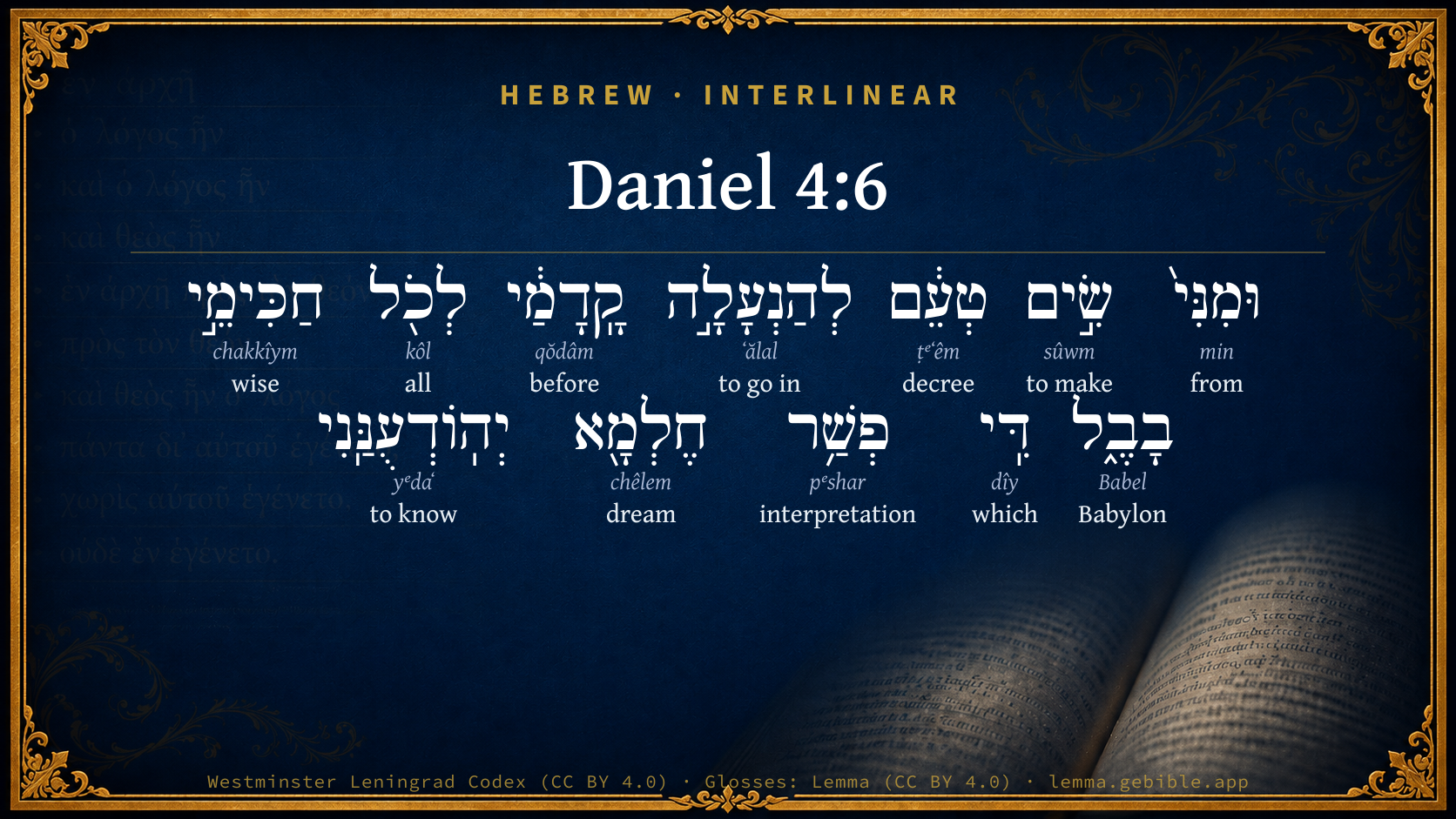
Hebrew (Westminster Leningrad Codex) Daniel 4:6 appears in the Hebrew Old Testament. The text above is from the Westminster Leningrad Codex. Each word links to its Strong’s number, a concise gloss, and parsing drawn from the Open Scriptures Hebrew Bible morphology. Click any word for its full Brown-Driver-Briggs (BDB) entry.
Download image
Cite this verse

Daniel 4:6 (World English Bible). Public Domain. Lemma interlinear Bible study tool, https://lemma.gebible.app/v/daniel/4/6.

Show BibTeX & RIS
BibTeX
RIS
English Translation
Therefore made I a decree to bring in all the wise men of Babylon before me, that they might make known to me the interpretation of the dream.
World English Bible · Public Domain
Download a study sheet

One document with this verse’s original text, its word-by-word gloss line, the meaning frame, cross-references with their text, attributed commentary, and full source and license credits — printable, and it pastes into notes with its structure intact.

This verse Autodidact and up

Study sheet (.html) Plain text (.txt)

A passage Seminary Student

Up to 50 verses in one chapter. A passage sheet keeps up to 6 commentary sources and 12 cross-references per verse, in the order this page ranks them, and says so on the sheet whenever that leaves anything out. Ask for a single verse and you get the Autodidact verse sheet above.

Everything on this page stays free to read, with no account — the sheet is a download of what is already on screen, not access to it.

Want to remove ads? Support Godless Engineer
Compare translations 3

The same verse in 3 English versions, stacked beneath the original-language interlinear above. Click any original word for its lexicon entry.

Each is an independent rendering of the whole verse — the interlinear is not word-aligned to these translations.

Highlighted words mark where these versions differ — a whole-verse word diff, not a word-by-word alignment.

  • World English Bible Public Domain
    Therefore made I a decree to bring in all the wise men of Babylon before me, that they might make known to me the interpretation of the dream.
  • King James Version Public Domain
    Therefore made I a decree to bring in all the wise men of Babylon before me, that they might make known unto me the interpretation of the dream.
  • unfoldingWord Literal Text CC BY-SA 4.0
    So I gave a decree to bring before me all the wise men of Babylon that they might make known to me the interpretation of the dream.

unfoldingWord Literal Text — © unfoldingWord, licensed CC BY-SA 4.0. Word-aligned USFM3 via Door43 (git.door43.org/unfoldingWord/en_ult).

Versions to compare (up to 4)

3 of 4 selected

Show all 18 translations

Every available English version of this verse, each an independent rendering of the whole verse.

  • World English Bible Public Domain
    Therefore made I a decree to bring in all the wise men of Babylon before me, that they might make known to me the interpretation of the dream.
  • Berean Standard Bible Public Domain
    So I issued a decree that all the wise men of Babylon be brought before me to interpret the dream for me.
  • Majority Standard Bible Public Domain
    So I issued a decree that all the wise men of Babylon be brought before me to interpret the dream for me.
  • King James Version Public Domain
    Therefore made I a decree to bring in all the wise men of Babylon before me, that they might make known unto me the interpretation of the dream.
  • American Standard Version (1901) Public Domain
    Therefore made I a decree to bring in all the wise men of Babylon before me, that they might make known unto me the interpretation of the dream.
  • Revised Version (1885) Public Domain
    Therefore made I a decree to bring in all the wise men of Babylon before me, that they might make known unto me the interpretation of the dream.
  • Geneva Bible (1599) Public Domain
    O Belteshazzar, chiefe of the enchanters, because I know, that the spirit of the holy gods is in thee, and no secret troubleth thee, tell mee the visions of my dreame, that I haue seene and the interpretation thereof.
  • Douay-Rheims (1899) Public Domain
    Then I set forth a decree, that all the wise men of Babylon should be brought in before me, and that they should shew me the interpretation of the dream.
  • Young's Literal Translation Public Domain
    And by me a decree is made, to cause all the wise men of Babylon to come up before me, that the interpretation of the dream they may cause me to know.
  • Literal Standard Version CC BY-SA 4.0
    And by me a decree is made, to cause all the wise men of Babylon to come up before me, that the interpretation of the dream they may cause me to know.
  • Unlocked Literal Bible CC BY-SA 4.0
    So I gave a decree to bring before me all the men of Babylon who had wisdom so they could interpret the dream for me.
  • unfoldingWord Literal Text CC BY-SA 4.0
    So I gave a decree to bring before me all the wise men of Babylon that they might make known to me the interpretation of the dream.
  • Darby Bible Public Domain
    And I made a decree to bring in all the wise men of Babylon before me, that they might make known unto me the interpretation of the dream.
  • World Messianic Bible Public Domain
    Therefore I made a decree to bring in all the wise men of Babylon before me, that they might make known to me the interpretation of the dream.
  • Webster's Bible Public Domain
    Therefore I made a decree to bring in all the wise men of Babylon before me, that they might make known to me the interpretation of the dream.
  • Free Bible Version CC BY-SA 4.0
    So I ordered all the wise men of Babylon brought before me to explain the dream to me.
  • Bible in Basic English Public Domain
    And I gave orders for all the wise men of Babylon to come in before me so that they might make clear to me the sense of my dream.
  • JPS Tanakh (1917) Public Domain
    (4-3) Therefore made I a decree to bring in all the wise men of Babylon before me, that they might make known unto me the interpretation of the dream.

Literal Standard Version (2020), Covenant Press — licensed CC BY-SA 4.0. Text via the HelloAO Bible API (eBible.org). Unlocked Literal Bible (unfoldingWord) — licensed CC BY-SA 4.0. Text via the HelloAO Bible API (eBible.org). unfoldingWord Literal Text — © unfoldingWord, licensed CC BY-SA 4.0. Word-aligned USFM3 via Door43 (git.door43.org/unfoldingWord/en_ult). Free Bible Version, Dr. Jonathan Gallagher — licensed CC BY-SA 4.0. Text via the HelloAO Bible API (eBible.org).

Word by word

More ways to search: Search by grammar → Find every occurrence → Compare this word →

Practice this passage: Drill this verse → Learn its vocabulary →

About this verse

These counts appear in no published source. They are computed here, from the morphology-tagged text and Lemma’s own curated glosses. What Lemma adds →

12
words
12
distinct lemmas
Prophets
section

Notable vocabulary

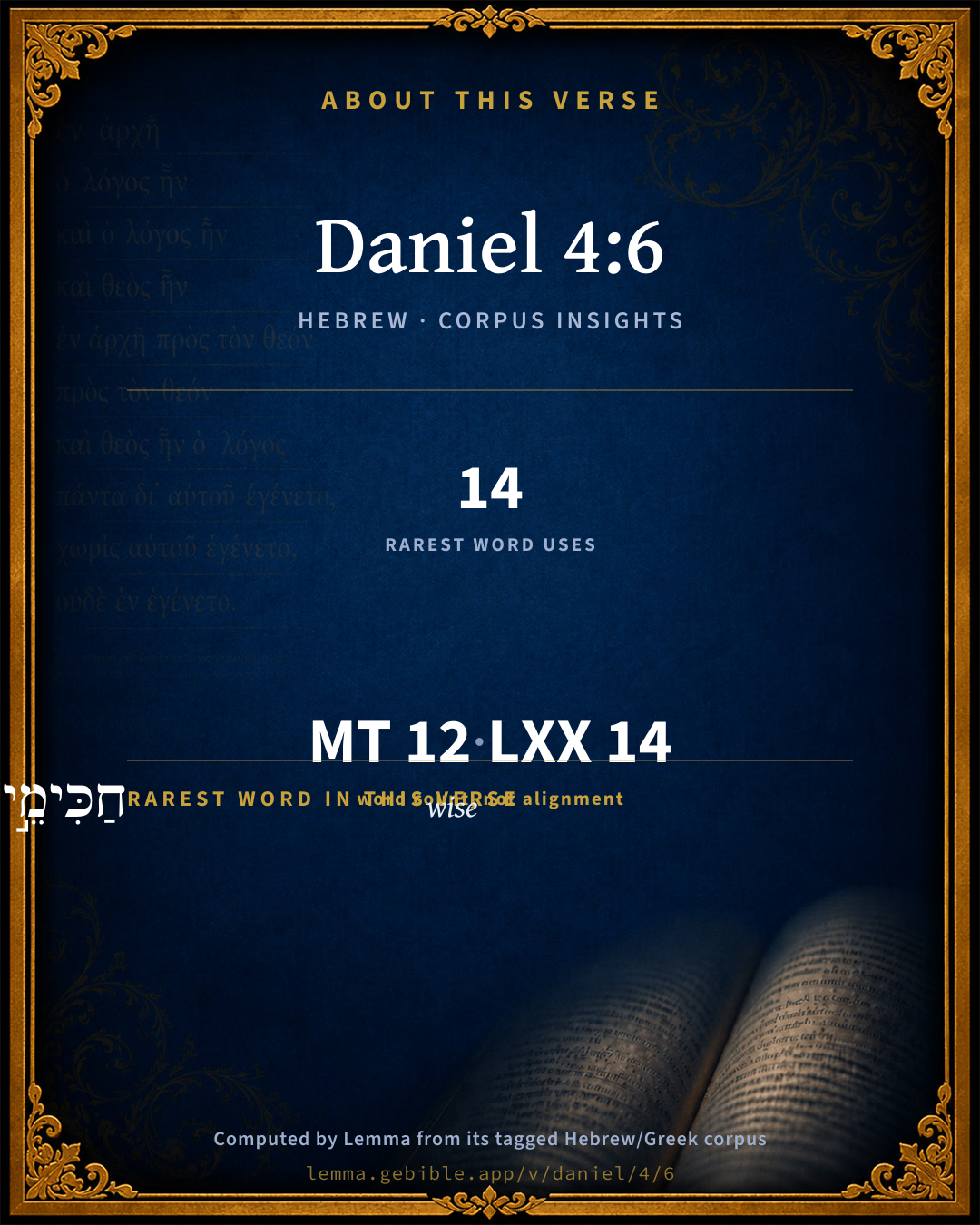
The rarest word here is חַכִּימֵ֣י wise H2445 — appearing just 14 times in the whole Hebrew Bible.

Shared distinctive vocabulary

חַכִּימֵ֣י wise H2445 occurs in 13 verses of the Hebrew Bible. Also found in:

Grammatical profile

  • 1 verb
  • 1 noun
  • 8 adjectives
  • 1 preposition
  • 1 particle

Verb forms

  • לְהַנְעָלָ֣ה Hiphil · Infinitive Construct

Hebrew & Septuagint length

In English translation the verse runs 28 words from the Hebrew and 43 from the Septuagint (LXX English) — the Septuagint runs noticeably longer here. See the side-by-side →

A rough comparison of the two English renderings, which tokenize alike — not a word-level alignment.

Word counts can differ between the Hebrew and the Greek without any difference in meaning — e.g. the Hebrew direct-object marker אֵת has no separate Greek word, and Greek often adds the article ὁ.

In the original languages it is 12 Hebrew tokens and 14 Greek tokens — but the two are counted differently (Hebrew bundles its prefixes and suffixes into one token; the Greek is in lemma form), so that isn’t a like-for-like length.

Cross-references

4

Topical passages linked to Daniel 4:6 in the Treasury of Scripture Knowledge — connected by theme and wording, ordered by reader-vote popularity; previews shown in the World English Bible.

  • Daniel 2:2 Then the king commanded to call the magicians, and the enchanters, and the sorcerers, and the Chaldeans, to tell the king his dreams. So they came in and stood before the king.
  • Genesis 41:7–8 The thin heads of grain swallowed up the seven healthy and full ears. Pharaoh awoke, and, behold, it was a dream.
  • Isaiah 8:19 When they shall tell you, "Consult with those who have familiar spirits and with the wizards, who chirp and who mutter:" shouldn't a people consult with their God? on behalf of the living [should they consult] with the dead?
  • Isaiah 47:12–14 Stand now with your enchantments, and with the multitude of your sorceries, in which you have labored from your youth; if so be you shall be able to profit, if so be you may prevail.

Cross-references courtesy of OpenBible.info (CC BY 4.0).

Hebrew and Greek witnesses Masoretic Hebrew ↔ Greek Septuagint

The same verse in the two great witnesses to the Old Testament, shown verse-for-verse.

Here the Septuagint runs noticeably longer than the Hebrew — LXX2012 (modern English Septuagint) 43 words vs World English Bible 28. A rough length comparison of the two English translations, not a word-level alignment — read both below.

These are two independent witnesses, not word-aligned to each other, and the Septuagint is shown in lemma (dictionary) form.

Hebrew Daniel 4:6 Masoretic · Westminster Leningrad Codex

וּמִנִּי֙ שִׂ֣ים טְעֵ֔ם לְהַנְעָלָ֣ה קָֽדָמַ֔י לְכֹ֖ל חַכִּימֵ֣י בָבֶ֑ל דִּֽי פְשַׁ֥ר חֶלְמָ֖א יְהֽוֹדְעֻנַּֽנִי

Therefore made I a decree to bring in all the wise men of Babylon before me, that they might make known to me the interpretation of the dream.

World English Bible · Public Domain

Greek LXX Daniel 4:6 Septuagint · lemma form

θεωρέω ἐν ὁ ὕπνος ἐγώ καί ἰδού ἄγγελος ἀποστέλλω ἐν ἰσχύς ἐκ ὁ οὐρανός

O Baltasar, chief of the enchanters, of whom I know that the Holy Spirit of God is in you, and no mystery is too hard for you, hear the vision of my dream which I had, and tell me the interpretation of it.

LXX2012 (modern English Septuagint) · Public Domain

On this verse, The Pulpit Commentary discusses the Septuagint’s reading. Read the note in Commentary ↓

Hebrew: Westminster Leningrad Codex (CC BY 4.0). Greek: Septuagint (public domain); English from LXX2012 (modern English Septuagint) (Public Domain). How the Septuagint differs from the Hebrew →

Commentary

Notes on Daniel 4:6 from classic Christian and Jewish commentators (each source and its license shown beneath its notes). The classic Christian expositions comment on the surrounding passage and are grouped to its opening verse, so a note may address several verses; the Jewish commentaries on the Tanakh (Rashi and others) are per-verse, so they appear only where the commentator wrote on this verse.

Lemma curates 59 commentaries, every one of them public domain or Creative Commons licensed, each selected and text-cleaned for this edition rather than reprinted as found. About our sources →

Trapp's Complete Commentary

John Trapp

Dan 4:6 Therefore made I a decree to bring in all the wise [men] of Babylon before me, that they might make known unto me the interpretation of the dream.

Ver. 6. Therefore I made a decree to bring in all the wise men of Babylon.] Whom yet he had formerly found to be no better than braggarts and impostors. Was this man truly converted?

John Trapp, A Commentary or Exposition upon All the Books of the Old and New Testament (1647–1656) — public domain. Text from a community e-Sword module.

Albert Barnes' Notes on the Bible

Therefore made I a decree - The word here rendered decree (טעם ṭe‛êm) means, commonly, “taste, flavor,” as of wine; then “judgment, discernment, reason;” and then a judgment of a king, a mandate, edict. Compare Dan 3:10. The primary notion seems to be that of a delicate “taste” enabling one to determine the qualities of wines, viands, etc.; and then a delicate and nice discrimination in regard to the qualities of actions. The word thus expresses a sound and accurate judgment, and is applied to a decree or edict, as declared by one who had the qualifications to express such a judgment. Here it means, that he issued a royal order to summon into his presence all who could be supposed to be qualified to explain the dream. The Greek (Codex Chisianus) omits Dan 4:6-9.

To bring in all the wise men ... - Particularly such as are enumerated in the following verse. Compare Dan 2:12. It was in accordance with his habit thus to call in the wise men who were retained at court to give counsel, and to explain those things which seemed to be an intimation of the Divine will. See the note at Dan 2:2. Compare also Gen 41:8.

Albert Barnes' Notes on the Bible (1834–1885) — public domain. Text from a community e-Sword/MySword module.

Joseph Benson's Commentary

Dan 4:6-7. Therefore made I a decree to bring in the wise men — As he did before, on a like occasion; but they did not make known unto me the interpretation — Though they had promised with great confidence, when consulted before, respecting his former dream, that if it were told them they would, without fail, interpret it. But the key of this dream was in a sacred prophecy, with which they were not acquainted, namely, Eze 31:3, &c., where the Assyrian monarch is compared, as Nebuchadnezzar is here, to a tree cut down for his pride. Had they read and considered that divine record, they might perhaps have discovered the mystery of this dream. But Providence ordered it so, that they should be first puzzled with it, that Daniel’s interpreting of it afterward might redound to the glory of Daniel’s God.

Joseph Benson's Commentary on the Old and New Testaments (1811–1818) — public domain. Text from a community e-Sword module.

Keil & Delitzsch

C. F. Keil & F. Delitzsch

Therefore Nebuchadnezzar commanded the wise men of Babylon (Dan 2:2) to be called to him, that they might interpret to him the dream. But they could not do so, although on this occasion he only asked them to give the interpretation, and not, as in Dan 2:2, at the same time the dream itself. Instead of the Kethiv עללין, the Keri here and at Dan 5:8 gives the contracted form עלּין, which became possible only by the shortening of , as in חשׁחן Dan 3:16. The form אחרין is differently explained; apparently it must be the plur. masc. instead of אחרן, and אחרין עד, to the last, a circumlocution of the adverb at last. That אחרין means posterus, and אחרן alius, Hitzig has not yet furnished the proof. The question, wherefore Daniel came only when the Chaldean wise men could not interpret the dream, is not answered satisfactorily by the remark of Zndel, p. 16, that it was the natural course that first they should be called who by virtue of their wisdom should interpret the dream, and that then, after their wisdom had failed, Daniel should be called, who had gained for himself a name by revelations not proceeding from the class of the Magi. For if Nebuchadnezzar had still the events of Daniel 2 in view, he would without doubt have called him forthwith, since it certainly did not come into his mind, in his anxiety on account of his dream, first to try the natural wisdom of his Magi. The objection offered by Hitzig, that the king does not go at once to his chief magician, v. 6 (Dan 4:9), who had already (Daniel 2) shown himself to be the best interpreter of dreams, is not thereby confuted; still less is it by the answer that the custom was not immediately to call the president of the Magi (Jahn), or that in the haste he was not at once thought of (Hv.). Though it may have been the custom not to call the chief president in every particular case, yet a dream by the king, which had filled him with terror, was an altogether unusual occurrence. If Daniel, therefore, was in this case first called only when the natural wisdom of the Magi had proved its inadequacy, the reason of this was, either that Nebuchadnezzar had forgotten what had occurred several years before (Daniel 2), and since the chief president of the wise men was only in special cases called on for counsel, therefore only the incorporated cultivators of the magician's art were called, and only when these could not accomplish that which was asked of them was the chief president Daniel required to come, - or it lay in this, that the king, afraid of receiving an unwelcome answer, purposely adopted the course indicated. Kranichfeld has decided in favour of this latter supposition. "The king," he thinks, "knew from the dream itself that the tree (v. 8 [Dan 4:11]) reaching unto heaven and extending to the end of the whole earth represented a royal person ruling the earth, who could come to ruin on account of the God of the Jews, and would remain in his ruin till there was an acknowledgment of the Almighty; cf. vv. 13, 14, (Dan 4:16, Dan 4:17). There was this reason for the king's keeping Daniel the Jew at a distance from this matter of the dream. Without doubt he would think himself intended by the person concerned in the dream; and since the special direction which the dream took (Dan 4:14) set forth as its natural point of departure an actual relation corresponding to that of the king to the God of Daniel, it must have occasioned to him a well-grounded fear (cf. Dan 4:24), as in the case of Ahab, the idolater, towards Micah, the prophet of Jehovah (cf. Kg1 22:8), of a severe judgment, leading him to treat with any other regarding his matter rather than with Daniel." For the establishment of this view Kranichfeld refers to the "king's subsequent address to Daniel, designed especially to appease and captivate (vv. 5, 6 [Dan 4:8, Dan 4:9]), as well as the visibly mild and gentle deportment of the king toward the worshipper of the God of the Jews." This proceeding tending to captivate appears in the appellation, Daniel, whose name was Belteshazzar, according to the name of my god; for Nebuchadnezzar, by the addition of a name of honour in commemoration of the celebrated god of the kingdom, intended to show favour toward him, as also in the expression which follows, In whom is the spirit of the holy gods, which Nebuchadnezzar repeats in the address. But neither in the one nor the other of these considerations can we perceive the intention of specially captivating and appeasing the Jew Daniel; - not in the latter of these expressions, for two reasons: 1. because Nebuchadnezzar uses the expression not merely in the address to Daniel, but also in the references to him which go before; had he designed it to captivate him, he would have used these words of honour only in the address to him; 2. because the expression, "in whom is the spirit of the holy gods," is so truly heathenish, that the Jew, who knew only one God, could not feel himself specially flattered by having the spirit of the holy gods ascribed to him.

If Nebuchadnezzar had had the intention of gaining the favour of Daniel, he would certainly, according to his confession (Dan 2:47), have attributed to him the spirit of the God of gods, the Lord of lords, - a confession which even as a heathen he could utter. We cannot give the king so little credit for understanding as to suppose that he meant to show

(Note: Calvin here rightly remarks: non dubium est, quin hoc nomen graviter vulneraverit animum prophetae.)

a special favour to Daniel, who held so firmly the confession of his father's God, by reminding him that he had given him the name Belteshazzar after the name of his god Bel, whom the Jews abhorred as an idol. Thus the reminding him of this name, as well as the saying that he possessed the spirit of the holy gods, is not accounted for by supposing that he intended to appease and captivate Daniel. In showing the unsatisfactoriness of this interpretation of these expressions, we have set aside also the explanation of the reason, which is based upon it, why Daniel was called in to the king only after the Chaldean wise men; and other weighty considerations can also be adduced against it. First, the edict contains certainly nothing which can give room to the conjecture that Nebuchadnezzar entertained no true confidence, but much rather want of confidence, in him. The comparison of Nebuchadnezzar also with king Ahab in his conduct toward the prophet Micah is not suitable, because Ahab was not a mere polytheist as Nebuchadnezzar, but much rather, like Antiochus Epiphanes, persecuted the servants of Jehovah in his kingdom, and at the instigation of his heathenish wife Jezebel wished to make the worship of Baal the only religion of his kingdom. Finally, the relation of the dream does not indicate that Nebuchadnezzar, if he knew or suspected that the dream referred to himself as ruler over the whole earth, thought that he would come to ruin because of the God of the Jews. For that this does not follow from v. 14 (Dan 4:17), is shown not only by the divine visitation that happened to the king, as mentioned in v. 27 (Dan 4:30) in fulfilment of the dream, but also by the exhortation to the king with which Daniel closes the interpretation, "to break off sin by righteousness, and his iniquities by showing mercy to the poor" (v. 24 [v. 27]).

Thus there only remains this supposition, that the former revelations of God to the king had passed away from his heart and his memory; which was not surprising in the successful founder and ruler of a world-kingdom, if we consider that from twenty-five to thirty years must have passed away since Daniel interpreted to him his dream in the second year of his reign, and from ten to fifteen had passed since the miracle of the deliverance of the three from the burning fiery furnace. But if those earlier revelations of God were obscured in his heart by the fulness of his prosperity, and for ten years Daniel had no occasion to show himself to him as a revealer of divine secrets, then it is not difficult to conceive how, amid the state of disquietude into which the dream recorded in this chapter had brought him, he only gave the command to summon all the wise men of Babylon without expressly mentioning their president, so that they came to him first, and Daniel was called only when the natural wisdom of the Chaldeans had shown itself helpless.

The naming of Daniel by his Hebrew name in the manifesto, intended for all the people of the kingdom as well as for the Jews, is simply intended, as in Dan 2:29, to designate the interpreter of the dream, as distinguished from the native wise men of Babylon, as a Jew, and at the same time as a worshipper of the most high God; and by the addition, "whose name is Belteshazzar, according to the name of my god," Nebuchadnezzar intends to indicate that Daniel by this name was brought into fellowship with his chief god Bel, and that not only as a worshipper of the God of the Jews, but also of the great god Bel, he had become a partaker of the spirit of the holy gods. But by the holy gods Nebuchadnezzar does not understand Jehovah, the Holy One, deriving this predicate "holy," as M. Geier says, ex theologia Isralitica, and the plur. "gods" denoting, as Calovius supposes, the mysterium pluralitatis personarum; but he speaks of the holy gods, as Jerome, Calvin, and Grotius supposed, as a heathen (ut idololatra) in a polytheistic sense. For that the revelation of supernatural secrets belonged to the gods, and that the man who had this power must possess the spirit of the gods, all the heathen acknowledged. Thus Pharaoh (Gen 41:38) judged regarding Joseph, and thus also the Chaldeans say to Nebuchadnezzar (Dan 2:11) that only the gods could know his dream. The truth lying at the foundation of this belief was acknowledged by Joseph before Pharaoh, as also by Daniel before the Chaldean king, for both of them declared before the heathen kings that the interpretation of their dreams was not in the power of man, but could come only from God (Gen 41:16; Dan 2:28). But when in the case before us Nebuchadnezzar speaks of the holy gods, he means by the expression the ἀγαθοδαίμονες as opposed to the κακοδαίμονες, using the word holy of the good gods, probably from his conversation with Daniel on the subject.

In the address, Dan 4:6, he calls Belteshazzar חרטמּיּא רב, master of the magicians, probably from the special branch of Chaldean wisdom with which Daniel was particularly conversant, at the same time that he was chief president over all the magicians. אנס, to oppress, to compel any one, to do violence to him; here, to make trouble, difficulty.

Keil & Delitzsch — Biblical Commentary on the Old Testament (1861–1891) — public domain (CC PDM 1.0). Text via the HelloAO Bible API. (Old Testament only.)

Ibn Ezra

Rabbi Abraham ibn Ezra

[Daniel 4:6] Belteshazzar, [...whom no mystery] baffles (לָא־אָנֵ֣ס): [The Aramaic phrase la anes lakh means] it will not overcome you (לֹא יְנַצֵּחֲךָ - lo y'natzechecha). And similar to it [using the related root א.נ.ס to mean force/compulsion] is [the phrase from Esther 1:8]: “no compulsion/forcing” (אֵ֣ין אֹנֵ֑ס - ein ones). [The root implies being] like: conquering (מְנַצֵּחַ - m'natzeach), compelling/forcing (מַכְרִיחַ - machriach).

Ibn Ezra on the Tanakh — English translations: “Sefaria Community Translation” (CC0 1.0 (public-domain dedication)); “Yalkut, Sifsei Chachomim Chumash, Metsudah Publications, 2009” (CC BY 4.0); and “Commentary of Ibn Ezra on Isaiah - trans. by M. Friedlander, 1873” (public domain). Text via Sefaria.

Geneva Bible (1599)

Geneva Bible translators

Which also was a great grief to the Prophet to be numbered among the sorcerers and men whose practices were wicked and contrary to God’s word.

Geneva Bible (1599) marginal notes — public domain. Text via Bolls.life.

Jamieson, Fausset & Brown

Robert Jamieson, A. R. Fausset & David Brown

It may seem strange that Daniel was not first summoned. But it was ordered by God's providence that he should be reserved to the last, in order that all mere human means should be proved vain, before God manifested His power through His servant; thus the haughty king was stripped of all fleshly confidences. The Chaldees were the king's recognized interpreters of dreams; whereas Daniel's interpretation of the one in Dan. 2:24-45 had been a peculiar case, and very many years before; nor had he been consulted on such matters since.

Jamieson, Fausset & Brown — Commentary Critical and Explanatory on the Whole Bible (1871) — public domain (CC PDM 1.0). Text via the HelloAO Bible API.

The Cambridge Bible for Schools and Colleges

gen. ed. J. J. S. Perowne

6. The ‘wise men’ of Babylon (Dan_2:12) were summoned before the king, as on the occasion of his previous dream (Dan_2:2).

The Cambridge Bible for Schools and Colleges (gen. ed. J. J. S. Perowne; Cambridge University Press, 1878–1918) — public domain. Text from a community e-Sword module.

John Gill's Exposition

Therefore made I a decree,.... Published a proclamation; signifying it was his mind and will

to bring in all the wise men of Babylon before him; all together, supposing that one or other of them, or by consulting together, would be able to explain things to his satisfaction, and make him more easy:

that they might make known unto me the interpretation of the dream; for though they could not tell the interpretation of his former dream, because he could not relate to them the dream itself; which, if he could, they promised him the interpretation; but now he could remember it, and therefore might expect they would make known the interpretation of it to him.

John Gill's Exposition of the Whole Bible (1746–1763) — public domain (CC PDM 1.0). Text via the HelloAO Bible API.

Haydock's Catholic Bible Commentary

And the. He is convinced that Daniel could do both, but condescends now to relate his dream. (Haydock)

George Leo Haydock (1774–1849), Haydock's Catholic Family Bible and Commentary, 1859 edition — public domain. Excludes Psalms (Douay-Rheims chapter numbering differs from Protestant) and Deuterocanonical books (Catholic canon only).

Matthew Poole's English Annotations

Though he had experienced before that these wise men were fooled, and could do nothing either in telling or interpreting his dream, Da 2, yet he will try them once again, possibly because they might gain fresh credit with the king; or he would hear what they could do, and if they failed him, he would then make use of Daniel whom he had in reserve. Perhaps these Chaldean doctors and wizards shunned and scorned Daniel’s company, and he was as much shy of theirs; therefore they came not together; but God had disposed of this whole scene, and, for the honour of his name, suffered Daniel not to be sent for till the last.

Matthew Poole's English Annotations on the Holy Bible (1683–1685) — public domain. Text from a community e-Sword/MySword module.

The Pulpit Commentary

Vers. 6, 7. Therefore made I a decree to bring in all the wise men of Babylon before me, that they might make known unto me the interpretation of the dream. Then came in the magicians, the astrologers, the Chaldeans, and the soothsayers: and I told the dream before them; but they did not make known unto me the interpretation thereof. These verses do not occur in the LXX Theodotion is a somewhat slavish translation of the Massoretic text, "From me there was set up (ejteqh) a decree to summon before me all the wise men of Babylon," etc. The Peshitta is somewhat freer, but as close to the Massoretic text. Still, the want of the verses in the Septuagint would throw a doubt on their authenticity, even if there were nothing in the verses themselves to make them liable to suspicion.

The Pulpit Commentary (1880–1919), ed. H.D.M. Spence-Jones & Joseph S. Exell — public domain. Text from a community e-Sword module.

Rashi

Rabbi Shlomo Yitzchaki (Rashi)

and no secret is hidden from you No mystery is robbed [from you] or denied you.

Rashi on the Tanakh — English translations: “The Judaica Press complete Tanach with Rashi, translated by A. J. Rosenberg” (CC BY 4.0); “Pentateuch with Rashi's commentary by M. Rosenbaum and A.M. Silbermann, 1929-1934” (public domain); “The Metsudah Tanach series, Lakewood, N.J” (CC BY 4.0); and “The Book of Joshua, Metsudah Publications, 1997” (CC BY 4.0). Text via Sefaria.

Lesson kit

Teaching starters — assembled from the data on this page, not authored interpretation. Every prompt links to the verse data it draws on. Edit before teaching.

Daniel, in the Prophets, opens this verse with 12 words (12 distinct Hebrew lemmas). Its most distinctive word is chakkîym (“wise”). The Greek Septuagint runs longer here. A historical commentator’s framing appears above. Read the whole chapter for the surrounding context.

Discussion questions

  1. What does “wise” (chakkîym) contribute to the verse as a whole?
  2. How does Daniel 2:12, which shares the word «wise», read alongside this verse?
  3. The Septuagint runs longer here than the Hebrew. What might account for the difference?
  4. These translations render this verse differently; the difference is in the English rendering, not the original. What questions does that raise?
  5. «לְהַנְעָלָ֣ה» is a Hiphil Infinitive Construct verb. How does that grammatical form shape the action described?
  6. Compare how Trapp's Complete Commentary and Albert Barnes' Notes on the Bible read this verse. Where do they agree or differ?

Things to notice

Reading settings

Reading text

Shown beneath each verse's original-language words.

Old Testament
Old Testament edition

Read the OT as the Masoretic Hebrew (MT) or the Greek Septuagint (LXX).

English shown for the Greek Septuagint (in the Hebrew ↔ Greek comparison).

Comparing translations? Open the Compare panel on any verse page to stack up to four side by side.