
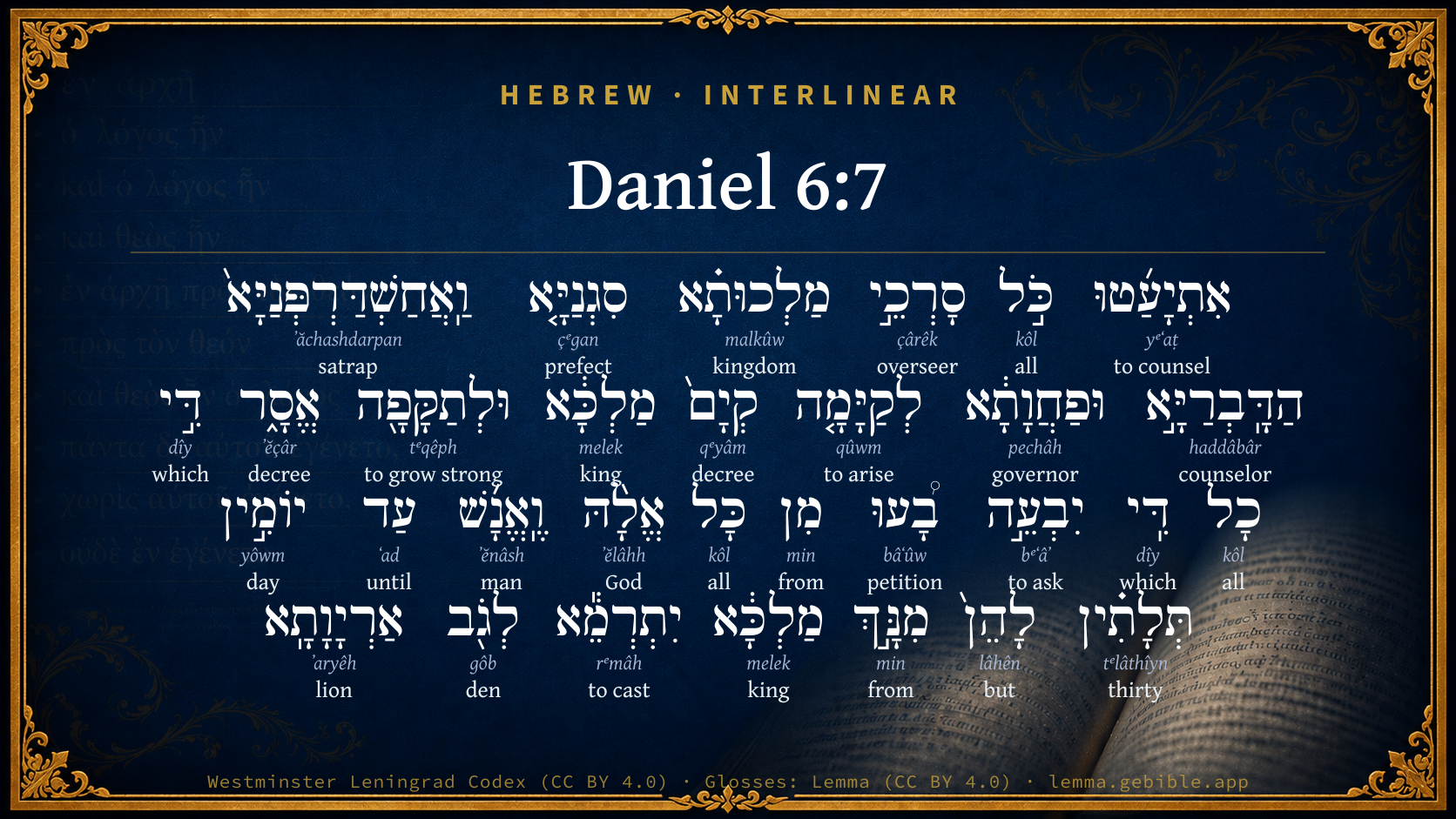
Daniel 6:7

Hebrew (Westminster Leningrad Codex) Daniel 6:7 appears in the Hebrew Old Testament. The text above is from the Westminster Leningrad Codex. Each word links to its Strong’s number, a concise gloss, and parsing drawn from the Open Scriptures Hebrew Bible morphology. Click any word for its full Brown-Driver-Briggs (BDB) entry.
Download image
Cite this verse

Daniel 6:7 (World English Bible). Public Domain. Lemma interlinear Bible study tool, https://lemma.gebible.app/v/daniel/6/7.

Show BibTeX & RIS
BibTeX
RIS
English Translation
All the presidents of the kingdom, the deputies and the satraps, the counselors and the governors, have consulted together to establish a royal statute, and to make a strong interdict, that whoever shall ask a petition of any god or man for thirty days, save of you, O king, he shall be cast into the den of lions.
World English Bible · Public Domain
Highlights
  • 6 first appearances in the Hebrew Bible
Full analysis ↓
Download a study sheet

One document with this verse’s original text, its word-by-word gloss line, the meaning frame, cross-references with their text, attributed commentary, and full source and license credits — printable, and it pastes into notes with its structure intact.

This verse Autodidact and up

Study sheet (.html) Plain text (.txt)

A passage Seminary Student

Up to 50 verses in one chapter. A passage sheet keeps up to 6 commentary sources and 12 cross-references per verse, in the order this page ranks them, and says so on the sheet whenever that leaves anything out. Ask for a single verse and you get the Autodidact verse sheet above.

Everything on this page stays free to read, with no account — the sheet is a download of what is already on screen, not access to it.

Want to remove ads? Support Godless Engineer
Compare translations 3

The same verse in 3 English versions, stacked beneath the original-language interlinear above. Click any original word for its lexicon entry.

Each is an independent rendering of the whole verse — the interlinear is not word-aligned to these translations.

Highlighted words mark where these versions differ — a whole-verse word diff, not a word-by-word alignment.

  • World English Bible Public Domain
    All the presidents of the kingdom, the deputies and the satraps, the counselors and the governors, have consulted together to establish a royal statute, and to make a strong interdict, that whoever shall ask a petition of any god or man for thirty days, save of you, O king, he shall be cast into the den of lions.
  • King James Version Public Domain
    All the presidents of the kingdom, the governors, and the princes, the counsellors, and the captains, have consulted together to establish a royal statute, and to make a firm decree, that whosoever shall ask a petition of any God or man for thirty days, save of thee, O king, he shall be cast into the den of lions.
  • unfoldingWord Literal Text CC BY-SA 4.0
    All the high officials of the kingdom, the prefects, and the satraps, the counselors, and the governors have consulted together that the king should establish a statute and enforce an injunction, that whoever makes a petition to any god or man for thirty days, except to you, O king, shall be thrown into the den of lions.

unfoldingWord Literal Text — © unfoldingWord, licensed CC BY-SA 4.0. Word-aligned USFM3 via Door43 (git.door43.org/unfoldingWord/en_ult).

Versions to compare (up to 4)

3 of 4 selected

Show all 18 translations

Every available English version of this verse, each an independent rendering of the whole verse.

  • World English Bible Public Domain
    All the presidents of the kingdom, the deputies and the satraps, the counselors and the governors, have consulted together to establish a royal statute, and to make a strong interdict, that whoever shall ask a petition of any god or man for thirty days, save of you, O king, he shall be cast into the den of lions.
  • Berean Standard Bible Public Domain
    All the royal administrators, prefects, satraps, advisers, and governors have agreed that the king should establish an ordinance and enforce a decree that for thirty days anyone who petitions any god or man except you, O king, will be thrown into the den of lions.
  • Majority Standard Bible Public Domain
    All the royal administrators, prefects, satraps, advisers, and governors have agreed that the king should establish an ordinance and enforce a decree that for thirty days anyone who petitions any god or man except you, O king, will be thrown into the den of lions.
  • King James Version Public Domain
    All the presidents of the kingdom, the governors, and the princes, the counsellors, and the captains, have consulted together to establish a royal statute, and to make a firm decree, that whosoever shall ask a petition of any God or man for thirty days, save of thee, O king, he shall be cast into the den of lions.
  • American Standard Version (1901) Public Domain
    All the presidents of the kingdom, the deputies and the satraps, the counsellors and the governors, have consulted together to establish a royal statute, and to make a strong interdict, that whosoever shall ask a petition of any god or man for thirty days, save of thee, O king, he shall be cast into the den of lions.
  • Revised Version (1885) Public Domain
    All the presidents of the kingdom, the deputies and the satraps, the counsellors and the governors, have consulted together to establish a royal statute, and to make a strong interdict, that whosoever shall ask a petition of any god or man for thirty days, save of thee, O king, he shall be cast into the den of lions.
  • Geneva Bible (1599) Public Domain
    All the rulers of thy kingdome, the officers and gouernours, the counsellers, and dukes haue consulted together to make a decree for the King and to establish a statute, that whosoeuer shall aske a petition of any god or man for thirtie dayes saue of thee, O King, he shalbe cast into the denne of lyons.
  • Douay-Rheims (1899) Public Domain
    All the princes of the kingdom, the magistrates, and governors, the senators, and judges have consulted together, that an imperial decree, and an edict be published: That whosoever shall ask any petition of any god, or man, for thirty days, but of thee, O king, shall be cast into the den of lions.
  • Young's Literal Translation Public Domain
    Taken counsel have all the presidents of the kingdom, the prefects, and the satraps, the counsellors, and the governors, to establish a royal statute, and to strengthen an interdict, that any who seeketh a petition from any god and man until thirty days, save of thee, O king, is cast into a den of lions.
  • Literal Standard Version CC BY-SA 4.0
    Taken counsel have all the presidents of the kingdom, the prefects, and the satraps, the counselors, and the governors, to establish a royal statute, and to strengthen an interdict, that any who seeks a petition from any god and man until thirty days, except of you, O king, is cast into a den of lions.
  • Unlocked Literal Bible CC BY-SA 4.0
    All the chief administrators of the kingdom, the regional governors, and the provincial governors, the advisors, and the governors have consulted together and decided that you, the king, should issue a decree and should enforce it, so that whoever makes a petition to any god or man for thirty days, except to you, king, that person must be thrown into the den of lions.
  • unfoldingWord Literal Text CC BY-SA 4.0
    All the high officials of the kingdom, the prefects, and the satraps, the counselors, and the governors have consulted together that the king should establish a statute and enforce an injunction, that whoever makes a petition to any god or man for thirty days, except to you, O king, shall be thrown into the den of lions.
  • Darby Bible Public Domain
    All the presidents of the kingdom, the prefects, and the satraps, the counsellors, and the governors have consulted together to establish a royal statute, and to make a firm decree, that whosoever shall ask a petition of any god or man for thirty days, except of thee, O king, he shall be cast into the den of lions.
  • World Messianic Bible Public Domain
    All the presidents of the kingdom, the deputies and the local governors, the counselors and the governors, have consulted together to establish a royal statute and to make a strong decree, that whoever asks a petition of any god or man for thirty days, except of you, O king, he shall be cast into the den of lions.
  • Webster's Bible Public Domain
    \\6:6\\Then these presidents and princes assembled to the king, and said thus to him, King Darius, live for ever.
  • Free Bible Version CC BY-SA 4.0
    “We have all agreed—chief ministers, prefects, provincial governors, counselors, and local governors—that Your Majesty should issue a decree, legally enforced, that for the next thirty days anyone who prays to any god or human being except you, Your Majesty, shall be thrown into the lions' den.
  • Bible in Basic English Public Domain
    Then these chief rulers and the captains came to the king and said to him, O King Darius, have life for ever.
  • JPS Tanakh (1917) Public Domain
    (6-8) All the presidents of the kingdom, the prefects and the satraps, the ministers and the governors, have consulted together that the king should establish a statute, and make a strong interdict, that whosoever shall ask a petition of any god or man for thirty days, save of thee, O king, he shall be cast into the den of lions.

Literal Standard Version (2020), Covenant Press — licensed CC BY-SA 4.0. Text via the HelloAO Bible API (eBible.org). Unlocked Literal Bible (unfoldingWord) — licensed CC BY-SA 4.0. Text via the HelloAO Bible API (eBible.org). unfoldingWord Literal Text — © unfoldingWord, licensed CC BY-SA 4.0. Word-aligned USFM3 via Door43 (git.door43.org/unfoldingWord/en_ult). Free Bible Version, Dr. Jonathan Gallagher — licensed CC BY-SA 4.0. Text via the HelloAO Bible API (eBible.org).

Word by word

More ways to search: Search by grammar → Find every occurrence → Compare this word →

Practice this passage: Drill this verse → Learn its vocabulary →

קְיָם֙
qᵉyâm
H7010
“decree of”
Adjective, N, Common
Part of Speech
Adjective
Gender
Common
Full BDB Definition

Origin: from H6966

TWOT: 2968a

decree, statute
  1. אִתְיָעַ֜טוּ yᵉʻaṭ H3272 “to counsel” Adjective, V, Plural
  2. כֹּ֣ל kôl H3606 “all of” Adjective, N, Common
  3. סָרְכֵ֣י çârêk H5632 “overseers of” Adjective, N, Common
  4. מַלְכוּתָ֗א malkûw H4437 “kingdom · the” Adjective, N, Common + Particle, Definite Article
  5. סִגְנַיָּ֤א çᵉgan H5460 “prefects · the” Adjective, N, Common + Particle, Definite Article
  6. וַֽאֲחַשְׁדַּרְפְּנַיָּא֙ ʼăchashdarpan H324 “and · satraps · the” Adjective, C + Noun, Common, Masculine, Plural, Determined + Particle, Definite Article
  7. הַדָּֽבְרַיָּ֣א haddâbâr H1907 “counselors · the” Adjective, N, Common + Particle, Definite Article
  8. וּפַחֲוָתָ֔א pechâh H6347 “and · governors · the” Adjective, C + Noun, Common, Masculine, Plural, Determined + Particle, Definite Article
  9. לְקַיָּמָ֤ה qûwm H6966 “to arise” Adjective, R + Verb, Piel, Infinitive Construct
  10. מַלְכָּ֔א melek H4430 “king · the” Adjective, N, Common + Particle, Definite Article
  11. וּלְתַקָּפָ֖ה tᵉqêph H8631 “and · to grow strong” Adjective, C + Preposition + Verb, Piel, Infinitive Construct
  12. אֱסָ֑ר ʼĕçâr H633 “decree” Adjective, N, Common
  13. דִּ֣י dîy H1768 “which” Adjective, T
  14. כָל kôl H3606 “all of” Adjective, N, Common
  15. דִּֽי dîy H1768 “which” Adjective, T
  16. יִבְעֵ֣ה bᵉʻâʼ H1156 “to ask” Adjective, V
  17. בָ֠עוּ bâʻûw H1159 “petition” Adjective, N, Common
  18. מִן min H4481 “from” Adjective, R
  19. כָּל kôl H3606 “all of” Adjective, N, Common
  20. אֱלָ֨הּ ʼĕlâhh H426 “God” Adjective, N, Common
  21. וֶֽאֱנָ֜שׁ ʼĕnâsh H606 “and · man” Adjective, C + Noun, Common, Masculine, Singular, Absolute
  22. עַד ʻad H5705 “until” Adjective, R
  23. יוֹמִ֣ין yôwm H3118 “days” Adjective, N, Common
  24. תְּלָתִ֗ין tᵉlâthîyn H8533 “thirty” Adjective, A, Common
  25. לָהֵן֙ lâhên H3861 “but” Adjective, C
  26. מִנָּ֣ךְ min H4481 “from · you” Adjective, R + Suffix, Personal, 2nd Person, Masculine, Singular
  27. מַלְכָּ֔א melek H4430 “king · the” Adjective, N, Common + Particle, Definite Article
  28. יִתְרְמֵ֕א rᵉmâh H7412 “to cast” Adjective, V
  29. לְגֹ֖ב gôb H1358 “to/for · den of” Adjective, R + Noun, Common, Masculine, Singular, Construct
  30. אַרְיָוָתָֽא ʼaryêh H744 “lions · the” Adjective, N, Common + Particle, Definite Article

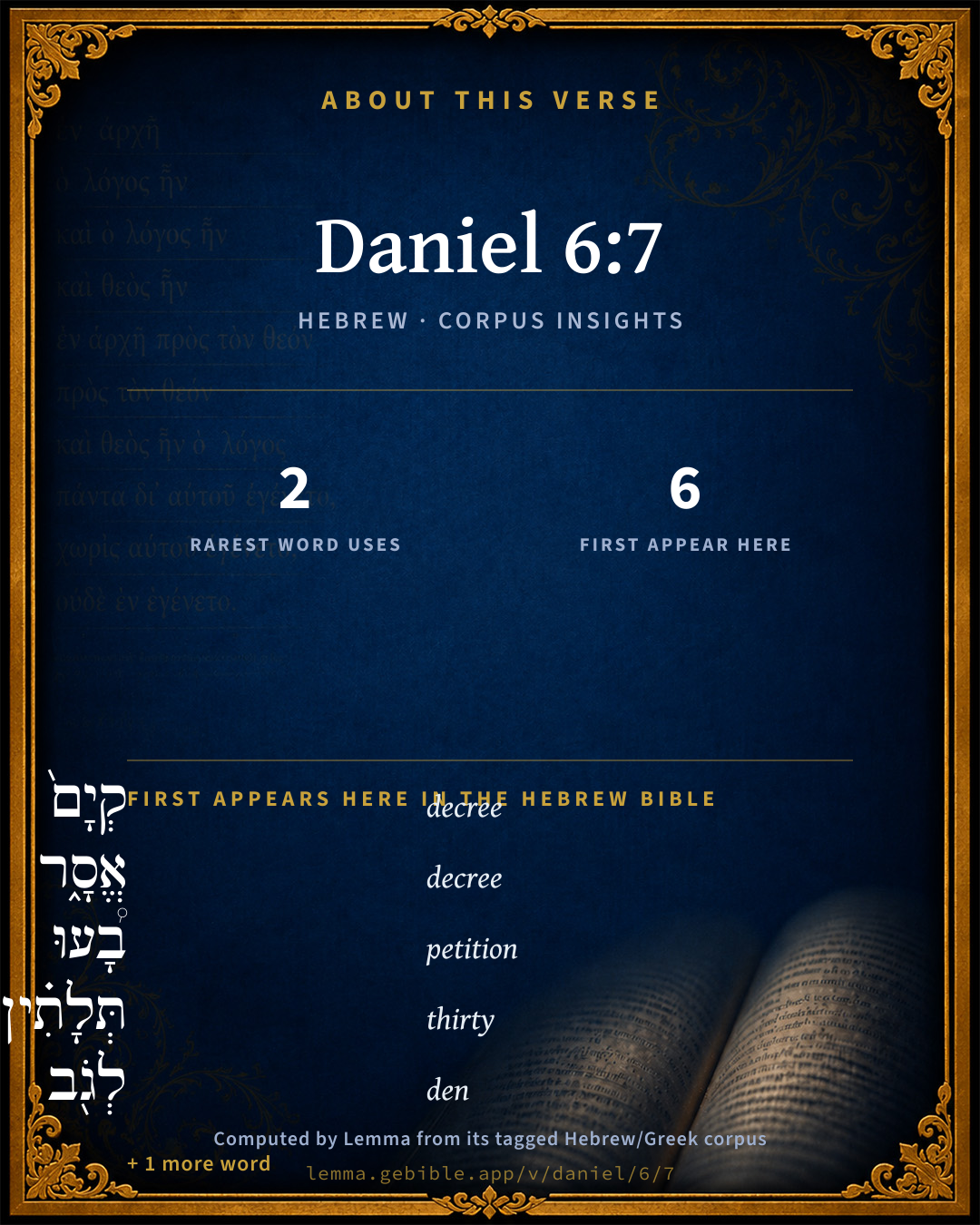
About this verse

These counts appear in no published source. They are computed here, from the morphology-tagged text and Lemma’s own curated glosses. What Lemma adds →

31
words
26
distinct lemmas
Prophets
section

Notable vocabulary

The rarest word here is קְיָם֙ decree H7010 — appearing just 2 times in the whole Hebrew Bible.

First appearance in Scripture

These words make their first canonical appearance in the Hebrew Bible here:

  • קְיָם֙ decree H7010
  • אֱסָ֑ר decree H633
  • בָ֠עוּ petition H1159
  • תְּלָתִ֗ין thirty H8533
  • לְגֹ֖ב den H1358
  • אַרְיָוָתָֽא lion H744

Shared distinctive vocabulary

קְיָם֙ decree H7010 occurs in 2 verses of the Hebrew Bible. Also found in:

Grammatical profile

  • 2 verbs
  • 2 nouns
  • 19 adjectives
  • 8 particles

Verb forms

  • לְקַיָּמָ֤ה Piel · Infinitive Construct
  • וּלְתַקָּפָ֖ה Piel · Infinitive Construct

Repetition

Words recur within this verse — often emphatic in Hebrew:

  • כֹּ֣ל all H3606 ×3
  • מַלְכָּ֔א king H4430 ×2
  • דִּ֣י which H1768 ×2
  • מִן from H4481 ×2

Hebrew & Septuagint length

In English translation the verse runs 58 words from the Hebrew and 55 from the Septuagint (LXX English) — closely comparable.

A rough comparison of the two English renderings, which tokenize alike — not a word-level alignment.

Word counts can differ between the Hebrew and the Greek without any difference in meaning — e.g. the Hebrew direct-object marker אֵת has no separate Greek word, and Greek often adds the article ὁ.

Cross-references

20

Topical passages linked to Daniel 6:7 in the Treasury of Scripture Knowledge — connected by theme and wording, ordered by reader-vote popularity; previews shown in the World English Bible.

  • Psalms 59:3 For, behold, they lie in wait for my soul. The mighty gather themselves together against me, Not for my disobedience, nor for my sin, Yahweh.
  • Psalms 62:4 They fully intend to throw him down from his lofty place. They delight in lies. They bless with their mouth, but they curse inwardly. Selah.
  • Psalms 83:1–3 God, don't keep silent. Don't keep silent, And don't be still, God.
  • Daniel 3:2 Then Nebuchadnezzar the king sent to gather together the satraps, the deputies, and the governors, the judges, the treasurers, the counselors, the sheriffs, and all the rulers of the provinces, to come to the dedication of the image which Nebuchadnezzar the king had set up.
  • Daniel 3:6 and whoever doesn't fall down and worships shall the same hour be cast into the midst of a burning fiery furnace.
  • Daniel 3:27 The satraps, the deputies, and the governors, and the king's counselors, being gathered together, saw these men, that the fire had no power on their bodies, nor was the hair of their head singed, neither were their pants changed, nor had the smell of fire passed on them.
  • Psalms 10:9 He lurks in secret as a lion in his ambush. He lies in wait to catch the helpless. He catches the helpless, when he draws him in his net.
  • Matthew 12:14 But the Pharisees went out, and conspired against him, how they might destroy him.
  • Matthew 26:4 They took counsel together that they might take Jesus by deceit, and kill him.
  • Mark 15:1 Immediately in the morning the chief priests, with the elders and scribes, and the whole council, held a consultation, and bound Jesus, and carried him away, and delivered him up to Pilate.
  • John 12:10 But the chief priests conspired to put Lazarus to death also,
  • Acts 4:26–28 The kings of the earth take a stand, And the rulers take council together, Against the Lord, and against his Christ.'
  • Psalms 2:2 The kings of the earth take a stand, And the rulers take counsel together, Against Yahweh, and against his anointed, saying,
  • Psalms 64:2–6 Hide me from the conspiracy of the wicked, From the noisy crowd of the ones doing evil;
  • Psalms 94:20 Shall the throne of wickedness have fellowship with you, Which brings about mischief by statute?
  • Daniel 3:11 and whoever doesn't fall down and worship shall be cast into the midst of a burning fiery furnace.
  • Daniel 6:2–3 and over them three presidents, of whom Daniel was one; that these satraps might give account to them, and that the king should have no damage.
  • Micah 6:5 My people, remember now what Balak king of Moab devised, And what Balaam the son of Beor answered him from Shittim to Gilgal, That you may know the righteous acts of Yahweh."
  • Nahum 2:12 The lion tore in pieces enough for his cubs, and strangled for his lionesses, and filled his caves with the kill, and his dens with prey.
  • Acts 4:5–7 It happened in the morning, that their rulers, elders, and scribes were gathered together in Jerusalem.

Cross-references courtesy of OpenBible.info (CC BY 4.0).

Hebrew and Greek witnesses Masoretic Hebrew ↔ Greek Septuagint

The same verse in the two great witnesses to the Old Testament, shown verse-for-verse.

These are two independent witnesses, not word-aligned to each other, and the Septuagint is shown in lemma (dictionary) form.

Hebrew Daniel 6:7 Masoretic · Westminster Leningrad Codex

אִתְיָעַ֜טוּ כֹּ֣ל סָרְכֵ֣י מַלְכוּתָ֗א סִגְנַיָּ֤א וַֽאֲחַשְׁדַּרְפְּנַיָּא֙ הַדָּֽבְרַיָּ֣א וּפַחֲוָתָ֔א לְקַיָּמָ֤ה קְיָם֙ מַלְכָּ֔א וּלְתַקָּפָ֖ה אֱסָ֑ר דִּ֣י כָל דִּֽי יִבְעֵ֣ה בָ֠עוּ מִן כָּל אֱלָ֨הּ וֶֽאֱנָ֜שׁ עַד יוֹמִ֣ין תְּלָתִ֗ין לָהֵן֙ מִנָּ֣ךְ מַלְכָּ֔א יִתְרְמֵ֕א לְגֹ֖ב אַרְיָוָתָֽא

All the presidents of the kingdom, the deputies and the satraps, the counselors and the governors, have consulted together to establish a royal statute, and to make a strong interdict, that whoever shall ask a petition of any god or man for thirty days, save of you, O king, he shall be cast into the den of lions.

World English Bible · Public Domain

Greek LXX Daniel 6:7 Septuagint · lemma form

τότε προςἔρχομαι ὁ ἄνθρωπος ἐκεῖνος καί εἶπον ἐναντίον ὁ βασιλεύς

All who preside over your kingdom, captains and satraps, chiefs and local governors, have taken counsel together, to establish by a royal statue and to confirm a decree, that whoever shall ask a petition of any god or man for thirty days, save of you, O king, shall be cast into the den of lions.

LXX2012 (modern English Septuagint) · Public Domain

Hebrew: Westminster Leningrad Codex (CC BY 4.0). Greek: Septuagint (public domain); English from LXX2012 (modern English Septuagint) (Public Domain). How the Septuagint differs from the Hebrew →

Commentary

Notes on Daniel 6:7 from classic Christian and Jewish commentators (each source and its license shown beneath its notes). The classic Christian expositions comment on the surrounding passage and are grouped to its opening verse, so a note may address several verses; the Jewish commentaries on the Tanakh (Rashi and others) are per-verse, so they appear only where the commentator wrote on this verse.

Lemma curates 59 commentaries, every one of them public domain or Creative Commons licensed, each selected and text-cleaned for this edition rather than reprinted as found. About our sources →

Trapp's Complete Commentary

John Trapp

Dan 6:7 All the presidents of the kingdom, the governors, and the princes, the counsellors, and the captains, have consulted together to establish a royal statute, and to make a firm decree, that whosoever shall ask a petition of any God or man for thirty days, save of thee, O king, he shall be cast into the den of lions.

Ver. 7. All the presidents of the kingdom.] Not all either, for Daniel would sooner have died a thousand deaths than have voted such a gross impiety; but he was one of the most, that knew least of the council, and it was he against whom, haec cudebatur faba, this plot was laid, though it proved at last to be against themselves.

The governors, and the princes, the counsellors and the captains.] A rabble of rebels, conspiring against heaven. Non numeranda aunt suffragia, sed expendenda.

To establish a royal statute.] But a very irreligious and injurious one, the like whereunto was that prohibition in France of Henry III, that it should not be lawful for householders to pray with their families; {a} and that of the Jesuits at Dolce, forbidding the common people to say anything at all of God, either in good sort or in bad. {b}

That whosoever shall ask a petition of any god or man.] What, not of their own gods? nor yet of Cyrus, who was co-partner with Darius in the kingdom? But, like enough, these conspiritors might think hereby the rather to ingratiate with the old dotard Darius, who feared the virtue and valour of his nephew and colleague, Cyrus, and would say with tears, as Xenophon reporteth, that Cyrus was more glorious than he, and had more applause of the people.

{a} Polan. in locum.

{b} Heyl. Geog.

John Trapp, A Commentary or Exposition upon All the Books of the Old and New Testament (1647–1656) — public domain. Text from a community e-Sword module.

The Biblical Illustrator

Joseph S. Exell

Dan_6:7

Consulted together to establish a royal statute.

The Faith of Daniel Tested

It was common for the Chaldeans to administer capital punishment by burning. To the Persians, who were worshippers of fire, this was regarded as something of an abomination, and hence they destroyed their condemned criminals by casting them to savage beasts. Whatever may have been the deficiences of this Darius, he had the shrewdness to find out the best and most competent man in Babylon to serve him as his prime minister. He made Daniel chief of the three presidents. Such a man, in such a position, administering affairs with rigid exactness and impartiality, strictly honest himself and tolerating no dishonesties or falsities in others, and ever growing in the esteem of his king and in favour with the people, could not, in the nature of things, escape the envy and malice of those who suffered by comparison, and who found him in the way of their selfish ambitions. It is part of the disease that is upon depraved humanity to be dissatisfied and unamiable toward the excellences and honours of others. It is loath to bear anything above itself. It is their delight to humiliate those who happen to be more favoured than themselves. But see what the true fear of God will do for a man! With all the determination of the malignants to ruin Daniel, they could find no fault in him. Piety was rooted in him, and it wrought for him a pureness, dignity and integrity of life and character on which the most envious tongues could obtain no hold. They could sustain no charges against him as a man, or against his administration. His devotion to his God made him true in all his life and faithful to all his trusts. Having satisfied themselves of the impeccable integrity of Daniel, both as a man and as a competent officer, the eyes of these plotters should have been opened to their unreasonableness in wishing to overthrow him. But when the devil of selfishness, envy and malice takes possession of the heart, no charms of virtue, no beauties of goodness, no adornments of innocence, no excellences of merit, are sufficient to cast him out or break his dominion. The more convinced these men were of Daniels unimpeachableness, the more desperate they became in their determination to destroy him. Look at the cunning baseness of their proceeding. The movement of these conspirators was to prove how much they were devoted to the sublimest honour of their sovereign, and to induce him to unite with them in establishing some royal decree which should memorialize his divine dignity, and bring to him the sacred reverence which belonged to his person. The holding of the laws of the Medes and Persians to be unalterable was founded on the assumption that the king is something of a deity, and can make no mistakes. And this divinity of their king these men professed to be most anxious to bring forward, and to have impressed upon all the subjects of the realm. Such was their scheme. It had a heathen lie for its basis; it was a huge hypocrisy in its suggestion; and it was nothing but a scheme of cold-blooded murder to destroy the greatest, best and purest man in the kingdom. Great was the kings sorrow when he found who was struck by his insane decree. But vainly did he now reproach himself for his wicked folly. He had played the fool. He had permitted himself to be flattered into a measure which was now about to put out of the world the most faithful friend he had on earth. Under the Medo-Persian laws Daniel could not be delivered. Sycophants and flatterers are always tyrants in their hearts. They will oppress when they get the power. But Jehovah can bring to naught the machination of princes, and shut the mouths of lions. And in this case he did both. Learn from this that there is righteous and merciful God at the helm of things, however crooked or unevenly they may seem to go. This is a mixed world. Excellence and virtue do not exempt from earthly ills and adversities. Learn also, how we may best conduct ourselves with reference to all these things. From early youth Daniel gave himself to God; he was diligent in his devotions; and always dared to obey God rather than man. (Joseph A. Seiss, D.D.)

The Biblical Illustrator, edited by Joseph S. Exell (c. 1880s–1900s) — public domain. Text from a community e-Sword module.

Joseph Benson's Commentary

Dan 6:7-9. All the presidents, &c., have consulted to make a firm decree — As Daniel’s adversaries could have no advantage against him by any law now in being, they therefore contrive a new law, by which they hope to insnare him, and in such a matter as they knew they would be sure of doing it. They pretended that this law, which they wished to have enacted, was the result of mature deliberation; that all the presidents of the kingdom, the governors, princes, &c., had consulted together about it, and that they not only agreed to it, but advised it, for divers good causes and considerations; nay, they intimate to the king that it was carried nemine contradicente. All the presidents, say they, are of this mind, and yet we are sure that Daniel, the chief of the three presidents, did not agree to it; and we have reason to think that many more excepted against it, as absurd and unreasonable. Observe, reader, it is no new thing for that to be represented, and with great assurance too, as the sense of the nation, which is far from being so; and that which few approve of, is sometimes confidently said to be that which all agree to! These designing men, under colour of doing honour to the king, but really intending the ruin of his favourite, urge him to make one of the most absurd decrees that can well be imagined; a decree which would not only suspend by law all the exercise of every kind of religion through that vast empire, for the space of a month, (except any chose to worship the king, who thus inconsiderately, or impiously, suffered himself to be regarded as the only deity of his subjects,) but would prohibit under pain of death, to be inflicted in the most barbarous manner, any request being made from one man to another: “nay, the edict was so framed, that a child might have been condemned for asking bread of his father, or a starving beggar for craving relief.” — Scott. And now, O king, say they, establish the decree, &c., according to the law of the Medes and Persians — There was a law in this monarchy, that no ordinance or edict, made with the necessary formalities, and with the consent of the king’s counsellors, could be revoked: the king himself had no power in this case. Diodorus Siculus tells us, lib. 4., that Darius, the last king of Persia, would have pardoned Charidemus after he was condemned to death, but could not reverse the law that had passed against him. We may observe the difference of style between this text and that of Est 1:19. Here the words are, the law of the Medes and Persians, out of regard to the king, who was a Mede; there it is styled, the law of the Persians and Medes, the king being a Persian at that time: see Calmet and Lowth. Chardin says, that in Persia, when the king has condemned a person, it is no longer lawful to mention his name, or to intercede in his favour. Though the king were drunk, or beside himself, yet the decree must be executed; otherwise he would contradict himself, and the law admits of no contradiction. Wherefore King Darius signed the writing — It is not much to be wondered at that Darius, who seems to have been a weak man, should sign the decree, as it appeared to be proposed in order to do him the highest honour, and to set him, as it were, upon an equality with the gods.

Joseph Benson's Commentary on the Old and New Testaments (1811–1818) — public domain. Text from a community e-Sword module.

Tyndale Open Study Notes

Tyndale Open Resources

6:7 the king should make a law: The request was couched as an appeal to truth and justice, but it was really an appeal to the king’s pride, with ulterior motives (6:4-5). • We already know that Daniel would not break God’s law to obey a human order (cp. 1:5-8; 3:4-12).

Tyndale Open Study Notes — © Tyndale Open Resources, licensed CC BY-SA 4.0. Text via the HelloAO Bible API.

Jamieson, Fausset & Brown

Robert Jamieson, A. R. Fausset & David Brown

The Persian king was regarded as representative of the chief god, Ormuzd; the seven princes near him represented the seven Amshaspands before the throne of Ormuzd; hence Mordecai (Est 3:4) refused such homage to Haman, the king's prime minister, as inconsistent with what is due to God alone. A weak despot, like Darius, much under the control of his princes, might easily be persuaded that such a decree would test the obedience of the Chaldeans just conquered, and tame their proud spirits. So absolute is the king in the East, that he is regarded not merely as the ruler, but the owner, of the people.

All . . . governors . . . counsellors, &c.--Several functionaries are here specified, not mentioned in Dan 6:4, Dan 6:6. They evidently exaggerated the case of the weak king, as if their request was that of all the officers in the empire.

den of lions--an underground cave or pit, covered with a stone. It is an undesigned proof of genuineness, that the "fiery furnace" is not made the means of punishment here, as in Dan 3:20; for the Persians were fire-worshippers, which the Babylonians were not.

Jamieson, Fausset & Brown — Commentary Critical and Explanatory on the Whole Bible (1871) — public domain (CC PDM 1.0). Text via the HelloAO Bible API.

Adam Clarke's Commentary

Verse 7. Whosoever shall ask a petition] What pretense could they urge for so silly an ordinance? Probably to flatter the ambition of the king, they pretend to make him a god for thirty days; so that the whole empire should make prayer and supplication to him, and pay him Divine honours! This was the bait; but their real object was to destroy Daniel.

Adam Clarke's Commentary on the Bible (1810–1826) — public domain. Text from a community e-Sword/MySword module.

John Calvin's Commentaries

WE said, yesterday, that the nobles who laid snares against Daniel were inspired with great fury when they dared to dictate to the king the edict recorded by Daniel. It was an intolerable sacrilege thus to deprive all the deities of their honor; yet he subscribed the edict, as we shall afterwards see, and thus put to the test the obedience of his people whom he had lately reduced under the yoke by the help of his son-in-law. There is no doubt of his wish to subdue the Chaldees, who up to that time had been masters; and we know how ferocity springs from the possession of authority. Since then the Chaldees had formerly reigned so far and wide, it was difficult to tame them and render them submissive, especially when they found themselves the slaves of those who had previously been their rivals. We know how many contests there were between them and the Medes; and although they were subdued in war, their spirits were not yet in subjection; hence Darius desired to prove their obedience, and this reason induced him to give his consent. He does not purposely provoke the anger of the gods; but through respect for the men, he forgets the deities, and substitutes himself in the place of the gods, as if it was in his power to attract the authority of heaven to himself! This, as I have said, was a grievous sacrilege. If any one could enter into the hearts of kings, he would find scarcely one in a hundred who does not despise everything divine. Although they confess themselves to enjoy their thrones by the grace of God, as we have previously remarked, yet they wish to be adored in his stead. We now see how easily flatterers persuade kings to do whatever appears likely to extol their magnificence. It follows:

John Calvin's Commentaries (1540-1563) — public domain. Text from the Calvin Translation Society English edition (1840s-50s) via the Christian Classics Ethereal Library (ccel.org). Calvin's coverage is partial (roughly two-thirds of the Bible); uncommented books and verses are honest gaps, never fabricated. The 19th-century editor's footnotes and remarks are omitted so the notes are faithfully Calvin's own voice.

Ellicott's Commentary for English Readers

(7) All the presidents.—Observe the order in which the State officers are mentioned—civil rulers, legal advisers, military governors—and comp. Note on Dan_3:2. The spokesman represents all these officers to have come to a fixed determination after due deliberation. This was false, as it is plain from Dan_6:24 that all were not involved in the conspiracy. The object of the decree was political, as well as hostile towards Daniel. By consenting to the plan proposed, Darius would acknowledge the Babylonian system of theology, according to which the king was “the living manifestation of all the gods,” while, at the same time, his subjects would have an opportunity of doing him religious homage. Probably this prevented the king from perceiving any plot against Daniel. We see from this history the antiquity of espionage in political matters.

A Bible Commentary for English Readers, edited by Charles John Ellicott (1878–1897) — public domain. Text from a community e-Sword module.

The Cambridge Bible for Schools and Colleges

gen. ed. J. J. S. Perowne

7. All the presidents] of course, with the exception of Daniel, who was one of them (Dan_6:2). But the misrepresentation may be meant to be intentional, as though to lead the king to suppose that the proposal had Daniel’s approval.

the governors, and the princes, the counsellers and the captains] the praefects (Dan_2:48), and the satraps, the ministers (Dan_3:24), and the governors (Dan_3:2). Cf. the enumeration of officials in Dan_3:2-3; Dan_3:27.

to establish a royal statute] Of course, indirectly,—by prevailing upon the king to take action. A.V. marg. ‘that the king should establish a statute, and make’ &c., expresses the meaning more distinctly; but it is a less natural rendering of the Aramaic.

and to make a firm decree] and to make a stringent interdict. ‘Interdict’ (so A.V. marg., and R.V.) is lit. a binding, or restraining; and almost the same word is used in Num_30:2-4, &c. of a restraining vow (A.V., R.V., ‘bond’). The passive partic. of the cognate verb is common in the Mishna in the sense of ‘prohibited.’

a petition] The meaning probably is, not any petition absolutely, but any petition of the nature of a prayer, or request addressed formally to a superior. The interdict has been deemed an incredible one; but some allowance must be made for what an oriental despot might prescribe in a freak of humour. Nevertheless, it is remarkable that the king should accede so readily to the proposal made to him, without either consulting the minister whose judgement he specially trusted (Dan_6:3), or reflecting upon the difficulties in which it might involve him.

the den of lions] the reference is “to the custom which existed already among the Assyrians, and from them was passed on to the Persians, of keeping lions for the chase” (Bevan): cf. Eze_19:9. The word rendered ‘den’ means properly a pit or dungeon: see the Targ. of Gen_37:22; Jer_38:6-7; and cf. Dan_6:23 (‘taken up’), and Dan_6:24, end.

The Cambridge Bible for Schools and Colleges (gen. ed. J. J. S. Perowne; Cambridge University Press, 1878–1918) — public domain. Text from a community e-Sword module.

John Gill's Exposition

All the presidents of the kingdom, the governors, and the princes, the counsellors, and the captains,.... There were but three presidents, and Daniel was one of them, so that these "all" were but "two"; they made the most of it they could; and very probably not all and everyone of the other officers mentioned were present; but they were willing to make their request appear as general as they could, in order that it might have the greater weight with the king:

have consulted together to establish a royal statute, and to make a firm decree; that is, they had met together, and had drawn up a bill that might be passed into a law by having the royal assent, and be made sure and firm by the king's signing it; which is as follows:

that whosoever shall ask a petition of any god or man for thirty days, save of thee, O king, he shall be cast into the den of lions; by which law all invocation of their own gods was prohibited for a month, as well as of the living and true God; but this they stuck not at, provided they could gain their point against Daniel; and they were obliged to express it in this general way, to cover their designs; for had they mentioned a particular deity, as the God of the Jews, or the God of Daniel, their views would have been seen into by the king; and not only religious invocation is here forbidden, but all civil requests are prohibited: servants might not ask anything of their masters, nor children of their parents, nor wives of their husbands, nor one neighbour of another; for this seems not to be limited to asking any thing of a man worshipped as a god; though Saadiah says there were some in Darius's kingdom that believed in, worshipped, and prayed to a man; but all men are excluded, except Darius himself, of whom only anything was to be asked for thirty days; which was not only a deifying him, but exalting him above all gods and men; and suggesting as if it was in his power to answer all the exigencies of his subjects, and supply all their wants, many of which it was impossible for him to do. Josephus (c) mentions this law in a different manner; as if the design of it was to give the people an intermission from devotion for such a time, and that they were neither to pray to Darius, nor any of the gods, during it; whereas the exception is express, "save of thee, O king". The sanction or penalty of it is, casting into the den of lions; the king's den of lions, as Jarchi, where his lions were kept; as it is usual with princes: this very probably was a punishment common in the eastern nations, as casting the Christians to the lions was usual with the Romans.

(c) Antiqu. l. 10. c. 11. sect. 5.

John Gill's Exposition of the Whole Bible (1746–1763) — public domain (CC PDM 1.0). Text via the HelloAO Bible API.

Albert Barnes' Notes on the Bible

All the presidents of the kingdom, the governor ... - Several functionaries are enumerated here who are not in the previous verses, as having entered into the conspiracy. It is possible, indeed, that all these different classes of officers had been consulted, and had concurred in asking the enactment of the proposed law; but it is much more probable that the leaders merely represented or affirmed what is here said in order to be more certain of the enactment of the law. If represented as proposed by all the officers of the realm, they appear to have conceived that there would be no hesitation on the part of Darius in granting the request. They could not but be conscious that it was an unusual request, and that it might appear unreasonable, and hence, they seem to have used every precaution to make the passing of the law certain.

Have consulted together to establish a royal statute - Or, that such a statute might be established. They knew that it could be established only by the king himself, but they were in the habit, doubtless, of recommending such laws as they supposed would be for the good of the realm.

And to make a firm decree - Margin, interdict. The word used (אסר 'ĕsâr - from אסר 'âsar - to bind, make fast) means, properly, a binding; then anything which is binding or obligatory - as a prohibition, an interdict, a law.

That whosoever shall ask - Any one of any rank. The real purpose was to involve Daniel in disgrace, but in order to do this it was necessary to make the prohibition universal - as Herod, in order to be sure that he had cut off the infant king of the Jews, was under a necessity of destroying all the children in the place.

Of any god or man - This would include all the gods acknowledged in Babylon, and all foreign divinities.

For thirty days - The object of this limitation of time was perhaps twofold:

(1) they would be sure to accomplish their purpose in regard to Daniel, for they understood his principles and habits so well that they had no doubt that within that three he would be found engaged in the worship of his God; and

(2) it would not do to make the law perpetual, and to make it binding longer than thirty days might expose them to the danger of popular tumults. It was easy enough to see that such a law could not be long enforced, yet they seem to have supposed that the people would acquiesce in it for so brief a period as one month. Unreasonable though it might be regarded, yet for so short a space of time it might be expected that it would be patiently submitted to.

Save of thee, O king - Perhaps either directly, or through some minister of the realm.

He shall be cast into the den of lions - The word “den” (גוב gôb) means, properly, a pit, or cistern; and the idea is that the den was underground, probably a cave constructed for that purpose. It was made with so narrow an entrance that it could be covered with a stone, and made perfectly secure, Dan 6:17. “The enclosures of wild beasts,” says Bertholdt, pp. 397, 398, “especially of lions,” which the kings of Asia and of North-western Africa formerly had, as they have at the present day, were generally constructed underground, but were ordinarily caves which had been excavated for the purpose, wailed up at the sides, enclosed within a wall through which a door led from the outer wall to the space lying between the walls, within which persons could pass round and contemplate the wild beasts.” “The emperor of Morocco says Host (Beschreibung von Marokos und Fess, p. 290, as quoted in Rosenmuller’s Morgenland, in loc.), “has a cave for lions,” - Lowengrube - into which men sometimes, and especially, Jews, are cast; but they commonly came up again uninjured, for the overseers of the lions are commonly Jews, and they have a sharp instrument in their hands, and with this they can pass among them, if they are careful to keep their faces toward the lions, for a lion will not allow one to turn his back to him.

The other Jews will not allow their brethren to remain longer in such a cave than one night, for the lions would be too hungry, but they redeem their brethren out of the cave by the payment of money - which, in fact, is the object of the emperor.” In another place (p. 77), he describes one of these caves. “In one end of the enclosure is a place for ostriches and their young ones, and at the other end toward the mountain is a cave for lions, which stands in a large cavern in the earth that has a division wall, in the midst of which is a door, which the Jews who have the charge of the lions can open and close from above, and, by means of food, they entice the lions from one room into another, that they may have the opportunity of cleaning the cage. It is all under the open sky.” Under what pretext the crafty counselors induced the king to ratify this statute is not stated. Some one or all of the following things may have induced the monarch to sign the decree:

(1) The law proposed was in a high degree flattering to the king, and he may have been ready at once to sign a decree which for the time gave him a supremacy over gods and men. If Alexander the Great desired to be adored as a god, then it is not improbable that a proud and weak Persian monarch would be willing to receive a similar tribute. Xerxes did things more foolish than what is here attributed to Darius. Instances of this are not wanting. Of Holofernes, in Judith 3:8, it is said that he “had decreed to destroy all the gods of the land, that all nations should worship Nabuchodonosor only, and that all tongues and tribes should call upon him as god.”

(2) It may have occurred to him, or may have been suggested, that this was an effectual way to test the readiness of his subjects to obey and honor him. Some such test, it may have been urged, was not improper, and this would determine what was the spirit of obedience as well as any other.

(3) More probably, however, it may have been represented that there was some danger of insubordination, or some conspiracy among the people, and that it was necessary that the sovereign should issue some mandate which would at once and effectually quell it. It may have been urged that there was danger of a revolt, and that it would be an effectual way of preventing it to order that whoever should solicit any favor of anyone but the king should be punished, for this would bring all matters at once before him, and secure order. The haste and earnestness with which they urged their request would rather seem to imply that there was a representation that some sudden occasion had arisen which made the enactment of such a statute proper.

(4) Or the king may have been in the habit of signing the decrees proposed by his counselors with little hesitation, and, lost in ease and sensuality, and perceiving only that this proposed law was flattering to himself, and not deliberating on what might be its possible result, he may have signed it at once.

Albert Barnes' Notes on the Bible (1834–1885) — public domain. Text from a community e-Sword/MySword module.

Whedon's Commentary on the Bible

Daniel D. Whedon

7. They told the king that all the “presidents” (though this was not true of Daniel, Dan_6:2), “the deputies and the satraps, the counselors and the governors” (R.V.) favored a royal decree and “strong interdict” which should provide death by the lions (see note Dan_6:16) for any person who “offereth prayer or presents petition [namely, in prayer] to any god for the space of thirty days, save only to Darius the king” (Greek). The statute asked for was so absurd that it has seemed incredible to many that these officials would have dared to demand it or that any governor in his senses would have yielded to their clamor. Such a decree, if it represents literal history, stands conspicuously alone, most of the supposed parallel instances cited by Delatre and Knabenbauer needing corroboration. Darius here is as crazy as Nebuchadnezzar! Yet it can be said that a “religious riot” has always been especially feared by wise kings; that in the multitude of antagonistic faiths gathered in Babylon such a riot was not at all impossible; that the worship of the king, who was supposed to be the incarnation of deity, may have been considered a public pledge of allegiance to the government (see note Dan_3:6) and that it might have been supposed, therefore, by Darius that this edict would restrain the people from processions and ceremonials which might prove offensive or dangerous and unite the mongrel population in a public act of loyalty to the new dynasty.

Daniel D. Whedon (gen. ed.), Commentary on the Old and New Testaments (1874–1909) — public domain. Text from a community e-Sword module.

Rashi

Rabbi Shlomo Yitzchaki (Rashi)

assembled Aram. הַרְגִּישׁוּ, they approached the king.

Rashi on the Tanakh — English translations: “The Judaica Press complete Tanach with Rashi, translated by A. J. Rosenberg” (CC BY 4.0); “Pentateuch with Rashi's commentary by M. Rosenbaum and A.M. Silbermann, 1929-1934” (public domain); “The Metsudah Tanach series, Lakewood, N.J” (CC BY 4.0); and “The Book of Joshua, Metsudah Publications, 1997” (CC BY 4.0). Text via Sefaria.

Lesson kit

Teaching starters — assembled from the data on this page, not authored interpretation. Every prompt links to the verse data it draws on. Edit before teaching.

Daniel, in the Prophets, opens this verse with 31 words (26 distinct Hebrew lemmas). Its most distinctive word is qᵉyâm (“decree”). A historical commentator’s framing appears above. Read the whole chapter for the surrounding context.

Discussion questions

  1. What does “decree” (qᵉyâm) contribute to the verse as a whole?
  2. 6 words here appear for the first time in Scripture. What is being introduced at this debut?
  3. Daniel 6:15 shares the word «decree» with this verse. How do the two illuminate each other?
  4. “all” occurs 3× in this one verse. What is the effect of the repetition?
  5. These translations render this verse differently. What is at stake in choosing one wording over another?
  6. The verb «לְקַיָּמָ֤ה» is Piel Infinitive Construct. How does its form color the action?
  7. Reading how Trapp's Complete Commentary and The Biblical Illustrator read this verse, where do the two commentators agree and where do they part?

Things to notice

  • 6 words make their first canonical appearance in Scripture here.
  • These translations choose different wording for 28 words in this verse.
  • “all” occurs 3× in this single verse.
  • 26 distinct Hebrew lemmas span 31 words in this verse.

Reading settings

Reading text

Shown beneath each verse's original-language words.

Old Testament
Old Testament edition

Read the OT as the Masoretic Hebrew (MT) or the Greek Septuagint (LXX).

English shown for the Greek Septuagint (in the Hebrew ↔ Greek comparison).

Comparing translations? Open the Compare panel on any verse page to stack up to four side by side.