Daniel 4:5

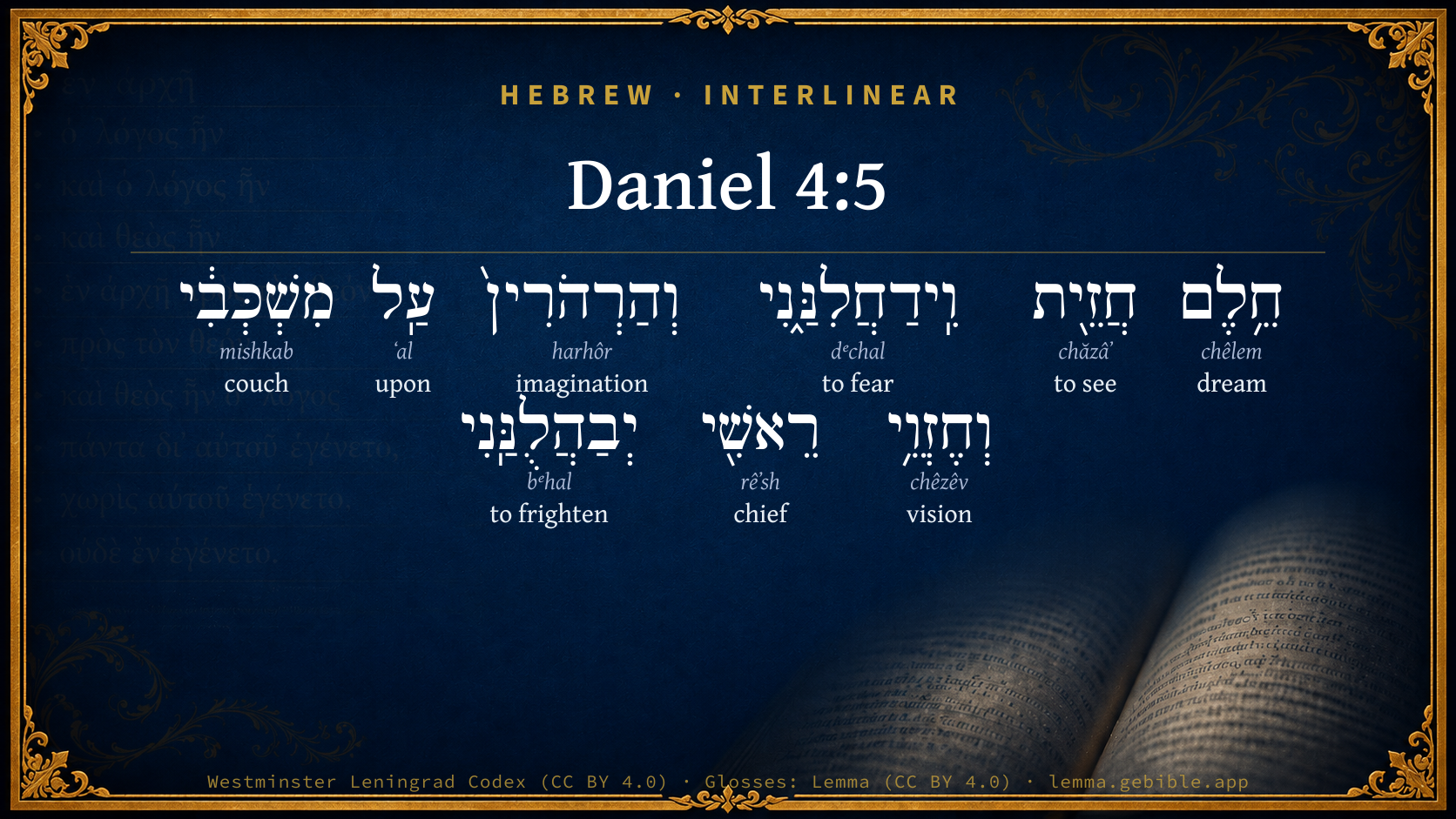
Hebrew (Westminster Leningrad Codex) Daniel 4:5 appears in the Hebrew Old Testament. The text above is from the Westminster Leningrad Codex. Each word links to its Strong’s number, a concise gloss, and parsing drawn from the Open Scriptures Hebrew Bible morphology. Click any word for its full Brown-Driver-Briggs (BDB) entry.
Download image
Cite this verse

Daniel 4:5 (World English Bible). Public Domain. Lemma interlinear Bible study tool, https://lemma.gebible.app/v/daniel/4/5.

Show BibTeX & RIS
BibTeX
RIS
English Translation
I saw a dream which made me afraid; and the thoughts on my bed and the visions of my head troubled me.
World English Bible · Public Domain
Highlights
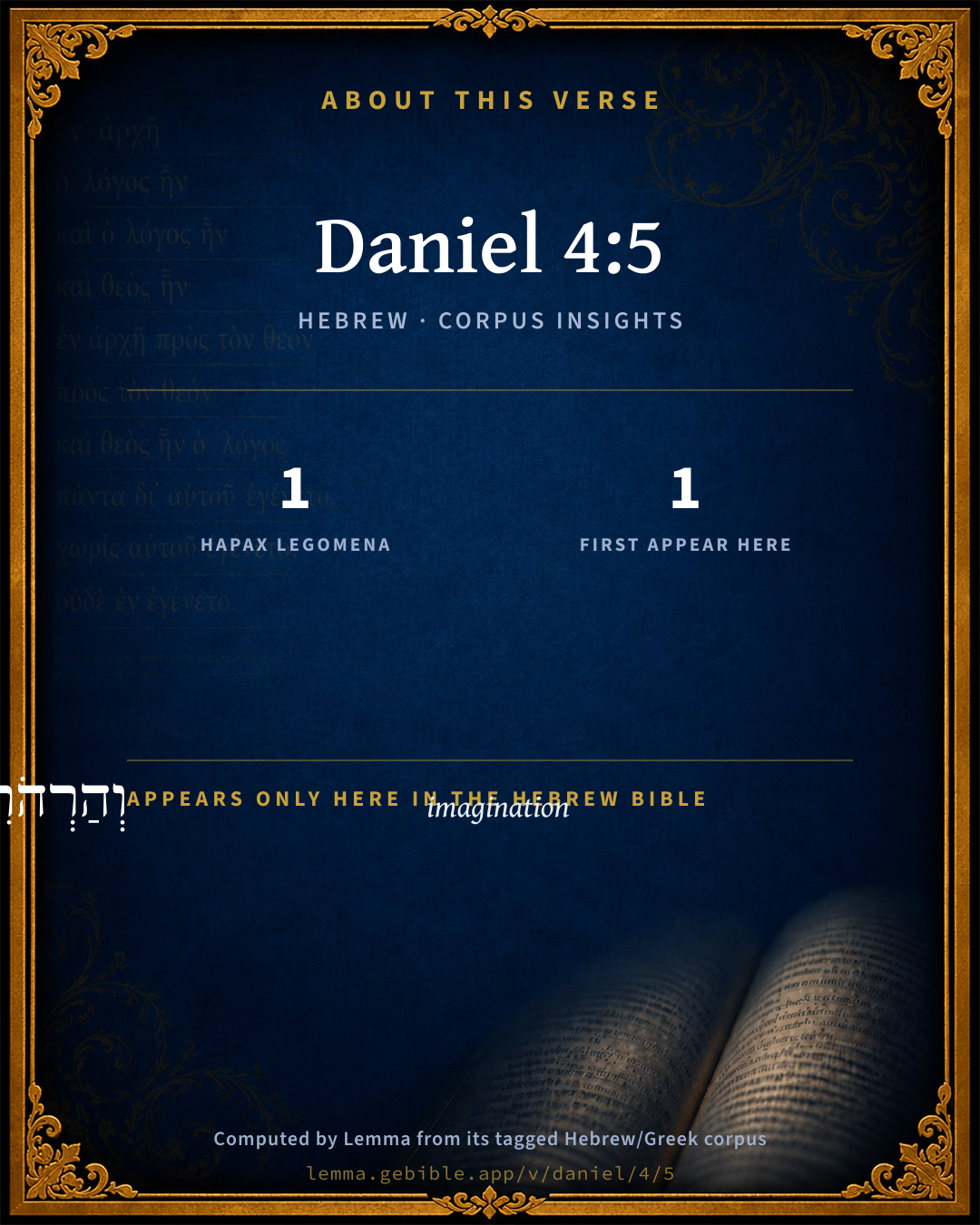
  • 1 hapax legomenon — only here in the Hebrew Bible
  • 1 first appearance in the Hebrew Bible
Full analysis ↓
Download a study sheet

One document with this verse’s original text, its word-by-word gloss line, the meaning frame, cross-references with their text, attributed commentary, and full source and license credits — printable, and it pastes into notes with its structure intact.

This verse Autodidact and up

Study sheet (.html) Plain text (.txt)

A passage Seminary Student

Up to 50 verses in one chapter. A passage sheet keeps up to 6 commentary sources and 12 cross-references per verse, in the order this page ranks them, and says so on the sheet whenever that leaves anything out. Ask for a single verse and you get the Autodidact verse sheet above.

Everything on this page stays free to read, with no account — the sheet is a download of what is already on screen, not access to it.

Want to remove ads? Support Godless Engineer
Compare translations 3

The same verse in 3 English versions, stacked beneath the original-language interlinear above. Click any original word for its lexicon entry.

Each is an independent rendering of the whole verse — the interlinear is not word-aligned to these translations.

Highlighted words mark where these versions differ — a whole-verse word diff, not a word-by-word alignment.

  • World English Bible Public Domain
    I saw a dream which made me afraid; and the thoughts on my bed and the visions of my head troubled me.
  • King James Version Public Domain
    I saw a dream which made me afraid, and the thoughts upon my bed and the visions of my head troubled me.
  • unfoldingWord Literal Text CC BY-SA 4.0
    I saw a dream that made me afraid. As I lay on my bed, the fantasies and the visions of my head alarmed me.

unfoldingWord Literal Text — © unfoldingWord, licensed CC BY-SA 4.0. Word-aligned USFM3 via Door43 (git.door43.org/unfoldingWord/en_ult).

Versions to compare (up to 4)

3 of 4 selected

Show all 18 translations

Every available English version of this verse, each an independent rendering of the whole verse.

  • World English Bible Public Domain
    I saw a dream which made me afraid; and the thoughts on my bed and the visions of my head troubled me.
  • Berean Standard Bible Public Domain
    I had a dream, and it frightened me; while in my bed, the images and visions in my mind alarmed me.
  • Majority Standard Bible Public Domain
    I had a dream, and it frightened me; while I was in my bed, the images and visions in my mind alarmed me.
  • King James Version Public Domain
    I saw a dream which made me afraid, and the thoughts upon my bed and the visions of my head troubled me.
  • American Standard Version (1901) Public Domain
    I saw a dream which made me afraid; and the thoughts upon my bed and the visions of my head troubled me.
  • Revised Version (1885) Public Domain
    I saw a dream which made me afraid; the thoughts upon my bed and the visions of my head troubled me.
  • Geneva Bible (1599) Public Domain
    Till at the last Daniel came before mee, (whose name was Belteshazzar, according to the name of my god, which hath the spirite of the holy gods in him) and before him I tolde the dreame, saying,
  • Douay-Rheims (1899) Public Domain
    I saw a dream that affrighted me: and my thoughts in my bed, and the visions of my head troubled me.
  • Young's Literal Translation Public Domain
    a dream I have seen, and it maketh me afraid, and the conceptions on my bed, and the visions of my head, do trouble me.
  • Literal Standard Version CC BY-SA 4.0
    a dream I have seen, and it makes me afraid, and the conceptions on my bed, and the visions of my head, trouble me.
  • Unlocked Literal Bible CC BY-SA 4.0
    But a dream I had made me afraid. As I lay there, the images I saw and the visions in my mind troubled me.
  • unfoldingWord Literal Text CC BY-SA 4.0
    I saw a dream that made me afraid. As I lay on my bed, the fantasies and the visions of my head alarmed me.
  • Darby Bible Public Domain
    I saw a dream which made me afraid, and the thoughts upon my bed and the visions of my head troubled me.
  • World Messianic Bible Public Domain
    I saw a dream which made me afraid; and the thoughts on my bed and the visions of my head troubled me.
  • Webster's Bible Public Domain
    I saw a dream which made me afraid, and the thoughts upon my bed and the visions of my head troubled me.
  • Free Bible Version CC BY-SA 4.0
    But then one night I had a dream that really scared me—I saw visions that terrified me while I lay in my bed.
  • Bible in Basic English Public Domain
    I saw a dream which was a cause of great fear to me; I was troubled by the images of my mind on my bed, and by the visions of my head.
  • JPS Tanakh (1917) Public Domain
    (4-2) I saw a dream which made me afraid; and imaginings upon my bed and the visions of my head affrighted me.

Literal Standard Version (2020), Covenant Press — licensed CC BY-SA 4.0. Text via the HelloAO Bible API (eBible.org). Unlocked Literal Bible (unfoldingWord) — licensed CC BY-SA 4.0. Text via the HelloAO Bible API (eBible.org). unfoldingWord Literal Text — © unfoldingWord, licensed CC BY-SA 4.0. Word-aligned USFM3 via Door43 (git.door43.org/unfoldingWord/en_ult). Free Bible Version, Dr. Jonathan Gallagher — licensed CC BY-SA 4.0. Text via the HelloAO Bible API (eBible.org).

Word by word

More ways to search: Search by grammar → Find every occurrence → Compare this word →

Practice this passage: Drill this verse → Learn its vocabulary →

וְהַרְהֹרִין֙
harhôr
H2031
“and · imaginations”
Adjective, C + Noun, Common, Masculine, Plural, Absolute
Part of Speech
Adjective + Noun
Type
Common
Gender
Masculine
Number
Plural
State
Absolute
Full BDB Definition

Origin: from a root corresponding to H2029

TWOT: 2700

mental conception, fantasy, image, mental picture, fancy, imagining
  1. חֵ֥לֶם chêlem H2493 “dream” Adjective, N, Common
  2. חֲזֵ֖ית chăzâʼ H2370 “to see” Adjective, V, Plural
  3. וִֽידַחֲלִנַּ֑נִי dᵉchal H1763 “and · to fear · me” Adjective, C + Verb, Piel, Imperfect, 3rd Person, Masculine, Singular + Suffix, Personal, 1st Person, Common, Singular
  4. עַֽל ʻal H5922 “upon” Adjective, R
  5. מִשְׁכְּבִ֔י mishkab H4903 “couch · my” Adjective, N, Common + Suffix, Personal, 1st Person, Common, Singular
  6. וְחֶזְוֵ֥י chêzêv H2376 “and · visions of” Adjective, C + Noun, Common, Masculine, Plural, Construct
  7. רֵאשִׁ֖י rêʼsh H7217 “chief · my” Adjective, N, Common + Suffix, Personal, 1st Person, Common, Singular
  8. יְבַהֲלֻנַּֽנִי bᵉhal H927 “to frighten · me” Adjective, V + Suffix, Personal, 1st Person, Common, Singular

About this verse

These counts appear in no published source. They are computed here, from the morphology-tagged text and Lemma’s own curated glosses. What Lemma adds →

9
words
9
distinct lemmas
Prophets
section

Notable vocabulary

1 hapax legomenon — a word that appears only here in the entire Hebrew Bible:

  • וְהַרְהֹרִין֙ imagination H2031

First appearance in Scripture

This word makes its first canonical appearance in the Hebrew Bible here:

  • וְהַרְהֹרִין֙ imagination H2031

Shared distinctive vocabulary

וִֽידַחֲלִנַּ֑נִי to fear H1763 occurs in 6 verses of the Hebrew Bible. Also found in:

Grammatical profile

  • 1 verb
  • 2 nouns
  • 6 adjectives

Verb forms

  • וִֽידַחֲלִנַּ֑נִי Piel · Imperfect

Hebrew & Septuagint length

In English translation the verse runs 22 words from the Hebrew and 27 from the Septuagint (LXX English) — closely comparable.

A rough comparison of the two English renderings, which tokenize alike — not a word-level alignment.

Word counts can differ between the Hebrew and the Greek without any difference in meaning — e.g. the Hebrew direct-object marker אֵת has no separate Greek word, and Greek often adds the article ὁ.

Cross-references

7

Topical passages linked to Daniel 4:5 in the Treasury of Scripture Knowledge — connected by theme and wording, ordered by reader-vote popularity; previews shown in the World English Bible.

  • Daniel 2:1 In the second year of the reign of Nebuchadnezzar, Nebuchadnezzar dreamed dreams; and his spirit was troubled, and his sleep went from him.
  • Genesis 41:1 It happened at the end of two full years, that Pharaoh dreamed: and, behold, he stood by the river.
  • Job 7:13–14 When I say, 'My bed shall comfort me, My couch shall ease my complaint;'
  • Daniel 2:28–29 but there is a God in heaven who reveals secrets, and he has made known to the king Nebuchadnezzar what shall be in the latter days. Your dream, and the visions of your head on your bed, are these:
  • Daniel 5:5–6 In the same hour came forth the fingers of a man's hand, and wrote over against the lampstand on the plaster of the wall of the king's palace: and the king saw the part of the hand that wrote.
  • Daniel 5:10 [Now] the queen by reason of the words of the king and his lords came into the banquet house: the queen spoke and said, O king, live forever; don't let your thoughts trouble you, nor let your face be changed.
  • Daniel 7:28 Here is the end of the matter. As for me, Daniel, my thoughts much troubled me, and my face was changed in me: but I kept the matter in my heart.

Cross-references courtesy of OpenBible.info (CC BY 4.0).

Hebrew and Greek witnesses Masoretic Hebrew ↔ Greek Septuagint

The same verse in the two great witnesses to the Old Testament, shown verse-for-verse.

These are two independent witnesses, not word-aligned to each other, and the Septuagint is shown in lemma (dictionary) form.

Hebrew Daniel 4:5 Masoretic · Westminster Leningrad Codex

חֵ֥לֶם חֲזֵ֖ית וִֽידַחֲלִנַּ֑נִי וְהַרְהֹרִין֙ עַֽל מִשְׁכְּבִ֔י וְחֶזְוֵ֥י רֵאשִׁ֖י יְבַהֲלֻנַּֽנִי

I saw a dream which made me afraid; and the thoughts on my bed and the visions of my head troubled me.

World English Bible · Public Domain

Greek LXX Daniel 4:5 Septuagint · lemma form

καί ὁ ὅρασις αὐτός μέγας ὁ κορυφή αὐτός ἐγγίζω ἕως ὁ οὐρανός καί ὁ κύτος αὐτός ἕως ὁ νεφέλη πληρόω ὁ ὑποκάτω ὁ οὐρανός ὁ ἥλιος καί ὁ σελήνη ἐν αὐτός οἰκέω καί φωτίζω πᾶς ὁ γῆ

until Daniel came, whose name is Baltasar, according to the name of my God, who has within him the Holy Spirit of God; to whom I said,

LXX2012 (modern English Septuagint) · Public Domain

Hebrew: Westminster Leningrad Codex (CC BY 4.0). Greek: Septuagint (public domain); English from LXX2012 (modern English Septuagint) (Public Domain). How the Septuagint differs from the Hebrew →

Commentary

Notes on Daniel 4:5 from classic Christian and Jewish commentators (each source and its license shown beneath its notes). The classic Christian expositions comment on the surrounding passage and are grouped to its opening verse, so a note may address several verses; the Jewish commentaries on the Tanakh (Rashi and others) are per-verse, so they appear only where the commentator wrote on this verse.

Lemma curates 59 commentaries, every one of them public domain or Creative Commons licensed, each selected and text-cleaned for this edition rather than reprinted as found. About our sources →

Trapp's Complete Commentary

John Trapp

Dan 4:5 I saw a dream which made me afraid, and the thoughts upon my bed and the visions of my head troubled me.

Ver. 5. I saw a dream, which made me afraid.] It is seldom seen that God alloweth unto the greatest darlings of the world a perfect contentment; something they must complain of that shall give an unsavoury verdure to their sweetest morsels, and make their very felicity miserable.

John Trapp, A Commentary or Exposition upon All the Books of the Old and New Testament (1647–1656) — public domain. Text from a community e-Sword module.

Tyndale Open Study Notes

Tyndale Open Resources

4:5 Nebuchadnezzar’s dream disrupted the false peace and serenity of the king’s misguided life.

Tyndale Open Study Notes — © Tyndale Open Resources, licensed CC BY-SA 4.0. Text via the HelloAO Bible API.

Ibn Ezra

Rabbi Abraham ibn Ezra

[Daniel 4:5] And finally (וְעַ֣ד אׇחֳרֵ֡ין): [The Aramaic word acharein means] last/finally (אַחֲרוֹן - acharon [in Hebrew]). And in whom [was] the spirit of the holy gods (וְדִ֛י רֽוּחַ־אֱלָהִ֥ין קַדִּישִׁ֖ין בֵּ֑הּ): [Ibn Ezra draws a conclusion from Nebuchadnezzar's statement:] If the spirit of holy gods is in him, he [Daniel] is holy.

Ibn Ezra on the Tanakh — English translations: “Sefaria Community Translation” (CC0 1.0 (public-domain dedication)); “Yalkut, Sifsei Chachomim Chumash, Metsudah Publications, 2009” (CC BY 4.0); and “Commentary of Ibn Ezra on Isaiah - trans. by M. Friedlander, 1873” (public domain). Text via Sefaria.

Geneva Bible (1599)

Geneva Bible translators

This no doubt was a great grief to Daniel not only to have his name changed, but to be called by the name of a vile idol, which thing Nebuchadnezzar did to make him forget the true religion of God.

Geneva Bible (1599) marginal notes — public domain. Text via Bolls.life.

Adam Clarke's Commentary

Verse 5. I saw a dream] See this dream circumstantially explained in the following verses.

Adam Clarke's Commentary on the Bible (1810–1826) — public domain. Text from a community e-Sword/MySword module.

The Cambridge Bible for Schools and Colleges

gen. ed. J. J. S. Perowne

5. the thoughts] imaginations (without the art.); cf. R.V. marg. The word is a peculiar one, and is found only here in the O.T. The idea expressed by it is probably that of fancyings, imaginings (in Syr. it means a mirage); in the Targums it is used especially (like the cognate verb) of sinful imaginations, as Isa_57:17 (for the Heb. ‘way’), Eze_38:10.

visions of my head] Dan_2:28.

troubled me] alarmed me: cf. Dan_4:19, Dan_5:6; Dan_5:10, Dan_7:15; Dan_7:28; also Dan_5:9. The corresponding Hebrew word means to perturb or dismay.

The Cambridge Bible for Schools and Colleges (gen. ed. J. J. S. Perowne; Cambridge University Press, 1878–1918) — public domain. Text from a community e-Sword module.

John Gill's Exposition

I saw a dream which made me afraid,.... Things were represented to his fancy in a dream, as if he saw them with his eyes, as the tree, its leaves and fruit; the shaking and cutting it down to the stump, &c.; and though he did not understand the meaning of it, yet he thought it portended some evil, which threw him into a panic; he was afraid that something bad would befall him, though he knew not what: thus God can make the minds of the greatest men uneasy amidst all their glory, pride, and pleasure:

and the thoughts upon my bed and the visions of my head troubled me; the thoughts that came into his mind while he was upon his bed dreaming, and the things which were represented to his fancy in his brain, he remembered when awake, gave him a great deal of trouble and uneasiness, what should be the meaning of them, and what would be the issue and event of these things.

John Gill's Exposition of the Whole Bible (1746–1763) — public domain (CC PDM 1.0). Text via the HelloAO Bible API.

Albert Barnes' Notes on the Bible

I saw a dream - That is, he saw a representation made to him in a dream. There is something incongruous in our language in saying of one that he saw a dream.

Which made me afraid - The fear evidently arose from the apprehension that it was designed to disclose some important and solemn event. This was in accordance with a prevalent belief then (comp. Dan 2:1), and it may be added that it is in accordance with a prevalent belief now. There are few persons, whatever may be their abstract belief, who are not more or less disturbed by fearful and solemn representations passing before the mind in the visions of the night. Compare Job 4:12-17; Job 33:14-15. So Virgil (Aen. iv. 9):

“Anna soror, quae me suspensam insomnia terrent!”

And the thoughts upon my bed - The thoughts which I had upon my bed; to wit, in my dream.

And the visions of my head - What I seemed to see. The vision seemed to be floating around his head.

Troubled me - Disturbed me; produced apprehension of what was to come; of some great and important event.

Albert Barnes' Notes on the Bible (1834–1885) — public domain. Text from a community e-Sword/MySword module.

Haydock's Catholic Bible Commentary

Colleague. Chaldee also, "another, or afterwards, (Haydock) or at last." (Calmet) --- My god. He says this, because the name of Baltassar, or Belteshazzar, is derived from the name of Bel, the chief god of the Babylonians. (Challoner) --- Gods. He speaks conformably to his false opinion; (St. Jerome) or, being instructed by Daniel, he testifies that the Holy Spirit enlightens the prophet. (Theod. Greek has "god," which St. Jerome disapproves; though the plural is often used for the true God. Reason evinces that only the Deity can disclose the secrets of futurity. (Genesis xli. 38.) (Calmet)

George Leo Haydock (1774–1849), Haydock's Catholic Family Bible and Commentary, 1859 edition — public domain. Excludes Psalms (Douay-Rheims chapter numbering differs from Protestant) and Deuterocanonical books (Catholic canon only).

Matthew Poole's English Annotations

There is no felicity in this world lasting; a black cloud, big with storm and tempest, spoils the fairest sun-shine day. They that fear not God shall be frighted by him. God doth justly make epicures and tyrants uneasy in the midst of their fool’s paradise, where if the fool saith in his heart, There is no God, he shall soon find in his heart to think otherwise.

Matthew Poole's English Annotations on the Holy Bible (1683–1685) — public domain. Text from a community e-Sword/MySword module.

Whedon's Commentary on the Bible

Daniel D. Whedon

5-7. See notes Dan_2:1-2. In the coronation decree of Nabonidus recently found in the ruins of Babylon (see Babylonian and Oriental Record, September, 1896) this king, the father of Belshazzar, tells how Nebuchadnezzar appeared to him in a night vision accompanied by the Babylonian high priest carrying a drawn sword. Nabonidus tells Nebuchadnezzar a dream which had troubled him greatly, and Nebuchadnezzar interprets it for him, the high priest being, as it seems, the “medium” through which this conversation between the living and the dead king was carried on. In another night vision mentioned in the same decree the goddess “who can raise to life the dead” appears to him.

Daniel D. Whedon (gen. ed.), Commentary on the Old and New Testaments (1874–1909) — public domain. Text from a community e-Sword module.

Keil & Delitzsch

C. F. Keil & F. Delitzsch

While in this state of security and peace, he was alarmed by a dream. The abrupt manner in which the matter is here introduced well illustrates the unexpected suddenness of the even itself. הרהרין, thoughts, from הרהר, to think, to meditate; in the Mishna and in Syr. images of the imagination; here, images in a dream. The words משׁכּבי על הרהרין are more properly taken as a passage by themselves with the verb, I had (I saw), supplied, than connected with the following noun to יבהלנּני. Regarding ראשׁי חזוי see under Dan 2:28. On this matter Chr. B. Michaelis has well remarked: "Licet somnii interpretationem nondum intelligeret, tamen sensit, infortunium sibi isthoc somnio portendi."

Keil & Delitzsch — Biblical Commentary on the Old Testament (1861–1891) — public domain (CC PDM 1.0). Text via the HelloAO Bible API. (Old Testament only.)

Rashi

Rabbi Shlomo Yitzchaki (Rashi)

Until, at last, until, at last, Daniel was brought in before me.

like the name of my god The deity of Babylon was named Bel. Teshazzar is the name of an expression of wisdom in Aramaic.

Rashi on the Tanakh — English translations: “The Judaica Press complete Tanach with Rashi, translated by A. J. Rosenberg” (CC BY 4.0); “Pentateuch with Rashi's commentary by M. Rosenbaum and A.M. Silbermann, 1929-1934” (public domain); “The Metsudah Tanach series, Lakewood, N.J” (CC BY 4.0); and “The Book of Joshua, Metsudah Publications, 1997” (CC BY 4.0). Text via Sefaria.

Lesson kit

Teaching starters — assembled from the data on this page, not authored interpretation. Every prompt links to the verse data it draws on. Edit before teaching.

Daniel, in the Prophets, opens this verse with 9 words (9 distinct Hebrew lemmas). Its most distinctive word is harhôr (“imagination”). A historical commentator’s framing appears above. Read the whole chapter for the surrounding context.

Discussion questions

  1. The word harhôr carries the sense “imagination.” How does it shape the verse?
  2. This verse holds 1 word here found nowhere else in the Hebrew Bible. What might the rare word draw attention to?
  3. The word “imagination” first appears here in Scripture. What is being introduced at this debut?
  4. Daniel 2:31 shares the word «to fear» with this verse. How do the two illuminate each other?
  5. These translations render this verse differently. What is at stake in choosing one wording over another?
  6. The verb «וִֽידַחֲלִנַּ֑נִי» is Piel Imperfect. How does its form color the action?
  7. Reading how Trapp's Complete Commentary and Tyndale Open Study Notes read this verse, where do the two commentators agree and where do they part?

Things to notice

  • 1 word in this verse appears nowhere else in the Hebrew Bible.
  • 1 word makes its first canonical appearance in Scripture here.
  • These translations choose different wording for 7 words in this verse.
  • 9 distinct Hebrew lemmas span 9 words in this verse.

Reading settings

Reading text

Shown beneath each verse's original-language words.

Old Testament
Old Testament edition

Read the OT as the Masoretic Hebrew (MT) or the Greek Septuagint (LXX).

English shown for the Greek Septuagint (in the Hebrew ↔ Greek comparison).

Comparing translations? Open the Compare panel on any verse page to stack up to four side by side.