Daniel 4:3

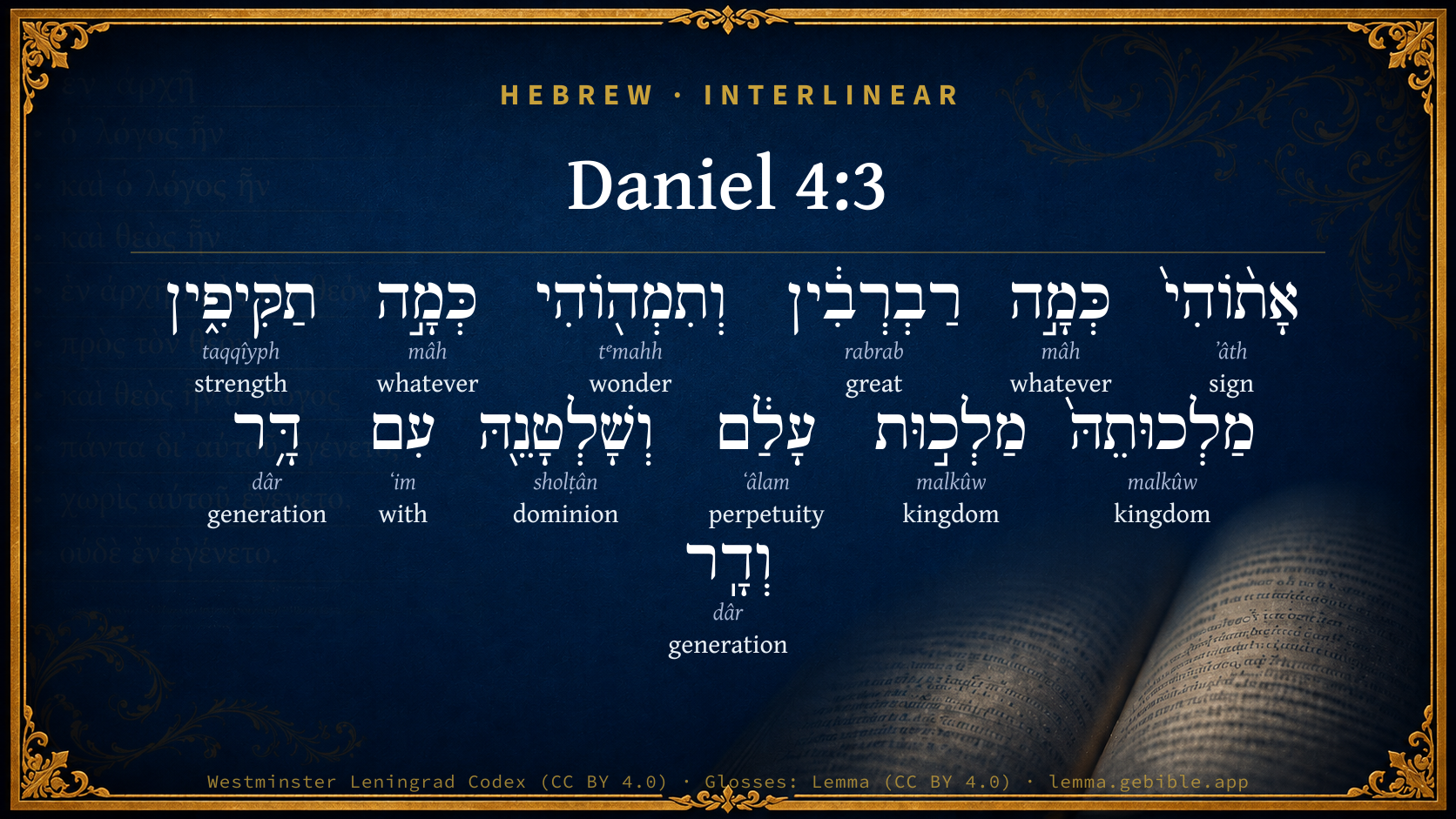
Hebrew (Westminster Leningrad Codex) Daniel 4:3 appears in the Hebrew Old Testament. The text above is from the Westminster Leningrad Codex. Each word links to its Strong’s number, a concise gloss, and parsing drawn from the Open Scriptures Hebrew Bible morphology. Click any word for its full Brown-Driver-Briggs (BDB) entry.
Download image
Cite this verse

Daniel 4:3 (World English Bible). Public Domain. Lemma interlinear Bible study tool, https://lemma.gebible.app/v/daniel/4/3.

Show BibTeX & RIS
BibTeX
RIS
English Translation
How great are his signs! and how mighty are his wonders! his kingdom is an everlasting kingdom, and his dominion is from generation to generation.
World English Bible · Public Domain
Highlights
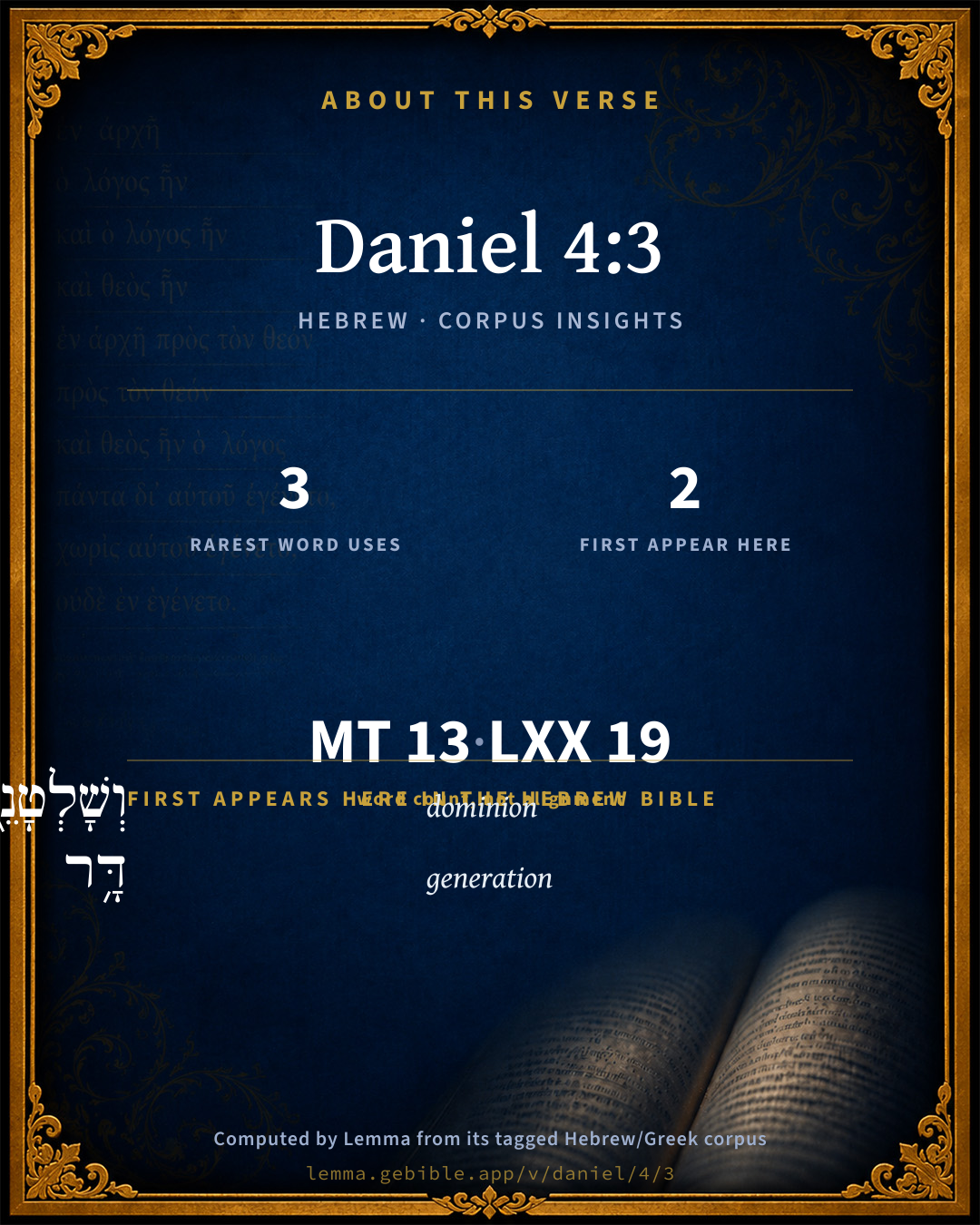
  • 2 first appearances in the Hebrew Bible
Full analysis ↓
Download a study sheet

One document with this verse’s original text, its word-by-word gloss line, the meaning frame, cross-references with their text, attributed commentary, and full source and license credits — printable, and it pastes into notes with its structure intact.

This verse Autodidact and up

Study sheet (.html) Plain text (.txt)

A passage Seminary Student

Up to 50 verses in one chapter. A passage sheet keeps up to 6 commentary sources and 12 cross-references per verse, in the order this page ranks them, and says so on the sheet whenever that leaves anything out. Ask for a single verse and you get the Autodidact verse sheet above.

Everything on this page stays free to read, with no account — the sheet is a download of what is already on screen, not access to it.

Want to remove ads? Support Godless Engineer
Compare translations 3

The same verse in 3 English versions, stacked beneath the original-language interlinear above. Click any original word for its lexicon entry.

Each is an independent rendering of the whole verse — the interlinear is not word-aligned to these translations.

Highlighted words mark where these versions differ — a whole-verse word diff, not a word-by-word alignment.

  • World English Bible Public Domain
    How great are his signs! and how mighty are his wonders! his kingdom is an everlasting kingdom, and his dominion is from generation to generation.
  • King James Version Public Domain
    How great are his signs! and how mighty are his wonders! his kingdom is an everlasting kingdom, and his dominion is from generation to generation.
  • unfoldingWord Literal Text CC BY-SA 4.0
    How great are his signs, and how mighty are his wonders! His kingdom is an everlasting kingdom, and his dominion is from generation to generation.

unfoldingWord Literal Text — © unfoldingWord, licensed CC BY-SA 4.0. Word-aligned USFM3 via Door43 (git.door43.org/unfoldingWord/en_ult).

Versions to compare (up to 4)

3 of 4 selected

Show all 18 translations

Every available English version of this verse, each an independent rendering of the whole verse.

  • World English Bible Public Domain
    How great are his signs! and how mighty are his wonders! his kingdom is an everlasting kingdom, and his dominion is from generation to generation.
  • Berean Standard Bible Public Domain
    How great are His signs, how mighty His wonders! His kingdom is an eternal kingdom; His dominion endures from generation to generation.
  • Majority Standard Bible Public Domain
    How great are His signs, how mighty His wonders! His kingdom is an eternal kingdom; His dominion endures from generation to generation.
  • King James Version Public Domain
    How great are his signs! and how mighty are his wonders! his kingdom is an everlasting kingdom, and his dominion is from generation to generation.
  • American Standard Version (1901) Public Domain
    How great are his signs! and how mighty are his wonders! his kingdom is an everlasting kingdom, and his dominion is from generation to generation.
  • Revised Version (1885) Public Domain
    How great are his signs! and how mighty are his wonders! his kingdom is an everlasting kingdom, and his dominion is from generation to generation.
  • Geneva Bible (1599) Public Domain
    Therefore made I a decree, that they should bring all the wise men of Babel before mee, that they might declare vnto me the interpretation of the dreame.
  • Douay-Rheims (1899) Public Domain
    His signs, because they are great: and his wonders, because they are mighty: and his kingdom is an everlasting kingdom, I and his power to all generations.
  • Young's Literal Translation Public Domain
    His signs how great! and His wonders how mighty! His kingdom `is' a kingdom age-during, and His rule `is' with generation and generation.
  • Literal Standard Version CC BY-SA 4.0
    How great His signs! And how mighty His wonders! His kingdom [is] a continuous kingdom, and His rule [is] with generation and generation.
  • Unlocked Literal Bible CC BY-SA 4.0
    How great are his signs, and how mighty are his wonders! His kingdom is an everlasting kingdom, and his dominion lasts from generation to generation.”
  • unfoldingWord Literal Text CC BY-SA 4.0
    How great are his signs, and how mighty are his wonders! His kingdom is an everlasting kingdom, and his dominion is from generation to generation.
  • Darby Bible Public Domain
    How great are his signs! and how mighty are his wonders! His kingdom is an everlasting kingdom, and his dominion is from generation to generation.
  • World Messianic Bible Public Domain
    How great are his signs! How mighty are his wonders! His kingdom is an everlasting kingdom. His dominion is from generation to generation.
  • Webster's Bible Public Domain
    How great are his signs! and how mighty are his wonders! his kingdom is an everlasting kingdom, and his dominion is from generation to generation.
  • Free Bible Version CC BY-SA 4.0
    His signs are incredible. His wonders are amazing! His kingdom is an eternal kingdom, and his rule will last for all generations!
  • Bible in Basic English Public Domain
    How great are his signs! and how full of power are his wonders! his kingdom is an eternal kingdom and his rule goes on from generation to generation.
  • JPS Tanakh (1917) Public Domain
    (3-33) How great are His signs! and how mighty are His wonders! His kingdom is an everlasting kingdom, and His dominion is from generation to generation.

Literal Standard Version (2020), Covenant Press — licensed CC BY-SA 4.0. Text via the HelloAO Bible API (eBible.org). Unlocked Literal Bible (unfoldingWord) — licensed CC BY-SA 4.0. Text via the HelloAO Bible API (eBible.org). unfoldingWord Literal Text — © unfoldingWord, licensed CC BY-SA 4.0. Word-aligned USFM3 via Door43 (git.door43.org/unfoldingWord/en_ult). Free Bible Version, Dr. Jonathan Gallagher — licensed CC BY-SA 4.0. Text via the HelloAO Bible API (eBible.org).

Word by word

More ways to search: Search by grammar → Find every occurrence → Compare this word →

Practice this passage: Drill this verse → Learn its vocabulary →

אָת֨וֹהִי֙
ʼâth
H852
“signs · his”
Adjective, N, Common + Suffix, Personal, 3rd Person, Masculine, Singular
Part of Speech
Adjective
Gender
Common
Full BDB Definition

Origin: corresponding to H226

TWOT: 2617

sign, miraculous signs, wonders
  1. כְּמָ֣ה mâh H4101 “like/as · whatever” Adjective, R + Pronoun, Indefinite, Common, Singular
  2. רַבְרְבִ֔ין rabrab H7260 “great” Adjective, A
  3. וְתִמְה֖וֹהִי tᵉmahh H8540 “and · wonders · his” Adjective, C + Noun, Common, Masculine, Plural, Construct + Suffix, Personal, 3rd Person, Masculine, Singular
  4. כְּמָ֣ה mâh H4101 “like/as · whatever” Adjective, R + Pronoun, Indefinite, Common, Singular
  5. תַקִּיפִ֑ין taqqîyph H8624 “strength” Adjective, A
  6. מַלְכוּתֵהּ֙ malkûw H4437 “kingdom · his” Adjective, N, Common + Suffix, Personal, 3rd Person, Masculine, Singular
  7. מַלְכ֣וּת malkûw H4437 “kingdom of” Adjective, N, Common
  8. עָלַ֔ם ʻâlam H5957 “perpetuity” Adjective, N, Common
  9. וְשָׁלְטָנֵ֖הּ sholṭân H7985 “and · dominion · his” Adjective, C + Noun, Common, Masculine, Singular, Construct + Suffix, Personal, 3rd Person, Masculine, Singular
  10. עִם ʻim H5974 “with” Adjective, R
  11. דָּ֥ר dâr H1859 “generation” Adjective, N, Common
  12. וְדָֽר dâr H1859 “and · generation” Adjective, C + Noun, Common, Masculine, Singular, Absolute

About this verse

These counts appear in no published source. They are computed here, from the morphology-tagged text and Lemma’s own curated glosses. What Lemma adds →

13
words
10
distinct lemmas
Prophets
section

Notable vocabulary

The rarest word here is אָת֨וֹהִי֙ sign H852 — appearing just 3 times in the whole Hebrew Bible.

First appearance in Scripture

These words make their first canonical appearance in the Hebrew Bible here:

  • וְשָׁלְטָנֵ֖הּ dominion H7985
  • דָּ֥ר generation H1859

Shared distinctive vocabulary

אָת֨וֹהִי֙ sign H852 occurs in 3 verses of the Hebrew Bible. Also found in:

Grammatical profile

  • 3 nouns
  • 8 adjectives
  • 2 pronouns

Repetition

Words recur within this verse — often emphatic in Hebrew:

  • כְּמָ֣ה whatever H4101 ×2
  • מַלְכוּתֵהּ֙ kingdom H4437 ×2
  • דָּ֥ר generation H1859 ×2

Hebrew & Septuagint length

In English translation the verse runs 25 words from the Hebrew and 28 from the Septuagint (LXX English) — closely comparable.

A rough comparison of the two English renderings, which tokenize alike — not a word-level alignment.

Word counts can differ between the Hebrew and the Greek without any difference in meaning — e.g. the Hebrew direct-object marker אֵת has no separate Greek word, and Greek often adds the article ὁ.

In the original languages it is 13 Hebrew tokens and 19 Greek tokens — but the two are counted differently (Hebrew bundles its prefixes and suffixes into one token; the Greek is in lemma form), so that isn’t a like-for-like length.

Cross-references

28

Topical passages linked to Daniel 4:3 in the Treasury of Scripture Knowledge — connected by theme and wording, ordered by reader-vote popularity; previews shown in the World English Bible.

  • Psalms 145:13 Your kingdom is an everlasting kingdom. Your dominion endures throughout all generations.
  • Isaiah 25:1 Yahweh, you are my God; I will exalt you, I will praise your name; for you have done wonderful things, [even] counsels of old, in faithfulness [and] truth.
  • Daniel 2:44 In the days of those kings shall the God of heaven set up a kingdom which shall never be destroyed, nor shall the sovereignty of it be left to another people; but it shall break in pieces and consume all these kingdoms, and it shall stand forever.
  • Daniel 7:14 There was given him dominion, and glory, and a kingdom, that all the peoples, nations, and languages should serve him: his dominion is an everlasting dominion, which shall not pass away, and his kingdom that which shall not be destroyed.
  • Revelation 11:15 The seventh angel sounded, and great voices in heaven followed, saying, "The kingdom of the world has become the Kingdom of our Lord, and of his Christ. He will reign forever and ever!"
  • Daniel 4:34–35 At the end of the days I, Nebuchadnezzar, lifted up my eyes to heaven, and my understanding returned to me, and I blessed the Most High, and I praised and honored him who lives forever; for his dominion is an everlasting dominion, and his kingdom from generation to generation.
  • Daniel 6:26–27 I make a decree, that in all the dominion of my kingdom men tremble and fear before the God of Daniel; for he is the living God, and steadfast forever, His kingdom that which shall not be destroyed; and his dominion shall be even to the end.
  • Daniel 7:27 The kingdom and the dominion, and the greatness of the kingdoms under the whole the sky, shall be given to the people of the saints of the Most High: his kingdom is an everlasting kingdom, and all dominions shall serve and obey him.
  • 1 Timothy 1:17 Now to the King eternal, immortal, invisible, to God who alone is wise, be honor and glory forever and ever. Amen.
  • Hebrews 1:8 but of the Son he says, "Your throne, O God, is forever and ever; The scepter of uprightness is the scepter of your Kingdom.
  • Psalms 105:27 They performed miracles among them, And wonders in the land of Ham.
  • Jeremiah 10:10 But Yahweh is the true God; he is the living God, and an everlasting King: at his wrath the earth trembles, and the nations are not able to abide his indignation.
  • Luke 1:32–33 He will be great, and will be called the Son of the Most High. The Lord God will give him the throne of his father, David,
  • Hebrews 2:4 God also bearing witness with them, both by signs and wonders, and by various works of power, and by gifts of the Holy Spirit, according to his own will?
  • 1 Peter 4:11 If any man speaks, let it be as it were oracles of God. If any man serves, let it be as of the strength which God supplies, that in all things God may be glorified through Jesus Christ, to whom belong the glory and the dominion forever and ever. Amen.
  • Deuteronomy 4:34 Or has God tried to go and take him a nation from the midst of [another] nation, by trials, by signs, and by wonders, and by war, and by a mighty hand, and by an outstretched arm, and by great terrors, according to all that Yahweh your God did for you in Egypt before your eyes?
  • Job 25:2 "Dominion and fear are with him; He makes peace in his high places.
  • Psalms 66:7 He rules by his might forever. His eyes watch the nations. Don't let the rebellious rise up against him. Selah.
  • Psalms 71:19–20 Your righteousness also, God, reaches to the heavens; You have done great things. God, who is like you?
  • Psalms 72:18 Praise be to Yahweh God, the God of Israel, Who alone does marvelous deeds.
  • Psalms 77:19 Your way was through the sea; Your paths through the great waters. Your footsteps were not known.
  • Psalms 86:10 For you are great, and do wondrous things. You are God alone.
  • Psalms 92:5 How great are your works, Yahweh! Your thoughts are very deep.
  • Psalms 104:24 Yahweh, how many are your works! In wisdom have you made them all. The earth is full of your riches.
  • Isaiah 9:7 Of the increase of his government and of peace there shall be no end, on the throne of David, and on his kingdom, to establish it, and to uphold it with justice and with righteousness from henceforth even forever. The zeal of Yahweh of Hosts will perform this.
  • Isaiah 28:29 This also comes forth from Yahweh of Hosts, who is wonderful in counsel, and excellent in wisdom.
  • Daniel 4:17 The sentence is by the decree of the watchers, and the demand by the word of the holy ones; to the intent that the living may know that the Most High rules in the kingdom of men, and gives it to whoever he will, and sets up over it the lowest of men.
  • Romans 11:33 Oh the depth of the riches both of the wisdom and the knowledge of God! How unsearchable are his judgments, and his ways past tracing out!

Cross-references courtesy of OpenBible.info (CC BY 4.0).

Hebrew and Greek witnesses Masoretic Hebrew ↔ Greek Septuagint

The same verse in the two great witnesses to the Old Testament, shown verse-for-verse.

These are two independent witnesses, not word-aligned to each other, and the Septuagint is shown in lemma (dictionary) form.

Hebrew Daniel 4:3 Masoretic · Westminster Leningrad Codex

אָת֨וֹהִי֙ כְּמָ֣ה רַבְרְבִ֔ין וְתִמְה֖וֹהִי כְּמָ֣ה תַקִּיפִ֑ין מַלְכוּתֵהּ֙ מַלְכ֣וּת עָלַ֔ם וְשָׁלְטָנֵ֖הּ עִם דָּ֥ר וְדָֽר

How great are his signs! and how mighty are his wonders! his kingdom is an everlasting kingdom, and his dominion is from generation to generation.

World English Bible · Public Domain

Greek LXX Daniel 4:3 Septuagint · lemma form

καταεὕδω καί ἰδού δένδρον ὑψηλός φύω ἐπί ὁ γῆ ὁ ὅρασις αὐτός μέγας καί οὐ εἰμί ἄλλος ὅμοιος αὐτός

And I made a decree to bring in before me all the wise men of Babylon, that they might make known to me the interpretation of the dream.

LXX2012 (modern English Septuagint) · Public Domain

Hebrew: Westminster Leningrad Codex (CC BY 4.0). Greek: Septuagint (public domain); English from LXX2012 (modern English Septuagint) (Public Domain). How the Septuagint differs from the Hebrew →

Commentary

Notes on Daniel 4:3 from classic Christian and Jewish commentators (each source and its license shown beneath its notes). The classic Christian expositions comment on the surrounding passage and are grouped to its opening verse, so a note may address several verses; the Jewish commentaries on the Tanakh (Rashi and others) are per-verse, so they appear only where the commentator wrote on this verse.

Lemma curates 59 commentaries, every one of them public domain or Creative Commons licensed, each selected and text-cleaned for this edition rather than reprinted as found. About our sources →

Trapp's Complete Commentary

John Trapp

Dan 4:3 How great [are] his signs! and how mighty [are] his wonders! his kingdom [is] an everlasting kingdom, and his dominion [is] from generation to generation.

Ver. 3. How great are his sons!] Mark how he is enlarged here; so should we. If David had had the thing in hand, he would have cried out also, "For his mercy endureth for ever." But Nebuchadnezzar celebrateth his kingdom only; and that also he had learned of Daniel. {Dan 2:46-47}

John Trapp, A Commentary or Exposition upon All the Books of the Old and New Testament (1647–1656) — public domain. Text from a community e-Sword module.

The Biblical Illustrator

Joseph S. Exell

Dan_4:3

How great are His signs, and how mighty are His wonders!

Man Touching the Inexpressible

That the spiritual impression of Nebuchadnezzar was of the right kind is shown by his introductory exclamation How great are His signs, and how mighty are His wonders! It is beautiful to see how the shining of God upon the soul affrights all our little speech.

Here the man is touching the inexpressible, the infinite; he can only hint at his meaning by way of exclamation: How great His signs, how mighty His wonders! there is no attempt at analysis, explanation, measurement, definite statement. All religious exaltation is overpowering. The mischief of our piety is that we can tell just what we believe and exactly what we feel. When a man can be so definite about his religion, the question is whether he has any religion to be definite about. No religion is complete that does not simply defy the believer to tell what it is in all its scope, in all its indications, in all its exalting enthusiasms. Some times we can only tell our creed by our tears. When a man touches the highest point of his faith he is silent; when he does speak he speaks in great bursts of feeling. To those who listen he may indeed be incoherent and unconnected, to that they, listening, may wonder what he is saying, for the only thing definite about the man is the indefiniteness of unutterable joy. Do not measure God; report nothing concerning His stature; gather up His universe, and regard it as but a symbol, poor and dim, of His majesty. We are the better for these great billows of enthusiasm rolling through the soul; it does us good to be brought into the sanctuary of the unutterable; so long as we can speak all we feel the fountains of the great deep have been broken up. Incoherence in the sanctuary may be but the highest and grandest aspect of eloquence--how great, how noble, how wondrous; all this is but exclamation to the man who carries his religion as a burden; but all this is inspiration to the man of whose soul his religion is an essential part. (Joseph Parker, D.D.)

Dan_4:3

His kingdom is an everlasting kingdom.

The Kingdom of God

I. A FEW WORDS ABOUT THIS KINGDOM--the antecedent is in the verse immediately preceding our text, in which the monarch talks of showing the signs and wonders that the high God had wrought towards him. He had not yet got quite into our school, and into the use of the phraseology of the servants of the living God, who call Him the Most High God. But by-and-bye you will find this same man learning that phrase also, and putting it forth. However, he calls Him here the High God, higher than his own god, higher than all the idols and gods of the heathen, higher even than himself, and he would fain have been a god. Glory to our covenant God, that this is a suitable and proper appellation, for the kingdom is His. The point I wish to establish is, that Jehovahs kingdom of grace is perfectly distinct from all the kingdoms of the world. We might say much concerning the kingdom of nature, and show how He rules that, as He did in the instance of those three persons, so that even fire should lose its power, and they walk about in it unhurt. And if He were not the God of the kingdom of nature, He could not control and govern it. And, first of all, my Lord says, His kingdom is not of this world; it is not carnal, it is not in the might and power of human potentates, it is not submitted to the authority of carnal minds, it is not that which the enemies of Jesus Christ are to lay their hands upon as if they had authority and offices appointed unto them in it. And this will in which the kingdom is founded is of ancient date. Look back to the earliest history we possess, and the account given of what real godliness was in Adams days, in Abels days, and in Abrahams days, and we shall find that the kingdom then, and for ages before, was founded in the settled purpose of eternity., in the council of peace, between the persons of Deity. Moreover, it is absolute in the Divine mind--With whom took He counsel? or whom did He consult on the matter? Where is the being that gave advice, or communicated understanding to Him? No, His will is absolute law. Probably it would be found a rather dangerous experiment to make the will of a created being absolute law; but there is no such danger with God. We are nowhere so safe, so happy and secure, as under the guidance, control, and management of Jehovahs absolute will. Moreover, it is a kingdom that has always been advancing, according to the absolute sovereignty of His own will. I know that the powers of darkness have done, and are now doing, all in their power to stop its progress. The more His people were afflicted the more they multiplied and grew. This kingdom, founded in the Divine will, is organised with infinite wisdom. There are privileges, advantages, comforts, pleasures, and usefulness pertaining to the organisation of a Christian church. Believers should not be like a scattered flock of sheep, not knowing one another; but should be knit together as one in heart, in love, and in bearing one anothers burdens. The organisation I mean is that which consists of the people, the principles, and the privileges, all of which are in accordance with, nay, organised by, infinite wisdom. Upon what principles has Jehovah organised His Church, His kingdom upon earth? One word would serve as a title page, a running title, to the whole statute book of the kingdom; and that word is grace. It is a grace kingdom. All its principles, doctrines, laws, and statutes emanate from the fulness of grace in the Fathers heart, in the Person of the Son, according to the register of the Holy Ghost, Grace makes the characteristics. Moreover, as regards privileges. Here a vast amount of illustration opens to my view; but I must limit myself to only one or two remarks. This blessed kingdom of our God has privileges for all its subjects, who are declared to be made kings and priests unto God. Moreover, if we speak of the privileges under which the Kingdom of Jesus Christ is organised, we find a vast revenue of promises, all of which are yea and amen in Jesus Christ, and are to the glory of God in the experience of every subject of His grace. Let us pass on to mark one thing more respecting this kingdom; I mean its unchangeable character; for my text says expressly that His kingdom is an everlasting kingdom. It shall know no variation.

II. THE INTERESTS OF THIS KINGDOM, which are great and rare, and concern the monarch and the subject both. I shall only mention two or three of those interests; and if one of them fall, the monarch is injured as well as the subject. The interests, then, are mutual, But whilst we speak of the interests of the kingdom, we must not lose sight of its dignity. All its subjects are dignified characters; and yet all their dignity is concentrated in their glorious sovereign. All His subjects are brought out from the world, washed and made clean, forgiven freely, justified perfectly, accepted cordially, received graciously, and loved freely.

III. DESCRIBE THE NATIVES OF THIS KINGDOM. There is a peculiar description of them given by Haman, when he sought the destruction of Gods Church in the time of king Ahasuerus, and the subtle Jesuit cried, O king, live for ever,. there is a certain people scattered abroad and dispersed among the people in the provinces of thy kingdom; and their laws are diverse from all people; neither keep they the kings laws, therefore it is not for the kings profit to, suffer them. If it please the king, let it be written that they may be destroyed. And what was the reason? Why, that their laws were diverse from all people. Now this I think a fine testimony to come from the mouth of so inveterate a foe of Gods people, with regard to their peculiar character as natives of His kingdom. Their laws are diverse from all other peoples. Now, if grace has not made you to differ from the world, if it has not distinguished you as a new creature in another character I fear it has done very little for you. But, though our laws are diverse from all others, we mean to abide by them, God helping us, and to rejoice in them. When the Jews were apprised of this wicked conspiracy, what course did they take? Did they attempt to alter, modify, or change their laws? Did they attempt to amalgamate their laws with those of the people around them? Did they say, Well, instead of having a sacrifice once a-morning, let us have one once a-week. No, they would not think of the least alteration. And there stood the people of God adhering constantly to the laws of God.

IV. THE GENERATION SPECIFIED IN SUCCESSION--His kingdom is an everlasting kingdom, and His dominion from generation to generation. Here, be it observed, that we are very fond of a line of succession; but it must not be carnal and fleshly; it must not be secular; it is a spiritual line of succession. This one line of succession has been specified in the Scripture in a text which I have already cited--instead of the fathers shall come up the children. Whether they were born in antediluvian times, or in the Mosaic times, or under the prophets ministry, or under the ministry of the Lord Jesus Christ, or during the apostles days, or down to the present hour, their family likeness has always exhibited, and always will exhibit, spirituality, separation, and subordination. But they are not only spiritual and separate, but subordinate to the monarch. They have touched His sceptre; they have obtained life Divine from Him. Now mark the subordination--and bring into captivity every thought to the obedience of Christ Thy will be done is the favourite motto inscribed upon their banners; not as I will, but as thou wilt, shouted their glorious Captain, and they reiterate the cry. The will of Jehovah is the law of their life. (Joseph Irons.)

The Biblical Illustrator, edited by Joseph S. Exell (c. 1880s–1900s) — public domain. Text from a community e-Sword module.

Ibn Ezra

Rabbi Abraham ibn Ezra

[Daniel 4:3] And from me [an order was issued] (וּמִנִּי֙): He [Nebuchadnezzar, writing in the first person] recounts the entire event that transpired. And it was written this way for the honor of Daniel, in that the king wrote this [account] in this manner [as a royal proclamation] to all the provinces of his kingdom. And [this constituted] a great glory/splendor (תִּפְאֶרֶת - tif'eret) for Israel.

Ibn Ezra on the Tanakh — English translations: “Sefaria Community Translation” (CC0 1.0 (public-domain dedication)); “Yalkut, Sifsei Chachomim Chumash, Metsudah Publications, 2009” (CC BY 4.0); and “Commentary of Ibn Ezra on Isaiah - trans. by M. Friedlander, 1873” (public domain). Text via Sefaria.

Adam Clarke's Commentary

Verse 3. How great are his signs!] There are no preternatural signs like his! His wonders - miraculous interferences, are mighty - they surpass all human power. He is the Sovereign of all kings, and his dominion is everlasting; and every generation is a proof of his all-governing influence. These are very fine sentiments, and show how deeply his mind was impressed with the majesty of God.

Adam Clarke's Commentary on the Bible (1810–1826) — public domain. Text from a community e-Sword/MySword module.

John Calvin's Commentaries

In fine, this preface might seem a proof of an important conversion; but we shall directly see how far Nebuchadnezzar was from being entirely purged of his errors. It ought, indeed, to affect us exceedingly to behold the king wrapt up in so many errors, and yet seized with admiration of the Divine virtue, since he cannot express his thoughts, but exclaims, — His signs how mighty! his wonders how powerful! He added, His kingdom is a perpetual kingdom, and his dominion is from age to age Here he confesses God’s power not to be dependent upon man’s will, since he had just before said, the statue which he had erected was to be worshipped, because he had chosen so to decree it. Now, however, he remits much of this pride by confessing God’s kingdom to be a perpetual one. The narrative now follows. Thus far we have merely a preface, because the edict was diffused among his subjects to render them attentive to the most important subjects.

John Calvin's Commentaries (1540-1563) — public domain. Text from the Calvin Translation Society English edition (1840s-50s) via the Christian Classics Ethereal Library (ccel.org). Calvin's coverage is partial (roughly two-thirds of the Bible); uncommented books and verses are honest gaps, never fabricated. The 19th-century editor's footnotes and remarks are omitted so the notes are faithfully Calvin's own voice.

The Cambridge Bible for Schools and Colleges

gen. ed. J. J. S. Perowne

3. an everlasting kingdom (מלכות עלם)] cf. Psa_145:13 (מלכות כל עולמים).

is from, &c.] more exactly, (endureth) with generation and generation (i.e. successive generations): so Dan_4:34 (Aram. 31). For ‘with,’ cf. also Dan_7:2, and Psa_72:5 Heb. The thought of this and the preceding clause, as Dan_4:34 b, Psa_145:13 : cf. also Dan_2:44, Dan_7:14 b, 18 b.

The Cambridge Bible for Schools and Colleges (gen. ed. J. J. S. Perowne; Cambridge University Press, 1878–1918) — public domain. Text from a community e-Sword module.

John Gill's Exposition

How great are his signs! and how mighty are his wonders!.... They are great, very great, exceeding great; so great that it cannot be said, nor even conceived how great they are, what a display of wisdom, power, and goodness is in them; they are wonderful beyond expression and conception; and so strong and mighty as not to be resisted and made void by all the powers of nature, earth, or hell; and if this may be said of his works of providence, and his miracles of that, how much more of his works and miracles of grace!

his kingdom is an everlasting kingdom; Nebuchadnezzar's reign, though a long one, had an end, and so have all others; but the kingdom of God is for ever; the kingdom of providence, and also of grace; the kingdom of his Son, the Messiah, as in Dan 2:44 from whence Nebuchadnezzar had learnt this:

and his dominion is from generation to generation; or, "with generation and generation" (a); it goes along, and continues with all generations, and will do so to the end of time.

(a) "cum generatione et generatione", Pagninus, Montanus, Michaelis; "cum omni aetate", Piscator.

John Gill's Exposition of the Whole Bible (1746–1763) — public domain (CC PDM 1.0). Text via the HelloAO Bible API.

Albert Barnes' Notes on the Bible

How great are his signs! - How great and wonderful are the things by which he makes himself known in this manner! The allusion is doubtless to what had occurred to himself - the event by which a monarch of such state and power had been reduced to a condition so humble. With propriety he would regard this as a signal instance of the Divine interposition, and as adapted to give him an exalted view of the supremacy of the true God.

And how mighty are his wonders! - The wonderful events which he does; the things fitted to produce admiration and astonishment. Compare Psa 72:18; Psa 86:10; Isa 25:1.

His kingdom is an everlasting kingdom - Nebuchadnezzar was doubtless led to this reflection by what had occurred to him. He, the most mighty monarch then on earth, had seen that his throne had no stability; he had seen that God had power at his will to bring him down from his lofty seat, and to transfer his authority to other hands; and he was naturally led to reflect that the throne of God was the only one that was stable and permanent. He could not but be convinced that God reigned over all, and that his kingdom was not subject to the vicissitudes which occur in the kingdoms of this world. There have been few occurrences on the earth better adapted to teach this lesson than this.

And his dominion is from generation to generation - That is, it is perpetual. It is not liable to be arrested as that of man is, by death; it does not pass over from one family to another as an earthly scepter often does. The same scepter; the same system of laws; the same providential arrangements; the same methods of reward and punishment, have always existed under his government, and will continue to do so to the end of time. There is, perhaps, no more sublime view that can be taken of the government of God than this. All earthly princes die; all authority lodged in the hands of an earthly monarch is soon withdrawn. No one is so mighty that he can prolong his own reign; and no one can make his own authority extend to the next generation. Earthly governments, therefore, however mighty, are of short duration; and history is made up of the records of a great number of such administrations, many of them exceedingly brief, and of very various character. The scepter falls from the hand of the monarch, never to be resumed by him again; another grasps it to retain it also but a little time, and then he passes away. But the dominion of God is in all generations the same. This generation is under the government of the same Sovereign who reigned when Semiramis or Numa lived; and though the scepter has long since fallen from the hands of Alexander and the Caesars, yet the same God who ruled in their age is still on the throne.

Albert Barnes' Notes on the Bible (1834–1885) — public domain. Text from a community e-Sword/MySword module.

Matthew Poole's English Annotations

How great are his signs! and how mighty are his wonders! these two words signify in their roots, admiration and astonishment; it seems these works of God had that impression upon this king; a great cause whereof was his ignorance of the true God, together with his own excessive pride and epicurism. God by this following dream, and Daniel’s instruction, had told him his fate, and that no kingdom but God’s kingdom was everlasting, which he had told him once before this, Dan 2:44.

This confession of the king was upon conviction, and it looks somewhat like repentance, but the sequel proves him to be no changeling, though God made prodigious mutations in his kingdom, and in the form of his person, as ye see, Dan 4:31,32 of this chapter; he was metamorphosed to a monstrous beast, and then to a man again, and yet no convert.

Matthew Poole's English Annotations on the Holy Bible (1683–1685) — public domain. Text from a community e-Sword/MySword module.

John Wesley's Explanatory Notes

How great are his signs - Nothing less than a real change of heart could cause such a confession as this! Nebuchadnezzar was now old, had reigned above forty years, and seen as much of the world as most men ever did. And yet never 'till now, did he admire surprizing events, as the signs and wonders of the high God!

John Wesley, Explanatory Notes Upon the Whole Bible (1754–1765) — public domain. Text via the GEBible commentary corpus.

Scofield Reference Notes

C. I. Scofield

everlasting kingdom

See, 2Sa 7:16; Psa 89:35-37; Dan 7:13; Dan 7:14; Dan 7:27; Luk 1:31-33.

The Scofield Reference Bible (1917 edition), notes by C. I. Scofield — public domain. Text from a community e-Sword module.

Lesson kit

Teaching starters — assembled from the data on this page, not authored interpretation. Every prompt links to the verse data it draws on. Edit before teaching.

Daniel, in the Prophets, opens this verse with 13 words (10 distinct Hebrew lemmas). Its most distinctive word is ʼâth (“sign”). A historical commentator’s framing appears above. Read the whole chapter for the surrounding context.

Discussion questions

  1. The word ʼâth carries the sense “sign.” How does it shape the verse?
  2. 2 words here appear for the first time in Scripture. What is being introduced at this debut?
  3. Daniel 4:2 shares the word «sign» with this verse. How do the two illuminate each other?
  4. “whatever” occurs 2× in this one verse. What is the effect of the repetition?
  5. Reading how Trapp's Complete Commentary and The Biblical Illustrator read this verse, where do the two commentators agree and where do they part?

Things to notice

Reading settings

Reading text

Shown beneath each verse's original-language words.

Old Testament
Old Testament edition

Read the OT as the Masoretic Hebrew (MT) or the Greek Septuagint (LXX).

English shown for the Greek Septuagint (in the Hebrew ↔ Greek comparison).

Comparing translations? Open the Compare panel on any verse page to stack up to four side by side.