
Daniel 3:29

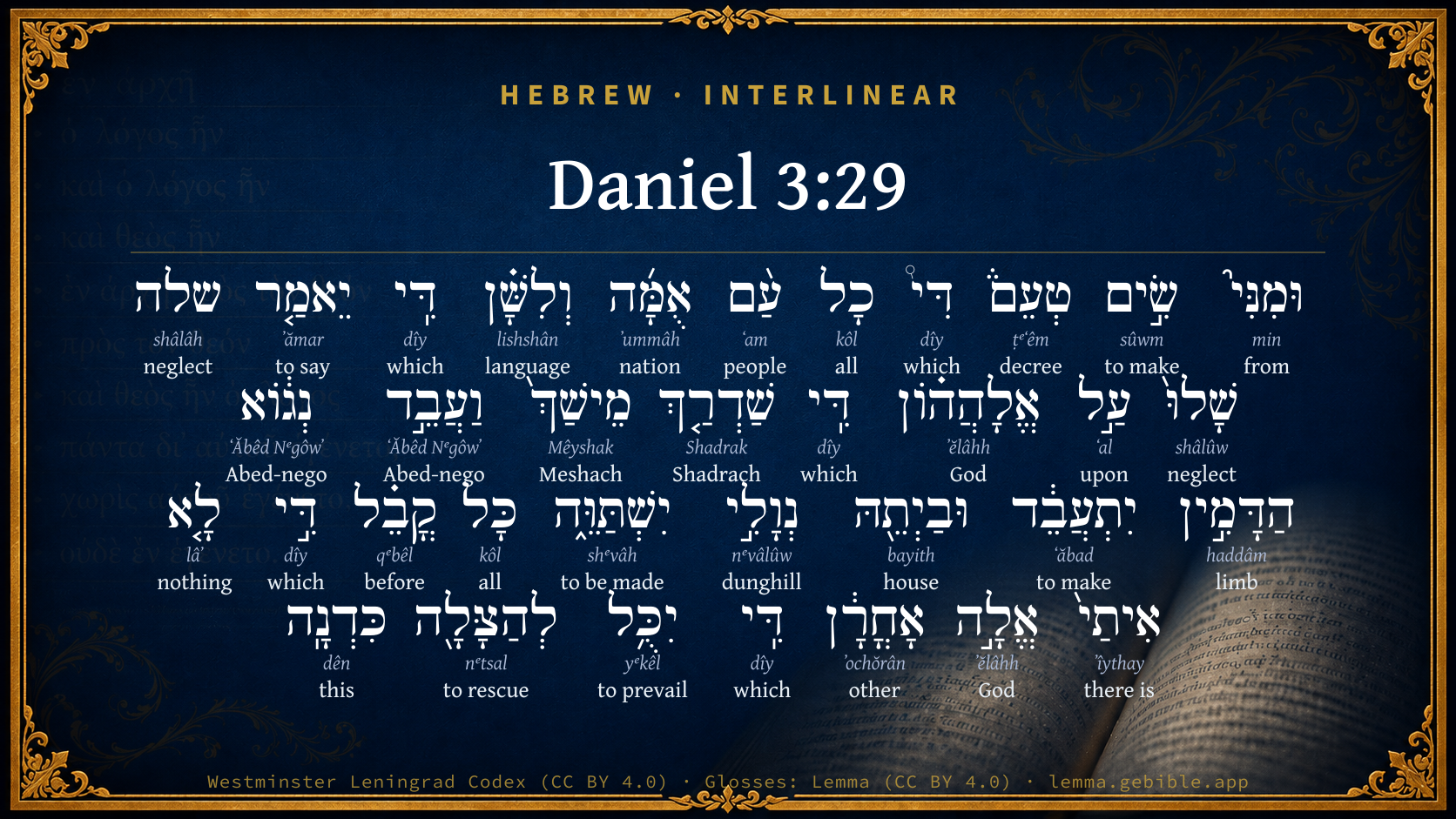
Hebrew (Westminster Leningrad Codex) Daniel 3:29 appears in the Hebrew Old Testament. The text above is from the Westminster Leningrad Codex. Each word links to its Strong’s number, a concise gloss, and parsing drawn from the Open Scriptures Hebrew Bible morphology. Click any word for its full Brown-Driver-Briggs (BDB) entry.
Download image
Cite this verse

Daniel 3:29 (World English Bible). Public Domain. Lemma interlinear Bible study tool, https://lemma.gebible.app/v/daniel/3/29.

Show BibTeX & RIS
BibTeX
RIS
English Translation
Therefore I make a decree, that every people, nation, and language, which speak anything evil against the God of Shadrach, Meshach, and Abednego, shall be cut in pieces, and their houses shall be made a dunghill; because there is no other god who is able to deliver after this sort.
World English Bible · Public Domain
Highlights
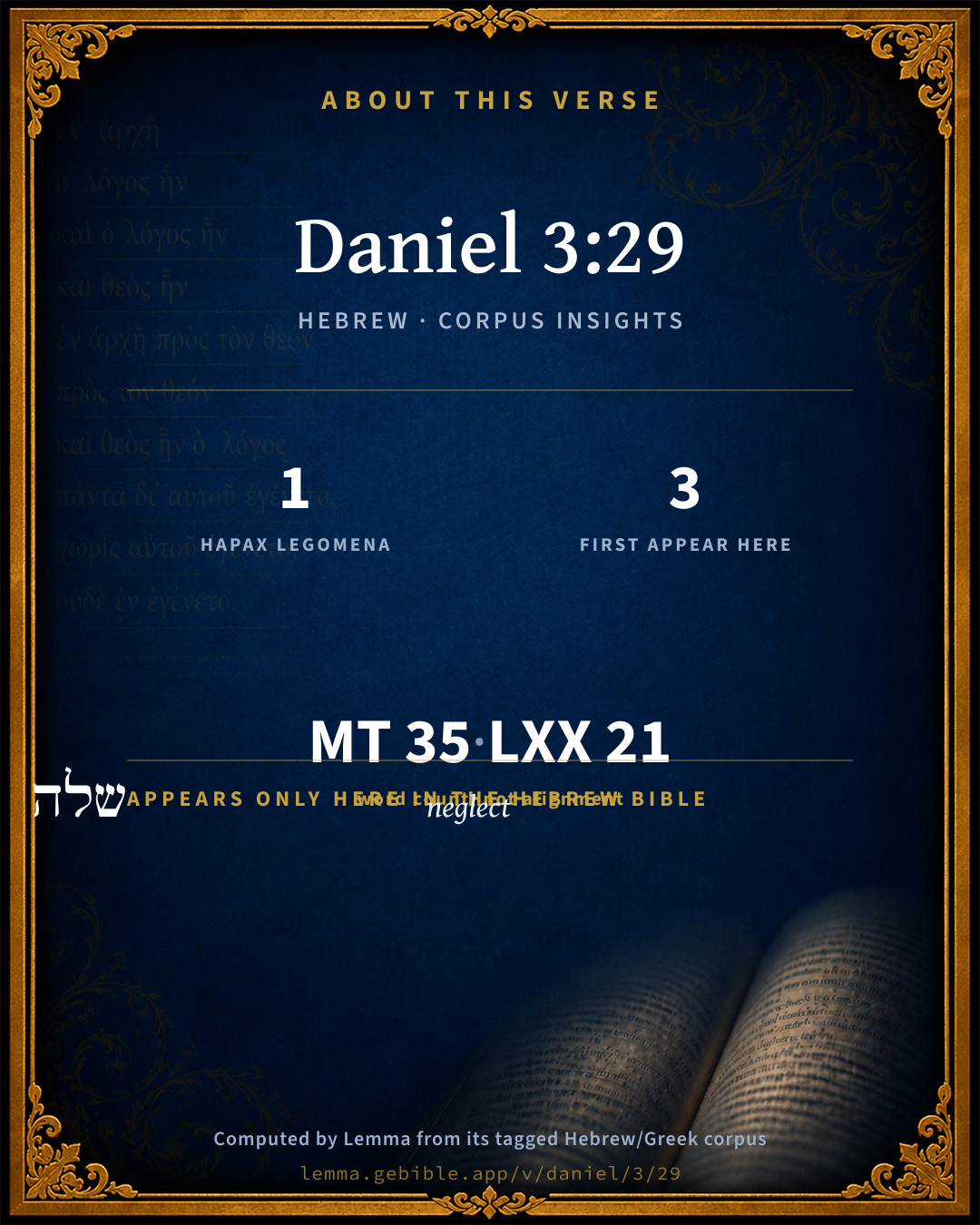
  • 1 hapax legomenon — only here in the Hebrew Bible
  • 3 first appearances in the Hebrew Bible
Full analysis ↓
Download a study sheet

One document with this verse’s original text, its word-by-word gloss line, the meaning frame, cross-references with their text, attributed commentary, and full source and license credits — printable, and it pastes into notes with its structure intact.

This verse Autodidact and up

Study sheet (.html) Plain text (.txt)

A passage Seminary Student

Up to 50 verses in one chapter. A passage sheet keeps up to 6 commentary sources and 12 cross-references per verse, in the order this page ranks them, and says so on the sheet whenever that leaves anything out. Ask for a single verse and you get the Autodidact verse sheet above.

Everything on this page stays free to read, with no account — the sheet is a download of what is already on screen, not access to it.

Want to remove ads? Support Godless Engineer
Compare translations 3

The same verse in 3 English versions, stacked beneath the original-language interlinear above. Click any original word for its lexicon entry.

Each is an independent rendering of the whole verse — the interlinear is not word-aligned to these translations.

Highlighted words mark where these versions differ — a whole-verse word diff, not a word-by-word alignment.

  • World English Bible Public Domain
    Therefore I make a decree, that every people, nation, and language, which speak anything evil against the God of Shadrach, Meshach, and Abednego, shall be cut in pieces, and their houses shall be made a dunghill; because there is no other god who is able to deliver after this sort.
  • King James Version Public Domain
    Therefore I make a decree, That every people, nation, and language, which speak any thing amiss against the God of Shadrach, Meshach, and Abednego, shall be cut in pieces, and their houses shall be made a dunghill: because there is no other God that can deliver after this sort.
  • unfoldingWord Literal Text CC BY-SA 4.0
    Therefore I make a decree that any people, nation, or language that speaks anything offensive against the God of Shadrach, Meshach, and Abednego will be torn limb from limb, and their houses be made into rubbish heaps because there is no other god who is able to save like this.”

unfoldingWord Literal Text — © unfoldingWord, licensed CC BY-SA 4.0. Word-aligned USFM3 via Door43 (git.door43.org/unfoldingWord/en_ult).

Versions to compare (up to 4)

3 of 4 selected

Show all 18 translations

Every available English version of this verse, each an independent rendering of the whole verse.

  • World English Bible Public Domain
    Therefore I make a decree, that every people, nation, and language, which speak anything evil against the God of Shadrach, Meshach, and Abednego, shall be cut in pieces, and their houses shall be made a dunghill; because there is no other god who is able to deliver after this sort.
  • Berean Standard Bible Public Domain
    Therefore I decree that the people of any nation or language who say anything offensive against the God of Shadrach, Meshach, and Abednego will be cut into pieces and their houses reduced to rubble. For there is no other god who can deliver in this way.”
  • Majority Standard Bible Public Domain
    Therefore I decree that the people of any nation or language who say anything offensive against the God of Shadrach, Meshach, and Abednego will be cut into pieces and their houses reduced to rubble. For there is no other god who can deliver in this way.”
  • King James Version Public Domain
    Therefore I make a decree, That every people, nation, and language, which speak any thing amiss against the God of Shadrach, Meshach, and Abednego, shall be cut in pieces, and their houses shall be made a dunghill: because there is no other God that can deliver after this sort.
  • American Standard Version (1901) Public Domain
    Therefore I make a decree, that every people, nation, and language, which speak anything amiss against the God of Shadrach, Meshach, and Abed-nego, shall be cut in pieces, and their houses shall be made a dunghill; because there is no other god that is able to deliver after this sort.
  • Revised Version (1885) Public Domain
    Therefore I make a decree, that every people, nation, and language, which speak any thing amiss against the God of Shadrach, Meshach, and Abed-nego, shall be cut in pieces, and their houses shall be made a dung-hill: because there is no other god that is able to deliver after this sort.
  • Geneva Bible (1599) Public Domain
    Therefore I make a decree, that euery people, nation, and language, which speake any blasphemie against the God of Shadrach, Meshach and Abednego, shalbe drawen in pieces, and their houses shall be made a iakes, because there is no god that can deliuer after this sort.
  • Douay-Rheims (1899) Public Domain
    By me therefore this decree is made, that every people, tribe, and tongue, which shall speak blasphemy against the God of Sidrach, Misach, and Abdenago, shall be destroyed, and their houses laid waste: for there is no other God that can save in this manner.
  • Young's Literal Translation Public Domain
    And by me a decree is made, that any people, nation, and language, that doth speak erroneously concerning the God of Shadrach, Meshach, and Abed-Nego, pieces he is made, and its house is made a dunghill, because that there is no other god who is able thus to deliver.'
  • Literal Standard Version CC BY-SA 4.0
    “And by me a decree is made, that any people, nation, and language, that speaks erroneously concerning the God of Shadrach, Meshach, and Abed-Nego, he is made pieces, and its house is made a dunghill, because that there is no other god who is able thus to deliver.”
  • Unlocked Literal Bible CC BY-SA 4.0
    Therefore I make a decree that any people, nation, or language that speaks anything against the God of Shadrach, Meshach, and Abednego must be torn apart, and that their houses must be made into rubbish heaps because there is no other god who is able to save like this.”
  • unfoldingWord Literal Text CC BY-SA 4.0
    Therefore I make a decree that any people, nation, or language that speaks anything offensive against the God of Shadrach, Meshach, and Abednego will be torn limb from limb, and their houses be made into rubbish heaps because there is no other god who is able to save like this.”
  • Darby Bible Public Domain
    Therefore I make a decree, that in every people, nation, and language, he who shall speak anything amiss against the God of Shadrach, Meshach, and Abed-nego, shall be cut in pieces, and his house shall be made a dunghill: because there is no other God that is able to deliver after this sort.
  • World Messianic Bible Public Domain
    Therefore I make a decree that every people, nation, and language which speak anything evil against the God of Shadrach, Meshach, and Abednego shall be cut in pieces, and their houses shall be made a dunghill, because there is no other god who is able to deliver like this.”
  • Webster's Bible Public Domain
    Therefore I make a decree, that every people, nation, and language, which speak any thing amiss against the God of Shadrach, Meshach, and Abed-nego, shall be cut in pieces, and their houses shall be made a dunghill: because there is no other god that can deliver after this sort.
  • Free Bible Version CC BY-SA 4.0
    Consequently I am issuing a decree that if anyone of any nation or language speaks disrespectfully about the God of Shadrach, Meshach, and Abednego they will be torn to pieces and their houses will be destroyed. There is no other God who is able to save like this!”
  • Bible in Basic English Public Domain
    And it is my decision that any people, nation, or language saying evil against the God of Shadrach, Meshach, and Abed-nego, will be cut to bits and their houses made waste: because there is no other god who is able to give salvation such as this.
  • JPS Tanakh (1917) Public Domain
    Therefore I make a decree, that every people, nation, and language, which speak any thing amiss against the God of Shadrach, Meshach, and Abed-nego, shall be cut in pieces, and their houses shall be made a dunghill; because there is no other god that is able to deliver after this sort.'

Literal Standard Version (2020), Covenant Press — licensed CC BY-SA 4.0. Text via the HelloAO Bible API (eBible.org). Unlocked Literal Bible (unfoldingWord) — licensed CC BY-SA 4.0. Text via the HelloAO Bible API (eBible.org). unfoldingWord Literal Text — © unfoldingWord, licensed CC BY-SA 4.0. Word-aligned USFM3 via Door43 (git.door43.org/unfoldingWord/en_ult). Free Bible Version, Dr. Jonathan Gallagher — licensed CC BY-SA 4.0. Text via the HelloAO Bible API (eBible.org).

Word by word

More ways to search: Search by grammar → Find every occurrence → Compare this word →

Practice this passage: Drill this verse → Learn its vocabulary →

שלה
shâlâh
H7955
“neglect”
Adjective, N, Common
Part of Speech
Adjective
Gender
Common
Full BDB Definition

Origin: from a root corresponding to H7952

TWOT: None

neglect, remissness
  1. וּמִנִּי֮ min H4481 “and · from · me” Adjective, C + Preposition + Suffix, Personal, 1st Person, Common, Singular
  2. שִׂ֣ים sûwm H7761 “to make” Adjective, V, Plural
  3. טְעֵם֒ ṭᵉʻêm H2942 “decree” Adjective, N, Common
  4. דִּי֩ dîy H1768 “which” Adjective, T
  5. כָל kôl H3606 “all of” Adjective, N, Common
  6. עַ֨ם ʻam H5972 “people” Adjective, N, Common
  7. אֻמָּ֜ה ʼummâh H524 “nation” Adjective, N, Common
  8. וְלִשָּׁ֗ן lishshân H3961 “and · language” Adjective, C + Noun, Common, Masculine, Singular, Absolute
  9. דִּֽי dîy H1768 “which” Adjective, T
  10. יֵאמַ֤ר ʼămar H560 “to say” Adjective, V
  11. שָׁלוּ֙ shâlûw H7960 “neglect” Adjective, N, Common
  12. עַ֣ל ʻal H5922 “upon” Adjective, R
  13. אֱלָהֲה֗וֹן ʼĕlâhh H426 “God · their” Adjective, N, Common + Suffix, Personal, 3rd Person, Masculine, Plural
  14. דִּֽי dîy H1768 “which” Adjective, T
  15. שַׁדְרַ֤ךְ Shadrak H7715 “Shadrach” Adjective, N
  16. מֵישַׁךְ֙ Mêyshak H4336 “Meshach” Adjective, N
  17. וַעֲבֵ֣ד ʻĂbêd Nᵉgôwʼ H5665 “and · Abed-nego” Adjective, C + Noun, Proper
  18. נְג֔וֹא ʻĂbêd Nᵉgôwʼ H5665 “Abed-nego” Adjective, N
  19. הַדָּמִ֣ין haddâm H1917 “limbs” Adjective, N, Common
  20. יִתְעֲבֵ֔ד ʻăbad H5648 “to make” Adjective, V
  21. וּבַיְתֵ֖הּ bayith H1005 “and · house · his” Adjective, C + Noun, Common, Masculine, Singular, Construct + Suffix, Personal, 3rd Person, Masculine, Singular
  22. נְוָלִ֣י nᵉvâlûw H5122 “dunghill” Adjective, N, Common
  23. יִשְׁתַּוֵּ֑ה shᵉvâh H7739 “to be made” Adjective, V
  24. כָּל kôl H3606 “all” Adjective, C + Conjunction
  25. קֳבֵ֗ל qᵉbêl H6903 “before” Adjective, C
  26. דִּ֣י dîy H1768 “which” Adjective, C
  27. לָ֤א lâʼ H3809 “nothing” Adjective, T
  28. אִיתַי֙ ʼîythay H383 “there is” Adjective, T
  29. אֱלָ֣ה ʼĕlâhh H426 “God” Adjective, N, Common
  30. אָחֳרָ֔ן ʼochŏrân H321 “other” Adjective, A
  31. דִּֽי dîy H1768 “which” Adjective, T
  32. יִכֻּ֥ל yᵉkêl H3202 “to prevail” Adjective, V
  33. לְהַצָּלָ֖ה nᵉtsal H5338 “to rescue” Adjective, R + Verb, Hiphil, Infinitive Construct
  34. כִּדְנָֽה dên H1836 “like/as · this” Adjective, R + Pronoun, Demonstrative, Masculine, Singular

About this verse

These counts appear in no published source. They are computed here, from the morphology-tagged text and Lemma’s own curated glosses. What Lemma adds →

35
words
28
distinct lemmas
Prophets
section

Notable vocabulary

1 hapax legomenon — a word that appears only here in the entire Hebrew Bible:

First appearance in Scripture

These words make their first canonical appearance in the Hebrew Bible here:

  • שלה neglect H7955
  • יִשְׁתַּוֵּ֑ה to be made H7739
  • לְהַצָּלָ֖ה to rescue H5338

Shared distinctive vocabulary

הַדָּמִ֣ין limb H1917 occurs in 2 verses of the Hebrew Bible. Also found in:

Grammatical profile

  • 1 verb
  • 3 nouns
  • 28 adjectives
  • 1 pronoun
  • 1 preposition
  • 1 conjunction

Verb forms

  • לְהַצָּלָ֖ה Hiphil · Infinitive Construct

Repetition

Words recur within this verse — often emphatic in Hebrew:

  • כָל all H3606 ×2
  • אֱלָהֲה֗וֹן God H426 ×2
  • וַעֲבֵ֣ד Abed-nego H5665 ×2
  • דִּי֩ which H1768 ×5

Hebrew & Septuagint length

In English translation the verse runs 50 words from the Hebrew and 44 from the Septuagint (LXX English) — closely comparable.

A rough comparison of the two English renderings, which tokenize alike — not a word-level alignment.

Word counts can differ between the Hebrew and the Greek without any difference in meaning — e.g. the Hebrew direct-object marker אֵת has no separate Greek word, and Greek often adds the article ὁ.

In the original languages it is 35 Hebrew tokens and 21 Greek tokens — but the two are counted differently (Hebrew bundles its prefixes and suffixes into one token; the Greek is in lemma form), so that isn’t a like-for-like length.

Cross-references

9

Topical passages linked to Daniel 3:29 in the Treasury of Scripture Knowledge — connected by theme and wording, ordered by reader-vote popularity; previews shown in the World English Bible.

  • Daniel 2:5 The king answered the Chaldeans, The thing is gone from me: if you don't make known to me the dream and the interpretation of it, you shall be cut in pieces, and your houses shall be made a dunghill.
  • Deuteronomy 32:31 For their rock is not as our Rock, Even our enemies themselves being judges.
  • Psalms 76:10 Surely the wrath of man praises you. The survivors of your wrath are restrained.
  • Daniel 6:26–27 I make a decree, that in all the dominion of my kingdom men tremble and fear before the God of Daniel; for he is the living God, and steadfast forever, His kingdom that which shall not be destroyed; and his dominion shall be even to the end.
  • Ezra 6:11 Also I have made a decree, that whoever shall alter this word, let a beam be pulled out from his house, and let him be lifted up and fastened thereon; and let his house be made a dunghill for this:
  • Psalms 3:8 Salvation belongs to Yahweh. Your blessing be on your people. Selah.
  • Daniel 3:15 Now if you are ready whenever you hear the sound of the horn, flute, zither, lyre, harp, pipe, and all kinds of music to you fall down and worship the image which I have made, [well]: but if you don't worship, you shall be cast the same hour into the midst of a burning fiery furnace; and who is that god that shall deliver you out of my hands?
  • Daniel 3:17 If it be [so], our God whom we serve is able to deliver us from the burning fiery furnace; and he will deliver us out of your hand, O king.
  • Daniel 3:28 Nebuchadnezzar spoke and said, Blessed be the God of Shadrach, Meshach, and Abednego, who has sent his angel, and delivered his servants who trusted in him, and have changed the king's word, and have yielded their bodies, that they might not serve nor worship any god, except their own God.

Cross-references courtesy of OpenBible.info (CC BY 4.0).

Hebrew and Greek witnesses Masoretic Hebrew ↔ Greek Septuagint

The same verse in the two great witnesses to the Old Testament, shown verse-for-verse.

These are two independent witnesses, not word-aligned to each other, and the Septuagint is shown in lemma (dictionary) form.

Hebrew Daniel 3:29 Masoretic · Westminster Leningrad Codex

וּמִנִּי֮ שִׂ֣ים טְעֵם֒ דִּי֩ כָל עַ֨ם אֻמָּ֜ה וְלִשָּׁ֗ן דִּֽי יֵאמַ֤ר שלה שָׁלוּ֙ עַ֣ל אֱלָהֲה֗וֹן דִּֽי שַׁדְרַ֤ךְ מֵישַׁךְ֙ וַעֲבֵ֣ד נְג֔וֹא הַדָּמִ֣ין יִתְעֲבֵ֔ד וּבַיְתֵ֖הּ נְוָלִ֣י יִשְׁתַּוֵּ֑ה כָּל קֳבֵ֗ל דִּ֣י לָ֤א אִיתַי֙ אֱלָ֣ה אָחֳרָ֔ן דִּֽי יִכֻּ֥ל לְהַצָּלָ֖ה כִּדְנָֽה

Therefore I make a decree, that every people, nation, and language, which speak anything evil against the God of Shadrach, Meshach, and Abednego, shall be cut in pieces, and their houses shall be made a dunghill; because there is no other god who is able to deliver after this sort.

World English Bible · Public Domain

Greek LXX Daniel 3:29 Septuagint · lemma form

ὅτι ἁμαρτάνω ἐν πᾶς καί ἀνομέω ἀποἵστημι ἀπό σύ καί ἐκἁμαρτάνω ἐν πᾶς καί ὁ ἐντολή ὁ νόμος σύ οὐ ὑποἀκούω

Therefore I publish a decree: Every people, tribe, or language, that shall speak reproachfully against the God of Sedrach, Misach, and Abdenago shall be destroyed, and their houses shall be plundered: because there is no other God who shall be able to deliver thus.

LXX2012 (modern English Septuagint) · Public Domain

On this verse, John Gill's Exposition discusses the Septuagint’s reading. Read the note in Commentary ↓

Hebrew: Westminster Leningrad Codex (CC BY 4.0). Greek: Septuagint (public domain); English from LXX2012 (modern English Septuagint) (Public Domain). How the Septuagint differs from the Hebrew →

Commentary

Notes on Daniel 3:29 from classic Christian and Jewish commentators (each source and its license shown beneath its notes). The classic Christian expositions comment on the surrounding passage and are grouped to its opening verse, so a note may address several verses; the Jewish commentaries on the Tanakh (Rashi and others) are per-verse, so they appear only where the commentator wrote on this verse.

Lemma curates 59 commentaries, every one of them public domain or Creative Commons licensed, each selected and text-cleaned for this edition rather than reprinted as found. About our sources →

Trapp's Complete Commentary

John Trapp

Dan 3:29 Therefore I make a decree, That every people, nation, and language, which speak any thing amiss against the God of Shadrach, Meshach, and Abednego, shall be cut in pieces, and their houses shall be made a dunghill: because there is no other God that can deliver after this sort.

Ver. 29. Therefore I make a decree.] Magistrates then have to do with men in matters of religion. {Deu 13:6 Rom 13:4}

Which speak anything amiss.] But was this all he would do for God after so clear convictions? It was very poor. A professor of the Turks’ law proclaimeth, before they attempt anything, that nothing be done against religion.

John Trapp, A Commentary or Exposition upon All the Books of the Old and New Testament (1647–1656) — public domain. Text from a community e-Sword module.

The Biblical Illustrator

Joseph S. Exell

Dan_3:29

There is no other God that can deliver after this sort.

The Great Deliverer

These are the words of a heathen king. They are not the less welcome to us on that account, but perhaps the more so. The testimony of a saint has, of course, its special value, but the witness of a sinner has a worth all its own, especially when it has been compelled from him by the power of God Himself. This unwilling testimony seems to me to exceed in worth the testimony of those from whom we should expect such witness. You may be sure that Nebuchadnezzar was not prejudiced in favour of Jehovah. This he said only through compulsion, yet he spake it with the accent of conviction. It was a matter not of theory but of experience with him. It is true also that this testimony is very far from satisfactory. We find ourselves wishing that Nebuchadnezzar had gone much further. I wish he had left out those last three words: That would have beans grand utterance, There is no other God that can deliver. But suppose he had left out three other words, and simply said, There is no other God, what an improvement that would have been. Oh, but he was a young beginner, you must remember; he was only just commencing to come under Divine influences. This is a repeating of the alphabet, and he gets through it wonderfully well considering. Wait till God has done with him, and you will find he has made wonderful progress. Read his testimony after he has been humbled by being driven into the fields to eat grass like the ox. Before God and you have done with him he may have given such a record as Nebuchadnezzar did towards the close of his career--Now I, Nebuchadnezzar, praise, and extol, and honour the King of heaven, all whose works are truth, and His ways judgment; and those that walk in pride He is able to abase.

I. THERE IS NO OTHER GOD THAT CAN DELIVER FROM SUCH OVERWHELMING PERIL. There are many features connected with this case that make it special. We may extend the meaning of Nebuchadnezzars phrase.

1. There is no other God that can deliver from such strong temptations. Try to put yourselves in the position of these three young men.

2. Moreover, these men were delivered from their accusers, for you will remember that certain Chaldeans came near, and accused the Jews. I expect they had been on the look-out for this opportunity. Now see--for you know the end of the story--how wonderfully the Jews were delivered from the hands of those who were trying to trip and destroy them. Hear me, if you are here who, if you told your story, would have to say, One of my greatest troubles is that I am so watched; they compass me about like bees; I get no rest or peace! they want to trip me up, to catch me in my words, to entangle me in my talk, if they could only find an occasion against me--and I am half afraid they will. I charge you, do not be afraid that they will succeed. If you are afraid, they will; but if you simply trust in God and do the right He will deliver you from the hands of your accusers. You need not fear what man can do unto you. If God be for you, who can be against you?

3. Again, the holy children were delivered from the wrath of the king, and I warrant you it was wrath of no ordinary nature. There are indications that Nebuchadnezzar was a fair-minded man, at least to some degree. He gave these offenders an opportunity to recant, and up to a certain point seems to have treated them with a commendable humanity. But when he did get angry, there was no mistaking it. Now read the sequel of the story. The lion has become a lamb; he who was like to leap upon them from the thicket now cringes before them, cowed and cowardly. He who had blasphemed their God now praises Him; He who had threatened to destroy them now sets them on high in the province of Babylon. I wonder if there is anybody present who has to deal with those who give way to evil temper. Well, I am not very much surprised that you are a little fearful of it, but oh, if God is with you and you with Him, He can make the wrath of His enemies praise Him.

4. From the fierceness of the fire also these young men were saved. Oh, how gloriously God delivers! They may do their worst--it only gives God an opportunity to do His best. Let them heap on the fuel, let them say all manner of evil against you falsely for His sake. God is a match for them, and more than equal to the emergency. I wonder what the difficulty is under which you labour just now. Is it the power of inbred sin? There is no other God that can deliver after this sort. You may see on every hand men and women who have been delivered from the power of sin. Do not suppose that the seas of sorrow must overwhelm you. God can turn your sighing into singing.

II. THERE IS NO OTHER GOD THAT DELIVERS BY SUCH MARVELLOUS MEANS. Think of the methods God employed in this case to set His servants free from their extremity.

1. He first of all inspired their confidence. Did you not admire them and rejoice in them as we read the story of their behaviour before the king? They were not in the least cowed by his august presence, nor frightened by his fearful threat. Well, that is Gods way of working with the hearts of men. He is fitting them for the ordeal through which they are going to pass. God never sends us through any ordeal without first preparing us.

2. Was it not God also who prompted them to a heroic confession of their faith? I can imagine a man full in his heart with holy boldness, and yet failing to speak it forth. They were altogether regardless of consequences. Yet they were not alone, for God was with them.

3. Then God helped them to marvellous patience. It was the spirit of peace and patience that kept them gentle as well as brave. There is no other God that can deliver after this sort. Some men can fight their way through difficulties, but the men whom God helps can stand still and see the salvation of the Lord.

4. Let it be noted, too, that God allowed these young men to be put into the furnace. God has permitted it, but only with the purpose that His strength may be made perfect in your weakness, and that he may eventually bring you out into a wealthy place.

5. Remember, too, that Nebuchadnezzar, to his great surprise, saw the form of a fourth walking amidst the flames. He did not know who it was. He used an expression which has, I think, been somewhat misunderstood. He had no idea that it could be Gods dear Son, our blessed Saviour. It is not likely that he had even heard of such an One. He really said, The form of the fourth is like a Son of God, and later he said that God had sent His angel to save His servants. Oh, if he could have known what I believe is the actual fact, that Jesus Himself, the second Person in the Trinity, put Himself side by side with Shadrach, Meshach, and Abed-nego, he would have wondered infinitely more. Oh, this is the wonder of wonders, that in the hour of our extremity, Christ comes right down to us, walks by us, holds us by the hand and does, by His presence, cheer and save us. Oh, what a gracious God is ours!

III. THERE IS NO OTHER GOD THAT CAN DELIVER IN SUCH A REMARKABLE MANNER. His methods are remarkable and strange, but the nature of the delivery still more surprises us.

1. No other God saves so readily. There is no sign in all this story of any particular stretching forth of the Divine arm. There is no visible and ostensible exhibition of Divine might. There is, for instance, no sudden burst of a waterspout to quench these flames; no mighty rushing wind to blow the fire away. God wrought a miracle, I gladly own, but the forces He employed were silent and secret. God often works that way. You hope He will deliver you. Yes! but do not dictate to Him the manner of deliverance. He knows in every detail what is best, and we are wise to leave them all to Him.

2. You may be sure He work effectually. There is no other god that does his work so thoroughly as the Hebrews God. So complete was the delivery that the king was astonished at it. I expect that the fetters were forged to the strongest point of resistance, but the fire seems to have centred all its force upon the fetters which the king had put upon his prisoners. Oh, welcome fires of persecution, and of temptation too, if the ultimate end is to set me freer than I was before, to burn the bonds that bound me. But upon themselves the fire had no power. And not so much as the smell of fire passed on them. There is an old legend to tee effect that they sang in the midst of the flames. I do not know whether that was really so, but I know that they did not singe in the flames, for God took the power out of the fire, so that they walked unharmed. All things are possible with Heaven.(Thomas Spurgeon.)

The Biblical Illustrator, edited by Joseph S. Exell (c. 1880s–1900s) — public domain. Text from a community e-Sword module.

Joseph Benson's Commentary

Dan 3:29. Therefore, I make a decree, &c. — He issues a royal edict, strictly forbidding any to speak evil of the God of Israel. We have reason to think that both the sins and the troubles of Israel had given great, though no just occasion to the Chaldeans to blaspheme the God of Israel, and it is likely Nebuchadnezzar himself had encouraged them to do it; but now, though he is no true convert, nor is influenced to worship him, yet he resolves never to speak evil of him again, nor to suffer others to do so. If any should presume to do it, he decrees that they should be counted the worst of malefactors, and should be dealt with accordingly. The miracle now wrought by the power of this God, in defence of his worshippers, and that publicly, in the sight of the thousands of Babylon, was a sufficient justification of this edict. And it would contribute much to the ease of the Jews in their captivity, to be, by this law, screened from the fiery darts of reproach and blasphemy, with which, otherwise, they would have been continually annoyed. Observe, reader, it is a great mercy to the church, and a good point gained, when its enemies, though they have not their hearts turned, yet have their mouths stopped, and their tongues tied. If a heathen prince laid such a restraint upon the proud lips of blasphemers, how much more should Christian princes do it. Nay, in this thing, one would suppose that men should be a law to themselves; and that those who have so little love to God that they care not to speak well of him, yet should never find in their hearts, for we are sure they can never find cause, to speak any thing amiss of him.

Joseph Benson's Commentary on the Old and New Testaments (1811–1818) — public domain. Text from a community e-Sword module.

Ibn Ezra

Rabbi Abraham ibn Ezra

[Daniel 3:29] And from me (וּמִנִּי - Uminni)... blasphemes [lit. says something amiss/error] (שָׁלוּ - shalu): [This means] like [the Hebrew word for] error (shegagah). And [it is] like [the related Hebrew word shal in the phrase]: “for his error” (עַל הַשַּׁל - ʿal ha-shal) [II Samuel 6:7].

For [lit. Corresponding to all this] (כָּל־קֳבֵל - Kol kovel): [Regarding the phrase] “to save in this way” (לְהַצָּלָה כִּדְנָה - l'hatzalah kidnah): [It means] like this God (k'elohim ha-zeh) [can save].

Ibn Ezra on the Tanakh — English translations: “Sefaria Community Translation” (CC0 1.0 (public-domain dedication)); “Yalkut, Sifsei Chachomim Chumash, Metsudah Publications, 2009” (CC BY 4.0); and “Commentary of Ibn Ezra on Isaiah - trans. by M. Friedlander, 1873” (public domain). Text via Sefaria.

Geneva Bible (1599)

Geneva Bible translators

If this heathen king moved by God’s Spirit would not see blasphemy unpunished, but made a law and set a punishment to such transgressors, much more ought all they that profess religion, take order that such impiety reign not, lest according as their knowledge and charge is greater, so they suffer double punishment.

Geneva Bible (1599) marginal notes — public domain. Text via Bolls.life.

Jamieson, Fausset & Brown

Robert Jamieson, A. R. Fausset & David Brown

This decree promulgated throughout the vast empire of Nebuchadnezzar must have tended much to keep the Jews from idolatry in the captivity and thenceforth (Psa 76:10).

Punished with insanity for his haughtiness, he sinks to the level of the beasts (illustrating Psa 49:6, Psa 49:12). The opposition between bestial and human life, set forth here, is a key to interpret the symbolism in the seventh chapter concerning the beasts and the Son of man. After his conquests, and his building in fifteen days a new palace, according to the heathen historian, ABYDENUS (268 B.C.), whose account confirms Daniel, he ascended upon his palace roof (Dan 4:29, Margin), whence he could see the surrounding city which he had built, and seized by some deity, he predicted the Persian conquest of Babylon, adding a prayer that the Persian leader might on his return be borne where there is no path of men, and where the wild beasts graze (language evidently derived by tradition from Dan 4:32-33, though the application is different). In his insanity, his excited mind would naturally think of the coming conquest of Babylon by the Medo-Persians, already foretold to him in the second chapter.

Next: Daniel Chapter 4

Jamieson, Fausset & Brown — Commentary Critical and Explanatory on the Whole Bible (1871) — public domain (CC PDM 1.0). Text via the HelloAO Bible API.

Adam Clarke's Commentary

Verse 29. Speak any thing amiss] Though by the decree the king does not oblige the people to worship the true God, yet he obliges them to treat him with reverence.

Adam Clarke's Commentary on the Bible (1810–1826) — public domain. Text from a community e-Sword/MySword module.

John Calvin's Commentaries

Here Nebuchadnezzar is urged further forward — for we must use this phrase — since he does not take up the worship of one God from his heart, and bid his errors finally farewell. Hence it is as if God was thrusting him violently forward, while he promulgates this edict. The edict is by itself pious and praiseworthy; but, as we have already said, Nebuchadnezzar is borne along by a blind and turbulent impulse, because piety had no root in his heart. Though he is always intent on this miracle, his faith is only momentary, and his fear of God but partial. Why then is Nebuchadnezzar now seen as the patron of God’s glory? Because he was frightened by the miracle, and thus being acted on by impulse alone, he could not; be soundly restrained by the fear of God alone. And finally, this desire which he expresses is nothing but an evanescent movement. It is useful to remark this, since we see many born along by impetuous zeal and rage to vindicate God’s glory; but they lack tact and judgment, so that they deserve no praise. And many wander still further — as we see in the Papacy — when many edicts of kings and princes fly about; and if any one should ask them why they are so eager as not to spare even human blood, they put forth indeed a zeal for God, but it is mere madness without a spark of true knowledge. We must hold, therefore, that no law can be passed nor any edict promulgated concerning religion and the worship of God, unless a real knowledge of God shines forth. Nebuchadnezzar indeed had a reason for this edict, but, as I have already said, there was a special motive for his conduct. Some, indeed, now wish to be thought Christian princes, and yet are only inflamed by a hypocritical zeal, and so they pour forth innocent blood like cruel beasts. And why so? Because they make no distinction between the true God and idols. But I shall discuss this point at greater length to-morrow, and so pass over casually what I shall treat at length, when the fit opportunity arrives.

Every people, therefore, and nation, and language, which shall have offered a perverse speech against their God Nebuchadnezzar again extolled the God of Israel, but how was he taught the majesty of God? By this one proof of his power, for he neglected the chief point — the ascertaining from the law and the prophets the nature of God and the power of his will. Thus we see, on one side, how God’s glory is asserted here, and yet the principal point in his worship, and in true piety, is neglected and omitted. No light punishment is added — -he must be cut in pieces, next, his house must be turned into a dunghill, since he has spoken reproachfully of the God of Israel Hence we gather how this severity is not to be utterly condemned, when God’s worship is defended by severe punishments; yet a correct sentence ought to be passed in each case. But I put this off also till to-morrow. It is now added, because there is no other God who can deliver after this manner; and. this confirms what I have formerly touched upon, namely, King Nebuchadnezzar does not regard the law in his edict, nor yet the other requisites of piety; but he is only impelled and moved by the miracle, so as not to bear or desire anything to be said opprobriously against the God of Israel. Hence the edict is deserving of blame in this point, since he does not inquire what God’s nature is, with the view of obtaining a sufficient reason for issuing it. It is added at length, —

John Calvin's Commentaries (1540-1563) — public domain. Text from the Calvin Translation Society English edition (1840s-50s) via the Christian Classics Ethereal Library (ccel.org). Calvin's coverage is partial (roughly two-thirds of the Bible); uncommented books and verses are honest gaps, never fabricated. The 19th-century editor's footnotes and remarks are omitted so the notes are faithfully Calvin's own voice.

Ellicott's Commentary for English Readers

(29) Anything amiss.—The marginal version is to be preferred.

A Bible Commentary for English Readers, edited by Charles John Ellicott (1878–1897) — public domain. Text from a community e-Sword module.

The Cambridge Bible for Schools and Colleges

gen. ed. J. J. S. Perowne

29. I make a decree] the same phrase (lit. a decree is made by me), in Dan_4:6 (cf. Dan_6:26); Ezr_4:11 (at the end), 19, Dan_5:17, Dan_6:8; Dan_6:11, Dan_7:13; Dan_7:21.

people, nation, and language] Dan_3:4; Dan_3:7.

any thing amiss] lit. any neglect or error: cf. the same word in Dan_6:4; Ezr_4:22; Ezr_6:9 (‘fail’). In the Targums it stands for the Heb. shegâgâh, or mishgeh, oversight, inadvertence, Gen_43:12; Lev_4:2; Lev_5:18.

cut in pieces, and … made a dunghill] see on Dan_2:5. The terms of the edict, it will be noticed, are inexact: ‘every people, nation, and language’ must stand for ‘every one belonging to any people, nation, and language.’ (‘Their houses’ is in the Aram. his house.)

The Cambridge Bible for Schools and Colleges (gen. ed. J. J. S. Perowne; Cambridge University Press, 1878–1918) — public domain. Text from a community e-Sword module.

John Gill's Exposition

Then the king promoted Shadrach, Meshach, and Abednego, in the province of Babylon,.... He restored them to their places of trust and profit, and increased their honours: or, "made them to prosper", as the word (x) signifies; they flourished in his court, and became very great and famous. The Septuagint and Arabic versions add,

"and he counted them worthy to preside over all the Jews that were in his kingdom.''

(x) "prosperare fecit", Munster; "prosperari jussit", Junius & Tremellius, Piscator; "prosperos felicesque fecit", Gejerus.

Next: Daniel Chapter 4

John Gill's Exposition of the Whole Bible (1746–1763) — public domain (CC PDM 1.0). Text via the HelloAO Bible API.

Albert Barnes' Notes on the Bible

Therefore I make a decree - Margin, “A decree is made by me.” Chaldee, “And from me a decree is laid down,” or enacted. This Chaldee word (טעם ṭe‛êm) means, properly, “taste, flavor;” then “judgment,” the power of “discerning” - apparently as of one who can judge of “wine,” etc., by the taste; then the sentence, the decree which is consequent on an act of judging - always retaining the idea that the determination or decree is based on a conception of the true merits of the case. The decree in this case was not designed to be regarded as arbitrary, but as being founded on what was right and proper. He had seen evidence that the God whom these three youths worshipped was a true God, and was able to protect those who trusted in him; and regarding him as a real God, he made this proclamation, that respect should be shown to him throughout his extended realm.

That every people, nation, and language - This decree is in accordance with the usual style of an Oriental monarch. It was, however, a fact that the empire of Nebuchadnezzar extended over nearly all of the then known world.

Which speak any thing amiss - Margin, “error.” The Chaldee word (שׁלה shâluh) means “error, wrong,” and it refers here to anything that would be fitted to lead the minds of men astray in regard to the true character of the God whom these persons worshipped. The Vulgate renders it “blasphemy.” So also it is rendered in the Greek, βλασφημίαν blasphēmian. The intention was, that their God was to be acknowledged as a God of eminent power and rank. It does not appear that Nebuchadnezzar meant that he should be regarded as the “only” true God, but he was willing, in accordance with the prevailing notions of idolatry, that he should take his place among the gods, and a most honored place.

Shall be cut in pieces - Margin, “made.” This was a species of punishment that was common in many ancient nations. - Gesenius.

And their houses shall be made a dunghill - Compare 2Ki 10:27. The idea is, that the utmost possible dishonor and contempt should be placed on their houses, by devoting them to the most vile and offensive uses.

Because there is no other god that can deliver after this sort - He does not say that there was no other god at all, for his mind had not yet reached this conclusion, but there was no other one who had equal power with the God of the Hebrews. He had seen a manifestation of his power in the preservation of the three Hebrews such as no other god had ever exhibited, and he was willing to admit that in this respect he surpassed all other divinities.

Albert Barnes' Notes on the Bible (1834–1885) — public domain. Text from a community e-Sword/MySword module.

Matthew Poole's English Annotations

Observe here, that though he doth not resolve to worship the true God, nor command others to do it, yet he would not allow the God of the Jews to be evil spoken of; this was all that he came up to. He was resolved to hold fast to the religion established, his own idols; nay, the great golden idol, which had been slurred and slighted by these three worthies, he would not take down and relinquish: this was the best quarter the true God could get among them, not to be spoken amiss of under great penalty; though he confessed no god else could deliver after that strange sort. Bel could not preserve his men out of the furnace, God preserves his servants in the furnace. All was one for that, Bel should be his god still.

Matthew Poole's English Annotations on the Holy Bible (1683–1685) — public domain. Text from a community e-Sword/MySword module.

The Pulpit Commentary

Therefore I make a decree, That every people, nation, and language, which speak anything amiss against the God of Shadrach, Meshach, and Abed-nego, shall be cut in pieces, and their houses shall be made a dunghill: because there is no other God that can deliver after this sort. The versions agree with the Massoretic text here, only that all put the crime, "speaking anything amiss," more strongly than we find it in the Massoretic recension, hlv is amended by the Massoretes to Wlv, "erroneous," whereas the Septuagint renders, ov an blasfhmhsh. Theodotion, h (agreeing with glwssa) ejan eiph blasfhmian. The Peshitta renders," to blaspheme." Hitzig has suggested that the K"thib here is to be preferred to the Q"ri, maintaining that hlv means "word," while Wlv really means "inadvertence." Certainly, if we were sure that the meaning he gives to hlv is correct, and the versions all support it, we would give the preference to it. It has, however, to be borne in mind that, in the notions of heathenism, intentional disrespect was not taken into consideration in regard to the gods. The intention of the worshipper was of very little moment in such a matter; he might even desire to be specially respectful to the deity he worshipped; but if, by inadvertence, he omitted something, or did something which was not according to rule, all the good will and respect in his mind was nothing the wrath of the insulted deity was poured out in full measure, unless some other deity regarded the action in question as specially honouring to him. It was the external action the mere form of words that was the important matter with thepolytheist. Idolatry is by its very nature a mental and moral disease; it is as absurd to expect logically concatenated actions from an idol-worshipper in regard to his deities, as to expect the same from a madman in regard to his craze. We must guard against imagining that the decree was against blasphemy as a crime against Jehovah. Primarily it was against words that, by exciting the wrath of Jehovah, might bring down damage on the empire. Nebuchadnezzar was not jealous for the honour of Jehovah, but for the safety of the Babylonian supremacy. The punishment threatened, it may be observed, is the same as that decreed against the wise men because of their failure to tell the dream and its interpretation. In regard to this, in Dan_2:5 the Septuagint renders the phrase, "Ye shall be made an example of, and your goods shall be escheat to the king"s treasury." This change, as we maintained, was due to a difference of reading, not to any objection to the harshness of the phrase. The object of the punishment here was to remove utterly from the earth the wrong-doer and every remembrance of him, so that the offended deity might have no excuse for visiting the kingdom of Babylon with judgments. The reason, "because there is no other god that can deliver after this sort," is not to be stretched too far. All that is asserted is that no other god has been able to deliver his worshippers out of the very realm of the god of fire, and therefore it is to be argued that his power of offence is as great; hence all are to avoid enraging him; but there is no worship enjoined. The Lagid princes, when Jerusalem was in their hands, ordered sacrifices to be offered on their behalf daffy. Nebuchadnezzar does nothing of this sort; his decree is simply negative

The Pulpit Commentary (1880–1919), ed. H.D.M. Spence-Jones & Joseph S. Exell — public domain. Text from a community e-Sword module.

unfoldingWord translationNotes

Door43 World Missions Community

any people, nation, or language ... must be torn apart, and that their houses must be made into rubbish heaps

This can be stated in active form. AT: "my servants will tear apart any people, nation, or language ... and make their houses into piles of garbage" (See: Active or Passive)

any people, nation, or language that speaks

Here "nations" and "language" represent people from different nations who speak different languages. See how you translated a similar phrase in Daniel 3:4. AT: "any people from any nation, or those who speak any language that says" (See: Metonymy)

speaks anything against the God

"speaks words that do not respect the God"

must be torn apart

"must have their bodies torn apart"

there is no other god who is able to save like this

This can be stated in positive form. AT: "only their God is able to save like this"

translationWords

decree

people group

nation

God

false god

save

king

province

Babylon

unfoldingWord translationNotes — © Distant Shores Media and the Door43 World Missions Community, licensed CC BY-SA 4.0. Source: git.door43.org/Door43/en_tn.

Rashi

Rabbi Shlomo Yitzchaki (Rashi)

Now an order is issued by me [as translated,] Now an order is issued by me.

that will speak amiss that will speak in error, i.e., any disrespectful word.

limb from limb Aram הַּדָּמִין limbs; i.e., they will cut him into limbs.

shall be made a dungheap [as translated,] shall be made a dungheap.

that can save in this manner [as translated,] that can save in this manner.

Rashi on the Tanakh — English translations: “The Judaica Press complete Tanach with Rashi, translated by A. J. Rosenberg” (CC BY 4.0); “Pentateuch with Rashi's commentary by M. Rosenbaum and A.M. Silbermann, 1929-1934” (public domain); “The Metsudah Tanach series, Lakewood, N.J” (CC BY 4.0); and “The Book of Joshua, Metsudah Publications, 1997” (CC BY 4.0). Text via Sefaria.

Lesson kit

Teaching starters — assembled from the data on this page, not authored interpretation. Every prompt links to the verse data it draws on. Edit before teaching.

Daniel, in the Prophets, opens this verse with 35 words (28 distinct Hebrew lemmas). Its most distinctive word is shâlâh (“neglect”). A historical commentator’s framing appears above. Read the whole chapter for the surrounding context.

Discussion questions

  1. The word shâlâh carries the sense “neglect.” How does it shape the verse?
  2. 1 word here appears nowhere else in the Hebrew Bible. Why might the author reach for such rare wording?
  3. 3 words make their first appearance in Scripture here. What does this debut establish?
  4. How does Daniel 2:5, which shares the word «limb», read alongside this verse?
  5. What does the repetition of “all” (2× in this one verse) do in this verse?
  6. These translations render this verse differently; the difference is in the English rendering, not the original. What questions does that raise?
  7. «לְהַצָּלָ֖ה» is a Hiphil Infinitive Construct verb. How does that grammatical form shape the action described?
  8. Compare how Trapp's Complete Commentary and The Biblical Illustrator read this verse. Where do they agree or differ?

Things to notice

  • 1 word in this verse appears nowhere else in the Hebrew Bible.
  • 3 words make their first canonical appearance in Scripture here.
  • This verse counts 35 Hebrew ↔ 21 Greek words.
  • These translations choose different wording for 28 words in this verse.
  • “all” occurs 2× in this single verse.

Reading settings

Reading text

Shown beneath each verse's original-language words.

Old Testament
Old Testament edition

Read the OT as the Masoretic Hebrew (MT) or the Greek Septuagint (LXX).

English shown for the Greek Septuagint (in the Hebrew ↔ Greek comparison).

Comparing translations? Open the Compare panel on any verse page to stack up to four side by side.