
Daniel 3:27

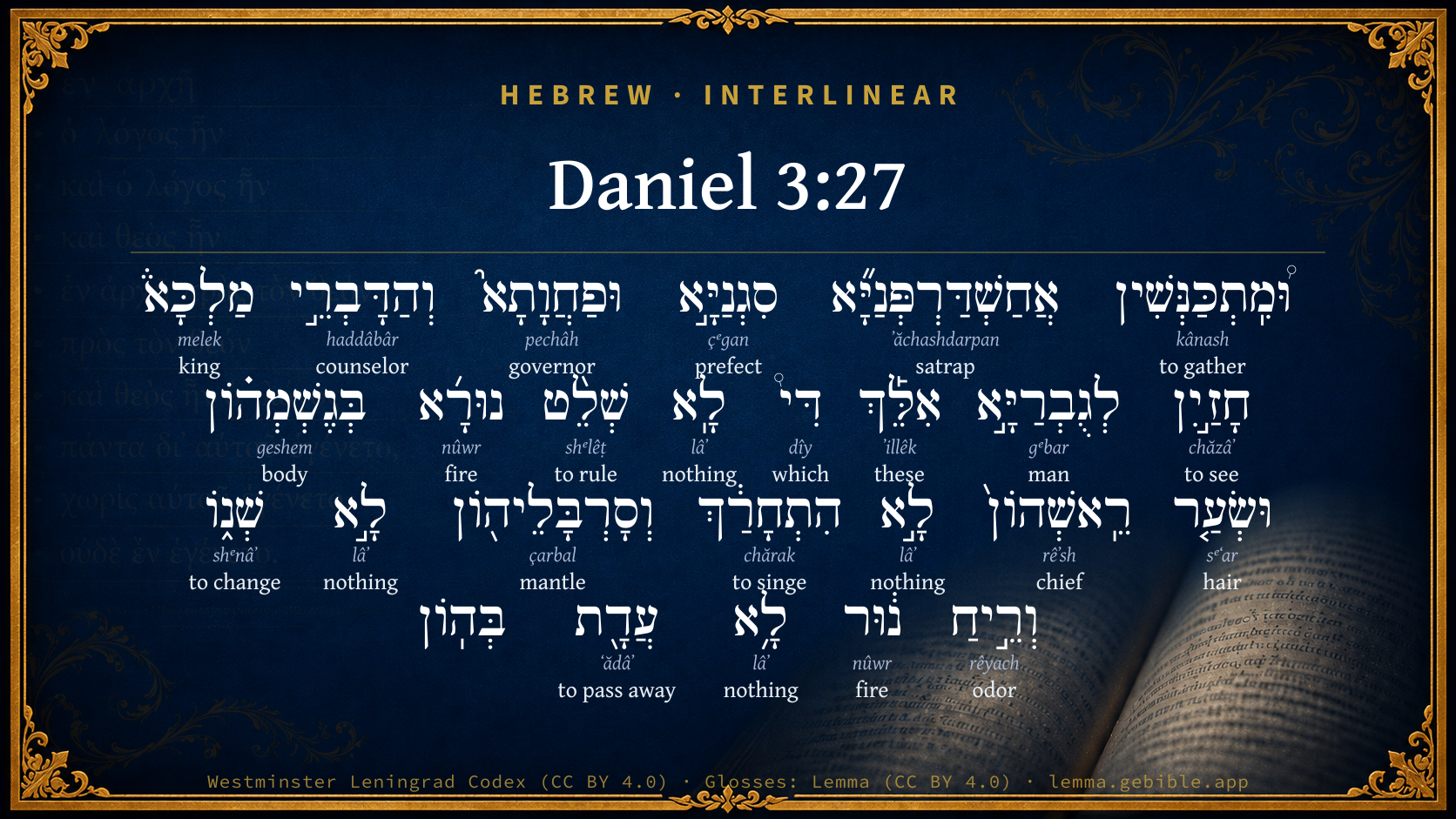
Hebrew (Westminster Leningrad Codex) Daniel 3:27 appears in the Hebrew Old Testament. The text above is from the Westminster Leningrad Codex. Each word links to its Strong’s number, a concise gloss, and parsing drawn from the Open Scriptures Hebrew Bible morphology. Click any word for its full Brown-Driver-Briggs (BDB) entry.
Download image
Cite this verse

Daniel 3:27 (World English Bible). Public Domain. Lemma interlinear Bible study tool, https://lemma.gebible.app/v/daniel/3/27.

Show BibTeX & RIS
BibTeX
RIS
English Translation
The satraps, the deputies, and the governors, and the king's counselors, being gathered together, saw these men, that the fire had no power on their bodies, nor was the hair of their head singed, neither were their pants changed, nor had the smell of fire passed on them.
World English Bible · Public Domain
Highlights
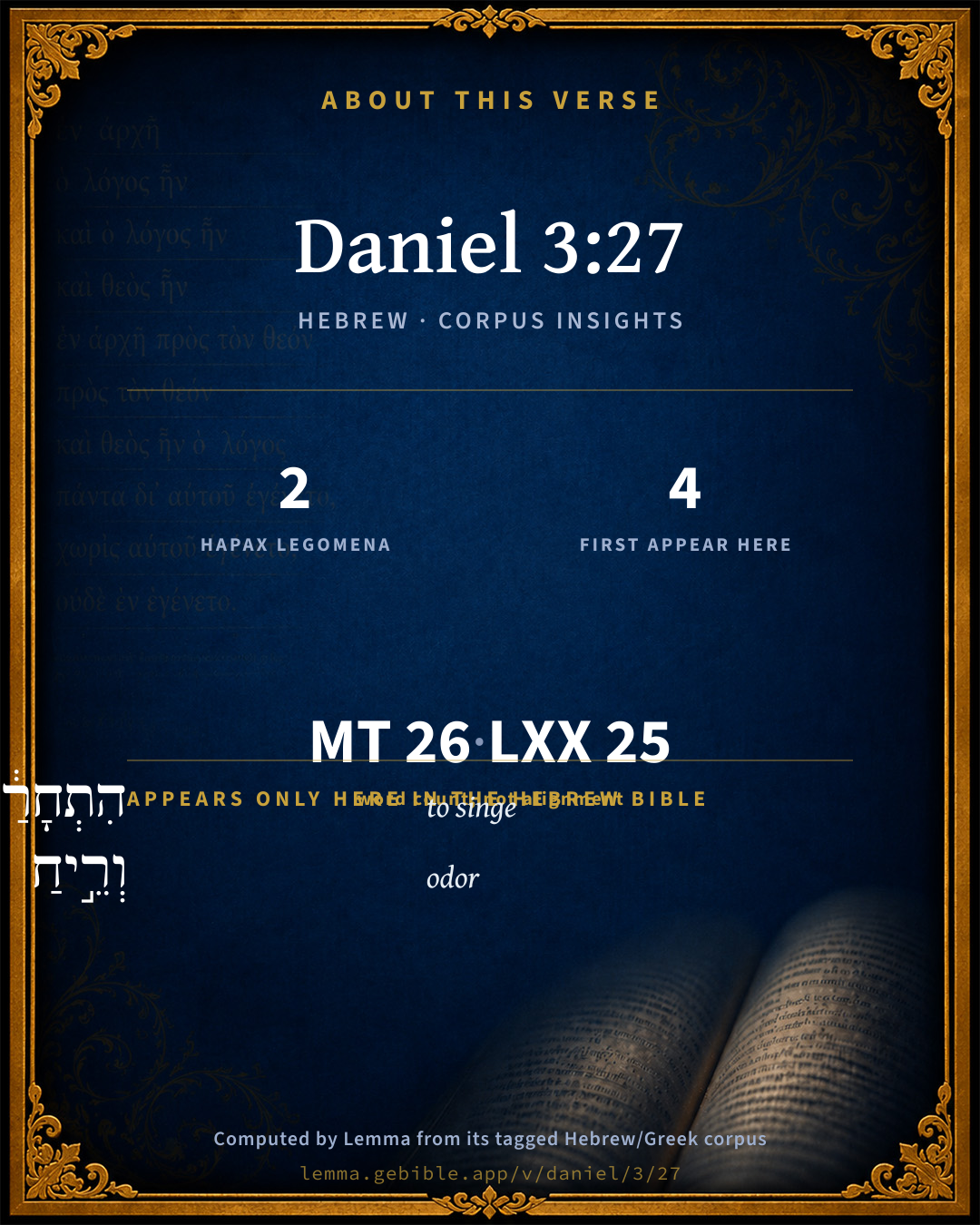
  • 2 hapax legomena — only here in the Hebrew Bible
  • 4 first appearances in the Hebrew Bible
Full analysis ↓
Download a study sheet

One document with this verse’s original text, its word-by-word gloss line, the meaning frame, cross-references with their text, attributed commentary, and full source and license credits — printable, and it pastes into notes with its structure intact.

This verse Autodidact and up

Study sheet (.html) Plain text (.txt)

A passage Seminary Student

Up to 50 verses in one chapter. A passage sheet keeps up to 6 commentary sources and 12 cross-references per verse, in the order this page ranks them, and says so on the sheet whenever that leaves anything out. Ask for a single verse and you get the Autodidact verse sheet above.

Everything on this page stays free to read, with no account — the sheet is a download of what is already on screen, not access to it.

Want to remove ads? Support Godless Engineer
Compare translations 3

The same verse in 3 English versions, stacked beneath the original-language interlinear above. Click any original word for its lexicon entry.

Each is an independent rendering of the whole verse — the interlinear is not word-aligned to these translations.

Highlighted words mark where these versions differ — a whole-verse word diff, not a word-by-word alignment.

  • World English Bible Public Domain
    The satraps, the deputies, and the governors, and the king's counselors, being gathered together, saw these men, that the fire had no power on their bodies, nor was the hair of their head singed, neither were their pants changed, nor had the smell of fire passed on them.
  • King James Version Public Domain
    And the princes, governors, and captains, and the king's counsellors, being gathered together, saw these men, upon whose bodies the fire had no power, nor was an hair of their head singed, neither were their coats changed, nor the smell of fire had passed on them.
  • unfoldingWord Literal Text CC BY-SA 4.0
    The satraps, the prefects, the governors, and the counselors of the king gathered together and saw that the fire had no power over the bodies of these men; the hair of their heads was not singed; their cloaks were not harmed; and the smell of fire had not come on them.

unfoldingWord Literal Text — © unfoldingWord, licensed CC BY-SA 4.0. Word-aligned USFM3 via Door43 (git.door43.org/unfoldingWord/en_ult).

Versions to compare (up to 4)

3 of 4 selected

Show all 18 translations

Every available English version of this verse, each an independent rendering of the whole verse.

  • World English Bible Public Domain
    The satraps, the deputies, and the governors, and the king's counselors, being gathered together, saw these men, that the fire had no power on their bodies, nor was the hair of their head singed, neither were their pants changed, nor had the smell of fire passed on them.
  • Berean Standard Bible Public Domain
    and when the satraps, prefects, governors, and royal advisers had gathered around, they saw that the fire had no effect on the bodies of these men. Not a hair of their heads was singed, their robes were unaffected, and there was no smell of fire on them.
  • Majority Standard Bible Public Domain
    and when the satraps, prefects, governors, and royal advisers had gathered around, they saw that the fire had no effect on the bodies of these men. Not a hair of their heads was singed, their robes were unaffected, and there was no smell of fire on them.
  • King James Version Public Domain
    And the princes, governors, and captains, and the king's counsellors, being gathered together, saw these men, upon whose bodies the fire had no power, nor was an hair of their head singed, neither were their coats changed, nor the smell of fire had passed on them.
  • American Standard Version (1901) Public Domain
    And the satraps, the deputies, and the governors, and the king's counsellors, being gathered together, saw these men, that the fire had no power upon their bodies, nor was the hair of their head singed, neither were their hosen changed, nor had the smell of fire passed on them.
  • Revised Version (1885) Public Domain
    And the satraps, the deputies, and the governors, and the king’s counsellors, being gathered together, saw these men, that the fire had no power upon their bodies, nor was the hair of their head singed, neither were their hosen changed, nor had the smell of fire passed on them.
  • Geneva Bible (1599) Public Domain
    Then the nobles, princes and dukes, and the Kings counsellers came together to see these men, because the fire had no power ouer their bodies: for not an heare of their head was burnt, neither was their coates changed, nor any smelll of fire came vpon them.
  • Douay-Rheims (1899) Public Domain
    And the nobles, and the magistrates, and the judges, and the great men of the king being gathered together, considered these men, that the fire had no power on their bodies, and that not a hair of their head had been singed, nor their garments altered, nor the smell of the fire had passed on them.
  • Young's Literal Translation Public Domain
    and gathered together, the satraps, the prefects, and the governors, and the counsellors of the king, are seeing these men, that the fire hath no power over their bodies, and the hair of their head hath not been singed, and their coats have not changed, and the smell of fire hath not passed on them.
  • Literal Standard Version CC BY-SA 4.0
    and gathered together, the satraps, the prefects, and the governors, and the counselors of the king, are seeing these men, that the fire has no power over their bodies, and the hair of their head has not been singed, and their coats have not changed, and the smell of fire has not passed on them.
  • Unlocked Literal Bible CC BY-SA 4.0
    The provincial governors, regional governors, other governors, and the king's counselors who had gathered together saw these men. The fire had not hurt their bodies; the hair on their heads was not singed; their robes were not harmed; and there was no smell of fire on them.
  • unfoldingWord Literal Text CC BY-SA 4.0
    The satraps, the prefects, the governors, and the counselors of the king gathered together and saw that the fire had no power over the bodies of these men; the hair of their heads was not singed; their cloaks were not harmed; and the smell of fire had not come on them.
  • Darby Bible Public Domain
    And the satraps, the prefects, and the governors, and the king's counsellors, being gathered together, saw these men, upon whose bodies the fire had had no power, nor was the hair of their head singed, neither were their hosen changed, nor had the smell of fire passed on them.
  • World Messianic Bible Public Domain
    The local governors, the deputies, and the governors, and the king’s counselors, being gathered together, saw these men, that the fire had no power on their bodies. The hair of their head wasn’t singed. Their pants weren’t changed. The smell of fire wasn’t even on them.
  • Webster's Bible Public Domain
    And the princes, governors, and captains, and the king's counselors, being assembled, saw these men, upon whose bodies the fire had no power, nor was a hair of their head singed, neither were their coats changed, nor had the smell of fire passed upon them.
  • Free Bible Version CC BY-SA 4.0
    The provincial governors, prefects, local governors, and the king's advisors gathered around them and saw that the fire had not harmed them. Their hair wasn't singed, their clothes weren't scorched—there wasn't even the smell of smoke!
  • Bible in Basic English Public Domain
    And the captains, the chiefs, and the rulers, and the king's wise men who had come together, saw these men, over whose bodies the fire had no power, and not a hair of their heads was burned, and their coats were not changed, and there was no smell of fire about them.
  • JPS Tanakh (1917) Public Domain
    And the satraps, the prefects, and the governors, and the king's ministers, being gathered together, saw these men, that the fire had no power upon their bodies, nor was the hair of their head singed, neither were their cloaks changed, nor had the smell of fire passed on them.

Literal Standard Version (2020), Covenant Press — licensed CC BY-SA 4.0. Text via the HelloAO Bible API (eBible.org). Unlocked Literal Bible (unfoldingWord) — licensed CC BY-SA 4.0. Text via the HelloAO Bible API (eBible.org). unfoldingWord Literal Text — © unfoldingWord, licensed CC BY-SA 4.0. Word-aligned USFM3 via Door43 (git.door43.org/unfoldingWord/en_ult). Free Bible Version, Dr. Jonathan Gallagher — licensed CC BY-SA 4.0. Text via the HelloAO Bible API (eBible.org).

Word by word

More ways to search: Search by grammar → Find every occurrence → Compare this word →

Practice this passage: Drill this verse → Learn its vocabulary →

הִתְחָרַ֔ךְ
chărak
H2761
“to singe”
Adjective, V, Plural
Part of Speech
Adjective
Number
Plural
Full BDB Definition

Origin: a root probably allied to the equivalent of H2787

TWOT: 2743

(Ithpael) to singe
  1. וּ֠מִֽתְכַּנְּשִׁין kânash H3673 “and · gathering” Adjective, C + Verb, Poal, Participle Active, Masculine, Plural, Absolute
  2. אֲחַשְׁדַּרְפְּנַיָּ֞א ʼăchashdarpan H324 “satraps · the” Adjective, N, Common + Particle, Definite Article
  3. סִגְנַיָּ֣א çᵉgan H5460 “prefects · the” Adjective, N, Common + Particle, Definite Article
  4. וּפַחֲוָתָא֮ pechâh H6347 “and · governors · the” Adjective, C + Noun, Common, Masculine, Plural, Determined + Particle, Definite Article
  5. וְהַדָּבְרֵ֣י haddâbâr H1907 “and · counselors of” Adjective, C + Noun, Common, Masculine, Plural, Construct
  6. מַלְכָּא֒ melek H4430 “king · the” Adjective, N, Common + Particle, Definite Article
  7. חָזַ֣יִן chăzâʼ H2370 “seeing” Adjective, V
  8. לְגֻבְרַיָּ֣א gᵉbar H1400 “to/for · men · the” Adjective, T + Noun, Common, Masculine, Plural, Determined + Particle, Definite Article
  9. אִלֵּ֡ךְ ʼillêk H479 “these” Adjective, P, Construct
  10. דִּי֩ dîy H1768 “which” Adjective, T
  11. לָֽא lâʼ H3809 “nothing” Adjective, T
  12. שְׁלֵ֨ט shᵉlêṭ H7981 “to rule” Adjective, V, Plural
  13. נוּרָ֜א nûwr H5135 “fire · the” Adjective, N, Common + Particle, Definite Article
  14. בְּגֶשְׁמְה֗וֹן geshem H1655 “in/at · body · their” Adjective, R + Noun, Common, Masculine, Singular, Construct + Suffix, Personal, 3rd Person, Masculine, Plural
  15. וּשְׂעַ֤ר sᵉʻar H8177 “and · hair of” Adjective, C + Noun, Common, Masculine, Singular, Construct
  16. רֵֽאשְׁהוֹן֙ rêʼsh H7217 “chief · their” Adjective, N, Common + Suffix, Personal, 3rd Person, Masculine, Plural
  17. לָ֣א lâʼ H3809 “nothing” Adjective, T
  18. וְסָרְבָּלֵיה֖וֹן çarbal H5622 “and · mantles · their” Adjective, C + Noun, Common, Masculine, Plural, Construct + Suffix, Personal, 3rd Person, Masculine, Plural
  19. לָ֣א lâʼ H3809 “nothing” Adjective, T
  20. שְׁנ֑וֹ shᵉnâʼ H8133 “to change” Adjective, V, Plural
  21. וְרֵ֣יחַ rêyach H7382 “and · odor of” Adjective, C + Noun, Common, Feminine, Singular, Construct
  22. נ֔וּר nûwr H5135 “fire” Adjective, N, Common
  23. לָ֥א lâʼ H3809 “nothing” Adjective, T
  24. עֲדָ֖ת ʻădâʼ H5709 “to pass away” Adjective, V, Plural

About this verse

These counts appear in no published source. They are computed here, from the morphology-tagged text and Lemma’s own curated glosses. What Lemma adds →

26
words
21
distinct lemmas
Prophets
section

Notable vocabulary

2 hapax legomena — words that appear only here in the entire Hebrew Bible:

  • הִתְחָרַ֔ךְ to singe H2761
  • וְרֵ֣יחַ odor H7382

First appearance in Scripture

These words make their first canonical appearance in the Hebrew Bible here:

  • בְּגֶשְׁמְה֗וֹן body H1655
  • וּשְׂעַ֤ר hair H8177
  • הִתְחָרַ֔ךְ to singe H2761
  • וְרֵ֣יחַ odor H7382

Shared distinctive vocabulary

וְסָרְבָּלֵיה֖וֹן mantle H5622 occurs in 2 verses of the Hebrew Bible. Also found in:

Grammatical profile

  • 1 verb
  • 5 nouns
  • 14 adjectives
  • 6 particles

Verb forms

  • וּ֠מִֽתְכַּנְּשִׁין Poal · Participle Active

Repetition

Words recur within this verse — often emphatic in Hebrew:

  • לָֽא nothing H3809 ×4
  • נוּרָ֜א fire H5135 ×2

Hebrew & Septuagint length

In English translation the verse runs 48 words from the Hebrew and 55 from the Septuagint (LXX English) — closely comparable.

A rough comparison of the two English renderings, which tokenize alike — not a word-level alignment.

Word counts can differ between the Hebrew and the Greek without any difference in meaning — e.g. the Hebrew direct-object marker אֵת has no separate Greek word, and Greek often adds the article ὁ.

In the original languages it is 26 Hebrew tokens and 25 Greek tokens — but the two are counted differently (Hebrew bundles its prefixes and suffixes into one token; the Greek is in lemma form), so that isn’t a like-for-like length.

Cross-references

14

Topical passages linked to Daniel 3:27 in the Treasury of Scripture Knowledge — connected by theme and wording, ordered by reader-vote popularity; previews shown in the World English Bible.

  • Isaiah 43:2 When you pass through the waters, I will be with you; and through the rivers, they shall not overflow you: when you walk through the fire, you shall not be burned, neither shall the flame kindle on you.
  • Hebrews 11:34 quenched the power of fire, escaped the edge of the sword, from weakness were made strong, grew mighty in war, and turned to flight armies of aliens.
  • Isaiah 26:11 Yahweh, your hand is lifted up, yet they don't see: but they shall see [your] zeal for the people, and be disappointed; yes, fire shall devour your adversaries.
  • Psalms 83:18 That they may know that you alone, whose name is Yahweh, Are the Most High over all the earth.
  • Matthew 10:30 but the very hairs of your head are all numbered.
  • Luke 21:17–18 You will be hated by all men for my name's sake.
  • Acts 27:34 Therefore I beg you to take some food, for this is for your safety; for not a hair will perish from any of your heads."
  • 1 Samuel 17:46–47 This day will Yahweh deliver you into my hand; and I will strike you, and take your head from off you; and I will give the dead bodies of the host of the Philistines this day to the birds of the sky, and to the wild animals of the earth; that all the earth may know that there is a God in Israel,
  • 2 Kings 19:19 Now therefore, Yahweh our God, save you us, I beg you, out of his hand, that all the kingdoms of the earth may know that you Yahweh are God alone.
  • Daniel 3:2–3 Then Nebuchadnezzar the king sent to gather together the satraps, the deputies, and the governors, the judges, the treasurers, the counselors, the sheriffs, and all the rulers of the provinces, to come to the dedication of the image which Nebuchadnezzar the king had set up.
  • Daniel 3:21 Then these men were bound in their pants, their tunics, and their mantles, and their [other] garments, and were cast into the midst of the burning fiery furnace.
  • Acts 2:6–12 When this sound was heard, the multitude came together, and were bewildered, because everyone heard them speaking in his own language.
  • Psalms 96:7–9 Ascribe to Yahweh, you families of nations, Ascribe to Yahweh glory and strength.
  • Acts 26:26 For the king knows of these things, to whom also I speak freely. For I am persuaded that none of these things is hidden from him, for this has not been done in a corner.

Cross-references courtesy of OpenBible.info (CC BY 4.0).

Hebrew and Greek witnesses Masoretic Hebrew ↔ Greek Septuagint

The same verse in the two great witnesses to the Old Testament, shown verse-for-verse.

These are two independent witnesses, not word-aligned to each other, and the Septuagint is shown in lemma (dictionary) form.

Hebrew Daniel 3:27 Masoretic · Westminster Leningrad Codex

וּ֠מִֽתְכַּנְּשִׁין אֲחַשְׁדַּרְפְּנַיָּ֞א סִגְנַיָּ֣א וּפַחֲוָתָא֮ וְהַדָּבְרֵ֣י מַלְכָּא֒ חָזַ֣יִן לְגֻבְרַיָּ֣א אִלֵּ֡ךְ דִּי֩ לָֽא שְׁלֵ֨ט נוּרָ֜א בְּגֶשְׁמְה֗וֹן וּשְׂעַ֤ר רֵֽאשְׁהוֹן֙ לָ֣א הִתְחָרַ֔ךְ וְסָרְבָּלֵיה֖וֹן לָ֣א שְׁנ֑וֹ וְרֵ֣יחַ נ֔וּר לָ֥א עֲדָ֖ת בְּהֽוֹן

The satraps, the deputies, and the governors, and the king's counselors, being gathered together, saw these men, that the fire had no power on their bodies, nor was the hair of their head singed, neither were their pants changed, nor had the smell of fire passed on them.

World English Bible · Public Domain

Greek LXX Daniel 3:27 Septuagint · lemma form

ὅτι δίκαιος εἰμί ἐπί πᾶς ὅς ποιέω ἐγώ καί πᾶς ὁ ἔργον σύ ἀληθινός καί ὁ ὁδός σύ εὐθύς καί πᾶς ὁ κρίσις σύ ἀληθινός

Then were assembled the satraps, and captains, and heads of provinces, and the royal princes; and they saw the men, and perceived that the fire had not had power against their bodies, and the hair of their head was not burnt, and their coats were not scorched, nor was the smell of fire upon them.

LXX2012 (modern English Septuagint) · Public Domain

On this verse, John Gill's Exposition discusses the Septuagint’s reading. Read the note in Commentary ↓

Hebrew: Westminster Leningrad Codex (CC BY 4.0). Greek: Septuagint (public domain); English from LXX2012 (modern English Septuagint) (Public Domain). How the Septuagint differs from the Hebrew →

Commentary

Notes on Daniel 3:27 from classic Christian and Jewish commentators (each source and its license shown beneath its notes). The classic Christian expositions comment on the surrounding passage and are grouped to its opening verse, so a note may address several verses; the Jewish commentaries on the Tanakh (Rashi and others) are per-verse, so they appear only where the commentator wrote on this verse.

Lemma curates 59 commentaries, every one of them public domain or Creative Commons licensed, each selected and text-cleaned for this edition rather than reprinted as found. About our sources →

Trapp's Complete Commentary

John Trapp

Dan 3:27 And the princes, governors, and captains, and the king’s counsellors, being gathered together, saw these men, upon whose bodies the fire had no power, nor was an hair of their head singed, neither were their coats changed, nor the smell of fire had passed on them.

Ver. 27. And the princes, governors, and captains.] Who were more obstinate than the king, and willing to have shut the windows lest the light should shine in upon them; but that there was no withstanding it.

Upon whose bodies the fire had no power.] See on Dan 3:23. The creatures are at a league with the saints. {Job 5:22}

John Trapp, A Commentary or Exposition upon All the Books of the Old and New Testament (1647–1656) — public domain. Text from a community e-Sword module.

Ibn Ezra

Rabbi Abraham ibn Ezra

[Daniel 3:27] And gathered (וּמִֽתְכַּנְּשִׁין - umitkanneshin)... and the royal companions (וְהַדָּבְרֵי מַלְכָּא - v'haddavrei malka): [These are] his counselors (yoʿatzav) who are accustomed to being with him (she-hen nehogin ʿimo).

On whose bodies (בְּגֶשְׁמְהוֹן - b'geshmehon): [Means] their bodies (gufotam). Like [the Hebrew word geshem (meaning rain, homonymous with the Aramaic for body) used in]: “and the rain (geshem) makes them grow” [Isaiah 44:14].

And the odor of fire... had not clung [lit. passed on] (וְרֵיחַ נוּר... לָא עֲדָת בְּהוֹן - v'reiach nur... la ʿadat b'hon): The odor of fire (reiach esh) did not pass (ʿavar) onto them. Like [the Hebrew verb ʿadah in]: “like one who takes off (maʿadeh) a garment on a cold day” [Proverbs 25:20].

Had not been singed (לָא הִתְחָרַךְ - la hitḥarakh): [This Aramaic verb is] like [its Hebrew cognate ch-r-k in]: “The lazy man will not roast (lo yacharokh) his prey” [Proverbs 12:27]. And [the verse] mentioned the outer garment (סַרְבָּלֵיהוֹן - sarbaleyhon), and there is no need to mention the others [as it implies they were also unharmed].

Ibn Ezra on the Tanakh — English translations: “Sefaria Community Translation” (CC0 1.0 (public-domain dedication)); “Yalkut, Sifsei Chachomim Chumash, Metsudah Publications, 2009” (CC BY 4.0); and “Commentary of Ibn Ezra on Isaiah - trans. by M. Friedlander, 1873” (public domain). Text via Sefaria.

Jamieson, Fausset & Brown

Robert Jamieson, A. R. Fausset & David Brown

nor . . . an hair-- (Luk 12:7; Luk 21:18).

fire had no power--fulfilling Isa 43:2; compare Heb 11:34. God alone is a "consuming fire" (Heb 12:29).

nor . . . smell of fire--compare spiritually, Th1 5:22.

Jamieson, Fausset & Brown — Commentary Critical and Explanatory on the Whole Bible (1871) — public domain (CC PDM 1.0). Text via the HelloAO Bible API.

Adam Clarke's Commentary

Verse 27. Upon whose bodies the fire had no pouter] The heathens boasted that their priests could walk on burning coals unhurt; and Virgil mentions this of the priests of Apollo of Soracte: -

Summe Deum, sancti custos Soractis Apollo!

Quem primi colimus, cui pineus ardor acervo

Pascitur; et medium, freti pietate, per ignem

Cultores multa premimus vestigia pruna.

VIRG. AEn. xi. 785.

O Phoebus, guardian of Soracte's woods

And shady hills; a god above the gods;

To whom our natives pay the rites divine,

And burn whole crackling groves of hallowed pine;

Walk through the fire in honour of thy name,

Unhurt, unsinged, and sacred from the flame.

PITTS.

But Varro tells us that they anointed the soles of their feet with a species of unguent that preserved them from being burnt. Very lately a female showed many feats of this kind, putting red hot iron upon her arms, breasts, c., and passing it over her hair without the slightest inconvenience but in the case of the three Hebrews all was supernatural, and the king and his officers well knew it.

Adam Clarke's Commentary on the Bible (1810–1826) — public domain. Text from a community e-Sword/MySword module.

John Calvin's Commentaries

Daniel relates how the satraps were gathered together with the leaders, prefects, and councilors of the king. The gathering was simply a collection of numbers, and if they deliberated about anything of importance, they all agreed. And this confirms the miracle, since if they had been stupefied, how could the great power of God be proposed to the eyes of the blind? Although they were so astonished, they were not altogether foolish, And Daniel implies this by saying, they were assembled together After they had discussed the matter, he says, they came to behold that specimen of the incredible power of God. Then he enumerates many reasons, which clearly shew these three men not to have been preserved by any other means than God’s singular good will. He says, The fire had no power over their bodies then, a hair of their head was not burnt thirdly, their garments were unchanged lastly, the smell of fire had not penetrated to themselves or their garments He expresses more by the word smell than if he had simply said, — the fire had not penetrated. For fire must naturally consume and burn up whatever is submitted to it; but when not even the smell of fire has passed over any substance, the miracle is more conspicuous. Now, we understand the Prophet’s intention. On the whole, he shews how the benefit of freedom was no, small one, since Shadrach, Meshach, and Abed-nego came out of the furnace. Besides, these satraps, prefects, and. governors, were witnesses of the power of God. Their testimony would be the more valuable, as all the Jews were, spectators of this grace of God, which even they scarcely believed. But since these men were clearly and professedly enemies to true piety, they would willingly have concealed the miracle, had it been in their power. But God draws them against their wills, and compels them to be eye-witnesses, and they are thus obliged to confess what cannot be in the slightest degree doubtful. It follows-

John Calvin's Commentaries (1540-1563) — public domain. Text from the Calvin Translation Society English edition (1840s-50s) via the Christian Classics Ethereal Library (ccel.org). Calvin's coverage is partial (roughly two-thirds of the Bible); uncommented books and verses are honest gaps, never fabricated. The 19th-century editor's footnotes and remarks are omitted so the notes are faithfully Calvin's own voice.

The Cambridge Bible for Schools and Colleges

gen. ed. J. J. S. Perowne

27. princes, governors, and captains] satraps, praefects, and governors. See on Dan_3:2.

counsellers] ministers (Dan_3:24).

upon whose bodies, &c.] that the fire had no power upon their bodies, nor was the hair, &c.

coats] either mantles, or trousers (Dan_3:21).

changed] viz. for the worse, a sense which the word often has in Aramaic. Cf. Dan_5:6.

The Cambridge Bible for Schools and Colleges (gen. ed. J. J. S. Perowne; Cambridge University Press, 1878–1918) — public domain. Text from a community e-Sword module.

John Gill's Exposition

Then Nebuchadnezzar spake and said,.... In the presence of his princes and prime ministers of state, and made the following confession, to the praise and glory of the true God; which was extorted from him at this time through the force of conviction; for it does not appear to be a thorough conversion; nor did he relinquish his gods, and the worship of them:

blessed be the God of Shadrach, Meshach, and Abednego; he does not call him his God, but theirs, as he had called him the God of Daniel before, Dan 2:47,

who hath sent his angel, and delivered his servants that trusted in him; the fourth man he saw in the furnace he now calls an angel of God; for the Heathens had notions of some being the messengers of the gods: this seems to favour the sense of those who think an angel is designed by the fourth person; though it does not follow that a created one must be meant; for it may be understood of the Angel of God's presence, the uncreated Angel, Jesus Christ; who, being sent by his divine Father; came and delivered these three persons from being consumed in the fire, who had in so strong a manner expressed their confidence in God, which the king now remembers and observes; see Dan 3:17,

and have changed the king's word; made it null and void, refused to obey it, knowing it was their duty to obey God rather than man; so that the king was forced to change his word, and, instead of obliging them to worship his image, blesses their God:

and yielded their bodies; freely gave them up, without any resistance, into the hands of those who were ordered by the king to take and bind them, and cast them into the furnace, to which also they readily yielded themselves: so the Septuagint and Arabic versions add, "to the fire",

that they might not serve nor worship any god except their own God; they chose rather to deliver up themselves to death, to be burnt in a furnace, than to serve any other god than the God of Israel; such was their constancy and firmness of mind; such their attachment to the true God, and their faithfulness to him.

John Gill's Exposition of the Whole Bible (1746–1763) — public domain (CC PDM 1.0). Text via the HelloAO Bible API.

Albert Barnes' Notes on the Bible

And the princes, governors, and captains - Notes, Dan 3:3.

And the king’s counselors - Notes, Dan 3:24.

Being gathered together, saw these men - There could be no mistake about the reality of the miracle. They came out as they were cast in. There could have been no trick, no art, no legerdemain, by which they could have been preserved and restored. If the facts occurred as they are stated here, then there can be no doubt that this was a real miracle.

Upon whose bodies the fire had no power - That is, the usual power of fire on the human body was prevented.

Nor was a hair of their head singed - That which would be most likely to have burned. The design is to show that the fire had produced absolutely no effect on them.

Neither were their coats changed - On the word “coats,” see the notes at Dan 3:21. The word “changed” means that there was no change caused by the fire either in their color or their texture.

Nor the smell of fire had passed on them - Not the slightest effect had been produced by the fire; not even so much as to occasion the smell caused by fire when cloth is singed or burned. Perhaps, however, sulphur or pitch had been used in heating the furnace; and the idea may be, that their preservation had been so entire, that not even the smell of the smoke caused by those combustibles could be perceived.

Albert Barnes' Notes on the Bible (1834–1885) — public domain. Text from a community e-Sword/MySword module.

Haydock's Catholic Bible Commentary

True; not fickle, and liable to change. (Calmet) --- Opera mutas non mutas consilium. (St. Augustine, Confessions i. 4.) --- Cappel. argues from this confession, that the piece is not divine, as they would rather have burst out into expressions of admiration, as they do in the canticle below. But they had done so already, (ver. 26) and make this confession, (Haydock) as Daniel does, Chap. ix.; reflecting, that if the nation had not transgressed, they would not thus have been exposed to the fury of the king. (Houbigant. v. 40.) (Haydock)

George Leo Haydock (1774–1849), Haydock's Catholic Family Bible and Commentary, 1859 edition — public domain. Excludes Psalms (Douay-Rheims chapter numbering differs from Protestant) and Deuterocanonical books (Catholic canon only).

Matthew Poole's English Annotations

Saw these men, with great admiration, for the satisfaction of all by their sight of them, and by their smell. All the works of God are perfect, and there was nothing here wanting to make this wonderful deliverance complete. Here was a pure act of God’s omnipotence, to divide between the fire and its most intense heat, and to master any creature in the world in its height, by working against and above nature, whose utmost sphere of activity is limited by God.

Matthew Poole's English Annotations on the Holy Bible (1683–1685) — public domain. Text from a community e-Sword/MySword module.

Whedon's Commentary on the Bible

Daniel D. Whedon

27. See note Dan_3:21. How triumphantly was Jehovah victor when even the hair of their heads was not singed nor even their loose white trousers scorched. (Compare Isa_43:2; Heb_11:34, and note Dan_3:25.) Some Jewish commentators sought to improve even this remarkable climax by saying that while their bodies were protected all their clothes had been burned away excepting this one garment.

Daniel D. Whedon (gen. ed.), Commentary on the Old and New Testaments (1874–1909) — public domain. Text from a community e-Sword module.

The Pulpit Commentary

And the princes, governors, and captains, and the king"s counsellors, being gathered together, saw these men, upon whose bodies the fire had no power, nor was a hair of their head singed, neither were their coats changed, nor the smell of fire had passed on them. The versions present no variation of importance. We can, however, at this point compare the list of officials with that which we find in the beginning of this chapter, in vers. 2 and 3. We find that the word haddabereen occupies the same place in the list as gedabreen, translated "treasurer," from which one might be inclined to think that h had taken the place of g, not an impossible change. The probability rather is that the word is to be regarded as collective, equivalent to "officials of the court," to save the repetition of the remaining classes Whether or not these officials had seen the companion the three witnesses for the truth had with them in the furnace, they, at all events, were now able to bear testimony to the fact that the three friends had escaped, and "had quenched the violence of the fire". (Heb_11:34) This event was all the more important to the Babylonians as to them fire was a god high in the pantheon. The God of Israel was thus manifested as so much greater than Iz-bar, that he could deliver his servants even when in the very element in which Iz-bar had his power. The fact that even their "coats whatever these garments were were not burned, and not even a hair singed, while the cords that hadbeen used to bind them were consumed, emphasizes their deliverance, and shows it to be the work of a higher power, who could discriminate and limit the deliverance. The cords were consumed, but the garments of his servants were preserved even from the smell of fire. The Babylonians had conquered the city of Jehovah, had burned his temple, and had done this through the power of Marduk, so they thought; but here Bel-Marduk had been openly defied by three worshippers of Jehovah. They had been hurled into the very element of Iz-bar, the servant and ally of Marduk, yet fire had been unable to harm them or vindicate the honour of Bel-Marduk. What emphasized this was that the fire that spared the servants of Jehovah slew the votaries of Bel-Marduk, who were eager to show their reverence for Marduk by carrying these Jehovah-worshippers to the furnace. Such a miracle, so wrought before all the high dignitaries of the Babylonian Empire, would go far to take the edge off any taunting reference to the weakness of Jehovah"s Godhead as demonstrated by the ruins of Jerusalem. Jehovah had shown himself as the supreme Revealer of secrets when he enabled Daniel to tell Nebuchadnezzar his dream. He now manifested himself as Master of the most powerful of elements fire. The Jews could thus maintain their faith unchallenged.

The Pulpit Commentary (1880–1919), ed. H.D.M. Spence-Jones & Joseph S. Exell — public domain. Text from a community e-Sword module.

Rashi

Rabbi Shlomo Yitzchaki (Rashi)

And the satraps...gathered Four nations were counted above in the first gathering who were not counted here: Adargazeria, Dethaveria, Gedaveria, Tiftaei. They are the mighty men whom the spark of fire had killed when they cast Hananiah and his colleagues into the fire.

saw these men saw these men: Hananiah and his colleagues.

that the fire had taken no effect on their bodies [as translated,] that the fire had taken no effect on their bodies.

on their bodies בְּגֶשְּׁמְהוֹן, their bodies, in Aramaic, and there are many [instances of it] in this Book.

the hair of their heads was not singed [as translated,] the hair of their heads was not singed.

their robes were not changed They did not change from their appearance.

and the smell of fire had not been absorbed by them Aram. לָא עֲדַת בְּהוֹן, did not pass into their midst.

Rashi on the Tanakh — English translations: “The Judaica Press complete Tanach with Rashi, translated by A. J. Rosenberg” (CC BY 4.0); “Pentateuch with Rashi's commentary by M. Rosenbaum and A.M. Silbermann, 1929-1934” (public domain); “The Metsudah Tanach series, Lakewood, N.J” (CC BY 4.0); and “The Book of Joshua, Metsudah Publications, 1997” (CC BY 4.0). Text via Sefaria.

Lesson kit

Teaching starters — assembled from the data on this page, not authored interpretation. Every prompt links to the verse data it draws on. Edit before teaching.

Daniel, in the Prophets, opens this verse with 26 words (21 distinct Hebrew lemmas). Its most distinctive word is chărak (“to singe”). A historical commentator’s framing appears above. Read the whole chapter for the surrounding context.

Discussion questions

  1. How does “to singe” (chărak) shape what this verse is saying?
  2. 2 words here appear nowhere else in the Hebrew Bible. Why might the author reach for such rare wording?
  3. 4 words make their first appearance in Scripture here. What does this debut establish?
  4. How does Daniel 3:21, which shares the word «mantle», read alongside this verse?
  5. What does the repetition of “nothing” (4× in this one verse) do in this verse?
  6. The translations on this page render this verse differently — a whole-verse word diff, not a word-by-word alignment. What might account for the different wordings?
  7. «וּ֠מִֽתְכַּנְּשִׁין» is a Poal Participle Active verb. How does that grammatical form shape the action described?
  8. Compare how Trapp's Complete Commentary and Ibn Ezra read this verse. Where do they agree or differ?

Things to notice

  • 2 words in this verse appear nowhere else in the Hebrew Bible.
  • 4 words make their first canonical appearance in Scripture here.
  • This verse counts 26 Hebrew ↔ 25 Greek words.
  • These translations choose different wording for 23 words in this verse.
  • “nothing” occurs 4× in this single verse.

Reading settings

Reading text

Shown beneath each verse's original-language words.

Old Testament
Old Testament edition

Read the OT as the Masoretic Hebrew (MT) or the Greek Septuagint (LXX).

English shown for the Greek Septuagint (in the Hebrew ↔ Greek comparison).

Comparing translations? Open the Compare panel on any verse page to stack up to four side by side.