Daniel 4:2

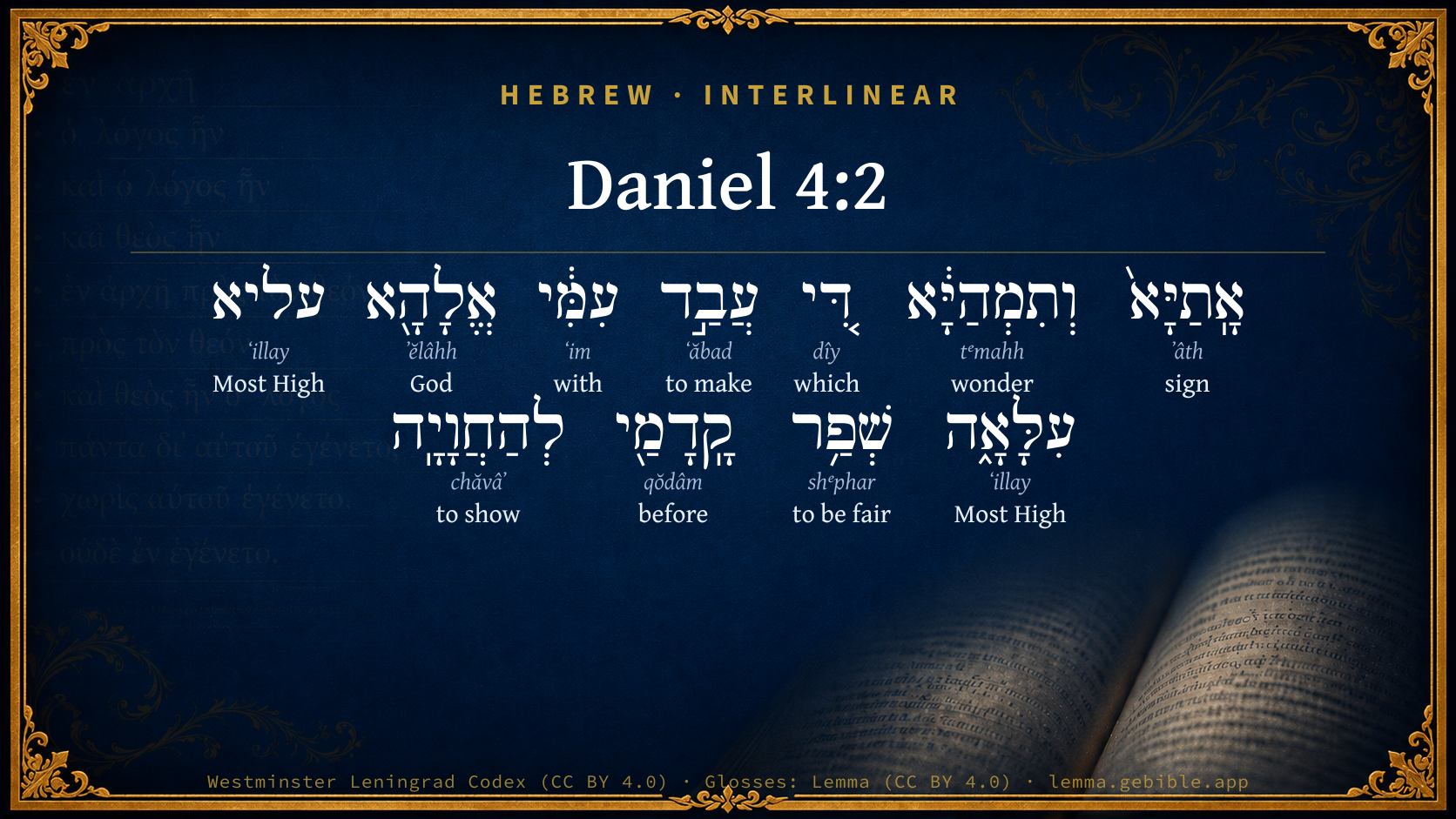
Hebrew (Westminster Leningrad Codex) Daniel 4:2 appears in the Hebrew Old Testament. The text above is from the Westminster Leningrad Codex. Each word links to its Strong’s number, a concise gloss, and parsing drawn from the Open Scriptures Hebrew Bible morphology. Click any word for its full Brown-Driver-Briggs (BDB) entry.
Download image
Cite this verse

Daniel 4:2 (World English Bible). Public Domain. Lemma interlinear Bible study tool, https://lemma.gebible.app/v/daniel/4/2.

Show BibTeX & RIS
BibTeX
RIS
English Translation
It has seemed good to me to show the signs and wonders that the Most High God has worked toward me.
World English Bible · Public Domain
Highlights
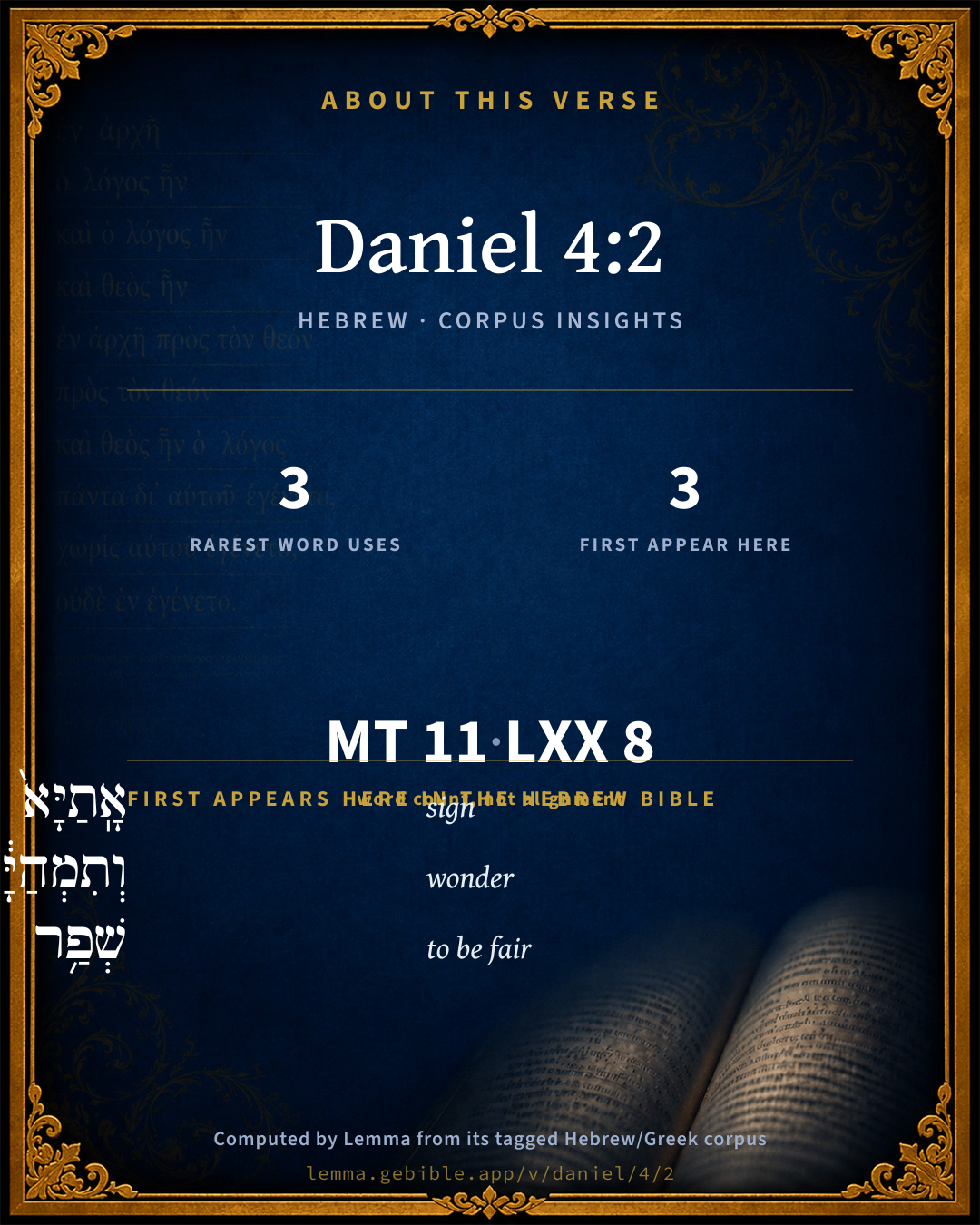
  • 3 first appearances in the Hebrew Bible
Full analysis ↓
Download a study sheet

One document with this verse’s original text, its word-by-word gloss line, the meaning frame, cross-references with their text, attributed commentary, and full source and license credits — printable, and it pastes into notes with its structure intact.

This verse Autodidact and up

Study sheet (.html) Plain text (.txt)

A passage Seminary Student

Up to 50 verses in one chapter. A passage sheet keeps up to 6 commentary sources and 12 cross-references per verse, in the order this page ranks them, and says so on the sheet whenever that leaves anything out. Ask for a single verse and you get the Autodidact verse sheet above.

Everything on this page stays free to read, with no account — the sheet is a download of what is already on screen, not access to it.

Want to remove ads? Support Godless Engineer
Compare translations 3

The same verse in 3 English versions, stacked beneath the original-language interlinear above. Click any original word for its lexicon entry.

Each is an independent rendering of the whole verse — the interlinear is not word-aligned to these translations.

Highlighted words mark where these versions differ — a whole-verse word diff, not a word-by-word alignment.

  • World English Bible Public Domain
    It has seemed good to me to show the signs and wonders that the Most High God has worked toward me.
  • King James Version Public Domain
    I thought it good to shew the signs and wonders that the high God hath wrought toward me.
  • unfoldingWord Literal Text CC BY-SA 4.0
    It has seemed good to me to make known the signs and wonders that the Most High God has done for me.

unfoldingWord Literal Text — © unfoldingWord, licensed CC BY-SA 4.0. Word-aligned USFM3 via Door43 (git.door43.org/unfoldingWord/en_ult).

Versions to compare (up to 4)

3 of 4 selected

Show all 18 translations

Every available English version of this verse, each an independent rendering of the whole verse.

  • World English Bible Public Domain
    It has seemed good to me to show the signs and wonders that the Most High God has worked toward me.
  • Berean Standard Bible Public Domain
    I am pleased to declare the signs and wonders that the Most High God has performed for me.
  • Majority Standard Bible Public Domain
    I am pleased to declare the signs and wonders that the Most High God has performed for me.
  • King James Version Public Domain
    I thought it good to shew the signs and wonders that the high God hath wrought toward me.
  • American Standard Version (1901) Public Domain
    It hath seemed good unto me to show the signs and wonders that the Most High God hath wrought toward me.
  • Revised Version (1885) Public Domain
    It hath seemed good unto me to shew the signs and wonders that the Most High God hath wrought toward me.
  • Geneva Bible (1599) Public Domain
    Saw a dreame, which made me afraide, and the thoughtes vpon my bed, and the visions of mine head troubled me.
  • Douay-Rheims (1899) Public Domain
    The most high God hath wrought signs and wonders toward me. It hath seemed good to me therefore to publish
  • Young's Literal Translation Public Domain
    The signs and wonders that God Most High hath done with me, it is good before me to shew.
  • Literal Standard Version CC BY-SA 4.0
    The signs and wonders that God Most High has done with me, it is good before me to show.
  • Unlocked Literal Bible CC BY-SA 4.0
    It has seemed good to me to tell you about the signs and wonders that the Most High has done for me.
  • unfoldingWord Literal Text CC BY-SA 4.0
    It has seemed good to me to make known the signs and wonders that the Most High God has done for me.
  • Darby Bible Public Domain
    It hath seemed good unto me to declare the signs and wonders that the Most High God hath wrought toward me.
  • World Messianic Bible Public Domain
    It has seemed good to me to show the signs and wonders that the Most High God has worked toward me.
  • Webster's Bible Public Domain
    I thought it good to show the signs and wonders that the high God hath wrought towards me.
  • Free Bible Version CC BY-SA 4.0
    It is my pleasure to share with you an account of the signs and wonders the Most High God has done for me.
  • Bible in Basic English Public Domain
    It has seemed good to me to make clear the signs and wonders which the Most High God has done with me.
  • JPS Tanakh (1917) Public Domain
    (3-32) It hath seemed good unto me to declare the signs and wonders that God Most High hath wrought toward me.

Literal Standard Version (2020), Covenant Press — licensed CC BY-SA 4.0. Text via the HelloAO Bible API (eBible.org). Unlocked Literal Bible (unfoldingWord) — licensed CC BY-SA 4.0. Text via the HelloAO Bible API (eBible.org). unfoldingWord Literal Text — © unfoldingWord, licensed CC BY-SA 4.0. Word-aligned USFM3 via Door43 (git.door43.org/unfoldingWord/en_ult). Free Bible Version, Dr. Jonathan Gallagher — licensed CC BY-SA 4.0. Text via the HelloAO Bible API (eBible.org).

Word by word

More ways to search: Search by grammar → Find every occurrence → Compare this word →

Practice this passage: Drill this verse → Learn its vocabulary →

אָֽתַיָּא֙
ʼâth
H852
“signs · the”
Adjective, N, Common + Particle, Definite Article
Part of Speech
Adjective + Particle
Type
Definite Article
Full BDB Definition

Origin: corresponding to H226

TWOT: 2617

sign, miraculous signs, wonders
  1. וְתִמְהַיָּ֔א tᵉmahh H8540 “and · wonders · the” Adjective, C + Noun, Common, Masculine, Plural, Determined + Particle, Definite Article
  2. דִּ֚י dîy H1768 “which” Adjective, T
  3. עֲבַ֣ד ʻăbad H5648 “to make” Adjective, V, Plural
  4. עִמִּ֔י ʻim H5974 “with · me” Adjective, R + Suffix, Personal, 1st Person, Common, Singular
  5. אֱלָהָ֖א ʼĕlâhh H426 “God · the” Adjective, N, Common + Particle, Definite Article
  6. עליא ʻillay H5943 “Most High · the” Adjective, A + Particle, Definite Article
  7. עִלָּאָ֑ה ʻillay H5943 “Most High · the” Adjective, A + Particle, Definite Article
  8. שְׁפַ֥ר shᵉphar H8232 “to be fair” Adjective, V, Plural
  9. קָֽדָמַ֖י qŏdâm H6925 “before · me” Adjective, R + Suffix, Personal, 1st Person, Common, Singular
  10. לְהַחֲוָיָֽה chăvâʼ H2324 “to show” Adjective, R + Verb, Hiphil, Infinitive Construct

About this verse

These counts appear in no published source. They are computed here, from the morphology-tagged text and Lemma’s own curated glosses. What Lemma adds →

11
words
10
distinct lemmas
Prophets
section

Notable vocabulary

The rarest word here is אָֽתַיָּא֙ sign H852 — appearing just 3 times in the whole Hebrew Bible.

First appearance in Scripture

These words make their first canonical appearance in the Hebrew Bible here:

  • אָֽתַיָּא֙ sign H852
  • וְתִמְהַיָּ֔א wonder H8540
  • שְׁפַ֥ר to be fair H8232

Shared distinctive vocabulary

אָֽתַיָּא֙ sign H852 occurs in 3 verses of the Hebrew Bible. Also found in:

Grammatical profile

  • 1 verb
  • 5 adjectives
  • 5 particles

Verb forms

  • לְהַחֲוָיָֽה Hiphil · Infinitive Construct

Repetition

A word recurs within this verse — often emphatic in Hebrew:

  • עליא Most High H5943 ×2

Hebrew & Septuagint length

In English translation the verse runs 21 words from the Hebrew and 23 from the Septuagint (LXX English) — closely comparable.

A rough comparison of the two English renderings, which tokenize alike — not a word-level alignment.

Word counts can differ between the Hebrew and the Greek without any difference in meaning — e.g. the Hebrew direct-object marker אֵת has no separate Greek word, and Greek often adds the article ὁ.

In the original languages it is 11 Hebrew tokens and 8 Greek tokens — but the two are counted differently (Hebrew bundles its prefixes and suffixes into one token; the Greek is in lemma form), so that isn’t a like-for-like length.

Cross-references

8

Topical passages linked to Daniel 4:2 in the Treasury of Scripture Knowledge — connected by theme and wording, ordered by reader-vote popularity; previews shown in the World English Bible.

  • Daniel 3:26 Then Nebuchadnezzar came near to the mouth of the burning fiery furnace: he spoke and said, Shadrach, Meshach, and Abednego, you servants of the Most High God, come forth, and come here. Then Shadrach, Meshach, and Abednego came forth out of the midst of the fire.
  • Psalms 66:16 Come, and hear, all you who fear God. I will declare what he has done for my soul.
  • Joshua 7:19 Joshua said to Achan, My son, please give glory to Yahweh, the God of Israel, and make confession to him; and tell me now what you have done; don't hide it from me.
  • Psalms 51:14 Deliver me from bloodguiltiness, O God, the God of my salvation. My tongue shall sing aloud of your righteousness.
  • Psalms 71:18 Yes, even when I am old and gray-haired, God, don't forsake me, Until I have declared your strength to the next generation, Your might to everyone who is to come.
  • Psalms 92:1–2 It is a good thing to give thanks to Yahweh, To sing praises to your name, Most High;
  • Acts 22:3–16 "I am indeed a Jew, born in Tarsus of Cilicia, but brought up in this city at the feet of Gamaliel, instructed according to the strict manner of the law of our fathers, being zealous for God, even as you all are this day.
  • Acts 26:9–16 "I myself most assuredly thought that I ought to do many things contrary to the name of Jesus of Nazareth.

Cross-references courtesy of OpenBible.info (CC BY 4.0).

Hebrew and Greek witnesses Masoretic Hebrew ↔ Greek Septuagint

The same verse in the two great witnesses to the Old Testament, shown verse-for-verse.

These are two independent witnesses, not word-aligned to each other, and the Septuagint is shown in lemma (dictionary) form.

Hebrew Daniel 4:2 Masoretic · Westminster Leningrad Codex

אָֽתַיָּא֙ וְתִמְהַיָּ֔א דִּ֚י עֲבַ֣ד עִמִּ֔י אֱלָהָ֖א עליא עִלָּאָ֑ה שְׁפַ֥ר קָֽדָמַ֖י לְהַחֲוָיָֽה

It has seemed good to me to show the signs and wonders that the Most High God has worked toward me.

World English Bible · Public Domain

Greek LXX Daniel 4:2 Septuagint · lemma form

ἐνύπνιον ὁράω καί εὐλαβέομαι καί φόβος ἐγώ ἐπιπίπτω

I saw a vision, and it terrified me, and I was troubled on my bed, and the visions of my head troubled me.

LXX2012 (modern English Septuagint) · Public Domain

On this verse, The Pulpit Commentary discusses the Septuagint’s reading. Read the note in Commentary ↓

Hebrew: Westminster Leningrad Codex (CC BY 4.0). Greek: Septuagint (public domain); English from LXX2012 (modern English Septuagint) (Public Domain). How the Septuagint differs from the Hebrew →

Commentary

Notes on Daniel 4:2 from classic Christian and Jewish commentators (each source and its license shown beneath its notes). The classic Christian expositions comment on the surrounding passage and are grouped to its opening verse, so a note may address several verses; the Jewish commentaries on the Tanakh (Rashi and others) are per-verse, so they appear only where the commentator wrote on this verse.

Lemma curates 59 commentaries, every one of them public domain or Creative Commons licensed, each selected and text-cleaned for this edition rather than reprinted as found. About our sources →

The Cambridge Bible for Schools and Colleges

gen. ed. J. J. S. Perowne

2. I thought it good] better (R.V.) It hath seemed good unto me.

to shew] to declare (Dan_2:4). ‘Shew’ suggests here, at least to modern readers, a wrong sense.

signs and wonders] similarly in Darius’s decree (Dan_4:27). Cf. ‘signs and portents,’ Deu_4:34; Deu_6:22; Deu_7:19 al. (where the Targ. of Pseudo-Jon. represents ‘portents’ by the same word ‘wonders,’ which is used here). The meaning is, significant and surprising evidences of power. The phraseology of the proclamation, both in Dan_4:2-3, and also in Dan_4:34-35; Dan_4:37, betrays its Jewish author.

the high God] God Most High (Dan_3:26).

toward] lit. with, i.e. (in dealing) with: cf. Psa_86:17 Heb.

The Cambridge Bible for Schools and Colleges (gen. ed. J. J. S. Perowne; Cambridge University Press, 1878–1918) — public domain. Text from a community e-Sword module.

Trapp's Complete Commentary

John Trapp

Dan 4:2 I thought it good to shew the signs and wonders that the high God hath wrought toward me.

Ver. 2. I thought it good.] Chald., It was meet (or seemly) before me; It was my duty, so Junius.

To show the signs and wonders.] "Signs" they were, because evident testimonies of God’s wisdom, justice, power; "wonders," because worthy to be wondered at.

John Trapp, A Commentary or Exposition upon All the Books of the Old and New Testament (1647–1656) — public domain. Text from a community e-Sword module.

Ibn Ezra

Rabbi Abraham ibn Ezra

[Daniel 4:2] Dream (חֵ֥לֶם), and it frightened me (וִֽידַחֲלִנַּ֑נִי): [Meaning] it scared me (הִפְחִידַנִי - hiphchidani).

And my thoughts (וְהַרְהֹרִין֙): The contemplation/musing of the heart. And it [this specific Aramaic word harhorin] has no [exact] parallel [in Scripture].

And the visions of my head (וְחֶזְוֵ֥י רֵאשִׁ֖י): [This phrase is used] because the eyes are in the head; or, because the vision is [formed] in the brain.

Ibn Ezra on the Tanakh — English translations: “Sefaria Community Translation” (CC0 1.0 (public-domain dedication)); “Yalkut, Sifsei Chachomim Chumash, Metsudah Publications, 2009” (CC BY 4.0); and “Commentary of Ibn Ezra on Isaiah - trans. by M. Friedlander, 1873” (public domain). Text via Sefaria.

Geneva Bible (1599)

Geneva Bible translators

This was another dream besides that which he saw of the four Empires, for Daniel both declared what that dream was, and what it meant, and here he only expoundeth the dream.

Geneva Bible (1599) marginal notes — public domain. Text via Bolls.life.

Jamieson, Fausset & Brown

Robert Jamieson, A. R. Fausset & David Brown

I thought it good--"It was seemly before me" (Psa 107:2-8).

signs--tokens significant of God's omnipotent agency. The plural is used, as it comprises the marvellous dream, the marvellous interpretation of it, and its marvellous issue.

Jamieson, Fausset & Brown — Commentary Critical and Explanatory on the Whole Bible (1871) — public domain (CC PDM 1.0). Text via the HelloAO Bible API.

Adam Clarke's Commentary

Verse 2. I thought it good to show] A part of the decree was a recital of the wonders wrought by the hand of the true God in his kingdom and on his person.

Adam Clarke's Commentary on the Bible (1810–1826) — public domain. Text from a community e-Sword/MySword module.

Ellicott's Commentary for English Readers

(2) Signs and wonders.—Comp. Isa_8:18. The appearance of various scriptural phrases in this letter leads us to believe that Daniel must have written it at the king’s request.

The high God.—Referring to his language (Dan_3:26).

A Bible Commentary for English Readers, edited by Charles John Ellicott (1878–1897) — public domain. Text from a community e-Sword module.

John Gill's Exposition

I thought it good,.... Or, "fair" (y) and beautiful, highly becoming me, what was my duty, and what might be profitable and beneficial to others, and make for the glory of the great God of heaven and earth:

to show the signs and wonders the high God hath wrought toward me; to declare by writing the wonderful things God, who is above all, the most high God, had done unto him, by giving him a wonderful dream, exactly describing his future case and condition, and then as wonderful an interpretation of it, and which was as wonderfully fulfilled, and, after all, in a wonderful manner restoring him to the exercise of his reason, and the administration of his kingdom, after both had departed from him.

(y) "pulchrum", Montanus, Grotius, Gejerus, Michaelis; "decet me", Junius & Tremellius.

John Gill's Exposition of the Whole Bible (1746–1763) — public domain (CC PDM 1.0). Text via the HelloAO Bible API.

Albert Barnes' Notes on the Bible

I thought it good - Margin, “it was seemly before me.” The marginal reading is more in accordance with the original (קדמי שׁפר shephar qâdâmay). The proper meaning of the Chaldee word (שׁפר shephar) is, to be fair or beautiful; and the sense here is, that it seemed to him to be appropriate or becoming to make this public proclamation. It was fit and right that what God had done to him should be proclaimed to all nations.

To show the signs and wonders - Signs and wonders, as denoting mighty miracles, are not unfrequently connected in the Scriptures. See Exo 7:3; Deu 4:34; Deu 13:1; Deu 34:11; Isa 8:18; Jer 32:20. The word rendered “signs” (Hebrew: אות 'ôth - Chaldee: את 'âth) means, properly, “a sign,” as something significant, or something that points out or designates anything; as Gen 1:14, “shall be for “signs” and for seasons;” that is, signs of seasons. Then the word denotes an ensign, a military flag, Num 2:2; then a sign of something past, a token or remembrancer, Exo 13:9, Exo 13:16; Deu 6:8; then a sign of something future, a portent, an omen, Isa 8:18; then a sign or token of what is visible, as circumcision, Gen 17:11, or the rainbow in the cloud, as a token of the covenant which God made with man, Gen 9:12; then anything which serves as a sign or proof of the fulfillment of prophecy, Exo 3:12; 1Sa 2:34; and then it refers to anything which is a sign or proof of Divine power, Deu 4:34; Deu 6:22; Deu 7:19, “et al.”

The Hebrew word is commonly rendered “signs,” but it is also rendered “token, ensign, miracles.” As applied to what God does, it seems to be used in the sense of anything that is significant of his presence and power; anything that shall manifestly show that, what occurs is done by him; anything that is beyond human ability, and that makes known the being and the perfections of God by a direct and extraordinary manifestation. Here the meaning is, that what was done in so remarkable a manner was significant of the agency of God; it was what demonstrated that he exists, and that showed his greatness. The word rendered “wonders” (תמה temahh) means, properly, what is fitted to produce astonishment, or to lead one to wonder, and is applied to miracles as adapted to produce that effect. It refers to that state of mind which exists where anything occurs out of the ordinary course of nature, or which indicates supernatural power. The Hebrew word rendered “wonders” is often used to denote miracles, Exo 3:20; Exo 7:3; Exo 11:9; Deu 6:22, “et al.” The meaning here is, that what had occurred was fitted to excite amazement, and to lead men to wonder at the mighty works of God.

That the high God - The God who is exalted, or lifted up; that is, the God who is above all. See Dan 3:26. It is an appellation which would be given to God as the Supreme Being. The Greek translation of this verse is, “And now I show unto you the deeds - πράξεις praxeis - which the great God has done unto me, for it seemed good to me to show to you and your wise men” - τοῖς σοφισταῖς ὑμῶν tois sophistais humōn.

Albert Barnes' Notes on the Bible (1834–1885) — public domain. Text from a community e-Sword/MySword module.

Matthew Poole's English Annotations

I did upon mature thoughts judge it very becoming me, yea, it was my pleasure to let all the world know,

1. The signs and wonders,

2. Wrought by the high God,

3. Toward me, wherein I was personally concerned: these were his reasons why he made it known to the world.

Matthew Poole's English Annotations on the Holy Bible (1683–1685) — public domain. Text from a community e-Sword/MySword module.

The Pulpit Commentary

Vers. 2, 3. I thought it good to show the signs and wonders that the high God hath wrought toward me. How great are his signs! and how mighty are his wonders! his kingdom is an everlasting kingdom, and his dominion is from generation to generation. The Greek versions for these two verses are in absolute agreement, hence one is not surprised to find that in the Syriac of Paulus Tellensis, these verses, with that preceding, are marked with an asterisk, which proclaims them not to have been regarded by their translator as a genuine part of the Septuagint, but to have been added from Theodotion. They are in close agreement with the Massoretic text. In these two verses the Peshitta is also at one with the Massoretic text. It is possible that this may have been the actual beginning of the document; on the other hand, it may have been simply the suggestion of some later scribe of how such a proclamation might have begun. The latter is, perhaps, the more probable. At the same time, it vindicates its position by being a not unnatural expression of feelings such as Nebuchadnezzar might well be supposed to have had after such an experience as he had passed through. It may even be that the signs and wonders to which Nebuchadnezzar refers are not merely those of his dream and its fulfilment, but all the signs that had been manifested in his reign.

The Pulpit Commentary (1880–1919), ed. H.D.M. Spence-Jones & Joseph S. Exell — public domain. Text from a community e-Sword module.

Rashi

Rabbi Shlomo Yitzchaki (Rashi)

and it frightened me It brought upon me fear and fright.

Rashi on the Tanakh — English translations: “The Judaica Press complete Tanach with Rashi, translated by A. J. Rosenberg” (CC BY 4.0); “Pentateuch with Rashi's commentary by M. Rosenbaum and A.M. Silbermann, 1929-1934” (public domain); “The Metsudah Tanach series, Lakewood, N.J” (CC BY 4.0); and “The Book of Joshua, Metsudah Publications, 1997” (CC BY 4.0). Text via Sefaria.

Lesson kit

Teaching starters — assembled from the data on this page, not authored interpretation. Every prompt links to the verse data it draws on. Edit before teaching.

Daniel, in the Prophets, opens this verse with 11 words (10 distinct Hebrew lemmas). Its most distinctive word is ʼâth (“sign”). A historical commentator’s framing appears above. Read the whole chapter for the surrounding context.

Discussion questions

  1. How does “sign” (ʼâth) shape what this verse is saying?
  2. 3 words make their first appearance in Scripture here. What does this debut establish?
  3. How does Daniel 4:3, which shares the word «sign», read alongside this verse?
  4. What does the repetition of “Most High” (2× in this one verse) do in this verse?
  5. The translations on this page render this verse differently — a whole-verse word diff, not a word-by-word alignment. What might account for the different wordings?
  6. «לְהַחֲוָיָֽה» is a Hiphil Infinitive Construct verb. How does that grammatical form shape the action described?
  7. Compare how The Cambridge Bible for Schools and Colleges and Trapp's Complete Commentary read this verse. Where do they agree or differ?

Things to notice

Reading settings

Reading text

Shown beneath each verse's original-language words.

Old Testament
Old Testament edition

Read the OT as the Masoretic Hebrew (MT) or the Greek Septuagint (LXX).

English shown for the Greek Septuagint (in the Hebrew ↔ Greek comparison).

Comparing translations? Open the Compare panel on any verse page to stack up to four side by side.