
Daniel 5:15

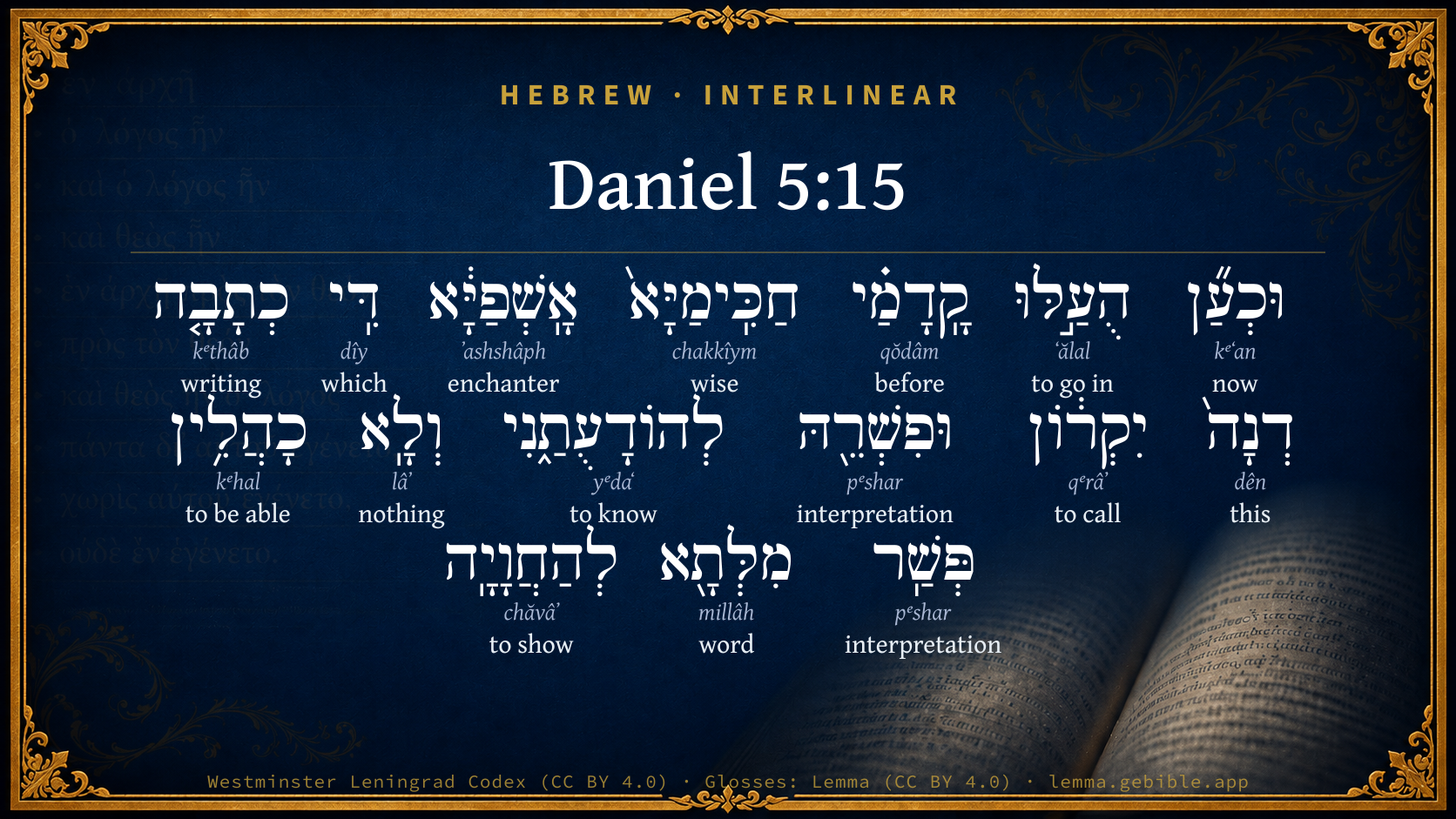
Hebrew (Westminster Leningrad Codex) Daniel 5:15 appears in the Hebrew Old Testament. The text above is from the Westminster Leningrad Codex. Each word links to its Strong’s number, a concise gloss, and parsing drawn from the Open Scriptures Hebrew Bible morphology. Click any word for its full Brown-Driver-Briggs (BDB) entry.
Download image
Cite this verse

Daniel 5:15 (World English Bible). Public Domain. Lemma interlinear Bible study tool, https://lemma.gebible.app/v/daniel/5/15.

Show BibTeX & RIS
BibTeX
RIS
English Translation
Now the wise men, the enchanters, have been brought in before me, that they should read this writing, and make known to me the interpretation of it; but they could not show the interpretation of the thing.
World English Bible · Public Domain
Download a study sheet

One document with this verse’s original text, its word-by-word gloss line, the meaning frame, cross-references with their text, attributed commentary, and full source and license credits — printable, and it pastes into notes with its structure intact.

This verse Autodidact and up

Study sheet (.html) Plain text (.txt)

A passage Seminary Student

Up to 50 verses in one chapter. A passage sheet keeps up to 6 commentary sources and 12 cross-references per verse, in the order this page ranks them, and says so on the sheet whenever that leaves anything out. Ask for a single verse and you get the Autodidact verse sheet above.

Everything on this page stays free to read, with no account — the sheet is a download of what is already on screen, not access to it.

Want to remove ads? Support Godless Engineer
Compare translations 3

The same verse in 3 English versions, stacked beneath the original-language interlinear above. Click any original word for its lexicon entry.

Each is an independent rendering of the whole verse — the interlinear is not word-aligned to these translations.

Highlighted words mark where these versions differ — a whole-verse word diff, not a word-by-word alignment.

  • World English Bible Public Domain
    Now the wise men, the enchanters, have been brought in before me, that they should read this writing, and make known to me the interpretation of it; but they could not show the interpretation of the thing.
  • King James Version Public Domain
    And now the wise men, the astrologers, have been brought in before me, that they should read this writing, and make known unto me the interpretation thereof: but they could not shew the interpretation of the thing:
  • unfoldingWord Literal Text CC BY-SA 4.0
    Now the wise men and enchanters have been brought in before me to read this writing and make known to me its interpretation, but they could not show the interpretation of the matter.

unfoldingWord Literal Text — © unfoldingWord, licensed CC BY-SA 4.0. Word-aligned USFM3 via Door43 (git.door43.org/unfoldingWord/en_ult).

Versions to compare (up to 4)

3 of 4 selected

Show all 18 translations

Every available English version of this verse, each an independent rendering of the whole verse.

  • World English Bible Public Domain
    Now the wise men, the enchanters, have been brought in before me, that they should read this writing, and make known to me the interpretation of it; but they could not show the interpretation of the thing.
  • Berean Standard Bible Public Domain
    Now the wise men and enchanters were brought before me to read this inscription and interpret it for me, but they could not give its interpretation.
  • Majority Standard Bible Public Domain
    Now the wise men and enchanters were brought before me to read this inscription and interpret it for me, but they could not give its interpretation.
  • King James Version Public Domain
    And now the wise men, the astrologers, have been brought in before me, that they should read this writing, and make known unto me the interpretation thereof: but they could not shew the interpretation of the thing:
  • American Standard Version (1901) Public Domain
    And now the wise men, the enchanters, have been brought in before me, that they should read this writing, and make known unto me the interpretation thereof; but they could not show the interpretation of the thing.
  • Revised Version (1885) Public Domain
    And now the wise men, the enchanters, have been brought in before me, that they should read this writing, and make known unto me the interpretation thereof: but they could not shew the interpretation of the thing.
  • Geneva Bible (1599) Public Domain
    Now therefore, wisemen and astrologians haue bene brought before me, that they should reade this writing, and shewe me the interpretation thereof: but they could not declare the interpretation of the thing.
  • Douay-Rheims (1899) Public Domain
    And now the wise men the magicians have come in before me, to read this writing, and shew me the interpretation thereof: and they could not declare to me the meaning of this writing.
  • Young's Literal Translation Public Domain
    `And now, caused to come up before me have been the wise men, the enchanters, that this writing they may read, and its interpretation to cause me to know: and they are not able to shew the interpretation of the thing:
  • Literal Standard Version CC BY-SA 4.0
    And now, caused to come up before me have been the wise men, the enchanters, that they may read this writing, and its interpretation to cause me to know: and they are not able to show the interpretation of the thing:
  • Unlocked Literal Bible CC BY-SA 4.0
    Now the men known for wisdom and those who claim to speak with the dead have been brought in before me to read this writing and make known to me its interpretation, but they could not make known the interpretation of it.
  • unfoldingWord Literal Text CC BY-SA 4.0
    Now the wise men and enchanters have been brought in before me to read this writing and make known to me its interpretation, but they could not show the interpretation of the matter.
  • Darby Bible Public Domain
    And now the wise men, the magicians, have been brought in before me, that they should read this writing, and make known unto me the interpretation thereof; but they could not shew the interpretation of the thing.
  • World Messianic Bible Public Domain
    Now the wise men, the enchanters, have been brought in before me, that they should read this writing, and make known to me its interpretation; but they could not show the interpretation of the thing.
  • Webster's Bible Public Domain
    And now the wise men, the astrologers, have been brought in before me, that they should read this writing, and make known to me the interpretation of it, but they could not show the interpretation of the thing:
  • Free Bible Version CC BY-SA 4.0
    Just now the wise men and enchanters were brought before me to read this writing and explain it to me, but they weren't able to do so—they couldn't tell me what it meant.
  • Bible in Basic English Public Domain
    And now the wise men, the users of secret arts, have been sent in before me for the purpose of reading this writing and making clear to me the sense of it: but they are not able to make clear the sense of the thing:
  • JPS Tanakh (1917) Public Domain
    And now the wise men, the enchanters, have been brought in before me, that they should read this writing, and make known unto me the interpretation thereof; but they could not declare the interpretation of the thing.

Literal Standard Version (2020), Covenant Press — licensed CC BY-SA 4.0. Text via the HelloAO Bible API (eBible.org). Unlocked Literal Bible (unfoldingWord) — licensed CC BY-SA 4.0. Text via the HelloAO Bible API (eBible.org). unfoldingWord Literal Text — © unfoldingWord, licensed CC BY-SA 4.0. Word-aligned USFM3 via Door43 (git.door43.org/unfoldingWord/en_ult). Free Bible Version, Dr. Jonathan Gallagher — licensed CC BY-SA 4.0. Text via the HelloAO Bible API (eBible.org).

Word by word

More ways to search: Search by grammar → Find every occurrence → Compare this word →

Practice this passage: Drill this verse → Learn its vocabulary →

כָהֲלִ֥ין
kᵉhal
H3546
“being able”
Adjective, V
Part of Speech
Adjective
Full BDB Definition

Origin: a root corresponding to H3201 and H3557

TWOT: 2785

to be able - (Peal) to be able
  1. וּכְעַ֞ן kᵉʻan H3705 “and · now” Adjective, C + Adverb
  2. הֻעַ֣לּוּ ʻălal H5954 “to go in” Adjective, V, Plural
  3. קָֽדָמַ֗י qŏdâm H6925 “before · me” Adjective, R + Suffix, Personal, 1st Person, Common, Singular
  4. חַכִּֽימַיָּא֙ chakkîym H2445 “wise men · the” Adjective, N, Common + Particle, Definite Article
  5. אָֽשְׁפַיָּ֔א ʼashshâph H826 “enchanters · the” Adjective, N, Common + Particle, Definite Article
  6. דִּֽי dîy H1768 “which” Adjective, C
  7. כְתָבָ֤ה kᵉthâb H3792 “writing · the” Adjective, N, Common + Particle, Definite Article
  8. דְנָה֙ dên H1836 “this” Adjective, P
  9. יִקְר֔וֹן qᵉrâʼ H7123 “to call” Adjective, V
  10. וּפִשְׁרֵ֖הּ pᵉshar H6591 “and · interpretation · his” Adjective, C + Noun, Common, Masculine, Singular, Construct + Suffix, Personal, 3rd Person, Masculine, Singular
  11. לְהוֹדָעֻתַ֑נִי yᵉdaʻ H3046 “to know · me” Adjective, R + Verb, Hiphil, Infinitive Construct + Suffix, Personal, 1st Person, Common, Singular
  12. וְלָֽא lâʼ H3809 “and · nothing” Adjective, C + Particle, Negative
  13. פְּשַֽׁר pᵉshar H6591 “interpretation of” Adjective, N, Common
  14. מִלְּתָ֖א millâh H4406 “word · the” Adjective, N, Common + Particle, Definite Article
  15. לְהַחֲוָיָֽה chăvâʼ H2324 “to show” Adjective, R + Verb, Hiphil, Infinitive Construct

About this verse

These counts appear in no published source. They are computed here, from the morphology-tagged text and Lemma’s own curated glosses. What Lemma adds →

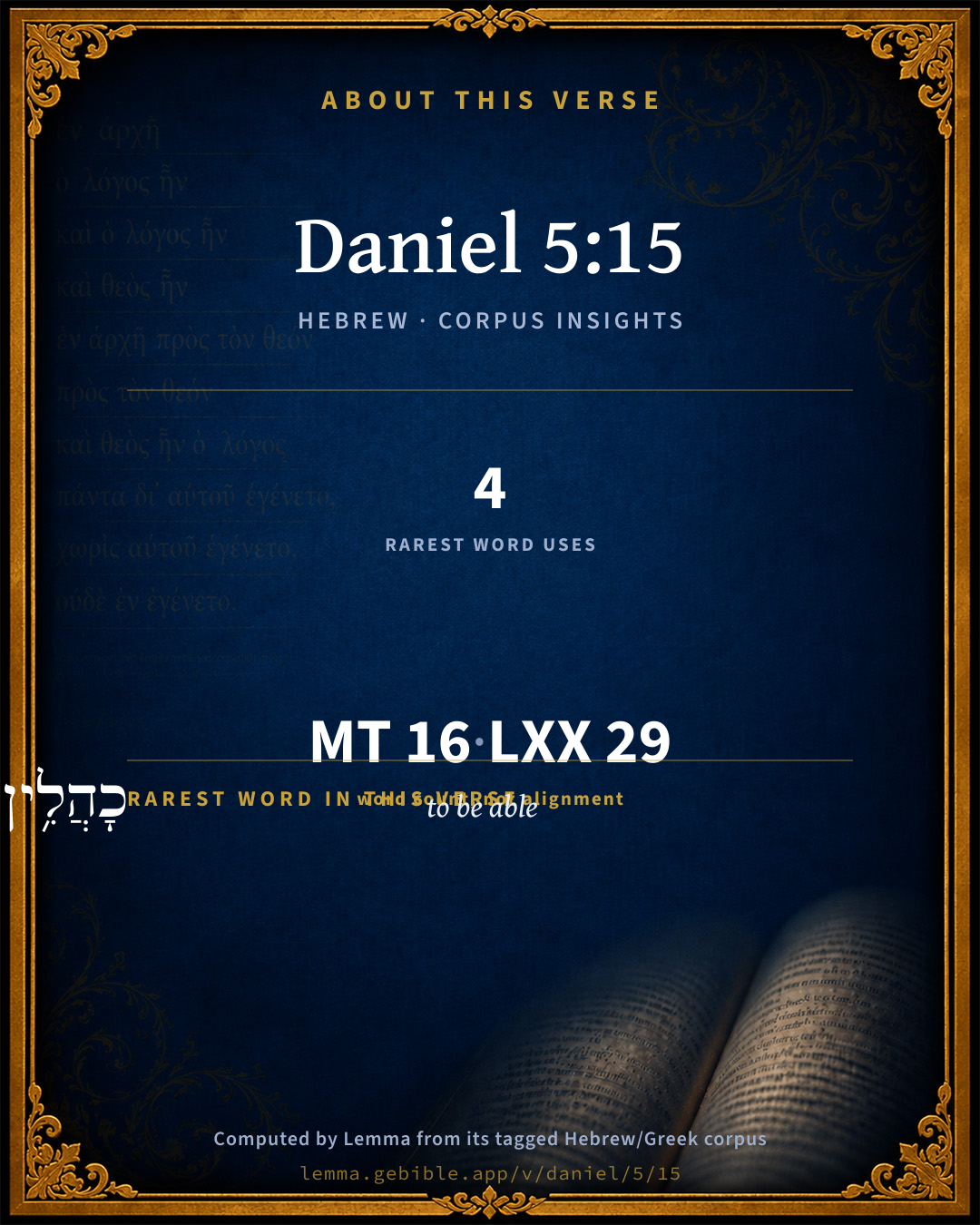
16
words
15
distinct lemmas
Prophets
section

Notable vocabulary

The rarest word here is כָהֲלִ֥ין to be able H3546 — appearing just 4 times in the whole Hebrew Bible.

Shared distinctive vocabulary

כָהֲלִ֥ין to be able H3546 occurs in 4 verses of the Hebrew Bible. Also found in:

Grammatical profile

  • 2 verbs
  • 1 noun
  • 7 adjectives
  • 1 adverb
  • 5 particles

Verb forms

  • לְהוֹדָעֻתַ֑נִי Hiphil · Infinitive Construct
  • לְהַחֲוָיָֽה Hiphil · Infinitive Construct

Repetition

A word recurs within this verse — often emphatic in Hebrew:

  • וּפִשְׁרֵ֖הּ interpretation H6591 ×2

Hebrew & Septuagint length

In English translation the verse runs 37 words from the Hebrew and 31 from the Septuagint (LXX English) — closely comparable.

A rough comparison of the two English renderings, which tokenize alike — not a word-level alignment.

Word counts can differ between the Hebrew and the Greek without any difference in meaning — e.g. the Hebrew direct-object marker אֵת has no separate Greek word, and Greek often adds the article ὁ.

In the original languages it is 16 Hebrew tokens and 29 Greek tokens — but the two are counted differently (Hebrew bundles its prefixes and suffixes into one token; the Greek is in lemma form), so that isn’t a like-for-like length.

Cross-references

4

Topical passages linked to Daniel 5:15 in the Treasury of Scripture Knowledge — connected by theme and wording, ordered by reader-vote popularity; previews shown in the World English Bible.

  • Daniel 5:7–8 The king cried aloud to bring in the enchanters, the Chaldeans, and the soothsayers. The king spoke and said to the wise men of Babylon, Whoever shall read this writing, and show me the interpretation of it, shall be clothed with purple, and have a chain of gold about his neck, and shall be the third ruler in the kingdom.
  • Isaiah 47:12 Stand now with your enchantments, and with the multitude of your sorceries, in which you have labored from your youth; if so be you shall be able to profit, if so be you may prevail.
  • Isaiah 29:10–12 For Yahweh has poured out on you the spirit of deep sleep, and has closed your eyes, the prophets; and your heads, the seers, has he covered.
  • Daniel 2:3–11 The king said to them, I have dreamed a dream, and my spirit is troubled to know the dream.

Cross-references courtesy of OpenBible.info (CC BY 4.0).

Hebrew and Greek witnesses Masoretic Hebrew ↔ Greek Septuagint

The same verse in the two great witnesses to the Old Testament, shown verse-for-verse.

These are two independent witnesses, not word-aligned to each other, and the Septuagint is shown in lemma (dictionary) form.

Hebrew Daniel 5:15 Masoretic · Westminster Leningrad Codex

וּכְעַ֞ן הֻעַ֣לּוּ קָֽדָמַ֗י חַכִּֽימַיָּא֙ אָֽשְׁפַיָּ֔א דִּֽי כְתָבָ֤ה דְנָה֙ יִקְר֔וֹן וּפִשְׁרֵ֖הּ לְהוֹדָעֻתַ֑נִי וְלָֽא כָהֲלִ֥ין פְּשַֽׁר מִלְּתָ֖א לְהַחֲוָיָֽה

Now the wise men, the enchanters, have been brought in before me, that they should read this writing, and make known to me the interpretation of it; but they could not show the interpretation of the thing.

World English Bible · Public Domain

Greek LXX Daniel 5:15 Septuagint · lemma form

τότε δανιηλ ἵστημι κατέναντι ὁ γραφή καί ἀναγιγνώσκω καί οὕτως ἀποκρίνω ὁ βασιλεύς οὗτος ὁ γραφή ἀριθμέω καταλογίζομαι ἐκαἴρω καί ἵστημι ὁ γράφω χείρ καί οὗτος ὁ σύγκρισις αὐτός

And now, the wise men, magicians, and soothsayers, have come in before me, to read the writing, and make known to me the interpretation: but they could not tell it me.

LXX2012 (modern English Septuagint) · Public Domain

Hebrew: Westminster Leningrad Codex (CC BY 4.0). Greek: Septuagint (public domain); English from LXX2012 (modern English Septuagint) (Public Domain). How the Septuagint differs from the Hebrew →

Commentary

Notes on Daniel 5:15 from classic Christian and Jewish commentators (each source and its license shown beneath its notes). The classic Christian expositions comment on the surrounding passage and are grouped to its opening verse, so a note may address several verses; the Jewish commentaries on the Tanakh (Rashi and others) are per-verse, so they appear only where the commentator wrote on this verse.

Lemma curates 59 commentaries, every one of them public domain or Creative Commons licensed, each selected and text-cleaned for this edition rather than reprinted as found. About our sources →

Trapp's Complete Commentary

John Trapp

Dan 5:15 And now the wise [men], the astrologers, have been brought in before me, that they should read this writing, and make known unto me the interpretation thereof: but they could not shew the interpretation of the thing:

Ver. 15. But they could not show the interpretation of the thing.] They could not read nor interpret it. Such as seek to sorcerers are worthy to lose their labour, as a punishment of their folly. Suidas testifieth that the citizens of Alexandria in Egypt devised and decreed that astrologers should pay a certain tribute to the State out of their gettings, and that it should be called the fool’s tribute, because none but fools and light fellows would resort to such for direction.

John Trapp, A Commentary or Exposition upon All the Books of the Old and New Testament (1647–1656) — public domain. Text from a community e-Sword module.

Tyndale Open Study Notes

Tyndale Open Resources

5:15 None of the Babylonian wise men could break the heavenly code (cp. 2:27; 4:7). Only true wise men or prophets can interpret God’s messages. Daniel knew that it was the Spirit of God who enabled him to do so (cp. 2:28; 5:24).

Tyndale Open Study Notes — © Tyndale Open Resources, licensed CC BY-SA 4.0. Text via the HelloAO Bible API.

John Calvin's Commentaries

The following phrase has the same meaning: — All the wise men were brought before me, and the soothsayers or diviners, to read this writing to me, and to reveal its interpretation; and they could not do it, said he; for God punished him by shewing how profitless were all the Chaldeans and soothsayers, in whom he trusted at the moment of his extremity. While he was thus disappointed in his hopes, he acknowledges himself to have been deceived; and when he preferred the magi and soothsayers, he thought himself fortified by their counsel, as long as they were on his side. Meanwhile his rejection of the holy Prophet was deservedly intolerable to God. Belshazzar confesses this without intending to do so; hence I said his confession was not ingenuous or voluntary, but violently extorted by the secret instinct of God. He also promises Daniel what he had previously promised the magi, — Thou shalt be clothed in purple if thou canst read this writing, and wear a golden chain round thy neck, and thou shalt reign as the third person in the kingdom But the end of his reign was now close at hand, and yet in security he offers this dignity to Daniel. This shews how rapidly the terror which God had occasioned him had vanished away. He is agitated by the greatest uneasiness, just like madmen, for they having no certainty exult amidst their terror, and wish to leap or fly towards heaven itself. Thus also this tyrant though he trembles at God’s judgment, yet retains a hidden obstinacy in his heart, and imagines his kingdom will permanently continue, while he promises wealth and honors to others. It now follows, —

John Calvin's Commentaries (1540-1563) — public domain. Text from the Calvin Translation Society English edition (1840s-50s) via the Christian Classics Ethereal Library (ccel.org). Calvin's coverage is partial (roughly two-thirds of the Bible); uncommented books and verses are honest gaps, never fabricated. The 19th-century editor's footnotes and remarks are omitted so the notes are faithfully Calvin's own voice.

Ellicott's Commentary for English Readers

(15) The thing—i.e., the whole of this miraculous transaction.

A Bible Commentary for English Readers, edited by Charles John Ellicott (1878–1897) — public domain. Text from a community e-Sword module.

The Cambridge Bible for Schools and Colleges

gen. ed. J. J. S. Perowne

15. the astrologers] the enchanters (Dan_1:20).

shew] declare.

The Cambridge Bible for Schools and Colleges (gen. ed. J. J. S. Perowne; Cambridge University Press, 1878–1918) — public domain. Text from a community e-Sword module.

John Gill's Exposition

And now the wise men; the astrologers, have been brought in before me,.... For it seems they came not of themselves, or upon hearing his loud cry; but were sent for by him, and came by his orders, and were introduced into his presence by the proper officers:

that they should read this writing, and make known unto me the interpretation thereof; pointing to the writing upon the wall:

but they could not show the interpretation of the thing; nor even read it; though it may be some of them might attempt to read it, and did read it in their way, as well as they could, or at least pretended to read; yet could make no manner of sense of it, which was the thing the king was intent upon.

John Gill's Exposition of the Whole Bible (1746–1763) — public domain (CC PDM 1.0). Text via the HelloAO Bible API.

Albert Barnes' Notes on the Bible

And now the wise men ... - Dan 5:7-8.

Albert Barnes' Notes on the Bible (1834–1885) — public domain. Text from a community e-Sword/MySword module.

unfoldingWord translationNotes

Door43 World Missions Community

Now the men known ... have been brought in before me

This can be stated in active form. AT: "Now the men known ... have come in before me" (See: Active or Passive)

make known to me

"tell me"

you will be clothed with purple and have a gold chain placed around your neck

This can be stated in active form. AT: "I will give you purple clothes and a gold neck chain" (See: Active or Passive)

clothed with purple

Purple cloth was rare and reserved for royal officials. AT: "dressed in royal clothing" (See: Assumed Knowledge and Implicit Information)

the third highest ruler

"the number three ruler" (See: Ordinal Numbers)

translationWords

wise

die

interpret

purple

gold

authority

rule

kingdom

unfoldingWord translationNotes — © Distant Shores Media and the Door43 World Missions Community, licensed CC BY-SA 4.0. Source: git.door43.org/Door43/en_tn.

Lesson kit

Teaching starters — assembled from the data on this page, not authored interpretation. Every prompt links to the verse data it draws on. Edit before teaching.

Daniel, in the Prophets, opens this verse with 16 words (15 distinct Hebrew lemmas). Its most distinctive word is kᵉhal (“to be able”). A historical commentator’s framing appears above. Read the whole chapter for the surrounding context.

Discussion questions

  1. What does “to be able” (kᵉhal) contribute to the verse as a whole?
  2. Daniel 2:26 shares the word «to be able» with this verse. How do the two illuminate each other?
  3. “interpretation” occurs 2× in this one verse. What is the effect of the repetition?
  4. The translations on this page render this verse differently — a whole-verse word diff, not a word-by-word alignment. What might account for the different wordings?
  5. The verb «לְהוֹדָעֻתַ֑נִי» is Hiphil Infinitive Construct. How does its form color the action?
  6. Reading how Trapp's Complete Commentary and Tyndale Open Study Notes read this verse, where do the two commentators agree and where do they part?

Things to notice

Reading settings

Reading text

Shown beneath each verse's original-language words.

Old Testament
Old Testament edition

Read the OT as the Masoretic Hebrew (MT) or the Greek Septuagint (LXX).

English shown for the Greek Septuagint (in the Hebrew ↔ Greek comparison).

Comparing translations? Open the Compare panel on any verse page to stack up to four side by side.