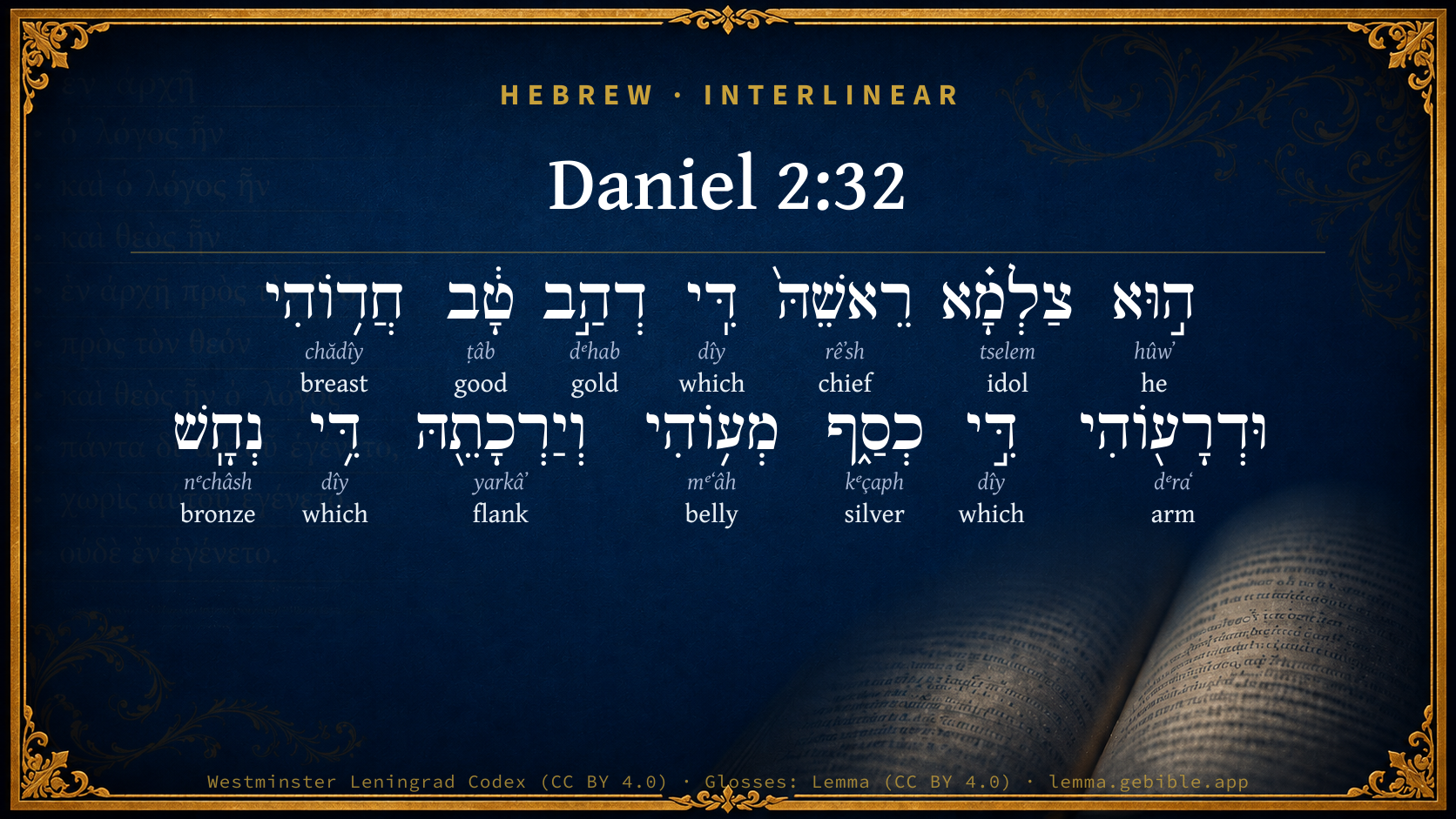
Daniel 2:32

Hebrew (Westminster Leningrad Codex) Daniel 2:32 appears in the Hebrew Old Testament. The text above is from the Westminster Leningrad Codex. Each word links to its Strong’s number, a concise gloss, and parsing drawn from the Open Scriptures Hebrew Bible morphology. Click any word for its full Brown-Driver-Briggs (BDB) entry.
Download image
Cite this verse

Daniel 2:32 (World English Bible). Public Domain. Lemma interlinear Bible study tool, https://lemma.gebible.app/v/daniel/2/32.

Show BibTeX & RIS
BibTeX
RIS
English Translation
As for this image, its head was of fine gold, its breast and its arms of silver, its belly and its thighs of brass,
World English Bible · Public Domain
Highlights
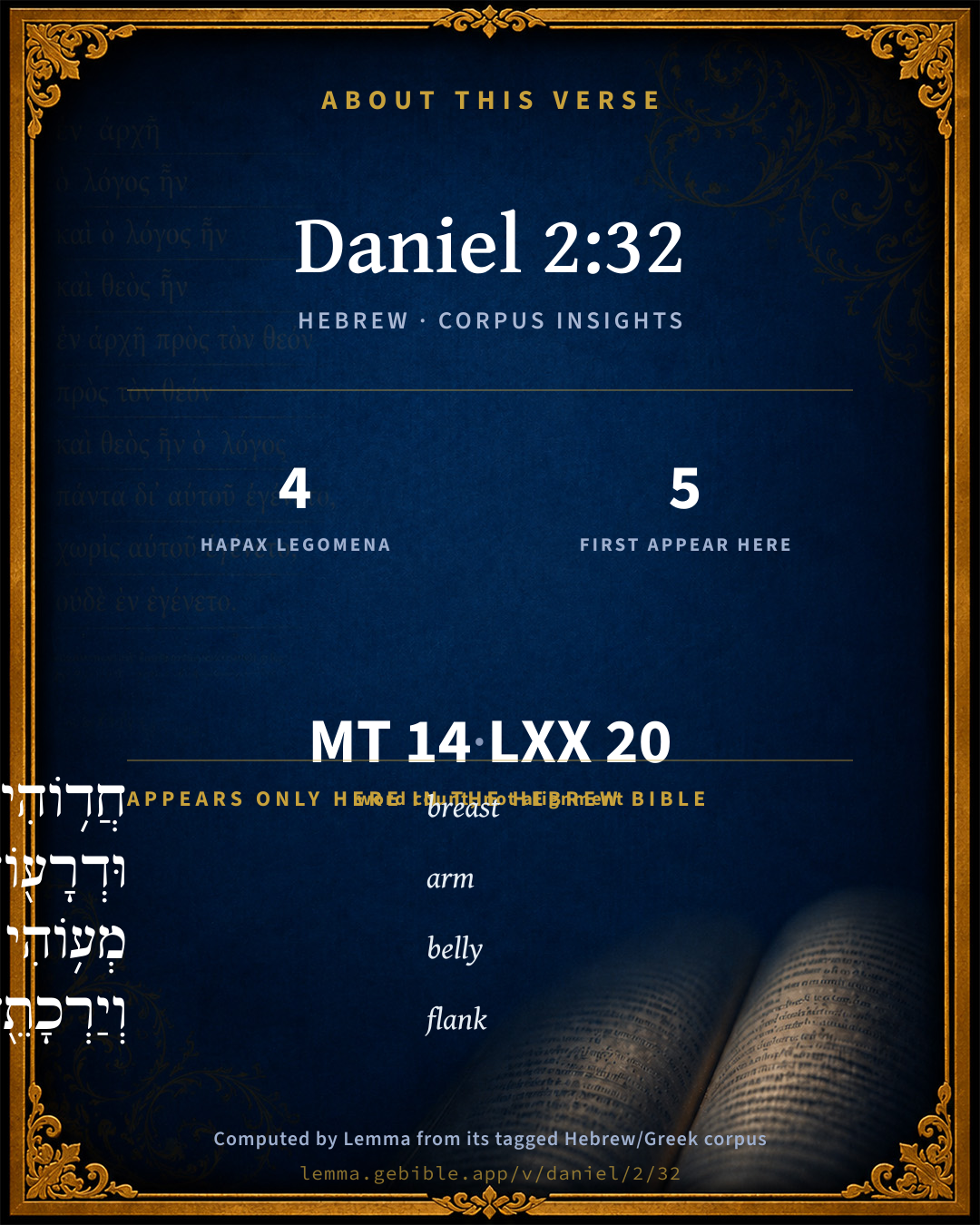
  • 4 hapax legomena — only here in the Hebrew Bible
  • 5 first appearances in the Hebrew Bible
Full analysis ↓
Download a study sheet

One document with this verse’s original text, its word-by-word gloss line, the meaning frame, cross-references with their text, attributed commentary, and full source and license credits — printable, and it pastes into notes with its structure intact.

This verse Autodidact and up

Study sheet (.html) Plain text (.txt)

A passage Seminary Student

Up to 50 verses in one chapter. A passage sheet keeps up to 6 commentary sources and 12 cross-references per verse, in the order this page ranks them, and says so on the sheet whenever that leaves anything out. Ask for a single verse and you get the Autodidact verse sheet above.

Everything on this page stays free to read, with no account — the sheet is a download of what is already on screen, not access to it.

Want to remove ads? Support Godless Engineer
Compare translations 3

The same verse in 3 English versions, stacked beneath the original-language interlinear above. Click any original word for its lexicon entry.

Each is an independent rendering of the whole verse — the interlinear is not word-aligned to these translations.

Highlighted words mark where these versions differ — a whole-verse word diff, not a word-by-word alignment.

  • World English Bible Public Domain
    As for this image, its head was of fine gold, its breast and its arms of silver, its belly and its thighs of brass,
  • King James Version Public Domain
    This image's head was of fine gold, his breast and his arms of silver, his belly and his thighs of brass,
  • unfoldingWord Literal Text CC BY-SA 4.0
    The head of this statue was of fine gold, its chest and arms of silver, its middle and its thighs of bronze,

unfoldingWord Literal Text — © unfoldingWord, licensed CC BY-SA 4.0. Word-aligned USFM3 via Door43 (git.door43.org/unfoldingWord/en_ult).

Versions to compare (up to 4)

3 of 4 selected

Show all 18 translations

Every available English version of this verse, each an independent rendering of the whole verse.

  • World English Bible Public Domain
    As for this image, its head was of fine gold, its breast and its arms of silver, its belly and its thighs of brass,
  • Berean Standard Bible Public Domain
    The head of the statue was pure gold, its chest and arms were silver, its belly and thighs were bronze,
  • Majority Standard Bible Public Domain
    The head of the statue was pure gold, its chest and arms were silver, its belly and thighs were bronze,
  • King James Version Public Domain
    This image's head was of fine gold, his breast and his arms of silver, his belly and his thighs of brass,
  • American Standard Version (1901) Public Domain
    As for this image, its head was of fine gold, its breast and its arms of silver, its belly and its thighs of brass,
  • Revised Version (1885) Public Domain
    As for this image, his head was of fine gold, his breast and his arms of silver, his belly and his thighs of brass,
  • Geneva Bible (1599) Public Domain
    This images head was of fine golde, his breast and his armes of siluer, his bellie and his thighs of brasse,
  • Douay-Rheims (1899) Public Domain
    The head of this statue was of fine gold, but the breast and the arms of silver, and the belly and the thighs of brass:
  • Young's Literal Translation Public Domain
    This image! its head `is' of good gold, its breasts and its arms of silver, its belly and its thighs of brass;
  • Literal Standard Version CC BY-SA 4.0
    This image! Its head [is] of fine gold, its breasts and its arms of silver, its belly and its thighs of bronze;
  • Unlocked Literal Bible CC BY-SA 4.0
    The head of the statue was made of fine gold. Its breast and arms were of silver. Its middle and its thighs were made of bronze,
  • unfoldingWord Literal Text CC BY-SA 4.0
    The head of this statue was of fine gold, its chest and arms of silver, its middle and its thighs of bronze,
  • Darby Bible Public Domain
    This image's head was of fine gold, its breast and its arms of silver, its belly and its thighs of brass,
  • World Messianic Bible Public Domain
    As for this image, its head was of fine gold, its chest and its arms of silver, its belly and its thighs of bronze,
  • Webster's Bible Public Domain
    The head of this image was of fine gold, his breast and his arms of silver, his belly and his thighs of brass,
  • Free Bible Version CC BY-SA 4.0
    The head of the statue was gold, the chest and arms were silver, its middle and thighs were bronze,
  • Bible in Basic English Public Domain
    As for this image, its head was made of the best gold, its breast and its arms were of silver, its middle and its sides were of brass,
  • JPS Tanakh (1917) Public Domain
    As for that image, its head was of fine gold, its breast and its arms of silver, its belly and its thighs of brass,

Literal Standard Version (2020), Covenant Press — licensed CC BY-SA 4.0. Text via the HelloAO Bible API (eBible.org). Unlocked Literal Bible (unfoldingWord) — licensed CC BY-SA 4.0. Text via the HelloAO Bible API (eBible.org). unfoldingWord Literal Text — © unfoldingWord, licensed CC BY-SA 4.0. Word-aligned USFM3 via Door43 (git.door43.org/unfoldingWord/en_ult). Free Bible Version, Dr. Jonathan Gallagher — licensed CC BY-SA 4.0. Text via the HelloAO Bible API (eBible.org).

Word by word

More ways to search: Search by grammar → Find every occurrence → Compare this word →

Practice this passage: Drill this verse → Learn its vocabulary →

חֲד֥וֹהִי
chădîy
H2306
“breast · his”
Adjective, N, Common + Suffix, Personal, 3rd Person, Masculine, Singular
Part of Speech
Adjective
Gender
Common
Full BDB Definition

Origin: corresponding to H2373

TWOT: 2720

breast, chest
  1. ה֣וּא hûwʼ H1932 “he” Adjective, P
  2. צַלְמָ֗א tselem H6755 “idol · the” Adjective, N, Common + Particle, Definite Article
  3. רֵאשֵׁהּ֙ rêʼsh H7217 “chief · his” Adjective, N, Common + Suffix, Personal, 3rd Person, Masculine, Singular
  4. דִּֽי dîy H1768 “which” Adjective, T
  5. דְהַ֣ב dᵉhab H1722 “gold” Adjective, N, Common
  6. טָ֔ב ṭâb H2869 “good” Adjective, A
  7. וּדְרָע֖וֹהִי dᵉraʻ H1872 “and · arms · his” Adjective, C + Noun, Common, Feminine, Plural, Construct + Suffix, Personal, 3rd Person, Masculine, Singular
  8. דִּ֣י dîy H1768 “which” Adjective, T
  9. כְסַ֑ף kᵉçaph H3702 “silver” Adjective, N, Common
  10. מְע֥וֹהִי mᵉʻâh H4577 “belly · his” Adjective, N, Common + Suffix, Personal, 3rd Person, Masculine, Singular
  11. וְיַרְכָתֵ֖הּ yarkâʼ H3410 “and · flanks · his” Adjective, C + Noun, Common, Feminine, Plural, Construct + Suffix, Personal, 3rd Person, Masculine, Singular
  12. דִּ֥י dîy H1768 “which” Adjective, T
  13. נְחָֽשׁ nᵉchâsh H5174 “bronze” Adjective, N, Common

About this verse

These counts appear in no published source. They are computed here, from the morphology-tagged text and Lemma’s own curated glosses. What Lemma adds →

14
words
12
distinct lemmas
Prophets
section

Notable vocabulary

4 hapax legomena — words that appear only here in the entire Hebrew Bible:

  • חֲד֥וֹהִי breast H2306
  • וּדְרָע֖וֹהִי arm H1872
  • מְע֥וֹהִי belly H4577
  • וְיַרְכָתֵ֖הּ flank H3410

First appearance in Scripture

These words make their first canonical appearance in the Hebrew Bible here:

  • חֲד֥וֹהִי breast H2306
  • וּדְרָע֖וֹהִי arm H1872
  • מְע֥וֹהִי belly H4577
  • וְיַרְכָתֵ֖הּ flank H3410
  • נְחָֽשׁ bronze H5174

Shared distinctive vocabulary

טָ֔ב good H2869 occurs in 2 verses of the Hebrew Bible. Also found in:

Grammatical profile

  • 2 nouns
  • 11 adjectives
  • 1 particle

Repetition

A word recurs within this verse — often emphatic in Hebrew:

  • דִּֽי which H1768 ×3

Hebrew & Septuagint length

In English translation the verse runs 24 words from the Hebrew and 26 from the Septuagint (LXX English) — closely comparable.

A rough comparison of the two English renderings, which tokenize alike — not a word-level alignment.

Word counts can differ between the Hebrew and the Greek without any difference in meaning — e.g. the Hebrew direct-object marker אֵת has no separate Greek word, and Greek often adds the article ὁ.

In the original languages it is 14 Hebrew tokens and 20 Greek tokens — but the two are counted differently (Hebrew bundles its prefixes and suffixes into one token; the Greek is in lemma form), so that isn’t a like-for-like length.

Cross-references

9

Topical passages linked to Daniel 2:32 in the Treasury of Scripture Knowledge — connected by theme and wording, ordered by reader-vote popularity; previews shown in the World English Bible.

  • Isaiah 14:4 that you shall take up this parable against the king of Babylon, and say, How has the oppressor ceased! the golden city ceased!
  • Jeremiah 51:7 Babylon has been a golden cup in Yahweh's hand, who made all the earth drunken: the nations have drunk of her wine; therefore the nations are mad.
  • Daniel 2:37–39 You, O king, are king of kings, to whom the God of heaven has given the kingdom, the power, and the strength, and the glory;
  • Daniel 4:22 it is you, O king, that are grown and become strong; for your greatness is grown, and reaches to the sky, and your dominion to the end of the earth.
  • Daniel 4:30 The king spoke and said, Is not this great Babylon, which I have built for the royal dwelling-place, by the might of my power and for the glory of my majesty?
  • Daniel 7:4–6 The first was like a lion, and had eagle's wings: I saw until the wings of it were plucked, and it was lifted up from the earth, and made to stand on two feet as a man; and a man's heart was given to it.
  • Daniel 11:2–20 Now will I show you the truth. Behold, there shall stand up yet three kings in Persia; and the fourth shall be far richer than they all: and when he has grown strong through his riches, he shall stir up all against the realm of Greece.
  • Revelation 17:4 The woman was dressed in purple and scarlet, and decked with gold and precious stones and pearls, having in her hand a golden cup full of abominations and the impurities of the sexual immorality of the earth.
  • Daniel 8:3–8 Then I lifted up my eyes, and saw, and, behold, there stood before the river a ram which had two horns: and the two horns were high; but one was higher than the other, and the higher came up last.

Cross-references courtesy of OpenBible.info (CC BY 4.0).

Hebrew and Greek witnesses Masoretic Hebrew ↔ Greek Septuagint

The same verse in the two great witnesses to the Old Testament, shown verse-for-verse.

These are two independent witnesses, not word-aligned to each other, and the Septuagint is shown in lemma (dictionary) form.

Hebrew Daniel 2:32 Masoretic · Westminster Leningrad Codex

ה֣וּא צַלְמָ֗א רֵאשֵׁהּ֙ דִּֽי דְהַ֣ב טָ֔ב חֲד֥וֹהִי וּדְרָע֖וֹהִי דִּ֣י כְסַ֑ף מְע֥וֹהִי וְיַרְכָתֵ֖הּ דִּ֥י נְחָֽשׁ

As for this image, its head was of fine gold, its breast and its arms of silver, its belly and its thighs of brass,

World English Bible · Public Domain

Greek LXX Daniel 2:32 Septuagint · lemma form

καί εἰμί ὁ κεφαλή αὐτός ἀπό χρυσίον χρηστός ὁ στῆθος καί ὁ βραχίων ἀργυροῦς ὁ κοιλία καί ὁ μηρός χαλκοῦς

It was an image, the head of which was of fine gold, its hands and breast and arms of silver, its belly and thighs of brass,

LXX2012 (modern English Septuagint) · Public Domain

Hebrew: Westminster Leningrad Codex (CC BY 4.0). Greek: Septuagint (public domain); English from LXX2012 (modern English Septuagint) (Public Domain). How the Septuagint differs from the Hebrew →

Commentary

Notes on Daniel 2:32 from classic Christian and Jewish commentators (each source and its license shown beneath its notes). The classic Christian expositions comment on the surrounding passage and are grouped to its opening verse, so a note may address several verses; the Jewish commentaries on the Tanakh (Rashi and others) are per-verse, so they appear only where the commentator wrote on this verse.

Lemma curates 59 commentaries, every one of them public domain or Creative Commons licensed, each selected and text-cleaned for this edition rather than reprinted as found. About our sources →

Trapp's Complete Commentary

John Trapp

Dan 2:32 This image’s head [was] of fine gold, his breast and his arms of silver, his belly and his thighs of brass,

Ver. 32. The image’s head was of fine gold.] This is the first, and till now, altogether unheard of prophecy concerning the four monarchies of the world. Res plane digna quae memoriae tota commendetur, saith one; {a} a scripture worthy to be well remembered, because it briefly comprehendeth the history of all ages to the world’s end.

His breast and his arms of silver.] The elder they are the baser; so is Rome papal, of which one of her sons, {b} over two hundred years since, complained, not without good cause, that she was become of gold, silver; of silver, iron; of iron, earth; superesse ut in stercus abiret, and that she would turn next into dung.

{a} Sleid. Deu 4:1-49 Monarch.

{b} Theodoric Urias, A.D. 1414.

John Trapp, A Commentary or Exposition upon All the Books of the Old and New Testament (1647–1656) — public domain. Text from a community e-Sword module.

Joseph Benson's Commentary

Dan 2:32-33. This image’s head was of fine gold — The Babylonian monarchy had arrived to the height of glory under Nebuchadnezzar, (see Dan 2:37-38,) who likewise improved and adorned the city of Babylon to such a degree as to make it one of the wonders of the world; so that this empire might justly be compared to a head of gold. His breast and his arms of silver — The second monarchy, of Medes and Persians, would be inferior to the first: see note on Dan 2:39. His belly and his thighs of brass, his legs of iron — These emblems denoted the strength of the third and fourth monarchies, and the irresistible force with which they should subdue their adversaries. Iron and brass are the emblems of strength in the prophetical writings; and they were in other respects emblematical of these empires, as we shall see by and by. His feet part of iron and part of clay — By this was signified the Roman empire in its declining state, as will be shown presently.

Joseph Benson's Commentary on the Old and New Testaments (1811–1818) — public domain. Text from a community e-Sword module.

Tyndale Open Study Notes

Tyndale Open Resources

2:32-33 There were gradations of gold; fine gold was the highest quality. • thighs: Above the knees. • legs: Below the knees.

Tyndale Open Study Notes — © Tyndale Open Resources, licensed CC BY-SA 4.0. Text via the HelloAO Bible API.

Ibn Ezra

Rabbi Abraham ibn Ezra

[Daniel 2:32] Hu tzalma (הוּא צַלְמָא - That statue): [Identifying the body parts mentioned:] Its head of fine gold; Its breast (chadohi - חֲדוֹהִי) and arms (ud'raʿohi - וּדְרָעוֹהִי) of silver [are] the breast (ha-chazeh - הֶחָזֶה) and its arms (uz'roʿotav - וּזְרֹעוֹתָיו); its belly (meʿohi - מְעוֹהִי) and thighs (v'yarkhateh - וְיַרְכָתֵהּ) of bronze [are] its belly (bitno - בִּטְנוֹ) and its thighs (viyrichav - וִירֵכָיו).

Ibn Ezra on the Tanakh — English translations: “Sefaria Community Translation” (CC0 1.0 (public-domain dedication)); “Yalkut, Sifsei Chachomim Chumash, Metsudah Publications, 2009” (CC BY 4.0); and “Commentary of Ibn Ezra on Isaiah - trans. by M. Friedlander, 1873” (public domain). Text via Sefaria.

Geneva Bible (1599)

Geneva Bible translators

By gold, silver, brass and iron, are meant the Chaldean, Persian, Macedonian and Roman kingdoms, which should successively rule all the world till Christ (which is here called the stone) come himself, and destroy the last: and this was to assure the Jews, that their affliction should not end with the empire of the Chaldeans, but that they should patiently abide the coming of Messiah, which should be at the end of this fourth monarchy.

Geneva Bible (1599) marginal notes — public domain. Text via Bolls.life.

Jamieson, Fausset & Brown

Robert Jamieson, A. R. Fausset & David Brown

On ancient coins states are often represented by human figures. The head and higher parts signify the earlier times; the lower, the later times. The metals become successively baser and baser, implying the growing degeneracy from worse to worse. Hesiod, two hundred years before Daniel, had compared the four ages to the four metals in the same order; the idea is sanctioned here by Holy Writ. It was perhaps one of those fragments of revelation among the heathen derived from the tradition as to the fall of man. The metals lessen in specific gravity, as they downwards; silver is not so heavy as gold, brass not so heavy as silver, and iron not so heavy as brass, the weight thus being arranged in the reverse of stability [TREGELLES]. Nebuchadnezzar derived his authority from God, not from man, nor as responsible to man. But the Persian king was so far dependent on others that he could not deliver Daniel from the princes (Dan 6:14-15); contrast Dan 5:18-19, as to Nebuchadnezzar's power from God, whom he would he slew, and whom he would he kept alive" (compare Ezr 7:14; Est 1:13-16). Græco-Macedonia betrays its deterioration in its divisions, not united as Babylon and Persia. Iron is stronger than brass, but inferior in other respects; so Rome hardy and strong to tread down the nations, but less kingly and showing its chief deterioration in its last state. Each successive kingdom incorporates its predecessor (compare Dan 5:28). Power that in Nebuchadnezzar's hands was a God-derived (Dan 2:37-38) autocracy, in the Persian king's was a rule resting on his nobility of person and birth, the nobles being his equals in rank, but not in office; in Greece, an aristocracy not of birth, but individual influence, in Rome, lowest of all, dependent entirely on popular choice, the emperor being appointed by popular military election.

Jamieson, Fausset & Brown — Commentary Critical and Explanatory on the Whole Bible (1871) — public domain (CC PDM 1.0). Text via the HelloAO Bible API.

Adam Clarke's Commentary

Verse 32. Head was of fine gold] The Babylonish empire, the first and greatest.

Breast and his arms of silver] The Medo-Persian empire, under Cyrus, &c.

His belly and his thighs of brass] The Macedonian empire, under Alexander the Great, and his successors.

Adam Clarke's Commentary on the Bible (1810–1826) — public domain. Text from a community e-Sword/MySword module.

Ellicott's Commentary for English Readers

(32) Breast . . .—It should be remarked that though many different parts of the body of the image are mentioned, Daniel regards the whole thing as made up of only four parts, each corresponding to one of the four metals. Similarly he shows the history of the world in its relation to God’s people, complicated though it may be and varied in its aspect, consists of no more than four principal parts. It will be noticed that by the additional matter mentioned Dan_2:41-42, certain minor complications of history are intended, which, however, do not interfere with the fourfold division of which the outline is here given.

A Bible Commentary for English Readers, edited by Charles John Ellicott (1878–1897) — public domain. Text from a community e-Sword module.

The Cambridge Bible for Schools and Colleges

gen. ed. J. J. S. Perowne

32. This image’s head was, &c.] more forcibly, and also in better agreement with the original, As for that image, its head was, &c.

brass] i.e. copper (or bronze): see Wright’s Bible Word-book.

32, 33. The head of the image was of gold; but its substance deteriorated more and more until the feet were reached, which were of mingled iron and clay.

The Cambridge Bible for Schools and Colleges (gen. ed. J. J. S. Perowne; Cambridge University Press, 1878–1918) — public domain. Text from a community e-Sword module.

John Gill's Exposition

This image's head was of fine gold,.... The prophet begins with the superior part of this image, and descends to the lower, because of the order and condition of the monarchies it represents: this signifies the Babylonian monarchy, as afterwards explained; called the "head", being the first and chief of the monarchies; and compared to "fine gold", because of the glory, excellency, and duration of it:

his breast and his arms of silver; its two arms, including its hands and its breast, to which they were joined, were of silver, a metal of less value than gold; designing the monarchy of the Medes and Persians, which are the two arms, and which centred in Cyrus, who was by his father a Persian, by his mother a Mede; and upon whom, after his uncle's death, the whole monarchy devolved:

his belly and his thighs of brass; a baser metal still; this points at the Macedonian or Grecian monarchy, set up by Alexander, signified by the "belly", for intemperance and luxury; as the two "thighs" denote his principal successors, the Selucidae and Lagidae, the Syrian and Egyptian kings; and these of brass, because of the sounding fame of them, as Jerom.

John Gill's Exposition of the Whole Bible (1746–1763) — public domain (CC PDM 1.0). Text via the HelloAO Bible API.

Albert Barnes' Notes on the Bible

This image’s head was of fine gold - Chaldee, “good gold” - טב דהב dehab ṭâb - that is, fine, pure, unalloyed. The whole head of the figure, colossal as it was, appeared to be composed wholly of this. Had the “whole” image been made of gold, it would not have been so striking - for it was not uncommon to construct vast statues of this metal. Compare Dan 3:1. But the remarkable peculiarity of this image was, that it was composed of different materials, some of which were seldom or never used in such a structure, and all of which had a peculiar significancy. On the significancy of this part of the figure, and the resemblance between this head of gold and Nebuchadnezzar himself, see the notes at Dan 2:37-38.

His breast and his arms of silver - The word rendered “breast” (חדין chădı̂y) is in the plural number, in accordance with common usage in the Hebrew, by which several members of the human body are often expressed in the plural; as פנים pânı̂ym - “faces,” etc. There is a foundation for such a usage in nature, in the two-fold form of many of the portions of the human body. The portion of the body which is here represented is obviously the upper portion of the front part - what is prominently visible when we look at the human frame. Next to the head it is the most important part, as it embraces most of the vital organs. Some degree of inferiority, as well as the idea of succession, would be naturally represented by this. “The inferior value of silver as compared with gold will naturally suggest some degree of decline or degeneracy in the character of the subject represented by the metal; and so in other members, as we proceed downward, as the material becomes continually baser, we naturally infer that the subject deteriorates, in some sense, in the like manner.” - Professor Bush, in loc. On the kingdom represented by this, and the propriety of this representation, see the notes at Dan 2:39.

His belly and his thighs of brass - Margin, “sides.” It is not necessary to enter minutely into an examination of the words here used. The word “belly” denotes, unquestionably, the regions of the abdomen as externally visible. The word rendered “thighs” in the text is rendered “sides” in the margin. It is, like the word “breast” in the previous verse, in the plural number and for the same reason. The Hebrew word (ירך yârêk) is commonly rendered “thigh” in the Scriptures (Gen 24:2, Gen 24:9; Gen 32:25 (26), 31, 32(32, 33), et al.), though it is also frequently rendered “side,” Exo 32:27; Exo 40:22, Exo 40:24; Lev 1:11; Num 3:29, et al. According to Gesenius, it denotes “the thick and double fleshy member which commences at the bottom of the spine, and extends to the lower legs.” It is that part on which the sword was formerly worn, Exo 32:27; Jdg 3:16, Jdg 3:21; Psa 45:3 (4). It is also that part which was smitten, as an expression of mourning or of indignation, Jer 31:19; Eze 21:12 (17). Compare Hom. Iliad xii. 162, xv. 397; Odyssey xiii. 198; Cic. 150: “Orat.” 80; “Quinc.” xi. 3. It is not improperly here rendered “thighs,” and the portion of the figure that was of brass was that between the breast and the lower legs, or extended from the breast to the knees. The word is elsewhere employed to denote the shaft or main trunk of the golden candlestick of the tabernacle, Exo 25:31; Exo 37:17; Num 8:4.

Of brass - An inferior metal, and denoting a kingdom of inferior power or excellence. On the kingdom represented by this, see the notes at Dan 2:39.

Albert Barnes' Notes on the Bible (1834–1885) — public domain. Text from a community e-Sword/MySword module.

Whedon's Commentary on the Bible

Daniel D. Whedon

32, 33. The dreamer dreams through the ages though he knows it not. In that sleep a thousand years were but as a watch in the night. “In the Parsee tradition Zoroaster was shown four trees, one of gold, another of silver, another of steel, and the fourth of iron, and he was told that these four trees represented four ages of the world (Bahman Yesht). Ovid sings of the ages of gold, silver, bronze, and iron (Metamorphoses); and though Hesiod (Works and Days) mentions five ages, he has for them only four metallic names — gold, silver, brass, and iron” (Terry). Compare also Dante, Inferno, 14:94, and Goethe, Das Mahrchen.

Daniel D. Whedon (gen. ed.), Commentary on the Old and New Testaments (1874–1909) — public domain. Text from a community e-Sword module.

The Pulpit Commentary

Vers. 32, 33. This image"s head was of fine gold, his breasts and his arms of silver, his belly and his thighs of brass, his legs of iron, his feet part of iron and part of clay. The versions present no occasion of r,-mark, save that Theodotion has a doublet, a; ceirev, translating, "the hands, the breast, and the arms." The word rendered "fine" is really "good" (bf; tab). Naturally, there have not been preserved to us any composite images of this kind; gold and silver would certainly soon have found their way to the melting-pot after the fall of the Babylonian empire, had such a statue been erected in Babylon. Brass and iron were too precious not to follow in the same road. Among the Greeks, as we know, there were what were called "chryselephantine" statues, partly gold and partly ivory. In the description given of the Temple of Belus, we see a succession something akin to that in the statue, but it may be doubted whether we may deduce any connection between the two on that account. In the Book of Enoch the apocalyptist sees mountains of different kinds of metal of gold, silver, brass, iron, tin, and mercury, the first four coinciding with the metals in Daniel"s vision. Ewald refers in a note to the possibility that this idea might be borrowed from Hesiod, but rightly dismisses it as improbable. As to the metals used, gold and silver were well known in ancient times, as also iron, though, from the difficulty of working it, later. What is here translated "brass" ought to be rendered "copper;" "bronze" certainly was known very early, but the whole use of the word, vjn (Aramaic), or tvjn (Hebrew), implies that it is a simple metal; thus; Deu_8:9, "Out of whose hills thou mayest dig brass" (Hebrew, tvjn Onkelos, avjn). In this statue the progressive degradation of the material and situation is to be observed. The head, the highest part, gold; the shoulders, lower, silver; the belly and thighs, lower still, brass; the legs, lower yet, iron; and the feet and toes, lowest of all, a mixture of iron and clay. It is observed by Kliefoth that there is further a growing division. The head is one, without any appearance of division; the portion consisting of the breast and arms is divided, though slightly, for the chest is more important and bulky than the arms; the belly and thighs form a portion which from the plural form given to the word translated "belly," yhwOm (m"ohi), suggests more of dividedness than does that above. The lowest portion, that forming the legs and toes, has the greatest amount of division. Kliefoth also refers to another point that while there is a progressive degradation of the metal, there is also progression in degrees of hardness, silver being harder than gold, copper harder than silver, and iron hardest of all; then suddenly the iron is mingled with clay. There is not a new, softer material added to form a new fifth part; but there is a mingling of "clay clay suitable for the potter, or rather that has already been baked in the kiln, and therefore in the last degree brittle. In fact, there is a progress in frangibility gold the most ductile of metals, and iron the least so, then clay, when baked, more brittle still. There are many other successions that might be followed, which are at least ingenious. The idea suggested by the phrase, "part of iron and part of clay," is that there was not a complete mingling, but that portions were seen that were clearly clay, and other portions as clearly still iron; there was therefore the superadded notion of the imperfect union of the parts with the necessary additional weakness which follows.

The Pulpit Commentary (1880–1919), ed. H.D.M. Spence-Jones & Joseph S. Exell — public domain. Text from a community e-Sword module.

Rashi

Rabbi Shlomo Yitzchaki (Rashi)

of fine gold [as translated,] of fine gold.

its breast [as translated,] its breast.

and its arms [as translated,] and its arms.

its belly and thighs [as translated,] its belly and thighs.

Rashi on the Tanakh — English translations: “The Judaica Press complete Tanach with Rashi, translated by A. J. Rosenberg” (CC BY 4.0); “Pentateuch with Rashi's commentary by M. Rosenbaum and A.M. Silbermann, 1929-1934” (public domain); “The Metsudah Tanach series, Lakewood, N.J” (CC BY 4.0); and “The Book of Joshua, Metsudah Publications, 1997” (CC BY 4.0). Text via Sefaria.

Lesson kit

Teaching starters — assembled from the data on this page, not authored interpretation. Every prompt links to the verse data it draws on. Edit before teaching.

Daniel, in the Prophets, opens this verse with 14 words (12 distinct Hebrew lemmas). Its most distinctive word is chădîy (“breast”). A historical commentator’s framing appears above. Read the whole chapter for the surrounding context.

Discussion questions

  1. The word chădîy carries the sense “breast.” How does it shape the verse?
  2. This verse holds 4 words here found nowhere else in the Hebrew Bible. What might the rare words draw attention to?
  3. 5 words here appear for the first time in Scripture. What is being introduced at this debut?
  4. Ezra 5:17 shares the word «good» with this verse. How do the two illuminate each other?
  5. “which” occurs 3× in this one verse. What is the effect of the repetition?
  6. These translations render this verse differently; the difference is in the English rendering, not the original. What questions does that raise?
  7. Reading how Trapp's Complete Commentary and Joseph Benson's Commentary read this verse, where do the two commentators agree and where do they part?

Things to notice

  • 4 words in this verse appear nowhere else in the Hebrew Bible.
  • 5 words make their first canonical appearance in Scripture here.
  • This verse counts 14 Hebrew ↔ 20 Greek words.
  • These translations choose different wording for 9 words in this verse.
  • “which” occurs 3× in this single verse.

Reading settings

Reading text

Shown beneath each verse's original-language words.

Old Testament
Old Testament edition

Read the OT as the Masoretic Hebrew (MT) or the Greek Septuagint (LXX).

English shown for the Greek Septuagint (in the Hebrew ↔ Greek comparison).

Comparing translations? Open the Compare panel on any verse page to stack up to four side by side.