
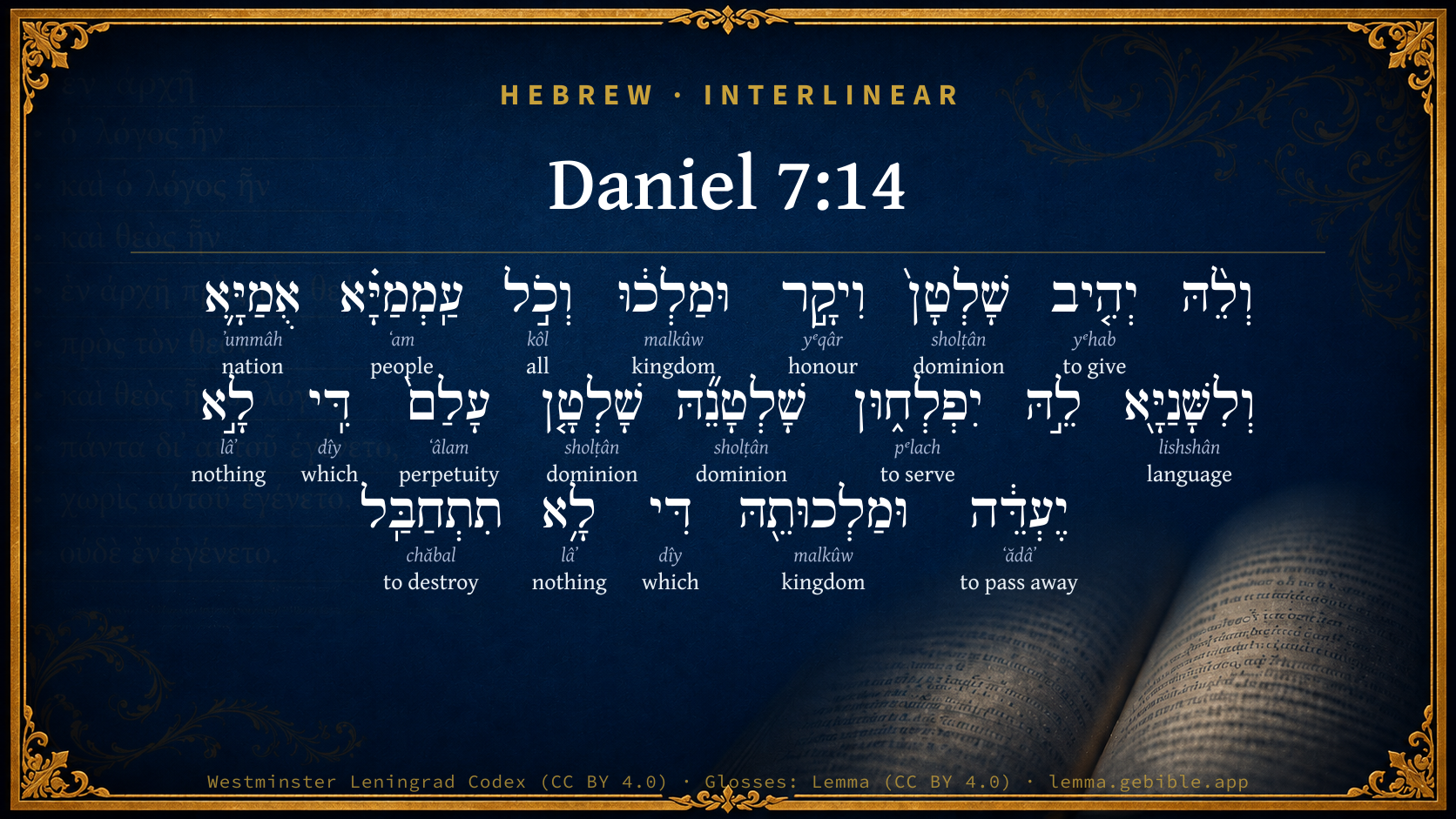
Daniel 7:14

Hebrew (Westminster Leningrad Codex) Daniel 7:14 appears in the Hebrew Old Testament. The text above is from the Westminster Leningrad Codex. Each word links to its Strong’s number, a concise gloss, and parsing drawn from the Open Scriptures Hebrew Bible morphology. Click any word for its full Brown-Driver-Briggs (BDB) entry.
Download image
Cite this verse

Daniel 7:14 (World English Bible). Public Domain. Lemma interlinear Bible study tool, https://lemma.gebible.app/v/daniel/7/14.

Show BibTeX & RIS
BibTeX
RIS
English Translation
There was given him dominion, and glory, and a kingdom, that all the peoples, nations, and languages should serve him: his dominion is an everlasting dominion, which shall not pass away, and his kingdom that which shall not be destroyed.
World English Bible · Public Domain
Download a study sheet

One document with this verse’s original text, its word-by-word gloss line, the meaning frame, cross-references with their text, attributed commentary, and full source and license credits — printable, and it pastes into notes with its structure intact.

This verse Autodidact and up

Study sheet (.html) Plain text (.txt)

A passage Seminary Student

Up to 50 verses in one chapter. A passage sheet keeps up to 6 commentary sources and 12 cross-references per verse, in the order this page ranks them, and says so on the sheet whenever that leaves anything out. Ask for a single verse and you get the Autodidact verse sheet above.

Everything on this page stays free to read, with no account — the sheet is a download of what is already on screen, not access to it.

Want to remove ads? Support Godless Engineer
Compare translations 3

The same verse in 3 English versions, stacked beneath the original-language interlinear above. Click any original word for its lexicon entry.

Each is an independent rendering of the whole verse — the interlinear is not word-aligned to these translations.

Highlighted words mark where these versions differ — a whole-verse word diff, not a word-by-word alignment.

  • World English Bible Public Domain
    There was given him dominion, and glory, and a kingdom, that all the peoples, nations, and languages should serve him: his dominion is an everlasting dominion, which shall not pass away, and his kingdom that which shall not be destroyed.
  • King James Version Public Domain
    And there was given him dominion, and glory, and a kingdom, that all people, nations, and languages, should serve him: his dominion is an everlasting dominion, which shall not pass away, and his kingdom that which shall not be destroyed.
  • unfoldingWord Literal Text CC BY-SA 4.0
    And to him was given dominion and glory and a kingdom, so that all the peoples, nations, and languages should serve him. His dominion is an everlasting dominion that will not pass away, and his kingdom is one that will not be destroyed.

unfoldingWord Literal Text — © unfoldingWord, licensed CC BY-SA 4.0. Word-aligned USFM3 via Door43 (git.door43.org/unfoldingWord/en_ult).

Versions to compare (up to 4)

3 of 4 selected

Show all 18 translations

Every available English version of this verse, each an independent rendering of the whole verse.

  • World English Bible Public Domain
    There was given him dominion, and glory, and a kingdom, that all the peoples, nations, and languages should serve him: his dominion is an everlasting dominion, which shall not pass away, and his kingdom that which shall not be destroyed.
  • Berean Standard Bible Public Domain
    And He was given dominion, glory, and kingship, that the people of every nation and language should serve Him. His dominion is an everlasting dominion that will not pass away, and His kingdom is one that will never be destroyed.
  • Majority Standard Bible Public Domain
    And He was given dominion, glory, and kingship, that the people of every nation and language should serve Him. His dominion is an everlasting dominion that will not pass away, and His kingdom is one that will never be destroyed.
  • King James Version Public Domain
    And there was given him dominion, and glory, and a kingdom, that all people, nations, and languages, should serve him: his dominion is an everlasting dominion, which shall not pass away, and his kingdom that which shall not be destroyed.
  • American Standard Version (1901) Public Domain
    And there was given him dominion, and glory, and a kingdom, that all the peoples, nations, and languages should serve him: his dominion is an everlasting dominion, which shall not pass away, and his kingdom that which shall not be destroyed.
  • Revised Version (1885) Public Domain
    And there was given him dominion, and glory, and a kingdom, that all the peoples, nations, and languages should serve him: his dominion is an everlasting dominion, which shall not pass away, and his kingdom that which shall not be destroyed.
  • Geneva Bible (1599) Public Domain
    And he gaue him dominion, and honour, and a kingdome, that all people, nations and languages should serue him: his dominion is an euerlasting dominion, which shall neuer bee taken away: and his kingdome shall neuer be destroyed.
  • Douay-Rheims (1899) Public Domain
    And he gave him power, and glory, and a kingdom: and all peoples, tribes and tongues shall serve him: his power is an everlasting power that shall not be taken away: and his kingdom that shall not be destroyed.
  • Young's Literal Translation Public Domain
    And to him is given dominion, and glory, and a kingdom, and all peoples, nations, and languages do serve him, his dominion `is' a dominion age-during, that passeth not away, and his kingdom that which is not destroyed.
  • Literal Standard Version CC BY-SA 4.0
    And to Him is given dominion, and glory, and a kingdom, and all peoples, nations, and languages serve Him, His dominion [is] a continuous dominion, that does not pass away, and His kingdom that which is not destroyed.
  • Unlocked Literal Bible CC BY-SA 4.0
    Authority to rule and glory and royal power were given to him so that all the peoples, nations, and languages should serve him. His authority to rule is an everlasting authority that will not pass away, and his kingdom is one that will never be destroyed.
  • unfoldingWord Literal Text CC BY-SA 4.0
    And to him was given dominion and glory and a kingdom, so that all the peoples, nations, and languages should serve him. His dominion is an everlasting dominion that will not pass away, and his kingdom is one that will not be destroyed.
  • Darby Bible Public Domain
    And there was given him dominion, and glory, and a kingdom, that all peoples, nations, and languages should serve him: his dominion is an everlasting dominion, which shall not pass away, and his kingdom [that] which shall not be destroyed.
  • World Messianic Bible Public Domain
    Dominion was given him, and glory, and a kingdom, that all the peoples, nations, and languages should serve him. His dominion is an everlasting dominion, which will not pass away, and his kingdom one that will not be destroyed.
  • Webster's Bible Public Domain
    And there was given him dominion, and glory, and a kingdom, that all people, nations, and languages, should serve him: his dominion is an everlasting dominion, which shall not pass away, and his kingdom that which shall not be destroyed.
  • Free Bible Version CC BY-SA 4.0
    He was given authority, glory, and the power to rule over all people, the different nations and languages, so they would all worship him. His rule is everlasting—it will never cease, and his kingdom will never be destroyed.
  • Bible in Basic English Public Domain
    And to him was given authority and glory and a kingdom; and all peoples, nations, and languages were his servants: his authority is an eternal authority which will not come to an end, and his kingdom is one which will not come to destruction.
  • JPS Tanakh (1917) Public Domain
    And there was given him dominion, and glory, and a kingdom, that all the peoples, nations, and languages should serve him; his dominion is an everlasting dominion, which shall not pass away, and his kingdom that which shall not be destroyed.

Literal Standard Version (2020), Covenant Press — licensed CC BY-SA 4.0. Text via the HelloAO Bible API (eBible.org). Unlocked Literal Bible (unfoldingWord) — licensed CC BY-SA 4.0. Text via the HelloAO Bible API (eBible.org). unfoldingWord Literal Text — © unfoldingWord, licensed CC BY-SA 4.0. Word-aligned USFM3 via Door43 (git.door43.org/unfoldingWord/en_ult). Free Bible Version, Dr. Jonathan Gallagher — licensed CC BY-SA 4.0. Text via the HelloAO Bible API (eBible.org).

Word by word

More ways to search: Search by grammar → Find every occurrence → Compare this word →

Practice this passage: Drill this verse → Learn its vocabulary →

תִתְחַבַּֽל
chăbal
H2255
“to destroy”
Adjective, V
Part of Speech
Adjective
Full BDB Definition

Origin: corresponding to H2254

TWOT: 2716

to hurt, destroy - (Pael) to hurt, destroy - (Ithpael) to be destroyed
  1. יְהִ֤יב yᵉhab H3052 “to give” Adjective, V, Plural
  2. שָׁלְטָן֙ sholṭân H7985 “dominion” Adjective, N, Common
  3. וִיקָ֣ר yᵉqâr H3367 “and · honour” Adjective, C + Noun, Common, Masculine, Singular, Absolute
  4. וּמַלְכ֔וּ malkûw H4437 “and · kingdom” Adjective, C + Noun, Common, Feminine, Singular, Absolute
  5. וְכֹ֣ל kôl H3606 “and · all of” Adjective, C + Noun, Common, Masculine, Singular, Construct
  6. עַֽמְמַיָּ֗א ʻam H5972 “peoples · the” Adjective, N, Common + Particle, Definite Article
  7. אֻמַיָּ֛א ʼummâh H524 “nations · the” Adjective, N, Common + Particle, Definite Article
  8. וְלִשָּׁנַיָּ֖א lishshân H3961 “and · languages · the” Adjective, C + Noun, Common, Masculine, Plural, Determined + Particle, Definite Article
  9. יִפְלְח֑וּן pᵉlach H6399 “to serve” Adjective, V
  10. שָׁלְטָנֵ֞הּ sholṭân H7985 “dominion · his” Adjective, N, Common + Suffix, Personal, 3rd Person, Masculine, Singular
  11. שָׁלְטָ֤ן sholṭân H7985 “dominion of” Adjective, N, Common
  12. עָלַם֙ ʻâlam H5957 “perpetuity” Adjective, N, Common
  13. דִּֽי dîy H1768 “which” Adjective, T
  14. לָ֣א lâʼ H3809 “nothing” Adjective, T
  15. יֶעְדֵּ֔ה ʻădâʼ H5709 “to pass away” Adjective, V
  16. וּמַלְכוּתֵ֖הּ malkûw H4437 “and · kingdom · his” Adjective, C + Noun, Common, Feminine, Singular, Construct + Suffix, Personal, 3rd Person, Masculine, Singular
  17. דִּי dîy H1768 “which” Adjective, T
  18. לָ֥א lâʼ H3809 “nothing” Adjective, T

About this verse

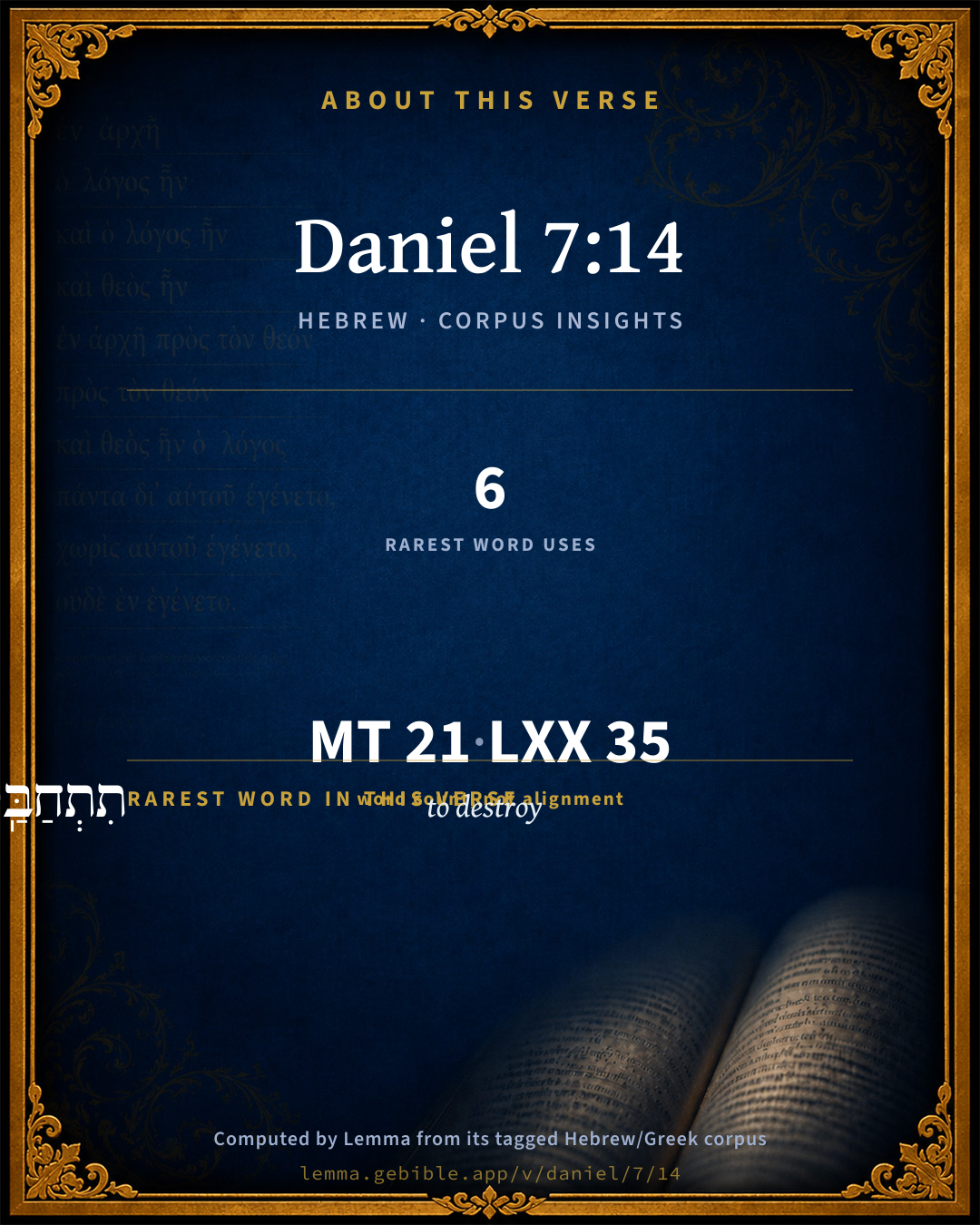
These counts appear in no published source. They are computed here, from the morphology-tagged text and Lemma’s own curated glosses. What Lemma adds →

21
words
14
distinct lemmas
Prophets
section

Notable vocabulary

The rarest word here is תִתְחַבַּֽל to destroy H2255 — appearing just 6 times in the whole Hebrew Bible.

Shared distinctive vocabulary

תִתְחַבַּֽל to destroy H2255 occurs in 6 verses of the Hebrew Bible. Also found in:

Grammatical profile

  • 4 nouns
  • 13 adjectives
  • 1 preposition
  • 3 particles

Repetition

Words recur within this verse — often emphatic in Hebrew:

  • שָׁלְטָן֙ dominion H7985 ×3
  • וּמַלְכ֔וּ kingdom H4437 ×2
  • לָ֣א nothing H3809 ×2
  • דִּֽי which H1768 ×2

Hebrew & Septuagint length

In English translation the verse runs 40 words from the Hebrew and 40 from the Septuagint (LXX English) — the same length.

A rough comparison of the two English renderings, which tokenize alike — not a word-level alignment.

Word counts can differ between the Hebrew and the Greek without any difference in meaning — e.g. the Hebrew direct-object marker אֵת has no separate Greek word, and Greek often adds the article ὁ.

In the original languages it is 21 Hebrew tokens and 35 Greek tokens — but the two are counted differently (Hebrew bundles its prefixes and suffixes into one token; the Greek is in lemma form), so that isn’t a like-for-like length.

Cross-references

36

Topical passages linked to Daniel 7:14 in the Treasury of Scripture Knowledge — connected by theme and wording, ordered by reader-vote popularity; previews shown in the World English Bible.

  • Revelation 11:15 The seventh angel sounded, and great voices in heaven followed, saying, "The kingdom of the world has become the Kingdom of our Lord, and of his Christ. He will reign forever and ever!"
  • Daniel 7:27 The kingdom and the dominion, and the greatness of the kingdoms under the whole the sky, shall be given to the people of the saints of the Most High: his kingdom is an everlasting kingdom, and all dominions shall serve and obey him.
  • Daniel 2:44 In the days of those kings shall the God of heaven set up a kingdom which shall never be destroyed, nor shall the sovereignty of it be left to another people; but it shall break in pieces and consume all these kingdoms, and it shall stand forever.
  • John 3:35 The Father loves the Son, and has given all things into his hand.
  • 1 Corinthians 15:24–28 Then the end comes, when he will deliver up the Kingdom to God, even the Father; when he will have abolished all rule and all authority and power.
  • Ephesians 1:20–22 which he worked in Christ, when he raised him from the dead, and made him to sit at his right hand in the heavenly places,
  • Philippians 2:9–11 Therefore God also highly exalted him, and gave to him the name which is above every name;
  • Isaiah 9:7 Of the increase of his government and of peace there shall be no end, on the throne of David, and on his kingdom, to establish it, and to uphold it with justice and with righteousness from henceforth even forever. The zeal of Yahweh of Hosts will perform this.
  • Hebrews 12:28 Therefore, receiving a Kingdom that can't be shaken, let us have grace, through which we serve God acceptably, with reverence and awe,
  • Matthew 28:18 Jesus came to them and spoke to them, saying, "All authority has been given to me in heaven and on earth.
  • Revelation 17:14 These will war against the Lamb, and the Lamb will overcome them, for he is Lord of lords, and King of kings. They also will overcome who are with him, called and chosen and faithful."
  • Psalms 45:6 Your throne, God, is forever and ever. A scepter of equity is the scepter of your kingdom.
  • Psalms 110:1–2 Yahweh says to my Lord, "Sit at my right hand, Until I make your enemies your footstool for your feet."
  • Matthew 11:27 All things have been delivered to me by my Father. No one knows the Son, except the Father; neither does anyone know the Father, except the Son, and he to whom the Son desires to reveal him.
  • Luke 1:33 and he will reign over the house of Jacob forever. There will be no end to his Kingdom."
  • Psalms 2:6–8 "Yet I have set my king on my holy hill of Zion."
  • Psalms 8:6 You make him ruler over the works of your hands. You have put all things under his feet:
  • Psalms 145:13 Your kingdom is an everlasting kingdom. Your dominion endures throughout all generations.
  • Isaiah 60:12 For that nation and kingdom that will not serve you shall perish; yes, those nations shall be utterly wasted.
  • Luke 19:11–12 As they heard these things, he went on and told a parable, because he was near Jerusalem, and they supposed that the Kingdom of God would be revealed immediately.
  • Revelation 3:21 He who overcomes, I will give to him to sit down with me on my throne, as I also overcame, and sat down with my Father on his throne.
  • Psalms 72:17 His name endures forever. His name continues as long as the sun. Men shall be blessed by him. All nations will call him blessed.
  • Psalms 146:10 Yahweh will reign forever; Your God, O Zion, to all generations. Praise Yah!
  • Daniel 2:35 Then was the iron, the clay, the brass, the silver, and the gold, broken in pieces together, and became like the chaff of the summer threshing floors; and the wind carried them away, so that no place was found for them: and the stone that struck the image became a great mountain, and filled the whole earth.
  • Daniel 3:4 Then the herald cried aloud, To you it is commanded, peoples, nations, and languages,
  • Daniel 4:3 How great are his signs! and how mighty are his wonders! his kingdom is an everlasting kingdom, and his dominion is from generation to generation.
  • Daniel 6:26 I make a decree, that in all the dominion of my kingdom men tremble and fear before the God of Daniel; for he is the living God, and steadfast forever, His kingdom that which shall not be destroyed; and his dominion shall be even to the end.
  • Obadiah 1:21 Saviors will go up on Mount Zion to judge the mountains of Esau, and the kingdom will be Yahweh's.
  • Micah 4:7 And I will make that which was lame a remnant, And that which was cast far off a strong nation: And Yahweh will reign over them on Mount Zion from then on, even forever.
  • Luke 10:22 Turning to the disciples, he said, "All things have been delivered to me by my Father. No one knows who the Son is, except the Father, and who the Father is, except the Son, and he to whomever the Son desires to reveal him."
  • John 5:22–27 For the Father judges no one, but he has given all judgment to the Son,
  • Psalms 72:11 Yes, all kings shall fall down before him. All nations shall serve him.
  • Psalms 102:22 When the peoples are gathered together, The kingdoms, to serve Yahweh.
  • Daniel 7:18 But the saints of the Most High shall receive the kingdom, and possess the kingdom forever, even forever and ever.
  • John 12:34 The multitude answered him, "We have heard out of the law that the Christ remains forever. How do you say, 'The Son of Man must be lifted up?' Who is this Son of Man?"
  • 1 Peter 3:22 who is at the right hand of God, having gone into heaven, angels and authorities and powers being made subject to him.

Cross-references courtesy of OpenBible.info (CC BY 4.0).

Hebrew and Greek witnesses Masoretic Hebrew ↔ Greek Septuagint

The same verse in the two great witnesses to the Old Testament, shown verse-for-verse.

These are two independent witnesses, not word-aligned to each other, and the Septuagint is shown in lemma (dictionary) form.

Hebrew Daniel 7:14 Masoretic · Westminster Leningrad Codex

וְלֵ֨הּ יְהִ֤יב שָׁלְטָן֙ וִיקָ֣ר וּמַלְכ֔וּ וְכֹ֣ל עַֽמְמַיָּ֗א אֻמַיָּ֛א וְלִשָּׁנַיָּ֖א לֵ֣הּ יִפְלְח֑וּן שָׁלְטָנֵ֞הּ שָׁלְטָ֤ן עָלַם֙ דִּֽי לָ֣א יֶעְדֵּ֔ה וּמַלְכוּתֵ֖הּ דִּי לָ֥א תִתְחַבַּֽל

There was given him dominion, and glory, and a kingdom, that all the peoples, nations, and languages should serve him: his dominion is an everlasting dominion, which shall not pass away, and his kingdom that which shall not be destroyed.

World English Bible · Public Domain

Greek LXX Daniel 7:14 Septuagint · lemma form

καί δίδωμι αὐτός ἐξουσία καί πᾶς ὁ ἔθνος ὁ γῆ κατά γένος καί πᾶς δόξα αὐτός λατρεύω καί ὁ ἐξουσία αὐτός ἐξουσία αἰώνιος ὅστις οὐ μή αἴρω καί ὁ βασιλεία αὐτός ὅστις οὐ μή φθείρω

And to him was given the dominion, and the honor, and the kingdom; and all nations, tribes, and languages, shall serve him: his dominion is an everlasting dominion, which shall not pass away, and his kingdom shall not be destroyed.

LXX2012 (modern English Septuagint) · Public Domain

Hebrew: Westminster Leningrad Codex (CC BY 4.0). Greek: Septuagint (public domain); English from LXX2012 (modern English Septuagint) (Public Domain). How the Septuagint differs from the Hebrew →

Commentary

Notes on Daniel 7:14 from classic Christian and Jewish commentators (each source and its license shown beneath its notes). The classic Christian expositions comment on the surrounding passage and are grouped to its opening verse, so a note may address several verses; the Jewish commentaries on the Tanakh (Rashi and others) are per-verse, so they appear only where the commentator wrote on this verse.

Lemma curates 59 commentaries, every one of them public domain or Creative Commons licensed, each selected and text-cleaned for this edition rather than reprinted as found. About our sources →

Trapp's Complete Commentary

John Trapp

Dan 7:14 And there was given him dominion, and glory, and a kingdom, that all people, nations, and languages, should serve him: his dominion [is] an everlasting dominion, which shall not pass away, and his kingdom [that] which shall not be destroyed.

Ver. 14. And there was given him dominion.] Christ hath a manifold right to the kingdom; it is his by inheritance, conquest, donation, &c. This is comfortable to consider, forasmuch as he will not reign without his members, who all hold all in capite; and have all already, (1.) In precio; in prayer (2.) In promisso; in promise (3.) In primitiis. in starting.

That all people, nations, and languages, &c.] Christ’s kingdom is first universal, secondly perpetual; so was none of the former, though the Roman was very large, reaching from Euphrates to Great Britain, and the Assyrian very lasting, of a thousand and four hundred years’ duration.

John Trapp, A Commentary or Exposition upon All the Books of the Old and New Testament (1647–1656) — public domain. Text from a community e-Sword module.

Joseph Benson's Commentary

Dan 7:14. There was given him dominion, &c. — “All these kingdoms shall in their turns be destroyed, but the kingdom of the Messiah shall stand for ever. It was in allusion to this prophecy that the angel said of Jesus, before he was conceived in the womb, Luk 1:33, He shall reign over the house of Jacob for ever, and of his kingdom there shall be no end. After what manner these great changes will be effected, we cannot pretend to say, as God hath not been pleased to reveal it. We see the remains of the ten horns which arose out of the Roman empire. We see the little horn still subsisting, though not in full strength and vigour, but as we hope upon the decline, and tending toward a dissolution. And having seen so many of these particulars accomplished, we can have no reason to doubt that the rest also will be fulfilled in due season; though we cannot frame any conception how Christ will be manifested in glory; how the little horn, with the body of the fourth beast, will be given to the burning flame; or how the saints will take the kingdom, and possess it for ever and ever. It is the nature of such prophecies, not to be perfectly understood till they are fulfilled. The best comment upon them will be their completion.” — Bishop Newton.

Joseph Benson's Commentary on the Old and New Testaments (1811–1818) — public domain. Text from a community e-Sword module.

Scofield Reference Notes

C. I. Scofield

him

Dan 7:13; Dan 7:14 is identical with Rev 5:1-7 and antedates the fulfilment of Dan 2:34; Dan 2:35.; Dan 7:13; Dan 7:14; Rev 5:1-7 describe the investiture of the Son of Man and Son of David with the kingdom authority, while Dan 2:34; Dan 2:35 describes the crushing blow (Armageddon, Rev 16:14 which destroys Gentile world-power, thus clearing the way for the actual setting up of the kingdom of heaven.; Dan 2:34; Dan 2:35; Rev 19:19-21 are the same event.

The Scofield Reference Bible (1917 edition), notes by C. I. Scofield — public domain. Text from a community e-Sword module.

Tyndale Open Study Notes

Tyndale Open Resources

7:14 Unlike the rulers and kingdoms of the earth, which pass away, his rule is eternal and will never be destroyed. His kingdom is given to the holy people of the Most High (7:27), and it “fills” the earth (2:35, 44-45).

Tyndale Open Study Notes — © Tyndale Open Resources, licensed CC BY-SA 4.0. Text via the HelloAO Bible API.

Geneva Bible (1599)

Geneva Bible translators

This is meant of the beginning of Christ’s kingdom, when God the Father gave unto him all dominion, as to the Mediator, to the intent that he should govern here his Church in earth continually, till the time that he brought them to eternal life.

Geneva Bible (1599) marginal notes — public domain. Text via Bolls.life.

Adam Clarke's Commentary

Verse 14. And there was given him dominion] This also is applied to our Lord Jesus by himself, after his resurrection, Mt 28:18.

His dominion is an everlasting dominion] Christianity shall increase, and prevail to the end of the world. See the parallel passages in the margin.

Adam Clarke's Commentary on the Bible (1810–1826) — public domain. Text from a community e-Sword/MySword module.

John Calvin's Commentaries

The Prophet; confirms and explains more clearly in this verse what he had said in the former one. For we may collect from it how the personage previously mentioned arrived at the Ancient of days, who is God, namely, because power was given to him. For although Christ truly ascended into heaven, (Matthew 28:18,) yet we ought clearly to weigh the purpose of his doing so. It was to acquire the supreme power in heaven and in earth, as he himself says. And Paul also mentions this purpose in the first and second chapters of the Ephesians. (Ephesians 1:21; Ephesians 2:7.) Christ left the world and ascended to the Father; first, to subdue all powers to himself, and to render angels obedient; next, to restrain the devil, and to protect and preserve the Church by his help, as well as all the elect of God the Father. So, therefore, Daniel now proceeds with what he formerly said concerning the approach of Christ to God. Thus the madness of those who argue against Christ; being true and eternal God, because he is said to have come to the Ancient of days, is refuted. First of all, as we have said, this is understood of the person of the Mediator; next, all doubt is taken away when the Prophet adds, Power was given unto him. Behold, therefore, a certain explanation. We will not say it was bestowed with relation to his being, and being called God. It was given to him as Mediator, as God manifest in flesh, and with respect to his human nature. We observe how well all these things agree, when the Prophet here says, The chief power was given to Christ We must hold therefore its reference to that manifestation, because Christ was from the beginning the life of men, the world was created by him, and his energy always sustained it, (John 1:4;) but power was given to him to inform us how God reigned by means of his hand. If we were required to seek God without a Mediator, his distance would be far too great, but when a Mediator meets us, and offers himself to us in our human nature, such is the nearness between God and us, that our faith easily passes beyond the world and penetrates the very heavens. For this reason therefore, All power, honor, and kingdom was given to Christ. He adds also, All nations shall serve him, that is, they may serve him; for the copula ought to be translated thus, — That all nations, people, and tongues should serve him. We have shewn how this ought properly to be understood of the commencement of the reign of Christ, and ought not to be connected with its final close, as many interpreters force and strain the passage. Meanwhile we must add, that the events which the Prophet here narrates are not yet complete; but this ought to be familiar to all the pious, for whenever the kingdom of Christ is treated of, his glory magnificently extolled, as if it were now absolutely complete in all its parts. It is not surprising, if according to the frequent and perpetual usage of Scripture, the Prophet should say power was given to Christ, to subdue all people, nations, and languages to himself, as it is said in Psalm 110:1, — Jehovah said to my Lord, Sit thou on my right hand, until I make thy enemies the footstool of thy feet. We see, then, how Christ was raised to his own empire to govern his Church in the name and with the power of his Father, while at the same time many enemies rise up against him. Still the obstinacy of the devil and of all impious men continues, although Christ governs heaven and earth, and is the supreme king before whom every knee is bent. We also know how marked the difference is between the beginning of his kingdom and its final completion. Whatever the meaning, this vision suits very well with many assertions of Christ, where he bears witness to the power given him by the Father. (Matthew 28:18, and elsewhere) He does not here speak of the last judgment, but is only teaching us, the object of his ascension to heaven.

This view the Prophet confirms by saying, his dominion is the dominion of an age, which is mot taken away, and his kingdom can never be corrupted or abolished. For by these words he teaches familiarly and openly, why Christ is the Supreme King, namely, for the perpetual government of his Church in this world. We ought to look up to heaven in very deed whenever the state of the Church is under consideration, since its happiness is neither earthly, nor perishable, nor temporary, though nothing sublunary is either firm or perpetual. But when the Prophet says Christ’s dominion is eternal, he doubtless signifies the constant endurance of his monarchy, even to the end of the world, when he shall gather his people together to a happy life and an eternal inheritance. Although, therefore, celestial immortality is comprehended under these words, yet in a former passage the Prophet pointed out the perpetual existence of the Church in this world, because Christ will defend it, although daily subject to numberless causes of destruction. And who would not assert the almost daily perishing of the Church, if God did not wonderfully preserve it by the hand of his only begotten Son? Hence it is correct to understand the phrase, His kingdom shall be the kingdom of an age. And thus we receive no common consolation, when we see the Church tossed about amidst various fluctuations, and almost buried and devoured by continual shipwrecks, yet Christ is ever stretching forth his hand to preserve it, and to save it from every sorrowful and horrible species of destruction. It now follows, —

John Calvin's Commentaries (1540-1563) — public domain. Text from the Calvin Translation Society English edition (1840s-50s) via the Christian Classics Ethereal Library (ccel.org). Calvin's coverage is partial (roughly two-thirds of the Bible); uncommented books and verses are honest gaps, never fabricated. The 19th-century editor's footnotes and remarks are omitted so the notes are faithfully Calvin's own voice.

Ellicott's Commentary for English Readers

(14) Serve him.—In Biblical Chaldee this word is only used of rendering Divine service or worship. The “Son of man” is therefore here spoken of as God.

A Bible Commentary for English Readers, edited by Charles John Ellicott (1878–1897) — public domain. Text from a community e-Sword module.

The Cambridge Bible for Schools and Colleges

gen. ed. J. J. S. Perowne

14. A universal and never-ending dominion is given to him. The expressions in the first half of the verse resemble in part those used in Dan_5:18-19 of Nebuchadnezzar. Serve does not necessarily mean worship: like the word which has the same meaning in Heb. (עבד), it may be used of obedience to either God (Dan_3:12; Dan_3:14 al.) or a human ruler (Dan_7:27; and the Targ. of Jer_27:6-8, &c.). With the second half of the verse comp. Dan_2:44, and especially Dan_4:3 b, 34 b (of the kingdom of God). All peoples, nations, &c., as Dan_3:4.

The Cambridge Bible for Schools and Colleges (gen. ed. J. J. S. Perowne; Cambridge University Press, 1878–1918) — public domain. Text from a community e-Sword module.

John Gill's Exposition

And there was given him dominion, and glory, and a kingdom,.... That is, a large, powerful, and glorious kingdom; not but that he had a kingdom before, but now it will be more extensive, and appear in greater glory: this will be fulfilled when the kingdoms of this world shall become his, and all nations shall serve and worship him, Rev 11:15, as follows:

that all people, nations, and languages, should serve him; embrace his Gospel, submit to his ordinances serve and worship him in every religious duty; every people, of all nations, and of every language under heaven; which will be the case when the everlasting Gospel will be preached to them all with success, Rev 14:6,

his dominion is an everlasting dominion; it shall never have an end, as the rest of the monarchies, signified by the four beasts, have had, or will have; see Psa 14:6,

which shall not pass away; or be removed from one to another, like the above monarchies:

and his kingdom that which shall not be destroyed; or "corrupted" (z) abolished and brought to nothing, as the said monarchies were one by another; and, at last, all of them by the stone cut out of the mountain; see Dan 2:44.

(z) "corrumpetur", Pagninus, Montanus; "corrumpitur", Junius & Tremellius, Piscator, Coccceus.

John Gill's Exposition of the Whole Bible (1746–1763) — public domain (CC PDM 1.0). Text via the HelloAO Bible API.

Albert Barnes' Notes on the Bible

And there was given him dominion - That is, by him who is represented as the “Ancient of days.” The fair interpretation of this is, that he received the dominion from him. This is the uniform representation in the New Testament. Compare Mat 28:18; Joh 3:35; 1Co 15:27. The word dominion here means rule or auhority - such as a prince exercises. He was set over a kingdom as a prince or ruler.

And glory - That is the glory or honor appropriate to one at the head of such an empire.

And a kingdom - That is, he would reign. He would have sovereignty. The nature and the extent of this kingdom is immediately designated as one that would be universal and perpetual. What is properly implied in this language as to the question whether it will be literal and visible, will be appropriately considered at the close of the verse. All that is necessary to be noticed here is, that it is everywhere promised in the Old Testament that the Messiah would be a king, and have a kingdom. Compare Psa 2:1-12; Isa 9:6-7.

That all people, nations, and languages should serve him - It would be universal; would embrace all nations. The language here is such as would emphatically denote universality. See the notes at Dan 3:4; Dan 4:1. It implies that that kingdom would extend over all the nations of the earth, and we are to look for the fulfillment of this only in such a universal reign of the Messiah.

His dominion is an everlasting dominion ... - The others, represented by the four beasts, would all pass away, but this would be permanent and eternal. Nothing would destroy it. It would not have, as most kingdoms of the earth have had, any such internal weakness or source of discord as would be the cause of its destruction, nor would there be any external power that would invade or overthrow it. This declaration affirms nothing as to the form in which the kingdom would exist, but merely asserts the fact that it would do so. Respecting the kingdom of the Messiah, to which this undoubtedly alludes, the same thing is repeatedly and uniformly affirmed in the New Testament. Compare Mat 16:18; Heb 12:28; Rev 11:15. The form and manner in which this will occur is more fully developed in the New Testament; in the vision seen by Daniel the fact only is stated.

The question now arises, What would be a fulfillment of this prediction respecting the kingdom that will be given to the saints? What, from the language used in the vision, should we be legitimately authorized to expect to take place on the earth? In regard to these questions, there are but two views which can be taken, and the interpretation of the passage must sustain the one or the other.

(a) One is what supposes that this will be literally fulfilled in the sense that the Son of God, the Messiah, will reign personally on earth. According to this, he will come to set up a visible and glorious kingdom, making Jerusalem his capital, and swaying his scepter over the world. All nations and people will be subject to him; all authority will be wielded by his people under him.

(b) According to the other view, there will be a spiritual reign of the Son of God over the earth; that is, the principles of his religion will everywhere prevail, and the righteous will rule, and the laws of the Redeemer will be obeyed everywhere. There will be such a prevalence of his gospel on the hearts of all - rulers and people; the gospel will so modify all laws, and control all customs, and remove all abuses, and all the forms of evil; men will be so generally under the influence of that gospel, that it may be said that He reigns on the earth, or that the government actually administered is his.

In regard to these different views, and to the true interpretation of the passage, it may be remarked,

(1) That we are not to look for the literal fulfillment of this; we are not to expect that what is here described will literally occur. The whole is evidently a symbolic representation, and the fulfillment is to be found in something that the symbol would properly denote. No one can pretend that there is to be an actual sitting on the throne, by one in the form of an old man - “the Ancient of days” - or that there is to be a literal coming to him by one “like the Son of man,” to receive a kingdom. But if one part of the representation is not to be literally interpreted, why should the other be? It may be added, that it is nowhere said that this would literally occur.

(2) All that is fairly implied here is found in the latter interpretation. Such a prevalence of the principles of the gospel would meet the force of the language, and every part of the vision would find a real fulfillment in that.

(a) The fact that it proceeds from God - represented as “the Ancient of days.”

(b) The fact that it is given by him, or that the kingdom is made over by him to the Messiah.

(c) The fact that the Messiah would have such a kingdom; that is, that he would reign on the earth, in the hearts and lives of men.

(d) The fact that that kingdom would be universal - extending over all people.

(e) And the fact that it would be perpetual; that is, that it would extend down to the end of time, or the consummation of all things here, and that it would be then eternal in the heavens.

For a very full and ample illustration of this passage - so full and ample as to supersede the necessity of any additional illustration here, see the notes at Dan 2:44-45.

Albert Barnes' Notes on the Bible (1834–1885) — public domain. Text from a community e-Sword/MySword module.

Haydock's Catholic Bible Commentary

Destroyed. The eternal dominion of Christ could not be expressed in stronger terms. He seems to allude to them, Matthew xxviii. 18. (Calmet)

George Leo Haydock (1774–1849), Haydock's Catholic Family Bible and Commentary, 1859 edition — public domain. Excludes Psalms (Douay-Rheims chapter numbering differs from Protestant) and Deuterocanonical books (Catholic canon only).

Whedon's Commentary on the Bible

Daniel D. Whedon

14. This prophecy could never be fulfilled by any merely Jewish king or Jewish nation. These are the same expressions used of the kingdom of Daniel’s God (Dan_2:44; Dan_4:3; Dan_4:34; Dan_6:26). He who has the appearance as the likeness of a man (Eze_1:26) is now seen coming in the cloud chariot of Jehovah to take rule over the world. Dr. Terry says: “His receiving dominion and glory and a kingdom is explained in Joh_5:22; Joh_5:27, ‘The Father hath given all judgment unto the Son, and he gave him authority to execute judgment because he is the Son of man;’ so too in Mat_28:18, ‘There has been given to me all authority in heaven and upon earth.’” It is not to be supposed that the Christian era lay open before the author of Daniel and that he saw Jesus when he uttered these words. The prophets often spake more wisely than they knew. That this prophecy refers to Christ’s first coming to set up the New Testament “kingdom of heaven,” and not to his inauguration as King after the universal Resurrection and General Judgment, Professor Cowles has satisfactorily and thoroughly established.

Daniel D. Whedon (gen. ed.), Commentary on the Old and New Testaments (1874–1909) — public domain. Text from a community e-Sword module.

The Pulpit Commentary

And there was given him dominion, and glory, and a kingdom, that all people, nations, and languages, should serve him: his dominion is an everlasting dominion, which shall not pass away, and his kingdom that which shall not be destroyed. The versions differ only slightly and verbally from this. The personal element is here made prominent. Compare with this Rev_5:12, "Worthy is the Lamb that was slain to receive power, and riches, and wisdom, and strength, and honour, and glory, and blessing." The Messianic kingdom, and with it the Messiah, was to be everlasting. The resemblance is great, as might be expected, between this statement and that in Dan_2:44, "A kingdom which shall never be destroyed, and the kingdom shall not be left to other people." It is to be noted that even his dominion is bestowed upon him.

The Ancient of days, whose sentence has deprived the other dynasties of theft empire, bestows boundless empire on the Messiah (Comp. Psalm 2. and 72.). Jeremiah"s account of the state of matters on the return from the Captivity is (Jer_30:21) compared to this by Hitzig; but there it is not a king who is to come near before God, it is simply "governor" (mashal). In Jeremiah we have to do with a subject-people living in the fear of the Lord, but under the yoke of a foreign power.

Ecursus on The Son of Man.

The title given here to the Messiah for the first time, appears prominently in the Book of Enoch, and becomes consecrated to us in the lips of our Lord, as the favourite title by which he designated himself as the Messiah.

The phrase, "son of man," ben-adam, is used of man as contrasted with Num_23:19, "God is not a man that he should lie, nor the son of man that he should repent;" of man as weak: Isa_51:12, "Who art thou, that thou shouldest be afraid of a man that shall die, and of the son of man which shall be made as the grass?" (so Job_25:6; Psa_144:3) Again, it is used simply as equivalent to "man:" Jer_49:18, "No man shall abide there, neither shall son of man dwell in it". (see also Jer_51:43) The contrast, so far as there is a contrast, is between vyai and In the Psalms we have benee adam and benee ish contrasted: Psa_62:9, "Surely men of low degree (b e nee adam) are vanity, and men of high degree (benee ish) are a lie." This distinction does not apply to Aramaic, in which enush is the only generally used word for "man." In the prophecies of Ezekiel the phrase becomes determinative of the prophet. The question is complicated, however, by the fact that in Eastern Aramaic barnesh, a contraction for bar-enasho, is used very generally for "men," as col-bar-nesh, everybody. " It also occurs in this sense in Targumic, though more rarely, as Job_5:7. The title here, then, simply declares that one, having the appearance of a man, was seen coming in the clouds of heaven. The phrase in the Peshitta for "the Son of man" is batch d"nosh. It is implied that this mysterious Being had the form of a man, but further, it is implied that he was other than man. In the Book of Enoch the phrase has ceased to be descriptive merely, and has become an appellation. Thus Enoch 46.:

(1) And there I saw one who had a head of days, and his head was white like wool, and with him was another being, whose countenance had the appearance of a man, and his face was full of graciousness like one of the holy angels.

(2) And I asked the angel who went with me and showed me all the hidden things concerning that Son of man, who he was, and why he went with the Head of days.

(3) And he answered and said unto me, This is the Son of man, who hath righteousness, with whom dwelleth righteousness, and who reveals all the treasures of that which is hidden, because the Lord of spirits hath chosen him, and his lot before the Lord of spirits hath surpassed everything in uprightness for ever." This is clearly borrowed from the chapter before us. Elsewhere we have endeavoured to fix the date of this part of the Book of Enoch, as B.C. 210. Of course, in this view the Maccabean origin of Daniel is definitely set aside. If, however, we take the date assigned to this part by Mr. Charles, then we have a choice between approximately B.C. 90 and B.C. 70. Even then the date seems too near the critical date of Daniel toexplain the rapid development the idea has undergone. In Daniel the person "like a son of man" may be a personification of Israel, though not naturally so; here in Enoch we have to do with a super-angelic being.

As to the question of the reference of the title, it has been doubted whether it is to be held as applying to the Messiah, the Messianic kingdom, or to the people of Israel. The last view is that of Hitzig and many other critics of his school. It practically involves a denial of the truth of the idea that the Jews ever had Messianic hopes. In the present case there is nothing to indicate any reference to Israel personified. While there might be some plausibility in arguing from each of the four beasts representing empires that this "Son of man" should represent an empire also; it must be observed that in all the other cases there is a peculiarity which marks off the animal as merely a symbol: the lion has wings; the bear has three ribs in its teeth; the leopard has four heads and four wings; and the last, unnamed, beast has ten heads and iron teeth. Further, this "Son of man" is brought to the Ancient of days, and does not merely appear as do the "beasts." He has thus many of the characteristics of a person. The other view, that the "Son of man" indicates the Messianic kingdom, thus comes into line with the view of Hitzig. The view that it is the Messiah who is meant by the "Son of man" was held practically by all interpreters, Jewish and Christian, until the middle of last century.

If we look at the phenomenon of prophetism, we shall find ourselves open to another view of the matter. From 1Pe_1:10 we see that prophets did not necessarily know the meaning of their own prophecies. It might well be, then, that to Daniel the distinction between the Messianic King and the Messianic kingdom was not one clearly apprehended. We see in the prophecies of the second Isaiah that the "servant of the Lord" is first the holy people, then the prophetic order, and latterly a person. There probably was a similar uncertainty here. If we grant this indeffiniteness, the next question that rises is What is the special aspect of the Messianic kingdom that is intended to be portrayed when this title is given to its King? If we are guided by what is incomparably the oldest interpretation, that of the second Book of Enoch, this title implies an incalculable dignity. When we come to our Lord"s use of it in the Gospels, there is nothing to oppose this. Thus Joh_5:22, "And hath committed all judgment unto him, because he is the Son of man;" so Mat_9:6, "The Son of man hath power on earth to forgive sins." This is not contradicted by Mat_8:20, "The foxes have holes, but the Son of man hath not where to lay his head." The emphasis of the statement lies in the contrast between the inexpressible dignity of the Person and the poverty of his earthly circumstances. It is because the ideas of superhuman dignity had been associated with the title that our Lord had, in foretelling his approaching crucifixion,. to bring the two facts into close connection, "The Son of man must be lifted up." So after Peter"s confession, "The Son of man must suffer many things." We see that the multitude of the Jews understood the title to have this lofty meaning, for they demand, (Joh_12:34) "How sayest thou, The Sen of man must be lifted up? Who is this Son of man?" The attempts to make it imply something humiliating by dwelling on the fact that not adam or ish is the word for "man," but enosh, are beside the question, for these deductions apply to the Hebrew words, not to.the Aramaic. And in Aramaic neither ish nor adam is in common use as equivalent for "man." It is as much beside the point as if one, knowing the difference between man and mann in German, should lay stress on the fact that in this phrase in English "man" has only one n.

The connection of this surpassing dignity with humanity has probably deep roots in human nature. The late Professor Fuller saw reference here to the function occupied by Silik-mooloo-Khi as mediator between Hea and mankind, and to the further development of this in the Zoroastrian doctrine of a sosiosh, or redeemer. The fall investigation of this is beside our present purpose.

The Pulpit Commentary (1880–1919), ed. H.D.M. Spence-Jones & Joseph S. Exell — public domain. Text from a community e-Sword module.

Rashi

Rabbi Shlomo Yitzchaki (Rashi)

And He gave him dominion And to that man He gave dominion over the nations, for the heathens he likens to beasts, and Israel he likens to a man because they are humble and innocent.

which will not be removed [as translated,] will not be removed.

Rashi on the Tanakh — English translations: “The Judaica Press complete Tanach with Rashi, translated by A. J. Rosenberg” (CC BY 4.0); “Pentateuch with Rashi's commentary by M. Rosenbaum and A.M. Silbermann, 1929-1934” (public domain); “The Metsudah Tanach series, Lakewood, N.J” (CC BY 4.0); and “The Book of Joshua, Metsudah Publications, 1997” (CC BY 4.0). Text via Sefaria.

Lesson kit

Teaching starters — assembled from the data on this page, not authored interpretation. Every prompt links to the verse data it draws on. Edit before teaching.

Daniel, in the Prophets, opens this verse with 21 words (14 distinct Hebrew lemmas). Its most distinctive word is chăbal (“to destroy”). A historical commentator’s framing appears above. Read the whole chapter for the surrounding context.

Discussion questions

  1. How does “to destroy” (chăbal) shape what this verse is saying?
  2. How does Ezra 6:12, which shares the word «to destroy», read alongside this verse?
  3. What does the repetition of “dominion” (3× in this one verse) do in this verse?
  4. These translations render this verse differently. What is at stake in choosing one wording over another?
  5. Compare how Trapp's Complete Commentary and Joseph Benson's Commentary read this verse. Where do they agree or differ?

Things to notice

Reading settings

Reading text

Shown beneath each verse's original-language words.

Old Testament
Old Testament edition

Read the OT as the Masoretic Hebrew (MT) or the Greek Septuagint (LXX).

English shown for the Greek Septuagint (in the Hebrew ↔ Greek comparison).

Comparing translations? Open the Compare panel on any verse page to stack up to four side by side.