Daniel 2:39

Hebrew (Westminster Leningrad Codex) Daniel 2:39 appears in the Hebrew Old Testament. The text above is from the Westminster Leningrad Codex. Each word links to its Strong’s number, a concise gloss, and parsing drawn from the Open Scriptures Hebrew Bible morphology. Click any word for its full Brown-Driver-Briggs (BDB) entry.
Download image
Cite this verse

Daniel 2:39 (World English Bible). Public Domain. Lemma interlinear Bible study tool, https://lemma.gebible.app/v/daniel/2/39.

Show BibTeX & RIS
BibTeX
RIS
English Translation
After you shall arise another kingdom inferior to you; and another third kingdom of brass, which shall bear rule over all the earth.
World English Bible · Public Domain
Highlights
  • 2 first appearances in the Hebrew Bible
Full analysis ↓
Download a study sheet

One document with this verse’s original text, its word-by-word gloss line, the meaning frame, cross-references with their text, attributed commentary, and full source and license credits — printable, and it pastes into notes with its structure intact.

This verse Autodidact and up

Study sheet (.html) Plain text (.txt)

A passage Seminary Student

Up to 50 verses in one chapter. A passage sheet keeps up to 6 commentary sources and 12 cross-references per verse, in the order this page ranks them, and says so on the sheet whenever that leaves anything out. Ask for a single verse and you get the Autodidact verse sheet above.

Everything on this page stays free to read, with no account — the sheet is a download of what is already on screen, not access to it.

Want to remove ads? Support Godless Engineer
Compare translations 3

The same verse in 3 English versions, stacked beneath the original-language interlinear above. Click any original word for its lexicon entry.

Each is an independent rendering of the whole verse — the interlinear is not word-aligned to these translations.

Highlighted words mark where these versions differ — a whole-verse word diff, not a word-by-word alignment.

  • World English Bible Public Domain
    After you shall arise another kingdom inferior to you; and another third kingdom of brass, which shall bear rule over all the earth.
  • King James Version Public Domain
    And after thee shall arise another kingdom inferior to thee, and another third kingdom of brass, which shall bear rule over all the earth.
  • unfoldingWord Literal Text CC BY-SA 4.0
    After you will arise another kingdom inferior to you, then another third kingdom of bronze, which will rule over all the earth.

unfoldingWord Literal Text — © unfoldingWord, licensed CC BY-SA 4.0. Word-aligned USFM3 via Door43 (git.door43.org/unfoldingWord/en_ult).

Versions to compare (up to 4)

3 of 4 selected

Show all 18 translations

Every available English version of this verse, each an independent rendering of the whole verse.

  • World English Bible Public Domain
    After you shall arise another kingdom inferior to you; and another third kingdom of brass, which shall bear rule over all the earth.
  • Berean Standard Bible Public Domain
    But after you, there will arise another kingdom, inferior to yours. Next, a third kingdom, one of bronze, will rule the whole earth.
  • Majority Standard Bible Public Domain
    But after you, there will arise another kingdom, inferior to yours. Next, a third kingdom, one of bronze, will rule the whole earth.
  • King James Version Public Domain
    And after thee shall arise another kingdom inferior to thee, and another third kingdom of brass, which shall bear rule over all the earth.
  • American Standard Version (1901) Public Domain
    And after thee shall arise another kingdom inferior to thee; and another third kingdom of brass, which shall bear rule over all the earth.
  • Revised Version (1885) Public Domain
    And after thee shall arise another kingdom inferior to thee; and another third kingdom of brass, which shall bear rule over all the earth.
  • Geneva Bible (1599) Public Domain
    And after thee shall rise another kingdome, inferiour to thee, of siluer, and another third kingdome shalbe of brasse, which shall beare rule ouer all the earth.
  • Douay-Rheims (1899) Public Domain
    And after thee shall rise up another kingdom, inferior to thee, of silver: and another third kingdom of brass, which shall rule over all the world.
  • Young's Literal Translation Public Domain
    And after thee doth rise up another kingdom lower than those, and another third kingdom of brass, that doth rule overall the earth.
  • Literal Standard Version CC BY-SA 4.0
    And after you another kingdom arises lower than those, and another third kingdom of bronze, that rules over all the earth.
  • Unlocked Literal Bible CC BY-SA 4.0
    After you, another kingdom will arise that is inferior to you, and yet a third kingdom of bronze will rule over all the earth.
  • unfoldingWord Literal Text CC BY-SA 4.0
    After you will arise another kingdom inferior to you, then another third kingdom of bronze, which will rule over all the earth.
  • Darby Bible Public Domain
    And after thee shall arise another kingdom inferior to thee; then another third kingdom of brass, which shall bear rule over all the earth.
  • World Messianic Bible Public Domain
    “After you, another kingdom will arise that is inferior to you; and another third kingdom of bronze, which will rule over all the earth.
  • Webster's Bible Public Domain
    And after thee shall arise another kingdom inferior to thee, and another third kingdom of brass, which shall bear rule over all the earth.
  • Free Bible Version CC BY-SA 4.0
    But after you another kingdom will rise that is inferior to your kingdom and will replace yours. After that a third kingdom that is bronze will rise and rule over the whole world.
  • Bible in Basic English Public Domain
    And after you another kingdom, lower than you, will come to power; and a third kingdom, of brass, ruling over all the earth.
  • JPS Tanakh (1917) Public Domain
    And after thee shall arise another kingdom inferior to thee; and another third kingdom of brass, which shall bear rule over all the earth.

Literal Standard Version (2020), Covenant Press — licensed CC BY-SA 4.0. Text via the HelloAO Bible API (eBible.org). Unlocked Literal Bible (unfoldingWord) — licensed CC BY-SA 4.0. Text via the HelloAO Bible API (eBible.org). unfoldingWord Literal Text — © unfoldingWord, licensed CC BY-SA 4.0. Word-aligned USFM3 via Door43 (git.door43.org/unfoldingWord/en_ult). Free Bible Version, Dr. Jonathan Gallagher — licensed CC BY-SA 4.0. Text via the HelloAO Bible API (eBible.org).

Word by word

More ways to search: Search by grammar → Find every occurrence → Compare this word →

Practice this passage: Drill this verse → Learn its vocabulary →

תליתיא
tᵉlîythay
H8523
“third”
Adjective, A
Part of Speech
Adjective
Full BDB Definition

Origin: ordinal from H8532

TWOT: 3058c

third - third (the ordinal number)
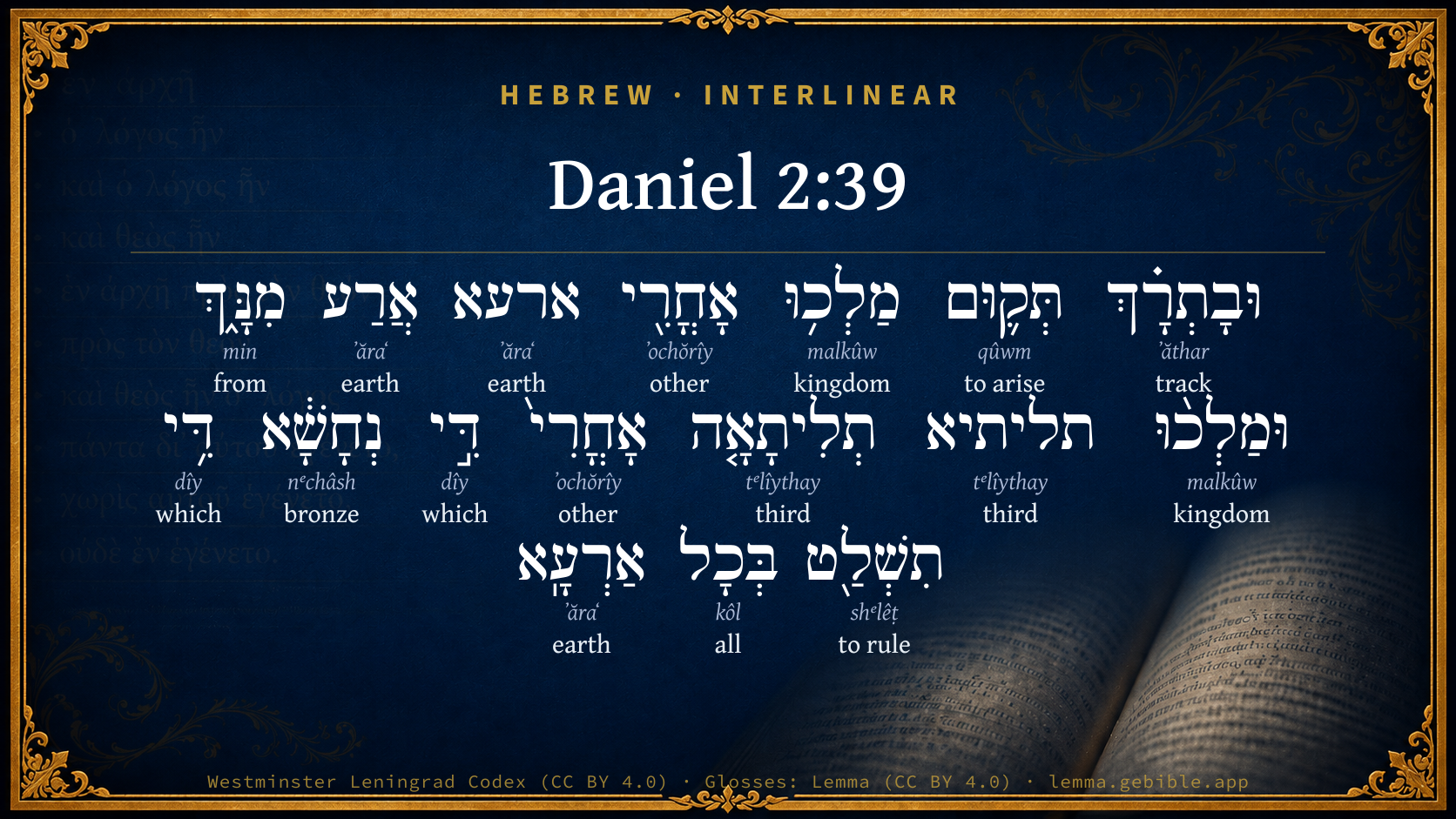
  1. וּבָתְרָ֗ךְ ʼăthar H870 “and · track · your” Adjective, C + Noun, Common, Masculine, Singular, Construct + Suffix, Personal, 2nd Person, Masculine, Singular
  2. תְּק֛וּם qûwm H6966 “to arise” Adjective, V
  3. מַלְכ֥וּ malkûw H4437 “kingdom” Adjective, N, Common
  4. אָחֳרִ֖י ʼochŏrîy H317 “other” Adjective, A
  5. ארעא ʼăraʻ H772 “earth · toward” Adjective, N, Common + Suffix, Demonstrative
  6. אֲרַע ʼăraʻ H772 “earth” Adjective, N, Common
  7. מִנָּ֑ךְ min H4481 “from · you” Adjective, R + Suffix, Personal, 2nd Person, Masculine, Singular
  8. וּמַלְכ֨וּ malkûw H4437 “and · kingdom” Adjective, C + Noun, Common, Feminine, Singular, Absolute
  9. תְלִיתָאָ֤ה tᵉlîythay H8523 “third” Adjective, A
  10. אָחֳרִי֙ ʼochŏrîy H317 “other” Adjective, A
  11. דִּ֣י dîy H1768 “which” Adjective, T
  12. נְחָשָׁ֔א nᵉchâsh H5174 “bronze · the” Adjective, N, Common + Particle, Definite Article
  13. דִּ֥י dîy H1768 “which” Adjective, T
  14. תִשְׁלַ֖ט shᵉlêṭ H7981 “to rule” Adjective, V
  15. בְּכָל kôl H3606 “in/at · all of” Adjective, R + Noun, Common, Masculine, Singular, Construct
  16. אַרְעָֽא ʼăraʻ H772 “earth · the” Adjective, N, Common + Particle, Definite Article

About this verse

These counts appear in no published source. They are computed here, from the morphology-tagged text and Lemma’s own curated glosses. What Lemma adds →

17
words
11
distinct lemmas
Prophets
section

Notable vocabulary

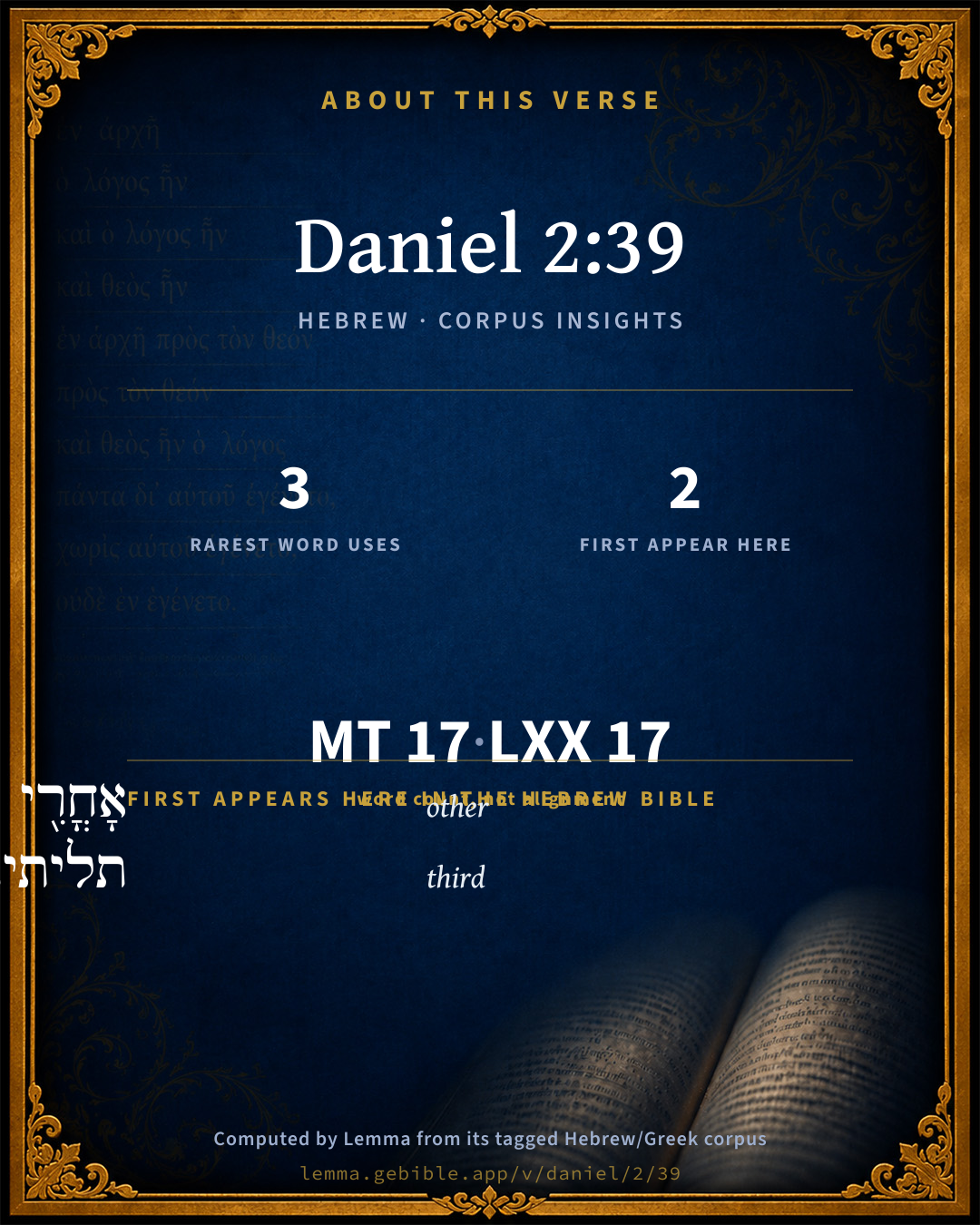
The rarest word here is תליתיא third H8523 — appearing just 3 times in the whole Hebrew Bible.

First appearance in Scripture

These words make their first canonical appearance in the Hebrew Bible here:

  • אָחֳרִ֖י other H317
  • תליתיא third H8523

Shared distinctive vocabulary

תליתיא third H8523 occurs in 2 verses of the Hebrew Bible. Also found in:

Grammatical profile

  • 3 nouns
  • 12 adjectives
  • 2 particles

Repetition

Words recur within this verse — often emphatic in Hebrew:

  • ארעא earth H772 ×3
  • מַלְכ֥וּ kingdom H4437 ×2
  • אָחֳרִ֖י other H317 ×2
  • תליתיא third H8523 ×2
  • דִּ֣י which H1768 ×2

Hebrew & Septuagint length

In English translation the verse runs 23 words from the Hebrew and 32 from the Septuagint (LXX English) — closely comparable.

A rough comparison of the two English renderings, which tokenize alike — not a word-level alignment.

Word counts can differ between the Hebrew and the Greek without any difference in meaning — e.g. the Hebrew direct-object marker אֵת has no separate Greek word, and Greek often adds the article ὁ.

In the original languages it is 17 Hebrew tokens and 17 Greek tokens — but the two are counted differently (Hebrew bundles its prefixes and suffixes into one token; the Greek is in lemma form), so that isn’t a like-for-like length.

Cross-references

11

Topical passages linked to Daniel 2:39 in the Treasury of Scripture Knowledge — connected by theme and wording, ordered by reader-vote popularity; previews shown in the World English Bible.

  • Isaiah 44:28–45:5 Who says of Cyrus, [He is] my shepherd, and shall perform all my pleasure, even saying of Jerusalem, She shall be built; and of the temple, Your foundation shall be laid.
  • Daniel 2:32 As for this image, its head was of fine gold, its breast and its arms of silver, its belly and its thighs of brass,
  • Daniel 5:28–31 PERES; your kingdom is divided, and given to the Medes and Persians.
  • Daniel 8:3–14 Then I lifted up my eyes, and saw, and, behold, there stood before the river a ram which had two horns: and the two horns were high; but one was higher than the other, and the higher came up last.
  • Daniel 8:20 The ram which you saw, that had the two horns, they are the kings of Media and Persia.
  • Daniel 10:20 Then he said, "Do you know why I have come to you? Now I will return to fight with the prince of Persia. When I go forth, behold, the prince of Greece shall come.
  • Daniel 7:5–7 Behold, another animal, a second, like a bear; and it was raised up on one side, and three ribs were in its mouth between its teeth: and they said thus to it, Arise, devour much flesh.
  • Daniel 7:23 Thus he said, The fourth animal shall be a fourth kingdom on earth, which shall be diverse from all the kingdoms, and shall devour the whole earth, and shall tread it down, and break it in pieces.
  • Daniel 11:2–20 Now will I show you the truth. Behold, there shall stand up yet three kings in Persia; and the fourth shall be far richer than they all: and when he has grown strong through his riches, he shall stir up all against the realm of Greece.
  • Zechariah 6:3 in the third chariot white horses; and in the fourth chariot dappled horses, all of them powerful.
  • Zechariah 6:6 The one with the black horses goes out toward the north country; and the white went out after them; and the dappled went forth toward the south country."

Cross-references courtesy of OpenBible.info (CC BY 4.0).

Hebrew and Greek witnesses Masoretic Hebrew ↔ Greek Septuagint

The same verse in the two great witnesses to the Old Testament, shown verse-for-verse.

These are two independent witnesses, not word-aligned to each other, and the Septuagint is shown in lemma (dictionary) form.

Hebrew Daniel 2:39 Masoretic · Westminster Leningrad Codex

וּבָתְרָ֗ךְ תְּק֛וּם מַלְכ֥וּ אָחֳרִ֖י ארעא אֲרַע מִנָּ֑ךְ וּמַלְכ֨וּ תליתיא תְלִיתָאָ֤ה אָחֳרִי֙ דִּ֣י נְחָשָׁ֔א דִּ֥י תִשְׁלַ֖ט בְּכָל אַרְעָֽא

After you shall arise another kingdom inferior to you; and another third kingdom of brass, which shall bear rule over all the earth.

World English Bible · Public Domain

Greek LXX Daniel 2:39 Septuagint · lemma form

καί μετά σύ ἀναἵστημι βασιλεία ἐλάττων σύ καί τρίτος βασιλεία ἄλλος χαλκοῦς ὅς κυριεύω πᾶς ὁ γῆ

You are the head of gold. And after you shall arise another kingdom inferior to you, an a third kingdom which is the brass, which shall have dominion over all the earth;

LXX2012 (modern English Septuagint) · Public Domain

Hebrew: Westminster Leningrad Codex (CC BY 4.0). Greek: Septuagint (public domain); English from LXX2012 (modern English Septuagint) (Public Domain). How the Septuagint differs from the Hebrew →

Commentary

Notes on Daniel 2:39 from classic Christian and Jewish commentators (each source and its license shown beneath its notes). The classic Christian expositions comment on the surrounding passage and are grouped to its opening verse, so a note may address several verses; the Jewish commentaries on the Tanakh (Rashi and others) are per-verse, so they appear only where the commentator wrote on this verse.

Lemma curates 59 commentaries, every one of them public domain or Creative Commons licensed, each selected and text-cleaned for this edition rather than reprinted as found. About our sources →

Trapp's Complete Commentary

John Trapp

Dan 2:39 And after thee shall arise another kingdom inferior to thee, and another third kingdom of brass, which shall bear rule over all the earth.

Ver. 39. And after thee shall arise another kingdom,] {a} viz., That of the Persians, fitly set forth by silver, for their exceeding great wealth mentioned by many heathen authors. The two silver arms are the Medes and Persians, meeting both in Cyrus, as the two arms do in the breast; Cyrus also, by his great strength and much bodily labour all his life long, got this other empire.

Inferior to thee,] sc., In fame and felicity. Chald., Humilius; quia durius et minus tolerabile, saith one.

And another kingdom of brass.] This is the third monarchy, which is the Grecian, not the Carthaginian, as Orosius, and, out of him, Prosper, would have it; and it is fitly set forth by brass, which, as it is a metal strong and hard, so noisy and loud sounding. The belly noteth the beginning and greatness of this kingdom, saith one, {b} under Alexander the Great; the joints between the belly and thighs note the plucking up of this kingdom after Alexander’s death, to be divided into four, whereof the principal were two - the one of the Seleucidae, the other of the Lagidae, figured here by the two thighs of brass. See Dan 11:4-5.

{a} Ex hac Danielis visione Gentiles fabulam acceperunt de quattuor saeculis, aureo, argenteo, &c.

{b} Parker in loc.

John Trapp, A Commentary or Exposition upon All the Books of the Old and New Testament (1647–1656) — public domain. Text from a community e-Sword module.

Joseph Benson's Commentary

Dan 2:39. After thee shall arise another kingdom inferior to thee — “It is very well known, that the kingdom which arose after the Babylonian was the Medo-Persian. The two hands and the shoulders signify that the empire of the Babylonians should be destroyed by two kings. The two kings were the kings of the Medes and Persians, whose powers were united under Cyrus, who was son of one of the kings, and son-in-law of the other, and who besieged and took Babylon, put an end to that empire, and erected on its ruin the Medo-Persian, or the Persian, as it is more usually called, the Persians having soon gained ascendency over the Medes. The empire is said to be inferior, as being less than the former, according to the Vulgate translation, because neither Cyrus, nor any of his successors, ever carried their arms into Africa or Spain, so far as Nebuchadnezzar is reported to have done; or rather, as being worse, according to Castalio; for indeed it may be truly asserted, that the kings of Persia were the worst race of men that ever governed an empire. This empire, from its first establishment by Cyrus to the death of Darius Codomanus, lasted not much above two hundred years.” — Bishop Newton.

And another third kingdom of brass, which shall bear rule over all the earth — “The prophet,” says Jackson, in his Chronicles, vol. 1. p. 393, “having just mentioned this second kingdom, with great delicacy hastens to the third, because he would not tell the king that the second kingdom was to destroy his.” It is universally known that Alexander the Great subdued the Medes and Persians, and subverted their empire. This prince is said, by the author of the first book of Maccabees, “to be the first that reigned over Greece, after having smitten Darius the king of the Persians and Medes; to have made many wars, won many strong holds, and slain the kings of the earth; also to have gone through to the ends of the earth, and taken the spoils of many nations.” It is reported of this mighty conqueror, that “he built more than seventy cities, twelve of which, or, as Curtius intimates, eighteen, he named Alexandria; that his soldiers, though unarmed, were never afraid, while he was with them, of any armed forces. He engaged no enemy which he did not conquer, besieged no city which he did not take, and made attempts on no nation which he did not entirely subdue.” But all would not satisfy the vast cravings of his ambition, so that the Roman satirist with great justice observed of him,

“Unus Pellæo juveni non sufficit orbis; Æstuat infelix augusto limite mundi.” — Juv. Sat. 10.

One world does not satisfy the Macedonian youth: he chafes unhappy, cooped in the narrow compass of the globe: see Wintle. The kingdom, therefore, which succeeded to the Persian was the Macedonian, or Grecian; and this kingdom was fitly represented by brass, for the Greeks were famous for their brazen armour, their usual epithet being, Χαλκοχιτωνες Αχαιοι, The brazen-coated Greeks. This third kingdom is said to bear rule over all the earth, by a figure usual in almost all authors. Alexander himself commanded that he should be called, The king of all the world; not that he really conquered the whole world, but that he had considerable dominions in Europe, Asia, and Africa, that is, in all the three parts of the world then known. Diodorus Siculus, and other writers, give an account of ambassadors coming from almost all the world, to congratulate him upon his success, or to submit to his empire: and then especially, as Arrian remarks, did Alexander appear to himself, and to those about him, to be master both of all the earth and all the sea. But this third kingdom must be considered as comprehending not only Alexander, but likewise the Macedonian princes who succeeded him. This will appear the more probable, because the former kingdoms comprehended all the succeeding princes of the same house and nation, even till the ruin of their empire, and its translation to the different prince and nation which succeeded to the sovereign power and dominion: see Bishop Newton, and Dr. Chandler’s Vindication of Daniel.

Joseph Benson's Commentary on the Old and New Testaments (1811–1818) — public domain. Text from a community e-Sword module.

Whedon's Commentary on the Bible

Daniel D. Whedon

39. Nebuchadnezzar’s kingdom shall be followed by a silver kingdom, inferior (or, literally, lower down; that is, nearer the ground) to that of the golden head, and it, in turn, by a brazen kingdom, to be followed by one of iron and miry clay (Dan_2:40-41). Expositors of the greatest ability and spiritual insight have differed in their interpretation of these four kingdoms. That the first world-empire is the Babylonian and that another is the Greek (Dan_8:21) all admit; but of the other two empires no explanation can be given which is free from difficulty. The best that can be done is to choose the view which does not positively contradict either the statements of Daniel or the acknowledged certainties of history. We will now consider the three leading positions.

(1) The most attractive view to modern scholars is that the four empires are the Babylonian, Median, Persian, and Greek. In favor of this it is urged that, following the ordinary rules of historic interpretation, the description of the fourth empire — of iron, which was afterward broken, divided, and weak (Dan_2:34-35) — and of the fourth beast, with the ten horns (namely, ten kings, Dan_7:24) among which sprung up a “little horn” which made war with the saints and took away the daily sacrifice (chaps. 7, 8), is clearly a description of the Greek empire, and of the little horn Antiochus Epiphanes, whose reign of guilt is so elaborately set forth in chap. 11. It is also said that the second empire must necessarily be Median, since Daniel himself makes Darius the Mede king of an independent world-monarchy (Dan_5:31; Daniel 6) and therefore whatever history may say, we must interpret these visions from the prophet’s standpoint.

Against this it may be said that, allowing the argument that the fourth monarchy cannot be Roman, and that the “little horn” in each chapter represents Antiochus Epiphanes, it still does not necessitate our making the second empire Median; it may be Medo-Persian, and the fourth empire that of the successors of Alexander. That Daniel did regard the Medes and Persians as a unit, so far as their kingdom is concerned, is clearly seen from the fact that the law of the kingdom, even under Darius the Mede, was the “law of the Medes and Persians” (Dan_6:8; Dan_6:12; Dan_6:15), while, as Dr. Terry himself admits, Daniel’s statement that the two-horned ram denotes “the kings of Media and Persia” (Dan_8:20) does show that “Daniel himself recognized Medes and Persians as constituting one monarchy” (Hermeneutics, p. 352). It will not do to say that the standpoint here “is manifestly in the last period of the Persian rule” (Terry); for Daniel himself states that this vision occurred not, as Terry assumes, “long after the Median power in Babylon had ceased to exist,” but in the reign of King Belshazzar (Dan_8:1) — and surely, as Dr. Terry says, we should study these visions from Daniel’s point of view and “in the light of his own explanations and historical statements.” Daniel never distinguishes between the empire of Media and that of Persia, but invariably speaks of these empires as one. Neither the Book of Daniel nor the facts of history warrant us in assuming the existence of a Median empire between the Babylonian and Persian empires. Indeed, as Kamphausen says, “There never really was a Median world-kingdom, either before or after the fall of Babylon.” This is acknowledged by all. Therefore, if Daniel did declare the Median to be the second empire, he made a mistake. So Kamphausen frankly acknowledges. But such mistake ought not to be charged against him unnecessarily, especially in the face of his own declaration in the same book that the law and monarchy of the Medes and Persians were a duality in unity.

Daniel’s thought of the Medes and Persians as joint rulers of one kingdom is exactly that of the ancient writers, like Herodotus and Thucydides, who scarcely distinguished between these two peoples, and is also that of modern historians, who have before them all the facts of modern discovery. Maspero, without any thought of its bearing on a Bible statement, says: “The Median empire had fallen (549 B.C.), but it was a change of dynasty rather than a foreign conquest. Astyages and his predecessors had been kings of the Medes and Persians, Cyrus and his successors were kings of the Persians and Medes” (Histoire Ancienne, 1893, p. 564). Therefore, we are compelled by the facts of history, in perfect harmony with the words of Daniel himself, to make the second empire not Median, but Medo-Persian.

(2) The view that the fourth empire was Roman took its rise before the Christian era (as is seen from 2 Esdras, etc.), and continued to be so universally accepted by the Christian Church that Luther could say, with only a little exaggeration, “In this interpretation and meaning all the world agree.”

The most powerful argument in favor of this view is that from the days of Nebuchadnezzar until now there have been only four universal world-empires — the Babylonian, the Medo-Persian, the Greek, and the Roman. Many mighty emperors like Charlemagne and Napoleon have “hoped and plotted and warred and shed oceans of blood to form a fifth, but they have not succeeded; the fragments of the Roman empire still hold the field.” And this fourth empire corresponded exactly to the description of Daniel; for it was an Iron Empire, a beast with iron teeth, diverse from all which had preceded it, devouring and treading down the whole earth (Dan_7:7; Dan_7:27). Besides, it was “in the days of these kings” (Dan_2:44), during the Roman dominion, that the prophesied Messiah came, and St. John, in his Apocalypse, means Rome when he speaks of the beast with the seven heads and ten horns.

However, in answer to this it may be said that the Bible writers are not concerned to lay out a map of the world’s history in which all future world-monarchies are mentioned, but (certainly in all other prophecies) confine themselves, so far as details are concerned, to the history which is near their own times and to the kings which have vital relations to Israel. It is entirely in accordance with this prophetic analogy that St. John, writing in the Roman period, should make very specific reference to the beastly Roman empire, but even if the seven-headed beast with ten horns which he describes (Revelation 13) be Rome, which is very doubtful (Milligan, Book of Revelation, 1895), that would by no means prove that the one-headed beast with ten horns which Daniel spoke of (Dan_7:7; Dan_7:19) referred to the same world-power. The same symbol is often used in Scripture of very different historic events (Terry, Biblical Hermeneutics, 1891). Indeed there are several other considerations which indicate that Daniel’s fourth empire could not be Rome. It was not the immediate successor of Alexander’s empire; it arose and had its chief field of operations in a different country from that of the other empires of Daniel; it was not Rome, but Syria, which touched most closely the life and fate of the Jewish people at the close of the Greek domination; it is not Roman kings whose life and acts Daniel describes most minutely, but Syrian kings; while the description of this fourth empire of Daniel as iron and miry clay, that is, as “mixed, composite, brittle, inadhesive, not unified and consolidated into one firm power,” does not properly describe the Roman empire at the beginning of the Christian era. Daniel prophesied that the kingdom of heaven should appear on the earth at a time when a kingdom, once strong, had become weak and divided, and when its unkingly kings, like the clay toes of the great image, could easily be smitten (Dan_2:42). This is not a picture of Augustus and the Roman empire which was at the apex of its glory when Christ was born. “It was three hundred years later than Christ’s coming when the Roman empire was divided, and much later still when broken in pieces and made to pass away. But the stone smote not the legs of iron, but the feet, which were partly of iron and partly of clay” (Terry). Daniel’s fourth empire was to be destroyed, broken to pieces, and swept away upon the rise of the Messianic kingdom (Dan_2:35); but historically this was not true of Rome. If it be said in reply to this that the deathblow was really given to the Roman empire when the Messiah came, but that it took two thousand years for it to die, and that while the fragments of this empire still remain in the earth, and the “little horn” yet rages, all these enemies of the kingdom will be destroyed in the future, when the Son of man comes the second time in the clouds of heaven; we would answer, with Bruston, that it is incredible, and contrary to all prophetic analogy, that, without saying a word of the first coming of Christ, Daniel should describe here the struggles of the Christian Church through long ages, ending with this thrilling picture of our Lord’s second advent. Nowhere else in the Old Testament is the second advent referred to, and it ought not to be read into this passage if it can be consistently interpreted, as it can, of his first coming.

(3) The third position to which we are forced by the unsurmountable objections to other views is that Daniel’s four kingdoms are Babylonian, Medo-Persian, Greek, and Syrian.

While objections can be made to this, for example, that the Medo-Persian empire was not “inferior” to the Babylonian (Dan_2:39); the Syriac kingdom did not break in pieces and subdue all things (Dan_2:40); the kingdom of God did not strike and crush this Syrian kingdom (Dan_2:34) which had disappeared before Christ was born — the Messianic kingdom appearing not “in” but “after” the days of those kings (Dan_2:44) — yet, instead of being vital and fundamental objections, these are mostly verbal criticisms, such as lie against all rival views. These seeming contradictions to our position are mostly due to the fact that a symbol cannot go on all fours, and a picture cannot apply to every minute section of the reality. (See note Dan_2:40.)

Gutschmidt and other historians well see that “the fall of Perdiccas (321 B.C.) was really the end of the Perso-Macedonian empire founded by Alexander,” and that following this came the great empires of the Seleucidae and Ptolemies. The empire founded by Seleucus (who at least for a time became “arbiter of the world,” Mahaffy), was, together with the allied kingdom of Egypt (chap. xi), the fourth empire of Daniel. Not only was Seleucus a great king, and a terrible scourge upon the nations of the East, his very name meaning “conqueror,” but he was especially great and terrible to the Jews, and ruled over those very countries “which for nearly three hundred years had been the seat of empire for the three great prophetic dynasties before him” (Cowles).

Daniel D. Whedon (gen. ed.), Commentary on the Old and New Testaments (1874–1909) — public domain. Text from a community e-Sword module.

Tyndale Open Study Notes

Tyndale Open Resources

2:39 inferior to yours: Silver was inferior in value to gold, as the chest is lower than the head. Nebuchadnezzar was an extremely stable ruler who held the Neo-Babylonian Empire together. Persia, by contrast, was often threatened with internal divisions and instability around the periphery.

Tyndale Open Study Notes — © Tyndale Open Resources, licensed CC BY-SA 4.0. Text via the HelloAO Bible API.

Ibn Ezra

Rabbi Abraham ibn Ezra

[Daniel 2:39] Uvatrekh (וּבָתְרָךְ - And after you): And after you an inferior kingdom will arise. [The word for inferior is] araʿ (אֲרַע), like the Targum’s rendering [of the concept as] ‘lower’ (tachtayim - תַּחְתַּיִים). And because of it [this sense of lowness inherent in the root], the earth is called arʿa (אַרְעָא) [in Aramaic], for it is beneath everything. The Gaon Rav Saadia—and all the commentators relied upon him—said: That the gold is the kingdom of Babylon: Nebuchadnezzar, his son Evil-merodach, and Belshazzar his grandson. With him [Belshazzar], the kingdom of the Chaldeans ceased. And so it is written concerning him: “That very night Belshazzar the Chaldean king was slain (b'he b'leilya q'til Belshe'tztzar malka). And Darius the Mede received the kingdom (v'Daryavesh Mada'ah qabbel malkhuta)” [Daniel 5:30-6:1]. And this view is correct, for Scripture says: “And all the nations shall serve him, and his son, and his son’s son” [Jeremiah 27:7]. And it is also written: “and they were servants to him and to his sons” [II Chronicles 36:20] – [the referenced ‘sons’ being] Evil-merodach and Belshazzar his son [i.e., grandson]. For a grandson is [sometimes] called a son, like “to Reuel their father” [Exodus 2:18], for he [Reuel] is Hobab, Moses' father-in-law [cf. Numbers 10:29; Judges 4:11 identify Hobab as father-in-law, traditionally equated with Reuel/Jethro]. And it is written: “And it came to pass in the thirty-seventh year of the exile of Jehoiachin... Evil-merodach king of Babylon, in the year that he began to reign, lifted up the head of Jehoiachin...” [II Kings 25:27 / Jeremiah 52:31]. And behold, he [Evil-merodach] is between the reign of Nebuchadnezzar and the reign of Belshazzar.

[Daniel 2:39] [The Silver]: [represents] the kingdom of Media and Persia. I will explain further [later], for there is great confusion in their count/chronology.

[Daniel 2:39] [The Bronze]: is the kingdom of Greece (Yavan - יָוָן), and their beginning was Alexander of Macedon, as Daniel will explain in the words of his [later] prophecies [cf. Daniel 8]. And the Gaon [Saadia] said that the fourth [kingdom, the iron] is the kingdom of Aram [=Rome/Byzantium]. And [he further interpreted that the element of] clay (cheres - חֶרֶס) [mixed with the iron, Daniel 2:41-43] is the kingdom of Ishmael [Islam]. And furthermore, he [Saadia] said in his book: ‘Do not be astonished that he compared the kingdom of Ishmael to clay. Behold, it is not [inherently] inferior to the aforementioned kingdoms; it is merely the way of one arranging his vessels: first he shows the gold, then the silver, then the bronze, then the iron, and lastly, earthenware.’ But these [Saadia's words justifying clay = Ishmael] are words of emptiness and void (tohu va-vohu - תֹּהוּ וָבֹהוּ)! For there is no correct [descending] order according to his arrangement [if clay doesn't mean weaker]. The proof [that the order implies value/strength] is that Daniel said of the kingdom of Persia “inferior (araʿ - אֲרַע) to you” [Daniel 2:39], just as silver is inferior to gold. And he said concerning the clay: “and part of it (minnah - מִנַּהּ) shall be brittle/broken (tevira - תְבִירָה)” [Daniel 2:42]. And the reliable proof that the clay is part of the iron kingdom is that he explicitly said concerning the toes of iron and the toes of clay: “part of the kingdom shall be strong (takkifa - תַקִּיפָא), and the clay (charsa - חַרְסָא) shall be brittle/broken (tevira - תְבִירָא)” [Daniel 2:42, paraphrased/combined concepts]. Behold, it [the fourth kingdom] is one kingdom! How then can the kingdom of Ishmael be joined with the kingdom of Aram [Rome], when Ishmael never ruled over it [Rome proper], and their religions (toratam - תּוֹרָתָם - laws/religions) are not one?! And since the matter is thus [that Saadia’s identification of Ishmael as the clay mixed with Roman iron is problematic], one must wonder how Daniel did not mention the [powerful] kingdom of Ishmael? And why were there not five kingdoms [if Ishmael is distinct and important]? And now I will explain: Know that Alexander, who was king of Greece (Yavan), is the one who killed Darius the Persian, as Daniel will explain [cf. Daniel 8:5-7, Daniel 8:20-21]. He was also the king of Aram. And Aram itself is Kittim, as Joseph ben Gorion indicated in his book [Josippon]. And in Daniel [it says]: “But ships of Kittim shall come against him...” [Daniel 11:30]. And the Targum translates “And ships from the hand of Kittim...” [Numbers 24:24] as ‘sent from the Romans’ [Targum Jonathan on Numbers 24:24]. And behold, Kittim is a son [descendant] of Yavan (Greece) [along with] “Elishah, Tarshish, Kittim, and Dodanim” [Genesis 10:4; I Chronicles 1:7]. Therefore, the kingdom of bronze is the kingdom of Greece. And [thus] the kingdom of Aram [in this prophetic context] is the kingdom of Greece [i.e., the Greco-Roman world originating from Yavan/Kittim]. Therefore [since Greece/Rome is the Bronze], the iron is the kingdom of Ishmael. And the rationale [is this]: Because the kingdom of Persia destroyed the entire kingdom of the Chaldeans, and the kingdom of Greece also destroyed the entire kingdom of Persia, but the kingdom of Ishmael, which is the iron, could not destroy the entire kingdom of Greece [=Aram/Rome/Byzantium]; it destroyed only part of the kingdom. And behold, to this day, there are places where Ishmael conquers the kingdom of Aram [Byzantium], and places where Ishmael is conquered [by Aram]. Therefore, it said: “part of the kingdom shall be brittle (tevira) and part shall be strong (takkifa)” [Daniel 2:42, using Aramaic terms miqtzat malchuta tehveh tevirah umiqtzat tehveh takkifa]. And afterwards it said: “And in the days of those kings...” (uv'yomeihon di malkhayya illein - וּבְיוֹמֵיהוֹן דִּי מַלְכַיָּא אִלֵּין) [Daniel 2:44]. The meaning is: Two kingdoms rule [contemporaneously or interactively in this final phase] – Aram (which is the kingdom of Greece [=Rome/Byzantium]) and the kingdom of Ishmael. And these two kingdoms [exist] in this day. And this fourth kingdom [the iron/clay] is the kingdom of Ishmael, which spread throughout the world. For all of Persia, Media, Sheba, Seba, Egypt, Africa, many from India, and most of the kingdom of Kush converted to their religion (toratam - תּוֹרָתָם).

Ibn Ezra on the Tanakh — English translations: “Sefaria Community Translation” (CC0 1.0 (public-domain dedication)); “Yalkut, Sifsei Chachomim Chumash, Metsudah Publications, 2009” (CC BY 4.0); and “Commentary of Ibn Ezra on Isaiah - trans. by M. Friedlander, 1873” (public domain). Text via Sefaria.

Geneva Bible (1599)

Geneva Bible translators

That is, of the Macedonians shall be of brass, not alluding to the hardness thereof, but to the vileness in respect of silver.

Meaning, the Persians which were not inferior in dignity, power, and riches, but were worse touching ambition, cruelty, and all kind of vice, showing that the world should grow worse and worse, till it was restored by Christ.

Geneva Bible (1599) marginal notes — public domain. Text via Bolls.life.

Jamieson, Fausset & Brown

Robert Jamieson, A. R. Fausset & David Brown

That Medo-Persia is the second kingdom appears from Dan 5:28 and Dan 8:20. Compare Ch2 36:20; Isa 21:2.

inferior--"The kings of Persia were the worst race of men that ever governed an empire" [PRIDEAUX]. Politically (which is the main point of view here) the power of the central government in which the nobles shared with the king, being weakened by the growing independence of the provinces, was inferior to that of Nebuchadnezzar, whose sole word was law throughout his empire.

brass--The Greeks (the third empire, Dan 8:21; Dan 10:20; Dan 11:2-4) were celebrated for the brazen armor of their warriors. JEROME fancifully thinks that the brass, as being a clear-sounding metal, refers to the eloquence for which Greece was famed. The "belly," in Dan 2:32, may refer to the drunkenness of Alexander and the luxury of the Ptolemies [TIRINUS].

over all the earth--Alexander commanded that he should be called "king of all the world" [JUSTIN, 12. sec. 16.9; ARRIAN, Campaigns of Alexander, 7. sec. 15]. The four successors (diadochi) who divided Alexander's dominions at his death, of whom the Seleucidæ in Syria and the Lagidæ in Egypt were chief, held the same empire.

Jamieson, Fausset & Brown — Commentary Critical and Explanatory on the Whole Bible (1871) — public domain (CC PDM 1.0). Text via the HelloAO Bible API.

John Calvin's Commentaries

In this verse Daniel embraces the Second and Third Monarchies. He says the second should be inferior to the Chaldean in neither power nor wealth; for the Chaldean empire, although it spread so far and so wide, was added to that of the Medes and Persians. Cyrus subdued the Medes first; and although he made his father-in-law, Cyaxares, his ally in the sovereignty, yet he had expelled his maternal grandfather, and thus obtained peaceable possession of the kingdom throughout all Media. Then he afterwards conquered the Chaldeans and Assyrians, as well as the Lydians and the rest of the nations of Asia Minor. We see then that his kingdom is not called inferior through having less splendor or opulence in human estimation, but because the general condition of the world was worse under the second monarchy, as men’s vices and corruptions increase more and more. Cyrus was, it is true, a prudent prince, but yet sanguinary. Ambition and avarice carried him fiercely onwards, and he wandered in every direction, like a wild beast, forgetful of all humanity. And if we scan his disposition accurately, we shall discover it to be, as Isaiah says, very greedy of human blood. (Isaiah 13:18.) And here we may remark, that he does not treat only of the persons of kings, but of their counselors and of the whole people. Hence Daniel deservedly pronounces the second state of the kingdom inferior to the first; not because Nebuchadnezzar excelled in dignity, or wealth, or power, but because the world had not degenerated so much as it afterwards did. For the more these monarchies extend themselves, the more licentiousness increases in the world, according to the teaching of experience. Whence the folly and madness of those who desire to have kings very powerful is apparent, just as if any one should desire a river to be most rapid, as Isaiah says when combating this folly. (Isaiah 8:7.) For the swifter, the deeper, and the wider a river flows on, the greater the destruction of its overflow to the whole neighborhood. Hence the insanity of those who desire the greatest monarchies, because some things will by positive necessity occur out of lawful order. when one man occupies so broad a space; and this did occur under the sway of the Medes and Persians.

The description of the Third Monarchy now follows. It is called brazen, not so much from its hardness as from its being worse than the second. The Prophet teaches how the difference between the second and third monarchies is similar to that between silver and brass. The rabbis confound the two monarchies, through their desire to comprehend under the second what they call the kingdom of the Greeks; but they display the grossest ignorance and dishonesty. For they do not err, through simple ignorance, but they purposely desire to overthrow what Scripture here states clearly concerning the advent of Christ. Hence they are not ashamed to mingle and confuse history, and to pronounce carelessly on subjects unknown to them — unknown, I say, not because they escape men moderately versed hi history, but through their being brutal themselves, and discerning nothing. For instead of Alexander the son of Philip, they put Alexander the son of Mammea, who possessed the Roman empire, when half its provinces had been already separated from it. He was a spiritless boy, and was slain in his tent with the greatest ignominy by his own soldiers; besides that, he never really governed, but lived as a minor under the sway of his mother. And yet the Jews are not ashamed to distort and twist what relates to the king of Macedon to this Alexander the son of Mammea. But their wickedness and ignorance is easily refuted by the context, as we shall afterwards see. Here Daniel states shortly that there shall be a third monarchy, he does not describe its character, nor explain it fully; but we shall see in another place the meaning of his prophecy. He now interprets the dream of the king of Babylon, as the vision of the four empires had been offered to him. But the angel afterwards confirms the same to him by a vision, and very clearly, too, as will be seen in its own place. Without doubt this narrative of the brazen image relates to the Macedonian kingdom. How, then, is all doubt removed? By the description of the fourth empire, which is much fuller, and clearly indicates what we shall soon see, that the Roman empire was like the feet, partly of clay and partly of iron. He says, therefore, —

John Calvin's Commentaries (1540-1563) — public domain. Text from the Calvin Translation Society English edition (1840s-50s) via the Christian Classics Ethereal Library (ccel.org). Calvin's coverage is partial (roughly two-thirds of the Bible); uncommented books and verses are honest gaps, never fabricated. The 19th-century editor's footnotes and remarks are omitted so the notes are faithfully Calvin's own voice.

Ellicott's Commentary for English Readers

(39) Another kingdom.—These words make it clear that by “the king” in the last verse “kingdom” was meant; or, in other words, Nebuchadnezzar was identified with his kingdom (comp. Dan_7:5; Dan_8:3; Dan_8:20). The second kingdom is the Medo-Persian (as appears more fully below, Exc. E). The inferiority is to be found in the divided character of that empire, as compared with the massive solidity of its predecessor. This is signified in the image, partly by the inferiority of the metal, silver instead of gold, and partly by the symbol of division, the two breasts opposed to the one head. It must not be forgotten that in other respects, such as extent of territory and duration of empire, the Medo-Persian far exceeded the Babylonian kingdom.

Another third.—The metal implies a certain inferiority, but the phrase “shall bear rule over the whole earth” speaks of an empire that extended further than the preceding. This is the Græco-Macedonian Empire (see Exc. E, and comp. Dan_7:6; Dan_8:5-7).

A Bible Commentary for English Readers, edited by Charles John Ellicott (1878–1897) — public domain. Text from a community e-Sword module.

The Cambridge Bible for Schools and Colleges

gen. ed. J. J. S. Perowne

39. The second and third kingdoms are, in all probability, the Median and the Persian. The home of the Medes was in the mountainous country N. and N.E. of Babylon, and S.W. of the Caspian Sea; they are often mentioned in the Assyrian inscriptions from the 8th cent. b.c.; but they were first consolidated into an important power by Cyaxares, b.c. 624–584, during whose reign, in 607, they were the chief instruments in bringing about the destruction of Nineveh. Cyaxares was succeeded by Astyages, whose soldiers deserted en masse to Cyrus (b.c. 549); and the empire of the Medes thus passed into the hands of the Persians. Their name was however long remembered; for the Greeks regularly spoke of the Persians as Medes (οἱ Μῆδοι, τὰ Μηδικά). In the book of Daniel the ‘Medes and Persians’ are, it is true, sometimes represented as united (Dan_5:28, Dan_6:8; Dan_6:12; Dan_6:15, cf. Dan_8:20): but elsewhere they are represented as distinct; after the fall of Babylon, Darius ‘the Mede’ ‘receives the kingdom’ (Dan_5:31), and acts in it as king (Dan_6:1-2; Dan_6:15; Dan_6:25-26); he reigns for a time—it is not said how long—and is succeeded by Cyrus, who is called pointedly ‘the Persian’ (Dan_6:28; cf. Dan_10:1, and contrast Dan_9:1, Dan_11:1); the two horns of the ram in Dan_8:3 are distinguished from each other, one (representing the Persian empire) being higher (i.e. more powerful) than the other (the Median empire), and coming up after it. Thus in the view of the author of the book, the more powerful rule of Persia is preceded by a ‘kingdom’ of the Medes, beginning immediately after the death of Belshazzar. It is possible that this representation is based upon the prediction in Isa_13:17, Jer_51:11; Jer_51:28, that the Medes would be the conquerors of Babylon. If the second kingdom be the Median, the third will be that of Persia; it is described as ruling ‘over all the earth,’ with allusion to the wide empire of Cyrus and his successors, which embraced virtually the whole of Western Asia (including Asia Minor) and Egypt (cf. the note on Dan_4:1, at the end). Compare in the O.T. Ezr_1:2, Est_1:1; Est_10:1.

inferior to thee] lit. lower than thou.

The Cambridge Bible for Schools and Colleges (gen. ed. J. J. S. Perowne; Cambridge University Press, 1878–1918) — public domain. Text from a community e-Sword module.

John Gill's Exposition

And after thee shall arise another kingdom inferior to thee,.... This is the kingdom of the Medes and Persians, signified by the breasts and arms of silver, an inferior metal to gold; this rose up, not immediately after the death of Nebuchadnezzar, but after his successors, when Belshazzar his grandson was slain, and Babylon taken by Cyrus; now though this monarchy was as large at the first as the Babylonish monarchy, nay, larger, as it had Media and Persia added to it, new conquests made by Cyrus, and was as rich and as opulent in his times; yet in later kings it shrunk much, in its peace and prosperity, grandeur and glory, as in the times of Cambyses and the Magi; and especially in the reigns of Cyrus the younger, and of Artaxerxes Mnemon; and at last ceased in Darius Codomannus, conquered by Alexander; and was worse than the former monarchy, being more cruel under some of its princes to the people of the Jews:

and another third kingdom of brass: this is the Grecian monarchy, which succeeded the Persian, and therefore called the third kingdom, and is signified by the belly and thighs of brass of the image See Gill on Dan 2:32;

which shall bear rule over all the earth; not the land of Israel, as Saadiah restrains it, but the whole world, as Alexander did, at least in his own opinion; who thought he had conquered the whole world, and wept because there was not another to conquer; and it is certain he did subdue a great part of it. Justin (n) says,

"that when he was returning to Babylon from the uttermost shores of the sea, it was told him that the embassies of the Carthaginians and other cities of Africa, and also of Spain, Sicily, France, Sardinia, and some out of Italy, were waiting for his coming; the terror of his name so struck the whole world, that all nations complimented him as their king destined for them.''

And Pliny reports (o) of Macedonia, that

"it formerly (that is, in the times of Alexander) governed the world; this (says he) passed over Asia, Armenia, Iberia, Albania, Cappadocia, Syria, Egypt, Taurus, and Caucasus; this ruled over the Bactrians, Medes, and Persians, possessing the whole east; this also was conqueror of India.''

(n) Ex Trogo, l. 12. c. 13. (o) Nat. Hist. l. 4. c. 10.

John Gill's Exposition of the Whole Bible (1746–1763) — public domain (CC PDM 1.0). Text via the HelloAO Bible API.

Albert Barnes' Notes on the Bible

And after thee - This must mean “subsequently” to the reign, but it does not mean that the kingdom here referred to would “immediately” succeed his own reign, for that would not be true. The Medo-Persian empire did not come into the ascendency until many years after the death of Nebuchadnezzar. This occurred during the reign of Belshazzar, a grandson of Nebuchadnezzar, between whose reign and that of his grandfather there had intervened the reigns of Evil-merodach and Neriglissar; besides, as the remainder of the prophecy relating to the image refers to “kingdoms,” and not to individual monarchs, it is clear that this also relates not primarily to Nebuchadnezzar as an individual, but as the head of a kingdom. The meaning is, that a kingdom would succeed that over which he reigned, so far inferior that it might be represented by silver as compared with gold.

Shall arise another kingdom - Chaldee, “shall stand up (תקוּם teqûm) another kingdom.” This is language which would denote something different from a succession in the same dynasty, for that would be a mere “continuance of the same kingdom.” The reference is evidently to a change of empire; and the language implies that there would be some revolution or conquest by which the existing kingdom would pass away, and another would succeed. Still there would be so much of sameness in respect to its occupying essentially the same territory, that it would be symbolized in the same image that appeared to Nebuchadnezzar. The kingdom here referred to was undoubtedly the Medo-Persian, established by Cyrus in the conquest of Babylon, which continued through the reigns of his successors until it was conquered by Alexander the Great. This kingdom succeeded that of Assyria or Babylon, 538 years b.c., to the overthrow of Darius Codomanus, 333 years b.c. It extended, of course, through the reigns of the Persian kings, who acted so important a part in the invasion of Greece, and whose defeats have given immortality to the names of Leonidas, Aristides, Miltiades, and Themistocles, and made the names of Salamis, Thermopylae, Marathon, and Leuctra so celebrated. For a general account of Cyrus, and the founding of the Medo-Persian empire, the reader is referred to the notes at Isa 41:2.

Inferior to thee - And therefore represented by silver as compared with gold. In what respects it would be inferior, Daniel does not specify, and this can only be learned from “the facts” which occurred in relation to that kingdom. All that is necessary to confirm the truth of the prophetic description is, that it was to be so far inferior as to make the appellation “silver” applicable to it in comparison with the kingdom of Babylon, represented by “gold.” The expression would denote that there was a general decline or degeneracy in the character of the monarchs, and the general condition of the empire. There have been different opinions as to the inferiority of this kingdom to the Babylonian. Calvin supposes that it refers to degeneracy. Geir supposes that it relates to the duration of the kingdom - this continuing not more than two hundred and forty years; while the other, including the Assyrian, embraced a period of one thousand five hundred years. Polanus supposes that the meaning is, that the Babylonian had more rest and tranquility; while Junius, Willett, and others understand it of a milder and more humane treatment of the Jews by the Babylonians than the Persians. Perhaps, however, none of these opinions meet the circumstances of the case, for they de not furnish as full an account of the reasons of this inferiority as is desirable. In regard to this, it may be observed,

(a) that it is not to be supposed that this kingdom was to be in “all respects” inferior to the Babylonian, but only that it would have certain characteristics which would make it more appropriate to describe it as “silver” than as “gold.” In certain other respects it might be far superior, as the Roman, though in the same general line of succession, was in extent and power superior to either, though there was still a reason why that should be represented by “iron,” rather than by gold, by silver, or by brass.

(b) The inferiority did not relate to the power, the riches, or the territorial extent of the Medo-Persian empire, for it embraced, so far as appears, all that was comprehended in the Babylonian empire, and all in addition which was added by the conquests of Cyrus. In his proclamation to rebuild the temple Ezr 1:2, Cyrus speaks of the extent of his empire in language strongly resembling what is applied to the kingdom of Nebuchadnezzar. “Thus saith Cyrus, king of Persia, The Lord God of heaven hath given me all the kingdoms of the earth.” Thus also it is said of AhaAhasuerus or Astyages, king of Media - a kingdom that constituted a part of the Medo-Persian empire under Cyrus and his successors, that he “reigned from India even unto Ethiopia, over an hundred and twenty and seven provinces.” To the kingdom of Babylon, as he found it when he conquered it, Cyrus of course added the kingdoms of Media and Persia, to the crowns of which he was the heir (see the notes at Isa 41:2), and also the various provinces which he had conquered before he came to the throne; that is, Cappadocia, the kingdom of Lydia, and almost the whole of Asia Minor.

(c) Nor can it be supposed that the kingdom was inferior in regard to “wealth,” for, in addition to all the wealth that Cyrus found in Babylon, he brought the spoils of his victories; the treasures in the possession of the crowns of Persia and Media, and all the wealth of Croesus, the rich king of Lydia, of which he had become possessor by conquest. In considering the “inferiority” of this kingdom, which made it proper that it should be represented by silver rather than by gold, it is to be borne in mind that the representation should embrace “the whole kingdom” in all the successive reigns, and not merely the kingdom as it was under the administration of Cyrus. Thus regarded, it will comprehend the succession of Persian monarchs until the time of the invasion and conquest of the East by Alexander the Great. The reign of Cyrus was indeed splendid; and if “he” alone, or if the kingdom during his administration, were contemplated, it would be difficult to assign a reason why an appellation should have been given to it implying any inferiority to that of Nebuchadnezzar. The “inferiority” of the kingdom, or what made it proper to represent it by silver rather than by gold, as compared with the kingdom of Babylon, may have consisted in the following particulars:

(1) In reference to the succession of kings who occupied the Persian throne. It is true that the character of Cyrus is worthy of the highest commendation, and that he was distinguished not only as a brave and successful conqueror, but as a mild, able, and upright civil ruler. Xenophon, who wished to draw the character of a model prince, made choice of Cyrus as the example; and though he has not improbably embellished his character by ascribing to him virtues drawn from his own fancy in some degree, yet there can be no doubt that in the main his description was drawn from the life. “The true reason,” says Prideaux (“Connections,” vol. i. p. 252, Ed. Charlestown, 1815), “why he chose the life of Cyrus before all others for the purpose above mentioned” (that of giving a description of what a worthy and just prince ought to be) “seemeth to be no other but that he found the true history of that excellent and gallant prince to be, above all others, the fittest for those maxims of right policy and true princely virtue to correspond with, which he grafted upon it.” But he was succeeded by a madman, Cambyses, and by a race of kings eminent among princes for folly and crime. “The kings of Persia,” says Prideaux, “were the worst race of men that ever governed an empire.”

(2) The kingdom was inferior in reference to the remarkable “defeats” in the military campaigns which were undertaken. The Assyrian or Babylonian empire was distinguished for the victories by which it carried its arms around the then known world. The Medo-Persian empire, after the reign of Cyrus, was almost as remarkable for the succession of defeats which have made the period of the world during which the empire continued, so well known in history. It is probable that no kingdom ever undertook so many foolish projects in reference to the conquests of other nations - projects so unwisely planned, and that resulted in so signal failures. The successor of Cyrus, Cambyses, invaded Egypt, and his conduct there in carrying on the war was such as to make him be regarded as a madman. Enraged against the Ethiopians for an answer which they gave him when, under pretence of friendship, he sent spies to examine their country, he resolved to invade their territory.

Having come to Thebes, in Upper Egypt, he detached from his army fifty thousand men to go against the Hammonians, with orders to destroy their country, and to burn the temple of Jupiter Hammon that stood in it. After marching a few days in the desert, they were overwhelmed in the sands by a strong south wind, and all perished. Meantime Cambyses marched with the rest of his army against the Ethiopians, though he wanted all the means of subsistence for his army, until, having devoured all their beasts of burden, they were constrained to designate every tenth man of the army to be killed and eaten. In these deplorable circumstances, Cambyses returned to Thebes, having lost a great part of his army in this wild expedition. - Prideaux’s “Con.” i. 328. It was also during the continuance of this kingdom, that the ill-starred expeditions to Greece occurred, when Mardonius and Xerxes poured the million of Asia on the countries of Greece, and met such signal overthrows at Platea, Marathon, and Salamis. Such a series of disasters never before had occurred to invading armies, or made those who repelled invasion so illustrious. In this respect there was an evident propriety in speaking of this as an inferior or degenerate kingdom.

(3) It was inferior in respect to the growing degeneracy and effeminacy of character and morals. From the time of Xerxes (479 b.c.) “symptoms of decay and corruption were manifest in the empire; the national character gradually degenerated; the citizens were corrupted and enfeebled by luxury; and confided more in mercenary troops than in native valor and fidelity. The kings submitted to the control of their wives, or the creatures whom they raised to posts of distinction; and the satraps, from being civil functionaries, began to usurp military authority.” - Lyman, “Hist. Chart.”

(4) The kingdom was inferior by the gradual weakening of its power from internal causes. It was not only defeated in its attempts to invade others, and weakened by the degeneracy of the court and people, but, as a natural consequence, by the gradual lessening of the power of the central government, and the growing independence of the provinces. From the time of Darius Nothus (423 b.c.) - a weak, effeminate, and indolent prince - “the satraps of the distant provinces paid only a nominal obedience to the king. Many of them were, in fact, sovereigns over the countries over which they presided, and carried on wars against each other.” - Lyman. It was from causes such as these that the power of the kingdom became gradually weakened, and that the way was prepared for the easy conquests of Alexander the Great. Their successive defeats, and this gradual degeneracy and weakening of the kingdom, show the propriety of the description given of the kingdom in the vision and the interpretation - that it would be an “inferior kingdom,” a kingdom which, in comparison with that of Babylon, might be compared with silver as compared with gold.

Still it sustained an important relation to the progress of events in regard to the history of religion in the world, and had an important bearing on the redemption of man. As this is the most important bearing of history, and as it was doubtless with reference to this that the mention of it is introduced into the sacred Scriptures, and as it is, in fact, often alluded to by Isaiah, and in the books of Ezra, Nehemiah, Esther, and some of the minor prophets, it may be proper, in the most summary way, to alude to some of those things which pertain to the bearing of this kingdom on the great events connected with redemption, or to what was done during the continuance of this kingdom for the promotion of the true religion. A full account may be found in Prideaux’s “Connections,” part 1, books iii-vii. Compare Edwards’ “History of Redemption,” Period I, part vi. The particular things which occurred in connection with this kingdom bearing on the progress of religion, and favorable to its advancement, were these:

(a) The overthrow of Babylon, so long the formidable enemy of the ancient people of God.

(b) The restoration of the exiles to their own land under the auspices of Cyrus, Ezr 1:1.

(c) The rebuilding of the temple under the same auspices, and with the favor of the successors of Cyrus.

(d) The preparation of the world for the coming of the Messiah, in the agitations that took place during the continuance of the Persian monarchy; the invasion of Greece; the defeats there; the preparation by these defeats for the coming of Him who was so long promised as the “desire of all nations.”

Compare Hag 2:7 : “And I will shake all nations, and the desire of all nations shall come; and I will fill this house” (the temple erected under the auspices of Cyrus and his successors) “with glory, saith the Lord of hosts.” There was a propriety, therefore, that this kingdom should receive a distinct notice in the sacred Scriptures, for some of the most important events connected with the history of true religion in the world occurred under the auspices of Cyrus and his successors, and perhaps at no period has there been more occasion to recognize the hand of God than in the influences exerted on the minds of those pagan princes, disposing them to be favorable to the long-oppressed children of God.

And another third kingdom of brass - See the notes at Dan 2:32. The parts of the image which were of brass were the belly and thighs, denoting inferiority not only to the head, but to the part which immediately preceded it - the breast and the arms of silver. It is not, indeed, specified, as in the former case, that this kingdom would be inferior to the former, and it is only from the position assigned to it in the image, and the inferior quality of the metal by which it is represented, that it is implied that there would be any inferiority. There can be no reasonable doubt that by this third kingdom is denoted the empire founded by Alexander the Great - the Macedonian empire. It is known to all that he overthrew the Persian empire, and established a kingdom in the East, embracng substantially the same territory which had been occupied by the Medo-Persian and the Babylonian empire. While there can be no doubt that that kingdom is referred to, there can be as little that the reference is not merely to the empire during the reign of Alexander himself, but that it embraced the whole empire as founded and arranged by him, until it was succeeded by another universal empire - here denominated the fourth kingdom. The reasons for supposing that the Macedonian empire is referred to here are almost too obvious to require that they should be specified. They are such as these:

(1) This kingdom actually succeeded that of Mede-Persia, covering the same territory, and, like that, was then understood to be a universal monarchy.

(2) The empire of Alexander is elsewhere more than once referred to by Daniel in the same order, and in such a manner that the sense cannot be mistaken. Thus, in Dan 8:21 : “And the rough goat is the king of Grecia: and the great horn that is between his eyes is the first king. Now that being broken, whereas four stood up for it, four kingdoms shall stand up out of the nation, but not in his power.” Dan 10:20 : “and now,” said the man that appeared in vision to Daniel Dan 2:5, “will I retram to fight with the prince of Persia: and when I am gone forth, lo, the prince of Grecia shall come.” Dan 11:2-4 : “and now will I show thee the truth. Behold there shall stand up yet three kings in Persia; and the fourth shall be far richer than they all, and by his strength through his riches he shall stir up all against the realm of Grecia. And a mighty king shall stand up, that shall rule with great dominion, and do according to his will. And when he shall stand up, his kingdom shall be broken, and shall be divided toward the four winds of heaven; and not to his posterity, nor according to the kingdom that he ruled: for his kingdom shall be plucked up, even for others beside those.” Since this kingdom is thus referred to elsewhere by Daniel in the same order, and as destined to act an important part in the affairs of the world, it is reasonable to suppose that there is a reference to it here.

(3) It is a circumstance of some importance that the emblem here by which this kingdom is represented, “brass,” is one that is peculiarly appropriate to the Greeks, and one that could not be applied to any other naion with equal propriety. The Greeks were distinguished for their “brazen armor,” and the appellation, the “brazen-coated Greeks” - χαλκοχιτώνες Ἀχαιοὶ chalkochitōnes Achaioi - is that by which they were designated most commonly by the ancients. - Iliad i. 371; ii. 47; Odyssey i. 286. In accordance with this, Josephus says (“Ant.” b. x. c. 10, Section 4), τὴν δὲ ἐκεὶνων ἕτερος τις ἀπὸ δύσεως καθαιρήσει χαλκὸν ἠμφιεσμένος tēn de ekeinōn heteros tis apo duseōs kathairēsei chalkon ēmphiesmenos, - “their empire another shall come from the West, clothed with brass, shall destroy.” These considerations leave no doubt that the kingdom here referred to was that Grecian or Macedonian, which, under Alexander, obtained dominion over all the East.

Which shall bear rule over all the earth - In a sense similar to that of the Assyrian, the Babylonian, and the Medo-Persian empire. This is the common description of the empire of Alexander. He himself commanded that he should be called “the king of all the world.” “Accepto deinde imperio, regem se terrarum omnium ac mundi appellari jussit” (Justin. l. 12, c. 16, Section 9) - “Having received the empire, he ordered himself to be called the king of all lands and of the world.” Diodorus Siculus says that he received ambassadors from all countries; κατὰ δὲ τοῦτον τὸν χρόνον ἐξ ἀπάσης σχεδόν τῆς οἰκουμένης ἦκον πρέσβεις, κ.τ.λ. kata de touton ton chronon ex apasē; schedon tēs oikoumenēs ēkon presbeis, etc. - “At which time, legates came to him from almost the whole habitable world.” - L. 17, c. 113. So Arrian (Expedi. Alex. l. 7, c. 15) remarks, that “Alexander then appeared to himself, and to those around him, “to be lord of all the earth and of the sea” - γῆς τε ἁπάσης καὶ θαλάσσης κύριον gēs te hapasēs kai thalassēs kurion.

The author of the book of Maccabees gives a similar account of the extent of this kingdom: “And it came to pass, after that Alexander, the son of Philip the Macedonian, who first reigned in Greece, had overthrown Darius, the king of the Persian and Medes, he fought many battles, and took the strongholds of all, and slew the kings of the earth; and he went through even to the ends of the earth; and took the spoil of many nations; and the earth was quiet before him,” 1 Macc. 1:1-3. The propriety of saying that this “kingdom bore rule over all the earth” is, therefore, apparent. It embraced, of course, all that was anciently included in the Assyrian and Babylonian empires; all that had been added to that empire by the conquests of Cyrus, and also all that Alexander had added to it by his hereditary dominions, and by his conquests in other places. Nearly or quite all the known world, except what was then subject to the Romans, then just a rising power, was under the sway of Alexander. A question has been started whether this refers merely to the kingdom of Alexander during his own life, or whether it embraced also the succession of dynasties until the conquests of the Romans. That the latter is the correct opinion seems clear from the following considerations:

(1) It was true, as we have seen, of the two previous kingdoms specified the Babylonian and the Medo-Persian - that they embraced, not merely the kingdom under any one reigning monarch, but during its entire continuance until it was overthrown by one that had also pretensions to a universal empire - the former by the Medo-Persian, and the latter by the Macedonian. It is to be presumed that the same principles of interpretation are to be applied also to the Macedonian kingdom itself - especially as that was also actually succeeded by one that in a still higher sense laid claim to universal empire.

(2) This was, in fact, one kingdom. It is true that, on the death of Alexander, the empire which he founded was divided among four of his generals, and also that from that sprung the two reigns, the Seleucidae in Syria, and of the Lagidae who reigned in Egypt; but, as Newton has remarked, “their kingdom was no more a different kingdom from that of Alexander, than the parts differ from the whole. It was the same government still continued. Those who governed were still Macedonians. All ancient authors spoke of the kingdom of Alexander and of his successors as one and the same kingdom The thing is implied in the very name by which they are usually called, the “successors of Alexander.” ‘Alexander being dead,’ says Josephus (Ant. b. xi. ch. 8, Section 7), ‘the empire was divided among his successors.’ ‘After the death of Alexander,’ says Justin (lib. xli. c. 4, Section 1), ‘the kingdoms of the East were divided among his successors;’ and he still denominates them Macedonians, and their empire the Macedonian.” - Newton “on the Prophecies,” pp. 189, 190.

In regard to the point before adverted to in reference to the kingdoms of Babylon and of Medo-Persia - the relation which they sustained to religion, or the methods in which they were made to contribute to its progress in the world, making it proper that they should be noticed in the volume of inspiration, it may be remarked that the Macedonian kingdom was also designed, undoubtedly, under an overruling Providence, to contribute to the progress of the great work of human redemption, and to prepare the way for the coming of the Messiah. A full statement of what was done under this reign in respect to religion - the most interesting aspect of history - may be seen in Edwards’ “History of Redemption,” pp. 271-275, and in Prideaux’s “Connections,” vol. ii. p. 279, “seq.” The kingdom here referred to - the Macedonian, represented here by the portion of the image that was of brass, and in the vision of the four beasts Dan. 7 by a leopard that had on its back the wings of a fowl, and in Dan 8:21, by the rough goat - continued from the overthrow of Darius Codomanus by Alexander (333 b.c.), to the conquest of Syria, and the East, by the Romans under Pompey, about sixty-six years before the birth of the Saviour. The principal events during this period affecting the interests of religion, and preparing the way for the coming of the Messiah, were the following:

I. The extensive diffusion of the knowledge of the Greek language. The army of Alexander was mainly composed of Greeks. The Greek language was, of course, what was spoken by the court, and in the cities which he founded; the despatches were in Greek; that language would be extensively cultivated to gratify those in power; and the successors of Alexander were those who used the Greek tongue. The consequence was, that the Greek language was extensively spread over the countries which were subdued by Alexander, and which were governed by his successors. That language became the popular tongue; a sort of universal language understood by the great mass of the people, in a manner not unlike the French in Europe at the present day. The effect of this, in preparing for the introduction of the gospel, was seen in two respects:

(a) In facilitating the “preaching” of the gospel. It is true that the apostles had the gift of tongues, and that there was, notwithstanding the prevalence of the Greek language, occasion for this. But there is no evidence that this was conferred on “all” the early preachers of the gospel, nor is it certain that those on whom it “was” conferred were able to make use of it on all occasions. It is not improbable that, in their ordinary labors, the apostles and others were left to rely on their natural endowments, and to use the language to which they had been most accustomed. As there was, therefore, a common language in most of the countries in which the gospel would be proclaimed, it is evident that the propagation of religion would be greatly facilitated by this, and there can be no doubt that it was “one” of the designs of Providence in permitting the Macedonian conquest thus to prepare the way for the more easy and rapid diffusion of the new religion.

(b) In like manner, this conquest prepared the way “for the permanent record” of the history of the Saviour’s life, and the doctrines of religion in the writings of the New Testament. It was evidently desirable, on many accounts, that the records should be made in one language rather than in many, and of all the languages then spoken on the earth, the “Greek” was the best adapted to such a purpose. It was not only the most polished and cultivated, but it was the most copious; and it was the best fitted to express abstract ideas, and accurate distinctions. Probably with all the improvements since made in the copious Arabic language, and in the languages of modern times, there never has been one that was so well fitted for the purposes of a Divine revelation as the Greek. It may have been one design of Providence, in the extensive and accurate cultivation of that language in Greece itself, as well as in its diffusion over the world, that there should be at the time of the introduction of the Christian revelation a medium of permanent record that should be as free from imperfection as language could be; a medium also in which there should be so much permanent and valuable literature that, even after it should cease to be a spoken language, it would be cultivated by the whole literary world, thus furnishing the means of an accurate knowledge of the meaning of the sacred writings.

II. The translation of the Old Testament into the same language was another important event, which took place during the continuance of this kingdom, which greatly facilitated the introduction and spread of Christianity. The Hebrew language was understood by comparatively few. It ceased to be spoken in its purity after the time of the captivity. In that language the Scriptures of the Old Testament would have been but little diffused in the world. By their being translated, however, into Greek, they became extensively known, and furnished a ready and an intelligible ground of appeal to the preachers of the new religion when they referred to the prophecies of the Old Testament, and the recorded predictions of the Messiah. For a full account of the history of this version, the reader may consult Prideaux’s “Connections,” vol. iii. p. 53, following. It was made according to Archbishop Usher, about 277 b.c. The probability is, that it was made at different periods, and by different hands, as it is executed with very various degrees of ability. See Introduction to Isaiah, Section viii. I. (1), for a more extended account of this version and its value. There can be no doubt that it contributed much to the diffusion of the knowledge of the Holy Scriptures, and was an important instrument in preparing the world for the reception of the revelation that should be made by the Messiah.

III. Events of great importance occurred dating the continuance of this kingdom in preserving the Jewish people in times of persecution, and saving their city and temple from ruin. and their nation from extinction.

(a) The destruction of Jerusalem and the temple was threatened by Alexander himself. After the siege and capture of Tyre, he became enraged at the Jews for refusing to furnish supplies for his army during the siege, under the plea that they were bound to show allegiance to Darius, and he marched to Jerusalem with an intention to take and destroy it. In order to appease him, it is said that Jaddua, the high priest, went out to meet him in his pontifical robes, at the head of a procession of priests, and accompanied by the people in white garments. Alexander was so impressed with the scene that, to the surprise of all, he spared the city and temple; and on being asked by Parmenio the reason of this clemency, said that he had seen this person in vision, who had directed him to lay aside all anxiety about his contemplated expedition to Asia, and that he had promised that God would give him the empire of the Persians. According to the story, Jaddua showed him the prophecies of Daniel, and confirmed him by those prophecies in the confident expectation of conquering the East; and in view of this, Alexander offered sacrifices in the temple, and granted to the Hebrews the freedom of their country, and the exercise of their laws and religion. See Prideaux, vol. ii. p. 302, following; Josephus, “Ant.” b. xi. ch. 8. Whatever of fable there may be in this account, it is certain that this city and temple were not destroyed by Alexander, but that in his ravages in the East, he was led, by some cause, to deal with the capital of the Hebrew nation in a masher different from what he did with others.

(b) A remarkable preservation of the Jewish people, of a somewhat similar character, and evincing the protection of God, occurred during the great persecution under Antiochus Epiphanes, one of the successors of Alexander, in the time of the Maccabees. See Prideaux, vol. iii. p. 230, and 2 Macc. 5:11-27. In the times of that celebrated persecution, multitudes of the Jews were slain by Antiochus himself; the city was taken, and the temple defiled. Three years after it was taken by Antiochus (168 b.c.), Apollonius was directed by him to march against the city to vent his wrath on the Jews; and when the people were assembled in their synagogues for worship, he let loose his forces on them, with a command to slay all the men, and to take all the women and children captives to be sold as slaves. After this, he plundered the city, demolished the houses, and pulled down the walls, and then with the ruins of the demolished city built a strong fortress on the top of an eminence in the city of David, in a place which overlooked the temple, and placed a strong garrison within. From this place attacks were made on all who went up to the temple to worship; and the temple was defiled with all manner of pollutions, until it was deserted, and the daily sacrifices ceased. From these calamities and persecutions, the city and the Jewish nation were delivered by the valor of Judas Maccabeus, in the manner detailed in the first book of Maccabees.

Albert Barnes' Notes on the Bible (1834–1885) — public domain. Text from a community e-Sword/MySword module.

Haydock's Catholic Bible Commentary

Another kingdom; viz. that of the Medes and Persians. (Challoner) --- Inferior; later, of less duration and extent. (Calmet) --- Third, &c. That of Alexander the Great. (Challoner) --- World. Alexander received ambassadors at Babylon, from the most distant nations, testifying their submission. He conquered beyond the river Indus, &c. (Diodorus A. 1. Olym. 14.) (Calmet)

George Leo Haydock (1774–1849), Haydock's Catholic Family Bible and Commentary, 1859 edition — public domain. Excludes Psalms (Douay-Rheims chapter numbering differs from Protestant) and Deuterocanonical books (Catholic canon only).

Matthew Poole's English Annotations

Another kingdom inferior to thee; this was that of the Medes and Persians, inferior in time and succession; in duration, it lasted not half so long as the Assyrian; and in prosperity and tranquillity, for the Persian was fuller of trouble; yet was this wonderfully rich and large for a time, Est 1:1; this was the breast and arms of silver.

Another third kingdom of brass; this was the Grecian monarchy, under Alexander the Great, who conquered the former, called "the city," because given so much to luxury; brass, because coarser than the other, and their armour was chiefly brass, χαλκοχιτονες.

Which shall bear rule over all the earth; therefore this is also called a universal monarchy; for Alexander marched into the Indies, and conquered much of that, (by which he was said to conquer the world,) and wept that he had not another world to conquer: yet; his lasted not long, for he was soon overcome and killed by his worldly lusts.

Matthew Poole's English Annotations on the Holy Bible (1683–1685) — public domain. Text from a community e-Sword/MySword module.

The Pulpit Commentary

And after thee shall arise another kingdom inferior to thee, and another third kingdom of brass, which shall bear rule over all the earth. None of the versions presents any difficulties, or gives occasion for any remark, save the Vulgate, which inserts argenteum, as if reading psk. The word used, "kingdom," not "king," shows, without possibility of reasonable dispute, that in identifying Nebuchadnezzar with the head of gold, the reference is not to him per-serially, but to him as representing his dynasty. The next dynasty is said to be inferior, that is to say, nearer the ground ara (ar"a), which is certainly true of the shoulders in relation to the head. Not only does the inferior metal imply inferiority, but the inferior position dues so also. The metal is omitted here, but stated in the next clause, Another third kingdom of brass, which shall bear rule over all the earth. The metal is here referred to, but not the position; there is no need to say it is inferior that is implied when it is said to be a kingdom of brass. We need only refer to what we have said above, as to the fact that "brass" here really means "copper." As the inferiority stated in the first clause is omitted in the second, so the statement made at the end, which grammatically applies only to the third kingdom, applies also to the second. It is only as, in a sense, bearing rule over the whole earth, that any monarchy comes into this statue at all. When we look at these two, we find certainly the two arms suggesting and rendering emphatic a twofoldness of some sort in this power. The fact that, in the description of the statue, the word translated "belly" (yhwm) is plural, suggests, along with the two thighs, the idea of four-foldness. Faintly is this suggestion made, but the exigencies of the figure must be considered.

The Pulpit Commentary (1880–1919), ed. H.D.M. Spence-Jones & Joseph S. Exell — public domain. Text from a community e-Sword module.

John Wesley's Explanatory Notes

Another kingdom - This was that of the Medes and Persians, inferior in time for it lasted not half so long as the Assyrian in prosperity and tranquillity; yet, was this wonderful, rich and large for a time. Third kingdom - This was the Grecian monarchy under Alexander the great, called brass, because coarser than the other. Over all the earth - Alexander marched even to the Indies, and was said to conquer the world.

John Wesley, Explanatory Notes Upon the Whole Bible (1754–1765) — public domain. Text via the GEBible commentary corpus.

unfoldingWord translationNotes

Door43 World Missions Community

General Information:

Daniel continues talking to the king.

another kingdom will arise

In the king's dream his kingdom is gold so an inferior kingdom would be silver. AT: "another kingdom, which is of silver, will arise" or "another kingdom, which is represented by the silver parts of the statue, will arise" (See: Assumed Knowledge and Implicit Information and Symbolic Language)

yet a third kingdom of bronze

This is symbolic language where the bronze of parts of the statue represent a future kingdom. AT: "then still another kingdom, which is represented by the bronze parts of the statue" (See: Symbolic Language and Assumed Knowledge and Implicit Information)

a third kingdom

"kingdom number three" (See: Ordinal Numbers)

translationWords

kingdom

bronze

rule

earth

unfoldingWord translationNotes — © Distant Shores Media and the Door43 World Missions Community, licensed CC BY-SA 4.0. Source: git.door43.org/Door43/en_tn.

Rashi

Rabbi Shlomo Yitzchaki (Rashi)

And after you will arise another kingdom lower than you And after you, after the reign of your son, Belshazzar, will arise a kingdom that will take the ruling power from your seed, lower and humbler than your kingdom.

lower Aram. אֶרַע, lower, as silver is lower and humbler than gold, and you saw that the breast, which is after the head, was of silver; so will the kingdom of Media and Persia, which will follow the kingdom of Babylon, be humbler than the kingdom of Nebuchadnezzar.

and another, a third kingdom [as translated,] another.

of copper as strong as copper, and that is the kingdom of Alexander of Macedon.

Rashi on the Tanakh — English translations: “The Judaica Press complete Tanach with Rashi, translated by A. J. Rosenberg” (CC BY 4.0); “Pentateuch with Rashi's commentary by M. Rosenbaum and A.M. Silbermann, 1929-1934” (public domain); “The Metsudah Tanach series, Lakewood, N.J” (CC BY 4.0); and “The Book of Joshua, Metsudah Publications, 1997” (CC BY 4.0). Text via Sefaria.

Lesson kit

Teaching starters — assembled from the data on this page, not authored interpretation. Every prompt links to the verse data it draws on. Edit before teaching.

Daniel, in the Prophets, opens this verse with 17 words (11 distinct Hebrew lemmas). Its most distinctive word is tᵉlîythay (“third”). A historical commentator’s framing appears above. Read the whole chapter for the surrounding context.

Discussion questions

  1. How does “third” (tᵉlîythay) shape what this verse is saying?
  2. 2 words make their first appearance in Scripture here. What does this debut establish?
  3. How does Daniel 5:7, which shares the word «third», read alongside this verse?
  4. What does the repetition of “earth” (3× in this one verse) do in this verse?
  5. These translations render this verse differently; the difference is in the English rendering, not the original. What questions does that raise?
  6. Compare how Trapp's Complete Commentary and Joseph Benson's Commentary read this verse. Where do they agree or differ?

Things to notice

Reading settings

Reading text

Shown beneath each verse's original-language words.

Old Testament
Old Testament edition

Read the OT as the Masoretic Hebrew (MT) or the Greek Septuagint (LXX).

English shown for the Greek Septuagint (in the Hebrew ↔ Greek comparison).

Comparing translations? Open the Compare panel on any verse page to stack up to four side by side.