Daniel 5:20

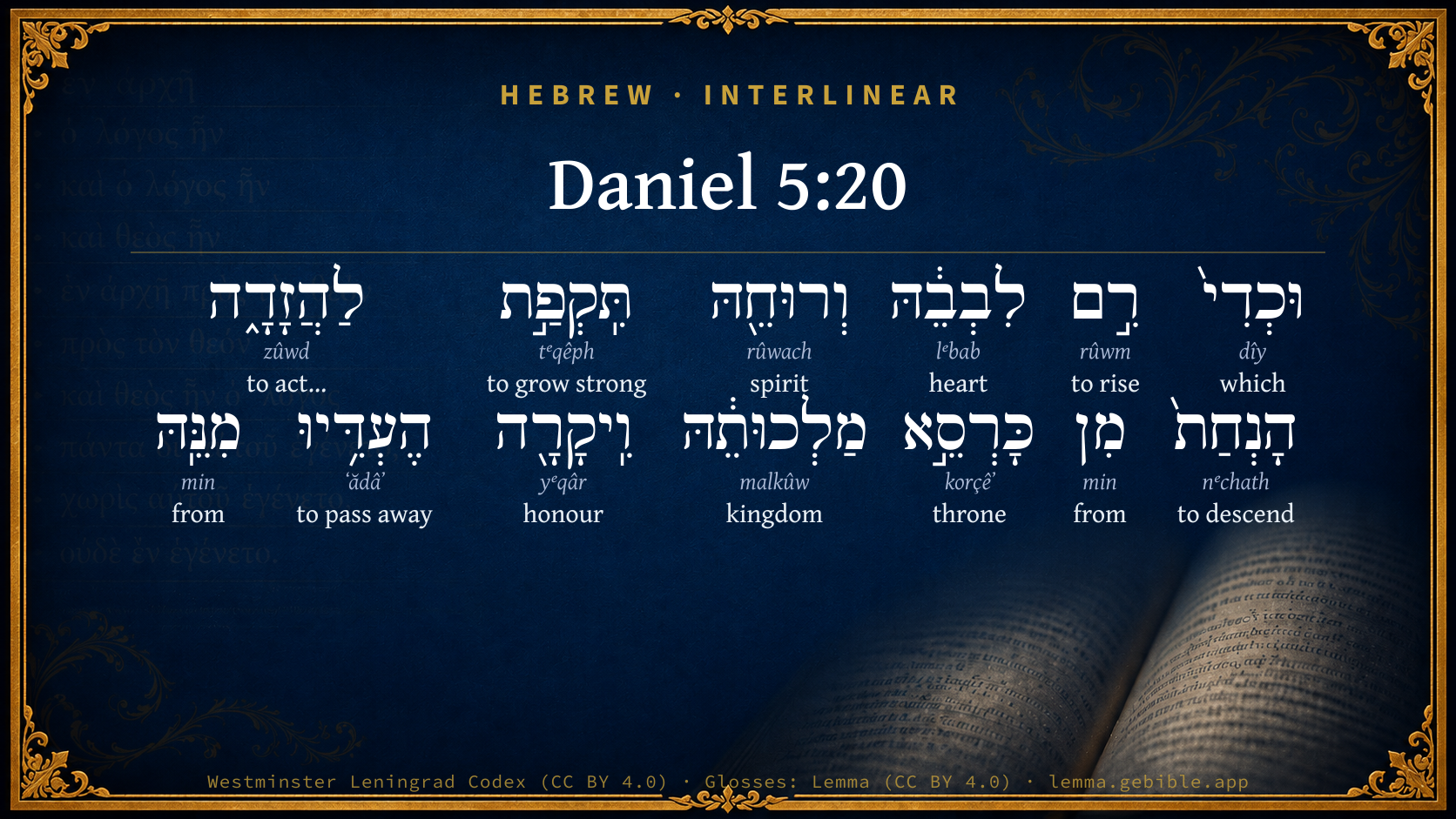
Hebrew (Westminster Leningrad Codex) Daniel 5:20 appears in the Hebrew Old Testament. The text above is from the Westminster Leningrad Codex. Each word links to its Strong’s number, a concise gloss, and parsing drawn from the Open Scriptures Hebrew Bible morphology. Click any word for its full Brown-Driver-Briggs (BDB) entry.
Download image
Cite this verse

Daniel 5:20 (World English Bible). Public Domain. Lemma interlinear Bible study tool, https://lemma.gebible.app/v/daniel/5/20.

Show BibTeX & RIS
BibTeX
RIS
English Translation
But when his heart was lifted up, and his spirit was hardened so that he dealt proudly, he was deposed from his kingly throne, and they took his glory from him:
World English Bible · Public Domain
Highlights
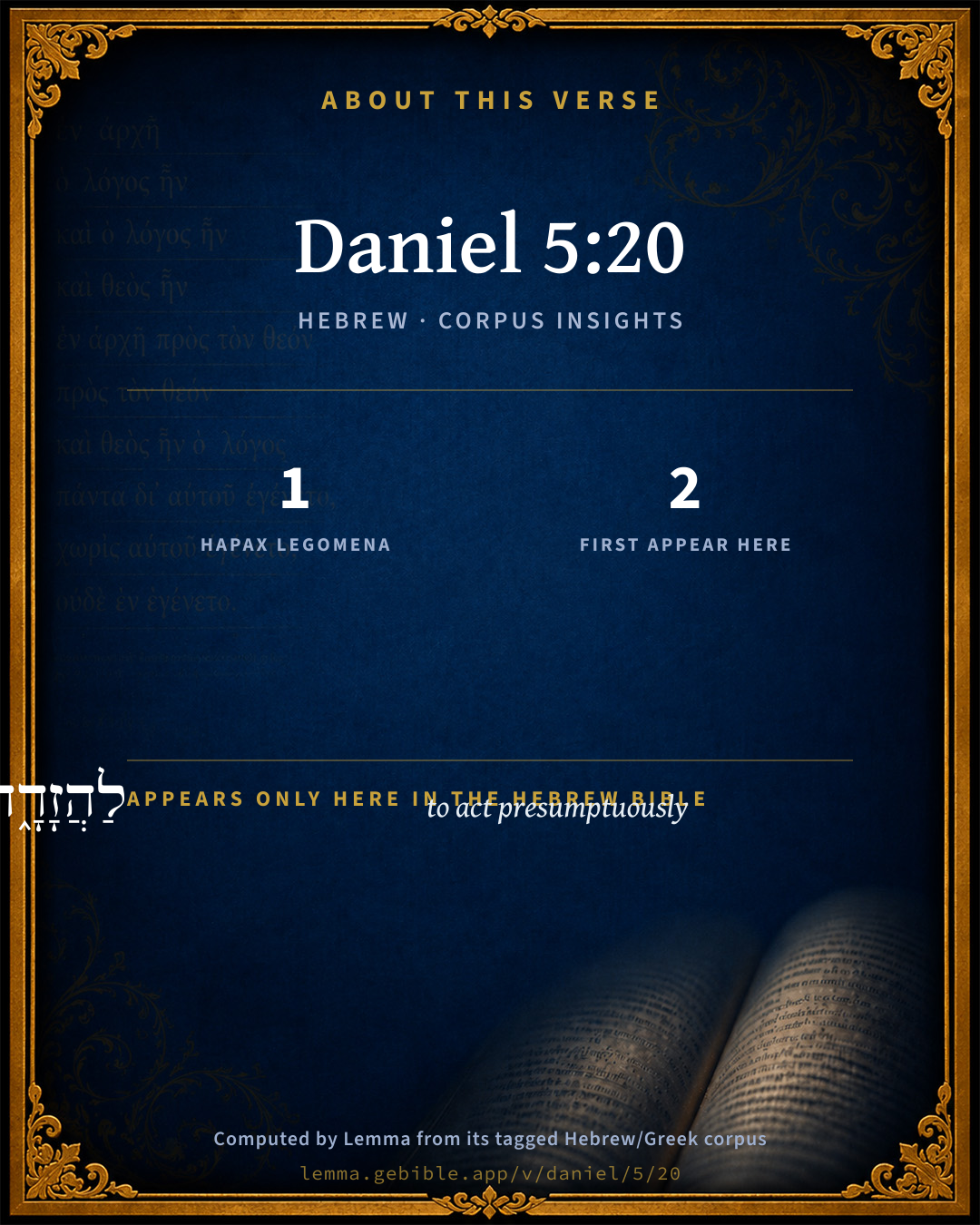
  • 1 hapax legomenon — only here in the Hebrew Bible
  • 2 first appearances in the Hebrew Bible
Full analysis ↓
Download a study sheet

One document with this verse’s original text, its word-by-word gloss line, the meaning frame, cross-references with their text, attributed commentary, and full source and license credits — printable, and it pastes into notes with its structure intact.

This verse Autodidact and up

Study sheet (.html) Plain text (.txt)

A passage Seminary Student

Up to 50 verses in one chapter. A passage sheet keeps up to 6 commentary sources and 12 cross-references per verse, in the order this page ranks them, and says so on the sheet whenever that leaves anything out. Ask for a single verse and you get the Autodidact verse sheet above.

Everything on this page stays free to read, with no account — the sheet is a download of what is already on screen, not access to it.

Want to remove ads? Support Godless Engineer
Compare translations 3

The same verse in 3 English versions, stacked beneath the original-language interlinear above. Click any original word for its lexicon entry.

Each is an independent rendering of the whole verse — the interlinear is not word-aligned to these translations.

Highlighted words mark where these versions differ — a whole-verse word diff, not a word-by-word alignment.

  • World English Bible Public Domain
    But when his heart was lifted up, and his spirit was hardened so that he dealt proudly, he was deposed from his kingly throne, and they took his glory from him:
  • King James Version Public Domain
    But when his heart was lifted up, and his mind hardened in pride, he was deposed from his kingly throne, and they took his glory from him:
  • unfoldingWord Literal Text CC BY-SA 4.0
    But when his heart was lifted up and his spirit was hardened so that he acted presumptuously, he was brought down from his kingly throne, and his glory was taken away from him.

unfoldingWord Literal Text — © unfoldingWord, licensed CC BY-SA 4.0. Word-aligned USFM3 via Door43 (git.door43.org/unfoldingWord/en_ult).

Versions to compare (up to 4)

3 of 4 selected

Show all 18 translations

Every available English version of this verse, each an independent rendering of the whole verse.

  • World English Bible Public Domain
    But when his heart was lifted up, and his spirit was hardened so that he dealt proudly, he was deposed from his kingly throne, and they took his glory from him:
  • Berean Standard Bible Public Domain
    But when his heart became arrogant and his spirit was hardened with pride, he was deposed from his royal throne, and his glory was taken from him.
  • Majority Standard Bible Public Domain
    But when his heart became arrogant and his spirit was hardened with pride, he was deposed from his royal throne, and his glory was taken from him.
  • King James Version Public Domain
    But when his heart was lifted up, and his mind hardened in pride, he was deposed from his kingly throne, and they took his glory from him:
  • American Standard Version (1901) Public Domain
    But when his heart was lifted up, and his spirit was hardened so that he dealt proudly, he was deposed from his kingly throne, and they took his glory from him:
  • Revised Version (1885) Public Domain
    But when his heart was lifted up, and his spirit was hardened that he dealt proudly, he was deposed from his kingly throne, and they took his glory from him:
  • Geneva Bible (1599) Public Domain
    But when his heart was puft vp, and his minde hardened in pride, hee was deposed from his kingly throne, and they tooke his honour from him.
  • Douay-Rheims (1899) Public Domain
    But when his heart was lifted up, and his spirit hardened unto pride, he was put down from the throne of his kingdom, and his glory was taken away.
  • Young's Literal Translation Public Domain
    and when his heart was high, and his spirit was strong to act proudly, he hath been caused to come down from the throne of his kingdom, and his glory they have caused to pass away from him,
  • Literal Standard Version CC BY-SA 4.0
    and when his heart was high, and his spirit was strong to act proudly, he has been caused to come down from the throne of his kingdom, and his glory they have caused to pass away from him,
  • Unlocked Literal Bible CC BY-SA 4.0
    But when his heart was arrogant and his spirit was hardened so that he acted presumptuously, he was brought down from his kingly throne, and they took away his majesty.
  • unfoldingWord Literal Text CC BY-SA 4.0
    But when his heart was lifted up and his spirit was hardened so that he acted presumptuously, he was brought down from his kingly throne, and his glory was taken away from him.
  • Darby Bible Public Domain
    But when his heart was lifted up, and his spirit hardened unto presumption, he was deposed from the throne of his kingdom, and they took his glory from him;
  • World Messianic Bible Public Domain
    But when his heart was lifted up, and his spirit was hardened so that he dealt proudly, he was deposed from his kingly throne, and they took his glory from him.
  • Webster's Bible Public Domain
    But when his heart was lifted up, and his mind hardened in pride, he was deposed from his kingly throne, and they took his glory from him:
  • Free Bible Version CC BY-SA 4.0
    But when he became arrogant and hard-hearted, acting proudly, he was removed from his royal throne and his glory was taken away from him.
  • Bible in Basic English Public Domain
    But when his heart was lifted up and his spirit became hard with pride, he was put down from his place as king, and they took his glory from him:
  • JPS Tanakh (1917) Public Domain
    But when his heart was lifted up, and his spirit was hardened that he dealt proudly, he was deposed from his kingly throne, and his glory was taken from him;

Literal Standard Version (2020), Covenant Press — licensed CC BY-SA 4.0. Text via the HelloAO Bible API (eBible.org). Unlocked Literal Bible (unfoldingWord) — licensed CC BY-SA 4.0. Text via the HelloAO Bible API (eBible.org). unfoldingWord Literal Text — © unfoldingWord, licensed CC BY-SA 4.0. Word-aligned USFM3 via Door43 (git.door43.org/unfoldingWord/en_ult). Free Bible Version, Dr. Jonathan Gallagher — licensed CC BY-SA 4.0. Text via the HelloAO Bible API (eBible.org).

Word by word

More ways to search: Search by grammar → Find every occurrence → Compare this word →

Practice this passage: Drill this verse → Learn its vocabulary →

לַהֲזָדָ֑ה
zûwd
H2103
“to act presumptuously”
Adjective, R + Verb, Hiphil, Infinitive Construct
Part of Speech
Adjective + Verb
Stem
Hiphil
Form
Infinitive Construct
Full BDB Definition

Origin: corresponding to H2102

TWOT: 2704

to act proudly, be presumptuous - (Aphel) to act presumptuously
  1. וּכְדִי֙ dîy H1768 “and · like/as · which” Adjective, C + Conjunction + Conjunction
  2. רִ֣ם rûwm H7313 “to rise” Adjective, V, Plural
  3. לִבְבֵ֔הּ lᵉbab H3825 “heart · his” Adjective, N, Common + Suffix, Personal, 3rd Person, Masculine, Singular
  4. וְרוּחֵ֖הּ rûwach H7308 “and · spirit · his” Adjective, C + Noun, Common, Feminine, Singular, Construct + Suffix, Personal, 3rd Person, Masculine, Singular
  5. תִּֽקְפַ֣ת tᵉqêph H8631 “to grow strong” Adjective, V
  6. הָנְחַת֙ nᵉchath H5182 “to descend” Adjective, V, Plural
  7. מִן min H4481 “from” Adjective, R
  8. כָּרְסֵ֣א korçêʼ H3764 “throne of” Adjective, N, Common
  9. מַלְכוּתֵ֔הּ malkûw H4437 “kingdom · his” Adjective, N, Common + Suffix, Personal, 3rd Person, Masculine, Singular
  10. וִֽיקָרָ֖ה yᵉqâr H3367 “and · honour · the” Adjective, C + Noun, Common, Masculine, Singular, Determined + Particle, Definite Article
  11. הֶעְדִּ֥יוּ ʻădâʼ H5709 “to pass away” Adjective, V, Plural
  12. מִנֵּֽהּ min H4481 “from · him” Adjective, R + Suffix, Personal, 3rd Person, Masculine, Singular

About this verse

These counts appear in no published source. They are computed here, from the morphology-tagged text and Lemma’s own curated glosses. What Lemma adds →

13
words
12
distinct lemmas
Prophets
section

Notable vocabulary

1 hapax legomenon — a word that appears only here in the entire Hebrew Bible:

  • לַהֲזָדָ֑ה to act presumptuously H2103

First appearance in Scripture

These words make their first canonical appearance in the Hebrew Bible here:

  • לַהֲזָדָ֑ה to act presumptuously H2103
  • כָּרְסֵ֣א throne H3764

Shared distinctive vocabulary

כָּרְסֵ֣א throne H3764 occurs in 2 verses of the Hebrew Bible. Also found in:

Grammatical profile

  • 1 verb
  • 1 noun
  • 9 adjectives
  • 1 conjunction
  • 1 particle

Verb forms

  • לַהֲזָדָ֑ה Hiphil · Infinitive Construct

Repetition

A word recurs within this verse — often emphatic in Hebrew:

Hebrew & Septuagint length

In English translation the verse runs 31 words from the Hebrew and 29 from the Septuagint (LXX English) — closely comparable.

A rough comparison of the two English renderings, which tokenize alike — not a word-level alignment.

Word counts can differ between the Hebrew and the Greek without any difference in meaning — e.g. the Hebrew direct-object marker אֵת has no separate Greek word, and Greek often adds the article ὁ.

Cross-references

20

Topical passages linked to Daniel 5:20 in the Treasury of Scripture Knowledge — connected by theme and wording, ordered by reader-vote popularity; previews shown in the World English Bible.

  • 2 Kings 17:14 Notwithstanding, they would not hear, but hardened their neck, like the neck of their fathers, who didn't believe in Yahweh their God.
  • Exodus 9:17 as you still exalt yourself against my people, that you won't let them go.
  • 2 Chronicles 36:13 He also rebelled against king Nebuchadnezzar, who had made him swear by God: but he stiffened his neck, and hardened his heart against turning to Yahweh, the God of Israel.
  • Proverbs 16:18 Pride goes before destruction, And a haughty spirit before a fall.
  • Jeremiah 13:18 Say you to the king and to the queen-mother, Humble yourselves, sit down; for your headdresses are come down, even the crown of your glory.
  • Hebrews 3:13 but exhort one another day by day, so long as it is called "today;" lest any one of you be hardened by the deceitfulness of sin.
  • Job 40:11–12 Pour forth the fury of your anger. Look on everyone who is proud, and bring him low.
  • Proverbs 16:5 Everyone who is proud in heart is an abomination to Yahweh: They shall assuredly not be unpunished.
  • Isaiah 14:12–17 How you are fallen from heaven, day-star, son of the morning! How you are cut down to the ground, who laid the nations low!
  • Jeremiah 19:15 Thus says Yahweh of Hosts, the God of Israel, Behold, I will bring on this city and on all its towns all the evil that I have pronounced against it; because they have made their neck stiff, that they may not hear my words.
  • Exodus 18:11 Now I know that Yahweh is greater than all gods because of the thing in which they dealt arrogantly against them."
  • 1 Samuel 6:6 Why then do you harden your hearts, as the Egyptians and Pharaoh hardened their hearts? When he had worked wonderfully among them, didn't they let the people go, and they departed?
  • Job 15:25–27 Because he has stretched out his hand against God, And behaves himself proudly against the Almighty;
  • Daniel 4:37 Now I, Nebuchadnezzar, praise and extol and honor the King of heaven; for all his works are truth, and his ways justice; and those who walk in pride he is able to abase.
  • Luke 1:51–52 He has shown strength with his arm. He has scattered the proud in the imagination of their heart.
  • Luke 18:14 I tell you, this man went down to his house justified rather than the other; for everyone who exalts himself will be humbled, but he who humbles himself will be exalted."
  • Isaiah 47:1 Come down, and sit in the dust, virgin daughter of Babylon; sit on the ground without a throne, daughter of the Chaldeans: for you shall no more be called tender and delicate.
  • Jeremiah 48:18 You daughter who dwells in Dibon, come down from your glory, and sit in thirst; for the destroyer of Moab is come up against you, he has destroyed your strongholds.
  • Ezekiel 30:6 Thus says Yahweh: They also who uphold Egypt shall fall; and the pride of her power shall come down: from the tower of Seveneh shall they fall in it by the sword, says the Lord Yahweh.
  • Daniel 4:30–33 The king spoke and said, Is not this great Babylon, which I have built for the royal dwelling-place, by the might of my power and for the glory of my majesty?

Cross-references courtesy of OpenBible.info (CC BY 4.0).

Hebrew and Greek witnesses Masoretic Hebrew ↔ Greek Septuagint

The same verse in the two great witnesses to the Old Testament, shown verse-for-verse.

These are two independent witnesses, not word-aligned to each other, and the Septuagint is shown in lemma (dictionary) form.

Hebrew Daniel 5:20 Masoretic · Westminster Leningrad Codex

וּכְדִי֙ רִ֣ם לִבְבֵ֔הּ וְרוּחֵ֖הּ תִּֽקְפַ֣ת לַהֲזָדָ֑ה הָנְחַת֙ מִן כָּרְסֵ֣א מַלְכוּתֵ֔הּ וִֽיקָרָ֖ה הֶעְדִּ֥יוּ מִנֵּֽהּ

But when his heart was lifted up, and his spirit was hardened so that he dealt proudly, he was deposed from his kingly throne, and they took his glory from him:

World English Bible · Public Domain

Greek LXX Daniel 5:20 Septuagint · lemma form
But when his heart was lifted up, and his spirit was emboldened to act proudly, he was deposed from his royal throne, and his honor was taken from him.

LXX2012 (modern English Septuagint) · Public Domain

Hebrew: Westminster Leningrad Codex (CC BY 4.0). Greek: Septuagint (public domain); English from LXX2012 (modern English Septuagint) (Public Domain). How the Septuagint differs from the Hebrew →

Commentary

Notes on Daniel 5:20 from classic Christian and Jewish commentators (each source and its license shown beneath its notes). The classic Christian expositions comment on the surrounding passage and are grouped to its opening verse, so a note may address several verses; the Jewish commentaries on the Tanakh (Rashi and others) are per-verse, so they appear only where the commentator wrote on this verse.

Lemma curates 59 commentaries, every one of them public domain or Creative Commons licensed, each selected and text-cleaned for this edition rather than reprinted as found. About our sources →

Trapp's Complete Commentary

John Trapp

Dan 5:20 But when his heart was lifted up, and his mind hardened in pride, he was deposed from his kingly throne, and they took his glory from him:

Ver. 20. But when his heart was lifted up, and his mind hardened in pride.] Pride is of a hardening property, causeth men to commit sin with a high hand, as Pharaoh. The increase of the spleen is the decrease of the body; so is pride of the soul, and overturneth the whole man. Evagrius noteth it for a special commendation of Mauritius the Emperor, that he was not puffed up with his preferments.

John Trapp, A Commentary or Exposition upon All the Books of the Old and New Testament (1647–1656) — public domain. Text from a community e-Sword module.

Joseph Benson's Commentary

Dan 5:20-23. But when his heart was lifted up — The expressions here have a peculiar force, in marking the haughty insolence of King Nebuchadnezzar. His authority, as mentioned in the last verse, had been raised to the highest pitch; and on that account we find here that his mind was elated, and his spirit grown obdurate in pride and arrogance; instead of his ascribing all his honours and advantages to the real giver of them, the true God, whom he had been brought to acknowledge, and to the neglect of whom, and of improving by his grandfather’s sufferings, the prophet justly and judiciously attributes Belshazzar’s fate. Thou his son, &c., hast not humbled thy heart — Thou hast not been made sensible of thy own utter weakness, and thy absolute dependance on Jehovah, the true God, who thus abased thy father in the midst of his power and pride. But hast lifted up thyself against the Lord of heaven — As if thou hadst been equal, or even superior to him in wisdom and power. He instances in four particulars: 1st, They have brought the vessels of his house before thee — To profane them in your idolatrous feasts: 2d, Thou hast praised the gods of silver and gold, &c., which see not, &c. 3d, Thou hast not glorified the true God, in whose hands thy breath is, and all thy ways: yea, 4th, Thou hast highly dishonoured, affronted, and reproached him.

Joseph Benson's Commentary on the Old and New Testaments (1811–1818) — public domain. Text from a community e-Sword module.

Tyndale Open Study Notes

Tyndale Open Resources

5:20 A rebel against God characteristically has a heart and mind that are puffed up (or hardened) with arrogance (see Exod 7:13; Josh 11:20; Isa 14:3-5). Nebuchadnezzar was brought down when he became puffed up with arrogance, and Belshazzar would be as well.

Tyndale Open Study Notes — © Tyndale Open Resources, licensed CC BY-SA 4.0. Text via the HelloAO Bible API.

Ibn Ezra

Rabbi Abraham ibn Ezra

[Daniel 5:20] To act presumptuously (לַהֲזָדָה - lahazadah): [Meaning] in a way of insolence/presumption (דֶּרֶךְ זָדוֹן - derech zadon).

And the meaning of [the phrase later in Daniel 5:23] “and whose are all your ways” (וְכֹל אֹרְחָתָךְ לֵהּ - v'chol orchatecha leh) is: that you are in His hand, and He leads you to the place He desires, like the bridle of the horse in the hand of the rider. But Yefet [ben Ali] said [interpreting Daniel 5:23]: "And in your end, you will go to Him," along the lines of [the verse]: “and the spirit returns to God who gave it” [Ecclesiastes 12:7].

Ibn Ezra on the Tanakh — English translations: “Sefaria Community Translation” (CC0 1.0 (public-domain dedication)); “Yalkut, Sifsei Chachomim Chumash, Metsudah Publications, 2009” (CC BY 4.0); and “Commentary of Ibn Ezra on Isaiah - trans. by M. Friedlander, 1873” (public domain). Text via Sefaria.

Adam Clarke's Commentary

Verse 20. He was deposed from his kingly throne] Became insane; and the reins of government were taken out of his hands.

Adam Clarke's Commentary on the Bible (1810–1826) — public domain. Text from a community e-Sword/MySword module.

The Cambridge Bible for Schools and Colleges

gen. ed. J. J. S. Perowne

20. was lifted up] Cf. Deu_8:14; Deu_17:20; Eze_31:10, &c.

and his spirit was hardened that he dealt proudly (R.V.)] ‘was hardened’ is literally was strong (i.e. stiff, unyielding): the same word (teḳaph) is used in the Targums for the Hebrew ḥâzaḳ, ḥizzçḳ ‘to be or make strong (hard)’ in Exo_7:13; Exo_7:22; Exo_9:12; Exo_9:35, &c. (of Pharaoh’s heart). Cf. Deu_2:30.

they took his glory] or, his glory was taken, according to the principle explained on Dan_4:25.

The Cambridge Bible for Schools and Colleges (gen. ed. J. J. S. Perowne; Cambridge University Press, 1878–1918) — public domain. Text from a community e-Sword module.

John Gill's Exposition

But when his heart was lifted up, and his mind hardened it pride,.... When his heart was elated with his successes and victories, with the enlargement of his dominions, and with his grandeur and glory he had arrived unto; and his pride increased yet more, till he was strengthened and hardened in it: or, "to deal proudly" (u); and behave haughtily to God and man: or, "to do wickedly", as Jarchi interprets it; for pride and haughtiness of mind puts men, especially great men, kings and monarchs, on doing things extremely vile and wicked:

he was deposed from his kingly throne; not by his nobles and subjects, but by the hand of God, which struck him with madness, and made him unfit for government; obliged him to quit the throne, and to range among the beasts of the field, as is afterwards observed:

and they took his glory from him; the watchers, the angels, or the divine Persons that ordered the tree to be cut down to the roots, Dan 4:14, or it may be rendered impersonally, "and his glory was taken from him" (w); his glory as a man, being deprived of his reason, and acting like a brute beast; and his glory as a king, which departed from him for a season, while he was driven from men, from his royal palace and court, and lived among beasts, and fed as they did, as follows:

(u) "ad superbe agendum", Junius & Tremellius; "ad superbiendum", Piscator, Michaelis; "ut superbe ageret", Cocceius. (w) "et gloria ejus ablata est", V. L.; "honor ejus translatus fuit", Michaelis.

John Gill's Exposition of the Whole Bible (1746–1763) — public domain (CC PDM 1.0). Text via the HelloAO Bible API.

Albert Barnes' Notes on the Bible

But when his heart was lifted up - See Dan 4:30.

And his mind hardened in pride - Margin, “to deal proudly.” The state of mind indicated here is that in which there is no sense of dependence, but where one feels that he has all resources in himself, and need only look to himself.

He was deposed from his kingly throne - Margin, “made to come down.” That is, he was so deposed by the providence of God, not by the acts of his own subjects.

Albert Barnes' Notes on the Bible (1834–1885) — public domain. Text from a community e-Sword/MySword module.

Matthew Poole's English Annotations

Which was explained before: all this Daniel minds him of to rub up his memory, that he might have the fuller blow in the application, Dan 5:22, for the aggravation of his crime.

Matthew Poole's English Annotations on the Holy Bible (1683–1685) — public domain. Text from a community e-Sword/MySword module.

unfoldingWord translationNotes

Door43 World Missions Community

his heart was arrogant

Here "heart" refers to the king himself. AT: "the king was arrogant" (See: Synecdoche)

his spirit was hardened

Here "spirit" refers to the king himself. His stubbornness is spoken of as if he were hardened. AT: "the king became stubborn" (See: Synecdoche and Metaphor)

presumptuously

rudely and overly confident

he was brought down from his kingly throne

Here "throne" refers to his authority to rule. This can be stated in active form. AT: "the people took away his kingdom" (See: Metonymy and Active or Passive)

He was driven away from humanity

This can be stated in active form. AT: "The people chased him away from them" (See: Active or Passive)

he had the mind of an animal

Here "mind" represents his thoughts. AT: "he thought as an animal thinks" (See: Metonymy)

dew

the moisture on the ground that is found in the mornings

anyone he wishes

"whomever he chooses"

translationWords

heart

spirit

king

throne

majesty

donkey

cow

Most High

rule

heaven

kingdom

unfoldingWord translationNotes — © Distant Shores Media and the Door43 World Missions Community, licensed CC BY-SA 4.0. Source: git.door43.org/Door43/en_tn.

Rashi

Rabbi Shlomo Yitzchaki (Rashi)

and when his heart became haughty [as translated,] and when his heart became haughty.

so that he dealt wickedly [as translated,] so that he dealt wickedly.

he was deposed Aram. הָנְחַת, lit. he took him down.

was removed from him. Aram. הֶעְדִּיו, He removed from him.

Rashi on the Tanakh — English translations: “The Judaica Press complete Tanach with Rashi, translated by A. J. Rosenberg” (CC BY 4.0); “Pentateuch with Rashi's commentary by M. Rosenbaum and A.M. Silbermann, 1929-1934” (public domain); “The Metsudah Tanach series, Lakewood, N.J” (CC BY 4.0); and “The Book of Joshua, Metsudah Publications, 1997” (CC BY 4.0). Text via Sefaria.

Lesson kit

Teaching starters — assembled from the data on this page, not authored interpretation. Every prompt links to the verse data it draws on. Edit before teaching.

Daniel, in the Prophets, opens this verse with 13 words (12 distinct Hebrew lemmas). Its most distinctive word is zûwd (“to act presumptuously”). A historical commentator’s framing appears above. Read the whole chapter for the surrounding context.

Discussion questions

  1. How does “to act presumptuously” (zûwd) shape what this verse is saying?
  2. This verse holds 1 word here found nowhere else in the Hebrew Bible. What might the rare word draw attention to?
  3. 2 words here appear for the first time in Scripture. What is being introduced at this debut?
  4. Daniel 7:9 shares the word «throne» with this verse. How do the two illuminate each other?
  5. “from” occurs 2× in this one verse. What is the effect of the repetition?
  6. These translations render this verse differently. What is at stake in choosing one wording over another?
  7. The verb «לַהֲזָדָ֑ה» is Hiphil Infinitive Construct. How does its form color the action?
  8. Reading how Trapp's Complete Commentary and Joseph Benson's Commentary read this verse, where do the two commentators agree and where do they part?

Things to notice

  • 1 word in this verse appears nowhere else in the Hebrew Bible.
  • 2 words make their first canonical appearance in Scripture here.
  • These translations choose different wording for 13 words in this verse.
  • “from” occurs 2× in this single verse.
  • 12 distinct Hebrew lemmas span 13 words in this verse.

Reading settings

Reading text

Shown beneath each verse's original-language words.

Old Testament
Old Testament edition

Read the OT as the Masoretic Hebrew (MT) or the Greek Septuagint (LXX).

English shown for the Greek Septuagint (in the Hebrew ↔ Greek comparison).

Comparing translations? Open the Compare panel on any verse page to stack up to four side by side.