
Daniel 2:23

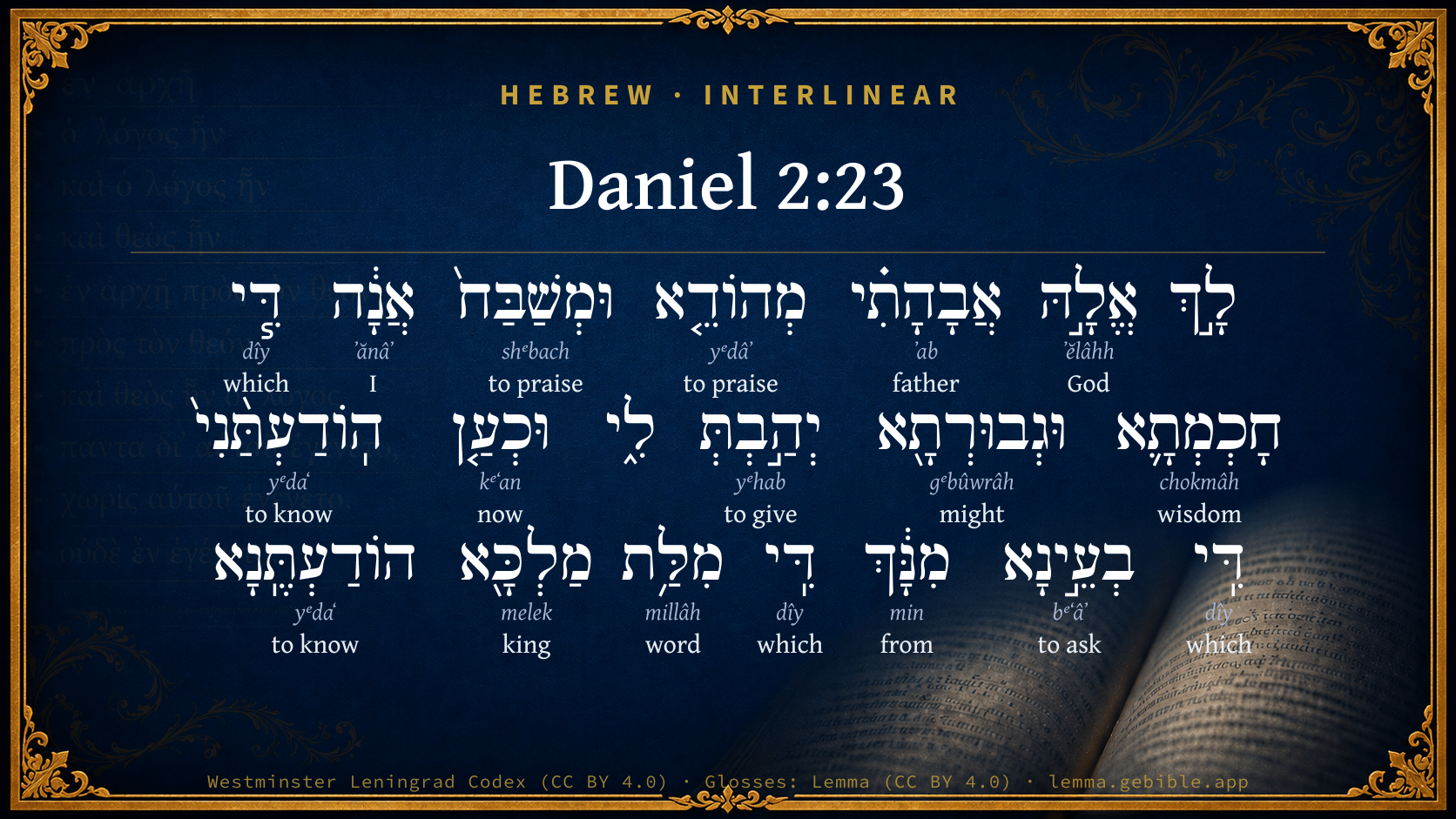
Hebrew (Westminster Leningrad Codex) Daniel 2:23 appears in the Hebrew Old Testament. The text above is from the Westminster Leningrad Codex. Each word links to its Strong’s number, a concise gloss, and parsing drawn from the Open Scriptures Hebrew Bible morphology. Click any word for its full Brown-Driver-Briggs (BDB) entry.
Download image
Cite this verse

Daniel 2:23 (World English Bible). Public Domain. Lemma interlinear Bible study tool, https://lemma.gebible.app/v/daniel/2/23.

Show BibTeX & RIS
BibTeX
RIS
English Translation
I thank you, and praise you, you God of my fathers, who have given me wisdom and might, and have now made known to me what we desired of you; for you have made known to us the king's matter.
World English Bible · Public Domain
Highlights
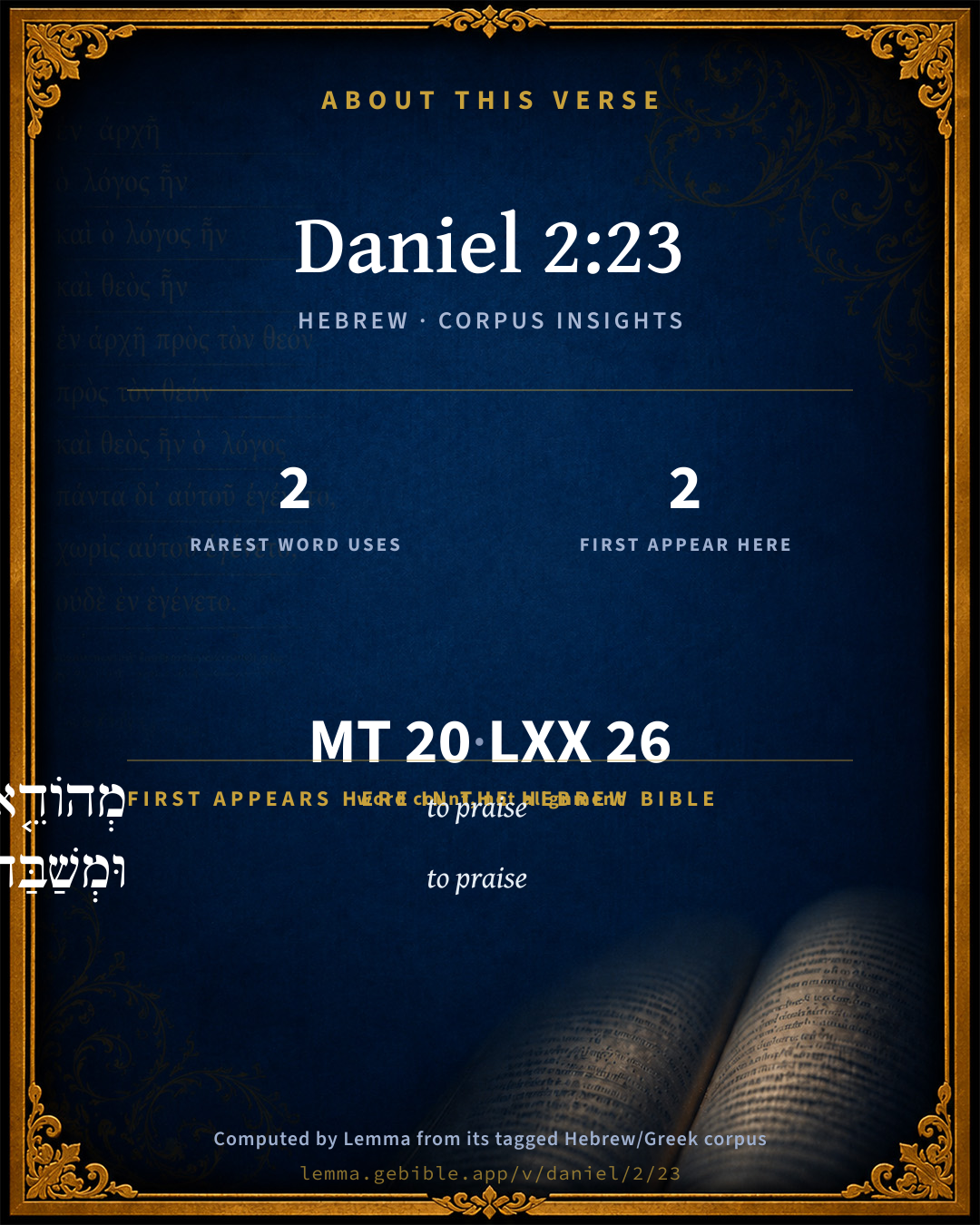
  • 2 first appearances in the Hebrew Bible
Full analysis ↓
Download a study sheet

One document with this verse’s original text, its word-by-word gloss line, the meaning frame, cross-references with their text, attributed commentary, and full source and license credits — printable, and it pastes into notes with its structure intact.

This verse Autodidact and up

Study sheet (.html) Plain text (.txt)

A passage Seminary Student

Up to 50 verses in one chapter. A passage sheet keeps up to 6 commentary sources and 12 cross-references per verse, in the order this page ranks them, and says so on the sheet whenever that leaves anything out. Ask for a single verse and you get the Autodidact verse sheet above.

Everything on this page stays free to read, with no account — the sheet is a download of what is already on screen, not access to it.

Want to remove ads? Support Godless Engineer
Compare translations 3

The same verse in 3 English versions, stacked beneath the original-language interlinear above. Click any original word for its lexicon entry.

Each is an independent rendering of the whole verse — the interlinear is not word-aligned to these translations.

Highlighted words mark where these versions differ — a whole-verse word diff, not a word-by-word alignment.

  • World English Bible Public Domain
    I thank you, and praise you, you God of my fathers, who have given me wisdom and might, and have now made known to me what we desired of you; for you have made known to us the king's matter.
  • King James Version Public Domain
    I thank thee, and praise thee, O thou God of my fathers, who hast given me wisdom and might, and hast made known unto me now what we desired of thee: for thou hast now made known unto us the king's matter.
  • unfoldingWord Literal Text CC BY-SA 4.0
    O God of my fathers, I thank you and praise you for the wisdom and power you have given to me. Now you have made known to me what we asked of you, for you have made known to us the matter that concerns the king.”

unfoldingWord Literal Text — © unfoldingWord, licensed CC BY-SA 4.0. Word-aligned USFM3 via Door43 (git.door43.org/unfoldingWord/en_ult).

Versions to compare (up to 4)

3 of 4 selected

Show all 18 translations

Every available English version of this verse, each an independent rendering of the whole verse.

  • World English Bible Public Domain
    I thank you, and praise you, you God of my fathers, who have given me wisdom and might, and have now made known to me what we desired of you; for you have made known to us the king's matter.
  • Berean Standard Bible Public Domain
    To You, O God of my fathers, I give thanks and praise, because You have given me wisdom and power. And now You have made known to me what we have requested, for You have made known to us the dream of the king.”
  • Majority Standard Bible Public Domain
    To You, O God of my fathers, I give thanks and praise, because You have given me wisdom and power. And now You have made known to me what we have requested, for You have made known to us the dream of the king.”
  • King James Version Public Domain
    I thank thee, and praise thee, O thou God of my fathers, who hast given me wisdom and might, and hast made known unto me now what we desired of thee: for thou hast now made known unto us the king's matter.
  • American Standard Version (1901) Public Domain
    I thank thee, and praise thee, O thou God of my fathers, who hast given me wisdom and might, and hast now made known unto me what we desired of thee; for thou hast made known unto us the king's matter.
  • Revised Version (1885) Public Domain
    I thank thee, and praise thee, O thou God of my fathers, who hast given me wisdom and might, and hast now made known unto me what we desired of thee: for thou hast made known unto us the king’s matter.
  • Geneva Bible (1599) Public Domain
    I thanke thee and prayse thee, O thou God of my fathers, that thou hast giuen mee wisedome and strength, and hast shewed me nowe the thing that wee desired of thee: for thou hast declared vnto vs the kings matter.
  • Douay-Rheims (1899) Public Domain
    To thee, O God of our fathers, I give thanks, and I praise thee: because thou hast given me wisdom and strength: and now thou hast shewn me what we desired of thee, for thou hast made known to us, the king's discourse.
  • Young's Literal Translation Public Domain
    Thee, O God of my fathers, I am thanking and praising, for wisdom and might Thou hast given to me; and now, Thou hast caused me to know that which we have sought from Thee, for the king's matter Thou hast caused us to know.'
  • Literal Standard Version CC BY-SA 4.0
    You, O God of my fathers, I am thanking and praising, for wisdom and might You have given to me; and now, You have caused me to know that which we have sought from You, for the king’s matter You have caused us to know.”
  • Unlocked Literal Bible CC BY-SA 4.0
    God of my ancestors, I thank you and praise you for the wisdom and power you gave to me. Now you have made known to me what we asked of you, you have made known to us the matter that concerns the king.”
  • unfoldingWord Literal Text CC BY-SA 4.0
    O God of my fathers, I thank you and praise you for the wisdom and power you have given to me. Now you have made known to me what we asked of you, for you have made known to us the matter that concerns the king.”
  • Darby Bible Public Domain
    I thank thee, and I praise thee, O God of my fathers, Who hast given me wisdom and might, And hast made known unto me already what we desired of thee; For thou hast made known unto us the king's matter.
  • World Messianic Bible Public Domain
    I thank you and praise you, O God of my fathers, who have given me wisdom and might, and have now made known to me what we desired of you; for you have made known to us the king’s matter.”
  • Webster's Bible Public Domain
    I thank thee, and praise thee, O thou God of my fathers, who hast given me wisdom and might, and hast made known to me now what we desired of thee: for thou hast now made known to us the king's matter.
  • Free Bible Version CC BY-SA 4.0
    I give thanks and praise to you, God of my fathers, for you have given me wisdom and power. Now you have revealed to me what we asked you; you have revealed to us the king's dream.”
  • Bible in Basic English Public Domain
    I give you praise and worship, O God of my fathers, who have given me wisdom and strength, and have now made clear to me what we were requesting from you: for you have given us knowledge of the king's business.
  • JPS Tanakh (1917) Public Domain
    I thank Thee, and praise Thee, O Thou God of my fathers, who hath given me wisdom and might, and hast now made known unto me what we desired of Thee; for Thou hast made known unto us the king's matter.

Literal Standard Version (2020), Covenant Press — licensed CC BY-SA 4.0. Text via the HelloAO Bible API (eBible.org). Unlocked Literal Bible (unfoldingWord) — licensed CC BY-SA 4.0. Text via the HelloAO Bible API (eBible.org). unfoldingWord Literal Text — © unfoldingWord, licensed CC BY-SA 4.0. Word-aligned USFM3 via Door43 (git.door43.org/unfoldingWord/en_ult). Free Bible Version, Dr. Jonathan Gallagher — licensed CC BY-SA 4.0. Text via the HelloAO Bible API (eBible.org).

Word by word

More ways to search: Search by grammar → Find every occurrence → Compare this word →

Practice this passage: Drill this verse → Learn its vocabulary →

מְהוֹדֵ֤א
yᵉdâʼ
H3029
“praising”
Adjective, V
Part of Speech
Adjective
Full BDB Definition

Origin: corresponding to H3034

TWOT: 2764

(Aphel) to praise, give thanks
  1. אֱלָ֣הּ ʼĕlâhh H426 “God of” Adjective, N, Common
  2. אֲבָהָתִ֗י ʼab H2 “fathers · my” Adjective, N, Common + Suffix, Personal, 1st Person, Common, Singular
  3. וּמְשַׁבַּח֙ shᵉbach H7624 “and · praising” Adjective, C + Verb, Piel, Participle Active, Masculine, Singular, Absolute
  4. אֲנָ֔ה ʼănâʼ H576 “I” Adjective, P, Construct
  5. דִּ֧י dîy H1768 “which” Adjective, T
  6. חָכְמְתָ֛א chokmâh H2452 “wisdom · the” Adjective, N, Common + Particle, Definite Article
  7. וּגְבוּרְתָ֖א gᵉbûwrâh H1370 “and · might · the” Adjective, N, Common + Particle, Definite Article + Particle, Definite Article
  8. יְהַ֣בְתְּ yᵉhab H3052 “to give” Adjective, V, Plural
  9. וּכְעַ֤ן kᵉʻan H3705 “and · now” Adjective, C + Adverb
  10. הֽוֹדַעְתַּ֨נִי֙ yᵉdaʻ H3046 “to know · me” Adjective, V, Plural + Suffix, Personal, 1st Person, Common, Singular
  11. דִּֽי dîy H1768 “which” Adjective, T
  12. בְעֵ֣ינָא bᵉʻâʼ H1156 “to ask” Adjective, V, Plural
  13. מִנָּ֔ךְ min H4481 “from · you” Adjective, R + Suffix, Personal, 2nd Person, Masculine, Singular
  14. דִּֽי dîy H1768 “which” Adjective, C
  15. מִלַּ֥ת millâh H4406 “word of” Adjective, N, Common
  16. מַלְכָּ֖א melek H4430 “king · the” Adjective, N, Common + Particle, Definite Article
  17. הוֹדַעְתֶּֽנָא yᵉdaʻ H3046 “to know · us” Adjective, V, Plural + Suffix, Personal, 1st Person, Common, Plural

About this verse

These counts appear in no published source. They are computed here, from the morphology-tagged text and Lemma’s own curated glosses. What Lemma adds →

20
words
15
distinct lemmas
Prophets
section

Notable vocabulary

The rarest word here is מְהוֹדֵ֤א to praise H3029 — appearing just 2 times in the whole Hebrew Bible.

First appearance in Scripture

These words make their first canonical appearance in the Hebrew Bible here:

  • מְהוֹדֵ֤א to praise H3029
  • וּמְשַׁבַּח֙ to praise H7624

Shared distinctive vocabulary

מְהוֹדֵ֤א to praise H3029 occurs in 2 verses of the Hebrew Bible. Also found in:

Grammatical profile

  • 1 verb
  • 15 adjectives
  • 1 adverb
  • 3 particles

Verb forms

  • וּמְשַׁבַּח֙ Piel · Participle Active

Repetition

Words recur within this verse — often emphatic in Hebrew:

  • הֽוֹדַעְתַּ֨נִי֙ to know H3046 ×2
  • דִּ֧י which H1768 ×3

Hebrew & Septuagint length

In English translation the verse runs 40 words from the Hebrew and 44 from the Septuagint (LXX English) — closely comparable.

A rough comparison of the two English renderings, which tokenize alike — not a word-level alignment.

Word counts can differ between the Hebrew and the Greek without any difference in meaning — e.g. the Hebrew direct-object marker אֵת has no separate Greek word, and Greek often adds the article ὁ.

In the original languages it is 20 Hebrew tokens and 26 Greek tokens — but the two are counted differently (Hebrew bundles its prefixes and suffixes into one token; the Greek is in lemma form), so that isn’t a like-for-like length.

Cross-references

29

Topical passages linked to Daniel 2:23 in the Treasury of Scripture Knowledge — connected by theme and wording, ordered by reader-vote popularity; previews shown in the World English Bible.

  • Daniel 2:18 that they would desire mercies of the God of heaven concerning this secret; that Daniel and his companions should nor perish with the rest of the wise men of Babylon.
  • Exodus 3:15 God said moreover to Moses, "You shall tell the children of Israel this, 'Yahweh, the God of your fathers, the God of Abraham, the God of Isaac, and the God of Jacob, has sent me to you.' This is my name forever, and this is my memorial to all generations.
  • Psalms 25:14 The friendship of Yahweh is with those who fear him. He will show them his covenant.
  • Daniel 2:20–21 Daniel answered, Blessed be the name of God forever and ever; for wisdom and might are his.
  • Daniel 2:29–30 as for you, O king, your thoughts came [into your mind] on your bed, what should happen hereafter; and he who reveals secrets has made known to you what shall happen.
  • Amos 3:7 Surely the Lord Yahweh will do nothing, Unless he reveals his secret to his servants the prophets.
  • Luke 10:21 In that same hour Jesus rejoiced in the Holy Spirit, and said, "I thank you, O Father, Lord of heaven and earth, that you have hidden these things from the wise and understanding, and revealed them to little children. Yes, Father, for so it was well-pleasing in your sight."
  • Genesis 18:17 Yahweh said, "Will I hide from Abraham what I do,
  • 1 Kings 8:57 Yahweh our God be with us, as he was with our fathers: let him not leave us, nor forsake us;
  • 1 Kings 18:36 It happened at the time of the offering of the [evening] offering, that Elijah the prophet came near, and said, Yahweh, the God of Abraham, of Isaac, and of Israel, let it be known this day that you are God in Israel, and that I am your servant, and that I have done all these things at your word.
  • 1 Chronicles 29:10 Therefore David blessed Yahweh before all the assembly; and David said, You are blessed, Yahweh, the God of Israel our father, forever and ever.
  • Psalms 50:14 Offer to God the sacrifice of thanksgiving. Pay your vows to the Most High.
  • Isaiah 12:1 In that day you will say, "I will give thanks to you, Yahweh; for though you were angry with me, your anger has turned away and you comfort me.
  • Daniel 1:17 Now as for these four youths, God gave them knowledge and skill in all learning and wisdom: and Daniel had understanding in all visions and dreams.
  • Matthew 11:25 At that time, Jesus answered, "I thank you, Father, Lord of heaven and earth, that you hid these things from the wise and understanding, and revealed them to infants.
  • Revelation 1:1 This is the Revelation of Jesus Christ, which God gave him to show to his servants the things which must happen soon, which he sent and made known by his angel to his servant, John,
  • Genesis 32:9–11 Jacob said, "God of my father Abraham, and God of my father Isaac, Yahweh, who said to me, 'Return to your country, and to your relatives, and I will do you good.'
  • 1 Chronicles 29:13 Now therefore, our God, we thank you, and praise your glorious name.
  • 2 Chronicles 20:6 and he said, Yahweh, the God of our fathers, aren't you God in heaven? and aren't you ruler over all the kingdoms of the nations? and in your hand is power and might, so that none is able to withstand you.
  • Psalms 103:1–4 Praise Yahweh, my soul! All that is within me, praise his holy name!
  • Proverbs 8:14 Counsel and sound knowledge are mine. I have understanding and power.
  • Proverbs 21:22 A wise man scales the city of the mighty, And brings down the strength of its confidence.
  • Proverbs 24:5 A wise man has great power; And a knowledgeable man increases strength;
  • Ecclesiastes 7:19 Wisdom is a strength to the wise man more than ten rulers who are in a city.
  • Ecclesiastes 9:18 Wisdom is better than weapons of war; but one sinner destroys much good.
  • John 11:41 So they took away the stone from the place where the dead man was lying. Jesus lifted up his eyes, and said, "Father, I thank you that you listened to me.
  • John 15:15 No longer do I call you servants, for the servant doesn't know what his lord does. But I have called you friends, for everything that I heard from my Father, I have made known to you.
  • Revelation 5:5 One of the elders said to me, "Don't weep. Behold, the Lion who is of the tribe of Judah, the Root of David, has overcome; he who opens the book and its seven seals."
  • Ecclesiastes 9:16 Then said I, Wisdom is better than strength. Nevertheless the poor man's wisdom is despised, and his words are not heard.

Cross-references courtesy of OpenBible.info (CC BY 4.0).

Hebrew and Greek witnesses Masoretic Hebrew ↔ Greek Septuagint

The same verse in the two great witnesses to the Old Testament, shown verse-for-verse.

These are two independent witnesses, not word-aligned to each other, and the Septuagint is shown in lemma (dictionary) form.

Hebrew Daniel 2:23 Masoretic · Westminster Leningrad Codex

לָ֣ךְ אֱלָ֣הּ אֲבָהָתִ֗י מְהוֹדֵ֤א וּמְשַׁבַּח֙ אֲנָ֔ה דִּ֧י חָכְמְתָ֛א וּגְבוּרְתָ֖א יְהַ֣בְתְּ לִ֑י וּכְעַ֤ן הֽוֹדַעְתַּ֨נִי֙ דִּֽי בְעֵ֣ינָא מִנָּ֔ךְ דִּֽי מִלַּ֥ת מַלְכָּ֖א הוֹדַעְתֶּֽנָא

I thank you, and praise you, you God of my fathers, who have given me wisdom and might, and have now made known to me what we desired of you; for you have made known to us the king's matter.

World English Bible · Public Domain

Greek LXX Daniel 2:23 Septuagint · lemma form

σύ κύριος ὁ πατήρ ἐγώ ἐκὁμολογέω καί αἰνέω ὅτι σοφία καί φρόνησις δίδωμι ἐγώ καί νῦν σημαίνω ἐγώ ὅσος ἀξιόω ὁ δηλόω ὁ βασιλεύς πρός οὗτος

I give thanks to you, and praise you, O God of my fathers, for you have given me wisdom and power, and has made known to me the things which we asked of you; and you have made known to me the king's vision.

LXX2012 (modern English Septuagint) · Public Domain

On this verse, The Pulpit Commentary discusses the Septuagint’s reading. Read the note in Commentary ↓

Hebrew: Westminster Leningrad Codex (CC BY 4.0). Greek: Septuagint (public domain); English from LXX2012 (modern English Septuagint) (Public Domain). How the Septuagint differs from the Hebrew →

Commentary

Notes on Daniel 2:23 from classic Christian and Jewish commentators (each source and its license shown beneath its notes). The classic Christian expositions comment on the surrounding passage and are grouped to its opening verse, so a note may address several verses; the Jewish commentaries on the Tanakh (Rashi and others) are per-verse, so they appear only where the commentator wrote on this verse.

Lemma curates 59 commentaries, every one of them public domain or Creative Commons licensed, each selected and text-cleaned for this edition rather than reprinted as found. About our sources →

Trapp's Complete Commentary

John Trapp

Dan 2:23 I thank thee, and praise thee, O thou God of my fathers, who hast given me wisdom and might, and hast made known unto me now what we desired of thee: for thou hast [now] made known unto us the king’s matter.

Ver. 23. I thank thee, and praise thee.] A gracious man is a grateful man; there is the same word in Greek (χαρις) for grace and gratitude. See on Dan 2:22. A thankful man will enumerate God’s mercies, and redouble his praises.

O thou God of my fathers.] The very best inheritance that we can leave our children is the true God.

Who hast given me wisdom and might.] Wisdom to dive into deep matters, and might to manage it.

John Trapp, A Commentary or Exposition upon All the Books of the Old and New Testament (1647–1656) — public domain. Text from a community e-Sword module.

Ibn Ezra

Rabbi Abraham ibn Ezra

[Daniel 2:23] Lakh Elah avahati (לָךְ אֱלָהּ אֲבָהָתִי - To You, O God of my fathers): [Daniel addresses God specifically as God of his fathers] because my fathers were prophets, unlike the fathers of other nations. [And as this God,] You who have given me wisdom and power superior to all [other] wise men.

And he said: “You have let me know” (hodaʿtani - הוֹדַעְתַּנִי): [Using the singular] because the secret became known to him alone....

And he said: “what we asked” (di veʿeina minnakh - דִּי בְעֵינָא מִנָּךְ): [Using the plural, referring to] himself and his companions. As if saying: "Not by my merit alone did You make this secret known to me" [acknowledging their joint prayer]....

And he said: “You have let us know” (hodaʿtana - הוֹדַעְתֶּנָא): [Using the plural again] because he [Daniel] informed them [his companions of the revealed secret].

Ibn Ezra on the Tanakh — English translations: “Sefaria Community Translation” (CC0 1.0 (public-domain dedication)); “Yalkut, Sifsei Chachomim Chumash, Metsudah Publications, 2009” (CC BY 4.0); and “Commentary of Ibn Ezra on Isaiah - trans. by M. Friedlander, 1873” (public domain). Text via Sefaria.

Geneva Bible (1599)

Geneva Bible translators

To whom thou madest thy promise, and who lived in thy fear: whereby he excludeth all other gods.

Meaning, power to interpret it.

Geneva Bible (1599) marginal notes — public domain. Text via Bolls.life.

Jamieson, Fausset & Brown

Robert Jamieson, A. R. Fausset & David Brown

thee . . . thee--He ascribes all the glory to God.

God of my fathers--Thou hast shown Thyself the same God of grace to me, a captive exile, as Thou didst to Israel of old and this on account of the covenant made with our "fathers" (Luk 1:54-55; compare Psa 106:45).

given me wisdom and might--Thou being the fountain of both; referring to Dan 2:20. Whatever wise ability I have to stay the execution of the king's cruel decree, is Thy gift.

me . . . we . . . us--The revelation was given to Daniel, as "me" implies; yet with just modesty he joins his friends with him; because it was to their joint prayers, and not to his individually, that he owed the revelation from God.

known . . . the king's matter--the very words in which the Chaldeans had denied the possibility of any man on earth telling the dream ("not a man upon the earth can show the king's matter," Dan 2:10). Impostors are compelled by the God of truth to eat up their own words.

Jamieson, Fausset & Brown — Commentary Critical and Explanatory on the Whole Bible (1871) — public domain (CC PDM 1.0). Text via the HelloAO Bible API.

Adam Clarke's Commentary

Verse 23. I thank thee and praise thee] No wonder he should feel gratitude, when God by this merciful interference had saved both the life of him and his fellows; and was about to reflect the highest credit on the God of the Jews, and on the people themselves.

Adam Clarke's Commentary on the Bible (1810–1826) — public domain. Text from a community e-Sword/MySword module.

John Calvin's Commentaries

Daniel turns his discourse to God. I confess to thee, says he, O God of my fathers, and praise thee Here he more openly distinguishes the God of the Israelites from all the fictions of the nations. Nor does he use this epithet in vain, when he praises the God of his fathers; for he wishes to reduce to nothing all the fabrications of the Gentiles concerning a multitude of deities. Daniel rejects this as a vain and foolish thing, and shews how the God of Israel alone is worthy of praise. But he does not found the glory of God on the authority of their fathers, as the Papists, when they wish to ascribe the supreme power to either George, or Catharine, or any others, count up the number of ages during which the error has prevailed. Thus they wish whatever the consent of mankind has approved to be received as oracular. But if religion depended on the common consent of mankind, where would be its stability? We know nothing vainer than the minds of men. If man is weighed, says the Prophet, with vanity in a balance, vanity itself will preponderate. (Psalm 62:9.) Nothing, therefore, is more foolish than this principle of this king, — what has prevailed by the consent of many ages must be religiously true. But here Daniel partially commends the God of their fathers, as their fathers were the sorts of God. For that sacred adoption prevailed among the Jews, by which God chose Abraham and his whole family for himself. Daniel, therefore, here does not extol the persons of men, as if they either could or ought to add anything they pleased to God; but this is the reason why he says, the God of Israel is the God of their fathers, since he was of that race which the Almighty had adopted. On the whole, he so opposes the God of Israel to all the idols of the Gentiles, that the mark of separation is in the covenant itself, and in the celestial doctrine by which he revealed himself to the sacred fathers. For while the Gentiles have no certain vision, and follow only their own dreams, Daniel here deservedly sets forth the God of their fathers.

He afterwards adds, because thou hast given me wisdom and strength As far as relates to wisdom, the reason is. clear enough why Daniel thanks God, since he had obtained, as he soon afterwards says, the revelation of the dream. He had also formerly been endued with the prophetic spirit and with visions. as he related in the first chapter, (Daniel 1:17.) We may here, inquire what he means by strength? He was not remarkable for his honor among men, nor was he ever a commander in military affairs, and he had no superior gift of magnificent power to cause him to return thanks to God. But Daniel regards this as the principal point, that the God. of Israel was then acknowledged as the true and only God; because, whatever wisdom and virtue exists in the world, it flows from him as its only source. For this reason he speaks of himself as well as of all others, as if he had said — If I have any strength or understanding, I ascribe it all to thee; it is thine entirely. And, truly, though Daniel was neither a king nor a prefect, yet that unconquered greatness of mind which we have seen was not to be esteemed as without value. Hence he very properly acknowledges something of this kind to have been conferred upon him by heaven. Lastly, his intention is to debase himself and to attribute to God his own; but he speaks concisely, as we have said, since under the phrases “power” and “wisdom” he had previously embraced the proof of his divinity. He afterwards adds, Thou hast revealed to me what we demanded of thee; thou hast made known to us the king’s inquiry There seems here a slight discrepancy, as he praises God for granting him a revelation of the dream, and then unites others to himself. Yet the revelation was not common to them, but peculiar to himself. The solution is easy; for he first expresses that this was given to himself specially, that he might know the king’s dream and understand its interpretation. When he has confessed this, he extends the benefit to his companions, and deservedly so; because though they did not yet understand what God had conferred upon Daniel, yet he had obtained this in their favor,-they were all snatched from death, and all their prayers attended to. And this availed very much for the confirmation of their faith as it assured them they had not prayed in vain. For we said that there was no ambition in their prayers, as if any one desired any peculiar gift by which he might acquire honor and estimation for himself in the world. Nothing of the kind. It was enough for them to shew forth God’s name among unbelievers; because by his kindness, they had been delivered from death. Hence Daniel very properly says, the king’s dream was made known to him with its interpretation; and this he will afterwards transfer to his companions.

John Calvin's Commentaries (1540-1563) — public domain. Text from the Calvin Translation Society English edition (1840s-50s) via the Christian Classics Ethereal Library (ccel.org). Calvin's coverage is partial (roughly two-thirds of the Bible); uncommented books and verses are honest gaps, never fabricated. The 19th-century editor's footnotes and remarks are omitted so the notes are faithfully Calvin's own voice.

Ellicott's Commentary for English Readers

(23) Who hast given me.—The Hebrew perfect represents what has already occurred and still continues. (See Jer_2:2.) The wisdom spoken of here does not refer to the dream, but to the same subjects as in Dan_1:7.

God of my fathers.—Comp. 1Ki_18:36, Psalms 105 God dealt gloriously with Israel of old. He continues to be faithful to His promises to Israel by blessing Daniel’s education in secular subjects, and finally by the dream. Observe that to Daniel each appears alike supernatural, his proficiency in Chaldean wisdom, and his skill in interpreting dreams.

A Bible Commentary for English Readers, edited by Charles John Ellicott (1878–1897) — public domain. Text from a community e-Sword module.

The Cambridge Bible for Schools and Colleges

gen. ed. J. J. S. Perowne

23. Thee, O God of my fathers, do I thank and praise] ‘God of my fathers,’ i.e., the same as of old, unchanged among the changes of human generations, and still able to help and defend His servants. Cf. ‘God of thy (Israel’s) fathers,’ Deu_1:21; Deu_6:3; Deu_12:1, al.

wisdom and might] a share of His own attributes (Dan_2:20): ‘might,’ however, rather in the special sense of moral strength, enabling Daniel, for instance, to remain firm in his religion (Dan_1:8).

The Cambridge Bible for Schools and Colleges (gen. ed. J. J. S. Perowne; Cambridge University Press, 1878–1918) — public domain. Text from a community e-Sword module.

John Gill's Exposition

I thank thee, and praise thee, O thou God my fathers,.... His remote ancestors, Abraham, Isaac, and Jacob, and more near progenitors, to whom God had made promises, and revealed his secrets in time past, and still continued his favours to Daniel; for which he was abundantly thankful, and owned and confessed the goodness of God to him, and praised him on account of it:

who hast given me wisdom and might; or "strength" (s); courage and fortitude of mind, to go in to the king when in his fury, to promise to show his dream, and the interpretation of it; and strength of faith in prayer to God to obtain it, and who gave him wisdom to know it: Jacchiades interprets this might of power to save his own life, and the life of others:

and hast made known unto me now what we desired of thee; for though it was only made known to Daniel, yet it was in consequence of the united prayers of him and his companions, to which he ascribes it; which shows his great modesty and humility, not to attribute it to his own prayer, and the interest he had in God, as a God hearing prayer:

for thou hast now made known unto us the king's matter; or "word" (t); which he required of the wise men, namely, his dream, and the interpretation of it; this being made known to Daniel, he communicated it to his friends.

(s) "fortitudinem", V. L. Pagninus, Montanus; "robur", Piscator. (t) "verbum", Junius & Tremellius, Broughtonus, Michaelis; "sermonen", Pagninus, Montanus; "quod dicit rex", Cocceius.

John Gill's Exposition of the Whole Bible (1746–1763) — public domain (CC PDM 1.0). Text via the HelloAO Bible API.

Albert Barnes' Notes on the Bible

I thank thee, and praise thee, O thou God of my fathers - By his “fathers” here, Daniel refers doubtless to the Jewish people in general, and not to his own particular ancestors. The meaning of the phrase “God of my fathers” is, that he had been their protector; had regarded them as his people; had conferred on them great favors. The particular ground of thanksgiving here is, that the same God who had so often revealed himself to the Hebrew people by the prophets in their own land, had now condescended to do the same thing to one of their nation, though a captive in a strange country. The favor thus bestowed had an increased value, from the fact that it showed that the Hebrew people were not forgotten, though far from the land of their birth, and that, though in captivity, they might still hope for the benign interposition of God.

Who hast given me wisdom and might - The word “wisdom” here undoubtedly refers to the ability which had now been given him to declare the nature and purport of the dream, imparting to him a degree of wisdom far superior to those pretenders to whom the matter had been at first submitted. The word “might” (Chaldee, strength - גבוּרתא gebûrethâ') does not probably differ materially from “wisdom.” It means “ability” to interpret the dream - implying that it was a task beyond natural human ability.

For thou hast now made known unto us the king’s matter - That is, it had been made known to him and his friends. He joins himself with them, for, although it was particularly made known to him, yet, as they had united with him in prayer that the secret might be disclosed, and as they shared common dangers, he regarded it as in fact made known to them all.

Albert Barnes' Notes on the Bible (1834–1885) — public domain. Text from a community e-Sword/MySword module.

Matthew Poole's English Annotations

Here he gives his God another distinguishing title from all the gods of the heathen, he calls him the God of his fathers, meaning the covenant made with Abraham, &c., to whom and their seed God revealed his saving knowledge, which he did not to the heathen. God is the God of all by the kingdom of his power, but the God of his church only according to the kingdom of his grace.

Thou hast now made known unto us the king’s matter; in which words he intimates a twofold privilege; the one that, as the son of such fathers, he obtained the grace and favour of God in giving him safety and wisdom; the other, that he found him a God hearing prayer, and that in a thing of a high nature, he made known to him the king’s matter.

Matthew Poole's English Annotations on the Holy Bible (1683–1685) — public domain. Text from a community e-Sword/MySword module.

The Pulpit Commentary

I thank thee, and praise thee, O thou God of my fathers, who hast given me wisdom and might, and hast made known unto me now what we desired of thee; for thou hast now made known unto us the king"s matter. The Septuagint renders, "Thee, O Lord of my fathers, i thank and praise, because thou gavest wisdom and knowledge to me, and now thou hast revealed to me what I entreated, in order to show the king concerning these things." There seems a slight difference of reading implied here. Theodotion and the Peshitta are practically at one with the Massoretic. Theodotion translates the relative ydi as if it were "and," not, as in our version, "for;" and the Peshitta repeats the first personal pronoun. Daniel now particularizes his reasons for praise and thanksgiving. He addresses God as the God of his fathers. He appeals to him as the covenant God of Israel, who had led their fathers through the wilderness. God revealed himself to Jacob at Bethel as "the God of Abraham and the God of Isaac." So to Moses at the burning bush he declared himself "the God of Abraham, the God of Isaac, and the God. of Jacob." On the other hand, when Jacob approached God in prayer, he addressed him as "the God of my father Abraham, and the God of my father Isaac." God had shown kindness to his fathers: would he not also show kindness to their seed after them? Who hast given me wisdom and might. As Jacob in his prayer at Mahanaim (Gen_32:9) not only pleads with God as the God of his fathers, but also as the God who had blessed him with his guidance before, so Daniel now further addresses God who had bestowed upon him "wisdom and might." When God has bestowed upon any one special faculties, he must presumably have a special work for him,rid it is therefore reasonable to plead with God to give an opportunity for the exercise of these special powers. Here it forms an occasion of thanksgiving. We are apt to forget that our powers, mental and physical, our possessions and acquirements, are gifts of God"s grace for which we owe thanks. The special reason for gratitude, however, follows God has answered the prayer of his servants. Hast made known unto me now what we desired of thee. It is to be noted that Daniel attributes the answer not merely to his own prayer, but to the united prayer of his three friends as well. Their earnest desire had gone along with his own in calling down the Divine answer. Daniel, while giving thanks for the knowledge vouchsafed to him, recognizes the help his friends had afforded. For thou hast made known unto us the kings matter. Daniel assigns the reason here for his thanksgiving yet more definitely. God had made known to him what the king had required.

Special blessing demands special praise.

The state of mind which generates fervent prayer generates also joyous praise. Success in prayer is a fitting occasion for exuberant delight:

1. The basis of sacred praise is gratitude. "I thank and praise thee." Inward insensibility of feeling and forgetfulness of past favours are deadly enemies to praise. When gratitude opens the inner fountains of feeling, the crystal waters of praise freely flow. Thankfulness is the parent of song.

2. God the proper Object of praise. God, in his own nature and excellence, is deserving of the best music of the heart. The unchangeableness and faithful love of God are fitting materials for praise. The covenant mercies of God should be celebrated in praise. "God of my fathers.

3. New blessings received are new occasions for praise. No mental possession is of human origination. Our wisdom is a gift from God. Our power to influence others for good is a talent entrusted to us by God. Answers to prayer should be occasions of hearty praise. The pathway to the Divine favour has been found. New revelations of God"s will should start afresh our powers of music. "Oh, praise the Lord! D.

The Pulpit Commentary (1880–1919), ed. H.D.M. Spence-Jones & Joseph S. Exell — public domain. Text from a community e-Sword module.

unfoldingWord translationNotes

Door43 World Missions Community

General Information:

This verse is also part of Daniel's prayer. He stops addressing God in the third person and switches to the more personal second person. (See: First, Second, or Third Person)

made known to me what we asked of you

"told me what my friends and I asked you to tell us"

made known to us the matter that concerns the king

"told us what the king wants to know"

translationWords

God

praise

wise

power

pray

king

unfoldingWord translationNotes — © Distant Shores Media and the Door43 World Missions Community, licensed CC BY-SA 4.0. Source: git.door43.org/Door43/en_tn.

Rashi

Rabbi Shlomo Yitzchaki (Rashi)

You have let me know [as translated,] You have let me know.

Rashi on the Tanakh — English translations: “The Judaica Press complete Tanach with Rashi, translated by A. J. Rosenberg” (CC BY 4.0); “Pentateuch with Rashi's commentary by M. Rosenbaum and A.M. Silbermann, 1929-1934” (public domain); “The Metsudah Tanach series, Lakewood, N.J” (CC BY 4.0); and “The Book of Joshua, Metsudah Publications, 1997” (CC BY 4.0). Text via Sefaria.

Lesson kit

Teaching starters — assembled from the data on this page, not authored interpretation. Every prompt links to the verse data it draws on. Edit before teaching.

Daniel, in the Prophets, opens this verse with 20 words (15 distinct Hebrew lemmas). Its most distinctive word is yᵉdâʼ (“to praise”). A historical commentator’s framing appears above. Read the whole chapter for the surrounding context.

Discussion questions

  1. How does “to praise” (yᵉdâʼ) shape what this verse is saying?
  2. 2 words here appear for the first time in Scripture. What is being introduced at this debut?
  3. Daniel 6:10 shares the word «to praise» with this verse. How do the two illuminate each other?
  4. “to know” occurs 2× in this one verse. What is the effect of the repetition?
  5. These translations render this verse differently; the difference is in the English rendering, not the original. What questions does that raise?
  6. The verb «וּמְשַׁבַּח֙» is Piel Participle Active. How does its form color the action?
  7. Reading how Trapp's Complete Commentary and Ibn Ezra read this verse, where do the two commentators agree and where do they part?

Things to notice

Reading settings

Reading text

Shown beneath each verse's original-language words.

Old Testament
Old Testament edition

Read the OT as the Masoretic Hebrew (MT) or the Greek Septuagint (LXX).

English shown for the Greek Septuagint (in the Hebrew ↔ Greek comparison).

Comparing translations? Open the Compare panel on any verse page to stack up to four side by side.