
Daniel 5:2

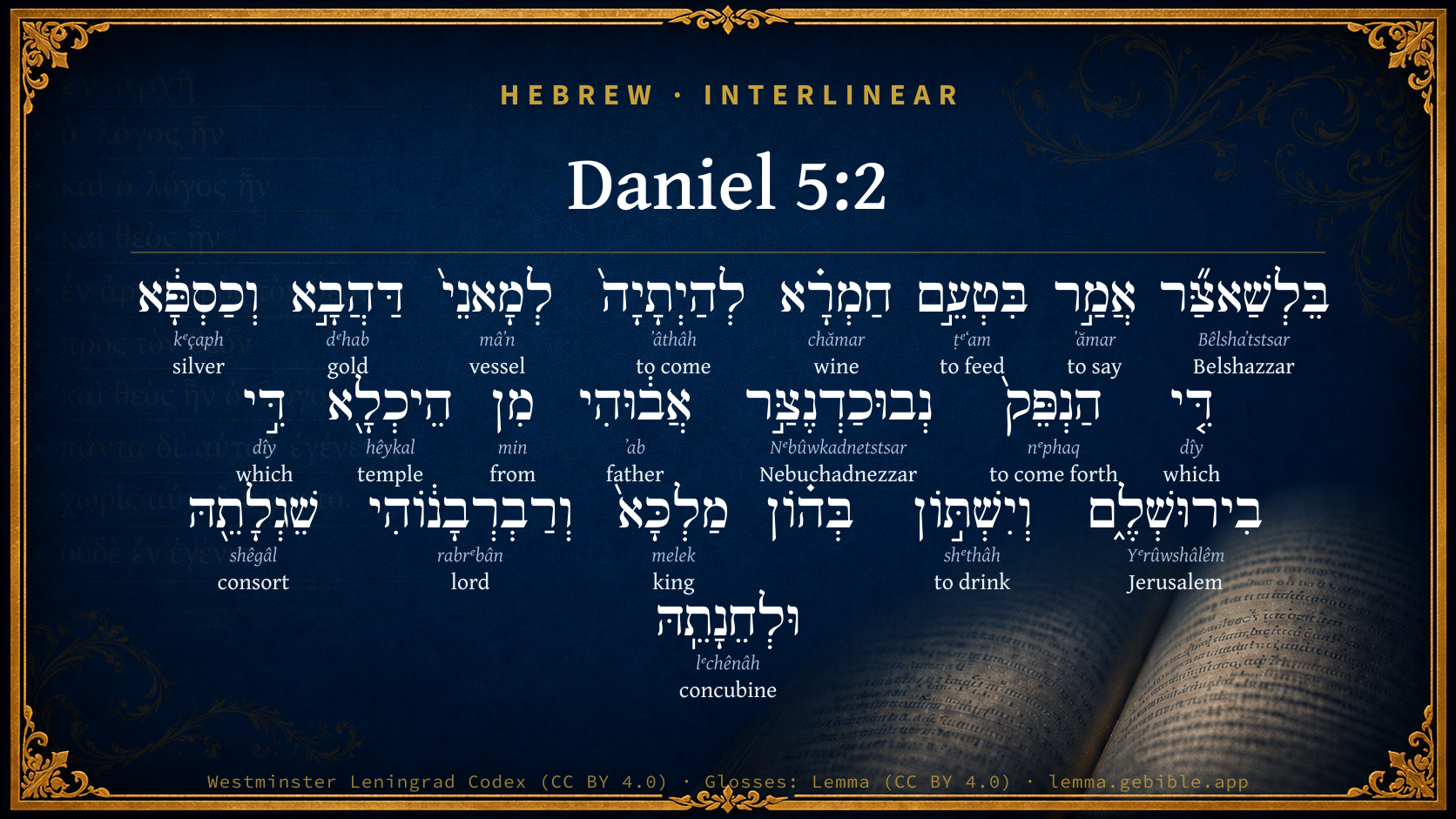
Hebrew (Westminster Leningrad Codex) Daniel 5:2 appears in the Hebrew Old Testament. The text above is from the Westminster Leningrad Codex. Each word links to its Strong’s number, a concise gloss, and parsing drawn from the Open Scriptures Hebrew Bible morphology. Click any word for its full Brown-Driver-Briggs (BDB) entry.
Download image
Cite this verse

Daniel 5:2 (World English Bible). Public Domain. Lemma interlinear Bible study tool, https://lemma.gebible.app/v/daniel/5/2.

Show BibTeX & RIS
BibTeX
RIS
English Translation
Belshazzar, while he tasted the wine, commanded to bring the golden and silver vessels which Nebuchadnezzar his father had taken out of the temple which was in Jerusalem; that the king and his lords, his wives and his concubines, might drink from it.
World English Bible · Public Domain
Highlights
  • 2 first appearances in the Hebrew Bible
Full analysis ↓
Download a study sheet

One document with this verse’s original text, its word-by-word gloss line, the meaning frame, cross-references with their text, attributed commentary, and full source and license credits — printable, and it pastes into notes with its structure intact.

This verse Autodidact and up

Study sheet (.html) Plain text (.txt)

A passage Seminary Student

Up to 50 verses in one chapter. A passage sheet keeps up to 6 commentary sources and 12 cross-references per verse, in the order this page ranks them, and says so on the sheet whenever that leaves anything out. Ask for a single verse and you get the Autodidact verse sheet above.

Everything on this page stays free to read, with no account — the sheet is a download of what is already on screen, not access to it.

Want to remove ads? Support Godless Engineer
Compare translations 3

The same verse in 3 English versions, stacked beneath the original-language interlinear above. Click any original word for its lexicon entry.

Each is an independent rendering of the whole verse — the interlinear is not word-aligned to these translations.

Highlighted words mark where these versions differ — a whole-verse word diff, not a word-by-word alignment.

  • World English Bible Public Domain
    Belshazzar, while he tasted the wine, commanded to bring the golden and silver vessels which Nebuchadnezzar his father had taken out of the temple which was in Jerusalem; that the king and his lords, his wives and his concubines, might drink from it.
  • King James Version Public Domain
    Belshazzar, whiles he tasted the wine, commanded to bring the golden and silver vessels which his father Nebuchadnezzar had taken out of the temple which was in Jerusalem; that the king, and his princes, his wives, and his concubines, might drink therein.
  • unfoldingWord Literal Text CC BY-SA 4.0
    When Belshazzar tasted the wine, he gave orders to bring the vessels of gold and silver that Nebuchadnezzar his father had taken out of the temple which was in Jerusalem, so that the king and his noblemen, his wives and his concubines might drink from them.

unfoldingWord Literal Text — © unfoldingWord, licensed CC BY-SA 4.0. Word-aligned USFM3 via Door43 (git.door43.org/unfoldingWord/en_ult).

Versions to compare (up to 4)

3 of 4 selected

Show all 18 translations

Every available English version of this verse, each an independent rendering of the whole verse.

  • World English Bible Public Domain
    Belshazzar, while he tasted the wine, commanded to bring the golden and silver vessels which Nebuchadnezzar his father had taken out of the temple which was in Jerusalem; that the king and his lords, his wives and his concubines, might drink from it.
  • Berean Standard Bible Public Domain
    Under the influence of the wine, Belshazzar gave orders to bring in the gold and silver vessels that Nebuchadnezzar his father had taken from the temple in Jerusalem, so that the king could drink from them, along with his nobles, his wives, and his concubines.
  • Majority Standard Bible Public Domain
    Under the influence of the wine, Belshazzar gave orders to bring in the gold and silver vessels that Nebuchadnezzar his father had taken from the temple in Jerusalem, so that the king could drink from them, along with his nobles, his wives, and his concubines.
  • King James Version Public Domain
    Belshazzar, whiles he tasted the wine, commanded to bring the golden and silver vessels which his father Nebuchadnezzar had taken out of the temple which was in Jerusalem; that the king, and his princes, his wives, and his concubines, might drink therein.
  • American Standard Version (1901) Public Domain
    Belshazzar, while he tasted the wine, commanded to bring the golden and silver vessels which Nebuchadnezzar his father had taken out of the temple which was in Jerusalem; that the king and his lords, his wives and his concubines, might drink therefrom.
  • Revised Version (1885) Public Domain
    Belshazzar, whiles he tasted the wine, commanded to bring the golden and silver vessels which Nebuchadnezzar his father had taken out of the temple which was in Jerusalem; that the king and his lords, his wives and his concubines, might drink therein.
  • Geneva Bible (1599) Public Domain
    And Belshazzar whiles he tasted the wine, commanded to bring him the golden and siluer vessels, which his father Nebuchad-nezzar had brought from the Temple in Ierusalem, that the King and his princes, his wiues, and his concubines might drinke therein.
  • Douay-Rheims (1899) Public Domain
    And being now drunk he commanded that they should bring the vessels of gold and silver which Nabuchodonosor his father had brought away out of the temple, that was in Jerusalem, that the king and his nobles, and his wives and his concubines, might drink in them.
  • Young's Literal Translation Public Domain
    Belshazzar hath said -- while tasting the wine -- to bring in the vessels of gold and of silver that Nebuchadnezzar his father had taken from the temple that `is' in Jerusalem, that drink with them may the king, and his great men, his wives, and his concubines.
  • Literal Standard Version CC BY-SA 4.0
    Belshazzar has said—while tasting the wine—to bring in the vessels of gold and of silver that his father Nebuchadnezzar had taken from the temple that [is] in Jerusalem, that the king may drink with them, and his great men, his wives, and his concubines.
  • Unlocked Literal Bible CC BY-SA 4.0
    While Belshazzar tasted the wine, he gave orders to bring the containers made of gold or silver that Nebuchadnezzar his father had taken out of the temple in Jerusalem, from which he, his noblemen, and his wives and concubines could drink.
  • unfoldingWord Literal Text CC BY-SA 4.0
    When Belshazzar tasted the wine, he gave orders to bring the vessels of gold and silver that Nebuchadnezzar his father had taken out of the temple which was in Jerusalem, so that the king and his noblemen, his wives and his concubines might drink from them.
  • Darby Bible Public Domain
    Belshazzar, while he tasted the wine, commanded to bring the golden and silver vessels that Nebuchadnezzar his father had taken out of the temple which was in Jerusalem; that the king and his nobles, his wives and his concubines, might drink in them.
  • World Messianic Bible Public Domain
    Belshazzar, while he tasted the wine, commanded that the golden and silver vessels which Nebuchadnezzar his father had taken out of the temple which was in Jerusalem be brought to him, that the king and his lords, his wives and his concubines, might drink from them.
  • Webster's Bible Public Domain
    Belshazzar, while he tasted the wine, commanded to bring the golden and silver vessels which his father Nebuchadnezzar had taken out of the temple which was in Jerusalem; that the king, and his princes, his wives, and his concubines, might drink in them.
  • Free Bible Version CC BY-SA 4.0
    Under the wine's influence Belshazzar ordered his servants to bring in the cups and bowls of gold and silver his father Nebuchadnezzar had taken from the Temple in Jerusalem so that he and his nobles, his wives and concubines, could drink from them.
  • Bible in Basic English Public Domain
    Belshazzar, while he was overcome with wine, gave orders for them to put before him the gold and silver vessels which Nebuchadnezzar, his father, had taken from the Temple in Jerusalem; so that the king and his lords, his wives and his other women, might take their drink from them.
  • JPS Tanakh (1917) Public Domain
    Belshazzar, while he tasted the wine, commanded to bring the golden and silver vessels which Nebuchadnezzar his father had taken out of the temple which was in Jerusalem; that the king and his lords, his consorts and his concubines, might drink therein.

Literal Standard Version (2020), Covenant Press — licensed CC BY-SA 4.0. Text via the HelloAO Bible API (eBible.org). Unlocked Literal Bible (unfoldingWord) — licensed CC BY-SA 4.0. Text via the HelloAO Bible API (eBible.org). unfoldingWord Literal Text — © unfoldingWord, licensed CC BY-SA 4.0. Word-aligned USFM3 via Door43 (git.door43.org/unfoldingWord/en_ult). Free Bible Version, Dr. Jonathan Gallagher — licensed CC BY-SA 4.0. Text via the HelloAO Bible API (eBible.org).

Word by word

More ways to search: Search by grammar → Find every occurrence → Compare this word →

Practice this passage: Drill this verse → Learn its vocabulary →

שֵׁגְלָתֵ֖הּ
shêgâl
H7695
“consorts · his”
Adjective, N, Common + Suffix, Personal, 3rd Person, Masculine, Singular
Part of Speech
Adjective
Gender
Common
Full BDB Definition

Origin: corresponding to H7694

TWOT: 3020

king's wife, king's concubine, (royal) consort
  1. בֵּלְשַׁאצַּ֞ר Bêlshaʼtstsar H1113 “Belshazzar” Adjective, N
  2. אֲמַ֣ר ʼămar H560 “to say” Adjective, V, Plural
  3. בִּטְעֵ֣ם ṭᵉʻam H2939 “in/at · taste of” Adjective, R + Noun, Common, Masculine, Singular, Construct
  4. חַמְרָ֗א chămar H2562 “wine · the” Adjective, N, Common + Particle, Definite Article
  5. לְהַיְתָיָה֙ ʼâthâh H858 “to come” Adjective, R + Verb, Hiphil, Infinitive Construct
  6. לְמָאנֵי֙ mâʼn H3984 “to/for · vessels of” Adjective, T + Noun, Common, Masculine, Plural, Construct
  7. דַּהֲבָ֣א dᵉhab H1722 “gold · the” Adjective, N, Common + Particle, Definite Article
  8. וְכַסְפָּ֔א kᵉçaph H3702 “and · silver · the” Adjective, C + Noun, Common, Masculine, Singular, Determined + Particle, Definite Article
  9. דִּ֤י dîy H1768 “which” Adjective, T
  10. הַנְפֵּק֙ nᵉphaq H5312 “to come forth” Adjective, V, Plural
  11. נְבוּכַדְנֶצַּ֣ר Nᵉbûwkadnetstsar H5020 “Nebuchadnezzar” Adjective, N
  12. אֲב֔וּהִי ʼab H2 “father · his” Adjective, N, Common + Suffix, Personal, 3rd Person, Masculine, Singular
  13. מִן min H4481 “from” Adjective, R
  14. הֵיכְלָ֖א hêykal H1965 “temple · the” Adjective, N, Common + Particle, Definite Article
  15. דִּ֣י dîy H1768 “which” Adjective, T
  16. בִירוּשְׁלֶ֑ם Yᵉrûwshâlêm H3390 “in/at · Jerusalem” Adjective, R + Noun, Proper
  17. וְיִשְׁתּ֣וֹן shᵉthâh H8355 “and · to drink” Adjective, C + Verb, Qal, Imperfect, 3rd Person, Masculine, Plural
  18. מַלְכָּא֙ melek H4430 “king · the” Adjective, N, Common + Particle, Definite Article
  19. וְרַבְרְבָנ֔וֹהִי rabrᵉbân H7261 “and · lords · his” Adjective, C + Noun, Common, Masculine, Plural, Construct + Suffix, Personal, 3rd Person, Masculine, Singular
  20. וּלְחֵנָתֵֽהּ lᵉchênâh H3904 “and · concubine · his” Adjective, C + Noun, Common, Feminine, Singular, Construct + Suffix, Personal, 3rd Person, Masculine, Singular

About this verse

These counts appear in no published source. They are computed here, from the morphology-tagged text and Lemma’s own curated glosses. What Lemma adds →

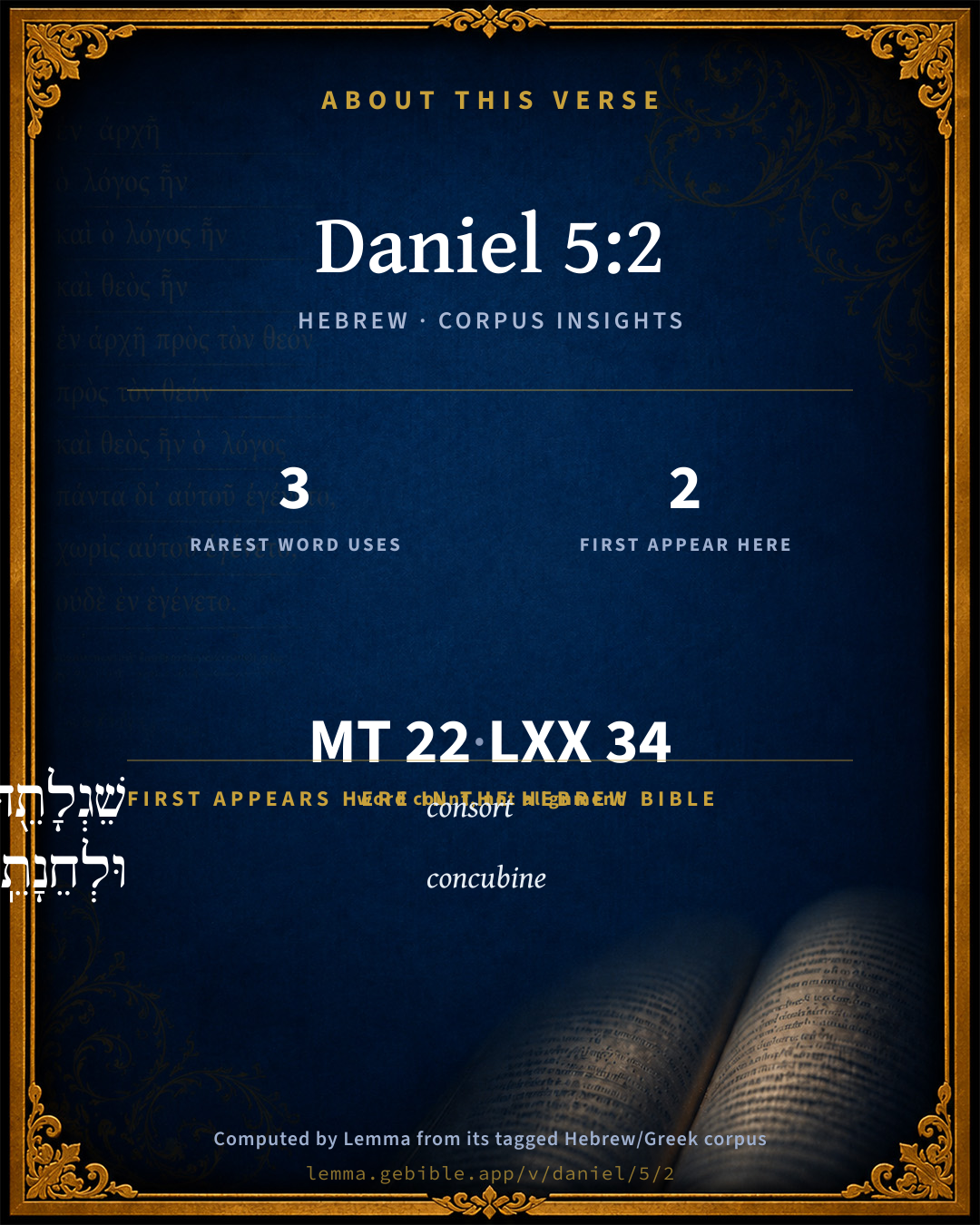
22
words
20
distinct lemmas
Prophets
section

Notable vocabulary

The rarest word here is שֵׁגְלָתֵ֖הּ consort H7695 — appearing just 3 times in the whole Hebrew Bible.

First appearance in Scripture

These words make their first canonical appearance in the Hebrew Bible here:

  • שֵׁגְלָתֵ֖הּ consort H7695
  • וּלְחֵנָתֵֽהּ concubine H3904

Shared distinctive vocabulary

שֵׁגְלָתֵ֖הּ consort H7695 occurs in 3 verses of the Hebrew Bible. Also found in:

Grammatical profile

  • 2 verbs
  • 5 nouns
  • 10 adjectives
  • 5 particles

Verb forms

  • לְהַיְתָיָה֙ Hiphil · Infinitive Construct
  • וְיִשְׁתּ֣וֹן Qal · Imperfect

Repetition

A word recurs within this verse — often emphatic in Hebrew:

  • דִּ֤י which H1768 ×2

Hebrew & Septuagint length

In English translation the verse runs 43 words from the Hebrew and 48 from the Septuagint (LXX English) — closely comparable.

A rough comparison of the two English renderings, which tokenize alike — not a word-level alignment.

Word counts can differ between the Hebrew and the Greek without any difference in meaning — e.g. the Hebrew direct-object marker אֵת has no separate Greek word, and Greek often adds the article ὁ.

In the original languages it is 22 Hebrew tokens and 34 Greek tokens — but the two are counted differently (Hebrew bundles its prefixes and suffixes into one token; the Greek is in lemma form), so that isn’t a like-for-like length.

Cross-references

18

Topical passages linked to Daniel 5:2 in the Treasury of Scripture Knowledge — connected by theme and wording, ordered by reader-vote popularity; previews shown in the World English Bible.

  • Daniel 1:2 The Lord gave Jehoiakim king of Judah into his hand, with part of the vessels of the house of God; and he carried them into the land of Shinar to the house of his god: and he brought the vessels into the treasure-house of his god.
  • 2 Kings 24:13 He carried out there all the treasures of the house of Yahweh, and the treasures of the king's house, and cut in pieces all the vessels of gold, which Solomon king of Israel had made in the temple of Yahweh, as Yahweh had said.
  • 2 Kings 25:15 The fire pans, and the basins, that which was of gold, in gold, and that which was of silver, in silver, the captain of the guard took away.
  • Ezra 1:7–11 Also Cyrus the king brought forth the vessels of the house of Yahweh, which Nebuchadnezzar had brought forth out of Jerusalem, and had put in the house of his gods;
  • Jeremiah 27:16–22 Also I spoke to the priests and to all this people, saying, Thus says Yahweh: Don't listen to the words of your prophets who prophesy to you, saying, Behold, the vessels of Yahweh's house shall now shortly be brought again from Babylon; for they prophesy a lie to you.
  • Daniel 5:23 but have lifted up yourself against the Lord of heaven; and they have brought the vessels of his house before you, and you and your lords, your wives and your concubines, have drunk wine from them; and you have praised the gods of silver and gold, of brass, iron, wood, and stone, which don't see, nor hear, nor know; and the God in whose hand your breath is, and whose are all your ways, you have not glorified.
  • 2 Samuel 9:7 David said to him, "Don't be afraid of him; for I will surely show you kindness for Jonathan your father's sake, and will restore you all the land of Saul your father; and you shall eat bread at my table continually."
  • 2 Kings 8:25–27 In the twelfth year of Joram the son of Ahab king of Israel did Ahaziah the son of Jehoram king of Judah begin to reign.
  • 2 Chronicles 11:20 After her he took Maacah the daughter of Absalom; and she bore him Abijah, and Attai, and Ziza, and Shelomith.
  • 2 Chronicles 15:16 Also Maacah, the mother of Asa the king, he removed from being queen, because she had made an abominable image for an Asherah; and Asa cut down her image, and made dust of it, and burnt it at the brook Kidron.
  • 2 Chronicles 36:10 At the return of the year king Nebuchadnezzar sent, and brought him to Babylon, with the goodly vessels of the house of Yahweh, and made Zedekiah his brother king over Judah and Jerusalem.
  • 2 Chronicles 36:18 All the vessels of the house of God, great and small, and the treasures of the house of Yahweh, and the treasures of the king, and of his princes, all these he brought to Babylon.
  • Jeremiah 27:7 All the nations shall serve him, and his son, and his son's son, until the time of his own land come: and then many nations and great kings shall make him their bondservant.
  • Jeremiah 52:19 The cups, and the fire pans, and the basins, and the pots, and the lampstands, and the spoons, and the bowls-that which was of gold, in gold, and that which was of silver, in silver,-the captain of the guard took away.
  • Daniel 5:4 They drank wine, and praised the gods of gold, and of silver, of brass, of iron, of wood, and of stone.
  • Daniel 5:11 There is a man in your kingdom, in whom is the spirit of the holy gods; and in the days of your father light and understanding and wisdom, like the wisdom of the gods, were found in him; and the king Nebuchadnezzar your father, the king, [I say], your father, made him master of the magicians, enchanters, Chaldeans, and soothsayers;
  • Daniel 5:13 Then was Daniel brought in before the king. The king spoke and said to Daniel, Are you that Daniel, who are of the children of the captivity of Judah, whom the king my father brought out of Judah?
  • Daniel 5:18 You king, the Most High God gave Nebuchadnezzar your father the kingdom, and greatness, and glory, and majesty:

Cross-references courtesy of OpenBible.info (CC BY 4.0).

Hebrew and Greek witnesses Masoretic Hebrew ↔ Greek Septuagint

The same verse in the two great witnesses to the Old Testament, shown verse-for-verse.

These are two independent witnesses, not word-aligned to each other, and the Septuagint is shown in lemma (dictionary) form.

Hebrew Daniel 5:2 Masoretic · Westminster Leningrad Codex

בֵּלְשַׁאצַּ֞ר אֲמַ֣ר בִּטְעֵ֣ם חַמְרָ֗א לְהַיְתָיָה֙ לְמָאנֵי֙ דַּהֲבָ֣א וְכַסְפָּ֔א דִּ֤י הַנְפֵּק֙ נְבוּכַדְנֶצַּ֣ר אֲב֔וּהִי מִן הֵיכְלָ֖א דִּ֣י בִירוּשְׁלֶ֑ם וְיִשְׁתּ֣וֹן בְּה֗וֹן מַלְכָּא֙ וְרַבְרְבָנ֔וֹהִי שֵׁגְלָתֵ֖הּ וּלְחֵנָתֵֽהּ

Belshazzar, while he tasted the wine, commanded to bring the golden and silver vessels which Nebuchadnezzar his father had taken out of the temple which was in Jerusalem; that the king and his lords, his wives and his concubines, might drink from it.

World English Bible · Public Domain

Greek LXX Daniel 5:2 Septuagint · lemma form

καί ἀναὑψόω ὁ καρδία αὐτός καί εἶπον φέρω ὁ σκεῦος ὁ χρυσοῦς καί ὁ ἀργυροῦς ὁ οἶκος ὁ θεός ὅς φέρω ναβουχοδονοσορ ὁ πατήρ αὐτός ἀπό ἰερουσαλήμ καί οἰνοχοέω ἐν αὐτός ὁ ἑταῖρος αὐτός

And Baltasar drinking gave orders as he tasted the wine that they should bring the gold and silver vessels, which Nabuchodonosor his father had brought forth from the temple in Jerusalem; that the king, and his nobles, and his mistresses, and his concubines, should drink out of them.

LXX2012 (modern English Septuagint) · Public Domain

On this verse, The Cambridge Bible for Schools and Colleges discusses the Septuagint’s reading. Read the note in Commentary ↓

Hebrew: Westminster Leningrad Codex (CC BY 4.0). Greek: Septuagint (public domain); English from LXX2012 (modern English Septuagint) (Public Domain). How the Septuagint differs from the Hebrew →

Commentary

Notes on Daniel 5:2 from classic Christian and Jewish commentators (each source and its license shown beneath its notes). The classic Christian expositions comment on the surrounding passage and are grouped to its opening verse, so a note may address several verses; the Jewish commentaries on the Tanakh (Rashi and others) are per-verse, so they appear only where the commentator wrote on this verse.

Lemma curates 59 commentaries, every one of them public domain or Creative Commons licensed, each selected and text-cleaned for this edition rather than reprinted as found. About our sources →

Trapp's Complete Commentary

John Trapp

Dan 5:2 Belshazzar, whiles he tasted the wine, commanded to bring the golden and silver vessels which his father Nebuchadnezzar had taken out of the temple which [was] in Jerusalem; that the king, and his princes, his wives, and his concubines, might drink therein.

Ver. 2. Belshazzar, whiles he tasted the wine.] {a} And was mastered by it; being now in his cups, as they say, and well whittled, "swallowed up of wine," as the prophet expresseth it. {Isa 28:7} Aben Ezra rendereth it, in consilio vini, doing as the wine advised him.

Commanded to bring the golden and silver vessels.] Being intoxicated, he casteth off all care of God and man, and falleth into the sins of sacrilege and blasphemy.

Which his father Nebuchadnezzar had taken out of the temple.] And should have restored them hither again. We read that when Gensericus had spoiled and plundered Rome, he took the vessels of gold and silver which Titus had brought from the temple in Jerusalem, and carried them with him to Carthage; these vessels, among other spoils, Belisarius met with when he took Carthage, and carried them to Constantinople. But the good Emperor Justinian would not receive them into his treasury, but sent them again to Jerusalem to be disposed of for the good of the Church, according to the discretion of the Christian bishops who lived there. {b}

{a} Iam temulentus . - Vulgate

{b} The Life of Justin, by Mr Clark, 79.

John Trapp, A Commentary or Exposition upon All the Books of the Old and New Testament (1647–1656) — public domain. Text from a community e-Sword module.

Joseph Benson's Commentary

Dan 5:2-4. Belshazzar, while he tasted the wine — When he grew warm with wine, Houb. Commanded to bring the golden and silver vessels, &c. Triumphing thereby over God and his people. They drank wine — Made themselves merry with wine. And praised the gods of gold, &c. — Praised, as gods, senseless images of gold, silver, brass, iron, &c.; thus insulting the great God of heaven and earth, as if these images were more powerful than he, and had enabled them to prevail against him and his people. This their conduct was the more sinful, because Nebuchadnezzar had, not long before, prohibited, by a solemn decree, that any one should speak lightly of the God of the Jews. The Alexandrine and Coptic versions, after mentioning their praising their false gods, add, “But the everlasting God they praised not.” Such a wanton and sacrilegious insult deserved and called for exemplary punishment.

Joseph Benson's Commentary on the Old and New Testaments (1811–1818) — public domain. Text from a community e-Sword module.

Tyndale Open Study Notes

Tyndale Open Resources

5:2-4 The gold and silver cups from the Temple in Jerusalem had been taken into captivity along with the people (1:2), but previous Babylonian kings had not defiled them. They were eventually returned to Jerusalem (Ezra 1:7-11). • predecessor (literally father): Belshazzar was the oldest son of Nabonidus; his relationship with Nebuchadnezzar is uncertain. • While they drank from them they praised their idols: If Belshazzar had ever known of the honor Nebuchadnezzar had shown toward the Most High God decades earlier (Dan 4:34-37), he had long forgotten it. Two ancient Greek historians, Herodotus and Xenophon, record the all-night festivities, dancing, and excessive drinking that took place as the city was taken by Persia.

Tyndale Open Study Notes — © Tyndale Open Resources, licensed CC BY-SA 4.0. Text via the HelloAO Bible API.

Ibn Ezra

Rabbi Abraham ibn Ezra

[Daniel 5:2] Belshazzar... under the influence of the wine (בִּטְעֵם חַמְרָא - bit'em chamra): This [command] was the effect (lit. counsel - עֵצָה - etzah) of the wine that he drank, having become drunk.

His consorts (שֵׁגְלָתֵהּ - sheglateih): [This word shegal means queen or primary consort], like [in the verse]: “and the consort (shegal) sitting beside him” [Nehemiah 2:6]. And she is the mistress/lady designated for the king's bed. And similarly [the related verb form appears in]: “...you shall become engaged to a woman, but another man shall violate her (יִשְׁגָּלֶנָּה - yishgalennah)” [Deuteronomy 28:30], and this refers to the act [of intercourse].

And his concubines (וּלְחֵנָתֵהּ - ul'chenateih): [Meaning] his secondary wives/concubines (פִּילַגְשָׁיו - pilagshav). And behold, he committed two evils: [first,] that everyone drank from the holy vessels, and [second,] that they praised gods of gold, wood, and stone [cf. Daniel 5:4, Daniel 5:23].

Ibn Ezra on the Tanakh — English translations: “Sefaria Community Translation” (CC0 1.0 (public-domain dedication)); “Yalkut, Sifsei Chachomim Chumash, Metsudah Publications, 2009” (CC BY 4.0); and “Commentary of Ibn Ezra on Isaiah - trans. by M. Friedlander, 1873” (public domain). Text via Sefaria.

Geneva Bible (1599)

Geneva Bible translators

Or, overcome with wine.

Meaning, his grandfather.

Geneva Bible (1599) marginal notes — public domain. Text via Bolls.life.

Jamieson, Fausset & Brown

Robert Jamieson, A. R. Fausset & David Brown

whiles he tasted the wine--While under the effects of wine, men will do what they dare not do when sober.

his father Nebuchadnezzar--that is, his forefather. So "Jesus . . . the son of David, the son of Abraham" (Mat 1:1). Daniel does not say that the other kings mentioned in other writers did not reign between Belshazzar and Nebuchadnezzar, namely, Evil-merodach (Jer 52:31), Neriglissar, his brother-in-law, and Laborasoarchod (nine months). BEROSUS makes Nabonidus, the last king, to have been one of the people, raised to the throne by an insurrection. As the inscriptions show that Belshazzar was distinct from, and joint king with, him, this is not at variance with Daniel, whose statement that Belshazzar was son (grandson) of Nebuchadnezzar is corroborated by Jeremiah (Jer 27:7). Their joint, yet independent, testimony, as contemporaries, and having the best means of information, is more trustworthy than any of the heathen historians, if there were a discrepancy. Evil-merodach, son of Nebuchadnezzar (according to BEROSUS), reigned but a short time (one or two years), having, in consequence of his bad government, been dethroned by a plot of Neriglissar, his sister's husband; hence Daniel does not mention him. At the elevation of Nabonidus as supreme king, Belshazzar, the grandson of Nebuchadnezzar, was doubtless suffered to be subordinate king and successor, in order to conciliate the legitimate party. Thus the seeming discrepancy becomes a confirmation of genuineness when cleared up, for the real harmony must have been undesigned.

wives . . . concubines--not usually present at feasts in the East, where women of the harem are kept in strict seclusion. Hence Vashti's refusal to appear at Ahasuerus' feast (Est 1:9-12). But the Babylonian court, in its reckless excesses, seems not to have been so strict as the Persian. XENOPHON [Cyropædia, 5.2,28] confirms Daniel, representing a feast of Belshazzar where the concubines are present. At the beginning "the lords" (Dan 5:1), for whom the feast was made, alone seem to have been present; but as the revelry advanced, the women were introduced. Two classes of them are mentioned, those to whom belonged the privileges of "wives," and those strictly concubines (Sa2 5:13; Kg1 11:3; Sol 6:8).

Jamieson, Fausset & Brown — Commentary Critical and Explanatory on the Whole Bible (1871) — public domain (CC PDM 1.0). Text via the HelloAO Bible API.

Adam Clarke's Commentary

Verse 2. Whiles he tasted the wine] He relished it, got heated by it, and when WINE got fully in, WIT went wholly out; and in consequence he acted the profane part of which we immediately read.

Adam Clarke's Commentary on the Bible (1810–1826) — public domain. Text from a community e-Sword/MySword module.

John Calvin's Commentaries

Here king Belshazzar courts his own punishment, because he furiously stirred up God’s wrath against himself, as if he was dissatisfied with its delay while God put off his judgment for so long a period. This is according to what I have said. When the destruction of a house is at hand, the impious remove the posts and gates, as Solomon says. (Proverbs 17:19.) God therefore, when he wishes to execute his judgments, impels the reprobrate by a secret instinct to rush forward of their own accord, and to hasten their own destruction. Belshazzar did this. His carelessness was the sign of his stupidity, and also of God’s wrath, when in the midst of his own pride and crimes he could delight in reveling. Thus his blindness more clearly points out God’s vengeance, since he was not content with his own intemperance and excesses, but must openly declare war against God. He ordered, therefore, says he, the gold and silver vessels to be brought to him which he had taken away from Nebuchadnezzar These vessels appear to have been laid up in the treasury; hence Nebuchadnezzar had never abused these vessels in his lifetime; we do not read that Evil-Merodach did anything of this kind, and Belshazzar now wishes purposely to inflict this insult on God. There is no doubt he brought forth those vessels by way of ridicule, for the purpose of triumphing over the true God, as we shall afterwards see.

We have already explained the sense in which the Prophet calls Nebuchadnezzar the father of Belshazzar, since it is usual in all languages to speak of ancestors as fathers; for Belshazzar was of the offspring of Nebuchadnezzar, and being really his grandson, he is naturally called his son; and this will occur again. There are some who think Evil-Merodach was stricken with that grievous affliction mentioned in the last chapter: possibly his name was Nebuchadnezzar, but there is no reason for adopting their opinion; it is frivolous to fly directly to this conjecture when the name of the father occurs. the Prophet says Belshazzar committed this under the influence of wine Since טעם, tegnem, signifies “to taste,” no doubt he here speaks of tasting; and since this may be metaphorically transferred to the understanding, some explain it to mean being impelled by wine, and thus his drunkenness took the place of reason and judgment. Nights and love and wine, says Ovid, have no moderation in them. This explanation I think too forced; it seems simply to mean, when Belshazzar grew warm with wine, he commanded the vessels to be brought to him; and this is the more usual view. When, therefore, the savor of the wine prevailed, — that is, when it seized upon the king’s senses, then he ordered the vessels to be brought It is worth while to notice this, to induce us to be cautious concerning intemperance in drinking, because nothing is more common than the undertaking many things far too rashly when our senses are under the influence of wine. Hence we must use wine soberly, that it may invigorate not only the body but the mind and the senses, and may never weaken, or enervate, or stupify our bodily or mental powers. And this is, alas! too common, since the vulgar proverb is well known — pride springs from drunkenness. For this reason the poets supposed Bacchus to have horns, since intemperate men are always puffed up, and the most wretched fancy themselves kings. What then must happen to monarchs, when in their forgetfulness they dream themselves kings of kings, and even deities? The Prophet wishes to mark this fault when he says, Belshazzar, under the influence of wine, ordered vessels to be brought to him It now follows, —

John Calvin's Commentaries (1540-1563) — public domain. Text from the Calvin Translation Society English edition (1840s-50s) via the Christian Classics Ethereal Library (ccel.org). Calvin's coverage is partial (roughly two-thirds of the Bible); uncommented books and verses are honest gaps, never fabricated. The 19th-century editor's footnotes and remarks are omitted so the notes are faithfully Calvin's own voice.

Ellicott's Commentary for English Readers

(2) Whiles he tasted—i.e., while he was enjoying the wine. The sacred vessels were brought out of the temple of Merodach, and profaned in this manner for the purpose of defying Jehovah. But it may be reasonably asked, What led him to think of Jehovah in the midst of the revelry? It may have been that some drunken fancy seized him. It may have been that he had been warned that the prophets of Jehovah had foretold the overthrow of Babylon by Cyrus, whose armies were now in the neighbourhood. Whatever the true explanation may be, there can be no doubt, from Daniel’s language (Dan_5:23), and from the way in which Belshazzar’s gods are mentioned (Dan_5:4), that the whole act was one of defiance of Jehovah.

A Bible Commentary for English Readers, edited by Charles John Ellicott (1878–1897) — public domain. Text from a community e-Sword module.

The Cambridge Bible for Schools and Colleges

gen. ed. J. J. S. Perowne

2. whiles] the genitive sing. of the subst. while (as in ‘for a while’), used adverbially (cf. ‘needs,’ ‘upwards’). It occurs in A.V. Dan_9:20-21; Eze_21:29 (twice), Eze_44:17; Hos_7:6; Mat_5:25; Act_5:4; 2Co_9:13; and several times in Shakespeare, as Much Ado, iv. 1, 221, ‘What we have we prize not to the worth, Whiles we enjoy it, Meas. for Meas. iv. 3, 84; Jul. Caes. i. 2. 209.

whiles he tasted the wine] in the taste—i.e. enjoyment—of the wine, when he began to feel the influence of the wine.

commanded, &c.] an act, under the circumstances, of wanton and defiant impiety.

the golden and silver vessels, &c.] see Dan_1:2.

his father] Belshazzar is not known to have been related to Nebuchadnezzar: his father was Nabu-na’id, a usurper, the son of one Nabo-balâṭsu-iḳbi, and expressly said (see Introd. pp. xxvii, li) to have been unconnected with Nebuchadnezzar’s family.

‘Father’ may, however, by Hebrew usage, be understood to mean grandfather (Gen_28:13; Gen_32:10; cf. 1Ki_15:13 for great-grandfather); and there remains the possibility that Nabu-na’id may have sought to strengthen his position by marrying a daughter of Nebuchadnezzar, in which case, of course, Nebuchadnezzar would be ‘Belshazzar’s grandfather on his mother’s side (see however, p. li, [254].).

[254] The supposition, sometimes made, that he was ‘co-regent’ with his father is also destitute of foundation in the inscriptions.

2. princes] lords, as Dan_5:1. So Dan_5:3.

his wives] his consorts: so Dan_5:3; Dan_5:23. The word is a rare one, being found otherwise in the O.T. only in Neh_2:6 (of the queen of Artaxerxes), and Psa_45:9[255].

[255] It is read by some scholars conjecturally in Jdg_5:30 (‘for the neck of the consort,’—שׁגל for שׁלל). The coguate verb means to ravish (Isa_13:16 al.)

concubines] so Dan_5:3; Dan_5:23. Not the usual Hebrew word, but one found also in the Aramaic of the Targums. Cf. Son_6:8, where ‘queens’ and ‘concubines’ are mentioned side by side.

The presence of women at feasts was not usual in antiquity (cf., of Persia, Est_1:10-12); but there is some evidence, though slight, that it was allowed in Babylon (Xen. Cyrop. v. ii. 28; and, in the age of Alexander, Curtius v. i. 38). The LXX. translator, feeling probably some difficulty in the statement, omits the clause relating to the ‘wives and concubines’ both here and Dan_5:3; Dan_5:23.

The Cambridge Bible for Schools and Colleges (gen. ed. J. J. S. Perowne; Cambridge University Press, 1878–1918) — public domain. Text from a community e-Sword module.

John Gill's Exposition

Belshazzar, while he tasted the wine,.... As he was drinking his cups, and delighted with the taste of the wine, and got merry with it: or, "by the advice of the wine" (h), as Aben Ezra and Jarchi interpret it, by a personification; as if that dictated to him, and put him upon doing what follows; and which often puts both foolish and wicked things into the heads of men, and upon doing them: then he

commanded to bring the golden and silver vessels, which his father Nebuchadnezzar had taken out of the temple which was in Jerusalem; what these vessels were, and the number of them, we learn from the delivery of them afterwards to the prince of Judah by Cyrus, Ezr 1:9, these were put into the temple of Bel by Nebuchadnezzar, Dan 1:2 and from thence they were now ordered to be brought to the king's palace, and to the apartment where he and his nobles were drinking:

that the king, and his princes, his wives, and his concubines, might drink therein; Saadiah says, this day the seventy years' captivity ended; and so, in contempt of the promise and prophecy of it, he ordered the vessels to be brought out and drank in, to show that in vain the Jews expected redemption from it.

(h) "vino dictante", Tigurine version.

John Gill's Exposition of the Whole Bible (1746–1763) — public domain (CC PDM 1.0). Text via the HelloAO Bible API.

Albert Barnes' Notes on the Bible

Belshazzar, while he tasted the wine - As the effect of tasting the wine - stating a fact which is illustrated in every age and land, that men, under the influence of intoxicating drinks, will do what they would not do when sober. In his sober moments it would seem probable that he would have respected the vessels consecrated to the service of religion, and would not have treated them with dishonor by introducing them for purposes of revelry.

Commanded to bring the golden and silver vessels - These vessels had been carefully deposited in some place as the spoils of victory (see Dan 1:2), and it would appear that they had not before been desecrated for purposes of feasting. Belshazzar did what other men would have done in the same condition. He wished to make a display; to do something unusually surprising; and, though it had not been contemplated when the festival was appointed to make use of these vessels, yet, under the excitement of wine, nothing was too sacred to be introduced to the scenes of intoxication; nothing too foolish to be done. In regard to the vessels taken from the temple at Jerusalem, see the note at Dan 1:2.

Which his father Nebuchadnezzar had taken - Margin, “grandfather.” According to the best account which we have of Belshazzar, he was the son of Evil-Merodach, who was the son of Nebuchadnezzar (see the Introduction to the chapter, Section II.), and therefore the word is used here, as in the margin, to denote grandfather. Compare Jer 27:7. See the note at Isa 14:22. The word father is often used in a large signification. See 2Sa 9:7; also the notes at Mat 1:1. There is no improbability in supposing that this word would be used to denote a grandfather, when applied to one of the family or dynasty of Nebuchadnezzar The fact that Belshazzar is here called “the son” of Nebuchadnezzar has been made a ground of objection to the credibility of the book of Daniel, by Lengerke, p. 204. The objection is, that the “last king of Babylon was “not” the son of Nebuchadnezzar.” But, in reply to this, in addition to the remarks above made, it may be observed that it is not necessary, in vindicating the assertion in the text, to suppose that he was the “immediate” descendant of Nebuchadnezzar, in the first degree. “The Semitic use of the word in question goes far beyond the first degree of descent, and extends the appellation of “son” to the designation “grandson,” and even of the most remote posterity. In Ezr 6:14, the prophet Zechariah is called “the son of Iddo;” in Zec 1:1, Zec 1:7, the same person is called “the son of Berechiah, the son of Iddo.” So Isaiah threatens Hezekiah Isa 39:7 that the sons whom he shall beget shall be conducted as exiles to Babylon; in which case, however, four generations intervened before this happened. So in Mat 1:1, ‘Jesus Christ, the son of David, the son of Abraham.’ And so we speak every day: ‘The sons of Adam, the sons of Abraham, the sons of Israel, the sons of the Pilgrims,’ and the like.” - Prof. Stuart, “Com. on Dan.” p. 144.

That the king and his princes, his wives, and his concubines, might drink therein - Nothing is too sacred to be profaned when men are under the influence of wine. They do not hesitate to desecrate the holiest things, and vessels taken from the altar of God are regarded with as little reverence as any other. It would seem that Nebuchadnezzar had some respect for these vessels, as having been employed in the purposes of religion; at least so much respect as to lay them up as trophies of victory, and that this respect had been shown for them under the reign of his successors, until the exciting scenes of this “impious feast” occurred, when all veneration for them vanished. It was not very common for females in the East to be present at such festivals as this, but it would seem that all the usual restraints of propriety and decency came to be disregarded as the feast advanced. The “wives and concubines” were probably not present when the feast began, for it was made for “his lords” Dan 5:1; but when the scenes of revelry had advanced so far that it was proposed to introduce the sacred vessels of the temple, it would not be unnatural to propose also to introduce the females of the court.

A similar instance is related in the book of Esther. In the feast which Ahasuerus gave, it is said that “on the seventh day, when the heart of the king was merry with wine, he commanded Mehuman, Biztha, etc., the seven chamberlains that served in the presence of Ahasuerus the king, to bring Vashti the queen before the king with the crown royal, to show the people and the princes her beauty,” etc. Est 1:10-11. Compare Joseph. “Ant.” b. xi. ch. 6: Section 1. The females that were thus introduced to the banquet were those of the harem, yet it would seem that she who was usually called “the queen” by way of eminence, or the queen-mother (compare the note at Est 5:10), was not among them at this time. The females in the court of an Oriental monarch were divided into two classes; those who were properly concubines, and who had none of the privileges of a wife; and those of a higher class, and who were spoken of as wives, and to whom pertained the privileges of that relation. Among the latter, also, in the court of a king, it would seem that there was one to whom properly belonged the appellation of “queen;” that is, probably, a favorite wife whose children were heirs to the crown. See Bertholdt, in loc. Compare 2Sa 5:13; 1Ki 11:3; Son 6:8.

Albert Barnes' Notes on the Bible (1834–1885) — public domain. Text from a community e-Sword/MySword module.

Matthew Poole's English Annotations

This king having the wine, liked it so well, that he resolved to make a merry day of it, and in order to it, sent for the vessels of God’s temple, which he did in scorn and contempt, triumphing thereby over God and his people; but this sport lasted not long: they had more honour for the vessels of their own idols, which they kept sacred and untouched; therefore the prophet upbraids them with this insolent profaneness, for the concubines also drank of them.

Matthew Poole's English Annotations on the Holy Bible (1683–1685) — public domain. Text from a community e-Sword/MySword module.

Whedon's Commentary on the Bible

Daniel D. Whedon

2. While he tasted the wine — Prince renders being under the influence of the wine. The earliest version of the LXX., probably through prejudice (see note Dan_5:1), omits all reference to the presence of women.

Daniel D. Whedon (gen. ed.), Commentary on the Old and New Testaments (1874–1909) — public domain. Text from a community e-Sword module.

The Pulpit Commentary

Belshazzar, whiles he tasted the wine, commanded to bring the golden and silver vessels which his father Nebuchadnezzar had taken out of the temple which was in Jerusalem; that the king, and his princes, his wives, and his concubines, might drink therein. The Septuagint has included the last clause of the Massoretic recension of the first verse, "And he drank wine, and his heart was lifted up, and he commanded to bring the vessels of gold and of silver of the house of God, which Nebuchadnezzar his father had brought from Jerusalem, and to pour out wine in them for those companions of his (ejn aujtoiv toiv eJtairoiv)." The translator seems to have regarded the first syllable of the name Belshazzar as a separate word, and has translated it according to the meaning the word has in Eastern Aramaic, "heart". (Exo_12:23, Peshitta) After this initial mistake if mistake it was the remaining change was easy. The syntax here, according to the Massoretic text, is different from what we should expect. rma (amar), "to say," is translated "command" in eight cases in this book, and in every other case it is followed immediately by the infinitive" of the action commanded. Hence we are inclined, with the LXX, to omit "whiles he tasted the wine." While the LXX Aramaic seems to have yhb, "in them," it has not had "king," "wives," or "concubines." As the Septuagint is the shorter, on the whole, we prefer it, though we maintain the Massoretic reading of "in them," referring to the vessels. Theodotion and the Peshitta follow the Massoretic reading. Whether or not the libation offered to the gods was in the mind of the writer, the mere fact that the sacred vessels were used for the purposes of a common feast was desecration. The addition of the "wives" and "concubines" adds at once to the degradation in the eyes of an Eastern, and to the stately rhetorical cadence of the verse. This renders all the stronger the suspicion engendered by the omission of these features in the Septuagint. It is to be observed that the Septuagint translator must have had an Eastern Aramaic manuscript before him, or he could never have translated bal "heart." At the same time, the presence of women at Babylonian feasts was not so uncommon as it was in the rest of the East, as we learn from the Ninevite remains. Certainly Quintus Curtius mentions this in connection with Alexander"s visit to Babylon (v. 1). But was an obscure Jew likely to know this in Palestine? It is very difficult for a person writing in a different age to keep strictly to verisimilitude in these matters. Even a contemporary may make a blunder in writing, not a novel, but a biography, as Froude, in his "Life of Carlyle," declares he was "quietly married in the parish church of Temple." To be quietly married in a parish church in any part of Scotland, in the early years of this century, would be a contradiction in terms. Yet Froude had often been in Scotland, and knew Carlyle well. Could a Jew living in Palestine have all his wits about him so as to note every varying feature which distinguished the habits of Babylon from those of the rest of the East? The question may be asked why were the vessels of the Lord in Jerusalem singled out to be desecrated by a common use? It might, of course, be that the sacred vessels of the temples of the gods of all conquered nationalities were brought in, and thus that the singling out of the Jewish sacred vessels was due, not to the preference of the Babylonian monarch, but to the Jew, who saw only those. We think this can scarcely be. It was certainly the policy of Nabunahid to draw all worship to Babylon (Annals of Nabunahid, col. 3. line 20, "The gods of Akkad, which Nabunabid had brought to Babylon, were carried back to their city"). But this would lead him to avoid anything that would savour of disrespect to these gods whom he had brought to dwell in Babylon. We do not think it would have been merely the beauty of those vessels that led to their desecration, for the temple at Jerusalem had suffered several plunderings before the capture of the city, and the period between the age of Hezekiah and Zedekiah was not one in which wealth and artistic talent were likely to increase. Some suspicion must have reached the court of Babylon that the Jews were in league with Cyrus; perhaps the contents of the second Isaiah had reached the knowledge of the Babylonian police. If so, the act of Belshazzar was an act of defiance against Jehovah of Israel.

The Pulpit Commentary (1880–1919), ed. H.D.M. Spence-Jones & Joseph S. Exell — public domain. Text from a community e-Sword module.

John Wesley's Explanatory Notes

To bring the vessels - Triumphing thereby over God and his people.

John Wesley, Explanatory Notes Upon the Whole Bible (1754–1765) — public domain. Text via the GEBible commentary corpus.

Scofield Reference Notes

C. I. Scofield

father

Nebuchadnezzar was "father" of Belshazzar in the biblical sense that David is called "father" of Jesus, Luk 1:32. Belshazzar was probably a grandson.

The Scofield Reference Bible (1917 edition), notes by C. I. Scofield — public domain. Text from a community e-Sword module.

Rashi

Rabbi Shlomo Yitzchaki (Rashi)

said, with the counsel of the wine He said with the counsel of the wine that he had imbibed.

to bring [as translated,] to bring.

that...had taken out [as translated,] had taken out.

his queen Aram. שֵּׁגְלָתֵה, an expression of a queen in Aramaic, like: (Neh. 2:6): “and the queen (וְהַשֵׁגָל) was sitting beside him.”

Rashi on the Tanakh — English translations: “The Judaica Press complete Tanach with Rashi, translated by A. J. Rosenberg” (CC BY 4.0); “Pentateuch with Rashi's commentary by M. Rosenbaum and A.M. Silbermann, 1929-1934” (public domain); “The Metsudah Tanach series, Lakewood, N.J” (CC BY 4.0); and “The Book of Joshua, Metsudah Publications, 1997” (CC BY 4.0). Text via Sefaria.

Lesson kit

Teaching starters — assembled from the data on this page, not authored interpretation. Every prompt links to the verse data it draws on. Edit before teaching.

Daniel, in the Prophets, opens this verse with 22 words (20 distinct Hebrew lemmas). Its most distinctive word is shêgâl (“consort”). A historical commentator’s framing appears above. Read the whole chapter for the surrounding context.

Discussion questions

  1. How does “consort” (shêgâl) shape what this verse is saying?
  2. 2 words here appear for the first time in Scripture. What is being introduced at this debut?
  3. Daniel 5:3 shares the word «consort» with this verse. How do the two illuminate each other?
  4. “which” occurs 2× in this one verse. What is the effect of the repetition?
  5. These translations render this verse differently; the difference is in the English rendering, not the original. What questions does that raise?
  6. The verb «לְהַיְתָיָה֙» is Hiphil Infinitive Construct. How does its form color the action?
  7. Reading how Trapp's Complete Commentary and Joseph Benson's Commentary read this verse, where do the two commentators agree and where do they part?

Things to notice

Reading settings

Reading text

Shown beneath each verse's original-language words.

Old Testament
Old Testament edition

Read the OT as the Masoretic Hebrew (MT) or the Greek Septuagint (LXX).

English shown for the Greek Septuagint (in the Hebrew ↔ Greek comparison).

Comparing translations? Open the Compare panel on any verse page to stack up to four side by side.