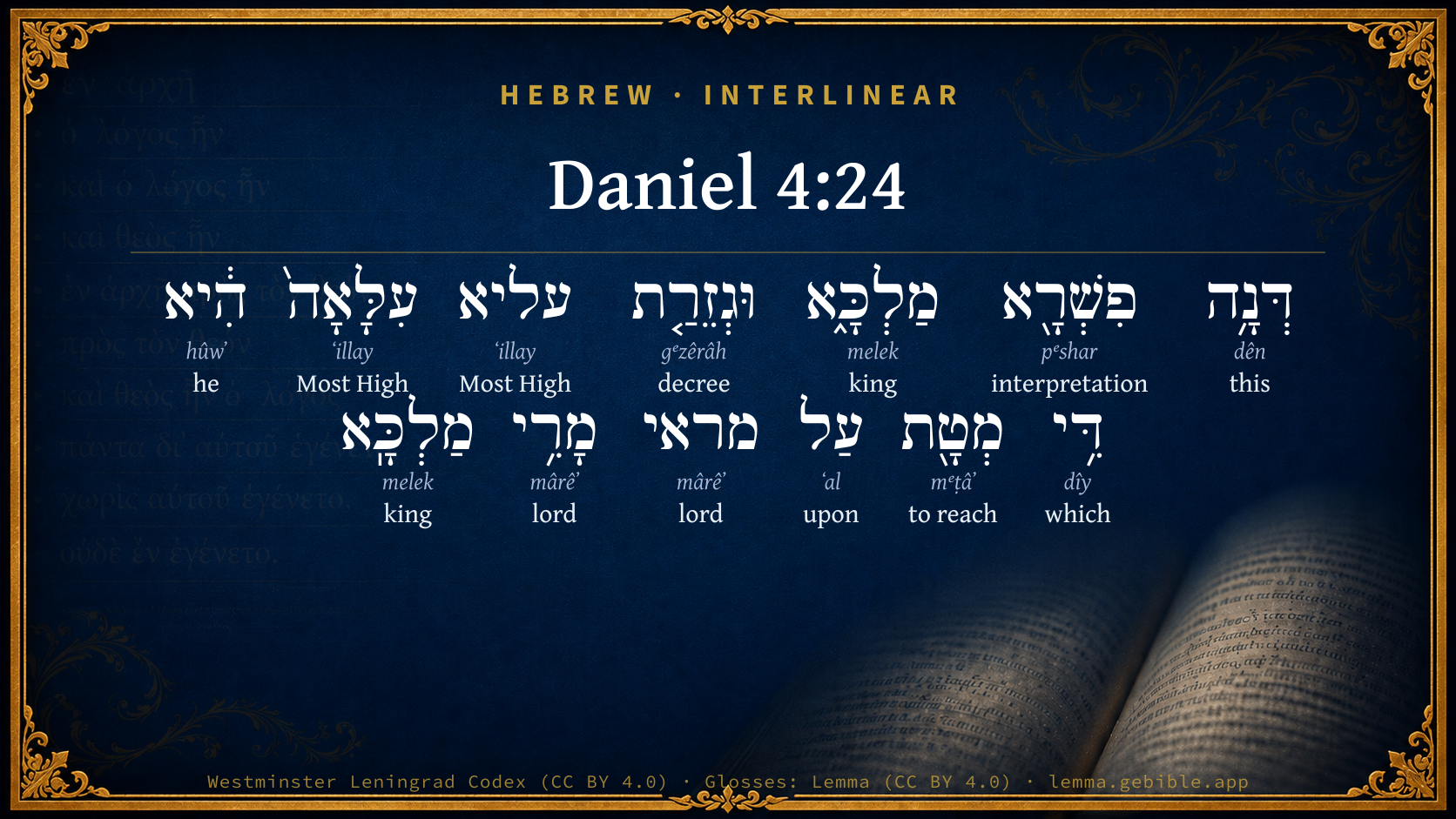
Daniel 4:24

Hebrew (Westminster Leningrad Codex) Daniel 4:24 appears in the Hebrew Old Testament. The text above is from the Westminster Leningrad Codex. Each word links to its Strong’s number, a concise gloss, and parsing drawn from the Open Scriptures Hebrew Bible morphology. Click any word for its full Brown-Driver-Briggs (BDB) entry.
Download image
Cite this verse

Daniel 4:24 (World English Bible). Public Domain. Lemma interlinear Bible study tool, https://lemma.gebible.app/v/daniel/4/24.

Show BibTeX & RIS
BibTeX
RIS
English Translation
this is the interpretation, O king, and it is the decree of the Most High, which is come on my lord the king:
World English Bible · Public Domain
Download a study sheet

One document with this verse’s original text, its word-by-word gloss line, the meaning frame, cross-references with their text, attributed commentary, and full source and license credits — printable, and it pastes into notes with its structure intact.

This verse Autodidact and up

Study sheet (.html) Plain text (.txt)

A passage Seminary Student

Up to 50 verses in one chapter. A passage sheet keeps up to 6 commentary sources and 12 cross-references per verse, in the order this page ranks them, and says so on the sheet whenever that leaves anything out. Ask for a single verse and you get the Autodidact verse sheet above.

Everything on this page stays free to read, with no account — the sheet is a download of what is already on screen, not access to it.

Want to remove ads? Support Godless Engineer
Compare translations 3

The same verse in 3 English versions, stacked beneath the original-language interlinear above. Click any original word for its lexicon entry.

Each is an independent rendering of the whole verse — the interlinear is not word-aligned to these translations.

Highlighted words mark where these versions differ — a whole-verse word diff, not a word-by-word alignment.

  • World English Bible Public Domain
    this is the interpretation, O king, and it is the decree of the Most High, which is come on my lord the king:
  • King James Version Public Domain
    This is the interpretation, O king, and this is the decree of the most High, which is come upon my lord the king:
  • unfoldingWord Literal Text CC BY-SA 4.0
    this is the interpretation, O king, and this is the decree of the Most High that has come upon my lord the king:

unfoldingWord Literal Text — © unfoldingWord, licensed CC BY-SA 4.0. Word-aligned USFM3 via Door43 (git.door43.org/unfoldingWord/en_ult).

Versions to compare (up to 4)

3 of 4 selected

Show all 18 translations

Every available English version of this verse, each an independent rendering of the whole verse.

  • World English Bible Public Domain
    this is the interpretation, O king, and it is the decree of the Most High, which is come on my lord the king:
  • Berean Standard Bible Public Domain
    This is the interpretation, O king, and this is the decree that the Most High has issued against my lord the king:
  • Majority Standard Bible Public Domain
    This is the interpretation, O king, and this is the decree that the Most High has issued against my lord the king:
  • King James Version Public Domain
    This is the interpretation, O king, and this is the decree of the most High, which is come upon my lord the king:
  • American Standard Version (1901) Public Domain
    this is the interpretation, O king, and it is the decree of the Most High, which is come upon my lord the king:
  • Revised Version (1885) Public Domain
    this is the interpretation, O king, and it is the decree of the Most High, which is come upon my lord the king:
  • Geneva Bible (1599) Public Domain
    Wherefore, O King, let my counsell be acceptable vnto thee, and breake off thy sinnes by righteousnes, and thine iniquities by mercy toward the poore: lo, let there be an healing of thine errour.
  • Douay-Rheims (1899) Public Domain
    This is the interpretation of the sentence of the most High, which is come upon my lord the king.
  • Young's Literal Translation Public Domain
    `This `is' the interpretation, O king, and the decree of the Most High it `is' that hath come against my lord the king:
  • Literal Standard Version CC BY-SA 4.0
    This [is] the interpretation, O king, and it [is] the decree of the Most High that has come against my lord the king:
  • Unlocked Literal Bible CC BY-SA 4.0
    This is the interpretation, king. It is a decree of the Most High that has reached you, my master the king.
  • unfoldingWord Literal Text CC BY-SA 4.0
    this is the interpretation, O king, and this is the decree of the Most High that has come upon my lord the king:
  • Darby Bible Public Domain
    this is the interpretation, O king, and it is the decree of the Most High, which cometh upon my lord the king:
  • World Messianic Bible Public Domain
    “This is the interpretation, O king, and it is the decree of the Most High, which has come on my lord the king:
  • Webster's Bible Public Domain
    This is the interpretation, O king, and this is the decree of the most High, which is come upon my lord the king:
  • Free Bible Version CC BY-SA 4.0
    This is what it means, Your Majesty, and what the Most High has decreed will happen to my lord the king.
  • Bible in Basic English Public Domain
    This is the sense of it, O King, and it is the decision of the Most High which has come on my lord the king:
  • JPS Tanakh (1917) Public Domain
    (4-21) this is the interpretation, O king, and it is the decree of the Most High, which is come upon my lord the king,

Literal Standard Version (2020), Covenant Press — licensed CC BY-SA 4.0. Text via the HelloAO Bible API (eBible.org). Unlocked Literal Bible (unfoldingWord) — licensed CC BY-SA 4.0. Text via the HelloAO Bible API (eBible.org). unfoldingWord Literal Text — © unfoldingWord, licensed CC BY-SA 4.0. Word-aligned USFM3 via Door43 (git.door43.org/unfoldingWord/en_ult). Free Bible Version, Dr. Jonathan Gallagher — licensed CC BY-SA 4.0. Text via the HelloAO Bible API (eBible.org).

Word by word

More ways to search: Search by grammar → Find every occurrence → Compare this word →

Practice this passage: Drill this verse → Learn its vocabulary →

וּגְזֵרַ֤ת
gᵉzêrâh
H1510
“and · decree of”
Adjective, C + Noun, Common, Feminine, Singular, Construct
Part of Speech
Adjective + Noun
Type
Common
Gender
Feminine
Number
Singular
State
Construct
Full BDB Definition

Origin: from H1505 (as H1504 )

TWOT: 2654a

decree
  1. דְּנָ֥ה dên H1836 “this” Adjective, P
  2. פִשְׁרָ֖א pᵉshar H6591 “interpretation · the” Adjective, N, Common + Particle, Definite Article
  3. מַלְכָּ֑א melek H4430 “king · the” Adjective, N, Common + Particle, Definite Article
  4. עליא ʻillay H5943 “Most High · the” Adjective, A + Particle, Definite Article
  5. עִלָּאָה֙ ʻillay H5943 “Most High · the” Adjective, A + Particle, Definite Article
  6. הִ֔יא hûwʼ H1932 “he” Adjective, P
  7. דִּ֥י dîy H1768 “which” Adjective, T
  8. מְטָ֖ת mᵉṭâʼ H4291 “to reach” Adjective, V, Plural
  9. עַל ʻal H5922 “upon” Adjective, R
  10. מראי mârêʼ H4756 “lord · my” Adjective, N, Common + Suffix, Personal, 1st Person, Common, Singular
  11. מָרִ֥י mârêʼ H4756 “lord · my” Adjective, N, Common + Suffix, Personal, 1st Person, Common, Singular
  12. מַלְכָּֽא melek H4430 “king · my” Adjective, N, Common + Suffix, Personal, 1st Person, Common, Singular

About this verse

These counts appear in no published source. They are computed here, from the morphology-tagged text and Lemma’s own curated glosses. What Lemma adds →

13
words
10
distinct lemmas
Prophets
section

Notable vocabulary

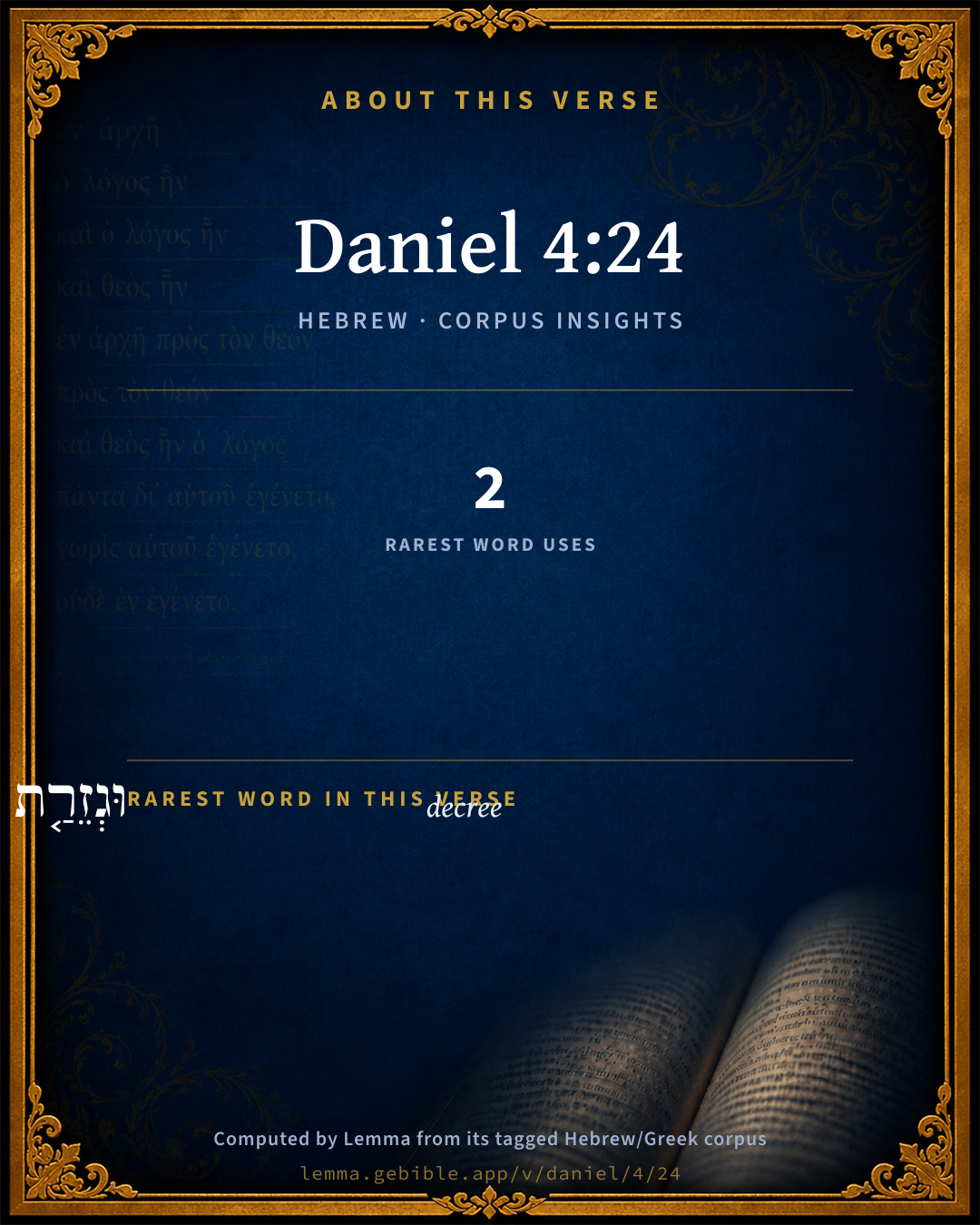
The rarest word here is וּגְזֵרַ֤ת decree H1510 — appearing just 2 times in the whole Hebrew Bible.

Shared distinctive vocabulary

וּגְזֵרַ֤ת decree H1510 occurs in 2 verses of the Hebrew Bible. Also found in:

Grammatical profile

  • 1 noun
  • 8 adjectives
  • 4 particles

Repetition

Words recur within this verse — often emphatic in Hebrew:

  • מַלְכָּ֑א king H4430 ×2
  • עליא Most High H5943 ×2
  • מראי lord H4756 ×2

Hebrew & Septuagint length

In English translation the verse runs 23 words from the Hebrew and 33 from the Septuagint (LXX English) — the Septuagint runs noticeably longer here. See the side-by-side →

A rough comparison of the two English renderings, which tokenize alike — not a word-level alignment.

Word counts can differ between the Hebrew and the Greek without any difference in meaning — e.g. the Hebrew direct-object marker אֵת has no separate Greek word, and Greek often adds the article ὁ.

Cross-references

10

Topical passages linked to Daniel 4:24 in the Treasury of Scripture Knowledge — connected by theme and wording, ordered by reader-vote popularity; previews shown in the World English Bible.

  • Psalms 107:40 He pours contempt on princes, And causes them to wander in a trackless waste.
  • Job 40:11–12 Pour forth the fury of your anger. Look on everyone who is proud, and bring him low.
  • Isaiah 46:10–11 declaring the end from the beginning, and from ancient times things that are not [yet] done; saying, My counsel shall stand, and I will do all my pleasure;
  • Job 1:12–19 Yahweh said to Satan, "Behold, all that he has is in your power. Only on himself don't put forth your hand." So Satan went forth from the presence of Yahweh.
  • Job 20:29 This is the portion of a wicked man from God, The heritage appointed to him by God."
  • Psalms 2:7 I will tell of the decree. Yahweh said to me, "You are my son. Today I have become your father.
  • Psalms 148:6 He has also established them forever and ever. He has made a decree which will not pass away.
  • Isaiah 14:24–27 Yahweh of Hosts has sworn, saying, Surely, as I have thought, so shall it happen; and as I have purposed, so shall it stand:
  • Isaiah 23:9 Yahweh of hosts has purposed it, to stain the pride of all glory, to bring into contempt all the honorable of the earth.
  • Daniel 4:17 The sentence is by the decree of the watchers, and the demand by the word of the holy ones; to the intent that the living may know that the Most High rules in the kingdom of men, and gives it to whoever he will, and sets up over it the lowest of men.

Cross-references courtesy of OpenBible.info (CC BY 4.0).

Hebrew and Greek witnesses Masoretic Hebrew ↔ Greek Septuagint

The same verse in the two great witnesses to the Old Testament, shown verse-for-verse.

Here the Septuagint runs noticeably longer than the Hebrew — LXX2012 (modern English Septuagint) 33 words vs World English Bible 23. A rough length comparison of the two English translations, not a word-level alignment — read both below.

These are two independent witnesses, not word-aligned to each other, and the Septuagint is shown in lemma (dictionary) form.

Hebrew Daniel 4:24 Masoretic · Westminster Leningrad Codex

דְּנָ֥ה פִשְׁרָ֖א מַלְכָּ֑א וּגְזֵרַ֤ת עליא עִלָּאָה֙ הִ֔יא דִּ֥י מְטָ֖ת עַל מראי מָרִ֥י מַלְכָּֽא

this is the interpretation, O king, and it is the decree of the Most High, which is come on my lord the king:

World English Bible · Public Domain

Greek LXX Daniel 4:24 Septuagint · lemma form

καί ἐπί συντέλεια ὁ λόγος αὐτός φωνή ἐκ ὁ οὐρανός ἀκούω σύ λέγω ναβουχοδονοσορ βασιλεύς ὁ βασιλεία βαβυλών ἀποαἱρέω σύ καί ἕτερος δίδωμι ἐκοὐθενέω ἄνθρωπος ἐν ὁ οἶκος σύ ἰδού ἐγώ καταἵστημι αὐτός ἐπί ὁ βασιλεία σύ καί ὁ ἐξουσία σύ καί ὁ δόξα σύ καί ὁ τρυφή σύ παραλαμβάνω ὅπως ἐπιγιγνώσκω ὅτι ἐξουσία ἔχω ὁ θεός ὁ οὐρανός ἐν ὁ βασιλεία ὁ ἄνθρωπος καί ὅς ἐάν βούλομαι δίδωμι αὐτός ἕως δέ ἥλιος ἀνατολή βασιλεύς ἕτερος εὐφραίνω ἐν ὁ οἶκος σύ καί κρατέω ὁ δόξα σύ καί ὁ ἰσχύς σύ καί ὁ ἐξουσία σύ

Therefore, O king, let my counsel please you, and atone for your sins by alms, and your iniquities by compassion on the poor: it may be God will be longsuffering to your trespasses.

LXX2012 (modern English Septuagint) · Public Domain

On this verse, The Pulpit Commentary discusses the Septuagint’s reading. Read the note in Commentary ↓

Hebrew: Westminster Leningrad Codex (CC BY 4.0). Greek: Septuagint (public domain); English from LXX2012 (modern English Septuagint) (Public Domain). How the Septuagint differs from the Hebrew →

Commentary

Notes on Daniel 4:24 from classic Christian and Jewish commentators (each source and its license shown beneath its notes). The classic Christian expositions comment on the surrounding passage and are grouped to its opening verse, so a note may address several verses; the Jewish commentaries on the Tanakh (Rashi and others) are per-verse, so they appear only where the commentator wrote on this verse.

Lemma curates 59 commentaries, every one of them public domain or Creative Commons licensed, each selected and text-cleaned for this edition rather than reprinted as found. About our sources →

Trapp's Complete Commentary

John Trapp

Dan 4:24 This [is] the interpretation, O king, and this [is] the decree of the most High, which is come upon my lord the king:

Ver. 24. This is the interpretation.] See Dan 4:19.

John Trapp, A Commentary or Exposition upon All the Books of the Old and New Testament (1647–1656) — public domain. Text from a community e-Sword module.

Joseph Benson's Commentary

Dan 4:24-26. This is the interpretation, O king, &c. — We may observe that Daniel informs the king with the greatest tenderness, and most respectful terms, of the sad reverse of condition that was to happen to him. They shall drive thee from men — In the Chaldee and Hebrew the plural active, they shall do, signifies no more than, thus it shall be, be the cause what it may. The meaning seems to be, that Nebuchadnezzar should be punished with insanity, which should so deprave his imagination, while he yet retained his memory, and, perhaps, his reason in some intervals, as that he should fancy himself to be a beast, and should live as such, till his heart, that is, his apprehension, appetite, or likings, should be changed from those of a man to those of a beast. To eat grass as oxen signifies to live upon the herbs of the field; for the original word signifies any kind of field-herb as well as grass. Till thou know that the most high God ruleth, &c. — It appears from what is here said, that this judgment was inflicted on Nebuchadnezzar on account of his pride or haughtiness, and his making no acknowledgment of a Divine Providence ordering and governing the affairs of the world; but attributing the acquisition of all his great power and vast dominion to his own prudence and valour, instead of acknowledging it as the gift of the most high God. And whereas they commanded to leave the stump, &c., thy kingdom shall be sure unto thee — There shall be no other king chosen during thy affliction, but thou shalt again receive thy kingly power, and reign as before. After that thou shalt have known that the heavens do rule — The heavens are here put for the God of the heavens.

Joseph Benson's Commentary on the Old and New Testaments (1811–1818) — public domain. Text from a community e-Sword module.

Ibn Ezra

Rabbi Abraham ibn Ezra

[Daniel 4:24] Redeem (פְרֻק): [Means] redeem (גְּאַל - g'al). Like [the phrase from Psalms 136:24 (and commonly found in the Passover Haggadah)]: “And He redeemed us from our enemies” (וַיִּפְרְקֵנוּ מִצָּרֵינוּ - vayifrǝqenu mitzareinu).

By generosity to the poor (בְּמִחַן עֲנָיִן): [Meaning] by showing favor/grace to the poor (לָחוֹן עֲנִיִּים - lachon aniyim) [connecting the Aramaic michan to the Hebrew root ח.נ.נ - favor/grace]. Then your serenity may be extended (הֵן תֶּהֱוֵה אַרְכָה לִשְׁלֵוְתָךְ): [Meaning] Perhaps there will be a lengthening (אֲרִיכוּת - arichut) for your serenity. Or [it could be understood] like [the concept of] healing/restoration (אֲרוּכָה - arukah) for your error (לִשְׁגָגָתְךָ - lishgagatecha). [Ibn Ezra draws a parallel between arkah (lengthening/extension) and arukah (healing, cf. Jeremiah 8:22, Nehemiah 4:1), suggesting the extension of peace is akin to a healing or remedy for the error that caused the decree].

Ibn Ezra on the Tanakh — English translations: “Sefaria Community Translation” (CC0 1.0 (public-domain dedication)); “Yalkut, Sifsei Chachomim Chumash, Metsudah Publications, 2009” (CC BY 4.0); and “Commentary of Ibn Ezra on Isaiah - trans. by M. Friedlander, 1873” (public domain). Text via Sefaria.

Geneva Bible (1599)

Geneva Bible translators

Cease from provoking God to anger any longer by thy sins, that he may mitigate his punishment, if thou show by thine upright life that thou hast true faith and repentance.

Suffer the errors of thy former life to be redressed.

Geneva Bible (1599) marginal notes — public domain. Text via Bolls.life.

Jamieson, Fausset & Brown

Robert Jamieson, A. R. Fausset & David Brown

decree of the Most High--What was termed in Dan 4:17 by Nebuchadnezzar, "the decree of the watchers," is here more accurately termed by Daniel, "the decree of the Most High." They are but His ministers.

Jamieson, Fausset & Brown — Commentary Critical and Explanatory on the Whole Bible (1871) — public domain (CC PDM 1.0). Text via the HelloAO Bible API.

Ellicott's Commentary for English Readers

(24) Which is come upon.—See Note on Dan_4:13.

A Bible Commentary for English Readers, edited by Charles John Ellicott (1878–1897) — public domain. Text from a community e-Sword module.

The Cambridge Bible for Schools and Colleges

gen. ed. J. J. S. Perowne

24. and it is the decree of the most High, &c.] cf. Dan_4:17 a.

The Cambridge Bible for Schools and Colleges (gen. ed. J. J. S. Perowne; Cambridge University Press, 1878–1918) — public domain. Text from a community e-Sword module.

John Gill's Exposition

And whereas they commanded to leave the stump of the tree roots,.... That is the watchers and the Holy Ones; or it was commanded: this was the order given by the most High:

thy kingdom shall be sure unto thee; signifying that another king should not be set up in his place; and though the kingdom and administration of it would depart from, him for a while, yet it would be restored again, and be firm and stable:

after that thou shall have known that the heavens do rule; that is, that God, who is the Maker of the heavens, and dwells there, is known and acknowledged by thee to rule on the earth; from the government of which he was desirous of excluding him, and taking it to himself; see Luk 15:18.

John Gill's Exposition of the Whole Bible (1746–1763) — public domain (CC PDM 1.0). Text via the HelloAO Bible API.

Albert Barnes' Notes on the Bible

This is the decree of the Most High - Daniel here designs evidently to direct the attention of the monarch to the one living and true God, and to show him that he presides over all. The purpose of the vision was, in a most impressive way, to convince the king of his existence and sovereignty. Hence, Daniel says that all this was in accordance with his “decree.” It was not a thing of chance; it was not ordered by idol gods; it was not an event that occurred by the mere force of circumstances, or as the result of the operation of secondary laws: it was a direct Divine interposition - the solemn purpose of the living God that it should be so. Nebuchadnezzar had represented this, in accordance with the prevailing views of religion in his land, as a “decree of the Watchers” Dan 4:17; Daniel, in accordance with his views of religion, and with truth, represents it as the decree of the true God.

Which is come upon my Lord the king - The decree had been previously formed; its execution had now come upon the king.

Albert Barnes' Notes on the Bible (1834–1885) — public domain. Text from a community e-Sword/MySword module.

Haydock's Catholic Bible Commentary

Alms. Chaldee: "justice," is often taken in this sense. (Syr. &c. 2 Corinthians ix. 9.) (Calmet) --- The prediction was conditional, and therefore Daniel exhorts the king to strive to obtain pardon by the powerful remedy of alms-deeds; as he did, after enduring some punishment. (Worthington) --- Yet this is very doubtful. (ver. 31.)

George Leo Haydock (1774–1849), Haydock's Catholic Family Bible and Commentary, 1859 edition — public domain. Excludes Psalms (Douay-Rheims chapter numbering differs from Protestant) and Deuterocanonical books (Catholic canon only).

Matthew Poole's English Annotations

By saying these words,

my lord the king, he endeavours to sweeten the bitterness of this cup of God’s displeasure as much as he can.

Matthew Poole's English Annotations on the Holy Bible (1683–1685) — public domain. Text from a community e-Sword/MySword module.

The Pulpit Commentary

This is the interpretation, O king, and this is the decree of the Most High, which is come upon my lord the king. The passage in the Seventy which is parallel with this is partly in the last clause of the previous verse and partly in the verse that occupies a similar place to this in the Septuagint text, "The judgments of the great God shall come upon thee, and the Most High and his angels assail thee (katatrecousin ejpi se)." The change of tense here indicates that the second clause is an alternative rendering, brought into the text from the margin. In this marginal note meta has been taken as "assail," and malka", "O king," has been, by transposition of the two final letters, read mela"k , "angel." Theodotion and the Peshitta agree with the Massoretic text. The respectful tone in which Daniel addresses Nebuchadnezzar in the received text is to be observed; it is utterly alien to the boastful tone Judaism was afterwards accustomed to impute to its old saints. That there is no reference to the watchers or to their decree in this is imputed to Daniel"s recognition of its true source; but in the Septuagint there is nothing equivalent to the statement in ver. 17. The fact that it is omitted here confirms the suspicion against it which we expressed in regard to the earlier verse.

The Pulpit Commentary (1880–1919), ed. H.D.M. Spence-Jones & Joseph S. Exell — public domain. Text from a community e-Sword module.

unfoldingWord translationNotes

Door43 World Missions Community

General Information:

Verses 19-33 use the third person to describe the punishment of Nebuchadnezzar. (See: First, Second, or Third Person)

General Information:

Many terms in these verses are almost the same as Daniel 4:15-16. See how you translated those verses.

that has reached you

"that you have heard"

You will be driven from among men

This can be stated in active form. AT: "Men will drive you away from them" (See: Active or Passive)

You will be made to eat grass

This can be stated in active form. AT: "You will eat grass" (See: Active or Passive)

translationWords

interpret

decree

Most High

lord

king

cast out

cow

heaven

acknowledge

rule

kingdom

unfoldingWord translationNotes — © Distant Shores Media and the Door43 World Missions Community, licensed CC BY-SA 4.0. Source: git.door43.org/Door43/en_tn.

Rashi

Rabbi Shlomo Yitzchaki (Rashi)

Indeed, O king Indeed, O king, hearken to my counsel.

my counsel Aram. מִלְכִּי, my counsel, like (Num. 24:14): “I shall advise you (אִיעָצְךָ),” which is translated: אֲמַלְּכִינָךְ.

please you May my counsel please you that you hearken to my words.

and with charity you will remove your sin With charity, break your sin off your neck.

and your iniquity by showing mercy to poor and remove your iniquities by showing mercy to the poor.

perhaps your tranquility will last Perhaps there will be time for your tranquility, that the evil should not come swiftly. Now what did Daniel see to give Nebuchadnezzar good advice? He saw the Jews poor and humbled by the exile, going from door to door begging for alms, and he gave him advice to deal mercifully with them. He said to him, “These poor people whom you exiled are hungry; nourish them.” And so he did. He opened his storehouses and fed them for a full twelve months.

Rashi on the Tanakh — English translations: “The Judaica Press complete Tanach with Rashi, translated by A. J. Rosenberg” (CC BY 4.0); “Pentateuch with Rashi's commentary by M. Rosenbaum and A.M. Silbermann, 1929-1934” (public domain); “The Metsudah Tanach series, Lakewood, N.J” (CC BY 4.0); and “The Book of Joshua, Metsudah Publications, 1997” (CC BY 4.0). Text via Sefaria.

Lesson kit

Teaching starters — assembled from the data on this page, not authored interpretation. Every prompt links to the verse data it draws on. Edit before teaching.

Daniel, in the Prophets, opens this verse with 13 words (10 distinct Hebrew lemmas). Its most distinctive word is gᵉzêrâh (“decree”). The Greek Septuagint runs longer here. A historical commentator’s framing appears above. Read the whole chapter for the surrounding context.

Discussion questions

  1. How does “decree” (gᵉzêrâh) shape what this verse is saying?
  2. How does Daniel 4:17, which shares the word «decree», read alongside this verse?
  3. What does the repetition of “king” (2× in this one verse) do in this verse?
  4. The Septuagint runs longer here than the Hebrew. What might account for the difference?
  5. These translations render this verse differently; the difference is in the English rendering, not the original. What questions does that raise?
  6. Compare how Trapp's Complete Commentary and Joseph Benson's Commentary read this verse. Where do they agree or differ?

Things to notice

Reading settings

Reading text

Shown beneath each verse's original-language words.

Old Testament
Old Testament edition

Read the OT as the Masoretic Hebrew (MT) or the Greek Septuagint (LXX).

English shown for the Greek Septuagint (in the Hebrew ↔ Greek comparison).

Comparing translations? Open the Compare panel on any verse page to stack up to four side by side.