
Daniel 5:22

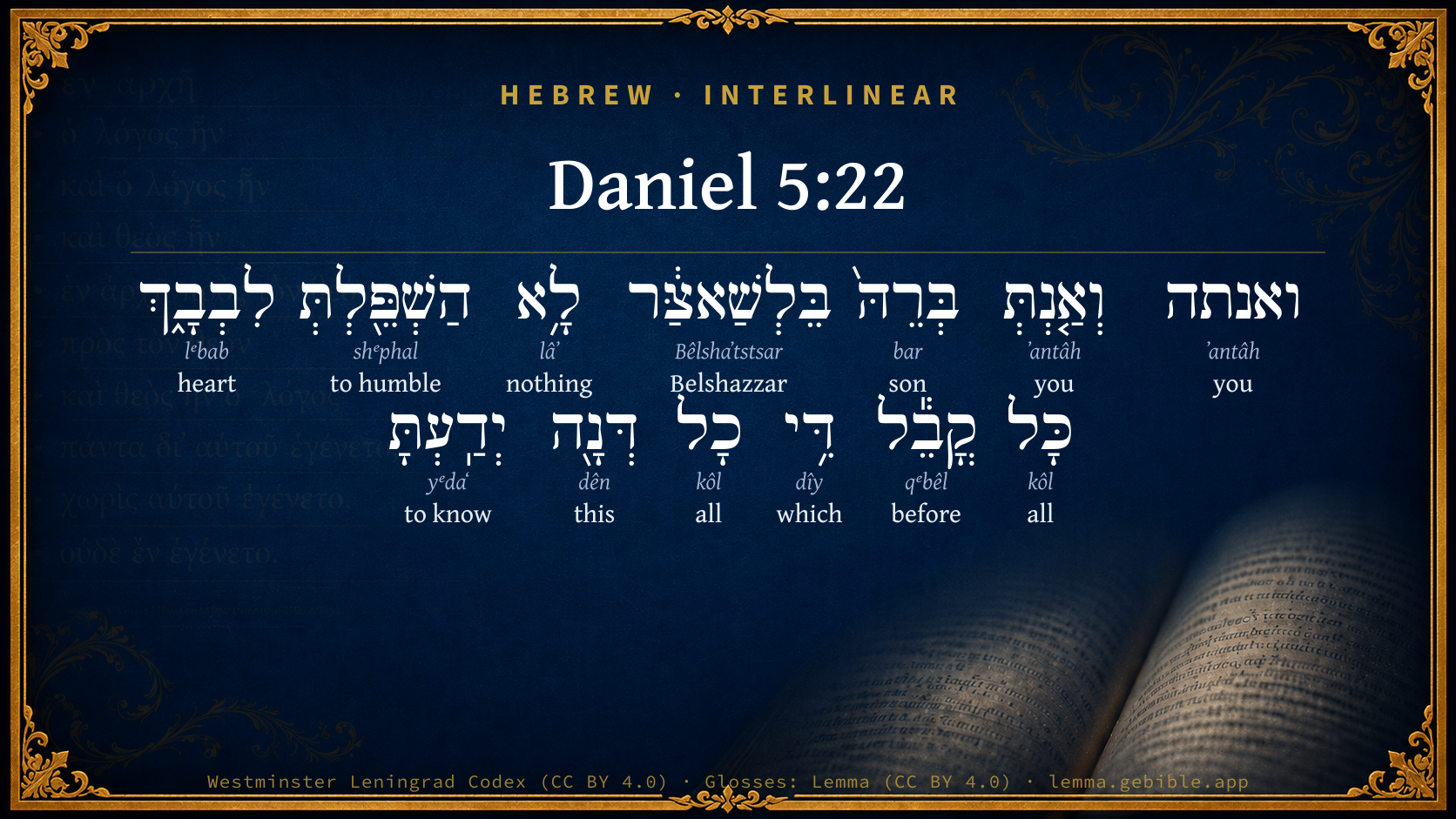
Hebrew (Westminster Leningrad Codex) Daniel 5:22 appears in the Hebrew Old Testament. The text above is from the Westminster Leningrad Codex. Each word links to its Strong’s number, a concise gloss, and parsing drawn from the Open Scriptures Hebrew Bible morphology. Click any word for its full Brown-Driver-Briggs (BDB) entry.
Download image
Cite this verse

Daniel 5:22 (World English Bible). Public Domain. Lemma interlinear Bible study tool, https://lemma.gebible.app/v/daniel/5/22.

Show BibTeX & RIS
BibTeX
RIS
English Translation
You his son, Belshazzar, have not humbled your heart, though you knew all this,
World English Bible · Public Domain
Download a study sheet

One document with this verse’s original text, its word-by-word gloss line, the meaning frame, cross-references with their text, attributed commentary, and full source and license credits — printable, and it pastes into notes with its structure intact.

This verse Autodidact and up

Study sheet (.html) Plain text (.txt)

A passage Seminary Student

Up to 50 verses in one chapter. A passage sheet keeps up to 6 commentary sources and 12 cross-references per verse, in the order this page ranks them, and says so on the sheet whenever that leaves anything out. Ask for a single verse and you get the Autodidact verse sheet above.

Everything on this page stays free to read, with no account — the sheet is a download of what is already on screen, not access to it.

Want to remove ads? Support Godless Engineer
Compare translations 3

The same verse in 3 English versions, stacked beneath the original-language interlinear above. Click any original word for its lexicon entry.

Each is an independent rendering of the whole verse — the interlinear is not word-aligned to these translations.

Highlighted words mark where these versions differ — a whole-verse word diff, not a word-by-word alignment.

  • World English Bible Public Domain
    You his son, Belshazzar, have not humbled your heart, though you knew all this,
  • King James Version Public Domain
    And thou his son, O Belshazzar, hast not humbled thine heart, though thou knewest all this;
  • unfoldingWord Literal Text CC BY-SA 4.0
    Yet you, his son, Belshazzar, have not humbled your heart, even though you knew all this.

unfoldingWord Literal Text — © unfoldingWord, licensed CC BY-SA 4.0. Word-aligned USFM3 via Door43 (git.door43.org/unfoldingWord/en_ult).

Versions to compare (up to 4)

3 of 4 selected

Show all 18 translations

Every available English version of this verse, each an independent rendering of the whole verse.

  • World English Bible Public Domain
    You his son, Belshazzar, have not humbled your heart, though you knew all this,
  • Berean Standard Bible Public Domain
    But you his son, O Belshazzar, have not humbled your heart, even though you knew all this.
  • Majority Standard Bible Public Domain
    But you his son, O Belshazzar, have not humbled your heart, even though you knew all this.
  • King James Version Public Domain
    And thou his son, O Belshazzar, hast not humbled thine heart, though thou knewest all this;
  • American Standard Version (1901) Public Domain
    And thou his son, O Belshazzar, hast not humbled thy heart, though thou knewest all this,
  • Revised Version (1885) Public Domain
    And thou his son, O Belshazzar, hast not humbled thine heart, though thou knewest all this;
  • Geneva Bible (1599) Public Domain
    And thou his sonne, O Belshazzar, hast not humbled thine heart, though thou knewest all these things,
  • Douay-Rheims (1899) Public Domain
    Thou also his son, O Baltasar, hast not humbled thy heart, whereas thou knewest all these things:
  • Young's Literal Translation Public Domain
    `And thou, his son, Belshazzar, hast not humbled thy heart, though all this thou hast known;
  • Literal Standard Version CC BY-SA 4.0
    And you, his son, Belshazzar, have not humbled your heart, though all this you have known;
  • Unlocked Literal Bible CC BY-SA 4.0
    You his son, Belshazzar, have not humbled your heart, even though you knew all this.
  • unfoldingWord Literal Text CC BY-SA 4.0
    Yet you, his son, Belshazzar, have not humbled your heart, even though you knew all this.
  • Darby Bible Public Domain
    And thou, Belshazzar, his son, hast not humbled thy heart, although thou knewest all this;
  • World Messianic Bible Public Domain
    “You, his son, Belshazzar, have not humbled your heart, though you knew all this,
  • Webster's Bible Public Domain
    And thou his son, O Belshazzar, hast not humbled thy heart, though thou knewest all this;
  • Free Bible Version CC BY-SA 4.0
    But you, Belshazzar, his son, have not humbled yourself, even though you knew all this.
  • Bible in Basic English Public Domain
    And you, his son, O Belshazzar, have not kept your heart free from pride, though you had knowledge of all this;
  • JPS Tanakh (1917) Public Domain
    And thou his son, O Belshazzar, hast not humbled thy heart, though thou knewest all this;

Literal Standard Version (2020), Covenant Press — licensed CC BY-SA 4.0. Text via the HelloAO Bible API (eBible.org). Unlocked Literal Bible (unfoldingWord) — licensed CC BY-SA 4.0. Text via the HelloAO Bible API (eBible.org). unfoldingWord Literal Text — © unfoldingWord, licensed CC BY-SA 4.0. Word-aligned USFM3 via Door43 (git.door43.org/unfoldingWord/en_ult). Free Bible Version, Dr. Jonathan Gallagher — licensed CC BY-SA 4.0. Text via the HelloAO Bible API (eBible.org).

Word by word

More ways to search: Search by grammar → Find every occurrence → Compare this word →

Practice this passage: Drill this verse → Learn its vocabulary →

About this verse

These counts appear in no published source. They are computed here, from the morphology-tagged text and Lemma’s own curated glosses. What Lemma adds →

13
words
11
distinct lemmas
Prophets
section

Notable vocabulary

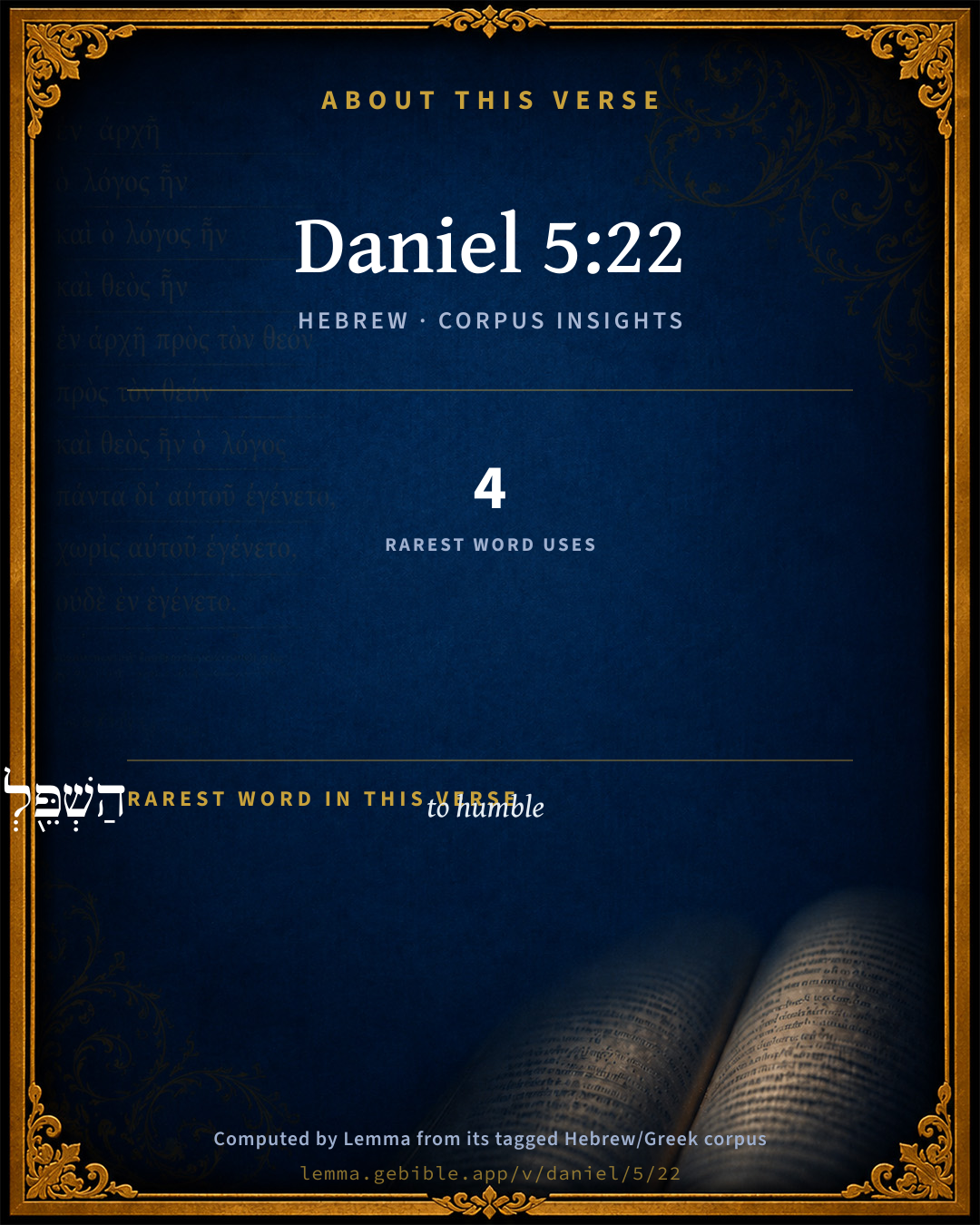
The rarest word here is הַשְׁפֵּ֖לְתְּ to humble H8214 — appearing just 4 times in the whole Hebrew Bible.

Shared distinctive vocabulary

הַשְׁפֵּ֖לְתְּ to humble H8214 occurs in 4 verses of the Hebrew Bible. Also found in:

Grammatical profile

  • 10 adjectives
  • 2 pronouns
  • 1 conjunction

Repetition

Words recur within this verse — often emphatic in Hebrew:

  • כָּל all H3606 ×2
  • ואנתה you H607 ×2

Hebrew & Septuagint length

In English translation the verse runs 14 words from the Hebrew and 19 from the Septuagint (LXX English) — closely comparable.

A rough comparison of the two English renderings, which tokenize alike — not a word-level alignment.

Word counts can differ between the Hebrew and the Greek without any difference in meaning — e.g. the Hebrew direct-object marker אֵת has no separate Greek word, and Greek often adds the article ὁ.

Cross-references

15

Topical passages linked to Daniel 5:22 in the Treasury of Scripture Knowledge — connected by theme and wording, ordered by reader-vote popularity; previews shown in the World English Bible.

  • Exodus 10:3 Moses and Aaron went in to Pharaoh, and said to him, "This is what Yahweh, the God of the Hebrews, says: 'How long will you refuse to humble yourself before me? Let my people go, that they may serve me.
  • 2 Chronicles 33:23 He didn't humble himself before Yahweh, as Manasseh his father had humbled himself; but this same Amon trespassed more and more.
  • 2 Chronicles 36:12 and he did that which was evil in the sight of Yahweh his God; he didn't humble himself before Jeremiah the prophet [speaking] from the mouth of Yahweh.
  • James 4:17 To him therefore who knows to do good, and doesn't do it, to him it is sin.
  • James 4:6 But he gives more grace. Therefore it says, "God resists the proud, but gives grace to the humble."
  • 1 Peter 5:5–6 Likewise, you younger ones, be subject to the elder. Yes, all of you gird yourselves with humility, to subject yourselves to one another; for "God resists the proud, but gives grace to the humble."
  • Psalms 119:46 I will also speak of your statutes before kings, And will not be disappointed.
  • Isaiah 26:10 Let favor be shown to the wicked, yet will he not learn righteousness; in the land of uprightness will he deal wrongfully, and will not see the majesty of Yahweh.
  • Daniel 5:18 You king, the Most High God gave Nebuchadnezzar your father the kingdom, and greatness, and glory, and majesty:
  • Matthew 14:4 For John said to him, "It is not lawful for you to have her."
  • Matthew 21:32 For John came to you in the way of righteousness, and you didn't believe him, but the tax collectors and the prostitutes believed him. When you saw it, you didn't even repent afterward, that you might believe him.
  • Luke 12:47 That servant, who knew his lord's will, and didn't prepare, nor do what he wanted, will be beaten with many stripes,
  • John 13:17 If you know these things, blessed are you if you do them.
  • Acts 4:8–13 Then Peter, filled with the Holy Spirit, said to them, "You rulers of the people, and elders of Israel,
  • Acts 5:29–33 But Peter and the apostles answered, "We must obey God rather than men.

Cross-references courtesy of OpenBible.info (CC BY 4.0).

Hebrew and Greek witnesses Masoretic Hebrew ↔ Greek Septuagint

The same verse in the two great witnesses to the Old Testament, shown verse-for-verse.

These are two independent witnesses, not word-aligned to each other, and the Septuagint is shown in lemma (dictionary) form.

Hebrew Daniel 5:22 Masoretic · Westminster Leningrad Codex

ואנתה וְאַ֤נְתְּ בְּרֵהּ֙ בֵּלְשַׁאצַּ֔ר לָ֥א הַשְׁפֵּ֖לְתְּ לִבְבָ֑ךְ כָּל קֳבֵ֕ל דִּ֥י כָל דְּנָ֖ה יְדַֽעְתָּ

You his son, Belshazzar, have not humbled your heart, though you knew all this,

World English Bible · Public Domain

Greek LXX Daniel 5:22 Septuagint · lemma form
And you accordingly, his son, O Baltasar, has not humbled your heart before God: know you not all this?

LXX2012 (modern English Septuagint) · Public Domain

Hebrew: Westminster Leningrad Codex (CC BY 4.0). Greek: Septuagint (public domain); English from LXX2012 (modern English Septuagint) (Public Domain). How the Septuagint differs from the Hebrew →

Commentary

Notes on Daniel 5:22 from classic Christian and Jewish commentators (each source and its license shown beneath its notes). The classic Christian expositions comment on the surrounding passage and are grouped to its opening verse, so a note may address several verses; the Jewish commentaries on the Tanakh (Rashi and others) are per-verse, so they appear only where the commentator wrote on this verse.

Lemma curates 59 commentaries, every one of them public domain or Creative Commons licensed, each selected and text-cleaned for this edition rather than reprinted as found. About our sources →

Trapp's Complete Commentary

John Trapp

Dan 5:22 And thou his son, O Belshazzar, hast not humbled thine heart, though thou knewest all this;

Ver. 22. And thou his son, O Belshazzar, hast not humbled thy heart.] It was no small aggravation of his sins not to be warned, and now he shall hear of it on both ears. The putting out of the French king’s eyes, which promised before with his eyes to see one of God’s true servants burned, who seeth not to be the stroke of God’s hand? Then his son Francis, not regarding his father’s stripe, would needs yet proceed in burning the same man. And did not the same God give him such a blow on the ear that it cost him his life? {a}

{a} Acts and Mon., fol. 1914.

John Trapp, A Commentary or Exposition upon All the Books of the Old and New Testament (1647–1656) — public domain. Text from a community e-Sword module.

The Biblical Illustrator

Joseph S. Exell

Dan_5:22-23

Hast not humbled thine heart, though thou knewest all this.

The Prophets Indictment

It included three counts.

1. The teaching of God had been disregarded. The sovereignty of Nebuchadnezzar had been from God. That dependence had been forgotten, and so pride had been chastened by insanity.

2. God had been insulted. A poor worm had dared to exalt itself against him. In the midst of a scene of which many a heathen would have been ashamed, the consecrated vessels of His house had been used to drink to other gods, which see not, nor hear, nor know.

3. The glory of God had not been sought. It was not in Belshazzars power, indeed, to add anything to the essential glory of God, but it was for him to reflect that glory. He could add nothing to Gods ineffable brightness, but he could catch light from Heaven, and diffuse it. He could be such a man, and live such a life, that others might have their ideas of God exalted, and be constrained to confess that He whose name is Jehovah is the Most High over all the earth. (H. T. RobJohns, B.A.)

The Biblical Illustrator, edited by Joseph S. Exell (c. 1880s–1900s) — public domain. Text from a community e-Sword module.

Jamieson, Fausset & Brown

Robert Jamieson, A. R. Fausset & David Brown

Thou hast erred not through ignorance, but through deliberate contempt of God, notwithstanding that thou hadst before thine eyes the striking warning given in thy grandfather's case.

Jamieson, Fausset & Brown — Commentary Critical and Explanatory on the Whole Bible (1871) — public domain (CC PDM 1.0). Text via the HelloAO Bible API.

Adam Clarke's Commentary

Verse 22. Hast not humbled thine heart] These judgments and mercies have had no good effect upon thee.

Adam Clarke's Commentary on the Bible (1810–1826) — public domain. Text from a community e-Sword/MySword module.

John Calvin's Commentaries

Daniel here shews why he, related what we have hitherto heard concerning King Nebuchadnezzar’s punishment; for Belshazzar ought to have been so affected by that domestic example, as to submit himself to God. We may believe, indeed, that his father Evil-Merodach had forgotten his punishments, since he would not have conducted himself so petulantly against God, nor trampled on true and sincere piety; for God spared the wretched tyrant who restrained himself within the bounds of moderation. But as to his grandfather Belshazzar, he was altogether intolerable; hence God stretched forth his hand. The Prophet now teaches this. Thou art his son, says he. This circumstance urges upon him with greater force the duty of not seeking an example in foreign nations, since he acknowledged himself to have sufficient at home of what was both necessary and useful. He enlarges upon his crime in another way, by saying, Yet thou didst know this Men are accustomed to shield themselves under their ignorance with the view of extenuating the guilt of their crimes, but those who sin knowingly and willfully are without the slightest excuse. The Prophet therefore convinces the king of manifest obstinacy; as if he had said, You have provoked God’s anger on purpose; since he ought to have been aware of the horrible judgment awaiting all the proud, when he had such a remarkable and singular proof of it in his grandfather, which he ought to have kept constantly before his eyes. It follows, —

John Calvin's Commentaries (1540-1563) — public domain. Text from the Calvin Translation Society English edition (1840s-50s) via the Christian Classics Ethereal Library (ccel.org). Calvin's coverage is partial (roughly two-thirds of the Bible); uncommented books and verses are honest gaps, never fabricated. The 19th-century editor's footnotes and remarks are omitted so the notes are faithfully Calvin's own voice.

Ellicott's Commentary for English Readers

(22) Though thou knewest.—The whole history of Nebuchadnezzar was known to Belshazzar. He had not, however, learned the moral lesson conveyed by it. He was therefore doubly guilty in the sight of God, because his blasphemy was wilful.

A Bible Commentary for English Readers, edited by Charles John Ellicott (1878–1897) — public domain. Text from a community e-Sword module.

The Cambridge Bible for Schools and Colleges

gen. ed. J. J. S. Perowne

22–23. But Belshazzar, in spite of the warning afforded by Nebuchadnezzar’s fate, has sinned still more deeply, and by wanton sacrilege has deliberately defied the God of heaven.

The Cambridge Bible for Schools and Colleges (gen. ed. J. J. S. Perowne; Cambridge University Press, 1878–1918) — public domain. Text from a community e-Sword module.

John Gill's Exposition

And thou his son, O Belshazzar,.... His grandson; See Gill on Dan 5:1,

hast not humbled thine heart; so as to acknowledge the most high God, and his dependence on him; to own him as his Sovereign, by whom he held his crown and kingdom, and to whom he was accountable; but, on the contrary, lifted up his heart in pride and haughtiness against him:

though thou knewest all this; either by the relation of others, his father and mother, and others; or being an eyewitness of it himself; wherefore his sin was the more aggravated, since he had had an example before him of pride being humbled in a very awful manner, and yet took no warning by it.

John Gill's Exposition of the Whole Bible (1746–1763) — public domain (CC PDM 1.0). Text via the HelloAO Bible API.

Albert Barnes' Notes on the Bible

And thou his son, O Belshazzar, hast not humbled thine heart ... - As thou shouldst have done in remembrance of these events. The idea is, that we ought to derive valuable lessons from what has taken place in past times; that, from the events which have occurred in history, we should learn what God approves and what he disapproves; that we should avoid the course which has subjected others to his displeasure, and which has brought his judgments upon them. The course, however, which Belshazzar pursued has been that of kings and princes commonly in the world, and indeed of mankind at large. How little do men profit by the record of the calamities which have come upon others for their crimes! How little are the intemperate of one generation admonished by the calamities which have come upon those of another; how little are the devotees of pleasure; how little are those in places of power!

Albert Barnes' Notes on the Bible (1834–1885) — public domain. Text from a community e-Sword/MySword module.

Matthew Poole's English Annotations

Sins against knowledge, experience, and example have the highest aggravation. Thy father was punished for his pride most dreadfully, and thou knewest it, and behold thou art worse than he. God punisheth others for example and warning to us, that we may hear and fear, and do no more wickedly; but thou, O king Belshazzar, art more wicked than thy father; he was restored, but thou art utterly destroyed. And now he goes on to tell for what.

Matthew Poole's English Annotations on the Holy Bible (1683–1685) — public domain. Text from a community e-Sword/MySword module.

unfoldingWord translationNotes

Door43 World Missions Community

Belshazzar

This is the son of Nebuchadnezzar who became king after his father. See how you wrote this name in Daniel 5:1. (See: How to Translate Names)

have not humbled your heart

Here "heart" refers to Belshazzar himself. AT: "have not humbled yourself" (See: Synecdoche)

You have lifted yourself up against the Lord

To rebel against God is spoken of as raising oneself up against him. AT: "You have rebelled against the Lord" (See: Metaphor)

From his house

What and where "his house" is can be stated clearly. AT: "From his temple in Jerusalem" (See: Assumed Knowledge and Implicit Information)

God who holds your breath in his hand

Here "breath" refers to life and "hand" refers to power or control. AT: "God who gives you breath" or "God who has control over your entire life" (See: Metonymy)

all your ways

"everything you do"

this writing was done

This can be stated in active form. AT: "it wrote this message" (See: Active or Passive)

translationWords

heart

lord

heaven

noble

concubine

wine

false god

silver

gold

honor

breath

hand

unfoldingWord translationNotes — © Distant Shores Media and the Door43 World Missions Community, licensed CC BY-SA 4.0. Source: git.door43.org/Door43/en_tn.

Rashi

Rabbi Shlomo Yitzchaki (Rashi)

in view of the fact that you know all this in view of the fact that you know all this that befell your father, and you should have feared the Holy One, blessed be He.

Rashi on the Tanakh — English translations: “The Judaica Press complete Tanach with Rashi, translated by A. J. Rosenberg” (CC BY 4.0); “Pentateuch with Rashi's commentary by M. Rosenbaum and A.M. Silbermann, 1929-1934” (public domain); “The Metsudah Tanach series, Lakewood, N.J” (CC BY 4.0); and “The Book of Joshua, Metsudah Publications, 1997” (CC BY 4.0). Text via Sefaria.

Lesson kit

Teaching starters — assembled from the data on this page, not authored interpretation. Every prompt links to the verse data it draws on. Edit before teaching.

Daniel, in the Prophets, opens this verse with 13 words (11 distinct Hebrew lemmas). Its most distinctive word is shᵉphal (“to humble”). A historical commentator’s framing appears above. Read the whole chapter for the surrounding context.

Discussion questions

  1. What does “to humble” (shᵉphal) contribute to the verse as a whole?
  2. Daniel 4:37 shares the word «to humble» with this verse. How do the two illuminate each other?
  3. “all” occurs 2× in this one verse. What is the effect of the repetition?
  4. These translations render this verse differently. What is at stake in choosing one wording over another?
  5. Reading how Trapp's Complete Commentary and The Biblical Illustrator read this verse, where do the two commentators agree and where do they part?

Things to notice

Reading settings

Reading text

Shown beneath each verse's original-language words.

Old Testament
Old Testament edition

Read the OT as the Masoretic Hebrew (MT) or the Greek Septuagint (LXX).

English shown for the Greek Septuagint (in the Hebrew ↔ Greek comparison).

Comparing translations? Open the Compare panel on any verse page to stack up to four side by side.