Daniel 3:8

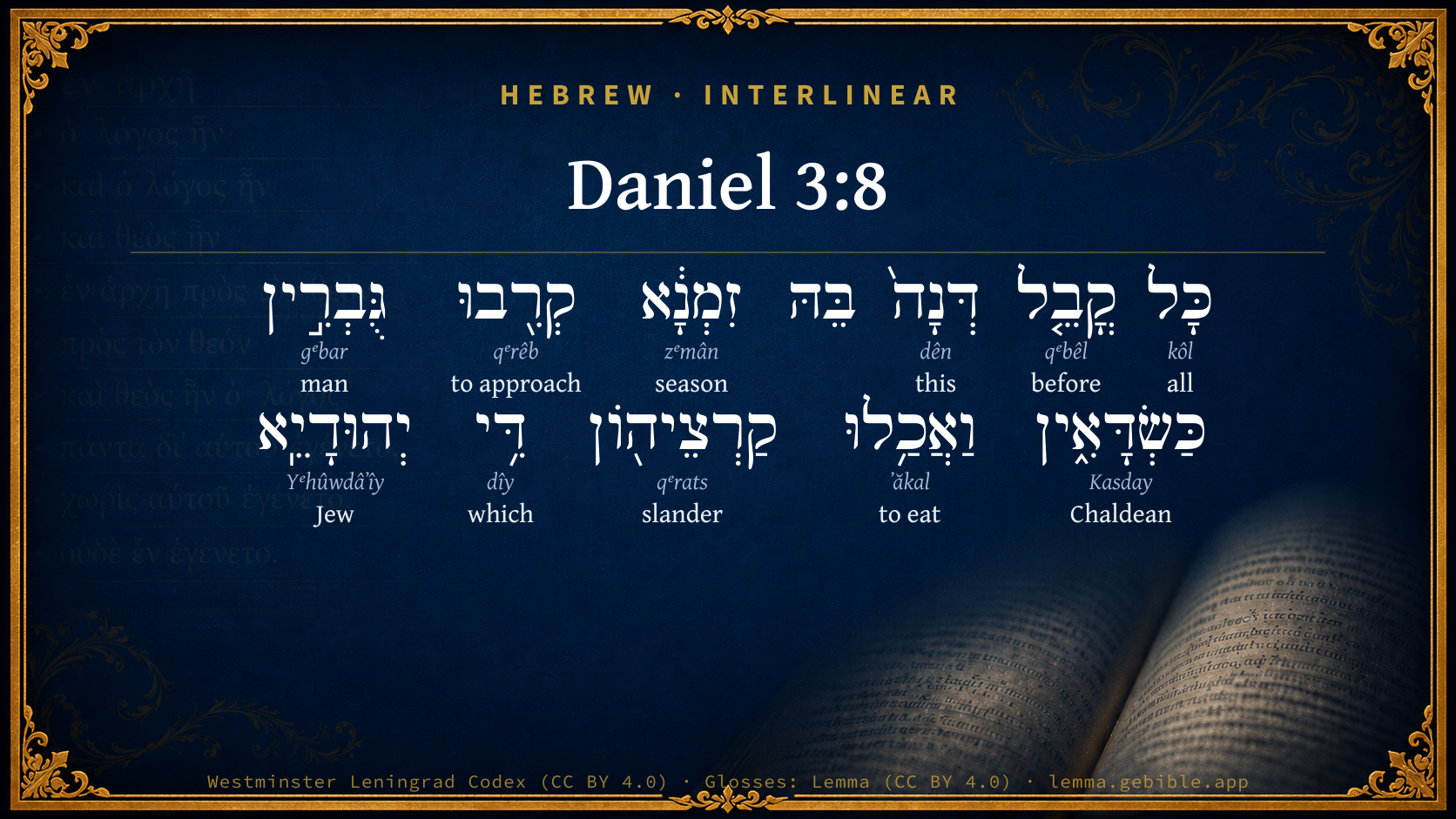
Hebrew (Westminster Leningrad Codex) Daniel 3:8 appears in the Hebrew Old Testament. The text above is from the Westminster Leningrad Codex. Each word links to its Strong’s number, a concise gloss, and parsing drawn from the Open Scriptures Hebrew Bible morphology. Click any word for its full Brown-Driver-Briggs (BDB) entry.
Download image
Cite this verse

Daniel 3:8 (World English Bible). Public Domain. Lemma interlinear Bible study tool, https://lemma.gebible.app/v/daniel/3/8.

Show BibTeX & RIS
BibTeX
RIS
English Translation
Therefore at that time certain Chaldeans came near, and brought accusation against the Jews.
World English Bible · Public Domain
Highlights
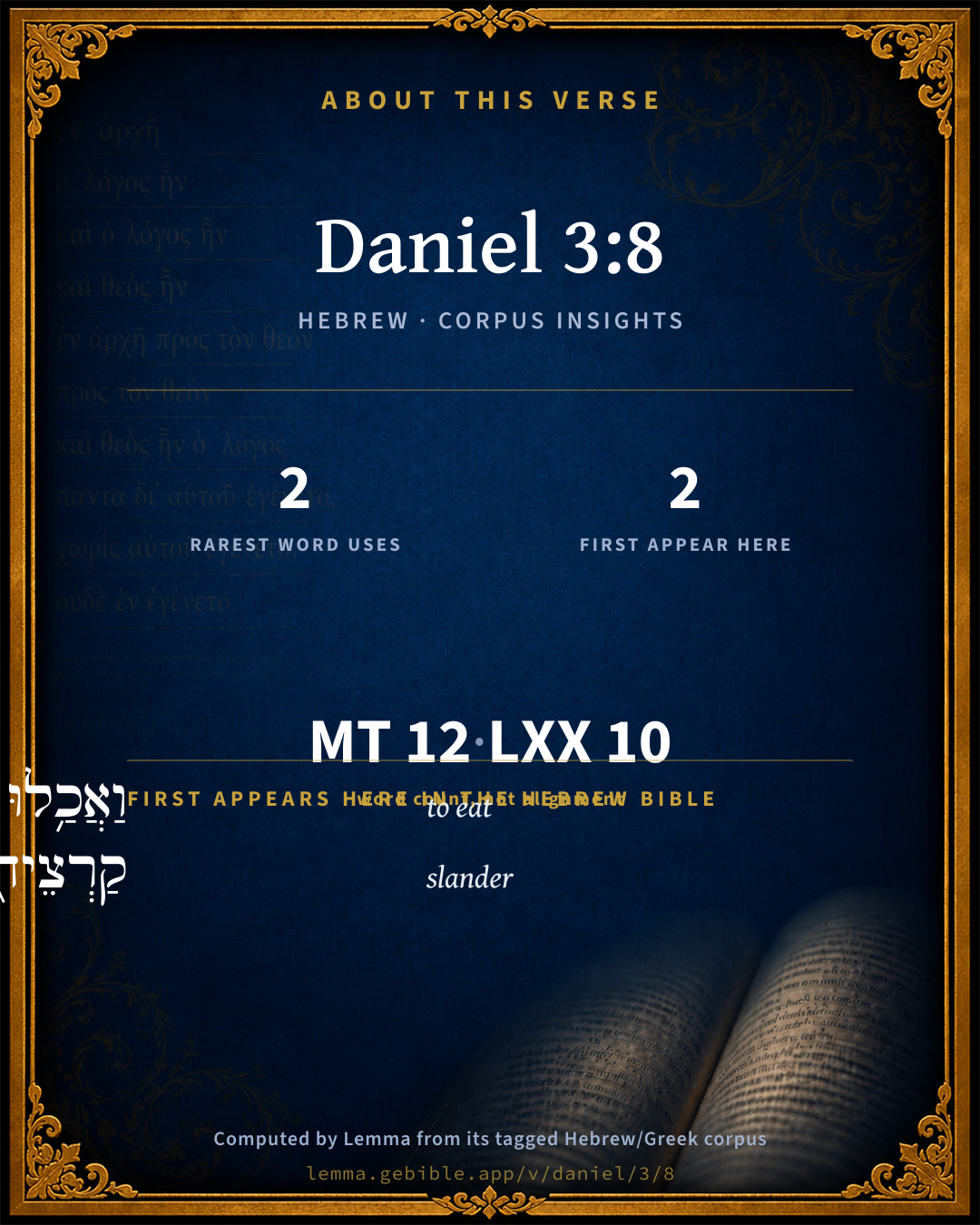
  • 2 first appearances in the Hebrew Bible
Full analysis ↓
Download a study sheet

One document with this verse’s original text, its word-by-word gloss line, the meaning frame, cross-references with their text, attributed commentary, and full source and license credits — printable, and it pastes into notes with its structure intact.

This verse Autodidact and up

Study sheet (.html) Plain text (.txt)

A passage Seminary Student

Up to 50 verses in one chapter. A passage sheet keeps up to 6 commentary sources and 12 cross-references per verse, in the order this page ranks them, and says so on the sheet whenever that leaves anything out. Ask for a single verse and you get the Autodidact verse sheet above.

Everything on this page stays free to read, with no account — the sheet is a download of what is already on screen, not access to it.

Want to remove ads? Support Godless Engineer
Compare translations 3

The same verse in 3 English versions, stacked beneath the original-language interlinear above. Click any original word for its lexicon entry.

Each is an independent rendering of the whole verse — the interlinear is not word-aligned to these translations.

Highlighted words mark where these versions differ — a whole-verse word diff, not a word-by-word alignment.

  • World English Bible Public Domain
    Therefore at that time certain Chaldeans came near, and brought accusation against the Jews.
  • King James Version Public Domain
    Wherefore at that time certain Chaldeans came near, and accused the Jews.
  • unfoldingWord Literal Text CC BY-SA 4.0
    Therefore at this time certain Chaldeans came forward and brought malicious accusations against the Jews.

unfoldingWord Literal Text — © unfoldingWord, licensed CC BY-SA 4.0. Word-aligned USFM3 via Door43 (git.door43.org/unfoldingWord/en_ult).

Versions to compare (up to 4)

3 of 4 selected

Show all 18 translations

Every available English version of this verse, each an independent rendering of the whole verse.

  • World English Bible Public Domain
    Therefore at that time certain Chaldeans came near, and brought accusation against the Jews.
  • Berean Standard Bible Public Domain
    At this time some astrologers came forward and maliciously accused the Jews,
  • Majority Standard Bible Public Domain
    At this time some astrologers came forward and maliciously accused the Jews,
  • King James Version Public Domain
    Wherefore at that time certain Chaldeans came near, and accused the Jews.
  • American Standard Version (1901) Public Domain
    Wherefore at that time certain Chaldeans came near, and brought accusation against the Jews.
  • Revised Version (1885) Public Domain
    Wherefore at that time certain Chaldeans came near, and brought accusation against the Jews.
  • Geneva Bible (1599) Public Domain
    By reason whereof at that same time came men of the Caldeans, and grieuously accused the Iewes.
  • Douay-Rheims (1899) Public Domain
    And presently at that very time some Chaldeans came and accused the Jews,
  • Young's Literal Translation Public Domain
    Therefore at that time drawn near have certain Chaldeans, and accused the Jews;
  • Literal Standard Version CC BY-SA 4.0
    Therefore at that time certain Chaldeans have drawn near, and accused the Jews;
  • Unlocked Literal Bible CC BY-SA 4.0
    Now at this time certain Chaldeans came and brought accusations against the Jews.
  • unfoldingWord Literal Text CC BY-SA 4.0
    Therefore at this time certain Chaldeans came forward and brought malicious accusations against the Jews.
  • Darby Bible Public Domain
    Whereupon at that time certain Chaldeans came near, and accused the Jews.
  • World Messianic Bible Public Domain
    Therefore at that time certain Kasdim came near and brought accusation against the Jews.
  • Webster's Bible Public Domain
    Wherefore at that time certain Chaldeans came near, and accused the Jews.
  • Free Bible Version CC BY-SA 4.0
    Right then some of the astrologers came forward and made accusations against the Jews.
  • Bible in Basic English Public Domain
    At that time certain Chaldaeans came near and made a statement against the Jews.
  • JPS Tanakh (1917) Public Domain
    Wherefore at that time certain Chaldeans came near, and brought accusation against the Jews.

Literal Standard Version (2020), Covenant Press — licensed CC BY-SA 4.0. Text via the HelloAO Bible API (eBible.org). Unlocked Literal Bible (unfoldingWord) — licensed CC BY-SA 4.0. Text via the HelloAO Bible API (eBible.org). unfoldingWord Literal Text — © unfoldingWord, licensed CC BY-SA 4.0. Word-aligned USFM3 via Door43 (git.door43.org/unfoldingWord/en_ult). Free Bible Version, Dr. Jonathan Gallagher — licensed CC BY-SA 4.0. Text via the HelloAO Bible API (eBible.org).

Word by word

More ways to search: Search by grammar → Find every occurrence → Compare this word →

Practice this passage: Drill this verse → Learn its vocabulary →

קַרְצֵיה֖וֹן
qᵉrats
H7170
“slander · their”
Adjective, N, Common + Suffix, Personal, 3rd Person, Masculine, Plural
Part of Speech
Adjective
Gender
Common
Full BDB Definition

Origin: corresponding to H7171 in the sense of a bit (to "eat the morsels of" any one, i.e. chew him up [fig] by slander)

TWOT: 2981

piece - denounce, slander, accuse maliciously, chew on (idiom)
  1. כָּל kôl H3606 “all” Adjective, C + Conjunction
  2. קֳבֵ֤ל qᵉbêl H6903 “before” Adjective, C
  3. דְּנָה֙ dên H1836 “this” Adjective, C
  4. זִמְנָ֔א zᵉmân H2166 “season · the” Adjective, N, Common + Particle, Definite Article
  5. קְרִ֖בוּ qᵉrêb H7127 “to approach” Adjective, V, Plural
  6. גֻּבְרִ֣ין gᵉbar H1400 “men” Adjective, N, Common
  7. כַּשְׂדָּאִ֑ין Kasday H3779 “Chaldeans” Adjective, N
  8. וַאֲכַ֥לוּ ʼăkal H399 “and · to eat” Adjective, C + Verb, Qal, Perfect, 3rd Person, Masculine, Plural
  9. דִּ֥י dîy H1768 “which” Adjective, T
  10. יְהוּדָיֵֽא Yᵉhûwdâʼîy H3062 “Jews · the” Adjective, N + Particle, Definite Article

About this verse

These counts appear in no published source. They are computed here, from the morphology-tagged text and Lemma’s own curated glosses. What Lemma adds →

12
words
11
distinct lemmas
Prophets
section

Notable vocabulary

The rarest word here is קַרְצֵיה֖וֹן slander H7170 — appearing just 2 times in the whole Hebrew Bible.

First appearance in Scripture

These words make their first canonical appearance in the Hebrew Bible here:

  • וַאֲכַ֥לוּ to eat H399
  • קַרְצֵיה֖וֹן slander H7170

Shared distinctive vocabulary

קַרְצֵיה֖וֹן slander H7170 occurs in 2 verses of the Hebrew Bible. Also found in:

Grammatical profile

  • 1 verb
  • 8 adjectives
  • 1 conjunction
  • 2 particles

Verb forms

  • וַאֲכַ֥לוּ Qal · Perfect

Hebrew & Septuagint length

In English translation the verse runs 14 words from the Hebrew and 13 from the Septuagint (LXX English) — closely comparable.

A rough comparison of the two English renderings, which tokenize alike — not a word-level alignment.

Word counts can differ between the Hebrew and the Greek without any difference in meaning — e.g. the Hebrew direct-object marker אֵת has no separate Greek word, and Greek often adds the article ὁ.

In the original languages it is 12 Hebrew tokens and 10 Greek tokens — but the two are counted differently (Hebrew bundles its prefixes and suffixes into one token; the Greek is in lemma form), so that isn’t a like-for-like length.

Cross-references

9

Topical passages linked to Daniel 3:8 in the Treasury of Scripture Knowledge — connected by theme and wording, ordered by reader-vote popularity; previews shown in the World English Bible.

  • Ezra 4:12–16 Be it known to the king, that the Jews who came up from you are come to us to Jerusalem; they are building the rebellious and the bad city, and have finished the walls, and repaired the foundations.
  • Esther 3:8–9 Haman said to king Ahasuerus, There is a certain people scattered abroad and dispersed among the peoples in all the provinces of your kingdom; and their laws are diverse from [those of] every people; neither keep they the king's laws: therefore it is not for the king's profit to allow them.
  • Daniel 6:12–13 Then they came near, and spoke before the king concerning the king's interdict: Haven't you signed an interdict, that every man who shall make petition to any god or man within thirty days, save to you, O king, shall be cast into the den of lions? The king answered, The thing is true, according to the law of the Medes and Persians, which doesn't alter.
  • Esther 3:6 But he scorned the thought of laying hands on Mordecai alone; for they had made known to him the people of Mordecai: therefore Haman sought to destroy all the Jews who were throughout the whole kingdom of Ahasuerus, even the people of Mordecai.
  • Daniel 2:10 The Chaldeans answered before the king, and said, There is not a man on the earth who can show the king's matter, because no king, lord, or ruler, has asked such a thing of any magician, or enchanter, or Chaldean.
  • Acts 16:20–22 When they had brought them to the magistrates, they said, "These men, being Jews, are agitating our city,
  • Acts 17:6–8 When they didn't find them, they dragged Jason and certain brothers before the rulers of the city, crying, "These who have turned the world upside down have come here also,
  • Acts 28:22 But we desire to hear from you what you think. For, as concerning this sect, it is known to us that everywhere it is spoken against."
  • 1 Peter 4:3–4 For we have spent enough of our past time doing the desire of the Gentiles, and having walked in lewdness, lusts, drunken binges, orgies, carousings, and abominable idolatries.

Cross-references courtesy of OpenBible.info (CC BY 4.0).

Hebrew and Greek witnesses Masoretic Hebrew ↔ Greek Septuagint

The same verse in the two great witnesses to the Old Testament, shown verse-for-verse.

These are two independent witnesses, not word-aligned to each other, and the Septuagint is shown in lemma (dictionary) form.

Hebrew Daniel 3:8 Masoretic · Westminster Leningrad Codex

כָּל קֳבֵ֤ל דְּנָה֙ בֵּהּ זִמְנָ֔א קְרִ֖בוּ גֻּבְרִ֣ין כַּשְׂדָּאִ֑ין וַאֲכַ֥לוּ קַרְצֵיה֖וֹן דִּ֥י יְהוּדָיֵֽא

Therefore at that time certain Chaldeans came near, and brought accusation against the Jews.

World English Bible · Public Domain

Greek LXX Daniel 3:8 Septuagint · lemma form

ἐν ἐκεῖνος ὁ καιρός προςἔρχομαι ἀνήρ χαλδαῖος διαβάλλω ὁ ἰουδαῖος

Then came near certain Chaldeans, and accused the Jews to the king, saying,

LXX2012 (modern English Septuagint) · Public Domain

On this verse, The Preacher's Complete Homiletical Commentary discusses the Septuagint’s reading. Read the note in Commentary ↓

Hebrew: Westminster Leningrad Codex (CC BY 4.0). Greek: Septuagint (public domain); English from LXX2012 (modern English Septuagint) (Public Domain). How the Septuagint differs from the Hebrew →

Commentary

Notes on Daniel 3:8 from classic Christian and Jewish commentators (each source and its license shown beneath its notes). The classic Christian expositions comment on the surrounding passage and are grouped to its opening verse, so a note may address several verses; the Jewish commentaries on the Tanakh (Rashi and others) are per-verse, so they appear only where the commentator wrote on this verse.

Lemma curates 59 commentaries, every one of them public domain or Creative Commons licensed, each selected and text-cleaned for this edition rather than reprinted as found. About our sources →

Matthew Henry's Commentary

It was strange that Shadrach, Meshach, and Abednego, would be present at this assembly, when, it is likely, they knew for what intent it was called together. Daniel, we may suppose, was absent, either his business calling him away or having leave from the king to withdraw, unless we suppose that he stood so high in the king's favour that none durst complain of him for his noncompliance. But why did not his companions keep out of the way? Surely because they would obey the king's orders as far as they could, and would be ready to bear a public testimony against this gross idolatry. They did not think it enough not to bow down to the image, but, being in office, thought themselves obliged to stand up against it, though it was the image which the king their master set up, and would be a golden image to those that worshipped it. Now,

I. Information is brought to the king by certain Chaldeans against these three gentlemen that they did not obey the king's edict, Dan 3:8. Perhaps these Chaldeans that accused them were some of those magicians or astrologers that were particularly called Chaldeans (Dan 2:2, Dan 2:4) who bore a grudge to Daniel's companions for his sake, because he had eclipsed them, and so had these companions. They by their prayers had obtained the mercy which saved the lives of these Chaldeans, and, behold, how they requite them evil for good! for their love they are their adversaries. Thus Jeremiah stood before God, to speak good for those who afterwards dug a pit for his life, Jer 18:20. We must not think it strange if we meet with such ungrateful men. Or perhaps they were such of the Chaldeans as expected the places to which they were advanced, and envied them their preferments; and who can stand before envy ? They appeal to the king himself concerning the edict, with all due respect to his majesty, and the usual compliment, O king! live forever (as if they aimed at nothing but his honour, and to serve his interest, when really they were putting him upon that which would endanger the ruin of him and his kingdom); they beg leave, 1. To put him in mind of the law he had lately made, That all manner of persons, without exception of nation or language, should fall down and worship this golden image; they put him in mind also of the penalty which by the law was to be inflicted upon recusants, that they were to be cast into the midst of the burning fiery furnace, Dan 3:10, Dan 3:11. It cannot be denied but that this was the law; whether a righteous law or no ought to be considered. 2. To inform him that these three men, Shadrach, Meshach, and Abednego, had not conformed to this edict, Dan 3:12. It is probable that Nebuchadnezzar had no particular design to ensnare them in making the law, for then he would himself have had his eye upon them, and would not have needed this information; but their enemies, that sought an occasion against them, laid hold on this, and were forward to accuse them. To aggravate the matter, and incense the king the more against them, (1.) They put him in mind of the dignity to which the criminals had been preferred. Though they were Jews, foreigners, captives, men of a despised nation and religion, yet the king had set them over the affairs of the province of Babylon. It was therefore very ungrateful, and an insufferable piece of insolence, for them to disobey the king's command, when they had shared so much of the king's favour. And, besides, the high station they were in would make their refusal the more scandalous; it would be a bad example, and have a bad influence upon others; and therefore it was necessary that it should be severely animadverted upon. Thus princes that are incensed enough against innocent people commonly have but too many about them who do all they can to make them worse. (2.) They suggest that it was done maliciously, contumaciously, and in contempt of him and his authority: "They have set no regard upon thee; for they serve not the gods which thou servest, and which thou requirest them to serve, nor worship the golden image which thou hast set up."

II. These three pious Jews are immediately brought before the king, and arraigned and examined upon this information. Nebuchadnezzar fell into a great passion, and in his rage and fury commanded them to be seized, Dan 3:13. How little was it the honour of this mighty prince that he had rule over so many nations when at the same time he had no rule over his own spirit, that there were so many who were subjects and captives to him when he was himself a perfect slave to his own brutish passions and led captive by them! How unfit was he to rule reasonable men who could not himself be ruled by reason! It needed not be a surprise to him to hear that these three men did not now serve his gods, for he knew very well they never had served them, and that their religion, which they had always adhered to, forbade them to do it. Nor had he any reason to think that they designed any contempt of his authority, for they had in all instances shown themselves respectful and dutiful to him as their prince. But it was especially unseasonable at this time, when he was in the midst of his devotions, dedicating his golden image, to be in such a rage and fury, and so much to discompose himself. The discretion of a man, one would think, should at least have deferred this anger. True devotion calms the spirit, quiets and meekens it; but superstition, and a devotion to false gods, inflame men's passions, inspire them with rage, and fury, and turn them into brutes. The wrath of a king is as the roaring of a lion; so was the wrath of this king; and yet, when he was in such a heat, these three men were brought before him, and appeared with an undaunted courage, and unshaken constancy.

III. The case is laid before them in short, and it is put to them whether they will comply or no. 1. The king asked them whether it was true that they had not worshipped the golden image when others did, Dan 3:14. "Is it of purpose?" so some read it. "Was it designedly and deliberately done, or was it only through inadvertency, that you have not served my gods? What! you that I have nourished and brought up, that have been educated and maintained at my charge, that I have been so kind to and done so much for, you that have been in such reputation for wisdom, and therefore should better have known your duty to your prince; what! do not you serve my gods nor worship the golden image which I have set up?" Note, The faithfulness of God's servants to him has often been the wonder of their enemies and persecutors, who think it strange that they run not with them to the same excess of riot. 2. He was willing to admit them to a new trial; if they did on purpose not do it before, yet, it may be, upon second thoughts, they will change their minds; it is therefore repeated to them upon what terms they now stand, Dan 3:15. (1.) The king is willing that music shall play again, only for their sakes, to soften them into a compliance; and if they will not, like the deaf adder, stop their ears, but will hearken to the voice of the charmers and will worship the golden image, well and good; their former omission shall be pardoned. But, (2.) The king is resolved, if they persist in their refusal, that they shall immediately be cast into the fiery furnace, and shall not have so much as an hour's reprieve. Thus does the matter lie in a little compass - Turn, or burn; and, because he knew they buoyed themselves up in their refusal with a confidence in their God, he insolently set him a defiance: "And who is that God that shall deliver you out of my hands? Let him, if he can." Now he forgot what he himself once owned, that their God was a God of gods and a Lord of kings, Dan 2:47. Proud men are still ready to say, as Pharaoh, Who is the Lord that I should obey his voice? or, as Nebuchadnezzar, Who is the Lord, that I should fear his power?

IV. They give in their answer, which they all agree in, that they still adhere to their resolution not to worship the golden image, Dan 3:16-18. We have here such an instance of fortitude and magnanimity as is scarcely to be paralleled. We call these the three children (and they were indeed young men), but we should rather call them the three champions, the first three of the worthies of God's kingdom among men. They did not break out into any intemperate heat or passion against those that did worship the golden image, did not insult or affront them; nor did they rashly thrust themselves upon the trial, or go out of their way to court martyrdom; but, when they were duly called to the fiery trial, they acquitted themselves bravely, with a conduct and courage that became sufferers for so good a cause. The king was not so daringly bad in making this idol, but they were as daringly good in witnessing against it. They keep their temper admirably well, do not call the king a tyrant or an idolater (the cause of God needs not the wrath of man), but, with an exemplary calmness and sedateness of mind, they deliberately give in their answer, which they resolve to abide by. Observe,

1. Their gracious and generous contempt of death, and the noble negligence with which they look upon the dilemma that they are put to: O Nebuchadnezzar! we are not careful to answer thee in this matter. They do not in sullenness deny him an answer, nor stand mute; but they tell him that they are in no care about it. There needs not an answer (so some read it); they are resolved not to comply, and the king is resolved they shall die if they do not; the matter therefore is determined, and why should it be disputed? But it is better read, "We want not an answer for thee, nor have it to seek, but come prepared." (1.) They needed no time to deliberate concerning the matter of their answer; for they did not in the least hesitate whether they should comply or no. It was a matter of life and death, and one would think they might have considered awhile before they had resolved; life is desirable, and death is dreadful. But when the sin and duty that were in the case were immediately determined by the letter of the second commandment, and no room was left to question what was right, the life and death that were in the case were not to be considered. Note, Those that would avoid sin must not parley with temptation. When that which we are allured or affrighted to is manifestly evil the motion is rather to be rejected with indignation and abhorrence than reasoned with; stand not to pause about it, but say, as Christ has taught us, Get thee behind me, Satan. (2.) They needed no time to contrive how they should word it. While they were advocates for God, and were called out to witness in his cause, they doubted not but it should be given them in that same hour what they should speak, Mat 10:19. They were not contriving an evasive answer, when a direct answer was expected from them; no, nor would they seem to court the king not to insist upon it. Here is nothing in their answer that looks like compliment; they begin not, as their accusers did, with, O king! live for ever, no artful insinuation, ad captandam benevolentiam - to put him into a good humour, but every thing that is plain and downright: O Nebuchadnezzar! we are not careful to answer thee. Note, Those that make their duty their main care need not be careful concerning the event.

2. Their believing confidence in God and their dependence upon him, Dan 3:17. It was this that enabled them to look with so much contempt upon death, death in pomp, death in all its terrors: they trusted in the living God, and by that faith chose rather to suffer than to sin; they therefore feared not the wrath of the king, but endured, because by faith they had an eye to him that is invisible (Heb 11:25, Heb 11:27): "If it be so, if we are brought to this strait, if we must be thrown into the fiery furnace unless we serve thy gods, know then," (1.) "That though we worship not thy gods yet we are not atheists; there is a God whom we can call ours, to whom we faithfully adhere." (2.) "That we serve this God; we have devoted ourselves to his honour; we employ ourselves in his work, and depend upon him to protect us, provide for us, and reward us." (3.) "That we are well assured that this God is able to deliver us from the burning fiery furnace; whether he will or no, we are sure that he can either prevent our being cast into the furnace or rescue us out of it." Note, The faithful servants of God will find him a Master able to bear them out in his service, and to control and overrule all the powers that are armed against them. Lord, if thou wilt, thou canst. (4.) "That we have reason to hope he will deliver us," partly because, in such a vast appearance of idolaters, it would be very much for the honour of his great name to deliver them, and partly because Nebuchadnezzar had defied him to do it - Who is that God that shall deliver you? God sometimes appears wonderfully for the silencing of the blasphemies of the enemy, as well as for the answering of the prayers of his people, Psa 74:18-22; Deu 32:27. "But, if he do not deliver us from the fiery furnace, he will deliver us out of thy hand." Nebuchadnezzar can but torment and kill the body, and after that, there is no more that he can do; then they are got out of his reach, delivered out of his hand. Note, Good thoughts of God, and a full assurance that he is with us while we are with him, will help very much to carry us through sufferings; and, if he be for us, we need not fear what man can do unto us; let him do his worst. God will deliver us either from death or in death.

3. Their firm resolution to adhere to their principles, whatever might be the consequence (Dan 3:18): "But, if not, though God should not think fit to deliver us from the fiery furnace (which yet we know he can do), if he should suffer us to fall into thy hand, and fall by thy hand, yet be it known unto thee, O king! we will not serve these gods, though they are thy gods, nor worship this golden image, though thou thyself hast set it up." They are neither ashamed nor afraid to own their religion, and tell the king to his face that they do not fear him, they will not yield to him; had they consulted with flesh and blood, much might have been said to bring them to a compliance, especially when there was no other way of avoiding death, so great a death. (1.) They were not required to abjure their own God, or to renounce his worship, no, nor by any verbal profession or declaration to own this golden image to be a god, but only to bow down before it, which they might do with a secret reserve of their hearts for the God of Israel, inwardly detesting this idolatry, as Naaman bowed in the house of Rimmon. (2.) They were not to fall into a course of idolatry; it was but one single act that was required of them, which would be done in a minute, and the danger was over, and they might afterwards declare their sorrow for it. (3.) The king that commanded it had an absolute power; they were under it, not only as subjects, but as captives; and, if they did it, it was purely by coercion and duress, which would serve to excuse them. (4.) He had been their benefactor, had educated and preferred them, and in gratitude to him they ought to go as far as they could, though it were to strain a point, a point of conscience. (5.) They were now driven into a strange country, and to those that were so driven out it was, in effect, said, Go, and serve other gods, Sa1 26:19. It was taken for granted that in their disposition they would serve other gods, and it was made a part of the judgment, Deu 4:28. They might be excused if they should go down the stream, when it is so strong. (6.) Did not their kings, and their princes, and their fathers, yea, and their priests too, set up idols even in God's temple, and worship them there, and not only bow down to them, but erect altars, burn incense, and offer sacrifices, even their own children, to them? Did not all the ten tribes, for many ages, worship gods of gold at Dan and Bethel? And shall they be more precise than their fathers? Communis error facit jus - What all do must be right. (7.) If they should comply, they would save their lives and keep their places, and so be in a capacity to do a great deal of service to their brethren in Babylon, and to do it long; for they were young men, and rising men. But there is enough in that one word of God wherewith to answer and silence these and many more such like carnal reasonings: Thou shalt not bow down thyself to any images, nor worship them. They know they must obey God rather than man; they must rather suffer than sin, and must not do evil that good may come. And therefore none of these things move them; they are resolved rather to die in their integrity than live in their iniquity. While their brethren, who yet remained in their own land, were worshipping images by choice, they in Babylon would not be brought to it by constraint, but, as if they were good by antiperistasis, were most zealous against idolatry in an idolatrous country. And truly, all things considered, the saving of them from this sinful compliance was as great a miracle in the kingdom of grace as the saving of them out of the fiery furnace was in the kingdom of nature. These were those who formerly resolved not to defile themselves with the king's meat, and now they as bravely resolve not to defile themselves with his gods. Note, A stedfast self-denying adherence to God and duty in less instances will qualify and prepare us for the like in greater. And in this we must be resolute, never, under any pretence whatsoever, to worship images, or to say "A confederacy" with those that do so.

Matthew Henry's Commentary on the Whole Bible (1708–1710) — public domain (CC PDM 1.0). Text via the HelloAO Bible API.

Trapp's Complete Commentary

John Trapp

Dan 3:8 Wherefore at that time certain Chaldeans came near, and accused the Jews.

Ver. 8. Wherefore at that time certain Chaldeans came near, and accused the Jews.] All the Jews are accused, because some refused to worship. So still all the generation of the righteous must be charged with the pretended miscarriages of some few among them. The world, we see, is no changeling; antiquum obtinet. The Jews indeed, ever since the captivity, have abhorred idolatry; and the Papist worshipping of images, for which both Jews and Turks call them idolatrous Christians, {a} is a main scandal to them, and a let to their conversion.

{a} Spec. Europ.

John Trapp, A Commentary or Exposition upon All the Books of the Old and New Testament (1647–1656) — public domain. Text from a community e-Sword module.

The Biblical Illustrator

Joseph S. Exell

Dan_3:8-9

O king, live for ever.

The Golden Image Set Up

These last words, O king, live for ever, were designed by those who uttered them as the expression of the most gross and servile adulation, and they were doubtless regarded by the monarch to whom they were addressed as the spontaneous effusion of a reverential and devoted loyally.

I. First, then, THE WORDS OF THIS SALUTATION, O king, live for ever, were, in the mouth of the Chaldeans, manifestly uttered with a twofold purpose; to dissemble the malignity of the courtiers, and to flatter the conceit, if not to impose on the credulity of the king. Now, we do not take upon ourselves to determine whether these Chaldeans had any notion at all of a state of existence after death, or if so, what those notions were; but we can hardly conceive that those who believed the Godhead to be of the substance of silver and of gold could have any reasonable conception of the spiritual essence, the immaterial, intellectual part of man. Judging from this, they could have hoped for nothing more, and could have looked for nothing better after death, than to be resolved into their primal element of dust, and become even as the brutes that perish. Their salutation, therefore, must have been the climax of absurdity, because it bare on the face of it what was to them a perfect impossibility--the violation of a fundamental and universal law of our being. They knew that the king could not, in the course of nature, live for ever; they knew, that as the ancient monarchs of the nations lay down every one in his own house, so Nebuchadnezzars ample territory must ere long contract itself to the narrow coffin. But they flattered the proud, in order to betray the innocent; they deified a bloodstained and capricious tyrant, that they might doom to death three unoffending strangers and captives, whom they hated. Now, this is a true portraiture of the world in every age. It exalts the oppressor, and tramples on the innocent. We may look upon Nebuchadnezzar, then, in this stage of his career, as a consummate specimen of the favourite of this world, the courted, the envied, the admired, the adored. The universe lay prostrate at his feet. This, then, is a specimen and a sample of the worlds lie. It promises the ungodly what it never can bestow, and threatens the servants of the Lord with the loss of that which it cannot take away; so that while it deludes Nebuchadnezzar into the infatuation of believing that he, because he was a monarch over men, might become a manufacturer of gods, it binds the servants of the one true and living God hand and foot, and casts them into the devouring flame, because they fear not those who can only kill the body, but rather fear Him who is the arbiter of life and death, and who, after He hath killed, hath power to cast into hell.

II. And now let us turn from the humbled king of Babylon, TO TRACE THE PRACTICAL BEARING OF THE SUBJECT UPON OURSELVES. True it is, that in our own age and country persecution for religions sake hath ceased, and with it the miracles that of old wrought strange deliverance, and the spiritual consolations and supports that suspended the laws of nature, and sustained the confessor beneath the scourge and the martyr amidst the flames: but there is no change in the enmity of the flesh against the Spirit, or in the barrel of the world to God. True it is, that the oppressor hath no longer at command the burning fiery furnace, nor the lions fearful den; but the evil one still does what he can, though he can no longer do what he would. If the weapon of the world is no longer cruelty, it is contumely; if it is no longer torture, it is ridicule. Live for ever, these words are a memorial of our own immortality, and they should call upon every one to consider, on the principles laid down in Holy Writ, whether he who is born for eternity is also living for it. Now we, like these intrepid and devoted children of the faithful Abraham, cannot at one and the same time bow down before the golden idol and adore the living God; we must be equally decided in our service with them. Examine yourselves, then, whether ye be in the faith; prove your own selves. (T. Dale, M.A.)

The Biblical Illustrator, edited by Joseph S. Exell (c. 1880s–1900s) — public domain. Text from a community e-Sword module.

Joseph Benson's Commentary

Dan 3:8-12. At that time certain Chaldeans came near, and accused the Jews — It is not improbable that these Chaldeans were such as envied these friends of Daniel their preferments, having perhaps themselves expected the places to which they had been advanced. They spake and said, O king, live for ever — They approached the king with a great show of loyalty, and concern for his life, honour, and interest. Thou, O king, hast made a decree, &c. — They put him in mind of the law he had lately made, that all manner of persons, without exception, should fall down and worship his golden image: they put him in mind also of the penalty which was to be inflicted upon recusants. There are certain Jews, &c. — It is likely that Nebuchadnezzar had no particular design to insnare Shadrach and his companions in making this law; for then he would himself have had his eye upon them, and would not have needed this information; but their enemies, who sought an occasion against them, laid hold on this, and were forward to accuse them. To aggravate the matter, and incense the king more against them, they, 1st, Put him in mind of the dignity to which the criminals had been preferred; that though they were Jews, foreigners, captives, and men of a despised nation and religion, yet the king had set them over the affairs of the province of Babylon — It was, therefore, they suggested, very ungrateful, and an insufferable piece of insolence in them, to disobey the king’s command, who had shared so much of the king’s favour. And, besides, the high station they were in would give their refusal the greater influence, and render it of the worse consequence. 2d, They suggest, that it was done maliciously, contumaciously, and in contempt of him and his authority. These men, say they, have not regarded thee, they serve not thy gods, &c. — Thus princes, who are wont to be incensed enough against innocent people, seldom want those about them who do all they can to excite them to greater wrath. If it be asked here, Where was Daniel on this occasion? It may be answered, He was probably absent, either because the king’s business called him elsewhere, or because he had leave of absence from the king; unless we suppose that he stood so high in the king’s favour that none durst complain of him for his non-compliance. But why did not his companions keep out of the way? Surely, because they would obey the king’s orders as far as they could conscientiously, and wished to be present to bear a public testimony against this gross idolatry. God also, no doubt, inclined them to attend, that they might glorify him by a noble confession, made in face of the most extreme danger; and that he might honour and reward them, by a most extraordinary and wonderful deliverance.

Joseph Benson's Commentary on the Old and New Testaments (1811–1818) — public domain. Text from a community e-Sword module.

The Preacher's Complete Homiletical Commentary

Joseph S. Exell (gen. ed.)

HOMILETICS

SECT. XIII.—THE FIERY FURNACE (Chap. Dan_3:8-27)

God has never left Himself without a witness. An Enoch and a Noah found on the eve of the Flood; an Abraham in Chaldea, and a Lot in Sodom. While the multitude were falling prostrate before the golden image, Shadrach, Meshach, and Abednego were in their closet on their knees. Where was Daniel? Probably now, as often, at some distance from the court. Wherever he is, he is worshipping the God of heaven. If at hand, like his three friends, fearless of the consequences, he refuses to obey the summons to the plain of Dura, but for this time left unmolested by his enemies, for reasons which we can only conjecture. Now not Daniel, but his three friends, are to be made illustrious through all time for their faith in and fidelity to the true God. Daniel, in noble self-forgetfulness, is content to leave them the honour of the deed, without being careful to give the grounds of his non-participation in it; an incidental confirmation of the genuineness of the history. We may notice in the narrative—

I. The accusation (Dan_3:8-12). The accusation probably the offspring alike of envy and religious zeal. The accusers the Chaldeans, the priests and religious teachers of the country. The charge, as in Daniel’s own case (chap. 6.), probably the thing the accusers desired, expected, and waited for. “Who can stand before envy?” The accusation betrays itself. “There are certain Jews, whom thou hast set over the affairs of the province of Babylon.” The language indicative of the spirit which prompted the accusation. Three faithful Jews so exalted, a likely butt for the shafts of envious idolatrous natives. Nothing to be found against these men except, as in the case of Daniel, “concerning the law of their God.” In a world “lying in the wicked one,” fidelity to God hardly able to escape the malice of men. In a corrupt time, “he that departeth from evil maketh himself a prey.” False or hostile accusation for the truth’s sake, according to the Sermon on the Mount, to be rather rejoiced in by the servants of God. The footprints of the prophets and of the Master Himself. The servant not greater than his lord.

II. The answer (Dan_3:13-18). The charge, true in itself, though made with evil intention, answered with meekness, firmness, and faith. The answer calm, dignified, and courageous. “O Nebuchadnezzar, we are not careful to answer thee in this matter” [94]. The naming of the king, as one has remarked, not disrespectful, but expressive of the deep earnestness of the speaker, and the desire to impress the mind of the hearer. The purpose declared, whatever may be the consequence. “If it be so, our God whom we serve is able to deliver us from the burning fiery furnace, and will deliver us out of thine hand, O king. But if not, be it known unto thee, O king, that we will not serve thy gods, nor worship the golden image which thou hast set up.” The fiery furnace with the favour of God and a good conscience to be preferred to the comforts of a palace without them. The choice was wise and according to reason. To a Jew or a Christian enlightened by a divine revelation compliance was sin, though to heathens and polytheists it might be a matter of indifference. The three exiles knew their duty, and they knew in whom they believed. The God they served was able, if He pleased, to deliver them from the furnace or preserve them in it, as, according to tradition, He had done their father Abraham before them in that very land. He who had answered prayer at the time of the king’s distress could answer prayer now. If not His pleasure, no matter. While the fire consumed their body in the furnace, their spirit should be with God in paradise. Better a thousand times over to die with His favour than live without it. Better a fiery furnace for the body than the fire of hell and a guilty conscience for the soul. Pleas for compliance, suggested by the flesh and the tempter, would not be wanting. It was only an act of the body, in which the mind, the principal thing, would not participate. It was from compulsion, not from choice. The king commanded it, and rulers are to be obeyed. It would be ungrateful to the king, from whom they had experienced so much kindness. To die now would terminate their usefulness. It would only be what many, perhaps all, of their countrymen would be found doing. To all these, and perhaps other arguments, these noble confessors had but one answer, No. “It is written, Thou shalt not bow down thyself to them, nor worship them.” Those, says Henry, who make their duty their main care, need not be careful concerning the event.

[94] “In this matter” (Dan_3:16). פִתְגָּם (pithgam), from the Zend paiti or Sanscrit prati, = πρὸς, to, and gam, to go; hence a message, edict, and in general a word or matter.—Keil. Calvin paraphrases the answer of the captives thus: “Thou hast erected this statue, but thy authority is of no moment to us, since we know it to be a fictitious deity, whose image thou wishest us to worship. The God whom we worship has revealed Himself to us; we know Him to be the maker of heaven and earth, to have redeemed our fathers from Egypt, and to intend our chastisement by driving us into exile. Since, then, we have a firm foundation for our faith, we reckon thy gods and thy sway valueless.”

III. The consequence (Dan_3:19-23). Arbitrary power brooks no opposition. The soft answer did not turn away wrath, while the firmness of faith and fidelity to God seem only to have inflamed it. Pride and passion shut both ears and eyes to reason. These Jewish captives’ past faithfulness and the king’s own former declarations alike forgotten. The decree goes forth with added cruelty. The victims are bound for the furnace. As if to defy the God of the Jews and make escape impossible, the furnace is heated seven times more than usual [95], while the strongest men in the army are employed to bind the three youths. So the Jews themselves thought afterwards to prevent the resurrection of Jesus by “sealing the stone and setting a watch.” So great was the heat of the furnace and the haste of the king, that the death designed for the accused at once overtook their executioners, possibly glad, as Matthew Henry suggests, to do their cruel work. “The righteous is delivered out of trouble, and the wicked cometh in his stead.” Bound in their ordinary clothes [96], the martyrs descend into the fiery furnace. But Abraham’s God will again vindicate His honour in Babylon. There are times when He may see it needful, for His own glory and for the welfare of His creatures, to arrest the processes of nature and to suspend for a time the laws which He Himself imposed on material things. The fire is made for a season to lose its power to consume or to give pain. The bonds which bound the victims were indeed consumed by the flames, but neither their persons nor their clothes were affected by the fire. The hair of their head was not singed, neither did the smell of fire pass on them. Whether in vision or otherwise [97], a strange spectacle presented itself to the king. “Did we not cast three men bound into the fire?” he suddenly exclaims to those about him; “lo! I see four men loose, walking in the midst of the fire, and they have no hurt; and the form of the fourth is like the Son of God” [98]. The light of nature guided a heathen poet to speak of a crisis worthy of divine interposition [99]. It is with the Almighty Himself to judge as to what is such. Here is a city standing at the head of the civilised world. The land is one of graven images. The worshippers of the only true God are captive in it, while Bel, the great idol, is apparently triumphant. Three faithful servants of Jehovah and witnesses to His truth have been cast into a burning furnace for their protesting fidelity, declaring at the same time that their God, if He pleased, was able to deliver them. Shall God vindicate His honour, and support the much-tried faith of His people? Or shall the heathen still tauntingly ask where is their God? [100]

[95] “To heat the furnace one seven times more” (Dan_3:19). An apocryphal addition at this place, attributed to Theodotion, the Greek translator, who flourished in the second century of the Christian era, contains a statement that the king’s servants were made to keep up the fire by flinging into the furnace naphtha, tow, pitch, and brands, such as were used in sieges for burning down cities; and that the flames rose forty-nine cubits high.—Rule.

[96] “In their coats, their hosen, and their hats, and their other garments” (Dan_3:21). According to Herodotus, the garments worn by the Babylonians were the tunic (κιθών), an under-garment of linen or cotton, reaching down to the feet; on this was another tunic of woollen; and over this again a white mantle (χλανίδιον). This threefold clothing, though not such as we might expect in a warm climate, found on Babylonian cylinders. In the present passage, in the dress of the three Jews, we meet with it complete, though not according to our own and ordinary translations. We have (1.) סַרְבָּלֵיהוֹן (sarbalehon), “their coats,” marg. “their mantles,” which the Sept., Aquila, Theodotion, the Syriac, and the Vulgate leave untranslated, and which Symmachus renders by a word denoting drawers or breeches reaching down to the feet, such as were worn by the Persians and Scythians. It is rather intended to denote a mantle or cloak, which Luther adopted, and which is favoured by Gesenius. Hengstenberg gives “upper garment.” (2.) פְּיִטֹשֵׁהוֹן (petishehon), “their hosen,” but which Gesenius, after the Syriac and Hebrew interpreters, renders “tunic.” Theodotion and the Vulgate render it “tiara” or turban. (3.) כַּרְבְּלָתְיהוֹן (carbelathehon), “their hats,” but which the Sept renders by περικνημίσι, a garment for the legs or feet, and the Vulgate by calceamentis, “shoes.” Keil renders it “mantles” and thinks that the other articles of clothing, coverings for the feet and the head, are to be understood under the word לְבוֹשֵׁיהוֹן (lebhushehon) “garments.”

[97] “Was astonied” (Dan_3:24), תְּוַהּ (levah), like the Heb. הִשְׁתּוֹמֵם (hishtomem), chap. Dan_8:27, or simply שׁוֹמֵם (shomem), Ezr_9:3. Between the 23d and 24th verses, the apocryphal “Song of the Three Children,” as it is called, has been inserted by Jerome and others. The Septuagint, followed by the Arabic, inserts the clause, “heard them singing praise” (ὑμνούντων), thus accounting for the king’s astonishment. To connect the two verses, Houbigant adds the words found in the Vulgate, “But an angel of the Lord went down with Azariah and his companions into the furnace, and drove out the flame of fire from the furnace, and they walked in the midst of the furnace.” Added to show the reason of the king’s astonishment, and to account for the appearance of a fourth person in the furnace.—A. Clark.

[98] “It like the Son of God,” בַּר אֱלָהִין (bar elahin), which some prefer to translate, “a son of the gods,” as more likely to be found on the lips of a polytheist. The expression, according to Gesenius, is equivalent to “one of the immortal gods,” as, according to the Syriac idiom, “Son of man” means simply a man or a mortal. Keil thinks that Nebuchadnezzar speaks in the spirit and meaning of the Babylonian doctrine of the gods, according to the representations peculiar to all Oriental religions, the inferior divinities being regarded by them as begotten by the superior ones, Mylitta, a female deity, being associated with their higher god, Bel. According to Hengstenberg, the designation cannot be explained by these theogonic ideas. Willet, after Rupertus, thinks that Nebuchadnezzar thought only of some divine presence, whether god or angel, but that in reality it was Christ, the Son of God, who appeared at this time in human shape. Calvin thinks it was a single angel that was sent to these three men. Though the words were probably only intended by the king “to describe the dignified and exalted deportment of Him whom he thus characterised,” yet they declared, unknown to himself, a precious truth,—the presence of Him who is the Son of God with His suffering servants. In Dan_3:28, the king calls him God’s “angel,” which He no doubt was—the “angel of the Lord,” otherwise called the “Messenger, of the Covenant,” the Son of God, who in the fulness of time was “made flesh and dwelt among us.”

[99] “Nec deus intersit, nodus nisi vindice dignus Inciderit.”—Horace, De Arte Poetica.

[100] Keil remarks: “Since all the heathen estimated the power of the gods according to the power of the people who honoured them, the God of the Jews whom they had subjugated by their arms would actually appear to the Chaldeans and their king as an inferior and feeble God, as He had already appeared to the Assyrians (Isa_10:8-11; Isa_36:11-20).”

“It is explicitly affirmed by Mr. J. S. Mill (System of Logic) that on this view of the constancy of nature,—on the hypothesis that the governing power of the universe is an infinitely wise and Almighty God,—a miracle is no infraction of nature’s harmony and concord, and, of course, not beyond reach of proof.… Lord Bacon declared that, in regard of redemption, ‘to which all God’s signs and miracles do refer,’ the Almighty could indeed ‘break the law of nature by miracles.’ The Saviour is called by the father of modern philosphy ‘the Lord of nature in His miracles.’ … Miracles are thus shown to be in harmony with a higher constancy than that of physical nature—a constancy of eternal purpose and everlasting wisdom, a course of mercy in the moral government of the world, a constancy of creative power, varying at pleasure its modes and its habitudes.”—P. Bayne, “Christ’s Testimony to Christianity.”

IV. The result (Dan_3:26-30). The king’s former impressions and convictions are revived and strengthened. A stronger declaration than before is made in favour of the true God. A decree is issued on behalf of His servants forbidding, in the style indeed of Oriental despotism, a single word to be uttered against Him [101] on pain of death. The three [102] confessors are restored to their office with increased honour. No wonder; those most likely to be faithful to their king that are faithful to their God. The effect of the whole probably a considerable furtherance of the cause of true religion in the land, the strengthening of the hands and encouraging of the hearts of God’s servants, and an important step towards the final release of the Jewish captives. “Surely the wrath of man shall praise Thee, and the remainder of wrath shalt Thou restrain” (Psa_76:10). From the whole we may observe:—

[101] “Speak anything amiss,” marg. “error,” שָׁלָה (shalah), “that which is erroneous or unjust,” from שְׁלה (shelah), to err, commit a fault; changed by the Masorites into שָּׁלֵה or שָׁלוּ (shalu), an error or fault, as in chap. Dan_6:5. Objection has been made to the difficulties connected with the carrying out of such a command. But such difficulties only confirm the historical character of the narrative.—Keil.

[102] “Promoted,” הַצְלַח (hatslakh), literally, as the margin, “made to prosper.” The Septuagint adds: “And he advanced them, and appointed them to rule over all the Jews that were in his kingdom.” Dr. Cumming remarks that this may be the meaning of the verse, as these three men were more likely to be set over the Jews than over the Chaldeans.

1. Persecution the frequent lot of God’s faithful people. “All that will live godly in Christ Jesus shall suffer persecution” (2Ti_3:12). In a world of which God’s enemy is the prince, His faithful servants not likely to be long without trouble. As surely as a knife cuts and fire burns, so surely will he who by his life and lips reproves the ways of the world incur its hatred and persecution. “The world cannot hate you; but me it hateth, because I testify of it that the works thereof are evil” (Joh_7:7).

2. The power and preciousness of faith. The noble act and glorious deliverance of these three Jewish captives ascribed to this divine principle. “By faith they quenched the violence of fire.” “This is the victory that overcometh the world, even your faith” (1Jn_5:4). Faith able to triumph over every difficulty and every trial. The same principle that enabled Moses to choose rather to suffer affliction with the people of God than enjoy the pleasures of sin for a season, raised these exiles above the fear of a fiery furnace. Its natural effect to make men heroes. Its property to give “substance” and reality to “things hoped for,” and “evidence” or conviction in regard to “things unseen.” Looks not at the things that are seen and temporal, but at those which are unseen and eternal. Believes that God not only can, but that according to His promise He will, in one way or other, deliver. To faith deliverance is certain, whether in this world or the next. Looking into the glorious future, it thinks it matters little which. Eyeing Him who said, “Be of good cheer, I have overcome the world,” it sings, even at the stake, “O death, where is thy sting?” “Deny Christ,” said the Roman governor to Polycarp, “or thou shalt be thrown to the wild beasts.” “Call for them,” said the venerable bishop; “we have no mind to change from better to worse.” “But if thou thinkest so lightly of wild beasts, I shall have a fire that will tame thee.” “You threaten me,” replied Polycarp, “with a fire that will burn for an hour and then be extinguished, but remember not the fire of eternal damnation reserved for the punishment of the ungodly. But why do you delay? Execute whatever you please.” “The emperor commands thee to do sacrifice,” said the proconsul to Cyprian; “therefore consult for thy welfare.” “I am a Christian,” was the heroic reply; “and I cannot sacrifice to your gods; do therefore what you are commanded: as for me, in so just a cause, there needs no consultation.”

3. A faithful adherence to God’s prescribed worship one of our first duties. The first commandment, “Thou shalt have no other gods before me;” the second, “Thou shalt not make to thyself any graven image; thou shalt not bow down to them nor worship them.” God jealous both of His worship and the manner of it. “I, the Lord thy God, am a jealous God.” Will-worship among the things condemned in His Word. “In vain do they worship me, teaching for doctrines the commandments of men” (Col_2:23; Mat_15:9). God’s glory to be esteemed “of more consequence than a thousand lives, and the gratification of a thousand senses.”

4. Christ ever present with His suffering servants. The Son of God a fourth in the fiery furnace. “Fear not, for I am with thee.” He that has power over fire present with His people in every fiery trial which is to try them. “When thou passest through the waters, I will be with thee, and through the floods, they shall not overflow thee: when thou walkest through the fire, thou shalt not be burned, neither shall the flame kindle upon thee” (Isa_43:2). Faith, laying hold of the Word, sings with the Psalmist, “Yea, though I walk through the valley of the shadow of death, I will fear no evil; for Thou art with me” (Psa_23:4).

5. Believers gainers rather than losers by their sufferings. The three confessors in Babylon lost nothing in the furnace but the bonds that bound them. Believers lose nothing by their sufferings but the bonds of corruption and sin. “When He hath tried me, I shall come forth as gold.” “This is all the fruit, to take away their sin.” Trouble often the method which God takes to consume our bonds and to purify our souls.

“I asked the Lord that I might grow

In faith and love and every grace;

Might more of His salvation know,

And seek more earnestly His face.

’Twas thus He taught me thus to pray;

And He, I think, has answered prayer;

But it was done in such a way

As almost drove me to despair.”

6. God glorified by the trials of His people. The fiery furnace a platform for the display of God’s glory in Babylon. His name raised higher by the deliverance of the three martyrs than by the interpretation of the king’s dream. The trial of believers, whatever it may be here, “found unto praise and honour and glory at the appearing of Jesus Christ.” The high privilege of Paul and of all suffering believers, to “fill up in their flesh that which is behind of the afflictions of Christ for His body’s sake, which is the Church” (Col_1:24). Their patient suffering made to glorify God as truly as their active service. The blood of the martyrs the seed of the Church.

7. Something to be imitated in the conduct of Nebuchadnezzar. A prompt, humble, and decided submission yielded to the truth as revealed in God’s deliverance of His servants. The effect and fruit of it the immediate employment of his influence in honouring God and advancing His cause. The threatened penalty to be condemned, as only corresponding to the character and customs of the time and country, and the ideas of an Oriental despot. Otherwise the edict an example to all in authority, whether as magistrates, parents, or masters, to employ their influence in restraining open ungodliness and forbidding profanity on the part of those who are under them.

8. Miracles precious as God’s testimony both to His power and to His presence with His people. One of the objections made against the genuineness of the book of Daniel is its alleged “aimless profusion of miracles.” But, as Hengstenberg remarks, the object in each miracle occurring in the first six chapters is distinctly stated—the manifestation of the omnipotence of the God of Israel before the heathen kings and nations, the circumstances of the chosen people at the time being such as to render it desirable that the weakness of their faith should be assisted even by sensible means of support. Objectless, says Dr. Pusey, they can only seem to those to whom all revelation from God seems to be objectless. “On the one side was the world-monarchy, irresistible, conquering, as the heathen thought, the God of the vanquished. On the other, a handful of the worshippers of the one only God, captives, scattered, with no visible centre or unity, without organisation or power to resist save their indomitable faith, inwardly upheld by God, outwardly strengthened by the very calamities which almost ended their national existence; for they were the fulfilment of His Word in whom they believed. Thrice during the seventy years human power put itself forth against the faith; twice in edicts which, if obeyed, would have extinguished the true faith on earth; once in direct insult to God. Faith, as we know, ‘quenched the violence of fire, stopped the mouth of lions.’ In all cases the assault was signally rolled back; the faith was triumphant in the face of all the representatives of the power and intelligence of the empire; in all, the truth of the one God was proclaimed by those who had assailed it. Unbelief, while it remains such, must deny all true miracles and all superhuman prophecy. But, if honest, it dare not designate as objectless miracles which decided the cause of truth in such battlefields.”

The Preacher's Complete Homiletical Commentary (gen. ed. Joseph S. Exell; Funk & Wagnalls, c. 1892) — public domain (pre-1929). A full-Bible homiletical/sermon-outline anthology covering 65 of 66 books (2 John is absent from the source module). Text from a community e-Sword module.

Ibn Ezra

Rabbi Abraham ibn Ezra

[Daniel 3:8] To slander [lit. And they ate their pieces] (וַאֲכַלוּ קַרְצֵיהוֹן - va'akhalu kartzeihon): Targum [Onkelos translates the prohibition] “You shall not go about as a talebearer (rakhil)” [Leviticus 19:16] [using this very idiom]: “Do not eat fragments (kurtzin) among your people” (לָא תֵיכוּל קוּרְצִין בְּעַמָּךְ) [Onkelos Leviticus 19:16]. [Ibn Ezra elaborates on the meaning of this idiom:] This refers to the one who speaks evil (raʿah) about another in secret, as if he were eating his flesh (k'ilu okhel besaro).

Ibn Ezra on the Tanakh — English translations: “Sefaria Community Translation” (CC0 1.0 (public-domain dedication)); “Yalkut, Sifsei Chachomim Chumash, Metsudah Publications, 2009” (CC BY 4.0); and “Commentary of Ibn Ezra on Isaiah - trans. by M. Friedlander, 1873” (public domain). Text via Sefaria.

Jamieson, Fausset & Brown

Robert Jamieson, A. R. Fausset & David Brown

accused the Jews--literally, "ate the rent limbs," or flesh of the Jews (compare Job 31:31; Psa 14:4; Psa 27:2; Jer 10:25). Not probably in general, but as Dan 3:12 states, Shadrach, Meshach, and Abed-nego. Why Daniel was not summoned does not appear. Probably he was in some distant part of the empire on state business, and the general summons (Dan 3:2) had not time to reach him before the dedication. Also, the Jews enemies found it more politic to begin by attacking Shadrach, Meshach, and Abed-nego, who were nearer at hand, and had less influence, before they proceeded to attack Daniel.

Jamieson, Fausset & Brown — Commentary Critical and Explanatory on the Whole Bible (1871) — public domain (CC PDM 1.0). Text via the HelloAO Bible API.

Adam Clarke's Commentary

Verse 8. Accused the Jews.] That is, Shadrach, Meshach, and Abed-nego. The other Jews were left unnoticed; and probably at this time Daniel was too high to be touched; but we may rest assured that he was not found among these idolaters, see Da 3:12.

Adam Clarke's Commentary on the Bible (1810–1826) — public domain. Text from a community e-Sword/MySword module.

John Calvin's Commentaries

Although their intention is not here expressed who accused Shadrach, Meshach, and Abednego, yet we gather from this event that the thing was most probably done on purpose when the king set up the golden image. We see how they were observed, and, as we said yesterday, Nebuchadnezzar seems to have followed the common practice of kings. For although they proudly despise God, yet they arm themselves with religion to strengthen their power, and pretend to encourage the worship of God for the single purpose of retaining the people in obedience. When, therefore, the Jews were mingled with Chaldeans and Assyrians, the king expected to meet with many differences of opinion, and so he placed the statue in a celebrated place by way of trial and experiment, whether the Jews would adopt the Babylonian rites. Meanwhile this passage teaches us how the king was probably instigated by his counselors, as they were indignant at strangers being made prefects of the province of Babylon while they were slaves; for they had become exiles by the right of warfare. Since then the Chaldeans were indignant, they were impelled by envy to suggest this advice to the king. For how did they so suddenly discover that the Jews paid no reverence to the statue, and especially Shadrach, Meshach, and Abednego? Truly, the thing speaks for itself. These men watched to see what the Jews would do and hence we readily ascertain how they, from the beginning, laid the snare by advising the king to fabricate the statue. And when they tumultuously accuse the Jews, we perceive how they were filled with envy and hatred. It may be said, they were inflamed with jealousy, since superstitious men wish to impose the same law upon all, and then their passion is increased by cruelty. But simple rivalry, as we may perceive, corrupted the Chaldeans, and caused them clamorously to accuse the Jews.

It is uncertain whether they spoke of the whole nation generally, namely, of all the exiles, or pointed out those three persons only. The accusation was probably restricted to Shadrach, Meshach, and Abed-nego. If these three could be broken down, the victory over the rest was easy. But few could be found in the whole people hardy enough to resist. We may well believe these clamorers wished to attack those whom they knew to be spirited and consistent beyond all others, and also to degrade them from those honors which they could not bear them to enjoy. It may be asked, then, why did they spare Daniel, since he would never consent to dissemble by worshipping the statue which the king commanded to be set up? They must have let Daniel alone for the time, since they knew him to be in favor wig the king; but they brought the charge against these three, because they could be oppressed with far less trouble. I think them to have been induced by this cunning in not naming Daniel with the other three, lest his favor should mitigate the king’s wrath. The form of accusation is added — O king, live for ever! It was the common salutation. Thou, O king! — this is emphatic, as if they had said, “Thou hast uttered this edict from thy royal authority, whoever hears the sound of the trumpet, or horn, harp, pipe, psaltery, and other musical instruments, shall fall down before the golden statue; whoever should refuse to do this should be cast into the burning fiery furnace. But here are some Jews whom thou hast set over the administration of the province of Babylon They add this through hatred, and through reproving the ingratitude of men admitted to such high honor and yet despising the king’s authority, and inducing others to follow the same example of disrespect. We see then how this was said to magnify their crime. The king has set them over the province of Babylon, and yet these men do not adore the golden image nor worship the gods. Here is the crime. We see how the Chaldeans, throughout the whole speech, condemn Shadrach, Meshach, and Abed-nego of this single crime — a refusal to obey the king’s edict. They enter into no dispute about their own religion, for it would not have suited their purpose to allow any question to be raised as to the claim their own deities had to supreme adoration. They omit, therefore, everything which they perceive would not suit them, and seize upon this weapon — the king is treated with contempt, because Shadrach, Meshach, and Abed-nego do not worship the image as the king’s edict ordered them to do.

Here, again, we see how the superstitious do not apply their minds to the real inquiry how they should piously and properly worship God; but they neglect this duty and follow their own audacity and lust. Since therefore the Holy Spirit sets before us such rashness, as in a mirror, let us learn. that God cannot approve of our worship unless it be offered. up with truth. Here human authority is utterly unavailing, because unless we are sure that our religion is pleasing to. God, whatever man can do for us will only add to our weakness. While we observe those holy men charged with the crime of ingratitude and rebellion, we in these times ought not to be grieved by it. Those who calumniate us reproach us with despising the edicts of kings who wish to bind us by their errors; but, as we shall see by and bye, our defense is obvious and easy. Meanwhile we ought to undergo this infamy before the world, as if we were disobedient and unmanageable; and with respect to ingratitude, even if a thousand wicked men should lead us with reproaches, we must bear their calumnies for the time patiently, until the Lord shall shine upon us as the assertor of our innocence. It now follows, —

John Calvin's Commentaries (1540-1563) — public domain. Text from the Calvin Translation Society English edition (1840s-50s) via the Christian Classics Ethereal Library (ccel.org). Calvin's coverage is partial (roughly two-thirds of the Bible); uncommented books and verses are honest gaps, never fabricated. The 19th-century editor's footnotes and remarks are omitted so the notes are faithfully Calvin's own voice.

Ellicott's Commentary for English Readers

(8) Wherefore.—i.e., because certain Jews were noticed to be absent at the time. It is natural to suppose that the promotion of three men of Jewish extraction would have been viewed with the greatest jealousy by the Babylonian officers, who, no doubt, had been carefully watching their opportunity of revenge. (Comp. Dan_5:11.)

Chaldeans.—Not to be confused with the astrologers mentioned in Dan_2:5, but Chaldean native subjects, contrasted with the Jewish colonists spoken of at the end of the verse.

A Bible Commentary for English Readers, edited by Charles John Ellicott (1878–1897) — public domain. Text from a community e-Sword module.

The Cambridge Bible for Schools and Colleges

gen. ed. J. J. S. Perowne

8. certain Chaldeans] probably, though not here necessarily, the learned class among the Babylonians (as Dan_1:4, Dan_2:2 &c.). See p. 12 ff.

accused] The figure in the original is a peculiar one, lit. ‘ate the (torn) pieces of the Jews.’ The expression has commonly in Aramaic the sense of falsely accuse, or slander, as Psa_15:3 in the Targ., and in Syriac (e.g. Luk_16:1 for διαβάλλειν; and ’âkhçl ḳarzâ for ὁ διάβολος, the false accuser, or, ‘devil,’ Mat_4:1, and regularly): here and Dan_4:24 it is used at least in the sense of accuse maliciously.

8–18. The accusation brought against the three Jewish youths, and their answer to the king.

The Cambridge Bible for Schools and Colleges (gen. ed. J. J. S. Perowne; Cambridge University Press, 1878–1918) — public domain. Text from a community e-Sword module.

John Gill's Exposition

Wherefore at that time certain Chaldeans came near,.... That is, to King Nebuchadnezzar, either in his palace at Babylon, or more likely in the plain of Dura:

and accused the Jews; particularly Shadrach, Meshach, and Abednego, as after mentioned, of not obeying the king's command, to worship the golden image: these Chaldeans at the time of adoration had their eyes upon the Jews, particularly those three men, to observe how they would behave; and as they stood up while the others fell down, they were easily observed; wherefore they immediately hasten to the king, to give this information against them; whose places of trust and honour they envied, and now hoped to be put into them in their place and if these were the Chaldeans, or some of them, whose lives these men had been the means of saving, as is probable, they acted a very ungrateful part. Should it be asked, how came these three men to be present? it may be answered, they came here in obedience to the king's orders, as his officers, who had summoned them to this place; which they judged their duty to do, though they determined not to worship his image, should he require it; or they came here on purpose to bear their testimony against such idolatry. No mention is made of Daniel; very probably he was not here; for what reasons cannot be said; however, no accusation is laid against him; perhaps he was too great to be meddled with, being high in the king's favour.

John Gill's Exposition of the Whole Bible (1746–1763) — public domain (CC PDM 1.0). Text via the HelloAO Bible API.

Albert Barnes' Notes on the Bible

Wherefore at that time certain Chaldeans came near, and accused the Jews - It does not appear that they accused the Jews in general, but particularly Shadrach, Meshach, and Abednego, Dan 3:12. They were present on the occasion, being summoned with the other officers of the realm Dan 3:2, but they could not unite in the idolatrous worship. It has been frequently said that the whole thing was arranged, either by the king of his own accord, or by the instigation of their enemies, with a view to involve the Jews in difficulty, knowing that they could not conscientiously comply with the command to worship the image. But nothing of this kind appears in the narrative itself, It does not appear that the Jews were unpopular, or that there was any less disposition to show favor to them than to any other foreigners. They had been raised indeed to high offices, but there is no evidence that any office was conferred on them which it was not regarded as proper to confer on foreigners; nor is there any evidence that in the discharge of the duties of the office they had given occasion for a just accusation. The plain account is, that the king set up the image for other purposes, and with no malicious design toward them; that when summoned to be present with the other officers of the realm at the dedication of the image they obeyed the command; but that when the order was issued that they should render “religious homage” to the idol, every principle of their religion revolted at it, and they refused. For the probable reasons why Daniel was not included in the number, see the note at Dan 3:12.

Albert Barnes' Notes on the Bible (1834–1885) — public domain. Text from a community e-Sword/MySword module.

Haydock's Catholic Bible Commentary

Jews: the three children whom they viewed with a jealous eye. Daniel was too much exalted, or was absent with other Jews.

George Leo Haydock (1774–1849), Haydock's Catholic Family Bible and Commentary, 1859 edition — public domain. Excludes Psalms (Douay-Rheims chapter numbering differs from Protestant) and Deuterocanonical books (Catholic canon only).

Whedon's Commentary on the Bible

Daniel D. Whedon

8. The statement that the Chaldeans (see Dan_3:2; Dan_3:5) accused the Jews (literally, ate their pieces) receives illustration in the Tel-el-Amarna tablets, where it is said, “If thou art a servant of the king in verity, why dost thou not eat his stomach before the king?”

Daniel D. Whedon (gen. ed.), Commentary on the Old and New Testaments (1874–1909) — public domain. Text from a community e-Sword module.

The Pulpit Commentary

Wherefore at that time certain Chaldeans came near, and accused the Jews. The Septuagint is in this verse closer to the Massoretic than is Theodotion. The latter has nothing to represent the hn; d lbeq"Alk; (kol-qobayl d"nah ) of the original, which appears in our versions as "wherefore." The Septuagint renders katenanti toutou. The Peshitta also has omitted "wherefore;" in the next clause it is slavishly accurate, giving the peculiar turn of the phrase in the original, achalu qartzchun, to devour pieces of them." It occurs in the Syriac of Luk_16:1; it is in the Targum of Psa_15:3. The Vulgate presents no points worthy of notice. It is evident that "Chaldean" is here used in its ethnic sense of the nation, not in its professional sense as of the alleged class. We must remember that "Chaldean" is not equivalent to "Babylonian." As we have seen, the Chaldeans were intruders in Babylon, and to them Nebuchadnezzar belonged. It was but natural that native-born Chaldeans, who reckoned themselves to be of the same kin as the king, objected to have their rights postponed to a set of Jews. The fact that the three friends are not named, or in any way designated, but the whole Jewish race is referred to, shows that the purpose of these Chaldeans involved the whole Jewish people, and that they singled out Shadrach, Meshach, and Abednego simply as test cases. Their elevation to positions Of such trust might well have caused jealousy of them.

Vers. 8-12.

The working of base and bitter envy.

The men of Chaldea, who plumed themselves with great titles, but possessed little souls, were not content with rendering servile homage to the king"s golden image; they must needs turn informers against those who had the courage of religious conviction. While true religion ennobles a man every way, superstition dwarfs intellect and soul emasculates a man. A gnat may sting to madness a mettled war-horse, and some men who are impotent to do good are busy with venting malicious spite on nobler natures than their own.

I ENVY IS THE NATURAL CHILD OF SELFISHNESS the base progeny of a base parentage. Under pretence of solicitude for the king, they were chiefly anxious to berid themselves of formidable rivals. These accused persons were foreigners, captives, and had been raised to eminent offices by virtue of their personal merits. But the little-minded native aristocrats could not endure this competition for royal honours, and were willing enough to degrade and injure good men, if only they could promote their own worldly interest. That is a despicable vice which has selfishness for its root. The envious man is ashamed to own his real object.

II ENVY STOOPS TO USE THE MEANEST ARTS. These Chaldeans invented a new name, a name of opprobrium, by which to designate these hated rivals. As the foes of Christ invented the name of "Christian" as a byword and a reproach, so these Chaldean informers used the word "Jew" as a stigma of disgrace. Further, they sought to flatter the king with all the arts of sycophancy. They flattered his greatness, his love of power, his bigotry, his religious zeal, his autocratic will. The best friends of a monarch are those who speak in his ear at proper times most unpalatable truths, and seek wisely to abate the growth of imperious tyranny. But these men, with ingenious skill, sought only to inflame the baser passions of the king. They reminded him that his royal authority was outraged; that his gods were dishonoured; that his honour, as a truthful monarch, was a; stake. No stone was left unturned by which to gain their nefarious end. Theirs was a busy zeal, worthy of a nobler object.

III ENVY MAGNIFIES THE SUPPOSED FAULTS OF OTHERS. From what appears in the narrative, there was no occasion for these Chaldean magnates to make any accusation against the Hebrews. It was no part of their office to become public prosecutors. The idolatry of that age was extremely tolerant. Every nation and people were allowed to worship their own gods. If these Chaldean satraps had cherished a spark of generosity in their breasts, they would have argued thus : "These Hebrews have a religious faith of their own. Let them worship what and how they please." But it is very probable that these officious governors had themselves instigated the king to make this cruel decree, and had narrowly watched its effect upon the conduct of the Hebrew youths. Now they think they have caught them in a deadly snare. Now they will exaggerate their offence before the king. Now they will accuse them, not only of withholding homage from the new idol, but with dishonour to all Chaldea"s gods with utter contempt of the king himself.

IV ENVY IS BLIND IN FORECASTING RESULTS. These envious men proceeded upon the principle that they foresaw and foreordered the course of events. Clearly it seemed to them, the series of events was as certain as the links in a chain. The king would be incensed. These Hebrew youths would be destroyed. Themselves would be promoted to honour. But though the first step was successful, and their whole plan seemed about to bear its expected fruit, lo! miscarriage and disappointment I If they could succeed in circumventing and slaughtering these innocent men, they would have proceeded To accuse Daniel also. But the executors of the royal mandate were the only persons slain. The Hebrew youths enjoyed in the furnace the presence of a heavenly Companion and Guest. The God of the Hebrews received royal homage and public regard. The envious satraps were put to silence and to shame.

V ENVY IS UNSCRUPULOUS AS TO OTHERS" SUFFERING. If only it can gain its paltry end, it cares not how much suffering of body and of mind it inflicts on others. They knew that the penalty decreed for noncompliance with the idolatrous practice was arbitrary and cruel; but what cared they? They might have foreseen that if these three Hebrew notables should suffer death, it would be the beginning of fiery persecution against the whole nation of Israel; but what cared they? Their pride and ambition were wounded by the elevation to office of these young Hebrews, and if they could only bring about their rivals" downfall, they were unscrupulous what amount of suffering would befall the Hebrews. Envy has ever been a deadly foe to brotherly love. D.

The Pulpit Commentary (1880–1919), ed. H.D.M. Spence-Jones & Joseph S. Exell — public domain. Text from a community e-Sword module.

Scofield Reference Notes

C. I. Scofield

Chaldeans

Cf. the conduct of Daniel, Dan 2:24.

The Scofield Reference Bible (1917 edition), notes by C. I. Scofield — public domain. Text from a community e-Sword module.

unfoldingWord translationNotes

Door43 World Missions Community

Now

This word is used to mark a break in the main story line. Here the writer tells about some new people in the story.

King, live forever

This was a common greeting to the king.

the horns, flutes ... and pipes

These are musical instruments. See how you translated these words in Daniel 3:5.

fall down

Here "fall down" means "quickly lie down"

prostrate himself to

The people would do this to worship the statue. AT: "stretch himself out on the ground face down in worship of" (See: Symbolic Action)

translationWords

Chaldea

accuse

Jew

Nebuchadnezzar

king

life

eternity

trumpet

flute

lute

harp

gold

unfoldingWord translationNotes — © Distant Shores Media and the Door43 World Missions Community, licensed CC BY-SA 4.0. Source: git.door43.org/Door43/en_tn.

Rashi

Rabbi Shlomo Yitzchaki (Rashi)

In view of this in view of this, that their enemies saw that there is a time to denounce them.

some Chaldean men approached and denounced Aram. וַאֲכַלוּ קַרְצֵיהוֹן informed about them. (Lev. 19: 16) “Do not go as a talebearer among your people,” is translated by Targum as קוּרצִין לָא תֵיכוּ I say that it was the custom of talebearers to eat a meal in the place where they informed, and that was a sign of the verification of their words; for at that time it was incumbent upon them to clarify their words and to verify the slander that they spoke, and that meal was called eating קוּרצִין, an expression of (Prov. 6:13) “he winks (קוֹרֵץ) with his eyes,” which is a sign of slander.

Rashi on the Tanakh — English translations: “The Judaica Press complete Tanach with Rashi, translated by A. J. Rosenberg” (CC BY 4.0); “Pentateuch with Rashi's commentary by M. Rosenbaum and A.M. Silbermann, 1929-1934” (public domain); “The Metsudah Tanach series, Lakewood, N.J” (CC BY 4.0); and “The Book of Joshua, Metsudah Publications, 1997” (CC BY 4.0). Text via Sefaria.

Lesson kit

Teaching starters — assembled from the data on this page, not authored interpretation. Every prompt links to the verse data it draws on. Edit before teaching.

Daniel, in the Prophets, opens this verse with 12 words (11 distinct Hebrew lemmas). Its most distinctive word is qᵉrats (“slander”). A historical commentator’s framing appears above. Read the whole chapter for the surrounding context.

Discussion questions

  1. How does “slander” (qᵉrats) shape what this verse is saying?
  2. 2 words here appear for the first time in Scripture. What is being introduced at this debut?
  3. Daniel 6:24 shares the word «slander» with this verse. How do the two illuminate each other?
  4. These translations render this verse differently. What is at stake in choosing one wording over another?
  5. The verb «וַאֲכַ֥לוּ» is Qal Perfect. How does its form color the action?
  6. Reading how Matthew Henry's Commentary and Trapp's Complete Commentary read this verse, where do the two commentators agree and where do they part?

Things to notice

Reading settings

Reading text

Shown beneath each verse's original-language words.

Old Testament
Old Testament edition

Read the OT as the Masoretic Hebrew (MT) or the Greek Septuagint (LXX).

English shown for the Greek Septuagint (in the Hebrew ↔ Greek comparison).

Comparing translations? Open the Compare panel on any verse page to stack up to four side by side.