Daniel 6:8

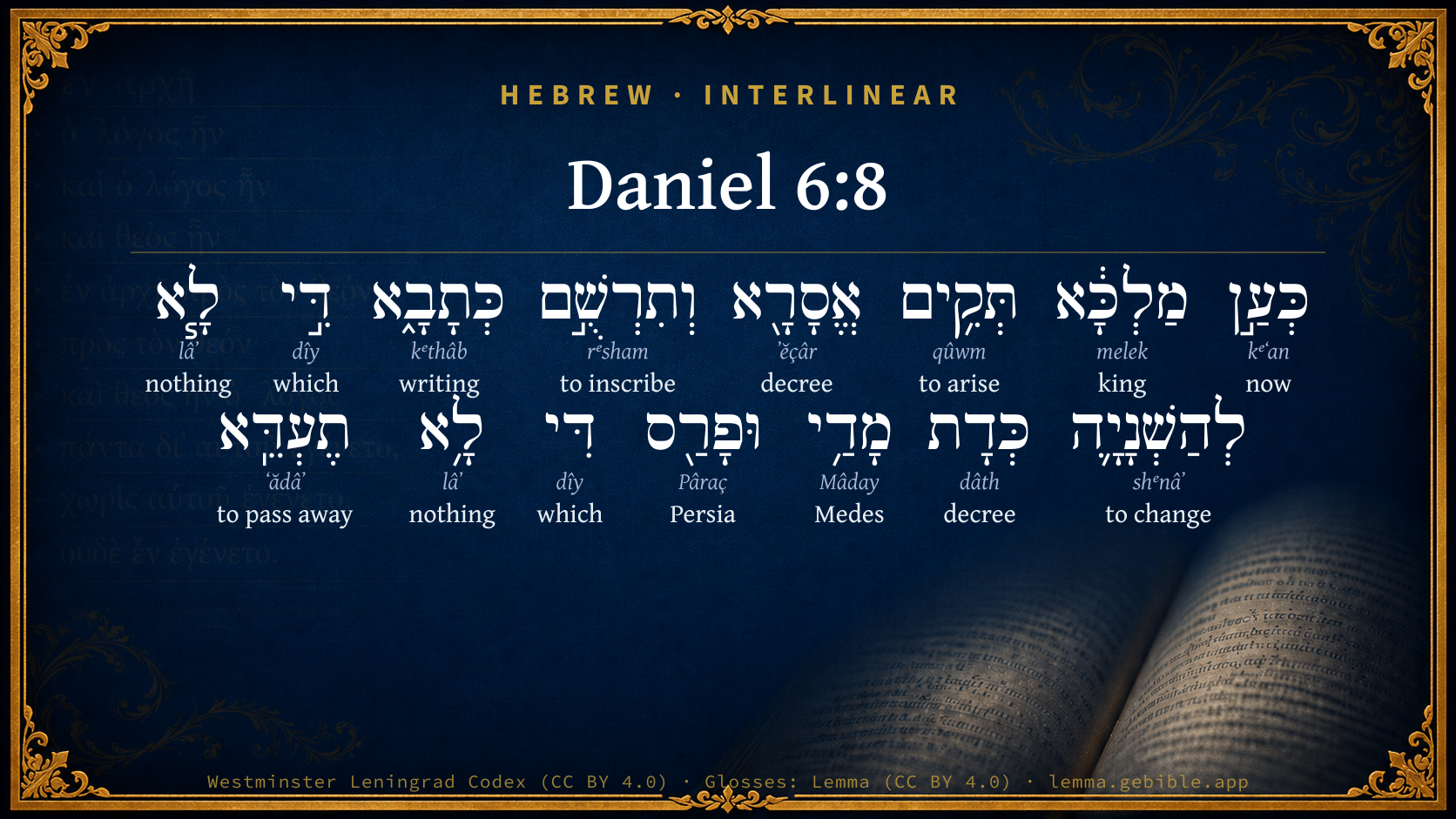
Hebrew (Westminster Leningrad Codex) Daniel 6:8 appears in the Hebrew Old Testament. The text above is from the Westminster Leningrad Codex. Each word links to its Strong’s number, a concise gloss, and parsing drawn from the Open Scriptures Hebrew Bible morphology. Click any word for its full Brown-Driver-Briggs (BDB) entry.
Download image
Cite this verse

Daniel 6:8 (World English Bible). Public Domain. Lemma interlinear Bible study tool, https://lemma.gebible.app/v/daniel/6/8.

Show BibTeX & RIS
BibTeX
RIS
English Translation
Now, O king, establish the interdict, and sign the writing, that it not be changed, according to the law of the Medes and Persians, which doesn't alter.
World English Bible · Public Domain
Download a study sheet

One document with this verse’s original text, its word-by-word gloss line, the meaning frame, cross-references with their text, attributed commentary, and full source and license credits — printable, and it pastes into notes with its structure intact.

This verse Autodidact and up

Study sheet (.html) Plain text (.txt)

A passage Seminary Student

Up to 50 verses in one chapter. A passage sheet keeps up to 6 commentary sources and 12 cross-references per verse, in the order this page ranks them, and says so on the sheet whenever that leaves anything out. Ask for a single verse and you get the Autodidact verse sheet above.

Everything on this page stays free to read, with no account — the sheet is a download of what is already on screen, not access to it.

Want to remove ads? Support Godless Engineer
Compare translations 3

The same verse in 3 English versions, stacked beneath the original-language interlinear above. Click any original word for its lexicon entry.

Each is an independent rendering of the whole verse — the interlinear is not word-aligned to these translations.

Highlighted words mark where these versions differ — a whole-verse word diff, not a word-by-word alignment.

  • World English Bible Public Domain
    Now, O king, establish the interdict, and sign the writing, that it not be changed, according to the law of the Medes and Persians, which doesn't alter.
  • King James Version Public Domain
    Now, O king, establish the decree, and sign the writing, that it be not changed, according to the law of the Medes and Persians, which altereth not.
  • unfoldingWord Literal Text CC BY-SA 4.0
    Now, O king, establish the injunction and sign the document so that it may not be changed, according to the law of the Medes and Persians, which may not be revoked.”

unfoldingWord Literal Text — © unfoldingWord, licensed CC BY-SA 4.0. Word-aligned USFM3 via Door43 (git.door43.org/unfoldingWord/en_ult).

Versions to compare (up to 4)

3 of 4 selected

Show all 18 translations

Every available English version of this verse, each an independent rendering of the whole verse.

  • World English Bible Public Domain
    Now, O king, establish the interdict, and sign the writing, that it not be changed, according to the law of the Medes and Persians, which doesn't alter.
  • Berean Standard Bible Public Domain
    Therefore, O king, establish the decree and sign the document so that it cannot be changed—in accordance with the law of the Medes and Persians, which cannot be repealed.”
  • Majority Standard Bible Public Domain
    Therefore, O king, establish the decree and sign the document so that it cannot be changed—in accordance with the law of the Medes and Persians, which cannot be repealed.”
  • King James Version Public Domain
    Now, O king, establish the decree, and sign the writing, that it be not changed, according to the law of the Medes and Persians, which altereth not.
  • American Standard Version (1901) Public Domain
    Now, O king, establish the interdict, and sign the writing, that it be not changed, according to the law of the Medes and Persians, which altereth not.
  • Revised Version (1885) Public Domain
    Now, O king, establish the interdict, and sign the writing, that it be not changed, according to the law of the Medes and Persians, which altereth not.
  • Geneva Bible (1599) Public Domain
    Nowe, O King, confirme the decree, and seale the writing, that it be not changed according to the law of the Medes and Persians, which altereth not.
  • Douay-Rheims (1899) Public Domain
    Now, therefore, O king, confirm the sentence, and sign the decree: that what is decreed by the Medes and Persians may not be altered, nor any man be allowed to transgress it.
  • Young's Literal Translation Public Domain
    Now, O king, thou dost establish the interdict, and sign the writing, that it is not to be changed, as a law of Media and Persia, that doth not pass away.'
  • Literal Standard Version CC BY-SA 4.0
    Now, O king, you establish the interdict, and sign the writing, that it is not to be changed, as a law of Media and Persia, that does not pass away.”
  • Unlocked Literal Bible CC BY-SA 4.0
    Now, King, issue a decree and sign the document so that it may not be changed, as directed by the laws of the Medes and Persians, so it cannot be repealed.”
  • unfoldingWord Literal Text CC BY-SA 4.0
    Now, O king, establish the injunction and sign the document so that it may not be changed, according to the law of the Medes and Persians, which may not be revoked.”
  • Darby Bible Public Domain
    Now, O king, establish the decree, and sign the writing, that it be not changed, according to the law of the Medes and Persians, which may not be revoked.
  • World Messianic Bible Public Domain
    Now, O king, establish the decree and sign the writing, that it not be changed, according to the law of the Medes and Persians, which doesn’t alter.”
  • Webster's Bible Public Domain
    \\6:7\\All the presidents of the kingdom, the governors, and the princes, the counselors, and the captains, have consulted together to establish a royal statute, and to make a firm decree, that whoever shall ask a petition of any God or man for thirty days, save of thee, O king, he shall be cast into the den of lions.
  • Free Bible Version CC BY-SA 4.0
    Now, Your Majesty, if you will sign the decree and have it issued so that it cannot be changed, according to the law of the Medes and the Persians that cannot be revoked.”
  • Bible in Basic English Public Domain
    All the chief rulers of the kingdom, the chiefs and the captains, the wise men and the rulers, have made a common decision to put in force a law having the king's authority, and to give a strong order, that whoever makes any request to any god or man but you, O King, for thirty days, is to be put into the lions' hole.
  • JPS Tanakh (1917) Public Domain
    (6-9) Now, O king, establish the interdict, and sign the writing, that it be not changed, according to the law of the Medes and Persians, which altereth not.'

Literal Standard Version (2020), Covenant Press — licensed CC BY-SA 4.0. Text via the HelloAO Bible API (eBible.org). Unlocked Literal Bible (unfoldingWord) — licensed CC BY-SA 4.0. Text via the HelloAO Bible API (eBible.org). unfoldingWord Literal Text — © unfoldingWord, licensed CC BY-SA 4.0. Word-aligned USFM3 via Door43 (git.door43.org/unfoldingWord/en_ult). Free Bible Version, Dr. Jonathan Gallagher — licensed CC BY-SA 4.0. Text via the HelloAO Bible API (eBible.org).

Word by word

More ways to search: Search by grammar → Find every occurrence → Compare this word →

Practice this passage: Drill this verse → Learn its vocabulary →

מָדַ֥י
Mâday
H4076
“Medes”
Adjective, N
Part of Speech
Adjective
Full BDB Definition

Origin: corresponding to H4074

TWOT: None

Medes = "middle land" - an inhabitant of Media (noun proper masculine) - the territory inhabited by the Medes (noun proper locative) - located northwest of Persia proper, south and southwest of the Caspian Sea, east of Armenia and Assyria, and west and northwest of the great salt desert of Iram
  1. כְּעַ֣ן kᵉʻan H3705 “now” Adjective, D
  2. מַלְכָּ֔א melek H4430 “king · the” Adjective, N, Common + Particle, Definite Article
  3. תְּקִ֥ים qûwm H6966 “to arise” Adjective, V
  4. אֱסָרָ֖א ʼĕçâr H633 “decree · the” Adjective, N, Common + Particle, Definite Article
  5. וְתִרְשֻׁ֣ם rᵉsham H7560 “and · to inscribe” Adjective, C + Verb, Qal, Imperfect, 2nd Person, Masculine, Singular
  6. כְּתָבָ֑א kᵉthâb H3792 “writing · the” Adjective, N, Common + Particle, Definite Article
  7. דִּ֣י dîy H1768 “which” Adjective, T
  8. לָ֧א lâʼ H3809 “nothing” Adjective, T
  9. לְהַשְׁנָיָ֛ה shᵉnâʼ H8133 “to change” Adjective, R + Verb, Hiphil, Infinitive Construct
  10. כְּדָת dâth H1882 “like/as · decree of” Adjective, R + Noun, Common, Feminine, Singular, Construct
  11. וּפָרַ֖ס Pâraç H6540 “and · Persia” Adjective, C + Noun, Proper
  12. דִּי dîy H1768 “which” Adjective, T
  13. לָ֥א lâʼ H3809 “nothing” Adjective, T
  14. תֶעְדֵּֽא ʻădâʼ H5709 “to pass away” Adjective, V

About this verse

These counts appear in no published source. They are computed here, from the morphology-tagged text and Lemma’s own curated glosses. What Lemma adds →

15
words
13
distinct lemmas
Prophets
section

Notable vocabulary

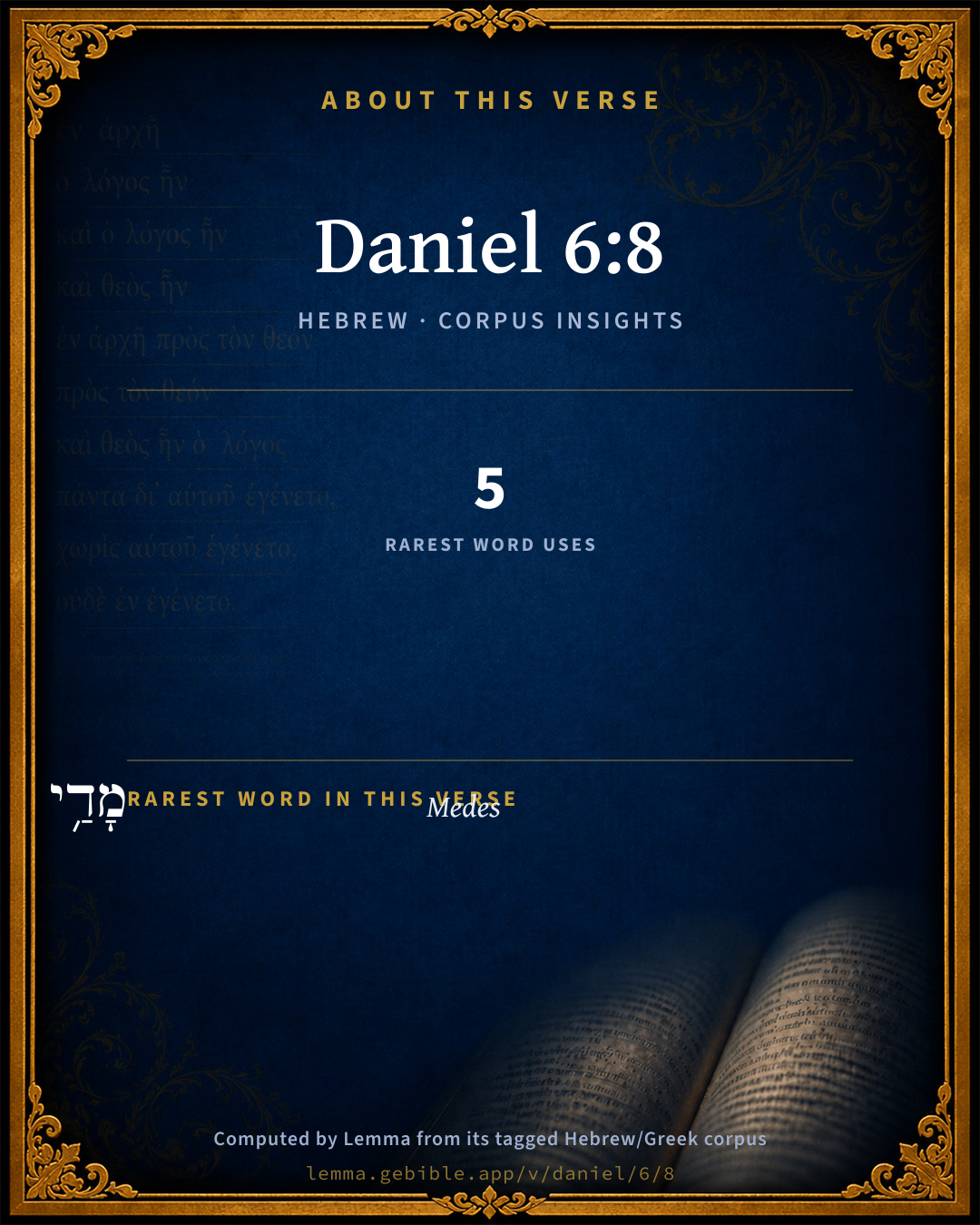
The rarest word here is מָדַ֥י Medes H4076 — appearing just 5 times in the whole Hebrew Bible.

Shared distinctive vocabulary

מָדַ֥י Medes H4076 occurs in 5 verses of the Hebrew Bible. Also found in:

Grammatical profile

  • 2 verbs
  • 2 nouns
  • 8 adjectives
  • 3 particles

Verb forms

  • וְתִרְשֻׁ֣ם Qal · Imperfect
  • לְהַשְׁנָיָ֛ה Hiphil · Infinitive Construct

Repetition

Words recur within this verse — often emphatic in Hebrew:

  • לָ֧א nothing H3809 ×2
  • דִּ֣י which H1768 ×2

Hebrew & Septuagint length

In English translation the verse runs 27 words from the Hebrew and 22 from the Septuagint (LXX English) — closely comparable.

A rough comparison of the two English renderings, which tokenize alike — not a word-level alignment.

Word counts can differ between the Hebrew and the Greek without any difference in meaning — e.g. the Hebrew direct-object marker אֵת has no separate Greek word, and Greek often adds the article ὁ.

Cross-references

9

Topical passages linked to Daniel 6:8 in the Treasury of Scripture Knowledge — connected by theme and wording, ordered by reader-vote popularity; previews shown in the World English Bible.

  • Esther 1:19 If it please the king, let there go forth a royal commandment from him, and let it be written among the laws of the Persians and the Medes, that it not be altered, that Vashti come no more before king Ahasuerus; and let the king give her royal estate to another who is better than she.
  • Daniel 6:15 Then these men assembled together to the king, and said to the king, Know, O king, that it is a law of the Medes and Persians, that no interdict nor statute which the king establishes may be changed.
  • Isaiah 10:1 Woe to those who decree unrighteous decrees, and to the writers who write perverseness;
  • Daniel 6:12 Then they came near, and spoke before the king concerning the king's interdict: Haven't you signed an interdict, that every man who shall make petition to any god or man within thirty days, save to you, O king, shall be cast into the den of lions? The king answered, The thing is true, according to the law of the Medes and Persians, which doesn't alter.
  • Esther 3:12 Then were the king's scribes called in the first month, on the thirteenth day of it; and there was written according to all that Haman commanded to the king's satraps, and to the governors who were over every province, and to the princes of every people, to every province according to the writing of it, and to every people after their language; in the name of king Ahasuerus was it written, and it was sealed with the king's ring.
  • Esther 8:10 He wrote the name of king Ahasuerus, and sealed it with the king's ring, and sent letters by post on horseback, riding on swift steeds that were used in the king's service, bred of the stud:
  • Esther 8:3 Esther spoke yet again before the king, and fell down at his feet, and begged him with tears to put away the mischief of Haman the Agagite, and his device that he had devised against the Jews.
  • Esther 8:8 Write you also to the Jews, as it pleases you, in the king's name, and seal it with the king's ring; for the writing which is written in the king's name, and sealed with the king's ring, may no man reverse.
  • Matthew 24:35 Heaven and earth will pass away, but my words will not pass away.

Cross-references courtesy of OpenBible.info (CC BY 4.0).

Hebrew and Greek witnesses Masoretic Hebrew ↔ Greek Septuagint

The same verse in the two great witnesses to the Old Testament, shown verse-for-verse.

These are two independent witnesses, not word-aligned to each other, and the Septuagint is shown in lemma (dictionary) form.

Hebrew Daniel 6:8 Masoretic · Westminster Leningrad Codex

כְּעַ֣ן מַלְכָּ֔א תְּקִ֥ים אֱסָרָ֖א וְתִרְשֻׁ֣ם כְּתָבָ֑א דִּ֣י לָ֧א לְהַשְׁנָיָ֛ה כְּדָת מָדַ֥י וּפָרַ֖ס דִּי לָ֥א תֶעְדֵּֽא

Now, O king, establish the interdict, and sign the writing, that it not be changed, according to the law of the Medes and Persians, which doesn't alter.

World English Bible · Public Domain

Greek LXX Daniel 6:8 Septuagint · lemma form

ὁρισμός καί στάσις ἵστημι ὅτι πᾶς ἄνθρωπος ὅς ἄν εὔχομαι εὐχή ἤ ἀξιόω ἀξίωμα τις παρά πᾶς θεός ἕως ἡμέρα τριάκοντα ἀλλά ἤ παρά δαρεῖος ὁ βασιλεύς ῥίπτω εἰς ὁ λάκκος ὁ λέων

Now then, O king, establish the decree, and publish a writ, that the decree of the Persians and Medes be not changed.

LXX2012 (modern English Septuagint) · Public Domain

Hebrew: Westminster Leningrad Codex (CC BY 4.0). Greek: Septuagint (public domain); English from LXX2012 (modern English Septuagint) (Public Domain). How the Septuagint differs from the Hebrew →

Commentary

Notes on Daniel 6:8 from classic Christian and Jewish commentators (each source and its license shown beneath its notes). The classic Christian expositions comment on the surrounding passage and are grouped to its opening verse, so a note may address several verses; the Jewish commentaries on the Tanakh (Rashi and others) are per-verse, so they appear only where the commentator wrote on this verse.

Lemma curates 59 commentaries, every one of them public domain or Creative Commons licensed, each selected and text-cleaned for this edition rather than reprinted as found. About our sources →

Trapp's Complete Commentary

John Trapp

Dan 6:8 Now, O king, establish the decree, and sign the writing, that it be not changed, according to the law of the Medes and Persians, which altereth not.

Ver. 8. Now, O king, establish the decree.] Confirm it, that it may receive the force of law.

According to the law of the Medes and Persians, that altereth not.] This was too much to be given to any law made by man, so mutable a creature. I have read of a people whose laws lasted in force but for three days at utmost; this was a fault in the other extreme. The Persians’ laws were therefore irrepealable, because they worshipped truth for a goddess, to whom inconstancy and change must needs be opposite and odious. But this was no good reason either, unless the law makers shall be supposed such as cannot err, nor will anything unjust, which can be truly attributed to none but God only.

John Trapp, A Commentary or Exposition upon All the Books of the Old and New Testament (1647–1656) — public domain. Text from a community e-Sword module.

Tyndale Open Study Notes

Tyndale Open Resources

6:8 cannot be changed . . . cannot be revoked: Cp. Esth 1:19. Human laws all pass away, but God’s law lasts forever (Pss 93:5; 119:152). This devotion to established laws was one of the special features of the Persian Empire. Eventually, the profusion of laws so swamped them in bureaucracy that they could not function efficiently.

Tyndale Open Study Notes — © Tyndale Open Resources, licensed CC BY-SA 4.0. Text via the HelloAO Bible API.

Jamieson, Fausset & Brown

Robert Jamieson, A. R. Fausset & David Brown

decree--or, "interdict."

that it be not changed-- (Est 1:19; Est 8:8). This immutability of the king's commands was peculiar to the Medes and Persians: it was due to their regarding him infallible as the representative of Ormuzd; it was not so among the Babylonians.

Medes and Persians--The order of the names is an undesigned mark of genuineness. Cyrus the Persian reigned subordinate to Darius the Mede as to dignity, though exercising more real power. After Darius' death, the order is "the Persians and Medes" (Est 1:14, Est 1:19, &c.).

Jamieson, Fausset & Brown — Commentary Critical and Explanatory on the Whole Bible (1871) — public domain (CC PDM 1.0). Text via the HelloAO Bible API.

Adam Clarke's Commentary

Verse 8. According to the law of the Medes and Persians] I do not think that this is to be understood so as to imply that whatever laws or ordinances the Medes or Persians once enacted, they never changed them. This would argue extreme folly in legislators in any country. Nothing more appears to be meant than that the decree should be enacted, written, and registered, according to the legal forms among the Medes and Persians; and this one to be made absolute for thirty days. The laws were such among this people, that, when once passed with the usual formalities, the king could not change them at his own will. This is the utmost that can be meant by the law of the Medes and Persians that could not be changed.

Adam Clarke's Commentary on the Bible (1810–1826) — public domain. Text from a community e-Sword/MySword module.

John Calvin's Commentaries

Here, as I have said, it is sufficiently apparent how inclined to fallacies are the minds of kings when they think they can benefit themselves and increase their own dignity. For the king did not dispute long with his nobles but subscribed the edict; for he thought it might prove useful to himself and his successors: if he found the Chaldeans obedient to himself and rather prepared to deny the existence of every god than to refuse whatever he commanded! As to the use of the word, some, translate אסרא, asra, by “writing,” deriving it from “to cut in,” as we know that all laws were formerly graven on tablets of brass; but I interpret it more simply of their seeking from the king a signature of the writing, that is, he was to sign the edict after it was written. Which cannot be changed, they say — meaning, the edict is unchangeable and inviolable, according to the law of the Medes and Persians, which does not pass away — that is, which does not vanish, as also Christ says, Heaven and earth shall pass away, but my words shall not pass away, or shall never become vain. (Matthew 24:35; Mark 13:31.) As to his joining the Medes with the Persians, this arises from what we said before, since Cyrus and Darius reigned in common as colleagues. Greater dignity was granted to Darius, while the power was in the hands of Cyrus; besides, without controversy, his sons were heirs of either kingdom and of the Monarchy of the East, unless when they began to make war on each other. When they say, the law of the Medes and Persians is immutable, this is worthy of praise in laws, and sanctions their authority; thus they are strong and obtain their full effect. When laws are variable, many are necessarily injured, and no private interest is stable unless the law be without variation; besides, when there is a liberty of changing laws, license succeeds in place of justice. For those who possess the supreme power, if corrupted by gifts, promulgate first one edict and then another. Thus justice cannot flourish where change in the laws allows of so much license. But, at the same time, kings ought prudently to consider lest they promulgate any edict or law without grave and mature deliberation; and secondly, kings ought to be careful lest they be counteracted by cunning and artful plots, to which they are often liable. Hence, constancy is praiseworthy in kings and their edicts, if only they are preceded by prudence and equity. But we shall immediately see how foolishly kings affect the fame of consistency, and how their obstinacy utterly perverts justice. But we shall see this directly in its own place. It follows:

John Calvin's Commentaries (1540-1563) — public domain. Text from the Calvin Translation Society English edition (1840s-50s) via the Christian Classics Ethereal Library (ccel.org). Calvin's coverage is partial (roughly two-thirds of the Bible); uncommented books and verses are honest gaps, never fabricated. The 19th-century editor's footnotes and remarks are omitted so the notes are faithfully Calvin's own voice.

Ellicott's Commentary for English Readers

(8) Sign the writing.—Literally, record the decree, so that there might be no possibility of its being recalled. (Comp. Est_8:8.)

A Bible Commentary for English Readers, edited by Charles John Ellicott (1878–1897) — public domain. Text from a community e-Sword module.

The Cambridge Bible for Schools and Colleges

gen. ed. J. J. S. Perowne

8. decree] interdict.

altereth not] lit. passeth not away. On the unalterableness of the edicts of a Persian king, cf. Est_1:19 (‘let it be written among the laws of the Persians and Medes, that it pass not away’), Dan_8:8 (a royal edict, properly signed and sealed, ‘may no man reverse’).

The Cambridge Bible for Schools and Colleges (gen. ed. J. J. S. Perowne; Cambridge University Press, 1878–1918) — public domain. Text from a community e-Sword module.

John Gill's Exposition

Now, O king, establish the decree, and sign the writing,.... For they had not only agreed upon it among themselves what to propose, as to the substance of it; but they had drawn it up in writing, ready to be signed, which they urge to have done immediately:

that it be not changed, according to the law of the Medes and Persians, which altereth not; when once signed by the king: mention being made of both the Medes and Persians, shows that these two nations were now united in one government; that Darius and Cyrus were partners in the empire; and it is easy to account for it why the Medes are mentioned first; because Darius was the Mede, and Cyrus the Persian; the one the uncle, the other the nephew; but afterwards, when a Persian only was on the throne, then the Persian is mentioned first, Est 1:19.

John Gill's Exposition of the Whole Bible (1746–1763) — public domain (CC PDM 1.0). Text via the HelloAO Bible API.

Albert Barnes' Notes on the Bible

Now, O king, establish the decree - Ordain, enact, confirm it.

And sign the writing - An act necessary to make it the law of the realm.

That it be not changed - That, having the sign-manual of the sovereign, it might be so confirmed that it could not be changed. With that sign it became so established, it seems, that even the sovereign himself could not change it.

According to the law of the Medes and Persians, which altereth not - Margin, Passeth. Which does not pass away; which is not abrogated. A similar fact in regard to a law of the Medes and Persians is mentioned in Esther viii., in which the king was unable to recall an order which had been given for the massacre of the Jews, and in which he attempted only to counteract it as far as possible by putting the Jews on their guard, and allowing them to defend themselves. Diodorus Siculus (lib. iv.) refers to this custom where he says that Darius, the last king of Persia, would have pardoned Charidemus after he was condemned to death, but could not reverse what the law had passed against him. - Lowth. “When the king of Persia,” says Montesquieu (Spirit of Laws, as quoted by Rosenmuller, Morgenland, in loc.), “has condemned any one to death, no one dares speak to him to make intercession for him. Were he even drunk when the crime was committed, or were he insane, the command must nevertheless be executed, for the law cannot be countermanded, and the laws cannot contradict themselves. This sentiment prevails throughout Persia.” It may seem singular that such a custom prevailed, and that the king, who was the fountain of law, and whose will was law, could not change a statute at his pleasure.

But this custom grew out of the opinions which prevailed in the East in regard to the monarch. His will was absolute, and it was a part of the system which prevailed then to exalt the monarch, and leave the impression on the mind of the people that he was more than a man - that he was infallible, and could not err. Nothing was better adapted to keep up that impression than an established principle of this kind - that a law once ordained could not be repealed or changed. To do this would be a practical acknowledgment that there was a defect in the law; that there was a want of wisdom in ordaining it; that all the circumstances were not foreseen; and that the king was liable to be deceived and to err. With all the disadvantages attending such a custom, it was judged better to maintain it than to allow that the monarch could err, and hence, when a law was ordained it became fixed and unchanging.

Even the king himself could not alter it, and, whatever might be the consequences, it was to be executed. It is evident, however, that such a custom might have some advantages. It would serve to prevent hasty legislation, and to give stability to the government by its being known what the laws were, thus avoiding the evils which result when they are frequently changed. It is often preferable to have permanent laws, though not the best that could be framed, than those which would be better, if there were no stability. There is only one Being, however, whose laws can be safely unchanging - and that is God, for his laws are formed with a full knowledge of all the relations of things, and of their bearing on all future circumstances and times. It serves to confirm the statement here made respecting the ancient custom in Media and Persia, that the same idea of the inviolability of the royal word has remained, in a mitigated form, to modern times.

A remarkable example of this is related by Sir John Malcolm, of Aga Mohammed Khan, the last but one of the Persian kings. After alluding to the present case, and that in Esther, he observes, “The character of the power of the king of Persia has undergone no change. The late king, Aga Mohammed Khan, when encamped near Shiraz, said that he would not move until the snow was off the mountains in the vicinity of his camp. The season proved severe, and the snow remained longer than was expected; the army began to suffer distress and sickness, but the king said while the snow remained upon the mountain, he would not move; and his word was as law, and could not be broken. A multitude of laborers were collected and sent to remove the snow; their efforts, and a few fine days, cleared the mountains, and Aga Mohammed Khan marched.” - History of Persia, i. 268, quoted in the Pict. Bible, in loc.

Albert Barnes' Notes on the Bible (1834–1885) — public domain. Text from a community e-Sword/MySword module.

Haydock's Catholic Bible Commentary

It, when it is confirmed both by the king and his nobility. (Esther viii. 8.)

George Leo Haydock (1774–1849), Haydock's Catholic Family Bible and Commentary, 1859 edition — public domain. Excludes Psalms (Douay-Rheims chapter numbering differs from Protestant) and Deuterocanonical books (Catholic canon only).

Whedon's Commentary on the Bible

Daniel D. Whedon

8. For Medes and Persians see Dan_2:39-42; Dan_7:5.

Daniel D. Whedon (gen. ed.), Commentary on the Old and New Testaments (1874–1909) — public domain. Text from a community e-Sword module.

unfoldingWord translationNotes

Door43 World Missions Community

Connecting Statement:

In verse 8, the administrators continue to speak to the king.

as directed by the laws

"according to the laws"

cannot be repealed

"cannot be canceled"

making the decree into a law

"making the order into a law"

translationWords

king

decree

law, laws

Medes

Persia

Darius

unfoldingWord translationNotes — © Distant Shores Media and the Door43 World Missions Community, licensed CC BY-SA 4.0. Source: git.door43.org/Door43/en_tn.

Rashi

Rabbi Shlomo Yitzchaki (Rashi)

have taken counsel [as translated,] have taken counsel.

to preserve the king’s law to preserve the king’s law with power because you have recently ascended the throne. [Moreover], you are from another country and are in need of support.

make any request [as translated,] make any request.

except from you, O King [as translated,] except from you, O King.

into a pit of lions into the pit where the king’s lions were [kept].

Rashi on the Tanakh — English translations: “The Judaica Press complete Tanach with Rashi, translated by A. J. Rosenberg” (CC BY 4.0); “Pentateuch with Rashi's commentary by M. Rosenbaum and A.M. Silbermann, 1929-1934” (public domain); “The Metsudah Tanach series, Lakewood, N.J” (CC BY 4.0); and “The Book of Joshua, Metsudah Publications, 1997” (CC BY 4.0). Text via Sefaria.

Lesson kit

Teaching starters — assembled from the data on this page, not authored interpretation. Every prompt links to the verse data it draws on. Edit before teaching.

Daniel, in the Prophets, opens this verse with 15 words (13 distinct Hebrew lemmas). Its most distinctive word is Mâday (“Medes”). A historical commentator’s framing appears above. Read the whole chapter for the surrounding context.

Discussion questions

  1. How does “Medes” (Mâday) shape what this verse is saying?
  2. How does Ezra 6:2, which shares the word «Medes», read alongside this verse?
  3. What does the repetition of “nothing” (2× in this one verse) do in this verse?
  4. These translations render this verse differently. What is at stake in choosing one wording over another?
  5. «וְתִרְשֻׁ֣ם» is a Qal Imperfect verb. How does that grammatical form shape the action described?
  6. Compare how Trapp's Complete Commentary and Tyndale Open Study Notes read this verse. Where do they agree or differ?

Things to notice

Reading settings

Reading text

Shown beneath each verse's original-language words.

Old Testament
Old Testament edition

Read the OT as the Masoretic Hebrew (MT) or the Greek Septuagint (LXX).

English shown for the Greek Septuagint (in the Hebrew ↔ Greek comparison).

Comparing translations? Open the Compare panel on any verse page to stack up to four side by side.