
Daniel 2:10

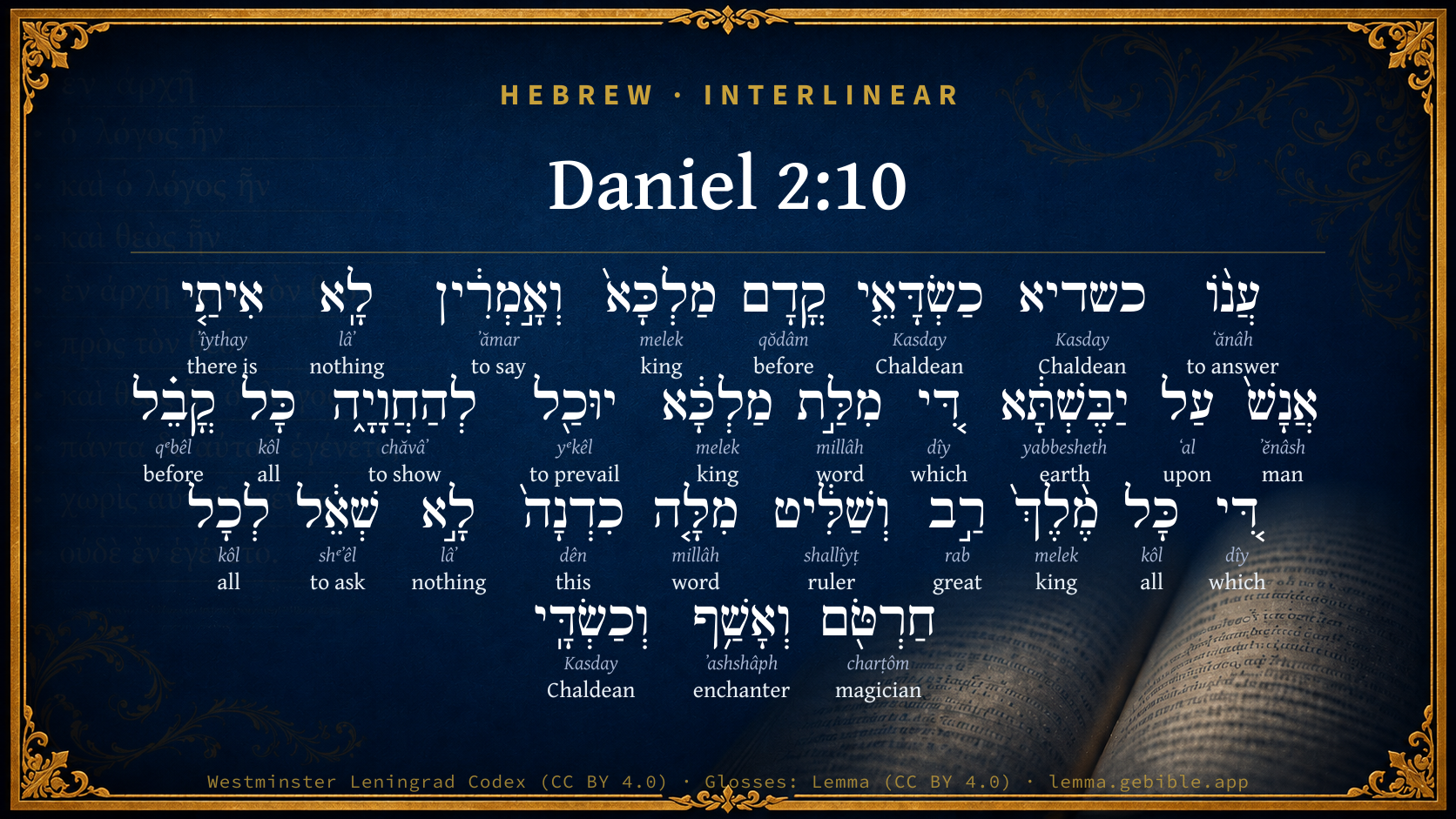
Hebrew (Westminster Leningrad Codex) Daniel 2:10 appears in the Hebrew Old Testament. The text above is from the Westminster Leningrad Codex. Each word links to its Strong’s number, a concise gloss, and parsing drawn from the Open Scriptures Hebrew Bible morphology. Click any word for its full Brown-Driver-Briggs (BDB) entry.
Download image
Cite this verse

Daniel 2:10 (World English Bible). Public Domain. Lemma interlinear Bible study tool, https://lemma.gebible.app/v/daniel/2/10.

Show BibTeX & RIS
BibTeX
RIS
English Translation
The Chaldeans answered before the king, and said, There is not a man on the earth who can show the king's matter, because no king, lord, or ruler, has asked such a thing of any magician, or enchanter, or Chaldean.
World English Bible · Public Domain
Highlights
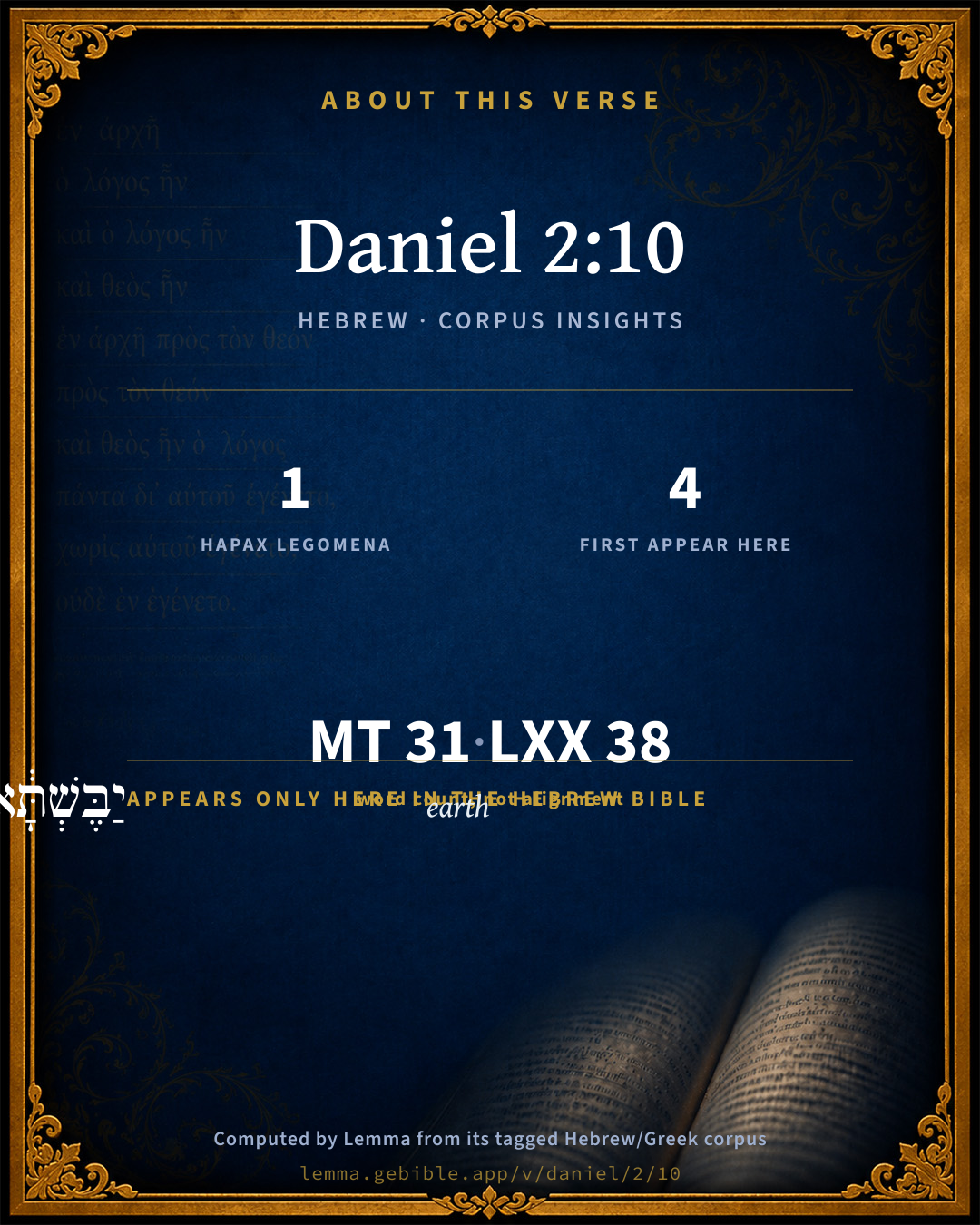
  • 1 hapax legomenon — only here in the Hebrew Bible
  • 4 first appearances in the Hebrew Bible
Full analysis ↓
Download a study sheet

One document with this verse’s original text, its word-by-word gloss line, the meaning frame, cross-references with their text, attributed commentary, and full source and license credits — printable, and it pastes into notes with its structure intact.

This verse Autodidact and up

Study sheet (.html) Plain text (.txt)

A passage Seminary Student

Up to 50 verses in one chapter. A passage sheet keeps up to 6 commentary sources and 12 cross-references per verse, in the order this page ranks them, and says so on the sheet whenever that leaves anything out. Ask for a single verse and you get the Autodidact verse sheet above.

Everything on this page stays free to read, with no account — the sheet is a download of what is already on screen, not access to it.

Want to remove ads? Support Godless Engineer
Compare translations 3

The same verse in 3 English versions, stacked beneath the original-language interlinear above. Click any original word for its lexicon entry.

Each is an independent rendering of the whole verse — the interlinear is not word-aligned to these translations.

Highlighted words mark where these versions differ — a whole-verse word diff, not a word-by-word alignment.

  • World English Bible Public Domain
    The Chaldeans answered before the king, and said, There is not a man on the earth who can show the king's matter, because no king, lord, or ruler, has asked such a thing of any magician, or enchanter, or Chaldean.
  • King James Version Public Domain
    The Chaldeans answered before the king, and said, There is not a man upon the earth that can shew the king's matter: therefore there is no king, lord, nor ruler, that asked such things at any magician, or astrologer, or Chaldean.
  • unfoldingWord Literal Text CC BY-SA 4.0
    The Chaldeans answered the king and said, “There is not a man on earth who is able to reveal the matter for the king, for no great and powerful king has asked such a thing from any magician or enchanter or Chaldean.

unfoldingWord Literal Text — © unfoldingWord, licensed CC BY-SA 4.0. Word-aligned USFM3 via Door43 (git.door43.org/unfoldingWord/en_ult).

Versions to compare (up to 4)

3 of 4 selected

Show all 18 translations

Every available English version of this verse, each an independent rendering of the whole verse.

  • World English Bible Public Domain
    The Chaldeans answered before the king, and said, There is not a man on the earth who can show the king's matter, because no king, lord, or ruler, has asked such a thing of any magician, or enchanter, or Chaldean.
  • Berean Standard Bible Public Domain
    The astrologers answered the king, “No one on earth can do what the king requests! No king, however great and powerful, has ever asked anything like this of any magician, enchanter, or astrologer.
  • Majority Standard Bible Public Domain
    The astrologers answered the king, “No one on earth can do what the king requests! No king, however great and powerful, has ever asked anything like this of any magician, enchanter, or astrologer.
  • King James Version Public Domain
    The Chaldeans answered before the king, and said, There is not a man upon the earth that can shew the king's matter: therefore there is no king, lord, nor ruler, that asked such things at any magician, or astrologer, or Chaldean.
  • American Standard Version (1901) Public Domain
    The Chaldeans answered before the king, and said, There is not a man upon the earth that can show the king's matter, forasmuch as no king, lord, or ruler, hath asked such a thing of any magician, or enchanter, or Chaldean.
  • Revised Version (1885) Public Domain
    The Chaldeans answered before the king, and said, There is not a man upon the earth that can shew the king’s matter: forasmuch as no king, lord, nor ruler, hath asked such a thing of any magician, or enchanter, or Chaldean.
  • Geneva Bible (1599) Public Domain
    Then the Caldeans answered before the King, and sayde, There is no man vpon earth that can declare the Kings matter: yea, there is neither king nor prince nor lorde that asked such things at an inchanter or astrologian or Caldean.
  • Douay-Rheims (1899) Public Domain
    Then the Chaldeains answered before the king, and said: There is no man upon earth, that can accomplish thy word, O king, neither doth any king, though great and mighty, ask such a thing of any diviner, or wise man, or Chaldean.
  • Young's Literal Translation Public Domain
    The Chaldeans have answered before the king, and are saying, `There is not a man on the earth who is able to shew the king's matter; therefore, no king, chief, and ruler, hath asked such a thing as this of any scribe, and enchanter, and Chaldean;
  • Literal Standard Version CC BY-SA 4.0
    The Chaldeans have answered before the king, and are saying, “There is not a man on the earth who is able to show the king’s matter; therefore, no king, chief, and ruler, has asked such a thing as this of any scribe, and enchanter, and Chaldean;
  • Unlocked Literal Bible CC BY-SA 4.0
    The wise men replied to the king, “There is not a man on earth able to meet the king's demand. There is no great and powerful king who has demanded such a thing from any magician, or from anyone who claims to speak with the dead, or from a wise man.
  • unfoldingWord Literal Text CC BY-SA 4.0
    The Chaldeans answered the king and said, “There is not a man on earth who is able to reveal the matter for the king, for no great and powerful king has asked such a thing from any magician or enchanter or Chaldean.
  • Darby Bible Public Domain
    The Chaldeans answered before the king and said, There is not a man upon the earth that can shew the king's matter; therefore there is no king, however great and powerful, that hath asked such a thing of any scribe, or magician, or Chaldean.
  • World Messianic Bible Public Domain
    The Kasdians answered the king and said, “There is not a man on the earth who can show the king’s matter, because no king, lord, or ruler has asked such a thing of any magician, enchanter, or Chaldean.
  • Webster's Bible Public Domain
    The Chaldeans answered before the king, and said, There is not a man upon the earth that can show the king's matter: therefore there is no king, lord, nor ruler, that hath asked such things of any magician, or astrologer, or Chaldean.
  • Free Bible Version CC BY-SA 4.0
    The astrologers answered the king, “No one on earth could tell the king what he dreamed! Never before has a king, however great and powerful, demanded this of any magician, enchanter, or astrologer!
  • Bible in Basic English Public Domain
    Then the Chaldaeans said to the king in answer, There is not a man on earth able to make clear the king's business; for no king, however great his power, has ever made such a request to any wonder-worker or user of secret arts or Chaldaean.
  • JPS Tanakh (1917) Public Domain
    The Chaldeans answered before the king, and said: 'There is not a man upon the earth that can declare the king's matter; forasmuch as no great and powerful king hath asked such a thing of any magician, or enchanter, or Chaldean.

Literal Standard Version (2020), Covenant Press — licensed CC BY-SA 4.0. Text via the HelloAO Bible API (eBible.org). Unlocked Literal Bible (unfoldingWord) — licensed CC BY-SA 4.0. Text via the HelloAO Bible API (eBible.org). unfoldingWord Literal Text — © unfoldingWord, licensed CC BY-SA 4.0. Word-aligned USFM3 via Door43 (git.door43.org/unfoldingWord/en_ult). Free Bible Version, Dr. Jonathan Gallagher — licensed CC BY-SA 4.0. Text via the HelloAO Bible API (eBible.org).

Word by word

More ways to search: Search by grammar → Find every occurrence → Compare this word →

Practice this passage: Drill this verse → Learn its vocabulary →

יַבֶּשְׁתָּ֔א
yabbesheth
H3007
“earth · the”
Adjective, N, Common + Particle, Definite Article
Part of Speech
Adjective + Particle
Type
Definite Article
Full BDB Definition

Origin: corresponding to H3006

TWOT: 2761

the earth (as a planet) - dry land
  1. עֲנ֨וֹ ʻănâh H6032 “to answer” Adjective, V, Plural
  2. כשדיא Kasday H3779 “Chaldean · the” Adjective, N + Particle, Definite Article
  3. כַשְׂדָּאֵ֤י Kasday H3779 “Chaldeans · my” Adjective, N + Suffix, Personal, 1st Person, Common, Singular
  4. קֳדָם qŏdâm H6925 “before” Adjective, R
  5. מַלְכָּא֙ melek H4430 “king · the” Adjective, N, Common + Particle, Definite Article
  6. וְאָ֣מְרִ֔ין ʼămar H560 “and · saying” Adjective, C + Verb, Qal, Participle Active, Masculine, Plural, Absolute
  7. לָֽא lâʼ H3809 “nothing” Adjective, T
  8. אִיתַ֤י ʼîythay H383 “there is” Adjective, T
  9. אֲנָשׁ֙ ʼĕnâsh H606 “man” Adjective, N, Common
  10. עַל ʻal H5922 “upon” Adjective, R
  11. דִּ֚י dîy H1768 “which” Adjective, T
  12. מִלַּ֣ת millâh H4406 “word of” Adjective, N, Common
  13. מַלְכָּ֔א melek H4430 “king · the” Adjective, N, Common + Particle, Definite Article
  14. יוּכַ֖ל yᵉkêl H3202 “to prevail” Adjective, V
  15. לְהַחֲוָיָ֑ה chăvâʼ H2324 “to show” Adjective, R + Verb, Hiphil, Infinitive Construct
  16. כָּל kôl H3606 “all” Adjective, C + Conjunction
  17. קֳבֵ֗ל qᵉbêl H6903 “before” Adjective, C
  18. דִּ֚י dîy H1768 “which” Adjective, C
  19. כָּל kôl H3606 “all of” Adjective, N, Common
  20. מֶ֨לֶךְ֙ melek H4430 “king” Adjective, N, Common
  21. רַ֣ב rab H7229 “great” Adjective, A
  22. וְשַׁלִּ֔יט shallîyṭ H7990 “and · ruler” Adjective, C + Adjective, Adjective, Masculine, Singular, Absolute
  23. מִלָּ֤ה millâh H4406 “word” Adjective, N, Common
  24. כִדְנָה֙ dên H1836 “like/as · this” Adjective, R + Pronoun, Demonstrative, Masculine, Singular
  25. לָ֣א lâʼ H3809 “nothing” Adjective, T
  26. שְׁאֵ֔ל shᵉʼêl H7593 “to ask” Adjective, V, Plural
  27. לְכָל kôl H3606 “to/for · all of” Adjective, R + Noun, Common, Masculine, Singular, Construct
  28. חַרְטֹּ֖ם charṭôm H2749 “magician” Adjective, N, Common
  29. וְאָשַׁ֥ף ʼashshâph H826 “and · enchanter” Adjective, C + Noun, Common, Masculine, Singular, Absolute
  30. וְכַשְׂדָּֽי Kasday H3779 “and · Chaldean” Adjective, C + Noun, Gentilic, Both, Singular, Absolute

About this verse

These counts appear in no published source. They are computed here, from the morphology-tagged text and Lemma’s own curated glosses. What Lemma adds →

31
words
22
distinct lemmas
Prophets
section

Notable vocabulary

1 hapax legomenon — a word that appears only here in the entire Hebrew Bible:

  • יַבֶּשְׁתָּ֔א earth H3007

First appearance in Scripture

These words make their first canonical appearance in the Hebrew Bible here:

  • יַבֶּשְׁתָּ֔א earth H3007
  • יוּכַ֖ל to prevail H3202
  • חַרְטֹּ֖ם magician H2749
  • וְאָשַׁ֥ף enchanter H826

Shared distinctive vocabulary

חַרְטֹּ֖ם magician H2749 occurs in 5 verses of the Hebrew Bible. Also found in:

Grammatical profile

  • 2 verbs
  • 3 nouns
  • 20 adjectives
  • 1 pronoun
  • 1 conjunction
  • 4 particles

Verb forms

  • וְאָ֣מְרִ֔ין Qal · Participle Active
  • לְהַחֲוָיָ֑ה Hiphil · Infinitive Construct

Repetition

Words recur within this verse — often emphatic in Hebrew:

  • כשדיא Chaldean H3779 ×3
  • מַלְכָּא֙ king H4430 ×3
  • כָּל all H3606 ×3
  • לָֽא nothing H3809 ×2
  • מִלַּ֣ת word H4406 ×2
  • דִּ֚י which H1768 ×2

Hebrew & Septuagint length

In English translation the verse runs 40 words from the Hebrew and 42 from the Septuagint (LXX English) — closely comparable.

A rough comparison of the two English renderings, which tokenize alike — not a word-level alignment.

Word counts can differ between the Hebrew and the Greek without any difference in meaning — e.g. the Hebrew direct-object marker אֵת has no separate Greek word, and Greek often adds the article ὁ.

In the original languages it is 31 Hebrew tokens and 38 Greek tokens — but the two are counted differently (Hebrew bundles its prefixes and suffixes into one token; the Greek is in lemma form), so that isn’t a like-for-like length.

Cross-references

1

Topical passages linked to Daniel 2:10 in the Treasury of Scripture Knowledge — connected by theme and wording, ordered by reader-vote popularity; previews shown in the World English Bible.

  • Daniel 2:27 Daniel answered before the king, and said, The secret which the king has demanded can neither wise men, enchanters, magicians, nor soothsayers, show to the king;

Cross-references courtesy of OpenBible.info (CC BY 4.0).

Hebrew and Greek witnesses Masoretic Hebrew ↔ Greek Septuagint

The same verse in the two great witnesses to the Old Testament, shown verse-for-verse.

These are two independent witnesses, not word-aligned to each other, and the Septuagint is shown in lemma (dictionary) form.

Hebrew Daniel 2:10 Masoretic · Westminster Leningrad Codex

עֲנ֨וֹ כשדיא כַשְׂדָּאֵ֤י קֳדָם מַלְכָּא֙ וְאָ֣מְרִ֔ין לָֽא אִיתַ֤י אֲנָשׁ֙ עַל יַבֶּשְׁתָּ֔א דִּ֚י מִלַּ֣ת מַלְכָּ֔א יוּכַ֖ל לְהַחֲוָיָ֑ה כָּל קֳבֵ֗ל דִּ֚י כָּל מֶ֨לֶךְ֙ רַ֣ב וְשַׁלִּ֔יט מִלָּ֤ה כִדְנָה֙ לָ֣א שְׁאֵ֔ל לְכָל חַרְטֹּ֖ם וְאָשַׁ֥ף וְכַשְׂדָּֽי

The Chaldeans answered before the king, and said, There is not a man on the earth who can show the king's matter, because no king, lord, or ruler, has asked such a thing of any magician, or enchanter, or Chaldean.

World English Bible · Public Domain

Greek LXX Daniel 2:10 Septuagint · lemma form

καί ἀποκρίνω ὁ χαλδαῖος ἐπί ὁ βασιλεύς ὅτι οὐδείς ὁ ἐπί ὁ γῆ δύναμαι εἶπον ὁ βασιλεύς ὅς ὁράω καθάπερ σύ ἐρωτάω καί πᾶς βασιλεύς καί πᾶς δυνάστης τοιοῦτος πρᾶγμα οὐ ἐπιἐρωτάω πᾶς σοφός καί μάγος καί χαλδαῖος

The Chaldeans answered before the king, and said, There is no man upon the earth, who shall be able to make known the king's matter: forasmuch as no great king or ruler asks such a question of an enchanter, magician, or Chaldean.

LXX2012 (modern English Septuagint) · Public Domain

On this verse, The Pulpit Commentary discusses the Septuagint’s reading. Read the note in Commentary ↓

Hebrew: Westminster Leningrad Codex (CC BY 4.0). Greek: Septuagint (public domain); English from LXX2012 (modern English Septuagint) (Public Domain). How the Septuagint differs from the Hebrew →

Commentary

Notes on Daniel 2:10 from classic Christian and Jewish commentators (each source and its license shown beneath its notes). The classic Christian expositions comment on the surrounding passage and are grouped to its opening verse, so a note may address several verses; the Jewish commentaries on the Tanakh (Rashi and others) are per-verse, so they appear only where the commentator wrote on this verse.

Lemma curates 59 commentaries, every one of them public domain or Creative Commons licensed, each selected and text-cleaned for this edition rather than reprinted as found. About our sources →

Trapp's Complete Commentary

John Trapp

Dan 2:10 The Chaldeans answered before the king, and said, There is not a man upon the earth that can shew the king’s matter: therefore [there is] no king, lord, nor ruler, [that] asked such things at any magician, or astrologer, or Chaldean.

Ver. 10. There is not a man upon earth.] Yes, there is. But this is the guise of worldly wisdom, fingit se scire omnia, excusat ac occulit suam ignorantiam, it would seem to know all things, and to be ignorant of nothing that is within the periphery of human possibility.

John Trapp, A Commentary or Exposition upon All the Books of the Old and New Testament (1647–1656) — public domain. Text from a community e-Sword module.

Joseph Benson's Commentary

Dan 2:10-11. The Chaldeans answered, There is not a man upon the earth that can show the king’s matter — Here the wise men are driven to acknowledge their inability, and their excuse is, that they could indeed tell what dreams signified, if the dreams were told them; but as to telling what a person had dreamed, it was above the power of any art or knowledge but that of the gods, who knew all things. But this reasoning was weak, and showed the king’s accusation to be just, namely, that they had prepared lying and corrupt words to speak before him; or, that their business and skill were only to invent or affix such interpretations of dreams as they thought suitable, without having any real knowledge at all of future things.

Joseph Benson's Commentary on the Old and New Testaments (1811–1818) — public domain. Text from a community e-Sword module.

Tyndale Open Study Notes

Tyndale Open Resources

2:10-11 The Babylonian wise men could possibly interpret dreams, but they could not retell them without being told, and they recognized that such a thing was only possible for divinity (cp. 2:17-23, 27-28).

Tyndale Open Study Notes — © Tyndale Open Resources, licensed CC BY-SA 4.0. Text via the HelloAO Bible API.

Ibn Ezra

Rabbi Abraham ibn Ezra

[Daniel 2:10] ʿAnu Khasda'e (עֲנוּ כַשְׂדָּאֵי - Answered the Chaldeans): [They said:] There is no man (enash - אֱנָשׁ) on the dry land (ʿal yabeshta - עַל־יַבֶּשְׁתָּא) who can tell the king's matter (millat malka - מִלַּת מַלְכָּא). And behold, every king who was before you never asked such a question as this.

Ibn Ezra on the Tanakh — English translations: “Sefaria Community Translation” (CC0 1.0 (public-domain dedication)); “Yalkut, Sifsei Chachomim Chumash, Metsudah Publications, 2009” (CC BY 4.0); and “Commentary of Ibn Ezra on Isaiah - trans. by M. Friedlander, 1873” (public domain). Text via Sefaria.

Jamieson, Fausset & Brown

Robert Jamieson, A. R. Fausset & David Brown

There is not a man . . . that can show--God makes the heathen out of their own mouth, condemn their impotent pretensions to supernatural knowledge, in order to bring out in brighter contrast His power to reveal secrets to His servants, though but "men upon the earth" (compare Dan 2:22-23).

therefore, &c.--that is, If such things could be done by men, other absolute princes would have required them from their magicians; as they have not, it is proof such things cannot be done and cannot be reasonably asked from us.

Jamieson, Fausset & Brown — Commentary Critical and Explanatory on the Whole Bible (1871) — public domain (CC PDM 1.0). Text via the HelloAO Bible API.

Adam Clarke's Commentary

Verse 10. There is not a man upon the earth] The thing is utterly impossible to man. This was their decision: and when Daniel gave the dream, with its interpretation, they knew that the spirit of the holy gods was in him. So, even according to their own theology, he was immeasurably greater than the wisest in Babylon or in the world.

Adam Clarke's Commentary on the Bible (1810–1826) — public domain. Text from a community e-Sword/MySword module.

John Calvin's Commentaries

The Chaldeans again excuse themselves for not relating the king’s dream. They say, in reality, this is not their peculiar art or science; and they know of no example handed down of wise men being asked in this way, and required to answer as well de facto as de jure, as the phrase is. They boasted themselves to be interpreters of dreams, but their conjectures could not be extended to discover the dreams themselves, but only their interpretation. This was a just excuse, yet the king does not admit it, but is impelled by his own wrath and by the divine instinct to shew the Magi, and sorcerers, and astrologers, to be mere impostors and deceivers of the people. And we must observe the end in view, because God wished to extol his servant Daniel, and to separate him from the common herd. They add, that no kings had ever dealt thus with Magi and wise men. It afterwards follows: —

John Calvin's Commentaries (1540-1563) — public domain. Text from the Calvin Translation Society English edition (1840s-50s) via the Christian Classics Ethereal Library (ccel.org). Calvin's coverage is partial (roughly two-thirds of the Bible); uncommented books and verses are honest gaps, never fabricated. The 19th-century editor's footnotes and remarks are omitted so the notes are faithfully Calvin's own voice.

Ellicott's Commentary for English Readers

(10) No king.—A further argument of the wise men, offering a delicate flattery to the king, and, at the same time, assuming as a proof of their wisdom, that all possibilities had been already submitted to them. “Because no king,” they say, “has left any precedent for such a request, therefore the thing is impossible.”

A Bible Commentary for English Readers, edited by Charles John Ellicott (1878–1897) — public domain. Text from a community e-Sword module.

The Cambridge Bible for Schools and Colleges

gen. ed. J. J. S. Perowne

10. shew] declare.

therefore, &c.] forasmuch as (R.V.) no great and powerful king (cf. R.V. marg.) hath asked such a thing of any magician or enchanter or Chaldean. As no king has ever thought of making such a demand, it may be fairly concluded to be one which it is impossible to satisfy.

The Cambridge Bible for Schools and Colleges (gen. ed. J. J. S. Perowne; Cambridge University Press, 1878–1918) — public domain. Text from a community e-Sword module.

John Gill's Exposition

The Chaldeans answered before the King, and said,.... As follows, in order to appease his wrath, and cool his resentment, and bring him to reason:

there is not a man upon the earth can show the king's matter; or, "upon the dry land" (g): upon the continent, throughout the whole world, in any country whatever; not one single man can be found, be he ever so wise and learned, that can show the king what he requires; and yet Daniel afterwards did; and so it appears, by this confession, that he was greater than they, or any other of the same profession with them: this is one argument they use to convince the king of the unreasonableness of his demand; it being such that no man on earth was equal to; another follows:

therefore there is no king, lord, nor ruler; there neither is, nor never was, any potentate or prince, be who he will; whether, as Jacchiades distinguishes them, a "king" over many provinces, whose empire is very large; or "lord" over many cities; or "ruler" over many villages belonging to one city; in short, no man of power and authority, whether supreme or subordinate:

that asked things at any magician, or astrologer, or Chaldean; never was such a thing required of any before; no instance, they suggest, could be produced in ancient history, or in the present age, in any kingdom or court under the heavens, of such a request being made; or that anything of this kind was ever insisted upon; and therefore hoped the king would not insist upon it; and which no doubt was true: Pharaoh required of his wise men to tell him the interpretation of his dream, but not the dream itself.

(g) "super aridam", Pagninus, Montanus; "super arida", Cocceius; "super arido", Michaelis.

John Gill's Exposition of the Whole Bible (1746–1763) — public domain (CC PDM 1.0). Text via the HelloAO Bible API.

Albert Barnes' Notes on the Bible

The Chaldeans answered before the king, and said - Perhaps the “Chaldeans” answered because they were the highest in favor, and were those in whom most confidence was usually reposed in such matters. See the notes at Dan 2:2. On such an occasion, those would be likely to be put forward to announce their inability to do this who would be supposed to be able to interpret the dream, if any could, and on whom most reliance was usually placed.

There is not a man upon the earth that can show the king’s matter - Chaldee, על־יבשׁתא ‛al-yabeshethâ' - “upon the dry ground.” Compare Gen 1:10. The meaning is, that the thing was utterly beyond the power of man. It was what none who practiced the arts of divining laid claim to. They doubtless supposed that as great proficients in that art as the world could produce might be found among the wise men assembled at the court of Babylon, and if they failed, they inferred that all others would fail. This was, therefore, a decided confession of their inability in the matter; but they meant to break the force of that mortifying confession, and perhaps to appease the wrath of the king, by affirming that the thing was wholly beyond the human powers, and that no one could be expected to do what was demanded.

Therefore” there is “no king, lord, nor ruler, that asked such things - No one has ever made a similar demand. The matter is so clear, the incompetency of man to make such a disclosure is so manifest, that no potentate of any rank ever made such a request. They designed, undoubtedly, to convince the king that the request was so unreasonable that he would not insist on it. They were urgent, for their life depended on it, and they apprehended that they had justice on their side.

Albert Barnes' Notes on the Bible (1834–1885) — public domain. Text from a community e-Sword/MySword module.

Whedon's Commentary on the Bible

Daniel D. Whedon

10-13. The magicians in utter desperation now appeal to the king’s sense of justice and to the lack of precedent, “forasmuch as no king, be he never so great and powerful” (R.V., margin) had ever demanded such a “hard thing,” which was absolutely impossible excepting to the highest deities, which have no intercourse with man. The king is, or pretends to be, very furious at this insinuation of injustice, and their confession of inability to meet the fair test proposed (note Dan_2:5) and sends forth his edict of death against the entire order of “wise men,” to which order Daniel and his friends belonged (Dan_2:13). So Herodotus says Astyages crucified the Magi who had advised him unwisely, interpreting wrongly the portents (128) — which could only mean, he thought, either that the magicians were impostors, that they were willfully deceiving him, or else that they had lost the favor of their gods, and in either case they ought to die.

Daniel D. Whedon (gen. ed.), Commentary on the Old and New Testaments (1874–1909) — public domain. Text from a community e-Sword module.

The Pulpit Commentary

The Chaldeans answered before the king, and said, There is not a man upon the earth that can show the king"s matter: therefore there is no king, lord, nor ruler, that asked such things at any magician, astrologer, or Chaldean. It is to be noted, in the first place, that we have the same Syriac form of ayedcK. This seems to us a survival from an earlier condition of the text, when the Syriac forms were predominant, if not universal, in it. Scribes accustomed to speak and write in Chaldee would naturally harmonize the text to the language they were accustomed to use. The word "saying" ("and said," Authorized Version) is omitted from the. Septuagint, but it is found in all other versions: its omission in the Septuagint may have been due to error the Aramaic is not complete without it. ytaiAal; (la-"itha), "there is not." The ordinary Targumic and Talmudic usage is tyil (layith), "is not." one word. This full way of writing this negative form is an undeniable proof of antiquity.

Neither Levy nor Castell gives any example of the full writing which is the regular practice in Biblical Aramaic. Merx, "Chrestomath. Targ.," 168, 225, also gives only tyl. As a rule, the fuller a form is, the older it is. Earth; literally, dry groined- the same word as is used in the Targum of Genesis, "Let the dry land appear," but not the usual word for "the world." Theodotion, in accordance, translates xhrav; the LXX renders merely, ejpi thv ghv. The Peshitta has (ar"a). The king"s matter (mil-lath malea); literally, the kings word, which, consequently, Theodotion translates rJhma. The LXX renders, "to tell the king that which he has seen." It is evident that he read milbdh, as it" derived from melal, "to speak," as lemallala. The rendering, "that which he has seen," is due to reading l (l) into d (d); the verb heva was read heza, and then the change in meaning be. conies intelligible. Therefore there is no king, lord, nor ruler. The mote natural interpretation of the Aramaic is, "There is no king great and powerful." Some have regarded ral, ushlat as a title of the King of Babylon, hut this does not seem to be borne out by inscriptions. The sense is rather that of 1he marginal rendering, "There is no king be he never so great and powerful." Then-dotion has this reading. The Septuagint renders, no king and no ruler (pav basileuv kaisthv oujk)," reading lwk (eol) for br (rab). The Peshitta follows the Massoretic closely here. In this connection, it may be observed, fyl (shaleet ) is not frequent in the Targums, but it occurs in the Peshitta. That asked such things. Kidnah, "like this." This form of the demonstration, ending with h (h), instead of a, is regarded as older than the Targumic form. Theodotion inserts rJhma here. At any magician, or astrologer, or Chaldean. The first thing that strikes the reader of the Aramaic, and for that matter the other versions, is the omission of one of the classes of soothsayers that called "sorcerers" in our Authorized Version. We saw that, according to the Septuagint, the" Chaldeans" were not a separate college of augurs or soothsayers. When we look atlentively at the Aramaic, the reason of the presence of "Chaldeans" here, and the absence of "sorcerers" becomes probable. In the first place, ayd is written without the a, as singular. When so written, its resemblance to pvekm (mekashshaph) suggests the question whether there might not be, occupying this place, an Aramaic noun equivalent to ashshaph, which we see is really Assyrian, and, interpreting it we find mekashshaph put thus after ashshaph elsewhere, but omitted here. The solution of" the omission of mekashshaph is the likeness the latter part of the word bears to Kusdt, especially in the script of Egypt, in which k and a were very like each other. These assembled wise men protest against the test to which the king would put them as essentially unfair. They had been trained to divine the future from dreams, but never to find out dreams by what they had learned from their airs the future would be; and in proof of this they urge that no king, however great, had made such a demand of any astrologer or soothsayer. Nay, they go further, and say that no man upon the earth is able to tell the king what he wishes. They endeavour to make the king see that what he asks is an impossibility.

The Pulpit Commentary (1880–1919), ed. H.D.M. Spence-Jones & Joseph S. Exell — public domain. Text from a community e-Sword module.

unfoldingWord translationNotes

Door43 World Missions Community

great and powerful

These two words mean basically the same thing and emphasize the greatness of the king's power. AT: "most powerful" (See: Doublet)

there is no one who can tell it to the king except the gods

This is stated in negative form for emphasis. It can be stated in positive form. AT: "only the gods can tell this to the king" (See: Litotes)

translationWords

king

earth

magic

wise men

false god

unfoldingWord translationNotes — © Distant Shores Media and the Door43 World Missions Community, licensed CC BY-SA 4.0. Source: git.door43.org/Door43/en_tn.

Rashi

Rabbi Shlomo Yitzchaki (Rashi)

who...the king’s word who will be able to tell the king’s word.

because Aram. כָּל קַבֵל, lit. all opposite; i.e., our reply is true, in view of the fact that there was never a king who asked anything like this.

such a thing Aram. מִלָה כִדְּנָה, a thing like this.

astrologer who presses the constellation.

Rashi on the Tanakh — English translations: “The Judaica Press complete Tanach with Rashi, translated by A. J. Rosenberg” (CC BY 4.0); “Pentateuch with Rashi's commentary by M. Rosenbaum and A.M. Silbermann, 1929-1934” (public domain); “The Metsudah Tanach series, Lakewood, N.J” (CC BY 4.0); and “The Book of Joshua, Metsudah Publications, 1997” (CC BY 4.0). Text via Sefaria.

Lesson kit

Teaching starters — assembled from the data on this page, not authored interpretation. Every prompt links to the verse data it draws on. Edit before teaching.

Daniel, in the Prophets, opens this verse with 31 words (22 distinct Hebrew lemmas). Its most distinctive word is yabbesheth (“earth”). A historical commentator’s framing appears above. Read the whole chapter for the surrounding context.

Discussion questions

  1. How does “earth” (yabbesheth) shape what this verse is saying?
  2. This verse holds 1 word here found nowhere else in the Hebrew Bible. What might the rare word draw attention to?
  3. 4 words here appear for the first time in Scripture. What is being introduced at this debut?
  4. Daniel 2:27 shares the word «magician» with this verse. How do the two illuminate each other?
  5. “Chaldean” occurs 3× in this one verse. What is the effect of the repetition?
  6. These translations render this verse differently; the difference is in the English rendering, not the original. What questions does that raise?
  7. The verb «וְאָ֣מְרִ֔ין» is Qal Participle Active. How does its form color the action?
  8. Reading how Trapp's Complete Commentary and Joseph Benson's Commentary read this verse, where do the two commentators agree and where do they part?

Things to notice

  • 1 word in this verse appears nowhere else in the Hebrew Bible.
  • 4 words make their first canonical appearance in Scripture here.
  • This verse counts 31 Hebrew ↔ 38 Greek words.
  • These translations choose different wording for 20 words in this verse.
  • “Chaldean” occurs 3× in this single verse.

Reading settings

Reading text

Shown beneath each verse's original-language words.

Old Testament
Old Testament edition

Read the OT as the Masoretic Hebrew (MT) or the Greek Septuagint (LXX).

English shown for the Greek Septuagint (in the Hebrew ↔ Greek comparison).

Comparing translations? Open the Compare panel on any verse page to stack up to four side by side.