Daniel 2:15

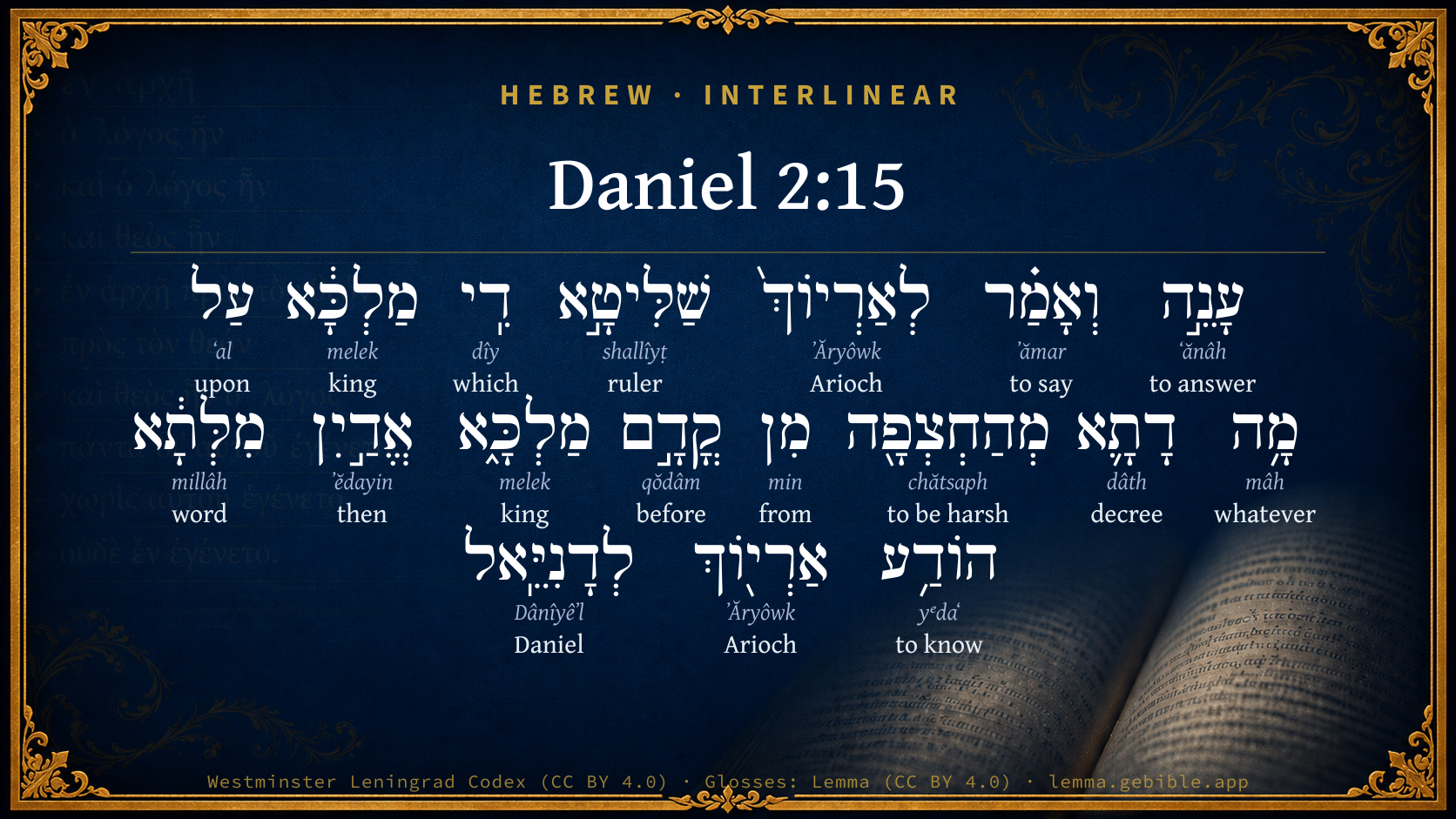
Hebrew (Westminster Leningrad Codex) Daniel 2:15 appears in the Hebrew Old Testament. The text above is from the Westminster Leningrad Codex. Each word links to its Strong’s number, a concise gloss, and parsing drawn from the Open Scriptures Hebrew Bible morphology. Click any word for its full Brown-Driver-Briggs (BDB) entry.
Download image
Cite this verse

Daniel 2:15 (World English Bible). Public Domain. Lemma interlinear Bible study tool, https://lemma.gebible.app/v/daniel/2/15.

Show BibTeX & RIS
BibTeX
RIS
English Translation
he answered Arioch the king's captain, Why is the decree so urgent from the king? Then Arioch made the thing known to Daniel.
World English Bible · Public Domain
Highlights
  • 1 first appearance in the Hebrew Bible
Full analysis ↓
Download a study sheet

One document with this verse’s original text, its word-by-word gloss line, the meaning frame, cross-references with their text, attributed commentary, and full source and license credits — printable, and it pastes into notes with its structure intact.

This verse Autodidact and up

Study sheet (.html) Plain text (.txt)

A passage Seminary Student

Up to 50 verses in one chapter. A passage sheet keeps up to 6 commentary sources and 12 cross-references per verse, in the order this page ranks them, and says so on the sheet whenever that leaves anything out. Ask for a single verse and you get the Autodidact verse sheet above.

Everything on this page stays free to read, with no account — the sheet is a download of what is already on screen, not access to it.

Want to remove ads? Support Godless Engineer
Compare translations 3

The same verse in 3 English versions, stacked beneath the original-language interlinear above. Click any original word for its lexicon entry.

Each is an independent rendering of the whole verse — the interlinear is not word-aligned to these translations.

Highlighted words mark where these versions differ — a whole-verse word diff, not a word-by-word alignment.

  • World English Bible Public Domain
    he answered Arioch the king's captain, Why is the decree so urgent from the king? Then Arioch made the thing known to Daniel.
  • King James Version Public Domain
    He answered and said to Arioch the king's captain, Why is the decree so hasty from the king? Then Arioch made the thing known to Daniel.
  • unfoldingWord Literal Text CC BY-SA 4.0
    He answered and said to Arioch, the commander of the king, “Why is the decree from the king so urgent?” Then Arioch made the matter known to Daniel.

unfoldingWord Literal Text — © unfoldingWord, licensed CC BY-SA 4.0. Word-aligned USFM3 via Door43 (git.door43.org/unfoldingWord/en_ult).

Versions to compare (up to 4)

3 of 4 selected

Show all 18 translations

Every available English version of this verse, each an independent rendering of the whole verse.

  • World English Bible Public Domain
    he answered Arioch the king's captain, Why is the decree so urgent from the king? Then Arioch made the thing known to Daniel.
  • Berean Standard Bible Public Domain
    “Why is the decree from the king so harsh?” he asked. At this time Arioch explained the situation to Daniel.
  • Majority Standard Bible Public Domain
    “Why is the decree from the king so harsh?” he asked. Then Arioch explained the situation to Daniel.
  • King James Version Public Domain
    He answered and said to Arioch the king's captain, Why is the decree so hasty from the king? Then Arioch made the thing known to Daniel.
  • American Standard Version (1901) Public Domain
    he answered and said to Arioch the king's captain, Wherefore is the decree so urgent from the king? Then Arioch made the thing known to Daniel.
  • Revised Version (1885) Public Domain
    he answered and said to Arioch the king’s captain, Wherefore is the decree so urgent from the king? Then Arioch made the thing known to Daniel.
  • Geneva Bible (1599) Public Domain
    Yea, he answered and sayde vnto Arioch the kings captaine, Why is the sentence so hastie from the king? Then Arioch declared the thing to Daniel.
  • Douay-Rheims (1899) Public Domain
    And he asked him that had received the orders of the king, why so cruel a sentence was gone forth from the face of the king. And when Arioch had told the matter to Daniel,
  • Young's Literal Translation Public Domain
    He hath answered and said to Arioch the king's captain, `Wherefore `is' the sentence so urgent from before the king?' Then Arioch hath made the thing known to Daniel,
  • Literal Standard Version CC BY-SA 4.0
    He has answered and said to Arioch the king’s captain, “Why [is] the sentence so urgent from before the king?” Then Arioch has made the thing known to Daniel,
  • Unlocked Literal Bible CC BY-SA 4.0
    Daniel asked the king's commander, “Why is the king's decree so urgent?” So Arioch told Daniel what had happened.
  • unfoldingWord Literal Text CC BY-SA 4.0
    He answered and said to Arioch, the commander of the king, “Why is the decree from the king so urgent?” Then Arioch made the matter known to Daniel.
  • Darby Bible Public Domain
    he answered and said to Arioch the king's captain, Why is the decree so rigorous from the king? Then Arioch made the thing known to Daniel.
  • World Messianic Bible Public Domain
    He answered Arioch the king’s captain, “Why is the decree so urgent from the king?” Then Arioch made the thing known to Daniel.
  • Webster's Bible Public Domain
    He answered and said to Arioch the king's captain, Why is the decree so hasty from the king? Then Arioch made the thing known to Daniel.
  • Free Bible Version CC BY-SA 4.0
    Daniel asked him, “Why would the king issue such a harsh decree?” So Arioch explained to Daniel what had happened.
  • Bible in Basic English Public Domain
    He made answer and said to Arioch, O captain of the king, why is the king's order so cruel? Then Arioch gave Daniel an account of the business.
  • JPS Tanakh (1917) Public Domain
    he answered and said to Arioch the king's captain: 'Wherefore is the decree so peremptory from the king?' Then Arioch made the thing known to Daniel.

Literal Standard Version (2020), Covenant Press — licensed CC BY-SA 4.0. Text via the HelloAO Bible API (eBible.org). Unlocked Literal Bible (unfoldingWord) — licensed CC BY-SA 4.0. Text via the HelloAO Bible API (eBible.org). unfoldingWord Literal Text — © unfoldingWord, licensed CC BY-SA 4.0. Word-aligned USFM3 via Door43 (git.door43.org/unfoldingWord/en_ult). Free Bible Version, Dr. Jonathan Gallagher — licensed CC BY-SA 4.0. Text via the HelloAO Bible API (eBible.org).

Word by word

More ways to search: Search by grammar → Find every occurrence → Compare this word →

Practice this passage: Drill this verse → Learn its vocabulary →

מְהַחְצְפָ֖ה
chătsaph
H2685
“being harsh”
Adjective, V
Part of Speech
Adjective
Full BDB Definition

Origin: a primitive root

TWOT: 2740

(Aphel) to be urgent, harsh, show insolence
  1. עָנֵ֣ה ʻănâh H6032 “answering” Adjective, V
  2. וְאָמַ֗ר ʼămar H560 “and · saying” Adjective, C + Verb, Qal, Participle Active, Masculine, Singular, Absolute
  3. לְאַרְיוֹךְ֙ ʼĂryôwk H746 “to/for · Arioch” Adjective, R + Noun, Proper
  4. שַׁלִּיטָ֣א shallîyṭ H7990 “ruler · the” Adjective, A + Particle, Definite Article
  5. דִֽי dîy H1768 “which” Adjective, T
  6. מַלְכָּ֔א melek H4430 “king · the” Adjective, N, Common + Particle, Definite Article
  7. עַל ʻal H5922 “upon” Adjective, R
  8. מָ֥ה mâh H4101 “whatever” Adjective, T
  9. דָתָ֛א dâth H1882 “decree · the” Adjective, N, Common + Particle, Definite Article
  10. מִן min H4481 “from” Adjective, R
  11. קֳדָ֣ם qŏdâm H6925 “before” Adjective, R
  12. מַלְכָּ֑א melek H4430 “king · the” Adjective, N, Common + Particle, Definite Article
  13. אֱדַ֣יִן ʼĕdayin H116 “then” Adjective, D
  14. מִלְּתָ֔א millâh H4406 “word · the” Adjective, N, Common + Particle, Definite Article
  15. הוֹדַ֥ע yᵉdaʻ H3046 “to know” Adjective, V, Plural
  16. אַרְי֖וֹךְ ʼĂryôwk H746 “Arioch” Adjective, N
  17. לְדָנִיֵּֽאל Dânîyêʼl H1841 “to/for · Daniel” Adjective, R + Noun, Proper

About this verse

These counts appear in no published source. They are computed here, from the morphology-tagged text and Lemma’s own curated glosses. What Lemma adds →

18
words
16
distinct lemmas
Prophets
section

Notable vocabulary

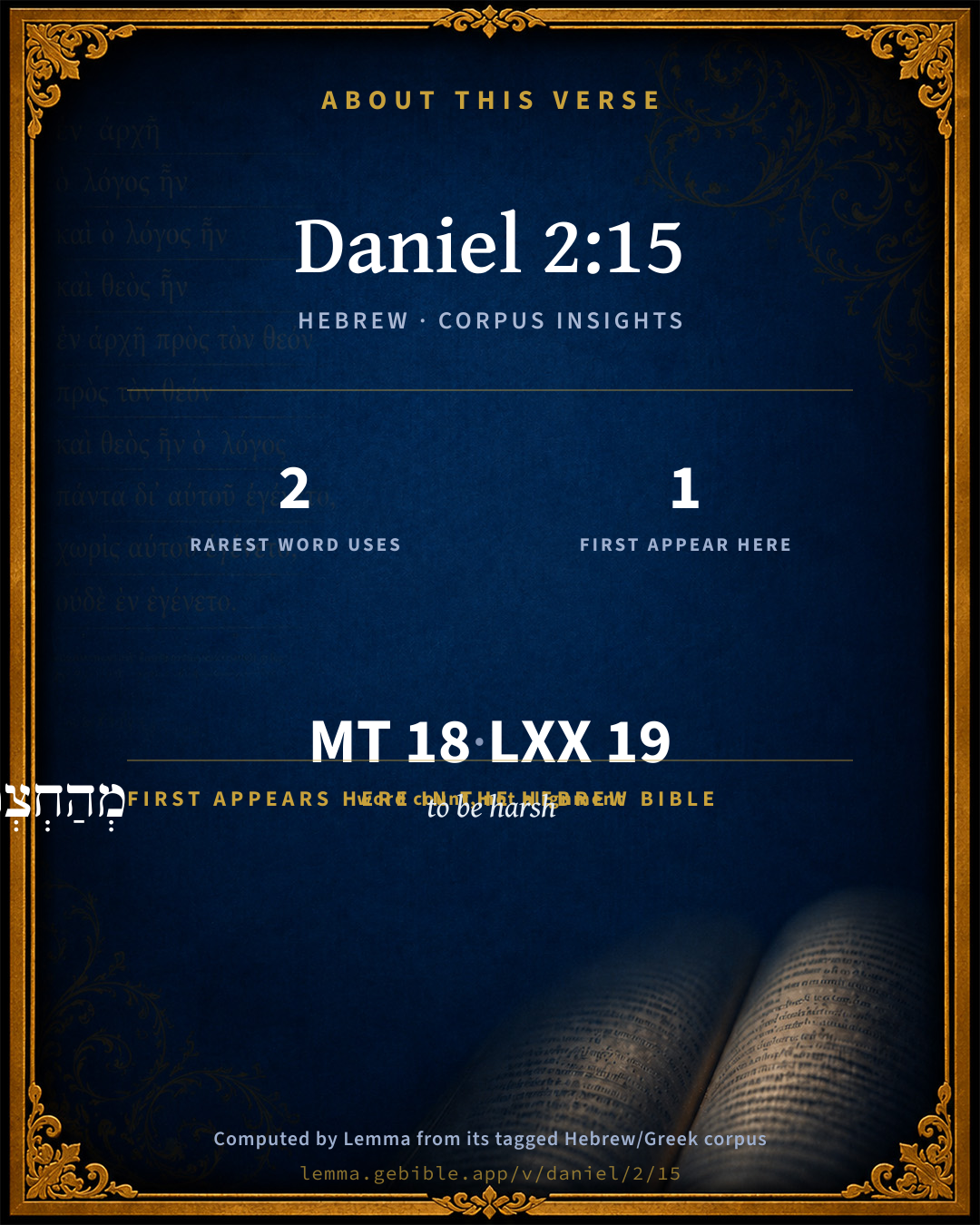
The rarest word here is מְהַחְצְפָ֖ה to be harsh H2685 — appearing just 2 times in the whole Hebrew Bible.

First appearance in Scripture

This word makes its first canonical appearance in the Hebrew Bible here:

  • מְהַחְצְפָ֖ה to be harsh H2685

Shared distinctive vocabulary

מְהַחְצְפָ֖ה to be harsh H2685 occurs in 2 verses of the Hebrew Bible. Also found in:

Grammatical profile

  • 1 verb
  • 2 nouns
  • 10 adjectives
  • 5 particles

Verb forms

  • וְאָמַ֗ר Qal · Participle Active

Repetition

Words recur within this verse — often emphatic in Hebrew:

  • לְאַרְיוֹךְ֙ Arioch H746 ×2
  • מַלְכָּ֔א king H4430 ×2

Hebrew & Septuagint length

In English translation the verse runs 23 words from the Hebrew and 22 from the Septuagint (LXX English) — closely comparable.

A rough comparison of the two English renderings, which tokenize alike — not a word-level alignment.

Word counts can differ between the Hebrew and the Greek without any difference in meaning — e.g. the Hebrew direct-object marker אֵת has no separate Greek word, and Greek often adds the article ὁ.

In the original languages it is 18 Hebrew tokens and 19 Greek tokens — but the two are counted differently (Hebrew bundles its prefixes and suffixes into one token; the Greek is in lemma form), so that isn’t a like-for-like length.

Hebrew and Greek witnesses Masoretic Hebrew ↔ Greek Septuagint

The same verse in the two great witnesses to the Old Testament, shown verse-for-verse.

These are two independent witnesses, not word-aligned to each other, and the Septuagint is shown in lemma (dictionary) form.

Hebrew Daniel 2:15 Masoretic · Westminster Leningrad Codex

עָנֵ֣ה וְאָמַ֗ר לְאַרְיוֹךְ֙ שַׁלִּיטָ֣א דִֽי מַלְכָּ֔א עַל מָ֥ה דָתָ֛א מְהַחְצְפָ֖ה מִן קֳדָ֣ם מַלְכָּ֑א אֱדַ֣יִן מִלְּתָ֔א הוֹדַ֥ע אַרְי֖וֹךְ לְדָנִיֵּֽאל

he answered Arioch the king's captain, Why is the decree so urgent from the king? Then Arioch made the thing known to Daniel.

World English Bible · Public Domain

Greek LXX Daniel 2:15 Septuagint · lemma form

καί πυνθάνομαι αὐτός λέγω περί τίς δογματίζω πικρῶς παρά ὁ βασιλεύς τότε ὁ πρόσταγμα σημαίνω ὁ αριώχης ὁ δανιηλ

Chief magistrate of the king, therefore has the preemptory command proceeded from the king? So Arioch made known the matter to Daniel.

LXX2012 (modern English Septuagint) · Public Domain

On this verse, Joseph Benson's Commentary discusses the Septuagint’s reading. Read the note in Commentary ↓

Hebrew: Westminster Leningrad Codex (CC BY 4.0). Greek: Septuagint (public domain); English from LXX2012 (modern English Septuagint) (Public Domain). How the Septuagint differs from the Hebrew →

Commentary

Notes on Daniel 2:15 from classic Christian and Jewish commentators (each source and its license shown beneath its notes). The classic Christian expositions comment on the surrounding passage and are grouped to its opening verse, so a note may address several verses; the Jewish commentaries on the Tanakh (Rashi and others) are per-verse, so they appear only where the commentator wrote on this verse.

Lemma curates 59 commentaries, every one of them public domain or Creative Commons licensed, each selected and text-cleaned for this edition rather than reprinted as found. About our sources →

Trapp's Complete Commentary

John Trapp

Dan 2:15 He answered and said to Arioch the king’s captain, Why [is] the decree [so] hasty from the king? Then Arioch made the thing known to Daniel.

Ver. 15. Why is the decree so hasty from the king?] Daniel, though now in danger of his life, forgetteth not his old freedom of speech; and God so wrought, that the king, who was stiff to the magicians, was tractable to Daniel. {Dan 2:16}

John Trapp, A Commentary or Exposition upon All the Books of the Old and New Testament (1647–1656) — public domain. Text from a community e-Sword module.

Matthew Poole's English Annotations

So hasty; so precipitate, to slay the innocent who were never called, who knew nothing of it-this appears plainly from these words,

Then Arioch made the thing known to Daniel, Dan 2:15, which was this, that the king had dreamed a strange dream that troubled him, that he had forgotten it, that he called all his wise men to show both the dream and interpretation, but they could not; therefore the king decreed the death of all the wise men in Babylon, and Daniel with his fellows among them, without saving the life of one of them, and he, viz. Arioch, had received command to execute it presently. Thus there was but a step between him and death.

Matthew Poole's English Annotations on the Holy Bible (1683–1685) — public domain. Text from a community e-Sword/MySword module.

Joseph Benson's Commentary

Dan 2:15-16. Why is the decree so hasty from the king? — So precipitate, or, as Wintle renders it, so urgent, to slay the innocent, who were never called, and knew nothing of the matter? The word מהחצפה, here used, signifies both hasty and pressing. So the Syriac. The LXX. render it, η αναιδης, shameful; the Vulgate translates the verse thus: He (namely, Daniel) asked him who had received authority from the king, for what reason so cruel a sentence had gone forth from the presence of the king? Then Arioch made the thing known to Daniel — Acquainted him with the whole affair, of which, it is evident, he knew nothing before. Then Daniel went in — Or, went up, as עלproperly signifies; that is, either to the palace or throne of the king; and desired of the king that he would give him time, &c. — The king’s anger was now abated; and withal the providence of God was visible, in inclining the king’s heart to allow Daniel that favour which he had before denied to the magicians; and that he would show the king the interpretation — Daniel promised this, in confidence that God, to whom he intended to make application by prayer, would discover to him both the dream and its interpretation. Doubtless God inspired him with a persuasion to this purpose.

Joseph Benson's Commentary on the Old and New Testaments (1811–1818) — public domain. Text from a community e-Sword module.

Ibn Ezra

Rabbi Abraham ibn Ezra

[Daniel 2:15] ʿAneh v'amar (עָנֵה וְאָמַר - Answered and said): The meaning of urgent/harsh (mehachtz'fah - מְהַחְצְפָה) is hastiness/urgency (mehirut - מְהִירוּת). Then (Edayin - אֱדַיִן) Arioch informed Daniel [of the matter], so that he [Daniel] could come and request time for himself. And so he [Daniel] did. And Daniel came and requested from the king, [perhaps framing his need for time with words similar to those] in the Holy Tongue [Hebrew, from Isaiah 21:12]: “If you would inquire, inquire” (im tivʿayun beʿayu - אִם־תִּבְעָיוּן בְּעָיוּ).

Ibn Ezra on the Tanakh — English translations: “Sefaria Community Translation” (CC0 1.0 (public-domain dedication)); “Yalkut, Sifsei Chachomim Chumash, Metsudah Publications, 2009” (CC BY 4.0); and “Commentary of Ibn Ezra on Isaiah - trans. by M. Friedlander, 1873” (public domain). Text via Sefaria.

Jamieson, Fausset & Brown

Robert Jamieson, A. R. Fausset & David Brown

Why is the decree so hasty--Why were not all of us consulted before the decree for the execution of all was issued?

the thing--the agitation of the king as to his dream, and his abortive consultation of the Chaldeans. It is plain from this that Daniel was till now ignorant of the whole matter.

Jamieson, Fausset & Brown — Commentary Critical and Explanatory on the Whole Bible (1871) — public domain (CC PDM 1.0). Text via the HelloAO Bible API.

John Calvin's Commentaries

Daniel also had said, Whither does the edict haste from before the king? It seems by these words, that Daniel obliquely blames the king’s anger and ingratitude, because he did not inquire with sufficient diligence before he rushed forward to that cruel punishment. Then he seems to mark his ingratitude, since he is now undeservedly doomed to death without being sent for, though the king might have known what was in him. As he refers to haste, I do not doubt his expostulating with the king, since he was neither called for nor listened to, and yet was to be slain with the rest, as if he were guilty of the same fault as the Chaldeans. The conclusion is, — there was no reason for such haste, since the king would probably find what he desired, if he inquired more diligently. It is afterwards added, Arioch explained the matter to Daniel. Whence it appears that Daniel was formerly ignorant of the whole matter; and hence we may conjecture the amount of the terror which seized upon the pious man. For he had known nothing about it, and was led to punishment suddenly and unexpectedly, as if he had been guilty. Hence, it was necessary for him to be divinely strengthened, that he might with composure seek the proper time from both the prefect and the king, for relating the dream and adding its interpretation. Daniel’s power of acting so composedly, arose from God’s singular gift, since terror would otherwise have seized on his mind; for we are aware that in sudden events, we become deprived of all plan, and lose our presence of mind. Since nothing of this kind was perceived in Daniel, it becomes clear that his mind was governed by God’s Spirit. It is afterwards added-

John Calvin's Commentaries (1540-1563) — public domain. Text from the Calvin Translation Society English edition (1840s-50s) via the Christian Classics Ethereal Library (ccel.org). Calvin's coverage is partial (roughly two-thirds of the Bible); uncommented books and verses are honest gaps, never fabricated. The 19th-century editor's footnotes and remarks are omitted so the notes are faithfully Calvin's own voice.

Ellicott's Commentary for English Readers

(15) So hasty.—Literally, why is this severe decree of the king? By this question Daniel wished Arioch to understand that after all the matter was not impossible, as the wise men had stated it to be.

A Bible Commentary for English Readers, edited by Charles John Ellicott (1878–1897) — public domain. Text from a community e-Sword module.

The Cambridge Bible for Schools and Colleges

gen. ed. J. J. S. Perowne

15. so hasty] harsh (Bevan). R.V. urgent, as A.V. itself has in Dan_3:22. This is not, however, strong enough: in Syriac and the Targums the word and its cognates express the idea of bold, shameless, insolent. Cf. Theod. here, ἀναιδής (LXX. πικρῶς).

The Cambridge Bible for Schools and Colleges (gen. ed. J. J. S. Perowne; Cambridge University Press, 1878–1918) — public domain. Text from a community e-Sword module.

John Gill's Exposition

And he answered and said to Arioch the king's captain,.... Or governor (m); over the persons before mentioned; either the king's guard or militia, or cooks or executioners: before, the manner in which Daniel answered is observed; here, the matter of it, as follows:

why is the decree so hasty from the King? or, "why this rash", hasty, or cruel (as the Vulgate Latin version) decree from the king? for so it was: what is the cause and reason of it?

then Arioch made the thing known to Daniel; who before was ignorant of it; he was not with the wise men before the king; either they did not care he should go with them, and therefore called him not; or he did not choose to go himself, being under no temptation by the rewards offered, and especially having no summons from the king himself: this being his case, Arioch informs him of the whole affair; how that the king had dreamed a dream, and forgot it; and had sent for the wise men to tell him both it and the interpretation; but they not being able to do it, and declaring also that it was impossible to be done, the king had given orders to slay all of that character.

(m) "dominatori", Junius &, Tremellius, Piscator, Broughtonus,

John Gill's Exposition of the Whole Bible (1746–1763) — public domain (CC PDM 1.0). Text via the HelloAO Bible API.

Albert Barnes' Notes on the Bible

He answered and said to Arioch the king’s captain - The word “captain” - a different word from what occurs in Dan 2:14, שׁליטא shallı̂yṭa' - denotes one who has rule or dominion; one who is powerful or mighty; and it would be applied only to one who sustained a post of honor and responsibility. See the use of the word שׁלט shālaṭ, as meaning “to rule,” in Neh 5:15; Ecc 2:19; Ecc 6:2; Ecc 8:9; Est 9:1; Psa 119:133. The word here used is the same which occurs in Dan 2:10, where it is rendered “ruler.” It doubtless denotes here an officer of rank, and designates one of more honorable employment than would be denoted by the word “executioner.” It should be said on these verses Dan 2:14-15, however, that the office of executioner in the East was by no means regarded as a dishonorable office. It was entrusted to those high in rank, and even nobles considered it an honor, and often boasted of it as such, that among their ancestors there were those who had in this way been entrusted with executing the commands of their sovereign. Hanway and AbdulKerim both say that this office conferred honor and rank. Tournefort says, that in Georgia “the executioners are very rich, and men of standing undertake this employment; far different from what occurs in other parts of the world, in that country this gives to a family a title of honor. They boast that among their ancestors there were many who were executioners; and this they base on the sentiment, that nothing is more desirable than justice, and that nothing can be more honorable than to be engaged in administering the laws.” See Rosenmuller, Morgenland, 1079.

Why is the decree so hasty from the king? - Implying that all the effort had not been made which it was possible to make to solve the mystery. The idea is, that a decree of such a nature, involving so many in ruin, ought not to have proceeded from the king without having taken all possible precautions, and having made all possible efforts to find those who might be able to disclose what the king desired. It was to Daniel a just matter of surprise that, after the favor and honor with which he had been received at court Dan 1:19-20, and the confidence which had been reposed in him, a command like this should have been issued. so comprehensive as to embrace him and his friends, when they had done nothing to deserve the displeasure of the king.

Then Arioch made the thing known to Daniel - The statement respecting the dream; the trouble of the king; the consultation of the magicians; their inability to explain the dream, and the positive command to put all the pretenders to wisdom to death. It is clear that Daniel had not before been informed of these things.

Albert Barnes' Notes on the Bible (1834–1885) — public domain. Text from a community e-Sword/MySword module.

Haydock's Catholic Bible Commentary

Cruel. Chaldee also, "precipitate." (Calmet)

George Leo Haydock (1774–1849), Haydock's Catholic Family Bible and Commentary, 1859 edition — public domain. Excludes Psalms (Douay-Rheims chapter numbering differs from Protestant) and Deuterocanonical books (Catholic canon only).

The Pulpit Commentary

He answered and said to Arioch the king"s captain, Why is the decree so hasty from the king? Then Arioch made the thing known to Daniel. The opening clause in this verse is doubtful. In the Septuagint the verse is rendered, "And he asked him saying, Ruler, why is it decreed so bitterly by the king? And he showed him the warrant." Theodotion is yet briefer, "Ruler of the king, why has so harsh a sentence come forth from the king? And he declared (ejgnwrise) to him his orders." But briefest of all is the Peshitta. It begins at once without any address, "Why is this harsh decree from the king? And Arioch showed the matter (miltha) to Daniel." As a rule, the shorter a reading is the better it is. Therefore we are inclined to prefer the Peshitta rendering. "Answered and said" is a formula that might easily be stuck in where anything of the kind seemed needed. Here it is not suitable, as Daniel is already said to have "answered Arioch with counsel and prudence." The addition of the Septuagint is more reasonable, "He asked him saying, Ruler." Theodotion feels some title is necessary, so he calls Arioch "ruler of the king." It appears to us that the brief Peshitta represents the best text. Hasty repesents to some extent, though not fully, the clement of blame implied in the word mehahetzpah in greater degree than our English word would indicate. It means" rough," "raging," "shameless;" it might be too strong to say that "scandalous" represents Daniel"s meaning. Some commentators cannot imagine a man thus criticizing a royal decree to one of the court officials. Much, however, is permitted to a man speaking about a decree which has condemned him to death without his having an opportunity to defend himself It is possible that he might be able to use all the more freedom by seeing that Arioch had no favour for the business to which he was ordered. The Greek versions represent that Arioch showed the warrant, the king"s order for the execution. As that would not be considered an answer to Daniel"s question, on the one hand, so on the other, it would not be an occasion for the step Daniel immediately thereafter took. We think, on the whole, that the Massoretic reading amended here by the Peshitta is the better. As leader of the royal bodyguard, the place of Arioch would be beside Nebuchadnezzar, even in the council-chamber. He would thus be quite cognizant of everything that took place the demands of the king, the arguments of the wise men. All this scene he could portray for the information of Daniel. The mere exhibition of a warrant would tell nothing more than the fact that the action of Arioch was in obedience to orders.

The Pulpit Commentary (1880–1919), ed. H.D.M. Spence-Jones & Joseph S. Exell — public domain. Text from a community e-Sword module.

Rashi

Rabbi Shlomo Yitzchaki (Rashi)

Why was the decree issued so hastily Why is the decree of the king [issued] in such a haste to kill?

Then Arioch made the matter known to Daniel that the king was angry because no one told him his dream.

Rashi on the Tanakh — English translations: “The Judaica Press complete Tanach with Rashi, translated by A. J. Rosenberg” (CC BY 4.0); “Pentateuch with Rashi's commentary by M. Rosenbaum and A.M. Silbermann, 1929-1934” (public domain); “The Metsudah Tanach series, Lakewood, N.J” (CC BY 4.0); and “The Book of Joshua, Metsudah Publications, 1997” (CC BY 4.0). Text via Sefaria.

Lesson kit

Teaching starters — assembled from the data on this page, not authored interpretation. Every prompt links to the verse data it draws on. Edit before teaching.

Daniel, in the Prophets, opens this verse with 18 words (16 distinct Hebrew lemmas). Its most distinctive word is chătsaph (“to be harsh”). A historical commentator’s framing appears above. Read the whole chapter for the surrounding context.

Discussion questions

  1. What does “to be harsh” (chătsaph) contribute to the verse as a whole?
  2. This is the first place “to be harsh” appears in Scripture (first appears here). What does its debut here establish?
  3. How does Daniel 3:22, which shares the word «to be harsh», read alongside this verse?
  4. What does the repetition of “Arioch” (2× in this one verse) do in this verse?
  5. The translations on this page render this verse differently — a whole-verse word diff, not a word-by-word alignment. What might account for the different wordings?
  6. «וְאָמַ֗ר» is a Qal Participle Active verb. How does that grammatical form shape the action described?
  7. Compare how Trapp's Complete Commentary and Matthew Poole's English Annotations read this verse. Where do they agree or differ?

Things to notice

Reading settings

Reading text

Shown beneath each verse's original-language words.

Old Testament
Old Testament edition

Read the OT as the Masoretic Hebrew (MT) or the Greek Septuagint (LXX).

English shown for the Greek Septuagint (in the Hebrew ↔ Greek comparison).

Comparing translations? Open the Compare panel on any verse page to stack up to four side by side.