
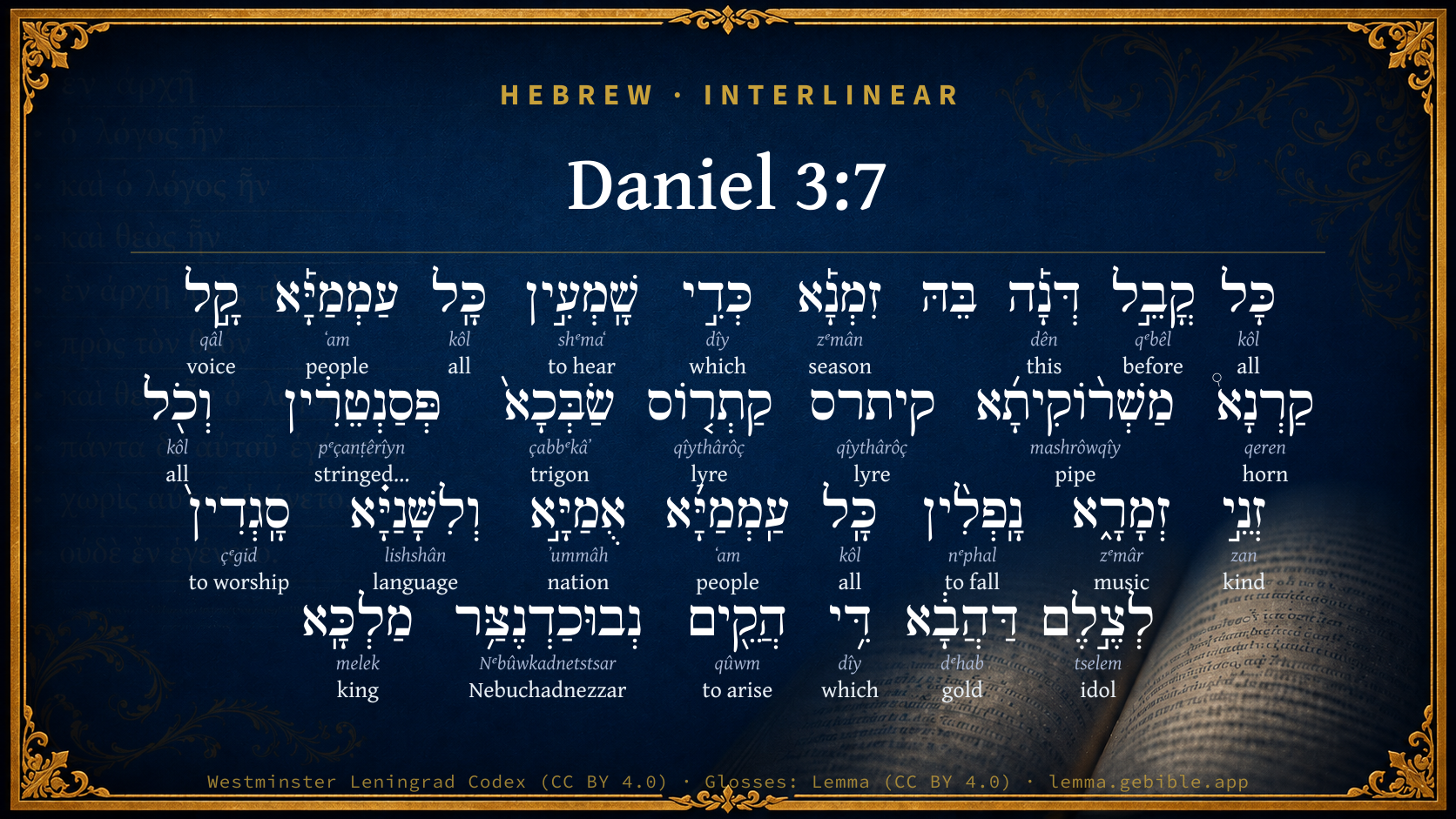
Daniel 3:7

Hebrew (Westminster Leningrad Codex) Daniel 3:7 appears in the Hebrew Old Testament. The text above is from the Westminster Leningrad Codex. Each word links to its Strong’s number, a concise gloss, and parsing drawn from the Open Scriptures Hebrew Bible morphology. Click any word for its full Brown-Driver-Briggs (BDB) entry.
Download image
Cite this verse

Daniel 3:7 (World English Bible). Public Domain. Lemma interlinear Bible study tool, https://lemma.gebible.app/v/daniel/3/7.

Show BibTeX & RIS
BibTeX
RIS
English Translation
Therefore at that time, when all the peoples heard the sound of the horn, flute, zither, lyre, harp, pipe, and all kinds of music, all the peoples, the nations, and the languages, fell down and worshiped the golden image that Nebuchadnezzar the king had set up.
World English Bible · Public Domain
Download a study sheet

One document with this verse’s original text, its word-by-word gloss line, the meaning frame, cross-references with their text, attributed commentary, and full source and license credits — printable, and it pastes into notes with its structure intact.

This verse Autodidact and up

Study sheet (.html) Plain text (.txt)

A passage Seminary Student

Up to 50 verses in one chapter. A passage sheet keeps up to 6 commentary sources and 12 cross-references per verse, in the order this page ranks them, and says so on the sheet whenever that leaves anything out. Ask for a single verse and you get the Autodidact verse sheet above.

Everything on this page stays free to read, with no account — the sheet is a download of what is already on screen, not access to it.

Want to remove ads? Support Godless Engineer
Compare translations 3

The same verse in 3 English versions, stacked beneath the original-language interlinear above. Click any original word for its lexicon entry.

Each is an independent rendering of the whole verse — the interlinear is not word-aligned to these translations.

Highlighted words mark where these versions differ — a whole-verse word diff, not a word-by-word alignment.

  • World English Bible Public Domain
    Therefore at that time, when all the peoples heard the sound of the horn, flute, zither, lyre, harp, pipe, and all kinds of music, all the peoples, the nations, and the languages, fell down and worshiped the golden image that Nebuchadnezzar the king had set up.
  • King James Version Public Domain
    Therefore at that time, when all the people heard the sound of the cornet, flute, harp, sackbut, psaltery, and all kinds of musick, all the people, the nations, and the languages, fell down and worshipped the golden image that Nebuchadnezzar the king had set up.
  • unfoldingWord Literal Text CC BY-SA 4.0
    Therefore at that time, when all the peoples heard the sound of the horn, flute, lyre, trigon, harp and all kinds of music, all the peoples, nations, and languages fell down and worshipped the golden image that King Nebuchadnezzar had set up.

unfoldingWord Literal Text — © unfoldingWord, licensed CC BY-SA 4.0. Word-aligned USFM3 via Door43 (git.door43.org/unfoldingWord/en_ult).

Versions to compare (up to 4)

3 of 4 selected

Show all 18 translations

Every available English version of this verse, each an independent rendering of the whole verse.

  • World English Bible Public Domain
    Therefore at that time, when all the peoples heard the sound of the horn, flute, zither, lyre, harp, pipe, and all kinds of music, all the peoples, the nations, and the languages, fell down and worshiped the golden image that Nebuchadnezzar the king had set up.
  • Berean Standard Bible Public Domain
    Therefore, as soon as all the people heard the sound of the horn, flute, zither, lyre, harp, and all kinds of music, the people of every nation and language would fall down and worship the golden statue that King Nebuchadnezzar had set up.
  • Majority Standard Bible Public Domain
    Therefore, as soon as all the people heard the sound of the horn, flute, zither, lyre, harp, and all kinds of music, the people of every nation and language would fall down and worship the golden statue that King Nebuchadnezzar had set up.
  • King James Version Public Domain
    Therefore at that time, when all the people heard the sound of the cornet, flute, harp, sackbut, psaltery, and all kinds of musick, all the people, the nations, and the languages, fell down and worshipped the golden image that Nebuchadnezzar the king had set up.
  • American Standard Version (1901) Public Domain
    Therefore at that time, when all the peoples heard the sound of the cornet, flute, harp, sackbut, psaltery, and all kinds of music, all the peoples, the nations, and the languages, fell down and worshipped the golden image that Nebuchadnezzar the king had set up.
  • Revised Version (1885) Public Domain
    Therefore at that time, when all the peoples heard the sound of the cornet, flute, harp, sackbut, psaltery, and all kinds of music, all the peoples, the nations, and the languages, fell down and worshipped the golden image that Nebuchadnezzar the king had set up.
  • Geneva Bible (1599) Public Domain
    Therefore assoone as all the people heard the sound of the cornet, trumpet, harpe, sackebut, psalterie, and all instruments of musike, all the people, nations, and languages fell downe, and worshipped the golden image, that Nebuchad-nezzar the King had set vp.
  • Douay-Rheims (1899) Public Domain
    Upon this therefore, at the time when all the people heard the sound of the trumpet, the flute, and the harp, of the sackbut, and the psaltery, of the symphony, and of all kind of music: all the nations, tribes, and languages fell down and adored the golden statue which king Nabuchodonosor had set up.
  • Young's Literal Translation Public Domain
    Therefore at that time, when all the peoples are hearing the voice of the cornet, the flute, the harp, the sackbut, the psaltery, and all kinds of music, falling down are all the peoples, nations and languages, doing obeisance to the golden image that Nebuchadnezzar the king hath raised up.
  • Literal Standard Version CC BY-SA 4.0
    Therefore at that time, when all the peoples are hearing the voice of the horn, the flute, the harp, the lyre, the stringed instrument, and all kinds of music, falling down are all the peoples, nations and languages, worshiping the golden image that Nebuchadnezzar the king has raised up.
  • Unlocked Literal Bible CC BY-SA 4.0
    So when all the peoples heard the sounds of the horns, flutes, zithers, lyres, harps, and pipes, and all kinds of music, all the peoples, nations, and languages fell down and prostrated themselves to the golden statue that Nebuchadnezzar the king had set up.
  • unfoldingWord Literal Text CC BY-SA 4.0
    Therefore at that time, when all the peoples heard the sound of the horn, flute, lyre, trigon, harp and all kinds of music, all the peoples, nations, and languages fell down and worshipped the golden image that King Nebuchadnezzar had set up.
  • Darby Bible Public Domain
    Therefore at that time when all the peoples heard the sound of the cornet, pipe, lute, sambuca, psaltery, and all kinds of music, all the peoples, the nations, and the languages fell down [and] worshipped the golden image that Nebuchadnezzar the king had set up.
  • World Messianic Bible Public Domain
    Therefore at that time, when all the peoples heard the sound of the horn, flute, zither, lyre, harp, pipe, and all kinds of music, all the peoples, the nations, and the languages fell down and worshiped the golden image that Nebuchadnezzar the king had set up.
  • Webster's Bible Public Domain
    Therefore at that time, when all the people heard the sound of the cornet, flute, harp, sackbut, psaltery, and all kinds of music, all the people, the nations, and the languages, fell down and worshiped the golden image that Nebuchadnezzar the king had set up.
  • Free Bible Version CC BY-SA 4.0
    So when all the people heard the sound of the musical instruments they all fell down—the people of all nations and languages worshiped the gold statue that King Nebuchadnezzar had set up.
  • Bible in Basic English Public Domain
    So at that time, all the people, when the sound of the horn, pipe, harp, trigon, psaltery, and all sorts of instruments, came to their ears, went down on their faces in worship before the image of gold which Nebuchadnezzar the king had put up.
  • JPS Tanakh (1917) Public Domain
    Therefore at that time, when all the peoples heard the sound of the horn, pipe, harp, trigon, psaltery, and all kinds of music, all the peoples, the nations, and the languages, fell down and worshipped the golden image that Nebuchadnezzar the king had set up.

Literal Standard Version (2020), Covenant Press — licensed CC BY-SA 4.0. Text via the HelloAO Bible API (eBible.org). Unlocked Literal Bible (unfoldingWord) — licensed CC BY-SA 4.0. Text via the HelloAO Bible API (eBible.org). unfoldingWord Literal Text — © unfoldingWord, licensed CC BY-SA 4.0. Word-aligned USFM3 via Door43 (git.door43.org/unfoldingWord/en_ult). Free Bible Version, Dr. Jonathan Gallagher — licensed CC BY-SA 4.0. Text via the HelloAO Bible API (eBible.org).

Word by word

More ways to search: Search by grammar → Find every occurrence → Compare this word →

Practice this passage: Drill this verse → Learn its vocabulary →

מַשְׁר֨וֹקִיתָ֜א
mashrôwqîy
H4953
“pipe · the”
Adjective, N, Common + Particle, Definite Article
Part of Speech
Adjective + Particle
Type
Definite Article
Full BDB Definition

Origin: from a root corresponding to H8319

TWOT: 3049a

pipe
  1. כָּל kôl H3606 “all” Adjective, C + Conjunction
  2. קֳבֵ֣ל qᵉbêl H6903 “before” Adjective, C
  3. דְּנָ֡ה dên H1836 “this” Adjective, C
  4. זִמְנָ֡א zᵉmân H2166 “season · the” Adjective, N, Common + Particle, Definite Article
  5. כְּדִ֣י dîy H1768 “like/as · which” Adjective, R + Particle, Relative
  6. שָֽׁמְעִ֣ין shᵉmaʻ H8086 “hearing” Adjective, V
  7. כָּֽל kôl H3606 “all of” Adjective, N, Common
  8. עַמְמַיָּ֡א ʻam H5972 “peoples · the” Adjective, N, Common + Particle, Definite Article
  9. קָ֣ל qâl H7032 “voice of” Adjective, N, Common
  10. קַרְנָא֩ qeren H7162 “horn · the” Adjective, N, Common + Particle, Definite Article
  11. קיתרס qîythârôç H7030 “lyre” Adjective, N, Common
  12. קַתְר֤וֹס qîythârôç H7030 “lyre” Adjective, N, Common
  13. שַׂבְּכָא֙ çabbᵉkâʼ H5443 “trigon” Adjective, N, Common
  14. פְּסַנְטֵרִ֔ין pᵉçanṭêrîyn H6460 “stringed instrument” Adjective, N, Common
  15. וְכֹ֖ל kôl H3606 “and · all of” Adjective, C + Noun, Common, Masculine, Singular, Construct
  16. זְנֵ֣י zan H2178 “kinds of” Adjective, N, Common
  17. זְמָרָ֑א zᵉmâr H2170 “music · the” Adjective, N, Common + Particle, Definite Article
  18. נָֽפְלִ֨ין nᵉphal H5308 “falling” Adjective, V
  19. כָּֽל kôl H3606 “all of” Adjective, N, Common
  20. עַֽמְמַיָּ֜א ʻam H5972 “peoples · the” Adjective, N, Common + Particle, Definite Article
  21. אֻמַיָּ֣א ʼummâh H524 “nations · the” Adjective, N, Common + Particle, Definite Article
  22. וְלִשָּׁנַיָּ֗א lishshân H3961 “and · languages · the” Adjective, C + Noun, Common, Masculine, Plural, Determined + Particle, Definite Article
  23. סָֽגְדִין֙ çᵉgid H5457 “worshiping” Adjective, V
  24. לְצֶ֣לֶם tselem H6755 “to/for · idol of” Adjective, R + Noun, Common, Masculine, Singular, Construct
  25. דַּהֲבָ֔א dᵉhab H1722 “gold · the” Adjective, N, Common + Particle, Definite Article
  26. דִּ֥י dîy H1768 “which” Adjective, T
  27. הֲקֵ֖ים qûwm H6966 “to arise” Adjective, V, Plural
  28. נְבוּכַדְנֶצַּ֥ר Nᵉbûwkadnetstsar H5020 “Nebuchadnezzar” Adjective, N
  29. מַלְכָּֽא melek H4430 “king · the” Adjective, N, Common + Particle, Definite Article

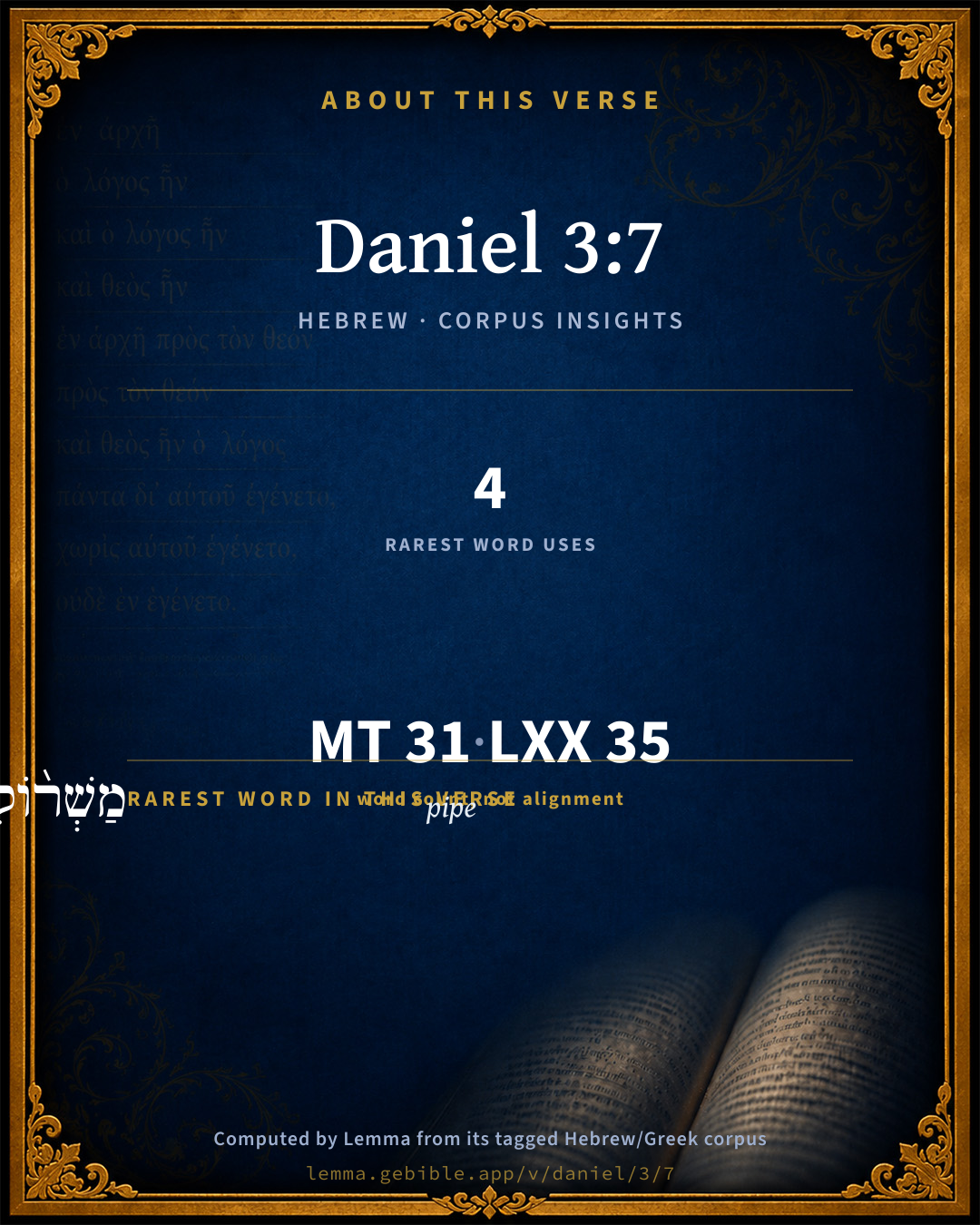
About this verse

These counts appear in no published source. They are computed here, from the morphology-tagged text and Lemma’s own curated glosses. What Lemma adds →

31
words
24
distinct lemmas
Prophets
section

Notable vocabulary

The rarest word here is מַשְׁר֨וֹקִיתָ֜א pipe H4953 — appearing just 4 times in the whole Hebrew Bible.

Shared distinctive vocabulary

מַשְׁר֨וֹקִיתָ֜א pipe H4953 occurs in 4 verses of the Hebrew Bible. Also found in:

Grammatical profile

  • 2 nouns
  • 17 adjectives
  • 1 conjunction
  • 11 particles

Repetition

Words recur within this verse — often emphatic in Hebrew:

  • כָּל all H3606 ×4
  • עַמְמַיָּ֡א people H5972 ×2
  • קיתרס lyre H7030 ×2
  • כְּדִ֣י which H1768 ×2

Hebrew & Septuagint length

In English translation the verse runs 46 words from the Hebrew and 46 from the Septuagint (LXX English) — the same length.

A rough comparison of the two English renderings, which tokenize alike — not a word-level alignment.

Word counts can differ between the Hebrew and the Greek without any difference in meaning — e.g. the Hebrew direct-object marker אֵת has no separate Greek word, and Greek often adds the article ὁ.

In the original languages it is 31 Hebrew tokens and 35 Greek tokens — but the two are counted differently (Hebrew bundles its prefixes and suffixes into one token; the Greek is in lemma form), so that isn’t a like-for-like length.

Cross-references

9

Topical passages linked to Daniel 3:7 in the Treasury of Scripture Knowledge — connected by theme and wording, ordered by reader-vote popularity; previews shown in the World English Bible.

  • Jeremiah 51:7 Babylon has been a golden cup in Yahweh's hand, who made all the earth drunken: the nations have drunk of her wine; therefore the nations are mad.
  • 1 John 5:19 We know that we are of God, and the whole world lies in the power of the evil one.
  • Revelation 12:9 The great dragon was thrown down, the old serpent, he who is called the devil and Satan, the deceiver of the whole world. He was thrown down to the earth, and his angels were thrown down with him.
  • Revelation 13:3 One of his heads looked like it had been wounded fatally. His fatal wound was healed, and the whole earth marveled at the beast.
  • Revelation 13:8 All who dwell on the earth will worship him, everyone whose name has not been written from the foundation of the world in the book of life of the Lamb who has been killed.
  • Revelation 13:14 He deceives my own people who dwell on the earth because of the signs he was granted to do in front of the beast; saying to those who dwell on the earth, that they should make an image to the beast who had the sword wound and lived.
  • Revelation 17:8 The beast that you saw was, and is not; and is about to come up out of the abyss and to go into destruction. Those who dwell on the earth and whose names have not been written in the book of life from the foundation of the world will marvel when they see that the beast was, and is not, and shall be present.
  • Revelation 19:20 The beast was taken, and with him the false prophet who worked the signs in his sight, with which he deceived those who had received the mark of the beast and those who worshiped his image. These two were thrown alive into the lake of fire that burns with sulfur.
  • Acts 14:16 who in the generations gone by allowed all the nations to walk in their own ways.

Cross-references courtesy of OpenBible.info (CC BY 4.0).

Hebrew and Greek witnesses Masoretic Hebrew ↔ Greek Septuagint

The same verse in the two great witnesses to the Old Testament, shown verse-for-verse.

These are two independent witnesses, not word-aligned to each other, and the Septuagint is shown in lemma (dictionary) form.

Hebrew Daniel 3:7 Masoretic · Westminster Leningrad Codex

כָּל קֳבֵ֣ל דְּנָ֡ה בֵּהּ זִמְנָ֡א כְּדִ֣י שָֽׁמְעִ֣ין כָּֽל עַמְמַיָּ֡א קָ֣ל קַרְנָא֩ מַשְׁר֨וֹקִיתָ֜א קיתרס קַתְר֤וֹס שַׂבְּכָא֙ פְּסַנְטֵרִ֔ין וְכֹ֖ל זְנֵ֣י זְמָרָ֑א נָֽפְלִ֨ין כָּֽל עַֽמְמַיָּ֜א אֻמַיָּ֣א וְלִשָּׁנַיָּ֗א סָֽגְדִין֙ לְצֶ֣לֶם דַּהֲבָ֔א דִּ֥י הֲקֵ֖ים נְבוּכַדְנֶצַּ֥ר מַלְכָּֽא

Therefore at that time, when all the peoples heard the sound of the horn, flute, zither, lyre, harp, pipe, and all kinds of music, all the peoples, the nations, and the languages, fell down and worshiped the golden image that Nebuchadnezzar the king had set up.

World English Bible · Public Domain

Greek LXX Daniel 3:7 Septuagint · lemma form

καί ἐν ὁ καιρός ἐκεῖνος ὅτε ἀκούω πᾶς ὁ ἔθνος ὁ φωνή ὁ σάλπιγξ καί πᾶς ἤχος μουσικός πίπτω πᾶς ὁ ἔθνος φυλή καί γλῶσσα προςκυνέω ὁ εἰκών ὁ χρυσοῦς ὅς ἵστημι ναβουχοδονοσορ κατέναντι οὗτος

And it came to pass when the nations heard the sound of the trumpet, and pipe, and harp, and sackbut, and lute, and all kinds of music, all the nations, tribes, and languages, fell down and worshipped the golden image which king Nabuchodonosor had set up.

LXX2012 (modern English Septuagint) · Public Domain

On this verse, The Pulpit Commentary discusses the Septuagint’s reading. Read the note in Commentary ↓

Hebrew: Westminster Leningrad Codex (CC BY 4.0). Greek: Septuagint (public domain); English from LXX2012 (modern English Septuagint) (Public Domain). How the Septuagint differs from the Hebrew →

Commentary

Notes on Daniel 3:7 from classic Christian and Jewish commentators (each source and its license shown beneath its notes). The classic Christian expositions comment on the surrounding passage and are grouped to its opening verse, so a note may address several verses; the Jewish commentaries on the Tanakh (Rashi and others) are per-verse, so they appear only where the commentator wrote on this verse.

Lemma curates 59 commentaries, every one of them public domain or Creative Commons licensed, each selected and text-cleaned for this edition rather than reprinted as found. About our sources →

Trapp's Complete Commentary

John Trapp

Dan 3:7 Therefore at that time, when all the people heard the sound of the cornet, flute, harp, sackbut, psaltery, and all kinds of musick, all the people, the nations, and the languages, fell down [and] worshipped the golden image that Nebuchadnezzar the king had set up.

Ver. 7. All the people, nations, and languages fell down.] They that come of the yielding willow, and not of the sturdy oak, will yield with the time, and ever be of the king’s religion. In Queen Mary’s days here, and so in the Palatinate lately, scarce one in five hundred stood out, but fell to Popery as fast as leaves fall in autumn. See on Dan 3:5.

John Trapp, A Commentary or Exposition upon All the Books of the Old and New Testament (1647–1656) — public domain. Text from a community e-Sword module.

Joseph Benson's Commentary

Dan 3:7. All the people, &c., fell down and worshipped — And what wonder, considering that all the charms of music were made use of to allure them to a compliance on the one hand, and the terrors of the fiery furnace to frighten them into it on the other? Thus beset with the double temptation of allurement and terror, they all yielded to the will of the idolatrous king. Observe, reader, there is nothing so unreasonable, or sinful, which the careless world will not be drawn to by pleasure, or driven to by pain, and fear of torture and death. By such methods as these, false worship has been set up and maintained in different ages.

Joseph Benson's Commentary on the Old and New Testaments (1811–1818) — public domain. Text from a community e-Sword module.

Tyndale Open Study Notes

Tyndale Open Resources

3:7 all the people: Outside of Israel, idol worship was normal, so all the non-Jewish people obeyed the king’s command.

Tyndale Open Study Notes — © Tyndale Open Resources, licensed CC BY-SA 4.0. Text via the HelloAO Bible API.

Ibn Ezra

Rabbi Abraham ibn Ezra

[Daniel 3:7] Therefore [lit. Corresponding to all this] (כָּל־קֳבֵל דְּנָה - Kol kovel denah): [Meaning] Upon the completion of all this (B'hashlamat kol zeh).

Ibn Ezra on the Tanakh — English translations: “Sefaria Community Translation” (CC0 1.0 (public-domain dedication)); “Yalkut, Sifsei Chachomim Chumash, Metsudah Publications, 2009” (CC BY 4.0); and “Commentary of Ibn Ezra on Isaiah - trans. by M. Friedlander, 1873” (public domain). Text via Sefaria.

Jamieson, Fausset & Brown

Robert Jamieson, A. R. Fausset & David Brown

None of the Jews seem to have been present, except the officers, summoned specially.

Jamieson, Fausset & Brown — Commentary Critical and Explanatory on the Whole Bible (1871) — public domain (CC PDM 1.0). Text via the HelloAO Bible API.

John Calvin's Commentaries

It follows again, — As soon as the burst of the trumpets was heard and the sound of so many instruments, all nations, peoples, and tongues fell down and adored the image which King Nebuchadnezzar had set up Here I may repeat what I said before — all men were very obedient to the injunctions of their monarchs; whatever they ordered was obeyed, so long as it did not cause complete ruin; and they often bore the heaviest burdens with the view of perfect conformity. But we must remark how our propensities have always a vicious tendency. If King Nebuchadnezzar had commanded the God of Israel to be worshipped, and all temples to be overthrown, and all altars throughout his empire to be thrown down, very great tumults would doubtless have arisen; for the devil so fascinates men’s minds that they remain pertinaciously fixed in the errors which they have imbibed. Hence the Chaldeans, Assyrians, and others would never have been induced to obey without the greatest difficulty. But now, on the appearance of the signal, they directly fall down and adore the golden statue. Hence we may learn to reflect upon our own character, as in a mirror, with the view of submitting ourselves to God’s Word, and of being immovable in the right faith, and of standing unconquered in our consistency, whatever kings may command. Although a hundred deaths may threaten us, they must not weaken our faith, for unless God restrain us by his Curb, we should instantly start aside to every species of vanity; and especially if a king introduces corruption’s among us, we are immediately carried away by them, and, as we said, are far too prone to vicious and perverse modes of worship. The Prophet repeats again the king’s name to shew us how little the multitude thought of pleasing God; never considering whether the worship was sacred and sound, but simply content; with the king’s nod. The Prophet deservedly condemns this easy indifference.

We should learn also from this passage, not to be induced, by the will of any man to embrace any kind of religion, but diligently to inquire what worship God approves, and so to use our judgment as not rashly to involve ourselves in any superstitions. Respecting the use of musical instruments, I confess it to be customary in the Church even by God’s command; but the intention of the Jews and of the Chaldeans was different. For when the Jews used trumpets and harps and other instruments in celebrating God’s praises, they ought not to have obtruded this custom on God as if it was the proof of piety; but it ought to have another object, since God wished to use all means of stirring men up from their sluggishness, for we know how cold we grow in the pursuits of piety, unless we are aroused. God, therefore, used these stimulants to cause the Jews to worship him with greater fervor. But the Chaldeans thought to satisfy their god by heaping together many musical instruments. For, like other persons, they supposed God like themselves, for whatever delights us, we think must also please the Deity. Hence the immense heap of ceremonies in the Papacy, since our eyes delight in such splendors; hence we think this to be required of us by God, as if he delighted in what pleases us. This is, indeed, a gross error. There is no doubt that the harp, trumpet, and other musical instruments with which Nebuchadnezzar worshipped his idol, formed a part of his errors, and so also did the gold. God, indeed, wished his sanctuary to manifest some splendor; not that gold, silver, and precious stones please him by themselves, but he wished to commend his glory to his people, since under this figure they might understand why everything precious should be offered to God, as it is sacred to him. The Jews, indeed, had many ceremonies, and much of what is called magnificent splendor in the worship of God, and still the principle of spiritual worship yet remained among them. The profane, while they invented gross deities which they reverenced according to their pleasure, thought it a proof of perfect sanctity, if they sang beautifully, if they used plenty of gold and silver, and if they employed showy utensils in these sacrifices. I must leave the rest for tomorrow.

John Calvin's Commentaries (1540-1563) — public domain. Text from the Calvin Translation Society English edition (1840s-50s) via the Christian Classics Ethereal Library (ccel.org). Calvin's coverage is partial (roughly two-thirds of the Bible); uncommented books and verses are honest gaps, never fabricated. The 19th-century editor's footnotes and remarks are omitted so the notes are faithfully Calvin's own voice.

The Cambridge Bible for Schools and Colleges

gen. ed. J. J. S. Perowne

7. sackbut] trigon.

The Cambridge Bible for Schools and Colleges (gen. ed. J. J. S. Perowne; Cambridge University Press, 1878–1918) — public domain. Text from a community e-Sword module.

John Gill's Exposition

Therefore at that time,.... Such a severe edict being published, threatening with so terrible a punishment:

when all the people heard the sound of the cornet, flute, harp, sackbut, psaltery, and all kinds of music; not only at Babylon, and that lived near the plain of Dura, but in all places where it was played:

all the people, the nations, and the languages, fell down and worshipped the golden image that Nebuchadnezzar the king had set up; what through love of music, the fear of the furnace, regard to superstition and idolatry, and to the king's command, men of all nations and languages gave it homage and worship.

John Gill's Exposition of the Whole Bible (1746–1763) — public domain (CC PDM 1.0). Text via the HelloAO Bible API.

Albert Barnes' Notes on the Bible

All the people, the nations, and the languages fell down ... - All excepting the Jews. An express exception is made in regard to them in the following verses, and it does not appear that any of them were present on this occasion. It would seem that only the “officers” had been summoned to be present, and it is not improbable that all the rest of the Jewish nation absented themselves.

Albert Barnes' Notes on the Bible (1834–1885) — public domain. Text from a community e-Sword/MySword module.

Matthew Poole's English Annotations

The same methods hath new Babylon followed, in the long slavery of their false catholic church, for the whole world wondered after the beast, and none could make war with him, Rev 13:3,4,7,8.

Matthew Poole's English Annotations on the Holy Bible (1683–1685) — public domain. Text from a community e-Sword/MySword module.

Whedon's Commentary on the Bible

Daniel D. Whedon

7. At that time — A number of commentators suppose that this burst of music took place at sunrise, when the summit of the statue first caught the blaze of the rising sun; that being from time immemorial the principal hour of prayer in the East.

Daniel D. Whedon (gen. ed.), Commentary on the Old and New Testaments (1874–1909) — public domain. Text from a community e-Sword module.

The Pulpit Commentary

Therefore at that time, when all the people heard the sound of the cornet, flute, harp, sackbut, psaltery, and all kinds of music, all the people, the nations, and the languages, fell down and worshipped the golden image that Nebuchadnezzar the king had set up. The Septuagint renders, "And at that time, when all the nations (Gentiles) heard the sound of the trumpet, the pipe and harp, sackbut and psaltery, and every sound of music, then all the nations (Gentiles), tribes, and tongues, fell down and worshipped the golden image which Nebuchadnezzar the king had set up." The last words, katenantu toutou evidently belong to the beginning of the next verse. It is possible hcou is due to another reading, but may also have been the result of a desire for variation. Theodotion does not differ from the Massoretic text The two Greek versions agree with the Massoretic in omitting sumfwnia. The rendering of the Peshitta is, "In the hour when the nations heard the voice of the horn, and flute, and lyre, (qithra), and harp (kinnor), and pipe (tziphonia), and all kinds of music, all these peoples, nations, and tongues, fell down and worshipped the golden image which Nebuchadnezzar the king had set up" It is to be noted that kinnor, its Shemitic equivalent, here again follows qithra, and that pesanterin is again omitted. Jerome, in opposition to the Massoretic and the Greek versions, inserts symphonia. In regard to the Massoretic text here, as in the fifth verse, we have qathros instead of the qithros of the K"thib; in this, the K"thib agrees, as generally, with the Eastern instead of the Western form the word assumes. Professor Bevan compares the use of ydiK here with that in the Palmyrene inscriptions (Vogue 15). Zemara is said by Keil to refer only to song; but Furst, Gesenius, and Wirier apply the word to instrumental music. It may, as a matter of fact, be either; if it be a chorus of voices, it is then equivalent to sumfwnia. This verse simply chronicles the obedience that was at once and unquestioningly rendered to the command of Nebuchadnezzar. The obedience of these Gentiles served to bring out into clearer relief the steadfastness of these Jews, or, what appears to the king and his courtiers, their obstinacy. Not impossibly, their resistance to the king was emphasized by their remaining standing amid the crowd of those prostrate officials.

The Pulpit Commentary (1880–1919), ed. H.D.M. Spence-Jones & Joseph S. Exell — public domain. Text from a community e-Sword module.

Rashi

Rabbi Shlomo Yitzchaki (Rashi)

In view of this in view of this, that they took heed to observe the king’s command concerning this bagpipes would be played.

at that time At the time that they hear the sound of the music, which is a sign that those who prostrate themselves should come to prostrate, all peoples would fall etc.

Rashi on the Tanakh — English translations: “The Judaica Press complete Tanach with Rashi, translated by A. J. Rosenberg” (CC BY 4.0); “Pentateuch with Rashi's commentary by M. Rosenbaum and A.M. Silbermann, 1929-1934” (public domain); “The Metsudah Tanach series, Lakewood, N.J” (CC BY 4.0); and “The Book of Joshua, Metsudah Publications, 1997” (CC BY 4.0). Text via Sefaria.

Lesson kit

Teaching starters — assembled from the data on this page, not authored interpretation. Every prompt links to the verse data it draws on. Edit before teaching.

Daniel, in the Prophets, opens this verse with 31 words (24 distinct Hebrew lemmas). Its most distinctive word is mashrôwqîy (“pipe”). A historical commentator’s framing appears above. Read the whole chapter for the surrounding context.

Discussion questions

  1. The word mashrôwqîy carries the sense “pipe.” How does it shape the verse?
  2. How does Daniel 3:5, which shares the word «pipe», read alongside this verse?
  3. What does the repetition of “all” (4× in this one verse) do in this verse?
  4. These translations render this verse differently; the difference is in the English rendering, not the original. What questions does that raise?
  5. Compare how Trapp's Complete Commentary and Joseph Benson's Commentary read this verse. Where do they agree or differ?

Things to notice

Reading settings

Reading text

Shown beneath each verse's original-language words.

Old Testament
Old Testament edition

Read the OT as the Masoretic Hebrew (MT) or the Greek Septuagint (LXX).

English shown for the Greek Septuagint (in the Hebrew ↔ Greek comparison).

Comparing translations? Open the Compare panel on any verse page to stack up to four side by side.