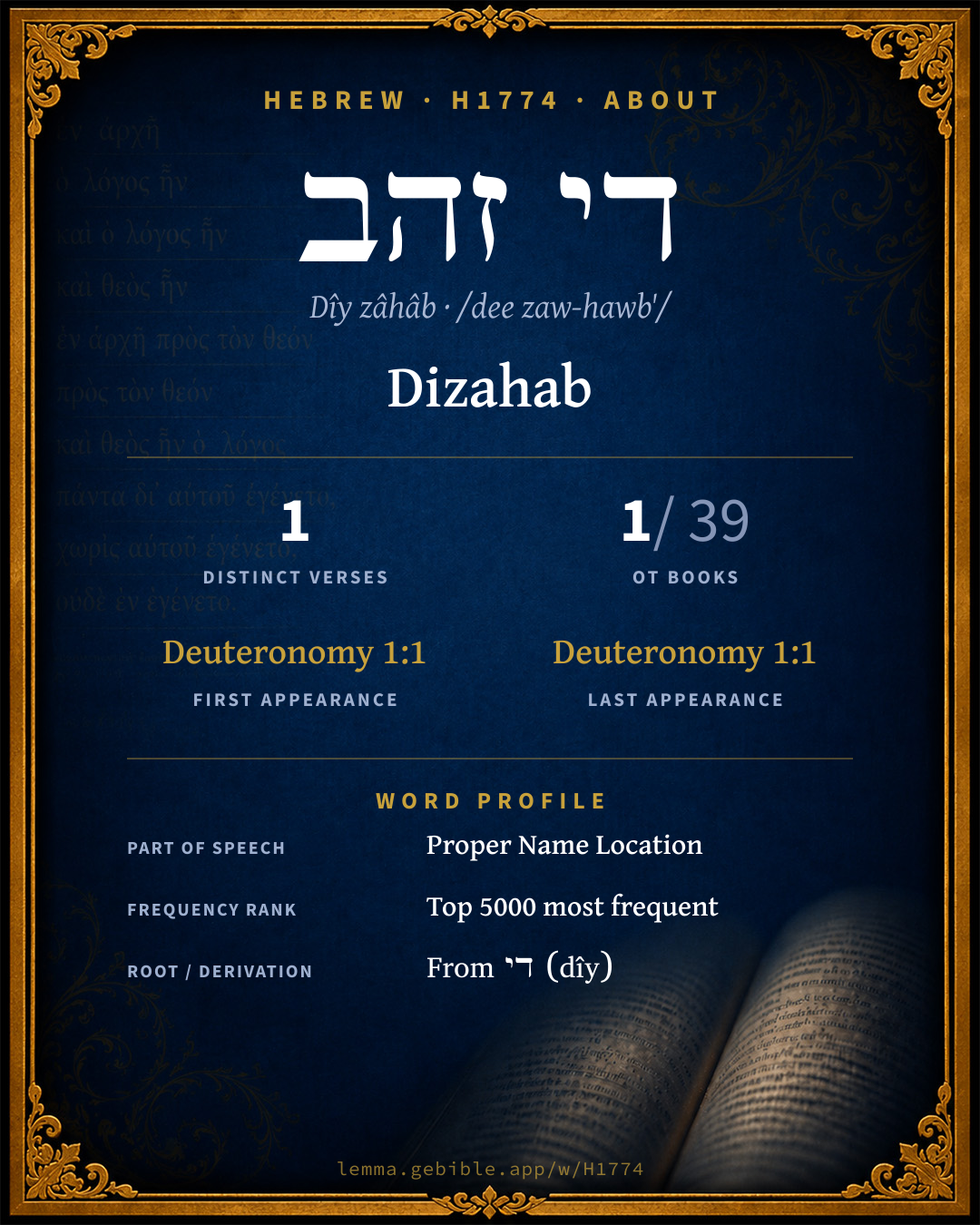
דִּי זָהָב
Dizahab
BDB lists 2 entries for ‘Dizahab’ fuller range ↓
Full lexicon entry — Brown-Driver-Briggs (BDB)
From Brown-Driver-Briggs (BDB)
Where this word appears
Grammar key — what these labels mean
Part of speech
- Noun
- A naming word — a person, place, thing, or idea.
Noun type
- Proper
- A name of a specific person, place, or people (e.g. Abraham, Zion, Israel).
Every verse where H1774 appears — 1 distinct verse across 1 book. Click any verse to open its interlinear word-by-word view. Verse text shown in the World English Bible for context — . Each verse’s Hebrew form is shown with its reference; the English is not keyword-highlighted, since the data carries no word-level English alignment. Use “Compare translations” on any verse to read it across multiple English versions. This concordance covers the Hebrew Bible; Septuagint (Greek Old Testament) occurrences are not indexed here.
Deuteronomy 1 verse
About this entry
At a glance — auto-summarized from this page’s data, not written by a person. Every figure links to its source below. This summary describes the numbers; it doesn’t interpret them.
די זהב — transliterated Dîy zâhâb — is a Hebrew name carrying the sense “Dizahab.” A scarce word — 1 verse in all of the Hebrew Bible. Its uses cluster heavily in Deuteronomy (100% of all occurrences). Its lone occurrence is Deuteronomy 1:1. See 1-verse concordance and the renderings breakdown below.
Gloss history
Strong's 1890 vs modern scholarship
About this word
Strong's H1774 catalogs a Hebrew word from the Hebrew Old Testament.
These counts are not copied from any lexicon or concordance. They are computed here, from the morphology-tagged Hebrew Old Testament. What Lemma adds →
- 1
- distinct verses
- The word appears in 1 distinct verse.
- 1 / 39
- OT books
- The word appears in 1 of 39 Old Testament books.
- #4,807
- by frequency
- Top 5000 most frequent Hebrew words (rank 4,807 of 8,640 Hebrew words by occurrence).
View all 1 occurrence in the concordance →
Most concentrated in
- Deuteronomy 1 verse 100%
By section of the Old Testament
By traditional corpus
Conventional, traditional groupings — biblical authorship is debated, so this is a traditional corpus grouping, not an authorship claim. Each share is this word’s portion of its verses in that division of the Hebrew canon. Each figure is a share of the word’s 1 distinct verse.
- Torah (Pentateuch) 1 verse · 100%
How translations render this word
Counts come from each version’s own published word-to-Strong’s tagging or interlinear alignment — an approximate guide to how each version renders this word, not a word-level alignment the data otherwise carries. Because each total is that version’s own tagged count, the per-version totals vary from one another and need not match the appearance or distinct-verse counts above. These counts may also differ from a printed concordance because Lemma counts each distinctly tagged rendering and does not collapse phrase taggings into a single head-word total. This is a fixed set of word-tagged versions (KJV, ASV, BSB, ULT) and does not change with the reading translation you choose elsewhere. Each version’s license is shown beside its name below (and on Sources).
- King James Version: Dizahab 1×
- American Standard Version: Di-zahab 1×
- Berean Standard Bible: Dizahab 1×
- unfoldingWord Literal Text: Di 1×, Zahab 1×
King James Version Public Domain
Renders H1774 across 1 tagged occurrence — most commonly:
American Standard Version Public Domain
Renders H1774 across 1 tagged occurrence — most commonly:
Berean Standard Bible Public Domain
Renders H1774 across 1 tagged occurrence — most commonly:
unfoldingWord Literal Text CC BY-SA 4.0
Renders H1774 across 2 tagged occurrences — most commonly:
Senses in BDB
The 2 senses BDB distinguishes for this word, in lexicon order (not ranked by frequency or importance). The full entry — with sub-senses — is in the Lexicon Entry tab.
- Dizahab = "enough gold"
- a place on the border of Moab
Word origin
n.pr.loc. appar. on border of Moab Dt 1:1 (𝔊 Καταχρύσεα).
— Brown-Driver-Briggs (Oxford 1906, public domain), digitized via Sefaria, supplemented by the OpenScriptures HebrewLexicon (CC BY 4.0). See Sources.
Derived from די (dîy) (H1768) — which.
Jastrow Dictionary
A second Hebrew/Aramaic lexicon for comparison, covering Aramaic and post-biblical (Talmudic, Targumic, Midrashic) usage that the biblical-Hebrew BDB does not. Matched by lemma rather than by Strong’s number, so a lemma may carry more than one Jastrow headword (shown separately below), and the entries cover usage well beyond the Bible.
דְּ־
- a prefix, corresp. to h. שֶׁ־, of, who, which, that (quod). Targ. Gen. XXXI, 42. Ib. IX, 5; a. v. fr.—Ber. 2ᵃ זמן ק"ש דשכיבה the time of reading the Sh’ma of bed-time (Deut. VI, 7). Ib. ליתני דערבית וכ׳ let him first state that of (the law concerning) the evening prayer. Ib. הא קמ"ל דכפרה וכ׳ we are given to understand (by implication) that &c. Ib. ממאי דהאי וכ׳ whence is it proved that this uba &c.? Ib.ᵇ ואינהו דמחשכי וכ׳ and it was they who (as an exception) worked late and early; a. v. fr.—[This prefix is used for the formation of what may be named Difel nouns, as דְּבֵיתָא, דִּכְמָא &c., a. Dispeel nouns as דִּיסְקַרְתָּא &c.] e.g. Deuteronomy 6:7
דִּי
- 1. who, which, where, whom &c. Dan. IV, 5; a. fr.—Targ. Gen. XXIV, 27. Targ. Ps. LXXIII, 27; a. fr.—Mostly as prefix: דִּי־, דִּ־, דְּ־, v. דְּ־.—With personal pronouns דִּידִי, דִּילִי; דִּידָךְ, דִּידֵיךְ, דִּילָךְ, דִּילִיךְ; דִּידֵיה, דִּידָהּ, דִּילֵיה, דִּילָהּ; דִּידָן, דִּילָן; דִּידְכוֹן, דִּלְכוֹן, דִּידְכוּ, דִּידְכֶן; דִּידְהוֹן, דִּידְהוּ, דִּידְהִי mine, thine &c. Targ. O. Gen. XXXI, 16 דילנא (Y. די לנא). Targ. O. ib. XXXIII, 9; a. fr.—B. Bath. 4ᵇ דידי ודידיה הוא it is mine and his. Ib. עבד דידיה he made the ḥazith on his side, v. חָזִית. Ber. 2ᵇ בין השמשות דידך thy definition of ben hash-sh’mashoth. Tam. 32ᵃ דידי טבא מדידכו my advice is better than yours. Gitt. 84ᵇ דילכון your countryman (Rab Kahăna). B. Kam. 117ᵇ דילכון אמרי דילהון היא I believed (learning) was yours (the Palestineans’); but it is theirs (the Babylonians’); Succ. 44ᵃ דִּלְכוֹן, דִּלְהוֹן.—Ḥull. 42ᵇ תנא דידן the author or compiler of our Mishnah. Deut. R. s. 2 ר"י דידיה אמר R. J. said in his own name. Ab. Zar. 17ᵃ פליגא דידיה אדידיה there is a discrepancy between two opinions of his. Y. Ḥag. II, 78ᵃ top מן דידכֶן; Y. Snh. VI, 23ᶜ bot. מן דידכון one of yours. e.g. Daniel 4:5
- 2. that (quod). Dan. IV, 3; a. fr.—Y. Taan. IV, 67ᶜ bot. די תעניתא that it is a fast-day. e.g. Daniel 4:3
דִּי II
- = דְּאִי, for if. Y. R. Hasḥ. I, 56ᵇ, די לא כן. Also דִּילָא, דִּלָא for if not. Y. Ter. V, 43ᶜ; a. fr.—דִּילָכֵן, דִּלָכֵן for if not so. Y. Shebi. IV, 35ᵃ bot.; a. fr. V. דִּל.
דַּי
- sufficiency, plenty; constr. דֵּי enough for; דּיִּי enough for me, דַּיֶּיךָ enough for thee &c. Nidd. I, 1 דַּיָּין שעתן they have enough for the time being, i.e. the unclean condition, now discovered, has no retrospective effect, opp. מפְּקִידָה לפקידה. Pes. 8ᵇ דַּיֵּינוּ we should have been contented. Taan. 24ᵇ דַּיּוֹ בקב וכ׳ (Ms. M. דַּיי לו קב) he is contented with a Kab of &c. B. Kam. II, 5 (25ᵃ) דיו לבא מן הדין וכ׳ it is sufficient for the law which is derived by conclusion ad majus to be as strict as the law from which it is derived, i.e. you cannot go beyond the latter. B. Kam. ור"ט לית ליה דיו does R. T. not follow the principle of dayyo (that the derived law cannot go beyond the original)? והא דיו דאורייתא הוא is not the principle of dayyo biblical?—Gen. R. s. 21 דייך פפוס it is enough for thee, Papus, i.e. say no more; a. fr.—With prefix כְּדַי (v. כְּדָיי), constr. כְּדֵי as much as is required for, corresponding to, as conj. in order to. Maasr. V, 6 ומצא כ׳ מדתו and found a quantity corresponding to what he had measured into it (reasonably increased); יתר על כ׳ מדתו more than the reasonable quantity.—כ׳ דיבור or תוך כ׳ ד׳ as much, within as much, time as is needed for an utterance (e.g. a greeting, v. Y. Ber. I, 4ᵇ). B. Kam. 73ᵃ, a. fr. תוך כ׳ דיבור כדיבור דמי two statements following each other immediately are considered one. Ib. 73ᵇ תרי ת׳ כ׳ ד׳ there are two different intervals comprised under the expression tokh k’d’e dibbur. Snh. 31ᵇ bot. כ׳ לחלוק וכ׳ in order to give honor to &c. Ib. 32ᵃ bot. כ׳ שלא תנעול דלת וכ׳ in order not to make loans too difficult, v. דֶּלֶת; a. fr.
דִּי־
- (representing δις-, δύο) two, twice, cmp. דּוּ III.
זָהַב
- , Hif. הִזְהִיב (denom. of זָהָב) to glitter, contrad. to הצהיב (v. צָהַב). Ḥull. 22ᵇ משיַזְהִיבוּ when their plumage is glittering.—Part. Hof. מוּזְהָב, f. מוּזְהֶבֶת gold-embroidered. Sabb. 59ᵇ.—Pl. f. מוּזְהָבוֹת. Tosef. Sot. XV, 9, v. זְהוֹרִית.
זָהָב
- (b. h.) gold, gold coin, v. דִּינָר. Snh. 92ᵇ יוצק ז׳ רותח וכ׳ molten gold be poured into &c. Ex. R. s. 33 מכל עשרך … ושל ז׳ than all thy (Korah’s) wealth of silver and gold; a. fr.—B. Mets. IV, 1 הז׳ קונה את הכסף וכ׳ the delivery of gold coin effects the purchase of silver &c., i.e. in an exchange of coined gold for silver &c., the superior metal is the merchandise and the inferior the money; Y. ed. הכסף קונה את הז׳; v. Bab. ib. 44ᵃ; a. fr.—Pl. זְהָבִים, זְהָבִין. Ex. R. s. 35; Cant. R. to III, 10 שבעה (מיני) ז׳ וכ׳ seven kinds of gold were used in the Temple. Yoma 44ᵇ שבעה ז׳ וכ׳ there are seven &c.—Erub. 53ᵇ (in allegorical speech) והרקיעו לז׳ וכ׳ Ms. M. (ed. ארקיעו) make the gold (glowing coals) sky-blue (fan them so as to give blue flames) and prepare for me two tellers in the dark (cocks).
A Dictionary of the Targumim, the Talmud Babli and Yerushalmi, and the Midrashic Literature (Marcus Jastrow; London, Luzac, 1903) — Public Domain. Digitized via Sefaria. Digitized via Sefaria. Full attribution on Sources.
Forms in the corpus
The 2 distinct written forms H1774 takes in the Hebrew Bible, most frequent first — each parse links to that state’s occurrences in the concordance. Hebrew forms include their vowel points and cantillation, so a single lemma takes many written forms.
| Form | Parsing | Example | Uses |
|---|---|---|---|
| וְ/דִ֥י | Noun, Proper | Deuteronomy 1:1 | 1 |
| זָהָֽב | Noun, Proper | Deuteronomy 1:1 | 1 |
Bible dictionary
Public-domain dictionary articles matched to this entry by name (Dizahab). A biblical name can be shared by more than one person or place, so an article may treat several.
Easton's Bible Dictionary · M. G. Easton, 1897
Region of gold, a place in the desert of Sinai, on the western shore of the Elanitic gulf (Deut. 1:1). It is now called Dehab.
Smith's Bible Dictionary · William Smith, 1863
(region of gold), a place in the Arabian desert, mentioned (1:1) is identified with Dahab, a cape on the western shore of the Gulf of Akabah.
Classic public-domain reference works; full attribution on Sources.
Septuagint verse parallels
This word appears in 1 verse that also exists in the Greek Old Testament (Septuagint), out of the 1 Hebrew verse it occurs in. You can read those verses in Greek by switching the Old Testament edition to the Septuagint.
Read these verses in the Septuagint
This is a verse-level parallel only — the same verses exist in both the Hebrew and Greek Old Testaments. No word-level Hebrew↔Greek correspondence is claimed: the data carries no such alignment, so no Greek word is shown as this Hebrew word’s translation. Coverage is not total — the Septuagint omits the deuterocanon and renumbers the Psalms, so some Hebrew verses have no direct Greek parallel.