
Daniel 3:14

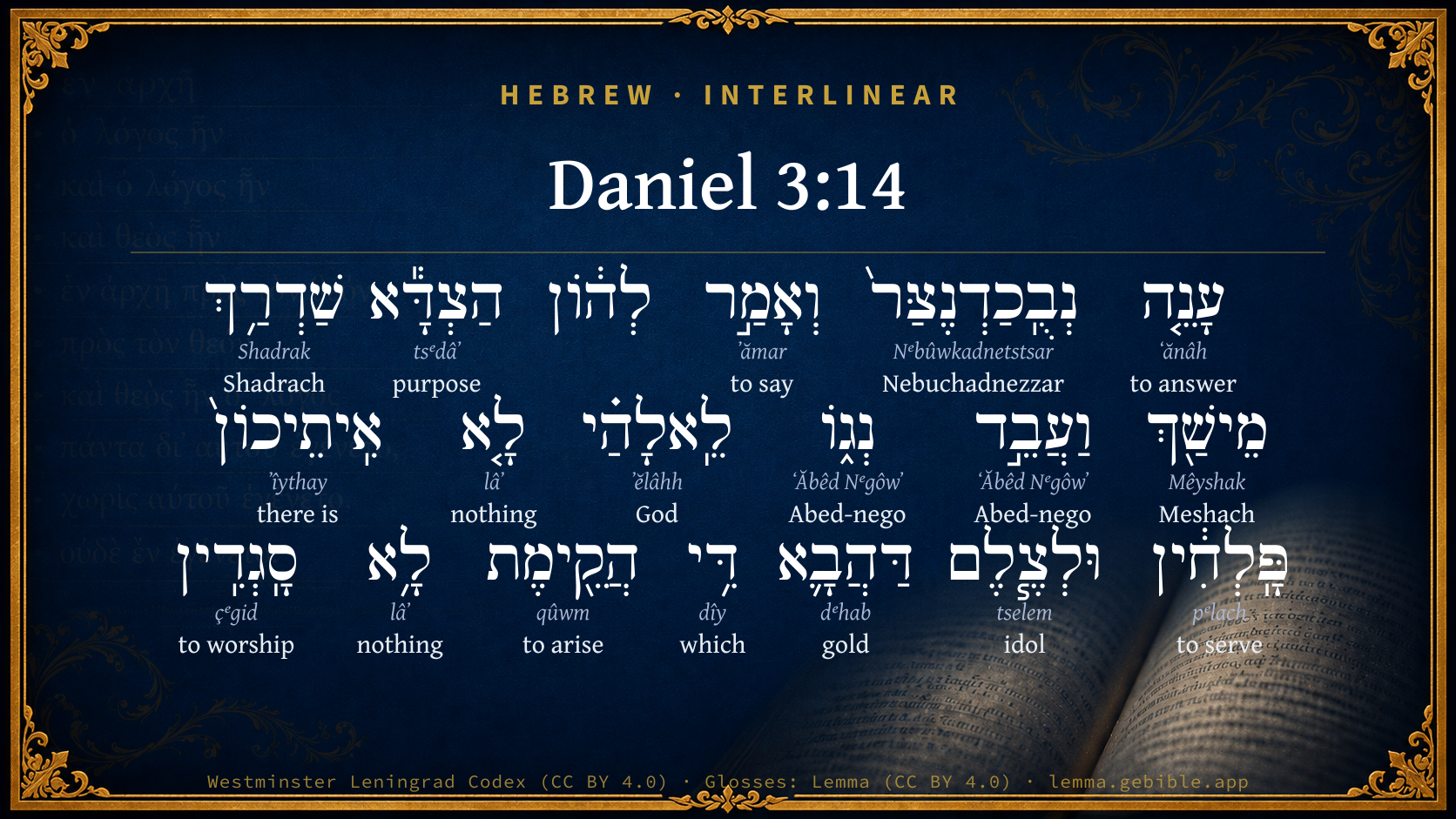
Hebrew (Westminster Leningrad Codex) Daniel 3:14 appears in the Hebrew Old Testament. The text above is from the Westminster Leningrad Codex. Each word links to its Strong’s number, a concise gloss, and parsing drawn from the Open Scriptures Hebrew Bible morphology. Click any word for its full Brown-Driver-Briggs (BDB) entry.
Download image
Cite this verse

Daniel 3:14 (World English Bible). Public Domain. Lemma interlinear Bible study tool, https://lemma.gebible.app/v/daniel/3/14.

Show BibTeX & RIS
BibTeX
RIS
English Translation
Nebuchadnezzar answered them, Is it on purpose, Shadrach, Meshach, and Abednego, that you don't serve my god, nor worship the golden image which I have set up?
World English Bible · Public Domain
Highlights
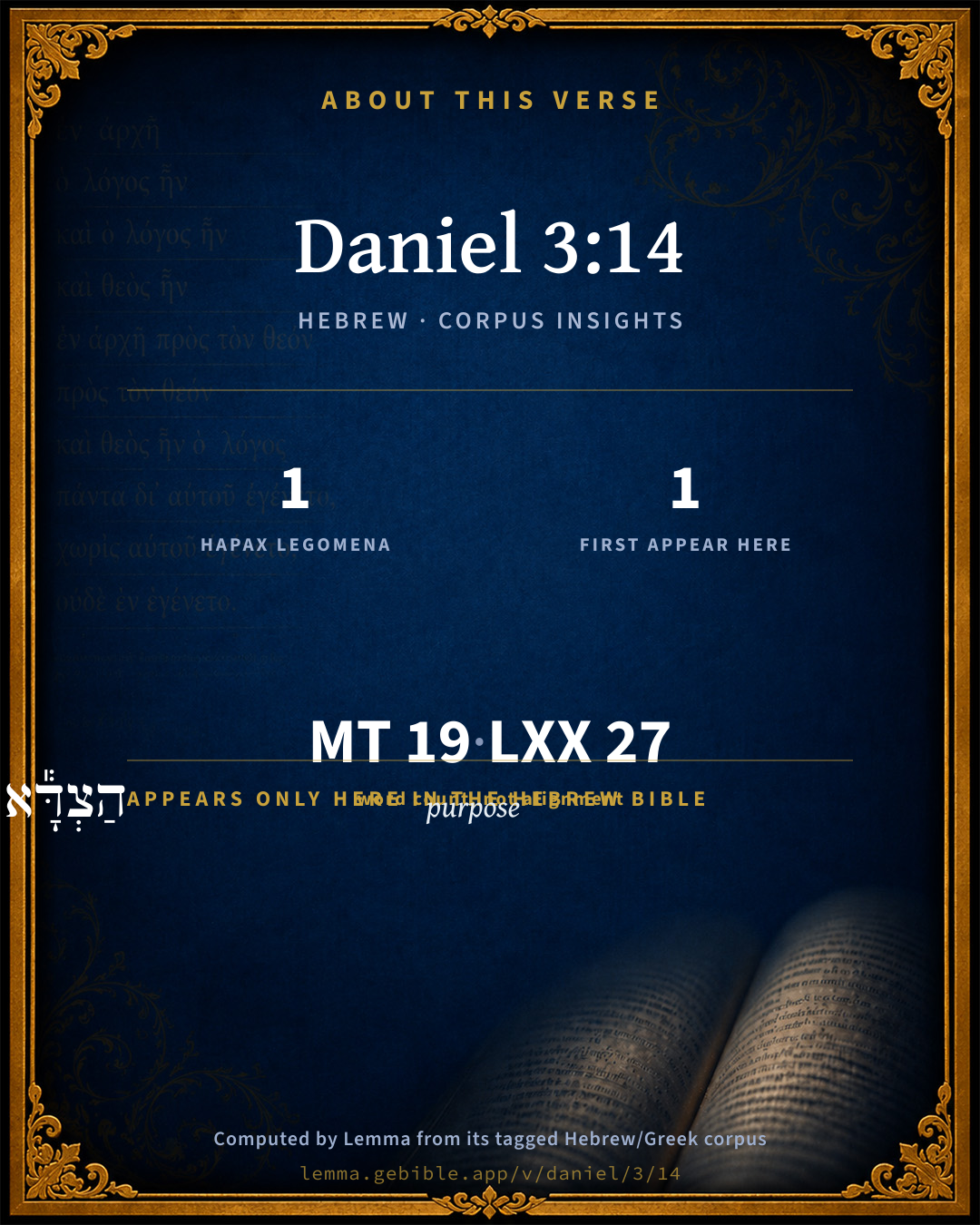
  • 1 hapax legomenon — only here in the Hebrew Bible
  • 1 first appearance in the Hebrew Bible
Full analysis ↓
Download a study sheet

One document with this verse’s original text, its word-by-word gloss line, the meaning frame, cross-references with their text, attributed commentary, and full source and license credits — printable, and it pastes into notes with its structure intact.

This verse Autodidact and up

Study sheet (.html) Plain text (.txt)

A passage Seminary Student

Up to 50 verses in one chapter. A passage sheet keeps up to 6 commentary sources and 12 cross-references per verse, in the order this page ranks them, and says so on the sheet whenever that leaves anything out. Ask for a single verse and you get the Autodidact verse sheet above.

Everything on this page stays free to read, with no account — the sheet is a download of what is already on screen, not access to it.

Want to remove ads? Support Godless Engineer
Compare translations 3

The same verse in 3 English versions, stacked beneath the original-language interlinear above. Click any original word for its lexicon entry.

Each is an independent rendering of the whole verse — the interlinear is not word-aligned to these translations.

Highlighted words mark where these versions differ — a whole-verse word diff, not a word-by-word alignment.

  • World English Bible Public Domain
    Nebuchadnezzar answered them, Is it on purpose, Shadrach, Meshach, and Abednego, that you don't serve my god, nor worship the golden image which I have set up?
  • King James Version Public Domain
    Nebuchadnezzar spake and said unto them, Is it true, O Shadrach, Meshach, and Abednego, do not ye serve my gods, nor worship the golden image which I have set up?
  • unfoldingWord Literal Text CC BY-SA 4.0
    Nebuchadnezzar responded and said to them, “Is it true, Shadrach, Meshach, and Abednego, that you will not serve my gods or worship the golden image that I have set up?

unfoldingWord Literal Text — © unfoldingWord, licensed CC BY-SA 4.0. Word-aligned USFM3 via Door43 (git.door43.org/unfoldingWord/en_ult).

Versions to compare (up to 4)

3 of 4 selected

Show all 18 translations

Every available English version of this verse, each an independent rendering of the whole verse.

  • World English Bible Public Domain
    Nebuchadnezzar answered them, Is it on purpose, Shadrach, Meshach, and Abednego, that you don't serve my god, nor worship the golden image which I have set up?
  • Berean Standard Bible Public Domain
    and Nebuchadnezzar said to them, “Shadrach, Meshach, and Abednego, is it true that you do not serve my gods or worship the golden statue I have set up?
  • Majority Standard Bible Public Domain
    and Nebuchadnezzar said to them, “Shadrach, Meshach, and Abednego, is it true that you do not serve my gods or worship the golden statue I have set up?
  • King James Version Public Domain
    Nebuchadnezzar spake and said unto them, Is it true, O Shadrach, Meshach, and Abednego, do not ye serve my gods, nor worship the golden image which I have set up?
  • American Standard Version (1901) Public Domain
    Nebuchadnezzar answered and said unto them, Is it of purpose, O Shadrach, Meshach, and Abed-nego, that ye serve not my god, nor worship the golden image which I have set up?
  • Revised Version (1885) Public Domain
    Nebuchadnezzar answered and said unto them, Is it of purpose, O Shadrach, Meshach, and Abed-nego, that ye serve not my god, nor worship the golden image which I have set up?
  • Geneva Bible (1599) Public Domain
    And Nebuchad-nezzar spake, and said vnto them, What disorder? will not you, Shadrach, Meshach, and Abednego serue my god, nor worship the golden image, that I haue set vp?
  • Douay-Rheims (1899) Public Domain
    And Nabuchodonosor the king spoke to them, and said: Is it true, O Sidrach, Misach, and Abdenago, that you do not worship my gods, nor adore the golden statue that I have set up?
  • Young's Literal Translation Public Domain
    Nebuchadnezzar hath answered and said to them, `Is `it' a laid plan, O Shadrach, Meshach, and Abed-Nego -- my gods ye are not serving, and to the golden image that I have raised up ye are not doing obeisance?
  • Literal Standard Version CC BY-SA 4.0
    Nebuchadnezzar has answered and said to them, “Is [it] a laid plan, O Shadrach, Meshach, and Abed-Nego—my gods you are not serving, and to the golden image that I have raised up you are not worshiping?
  • Unlocked Literal Bible CC BY-SA 4.0
    Nebuchadnezzar said to them, “Have you made your minds up, Shadrach, Meshach, and Abednego, that you will not worship my gods or prostrate yourselves to the golden statue that I have set up?
  • unfoldingWord Literal Text CC BY-SA 4.0
    Nebuchadnezzar responded and said to them, “Is it true, Shadrach, Meshach, and Abednego, that you will not serve my gods or worship the golden image that I have set up?
  • Darby Bible Public Domain
    Nebuchadnezzar spoke and said unto them, Is it of purpose, Shadrach, Meshach, and Abed-nego, that ye serve not my god, nor worship the golden image that I have set up?
  • World Messianic Bible Public Domain
    Nebuchadnezzar answered them, “Is it true, Shadrach, Meshach, and Abednego, that you don’t serve my gods and you don’t worship the golden image which I have set up?
  • Webster's Bible Public Domain
    Nebuchadnezzar spoke and said to them, Is it true, O Shadrach, Meshach, and Abed-nego, do ye not serve my gods, nor worship the golden image which I have set up?
  • Free Bible Version CC BY-SA 4.0
    “Shadrach, Meshach, and Abednego, are you deliberately refusing to serve my gods and worship the gold statue I set up?” asked the king.
  • Bible in Basic English Public Domain
    Nebuchadnezzar made answer and said to them, Is it true, O Shadrach, Meshach, and Abed-nego, that you will not be servants of my god or give worship to the image of gold which I have put up?
  • JPS Tanakh (1917) Public Domain
    Nebuchadnezzar spoke and said unto them: 'Is it true, O Shadrach, Meshach, and Abed-nego, that ye serve not my gods, nor worship the golden image which I have set up?

Literal Standard Version (2020), Covenant Press — licensed CC BY-SA 4.0. Text via the HelloAO Bible API (eBible.org). Unlocked Literal Bible (unfoldingWord) — licensed CC BY-SA 4.0. Text via the HelloAO Bible API (eBible.org). unfoldingWord Literal Text — © unfoldingWord, licensed CC BY-SA 4.0. Word-aligned USFM3 via Door43 (git.door43.org/unfoldingWord/en_ult). Free Bible Version, Dr. Jonathan Gallagher — licensed CC BY-SA 4.0. Text via the HelloAO Bible API (eBible.org).

Word by word

More ways to search: Search by grammar → Find every occurrence → Compare this word →

Practice this passage: Drill this verse → Learn its vocabulary →

הַצְדָּ֕א
tsᵉdâʼ
H6656
“purpose”
Adjective, T + Noun, Common, Masculine, Singular, Absolute
Part of Speech
Adjective + Noun
Type
Common
Gender
Masculine
Number
Singular
State
Absolute
Full BDB Definition

Origin: from an unused root corresponding to H6658 in the sense of intentness

TWOT: TWOT - 2956

purpose (noun masculine) - (CLBL) true (adjective)
  1. עָנֵ֤ה ʻănâh H6032 “answering” Adjective, V
  2. נְבֻֽכַדְנֶצַּר֙ Nᵉbûwkadnetstsar H5020 “Nebuchadnezzar” Adjective, N
  3. וְאָמַ֣ר ʼămar H560 “and · saying” Adjective, C + Verb, Qal, Participle Active, Masculine, Singular, Absolute
  4. שַׁדְרַ֥ךְ Shadrak H7715 “Shadrach” Adjective, N
  5. מֵישַׁ֖ךְ Mêyshak H4336 “Meshach” Adjective, N
  6. וַעֲבֵ֣ד ʻĂbêd Nᵉgôwʼ H5665 “and · Abed-nego” Adjective, C + Noun, Proper
  7. נְג֑וֹ ʻĂbêd Nᵉgôwʼ H5665 “Abed-nego” Adjective, N
  8. לֵֽאלָהַ֗י ʼĕlâhh H426 “to/for · God · my” Adjective, R + Noun, Common, Masculine, Singular, Construct + Suffix, Personal, 1st Person, Common, Singular
  9. לָ֤א lâʼ H3809 “nothing” Adjective, T
  10. אִֽיתֵיכוֹן֙ ʼîythay H383 “there is · you” Adjective, T + Suffix, Personal, 2nd Person, Masculine, Plural
  11. פָּֽלְחִ֔ין pᵉlach H6399 “serving” Adjective, V
  12. וּלְצֶ֧לֶם tselem H6755 “and · to/for · idol of” Adjective, C + Preposition + Noun, Common, Masculine, Singular, Construct
  13. דַּהֲבָ֛א dᵉhab H1722 “gold · the” Adjective, N, Common + Particle, Definite Article
  14. דִּ֥י dîy H1768 “which” Adjective, T
  15. הֲקֵ֖ימֶת qûwm H6966 “to arise” Adjective, V, Plural
  16. לָ֥א lâʼ H3809 “nothing” Adjective, T
  17. סָֽגְדִֽין çᵉgid H5457 “worshiping” Adjective, V

About this verse

These counts appear in no published source. They are computed here, from the morphology-tagged text and Lemma’s own curated glosses. What Lemma adds →

19
words
16
distinct lemmas
Prophets
section

Notable vocabulary

1 hapax legomenon — a word that appears only here in the entire Hebrew Bible:

  • הַצְדָּ֕א purpose H6656

First appearance in Scripture

This word makes its first canonical appearance in the Hebrew Bible here:

  • הַצְדָּ֕א purpose H6656

Shared distinctive vocabulary

פָּֽלְחִ֔ין to serve H6399 occurs in 10 verses of the Hebrew Bible. Also found in:

Grammatical profile

  • 1 verb
  • 4 nouns
  • 13 adjectives
  • 1 particle

Verb forms

  • וְאָמַ֣ר Qal · Participle Active

Repetition

Words recur within this verse — often emphatic in Hebrew:

  • וַעֲבֵ֣ד Abed-nego H5665 ×2
  • לָ֤א nothing H3809 ×2

Hebrew & Septuagint length

In English translation the verse runs 27 words from the Hebrew and 31 from the Septuagint (LXX English) — closely comparable.

A rough comparison of the two English renderings, which tokenize alike — not a word-level alignment.

Word counts can differ between the Hebrew and the Greek without any difference in meaning — e.g. the Hebrew direct-object marker אֵת has no separate Greek word, and Greek often adds the article ὁ.

In the original languages it is 19 Hebrew tokens and 27 Greek tokens — but the two are counted differently (Hebrew bundles its prefixes and suffixes into one token; the Greek is in lemma form), so that isn’t a like-for-like length.

Cross-references

5

Topical passages linked to Daniel 3:14 in the Treasury of Scripture Knowledge — connected by theme and wording, ordered by reader-vote popularity; previews shown in the World English Bible.

  • Jeremiah 50:2 Declare you among the nations and publish, and set up a standard; publish, and don't conceal: say, Babylon is taken, Bel is disappointed, Merodach is dismayed; her images are disappointed, her idols are dismayed.
  • Daniel 3:1 Nebuchadnezzar the king made an image of gold, whose height was sixty cubits, and the breadth of it six cubits: he set it up in the plain of Dura, in the province of Babylon.
  • Isaiah 46:1 Bel bows down, Nebo stoops; their idols are on the animals, and on the cattle: the things that you carried about are made a load, a burden to the weary [animal].
  • Daniel 4:8 But at the last Daniel came in before me, whose name was Belteshazzar, according to the name of my god, and in whom is the spirit of the holy gods: and I told the dream before him, [saying],
  • Exodus 21:13–14 but not if it is unintentional, but God allows it to happen: then I will appoint you a place where he shall flee.

Cross-references courtesy of OpenBible.info (CC BY 4.0).

Hebrew and Greek witnesses Masoretic Hebrew ↔ Greek Septuagint

The same verse in the two great witnesses to the Old Testament, shown verse-for-verse.

These are two independent witnesses, not word-aligned to each other, and the Septuagint is shown in lemma (dictionary) form.

Hebrew Daniel 3:14 Masoretic · Westminster Leningrad Codex

עָנֵ֤ה נְבֻֽכַדְנֶצַּר֙ וְאָמַ֣ר לְה֔וֹן הַצְדָּ֕א שַׁדְרַ֥ךְ מֵישַׁ֖ךְ וַעֲבֵ֣ד נְג֑וֹ לֵֽאלָהַ֗י לָ֤א אִֽיתֵיכוֹן֙ פָּֽלְחִ֔ין וּלְצֶ֧לֶם דַּהֲבָ֛א דִּ֥י הֲקֵ֖ימֶת לָ֥א סָֽגְדִֽין

Nebuchadnezzar answered them, Is it on purpose, Shadrach, Meshach, and Abednego, that you don't serve my god, nor worship the golden image which I have set up?

World English Bible · Public Domain

Greek LXX Daniel 3:14 Septuagint · lemma form

ὅς καί συνὁράω ναβουχοδονοσορ ὁ βασιλεύς εἶπον αὐτός διά τίς σεδραχ μισαχ αβδεναγω ὁ θεός ἐγώ οὐ λατρεύω καί ὁ εἰκών ὁ χρυσοῦς ὅς ἵστημι οὐ προςκυνέω

And Nabuchodonosor answered and said to them, Is it true, Sedrach, Misach, and Abdenago, that you⌃ serve not my gods, and worship not the golden image which I have set up?

LXX2012 (modern English Septuagint) · Public Domain

On this verse, The Pulpit Commentary discusses the Septuagint’s reading. Read the note in Commentary ↓

Hebrew: Westminster Leningrad Codex (CC BY 4.0). Greek: Septuagint (public domain); English from LXX2012 (modern English Septuagint) (Public Domain). How the Septuagint differs from the Hebrew →

Commentary

Notes on Daniel 3:14 from classic Christian and Jewish commentators (each source and its license shown beneath its notes). The classic Christian expositions comment on the surrounding passage and are grouped to its opening verse, so a note may address several verses; the Jewish commentaries on the Tanakh (Rashi and others) are per-verse, so they appear only where the commentator wrote on this verse.

Lemma curates 59 commentaries, every one of them public domain or Creative Commons licensed, each selected and text-cleaned for this edition rather than reprinted as found. About our sources →

Trapp's Complete Commentary

John Trapp

Dan 3:14 Nebuchadnezzar spake and said unto them, [Is it] true, O Shadrach, Meshach, and Abednego, do not ye serve my gods, nor worship the golden image which I have set up?

Ver. 14. Is it true, O Shadrach, Meshach, &c., ] q.d., I can very hardly believe it. Certe tu non occidisti patrem; Sure thou didst not kill thy father! saith Augustus Caesar once to a parricide, whom he had in examination; and Suetonins saith that it was usual with him to examine malefactors in that way, as if he could not believe any such thing of them. Some {a} render the text Num de industria aut certo consilio? Do ye this on set purpose to cross and provoke me? Others, as Montanus, Nunquid desolatio? q.d., What! you to oppose the command of a king? If this be suffered, what disorder, yea, desolation, must needs follow! Pride ever aggravateth anything done against its own mind.

{a} Tremel., Buxtorf.

John Trapp, A Commentary or Exposition upon All the Books of the Old and New Testament (1647–1656) — public domain. Text from a community e-Sword module.

Joseph Benson's Commentary

Dan 3:14-15. Nebuchadnezzar said, Is it true, O Shadrach? &c. — Or, of purpose, as the margin reads it, and as the word is used, Exo 21:13. Is it designedly and deliberately done, or was it only through inadvertency, that you have not served my gods? What! you that I have nourished and brought up; that have been educated and maintained at my charge; that I have been so kind to, and done so much for; you that have been in such reputation for wisdom, and therefore should better have known your duty to your prince; what! do not you serve my gods, nor worship the golden image which I have set up? Observe, reader, the faithfulness of God’s servants to him has often been the wonder of their enemies and persecutors, who think it strange that they run not with them to the same excess of riot. Now if ye be ready, &c. — He is willing to admit them to a new trial; if they did purpose before not to worship his gods, yet it may be, upon second thoughts, they will change their minds; it is therefore repeated to them upon what terms they now stand: 1st, The king is willing that the music should play again, for their sakes only, to soften them into a compliance; and if they will not, like the deaf adder, stop their ears, but will hearken to the voice of the charmers, and will worship the golden image, well and good, their former omission shall be pardoned. But, 2d, The king is resolved, if they persist in their refusal, that they shall immediately be cast into the fiery furnace, and shall not have so much as an hour’s reprieve. Thus does the matter lie in a little compass; Turn or burn, is the king’s language. And because he knew they buoyed themselves up in their refusal with a confidence in their God, he insolently sets him at defiance, saying, And who is that God that shall deliver you out of my hands? Let him deliver you if he can. Now he forgot what he himself once owned, that their God was a God of gods, and a Lord of kings, Dan 2:47. Proud men are still ready to say, as Pharaoh. Who is the Lord, that I should obey his voice?

Joseph Benson's Commentary on the Old and New Testaments (1811–1818) — public domain. Text from a community e-Sword module.

Keil & Delitzsch

C. F. Keil & F. Delitzsch

The trial of the accused.

Dan 3:14

The question הצדא the old translators incorrectly explain by Is it true? In the justice of the accusation Nebuchadnezzar had no doubt whatever, and צדא has not this meaning. Also the meaning, scorn, which אּצדי in Aram. has, and L. de Dieu, Hv., and Kran. make use of, does not appear to be quite consistent, since Nebuchadnezzar, if he had seen in the refusal to do homage to the image a despising of his gods, then certainly he would not have publicly repeated his command, and afforded to the accused the possibility of escaping the threatened punishment, as he did (Dan 3:15). We therefore agree with Hitz. and Klief., who interpret it, after the Hebr. צדיּה, Num 35:20., of malicious resolution, not merely intention, according to Gesen., Winer, and others. For all the three could not unintentionally or accidentally have made themselves guilty of transgression. The form הצדא we regard as a noun form with הinterrog. prefixed in adverbial cases, and not an Aphel formation: Scorning, Shadrach, etc., do ye not serve? (Kran.) The affirmative explanation of the verse, according to which the king would suppose the motive of the transgression as decided, does not agree with the alternative which (Dan 3:15) he places before the accused. But if הצדא is regarded as a question, there is no need for our supplying the conjunction דּי before the following verb, but we may unite the חצדא in one sentence with the following verb: "are ye of design ... not obeying?" Nebuchadnezzar speaks of his god in contrast to the God of the Jews.

Dan 3:15

עתידין taken with the following clause, תּפּלוּן ... דּי, is not a circumlocution for the future (according to Winer, Chald. Gram. 45, 2). This does not follow from the use of the simple future in contrast, but it retains its peculiar meaning ready. The conclusion to the first clause is omitted, because it is self-evident from the conclusion of the second, opposed passage: then ye will not be cast into the fiery furnace. Similar omissions are found in Exo 32:32; Luk 13:9. For the purpose of giving strength to his threatening, Nebuchadnezzar adds that no god would deliver them out of his hand. In this Hitz. is not justified in supposing there is included a blaspheming of Jehovah like that of Sennacherib, Isa 37:10. The case is different. Sennacherib raised his gods above Jehovah, the God of the Jews; Nebuchadnezzar only declares that deliverance out of the fiery furnace is a work which no god can accomplish, and in this he only indirectly likens the God of the Jews to the gods of the heathen.

Dan 3:16

In the answer of the accused, נבוּכדנצּר is not, contrary to the accent, to be placed in apposition to למלכּא; for, as Kran. has rightly remarked, an intentional omission of מלכּא in addressing Nebuchadnezzar is, after Dan 3:18, where מלכּא occurs in the address, as little likely as that the Athnach is placed under למלכּא only on account of the apposition going before, to separate from it the nomen propr.; and an error in the placing of the distinctivus, judging from the existing accuracy, is untenable. "The direct address of the king by his name plainly corresponds to the king's address to the three officers in the preceding words, Dan 3:14." We are not to conclude from it, as Hitz. supposes, "that they address him as a plebeian," but much rather, as in the corresponding address, Dan 3:14, are to see in it an evidence of the deep impression sought to be produced in the person concerned.

פּתגּם is the accus., and is not to be connected with דּנה על: as to this command (Hv.). If the demonstrative were present only before the noun, then the noun must stand in the status absol. as Dan 4:15 (18). פּתגּם, from the Zend. paiti = πρός, and gâm, to go, properly, "the going to," therefore message, edict, then generally word (as here) and matter (Ezr 6:11), as frequently in the Targ., corresponding to the Hebr. דּבר.

Dan 3:17-18

יכיל denotes the ethical ability, i.e., the ability limited by the divine holiness and righteousness, not the omnipotence of God as such. For this the accused did not doubt, nor will they place in question the divine omnipotence before the heathen king. The conclusion begins after the Athnach, and הן means, not see! lo! (according to the old versions and many interpreters), for which Daniel constantly uses אלוּ or ארו, but it means if, as here the contrast לא והן, and if not (Dan 3:18), demands. There lies in the answer, "If our God will save us, then ... and if not, know, O king, that we will not serve thy gods," neither audacity, nor a superstitious expectation of some miracle (Dan 3:17), nor fanaticism (Dan 3:18), as Berth., v. Leng., and Hitz. maintain, but only the confidence of faith and a humble submission to the will of God. "The three simply see that their standpoint and that of the king are altogether different, also that their standpoint can never be clearly understood by Nebuchadnezzar, and therefore they give up any attempt to justify themselves. But that which was demanded of them they could not do, because it would have been altogether contrary to their faith and their conscience. And then without fanaticism they calmly decline to answer, and only say, 'Let him do according to his own will;' thus without superstitiousness committing their deliverance to God" (Klief.).

Keil & Delitzsch — Biblical Commentary on the Old Testament (1861–1891) — public domain (CC PDM 1.0). Text via the HelloAO Bible API. (Old Testament only.)

Tyndale Open Study Notes

Tyndale Open Resources

3:14 Is it true . . . ? The Aramaic word is used only here in the Old Testament. The king may have been asking, “Are your actions deliberate?”

Tyndale Open Study Notes — © Tyndale Open Resources, licensed CC BY-SA 4.0. Text via the HelloAO Bible API.

Ibn Ezra

Rabbi Abraham ibn Ezra

[Daniel 3:14] Is it true (הַצְדָּא - Hatzda): He asked them if it was indeed true (ha-emet hu khakha) that it was so.

Ibn Ezra on the Tanakh — English translations: “Sefaria Community Translation” (CC0 1.0 (public-domain dedication)); “Yalkut, Sifsei Chachomim Chumash, Metsudah Publications, 2009” (CC BY 4.0); and “Commentary of Ibn Ezra on Isaiah - trans. by M. Friedlander, 1873” (public domain). Text via Sefaria.

Jamieson, Fausset & Brown

Robert Jamieson, A. R. Fausset & David Brown

Is it true--rather, as the Margin [THEODOTION], "Is it purposely that?" &c. Compare the Hebrew, Num 35:20, Num 35:22. Notwithstanding his "fury," his past favor for them disposes him to give them the opportunity of excusing themselves on the ground that their disobedience had not been intentional; so he gives them another trial to see whether they would still worship the image.

Jamieson, Fausset & Brown — Commentary Critical and Explanatory on the Whole Bible (1871) — public domain (CC PDM 1.0). Text via the HelloAO Bible API.

Ellicott's Commentary for English Readers

(14) Is it true?—Literally, Is it of design or of set purpose that you have done this?

A Bible Commentary for English Readers, edited by Charles John Ellicott (1878–1897) — public domain. Text from a community e-Sword module.

The Cambridge Bible for Schools and Colleges

gen. ed. J. J. S. Perowne

14. Is it true] Probably this is right (cf. Theod. εἰ ἀληθῶς; Pesh. in truth), though it requires a slight change in the text (האזדא [see Dan_2:5; Dan_2:8] for הצדא). R.V. (with Ges.) of purpose (Hitz., Keil, of malicious purpose): upon this view the word would be a Hebraism[227], from the rare root found in 1Sa_24:11; Exo_21:13; Num_35:20; Num_35:22[228]: this however rather means to lie in wait (see R.V. of the passages quoted), being used of one aiming at the life of another, and the word found here would not be derived correctly even from this verb.

[227] The Syr. verb ẓedâ with derivatives, cited by Ges. in his Thes., is not recognized by Payne Smith (who has only ẓedad, from which the word found here could not be derived).

[228] Levy, NHWB. iv. 170, quotes also three examples (in the sense of lying in wait, or capturing) from Talmud and Midrash (cf. Chald. Wörterb. ii. 316).

The Cambridge Bible for Schools and Colleges (gen. ed. J. J. S. Perowne; Cambridge University Press, 1878–1918) — public domain. Text from a community e-Sword module.

John Gill's Exposition

Nebuchadnezzar spake and said unto them, is it true,.... What I have heard of you, what you are charged with and accused of; surely it cannot be; so Aben Ezra and Saadiah interpret the word as we do, and all the Oriental versions: it is only used in this place: it is expressed by way of admiration, as Jacchiades observes; it being incredible to the king, what he could never believe, unless it appeared plain in his own eyes. Some (o) render it, is it a "desolation?" so Jarchi; is my decree such? or should you not obey it? was this suffered, nothing but disorder and desolation would follow in the kingdom: or, "is it of purpose?" as others (p); have you done this willingly and knowingly, or through imprudence and inadvertency? if the latter, it is pardonable; if not, it cannot be borne with. De Dieu, from the Syriac use of the word, renders it, "is it a joke?" are you serious, and in good earnest, or in joke, "that ye worship not my gods? or do you mock me and them?"

O Shadrach, Meshach, and Abednego; on whom I have conferred so many favours, raised from a low to a high estate, and yet used by you in this manner:

do ye not serve my gods; one would think he had no need to have asked this question; since he must needs know, that, by their nation and religion, they served only one God, and could serve no other; and that by their daily practice they never did, in which they were indulged:

nor worship the golden image that I have set up? it is for the sake of this the question is put; this was the thing his heart was set upon; and such was his pride, that he could not bear any control in it.

(o) "nunquid desolatio?" Montanus. So Jacchiades, and some in Ben Melech. (p) "An certo consilio?" Junius & Tremellius; "sive ex proposito?" Piscator; so Rabbenu Hai in Ben Melech; "an de industria?" Cocceius; "num revera, vel studiose?" Michaelis.

John Gill's Exposition of the Whole Bible (1746–1763) — public domain (CC PDM 1.0). Text via the HelloAO Bible API.

Albert Barnes' Notes on the Bible

Nebuchadnezzar spake and said unto them, Is it true - Margin, “of purpose;” that is, have you done this intentionally? Wintle renders this, “Is it insultingly?” Jacchiades says that the word is used to denote admiration or wonder, as if the king could not believe that it was possible that they could disregard so plain a command, when disobedience was accompanied with such a threat. De Dieu renders it, “Is it a joke?” That is, can you possibly be serious or in earnest that you disobey so positive a command? Aben Ezra, Theodotion, and Sandias render it as it is in margin, “Have you done this of set purpose and design?” as if the king had regarded it as possible that there had been a misunderstanding, and as if he was not unwilling to find that they could make an apology for their conduct. The Chaldee word (צדא tsedâ') occurs nowhere else. It is rendered by Gesenius, “purpose, design.” That is, “Is it on purpose?” The corresponding Hebrew word (צדה tsâdâh) means, “to lie in wait, to waylay,” Exo 21:13; 1Sa 24:11, (12). Compare Num 35:20, Num 35:22. The true meaning seems to be, “Is it your “determined purpose” not to worship my gods? Have you deliberately made up your minds to this, and do you mean to abide by this resolution?” That this is the meaning is apparent from the fact that he immediately proposes to try them on the point, giving them still an opportunity to comply with his command to worship the image if they would, or to show whether they were finally resolved not to do it.

Do not ye serve my gods? - It was one of the charges against them that they did not do it, Dan 3:12.

Albert Barnes' Notes on the Bible (1834–1885) — public domain. Text from a community e-Sword/MySword module.

Matthew Poole's English Annotations

Now when these men were brought before the king, though in rage, yet he doth not presently throw them into the fire, but makes inquiry by interrogatories, that he might see first if they were guilty, by hearing them speak for themselves, and telling them he expected obedience and conformity to his laws from them, and it was in vain to look for any indulgence from him, he would bate them nothing, they should be burned. What! do ye make a jest of my gods, and my religion, and my commands? so the word

tseda in the Syriac doth signify, to scoff or deride, as if he had said, Is it true indeed that ye refuse to worship my gods? do ye do it in earnest, or in jest? it seems by your carriage, if it be true what I hear of you, that ye slight my gods, and make a mock of my authority, but ye shall know there is no jesting with these edge-tools.

Matthew Poole's English Annotations on the Holy Bible (1683–1685) — public domain. Text from a community e-Sword/MySword module.

The Pulpit Commentary

Nebuchadnezzar spake, and said unto them, Is it true, O Shadrach, Meshach, and Abednego, do not ye serve my gods, nor worship the golden image which I have set up? The Septuagint rendering here is, "Whom when he saw, Nebuchadnezzar the king said to them, Wherefore, Shadrach, Meshach, and Abednego, do ye not worship my gods, nod before the golden image which I have set up do ye not prostrate yourselves?" There seems to have been a difference of reading here. The first words must have been read as whyl whb (behon aleehon), and the mysterious word aD; xh (hatzeda) had occupied a position before, not after rma. The word adx in the aphel in Syriac means "to look steadily." This interpretation of the word shows that the translator had before him a document in which Syriac meanings might be expected. Theodotion renders the last clause, "If truly (eij ajlhqwv) Shadrach, Meshach, and Abednego, my gods ye do not worship, and before the golden image which I have set up ye do not prostrate yourselves? a construction that shows a slavish following of the Aramaic. The sense here is really the same as that of the Authorized Version. The Peshitta renders the opening word of this latter portion of the verse, "in truth a rendering with which Jerome agrees. Professor Bevan suggests another reading, aDzah, followed by Behrmann. Unfortunately, the meaning of aD; za is very doubtful. The common rendering is "of set purpose." So Furst, Gesenius, Winer, among lexicographers, and Bertholdt, Ewald, Aben Ezra, Wordsworth, among commentators; Keil, Kliefoth, Kra-nichfeld, hold it to mean "with evil intent." It is suggested also that it may mean "in mockery." The reading suggested by Professor Bevan and supported by Behrmann is not to be thought of; they appeal to Theodotion, but when this word occurs in the previous chapter (ver. 5), Theodotion translates ajpesth, which makes it evident that adza (azda) did not mean "truth" to him. More may be said for the Peshitta, only that, though azda does seem to mean "truth," the translation is not the same in Dan_2:5 and the present verse. If there is to be a change of reading, that indicated by the Septuagint translation is preferable. The Septuagint translator has had adx before him, and there is no evidence that Theodotion had not. The change in the arrangement of the words is a simpler variation than any other, and it retains the word in its Syriac meaning; otherwise we should be inclined to follow the lexicographers, and translate "of set purpose." If we take the view of this word indicated above, then we may imagine Nebuchadnezzar looking steadfastly on those youths who had dared to oppose him, hoping, it may be, to see them shrink from his gaze, as he had seen so many of the kings he had conquered do. If this is correct, it gives a point to what the youths begin their answer with in ver. 16. If we take the more common rendering, we see the generosity of the king. Full of rage and fury as he is, he will give them an opening to say that it was of inadvertence that they failed to obey his decree. This is fully borne out by the next verse. If Nebuchadnezzar was full of fury at the crime against the gods, he yet was careful that the envy of the Chaldeans should not hinder him from giving the Jews who had been accused to him a chance to defend themselves. This mental fairness it was which, despite his outbursts of capricious rage, drew the affection of those about him to Nebuchadnezzar.

Vers. 14-18.

Principle illuminated by fire.

Nebuchadnezzar, we are not careful," etc. (vers. 16-18). Sketch the leading features of this intensely interesting martyr-history; and then

I RELIGIOUS PRINCIPLE. And here, that we may not move in mist, let us open out, step by step, what needs to be said.

1. Principle. What is it.9 A principle is literally a first thing; a beginning; a cause. The spring on the mountain-side, whence the mighty river. The root of the tree. Newton"s "Principia." The principle of the universe, the First, is God.

2. Religious principle. The essential idea in the word. "religion" is that of binding. (See the etymology.) Religion distinguishes that which binds man to God: it names the link that binds earth to heaven. Principle in religion is that at the root of man"s being; that beginning of things in the soul which determines the outer life word, deed, demeanour, habit, conduct.

3. The two kinds. Strictly speaking, the beginnings of religion may be in two entirely different spheres. They may be objective or subjective. There are beginnings with God, and beginnings in man.

(1) The objective principles of religion constitute the external revelation of God. That revelation is the expression of his love. Strictly regarded, this is the spring and root of all beside. From this point of view, the first principle of religion is indeed none other than God himself.

(2) The subjective principles of religion. These are the effect of the objective. They are beginnings in man; from whence all that is distinctly moral and spiritual proceeds.

(a) Truth in the mind. Fashion to decry the importance of truth; but it cannot be legitimately denied, it is vital.

(b) Feeling answering to the truth.

(c) Direction from the conscience according to truth and responding to emotion.

(d) Volition obedient to the royal authority of conscience.

1. The present form. Religious principle with us will take on evangelical forms. Our position is different from that of the three. They in twilight; we in blaze of midday. Truth came from God for them through Moses and the prophets; for us, by Jesus Christ. They started from Sinai, we from Calvary. We begin with trust in a personal Christthat is our first subjective principle then follow truth, emotion, the moral imperative, obedience.

2. Moment of principle. Impossible to exaggerate its importance. What a man is in principle, that the man is all through.

II ADHESION TO IT. A sublime example. Illustration and illumination of religious principle.

1. The temptation to abandon principle. Note what they were required to do. To bend the knee to an image of the world-power, perhaps of Bel, possibly of the king himself. All Sinai protested against it. But see temptations. Read their force in the light of our own nature.

(1) To bend the knee was a tittle thing. The moral meaning of little things; e.g. to sign another"s name is forgery. To allow the Persians to pass Thermopylae!

(2) All the world would do it.

(3) Gratitude moved to compliance. (Dan_2:48, Dan_2:49)

(4) Hope. More favour in the future.

(5) Fear. The furnace hot; the doom certain.

(6) Sight likely to be more dominant than faith. Faith sees as through mist.

2. The decision.

(1) Slowly built up. Perhaps the decision was instantly taken; but it was gradually built up in solidity and strength. The image not reared in a day. Gold to be collected. Plans. Estimates. Labourers got. The actual work. This would all take time. See mighty ruins of basements still at Dora. Some notice of the festival. Time to consult with friends, above all, with the heavenly Friend. (See John Foster"s admirable sermon in "Lectures," vol. 2. p. 42, Bohn"s edit.)

(2) The moral victory was earlier than the event. Long before first note of the music the decision had been reached, and the victory won. The pomp of the day had by meditation become familiar. All moral victory is secret and anticipative. (Illustration in common life: the Germans were virtually victorious before they crossed the Rhine in 1870-71.) So will it be with the Christian and death. (See Robertson"s "Sermons," vol. 3:190, 195, "Victory over Death.")

(3) The decision was irreversible, once taken.

1. The act. The moral majesty of the three among millions. Alone. Yet not alone. Daniel. Sympathizers. Angels. God. All there with them.

2. Their dependence. These saints militant entrenched themselves behind two lines.

(1) God. He was:

(a) Existent.

(b) Their own God: "Our God.

(c) The object of their service. Eternal

(d) Able righteousness to deliver.

(e) Certainly, would. But if all this were not so, then:

(2) Ineffable grandeur of this moral position. Let God not deliver, not be able, be only an imagined object of service, not be their God, because indeed he does not exist. Then there is something behind and deeper than his throne. Right is right for ever and ever. Our vision of God may be obscured; our sense of right scarcely ever. This is clear:

(a) If there be a God, it cannot be right to bend down to a thing.

(b) If there be not, man is man, and still may not bow to a thing like this. Amid all life"s temptations, bear in mind there is a God; and even if (for the sake of argument) there be not, there is still a soul; and in the soul a concept of absolute, unconditioned, eternal righteousness.

3. The result of the decision.

(1) As to themselves.

(a) Freedom from anxiety. "We are not careful.

(b) Silence. No noise. No apology. No elaborate defence.

(c) Salvation. In the fire, yet out of the fire; for the Saviour there.

(2) As to others. Who can estimate?

(a) On the Jews. Obedient to Sinai, but in more obscure positions than that of the three.

(b) On the heathen.

(c) On the universal Church, whenever and wherever the history of this heroism is told. R.

The Pulpit Commentary (1880–1919), ed. H.D.M. Spence-Jones & Joseph S. Exell — public domain. Text from a community e-Sword module.

Rashi

Rabbi Shlomo Yitzchaki (Rashi)

Is it meaningless Aram. הַצְדָא. Are my decrees void and desolate and an empty thing in your eyes, Shadrach, Meshach, and Abednego, that you do not worship my god? The “hey” of הַצְדָא is used as an interrogative expression.

that I have set up [as translated,] that I have set up.

Rashi on the Tanakh — English translations: “The Judaica Press complete Tanach with Rashi, translated by A. J. Rosenberg” (CC BY 4.0); “Pentateuch with Rashi's commentary by M. Rosenbaum and A.M. Silbermann, 1929-1934” (public domain); “The Metsudah Tanach series, Lakewood, N.J” (CC BY 4.0); and “The Book of Joshua, Metsudah Publications, 1997” (CC BY 4.0). Text via Sefaria.

Lesson kit

Teaching starters — assembled from the data on this page, not authored interpretation. Every prompt links to the verse data it draws on. Edit before teaching.

Daniel, in the Prophets, opens this verse with 19 words (16 distinct Hebrew lemmas). Its most distinctive word is tsᵉdâʼ (“purpose”). A historical commentator’s framing appears above. Read the whole chapter for the surrounding context.

Discussion questions

  1. How does “purpose” (tsᵉdâʼ) shape what this verse is saying?
  2. 1 word here appears nowhere else in the Hebrew Bible. Why might the author reach for such rare wording?
  3. This is the first place “purpose” appears in Scripture (first appears here). What does its debut here establish?
  4. How does Ezra 7:24, which shares the word «to serve», read alongside this verse?
  5. What does the repetition of “Abed-nego” (2× in this one verse) do in this verse?
  6. The translations on this page render this verse differently — a whole-verse word diff, not a word-by-word alignment. What might account for the different wordings?
  7. «וְאָמַ֣ר» is a Qal Participle Active verb. How does that grammatical form shape the action described?
  8. Compare how Trapp's Complete Commentary and Joseph Benson's Commentary read this verse. Where do they agree or differ?

Things to notice

  • 1 word in this verse appears nowhere else in the Hebrew Bible.
  • 1 word makes its first canonical appearance in Scripture here.
  • This verse counts 19 Hebrew ↔ 27 Greek words.
  • These translations choose different wording for 14 words in this verse.
  • “Abed-nego” occurs 2× in this single verse.

Reading settings

Reading text

Shown beneath each verse's original-language words.

Old Testament
Old Testament edition

Read the OT as the Masoretic Hebrew (MT) or the Greek Septuagint (LXX).

English shown for the Greek Septuagint (in the Hebrew ↔ Greek comparison).

Comparing translations? Open the Compare panel on any verse page to stack up to four side by side.