
Daniel 5:29

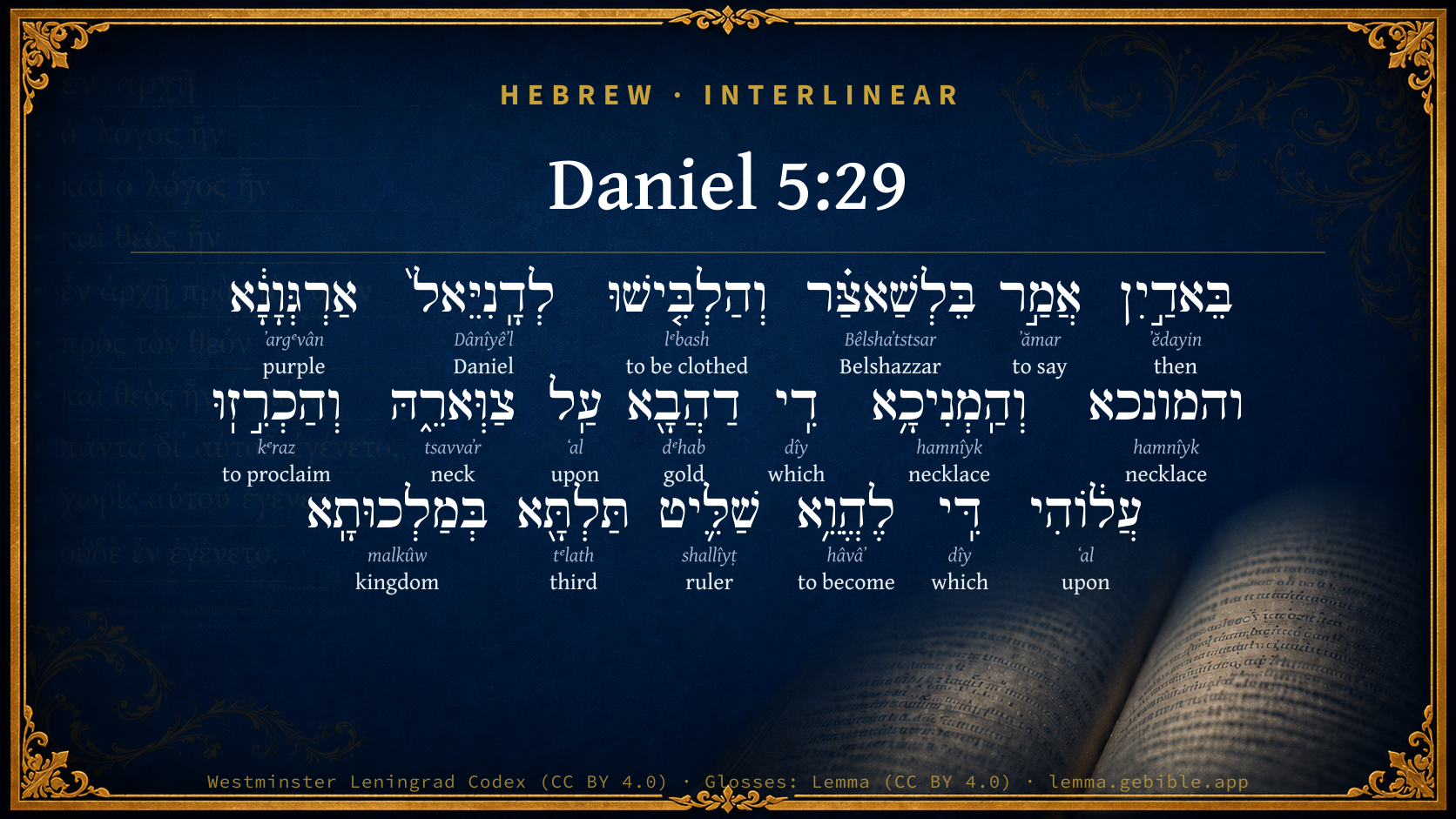
Hebrew (Westminster Leningrad Codex) Daniel 5:29 appears in the Hebrew Old Testament. The text above is from the Westminster Leningrad Codex. Each word links to its Strong’s number, a concise gloss, and parsing drawn from the Open Scriptures Hebrew Bible morphology. Click any word for its full Brown-Driver-Briggs (BDB) entry.
Download image
Cite this verse

Daniel 5:29 (World English Bible). Public Domain. Lemma interlinear Bible study tool, https://lemma.gebible.app/v/daniel/5/29.

Show BibTeX & RIS
BibTeX
RIS
English Translation
Then commanded Belshazzar, and they clothed Daniel with purple, and put a chain of gold about his neck, and made proclamation concerning him, that he should be the third ruler in the kingdom.
World English Bible · Public Domain
Highlights
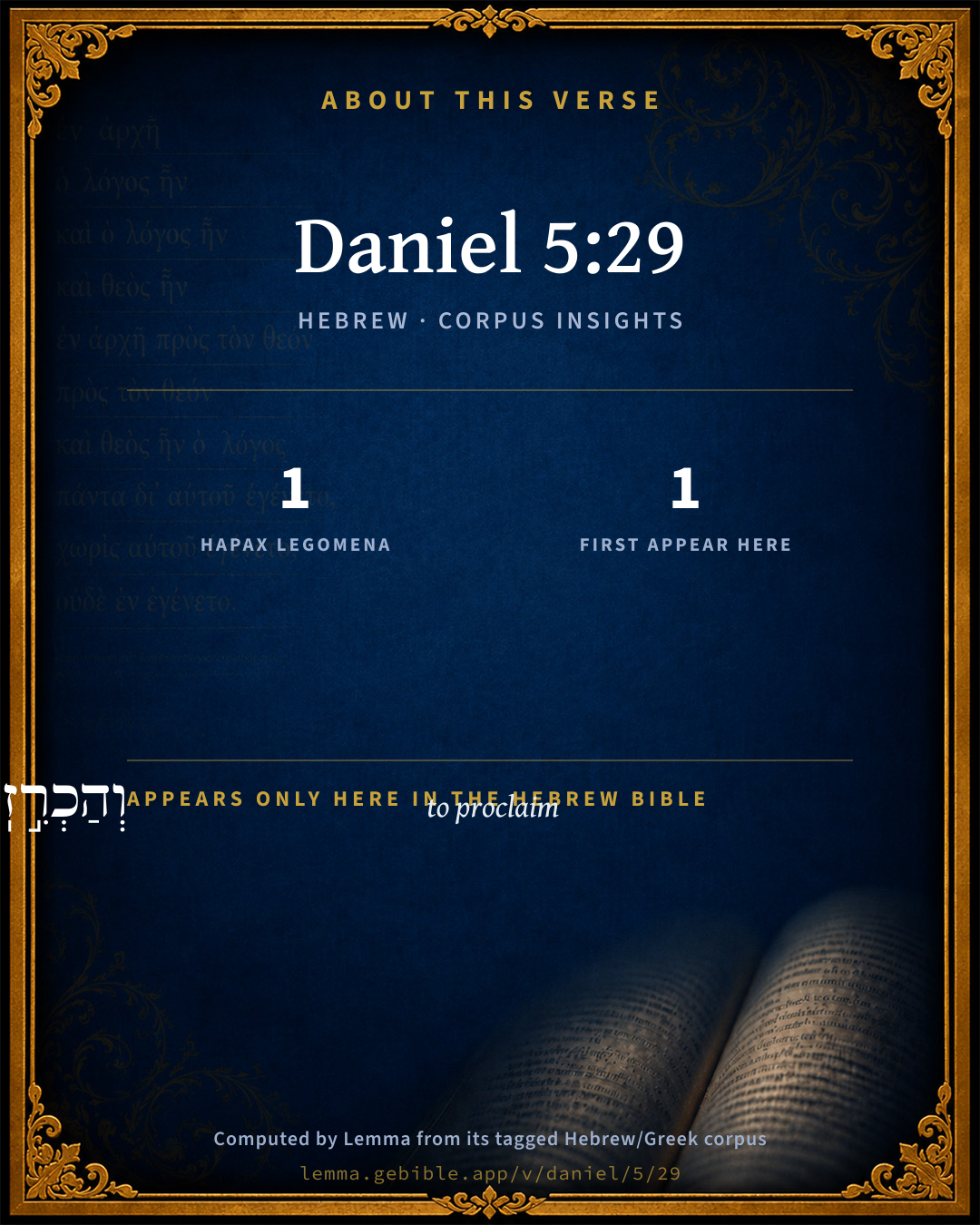
  • 1 hapax legomenon — only here in the Hebrew Bible
  • 1 first appearance in the Hebrew Bible
Full analysis ↓
Download a study sheet

One document with this verse’s original text, its word-by-word gloss line, the meaning frame, cross-references with their text, attributed commentary, and full source and license credits — printable, and it pastes into notes with its structure intact.

This verse Autodidact and up

Study sheet (.html) Plain text (.txt)

A passage Seminary Student

Up to 50 verses in one chapter. A passage sheet keeps up to 6 commentary sources and 12 cross-references per verse, in the order this page ranks them, and says so on the sheet whenever that leaves anything out. Ask for a single verse and you get the Autodidact verse sheet above.

Everything on this page stays free to read, with no account — the sheet is a download of what is already on screen, not access to it.

Want to remove ads? Support Godless Engineer
Compare translations 3

The same verse in 3 English versions, stacked beneath the original-language interlinear above. Click any original word for its lexicon entry.

Each is an independent rendering of the whole verse — the interlinear is not word-aligned to these translations.

Highlighted words mark where these versions differ — a whole-verse word diff, not a word-by-word alignment.

  • World English Bible Public Domain
    Then commanded Belshazzar, and they clothed Daniel with purple, and put a chain of gold about his neck, and made proclamation concerning him, that he should be the third ruler in the kingdom.
  • King James Version Public Domain
    Then commanded Belshazzar, and they clothed Daniel with scarlet, and put a chain of gold about his neck, and made a proclamation concerning him, that he should be the third ruler in the kingdom.
  • unfoldingWord Literal Text CC BY-SA 4.0
    Then Belshazzar gave the command, and they clothed Daniel with purple. A chain of gold was put around his neck, and a proclamation was made about him, that he would be the third ruler in the kingdom.

unfoldingWord Literal Text — © unfoldingWord, licensed CC BY-SA 4.0. Word-aligned USFM3 via Door43 (git.door43.org/unfoldingWord/en_ult).

Versions to compare (up to 4)

3 of 4 selected

Show all 18 translations

Every available English version of this verse, each an independent rendering of the whole verse.

  • World English Bible Public Domain
    Then commanded Belshazzar, and they clothed Daniel with purple, and put a chain of gold about his neck, and made proclamation concerning him, that he should be the third ruler in the kingdom.
  • Berean Standard Bible Public Domain
    Then Belshazzar gave the command, and they clothed Daniel in purple, placed a gold chain around his neck, and proclaimed him the third highest ruler in the kingdom.
  • Majority Standard Bible Public Domain
    Then Belshazzar gave the command, and they clothed Daniel in purple, placed a gold chain around his neck, and proclaimed him the third highest ruler in the kingdom.
  • King James Version Public Domain
    Then commanded Belshazzar, and they clothed Daniel with scarlet, and put a chain of gold about his neck, and made a proclamation concerning him, that he should be the third ruler in the kingdom.
  • American Standard Version (1901) Public Domain
    Then commanded Belshazzar, and they clothed Daniel with purple, and put a chain of gold about his neck, and made proclamation concerning him, that he should be the third ruler in the kingdom.
  • Revised Version (1885) Public Domain
    Then commanded Belshazzar, and they clothed Daniel with purple, and put a chain of gold about his neck, and made proclamation concerning him, that he should be the third ruler in the kingdom.
  • Geneva Bible (1599) Public Domain
    Then at the commandement of Belshazzar they clothed Daniel with purple, and put a chaine of golde about his necke, and made a proclamation concerning him that he should be the third ruler in the kingdome.
  • Douay-Rheims (1899) Public Domain
    Then by the king's command Daniel was clothed with purple, and a chain of gold was put about his neck: and it was proclaimed of him that he had power as the third man in the kingdom.
  • Young's Literal Translation Public Domain
    Then hath Belshazzar said, and they have clothed Daniel with purple, and a bracelet of gold `is' on his neck, and they have proclaimed concerning him that he is the third ruler in the kingdom.
  • Literal Standard Version CC BY-SA 4.0
    Then Belshazzar has spoken, and they have clothed Daniel with purple, and a bracelet of gold [is] on his neck, and they have proclaimed concerning him that he is the third ruler in the kingdom.
  • Unlocked Literal Bible CC BY-SA 4.0
    Then Belshazzar gave a command, and they clothed Daniel with purple. A chain of gold was put around his neck, and the king made a proclamation about him that he would have the authority of the third highest ruler in the kingdom.
  • unfoldingWord Literal Text CC BY-SA 4.0
    Then Belshazzar gave the command, and they clothed Daniel with purple. A chain of gold was put around his neck, and a proclamation was made about him, that he would be the third ruler in the kingdom.
  • Darby Bible Public Domain
    Then Belshazzar commanded, and they clothed Daniel with purple, and [put] a chain of gold about his neck, and made proclamation concerning him that he should be the third ruler in the kingdom.
  • World Messianic Bible Public Domain
    Then Belshazzar commanded, and they clothed Daniel with purple, and put a chain of gold about his neck, and made proclamation concerning him, that he should be the third ruler in the kingdom.
  • Webster's Bible Public Domain
    Then commanded Belshazzar, and they clothed Daniel with scarlet, and put a chain of gold about his neck, and made a proclamation concerning him, that he should be the third ruler in the kingdom.
  • Free Bible Version CC BY-SA 4.0
    Then Belshazzar gave the order and Daniel was clothed in purple and had a gold chain placed around his neck. He was proclaimed the third highest ruler in the kingdom.
  • Bible in Basic English Public Domain
    Then, by the order of Belshazzar, they put a purple robe on Daniel, and a gold chain round his neck, and a public statement was made that he was to be a ruler of high authority in the kingdom.
  • JPS Tanakh (1917) Public Domain
    Then commanded Belshazzar, and they clothed Daniel with purple, and put a chain of gold about his neck, and made proclamation concerning him, that he should rule as one of three in the kingdom.

Literal Standard Version (2020), Covenant Press — licensed CC BY-SA 4.0. Text via the HelloAO Bible API (eBible.org). Unlocked Literal Bible (unfoldingWord) — licensed CC BY-SA 4.0. Text via the HelloAO Bible API (eBible.org). unfoldingWord Literal Text — © unfoldingWord, licensed CC BY-SA 4.0. Word-aligned USFM3 via Door43 (git.door43.org/unfoldingWord/en_ult). Free Bible Version, Dr. Jonathan Gallagher — licensed CC BY-SA 4.0. Text via the HelloAO Bible API (eBible.org).

Word by word

More ways to search: Search by grammar → Find every occurrence → Compare this word →

Practice this passage: Drill this verse → Learn its vocabulary →

וְהַכְרִ֣זֽוּ
kᵉraz
H3745
“and · to proclaim”
Adjective, C + Verb, Hiphil, Perfect, 3rd Person, Masculine, Plural
Part of Speech
Adjective + Verb
Stem
Hiphil
Form
Perfect
Person
3rd Person
Gender
Masculine
Number
Plural
Full BDB Definition

Origin: probably of Greek origin

TWOT: 2801

(Aphel) to herald, proclaim, make proclamation
  1. בֵּאדַ֣יִן ʼĕdayin H116 “in/at · then” Adjective, R + Adverb
  2. אֲמַ֣ר ʼămar H560 “to say” Adjective, V, Plural
  3. בֵּלְשַׁאצַּ֗ר Bêlshaʼtstsar H1113 “Belshazzar” Adjective, N
  4. וְהַלְבִּ֤ישׁוּ lᵉbash H3848 “and · to be clothed” Adjective, C + Verb, Hiphil, Perfect, 3rd Person, Masculine, Plural
  5. לְדָֽנִיֵּאל֙ Dânîyêʼl H1841 “to/for · Daniel” Adjective, T + Noun, Proper
  6. אַרְגְּוָנָ֔א ʼargᵉvân H711 “purple · the” Adjective, N, Common + Particle, Definite Article
  7. והמונכא hamnîyk H2002 “and · necklace · the” Adjective, C + Noun, Common, Masculine, Singular, Determined + Particle, Definite Article
  8. וְהַֽמְנִיכָ֥א hamnîyk H2002 “and · necklace · the” Adjective, C + Noun, Common, Masculine, Singular, Determined + Particle, Definite Article
  9. דִֽי dîy H1768 “which” Adjective, T
  10. דַהֲבָ֖א dᵉhab H1722 “gold · the” Adjective, N, Common + Particle, Definite Article
  11. עַֽל ʻal H5922 “upon” Adjective, R
  12. צַוְּארֵ֑הּ tsavvaʼr H6676 “neck · his” Adjective, N, Common + Suffix, Personal, 3rd Person, Masculine, Singular
  13. עֲל֔וֹהִי ʻal H5922 “upon · him” Adjective, R + Suffix, Personal, 3rd Person, Masculine, Singular
  14. דִּֽי dîy H1768 “which” Adjective, C
  15. לֶהֱוֵ֥א hâvâʼ H1934 “to become” Adjective, V
  16. שַׁלִּ֛יט shallîyṭ H7990 “ruler” Adjective, A
  17. תַּלְתָּ֖א tᵉlath H8531 “third” Adjective, A
  18. בְּמַלְכוּתָֽא malkûw H4437 “in/at · kingdom · the” Adjective, R + Noun, Common, Feminine, Singular, Determined + Particle, Definite Article

About this verse

These counts appear in no published source. They are computed here, from the morphology-tagged text and Lemma’s own curated glosses. What Lemma adds →

19
words
16
distinct lemmas
Prophets
section

Notable vocabulary

1 hapax legomenon — a word that appears only here in the entire Hebrew Bible:

  • וְהַכְרִ֣זֽוּ to proclaim H3745

First appearance in Scripture

This word makes its first canonical appearance in the Hebrew Bible here:

  • וְהַכְרִ֣זֽוּ to proclaim H3745

Shared distinctive vocabulary

תַּלְתָּ֖א third H8531 occurs in 2 verses of the Hebrew Bible. Also found in:

Grammatical profile

  • 2 verbs
  • 1 noun
  • 10 adjectives
  • 1 adverb
  • 5 particles

Verb forms

  • וְהַלְבִּ֤ישׁוּ Hiphil · Perfect
  • וְהַכְרִ֣זֽוּ Hiphil · Perfect

Repetition

Words recur within this verse — often emphatic in Hebrew:

  • והמונכא necklace H2002 ×2
  • עַֽל upon H5922 ×2
  • דִֽי which H1768 ×2

Hebrew & Septuagint length

In English translation the verse runs 33 words from the Hebrew and 30 from the Septuagint (LXX English) — closely comparable.

A rough comparison of the two English renderings, which tokenize alike — not a word-level alignment.

Word counts can differ between the Hebrew and the Greek without any difference in meaning — e.g. the Hebrew direct-object marker אֵת has no separate Greek word, and Greek often adds the article ὁ.

Cross-references

2

Topical passages linked to Daniel 5:29 in the Treasury of Scripture Knowledge — connected by theme and wording, ordered by reader-vote popularity; previews shown in the World English Bible.

  • Daniel 5:7 The king cried aloud to bring in the enchanters, the Chaldeans, and the soothsayers. The king spoke and said to the wise men of Babylon, Whoever shall read this writing, and show me the interpretation of it, shall be clothed with purple, and have a chain of gold about his neck, and shall be the third ruler in the kingdom.
  • Daniel 5:16 But I have heard of you, that you can give interpretations, and dissolve doubts; now if you can read the writing, and make known to me the interpretation of it, you shall be clothed with purple, and have a chain of gold about your neck, and shall be the third ruler in the kingdom.

Cross-references courtesy of OpenBible.info (CC BY 4.0).

Hebrew and Greek witnesses Masoretic Hebrew ↔ Greek Septuagint

The same verse in the two great witnesses to the Old Testament, shown verse-for-verse.

These are two independent witnesses, not word-aligned to each other, and the Septuagint is shown in lemma (dictionary) form.

Hebrew Daniel 5:29 Masoretic · Westminster Leningrad Codex

בֵּאדַ֣יִן אֲמַ֣ר בֵּלְשַׁאצַּ֗ר וְהַלְבִּ֤ישׁוּ לְדָֽנִיֵּאל֙ אַרְגְּוָנָ֔א והמונכא וְהַֽמְנִיכָ֥א דִֽי דַהֲבָ֖א עַֽל צַוְּארֵ֑הּ וְהַכְרִ֣זֽוּ עֲל֔וֹהִי דִּֽי לֶהֱוֵ֥א שַׁלִּ֛יט תַּלְתָּ֖א בְּמַלְכוּתָֽא

Then commanded Belshazzar, and they clothed Daniel with purple, and put a chain of gold about his neck, and made proclamation concerning him, that he should be the third ruler in the kingdom.

World English Bible · Public Domain

Greek LXX Daniel 5:29 Septuagint · lemma form
Then Baltasar commanded, and they clothed Daniel with scarlet, and put the golden chain about his neck, and proclaimed concerning him that he was the third ruler in the kingdom.

LXX2012 (modern English Septuagint) · Public Domain

On this verse, The Pulpit Commentary discusses the Septuagint’s reading. Read the note in Commentary ↓

Hebrew: Westminster Leningrad Codex (CC BY 4.0). Greek: Septuagint (public domain); English from LXX2012 (modern English Septuagint) (Public Domain). How the Septuagint differs from the Hebrew →

Commentary

Notes on Daniel 5:29 from classic Christian and Jewish commentators (each source and its license shown beneath its notes). The classic Christian expositions comment on the surrounding passage and are grouped to its opening verse, so a note may address several verses; the Jewish commentaries on the Tanakh (Rashi and others) are per-verse, so they appear only where the commentator wrote on this verse.

Lemma curates 59 commentaries, every one of them public domain or Creative Commons licensed, each selected and text-cleaned for this edition rather than reprinted as found. About our sources →

Trapp's Complete Commentary

John Trapp

Dan 5:29 Then commanded Belshazzar, and they clothed Daniel with scarlet, and [put] a chain of gold about his neck, and made a proclamation concerning him, that he should be the third ruler in the kingdom.

Ver. 29. Then commanded Belshazzar, and they clothed Daniel.] No nay, but they would do it; and he at length admitted it, partly that he might not seem to slight the king’s courtesy and to be disaffected, and partly that thereby he might be the better known to the Persians for the comfort of God’s poor people.

And put a chain of gold about his neck, and made a proclamation, &c.] All this the king commanded to be done, out of an admiration of Daniel’s divine wisdom, and that he might be dicti sui dominus, as good as his word; but not a word hear we of his repentance, such was his stupidity; nor doth Daniel exhort him to it, because he saw him to be past feeling, and knew that the decree was gone forth.

John Trapp, A Commentary or Exposition upon All the Books of the Old and New Testament (1647–1656) — public domain. Text from a community e-Sword module.

Joseph Benson's Commentary

Dan 5:29. Then commanded Belshazzar, and they clothed Daniel — The king was so struck with his superior wisdom, and conceived himself so bound by the promise he had made before his nobles, that he ordered the prophet to be rewarded immediately with the honours he had promised him, which he was forced to accept, and which probably prepared him for a more easy reception by the succeeding monarch. “Nor let it be matter of wonder that Daniel is said to be clothed as it were immediately, for these habits were always at hand for the eastern monarchs to reward their friends or favourites with; and Mr. Harmer tells us, from Sir John Chardin, that the kings of Persia have great wardrobes, where there are always many hundreds of habits ready, designed for presents, and sorted. — Obs., vol. 2. p. 87. It seems likewise that, on some occasions, the great men of the East were accustomed to carry with them, on their journeys, a variety of habits and vestments, in order to distribute them as presents to those whom they wished to honour and reward. And this will account for the changes of garments which Naaman the Syrian had with him, when he returned from the Prophet Elisha, some of which were given to his perfidious servant, 2 Kings 5.” — Wintle.

Joseph Benson's Commentary on the Old and New Testaments (1811–1818) — public domain. Text from a community e-Sword module.

Tyndale Open Study Notes

Tyndale Open Resources

5:29 Instead of responding to the message, Belshazzar honored Daniel. • proclaimed the third highest ruler: Daniel did not desire the honor, and in a few hours it would be meaningless. God would reward Daniel in due time (12:13).

Tyndale Open Study Notes — © Tyndale Open Resources, licensed CC BY-SA 4.0. Text via the HelloAO Bible API.

Jamieson, Fausset & Brown

Robert Jamieson, A. R. Fausset & David Brown

Belshazzar . . . clothed Daniel with scarlet--To come from the presence of a prince in a dress presented to the wearer as a distinction is still held a great honor in the East. Daniel was thus restored to a similar rank to what he had held under Nebuchadnezzar (Dan 2:48). Godly fidelity which might be expected to bring down vengeance, as in this case, is often rewarded even in this life. The king, having promised, was ashamed before his courtiers to break his word. He perhaps also affected to despise the prophecy of his doom, as an idle threat. As to Daniel's reasons for now accepting what at first he had declined, compare Note, see on Dan 5:17. The insignia of honor would be witnesses for God's glory to the world of his having by God's aid interpreted the mystic characters. The cause of his elevation too would secure the favor of the new dynasty (Dan 6:2) for both himself and his captive countrymen. As the capture of the city by Cyrus was not till near daylight, there was no want of time in that eventful night for accomplishing all that is here recorded. The capture of the city so immediately after the prophecy of it (following Belshazzar's sacrilege), marked most emphatically to the whole world the connection between Babylon's sin and its punishment.

Jamieson, Fausset & Brown — Commentary Critical and Explanatory on the Whole Bible (1871) — public domain (CC PDM 1.0). Text via the HelloAO Bible API.

Adam Clarke's Commentary

Verse 29. Clothed Daniel with scarlet] ארגונא argevana, more probably with purple. The gold chain about the neck was an emblem of magisterial authority. It is often thus mentioned in Scripture.

Adam Clarke's Commentary on the Bible (1810–1826) — public domain. Text from a community e-Sword/MySword module.

John Calvin's Commentaries

This order of the king may excite surprise, since he had been so sharply reproved by the Prophet. He next seemed to have lost all spirit, for he had grown pale a hundred times, and would have devoted the holy Prophet of God to a thousand deaths! How happens it, then, that he ordered him to be adorned with royal apparel, and next to be proclaimed by his own herald the third person in the kingdom? Some think this was done because the laws of kings were sacred among the Babylonians; nay, their very words were held as binding, and whatever they proclaimed, they desired it to be esteemed firm and inviolable. They suppose King Belshazzar to have acted thus through ambition, that he might keep his promises. My opinion is, that he was at first utterly astonished, and through listening to the Prophet he became like a stock or a stone! I think he did so to consult his own ease and safety; otherwise he would have been contemptible to his nobles. To shew himself unmoved, he commands Daniel to be clothed in these robes, as if his threat had been perfectly harmless. He did not despise what the Prophet had said, but he wished to persuade his nobles and all his guests of his perfect indifference to God’s threats, as if he did not utter them for the purpose of executing them, but only of terrifying them all. Thus kings, when greatly terrified, are always exceedingly careful not to shew any sign of their timidity, since they think their authority would become materially weakened. To continue, therefore, his reverence among his subjects, he is desirous of appearing exceedingly careless and undisturbed; and I do not hesitate to pronounce this to have been the tyrant’s intention in ordering Daniel to be clad in purple and in royal magnificence.

John Calvin's Commentaries (1540-1563) — public domain. Text from the Calvin Translation Society English edition (1840s-50s) via the Christian Classics Ethereal Library (ccel.org). Calvin's coverage is partial (roughly two-thirds of the Bible); uncommented books and verses are honest gaps, never fabricated. The 19th-century editor's footnotes and remarks are omitted so the notes are faithfully Calvin's own voice.

The Cambridge Bible for Schools and Colleges

gen. ed. J. J. S. Perowne

29. Belshazzar fulfils the promise given in Dan_5:16. The unconcern exhibited by the king at Daniel’s interpretation, especially in presence of what (as Dan_5:30 shews) could hardly have been a distant or unsuspected danger, is scarcely consistent with historical probability.

scarlet] purple, as Dan_5:7; Dan_5:16.

that he should be ruler as one of three in the kingdom] See on Dan_5:7.

The Cambridge Bible for Schools and Colleges (gen. ed. J. J. S. Perowne; Cambridge University Press, 1878–1918) — public domain. Text from a community e-Sword module.

John Gill's Exposition

Then commanded Belshazzar,.... As soon as he had heard the writing read and interpreted; instead of being full of wrath, as might have been expected, he orders the reward promised to be given, to show he had a regard to his word and honour, as a king; and to secure his credit with his nobles and people; and perhaps he might not understand, by Daniel's interpretation, that the destruction of him and his kingdom was so near at hand as it was; or he might put this evil day far from him, and hope it might be prevented:

and they clothed Daniel with scarlet; the king's servants by his orders: or,

that they should clothe Daniel with scarlet (a); these were his orders; but whether executed is not certain; probably not, since the king was slain the same night; and so the rest of the clauses may be read,

and should put a chain of gold about his neck, and should make proclamation concerning him, that he should be the third ruler in the kingdom; all which was the reward promised to him that should read and interpret the writing, Dan 5:7, but that this was done, the king's death being so sudden, does not appear; and therefore it is needless to inquire the reasons of Daniel's acceptance after his refusal.

(a) "ut induerent", Gejerus.

John Gill's Exposition of the Whole Bible (1746–1763) — public domain (CC PDM 1.0). Text via the HelloAO Bible API.

Albert Barnes' Notes on the Bible

Then commanded Belshazzar - In compliance with his promise, Dan 5:16. Though the interpretation had been so fearful in its import, and though Daniel had been so plain and faithful with him, yet he did not hesitate to fulfill his promise. It is a remarkable instance of the result of fidelity, that a proud monarch should have received such a reproof, and such a prediction in this manner, and it is an encouragement to us to do our duty, and to state the truth plainly to wicked men. Their own consciences testify to them that it is the truth, and they will see the truth so clearly that they cannot deny it.

And they clothed Daniel with scarlet ... - All this, it would seem, was transacted in a single night, and it has been made an objection, as above remarked, to the authenticity of the book, that such events are said to have occurred in so short a space of time, and that Daniel should have been so soon clothed with the robes of office. On this objection, see Introduction to the chapter, Section I. II. In respect to the latter part of the objection, it may be here further remarked, that it was not necessary to “fit” him with a suit of clothes made expressly for the occasion, for the loose, flowing robes of the Orientals were as well adapted to one person as another, and in the palaces of kings such garments were always on hand. See Harmer’s “Observations on the East,” vol. ii. 392, following. Compare Rosenmuller, “Morgenland, in loc.”

That he should be the third ruler ... - See the notes at Dan 5:7.

Albert Barnes' Notes on the Bible (1834–1885) — public domain. Text from a community e-Sword/MySword module.

Haydock's Catholic Bible Commentary

Third, or over a third part. (St. Jerome; ver. 7.; Haydock) The honours wee conferred without delay, and they would have been made public in the morning. But death prevented the king; and Daniel did not enjoy them till they were ratified by Darius, to whom he adhered. (Calmet) --- The Medes then besieged the city, which they took that night, when most part were drunk. (Worthington) --- It was a solemn festival. (Isaiah xxi.) (St. Jerome) --- Cyrus rushed in by the channel of the Euphrates, and two of the king’s guards slew him to revenge themselves. (Xenoph. 7.;Berosus)

George Leo Haydock (1774–1849), Haydock's Catholic Family Bible and Commentary, 1859 edition — public domain. Excludes Psalms (Douay-Rheims chapter numbering differs from Protestant) and Deuterocanonical books (Catholic canon only).

Matthew Poole's English Annotations

Though it were a sad unwelcome message to him, yet he would be as good as his word, and performed his promise; for his princes were witnesses to it, and the word of those kings was counted sacred; besides, it was a great thing that Daniel had unfolded, all were convinced of it as well as the king.

Quest. But how comes Daniel to accept that now, which he seemed to refuse before, Dan 5:17?

Answ. He refused before lest he should seem to prophesy for reward, which was dishonourable; now it is as it were forced upon him, for the king commanded it, and there is as much danger and crime with some in refusing a favour as boldness in begging.

Matthew Poole's English Annotations on the Holy Bible (1683–1685) — public domain. Text from a community e-Sword/MySword module.

Whedon's Commentary on the Bible

Daniel D. Whedon

29. And they clothed — Or, commanded to clothe. (Compare Dan_5:17). Professor Kautzsch reads the famous phrase, third ruler in the kingdom, exactly as the A.V. and adds the explanation, “Either as one of three over the whole kingdom or as third by the side of the king and the king’s mother.” (See note Dan_5:7-9.)

Daniel D. Whedon (gen. ed.), Commentary on the Old and New Testaments (1874–1909) — public domain. Text from a community e-Sword module.

The Pulpit Commentary

Then commanded Belshazzar, and they clothed Daniel with scarlet, and put a chain of gold about his neck, and made a proclamation concerning him, that he should be the third ruler in the kingdom. The Septuagint runs thus: "Then Baltasar the king clothed Daniel in purple, and put on him a golden necklace, and gave authority to him over a third part of his kingdom." The only difference here is that there is no word of a proclamation. Theodotion and the Peshitta agree with the Massoretic text. We have atlT here instead of yTilT. The presence of the haphel form instead of the aphel, is to be noted. No reader whose attention is directed to it can fail to be struck with the magnanimity of Belshazzar; he had promised that whoever would interpret the inscription should be clothed in purple and gold, and be made third ruler of the kingdom. Had he been a mean man, he might have higgled about the matter; he might have declared an uncertainty as to whether Daniel did not, out of his spite against the murderers of the son of Nebuchadnezzar, invent the evil interpretation. The treatment Ahab meted out to Micaiah the son of Imlah sows the way a tyrannical monarch may a-t towards one who has uttered unpalatable prophecies against him. He might, according to the Persian story, have proclaimed Daniel exalted to all the promised honors, and then instantly had him executed. But, no; in noble simplicity he fulfils his promise to the last letter, without any apparent after-thought of vengeance. If Belshazzar is intended to represent Antiochus Epiphanes, certainly the portrait is singularly unlike anything we know of that monarch. Cruel and. treacherous, he was very unlikely to keep such a promise to one who had made such a prophecy concerning him. Even if lie could have done so, no Jew, with blood boiling from the indignities and cruelties heaped upon the Jewish race, could have pictured him doing this. Even the natural instinct that makes us think that specially terrible misfortune must be the result of specially unbroken wickedness, would certainly have led the writer of Daniel, if drawing on his imagination, to make Belshazzar meanly refuse his rewards, or, having given them, to threaten the receiver with death. It is no answer to say, with Ewald and Jephet-ibn-Ali. that the reward once promised was irrevocable, for the accuracy of the reading of the writing might have been contested, and the correctness of the interpretation denied. Further, as has been pointed out by Keil, there is no evidence that Epiphanes ever desecrated the sacred vessels at a banquet; he was regardless enough to have done so, but his financial necessities were too pressing for delaying the coining of these golden treasures. Moreover, in Antiochus such desecration would be without purpose, whereas, as we have seen, there might be a purpose in the action of Belshazzar. The idea maintained by commentators of the critical school, that there in any reference in the description given here of the feast of Belshazzar and its results to the feast which Antiochus gave to the Peel,in of Antioch, as described by Polybius, 26., is mere nonsense. The ponts of contrast are vastly more prominent than the points of resemblance. Belshazzar"s feast is over in one night; Antiochus"s feast lasted several days. Belshazzar"s feast was given in his palace, to "a thousand of his lords;" Antiochus invited the whole populace of Antioch to revel in the grove of Daphne. While, as we have seen, there is blasphemy against Jehovah and defiance of him in Belshazzar"s feast, there in no kind of debauchery. In regard to the feast of Antiochus, on the other hand, while there is maddest excess of every kind, a very orgy of lust and drunkenness, there is no word, either in Polybius or in the Books of the Maccabees, of any special act of defiance to Jehovah, or blasphemy of his Name. The only point of identity is that both the banquet of Belshazzar and the orgy of Antiochus have been called "feasts." Altogether, the idea that Belshazzar represents Antiochus Epiphanes is nearly as absurd as that Nebuchadnezzar does. Did the orthodox interpretation involve such an identification, what boundless scorn would be poured on the unfortunate maintainers of such a view?

The Pulpit Commentary (1880–1919), ed. H.D.M. Spence-Jones & Joseph S. Exell — public domain. Text from a community e-Sword module.

Keil & Delitzsch

C. F. Keil & F. Delitzsch

Daniel rewarded, and the beginning of the fulfilment of the writing.

Belshazzar fulfilled the promise he had made to Daniel by rewarding him for reading and interpreting the writing. והלבּשׁוּ is not to be translated: (commanded) that they should clothe, - this meaning must be conveyed by the imperfect (cf. Dan 2:49), - but: and they clothed him. The command was then carried out: Daniel was not only adorned with purple and with a golden chain, but was also proclaimed as the third ruler of the kingdom. The objection that this last-mentioned dignity was not possible, since, according to Dan 5:30, Belshazzar was slain that very night, is based on the supposition that the proclamation was publicly made in the streets of the city. But the words do not necessitate such a supposition. The proclamation might be made only before the assembled magnates of the kingdom in the palace, and then Belshazzar may have been slain on that very night. Perhaps, as Kliefoth thinks, the conspirators against Belshazzar availed themselves of the confusion connected with this proclamation, and all that accompanied it, for the execution of their purpose. We may not, however, add that therewith the dignity to which Daniel was advanced was again lost by him. It depended much rather on this: whether Belshazzar's successor recognised the promotion granted to Daniel in the last hours of his reign. But the successor would be inclined toward its recognition by the reflection, that by Daniel's interpretation of the mysterious writing from God the putting of Belshazzar to death appeared to have a higher sanction, presenting itself as if it were something determined in the councils of the gods, whereby the successor might claim before the people that his usurpation of the throne was rendered legitimate. Such a reflection might move him to confirm Daniel's elevation to the office to which Belshazzar had raised him. This supposition appears to be supported by Dan 6:2 (1).

Bleek and other critics have based another objection against the historical veracity of this narrative on the improbability that Belshazzar, although the interpretation predicted evil against him, and he could not at all know whether it was a correct interpretation, should have rewarded Daniel instead of putting him to death (Hitzig). But the force of this objection lies in the supposition that Belshazzar was as unbelieving with regard to a revelation from God, and with regard to the providence of the living God among the affairs of men, as are the critics of our day; the objection is altogether feeble when one appreciates the force of the belief, even among the heathen, in the gods and in revelations from God, and takes into consideration that Belshazzar perhaps scarcely believed the threatened judgment from God to be so near as it actually was, since the interpretation by Daniel decided nothing as regards the time, and perhaps also that he hoped to be able, by conferring honour upon Daniel, to appease the wrath of God.

(Note: "Non mirum, si Baltasar audiens tristia, solverit praemium quod pollicitus est. Aut enim longo post tempore credidit ventura quae dixerat, aut dum Dei prophetam honorat, sperat se veniam consecuturum." - Jerome.)

The circumstance, also, that Daniel received the honour promised to him notwithstanding his declining it (Dan 5:17), can afford no ground of objection against the truth of the narrative, since that refusal was only an expression of the entire absence of all self-interest, which was now so fully established by the matter of the interpretation that there was no longer any ground for his declining the honours which were conferred upon him unsought, while they comprehended in themselves in reality a recognition of the God whom he served.

Keil & Delitzsch — Biblical Commentary on the Old Testament (1861–1891) — public domain (CC PDM 1.0). Text via the HelloAO Bible API. (Old Testament only.)

unfoldingWord translationNotes

Door43 World Missions Community

Belshazzar

This is the son of Nebuchadnezzar who became king after his father. See how you wrote this name in Daniel 5:1. (See: How to Translate Names)

A chain of gold was put around his neck

This can be stated in active form. AT: "They put a chain of gold around his neck" (See: Active or Passive)

the third highest ruler

"the number three ruler" (See: Ordinal Numbers)

received the kingdom

"became the ruler of the kingdom"

when he was about sixty-two years old

"when he was about 62 years old" (See: Numbers)

translationWords

command

Daniel

purple

gold

king

preach

authority

rule

kingdom

Babylon

Darius

Medes

unfoldingWord translationNotes — © Distant Shores Media and the Door43 World Missions Community, licensed CC BY-SA 4.0. Source: git.door43.org/Door43/en_tn.

Lesson kit

Teaching starters — assembled from the data on this page, not authored interpretation. Every prompt links to the verse data it draws on. Edit before teaching.

Daniel, in the Prophets, opens this verse with 19 words (16 distinct Hebrew lemmas). Its most distinctive word is kᵉraz (“to proclaim”). A historical commentator’s framing appears above. Read the whole chapter for the surrounding context.

Discussion questions

  1. How does “to proclaim” (kᵉraz) shape what this verse is saying?
  2. 1 word here appears nowhere else in the Hebrew Bible. Why might the author reach for such rare wording?
  3. This is the first place “to proclaim” appears in Scripture (first appears here). What does its debut here establish?
  4. How does Daniel 5:16, which shares the word «third», read alongside this verse?
  5. What does the repetition of “necklace” (2× in this one verse) do in this verse?
  6. These translations render this verse differently. What is at stake in choosing one wording over another?
  7. «וְהַלְבִּ֤ישׁוּ» is a Hiphil Perfect verb. How does that grammatical form shape the action described?
  8. Compare how Trapp's Complete Commentary and Joseph Benson's Commentary read this verse. Where do they agree or differ?

Things to notice

  • 1 word in this verse appears nowhere else in the Hebrew Bible.
  • 1 word makes its first canonical appearance in Scripture here.
  • These translations choose different wording for 9 words in this verse.
  • “necklace” occurs 2× in this single verse.
  • 16 distinct Hebrew lemmas span 19 words in this verse.

Reading settings

Reading text

Shown beneath each verse's original-language words.

Old Testament
Old Testament edition

Read the OT as the Masoretic Hebrew (MT) or the Greek Septuagint (LXX).

English shown for the Greek Septuagint (in the Hebrew ↔ Greek comparison).

Comparing translations? Open the Compare panel on any verse page to stack up to four side by side.