
Daniel 3:10

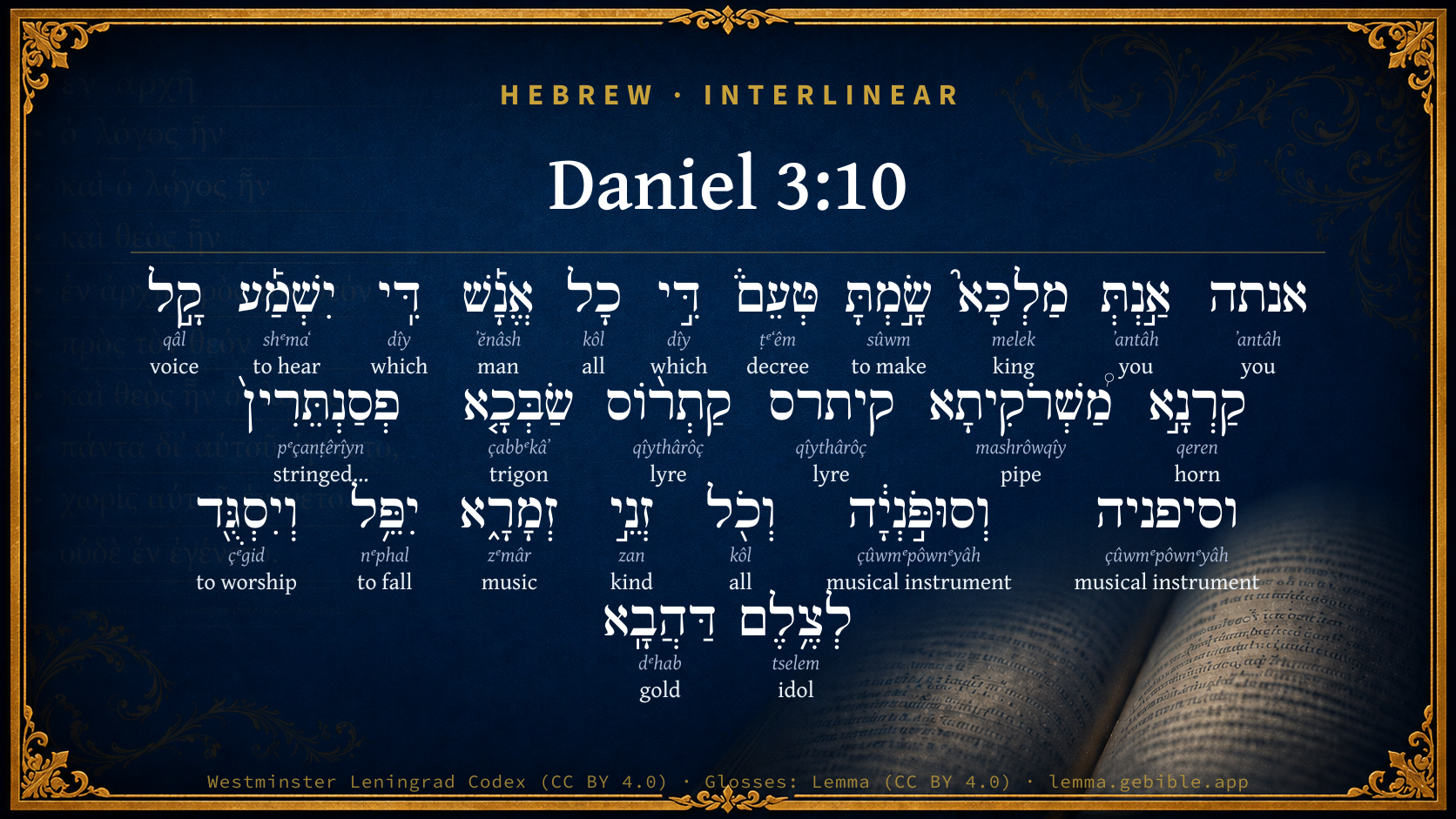
Hebrew (Westminster Leningrad Codex) Daniel 3:10 appears in the Hebrew Old Testament. The text above is from the Westminster Leningrad Codex. Each word links to its Strong’s number, a concise gloss, and parsing drawn from the Open Scriptures Hebrew Bible morphology. Click any word for its full Brown-Driver-Briggs (BDB) entry.
Download image
Cite this verse

Daniel 3:10 (World English Bible). Public Domain. Lemma interlinear Bible study tool, https://lemma.gebible.app/v/daniel/3/10.

Show BibTeX & RIS
BibTeX
RIS
English Translation
You, O king, have made a decree, that every man that shall hear the sound of the horn, flute, zither, lyre, harp, pipe, and all kinds of music, shall fall down and worship the golden image;
World English Bible · Public Domain
Download a study sheet

One document with this verse’s original text, its word-by-word gloss line, the meaning frame, cross-references with their text, attributed commentary, and full source and license credits — printable, and it pastes into notes with its structure intact.

This verse Autodidact and up

Study sheet (.html) Plain text (.txt)

A passage Seminary Student

Up to 50 verses in one chapter. A passage sheet keeps up to 6 commentary sources and 12 cross-references per verse, in the order this page ranks them, and says so on the sheet whenever that leaves anything out. Ask for a single verse and you get the Autodidact verse sheet above.

Everything on this page stays free to read, with no account — the sheet is a download of what is already on screen, not access to it.

Want to remove ads? Support Godless Engineer
Compare translations 3

The same verse in 3 English versions, stacked beneath the original-language interlinear above. Click any original word for its lexicon entry.

Each is an independent rendering of the whole verse — the interlinear is not word-aligned to these translations.

Highlighted words mark where these versions differ — a whole-verse word diff, not a word-by-word alignment.

  • World English Bible Public Domain
    You, O king, have made a decree, that every man that shall hear the sound of the horn, flute, zither, lyre, harp, pipe, and all kinds of music, shall fall down and worship the golden image;
  • King James Version Public Domain
    Thou, O king, hast made a decree, that every man that shall hear the sound of the cornet, flute, harp, sackbut, psaltery, and dulcimer, and all kinds of musick, shall fall down and worship the golden image:
  • unfoldingWord Literal Text CC BY-SA 4.0
    You, O king, have made a decree that every man who hears the sound of the horn, flute, lyre, trigon, harp, and bagpipe, and all kinds of music, must fall down and worship the golden image.

unfoldingWord Literal Text — © unfoldingWord, licensed CC BY-SA 4.0. Word-aligned USFM3 via Door43 (git.door43.org/unfoldingWord/en_ult).

Versions to compare (up to 4)

3 of 4 selected

Show all 18 translations

Every available English version of this verse, each an independent rendering of the whole verse.

  • World English Bible Public Domain
    You, O king, have made a decree, that every man that shall hear the sound of the horn, flute, zither, lyre, harp, pipe, and all kinds of music, shall fall down and worship the golden image;
  • Berean Standard Bible Public Domain
    You, O king, have issued a decree that everyone who hears the sound of the horn, flute, zither, lyre, harp, pipes, and all kinds of music must fall down and worship the golden statue,
  • Majority Standard Bible Public Domain
    You, O king, have issued a decree that everyone who hears the sound of the horn, flute, zither, lyre, harp, pipes, and all kinds of music must fall down and worship the golden statue,
  • King James Version Public Domain
    Thou, O king, hast made a decree, that every man that shall hear the sound of the cornet, flute, harp, sackbut, psaltery, and dulcimer, and all kinds of musick, shall fall down and worship the golden image:
  • American Standard Version (1901) Public Domain
    Thou, O king, hast made a decree, that every man that shall hear the sound of the cornet, flute, harp, sackbut, psaltery, and dulcimer, and all kinds of music, shall fall down and worship the golden image;
  • Revised Version (1885) Public Domain
    Thou, O king, hast made a decree, that every man that shall hear the sound of the cornet, flute, harp, sackbut, psaltery, and dulcimer, and all kinds of music, shall fall down and worship the golden image:
  • Geneva Bible (1599) Public Domain
    Thou, O King, hast made a decree, that euery man that shall heare the sounde of the cornet, trumpet, harpe, sackebut, psalterie, and dulcimer, and all instruments of musike, shall fall downe and worship the golden image,
  • Douay-Rheims (1899) Public Domain
    Thou, O king, hast made a decree that every man that shall bear the sound of the trumpet, the flute, and the harp, of the sackbut, and the psaltery, of the symphony, and of all kind of music, shall prostrate himself, and adore the golden statue:
  • Young's Literal Translation Public Domain
    Thou, O king, hast made a decree that every man who doth hear the voice of the cornet, the flute, the harp, the sackbut, the psaltery, and the symphony, and all kinds of music, doth fall down and do obeisance to the golden image;
  • Literal Standard Version CC BY-SA 4.0
    You, O king, have made a decree that every man who hears the voice of the horn, the flute, the harp, the lyre, the stringed instrument, and the symphony, and all kinds of music, falls down and pays respect to the golden image;
  • Unlocked Literal Bible CC BY-SA 4.0
    You, king, have made a decree that every person who hears the sounds of the horns, flutes, zithers, lyres, harps, and pipes, and all kinds of music, must fall down and prostrate himself to the golden statue.
  • unfoldingWord Literal Text CC BY-SA 4.0
    You, O king, have made a decree that every man who hears the sound of the horn, flute, lyre, trigon, harp, and bagpipe, and all kinds of music, must fall down and worship the golden image.
  • Darby Bible Public Domain
    Thou, O king, hast made a decree, that every man that shall hear the sound of the cornet, pipe, lute, sambuca, psaltery, and bagpipe, and all kinds of music, shall fall down and worship the golden image;
  • World Messianic Bible Public Domain
    You, O king, have made a decree that every man who hears the sound of the horn, flute, zither, lyre, harp, pipe, and all kinds of music shall fall down and worship the golden image;
  • Webster's Bible Public Domain
    Thou, O king, hast made a decree, that every man that shall hear the sound of the cornet, flute, harp, sackbut, psaltery, and dulcimer, and all kinds of music, shall fall down and worship the golden image:
  • Free Bible Version CC BY-SA 4.0
    Your Majesty has decreed that everyone who hears the sound of the musical instruments shall fall down and worship the gold statue,
  • Bible in Basic English Public Domain
    You, O King, have given an order that every man, when the sound of the horn, pipe, harp, trigon, psaltery, bagpipe, and all sorts of instruments, comes to his ears, is to go down on his face in worship before the image of gold:
  • JPS Tanakh (1917) Public Domain
    Thou, O king, hast made a decree, that every man that shall hear the sound of the horn, pipe, harp, trigon, psaltery, and bagpipe, and all kinds of music, shall fall down and worship the golden image;

Literal Standard Version (2020), Covenant Press — licensed CC BY-SA 4.0. Text via the HelloAO Bible API (eBible.org). Unlocked Literal Bible (unfoldingWord) — licensed CC BY-SA 4.0. Text via the HelloAO Bible API (eBible.org). unfoldingWord Literal Text — © unfoldingWord, licensed CC BY-SA 4.0. Word-aligned USFM3 via Door43 (git.door43.org/unfoldingWord/en_ult). Free Bible Version, Dr. Jonathan Gallagher — licensed CC BY-SA 4.0. Text via the HelloAO Bible API (eBible.org).

Word by word

More ways to search: Search by grammar → Find every occurrence → Compare this word →

Practice this passage: Drill this verse → Learn its vocabulary →

מַ֠שְׁרֹקִיתָא
mashrôwqîy
H4953
“pipe · the”
Adjective, N, Common + Particle, Definite Article
Part of Speech
Adjective + Particle
Type
Definite Article
Full BDB Definition

Origin: from a root corresponding to H8319

TWOT: 3049a

pipe
  1. אנתה ʼantâh H607 “you” Adjective, P
  2. אַ֣נְתְּ ʼantâh H607 “you” Adjective, P
  3. מַלְכָּא֮ melek H4430 “king · the” Adjective, N, Common + Particle, Definite Article
  4. שָׂ֣מְתָּ sûwm H7761 “to make” Adjective, V, Plural
  5. טְּעֵם֒ ṭᵉʻêm H2942 “decree” Adjective, N, Common
  6. דִּ֣י dîy H1768 “which” Adjective, T
  7. כָל kôl H3606 “all of” Adjective, N, Common
  8. אֱנָ֡שׁ ʼĕnâsh H606 “man” Adjective, N, Common
  9. דִּֽי dîy H1768 “which” Adjective, T
  10. יִשְׁמַ֡ע shᵉmaʻ H8086 “to hear” Adjective, V
  11. קָ֣ל qâl H7032 “voice of” Adjective, N, Common
  12. קַרְנָ֣א qeren H7162 “horn · the” Adjective, N, Common + Particle, Definite Article
  13. קיתרס qîythârôç H7030 “lyre” Adjective, N, Common
  14. קַתְר֨וֹס qîythârôç H7030 “lyre” Adjective, N, Common
  15. שַׂבְּכָ֤א çabbᵉkâʼ H5443 “trigon” Adjective, N, Common
  16. פְסַנְתֵּרִין֙ pᵉçanṭêrîyn H6460 “stringed instrument” Adjective, N, Common
  17. וסיפניה çûwmᵉpôwnᵉyâh H5481 “and · musical instrument” Adjective, C + Noun, Common, Feminine, Singular, Absolute
  18. וְסוּפֹּ֣נְיָ֔ה çûwmᵉpôwnᵉyâh H5481 “and · musical instrument” Adjective, C + Noun, Common, Feminine, Singular, Absolute
  19. וְכֹ֖ל kôl H3606 “and · all of” Adjective, C + Noun, Common, Masculine, Singular, Construct
  20. זְנֵ֣י zan H2178 “kinds of” Adjective, N, Common
  21. זְמָרָ֑א zᵉmâr H2170 “music · the” Adjective, N, Common + Particle, Definite Article
  22. יִפֵּ֥ל nᵉphal H5308 “to fall” Adjective, V
  23. וְיִסְגֻּ֖ד çᵉgid H5457 “and · to worship” Adjective, C + Verb, Qal, Imperfect, 3rd Person, Masculine, Singular
  24. לְצֶ֥לֶם tselem H6755 “to/for · idol of” Adjective, R + Noun, Common, Masculine, Singular, Construct
  25. דַּהֲבָֽא dᵉhab H1722 “gold · the” Adjective, N, Common + Particle, Definite Article

About this verse

These counts appear in no published source. They are computed here, from the morphology-tagged text and Lemma’s own curated glosses. What Lemma adds →

26
words
21
distinct lemmas
Prophets
section

Notable vocabulary

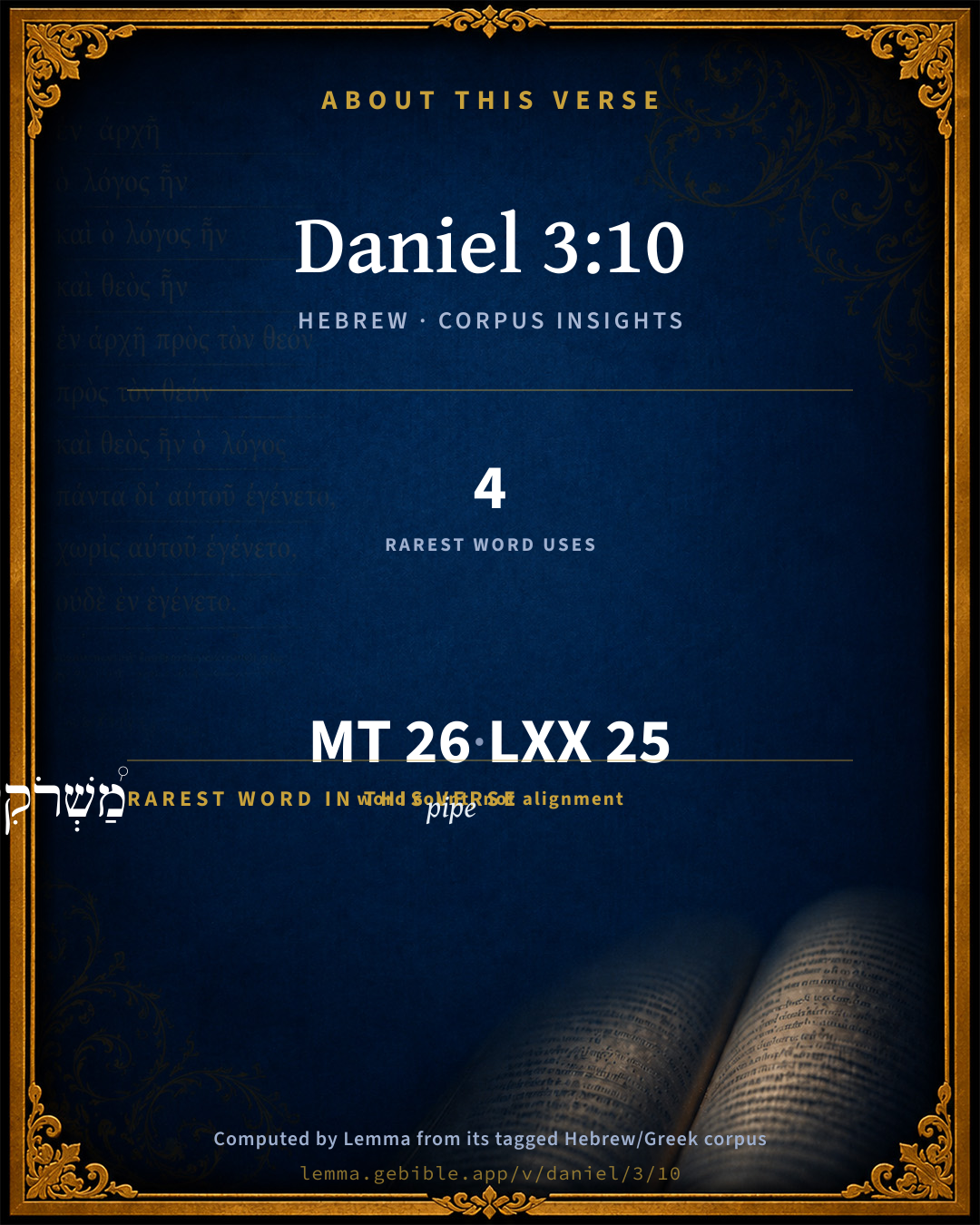
The rarest word here is מַ֠שְׁרֹקִיתָא pipe H4953 — appearing just 4 times in the whole Hebrew Bible.

Shared distinctive vocabulary

מַ֠שְׁרֹקִיתָא pipe H4953 occurs in 4 verses of the Hebrew Bible. Also found in:

Grammatical profile

  • 1 verb
  • 4 nouns
  • 16 adjectives
  • 5 particles

Verb forms

  • וְיִסְגֻּ֖ד Qal · Imperfect

Repetition

Words recur within this verse — often emphatic in Hebrew:

  • כָל all H3606 ×2
  • קיתרס lyre H7030 ×2
  • וסיפניה musical instrument H5481 ×2
  • אנתה you H607 ×2
  • דִּ֣י which H1768 ×2

Hebrew & Septuagint length

In English translation the verse runs 36 words from the Hebrew and 30 from the Septuagint (LXX English) — closely comparable.

A rough comparison of the two English renderings, which tokenize alike — not a word-level alignment.

Word counts can differ between the Hebrew and the Greek without any difference in meaning — e.g. the Hebrew direct-object marker אֵת has no separate Greek word, and Greek often adds the article ὁ.

In the original languages it is 26 Hebrew tokens and 25 Greek tokens — but the two are counted differently (Hebrew bundles its prefixes and suffixes into one token; the Greek is in lemma form), so that isn’t a like-for-like length.

Cross-references

23

Topical passages linked to Daniel 3:10 in the Treasury of Scripture Knowledge — connected by theme and wording, ordered by reader-vote popularity; previews shown in the World English Bible.

  • Esther 3:12–14 Then were the king's scribes called in the first month, on the thirteenth day of it; and there was written according to all that Haman commanded to the king's satraps, and to the governors who were over every province, and to the princes of every people, to every province according to the writing of it, and to every people after their language; in the name of king Ahasuerus was it written, and it was sealed with the king's ring.
  • Daniel 3:4–7 Then the herald cried aloud, To you it is commanded, peoples, nations, and languages,
  • Daniel 6:12 Then they came near, and spoke before the king concerning the king's interdict: Haven't you signed an interdict, that every man who shall make petition to any god or man within thirty days, save to you, O king, shall be cast into the den of lions? The king answered, The thing is true, according to the law of the Medes and Persians, which doesn't alter.
  • Exodus 1:16 and he said, "When you perform the duty of a midwife to the Hebrew women, and see them on the birth stool; if it is a son, then you shall kill him; but if it is a daughter, then she shall live."
  • Exodus 1:22 Pharaoh charged all his people, saying, "You shall cast every son who is born into the river, and every daughter you shall save alive."
  • Exodus 15:20–21 Miriam the prophetess, the sister of Aaron, took a tambourine in her hand; and all the women went out after her with tambourines and with dances.
  • Exodus 32:18–19 He said, "It isn't the voice of those who shout for victory, neither is it the voice of those who cry for being overcome; but the noise of those who sing that I hear."
  • 1 Chronicles 15:16 David spoke to the chief of the Levites to appoint their brothers the singers, with instruments of music, psalteries and harps and cymbals, sounding aloud and lifting up the voice with joy.
  • 1 Chronicles 15:28 Thus all Israel brought up the ark of the covenant of Yahweh with shouting, and with sound of the cornet, and with trumpets, and with cymbals, sounding aloud with psalteries and harps.
  • 1 Chronicles 16:5–6 Asaph the chief, and second to him Zechariah, Jeiel, and Shemiramoth, and Jehiel, and Mattithiah, and Eliab, and Benaiah, and Obed-edom, and Jeiel, with psalteries and with harps; and Asaph with cymbals, sounding aloud;
  • 1 Chronicles 25:1–6 Moreover, David and the captains of the host set apart for the service certain of the sons of Asaph, and of Heman, and of Jeduthun, who should prophesy with harps, with psalteries, and with cymbals: and the number of those who did the work according to their service was:
  • 2 Chronicles 29:25 He set the Levites in the house of Yahweh with cymbals, with psalteries, and with harps, according to the commandment of David, and of Gad the king's seer, and Nathan the prophet; for the commandment was of Yahweh by his prophets.
  • Psalms 81:1–3 Sing aloud to God, our strength! Make a joyful shout to the God of Jacob!
  • Psalms 92:1–3 It is a good thing to give thanks to Yahweh, To sing praises to your name, Most High;
  • Psalms 94:20 Shall the throne of wickedness have fellowship with you, Which brings about mischief by statute?
  • Psalms 149:3–4 Let them praise his name in the dance! Let them sing praises to him with tambourine and harp!
  • Psalms 150:3–6 Praise him with the sounding of the trumpet! Praise him with harp and lyre!
  • Ecclesiastes 3:16 Moreover I saw under the sun, in the place of justice, that wickedness was there; and in the place of righteousness, that wickedness was there.
  • Isaiah 10:1 Woe to those who decree unrighteous decrees, and to the writers who write perverseness;
  • Daniel 3:15 Now if you are ready whenever you hear the sound of the horn, flute, zither, lyre, harp, pipe, and all kinds of music to you fall down and worship the image which I have made, [well]: but if you don't worship, you shall be cast the same hour into the midst of a burning fiery furnace; and who is that god that shall deliver you out of my hands?
  • Amos 6:5 Who strum on the strings of a harp; Who invent for themselves instruments of music, like David;
  • John 11:57 Now the chief priests and the Pharisees had commanded that if anyone knew where he was, he should report it, that they might seize him.
  • Revelation 13:16–17 He causes all, the small and the great, the rich and the poor, and the free and the slave, to be given marks on their right hands, or on their foreheads;

Cross-references courtesy of OpenBible.info (CC BY 4.0).

Hebrew and Greek witnesses Masoretic Hebrew ↔ Greek Septuagint

The same verse in the two great witnesses to the Old Testament, shown verse-for-verse.

These are two independent witnesses, not word-aligned to each other, and the Septuagint is shown in lemma (dictionary) form.

Hebrew Daniel 3:10 Masoretic · Westminster Leningrad Codex

אנתה אַ֣נְתְּ מַלְכָּא֮ שָׂ֣מְתָּ טְּעֵם֒ דִּ֣י כָל אֱנָ֡שׁ דִּֽי יִשְׁמַ֡ע קָ֣ל קַרְנָ֣א מַ֠שְׁרֹקִיתָא קיתרס קַתְר֨וֹס שַׂבְּכָ֤א פְסַנְתֵּרִין֙ וסיפניה וְסוּפֹּ֣נְיָ֔ה וְכֹ֖ל זְנֵ֣י זְמָרָ֑א יִפֵּ֥ל וְיִסְגֻּ֖ד לְצֶ֥לֶם דַּהֲבָֽא

You, O king, have made a decree, that every man that shall hear the sound of the horn, flute, zither, lyre, harp, pipe, and all kinds of music, shall fall down and worship the golden image;

World English Bible · Public Domain

Greek LXX Daniel 3:10 Septuagint · lemma form

σύ βασιλεύς προςτάσσω καί κρίνω ἵνα πᾶς ἄνθρωπος ὅς ἄν ἀκούω ὁ φωνή ὁ σάλπιγξ καί πᾶς ἤχος μουσικός πίπτω προςκυνέω ὁ εἰκών ὁ χρυσοῦς

You, O king, have made a decree that every man who shall hear the sound of the trumpet, and pipe, and harp, sackbut, and lute, and all kinds of music,

LXX2012 (modern English Septuagint) · Public Domain

Hebrew: Westminster Leningrad Codex (CC BY 4.0). Greek: Septuagint (public domain); English from LXX2012 (modern English Septuagint) (Public Domain). How the Septuagint differs from the Hebrew →

Commentary

Notes on Daniel 3:10 from classic Christian and Jewish commentators (each source and its license shown beneath its notes). The classic Christian expositions comment on the surrounding passage and are grouped to its opening verse, so a note may address several verses; the Jewish commentaries on the Tanakh (Rashi and others) are per-verse, so they appear only where the commentator wrote on this verse.

Lemma curates 59 commentaries, every one of them public domain or Creative Commons licensed, each selected and text-cleaned for this edition rather than reprinted as found. About our sources →

Trapp's Complete Commentary

John Trapp

Dan 3:10 Thou, O king, hast made a decree, that every man that shall hear the sound of the cornet, flute, harp, sackbut, psaltery, and dulcimer, and all kinds of musick, shall fall down and worship the golden image:

Ver. 10. Thou, O king, hast made a decree.] Kings’ decrees are much urged by such as are resolved to be of King Harry’s religion, whether he stand for the old mumpsimus {a} or the new sumpsimus. {b}

{a} One who obstinately adheres to old ways, in spite of the clearest evidence that they are wrong; an ignorant and bigoted opponent of reform ŒD

{b} A correct expression taking the place of an incorrect but popular one (mumpsimus). ŒD

John Trapp, A Commentary or Exposition upon All the Books of the Old and New Testament (1647–1656) — public domain. Text from a community e-Sword module.

Ibn Ezra

Rabbi Abraham ibn Ezra

[Daniel 3:10] You (אַנְתְּ - Ant): [Meaning, regarding the phrase "You... gave an order" (שָׂמְתָּ טְּעֵם - samta te'em)]: You made (samta) the announcement of your decree (hoda'at ta'amcha).

Ibn Ezra on the Tanakh — English translations: “Sefaria Community Translation” (CC0 1.0 (public-domain dedication)); “Yalkut, Sifsei Chachomim Chumash, Metsudah Publications, 2009” (CC BY 4.0); and “Commentary of Ibn Ezra on Isaiah - trans. by M. Friedlander, 1873” (public domain). Text via Sefaria.

The Cambridge Bible for Schools and Colleges

gen. ed. J. J. S. Perowne

10. sackbut, psaltery, and dulcimer] trigon, psaltery, and bagpipe.

The Cambridge Bible for Schools and Colleges (gen. ed. J. J. S. Perowne; Cambridge University Press, 1878–1918) — public domain. Text from a community e-Sword module.

John Gill's Exposition

Thou, O king, hast made a decree,.... According to his own mind and will, and which he had published as such to his subjects:

that every man; let him be who he will, high or low, rich or poor, in whatsoever station or condition:

that shall hear the sound of the cornet, flute, harp, sackbut, psaltery, and dulcimer, and all kinds of music; such as had been just then blown or played on:

shall fall down and worship the golden image; which the king had ordered to be made and set up, and now dedicated, and had been worshipped by men of all ranks.

John Gill's Exposition of the Whole Bible (1746–1763) — public domain (CC PDM 1.0). Text via the HelloAO Bible API.

Albert Barnes' Notes on the Bible

Thou, O king, hast made a decree ... - See Dan 3:4-5. As the decree included “every man” who heard the sound of the music, it of course embraced the Jews, whatever religious scruples they might have. Whether their scruples, however, were known at the time is not certain; or whether they would have been regarded if known, is no more certain.

Albert Barnes' Notes on the Bible (1834–1885) — public domain. Text from a community e-Sword/MySword module.

Rashi

Rabbi Shlomo Yitzchaki (Rashi)

gave an order issued a decree.

Rashi on the Tanakh — English translations: “The Judaica Press complete Tanach with Rashi, translated by A. J. Rosenberg” (CC BY 4.0); “Pentateuch with Rashi's commentary by M. Rosenbaum and A.M. Silbermann, 1929-1934” (public domain); “The Metsudah Tanach series, Lakewood, N.J” (CC BY 4.0); and “The Book of Joshua, Metsudah Publications, 1997” (CC BY 4.0). Text via Sefaria.

Lesson kit

Teaching starters — assembled from the data on this page, not authored interpretation. Every prompt links to the verse data it draws on. Edit before teaching.

Daniel, in the Prophets, opens this verse with 26 words (21 distinct Hebrew lemmas). Its most distinctive word is mashrôwqîy (“pipe”). A historical commentator’s framing appears above. Read the whole chapter for the surrounding context.

Discussion questions

  1. How does “pipe” (mashrôwqîy) shape what this verse is saying?
  2. How does Daniel 3:5, which shares the word «pipe», read alongside this verse?
  3. What does the repetition of “all” (2× in this one verse) do in this verse?
  4. These translations render this verse differently. What is at stake in choosing one wording over another?
  5. «וְיִסְגֻּ֖ד» is a Qal Imperfect verb. How does that grammatical form shape the action described?
  6. Compare how Trapp's Complete Commentary and Ibn Ezra read this verse. Where do they agree or differ?

Things to notice

Reading settings

Reading text

Shown beneath each verse's original-language words.

Old Testament
Old Testament edition

Read the OT as the Masoretic Hebrew (MT) or the Greek Septuagint (LXX).

English shown for the Greek Septuagint (in the Hebrew ↔ Greek comparison).

Comparing translations? Open the Compare panel on any verse page to stack up to four side by side.